EP0456610B1 - Un procédé pour la fabrication des pigments - Google Patents
Un procédé pour la fabrication des pigments Download PDFInfo
- Publication number
- EP0456610B1 EP0456610B1 EP91810334A EP91810334A EP0456610B1 EP 0456610 B1 EP0456610 B1 EP 0456610B1 EP 91810334 A EP91810334 A EP 91810334A EP 91810334 A EP91810334 A EP 91810334A EP 0456610 B1 EP0456610 B1 EP 0456610B1
- Authority
- EP
- European Patent Office
- Prior art keywords
- component
- process according
- flakes
- mixture
- pigments
- Prior art date
- Legal status (The legal status is an assumption and is not a legal conclusion. Google has not performed a legal analysis and makes no representation as to the accuracy of the status listed.)
- Expired - Lifetime
Links
Images


Classifications
-
- C—CHEMISTRY; METALLURGY
- C09—DYES; PAINTS; POLISHES; NATURAL RESINS; ADHESIVES; COMPOSITIONS NOT OTHERWISE PROVIDED FOR; APPLICATIONS OF MATERIALS NOT OTHERWISE PROVIDED FOR
- C09D—COATING COMPOSITIONS, e.g. PAINTS, VARNISHES OR LACQUERS; FILLING PASTES; CHEMICAL PAINT OR INK REMOVERS; INKS; CORRECTING FLUIDS; WOODSTAINS; PASTES OR SOLIDS FOR COLOURING OR PRINTING; USE OF MATERIALS THEREFOR
- C09D11/00—Inks
- C09D11/50—Sympathetic, colour changing or similar inks
-
- C—CHEMISTRY; METALLURGY
- C09—DYES; PAINTS; POLISHES; NATURAL RESINS; ADHESIVES; COMPOSITIONS NOT OTHERWISE PROVIDED FOR; APPLICATIONS OF MATERIALS NOT OTHERWISE PROVIDED FOR
- C09C—TREATMENT OF INORGANIC MATERIALS, OTHER THAN FIBROUS FILLERS, TO ENHANCE THEIR PIGMENTING OR FILLING PROPERTIES ; PREPARATION OF CARBON BLACK ; PREPARATION OF INORGANIC MATERIALS WHICH ARE NO SINGLE CHEMICAL COMPOUNDS AND WHICH ARE MAINLY USED AS PIGMENTS OR FILLERS
- C09C3/00—Treatment in general of inorganic materials, other than fibrous fillers, to enhance their pigmenting or filling properties
- C09C3/10—Treatment with macromolecular organic compounds
-
- C—CHEMISTRY; METALLURGY
- C09—DYES; PAINTS; POLISHES; NATURAL RESINS; ADHESIVES; COMPOSITIONS NOT OTHERWISE PROVIDED FOR; APPLICATIONS OF MATERIALS NOT OTHERWISE PROVIDED FOR
- C09B—ORGANIC DYES OR CLOSELY-RELATED COMPOUNDS FOR PRODUCING DYES, e.g. PIGMENTS; MORDANTS; LAKES
- C09B67/00—Influencing the physical, e.g. the dyeing or printing properties of dyestuffs without chemical reactions, e.g. by treating with solvents grinding or grinding assistants, coating of pigments or dyes; Process features in the making of dyestuff preparations; Dyestuff preparations of a special physical nature, e.g. tablets, films
- C09B67/006—Preparation of organic pigments
- C09B67/0061—Preparation of organic pigments by grinding a dyed resin
Definitions
- the present invention relates to pigments, and more particularly to fluorescent pigments, and to a process and a device for their manufacture.
- the intensity of the emitted fluorescent light is extremely sensitive to so-called fluorescence extinction phenomena and that it is a function especially of the concentration of the fluorescent substance itself (autoextinction phenomenon) and of the possible presence of other substances known as fluorescence inhibitors (which act, for example, by reabsorbing the emitted light or by nonradiative quantum deexcitation processes).
- colourant molecules In most applications of colourants (for example paper coating, textile printing, plastic coatings) the colourant molecules must be prevented from migrating, diffusing or redissolving in a solvent.
- fluorescence intensity is at a maximum (low autoextinction) in a precise concentration range and, if the other causes of extinction of fluorescence are to be limited, the colourant matter must be protected in an inert but transparent optical medium.
- a rigid polymer matrix in which the colourant molecule is soluble (solid solution) or dispersible meets these requirements of isolation, confinement and immobilisation.
- These coloured polymers are employed in most cases in the form of finely ground particles, generally referred to as pigments.
- the polymers employed for manufacturing fluorescent pigments belong to the classes of thermoplastic and thermosetting resins. Among those most commonly employed are aminoplastic resins resulting from the polycondensation of triazines, amines and formaldehyde. Other polymers, such as polyesters, polyamides and polyurethanes and polyvinyl chlorides can also form the carrier for colourant molecules. Depending on the degree of crosslinking obtained during the polymerisation, these resins are either thermoset or thermoplastic. Thermoset resins are employed in cases where good resistance to solvents and to plasticisers is required (absence of swelling and of colourant diffusion) and when softening under the effect of heat could create problems. In most cases these pigments consist of a solid solution of colourants in a melamine-formaldehyde-sulfonamide resin.
- thermoset resins In known processes for the manufacture of these thermoset resins the above mixture is polycondensed in bulk, in noncontinuous batches. Such processes are described e.g. in US 3,939,093, in GB 1,341,602 or in US 3,812,051. On average the reaction takes 2 hours, per batch, in the reactor. After complete polymerisation a hard, tough solid is obtained, whose texture often resembles that of horn. This solid must be taken out of the polymerisation reactor as a block. This can prove difficult and it is often preferred to complete the reaction by casting the reacting mass, which is still pasty, into troughs and finishing the polymerisation in an oven. The blocks are then crushed and then micronised.
- the objective of the present invention is to manufacture pigments comprising a coloured composition incorporated in a resin which isolates, confines and immobilises the coloured composition, which pigments withstand the action of heat or of solvents, while avoiding the disadvantages of the processes of the prior art and especially the crushing and the difficulties of micronisation.
- a particularly preferred substance A is para-toluenesulfonamide, ortho-Toluenesulfonamide, or mixtures of aromatic sulfonamides, such as mixtures of ortho- and para-toluene-sulfonamide (e.g. a 50:50 mixture of these components), can also be employed and are available on the market.
- C1-C4alkyl-benzenesulfonamides, e.g. are also available commercially.
- urea (NH2CONH2), thiourea (NH2CSNH2), guanidine (NH2)2CNH, carbamylurea (C2H5N3O2), succinamide (C4H8N2O2), among the noncyclic compounds; among cyclic compounds and more particularly among nitrogenous heterocyclic rings there will be mentioned the molecules containing a plurality of NH2 groups, each of these groups being bonded to a carbon of a heterocyclic ring, the said carbon being linked by a double bond to a nitrogen of the heterocyclic ring; these heterocyclic rings include the triazole, diazine, triazine and pyrimidine nuclei; there will be mentioned in particular the guanamine derivatives of general formula: where R' is hydrogen, an aliphatic radical, an aromatic radical, a saturated or unsaturated cycloaliphatic or alkoxyaryloxy radical.
- Benzoguanamine is hydrogen, an aliphatic radical, an aromatic radical, a saturated or
- thermoset resin is melamine (where R' is NH2).
- Diguanamines and triguanamines (whose synthesis from the corresponding nitriles and from dicyanodiamide is known, furthermore), or mixtures of the above substances can also be employed as component B according to the present invention, as well as the particular triazine compounds described in the US 3,838,063.
- a certain amount of the component B according to the invention may be replaced by an isocyanuric ring containing compound, such as isocyanuric acid or its alkyl or aryl esters, respectively; pigment compositions comprising such resins are disclosed in US 3,620,993.
- aldehyde or the mixture of aldehydes forming the component C according to the present invention are formaldehyde, acetaldehyde, propionaldehyde (higher aldehydes can be employed but do not offer any particular advantage within the meaning of the present invention).
- a particularly preferred compound is paraformaldehyde (CH2O) n , because of its ease of use.
- the pigments according to the invention comprise preferably at least one substance which is fluorescent in daylight, the preferred concentration of said substance being between 1 % and 5 % by weight of the pigments.
- Colourants capable of forming a solid solution in a resin and capable of fluorescing in daylight are furthermore known and are, in general, listed in the Colour Index.
- Rhodamines, coumarines, xanthenes and naphthalimides will be mentioned by way of example, no limitation being implied.
- Examples of appropriate colourants are also compounds described in GB 1,341,602, US 3,939,093 and US 3,812,051.
- the present invention is particularly adapted to the manufacture of daylight fluorescent pigments, that is to say pigments whose coloured composition comprises one or more substances which are fluorescent in daylight and/or optionally one or more common coloured substances.
- daylight fluorescent pigments that is to say pigments whose coloured composition comprises one or more substances which are fluorescent in daylight and/or optionally one or more common coloured substances.
- it is not limited to pigments of this type: by including in a resin according to the invention a compound which does not absorb in the visible but which fluoresces when it is excited by UV radiation, "transparent" pigments are obtained, which can be employed for particular applications such as invisible inks.
- the pigments of the invention are suitable for a wide variety of applications, such as paper coating, textile printing, preparation of paints, plastisols, pastes, inks, markers or cosmetics.
- the present invention also makes it possible to manufacture common, nonfluorescent coloured pigments.
- the concentration of the fluorescent substances in the mixture which is to be polymerised and crosslinked may be adjusted so that the intensity of fluorescence is maximised. After polymerisation and micronisation the local microconcentration of fluorescent substances dissolved in the polymeric matrix remains constant whatever the subsequent overall dilution of the pigment powder, according to its use.
- the melamine concentration which is preferably between approximately 13 % and 40 % by weight, of the weight of sulfonamide component A in the reaction mixture, can be taken to values which are markedly higher than those employed in the processes for the manufacture of thermoplastic resins.
- the concentration of component C in the mixture is preferably between 27 % and 40 % by weight of the sulfonamide.
- thermoset resin A harder and more brittle material is thus obtained, which lends itself better to micronisation and which withstands better the action of heat and of solvents.
- the amine chosen as component B is melamine
- a decrease in the cost of manufacture is also obtained when the proportion of B is increased, given the low cost of this product.
- the decrease in the cost of manufacture of the pigments according to the present invention also results generally from the replacement of processes using noncontinuous batches by a continuous reaction process. Surprisingly, it is therefore possible using this process according to the invention to obtain a thermoset resin.
- IR spectrometry analysis of samples of crosslinked resin obtained according to the present invention shows differences in the absorption bands which are characteristic of these crosslinked structures (see Figures 2 and 3, in particular the 2500-3400 cm ⁇ 1 region), and hence differences in the polymeric structures.
- the continuous polycondensation process is carried out in a particularly convenient and simple manner, wherein the coloured composition, the component A, the component B and the component C are introduced continuously into a reactor, are melted and mixed, the mixture travels forward in the reactor and at the end of reaction the mixture is continuously withdrawn in a pasty state from the said reactor.
- the residence time of the mixture in the reactor is less than 10 min; on average it is 3-4 minutes.
- This process period which is short, when compared with the processes of the prior art (several hours, including stoving) offers the additional advantage of making it possible to include in the resin matrix heat-sensitive coloured substances and compositions (on condition that they withstand being heated to the reaction temperature for a few minutes), which would have been destroyed in the processes of the prior art.
- Another advantage of the process according to the present invention is that it is possible to cast or drop the mixture at the end of reaction onto a conveying device on which it breaks up, cools and forms thermoset flakes, and this makes it possible to do without a stage of crushing a solidified reaction mass.
- the flakes thus formed can be easily detached from the conveying device and are easy to micronise after cooling.
- the flakes are preferably micronised to a particle size of between 0.5 and 20 »m.
- the particularly preferred mean particle size is between 3 and 7 »m.
- a range of shades extending from yellow to orange shades and to red can be produced by mixing e.g. the following colourants, listed in the Colour Index: Solvent yellow 43 Solvent yellow 44 (C. I. No. 56200) Solvent yellow 172 Basic red 1 (rhodamine, C. I. No. 45160) Basic violet 10 (rhodamine, C. I. No. 45170) Basic blue 7 (C. I. No. 42595) Pigment green 7 (C. I. No. 74260).
- Pinks and mauves can be produced from rhodamine mixtures; in the case of mauve, the latter may be obtained e.g. by tinting basic violet 10 with basic blue (in small quantity, to minimise the fluorescence extinction). Green shades can be obtained with the aid of e.g. pigment green 7 and of yellow colourants.
- a fluorescent whitening agent may be added.
- Example 2 Manufacture of coloured flakes
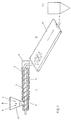
- a mixture comprising, by weight, 57 % of para-toluenesulfonamide, 25 % of paraformaldehyde and 15 % of melamine (filled with 3 %, relative to the total mixture, of yellow 43 colourant) is introduced (overall flow rate 30 kg/hour) via the feed hopper (2) of an extruder (1) of coaxial type.
- the internal temperature of the compression zone (3) and of the extrusion zone (4) of the extruder are maintained at 175°C (heater elements 7).
- the components of the reaction mixture are mixed with the aid of an extrusion screw (5) with a cylindrical core, which propels them through the compression zone.
- the average residence time, from the feed hopper to the extrusion head, is 2′ 30 ⁇ .
- An extrusion head (6) for solid beam profiles can be employed.
- the extruded pasty lace falls, breaking up, onto a conveyor (11) with a water-cooled endless belt (12).
- the resin forms flakes on the belt and has
- the flakes recovered at the end of the belt are fed into a mill (111) of the air jet microniser type.
- the operating conditions are: dry air at 7 bars, room temperature, 25 kg/hour flow rate.
- Example 4 According to the process of example 2, a fluorescent pink pigment is prepared from a mixture having 70 % by weight of para-toluene sulfonamide, 18 % by weight of paraformaldehyde, 9 % by weight of melamine (dyed by 1.5 % by weight of basic red 1 and 1.5 % by weight of basic violet 10, the amount of colourant being relative to the total mixture).
- a fluorescent pigment composition is prepared to be used for coating paper comprising: 25 parts of pink fluorescent pigment 25 parts of Carbital 95® 25 parts of latex BASF SD 215® 25 parts of of water A fluorescent pink coated paper is obtained.
- Example 5 A fluorescent pink pigment composition called masterbatch (cylindrical granulate forms - length: 5 mm-diameter: 2 mm) is obtained by including 35 g of pink fluorescent pigment of example 4 in 65 g of a polyvinyle chloride mixture composed of 55 % of polyvinyle chloride, 31 % of dioctyl phthalate and 2 % of an organo-tin stabilizer, and passing said mixture through an extruder at 125°C. The filaments obtained are cooled at room temperature and passed through a grind-mill.
- masterbatch cylindrical granulate forms - length: 5 mm-diameter: 2 mm
Landscapes
- Chemical & Material Sciences (AREA)
- Organic Chemistry (AREA)
- Life Sciences & Earth Sciences (AREA)
- Engineering & Computer Science (AREA)
- Materials Engineering (AREA)
- Wood Science & Technology (AREA)
- Chemical Kinetics & Catalysis (AREA)
- Compositions Of Macromolecular Compounds (AREA)
- Processes Of Treating Macromolecular Substances (AREA)
- Phenolic Resins Or Amino Resins (AREA)
- Inks, Pencil-Leads, Or Crayons (AREA)
- Paints Or Removers (AREA)
Claims (10)
- Procédé de préparation de pigments, comprenant une composition colorée incorporée à une résine thermodurcie réticulée par une polycondensation continue en vrac du mélange réactionnel, dans lequel(a) la composition colorée,(b) au moins un composant A choisi parmi les sulfonamides aromatiques contenant 2 atomes d'hydrogène liés à l'azote du groupe sulfonamide,(c) au moins un composant B choisi parmi les substances contenant 2 ou plusieurs groupes NH₂, chacun desdits groupes NH₂ étant lié à un atome de carbone, ledit atome de carbone étant lié par une double liaison à un =O, =S ou =N-,et(d) au moins un composant aldéhyde C
sont introduits en continu dans une extrudeuse à une température entre 105°C et 190°C, le mélange étant entraîné à travers l'extrudeuse et le mélange étant soutiré en continu de l'extrudeuse à la fin de la réaction et étant déposé en continu sur une courroie transporteuse, brisé en paillettes thermodurcies et refroidies, ladite courroie transporteuse comportant des moyens pour refroidir et des moyens pour détacher lesdites paillettes de ladite courroie. - Procédé selon la revendication 1, dans lequel ladite composition colorée comprend au moins une substance fluorescente à la lumière du jour et dont la concentration est comprise entre 1% et 5% en poids des pigments.
- Procédé selon la revendication 1, dans lequel ladite composition colorée comprend une substance fluorescente par excitation par les rayons ultraviolets mais n'absorbant pas dans le spectre visible.
- Procédé selon la revendication 1, dans lequel la concentration du composant B est comprise entre 13% et 40% en poids du composant A et la concentration du composant C est comprise entre 27% et 40% en poids du composant A.
- Procédé selon la revendication 1, dans lequel lesdites paillettes sont micronisées après refroidissement.
- Procédé selon la revendication 5, dans lequel lesdites paillettes sont micronisées jusqu'à une taille des particules comprise entre 0,5 et 20 »m.
- Procédé selon la revendication 6, dans lequel lesdites paillettes sont micronisées jusqu'à une taille moyenne des particules comprise entre 3 et 7 »m.
- Procédé selon la revendication 1, dans lequel ladite extrudeuse comprend au moins une vis sans fin capable de faire avancer un mélange pâteux.
- Matière plastique, feuille de papier ou textile colorés dans la masse, contenant ou enduits par un pigment préparé selon le procédé de la revendication 1.
- Encre d'imprimerie, teinture, laque, pâte ou plastisol contenant un pigment préparé par le procédé de la revendication 1.
Applications Claiming Priority (2)
| Application Number | Priority Date | Filing Date | Title |
|---|---|---|---|
| FR909005910A FR2661917B1 (fr) | 1990-05-11 | 1990-05-11 | Pigments, procede et dispositif pour les fabriquer. |
| FR9005910 | 1990-05-11 |
Publications (2)
| Publication Number | Publication Date |
|---|---|
| EP0456610A1 EP0456610A1 (fr) | 1991-11-13 |
| EP0456610B1 true EP0456610B1 (fr) | 1995-01-25 |
Family
ID=9396527
Family Applications (1)
| Application Number | Title | Priority Date | Filing Date |
|---|---|---|---|
| EP91810334A Expired - Lifetime EP0456610B1 (fr) | 1990-05-11 | 1991-04-30 | Un procédé pour la fabrication des pigments |
Country Status (5)
| Country | Link |
|---|---|
| EP (1) | EP0456610B1 (fr) |
| JP (1) | JPH04227750A (fr) |
| KR (1) | KR910020125A (fr) |
| DE (1) | DE69106932T2 (fr) |
| FR (1) | FR2661917B1 (fr) |
Families Citing this family (7)
| Publication number | Priority date | Publication date | Assignee | Title |
|---|---|---|---|---|
| US5989453A (en) * | 1990-05-11 | 1999-11-23 | Societe Nouvelle De Chimie Industrielle S.A. | Process for the manufacture of pigments, especially fluorescent pigments |
| US5411802A (en) * | 1993-10-29 | 1995-05-02 | Minnesota Mining And Manufacturing Company | Colorant compositions and processes |
| DE69703331T2 (de) * | 1996-09-12 | 2001-03-15 | Ciba Specialty Chemicals Holding Inc., Basel | Kontinuierliches Verfahren zur Herstellung von Farbstoffzusammensetzungen auf Basis von Acrylat |
| EP0892018A1 (fr) * | 1997-07-10 | 1999-01-20 | Ciba SC Holding AG | Extrusion réactive de pigments latents |
| US6160037A (en) * | 1997-07-10 | 2000-12-12 | Ciba Specialty Chemicals Corporation | Reactive extrusion of latent pigments |
| DE69901365T2 (de) | 1998-03-17 | 2003-01-23 | Ciba Speciality Chemicals Holding Inc., Basel | Kontinuierliches Verfahren zur Herstellung von Farbstoffzusammensetzungen auf Basis von Polymeren |
| TW503255B (en) | 1999-09-27 | 2002-09-21 | Ciba Sc Holding Ag | Electroluminescent devices comprising diketopyrrolopyrroles |
Family Cites Families (5)
| Publication number | Priority date | Publication date | Assignee | Title |
|---|---|---|---|---|
| GB980583A (en) * | 1961-02-14 | 1965-01-13 | Ind Colours Ltd | Fluorescent, dyed resinous condensation products |
| DE2009749A1 (de) * | 1970-03-03 | 1971-09-23 | Basf Ag | Tageshchtleuchtpigmente |
| DE2017765C3 (de) * | 1970-04-14 | 1979-08-16 | Hoechst Ag, 6000 Frankfurt | Tagesleuchtpigmente, deren Verwendung und Verfahren zu deren Herstellung |
| IT1026778B (it) * | 1973-12-06 | 1978-10-20 | Hoechst Ag | Pigmenti luminescenti alla luce diurna processo per la loro preparazione e loro impiego |
| DE3828793A1 (de) * | 1988-08-25 | 1990-03-01 | Basf Ag | Kontinuierliche herstellung von waessrigen melamin-formaldehyd-vorkondensat-loesungen |
-
1990
- 1990-05-11 FR FR909005910A patent/FR2661917B1/fr not_active Expired - Lifetime
-
1991
- 1991-04-30 EP EP91810334A patent/EP0456610B1/fr not_active Expired - Lifetime
- 1991-04-30 DE DE69106932T patent/DE69106932T2/de not_active Expired - Fee Related
- 1991-05-08 KR KR1019910007424A patent/KR910020125A/ko not_active Ceased
- 1991-05-10 JP JP3105667A patent/JPH04227750A/ja not_active Withdrawn
Also Published As
| Publication number | Publication date |
|---|---|
| JPH04227750A (ja) | 1992-08-17 |
| DE69106932T2 (de) | 1995-06-08 |
| DE69106932D1 (de) | 1995-03-09 |
| FR2661917A1 (fr) | 1991-11-15 |
| KR910020125A (ko) | 1991-12-19 |
| FR2661917B1 (fr) | 1994-10-21 |
| EP0456610A1 (fr) | 1991-11-13 |
Similar Documents
| Publication | Publication Date | Title |
|---|---|---|
| EP0542669B1 (fr) | Procédé pour la manufacture de pigments, spécialement de pigments fluorescents | |
| EP0422474B1 (fr) | Pigments fluorescents | |
| FI74721C (fi) | Markeringsmedel, foerfarande foer deras framstaellning och deras anvaendning vid markering av findispergerade system. | |
| JP4014691B2 (ja) | バナジン酸ビスマス顔料粉末混合物 | |
| CN108291139A (zh) | 安全颜料、发光聚合物树脂及其制造方法 | |
| US5989453A (en) | Process for the manufacture of pigments, especially fluorescent pigments | |
| EP0456610B1 (fr) | Un procédé pour la fabrication des pigments | |
| DE60108399T2 (de) | Die hitzebeständigkeit transparenter pigmente verbesserende dispergierzusammensetzungen | |
| US20090017307A1 (en) | Process for the Preparation of Organic Materials | |
| KR101178502B1 (ko) | 알데히드 또는 케톤 수지를 이용한 유기 및 무기 안료의코팅 | |
| US6734231B2 (en) | Easily distributable pigment compositions | |
| US6423132B2 (en) | Pigment granulation | |
| KR20090033472A (ko) | 알데히드 또는 케톤 수지로 무기 안료를 코팅 | |
| KR20060061341A (ko) | 유기용매 중 고형 안료 조제물 및 이의 분산액, 이의제조방법 및 이의 용도 | |
| EP1606353B1 (fr) | Procede de preparation de pigments fluorescents et non fluorescents | |
| CA1138144A (fr) | Methode de coloration a chaud de polyesters lineaires, a l'aide d'acide perylenetetracarboxylique bis-methylimide | |
| JP2002038044A (ja) | 蛍光着色剤 | |
| MXPA99003115A (en) | Pigment granulation | |
| DE1670423B2 (de) | 2-(1-pyrenyl)-4,6-bis-(2-hydroxy1-naphthyl)-s-triazin und ein verfahren zu dessen herstellung |
Legal Events
| Date | Code | Title | Description |
|---|---|---|---|
| PUAI | Public reference made under article 153(3) epc to a published international application that has entered the european phase |
Free format text: ORIGINAL CODE: 0009012 |
|
| 17P | Request for examination filed |
Effective date: 19910502 |
|
| AK | Designated contracting states |
Kind code of ref document: A1 Designated state(s): BE CH DE GB IT LI NL |
|
| 17Q | First examination report despatched |
Effective date: 19930921 |
|
| GRAA | (expected) grant |
Free format text: ORIGINAL CODE: 0009210 |
|
| AK | Designated contracting states |
Kind code of ref document: B1 Designated state(s): BE CH DE GB IT LI NL |
|
| ITF | It: translation for a ep patent filed | ||
| REF | Corresponds to: |
Ref document number: 69106932 Country of ref document: DE Date of ref document: 19950309 |
|
| PLBE | No opposition filed within time limit |
Free format text: ORIGINAL CODE: 0009261 |
|
| 26N | No opposition filed | ||
| PGFP | Annual fee paid to national office [announced via postgrant information from national office to epo] |
Ref country code: NL Payment date: 19970213 Year of fee payment: 7 |
|
| PGFP | Annual fee paid to national office [announced via postgrant information from national office to epo] |
Ref country code: DE Payment date: 19970220 Year of fee payment: 7 |
|
| PGFP | Annual fee paid to national office [announced via postgrant information from national office to epo] |
Ref country code: GB Payment date: 19970304 Year of fee payment: 7 |
|
| PGFP | Annual fee paid to national office [announced via postgrant information from national office to epo] |
Ref country code: CH Payment date: 19970401 Year of fee payment: 7 |
|
| PGFP | Annual fee paid to national office [announced via postgrant information from national office to epo] |
Ref country code: BE Payment date: 19970606 Year of fee payment: 7 |
|
| PG25 | Lapsed in a contracting state [announced via postgrant information from national office to epo] |
Ref country code: LI Free format text: LAPSE BECAUSE OF NON-PAYMENT OF DUE FEES Effective date: 19980430 Ref country code: GB Free format text: LAPSE BECAUSE OF NON-PAYMENT OF DUE FEES Effective date: 19980430 Ref country code: CH Free format text: LAPSE BECAUSE OF NON-PAYMENT OF DUE FEES Effective date: 19980430 Ref country code: BE Free format text: LAPSE BECAUSE OF NON-PAYMENT OF DUE FEES Effective date: 19980430 |
|
| BERE | Be: lapsed |
Owner name: SOC. NOUVELLE DE CHIMIE INDUSTRIELLE S.A. Effective date: 19980430 |
|
| PG25 | Lapsed in a contracting state [announced via postgrant information from national office to epo] |
Ref country code: NL Free format text: LAPSE BECAUSE OF NON-PAYMENT OF DUE FEES Effective date: 19981101 |
|
| REG | Reference to a national code |
Ref country code: CH Ref legal event code: PL |
|
| GBPC | Gb: european patent ceased through non-payment of renewal fee |
Effective date: 19980430 |
|
| NLV4 | Nl: lapsed or anulled due to non-payment of the annual fee |
Effective date: 19981101 |
|
| PG25 | Lapsed in a contracting state [announced via postgrant information from national office to epo] |
Ref country code: DE Free format text: LAPSE BECAUSE OF NON-PAYMENT OF DUE FEES Effective date: 19990202 |
|
| PG25 | Lapsed in a contracting state [announced via postgrant information from national office to epo] |
Ref country code: IT Free format text: LAPSE BECAUSE OF NON-PAYMENT OF DUE FEES Effective date: 20050430 |