EP0456740B1 - Beschichtungssystem für einen gegenstand - Google Patents
Beschichtungssystem für einen gegenstand Download PDFInfo
- Publication number
- EP0456740B1 EP0456740B1 EP90903090A EP90903090A EP0456740B1 EP 0456740 B1 EP0456740 B1 EP 0456740B1 EP 90903090 A EP90903090 A EP 90903090A EP 90903090 A EP90903090 A EP 90903090A EP 0456740 B1 EP0456740 B1 EP 0456740B1
- Authority
- EP
- European Patent Office
- Prior art keywords
- carrier
- article
- carriers
- particulate material
- recited
- Prior art date
- Legal status (The legal status is an assumption and is not a legal conclusion. Google has not performed a legal analysis and makes no representation as to the accuracy of the status listed.)
- Expired - Lifetime
Links
- 239000011248 coating agent Substances 0.000 title claims abstract description 30
- 238000000576 coating method Methods 0.000 title claims abstract description 30
- 238000004140 cleaning Methods 0.000 claims abstract description 61
- 239000000969 carrier Substances 0.000 claims abstract description 47
- 239000002245 particle Substances 0.000 claims abstract description 47
- 239000007921 spray Substances 0.000 claims abstract description 40
- 239000011236 particulate material Substances 0.000 claims description 33
- 238000000034 method Methods 0.000 claims description 9
- 238000000429 assembly Methods 0.000 claims description 2
- 230000000712 assembly Effects 0.000 claims description 2
- 230000001680 brushing effect Effects 0.000 claims description 2
- 239000012530 fluid Substances 0.000 claims 5
- 238000005507 spraying Methods 0.000 claims 2
- 238000000151 deposition Methods 0.000 abstract description 3
- 230000008021 deposition Effects 0.000 abstract 1
- 239000000463 material Substances 0.000 description 4
- 239000003973 paint Substances 0.000 description 3
- 239000000725 suspension Substances 0.000 description 3
- 239000004677 Nylon Substances 0.000 description 2
- 238000004519 manufacturing process Methods 0.000 description 2
- 229920001778 nylon Polymers 0.000 description 2
- 239000000843 powder Substances 0.000 description 2
- 239000002904 solvent Substances 0.000 description 2
- 239000003795 chemical substances by application Substances 0.000 description 1
- 230000002939 deleterious effect Effects 0.000 description 1
- 230000001419 dependent effect Effects 0.000 description 1
- 238000010586 diagram Methods 0.000 description 1
- 239000004744 fabric Substances 0.000 description 1
- 239000003517 fume Substances 0.000 description 1
- 239000000203 mixture Substances 0.000 description 1
- 239000006223 plastic coating Substances 0.000 description 1
- 239000000088 plastic resin Substances 0.000 description 1
- 238000012958 reprocessing Methods 0.000 description 1
- 239000011347 resin Substances 0.000 description 1
- 229920005989 resin Polymers 0.000 description 1
- 239000007787 solid Substances 0.000 description 1
- 231100000331 toxic Toxicity 0.000 description 1
- 230000002588 toxic effect Effects 0.000 description 1
- 239000011800 void material Substances 0.000 description 1
- 239000002699 waste material Substances 0.000 description 1
Images




Classifications
-
- B—PERFORMING OPERATIONS; TRANSPORTING
- B05—SPRAYING OR ATOMISING IN GENERAL; APPLYING FLUENT MATERIALS TO SURFACES, IN GENERAL
- B05B—SPRAYING APPARATUS; ATOMISING APPARATUS; NOZZLES
- B05B5/00—Electrostatic spraying apparatus; Spraying apparatus with means for charging the spray electrically; Apparatus for spraying liquids or other fluent materials by other electric means
- B05B5/08—Plant for applying liquids or other fluent materials to objects
- B05B5/082—Plant for applying liquids or other fluent materials to objects characterised by means for supporting, holding or conveying the objects
-
- B—PERFORMING OPERATIONS; TRANSPORTING
- B05—SPRAYING OR ATOMISING IN GENERAL; APPLYING FLUENT MATERIALS TO SURFACES, IN GENERAL
- B05B—SPRAYING APPARATUS; ATOMISING APPARATUS; NOZZLES
- B05B16/00—Spray booths
- B05B16/40—Construction elements specially adapted therefor, e.g. floors, walls or ceilings
-
- B—PERFORMING OPERATIONS; TRANSPORTING
- B05—SPRAYING OR ATOMISING IN GENERAL; APPLYING FLUENT MATERIALS TO SURFACES, IN GENERAL
- B05B—SPRAYING APPARATUS; ATOMISING APPARATUS; NOZZLES
- B05B16/00—Spray booths
- B05B16/90—Spray booths comprising conveying means for moving objects or other work to be sprayed in and out of the booth, e.g. through the booth
Definitions
- the present invention relates, generally, to a system for coating articles or workpieces and, specifically, for coating metalic articles using electrostatic attraction.
- the articles to be coated are transported or conveyed through the system by metalic supporting elements such as hooks which hang down from an overhead conveyer.
- the articles to be coated are grounded via the supporting elements.
- the articles are first conveyed through a spray booth where they are coated with ionized particles of an uncured material such as plastic resin.
- the particles are projected in the form of a spray from an electrode unit which charges and ionizes the particles.
- the particles are attracted to the grounded article and, hence, coat the article.
- the articles are then conveyed to a curing oven which fixes the particles to the articles to form a permanent coating on the articles. This process is used extensively in the plastic coating industry.
- the particles are also attracted to the supporting elements so that the supporting elements also become coated. This also means that the particles become fixed to the supporting elements when they are fixed to the article in the curing oven. After a few cycles, the conduction between the articles and the supporting elements ceases to exist. As a result, the quality of the treatment process quickly deteriorates.
- the supporting elements for the articles must be replaced frequently. This results in a substantial loss of production.
- the coated supporting elements are either discarded and replaced by new supporting elements or cleaned. In either case, this represents an added cost to the process.
- the preferred form of cleaning consists of burning the coating from the supporting elements.
- the burning requires consumption of energy and creates toxic fumes which must be contained.
- the equipment for performing both of these tasks and the energy which is consumed therein add considerably to the cost of the coating operation.
- Document US-A-2 553 724 relates to an apparatus for carrying an article as defined in the pre-characterising part of claim 1 below.
- the apparatus provides a support for maintaining an electrical connection with the article.
- a principle object of the invention to provide a system for coating articles by electrostatic attraction in which the particles are removed from the article supporting elements prior to curing of the particles on the article.
- Another object of the invention is the provision of a supporting element for articles to be coated by electrostatic attraction which enables the supporting elements to be cleaned of the particles while maintaining support of the article.
- a further object to the present invention is the provision of a spray booth which limits the amounts of deposit of spray particles on the supporting elements of the articles to be coated.
- Another object of the present invention is to provide a spray booth for depositing particles on articles to be coated which does not require cleaning when the spray is changed to particles having different characteristics such as color, etc.
- Embodiments of the invention may be used in association with a booth having a chamber for receiving a spray of particulate material, and a cleaning station for removing the particulate material from each carrier in succession by first moving one carrier away from its article supporting position for removal of the particulate material therefrom while the article is supported by the other carrier and repeating the process for the other carrier.
- the article is transported through the chamber of the spray booth by an overhead conveyor, where it is coated with particulate material, and then through a cleaning station, where the particulate material is removed from the carriers.
- the article is finally conveyed to a curing oven wherein the particulate material is subsequently cured so that a permanent coating of material is formed on the article but not on the carriers.
- the spray booth may restrict the area of the carriers which is coated with the particulate material which comprises a removal insert which is removed and replaced by another insert each time that the spray is changed to a particulate material having different characteristics such as color, composition, etc.
- the article coating system of the present invention is generally indicated by the reference numeral 10 and it comprises a spray booth, generally indicated by the reference numeral 12, a cleaning station, generally indicated by the reference numeral 14, and a curing oven, generally indicated by the reference numeral 16.
- the workpieces or articles to be coated are indicated by the letter A which are supported by suspension on hangers, generally indicated by the reference numeral 18, which are, in turn, suspended from an overhead conveyer which is generally indicated by the reference numeral 20.
- the articles to be coated are metalic and have a surface configuration which enables the articles to be supported by suspension on the free end of a projecting element. Such a surface configuration may include an aperture, hook, bracket, or any other structure which enable the article to be suspended.
- the overhead conveyer 20 comprises a plurality of clips 22 which are fixed to a horizontal chain which is driven horizontally within a guide tube 26 above the article coating system by drive means, not shown.
- the tube 26 is Supported in clamps 28 which are mounted on brackets 30 which are, in turn, fixed to supporting posts 32.
- the conveyer 24 extends in a complete loop and the tube 26 is supported by additional supporting posts, not shown.
- Each clip 22 includes a horizontal pin 34.
- Each hanger 18 comprises a connector such as a rod 36 which has a hook 38 at one end for suspension on the pin 34 of one of the clips 22.
- the lower end of the rod 36 is fixed to a clevis 40 which supports a horizontal pin 42 for supporting a carrier assembly, generally indicated by the reference numeral 43.
- the carrier assembly 43 comprises a forward carrier 44 and a rearward carrier 46, each of which is independently pivotally mounted on the pin 42.
- Each of the carriers 44 and 46 comprises a lower hook shaped projecting free end portion 48 and an upper portion 50 which is pivotally mounted on the pin 42.
- Each of the carriers 44 and 46 consist of a flat plate which has a laterally extending flange 54.
- the flanges 54 of the carriers 44 and 46 extend in opposite directions away from the main bodies of the carriers. When the carriers 44 and 46 are in their normal lower suspended position the flanges 54 are on one side of a vertical line which extends through the pivot pin 42, an enlarged section 56 is located on the opposite side of the vertical line from the flanges 54 to act as a counter-weight for the flange 54.
- the carriers 44 and 46 are freely suspended and are balanced to remain in perfect alignment with each other so that their inner flat surfaces abut. This prevents particles from being deposited on the inner flat surfaces of the carriers when they are transported through spray booth.
- Each connector rod 36 has a guide plate 39 affixed thereto to maintain the carriers 44 and 46 within the plane of travel during certain phases of the coating system.
- the spray booth 12 comprises a cylindrical housing 58 which has a cylindrical chamber and a circular front opening.
- the housing 58 contains a removable cylindrical insert 60 which has a cylindrical chamber 61 and a circular front opening 62.
- the insert 60 has a vertical slot 65 which is aligned with a vertical slot 64 in the housing 58 when the insert 60 is located within the housing 58. Slots 64 and 65 allow the articles to be coated and the hangers 18 to pass through the chamber 61 along a path in direction which is transverse to the central longitudinal axis of the chamber.
- the upper portion of each of the slots 64 and 65 is relatively narrow to allow for the passage of the rods 36 while the lower portion of each slot is relatively wide to accommodate the range of articles to be coated.
- Flanges 78 are located on opposite side of the slot 65 at each end of the slot and cooperate with the guide plates 39 to properly align the articles to be coated as they enter and leave the chamber 61.
- Most articles require turning within the chamber 61 in order for the article to be completely coated. This is accomplished by attaching an adapter to the clip 22, referred to in the trade as a spinner, and attaching the hook 38 to the spinner. Rotation of the spinner is controlled by fixed camming pins which cause the article to be rotated in a precise sequence. This mechanism is not shown but well known in the coating art.
- the chamber 61 is divided into a lower flow channel 68 and an upper flow channel 72 by a pair of vertical baffles 66 which are located on opposite sides of the slot 65.
- the upper limit of the lower flow channel 68 is defined by the lower edges 67 of the baffles 66.
- the upper portion of each baffle 66 has a pair of apertures 70 which provide entrance openings to the upper channel 72.
- An exhaust opening 74 is located at the back of the chamber 61 and is operatively connected to an exhaust duct 76.
- a grate 80 is located in front of the exhaust opening 74.
- Exhaust duct 76 is connected to a source of sub-atmospheric pressure which creates an air flow from the front opening 62 to the exhaust opening 74. However, two separate air flows are created within the chamber 61, due to the baffles 66.
- the lower air flow in the flow channel 68 contains the ionized particles to be deposited on articles which are transported through the spray booth.
- the upper air flow in the upper channel 72 is void of particles and helps to maintain the particles in the lower flow channel 68 until they reach the exhaust opening 74.
- the lower edges 67 of the baffles are positioned just above the workpiece to minimize the amount of coating which is deposited on the carriers.
- the particles are deposited by electrode units which charge and ionize the particles and the particles are attracted to the metalic articles A which are grounded though their contact with the metalic hangers 18.
- the hangers 18 are, in turn, grounded through their contact with the conveyer system 20. Any particles which are not deposited on the articles are drawn into the exhaust duct 76 to be subsequently collected and recycled. After the articles A are coated with the ionized particles, they are conveyed from the spray booth 12 to the cleaning station 14.
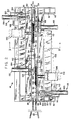
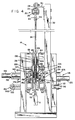
- the cleaning station 14 comprises framework 82 which supports a pair of spaced vertical plates 84 and 85 which define a cleaning zone 86 therebetween.
- a pair of horizontal guide rods 88 are fixed to the plates 84 and 85 and are in alignment with the guide flanges 39 of the connector rods 36 for maintaining the carriers 44 and 46 within the plane of travel through the cleaning zone 86.
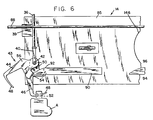
- a front cam 90 having an upper cam surface 92 is fixed to the front cam plate 84.
- An identical rear cam 94 having an upper cam surface 96 is fixed to the rear plate 85.
- each carrier 44 and 46 is cleaned by a two-step process which comprises removing most of the particles by a blast of air, and removing the remaining particles by a rotating brush.
- the first cleaning step is provided by a fan-shaped air nozzle 98 which is fixed to the front plate 84.
- the nozzle 98 is in horizontal alignment with the projecting portion 48 of the carrier 44 when the carrier 44 is in the position shown in FIG. 7.
- a blast of air from the nozzle 98 removes more than 90% of the particles, from the carrier 44.
- An identical air nozzle 100 is fixed to the plate 85.
- the nozzle 100 is in horizontal alignment with the carrier 46 when the carrier is in the position shown in FIG. 9 for removing more than 90% of the particles from the carrier 46.
- the nozzles 98 and 100 are operatively connected to a valve, not shown, which is actuated by an air switch 101 which is mounted on the guide tube 26.
- the valve is operatively connected to a source of pressurized air, not shown.
- the air switch 101 is normally closed and includes a switch arm which is engaged by each clip 22 as the clip passes by the air switch 101 to open the switch.
- the valve which it controls causes the nozzles 90 and 100 to deliver a blast of air into the cleaning zone 86.
- the spacing between the clips 22 is equal to the spacing between the nozzles 98 and 100.
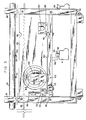
- the second cleaning step for the carriers 44 is provided by a brush assembly which is generally indicated by the reference numeral 102, see particularly FIGS. 2 and 3.
- the brush assembly 102 comprises a circular brush 104 which is mounted for rotation with a shaft 105 which is rotatably driven by a motor driven drive assembly 106.
- the drive assembly 106 is mounted on a horizontal beam 108 which is pivotally mounted on a horizontal portion of the framework 82 by means of a vertical pivot bolt 110. Beam 108 is pivoted about the vertical axis of the bolt 110 from its outer inactive position shown in dotted lines in FIG. 2 to its inner active position shown in full lines in FIG. 2. When the beam 108 is in its outer position, the brush 104 is outside of the cleaning zone 86 as show in dotted lines in FIG. 2.
- the beam 108 When the beam 108 is in its inner position, brush 104 extends through a circular opening 112 in the plate 84 (see FIG. 1) and into the cleaning zone 86 as shown in full lines in FIG. 2.
- the beam 108 is normally maintained in its outer position by a tension spring 114 which is anchored to a bracket 116 which is fixed to the framework 82.
- the beam 108 is moved to its inner position by a pneumatic actuating means, generally indicated by the reference numeral 113.
- the actuating means 118 comprises a pneumatic cylinder 120 which is fixed to the framework 82 by means of a mounting bracket 122.
- the cylinder 120 contains a piston 124 which is driven outwardly from the piston 120 toward the plate 84 when the cylinder 120 is actuated.
- the end of the piston 124 engages a pad 126 of material having a low coefficient of friction and high resistance to impact such as nylon.
- the pad 126 is fixed to the vertical portion of an L-shaped bracket 125 which is mounted on the beam 108. Movement of the piston 124 outwardly from the cylinder 120 causes the beam 108 to move inwardly toward the plate 84 by virtue of its contact with the pad 126.
- the piston 124 is withdrawn into the cylinder by means of an internal spring 121, see FIG.12, and the beam 108 is returned to its outer position by the spring 114.
- the outer position of the beam 108 is determined when the beam 108 strikes a stop bracket 113.
- An elongated opposer member in the form of a cylindrical rod 128 is moved into and out of the cleaning zone 86 in synchronism with the brush 104 from the opposite side of the cleaning zone.
- the opposer rod 128 is fixed to a piston 130 which is driven axially by a pneumatic cylinder 132 from an outer inactive position shown in dotted lines in FIG. 2 to an active inner position shown in full lines in FIG. 2.
- the pneumatic cylinder 132 is mounted on a bracket 134 which is fixed to the plate 85.
- a spring 133 see FIG.12, within the cylinder 132 maintains the piston 130 in its inactive withdrawn state which positions the opposer rod 128 outside of the cleaning zone 86.
- the piston 130 is extended to move the opposer rod 128 through an opening 129 in the plate 85 and into the cleaning zone cell 86 towards the brush 104.
- the cylinders 120 and 132 are actuated simultaneously after the front carrier 44 has been cleaned by the air nozzle 98 and the carrier 34 has advanced to the position shown in FIG. 2.
- brush 104 and the opposer rod 128 move towards each other and engage the lower portion of the carrier 44 therebetween.
- the action of the brush 104 removes the remaining particles from the outer surface of the carrier 44.
- the cylinders 120 and 132 are deactivated, thereby causing the brush 104 and the opposer member 128 return to their outer inactive positions.
- the second or brushing step of the cleaning cycle for the carrier 46 is accomplished by a brush assembly which is generally indicated by the reference numeral 136.
- the brush assembly 136 comprises a circular brush 138 which is mounted for rotation with a shaft 139 which is rotatably driven by a motor-driven drive assembly 140.
- the drive assembly 140 is mounted on a horizontal beam 142 which is pivotally mounted on a horizontal strut on the framework 82 by means of a vertical pivot bolt 144.
- the beam 142 is movable about the vertical axis of the pivot bolt 144 between an outer position shown in dotted lines in FIG. 2 to an inner position shown in full lines in FIG. 2.
- Beam 142 is maintained in its outer position against a stop bracket 148 by means of a tension spring 150 which is fixed to the framework by means of a mounting bracket 152.
- the brush 138 is located outside of the cleaning zone 86.
- the bracket 142 is moved to its inner position, the brush 138 passes through a circular opening 146 in the plate 85, see FIGS. 6-9, and into the cleaning zone 86.
- the beam 142 is moved to its inner position by means of a pneumatic actuator 154 which is generally indicated by the reference numeral 154.
- the pneumatic actuator 154 comprises a pneumatic cylinder 156 and a piston 158 which is movable axially into and out of the cylinder 156.
- the piston 158 is withdrawn within the cylinder 156 by means of an internal spring 157, see FIG. 12.
- the pneumatic cylinder 156 is actuated, the piston 158 is extended towards the plate 85.
- the cylinder 156 is fixed to the framework 82 by means of a mounting bracket 159.
- the piston 158 is extended from the cylinder 156, the end of the piston engages a pad 160 of material having a low coefficient of friction and high resistance to impact such as nylon.
- the pad 160 is fixed to the vertical portion of an L-shaped bracket 161 which is fixed to the beam 142. This causes the beam 142 to move towards the plate 85 and causes the brush 138 to move into the cleaning zone 86 as shown in full lines in FIG. 2.
- An elongated opposer member in the form of a cylindrical rod 162 is located on the opposite side of the cleaning zone 86 and is fixed to a piston 163 which is movable axially within a pneumatic cylinder 165.
- the cylinder 165 is fixed to the plate 84 by means of a mounting bracket 166.
- an internal spring 167 see FIG. 12, maintains the piston 163 withdrawn into the cylinder 165.
- the piston 163 is extended to move the opposer rod 162 through an opening in the plate 84 and into the cleaning zone 86 from its outer inactive position shown in dotted lines in FIG. 2 to its active position shown in full lines.
- the cylinders 156 and 165 are actuated simultaneously so that the opposer rod 162 and the brush 138 move towards each other the carrier 46 is in the position shown in FIG. 2 thereby trapping the lower portion of the carrier 46 therebetween and enabling the brush 138 to remove the remaining particles from the outer surface of the carrier 46 to complete the cleaning operation for the carrier 46.
- the cylinders 140 and 165 are deactivated to return the opposer rod 162 and the brush 138 to their outer inactive positions.
- the cylinders 120, 132, 165, and 155 are operatively connected to a valve 170 which is actuated by a valve or air switch 168 which is mounted on the guide tube 26.
- the valve is operatively connected to a super atmospheric air supply, not shown.
- the air switch 168 is normally closed and includes a switch arm which is engaged by each clip 22 as the clip passes by the air switch 168 to open the switch.
- the air switch 168 is opened, the the cylinders 120, 132, 165, and 156 are operatively connected to the super atmospheric air supply through the valve 170 and actuated simultaneously.
- the spacing between the clips 22 is equal to the spacing between the brush assemblies 102 and 154.
- the valve 170 is connected to the air switch 168 through a pulse generator 172 which causes the cylinders 120, 132, 156, and 165 to be actuated for approximately .4 seconds.
- the air switch 168, the pulse generator 172, and the air valve 170 are all products of Crouzet Control Incorporated of Schaumbury Illinois. Air switch 168 is identified as model no. 81-921701. The pulse generator 172 is identified as model no. 81-507540 and the air valve 170 is identified as model no. C-20151-40.
- the cylinders 120, 132, 156, and 165 are products of Parker Hannifir Corporation of Cleveland Ohio and identified as model no. .75NRSR01.5.
- the carriers 44 and 46 carry the article A out of the cleaning station 14 and into the curing oven 116, wherein the particles which are coated on the article A are cured to form a permanent coating on the article. However, since no particles remain on the carriers 44 and 46, no coating is formed on the carriers and they are ready to be used again without any deleterious effect for carrying another article through the coating system.
- the cleaning zone 86 is preferably, shrouded as much as possible to create a plenum.
- a vacuum system is operably connected to the plenum for evacuating air from the plenum to collect the particles which are removed from the carriers 44 and 46 for subsequent reprocessing.
- the article coating system which is shown and described is specifically adapted for coating articles with electrostatically charged particles in a solid or powder form such as uncured resin particles.
- the carrier assembly and spray booth could also be used for coating an article with electrostatically charged paint particles.
- the carriers have to be cleaned differently than they are for powder particles.
- a spray of paint solvent has to be used instead of a blast of air as the first cleaning step. Thereafter, the paint and solvent are wiped from the carrier by an appropriate wiping agent such as a cloth covered brush.
Landscapes
- Spray Control Apparatus (AREA)
- Electrostatic Spraying Apparatus (AREA)
- Manufacturing Of Electric Cables (AREA)
- Materials For Medical Uses (AREA)
Claims (21)
- Apparat zum Transportieren eines Gegenstandes (A) durch eine Zone zum Aufbringen einer Schicht aus losem Partikulatmaterial auf den Gegenstand zur anschließenden Fixierung des Partikulatmaterials auf dem Gegenstand, wobei der Apparat eine Aufhängevorrichtung (18), die von einer Hängebahn (20) an einem Ende der Aufhängevorrichtung herabhängt, und ein Förderorgan (43) zum Transportieren des Gegenstands (A), das schwenkbar von einem unteren Ende der Aufhängevorrichtung (18) herabhängt, aufweist, gekennzeichnet dadurch, daß das Förderorgan (43) ein Paar Förderelemente (44, 46) aufweist, die nebeneinander angeordnet sind und jeweils einen freien, vorstehenden, unteren Endabschnitt (48), um den Gegenstand (A) tragend mitzunehmen, und einen oberen Abschnitt (50) haben, der schwenkbar am unteren Ende der Aufhängevorrichtung (18) befestigt ist, worin jedes Förderelement zwischen einer unteren, den Gegenstand tragenden Position und einer oberen, nicht-tragenden Position geschwenkt werden kann, wodurch der Gegenstand von einem der Förderelemente in der unteren, tragenden Position getragen werden kann, während das andere Förderelement in der oberen, nicht-tragenden Position frei von dem Gegenstand geschwenkt wird, wodurch der untere Endabschnitt des anderen Förderelementes von Partikulatmaterial gesäubert werden kann, während der Gegenstand durch das eine Förderelement vollständig getragen wird.
- Apparat nach Anspruch 1, bei welchem das Paar Förderelemente mit einem Drehbolzen (42) schwenkbar am unteren Ende der Aufhängevorrichtung befestigt ist, um die Schwenkbewegung um eine horizontale Achse zu ermöglichen, die quer zur Bewegungsrichtung der Hängebahn verläuft.
- Apparat nach Anspruch 1, bei welchem jedes der Förderelemente hakenförmig ist.
- Apparat nach Anspruch 1, bei welchem der freie, vorstehende, untere Endabschnitt (48) der Förderelemente im wesentlichen horizontal und nach oben zu einem freien Ende hin verläuft.
- Apparat nach Anspruch 2, bei welchem jedes der Förderelemente (44, 46) einen im wesentlichen flachen Körperhauptabschnitt hat, der in der Bewegungsebene der Aufhängevorrichtung durch die Zone liegt, jedes der Förderelemente (44, 46) einen Randabschnitt (54) hat, der seitlich vom Körperhauptabschnitt verläuft, um während der Bewegung der Aufhängevorrichtung durch die Zone einen feststehenden Gegenstand mitzunehmen, um das Schwenken des Förderelementes um die horizontale Achse zu bewirken.
- Apparat nach Anspruch 5, bei welchem sich der Rand (54) auf einer Seite der vertikalen Achse befindet, die durch die horizontale Achse verläuft, und bei welchem der Körperhauptabschnitt auf der gegenüberliegenden Seite der vertikalen Achse ein Gegengewicht (56) hat.
- Apparat nach Anspruch 1, 2, 3, 4 oder 5, welcher außerdem(a) einen Verbinder aus Metall aufweist, der zur Bewegung längs der Bewegungsbahn von der Hängebahn herabhängt, und bei welchem auch das Förderorgan aus Metall ist,(b) eine Spritzstation (12) längs der Bewegungsbahn des transportierten Gegenstandes, um einen losen Überzug aus ionisierten Plasteteilchen auf den Gegenstand zu spritzen,(c) eine Reinigungsstation (14) längs der Bewegungsbahn des transportierten Gegenstandes unterhalb der Spritzstation, um die einzelnen Förderelemente (44, 46) nacheinander in deren obere Position zu bewegen und um die Plasteteilchen von wenigstens dem unteren freien Ende (48) jedes der Förderelemente zu entfernen, wenn sich dieses in der oberen Position befindet, und(d) einen Härtungsofen (116) längs der Bewegungsbahn des transportierten Gegenstandes unterhalb der Reinigungsstation, um die Plasteteilchen zu härten und einen permanenten Überzug aus Plaste auf dem Gegenstand (A) zu bilden.
- Apparat nach einem der Ansprüche 1 bis einschließlich 7, bei welchem die Spritzstation eine Spritzkabine (12) mit einer Kammer zur Aufnahme eines Sprühnebels des Partikulatmaterials aufweist.
- Apparat nach Anspruch 8, bei welchem die Spritzkabine folgende Elemente aufweist:(a) ein Gehäuse (58) mit einem horizontalen Spritzkanal, der quer zur Bewegungsbahn der Hängebahn verläuft,(b) eine Hauptöffnung zu diesem Spritzkanal, um einen Spritzmittelstrom aus Partikulatmaterial in den Spritzkanal einzuführen,(c) eine Austrittsöffnung (74), die der Hauptöffnung gegenüberliegt, und(d) einen senkrechten Spalt (64), der im Abstand zu der Öffnung angeordnet ist und der quer zu dem Spritzkanal und parallel zur Bewegungsrichtung der Hängebahn verläuft, wobei der Spalt senkrecht mit der Hängebahn ausgerichtet ist, so daß der Gegenstand (A) durch den Kanal geführt wird.
- Apparat nach Anspruch 8, bei welchem nur der Gegenstand (A) und die freien unteren Endabschnitte (48) der Förderelemente in den Spritzkanal hinein reichen.
- Apparat nach Anspruch 8 bis einschließlich 10, welcher außerdem eine Auskleidung (6) aufweist, welche abnehmbar in dem Gehäuse (58) angebracht ist und welche den Spritzkanal definiert, wobei diese Auskleidung eine Öffnung (62), die in Abmessungen und Anordnung mit der Hauptöffnung des Gehäuses übereinstimmt, und einen senkrechten Spalt (65) hat, der in Abmessungen und Anordnung mit dem senkrechten Spalt (64) des Gehäuses übereinstimmt, wenn die Auskleidung innerhalb des Gehäuses angebracht ist.
- Apparat nach Anspruch 1 bis einschließlich 11, bei welchem jedes der Förderelemente (44, 46) einen Körperhauptabschnitt, der schwenkbar an dem Verbinder zur Bewegung um eine horizontale Achse befestigt ist, und einen Randabschnitt hat, der von dem Körperhauptabschnitt ausgeht, und bei welchem die Reinigungsstation folgende Elemente aufweist:(a) ein Gehäuse mit einer Kammereinlaßöffnung zu der Kammer und einer Austrittsöffnung aus der Kammer,(b) einen ersten Vorsprung (90), der an dem Gehäuse befestigt ist, um in den Randabschnitt (54) eines der Förderelemente (44) des Förderorgans einzugreifen und das eine Förderelement über eine erste festgelegte Bewegungsstrecke durch die Reinigungsstation in dessen obere Position zu bewegen,(c) eine erste Reinigungsgruppe, um Partikulatmaterial von dem einen Förderelement zu entfernen, wenn sich das eine Förderelement in seiner oberen Position befindet, wobei das eine Fördermittel nach der ersten festgelegten Bewegungsstrecke in seine untere Position zurückkehrt,(d) einen zweiten Vorsprung, der an dem Gehäuse befestigt ist, um in den Randabschnitt des anderen Förderelementes (46) des Förderorgans einzugreifen und das andere Förderelement über eine zweite festgelegte Bewegungsstrecke durch die Reinigungsstation in dessen obere Position zu bewegen, nachdem das erste Förderelement in seine untere Position zurückgekehrt ist, und(e) eine zweite Reinigungsgruppe, um Partikulatmaterial von dem anderen Förderelement (46) zu entfernen, wenn sich das andere Förderelement in seiner oberen Position befindet.
- Apparat nach Anspruch 12, bei welchem jede der ersten und zweiten Reinigungsgruppen folgende Elemente aufweist:(a) eine Luftdüse (98), die an dem Gehäuse befestigt ist, um einen Luftstrom auf das Förderelement (44, 46) zu lenken, wenn sich das Förderelement in seiner oberen Position befindet, um den Hauptteil des Partikulatmaterials von dem Förderelement zu entfernen, und(b) eine Bürstengruppe (102), die an dem Gehäuse angebracht ist, um den Rest des Partikulatmaterials von dem Förderelement (44, 46) zu entfernen, nachdem der Hauptteil des Partikulatmaterials durch die Luftdüse von dem Förderelement entfernt worden ist.
- Apparat nach Anspruch 13, bei welchem die Bürstengruppe folgende Elemente aufweist:(a) eine Bürste (104), die an dem Gehäuse zwischen einer äußeren Position, in welcher sich die Bürste im wesentlichen im Abstand zu dem Förderelement befindet, und einer inneren Position, in welcher sich die Bürste mit dem Förderelement in Kontakt befindet, angebracht ist,(b) ein gegenüberliegendes Element (128), das an dem Gehäuse auf der der Bürste gegenüberliegenden Seite der Kammer zur Bewegung zwischen einer äußeren Position, in welcher sich das gegenüberliegende Element im wesentlichen im Abstand zu dem Förderelement befindet, und einer inneren Position, in welcher sich das gegenüberliegende Element im Kontakt mit dem Förderelement befindet, angebracht ist, und(c) einen Betätigungsmechanismus zur Bewegung der Bürste und des gegenüberliegenden Elementes aufeinander zu und zu den inneren Positionen der Bürste und des gegenüberliegenden Elementes hin, so daß das Förderelement zwischen die Bürste und das gegenüberliegende Element gedrückt wird.
- Apparat nach Anspruch 14, bei welchem die Bürstengruppe außerdem folgende Elemente aufweist:(a) eine Welle (105) mit einer Mittellängsachse, wobei die Bürste zur Rotation um die Achse auf der Welle montiert ist und einen Umfang hat, der kreisförmig um die Achse verläuft, und(b) ein Antriebsmittel, um die Bürste um die Achse zu rotieren.
- Apparat nach Anspruch 14, bei welchem der Betätigungs-mechanismus folgende Elemente aufweist:(a) einen ersten Antrieb, um die Bürste selektiv zwischen deren innerer und äußerer Position zu bewegen,(b) einen zweiten Antrieb, um das gegenüberliegende Element selektiv zwischen dessen innerer und äußerer Position zu bewegen, und(c) Steuerungsmittel für den ersten und zweiten Antrieb, um die Bewegung der Bürste und des gegenüberliegenden Elementes zueinander hin mit der Bewegung des Förderorgans durch die Reinigungskammer und dann, wenn sich das entsprechende Förderelement in seiner oberen Position befindet, zu synchronisieren.
- Apparat nach Anspruch 16, bei welchem das Steuerungsmittel ein Schalter ist, der im Verhältnis zur Hängebahn feststeht, wobei der Schalter operativ mit jedem der ersten und zweiten Antriebe verbunden ist, wobei der Schalter einen ersten Zustand, in welchem der Schalter die Steuerung des ersten und zweiten Antriebs in einer Weise bewirkt, daß die Bürste und das gegenüberliegende Element zu ihren äußeren Positionen bewegt werden, und einen zweiten Zustand hat, in welchem der Schalter die Steuerung des ersten und zweiten Antriebs in einer Weise bewirkt, daß die Bürste und das gegenüberliegende Element zu ihren inneren Positionen bewegt werden, wobei sich der Schalter normalerweise im inneren der Zustände befindet und durch eines der den Gegenstand transportierenden Elemente, das sich mit der Hängebahn bewegt, in den äußeren der Zustände gebracht wird.
- Apparat nach Anspruch 17, bei welchem jeder der ersten und zweiten Antriebe ein Betätigungselement mit pneumatischem Antrieb aufweist und der Schalter ein Fluid-Ventil ist, das operativ mit dem ersten und zweiten Antrieb verbunden ist, und bei welchem das Steuerungsmittel außerdem eine Quelle für ein Druckfluid aufweist, die operativ mit dem Ventil verbunden ist.
- Apparat nach Anspruch 18, bei welchem das Fluid Luft ist und jedes der Betätigungselemente mit pneumatischem Antrieb ein Druckluftzylinder ist.
- Methode zum Aufbringen eines Überzugs aus losem Partikulatmaterial auf einen Gegenstand mit einer Konfiguration, die es ermöglicht, den Gegenstand an dem freien Ende eines vorstehenden Elementes anzuhängen, zur nachfolgenden Fixierung des Partikulatmaterials auf dem Gegenstand, wobei die Methode folgende Schritte aufweist:(a) Anhängen des Gegenstandes an einem Paar von Förderelementen, wobei jedes Förderelement ein vorstehendes Element zum vollständigen Tragen des Gegenstandes hat,(b) Spritzen eines Überzugs aus Partikulatmaterial auf die Förderelemente, während der Gegenstand an den Förderelementen hängt, so daß auch die Abschnitte der Förderelemente, die an den Gegenstand angrenzen, mit dem Partikulatmaterial beschichtet werden,(c) Lösen des einen der Förderelemente von dem Gegenstand, so daß der Gegenstand voll von dem anderen Fördermittel getragen wird,(d) Entfernen des Partikulatmaterials von dem einen Förderelement,(e) erneutes Bringen des einen Förderelementes in die tragende Position an dem Gegenstand, nachdem das Partikulatmaterial von dem einen Förderelement entfernt worden ist,(f) Lösen des anderen der Förderelemente von dem Gegenstand, so daß der Gegenstand voll von dem einen Fördermittel getragen wird,(g) Entfernen des Partikulatmaterials von dem anderen Förderelement,(h) erneutes Bringen des anderen Förderelementes in die tragende Position an dem Gegenstand, nachdem das Partikulatmaterial von dem anderen Förderelement entfernt worden ist,(i) Härten des Partikulatmaterials auf dem Gegenstand, um das Partikulatmaterial auf dem Gegenstand zu fixieren.
- Methode nach Anspruch 20, bei welcher die Entfernung des Partikulatmaterials von jedem der Förderelemente folgende Schritte aufweist:(a) Richten einen Gasstromes auf das Förderelement, nachdem das Förderelement von dem Gegenstand gelöst wurde, um den größten Teil des Partikulatmaterials von dem Förderelement zu entfernen, und(b) Abbürsten des Rests des Partikulatmaterials von dem Förderelement, nachdem der größte Teil des Partikulatmaterials durch den Gasstrom von dem Förderelement entfernt worden ist.
Applications Claiming Priority (3)
| Application Number | Priority Date | Filing Date | Title |
|---|---|---|---|
| US07/305,453 US4953495A (en) | 1989-02-01 | 1989-02-01 | Article coating system |
| US305453 | 1989-02-01 | ||
| PCT/US1990/000643 WO1990008599A2 (en) | 1989-02-01 | 1990-02-01 | Article coating system |
Publications (2)
| Publication Number | Publication Date |
|---|---|
| EP0456740A1 EP0456740A1 (de) | 1991-11-21 |
| EP0456740B1 true EP0456740B1 (de) | 1994-09-21 |
Family
ID=23180857
Family Applications (1)
| Application Number | Title | Priority Date | Filing Date |
|---|---|---|---|
| EP90903090A Expired - Lifetime EP0456740B1 (de) | 1989-02-01 | 1990-02-01 | Beschichtungssystem für einen gegenstand |
Country Status (7)
| Country | Link |
|---|---|
| US (1) | US4953495A (de) |
| EP (1) | EP0456740B1 (de) |
| AT (1) | ATE111776T1 (de) |
| AU (1) | AU633880B2 (de) |
| CA (1) | CA2046323C (de) |
| DE (1) | DE69012798T2 (de) |
| WO (1) | WO1990008599A2 (de) |
Families Citing this family (11)
| Publication number | Priority date | Publication date | Assignee | Title |
|---|---|---|---|---|
| US5233795A (en) * | 1990-02-12 | 1993-08-10 | Robo Clean, Inc. | Paint line cleaning system |
| IT1279360B1 (it) * | 1995-02-17 | 1997-12-09 | Tecnomec Srl | Apparecchiatura per appendere ordinatamente oggetti, in particolare insaccati, su supporti trasferibili |
| US5617800A (en) * | 1995-02-24 | 1997-04-08 | Grass America, Inc. | System for cleaning fixtures utilized in spray painting |
| MY123046A (en) * | 1995-04-13 | 2006-05-31 | Meadwestvaco Packaging Systems | Method and apparatus for loading bottom-loading basket- sytle carrier |
| US6705545B1 (en) | 1998-11-13 | 2004-03-16 | Steelcase Development Corporation | Quick color change powder paint system |
| US6112999A (en) | 1998-11-13 | 2000-09-05 | Steelcase Development Inc. | Powder paint system and control thereof |
| JP3340402B2 (ja) * | 1999-06-07 | 2002-11-05 | 株式会社青山製作所 | 開閉式フック |
| US6695220B2 (en) | 2001-01-11 | 2004-02-24 | Herman Miller, Inc. | Powder spray coating system |
| ITBO20130182A1 (it) * | 2013-04-22 | 2014-10-23 | Cefla Coop | Metodo e apparecchiatura per la applicazione di vernici su manufatti a prevalente estensione piana |
| US9527097B2 (en) * | 2013-11-05 | 2016-12-27 | Torrent Systems Llc | Spray coating system and method |
| CN106151826B (zh) * | 2016-08-04 | 2018-05-22 | 中电科泰雷兹航空电子有限公司 | 一种挂接组件 |
Family Cites Families (12)
| Publication number | Priority date | Publication date | Assignee | Title |
|---|---|---|---|---|
| US603940A (en) * | 1898-05-10 | Hanger for harness | ||
| US253942A (en) * | 1882-02-21 | Eobeet ondeedonk | ||
| US216624A (en) * | 1879-06-17 | Improvement in devices for suspending swings | ||
| US801528A (en) * | 1905-03-30 | 1905-10-10 | Andrew Klay | Well-drilling machine. |
| US874412A (en) * | 1907-06-10 | 1907-12-24 | William H Lewis | Folding pocket coat and hat hook. |
| US1189966A (en) * | 1916-05-12 | 1916-07-04 | Frederick Le Pan | Hog-slaughtering appliance. |
| US2553724A (en) * | 1946-03-16 | 1951-05-22 | Ransburg Electro Coating Corp | Electrostatic coating apparatus |
| US2729191A (en) * | 1950-07-15 | 1956-01-03 | Ransburg Electro Coating Corp | Electrostatic coating apparatus |
| US3091492A (en) * | 1962-01-22 | 1963-05-28 | Joseph K D Young | Self-hooking tail chain |
| FR2212765A5 (en) * | 1973-01-03 | 1974-07-26 | Emballage Ste Gle Pour | Electrostatic resin coating of glass articles - using air curtains to prevent fouling of carrying jig |
| GB1576878A (en) * | 1977-09-14 | 1980-10-15 | Volstatic Holdings Ltd | Installation for electrostatically depositing particles of dielectric coating material |
| US4326744A (en) * | 1979-03-07 | 1982-04-27 | Kennecott Corporation | Work hook device |
-
1989
- 1989-02-01 US US07/305,453 patent/US4953495A/en not_active Expired - Fee Related
-
1990
- 1990-02-01 AU AU50871/90A patent/AU633880B2/en not_active Ceased
- 1990-02-01 CA CA002046323A patent/CA2046323C/en not_active Expired - Fee Related
- 1990-02-01 AT AT90903090T patent/ATE111776T1/de active
- 1990-02-01 EP EP90903090A patent/EP0456740B1/de not_active Expired - Lifetime
- 1990-02-01 DE DE69012798T patent/DE69012798T2/de not_active Expired - Fee Related
- 1990-02-01 WO PCT/US1990/000643 patent/WO1990008599A2/en not_active Ceased
Also Published As
| Publication number | Publication date |
|---|---|
| WO1990008599A2 (en) | 1990-08-09 |
| US4953495A (en) | 1990-09-04 |
| DE69012798D1 (de) | 1994-10-27 |
| DE69012798T2 (de) | 1995-04-13 |
| AU5087190A (en) | 1990-08-24 |
| EP0456740A1 (de) | 1991-11-21 |
| AU633880B2 (en) | 1993-02-11 |
| WO1990008599A3 (en) | 1990-11-29 |
| CA2046323A1 (en) | 1990-08-02 |
| ATE111776T1 (de) | 1994-10-15 |
| CA2046323C (en) | 2000-10-17 |
Similar Documents
| Publication | Publication Date | Title |
|---|---|---|
| EP0456740B1 (de) | Beschichtungssystem für einen gegenstand | |
| US3598626A (en) | Electrostatic method for coating with powder and withdrawing undeposited powder for reuse | |
| US5915621A (en) | Electrostatic powder coating method and apparatus | |
| KR101650866B1 (ko) | 화장품 용기 도장방법 | |
| CN111032232B (zh) | 用于用涂料粉末涂覆工件的粉末涂覆设备 | |
| US5769949A (en) | Automated coating process | |
| KR101650867B1 (ko) | 화장품 용기 도장방법 | |
| US5107789A (en) | Article coating system | |
| US4069974A (en) | Electrostatic powder coating apparatus | |
| US5617800A (en) | System for cleaning fixtures utilized in spray painting | |
| US5382450A (en) | Method for powder spray coating an article using a conveyor having a wiping surface | |
| US5776554A (en) | Electrostatic powder coating system and method | |
| US5264255A (en) | Method of applying a coating of loose particle material to an article | |
| US5000985A (en) | Method of powder coating | |
| WO1999016553A1 (en) | Ejector-augmented overspray reclaim system | |
| US4089295A (en) | Spray coater device | |
| US20030077404A1 (en) | Hangerless magnetic paint conveyor system | |
| US5233795A (en) | Paint line cleaning system | |
| US5133161A (en) | Paint line cleaning system | |
| JPS6028852A (ja) | 塗装装置 | |
| JP2002177826A (ja) | 静電粉体塗装装置 | |
| JPH0985137A (ja) | 静電粉体塗装装置及び静電粉体塗装用吊下治具 | |
| WO2021074805A1 (en) | Powder painting station with automatic cleaning system | |
| JP5420301B2 (ja) | 粉体塗装方法及びその装置 | |
| JP7774362B1 (ja) | 粉体塗装装置 |
Legal Events
| Date | Code | Title | Description |
|---|---|---|---|
| PUAI | Public reference made under article 153(3) epc to a published international application that has entered the european phase |
Free format text: ORIGINAL CODE: 0009012 |
|
| 17P | Request for examination filed |
Effective date: 19910902 |
|
| AK | Designated contracting states |
Kind code of ref document: A1 Designated state(s): AT BE CH DE DK ES FR GB IT LI LU NL SE |
|
| 17Q | First examination report despatched |
Effective date: 19920731 |
|
| GRAA | (expected) grant |
Free format text: ORIGINAL CODE: 0009210 |
|
| AK | Designated contracting states |
Kind code of ref document: B1 Designated state(s): AT BE CH DE DK ES FR GB IT LI LU NL SE |
|
| PG25 | Lapsed in a contracting state [announced via postgrant information from national office to epo] |
Ref country code: IT Free format text: LAPSE BECAUSE OF FAILURE TO SUBMIT A TRANSLATION OF THE DESCRIPTION OR TO PAY THE FEE WITHIN THE PRE;WARNING: LAPSES OF ITALIAN PATENTS WITH EFFECTIVE DATE BEFORE 2007 MAY HAVE OCCURRED AT ANY TIME BEFORE 2007. THE CORRECT EFFECTIVE DATE MAY BE DIFFERENT FROM THE ONE RECORDED.SCRIBED TIME-LIMIT Effective date: 19940921 Ref country code: ES Free format text: THE PATENT HAS BEEN ANNULLED BY A DECISION OF A NATIONAL AUTHORITY Effective date: 19940921 Ref country code: NL Effective date: 19940921 Ref country code: DK Effective date: 19940921 Ref country code: BE Effective date: 19940921 Ref country code: AT Effective date: 19940921 |
|
| REF | Corresponds to: |
Ref document number: 111776 Country of ref document: AT Date of ref document: 19941015 Kind code of ref document: T |
|
| REF | Corresponds to: |
Ref document number: 69012798 Country of ref document: DE Date of ref document: 19941027 |
|
| PG25 | Lapsed in a contracting state [announced via postgrant information from national office to epo] |
Ref country code: SE Effective date: 19941221 |
|
| ET | Fr: translation filed | ||
| PG25 | Lapsed in a contracting state [announced via postgrant information from national office to epo] |
Ref country code: LU Free format text: LAPSE BECAUSE OF NON-PAYMENT OF DUE FEES Effective date: 19950228 |
|
| NLV1 | Nl: lapsed or annulled due to failure to fulfill the requirements of art. 29p and 29m of the patents act | ||
| PLBE | No opposition filed within time limit |
Free format text: ORIGINAL CODE: 0009261 |
|
| STAA | Information on the status of an ep patent application or granted ep patent |
Free format text: STATUS: NO OPPOSITION FILED WITHIN TIME LIMIT |
|
| 26N | No opposition filed | ||
| PGFP | Annual fee paid to national office [announced via postgrant information from national office to epo] |
Ref country code: GB Payment date: 20000202 Year of fee payment: 11 |
|
| PGFP | Annual fee paid to national office [announced via postgrant information from national office to epo] |
Ref country code: DE Payment date: 20000207 Year of fee payment: 11 |
|
| PGFP | Annual fee paid to national office [announced via postgrant information from national office to epo] |
Ref country code: FR Payment date: 20000210 Year of fee payment: 11 |
|
| PGFP | Annual fee paid to national office [announced via postgrant information from national office to epo] |
Ref country code: CH Payment date: 20000214 Year of fee payment: 11 |
|
| PG25 | Lapsed in a contracting state [announced via postgrant information from national office to epo] |
Ref country code: GB Free format text: LAPSE BECAUSE OF NON-PAYMENT OF DUE FEES Effective date: 20010201 |
|
| PG25 | Lapsed in a contracting state [announced via postgrant information from national office to epo] |
Ref country code: LI Free format text: LAPSE BECAUSE OF NON-PAYMENT OF DUE FEES Effective date: 20010228 Ref country code: CH Free format text: LAPSE BECAUSE OF NON-PAYMENT OF DUE FEES Effective date: 20010228 |
|
| GBPC | Gb: european patent ceased through non-payment of renewal fee |
Effective date: 20010201 |
|
| REG | Reference to a national code |
Ref country code: CH Ref legal event code: PL |
|
| PG25 | Lapsed in a contracting state [announced via postgrant information from national office to epo] |
Ref country code: FR Free format text: LAPSE BECAUSE OF NON-PAYMENT OF DUE FEES Effective date: 20011031 |
|
| REG | Reference to a national code |
Ref country code: FR Ref legal event code: ST |
|
| PG25 | Lapsed in a contracting state [announced via postgrant information from national office to epo] |
Ref country code: DE Free format text: LAPSE BECAUSE OF NON-PAYMENT OF DUE FEES Effective date: 20011201 |