EP0456790B1 - Konjugate von antikörpern mit variablen domänen - Google Patents
Konjugate von antikörpern mit variablen domänen Download PDFInfo
- Publication number
- EP0456790B1 EP0456790B1 EP90917572A EP90917572A EP0456790B1 EP 0456790 B1 EP0456790 B1 EP 0456790B1 EP 90917572 A EP90917572 A EP 90917572A EP 90917572 A EP90917572 A EP 90917572A EP 0456790 B1 EP0456790 B1 EP 0456790B1
- Authority
- EP
- European Patent Office
- Prior art keywords
- linking group
- specific binding
- amino acid
- variable domain
- binding reagent
- Prior art date
- Legal status (The legal status is an assumption and is not a legal conclusion. Google has not performed a legal analysis and makes no representation as to the accuracy of the status listed.)
- Expired - Lifetime
Links
Images

Classifications
-
- C—CHEMISTRY; METALLURGY
- C12—BIOCHEMISTRY; BEER; SPIRITS; WINE; VINEGAR; MICROBIOLOGY; ENZYMOLOGY; MUTATION OR GENETIC ENGINEERING
- C12N—MICROORGANISMS OR ENZYMES; COMPOSITIONS THEREOF; PROPAGATING, PRESERVING, OR MAINTAINING MICROORGANISMS; MUTATION OR GENETIC ENGINEERING; CULTURE MEDIA
- C12N9/00—Enzymes; Proenzymes; Compositions thereof; Processes for preparing, activating, inhibiting, separating or purifying enzymes
- C12N9/0004—Oxidoreductases (1.)
- C12N9/0065—Oxidoreductases (1.) acting on hydrogen peroxide as acceptor (1.11)
-
- C—CHEMISTRY; METALLURGY
- C07—ORGANIC CHEMISTRY
- C07K—PEPTIDES
- C07K16/00—Immunoglobulins [IG], e.g. monoclonal or polyclonal antibodies
-
- C—CHEMISTRY; METALLURGY
- C07—ORGANIC CHEMISTRY
- C07K—PEPTIDES
- C07K16/00—Immunoglobulins [IG], e.g. monoclonal or polyclonal antibodies
- C07K16/40—Immunoglobulins [IG], e.g. monoclonal or polyclonal antibodies against enzymes
-
- C—CHEMISTRY; METALLURGY
- C07—ORGANIC CHEMISTRY
- C07K—PEPTIDES
- C07K16/00—Immunoglobulins [IG], e.g. monoclonal or polyclonal antibodies
- C07K16/44—Immunoglobulins [IG], e.g. monoclonal or polyclonal antibodies against material not provided for elsewhere, e.g. haptens, metals, DNA, RNA, amino acids
-
- C—CHEMISTRY; METALLURGY
- C12—BIOCHEMISTRY; BEER; SPIRITS; WINE; VINEGAR; MICROBIOLOGY; ENZYMOLOGY; MUTATION OR GENETIC ENGINEERING
- C12N—MICROORGANISMS OR ENZYMES; COMPOSITIONS THEREOF; PROPAGATING, PRESERVING, OR MAINTAINING MICROORGANISMS; MUTATION OR GENETIC ENGINEERING; CULTURE MEDIA
- C12N15/00—Mutation or genetic engineering; DNA or RNA concerning genetic engineering, vectors, e.g. plasmids, or their isolation, preparation or purification; Use of hosts therefor
- C12N15/09—Recombinant DNA-technology
- C12N15/11—DNA or RNA fragments; Modified forms thereof; Non-coding nucleic acids having a biological activity
- C12N15/62—DNA sequences coding for fusion proteins
-
- C—CHEMISTRY; METALLURGY
- C12—BIOCHEMISTRY; BEER; SPIRITS; WINE; VINEGAR; MICROBIOLOGY; ENZYMOLOGY; MUTATION OR GENETIC ENGINEERING
- C12N—MICROORGANISMS OR ENZYMES; COMPOSITIONS THEREOF; PROPAGATING, PRESERVING, OR MAINTAINING MICROORGANISMS; MUTATION OR GENETIC ENGINEERING; CULTURE MEDIA
- C12N9/00—Enzymes; Proenzymes; Compositions thereof; Processes for preparing, activating, inhibiting, separating or purifying enzymes
- C12N9/14—Hydrolases (3)
- C12N9/16—Hydrolases (3) acting on ester bonds (3.1)
-
- G—PHYSICS
- G01—MEASURING; TESTING
- G01N—INVESTIGATING OR ANALYSING MATERIALS BY DETERMINING THEIR CHEMICAL OR PHYSICAL PROPERTIES
- G01N33/00—Investigating or analysing materials by specific methods not covered by groups G01N1/00 - G01N31/00
- G01N33/48—Biological material, e.g. blood, urine; Haemocytometers
- G01N33/50—Chemical analysis of biological material, e.g. blood, urine; Testing involving biospecific ligand binding methods; Immunological testing
- G01N33/53—Immunoassay; Biospecific binding assay; Materials therefor
- G01N33/531—Production of immunochemical test materials
- G01N33/532—Production of labelled immunochemicals
-
- G—PHYSICS
- G01—MEASURING; TESTING
- G01N—INVESTIGATING OR ANALYSING MATERIALS BY DETERMINING THEIR CHEMICAL OR PHYSICAL PROPERTIES
- G01N33/00—Investigating or analysing materials by specific methods not covered by groups G01N1/00 - G01N31/00
- G01N33/48—Biological material, e.g. blood, urine; Haemocytometers
- G01N33/50—Chemical analysis of biological material, e.g. blood, urine; Testing involving biospecific ligand binding methods; Immunological testing
- G01N33/53—Immunoassay; Biospecific binding assay; Materials therefor
- G01N33/543—Immunoassay; Biospecific binding assay; Materials therefor with an insoluble carrier for immobilising immunochemicals
- G01N33/54353—Immunoassay; Biospecific binding assay; Materials therefor with an insoluble carrier for immobilising immunochemicals with ligand attached to the carrier via a chemical coupling agent
-
- G—PHYSICS
- G01—MEASURING; TESTING
- G01N—INVESTIGATING OR ANALYSING MATERIALS BY DETERMINING THEIR CHEMICAL OR PHYSICAL PROPERTIES
- G01N33/00—Investigating or analysing materials by specific methods not covered by groups G01N1/00 - G01N31/00
- G01N33/48—Biological material, e.g. blood, urine; Haemocytometers
- G01N33/50—Chemical analysis of biological material, e.g. blood, urine; Testing involving biospecific ligand binding methods; Immunological testing
- G01N33/68—Chemical analysis of biological material, e.g. blood, urine; Testing involving biospecific ligand binding methods; Immunological testing involving proteins, peptides or amino acids
- G01N33/6854—Immunoglobulins
- G01N33/6857—Antibody fragments
-
- C—CHEMISTRY; METALLURGY
- C07—ORGANIC CHEMISTRY
- C07K—PEPTIDES
- C07K2319/00—Fusion polypeptide
Definitions
- This invention relates to reagents having specific binding properties.
- the invention relates in particular to reagents comprising a specific binding agent linked to a solid surface or linked to a tracer.
- Natural antibodies either polyclonal or monoclonal, have been used widely as specific binding agents. When immobilised on solid phases, such as pegs, dip-sticks, wells and moisture-permeable membranes such as filters and strips, or when linked to various tracers (otherwise known as labels or markers), they can be used in assays.
- Antibodies are large complex multi-chain proteinaceous structures. Although it has been appreciated for some while that substantial portions of these structures seem unrelated to the specific binding properties, the minimum portion necessary to provide adequate specific binding has been a matter of debate. It has already been shown that so-called Fv fragments, ie. an antibody fragment essentially comprising only a single heavy-chain variable region and its corresponding light chain variable region, can exhibit specific binding activity. Very recently it has also been shown by Ward et al (Nature , 1989, Vol. 341, p.544-546) that a single variable domain from an antibody can exhibit significant specific binding activity. The production of single variable domain antibodies (Dabs), as described by Ward et al, is also described in detail in EP 0368684 A1 (Medical Research Council) published on 16 May 1990.
- specific binding activity alone is not sufficient.
- the specific binding agent must also be capable of being linked to other material, for example a label such as an enzyme or a particle, or to a solid phase. This linkage must be achievable without any significant adverse effect on the specific binding activity. Such adverse effects can easily arise through chemical or conformational changes in the specific binding region, or simply by physical (stearic) hindrance of access to the specific binding region.
- a label such as an enzyme or a particle
- solid phase This linkage must be achievable without any significant adverse effect on the specific binding activity. Such adverse effects can easily arise through chemical or conformational changes in the specific binding region, or simply by physical (stearic) hindrance of access to the specific binding region.
- conventional specific binding reagents ie. whole antibody molecules or large portions of such molecules such as Fab fragments, the specific binding region or regions comprise only a minor proportion of the total molecule.
- variable domains unassociated with any substantial portion of the originating antibody or antibodies, eg. a Fv fragment or a single variable domain (Dab)
- Dab single variable domain
- WO 88/09344 discloses multi-functional proteins comprising a binding site and a polypeptide sequence which can function as a site for attachment to an immobilization medium. Hydrophillic polypeptide sequences are recommended.
- WO 88/08981 discloses receptor molecules adsorbed to a hydrophobic surface via a hydrophobized water soluble polymer, such as modified celluloses and starches.
- An objective of the present invention is to facilitate the linking of such small specific binding entities to other useful materials with less risk of damage to their essential specific binding properties.
- the invention provides a specific binding reagent, essentially comprising:
- the "reagent" of the invention may be a water-soluble or water-dispersible material, or may be a solid device such as a bead, peg, dip-stick, or well or other container, having a surface on which the variable domain protein(s) are immobilised by means of the linking group.
- the linking group comprises not more than 20 amino acid residues.
- the linking group includes at least one lysine residue. The presence of a lysine residue provides a very convenient site for covalent attachment to proteinaceous tracers, such as enzymes.
- the polypeptide chain comprising the linking group should contain a sufficient number (which may be as few as two, if the residues are adjacent) or amino acid residues selected from the group consisting of valine, leucine, iso-leucine, phenylalanine, tyrosine, tryptophan, proline and alanine.
- a sufficient number which may be as few as two, if the residues are adjacent
- amino acid residues selected from the group consisting of valine, leucine, iso-leucine, phenylalanine, tyrosine, tryptophan, proline and alanine.
- An important embodiment of the invention is a single variable domain protein (Dab) attached to a proteinaceous 'tail' which acts as the linking group as defined above, the 'tail' being coupled to a solid surface or to a tracer without significant loss of specific binding activity.
- Dab single variable domain protein
- a particularly preferred linking group especially for use in coupling to a solid plastics surface, comprises the "Myc" amino acid sequence:
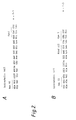
- the linking group will normally be attached at or near one end of a variable domain protein. Normally, the point of attachment will be the amino terminus of the peptide linking group. This is the left hand end of the sequences A and B as seen in Figure 2 of the accompanying drawings.
- the variable domain protein(s) and the linking group have been produced together by expression in a genetically modified organism.
- the polypeptide linking group may, for example, be synthesised (cloned) together with a variable domain protein and comprise a proteinaceous tail on one end of the domain sequence.
- the linking group will comprise at least about 5 amino acid residues, to confer sufficient length to "distance" the variable domain from the surface or tracer to which it is linked.
- the tracer is a protein, such as an enzyme
- it is preferably covalently coupled to the linking group via the e-amino group of a lysine residue in the linking group.
- suitable enzymes are horse raddish peroxidase, alkaline phosphatase, beta-galactosidase, glucose oxidase and urease.
- the surface is a surface of a solid structure formed from plastics material, such as polystyrene, polyvinylchloride (PVC) or polyethylene teraphthalate glycol (PETG).
- plastics material such as polystyrene, polyvinylchloride (PVC) or polyethylene teraphthalate glycol (PETG).
- PVC polyvinylchloride
- PETG polyethylene teraphthalate glycol
- surfaces to which it would be extremely useful to immobilise variable domains are so-called "latex" particles (which are minute solid particles of plastics material such as polystyrene, generally used in aqueous suspension), and the many other structures formed from plastics material such as beads, pegs and wells, commonly used in immunoassays.
- variable domain proteins can be equivalent to natural Fv fragments, ie. a heavy chain variable region with a light chain variable protein, or they can comprise combinations of heavy chain or light chain variable region proteins. Such combinations are normally held together by relatively weak interactions.
- the linking group of the invention can be incorporated at or near one end of one of the variable region protein sequences, but more than one linking group, of the same or differing character, can be incorporated in the combination if desired, eg. region protein or at or near ends of the different variable region proteins.
- the individual variable domain proteins can be expressed separately during cloning. Generally they will combine naturally under mild conditions, which do not inhibit the weak interactions that can cause them to associate.
- a reagent of the invention can be made to exhibit specificity for two distinct materials, by comprising a variable domain unassociated with any other substantial portion of its originating antibody, linked, by means of an intervening linking group, to a second variable domain of different specificity also unassociated with any other substantial portion of its originating antibody.
- particularly suitable combinations of specificities are anti-analyte and anti-enzyme.
- the invention is not concerned in principle with novel ways of producing single domain antibody fragment or novel ways of producing combinations of such fragments with peptide tails.
- the Ward et al paper discloses methods that are adequate for these purposes. Indeed, Ward et al disclose the production of an anti-lyzozyme single domain antibody fragment having a "Myc" tail. This combination could be used in accordance with the present invention, but Ward et al only contemplate the use of the "Myc" tail as an epitope to assist them in their experimental identification and isolation of the anti-lysozyme Dab that they produced. Ward et al make no suggestion that the "Myc" tail might be ideal for immobilising the Dab on a plastics surface. Neither is this concept disclosed in EP 0368684 Al. Also, neither of these documents mentions the advantage of having a lysine residue in such a peptide tail.
- the anti-lysozyme V H fragment D1.3 is excised as a Pst1 - BstEII fragment from the expression vector pSW1-VHD1.3-VKD1.3.
- This vector, and the other expression vector used in this example, pSW1-VHPOLY-TAG1, are fully described by Ward et al (1989).
- pSW1-VHPOLY-TAG1 is restricted with Pstl and BstEII, and the anti-lysozyme Pst1-BstEII V H fragment of D1.3 is ligated into the opened vector.
- This ligation creates an expression vector with the V H D1.3 fragment inserted and is essentially the same as the expression vector pSW1-VHD1.3-TAG1 (Ward et al.) but with the Pstl and BstEII restriction sites incorporated.
- pVHD1.3-TAG1 Ward et al.
- TAG1 by a linking group sequence downstream of the V H gene is done by the technique of site directed mutagenesis with large oligonucleotides as described in Verhoeyen et al., Science (1988), 239 , 1534-1536.
- Single stranded DNA template is prepared from mp19VHD1.3-TAG1. This is the HindIII-EcoRI fragment from pVHD1.3-TAG1, containing V H D1.3 and TAG1, cloned in the HindIII and EcoRI sites of mp19. Single stranded DNA obtained from this clone contains the coding strand of the V H D1.3-TAG1 sequence.
- a DNA oligonucleotide is hybridized to the template to serve as primer to polyerize a second DNA strand. This oligonucleotide contains the required linking group sequence flanked on either side by 12 bases homologous to the site of integration.
- the double stranded molecule is transformed in E.coli , where a certain proportion of the molecules is 'repaired' by incorporation of the activation sequence structure.
- the 12 flanking bases homologous to the site of integration, are the last four codons of V H D1.3 and the two stop codons followed by six bases present in pVHD1.3-TAG1.
- the oligonucleotide replaces the TAG1 gene sequence with that of the linking group gene sequence.
- Convenient restriction sites can be incorporated in the associated oligonucleotide to facilitate manipulation of the DNA sequences.
- Figure 1 of the accompanying drawings shows three oligonucleotide sequences I, II and III useful in the above procedure. Sequences I and II are alternative sequences for producing an identical hydrophylic linking group, and III can be used to produce a hydrophobic linking group.
- Figure 2 shows the cDNA and amino acid sequences of two linking groups A and B.
- Linking group A is hydrophylic, and can be produced using either of oligonucleotides I and II.
- Linking group B is hydrophobic, and can be produced using oligonucleotides III.
- V H domain of a different specificity from V H D1.3 and prepared as a DNA fragment using standard recombinant DNA technology, is cloned in the unique Kpnl restriction site of either pVHD1.3-ADI, pVHD1.3-ADII or pVHD1.3-ADIII.
- the resulting expression vectors now express V H D1.3 linked to a V H domain of different specificity by an amino acid 'bridge' containing a lysine residue to which other materials can be coupled.
- variable domain fragment protein with associated "tail" 100 ⁇ l of variable domain fragment protein with associated "tail" (2.5 - 5.0 mg/ml) is incubated with 100 ⁇ l alkaline phosphatase (10 mg/ml) and 5 ⁇ l glutaraldehyde (5%) at room temperature for 60 mins. Then 5 ml of Tris/ovalbumin buffer (0.05 M Tris, pH 7.5; 5% ovalbumin) is added and the mixture left at +4°C for at least 24 hrs. Then the conjugate mixture is tested, quick-frozen and stored in aliquots at low temperature, eg. -20 to -80°C, until use.
- Tris/ovalbumin buffer 0.05 M Tris, pH 7.5; 5% ovalbumin
- HRP horse radish peroxidase
- Monoclonal antibodies having binding specificities to linkers A and B are prepared for the purposes of detection of the variable domain fragments in the E.coli supernatant, for purification, and for construction of tracer immune complexes.
- monoclonal antibodies can be raised in mice using conventional techniques.
- Example 5 An immunoassay for lysozyme utilising variable domain antibody fragments with peptide tails
- Anti-lysozyme V H fragments were produced as described in Example 1 and Ward et al (1989). samples of fragments were prepared either with or without tails; two types of tail were used, one hydrophilic and the other hydrophobic, with sequences A and B respectively as shown in Figure 2. Two conjugates were made from each of the three types of fragment, one conjugate with biotin and the other with horse radish peroxidase (HRP).
- HRP horse radish peroxidase
- the wells were dosed with a solution of streptavidin/alkaline phosphase conjugate (Sigma) and incubated at 37°C for a further hour.
- the plate was washed 5 times again, and then dosed with Sigma 104 phosphatase substrate in 1M diethanolamine buffer, pH 9.8, at lmg/ml. Colour development was continued for 10 to 15 minutes at ambient temperature before the optical densities were read.
- the wells were immediately dosed with a solution of tetramethylbenzidine (TMB) in phosphate citrate buffer, pH 6.5 and colour development was continued for 10-15 minutes at ambient temperature.
- TMB tetramethylbenzidine
- Each well was dosed with 50 ⁇ l of 2M HCl before the optical densities were determined.
- Anti-lysozyme V H fragments were produced as described in Example 1 and Ward et al (1989), either alone or with a peptide tail.
- the amino acid sequence of this "Myc” peptide is as follows:-
- the mean optical densities produced from each type of sensitisation are shown in Table 1.
- the capture efficiency of solid phases produced by adsorption of fragments with various peptide tails onto the PETG wells is proportional to the measured optical density.
- Table 1 Mean optical density : Tail type Sensitized wells Control wells no tail 0.09 0.05 Myc tail 0.84 0.06 hydrophobic 0.44 0.07 hydrophilic 0.12 0.06
Landscapes
- Health & Medical Sciences (AREA)
- Life Sciences & Earth Sciences (AREA)
- Chemical & Material Sciences (AREA)
- Engineering & Computer Science (AREA)
- Immunology (AREA)
- Molecular Biology (AREA)
- Genetics & Genomics (AREA)
- Organic Chemistry (AREA)
- Biomedical Technology (AREA)
- Biochemistry (AREA)
- General Health & Medical Sciences (AREA)
- Medicinal Chemistry (AREA)
- Biotechnology (AREA)
- Hematology (AREA)
- Urology & Nephrology (AREA)
- Wood Science & Technology (AREA)
- Microbiology (AREA)
- Bioinformatics & Cheminformatics (AREA)
- Zoology (AREA)
- Biophysics (AREA)
- Proteomics, Peptides & Aminoacids (AREA)
- Physics & Mathematics (AREA)
- General Engineering & Computer Science (AREA)
- Analytical Chemistry (AREA)
- Cell Biology (AREA)
- Food Science & Technology (AREA)
- General Physics & Mathematics (AREA)
- Pathology (AREA)
- Plant Pathology (AREA)
- Peptides Or Proteins (AREA)
- Preparation Of Compounds By Using Micro-Organisms (AREA)
- Air Supply (AREA)
- Solid-Fuel Combustion (AREA)
- Weting (AREA)
Claims (13)
- Spezifisches Bindungsreagenz, umfassend:i) eine spezifische Bindungseinheit, die im wesentlichen nur ein oder mehrere Variable-Domäne-Protein(e) umfaßt,ii) eine Bindungsgruppe, die zu den spezifischen Bindungseigenschaften des Reagenzes nicht beiträgt, wobei die Bindungsgruppe mindestens 5 Aminosäurereste umfaßt und hydrophob ist, wobei die Bindungsgruppe wahlweise mindestens einen Lysinrest enthalten kann, wodurch die Kopplungseigenschaften der Bindungsgruppe verstärkt werden, undiii) eine Feststoffoberfläche oder einen Tracer, die/der über die Bindungsgruppe an das/die variable-Domäne-Protein(e) gekoppelt sind.
- Spezifisches Bindungsreagenz nach Anspruch 1, bei dem die Bindungsgruppe nicht mehr als 20 Aminosäurereste umfaßt.
- Spezifisches Bindungsreagenz nach Anspruch 1 oder 2, bei dem die Bindungsgruppe hydrophob ist und mindestens einen Lysinrest beinhaltet.
- Spezifisches Bindungsreagenz nach einem der vorstehenden Ansprüche, das aus einem einzelnen Variable-Domäne-Protein besteht, das an einen Protein-"Schwanz" gebunden ist, der als Bindungsgruppe wirkt, wobei der "Schwanz" ohne wesentlichen Verlust von spezifischer Bindungsaktivität an eine Feststoffoberfläche oder einen Tracer gekoppelt ist.
- Spezifisches Bindungsreagenz nach einem der vorstehenden Ansprüche, bei dem die Bindungsgruppe die Aminosäuresequenz umfaßt:

- Spezifisches Bindungsreagenz nach einem der vorstehenden Ansprüche, wobei das/die Variable-Domäne-Protein(e) und die Bindungsgruppe gemeinsam durch Expression in einem genetisch modifizierten Organismus hergestellt worden sind.
- Spezifisches Bindungsreagenz nach einem der vorstehenden Ansprüche, bei dem die Feststoffoberfläche eine Oberfläche einer aus Kunststoffmaterial gebildeten Feststoffstruktur ist.
- Spezifisches Bindungsreagenz nach einem der Ansprüche 1 bis 6, bei dem die Feststoffoberfläche die Oberfläche eines Latexteilchens ist.
- Spezifisches Bindungsreagenz nach einem der Ansprüche 1 bis 6, bei dem der Tracer ein Protein, z.B. ein Enzym, ist, das über die e-Aminogruppe eines Lysinsrests in der Bindungsgruppe an die Bindungsgruppe gekoppelt ist.
- Spezifisches Bindungsreagenz nach Anspruch 7 oder 8, bei dem die Bindungsgruppe mindestens zwei benachbarte Aminosäurereste enthält, die der Bindungsgruppe Hydrophobie verleihen.
- Verwendung eines 5 bis 20 Aminosäurereste enthaltenden hydrophoben Polypeptids als Bindungsgruppe zur Anknüpfung einer spezifischen Bindungseinheit, welche ein Fv- oder Dab-Antikörperfragment umfaßt, an eine Feststoffoberfäche.
- Verwendung eines 5 bis 20 Aminosäurereste enthaltenden Polypeptids, worin mindestens zwei benachbarte Aminosäurereste dem Polypeptid Hydrophobie verleihen, als eine Bindungsgruppe zur Anknüpfung einer spezifischen Bindungseinheit, die ein Fv- oder Dab-Antikörperfragment umfaßt, an eine Feststoffoberfläche.
- Verwendung nach einem der Ansprüche 11 oder 12, wobei das Polypeptid die Aminosäuresequenz hat:

Applications Claiming Priority (3)
| Application Number | Priority Date | Filing Date | Title |
|---|---|---|---|
| GB898927230A GB8927230D0 (en) | 1989-12-01 | 1989-12-01 | Reagents |
| GB8927230 | 1989-12-01 | ||
| PCT/GB1990/001839 WO1991008482A1 (en) | 1989-12-01 | 1990-11-27 | Antibody variable domain conjugates |
Publications (2)
| Publication Number | Publication Date |
|---|---|
| EP0456790A1 EP0456790A1 (de) | 1991-11-21 |
| EP0456790B1 true EP0456790B1 (de) | 1996-08-14 |
Family
ID=10667290
Family Applications (1)
| Application Number | Title | Priority Date | Filing Date |
|---|---|---|---|
| EP90917572A Expired - Lifetime EP0456790B1 (de) | 1989-12-01 | 1990-11-27 | Konjugate von antikörpern mit variablen domänen |
Country Status (8)
| Country | Link |
|---|---|
| EP (1) | EP0456790B1 (de) |
| JP (1) | JPH0833397B2 (de) |
| AT (1) | ATE141415T1 (de) |
| AU (1) | AU650857B2 (de) |
| DE (1) | DE69028094T2 (de) |
| ES (1) | ES2092514T3 (de) |
| GB (1) | GB8927230D0 (de) |
| WO (1) | WO1991008482A1 (de) |
Families Citing this family (10)
| Publication number | Priority date | Publication date | Assignee | Title |
|---|---|---|---|---|
| GB9021671D0 (en) * | 1990-10-05 | 1990-11-21 | Unilever Plc | Delivery of agents |
| GB9012995D0 (en) * | 1990-06-11 | 1990-08-01 | Celltech Ltd | Multivalent antigen-binding proteins |
| GB9226535D0 (en) * | 1992-12-21 | 1993-02-17 | Unilever Plc | Foodstuffs and other compositions |
| US6838254B1 (en) | 1993-04-29 | 2005-01-04 | Conopco, Inc. | Production of antibodies or (functionalized) fragments thereof derived from heavy chain immunoglobulins of camelidae |
| EP0736770A3 (de) * | 1995-04-05 | 1997-05-02 | Anda Biolog Sa | Immunoreaktives Konjugat, Verfahren zu seiner Herstellung, gegen dieses gerichtete Antikörper und sie enthaltende pharmazeutische Zusammensetzung und diagnostische Vorrichtung |
| CN1316910A (zh) * | 1998-02-19 | 2001-10-10 | 埃克斯西特治疗公司 | 用于调节淋巴细胞活化的组合物及方法 |
| CN1252264C (zh) | 1999-04-22 | 2006-04-19 | 荷兰联合利华有限公司 | 利用单价抗原-结合蛋白抑制病毒感染 |
| WO2001044301A1 (en) * | 1999-11-29 | 2001-06-21 | Unilever Plc | Immobilized single domain antigen-binding molecules |
| EP1242460B1 (de) | 1999-11-29 | 2006-10-18 | Unilever Plc | Immobilisierung von proteinen mit hilfe eines polypeptidsegments |
| DK2330121T3 (en) | 2004-06-02 | 2014-12-15 | Adalta Pty Ltd | Binding moieties based on shark IgNar domains |
Family Cites Families (8)
| Publication number | Priority date | Publication date | Assignee | Title |
|---|---|---|---|---|
| US4769326A (en) * | 1980-02-29 | 1988-09-06 | The Regents Of The University Of California | Expression linkers |
| US4671958A (en) * | 1982-03-09 | 1987-06-09 | Cytogen Corporation | Antibody conjugates for the delivery of compounds to target sites |
| EP0134307B1 (de) * | 1983-07-29 | 1989-04-19 | Henning Berlin GmbH Chemie und Pharmawerk | Voraktivierte Kunststoffoberflächen zur Immobilisierung von organisch-chemischen und biologischen Materialien, Verfahren zur Herstellung und Verwendung derselben |
| DE3640412A1 (de) * | 1986-11-26 | 1988-06-09 | Boehringer Mannheim Gmbh | Verfahren zur bestimmung einer spezifisch bindefaehigen substanz |
| SE8701962D0 (sv) * | 1987-05-13 | 1987-05-13 | Bo Hakan Nygren | Sett att isolera och/eller bestemma halten av ett organiskt emne genom kovalent koppling av en for emnet specifik motreaktant till ytadsorberad, hydrofoberad vattenloslig polymer |
| AU612370B2 (en) * | 1987-05-21 | 1991-07-11 | Micromet Ag | Targeted multifunctional proteins |
| IT1223320B (it) * | 1987-10-23 | 1990-09-19 | Eniricerche Spa | Sensore con membrana immunochimica legata chimicamente a un dispositivo semiconduttore |
| US4952519A (en) * | 1988-05-02 | 1990-08-28 | E. I. Du Pont De Nemours And Company | Protein immobilization with poly(ethyleneimine) derivatized with a hydroprobic group |
-
1989
- 1989-12-01 GB GB898927230A patent/GB8927230D0/en active Pending
-
1990
- 1990-11-27 DE DE69028094T patent/DE69028094T2/de not_active Expired - Fee Related
- 1990-11-27 EP EP90917572A patent/EP0456790B1/de not_active Expired - Lifetime
- 1990-11-27 AU AU68775/91A patent/AU650857B2/en not_active Ceased
- 1990-11-27 JP JP3500229A patent/JPH0833397B2/ja not_active Expired - Lifetime
- 1990-11-27 AT AT90917572T patent/ATE141415T1/de not_active IP Right Cessation
- 1990-11-27 ES ES90917572T patent/ES2092514T3/es not_active Expired - Lifetime
- 1990-11-27 WO PCT/GB1990/001839 patent/WO1991008482A1/en not_active Ceased
Non-Patent Citations (1)
| Title |
|---|
| CHEMICAL ABSTRACTS, vol. 95, no. 25, 21 December 1981, Columbus, OH (US); A.P. GEE et al., p. 389, no. 218667f * |
Also Published As
| Publication number | Publication date |
|---|---|
| ES2092514T3 (es) | 1996-12-01 |
| AU6877591A (en) | 1991-06-26 |
| ATE141415T1 (de) | 1996-08-15 |
| AU650857B2 (en) | 1994-07-07 |
| DE69028094T2 (de) | 1997-02-20 |
| GB8927230D0 (en) | 1990-01-31 |
| DE69028094D1 (de) | 1996-09-19 |
| EP0456790A1 (de) | 1991-11-21 |
| JPH0833397B2 (ja) | 1996-03-29 |
| WO1991008482A1 (en) | 1991-06-13 |
| JPH04504309A (ja) | 1992-07-30 |
Similar Documents
| Publication | Publication Date | Title |
|---|---|---|
| US6274324B1 (en) | Specific binding reagent comprising a variable domain protein linked to a support or tracer | |
| Kefalides et al. | Antibodies to basement membrane collagen and to laminin are present in sera from patients with poststreptococcal glomerulonephritis. | |
| Miller et al. | Antibodies directed against N-terminal residues on actin do not block acto-myosin binding | |
| JP2002508933A (ja) | 二官能分子 | |
| US5643731A (en) | Use of pairs of leucine zipper peptides in immunoassay methods | |
| CN102816234A (zh) | 肽、该肽的用途和生产方法以及固定有该肽的固相和其生产方法 | |
| AU650857B2 (en) | Antibody variable domain conjugates | |
| US5688659A (en) | Streptolysin O peptide antigens and methods for the determination of streptolysin antibodies | |
| US4957859A (en) | Antibodies for transforming ras protein | |
| JPH0368868A (ja) | 蛋白質分析物の酸化的変性 | |
| JPH07508411A (ja) | Cks融合タンパク質の使用方法 | |
| EP0577723A1 (de) | Verfahren zur Herstellung eines von Gruppe B Streptococcen abgeleiteten IgA bindenden Proteins | |
| JP3536731B2 (ja) | HIV−1p24抗原の免疫測定方法及び試薬 | |
| WO1993024630A1 (en) | Reagent for agglutination assays | |
| Xing et al. | Effect of variations in peptide sequence on anti-human milk fat globule membrane antibody reactions | |
| KR960013600B1 (ko) | 면역분석법에 이용되는 시스테인 티올-보호 펩티드 | |
| JP3836429B2 (ja) | 規定した化学量論の結合体 | |
| EP0984065A1 (de) | Modifiziertes, von treponema palladium stammendes proteinantigen. | |
| Van Leuven et al. | Mapping of structure-function relationships in proteins with a panel of monoclonal antibodies: A study on human α2 macroglobulin | |
| CN117304340B (zh) | 一种蛋白标签、含有其的融合蛋白或标记缀合物及其应用 | |
| JP3307637B2 (ja) | 酵素結合抗体免疫吸着アッセイを改善するために変性した伝播体タンパク質 | |
| DE19919121B4 (de) | Multimeres CMV-Antigen | |
| AU684715B2 (en) | Reagent for agglutination assays | |
| Wingen et al. | Characterisation and specificity of glomerular basement membrane antigens identified by sera of patients with anti-GBM nephritis | |
| JP3610736B2 (ja) | Htlv−iiを特異的に認識するモノクローナル抗体及び該モノクローナル抗体を産生するハイブリドーマ |
Legal Events
| Date | Code | Title | Description |
|---|---|---|---|
| PUAI | Public reference made under article 153(3) epc to a published international application that has entered the european phase |
Free format text: ORIGINAL CODE: 0009012 |
|
| 17P | Request for examination filed |
Effective date: 19910725 |
|
| AK | Designated contracting states |
Kind code of ref document: A1 Designated state(s): AT BE CH DE DK ES FR GB GR IT LI NL SE |
|
| RAP3 | Party data changed (applicant data changed or rights of an application transferred) |
Owner name: UNILEVER N.V. Owner name: UNILEVER PLC |
|
| 17Q | First examination report despatched |
Effective date: 19931214 |
|
| GRAH | Despatch of communication of intention to grant a patent |
Free format text: ORIGINAL CODE: EPIDOS IGRA |
|
| GRAH | Despatch of communication of intention to grant a patent |
Free format text: ORIGINAL CODE: EPIDOS IGRA |
|
| GRAA | (expected) grant |
Free format text: ORIGINAL CODE: 0009210 |
|
| AK | Designated contracting states |
Kind code of ref document: B1 Designated state(s): AT BE CH DE DK ES FR GB GR IT LI NL SE |
|
| PG25 | Lapsed in a contracting state [announced via postgrant information from national office to epo] |
Ref country code: AT Effective date: 19960814 Ref country code: BE Effective date: 19960814 Ref country code: GR Free format text: LAPSE BECAUSE OF FAILURE TO SUBMIT A TRANSLATION OF THE DESCRIPTION OR TO PAY THE FEE WITHIN THE PRESCRIBED TIME-LIMIT Effective date: 19960814 Ref country code: DK Effective date: 19960814 |
|
| REF | Corresponds to: |
Ref document number: 141415 Country of ref document: AT Date of ref document: 19960815 Kind code of ref document: T |
|
| REF | Corresponds to: |
Ref document number: 69028094 Country of ref document: DE Date of ref document: 19960919 |
|
| REG | Reference to a national code |
Ref country code: CH Ref legal event code: NV Representative=s name: R. A. EGLI & CO. PATENTANWAELTE |
|
| ITF | It: translation for a ep patent filed | ||
| ET | Fr: translation filed | ||
| REG | Reference to a national code |
Ref country code: ES Ref legal event code: FG2A Ref document number: 2092514 Country of ref document: ES Kind code of ref document: T3 |
|
| PLBE | No opposition filed within time limit |
Free format text: ORIGINAL CODE: 0009261 |
|
| STAA | Information on the status of an ep patent application or granted ep patent |
Free format text: STATUS: NO OPPOSITION FILED WITHIN TIME LIMIT |
|
| 26N | No opposition filed | ||
| REG | Reference to a national code |
Ref country code: GB Ref legal event code: IF02 |
|
| REG | Reference to a national code |
Ref country code: CH Ref legal event code: PUE Owner name: UNILEVER N.V. TRANSFER- INVERNESS MEDICAL SWITZERL |
|
| REG | Reference to a national code |
Ref country code: CH Ref legal event code: PVP |
|
| PGFP | Annual fee paid to national office [announced via postgrant information from national office to epo] |
Ref country code: NL Payment date: 20031016 Year of fee payment: 14 Ref country code: CH Payment date: 20031016 Year of fee payment: 14 |
|
| PGFP | Annual fee paid to national office [announced via postgrant information from national office to epo] |
Ref country code: SE Payment date: 20031022 Year of fee payment: 14 |
|
| PGFP | Annual fee paid to national office [announced via postgrant information from national office to epo] |
Ref country code: ES Payment date: 20031107 Year of fee payment: 14 |
|
| NLS | Nl: assignments of ep-patents |
Owner name: INVERNESS MEDICAL SWITZERLAND GMBH |
|
| PG25 | Lapsed in a contracting state [announced via postgrant information from national office to epo] |
Ref country code: SE Free format text: LAPSE BECAUSE OF NON-PAYMENT OF DUE FEES Effective date: 20041128 |
|
| PG25 | Lapsed in a contracting state [announced via postgrant information from national office to epo] |
Ref country code: ES Free format text: LAPSE BECAUSE OF NON-PAYMENT OF DUE FEES Effective date: 20041129 |
|
| PG25 | Lapsed in a contracting state [announced via postgrant information from national office to epo] |
Ref country code: LI Free format text: LAPSE BECAUSE OF NON-PAYMENT OF DUE FEES Effective date: 20041130 Ref country code: CH Free format text: LAPSE BECAUSE OF NON-PAYMENT OF DUE FEES Effective date: 20041130 |
|
| PG25 | Lapsed in a contracting state [announced via postgrant information from national office to epo] |
Ref country code: NL Free format text: LAPSE BECAUSE OF NON-PAYMENT OF DUE FEES Effective date: 20050601 |
|
| EUG | Se: european patent has lapsed | ||
| REG | Reference to a national code |
Ref country code: CH Ref legal event code: PL |
|
| NLV4 | Nl: lapsed or anulled due to non-payment of the annual fee |
Effective date: 20050601 |
|
| PG25 | Lapsed in a contracting state [announced via postgrant information from national office to epo] |
Ref country code: IT Free format text: LAPSE BECAUSE OF NON-PAYMENT OF DUE FEES;WARNING: LAPSES OF ITALIAN PATENTS WITH EFFECTIVE DATE BEFORE 2007 MAY HAVE OCCURRED AT ANY TIME BEFORE 2007. THE CORRECT EFFECTIVE DATE MAY BE DIFFERENT FROM THE ONE RECORDED. Effective date: 20051127 |
|
| REG | Reference to a national code |
Ref country code: ES Ref legal event code: FD2A Effective date: 20041129 |
|
| REG | Reference to a national code |
Ref country code: GB Ref legal event code: 732E |
|
| PGFP | Annual fee paid to national office [announced via postgrant information from national office to epo] |
Ref country code: DE Payment date: 20081120 Year of fee payment: 19 |
|
| PGFP | Annual fee paid to national office [announced via postgrant information from national office to epo] |
Ref country code: FR Payment date: 20081112 Year of fee payment: 19 |
|
| PGFP | Annual fee paid to national office [announced via postgrant information from national office to epo] |
Ref country code: GB Payment date: 20081126 Year of fee payment: 19 |
|
| REG | Reference to a national code |
Ref country code: FR Ref legal event code: TP |
|
| GBPC | Gb: european patent ceased through non-payment of renewal fee |
Effective date: 20091127 |
|
| REG | Reference to a national code |
Ref country code: FR Ref legal event code: ST Effective date: 20100730 |
|
| PG25 | Lapsed in a contracting state [announced via postgrant information from national office to epo] |
Ref country code: FR Free format text: LAPSE BECAUSE OF NON-PAYMENT OF DUE FEES Effective date: 20091130 |
|
| PG25 | Lapsed in a contracting state [announced via postgrant information from national office to epo] |
Ref country code: DE Free format text: LAPSE BECAUSE OF NON-PAYMENT OF DUE FEES Effective date: 20100601 |
|
| PG25 | Lapsed in a contracting state [announced via postgrant information from national office to epo] |
Ref country code: GB Free format text: LAPSE BECAUSE OF NON-PAYMENT OF DUE FEES Effective date: 20091127 |