EP0457087B1 - Fotografisches Material mit NC-Schicht - Google Patents
Fotografisches Material mit NC-Schicht Download PDFInfo
- Publication number
- EP0457087B1 EP0457087B1 EP91106889A EP91106889A EP0457087B1 EP 0457087 B1 EP0457087 B1 EP 0457087B1 EP 91106889 A EP91106889 A EP 91106889A EP 91106889 A EP91106889 A EP 91106889A EP 0457087 B1 EP0457087 B1 EP 0457087B1
- Authority
- EP
- European Patent Office
- Prior art keywords
- layer
- acid
- gelatine
- gelatin
- recording material
- Prior art date
- Legal status (The legal status is an assumption and is not a legal conclusion. Google has not performed a legal analysis and makes no representation as to the accuracy of the status listed.)
- Expired - Lifetime
Links
- 239000000463 material Substances 0.000 title claims description 18
- 229920000159 gelatin Polymers 0.000 claims description 41
- 235000019322 gelatine Nutrition 0.000 claims description 41
- -1 silver halide Chemical class 0.000 claims description 25
- 150000002009 diols Chemical class 0.000 claims description 13
- 239000000839 emulsion Substances 0.000 claims description 13
- 239000001828 Gelatine Substances 0.000 claims description 12
- 229920000728 polyester Polymers 0.000 claims description 10
- 229920001477 hydrophilic polymer Polymers 0.000 claims description 9
- 125000002947 alkylene group Chemical group 0.000 claims description 6
- 239000004332 silver Substances 0.000 claims description 6
- 229910052709 silver Inorganic materials 0.000 claims description 6
- XLYOFNOQVPJJNP-UHFFFAOYSA-N water Substances O XLYOFNOQVPJJNP-UHFFFAOYSA-N 0.000 claims description 5
- 238000010521 absorption reaction Methods 0.000 claims description 4
- 125000002993 cycloalkylene group Chemical group 0.000 claims description 4
- 125000000732 arylene group Chemical group 0.000 claims description 2
- 239000010410 layer Substances 0.000 description 50
- 108010010803 Gelatin Proteins 0.000 description 29
- 239000008273 gelatin Substances 0.000 description 29
- 235000011852 gelatine desserts Nutrition 0.000 description 29
- 229920000642 polymer Polymers 0.000 description 17
- 239000002253 acid Substances 0.000 description 12
- WNLRTRBMVRJNCN-UHFFFAOYSA-N adipic acid Chemical compound OC(=O)CCCCC(O)=O WNLRTRBMVRJNCN-UHFFFAOYSA-N 0.000 description 9
- LYCAIKOWRPUZTN-UHFFFAOYSA-N Ethylene glycol Chemical compound OCCO LYCAIKOWRPUZTN-UHFFFAOYSA-N 0.000 description 8
- 238000001035 drying Methods 0.000 description 7
- DNIAPMSPPWPWGF-UHFFFAOYSA-N Propylene glycol Chemical compound CC(O)CO DNIAPMSPPWPWGF-UHFFFAOYSA-N 0.000 description 6
- 125000004432 carbon atom Chemical group C* 0.000 description 6
- MTHSVFCYNBDYFN-UHFFFAOYSA-N diethylene glycol Chemical compound OCCOCCO MTHSVFCYNBDYFN-UHFFFAOYSA-N 0.000 description 6
- WERYXYBDKMZEQL-UHFFFAOYSA-N butane-1,4-diol Chemical compound OCCCCO WERYXYBDKMZEQL-UHFFFAOYSA-N 0.000 description 5
- 238000012545 processing Methods 0.000 description 5
- CXMXRPHRNRROMY-UHFFFAOYSA-N sebacic acid Chemical compound OC(=O)CCCCCCCCC(O)=O CXMXRPHRNRROMY-UHFFFAOYSA-N 0.000 description 5
- MUBZPKHOEPUJKR-UHFFFAOYSA-N Oxalic acid Chemical compound OC(=O)C(O)=O MUBZPKHOEPUJKR-UHFFFAOYSA-N 0.000 description 4
- HEMHJVSKTPXQMS-UHFFFAOYSA-M Sodium hydroxide Chemical compound [OH-].[Na+] HEMHJVSKTPXQMS-UHFFFAOYSA-M 0.000 description 4
- 239000001361 adipic acid Substances 0.000 description 4
- 235000011037 adipic acid Nutrition 0.000 description 4
- IISBACLAFKSPIT-UHFFFAOYSA-N bisphenol A Chemical compound C=1C=C(O)C=CC=1C(C)(C)C1=CC=C(O)C=C1 IISBACLAFKSPIT-UHFFFAOYSA-N 0.000 description 4
- 150000001991 dicarboxylic acids Chemical class 0.000 description 4
- OFOBLEOULBTSOW-UHFFFAOYSA-N Malonic acid Chemical compound OC(=O)CC(O)=O OFOBLEOULBTSOW-UHFFFAOYSA-N 0.000 description 3
- 150000001875 compounds Chemical class 0.000 description 3
- GHLKSLMMWAKNBM-UHFFFAOYSA-N dodecane-1,12-diol Chemical compound OCCCCCCCCCCCCO GHLKSLMMWAKNBM-UHFFFAOYSA-N 0.000 description 3
- XXMIOPMDWAUFGU-UHFFFAOYSA-N hexane-1,6-diol Chemical compound OCCCCCCO XXMIOPMDWAUFGU-UHFFFAOYSA-N 0.000 description 3
- SLCVBVWXLSEKPL-UHFFFAOYSA-N neopentyl glycol Chemical compound OCC(C)(C)CO SLCVBVWXLSEKPL-UHFFFAOYSA-N 0.000 description 3
- 229940117969 neopentyl glycol Drugs 0.000 description 3
- XNGIFLGASWRNHJ-UHFFFAOYSA-N phthalic acid Chemical compound OC(=O)C1=CC=CC=C1C(O)=O XNGIFLGASWRNHJ-UHFFFAOYSA-N 0.000 description 3
- HCEPYODGJFPWOI-UHFFFAOYSA-N tridecane-1,13-diol Chemical compound OCCCCCCCCCCCCCO HCEPYODGJFPWOI-UHFFFAOYSA-N 0.000 description 3
- XSMIOONHPKRREI-UHFFFAOYSA-N undecane-1,11-diol Chemical compound OCCCCCCCCCCCO XSMIOONHPKRREI-UHFFFAOYSA-N 0.000 description 3
- 239000000080 wetting agent Substances 0.000 description 3
- PUPZLCDOIYMWBV-UHFFFAOYSA-N (+/-)-1,3-Butanediol Chemical compound CC(O)CCO PUPZLCDOIYMWBV-UHFFFAOYSA-N 0.000 description 2
- ALVZNPYWJMLXKV-UHFFFAOYSA-N 1,9-Nonanediol Chemical compound OCCCCCCCCCO ALVZNPYWJMLXKV-UHFFFAOYSA-N 0.000 description 2
- FYBFGAFWCBMEDG-UHFFFAOYSA-N 1-[3,5-di(prop-2-enoyl)-1,3,5-triazinan-1-yl]prop-2-en-1-one Chemical compound C=CC(=O)N1CN(C(=O)C=C)CN(C(=O)C=C)C1 FYBFGAFWCBMEDG-UHFFFAOYSA-N 0.000 description 2
- LBTDHCQNAQRHCE-UHFFFAOYSA-N 2-[4-(2-hydroxyethoxy)cyclohexyl]oxyethanol Chemical compound OCCOC1CCC(OCCO)CC1 LBTDHCQNAQRHCE-UHFFFAOYSA-N 0.000 description 2
- WTPYFJNYAMXZJG-UHFFFAOYSA-N 2-[4-(2-hydroxyethoxy)phenoxy]ethanol Chemical compound OCCOC1=CC=C(OCCO)C=C1 WTPYFJNYAMXZJG-UHFFFAOYSA-N 0.000 description 2
- 229920002284 Cellulose triacetate Polymers 0.000 description 2
- ALQSHHUCVQOPAS-UHFFFAOYSA-N Pentane-1,5-diol Chemical compound OCCCCCO ALQSHHUCVQOPAS-UHFFFAOYSA-N 0.000 description 2
- UIIMBOGNXHQVGW-UHFFFAOYSA-M Sodium bicarbonate Chemical compound [Na+].OC([O-])=O UIIMBOGNXHQVGW-UHFFFAOYSA-M 0.000 description 2
- KDYFGRWQOYBRFD-UHFFFAOYSA-N Succinic acid Natural products OC(=O)CCC(O)=O KDYFGRWQOYBRFD-UHFFFAOYSA-N 0.000 description 2
- NNLVGZFZQQXQNW-ADJNRHBOSA-N [(2r,3r,4s,5r,6s)-4,5-diacetyloxy-3-[(2s,3r,4s,5r,6r)-3,4,5-triacetyloxy-6-(acetyloxymethyl)oxan-2-yl]oxy-6-[(2r,3r,4s,5r,6s)-4,5,6-triacetyloxy-2-(acetyloxymethyl)oxan-3-yl]oxyoxan-2-yl]methyl acetate Chemical compound O([C@@H]1O[C@@H]([C@H]([C@H](OC(C)=O)[C@H]1OC(C)=O)O[C@H]1[C@@H]([C@@H](OC(C)=O)[C@H](OC(C)=O)[C@@H](COC(C)=O)O1)OC(C)=O)COC(=O)C)[C@@H]1[C@@H](COC(C)=O)O[C@@H](OC(C)=O)[C@H](OC(C)=O)[C@H]1OC(C)=O NNLVGZFZQQXQNW-ADJNRHBOSA-N 0.000 description 2
- 239000012790 adhesive layer Substances 0.000 description 2
- 125000003545 alkoxy group Chemical group 0.000 description 2
- KDYFGRWQOYBRFD-NUQCWPJISA-N butanedioic acid Chemical compound O[14C](=O)CC[14C](O)=O KDYFGRWQOYBRFD-NUQCWPJISA-N 0.000 description 2
- YTIVTFGABIZHHX-UHFFFAOYSA-N butynedioic acid Chemical compound OC(=O)C#CC(O)=O YTIVTFGABIZHHX-UHFFFAOYSA-N 0.000 description 2
- 150000001244 carboxylic acid anhydrides Chemical class 0.000 description 2
- 238000005266 casting Methods 0.000 description 2
- 229920002678 cellulose Polymers 0.000 description 2
- FOTKYAAJKYLFFN-UHFFFAOYSA-N decane-1,10-diol Chemical compound OCCCCCCCCCCO FOTKYAAJKYLFFN-UHFFFAOYSA-N 0.000 description 2
- DOIRQSBPFJWKBE-UHFFFAOYSA-N dibutyl phthalate Chemical compound CCCCOC(=O)C1=CC=CC=C1C(=O)OCCCC DOIRQSBPFJWKBE-UHFFFAOYSA-N 0.000 description 2
- OREAFAJWWJHCOT-UHFFFAOYSA-N dimethylmalonic acid Chemical compound OC(=O)C(C)(C)C(O)=O OREAFAJWWJHCOT-UHFFFAOYSA-N 0.000 description 2
- 150000002148 esters Chemical class 0.000 description 2
- SXCBDZAEHILGLM-UHFFFAOYSA-N heptane-1,7-diol Chemical compound OCCCCCCCO SXCBDZAEHILGLM-UHFFFAOYSA-N 0.000 description 2
- 150000002430 hydrocarbons Chemical group 0.000 description 2
- 150000002596 lactones Chemical class 0.000 description 2
- 238000000034 method Methods 0.000 description 2
- 239000000203 mixture Substances 0.000 description 2
- BDJRBEYXGGNYIS-UHFFFAOYSA-N nonanedioic acid Chemical compound OC(=O)CCCCCCCC(O)=O BDJRBEYXGGNYIS-UHFFFAOYSA-N 0.000 description 2
- OEIJHBUUFURJLI-UHFFFAOYSA-N octane-1,8-diol Chemical compound OCCCCCCCCO OEIJHBUUFURJLI-UHFFFAOYSA-N 0.000 description 2
- 239000002245 particle Substances 0.000 description 2
- 125000000843 phenylene group Chemical group C1(=C(C=CC=C1)*)* 0.000 description 2
- WLJVNTCWHIRURA-UHFFFAOYSA-N pimelic acid Chemical compound OC(=O)CCCCCC(O)=O WLJVNTCWHIRURA-UHFFFAOYSA-N 0.000 description 2
- 239000004014 plasticizer Substances 0.000 description 2
- YPFDHNVEDLHUCE-UHFFFAOYSA-N propane-1,3-diol Chemical compound OCCCO YPFDHNVEDLHUCE-UHFFFAOYSA-N 0.000 description 2
- 235000013772 propylene glycol Nutrition 0.000 description 2
- 235000018102 proteins Nutrition 0.000 description 2
- 108090000623 proteins and genes Proteins 0.000 description 2
- 102000004169 proteins and genes Human genes 0.000 description 2
- CYIDZMCFTVVTJO-UHFFFAOYSA-N pyromellitic acid Chemical compound OC(=O)C1=CC(C(O)=O)=C(C(O)=O)C=C1C(O)=O CYIDZMCFTVVTJO-UHFFFAOYSA-N 0.000 description 2
- 238000011160 research Methods 0.000 description 2
- RCIJACVHOIKRAP-UHFFFAOYSA-N sodium;1,4-dioctoxy-1,4-dioxobutane-2-sulfonic acid Chemical compound [Na+].CCCCCCCCOC(=O)CC(S(O)(=O)=O)C(=O)OCCCCCCCC RCIJACVHOIKRAP-UHFFFAOYSA-N 0.000 description 2
- TYFQFVWCELRYAO-UHFFFAOYSA-N suberic acid Chemical compound OC(=O)CCCCCCC(O)=O TYFQFVWCELRYAO-UHFFFAOYSA-N 0.000 description 2
- 150000005846 sugar alcohols Polymers 0.000 description 2
- XVOUMQNXTGKGMA-OWOJBTEDSA-N (E)-glutaconic acid Chemical compound OC(=O)C\C=C\C(O)=O XVOUMQNXTGKGMA-OWOJBTEDSA-N 0.000 description 1
- DNIAPMSPPWPWGF-GSVOUGTGSA-N (R)-(-)-Propylene glycol Chemical compound C[C@@H](O)CO DNIAPMSPPWPWGF-GSVOUGTGSA-N 0.000 description 1
- UOQFZGVGGMHGEE-UHFFFAOYSA-N 1,1-dihydroxypropan-2-one Chemical compound CC(=O)C(O)O UOQFZGVGGMHGEE-UHFFFAOYSA-N 0.000 description 1
- RTBFRGCFXZNCOE-UHFFFAOYSA-N 1-methylsulfonylpiperidin-4-one Chemical compound CS(=O)(=O)N1CCC(=O)CC1 RTBFRGCFXZNCOE-UHFFFAOYSA-N 0.000 description 1
- PBSYYAIIQPROQV-UHFFFAOYSA-N 2,2-diaminohexanoic acid Chemical compound CCCCC(N)(N)C(O)=O PBSYYAIIQPROQV-UHFFFAOYSA-N 0.000 description 1
- GOHPTLYPQCTZSE-UHFFFAOYSA-N 2,2-dimethylsuccinic acid Chemical compound OC(=O)C(C)(C)CC(O)=O GOHPTLYPQCTZSE-UHFFFAOYSA-N 0.000 description 1
- CNIYVXIHYMFTCA-UHFFFAOYSA-N 2-acetyl-2-hydroxybutanedioic acid Chemical compound CC(=O)C(O)(C(O)=O)CC(O)=O CNIYVXIHYMFTCA-UHFFFAOYSA-N 0.000 description 1
- UYVRPHIVOKUAPF-UHFFFAOYSA-N 2-acetyloxybutanedioic acid Chemical compound CC(=O)OC(C(O)=O)CC(O)=O UYVRPHIVOKUAPF-UHFFFAOYSA-N 0.000 description 1
- HCUZVMHXDRSBKX-UHFFFAOYSA-N 2-decylpropanedioic acid Chemical compound CCCCCCCCCCC(C(O)=O)C(O)=O HCUZVMHXDRSBKX-UHFFFAOYSA-N 0.000 description 1
- FDYJJKHDNNVUDR-UHFFFAOYSA-N 2-ethyl-2-methylbutanedioic acid Chemical compound CCC(C)(C(O)=O)CC(O)=O FDYJJKHDNNVUDR-UHFFFAOYSA-N 0.000 description 1
- RLLJBUZYAVNFOG-UHFFFAOYSA-N 2-methylprop-1-ene-1,1-diol Chemical compound CC(C)=C(O)O RLLJBUZYAVNFOG-UHFFFAOYSA-N 0.000 description 1
- QJGNSTCICFBACB-UHFFFAOYSA-N 2-octylpropanedioic acid Chemical compound CCCCCCCCC(C(O)=O)C(O)=O QJGNSTCICFBACB-UHFFFAOYSA-N 0.000 description 1
- WMRCTEPOPAZMMN-UHFFFAOYSA-N 2-undecylpropanedioic acid Chemical compound CCCCCCCCCCCC(C(O)=O)C(O)=O WMRCTEPOPAZMMN-UHFFFAOYSA-N 0.000 description 1
- OXTNCQMOKLOUAM-UHFFFAOYSA-N 3-Oxoglutaric acid Chemical compound OC(=O)CC(=O)CC(O)=O OXTNCQMOKLOUAM-UHFFFAOYSA-N 0.000 description 1
- 102000009027 Albumins Human genes 0.000 description 1
- 108010088751 Albumins Proteins 0.000 description 1
- 102000008186 Collagen Human genes 0.000 description 1
- 108010035532 Collagen Proteins 0.000 description 1
- 229920002307 Dextran Polymers 0.000 description 1
- JOYRKODLDBILNP-UHFFFAOYSA-N Ethyl urethane Chemical compound CCOC(N)=O JOYRKODLDBILNP-UHFFFAOYSA-N 0.000 description 1
- VZCYOOQTPOCHFL-OWOJBTEDSA-N Fumaric acid Chemical compound OC(=O)\C=C\C(O)=O VZCYOOQTPOCHFL-OWOJBTEDSA-N 0.000 description 1
- 229920000084 Gum arabic Polymers 0.000 description 1
- 239000005057 Hexamethylene diisocyanate Substances 0.000 description 1
- VQTUBCCKSQIDNK-UHFFFAOYSA-N Isobutene Chemical compound CC(C)=C VQTUBCCKSQIDNK-UHFFFAOYSA-N 0.000 description 1
- CERQOIWHTDAKMF-UHFFFAOYSA-N Methacrylic acid Chemical class CC(=C)C(O)=O CERQOIWHTDAKMF-UHFFFAOYSA-N 0.000 description 1
- 229920002845 Poly(methacrylic acid) Polymers 0.000 description 1
- 239000002202 Polyethylene glycol Substances 0.000 description 1
- 241000978776 Senegalia senegal Species 0.000 description 1
- 229920002125 Sokalan® Polymers 0.000 description 1
- YSMRWXYRXBRSND-UHFFFAOYSA-N TOTP Chemical compound CC1=CC=CC=C1OP(=O)(OC=1C(=CC=CC=1)C)OC1=CC=CC=C1C YSMRWXYRXBRSND-UHFFFAOYSA-N 0.000 description 1
- 239000000205 acacia gum Substances 0.000 description 1
- 235000010489 acacia gum Nutrition 0.000 description 1
- 229920006322 acrylamide copolymer Polymers 0.000 description 1
- 150000003926 acrylamides Chemical class 0.000 description 1
- 239000000654 additive Substances 0.000 description 1
- 125000004450 alkenylene group Chemical group 0.000 description 1
- 125000000217 alkyl group Chemical group 0.000 description 1
- 125000004419 alkynylene group Chemical group 0.000 description 1
- 150000001408 amides Chemical class 0.000 description 1
- JFCQEDHGNNZCLN-UHFFFAOYSA-N anhydrous glutaric acid Natural products OC(=O)CCCC(O)=O JFCQEDHGNNZCLN-UHFFFAOYSA-N 0.000 description 1
- 125000000129 anionic group Chemical group 0.000 description 1
- BVKZGUZCCUSVTD-UHFFFAOYSA-N carbonic acid Chemical compound OC(O)=O BVKZGUZCCUSVTD-UHFFFAOYSA-N 0.000 description 1
- 125000003178 carboxy group Chemical group [H]OC(*)=O 0.000 description 1
- 150000001732 carboxylic acid derivatives Chemical class 0.000 description 1
- 239000005018 casein Substances 0.000 description 1
- BECPQYXYKAMYBN-UHFFFAOYSA-N casein, tech. Chemical compound NCCCCC(C(O)=O)N=C(O)C(CC(O)=O)N=C(O)C(CCC(O)=N)N=C(O)C(CC(C)C)N=C(O)C(CCC(O)=O)N=C(O)C(CC(O)=O)N=C(O)C(CCC(O)=O)N=C(O)C(C(C)O)N=C(O)C(CCC(O)=N)N=C(O)C(CCC(O)=N)N=C(O)C(CCC(O)=N)N=C(O)C(CCC(O)=O)N=C(O)C(CCC(O)=O)N=C(O)C(COP(O)(O)=O)N=C(O)C(CCC(O)=N)N=C(O)C(N)CC1=CC=CC=C1 BECPQYXYKAMYBN-UHFFFAOYSA-N 0.000 description 1
- 235000021240 caseins Nutrition 0.000 description 1
- 125000002091 cationic group Chemical group 0.000 description 1
- 239000001913 cellulose Substances 0.000 description 1
- 239000007795 chemical reaction product Substances 0.000 description 1
- 239000011248 coating agent Substances 0.000 description 1
- 238000000576 coating method Methods 0.000 description 1
- 229920001436 collagen Polymers 0.000 description 1
- 238000006482 condensation reaction Methods 0.000 description 1
- 229920006037 cross link polymer Polymers 0.000 description 1
- 125000004956 cyclohexylene group Chemical group 0.000 description 1
- 230000001419 dependent effect Effects 0.000 description 1
- 238000011161 development Methods 0.000 description 1
- 230000000694 effects Effects 0.000 description 1
- 125000001301 ethoxy group Chemical group [H]C([H])([H])C([H])([H])O* 0.000 description 1
- 125000000816 ethylene group Chemical group [H]C([H])([*:1])C([H])([H])[*:2] 0.000 description 1
- 238000002474 experimental method Methods 0.000 description 1
- 150000004676 glycans Chemical class 0.000 description 1
- 125000005843 halogen group Chemical group 0.000 description 1
- RRAMGCGOFNQTLD-UHFFFAOYSA-N hexamethylene diisocyanate Chemical compound O=C=NCCCCCCN=C=O RRAMGCGOFNQTLD-UHFFFAOYSA-N 0.000 description 1
- WGCNASOHLSPBMP-UHFFFAOYSA-N hydroxyacetaldehyde Natural products OCC=O WGCNASOHLSPBMP-UHFFFAOYSA-N 0.000 description 1
- 239000012442 inert solvent Substances 0.000 description 1
- QQVIHTHCMHWDBS-UHFFFAOYSA-N isophthalic acid Chemical compound OC(=O)C1=CC=CC(C(O)=O)=C1 QQVIHTHCMHWDBS-UHFFFAOYSA-N 0.000 description 1
- 229920000126 latex Polymers 0.000 description 1
- 238000004519 manufacturing process Methods 0.000 description 1
- HNEGQIOMVPPMNR-NSCUHMNNSA-N mesaconic acid Chemical compound OC(=O)C(/C)=C/C(O)=O HNEGQIOMVPPMNR-NSCUHMNNSA-N 0.000 description 1
- HNEGQIOMVPPMNR-UHFFFAOYSA-N methylfumaric acid Natural products OC(=O)C(C)=CC(O)=O HNEGQIOMVPPMNR-UHFFFAOYSA-N 0.000 description 1
- 125000000325 methylidene group Chemical group [H]C([H])=* 0.000 description 1
- 235000006408 oxalic acid Nutrition 0.000 description 1
- 125000001997 phenyl group Chemical group [H]C1=C([H])C([H])=C(*)C([H])=C1[H] 0.000 description 1
- 150000003014 phosphoric acid esters Chemical class 0.000 description 1
- 125000000612 phthaloyl group Chemical group C(C=1C(C(=O)*)=CC=CC1)(=O)* 0.000 description 1
- 229920001485 poly(butyl acrylate) polymer Polymers 0.000 description 1
- 229920000172 poly(styrenesulfonic acid) Polymers 0.000 description 1
- 239000004584 polyacrylic acid Substances 0.000 description 1
- 229920001515 polyalkylene glycol Polymers 0.000 description 1
- 238000006068 polycondensation reaction Methods 0.000 description 1
- 229920000120 polyethyl acrylate Polymers 0.000 description 1
- 229920001223 polyethylene glycol Polymers 0.000 description 1
- 229920001451 polypropylene glycol Polymers 0.000 description 1
- 229920001282 polysaccharide Polymers 0.000 description 1
- 239000005017 polysaccharide Substances 0.000 description 1
- 229940005642 polystyrene sulfonic acid Drugs 0.000 description 1
- 229920002635 polyurethane Polymers 0.000 description 1
- 239000004814 polyurethane Substances 0.000 description 1
- 125000006410 propenylene group Chemical group 0.000 description 1
- 125000002572 propoxy group Chemical group [*]OC([H])([H])C(C([H])([H])[H])([H])[H] 0.000 description 1
- 125000001453 quaternary ammonium group Chemical group 0.000 description 1
- 229910000030 sodium bicarbonate Inorganic materials 0.000 description 1
- 235000017557 sodium bicarbonate Nutrition 0.000 description 1
- 239000002904 solvent Substances 0.000 description 1
- 239000000126 substance Substances 0.000 description 1
- 150000003460 sulfonic acids Chemical class 0.000 description 1
- 150000000000 tetracarboxylic acids Chemical class 0.000 description 1
- ILJSQTXMGCGYMG-UHFFFAOYSA-N triacetic acid Chemical compound CC(=O)CC(=O)CC(O)=O ILJSQTXMGCGYMG-UHFFFAOYSA-N 0.000 description 1
- ZIBGPFATKBEMQZ-UHFFFAOYSA-N triethylene glycol Chemical compound OCCOCCOCCO ZIBGPFATKBEMQZ-UHFFFAOYSA-N 0.000 description 1
- PAPBSGBWRJIAAV-UHFFFAOYSA-N ε-Caprolactone Chemical compound O=C1CCCCCO1 PAPBSGBWRJIAAV-UHFFFAOYSA-N 0.000 description 1
Images

Classifications
-
- G—PHYSICS
- G03—PHOTOGRAPHY; CINEMATOGRAPHY; ANALOGOUS TECHNIQUES USING WAVES OTHER THAN OPTICAL WAVES; ELECTROGRAPHY; HOLOGRAPHY
- G03C—PHOTOSENSITIVE MATERIALS FOR PHOTOGRAPHIC PURPOSES; PHOTOGRAPHIC PROCESSES, e.g. CINE, X-RAY, COLOUR, STEREO-PHOTOGRAPHIC PROCESSES; AUXILIARY PROCESSES IN PHOTOGRAPHY
- G03C1/00—Photosensitive materials
- G03C1/76—Photosensitive materials characterised by the base or auxiliary layers
- G03C1/81—Photosensitive materials characterised by the base or auxiliary layers characterised by anticoiling means
-
- Y—GENERAL TAGGING OF NEW TECHNOLOGICAL DEVELOPMENTS; GENERAL TAGGING OF CROSS-SECTIONAL TECHNOLOGIES SPANNING OVER SEVERAL SECTIONS OF THE IPC; TECHNICAL SUBJECTS COVERED BY FORMER USPC CROSS-REFERENCE ART COLLECTIONS [XRACs] AND DIGESTS
- Y10—TECHNICAL SUBJECTS COVERED BY FORMER USPC
- Y10S—TECHNICAL SUBJECTS COVERED BY FORMER USPC CROSS-REFERENCE ART COLLECTIONS [XRACs] AND DIGESTS
- Y10S430/00—Radiation imagery chemistry: process, composition, or product thereof
- Y10S430/1053—Imaging affecting physical property or radiation sensitive material, or producing nonplanar or printing surface - process, composition, or product: radiation sensitive composition or product or process of making binder containing
- Y10S430/1055—Radiation sensitive composition or product or process of making
- Y10S430/106—Binder containing
- Y10S430/109—Polyester
-
- Y—GENERAL TAGGING OF NEW TECHNOLOGICAL DEVELOPMENTS; GENERAL TAGGING OF CROSS-SECTIONAL TECHNOLOGIES SPANNING OVER SEVERAL SECTIONS OF THE IPC; TECHNICAL SUBJECTS COVERED BY FORMER USPC CROSS-REFERENCE ART COLLECTIONS [XRACs] AND DIGESTS
- Y10—TECHNICAL SUBJECTS COVERED BY FORMER USPC
- Y10S—TECHNICAL SUBJECTS COVERED BY FORMER USPC CROSS-REFERENCE ART COLLECTIONS [XRACs] AND DIGESTS
- Y10S430/00—Radiation imagery chemistry: process, composition, or product thereof
- Y10S430/131—Anticurl layer
-
- Y—GENERAL TAGGING OF NEW TECHNOLOGICAL DEVELOPMENTS; GENERAL TAGGING OF CROSS-SECTIONAL TECHNOLOGIES SPANNING OVER SEVERAL SECTIONS OF THE IPC; TECHNICAL SUBJECTS COVERED BY FORMER USPC CROSS-REFERENCE ART COLLECTIONS [XRACs] AND DIGESTS
- Y10—TECHNICAL SUBJECTS COVERED BY FORMER USPC
- Y10S—TECHNICAL SUBJECTS COVERED BY FORMER USPC CROSS-REFERENCE ART COLLECTIONS [XRACs] AND DIGESTS
- Y10S430/00—Radiation imagery chemistry: process, composition, or product thereof
- Y10S430/162—Protective or antiabrasion layer
Definitions
- the invention relates to a photographic material, in particular a photographic material with an NC layer, which is designed in such a way that damage to the material, in particular during drying, is avoided or at least reduced during the processing process.
- Photographic recording materials e.g. 35mm or roll films consist of a transparent base, e.g. of cellulose triacetate and a plurality of layers applied on one side of the base, which consist essentially of gelatin, in which the photographically important components such as silver halide grains, color couplers and other substances are embedded.
- these materials show a tendency to bulge in such a way that the emulsion side, that is to say the side of the base on which the photographically important layers of gelatin are applied, lies on the inside (E i state).
- This tendency to bulge is intentional and is caused in the manufacture of the material by the tensile force that the gelatin exerts when it dries. So that this tendency to roll up does not become too strong, so-called NC layers ("non-curling" layers) are often applied to the back of the underlay, which counteract the curvature tendency and in the camera or in the printer (copier) for one Make sure that there is sufficient flatness so that blurring is avoided during exposure and copying.
- NC layers non-curling layers
- the compact laboratories are usually designed so that the beginning of a film to be processed is attached to a perforated drag belt and is transported with it through the device. The end of the film is free to move.
- the film is usually dried with air at a temperature of about 50 ° C.
- the object of the invention is to change the entry and strength of the E a curvature occurring during drying at least so that no more damage occurs to the emulsion layers.
- Photographic recording materials with an NL layer consisting of gelatin and a (meth) acrylamide copolymer are known from DE-A-1904527.
- Photographic recording materials with a hydrophilic polymer according to formula (I), which are used, for example, as oil formers, are known from EP-A-0358073. The use of the polymers leads to an improved maximum density.
- the object can be achieved by adding a certain hydrophilic polymer to the NC layer and maintaining certain quantitative ratios with respect to the gelatin on the emulsion side to the gelatin in the NC layer to the polymer according to the invention.
- the amounts of polymer and gelatin should preferably be matched to one another such that the ratio of the water absorption capacity of the layers on the emulsion side to the water absorption capacity of the NC layer ( ⁇ WAM) is 1 to 1.5.
- the polymer of the formula I particularly preferably makes up at least 90% by weight of the amount of the hydrophilic polymer.
- it can also be a black and white silver halide recording material in which the total gelatin application on the light-sensitive side of the support is 8 to 12 g / m2 and in the NC layer 3 to 6 g / m2.
- the polymers of formula I have acid numbers of 30 to 340, preferably 50 to 200 mg KOH / g.
- the compounds of the formula I are prepared by reacting polyester diols of the formula II with carboxylic anhydrides of the formula III or corresponding di- and tetracarboxylic acids at temperatures from 20 to 200 ° C. in a molar ratio of 1: 1 to 1: 2, if appropriate in inert solvents:
- the condensation reaction is preferably carried out without solvent, in particular at temperatures from 50 to 150 ° C.
- the alkyl groups have in particular one to four carbon atoms.
- the polyester diols II are known, for example, from Ullmann's Encyclopedia of Industrial Chemistry, 4th edition, volume 19, p. 305 ff. They are produced by polycondensation of one or more diols with one or more dicarboxylic acids and / or one or more oxy acids. Diols and dicarboxylic acids are preferably used. The oxyacids can be used as lactones.
- Ethylene glycol 1,2-propanediol, 1,3-butanediol, 1,4-butanediol, 1,6-hexanediol, neopentyl glycol, diethylene glycol are preferred.
- Preferred dicarboxylic acids are succinic acid, adipic acid, phthalic acid, sebacic acid, dodecanedicarboxylic acid.
- the lactone of an oxycarboxylic acid is e.g. Caprolactone into consideration.
- the average molecular weight, determined from the OH number by the end group method, of the polyester diols of the formula (II) is about 500 to 20,000, preferably 800 to 5,000.
- the molar ratio of polyhydric alcohol to polybasic carboxylic acid is greater than 1. Examples of polyester diols are listed in Table 1.
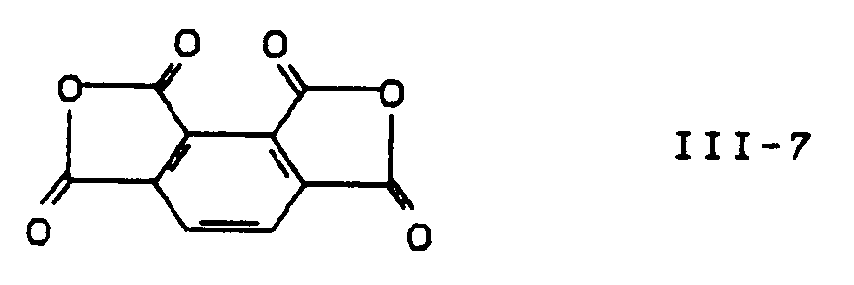
- Carboxylic anhydrides of the formula (III) are, for example
- hydrophilic polymers which can make up to 40% by weight, preferably up to 10% by weight, of the hydrophilic polymer according to the invention are both naturally occurring high-molecular compounds such as proteins, protein derivatives, cellulose derivatives, e.g. Cellulose esters, gelatin derivatives e.g. acetylated gelatin, phthaloyl gelatin, ureidogelatin, polysaccharides e.g. Dextran, gum arabic, casein, collagen derivatives, albumin as described in Research Disclosure December 1989 page 1003-1004.
- proteins protein derivatives
- cellulose derivatives e.g. Cellulose esters
- gelatin derivatives e.g. acetylated gelatin, phthaloyl gelatin, ureidogelatin
- polysaccharides e.g. Dextran, gum arabic, casein, collagen derivatives, albumin as described in Research Disclosure December 1989 page 1003-1004.
- the NC layer may also contain plasticizer additives. Suitable plasticizers and monohydric and polyhydric alcohols, acid amides, esters, for example phosphate esters such as tricresyl phosphate, phthalate esters such as dibutyl phthalate, polyacrylic acid esters such as polybutyl acrylate, polyethyl acrylate, polyurethane latices with anionic, cationic or nonionic groups as listed in Research Disclosure 12/89 page 1006.
- plasticizer additives Suitable plasticizers and monohydric and polyhydric alcohols, acid amides, esters, for example phosphate esters such as tricresyl phosphate, phthalate esters such as dibutyl phthalate, polyacrylic acid esters such as polybutyl acrylate, polyethyl acrylate, polyurethane latices with anionic, cationic or nonionic groups as listed in Research Disclosure 12/89 page 1006.
- the NC layer can also contain aqueous microgels.
- Aqueous microgels are water-swellable particles with an average particle diameter of less than 1 »m.
- microgels are crosslinked polystyrene sulfonic acid salts, crosslinked poly (meth) acrylic acid salts, crosslinked poly (meth) acrylamides, crosslinked polymers with quaternary ammonium groups.
- the NC layer according to the invention can be constructed in one or more layers, for example in two or three layers.
- the "NC layer” always means the NC layer package.
- a cellulose triacetate base of 95 »m thickness provided with an adhesive layer on both sides is coated on the front with a light-sensitive, 3-color structure, dry layer thickness 21.5» m; Gelatin application 16.9 g / m2.
- the dry layer thickness of the NC layer is 5.4 »m.
- the layer is applied in one pass using a triple cascade.
- the drying properties of this roll film are shown in Table 2.
- 35 mm wide film strips are cut from the coated material (60 cm wide). These are exposed, developed, bleached, fixed, washed and dried.
- the film was suspended in a conventional drying cabinet with a hot air blower at 50 ° C.
- the end of the film (total length 80 cm) is weighted with a clip of approx. 20 g weight.
- the curvature of the film is measured at intervals of one minute in the beginning, every 20 seconds during the bulging phase, and then again every minute thereafter.
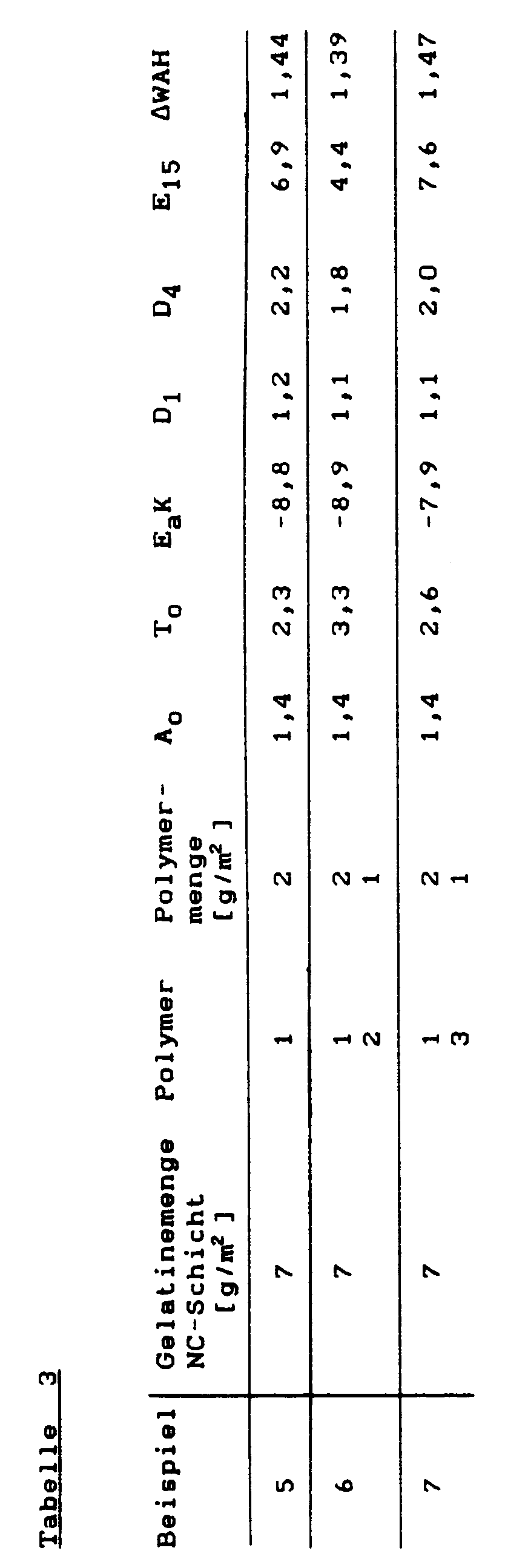
- the values (curvature versus time) are plotted against each other and connected to form a curve. From the curve, the values A o , T o , E a K, D1, D4 and E15 defined in Fig. 1 are read.
- Example 1 The values of Example 1 are shown in Table 2 below.
- Example 1 On a 95 »m thick triacetate base provided on both sides with an adhesive layer, the same light-sensitive three-color structure of Example 1 is applied on the front side and different NC layers are applied to the rear side, in which 2 different polymers or mixtures of polymers are added to the gelatin in the partial layer .
- Polymer 1 is a reaction product of a polyester diol from adipic acid and neopentyl glycol with benzene-1,2,4,5-tetracarboxylic acid, acid number 73.
- Polymer 2 is a polymer of the formula:
- Polymer 3 is a polyester urethane made from a polyester diol, hexamethylene diisocyanate and diaminocaproic acid, the polyester diol being produced from adipic acid and neipentyl glycol (MW: 80,000).
- An additional advantage of the NC layer according to the invention is the reduction of the flatness amphitude, ie the curvature of the film which is dependent on moisture becomes smaller.
- Table 4 shows, the flatness difference in the particularly practical humidity range of 50-20% for the starting film according to Example 1 is significantly larger than that of the comparison films with NC layers, which contain polymer 1 according to the invention alone or in admixture with an additional polymer.
Landscapes
- Chemical & Material Sciences (AREA)
- Engineering & Computer Science (AREA)
- Materials Engineering (AREA)
- Physics & Mathematics (AREA)
- General Physics & Mathematics (AREA)
- Polyesters Or Polycarbonates (AREA)
Description
- Die Erfindung betrifft ein fotografisches Material, insbesondere ein fotografisches Aufnahmematerial, mit einer NC-Schicht, das so gestaltet ist, daß Beschädigungen des Materials insbesondere beim Trocknen innerhalb des Verarbeitungsprozesses vermieden oder wenigstens vermindert werden.
- Fotografische Aufnahmematerialien, z.B. Kleinbild- oder Rollfilme bestehen aus einer transparenten Unterlage, z.B. aus Cellulosetriacetat und einer Mehrzahl von auf einer Seite der Unterlage aufgetragenen Schichten, die im wesentlichen aus Gelatine bestehen, in der die fotografisch wichtigen Bausteine wie Silberhalogenidkörner, Farbkuppler und andere Substanzen eingebettet sind.
- Diese Materialien zeigen im trockenen Zustand die Tendenz, sich so zu wölben, daß die Emulsionsseite, das heißt, die Seite der Unterlage, auf der die fotografisch wichtigen Gelatineschichten aufgetragen sind, innen liegt (Ei-Zustand). Diese Wölbungstendenz ist beabsichtigt und wird bei der Herstellung des Materials durch die Zugkraft bewirkt, die die Gelatine beim Trocknen ausübt. Um diese Aufrolltendenz nicht zu stark werden zu lassen, werden häufig auf der Rückseite der Unterlage sogenannte NC-Schichten ("non-curling"-Schichten) aufgetragen, die der Wölbungstendenz entgegen wirken und in der Kamera bzw. im Printer (Kopiergerät) für eine ausreichende Planlage sorgen, damit beim Belichten und Kopieren Unschärfen vermieden werden.
- Die NC-Schichten bestehen üblicherweise aus Gelatine. Es hat sich nun gezeigt, daß beim Verarbeiten solcher Materialien die NC-Schichten, die einen geringeren Gelatineauftrag haben als die Schichten der Vorderseite, schneller trocknen als die Schichten der Vorderseite, dadurch eine Zugkraft ausüben, die den Film so wölbt, daß die fotografisch wichtigen Gelatineschichten (= Emulsionsseite) sich zwischenzeitlich nach außen wölben (Ea-Zustand), wodurch es leicht zu Beschädigungen der Emulsionsschichten kommen kann, insbesondere im Trockenteil von Kompaktlabors, den sogenannten Minilabs, wenn der Film während der Trocknung über eine größere Entfernung (etwa 50 cm) nicht zwischen Rollenpaaren geführt wird. Im Extremfall kann das ohne zusätzliche Führung laufende Filmende schräg und noch stark gekrümmt in die Transportrollenpaare am Trocknerausgang einlaufen, wodurch es dann zu Knicken im Film kommt.
- Die Kompaktlabors sind üblicherweise so angelegt, daß den Anfang eines zu verarbeitenden Films an einem perforierten Schleppband befestigt ist und mit diesem durch das Gerät transportiert wird. Das Ende des Films ist frei beweglich. Die Trocknung des Films wird meist mit etwa 50°C-warmer Luft durchgeführt.
- Fig. 1 zeigt den idealisierten Verlauf einer Trocknungskurve, bei dem als Abszisse die Zeit T in Minuten und auf der Ordinate die Wölbung in mm angegeben ist (Höhe der Filmmitte über der aus den Filmrändern gebildeten Basis). Die Wölbung Ei hat ein positives, die Wölbung Ea ein negatives Vorzeichen. Es werden folgende Werte abgelesen:
- Ao [mm]:
- Anfangskrümmung
- To [min]:
- Durchgang durch die Null-Linie (Umschlag der Krümmung Ei nach Ea.
- EaK [mm]:
- Maximale Ea-Krümmung
- D₁ [min]:
- Dauer der Krümmung 1 mm über EaK
- D₄ [min]:
- Dauer der Krümmung 4 mm über EaK
- E₁₅ [mm]:
- Krümmung nach 15 Minuten (Endpunkt)
- Alle Werte wurden bei Trocknung mit 50°C warmer Luft bestimmt.
- Aufgabe der Erfindung ist es, Eintritt und Stärke der während des Trocknens auftretende Ea-Krümmung wenigstens so zu verändern, daß an den Emulsionsschichten keine Beschädigungen mehr auftreten. Dabei darf es jedoch nicht zu einer Erhöhung der Ei-Krümmung des Films vor oder nach Verarbeitung kommen, da dies sich negativ auf die Planlage in der Kamera bzw. im Printer auswirken würde.
- Fotografische Aufzeichnungsmaterialien mit einer NL-Schicht, bestehend aus Gelatine und einem (Meth)acrylamid-Copolymerisat sind aus DE-A-1904527 bekannt.
Fotografische Aufzeichnungmaterialien mit einem hydrophilen Polymer gemäß Formel (I), welche z.B. als Ölbildner eingesetzt werden, sind aus EP-A-0358073 bekannt. Die Verwendung der Polymere führt zu einer verbesserten Maximaldichte. - Es wurde nun gefunden, daß sich die Aufgabe lösen läßt, indem man der NC-Schicht ein bestimmtes hydrophiles Polymer zusetzt und bestimmte Mengenverhältnisse bezüglich der Gelatine auf der Emulsionsseite zur Gelatine in der NC-Schicht zum erfindungsgemäßen Polymer einhält.
- Gegenstand der Erfindung ist daher ein fotografisches Aufzeichnungsmaterial mit einem Träger, mindestens einer lichtempfindlichen, gelatinehaltigen Silberhalogenidemulsionsschicht auf der einen Seite des Trägers und einer gelatinehaltigen NC-Schicht auf der anderen Seite des Trägers, dadurch gekennzeichnet, daß die NC-Schicht wenigstens ein hydrophiles Polymer, das zu wenigstens 60 Gew.-% der Formel

entspricht, worin - R₁
- Alkylen, Arylen, Aralkylen oder Cycloalkylen,
- L
- den Rest eines Polyesterdiols mit einem mittleren Molekulargewicht von 500 bis 20.000,
- m
- 0 oder 1,
- n
- 0 bis 30, vorzugsweise 0 bis 10 und
- Vorzugsweise sollen die Polymer- und Gelatinemengen so aufeinander abgestimmt sein, daß das Verhältnis des Wasseraufnahmevermögens der Schichten auf der Emulsionsseite zum Wasseraufnahmevermögen der NC-Schicht (ΔWAM) 1 bis 1,5 beträgt.
- Besonders bevorzugt macht das Polymer der Formel I wenigstens 90 Gew.-% der Menge des hydrophilen Polymers aus.
- Vorzugsweise handelt es sich um ein farbfotografisches Silberhalogenidaufzeichnungsmaterial mit wenigstens einer rotempfindlichen Schicht, der wenigstens ein Blaugrünkuppler zugeordnet ist, wenigstens einer grünempfindlichen Schicht, der wenigstens ein Purpurkuppler zugeordnet ist und wenigstens einer blauempfindlichen Schicht, der wenigstens ein Gelbkuppler zugeordnet ist, wobei der Gesamtauftrag der Gelatine auf der lichtempfindlichen Seite des Trägers 12 bis 18 g/m² und in der NC-Schicht 4 bis 8 g/m² beträgt.
- Es kann sich aber auch um ein Schwarz-Weiß-Silberhalogenidaufzeichnungsmaterial handeln, bei dem der Gelatinegesamtauftrag auf der lichtempfindlichen Seite des Trägers 8 bis 12 g/m² und in der NC-Schicht 3 bis 6 g/m² beträgt.
- Die Polymere der Formel I haben Säurezahlen von 30 bis 340, vorzugsweise 50 bis 200 mg KOH/g.
- Die Verbindungen der Formel I werden hergestellt, indem man Polyesterdiole der Formel II mit Carbonsäureanhydriden der Formel III oder entsprechenden Di- und Tetracarbonsäuren bei Temperaturen von 20 bis 200°C im Molverhältnis 1 : 1 bis 1 : 2 gegebenenfalls in inerten Lösungsmitteln umsetzt:

- Vorzugsweise wird die Kondensationsreaktion lösungsmittelfrei durchgeführt, insbesondere bei Temperaturen von 50 bis 150°C.
- Die Alkylgruppen haben insbesondere ein bis vier C-Atome.
- Die Polyesterdiole II sind beispielsweise aus Ullmanns Enzyklopädie der technischen Chemie, 4. Auflage, Band 19, S. 305 ff bekannt. Sie werden durch Polykondensation eines oder mehrerer Diole mit einer oder mehreren Dicarbonsäuren und/oder einer oder mehreren Oxysäuren hergestellt. Vorzugsweise werden Diole und Dicarbonsäuren verwendet. Die Oxysäuren können als Lactone eingesetzt werden.
- Beispiele für Diole sind Polyalkylenglykole, in denen die Alkylengruppe 2 bis 4 C-Atome besitzt, wie Diethylenglykol, Triethylenglykol, Polyethylenglykol (mittleres Molekulargewicht etwa 200 bis 1.000), 1,2-Propylenglykol, 1,3-Propylenglykol, Polypropylenglykol (mittleres Molekulargewicht etwa 170 bis 1.000), oder Diole der allgemeinen Formel
HO-R₂-OH
in der - R₂
- eine zweiwertige Kohlenwasserstoffgruppe ist, die 2 bis 13 C-Atome enthält,
- Bevorzugt sind Ethylenglykol, 1,2-Propandiol, 1,3-Butandiol, 1,4-Butandiol, 1,6-Hexandiol, Neopentylglykol, Diethylenglykol.
- Spezielle Beispiele für geeignete Dicarbonsäuren sind Kohlensäure und Verbindungen der allgemeinen Formel
HOOC-(R₃)q-COOH ,
in der - R₃
- eine zweiwertige Kohlenwasserstoffgruppe mit bis zu 12 C-Atomen ist,
- R₄ und R₅
- jeweils eine geradkettige oder verzweigte Alkylengruppe mit bis zu 11 C-Atomen (zum Beispiel eine Methylen- oder Ethylengruppe), eine Alkenylengruppe (zum Beispiel eine -CH=CH-, Propenylen- oder 1-Butenylengruppe), eine Phenylengruppe, die substituiert sein kann mit einem oder mehreren Halogenatomen (zum Beispiel eine Phenylen- oder Tetrachlorphenylengruppe) oder eine Alkinylengruppe (zum Beispiel eine -C≡C- oder -C≡C-C-Gruppe) bedeuten, und
- q
- den Wert 0 oder 1 hat,
- Bevorzugte Dicarbonsäuren sind Bernsteinsäure, Adipinsäure, Phthalsäure, Sebacinsäure, Dodecandicarbonsäure.
- Als Lacton einer Oxycarbonsäure kommt z.B. Caprolacton in Betracht.
- Das mittlere Molekulargewicht, ermittelt aus der OH-Zahl nach der Endgruppenmethode, der Polyesterdiole der Formel (II) beträgt etwa 500 bis 20.000, vorzugsweise 800 bis 5.000. Das Molverhältnis von mehrwertigem Alkohol zu mehrbasischer Carbonsäure ist größer als 1. Beispiele für Polyesterdiole sind in Tabelle 1 aufgeführt.

- Carbonsäureanhydride der Formel (III) sind beispielsweise




- Andere geeignete hydrophile Polymere, die bis 40 Gew.-%, vorzugsweise bis zu 10 Gew.-%, des erfindungsgemäßen hydrophilen Polymers ausmachen können, sind sowohl natürlich vorkommende hochmolekulare Verbindungen wie Proteine, Proeinderivate, Cellulosederivate z.B. Celluloseester, Gelatinederivate z.B. acetylierte Gelatine, Phthaloylgelatine, Ureidogelatine, Polysaccharide z.B. Dextran, Gummi arabicum, Casein, Collagenderivate, Albumin wie in Research Disclosure Dezember 1989 Seite 1003-1004 beschrieben.
- Weiterhin kann die NC-Schicht Weichmacherzusätze enthalten. Geeignete Weichmacher und ein- und mehrwertige Alkohole, Säureamide, Ester z.B. Phosphatester wie Tricresylphosphat, Phthalatester wie z.B. Dibutylphthalat, Polyacrylsäureester wie Polybutylacrylat, Polyethylacrylat, Polyurethanlatices mit anionischen, kationischen oder nichtionischen Gruppen wie in Research Disclosure 12/89 Seite 1006 aufgeführt.
- Die NC-Schicht kann außerdem wäßrige Mikrogele enthalten. Wäßrige Mikrogele sind wasserquellbare Teilchen mit einem mittleren Teilchendurchmesser von unter 1 »m. Beispiele für Mikrogele sind vernetzte Polystyrolsulfonsäuresalze, vernetzte Poly-(meth-)acrylsäuresalze, vernetzte Poly(meth-)acrylamide, vernetzte Polymere mit quartären Ammoniumgruppen.
- Die erfindungsgemäße NC-Schicht kann ein- oder mehrschichtig, beispielsweise zwei- oder dreischichtig aufgebaut sein. Bei mehrschichtigem Aufbau ist unter "NC-Schicht" immer das NC-Schichtpaket zu verstehen.
- Eine beidseitig mit einer Haftschicht versehene Cellulosetriacetat-Unterlage von 95 »m Stärke wird vorderseitig mit einem lichtempfindlichen, 3-farbigen Coloraufbau beschichtet, Trockenschichtdicke 21,5 »m; Gelatineauftrag 16,9 g/m².
- Auf die Rückseite wird eine NC-Schicht folgender Zusammensetzung gegossen:
- 1. Eine Schicht aus:
0,9 g/m² Gelatine
0,01 g/m² Triacrylformal
0,005 g/m² Netzmittel
(pH der Gießlösung 6,3) - 2. Darauf eine Schicht aus:
5,1 g/m² Gelatine
0,06 g/m² Triacrylfomal
0,01 g/m² Netzmittel
(pH der Gießlösung 6,3) - 3. Darüber eine Deckschicht aus
0,2 g/m² Gelatine
0,76 g/m² Polymer 2
0,001 g/m² Triacrylformal
0,011 g/m² Netzmittel (Manoxol)
0,076 g/m² Natriumbicarbonat
0,072 g/m² Natriumhydroxid - Gesamtgelatineauftrag der NC-Schicht: 6,2 g/m².
- Die Trockenschichtdicke der NC-Schicht beträgt 5,4 »m. Die Schicht wird mittels Dreifachkaskade in einem Durchgang aufgebracht. Die Trocknungseigenschaften dieses Rollfilms sind in Tabelle 2 dargestellt.
- Aus dem beschichteten Material (60 cm Breite) werden 35 mm breite Filmstreifen geschnitten. Diese werden belichtet, entwickelt, gebleicht, fixiert, gewässert und getrocknet.
- Bei der Verarbeitung kommt es im Trockner (z.B. Trockner des Noritzu Minilab (Typ QSF-B50L-3)) zu Kratzern in der Emulsionsschicht und zu seitlichen Knicken.
- Um die Ursachen festzustellen, wurde der Film nach der Naßverarbeitung und dem Abstreifen des anhaftenden Wassers in einem üblichen Trockenschrank mit Heißluftgebläse bei 50°C hängend getrocknet. Das Filmende (80 cm Gesamtlänge) ist mit einer Klammer von ca. 20 g Gewicht beschwert.
- In Abständen von anfangs einer Minute, während der Wölbungsphase alle 20 Sek., danach wieder jede Minute, wird die Wölbung des Films gemessen. Die Werte (Wölbung gegen Zeit) werden gegeneinander aufgetragen und zu einer Kurve verbunden. Aus der Kurve werden die bei Fig. 1 definierten Werte Ao, To, EaK, D₁, D₄ und E₁₅ abgelesen.
- Aus den Versuchen zeigt sich, daß unbeschädigte Filme, die beim Kopieren eine gute Planlage einnehmen, nach der Trocknung im Noritzu-Minilab nur dann erhalten werden, wenn To ≧ 2,2, D₁ ≦ 1,5, E₁₅ 4,0 - 7,0 und EaK <10 sind.
- Die Werte von Beispiel 1 sind der nachfolgenden Tabelle 2 zu entnehmen.
- Erhöht man nur den Gelatineautrag der NC-Schicht, so werden zwar To und EaK in der gewünschten Weise verändert, jedoch liegt jetzt der Film vor und nach der Entwicklung zu stark Ea. Dadurch kommt es im Kopiergerät nicht zur erforderlichen Planlage bei Raumklima.
- Gelatinemengen und Ergebnisse sind in Tabelle 2 dargestellt.

- Auf eine 95 »m dicke, beidseitig mit einer Haftschicht versehenen Triacetatunterlage bringt man vorderseitig den gleichen lichtempfindlichen Dreifarbenaufbau des Beispiels 1 und auf die Rückseite unterschiedliche NC-Schichten auf, in denen man zusätzlich zur Gelatine in der Teilschicht 2 verschiedene Polymere oder Mischungen von Polymeren zusetzt.
- Die Mengen der Polymere und der Gelatine sowie die Ergebnisse sind in Tabelle 3 dargestellt.
- Kratzer auf der Emulsionsseite und Knicke werden beim Durchlauf durch den in Beispiel 1 genannten Trockner nicht beobachtet.
- Polymer 1 ist ein Umsetzungsprodukt eines Polyesterdiols aus Adipinsäure und Neopentylglykol mit Benzol-1,2,4,5-tetracarbonsäure, Säurezahl 73.
- Polymer 2 is ein Polymer der Formel:

- Polymer 3 ist ein Polyesterurethan aus einem Polyesterdiol, Hexamethylendiisocyanat und Diaminocapronsäure, wobei das Polyesterdiol aus Adipinsäure und Neipentylglykol hergestellt wurde (MG: 80 000).
- Ein zusätzlicher Vorteil der erfindungsgemäßen NC-Schicht ist die Verringerung der Planlageamphitude, d.h. die feuchtigkeitsabhängige Krümmung des Films wird kleiner. Wie die Tabelle 4 zeigt, ist die Planlagedifferenz im besonders praxisrelevanten Feuchtigkeitsbereich von 50 - 20% beim Ausgangsfilm gemäß Beispiel 1 deutlich größer, als die der Vergleichsfilme mit NC-Schichten, die das erfindungsgemäße Polymer 1 allein oder in Abmischung mit einem Zusatzpolymer enthalten.

m + n ≧ 1 bedeuten,
in einer Menge von bis 0,9 bis 4 g/m² enthält, wobei das Gewichtsverhältnis von Gelatine auf der Emulsionsseite zu Gelatine in der NC-Schicht 2 bis 3 und das Gewichtsverhältnis Gelatine in der NC-Schicht zum hydrophilen Polymer 2 bis 5 betragen.
wie geradkettige oder verzweigte Alkylengruppen oder Cycloalkylengruppen (wie Ethylen-, Propylen-, Butylen-, Isobutylen-, Pentylen-, Neopentylen-, Octylen-, Tridecylen- und Cyclohexylengruppen), und solche Gruppen, die substituiert sind mit einer oder mehreren Alkoxygruppen mit 1 bis 4 C-Atomen (wie Ethoxy- oder Propoxygruppen), Phenylgruppen, die substituiert sein können mit einer oder mehreren Alkoxygruppen, wie vorstehend beschrieben, wie Ethylenglykol, Propylenglykol, 1,4-Butandiol, Isobutylendiol, Dioxyaceton, 1,5-Pentandiol, Neopentylglykol, 1,6-Hexandiol, 1,7-Heptandiol, 1,8-Octandiol, 1,9-Nonandiol, 1,10-Decandiol, 1,11-Undecandiol, 1,12-Dodecandiol, 1,13-Tridecandiol, cis- und trons-Cyclohexan-1,4-diol, Bisphenol A, 1,4-Bis-(β-hydroxyethoxy)-benzol und 1,4-Bis-(β-hydroxyethoxy)-cyclohexan.
zum Beispiel eine geradkettige oder verzweigte Alkylengruppe oder Cycloalkylengruppe (zum Beispiel eine Methylen-, Ethylen-, Propylen-, Pentylen-, Nonylen-, Dodecylen- oder 1,1,3-Trimethylcyclopentylengruppe), eine Gruppe der allgemeinen Formel

in der
wie Oxalsäure, Malonsäure, Bernsteinsäure, Glutarsäure, Dimethylmalonsäure, Adipinsäure, Pimelinsäure, Korksäure, α,α-Dimethylbernsteinsäure, Acetyläpfelsäure, Acetondicarbonsäure, Azelainsäure, Sebacinsäure, Nonandicarbonsäure, Decandicarbonsäure, Undecandicarbonsäure, Dodecandicarbonsäure, Fumarsäure, Maleinsäure, Itaconsäure, Phthalsäure, Isophthalsäure, Tetrachlorphthalsäure, Mesaconsäure, Isopimelinsäure, Acetylendicarbonsäure, Glutaconsäure.
Claims (3)
- Fotografisches Aufzeichnungsmaterial mit einem Träger, mindestens einer lichtempfindlichen, gelatinehaltigen Silberhalogenidemulsionsschicht auf der einen Seite des Trägers und einer gelatinehaltigen NC-Schicht auf der anderen Seite des Trägers, dadurch gekennzeichnet, daß die NC-Schicht wenigstens ein hydrophiles Polymer, das zu wenigstens 60 Gew.-% der Formel
 R₁ Alkylen, Arylen, Aralkylen oder Cycloalkylen,L den Rest eines Polyesterdiols mit einem mittleren Molekulargewicht von 500 bis 20.000,m 0 oder 1,n 0 bis 30, vorzugsweise 0 bis 10 undm + n ≧ 1 bedeuten,
entspricht, in einer Menge von bis 0,9 bis 4 g/m² enthält,
wobei das Gewichtsverhältnis von Gelatine auf der Emulsionsseite zu Gelatine in der NC-Schicht 2 bis 3 und das Gewichtsverhältnis Gelatine in der NC-Schicht zum hydrophilen Polymer 2 bis 5 betragen. - Fotografisches Aufzeichnungsmaterial nach Anspruch 1, dadurch gekennzeichnet, daß das Verhältnis des Wasseraufnahmevermögens der Schichten auf der Emulsionsseite zum Wasseraufnahmevermögen der NC-Schicht (Δ WAM) 1 bis 1,5 beträgt.
- Fotografisches Aufzeichnungsmaterial nach Anspruch 1, dadurch gekennzeichnet, daß es sich um ein farbfotografisches Silberhalogenidaufzeichnungsmaterial mit wenigstens einer rotempfindlichen Schicht, der wenigstens ein Blaugrünkuppler zugeordnet ist, wenigstens einer grünempfindlichen Schicht, der wenigstens ein Purpurkuppler zugeordnet ist und wenigstens einer blauempfindlichen Schicht, der wenigstens ein Gelbkuppler zugeordnet ist, handelt, wobei der Gesamtauftrag der Gelatine auf der lichtempfindlichen Seite des Trägers 12 bis 18 g/m² und in der NC-Schicht 4 bis 8 g/m² beträgt.
Applications Claiming Priority (2)
| Application Number | Priority Date | Filing Date | Title |
|---|---|---|---|
| DE4015161 | 1990-05-11 | ||
| DE4015161A DE4015161A1 (de) | 1990-05-11 | 1990-05-11 | Fotografisches material mit nc-schicht |
Publications (2)
| Publication Number | Publication Date |
|---|---|
| EP0457087A1 EP0457087A1 (de) | 1991-11-21 |
| EP0457087B1 true EP0457087B1 (de) | 1995-03-29 |
Family
ID=6406194
Family Applications (1)
| Application Number | Title | Priority Date | Filing Date |
|---|---|---|---|
| EP91106889A Expired - Lifetime EP0457087B1 (de) | 1990-05-11 | 1991-04-27 | Fotografisches Material mit NC-Schicht |
Country Status (4)
| Country | Link |
|---|---|
| US (1) | US5070006A (de) |
| EP (1) | EP0457087B1 (de) |
| JP (1) | JP2872443B2 (de) |
| DE (2) | DE4015161A1 (de) |
Families Citing this family (5)
| Publication number | Priority date | Publication date | Assignee | Title |
|---|---|---|---|---|
| JPH05297514A (ja) * | 1992-04-20 | 1993-11-12 | Konica Corp | ハロゲン化銀写真感光材料 |
| JPH06123932A (ja) * | 1992-10-13 | 1994-05-06 | Konica Corp | ハロゲン化銀写真感光材料 |
| JPH0764239A (ja) * | 1993-08-30 | 1995-03-10 | Konica Corp | ハロゲン化銀写真感光材料 |
| US5753426A (en) * | 1995-06-30 | 1998-05-19 | Eastman Kodak Company | Photographic elements containing a transparent magnetic recording layer |
| US5891612A (en) * | 1997-08-28 | 1999-04-06 | Eastman Kodak Company | Photographic elements comprising highly loaded particulate material containing layer |
Family Cites Families (7)
| Publication number | Priority date | Publication date | Assignee | Title |
|---|---|---|---|---|
| FR1533835A (fr) * | 1966-08-12 | 1968-07-19 | Eastman Kodak Co | Produit photographique à révélateur incorporé comprenant une nouvelle sous-couche antigode |
| DE1904527A1 (de) * | 1969-01-30 | 1970-08-27 | Agfa Gevaert Ag | Photographisches Material |
| JPS5737347A (en) * | 1980-08-15 | 1982-03-01 | Fuji Photo Film Co Ltd | Photographic sensitive material |
| US4729945A (en) * | 1983-08-12 | 1988-03-08 | Felix Schoeller, Jr. | Multilayer photographic support material |
| JP2540307B2 (ja) * | 1986-07-18 | 1996-10-02 | コニカ株式会社 | 巻ぐせカ−ルの改良されたハロゲン化銀写真印画紙 |
| DE3830522A1 (de) * | 1988-09-08 | 1990-03-15 | Agfa Gevaert Ag | Fotografisches aufzeichnungsmaterial |
| EP0360616B1 (de) * | 1988-09-22 | 1995-02-01 | Konica Corporation | Lichtempfindliches, photographisches, zur Schnellverarbeitung geeignetes Silberhalogenidmaterial mit reduzierter Krümmung |
-
1990
- 1990-05-11 DE DE4015161A patent/DE4015161A1/de not_active Withdrawn
-
1991
- 1991-04-26 US US07/692,280 patent/US5070006A/en not_active Expired - Lifetime
- 1991-04-27 DE DE59105029T patent/DE59105029D1/de not_active Expired - Fee Related
- 1991-04-27 EP EP91106889A patent/EP0457087B1/de not_active Expired - Lifetime
- 1991-05-08 JP JP3131613A patent/JP2872443B2/ja not_active Expired - Fee Related
Also Published As
| Publication number | Publication date |
|---|---|
| DE59105029D1 (de) | 1995-05-04 |
| JP2872443B2 (ja) | 1999-03-17 |
| DE4015161A1 (de) | 1991-11-14 |
| US5070006A (en) | 1991-12-03 |
| EP0457087A1 (de) | 1991-11-21 |
| JPH04229855A (ja) | 1992-08-19 |
Similar Documents
| Publication | Publication Date | Title |
|---|---|---|
| DE2900542C2 (de) | Photographisches Aufzeichnungsmaterial | |
| DE69127153T2 (de) | Photographisches Material | |
| DE69021707T2 (de) | Fotografisches hilfsmaterial mit einer antistatischen schicht und einer sperrschicht. | |
| DE2532916C2 (de) | Photographisches Aufzeichnungsmaterial und antistatische Beschichtungsmasse zur Herstellung desselben | |
| DE68923570T2 (de) | Photographisches lichtempfindliches Material mit Polyesterträger. | |
| DE2610485A1 (de) | Verfahren zur herstellung eines photographischen materials | |
| DE3516466C2 (de) | Farbfotografisches Aufzeichnungsmaterial mit einem polymeren Gelatineweichmacher | |
| DE69423919T2 (de) | Photoapparat mit integriertem Film | |
| EP0457087B1 (de) | Fotografisches Material mit NC-Schicht | |
| DE2516967C3 (de) | Photographisches lichtempfindliches silberhalogenidhaltiges Aufzeichnungsmaterial | |
| DE1173795B (de) | Photographisches Material | |
| DE69018182T2 (de) | Packung für photographischen Film. | |
| DE60008490T2 (de) | Getemperte Haftvermittlerschicht für fotografische Abbildungselemente en | |
| DE2357408A1 (de) | Lichtempfindliches, photographisches silberhalogenid-aufzeichnungsmaterial | |
| DE2241400A1 (de) | Lichtempfindliches photographisches silberhalogenidmaterial | |
| DE1046487B (de) | Verfahren zur Herstellung von antistatischem photographischem Material | |
| DE827899C (de) | Traeger fuer photographische Schichten fuer Farbphotographie | |
| DE2943807A1 (de) | Verfahren zur haertung eines photographischen materials | |
| DE69518863T2 (de) | Farbphotographisches Silberhalogenidmaterial | |
| DE2139450A1 (de) | Verfahren zum vernetzen hydrophiler kolloide | |
| DE971996C (de) | Mehrschichtfilme | |
| DE69705806T2 (de) | Trägerfilm für photographische Filme | |
| DE1046492B (de) | Lichtempfindliche Schicht | |
| DE69228089T2 (de) | Photographisches lichtempfindliches Silberhalogenidmaterial | |
| JPH0713291A (ja) | ハロゲン化銀写真感光材料 |
Legal Events
| Date | Code | Title | Description |
|---|---|---|---|
| PUAI | Public reference made under article 153(3) epc to a published international application that has entered the european phase |
Free format text: ORIGINAL CODE: 0009012 |
|
| AK | Designated contracting states |
Kind code of ref document: A1 Designated state(s): BE DE FR GB IT NL |
|
| 17P | Request for examination filed |
Effective date: 19920218 |
|
| 17Q | First examination report despatched |
Effective date: 19940913 |
|
| GRAA | (expected) grant |
Free format text: ORIGINAL CODE: 0009210 |
|
| AK | Designated contracting states |
Kind code of ref document: B1 Designated state(s): BE DE FR GB IT NL |
|
| GBT | Gb: translation of ep patent filed (gb section 77(6)(a)/1977) |
Effective date: 19950327 |
|
| REF | Corresponds to: |
Ref document number: 59105029 Country of ref document: DE Date of ref document: 19950504 |
|
| ITF | It: translation for a ep patent filed | ||
| ET | Fr: translation filed | ||
| PLBE | No opposition filed within time limit |
Free format text: ORIGINAL CODE: 0009261 |
|
| STAA | Information on the status of an ep patent application or granted ep patent |
Free format text: STATUS: NO OPPOSITION FILED WITHIN TIME LIMIT |
|
| 26N | No opposition filed | ||
| PGFP | Annual fee paid to national office [announced via postgrant information from national office to epo] |
Ref country code: BE Payment date: 19980429 Year of fee payment: 8 |
|
| PGFP | Annual fee paid to national office [announced via postgrant information from national office to epo] |
Ref country code: NL Payment date: 19980430 Year of fee payment: 8 |
|
| PG25 | Lapsed in a contracting state [announced via postgrant information from national office to epo] |
Ref country code: BE Free format text: LAPSE BECAUSE OF NON-PAYMENT OF DUE FEES Effective date: 19990430 |
|
| BERE | Be: lapsed |
Owner name: AGFA-GEVAERT A.G. Effective date: 19990430 |
|
| PG25 | Lapsed in a contracting state [announced via postgrant information from national office to epo] |
Ref country code: NL Free format text: LAPSE BECAUSE OF NON-PAYMENT OF DUE FEES Effective date: 19991101 |
|
| NLV4 | Nl: lapsed or anulled due to non-payment of the annual fee |
Effective date: 19991101 |
|
| REG | Reference to a national code |
Ref country code: GB Ref legal event code: 746 Effective date: 20000223 |
|
| REG | Reference to a national code |
Ref country code: FR Ref legal event code: D6 |
|
| PGFP | Annual fee paid to national office [announced via postgrant information from national office to epo] |
Ref country code: GB Payment date: 20010312 Year of fee payment: 11 Ref country code: FR Payment date: 20010312 Year of fee payment: 11 |
|
| REG | Reference to a national code |
Ref country code: GB Ref legal event code: IF02 |
|
| PG25 | Lapsed in a contracting state [announced via postgrant information from national office to epo] |
Ref country code: GB Free format text: LAPSE BECAUSE OF NON-PAYMENT OF DUE FEES Effective date: 20020427 |
|
| GBPC | Gb: european patent ceased through non-payment of renewal fee |
Effective date: 20020427 |
|
| PG25 | Lapsed in a contracting state [announced via postgrant information from national office to epo] |
Ref country code: FR Free format text: LAPSE BECAUSE OF NON-PAYMENT OF DUE FEES Effective date: 20021231 |
|
| REG | Reference to a national code |
Ref country code: FR Ref legal event code: ST |
|
| PGFP | Annual fee paid to national office [announced via postgrant information from national office to epo] |
Ref country code: DE Payment date: 20040423 Year of fee payment: 14 |
|
| PG25 | Lapsed in a contracting state [announced via postgrant information from national office to epo] |
Ref country code: IT Free format text: LAPSE BECAUSE OF NON-PAYMENT OF DUE FEES;WARNING: LAPSES OF ITALIAN PATENTS WITH EFFECTIVE DATE BEFORE 2007 MAY HAVE OCCURRED AT ANY TIME BEFORE 2007. THE CORRECT EFFECTIVE DATE MAY BE DIFFERENT FROM THE ONE RECORDED. Effective date: 20050427 |
|
| PG25 | Lapsed in a contracting state [announced via postgrant information from national office to epo] |
Ref country code: DE Free format text: LAPSE BECAUSE OF NON-PAYMENT OF DUE FEES Effective date: 20051101 |