EP0457944A1 - Formplatte für die Herstellung eines Kabelbodens - Google Patents
Formplatte für die Herstellung eines Kabelbodens Download PDFInfo
- Publication number
- EP0457944A1 EP0457944A1 EP90109788A EP90109788A EP0457944A1 EP 0457944 A1 EP0457944 A1 EP 0457944A1 EP 90109788 A EP90109788 A EP 90109788A EP 90109788 A EP90109788 A EP 90109788A EP 0457944 A1 EP0457944 A1 EP 0457944A1
- Authority
- EP
- European Patent Office
- Prior art keywords
- end faces
- channels
- molding plate
- plate according
- electrically conductive
- Prior art date
- Legal status (The legal status is an assumption and is not a legal conclusion. Google has not performed a legal analysis and makes no representation as to the accuracy of the status listed.)
- Granted
Links
- 239000012799 electrically-conductive coating Substances 0.000 claims abstract description 7
- 238000000465 moulding Methods 0.000 claims description 14
- 238000000576 coating method Methods 0.000 claims description 8
- 239000011248 coating agent Substances 0.000 claims description 7
- OKTJSMMVPCPJKN-UHFFFAOYSA-N Carbon Chemical compound [C] OKTJSMMVPCPJKN-UHFFFAOYSA-N 0.000 claims description 5
- 239000010439 graphite Substances 0.000 claims description 5
- 229910002804 graphite Inorganic materials 0.000 claims description 5
- 230000000295 complement effect Effects 0.000 claims description 3
- 238000004519 manufacturing process Methods 0.000 claims description 3
- 239000002184 metal Substances 0.000 claims description 3
- 230000015572 biosynthetic process Effects 0.000 claims 1
- 238000003475 lamination Methods 0.000 claims 1
- 230000005684 electric field Effects 0.000 abstract description 3
- 238000010276 construction Methods 0.000 description 5
- 239000011810 insulating material Substances 0.000 description 2
- 239000012774 insulation material Substances 0.000 description 2
- 239000000463 material Substances 0.000 description 2
- 239000007921 spray Substances 0.000 description 2
- 238000005507 spraying Methods 0.000 description 2
- 235000013162 Cocos nucifera Nutrition 0.000 description 1
- 244000060011 Cocos nucifera Species 0.000 description 1
- 239000004793 Polystyrene Substances 0.000 description 1
- 229920002522 Wood fibre Polymers 0.000 description 1
- 239000007799 cork Substances 0.000 description 1
- 230000005574 cross-species transmission Effects 0.000 description 1
- 238000010790 dilution Methods 0.000 description 1
- 239000012895 dilution Substances 0.000 description 1
- 239000003000 extruded plastic Substances 0.000 description 1
- 239000000835 fiber Substances 0.000 description 1
- 239000006260 foam Substances 0.000 description 1
- 239000011888 foil Substances 0.000 description 1
- 239000011491 glass wool Substances 0.000 description 1
- 230000007257 malfunction Effects 0.000 description 1
- 239000002557 mineral fiber Substances 0.000 description 1
- 239000011490 mineral wool Substances 0.000 description 1
- 229920002223 polystyrene Polymers 0.000 description 1
- 150000003839 salts Chemical class 0.000 description 1
- 239000007787 solid Substances 0.000 description 1
- XLYOFNOQVPJJNP-UHFFFAOYSA-N water Substances O XLYOFNOQVPJJNP-UHFFFAOYSA-N 0.000 description 1
- 239000002025 wood fiber Substances 0.000 description 1
Images

Classifications
-
- E—FIXED CONSTRUCTIONS
- E04—BUILDING
- E04F—FINISHING WORK ON BUILDINGS, e.g. STAIRS, FLOORS
- E04F15/00—Flooring
- E04F15/02—Flooring or floor layers composed of a number of similar elements
- E04F15/024—Sectional false floors, e.g. computer floors
- E04F15/02405—Floor panels
- E04F15/02411—Floor panels with integrated feet
-
- H—ELECTRICITY
- H02—GENERATION; CONVERSION OR DISTRIBUTION OF ELECTRIC POWER
- H02G—INSTALLATION OF ELECTRIC CABLES OR LINES, OR OF COMBINED OPTICAL AND ELECTRIC CABLES OR LINES
- H02G3/00—Installations of electric cables or lines or protective tubing therefor in or on buildings, equivalent structures or vehicles
- H02G3/28—Installations of cables, lines, or separate protective tubing therefor in conduits or ducts pre-established in walls, ceilings or floors
- H02G3/283—Installations of cables, lines, or separate protective tubing therefor in conduits or ducts pre-established in walls, ceilings or floors in floors
- H02G3/285—Installations of cables, lines, or separate protective tubing therefor in conduits or ducts pre-established in walls, ceilings or floors in floors in modular floors, e.g. access floors
Definitions
- the invention relates to a mold plate for the production of a cable floor.
- Such a molding plate is known from DE utility model G 86 04 531.8 of the applicant.
- the molding plate is made from an insulating material into which the channels are milled from the underside.
- a form plate for the production of a cable base serves to solve this task, with: an underside which is in use rests on a building ceiling or structure; an upper surface to which a walking layer or floor construction is applied in use and which forms a surface substantially parallel to the lower surface; two end faces which are perpendicular to the underside or top side and are likewise essentially parallel and are separated from one another by the body of the molding plate; two side surfaces connecting the end faces; wherein channels are arranged in the body, which are open to the underside of the mold plate.
- any solid insulation material is suitable as the material for the molding plate, e.g. polystyrene, wood fiber, mineral fiber (such as rock wool or glass wool etc.), cork, bound natural fibers (e.g. coconut) or extruded plastic foams that have a closed-cell structure.
- An electrically conductive graphite coating for example, which is sold by Acheson under the trademark ELECTRODAG® 5405A, is suitable as the conductive coating.
- This graphite coating can be applied in a layer thickness of 25 to 50 ⁇ m, the application being carried out by spraying on with a spray pressure of 2 to 2.5 bar and a nozzle diameter of 1 to 2 mm.
- the resistance of the hardened layer is 20 ⁇ / m2 at 25 ⁇ m layer thickness.
- the continuous operating temperature is 150 ° C.
- Other suitable conductive coatings are, for example, metal foils, wire mesh or the like.
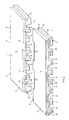
- Figure 1 shows a mold plate 1 according to the invention with two dash-dotted dividing lines A, which are intended to indicate that the mold plate 1 in one embodiment can end straight as shown in Figure 2, while in another embodiment several similar mold plates are laid together to form a cable floor. This will be discussed in more detail later.
- the mold plate 1 which can be seen in FIG. 1 has a body 6 which consists of an insulating material.
- the materials mentioned above can be used as insulation materials.
- the body 6 forms a plate with a width of approximately 500 mm, a length of approximately 1000 mm and a height of approximately 50 mm. It is clear that the dimensions can be easily adapted to the respective application.
- the mold plate 1 accordingly has an underside 2, an upper side 3 parallel thereto, two end faces 4 and 5, which are generally parallel to one another, and two side faces 7 and 8 connecting the end faces.
- the end faces 4 and 5 therefore lie just like the side faces 7 and 8 in Distance from each other.
- the mold plate 1 has the shape of a rectangle.
- Channels 9 are formed in the body 6 of the mold plate 1 from the underside 2 and extend over the entire length of the mold plate 1 and at a distance are arranged to each other.
- the channels 9 run parallel to one another and also parallel to the side surfaces 7 and 8.
- the channels 9 are open towards the underside 2.
- each mold plate 1 is provided with toothings 11 and 12 which are complementary to one another.
- toothings 11 and 12 which are complementary to one another.
- 4 recesses 18 are provided in the first end face
- 5 recesses 18 ' are formed in the corresponding region of the other end face.
- the toothing 11 and 12 in the end faces 4 and 5 of the mold plate 1 also form a first step 15, which is measured from the bottom 2 higher than the apex 17 of the channels 9.
- the channels 9 generally all have the same height, so that their apex 17 are approximately at the same height.
- the fact that the stage 15 is higher than the apex 17 of the channels 9 ensures that the teeth 11 and 12 do not cut into the channels 9 and thereby open them upwards.
- a second step 16 is provided in the side surfaces 7 and 8, which is also complementary to that in each case is formed in the opposite side surface 7 and 8 step 16 '.
- similar shaped plates 1 can, in principle, be placed close together without a gap being formed.
- the step 16, 16 ' is each formed by a projection 20 and a recess 21 which run parallel to the longitudinal extent of the side surface 7 and 8, respectively.
- the projection 20 is located on the left side surface 7 in the region of the upper side 3 of the mold plate 1, while it is provided on the right side surface 8 in the region of the lower side 2.
- Figure 2 shows two mold plates 1 and 1 'according to the invention in an exploded view, which indicate the structure of a floor structure.
- the upper or rear mold plate 1 corresponds to the mold plate shown in Figure 1.
- the one below the molding plate 1 ' is intended to indicate an edge element in which the front end face 4' is bluntly cut off so that there is no more toothing there.
- FIG. 2 shows how the toothings 11 and 12 of the mold plates 1 and 1 'can interlock and that the channels 9 extend in alignment through the entire floor construction.
- the inner sides 10 of the channels 9, the end faces 4 and 5 including their teeth 11 and 12 and the side surfaces 7 and 8 with their teeth 13 and 14 are provided with an electrically conductive coating.
- the electrically conductive coating is a graphite coating, for example of the type ELECTRODAG ® 5405 A from Fira Acheson. It provides excellent shielding against electromagnetic interference and also protection against electrostatic discharge. Even when exposed to heat, cold, moisture or salt, the coating maintains its low electrical resistance of around 20 ⁇ / m2 with a layer thickness of 25 ⁇ m.
- ELECTRODAG® 5405 A is applied by simple spraying, for example after additional dilution with water. The recommended spray pressure is 2 to 2.5 bar with a nozzle diameter of 1 to 2 mm. Further Details can be found in the product information from Acheson.
- the entire underside and the interfaces to adjacent mold plates are electrically conductive, so that they form a so-called Faraday cage for the cables and lines laid therein or below, which shields from one another the cables or lines which run in adjacent or spaced-apart channels.
Landscapes
- Engineering & Computer Science (AREA)
- Architecture (AREA)
- Civil Engineering (AREA)
- Structural Engineering (AREA)
- General Engineering & Computer Science (AREA)
- Floor Finish (AREA)
- Details Of Indoor Wiring (AREA)
- Installation Of Indoor Wiring (AREA)
Abstract
Description
- Die Erfindung betrifft eine Formplatte für die Herstellung eines Kabelbodens.
- Eine derartige Formplatte ist aus der DE Gebrauchsmusterschrift G 86 04 531.8 des Anmelders bekannt. Dort ist die Formplatte ebenso wie bei der vorliegenden Erfindung aus einem Dämmstoff hergestellt, in den die Kanäle von der Unterseite eingefräst sind.
- Es ist Aufgabe der Erfindung, die bekannte Formplatte dahingehend weiterzubilden, daß im Gebrauch mit in die Kanäle eingelegten oder eingezogenen Kabeln, insbesondere elektrische Leitungen, diese Leitungen zuverlässig voneinander abgeschirmt sind, so daß sich die um die Kabel bzw. Leitungen im Falle eines Stromflusses entstehenden elektrischen Felder nicht gegenseitig stören.
- Zur Lösung dieser Aufgabe dient eine Formplatte für die Herstellung eines Kabelbodens, mit: Einer Unterseite, die im Gebrauch auf einer Gebäudedecke oder Deckenkonstruktion aufliegt; einer Oberseite, auf die im Gebrauch eine Gehschicht oder Fußbodenkonstruktion aufgebracht wird und die zu der Unterseite eine im wesentlichen parallele Fläche bildet; zwei zu der Unterseite bzw. Oberseite senkrechte, im wesentlichen ebenfalls parallele Stirnseiten, die durch den Körper der Formplatte voneinander getrennt sind; zwei die Stirnseiten verbindende Seitenflächen; wobei in dem Körper Kanäle angeordnet sind, die zur Unterseite der Formplatte hin offen sind.
- Dadurch wird erreicht, daß die elektrischen Felder, welche die in den Kanälen verlegten elektrischen Kabel oder Leitungen umgeben, nicht auf in benachbarten Kanälen verlegte Kabel oder Leitungen übergreifen und dort Störimpulse hervorrufen können, die heutzutage bei der fortschreitenden Anwendung von elektrischen und elektronischen Geräten im Büro oder Haushalt zu Betriebsstörungen führen können. Die in den Fußboden bzw. die Deckenkonstruktion abgestrahlten Felder bleiben dabei ohne Einfluß.
- Vorteilhafte Ausgestaltungen der Erfindung ergeben sich aus den Unteransprüchen.
- Als Material für die Formplatte ist jeder feste Dämmstoff geeignet, beispielsweise Styropor, Holzfaser, Mineralfaser (wie Steinwolle oder Glaswolle etc.), Kork, gebundene Naturfasern (z.B. Kokos) oder extrudierte Kunststoffschäume, die einen geschlossen-zelligen Aufbau haben.
- Als leitfähige Beschichtung ist beispielsweise ein elektrisch leitfähiger Graphitüberzug geeignet, der von der Firma Acheson unter dem Warenzeichen ELECTRODAG® 5405A vertrieben wird. Dieser Graphitüberzug läßt sich in einer Schichtdicke von 25 bis 50 µm aufbringen, wobei das Aufbringen durch Aufsprühen mit einem Sprühdruck von 2 bis 2,5 bar und einem Düsendurchmesser von 1 bis 2 mm erfolgt. Der Widerstand der ausgehärteten Schicht beträgt 20 Ω/m² bei 25 µm Schichtdicke. Die Dauereinsatztemperatur beträgt 150°C. Andere geeignete leitfähige Überzüge sind beispielsweise Metallfolien, Drahtgeflechte o.ä..
- Die Erfindung wird im folgenden anhand eines Ausführungsbeispiels näher erläutert; es zeigen:
- Figur 1
- ein perspektivisches Ausführungsbeispiel einer Formplatte; und
- Figur 2
- die Art der Verlegung mehrerer Formplatten zu einem Kabelboden.
- Figur 1 zeigt eine erfindungsgemäße Formplatte 1 mit zwei strichpunktierten Trennlinien A, die andeuten sollen, daß die Formplatte 1 in einer Ausführungsform geradflächig wie in Figur 2 dargestellt, abschließen kann, während in einer anderen Ausführungsform mehrere gleichartige Formplatten zu einem Kabelboden aneinander gelegt sind. Hierauf wird später noch näher eingegangen.
- Die in Figur 1 erkennbare Formplatte 1 besitzt einen Körper 6, der aus einem Dämmstoff besteht. Als Dämmstoffe kommen die weiter oben genannten Materialien in Frage. Der Körper 6 bildet in einer Ausführungsform eine Platte mit einer Breite von etwa 500 mm, einer Länge von etwa 1 000 mm und einer Höhe von etwa 50 mm. Es ist klar, daß die Abmessungen ohne weiteres an den jeweiligen Anwendungsfall angepaßt werden können. Die Formplatte 1 besitzt demnach eine Unterseite 2, eine dazu parallele Oberseite 3, zwei in der Regel zueinander parallele Stirnseiten 4 und 5 und zwei die Stirnseiten verbindende Seitenflächen 7 und 8. Die Stirnseiten 4 und 5 liegen also ebenso wie die Seitenflächen 7 und 8 im Abstand zueinander. In der Draufsicht hat die Formplatte 1 die Form eines Rechtecks. In dem Körper 6 der Formplatte 1 sind von der Unterseite 2 her Kanäle 9 eingeformt, die sich über die gesamte Länge der Formplatte 1 erstrecken und im Abstand zueinander angeordnet sind. In einer bevorzugten Ausführungsform verlaufen die Kanäle 9 parallel zueinander und außerdem parallel zu den Seitenflächen 7 und 8. Die Kanäle 9 sind zur Unterseite 2 hin offen. Durch Aneinanderlegen mehrerer Formplatten 1 ergeben sich somit durchgehende Kanäle in der daraus hergestellten Bodenkonstruktion, die das nachträgliche Verlegen von elektrischen Leitungen oder Kabeln im Boden erlauben.
- Um eine sichere Verbindung von benachbarten Formplatten 1 und 1' (siehe Figur 2) zu erreichen, sind in einer Ausführungsform die Stirnseiten 4 und 5 jeder Formplatte 1 mit Verzahnungen 11 und 12 versehen, die zueinander komplementär sind. Dies bedeutet also, daß dort, wo in der ersten Stirnseite 4 Ausnehmungen 18 vorgesehen sind, befinden sich im entsprechenden Bereich der gegenüberliegenden zweiten Stirnseiten 5 Vorsprünge 19 von gleichere Höhe, Breite und Tiefe. Umgekehrt sind dort, wo in der ersten Stirnseite 4 Vorsprünge 19 vorgesehen sind, im entsprechenden Bereich der anderen Stirnseite 5 Ausnehmungen 18' gebildet.
- Die Verzahnungen 11 und 12 in den Stirnseiten 4 und 5 der Formplatte 1 bilden darüber hinaus eine erste Stufe 15, die von der Unterseite 2 her gemessen höher als der Scheitel 17 der Kanäle 9 liegt. In diesem Zusammenhang wird darauf hingewiesen, daß die Kanäle 9 in der Regel alle gleiche Höhe haben, so daß ihre Scheitel 17 etwa auf der gleichen Höhe liegen. Dadurch, daß die Stufe 15 höher als die Scheitel 17 der Kanäle 9 liegt, wird erreicht, daß die Verzahnungen 11 und 12 nicht in die Kanäle 9 hineinschneiden und diese dadurch nach oben öffnen.
- Unter der Annahme, daß die Richtung des Verlaufs der Kanäle 9 als die "Längsrichtung" der Formplatte bezeichnet wird, sei der Verlauf der Stirnseiten 4 und 5 als "Querrichtung" bezeichnet. Um nun in Querrichtung Formplatten 1 der erfindungsgemäßen Art aneinander zu legen, ist in den Seitenflächen 7 und 8 eine zweite Stufe 16 vorgesehen, die ebenfalls komplementär zu der jeweils in der gegenüberliegenden Seitenfläche 7 bzw. 8 gebildeten Stufe 16' ist. Auf diese Weise können wiederum gleichartige Formplatten 1 im Prinzip ohne Spaltbildung eng aneinander gelegt werden. Man erkennt in Figur 1, daß die Stufe 16, 16' jeweils von einem Vorsprung 20 und einer Ausnehmung 21 gebildet ist, die parallel zur Längserstreckung der Seitenfläche 7 bzw. 8 verlaufen. An der linken Seitenfläche 7 befindet sich der Vorsprung 20 im Bereich der Oberseite 3 der Formplatte 1, während er an der rechten Seitenfläche 8 im Bereich der Unterseite 2 vorgesehen ist.
- Figur 2 zeigt zwei erfindungsgemäße Formplatten 1 und 1' in auseinander gezogener Darstellung, die den Aufbau einer Bodenkonstruktion andeuten. Die obere oder hintere Formplatte 1 entspricht der in Figur 1 dargestellten Formplatte. Die unter Formplatte 1' soll ein Randelement andeuten, bei dem die vordere Stirnseite 4' stumpf abgeschnitten ist, so daß dort keine Verzahnung mehr vorliegt. Man erkennt aus Figur 2 aber deutlich, wie die Verzahnungen 11 und 12 der Formplatten 1 und 1' ineinander greifen können und daß sich die Kanäle 9 durch die gesamte Bodenkonstruktion fluchtend erstrecken.
- Ein wesentliches Merkmal der Erfindung besteht nun darin, daß die Innenseiten 10 der Kanäle 9, die Stirnseiten 4 und 5 einschließlich ihrer Verzahnungen 11 und 12 sowie die Seitenflächen 7 und 8 mit ihren Verzahnungen 13 und 14 mit einem elektrisch leitfähigen Überzug versehen sind. In einer Ausführungsform ist der elektrisch leitfähige Überzug ein Graphitüberzug, beispielsweise des Typs ELECTRODAG ® 5405 A der Fira Acheson. Er bietet eine ausgezeichnete Abschirmung gegen elektromagnetische Interferenz und außerdem Schutz gegen elektrostatische Entladungen. Auch bei der Einwirkung von Hitze, Kälte, Feuchtigkeit oder Salz behält der Überzug seinen niedrigen elektrischen Widerstand von etwa 20 Ω/m² bei 25 µm Schichtdicke. ELECTRODAG® 5405 A wird durch einfaches Sprühen aufgetragen, beispielsweise nach zusätzlicher Verdünnung mit Wasser. Als Sprühdruck werden 2 bis 2,5 bar bei einem Düsendurchmesser von 1 bis 2 mm empfohlen. Weitere Einzelheiten lassen sich der Produktinformation der Firma Acheson entnehmen.
- Auf diese Weise wird erreicht, daß bei einer Bodenkonstruktion, die aus den erfindungsgemäßen Formplatten gebildet ist, die gesamte Unterseite und die Grenzflächen zu benachbarten Formplatten elektrisch leitfähig sind, so daß sie für die darinnen oder darunter verlegten Kabel und Leitungen einen sogenannten Faradayschen Käfig bilden, der die Kabel oder Leitungen voneinander abschirmt, die in benachbarten oder in größerem Abstand geführten Kanälen verlaufen.
Claims (8)
- Formplatte für die Herstellung eines Kabelbodens, mit:- einer Unterseite (2), die im Gebrauch auf einer Gebäudedecke oder Deckenkonstruktion aufliegt;- einer Oberseite (3), auf die im Gebrauch eine Gehschicht oder Fußbodenschicht aufgebracht wird und die zu der Unterseite (2) eine im wesentlichen parallele Fläche bildet;- zwei zu der Unterseite (2) bzw. Oberseite (3) senkrechte, im wesentlichen ebenfalls parallele Stirnseiten (4,5), die durch den Körper (6) der Formplatte (1) voneinander getrennt sind;- zwei die Stirnseiten (4,5) verbindende Seitenflächen (7,8);- wobei in dem Körper (6) Kanäle (9) angeordnet sind, die zur Unterseite (2) der Formplatte (1) hin offen sind;dadurch gekennzeichnet,- daß die Stirnseiten (4,5) und die Seitenflächen (7,8) zueinander derart komplementäre Verzahnungen (11,12 bzw. 13,14) aufweisen, daß jeweils zwei Formplatten (1,1') im wesentlichen ohne Spalt aneinanderfügbar sind; und- daß die Innenseiten (10) der Kanäle (9), die Stirnseiten (4,5) und die Seitenflächen (7,8) mit einem elektrisch leitfähigen Überzug versehen sind.
- Formplatte nach Anspruch 1, dadurch gekennzeichnet, daß die Kanäle (9) parallel zueinander verlaufen.
- Formplatte nach Anspruch 1, dadurch gekennzeichnet, daß der elektrisch leitfähige Überzug ein Graphitüberzug ist.
- Formplatte nach Anspruch 3, dadurch gekennzeichnet, daß der elektrisch leitfähige Graphitüberzug ELECTRODAG® 5405A ist.
- Formplatte nach Anspruch 1, dadurch gekennzeichnet, daß der elektrisch leitfähige Überzug eine Metallkaschierung, ein Drahtgeflecht, ein Metallgewebe o. ä. ist.
- Formplatte nach Anspruch 1, dadurch gekennzeichnet, daß sich die Verzahnungen (11,12 bzw. 13,14) nicht über die gesamte Höhe der Stirnseiten (4,5) bzw. der Seitenflächen (7,8) geradflächig erstrecken, sondern eine Stufenbildung aufweisen.
- Formplatte nach Anspruch 6, dadurch gekennzeichnet, daß die in den Stirnseiten (4,5) vorgesehene Stufe (15) nicht auf der gleichen Höhe wie die in den Seitenflächen (13,14) angeordnete Stufe (16) liegt.
- Formplatte nach Anspruch 7, dadurch gekennzeichnet, daß die Stufe (15) in den Stirnflächen (4,5) näher zur Oberseite (3) der Formplatte (1) als der Scheitel (17) der Kanäle (9) liegt.
Priority Applications (3)
| Application Number | Priority Date | Filing Date | Title |
|---|---|---|---|
| AT90109788T ATE111650T1 (de) | 1990-05-23 | 1990-05-23 | Formplatte für die herstellung eines kabelbodens. |
| EP90109788A EP0457944B1 (de) | 1990-05-23 | 1990-05-23 | Formplatte für die Herstellung eines Kabelbodens |
| DE59007155T DE59007155D1 (de) | 1990-05-23 | 1990-05-23 | Formplatte für die Herstellung eines Kabelbodens. |
Applications Claiming Priority (1)
| Application Number | Priority Date | Filing Date | Title |
|---|---|---|---|
| EP90109788A EP0457944B1 (de) | 1990-05-23 | 1990-05-23 | Formplatte für die Herstellung eines Kabelbodens |
Publications (2)
| Publication Number | Publication Date |
|---|---|
| EP0457944A1 true EP0457944A1 (de) | 1991-11-27 |
| EP0457944B1 EP0457944B1 (de) | 1994-09-14 |
Family
ID=8204016
Family Applications (1)
| Application Number | Title | Priority Date | Filing Date |
|---|---|---|---|
| EP90109788A Expired - Lifetime EP0457944B1 (de) | 1990-05-23 | 1990-05-23 | Formplatte für die Herstellung eines Kabelbodens |
Country Status (3)
| Country | Link |
|---|---|
| EP (1) | EP0457944B1 (de) |
| AT (1) | ATE111650T1 (de) |
| DE (1) | DE59007155D1 (de) |
Cited By (3)
| Publication number | Priority date | Publication date | Assignee | Title |
|---|---|---|---|---|
| WO2007006151A1 (en) * | 2005-07-07 | 2007-01-18 | Ouellet Andre | Deck tile with support blade |
| EP1621673A3 (de) * | 2004-07-30 | 2008-02-27 | Pooltechnics B.V. | Fussbodenkonstruktion |
| EP2887479A1 (de) * | 2013-12-18 | 2015-06-24 | Tarkett GDL S.A. | An eine Gebäudeoberfläche anzubringende Fliese und Verfahren zur Installation von Kabeln in einem Gebäude |
Citations (3)
| Publication number | Priority date | Publication date | Assignee | Title |
|---|---|---|---|---|
| DE3041624A1 (de) * | 1980-11-05 | 1982-06-09 | Werner T. Dipl.-Ing. 3000 Hannover Huss | Pflasterung fuer hof- und hallenflaechen, verfahren zur herstellung dieser pflasterung und werkstein zur herstellung dieser pflasterung |
| EP0263583A2 (de) * | 1986-10-07 | 1988-04-13 | Philip J. Forde | Verteiler-Boden |
| WO1988003207A1 (en) * | 1986-10-22 | 1988-05-05 | Michael David Boyd | Modular hollow floor panels with integral ducting |
-
1990
- 1990-05-23 AT AT90109788T patent/ATE111650T1/de not_active IP Right Cessation
- 1990-05-23 EP EP90109788A patent/EP0457944B1/de not_active Expired - Lifetime
- 1990-05-23 DE DE59007155T patent/DE59007155D1/de not_active Expired - Fee Related
Patent Citations (3)
| Publication number | Priority date | Publication date | Assignee | Title |
|---|---|---|---|---|
| DE3041624A1 (de) * | 1980-11-05 | 1982-06-09 | Werner T. Dipl.-Ing. 3000 Hannover Huss | Pflasterung fuer hof- und hallenflaechen, verfahren zur herstellung dieser pflasterung und werkstein zur herstellung dieser pflasterung |
| EP0263583A2 (de) * | 1986-10-07 | 1988-04-13 | Philip J. Forde | Verteiler-Boden |
| WO1988003207A1 (en) * | 1986-10-22 | 1988-05-05 | Michael David Boyd | Modular hollow floor panels with integral ducting |
Cited By (3)
| Publication number | Priority date | Publication date | Assignee | Title |
|---|---|---|---|---|
| EP1621673A3 (de) * | 2004-07-30 | 2008-02-27 | Pooltechnics B.V. | Fussbodenkonstruktion |
| WO2007006151A1 (en) * | 2005-07-07 | 2007-01-18 | Ouellet Andre | Deck tile with support blade |
| EP2887479A1 (de) * | 2013-12-18 | 2015-06-24 | Tarkett GDL S.A. | An eine Gebäudeoberfläche anzubringende Fliese und Verfahren zur Installation von Kabeln in einem Gebäude |
Also Published As
| Publication number | Publication date |
|---|---|
| EP0457944B1 (de) | 1994-09-14 |
| DE59007155D1 (de) | 1994-10-20 |
| ATE111650T1 (de) | 1994-09-15 |
Similar Documents
| Publication | Publication Date | Title |
|---|---|---|
| DE3890470C2 (de) | Kabel mit niedrigem Profil für verdrillte Drahtpaare | |
| EP1725720B1 (de) | Paneelelement für Belag | |
| DE69120592T2 (de) | Kabelmodul | |
| DE2658708A1 (de) | Fuehrung fuer elektrische verteilungs- und fernmeldeleitungen in gebaeuden | |
| DE69226879T2 (de) | Elektrische Verbinder | |
| DE2441013C3 (de) | Verbinderblock fur Hauptverteilerrahmen in Modulausführung | |
| EP2491622A1 (de) | System zur verbindung elektrischer leiter mit voneinander verschiedenen potentialen sowie steckadapter für das system | |
| EP0735623A2 (de) | Elektrischer Verbinder | |
| DE2844523A1 (de) | Bewaesserungseinrichtung | |
| EP0457944B1 (de) | Formplatte für die Herstellung eines Kabelbodens | |
| DE3942520A1 (de) | Aus einem metallischen werkstoff bestehende anschlussklemme | |
| DE102012222364A1 (de) | Steckverbinder und Vorrichtung mit einem solchen Steckverbinder | |
| DE4244424C2 (de) | Installationsboden | |
| DE602004012175T2 (de) | Verfahren zur Herstellung von Kontaktstreifen für Verbinder von elektrischen Geräten | |
| EP0609651A1 (de) | Fassadenelement | |
| DE2123152B2 (de) | Verbindungsstueck fuer stromentnahmeschienen mit u-foermigem querschnitt der tragschiene | |
| DE3842205C2 (de) | Gehäuse für den Anschluß von Kommunikationssystemen | |
| EP0123192B1 (de) | Schlüssel für Zylinderschlösser | |
| DE3147223C2 (de) | Plattenförmiges Bauelement aus Hartschaumkunststoff oder dgl., insbesondere zur Wärmeisolierung von Dach- und Wandflächen von Gebäuden | |
| DE102024110585A1 (de) | Verriegelungselement, Steckverbinder und damit gebildete elektrische Steckverbindung | |
| DE3641971A1 (de) | Putztraegerdaemmplatte | |
| DE69306903T2 (de) | Elektrischer Verbinder mit Hermaphroditischen Kontaktelementen | |
| WO2002011156A1 (de) | Kabel, insbesondere unterwasserkabel | |
| DE3822981C2 (de) | ||
| EP3716423A1 (de) | Werkzeug zum ausgerichteten montieren von geräteeinsätzen |
Legal Events
| Date | Code | Title | Description |
|---|---|---|---|
| PUAI | Public reference made under article 153(3) epc to a published international application that has entered the european phase |
Free format text: ORIGINAL CODE: 0009012 |
|
| AK | Designated contracting states |
Kind code of ref document: A1 Designated state(s): AT BE CH DE DK ES FR GB GR IT LI LU NL SE |
|
| 17P | Request for examination filed |
Effective date: 19920311 |
|
| 17Q | First examination report despatched |
Effective date: 19930810 |
|
| GRAA | (expected) grant |
Free format text: ORIGINAL CODE: 0009210 |
|
| AK | Designated contracting states |
Kind code of ref document: B1 Designated state(s): AT BE CH DE DK ES FR GB GR IT LI LU NL SE |
|
| PG25 | Lapsed in a contracting state [announced via postgrant information from national office to epo] |
Ref country code: IT Free format text: LAPSE BECAUSE OF FAILURE TO SUBMIT A TRANSLATION OF THE DESCRIPTION OR TO PAY THE FEE WITHIN THE PRE;WARNING: LAPSES OF ITALIAN PATENTS WITH EFFECTIVE DATE BEFORE 2007 MAY HAVE OCCURRED AT ANY TIME BEFORE 2007. THE CORRECT EFFECTIVE DATE MAY BE DIFFERENT FROM THE ONE RECORDED.SCRIBED TIME-LIMIT Effective date: 19940914 Ref country code: BE Effective date: 19940914 Ref country code: DK Effective date: 19940914 Ref country code: NL Effective date: 19940914 Ref country code: ES Free format text: THE PATENT HAS BEEN ANNULLED BY A DECISION OF A NATIONAL AUTHORITY Effective date: 19940914 Ref country code: GB Effective date: 19940914 Ref country code: FR Effective date: 19940914 Ref country code: GR Free format text: LAPSE BECAUSE OF FAILURE TO SUBMIT A TRANSLATION OF THE DESCRIPTION OR TO PAY THE FEE WITHIN THE PRESCRIBED TIME-LIMIT Effective date: 19940914 |
|
| REF | Corresponds to: |
Ref document number: 111650 Country of ref document: AT Date of ref document: 19940915 Kind code of ref document: T |
|
| REF | Corresponds to: |
Ref document number: 59007155 Country of ref document: DE Date of ref document: 19941020 |
|
| PG25 | Lapsed in a contracting state [announced via postgrant information from national office to epo] |
Ref country code: SE Effective date: 19941214 |
|
| EN | Fr: translation not filed | ||
| NLV1 | Nl: lapsed or annulled due to failure to fulfill the requirements of art. 29p and 29m of the patents act | ||
| GBV | Gb: ep patent (uk) treated as always having been void in accordance with gb section 77(7)/1977 [no translation filed] |
Effective date: 19940914 |
|
| PG25 | Lapsed in a contracting state [announced via postgrant information from national office to epo] |
Ref country code: AT Effective date: 19950523 |
|
| PG25 | Lapsed in a contracting state [announced via postgrant information from national office to epo] |
Ref country code: LU Free format text: LAPSE BECAUSE OF NON-PAYMENT OF DUE FEES Effective date: 19950531 |
|
| PLBE | No opposition filed within time limit |
Free format text: ORIGINAL CODE: 0009261 |
|
| STAA | Information on the status of an ep patent application or granted ep patent |
Free format text: STATUS: NO OPPOSITION FILED WITHIN TIME LIMIT |
|
| 26N | No opposition filed | ||
| REG | Reference to a national code |
Ref country code: CH Ref legal event code: PL |
|
| REG | Reference to a national code |
Ref country code: CH Ref legal event code: AEN Free format text: WEITERBEHANDLUNG GUTGEHEISSEN.DAS PATENT WURDE REAKTIVIERT. |
|
| REG | Reference to a national code |
Ref country code: CH Ref legal event code: NV Representative=s name: PATENTANWALTSBUREAU R. A. MASPOLI |
|
| PGFP | Annual fee paid to national office [announced via postgrant information from national office to epo] |
Ref country code: CH Payment date: 19980520 Year of fee payment: 9 |
|
| PG25 | Lapsed in a contracting state [announced via postgrant information from national office to epo] |
Ref country code: CH Free format text: LAPSE BECAUSE OF NON-PAYMENT OF DUE FEES Effective date: 19990531 Ref country code: LI Free format text: LAPSE BECAUSE OF NON-PAYMENT OF DUE FEES Effective date: 19990531 |
|
| REG | Reference to a national code |
Ref country code: CH Ref legal event code: PL |
|
| PGFP | Annual fee paid to national office [announced via postgrant information from national office to epo] |
Ref country code: DE Payment date: 20060720 Year of fee payment: 17 |
|
| PG25 | Lapsed in a contracting state [announced via postgrant information from national office to epo] |
Ref country code: DE Free format text: LAPSE BECAUSE OF NON-PAYMENT OF DUE FEES Effective date: 20071201 |