EP0458070A1 - DNS-Gen zum Widerstand gegen Cytidine Analogen und reine Verwendung - Google Patents
DNS-Gen zum Widerstand gegen Cytidine Analogen und reine Verwendung Download PDFInfo
- Publication number
- EP0458070A1 EP0458070A1 EP19910106397 EP91106397A EP0458070A1 EP 0458070 A1 EP0458070 A1 EP 0458070A1 EP 19910106397 EP19910106397 EP 19910106397 EP 91106397 A EP91106397 A EP 91106397A EP 0458070 A1 EP0458070 A1 EP 0458070A1
- Authority
- EP
- European Patent Office
- Prior art keywords
- cytidine
- dna
- plasmid
- bacterial strain
- strain
- Prior art date
- Legal status (The legal status is an assumption and is not a legal conclusion. Google has not performed a legal analysis and makes no representation as to the accuracy of the status listed.)
- Withdrawn
Links
- UHDGCWIWMRVCDJ-ZAKLUEHWSA-N cytidine Chemical class O=C1N=C(N)C=CN1[C@H]1[C@H](O)[C@@H](O)[C@H](CO)O1 UHDGCWIWMRVCDJ-ZAKLUEHWSA-N 0.000 title claims abstract description 63
- 108090000623 proteins and genes Proteins 0.000 title claims description 11
- UHDGCWIWMRVCDJ-UHFFFAOYSA-N 1-beta-D-Xylofuranosyl-NH-Cytosine Natural products O=C1N=C(N)C=CN1C1C(O)C(O)C(CO)O1 UHDGCWIWMRVCDJ-UHFFFAOYSA-N 0.000 claims abstract description 38
- UHDGCWIWMRVCDJ-PSQAKQOGSA-N Cytidine Natural products O=C1N=C(N)C=CN1[C@@H]1[C@@H](O)[C@@H](O)[C@H](CO)O1 UHDGCWIWMRVCDJ-PSQAKQOGSA-N 0.000 claims abstract description 38
- 238000000034 method Methods 0.000 claims abstract description 34
- 239000013612 plasmid Substances 0.000 claims abstract description 30
- 241000193830 Bacillus <bacterium> Species 0.000 claims abstract description 21
- 230000001580 bacterial effect Effects 0.000 claims abstract description 17
- 238000004519 manufacturing process Methods 0.000 claims abstract description 13
- 239000013611 chromosomal DNA Substances 0.000 claims abstract description 12
- 108090000364 Ligases Proteins 0.000 claims abstract description 6
- PCDQPRRSZKQHHS-UHFFFAOYSA-N Cytidine 5'-triphosphate Natural products O=C1N=C(N)C=CN1C1C(O)C(O)C(COP(O)(=O)OP(O)(=O)OP(O)(O)=O)O1 PCDQPRRSZKQHHS-UHFFFAOYSA-N 0.000 claims abstract description 4
- 230000001747 exhibiting effect Effects 0.000 claims abstract description 3
- 238000003776 cleavage reaction Methods 0.000 claims description 10
- 230000007017 scission Effects 0.000 claims description 10
- 239000012634 fragment Substances 0.000 claims description 9
- 239000001963 growth medium Substances 0.000 claims description 6
- 102000003960 Ligases Human genes 0.000 claims description 4
- PCDQPRRSZKQHHS-ZAKLUEHWSA-N cytidine-5'-triphosphate Chemical compound O=C1N=C(N)C=CN1[C@H]1[C@H](O)[C@@H](O)[C@H](CO[P@](O)(=O)O[P@@](O)(=O)OP(O)(O)=O)O1 PCDQPRRSZKQHHS-ZAKLUEHWSA-N 0.000 abstract 1
- 108020004414 DNA Proteins 0.000 description 29
- 108010018956 CTP synthetase Proteins 0.000 description 25
- 244000063299 Bacillus subtilis Species 0.000 description 24
- 235000014469 Bacillus subtilis Nutrition 0.000 description 24
- 239000002609 medium Substances 0.000 description 19
- 241000588724 Escherichia coli Species 0.000 description 14
- 239000013598 vector Substances 0.000 description 14
- 108091008146 restriction endonucleases Proteins 0.000 description 12
- 230000002950 deficient Effects 0.000 description 11
- 210000004027 cell Anatomy 0.000 description 10
- 229960005091 chloramphenicol Drugs 0.000 description 10
- WIIZWVCIJKGZOK-RKDXNWHRSA-N chloramphenicol Chemical compound ClC(Cl)C(=O)N[C@H](CO)[C@H](O)C1=CC=C([N+]([O-])=O)C=C1 WIIZWVCIJKGZOK-RKDXNWHRSA-N 0.000 description 10
- 241000894006 Bacteria Species 0.000 description 9
- 230000009466 transformation Effects 0.000 description 8
- IJGRMHOSHXDMSA-UHFFFAOYSA-N Atomic nitrogen Chemical compound N#N IJGRMHOSHXDMSA-UHFFFAOYSA-N 0.000 description 6
- 102100026846 Cytidine deaminase Human genes 0.000 description 6
- 108010031325 Cytidine deaminase Proteins 0.000 description 6
- ISAKRJDGNUQOIC-UHFFFAOYSA-N Uracil Chemical compound O=C1C=CNC(=O)N1 ISAKRJDGNUQOIC-UHFFFAOYSA-N 0.000 description 6
- 241000588722 Escherichia Species 0.000 description 5
- 239000000725 suspension Substances 0.000 description 5
- OKTJSMMVPCPJKN-UHFFFAOYSA-N Carbon Chemical compound [C] OKTJSMMVPCPJKN-UHFFFAOYSA-N 0.000 description 4
- 108020004511 Recombinant DNA Proteins 0.000 description 4
- QAOWNCQODCNURD-UHFFFAOYSA-N Sulfuric acid Chemical class OS(O)(=O)=O QAOWNCQODCNURD-UHFFFAOYSA-N 0.000 description 4
- 239000004098 Tetracycline Substances 0.000 description 4
- 230000000694 effects Effects 0.000 description 4
- 230000035772 mutation Effects 0.000 description 4
- PXQPEWDEAKTCGB-UHFFFAOYSA-N orotic acid Chemical compound OC(=O)C1=CC(=O)NC(=O)N1 PXQPEWDEAKTCGB-UHFFFAOYSA-N 0.000 description 4
- 238000002360 preparation method Methods 0.000 description 4
- 229960002180 tetracycline Drugs 0.000 description 4
- 229930101283 tetracycline Natural products 0.000 description 4
- 235000019364 tetracycline Nutrition 0.000 description 4
- 150000003522 tetracyclines Chemical class 0.000 description 4
- ZEZJPIDPVXJEME-UHFFFAOYSA-N 2,4-Dihydroxypyridine Chemical compound OC=1C=CNC(=O)C=1 ZEZJPIDPVXJEME-UHFFFAOYSA-N 0.000 description 3
- STRZQWQNZQMHQR-UAKXSSHOSA-N 5-fluorocytidine Chemical compound C1=C(F)C(N)=NC(=O)N1[C@H]1[C@H](O)[C@H](O)[C@@H](CO)O1 STRZQWQNZQMHQR-UAKXSSHOSA-N 0.000 description 3
- HEMHJVSKTPXQMS-UHFFFAOYSA-M Sodium hydroxide Chemical compound [OH-].[Na+] HEMHJVSKTPXQMS-UHFFFAOYSA-M 0.000 description 3
- 229960000723 ampicillin Drugs 0.000 description 3
- AVKUERGKIZMTKX-NJBDSQKTSA-N ampicillin Chemical compound C1([C@@H](N)C(=O)N[C@H]2[C@H]3SC([C@@H](N3C2=O)C(O)=O)(C)C)=CC=CC=C1 AVKUERGKIZMTKX-NJBDSQKTSA-N 0.000 description 3
- 238000000855 fermentation Methods 0.000 description 3
- 230000004151 fermentation Effects 0.000 description 3
- 230000010354 integration Effects 0.000 description 3
- 238000002955 isolation Methods 0.000 description 3
- 244000005700 microbiome Species 0.000 description 3
- 229910052757 nitrogen Inorganic materials 0.000 description 3
- 150000003230 pyrimidines Chemical class 0.000 description 3
- 229940035893 uracil Drugs 0.000 description 3
- VHUUQVKOLVNVRT-UHFFFAOYSA-N Ammonium hydroxide Chemical compound [NH4+].[OH-] VHUUQVKOLVNVRT-UHFFFAOYSA-N 0.000 description 2
- VTYYLEPIZMXCLO-UHFFFAOYSA-L Calcium carbonate Chemical compound [Ca+2].[O-]C([O-])=O VTYYLEPIZMXCLO-UHFFFAOYSA-L 0.000 description 2
- UXVMQQNJUSDDNG-UHFFFAOYSA-L Calcium chloride Chemical compound [Cl-].[Cl-].[Ca+2] UXVMQQNJUSDDNG-UHFFFAOYSA-L 0.000 description 2
- VEXZGXHMUGYJMC-UHFFFAOYSA-N Hydrochloric acid Chemical class Cl VEXZGXHMUGYJMC-UHFFFAOYSA-N 0.000 description 2
- 229920002472 Starch Polymers 0.000 description 2
- XSQUKJJJFZCRTK-UHFFFAOYSA-N Urea Chemical compound NC(N)=O XSQUKJJJFZCRTK-UHFFFAOYSA-N 0.000 description 2
- DRTQHJPVMGBUCF-XVFCMESISA-N Uridine Chemical compound O[C@@H]1[C@H](O)[C@@H](CO)O[C@H]1N1C(=O)NC(=O)C=C1 DRTQHJPVMGBUCF-XVFCMESISA-N 0.000 description 2
- 238000009825 accumulation Methods 0.000 description 2
- 229940024606 amino acid Drugs 0.000 description 2
- 235000001014 amino acid Nutrition 0.000 description 2
- 150000001413 amino acids Chemical class 0.000 description 2
- QGZKDVFQNNGYKY-UHFFFAOYSA-N ammonia Natural products N QGZKDVFQNNGYKY-UHFFFAOYSA-N 0.000 description 2
- 230000015572 biosynthetic process Effects 0.000 description 2
- 239000001110 calcium chloride Substances 0.000 description 2
- 229910001628 calcium chloride Inorganic materials 0.000 description 2
- 229910052799 carbon Inorganic materials 0.000 description 2
- 210000000349 chromosome Anatomy 0.000 description 2
- 238000010369 molecular cloning Methods 0.000 description 2
- 108020004707 nucleic acids Proteins 0.000 description 2
- 150000007523 nucleic acids Chemical class 0.000 description 2
- 102000039446 nucleic acids Human genes 0.000 description 2
- 235000015097 nutrients Nutrition 0.000 description 2
- 229960005010 orotic acid Drugs 0.000 description 2
- 239000013600 plasmid vector Substances 0.000 description 2
- 239000002243 precursor Substances 0.000 description 2
- 238000000746 purification Methods 0.000 description 2
- 125000000561 purinyl group Chemical class N1=C(N=C2N=CNC2=C1)* 0.000 description 2
- 239000013605 shuttle vector Substances 0.000 description 2
- 239000008107 starch Substances 0.000 description 2
- 235000019698 starch Nutrition 0.000 description 2
- 235000013343 vitamin Nutrition 0.000 description 2
- 239000011782 vitamin Substances 0.000 description 2
- 229940088594 vitamin Drugs 0.000 description 2
- 229930003231 vitamin Natural products 0.000 description 2
- NWUYHJFMYQTDRP-UHFFFAOYSA-N 1,2-bis(ethenyl)benzene;1-ethenyl-2-ethylbenzene;styrene Chemical compound C=CC1=CC=CC=C1.CCC1=CC=CC=C1C=C.C=CC1=CC=CC=C1C=C NWUYHJFMYQTDRP-UHFFFAOYSA-N 0.000 description 1
- OWEGMIWEEQEYGQ-UHFFFAOYSA-N 100676-05-9 Natural products OC1C(O)C(O)C(CO)OC1OCC1C(O)C(O)C(O)C(OC2C(OC(O)C(O)C2O)CO)O1 OWEGMIWEEQEYGQ-UHFFFAOYSA-N 0.000 description 1
- RHFUOMFWUGWKKO-XVFCMESISA-N 2-thiocytidine Chemical compound S=C1N=C(N)C=CN1[C@H]1[C@H](O)[C@H](O)[C@@H](CO)O1 RHFUOMFWUGWKKO-XVFCMESISA-N 0.000 description 1
- CBOKZNLSFMZJJA-PEBGCTIMSA-N 3-Deazauridine Chemical compound O[C@@H]1[C@H](O)[C@@H](CO)O[C@H]1N1C(=O)C=C(O)C=C1 CBOKZNLSFMZJJA-PEBGCTIMSA-N 0.000 description 1
- OZQDLJNDRVBCST-SHUUEZRQSA-N 5-amino-2-[(2r,3r,4s,5r)-3,4-dihydroxy-5-(hydroxymethyl)oxolan-2-yl]-1,2,4-triazin-3-one Chemical compound O=C1N=C(N)C=NN1[C@H]1[C@H](O)[C@H](O)[C@@H](CO)O1 OZQDLJNDRVBCST-SHUUEZRQSA-N 0.000 description 1
- 241000186146 Brevibacterium Species 0.000 description 1
- PCDQPRRSZKQHHS-XVFCMESISA-N CTP Chemical compound O=C1N=C(N)C=CN1[C@H]1[C@H](O)[C@H](O)[C@@H](COP(O)(=O)OP(O)(=O)OP(O)(O)=O)O1 PCDQPRRSZKQHHS-XVFCMESISA-N 0.000 description 1
- FBPFZTCFMRRESA-FSIIMWSLSA-N D-Glucitol Natural products OC[C@H](O)[C@H](O)[C@@H](O)[C@H](O)CO FBPFZTCFMRRESA-FSIIMWSLSA-N 0.000 description 1
- FBPFZTCFMRRESA-JGWLITMVSA-N D-glucitol Chemical compound OC[C@H](O)[C@@H](O)[C@H](O)[C@H](O)CO FBPFZTCFMRRESA-JGWLITMVSA-N 0.000 description 1
- 102000012410 DNA Ligases Human genes 0.000 description 1
- 108010061982 DNA Ligases Proteins 0.000 description 1
- 241000701959 Escherichia virus Lambda Species 0.000 description 1
- WQZGKKKJIJFFOK-GASJEMHNSA-N Glucose Natural products OC[C@H]1OC(O)[C@H](O)[C@@H](O)[C@@H]1O WQZGKKKJIJFFOK-GASJEMHNSA-N 0.000 description 1
- CKLJMWTZIZZHCS-REOHCLBHSA-N L-aspartic acid Chemical compound OC(=O)[C@@H](N)CC(O)=O CKLJMWTZIZZHCS-REOHCLBHSA-N 0.000 description 1
- GUBGYTABKSRVRQ-PICCSMPSSA-N Maltose Natural products O[C@@H]1[C@@H](O)[C@H](O)[C@@H](CO)O[C@@H]1O[C@@H]1[C@@H](CO)OC(O)[C@H](O)[C@H]1O GUBGYTABKSRVRQ-PICCSMPSSA-N 0.000 description 1
- 241001467578 Microbacterium Species 0.000 description 1
- HLKXYZVTANABHZ-REOHCLBHSA-N N-carbamoyl-L-aspartic acid Chemical compound NC(=O)N[C@H](C(O)=O)CC(O)=O HLKXYZVTANABHZ-REOHCLBHSA-N 0.000 description 1
- VZUNGTLZRAYYDE-UHFFFAOYSA-N N-methyl-N'-nitro-N-nitrosoguanidine Chemical compound O=NN(C)C(=N)N[N+]([O-])=O VZUNGTLZRAYYDE-UHFFFAOYSA-N 0.000 description 1
- GRYLNZFGIOXLOG-UHFFFAOYSA-N Nitric acid Chemical class O[N+]([O-])=O GRYLNZFGIOXLOG-UHFFFAOYSA-N 0.000 description 1
- 239000001888 Peptone Substances 0.000 description 1
- 108010080698 Peptones Proteins 0.000 description 1
- 241000588777 Providencia rettgeri Species 0.000 description 1
- 235000019764 Soybean Meal Nutrition 0.000 description 1
- 229930006000 Sucrose Natural products 0.000 description 1
- CZMRCDWAGMRECN-UGDNZRGBSA-N Sucrose Chemical compound O[C@H]1[C@H](O)[C@@H](CO)O[C@@]1(CO)O[C@@H]1[C@H](O)[C@@H](O)[C@H](O)[C@@H](CO)O1 CZMRCDWAGMRECN-UGDNZRGBSA-N 0.000 description 1
- XCCTYIAWTASOJW-UHFFFAOYSA-N UDP-Glc Natural products OC1C(O)C(COP(O)(=O)OP(O)(O)=O)OC1N1C(=O)NC(=O)C=C1 XCCTYIAWTASOJW-UHFFFAOYSA-N 0.000 description 1
- KYOBSHFOBAOFBF-UHFFFAOYSA-N UMP Natural products OC1C(O)C(COP(O)(O)=O)OC1N1C(=O)NC(=O)C=C1C(O)=O KYOBSHFOBAOFBF-UHFFFAOYSA-N 0.000 description 1
- PGAVKCOVUIYSFO-XVFCMESISA-N UTP Chemical compound O[C@@H]1[C@H](O)[C@@H](COP(O)(=O)OP(O)(=O)OP(O)(O)=O)O[C@H]1N1C(=O)NC(=O)C=C1 PGAVKCOVUIYSFO-XVFCMESISA-N 0.000 description 1
- XCCTYIAWTASOJW-XVFCMESISA-N Uridine-5'-Diphosphate Chemical compound O[C@@H]1[C@H](O)[C@@H](COP(O)(=O)OP(O)(O)=O)O[C@H]1N1C(=O)NC(=O)C=C1 XCCTYIAWTASOJW-XVFCMESISA-N 0.000 description 1
- DJJCXFVJDGTHFX-UHFFFAOYSA-N Uridinemonophosphate Natural products OC1C(O)C(COP(O)(O)=O)OC1N1C(=O)NC(=O)C=C1 DJJCXFVJDGTHFX-UHFFFAOYSA-N 0.000 description 1
- 240000008042 Zea mays Species 0.000 description 1
- 235000005824 Zea mays ssp. parviglumis Nutrition 0.000 description 1
- 235000002017 Zea mays subsp mays Nutrition 0.000 description 1
- 238000005273 aeration Methods 0.000 description 1
- 238000000246 agarose gel electrophoresis Methods 0.000 description 1
- 150000003863 ammonium salts Chemical class 0.000 description 1
- 230000003321 amplification Effects 0.000 description 1
- 238000004458 analytical method Methods 0.000 description 1
- 239000003242 anti bacterial agent Substances 0.000 description 1
- 229940088710 antibiotic agent Drugs 0.000 description 1
- 239000002518 antifoaming agent Substances 0.000 description 1
- 235000003704 aspartic acid Nutrition 0.000 description 1
- 239000007640 basal medium Substances 0.000 description 1
- WQZGKKKJIJFFOK-VFUOTHLCSA-N beta-D-glucose Chemical compound OC[C@H]1O[C@@H](O)[C@H](O)[C@@H](O)[C@@H]1O WQZGKKKJIJFFOK-VFUOTHLCSA-N 0.000 description 1
- DRTQHJPVMGBUCF-PSQAKQOGSA-N beta-L-uridine Natural products O[C@H]1[C@@H](O)[C@H](CO)O[C@@H]1N1C(=O)NC(=O)C=C1 DRTQHJPVMGBUCF-PSQAKQOGSA-N 0.000 description 1
- OQFSQFPPLPISGP-UHFFFAOYSA-N beta-carboxyaspartic acid Natural products OC(=O)C(N)C(C(O)=O)C(O)=O OQFSQFPPLPISGP-UHFFFAOYSA-N 0.000 description 1
- GUBGYTABKSRVRQ-QUYVBRFLSA-N beta-maltose Chemical compound OC[C@H]1O[C@H](O[C@H]2[C@H](O)[C@@H](O)[C@H](O)O[C@@H]2CO)[C@H](O)[C@@H](O)[C@@H]1O GUBGYTABKSRVRQ-QUYVBRFLSA-N 0.000 description 1
- 230000003115 biocidal effect Effects 0.000 description 1
- 229910000019 calcium carbonate Inorganic materials 0.000 description 1
- 239000004202 carbamide Substances 0.000 description 1
- FFQKYPRQEYGKAF-UHFFFAOYSA-N carbamoyl phosphate Chemical compound NC(=O)OP(O)(O)=O FFQKYPRQEYGKAF-UHFFFAOYSA-N 0.000 description 1
- BVKZGUZCCUSVTD-UHFFFAOYSA-N carbonic acid Chemical class OC(O)=O BVKZGUZCCUSVTD-UHFFFAOYSA-N 0.000 description 1
- 238000006243 chemical reaction Methods 0.000 description 1
- 239000003795 chemical substances by application Substances 0.000 description 1
- 238000004587 chromatography analysis Methods 0.000 description 1
- 238000010367 cloning Methods 0.000 description 1
- 235000005822 corn Nutrition 0.000 description 1
- 238000012364 cultivation method Methods 0.000 description 1
- 230000007812 deficiency Effects 0.000 description 1
- 238000009795 derivation Methods 0.000 description 1
- UFIVEPVSAGBUSI-UHFFFAOYSA-N dihydroorotic acid Chemical compound OC(=O)C1CC(=O)NC(=O)N1 UFIVEPVSAGBUSI-UHFFFAOYSA-N 0.000 description 1
- 239000003814 drug Substances 0.000 description 1
- 238000005516 engineering process Methods 0.000 description 1
- 238000002474 experimental method Methods 0.000 description 1
- 238000000605 extraction Methods 0.000 description 1
- 238000012262 fermentative production Methods 0.000 description 1
- -1 for example Chemical compound 0.000 description 1
- 239000008103 glucose Substances 0.000 description 1
- 230000009036 growth inhibition Effects 0.000 description 1
- 150000002411 histidines Chemical class 0.000 description 1
- 238000003780 insertion Methods 0.000 description 1
- 230000037431 insertion Effects 0.000 description 1
- 239000003456 ion exchange resin Substances 0.000 description 1
- 229920003303 ion-exchange polymer Polymers 0.000 description 1
- 239000003550 marker Substances 0.000 description 1
- 239000000463 material Substances 0.000 description 1
- 229910021645 metal ion Inorganic materials 0.000 description 1
- 238000002156 mixing Methods 0.000 description 1
- 235000013379 molasses Nutrition 0.000 description 1
- 229910017604 nitric acid Inorganic materials 0.000 description 1
- 238000003199 nucleic acid amplification method Methods 0.000 description 1
- 125000001477 organic nitrogen group Chemical group 0.000 description 1
- FKCRAVPPBFWEJD-XVFCMESISA-N orotidine Chemical compound O[C@@H]1[C@H](O)[C@@H](CO)O[C@H]1N1C(=O)NC(=O)C=C1C(O)=O FKCRAVPPBFWEJD-XVFCMESISA-N 0.000 description 1
- FKCRAVPPBFWEJD-UHFFFAOYSA-N orotidine Natural products OC1C(O)C(CO)OC1N1C(=O)NC(=O)C=C1C(O)=O FKCRAVPPBFWEJD-UHFFFAOYSA-N 0.000 description 1
- KYOBSHFOBAOFBF-ZAKLUEHWSA-N orotidine-5'-monophosphate Chemical compound O[C@@H]1[C@@H](O)[C@H](COP(O)(O)=O)O[C@H]1N1C(=O)NC(=O)C=C1C(O)=O KYOBSHFOBAOFBF-ZAKLUEHWSA-N 0.000 description 1
- 235000019319 peptone Nutrition 0.000 description 1
- 238000007747 plating Methods 0.000 description 1
- 229920001521 polyalkylene glycol ether Polymers 0.000 description 1
- 238000001556 precipitation Methods 0.000 description 1
- 239000013587 production medium Substances 0.000 description 1
- 210000001938 protoplast Anatomy 0.000 description 1
- 239000002994 raw material Substances 0.000 description 1
- 230000006798 recombination Effects 0.000 description 1
- 238000005215 recombination Methods 0.000 description 1
- 230000010076 replication Effects 0.000 description 1
- RHFUOMFWUGWKKO-UHFFFAOYSA-N s2C Natural products S=C1N=C(N)C=CN1C1C(O)C(O)C(CO)O1 RHFUOMFWUGWKKO-UHFFFAOYSA-N 0.000 description 1
- 150000003839 salts Chemical class 0.000 description 1
- 229920002545 silicone oil Polymers 0.000 description 1
- 239000000600 sorbitol Substances 0.000 description 1
- 239000004455 soybean meal Substances 0.000 description 1
- 239000000126 substance Substances 0.000 description 1
- 239000005720 sucrose Substances 0.000 description 1
- 239000004094 surface-active agent Substances 0.000 description 1
- 238000003786 synthesis reaction Methods 0.000 description 1
- 238000011426 transformation method Methods 0.000 description 1
- DRTQHJPVMGBUCF-UHFFFAOYSA-N uracil arabinoside Natural products OC1C(O)C(CO)OC1N1C(=O)NC(=O)C=C1 DRTQHJPVMGBUCF-UHFFFAOYSA-N 0.000 description 1
- 229940045145 uridine Drugs 0.000 description 1
- DJJCXFVJDGTHFX-ZAKLUEHWSA-N uridine-5'-monophosphate Chemical compound O[C@@H]1[C@@H](O)[C@H](COP(O)(O)=O)O[C@H]1N1C(=O)NC(=O)C=C1 DJJCXFVJDGTHFX-ZAKLUEHWSA-N 0.000 description 1
- PGAVKCOVUIYSFO-UHFFFAOYSA-N uridine-triphosphate Natural products OC1C(O)C(COP(O)(=O)OP(O)(=O)OP(O)(O)=O)OC1N1C(=O)NC(=O)C=C1 PGAVKCOVUIYSFO-UHFFFAOYSA-N 0.000 description 1
Images


Classifications
-
- C—CHEMISTRY; METALLURGY
- C12—BIOCHEMISTRY; BEER; SPIRITS; WINE; VINEGAR; MICROBIOLOGY; ENZYMOLOGY; MUTATION OR GENETIC ENGINEERING
- C12P—FERMENTATION OR ENZYME-USING PROCESSES TO SYNTHESISE A DESIRED CHEMICAL COMPOUND OR COMPOSITION OR TO SEPARATE OPTICAL ISOMERS FROM A RACEMIC MIXTURE
- C12P19/00—Preparation of compounds containing saccharide radicals
- C12P19/26—Preparation of nitrogen-containing carbohydrates
- C12P19/28—N-glycosides
- C12P19/38—Nucleosides
- C12P19/385—Pyrimidine nucleosides
-
- C—CHEMISTRY; METALLURGY
- C12—BIOCHEMISTRY; BEER; SPIRITS; WINE; VINEGAR; MICROBIOLOGY; ENZYMOLOGY; MUTATION OR GENETIC ENGINEERING
- C12N—MICROORGANISMS OR ENZYMES; COMPOSITIONS THEREOF; PROPAGATING, PRESERVING, OR MAINTAINING MICROORGANISMS; MUTATION OR GENETIC ENGINEERING; CULTURE MEDIA
- C12N9/00—Enzymes; Proenzymes; Compositions thereof; Processes for preparing, activating, inhibiting, separating or purifying enzymes
Definitions
- the present invention relates to a process for production of cytidine which is a substance of importance as a biochemical agent or a raw material for synthesis of medicaments.
- Fig. 1 illustrates a restriction enzyme map of plasmid pYRG100 obtained in Example hereinafter.
- Fig. 2 illustrates procedure and a restriction enzyme map of plasmid pINV100 obtained in Example hereinafter.
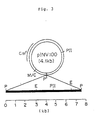
- Fig. 3 illustrates a restriction enzyme map of plasmid pINV128 obtained in Example hereinafter.
- the symbols P, E, PII, M and C represent cleavage sites by restriction enzymes, Pst I, Eco RI, Pvu II, Msp I and Cla I, respectively.
- the symbols Cm r , Am r and Tc r show regions of chloramphenicol resistance gene, ampicillin resistance gene and tetracycline resistance gene, respectively.
- the blank part is vector DNA and the black part means chromosomal DNA fragment derived from Bacillus subtilis DFCR-100.
- the present inventors have studied intensively to develop cytidine producers by using gene recombination technique. As a result, the present inventors have succeeded in isolating a gene region coding for cytidine 5'-triphosphate synthetase gene (hereinafter referred to as CTP synthetase gene) from bacteria belonging to the genus Bacillus showing cytidine analogue resistance, and have been found that the region provides cytidine analogue resistance and a transformant obtained by using a plasmid in which the gene region is incorporated can accumulate a large amount of cytidine in a medium. Thus, the present invention has been completed.
- CTP synthetase gene cytidine 5'-triphosphate synthetase gene
- the present invention provides (1) DNA containing CTP synthetase gene obtained from chromosomal DNA of a bacterial strain of the genus Bacillus exhibiting cytidine analogue resistance, especially, DNA containing CTP synthetase gene providing cytidine analogue resistance; (2) plasmid in which the DNA is incorporated; (3) a bacterial strain transformed with the plasmid, especially, a bacterial strain of the genus Bacillus having capability of the production of cytidine; and (4) a process for production of cytidine which comprises cultivating a bacterial strain of the genus Bacillus transformed with plasmid in which CTP synthetase gene providing cytidine analogue resistance is incorporated to produce and accumulate cytidine in a culture medium, and collecting the resultant.
- the DNA used in the present invention exhibits cytidine analogue resistance and can be isolated from bacteria of the genus Bacillus having capability of the production of cytidine. Such a DNA is also produced by inserting CTP synthetase gene from wild-type bacteria belonging to Bacillus into a plasmid vector and mutation of the resulting recombinant DNA.
- Example of the DNA donor includes Bacillus subtilis DFCR-100 (IFO 15026, FERM BP-2860) which is a cytidine analogue resistant mutant derived from Bacillus subtilis No. 122 (IFO 14386, FERM P-7908).
- the cytidine analogue resistant strain used herein means a mutant derived from a bacterial strain belonging to the genus Bacillus as a parent, which can grow on a medium containing cytidine analogue in such a concentration that the parent strain can not grow.
- a cytidine analogue used herein means a material whose growth inhibition effect can be recovered by cytidine, for example, 5-fluorocytidine, 2-thiocytidine, 6-azacytidine, 3-deazauracil, 3-deazauridine and the like.
- Examples of isolation of a DNA fragment containing CTP synthetase gene include a process wherein the chromosomal DNA is firstly extracted from the donor [for example, a method described in Biochim. Biophys. Acta, 72 , 619 (1963) can be employed], and the resultant is cleaved with a suitable restriction enzyme.
- a typical example of DNA conferring cytidine analogue resistance includes DNA having two Pst I cleavage sites at about 7.5 kb interval, and two Eco RI cleavage sites and one Pvu II cleavage site in the Pst I fragment.
- the vector DNA used in the present invention is appropriately selected from those growable in a bacterial strain belonging to the genus Bacillus , or those growable in a bacterial strain belonging to the genus Escherichia and Bacillus (so-called shuttle vector) or a recombinant of vector DNA deficient in automonous replication ability in a host belonging to the genus Bacillus and chromosomal DNA of a bacterial strain belonging to the genus Bacillus by which the recombinant DNA can be stably inserted in chromosome of the host cell (so-called integration vector).
- the growable plasmids which can grow in a bacterial strain belonging to the genus Bacillus include, for example, pUB110 [J.
- the so-called shuttle vectors which can grow in a bacterial strain belonging to the both genera Escherichia and Bacillus include, for example, pHV14 [Proc. Natl. Acad. Sci. U.S.A., 75 , 1433 (1978)], pHY300PLK [Jpn. J. Genet., 61 , 515 (1986)] and the like.
- the integration vector includes pJH101 [J.
- Thus-obtained vector DNA integrating CTP synthetase gene can be used for transformation of a bacterial strain belonging to the genera Escherichia and Bacillus .
- a method wherein the recipient cells are treated with calcium chloride to introduce DNA [J. Mol. Biol., 53 , 159 (1979)]
- transformation methods for example, a method wherein the recipient is converted to protoplast to introduce DNA [Mol. Gen. Genet., 168 , 111 (1979)] or a method using competent cells [J.
- CTP synthetase gene includes, for example, a method wherein CTP synthetase defective mutant of bacteria belonging to the genus Bacillus or Escherichia is transformed and the strains which have CTP synthetase activity are isolated, and CTP synthetase gene is isolated from the resultant.
- This procedure based on the fact that CTP synthetase defective mutant can not grow on the medium containing no cytidine, while the transformant having vector DNA integrating CTP synthetase gene can grow on a medium containing no cytidine.
- the example of this recipient includes Escherichia coli G-1445.
- the method wherein the antibiotics may be added to the above selected medium or the like may be employed to further facilitate selection of the objective transformant.
- Thus-obtained vector DNA integrating CTP synthetase gene is extracted from a transformant and introduced into another recipient.
- a DNA fragment containing CTP synthetase gene is prepared from the extracted recombinant DNA, and the resultant is used combining with another vector plasmid.
- the host to which the plasmid is introduced may be a CTP synthetase defective strain, or a wild-type strain.
- a mutant or cytidine deaminase defective recombinant or transformant wherein the biosynthesis activity of cytidine or a precursor thereof is enhanced by imparting properties such as pyrimidine analogue resistance may be used as a recipient.
- the precursor used herein means carbamyl phosphate, carbamyl aspartate, aspartic acid, dihydroorotic acid, orotic acid, 5-phospho-D-ribosyldiphosphate, orotic acid, orotidine, orotidine 5'-monophosphate, uracil, uridine, uridine 5'-monophosphate, uridine 5'-diphosphate, uridine 5'-triphosphate and the like.
- transformants thus obtained include, for example, Bacillus subtilis PINV128 (IFO 15028, FERM BP-2861) which is a transformant of Bacillus subtilis CDC-1, Bacillus subtilis PINV228 (IFO 15029, FERM BP-2859) which is a transformant of Bacillus subtilis DFCR-100 (IFO 15026, FERM BP-2860).
- Escherichia coli G-1445 is derived from Escherichia coli C600 [Bacteriol. Rev., 36 , 525 (1972)] as a parent strain, and which is deficient in CTP synthetase. Other mycological properties are the same as those of the parent strains.
- Bacillus subtilis DFCR-100 is derived from Bacillus subtilis No. 122 (IFO 14386, FERM P-7908) as a parent, deficient in cytidine deaminase, resistant to cytidine analogue and possesses capability of the production of cytidine. Other properties are the same as those of the parent strains.
- the IFO number used herein is the accession number in Institute for Fermentation (IFO, 2-17-85, Jusohonmachi, Yodogawa-ku, Osaka-city, Osaka, Japan) and FERM P number is the accession number in Fermentation Research Institute, Agency of Industrial Science and Technology (FRI, 1-1-3, Higashi, Tsukuba-city, Ibaragi, Japan) and FERM BP number is the accession number to FRI under Budapest treaty.
- cultivation methods for conventional microorganisms there can be used cultivation methods for conventional microorganisms. That is, culture media containing carbon sources, nitrogen sources, metal ions and, if necessary, other nutrients such as amino acids, nucleic acids, vitamins and the like can be used.
- carbon sources glucose, sucrose, maltose, sorbitol, starch, saccharified starch, molasses and the like can be used.
- inorganic nitrogen sources such as ammonium salts of sulfuric acid, nitric acid, hydrochloric acid, carbonic acid, gaseous ammonia, aqueous ammonia and the like can be also used alone or in combination thereof.
- various inorganic salts, amino acids, nucleic acid, vitamins and the like which are necessary for the growth of the microorganism are appropriately selected and used alone or in combination thereof.
- an antifoaming agent such as silicone oil, polyalkylene glycol ether or the like, a surfactant and the like can be added to the culture medium.
- the cultivation is carried out under aerobic conditions such as shaking culture, aeration submerged culture or the like.
- pH of the culture medium is within the range of 4 to 9.
- sulfuric acid, calcium carbonate, sodium hydroxide, gaseous ammonia, aqueous ammonia and the like can be added to adjust pH to the above preferred range.
- the cultivation temperature is appropriately selected from the range of 20 to 45°C so that the temperature is suitable for the growth of a particular microorganism to be used and the accumulation of cytidine. The cultivation is continued until the accumulation of cytidine substantially becomes maximum.
- the object can be attained by cultivation for 2 to 6 days.
- purification means for example, precipitation as well as isolation and purification methods such as chromatography using an ion exchange resin, activated charcoal and the like.
- Bacillus subtilis No. 122 (IFO 14386, FERM P-7908) was treated with 50 ⁇ g/ml of N-methyl-N'-nitro-N-nitrosoguanidine (NTG) at 37°C for 20 minutes (hereinafter, NTG treatment was conducted under the same conditions), then spread on the following basal medium (MT-9) to which was added 0.01% uracil and cultivation was conducted at 37°C for 2 days. Uracil-requiring mutants were selected from the developed colony by replica method. Subsequently, the uracil-requiring mutant was subjected to NTG treatment and spread on MT-9 medium containing 0.01% uracil and cultivated at 37°C for 2 days.
- the developed colonies were replicated onto MT-9 medium to which 100 ⁇ g/ml cytidine was added to select cytidine deaminase defective strains which can not grow on this medium were selected. Subsequently, the above cytidine deaminase defective strains were subjected to NTG treatment, smeared on MT-9 medium and cultivated at 37°C for 2 days. Bacillus subtilis CDD-1 was selected as a cytidine deaminase defective strain from among the developed colonies.
- the CDD-1 was further treated with NTG, then smeared on MT-9 medium containing 5 ⁇ g/ml of 5-fluorocytidine which was a kind of cytidine analogues and cultivated at 37°C for 3 days.
- Bacillus subtilis FCR-13 was selected as a strain having capability of the production of cytidine from among the developed colonies.
- the FCR-13 was further treated with NTG, then smeared on MT-9 medium containing 1,000 ⁇ g/ml of 3-deazauracil which was a kind of cytidine analogues and cultivated 37°C for 3 days.
- Bacillus subtilis DFCR-100 (IFO 15026, FERM BP-2860) was selected as a strain having enhanced capability of the production of cytidine from among the developed colonies.
- Bacillus subtilis DFCR-100 obtained in the above (i) having cytidine analogue tolerance and producing cytidine was inoculated on 1 liter of L medium shown below, cultivated at 37°C for 12 hours, and DNA was extracted from the resulting cells according to the method by Saito et al. [Biochim. Biophys. Acta, 72 , 619 (1963)] to obtain 6.0 mg of chromosomal DNA.
- the chromosomal DNA obtained in the above (i) (10 ⁇ g) and pBR322 (3 ⁇ g) were respectively cleaved with the restriction enzyme Pst I (manufactured by Nippon Gene Co., Ltd., Japan), then the both were mixed and ligated with DNA ligase (manufactured by Nippon Gene Co., Ltd.) derived from T4 phage.
- a method to introduce DNA by treatment of recipient cell with calcium chloride [J. Mol. Biol., 53 , 159 (1979)], i.e., competent cell method was employed.
- the plasmid DNA prepared in the above (iii) was added to the suspension of competent cells prepared from Escherichia coli G-1445 for transformation.
- the suspension containing this transformant was smeared on MT-9 medium containing 12.5 ⁇ g/ml of tetracycline and cultivated at 37°C for 3 days.
- Escherichia coli G-1 IFO 15027, FERM BP-2858
- the transformant Escherichia coli G-1 was inoculated on 1 liter of L medium containing 12.5 ⁇ g/ml of tetracycline and cultivated at 37°C for 12 hours. Eventually, 500 ⁇ g of plasmid was isolated from the resulting strain and named as pYRG100.
- pYRG100 was a recombinant plasmid wherein about 7.5-kbp DNA fragment was inserted at Pst I site of pBR322 and has Eco RI cleavage sites at 3.0, 6.5 kbp and Pvu II cleavage site at 4.8 kbp from PstI site at the right side of the drawing.
- Chloramphenicol resistant gene carried by plasmid pC194 [J. Bacteriol., 150 , 815 (1982)] was cleaved with restriction enzymes Msp I and Pvu II. After digests of plasmid pBR322 with Cla I and Pvu II were mixed with the resultant, ligation was carried out using T4 ligase. The reaction solution was added to a suspension of competent cells prepared from Escherichia coli C600, and transformed according to the method shown in the above (iii). Then, the suspension containing this transformant was smeared on MT-9 medium containing 10 ⁇ g/ml of chloramphenicol and cultivated at 37°C for one day.
- Escherichia coli PINV100 having resistance to chloramphenicol as well as resistance to ampicillin was obtained.
- a plasmid was extracted from Escherichia coli PINV100 by the method shown in the above (v) and named as pINV100.
- the preparation process and restriction enzyme map of pINV100 are shown in Fig. 2.
- chloramphenicol resistance gene derived from pC194 was inserted between ClaI and PvuII sites of pBR322.
- Plasmid pYRG100 (1 ⁇ g) obtained in the above (v) and plasmid pINV100 (1 ⁇ g) obtained in the above (vii) were cleaved with restriction enzyme Pst I. After mixing, ligation was carried out using T4 ligase. Escherichia coli G-1445 was transformed in the same manner as that described in (iv) by using the resultant. Then, the suspension containing this transformant was smeared on MT-9 medium containing 10 ⁇ g/ml of chloramphenicol and cultivated at 37°C for 2 days. Escherichia coli PINV128 which was a transformant having chloramphenicol resistance and no requirement for cytidine was obtained in the developed colonies.
- a plasmid was extracted from Escherichia coli PINV128 in the same manner as that shown in the above (v), and the resultant was named as pINV128. Restriction enzyme map of pINV128 is shown in Fig. 3. In pINV128, CTP synthetase gene which provides cytidine analogue resistance is inserted at Pst I site of pINV100.
- Bacillus subtilis CDD-1 and Bacillus subtilis DFCR-100 were transformed using pINV128 obtained in (viii). Transformation was conducted according to a competent cell method [J. Bacteriol., 81 , 714 (1961)], wherein MT-9 medium containing 10 ⁇ g/ml of chloramphenicol was used for selection of transformant. As transformants of Bacillus subtilis CDD-1 and Bacillus subtilis DFCR-100, Bacillus subtilis PINV128 (IFO 15028, FERM BP-2861) and Bacillus subtilis PINV228 (IFO 15029, FERM BP-2859) were obtained, respectively.
- Strain PINV128 obtained by introducing plasmid pINV128 into CDD-1 shows resistance to cytidine analogue such as 5-fluorocytidine and 3-deazauracil. The result shows that the DNA fragment derived from pYRG100 which is inserted in pINV128 is CTP synthetase gene providing cytidine analogue resistance.
- Transformants PINV128 and PINV228 and their parent strains, i.e., CDD-1 and DFCR-100 were inoculated in a 200 ml volume flask containing the following production medium (20 ml), cultivated at 37°C for 3 days, and productivity of cytidine was compared. The results are shown in Table 2.
- a cytidine producer can be derived by introducing the recombinant DNA containing CTP synthetase gene which provides cytidine analogue resistance.
- productivity of cytidine of a cytidine producer strain can be enhanced according to the present invention.
Landscapes
- Life Sciences & Earth Sciences (AREA)
- Chemical & Material Sciences (AREA)
- Organic Chemistry (AREA)
- Health & Medical Sciences (AREA)
- Zoology (AREA)
- Engineering & Computer Science (AREA)
- Wood Science & Technology (AREA)
- Genetics & Genomics (AREA)
- Bioinformatics & Cheminformatics (AREA)
- Microbiology (AREA)
- Biotechnology (AREA)
- Molecular Biology (AREA)
- Biochemistry (AREA)
- General Engineering & Computer Science (AREA)
- General Health & Medical Sciences (AREA)
- Biomedical Technology (AREA)
- Medicinal Chemistry (AREA)
- Chemical Kinetics & Catalysis (AREA)
- General Chemical & Material Sciences (AREA)
- Micro-Organisms Or Cultivation Processes Thereof (AREA)
- Preparation Of Compounds By Using Micro-Organisms (AREA)
Applications Claiming Priority (2)
| Application Number | Priority Date | Filing Date | Title |
|---|---|---|---|
| JP2106721A JPH044881A (ja) | 1990-04-23 | 1990-04-23 | シチジンアナログ耐性化遺伝子dnaおよびその用途 |
| JP106721/90 | 1990-04-23 |
Publications (1)
| Publication Number | Publication Date |
|---|---|
| EP0458070A1 true EP0458070A1 (de) | 1991-11-27 |
Family
ID=14440818
Family Applications (1)
| Application Number | Title | Priority Date | Filing Date |
|---|---|---|---|
| EP19910106397 Withdrawn EP0458070A1 (de) | 1990-04-23 | 1991-04-20 | DNS-Gen zum Widerstand gegen Cytidine Analogen und reine Verwendung |
Country Status (2)
| Country | Link |
|---|---|
| EP (1) | EP0458070A1 (de) |
| JP (1) | JPH044881A (de) |
Cited By (1)
| Publication number | Priority date | Publication date | Assignee | Title |
|---|---|---|---|---|
| WO1998031375A1 (en) * | 1997-01-21 | 1998-07-23 | The United States Of America As Represented By Thesecretary Of The Department Of Health And Human Sevices | Enhanced suppression of hiv-1 by the combination of cytidine nucleoside analogues and ctp synthase inhibitors |
Families Citing this family (1)
| Publication number | Priority date | Publication date | Assignee | Title |
|---|---|---|---|---|
| KR20000063486A (ko) * | 2000-07-15 | 2000-11-06 | 김상관 | 공동 배달물품 수납장치 |
Citations (2)
| Publication number | Priority date | Publication date | Assignee | Title |
|---|---|---|---|---|
| EP0188708A1 (de) * | 1984-12-06 | 1986-07-30 | Takeda Chemical Industries, Ltd. | Verfahren zur Herstellung von Cytidin und/oder Desoxycytidin |
| EP0329062A2 (de) * | 1988-02-17 | 1989-08-23 | Takeda Chemical Industries, Ltd. | Ein DNS-Resistenzgen gegen Pyrimidine Analoge und dessen Verwendung. |
-
1990
- 1990-04-23 JP JP2106721A patent/JPH044881A/ja active Pending
-
1991
- 1991-04-20 EP EP19910106397 patent/EP0458070A1/de not_active Withdrawn
Patent Citations (2)
| Publication number | Priority date | Publication date | Assignee | Title |
|---|---|---|---|---|
| EP0188708A1 (de) * | 1984-12-06 | 1986-07-30 | Takeda Chemical Industries, Ltd. | Verfahren zur Herstellung von Cytidin und/oder Desoxycytidin |
| EP0329062A2 (de) * | 1988-02-17 | 1989-08-23 | Takeda Chemical Industries, Ltd. | Ein DNS-Resistenzgen gegen Pyrimidine Analoge und dessen Verwendung. |
Non-Patent Citations (3)
| Title |
|---|
| AGRICULTURAL AND BIOLOGICAL CHEMISTRY vol. 53, no. 1, 1989, pages 97-102, JP; S. ASAHI et al.: "Regulation of Pyrimidine Nucleotide Biosynthesis in Cytidine Deaminase-negative Mutants of Bacillus subtilis" * |
| FOLIA MICROBIOLOGICA vol. 17, no. 6, 1972, pages 517-521, Prague, CS; V. FUCIK et al.: "Mechanism of Resistance to 5-Azacytidine in Bacillus Subtilis. I. Isolation and some Properties of Mutants Resistant to 5-Azacytidine and 5-Aza-2'-deoxycytidine" * |
| JOURNAL OF BACTERIOLOGY vol. 170, no. 9, September 1988, pages 4194-4208, Baltimore, US; K. TRACH et al.: "Complete Sequence and Transcriptional Analysis of the spo0F Region of the Bacillus subtilis Chromosome" * |
Cited By (1)
| Publication number | Priority date | Publication date | Assignee | Title |
|---|---|---|---|---|
| WO1998031375A1 (en) * | 1997-01-21 | 1998-07-23 | The United States Of America As Represented By Thesecretary Of The Department Of Health And Human Sevices | Enhanced suppression of hiv-1 by the combination of cytidine nucleoside analogues and ctp synthase inhibitors |
Also Published As
| Publication number | Publication date |
|---|---|
| JPH044881A (ja) | 1992-01-09 |
Similar Documents
| Publication | Publication Date | Title |
|---|---|---|
| EP0136359B1 (de) | Herstellungsverfahren für l-histidin | |
| WO2011115439A2 (ko) | 5'-크산틸산 및 5'-구아닐산 생산능이 향상된 미생물 및 이를 이용한 5'-크산틸산 또는 5'-구아닐산의 생산방법 | |
| EP2115120B1 (de) | Mikroorganismus zur herstellung von inosin und verfahren zur herstellung von inosin damit | |
| EP1792975B1 (de) | Mikroorganismus des Genus Corynebacterium der eine erhöhte L-Lysinproduktivität hat und Verfahren zur Herstellung von L-Lysin durch besagten Mikroorganismus | |
| EP0273660B1 (de) | Für inaktivierte IMP-Dehydrogenase kodierende DNS | |
| EP0286303B1 (de) | DNA und ihre Verwendung | |
| KR101072708B1 (ko) | 5'-크산틸산 생산능이 향상된 미생물 및 이를 이용한 5'-크산틸산의 생산방법 | |
| EP0504279B1 (de) | Fermentationsprozess zur herstellung von pyrimidin | |
| EP0412688A1 (de) | Modifizierter DNA und seine Verwendung | |
| EP0251489A2 (de) | Verfahren zur Herstellung von 5'-Guanyl-Säure | |
| EP0329062B1 (de) | Ein DNS-Resistenzgen gegen Pyrimidine Analoge und dessen Verwendung. | |
| JPH0673452B2 (ja) | 新規バチルス・ズブチリス | |
| EP0465132A2 (de) | DNA und seine Verwendung | |
| EP0179468B1 (de) | Herstellung von Uridin | |
| US4749650A (en) | Bacillus containing a 5'inosinate dehydrocenase gene | |
| EP0393969A2 (de) | ZMP-Dehydrogenase Gen enthaltende DNS und reine Verwendung | |
| EP2233563B1 (de) | Mikroorganismus der gattung corynebacterium mit fähigkeit zur herstellung von inosin sowie verfahren zur herstellung von inosin damit | |
| KR100957690B1 (ko) | 5'-크산틸산 생산능이 향상된 코리네박테리움 속 미생물및 이를 이용한 5'-크산틸산의 생산 방법 | |
| EP0080378A2 (de) | L-Tryptophan-herstellende Mikroorganismen | |
| EP1844135B1 (de) | Zur umwandlung von xmp in gmp und zur bewahrung des inaktivierten zustands eines oder mehrerer gene im zusammenhang mit gmp-abbau fähiger escherichia-stamm und verfahren zur verwendung davon | |
| Miyagawa et al. | Increased inosine production by a Bacillus subtilis xanthine-requiring mutant derived by insertional inactivation of the IMP dehydrogenase gene | |
| EP0417953A1 (de) | Verfahren zur Herstellung von Thiamin-Phosphaten | |
| JPH044881A (ja) | シチジンアナログ耐性化遺伝子dnaおよびその用途 | |
| EP0542240A2 (de) | Verfahren zur Herstellung von Flavin-Nukleotiden |
Legal Events
| Date | Code | Title | Description |
|---|---|---|---|
| PUAI | Public reference made under article 153(3) epc to a published international application that has entered the european phase |
Free format text: ORIGINAL CODE: 0009012 |
|
| AK | Designated contracting states |
Kind code of ref document: A1 Designated state(s): DE ES FR IT |
|
| RAP3 | Party data changed (applicant data changed or rights of an application transferred) |
Owner name: TAKEDA CHEMICAL INDUSTRIES, LTD. |
|
| STAA | Information on the status of an ep patent application or granted ep patent |
Free format text: STATUS: THE APPLICATION HAS BEEN WITHDRAWN |
|
| 18W | Application withdrawn |
Withdrawal date: 19920527 |