EP0458220B1 - Verfahren zur Herstellung von Reissverschlüssen - Google Patents
Verfahren zur Herstellung von Reissverschlüssen Download PDFInfo
- Publication number
- EP0458220B1 EP0458220B1 EP91108063A EP91108063A EP0458220B1 EP 0458220 B1 EP0458220 B1 EP 0458220B1 EP 91108063 A EP91108063 A EP 91108063A EP 91108063 A EP91108063 A EP 91108063A EP 0458220 B1 EP0458220 B1 EP 0458220B1
- Authority
- EP
- European Patent Office
- Prior art keywords
- stringer
- length
- chain
- stringer chain
- control mark
- Prior art date
- Legal status (The legal status is an assumption and is not a legal conclusion. Google has not performed a legal analysis and makes no representation as to the accuracy of the status listed.)
- Expired - Lifetime
Links
Images


Classifications
-
- A—HUMAN NECESSITIES
- A44—HABERDASHERY; JEWELLERY
- A44B—BUTTONS, PINS, BUCKLES, SLIDE FASTENERS, OR THE LIKE
- A44B19/00—Slide fasteners
- A44B19/42—Making by processes not fully provided for in one other class, e.g. B21D53/50, B21F45/18, B22D17/16, B29D5/00
-
- Y—GENERAL TAGGING OF NEW TECHNOLOGICAL DEVELOPMENTS; GENERAL TAGGING OF CROSS-SECTIONAL TECHNOLOGIES SPANNING OVER SEVERAL SECTIONS OF THE IPC; TECHNICAL SUBJECTS COVERED BY FORMER USPC CROSS-REFERENCE ART COLLECTIONS [XRACs] AND DIGESTS
- Y10—TECHNICAL SUBJECTS COVERED BY FORMER USPC
- Y10T—TECHNICAL SUBJECTS COVERED BY FORMER US CLASSIFICATION
- Y10T29/00—Metal working
- Y10T29/49—Method of mechanical manufacture
- Y10T29/49782—Method of mechanical manufacture of a slide fastener
-
- Y—GENERAL TAGGING OF NEW TECHNOLOGICAL DEVELOPMENTS; GENERAL TAGGING OF CROSS-SECTIONAL TECHNOLOGIES SPANNING OVER SEVERAL SECTIONS OF THE IPC; TECHNICAL SUBJECTS COVERED BY FORMER USPC CROSS-REFERENCE ART COLLECTIONS [XRACs] AND DIGESTS
- Y10—TECHNICAL SUBJECTS COVERED BY FORMER USPC
- Y10T—TECHNICAL SUBJECTS COVERED BY FORMER US CLASSIFICATION
- Y10T29/00—Metal working
- Y10T29/53—Means to assemble or disassemble
- Y10T29/53039—Means to assemble or disassemble with control means energized in response to activator stimulated by condition sensor
- Y10T29/53048—Multiple station assembly or disassembly apparatus
- Y10T29/53052—Multiple station assembly or disassembly apparatus including position sensor
-
- Y—GENERAL TAGGING OF NEW TECHNOLOGICAL DEVELOPMENTS; GENERAL TAGGING OF CROSS-SECTIONAL TECHNOLOGIES SPANNING OVER SEVERAL SECTIONS OF THE IPC; TECHNICAL SUBJECTS COVERED BY FORMER USPC CROSS-REFERENCE ART COLLECTIONS [XRACs] AND DIGESTS
- Y10—TECHNICAL SUBJECTS COVERED BY FORMER USPC
- Y10T—TECHNICAL SUBJECTS COVERED BY FORMER US CLASSIFICATION
- Y10T29/00—Metal working
- Y10T29/53—Means to assemble or disassemble
- Y10T29/53291—Slide fastener
Definitions
- This invention generally relates to a method of manufacturing slide fastener products from an elongate continuous stringer chain and more particularly such a method which enables selective production of slide fasteners of different types, lengths and/or colors during a continuous automatic cycle of operation.
- This invention particularly relates to a method of manufacturing slide fasteners which comprises the steps of gapping an elongate continuous stringer chain to provide first element-devoid space portions having a standard length at predetermined intervals therealong; selectively feeding and applying various slide fastener component parts onto said stringer chain; and cutting said stringer chain across said element-devoid space portions into individual slide fastener products.
- EP-A-0 181 576 A method of the type mentioned above is disclosed in EP-A-0 181 576.
- the element-devoid space portions having a standard length are detected by mechanical means associated with an optical sensor.
- these detecting means it is detected when a leading end of one of the successive spaced pairs of coupling elements groups is in a separate detecting station fully upstream of the cutting station.
- the moving rate of the fastener chain is reduced from a high speed to a low speed until a preceding element-free gap section continuous to the leading end of said one pair of coupling element groups arrives at the cutting station.
- the movement of the fastener chain is terminated and the slide fastener chain is severed transverse across said preceding element-free gap section.
- the present invention seeks to provide an improved method of manufacturing slide fasteners which will make it possible to produce slide fastener products of different forms, sizes and/or colors from a single continuous elongate stringer chain or a plurality of interconnected stringer chains.
- the invention further seeks to provide an improved method of manufacturing slide fasteners of the character described in which there is provided a means of detecting the control marks without fail to trigger operation of the respective parts applying units.
- a method satisfying these requirements is characterized in that it further comprises forming a control mark consisting of a second element-devoid space portion having a length greater than that of said first element-devoid space portion at locations spaced apart by predetermined distances along the length of said stringer chain; and detecting said control mark on said stringer chain in ad vance of each of said steps by means of a detector having an operating length corresponding to the length of said control mark.
- a single continuous stringer chain F which comprises a pair of the same kind of stringer tapes T, T and a row of the same kind of coupling elements E mounted thereon and gapped to provide element-devoid space portions at predetermined intervals.
- a first space portion S1 hereinafter referred to as a standard space portion, has a standard length l1 normally adopted for determining a given product length of an individual slide fastener.
- the first space portion S1 is formed by removing a corresponding length of a row of interengaged coupling elements E from the tapes T, T at locations spaced apart by predetermined distances along the length of the chain F by means of a gapping device 11 shown in Figure 7 which essentially comprises a punch 11a and a die anvil 11b, the punch 11a having an operating length corresponding to the standard space portion S1.
- a second space portion S2 hereinafter referred to as a control mark, has a length l2 greater than that l1 of the standard space portion S1 and hence can be formed by the same gapping device 11; that is, by actuating the punch 11a twice or thrice to provide the space length l2 at locations spaced a predetermined distance apart along the length of the chain F.
- the two neighboring control marks S2, S2 are spaced apart across a connecting strip C spanning the width of the tapes T, T, and interconnecting adjoining stringer tapes T, T which are different in for instance color, size and/or material.
- FIG. 3 shows a control mark detector 100 which comprises a pair of vertically disposed first and second levers 101 and 102 which are mounted on a carrier 103 in spaced apart relation longitudinally of the stringer chain F and pivotable about their respective pins 104 and 105.
- Each of the levers 101 and 102 has a shank 106, (107) at its lower end and a probing roll 108, (109) rotatably connected thereto.
- Springs 110 and 111 are connected to the upper portions of the respective levers 101 and 102 and adapted to normally urge the respective rolls 108 and 109 against the interengaged rows of coupling elements E.
- Designated at 112 and 113 are projecting lugs extending laterally from the upper ends of the respective levers 101 and 102 and adapted to engage respective microswitches 114 and 115 when the probing rolls 108 and 109 are brought into engagement with the second space portion or control mark S2 in a manner hereinafter described.
- the levers 101 and 102 are spaced from each other by a distance corresponding to the length l2 of the control mark S2 such that both of the microswitches 114 and 115 are actuated when both of the two rolls 108 and 109 are simultaneously located in and at the control mark S2 as shown in Figure 4.
- the probing roll 108 of the first lever 101 reaches the control mark S2, causing the lever 101 to make a pivotal movement about the pin 104 and hence the lug 112 to contact the microswitch 114.
- a similar action is followed by the second lever 102.
- both microswitches 114 and 115 are turned on simultaneously, whereupon a parts applying unit immediately downstream of the detector 100 is triggered to perform its work according to a computer program which has been compiled to effect a predetermined mode of operation of the apparatus.
- An optical detection means may be alternatively used to detect the control mark S2.
- Figures 5 and 6 illustrate a stringer chain F having a standard space portion S1 smaller in length than the control mark S2. Due to the standard space portion S1 being shorter, there is no instance in which the two rolls 108 and 109 are located simultaneously in and at the control mark S2 to actuate the two microswitches 114 and 115 at the same time. Therefore, there is no risk of erroneous detection of the control mark S2, or malfunction of the apparatus.
- the apparatus 10 comprises a gapping unit 11, a bottom end stop applying unit 12, a slider applying unit 13, a top end stop applying unit 14, and a cutting unit 15.
- the starting stringer chain F supplied from a source not shown is metered by a metering roll assembly 16 which meters the length of the chain F by counting the number of revolutions for instance of a roll 16', and the feeding of the stringer chain F is arranged to stop upon completion of a predetermined number of revolutions of the roll 16'.
- a reserve vessel V is provided for storing a plurality of stringer chains F of different sizes and product characteristics which have been metered and fed from the metering assembly 16.
- the chain F is advanced by feed rolls 17 into the gapping unit 11, which essentially comprises a punch 11a and a die anvil 11b disposed in confronting relation to each other, and gapped at a predetermined position to remove a length of coupling elements E thereby providing the first or standard element-devoid space portion S1 as well as the second space portion or control mark S2 at predetermined intervals as already described.
- the gapping unit 11 essentially comprises a punch 11a and a die anvil 11b disposed in confronting relation to each other, and gapped at a predetermined position to remove a length of coupling elements E thereby providing the first or standard element-devoid space portion S1 as well as the second space portion or control mark S2 at predetermined intervals as already described.
- the control mark detector 100 is located upstream of the bottom end stop applying unit 12 and adapted to detect the control mark S2 in a manner described hereinabove, thereby triggering operation of a bottom end stop feeder 19 to supply a new or selected set of end stops Be differring in form and/or color from a previous inventory of end stops.
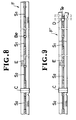
- the stringer chain F upon attachment with the end stop Be as shown in Figure 8, continues to advance until the control mark S2 is detected by another detector 100' upstream of the cutting unit 15, whereupon the subsequent slider and top end stop applying units 13 and 14 are triggered to apply a new or selected slider D and top end stop Te from a slider feeder 20 and a top end stop feeder 21, respectively in a manner well known in the art and as shown in Figure 9.
- the stringer chain F thus assembled is cut by the cutter 15 across the standard space portion S1 to provide an individual slide fastener product F' as shown in Figures 9 and 7.
Landscapes
- Slide Fasteners (AREA)
- Making Paper Articles (AREA)
Claims (5)
- Verfahren zur Herstellung von Reißverschlüssen (F'), umfassend die Schritte: Stanzen einer langgestreckten fortlaufenden Reißverschlußkette (F), um erste kuppelgliederfreie Bereiche (S₁) einer Standardlänge (l₁) in vorbestimmten Abständen derselben zu erzeugen; ausgewähltes Zuführen und Anbringen verschiedener Reißverschlußbestandteile an der Reißverschlußkette (F); und Zerschneiden der Reißverschlußkette (F) quer zu den kuppelgliederfreien Bereichen (S₁) in einzelne Reißverschlußerzeugnisse (F'), dadurch gekennzeichnet, daß das Verfahren ferner umfaßt: Ausbilden einer Kontrollmarke, bestehend aus einem zweiten kuppelgliederfreien Bereich (S₂) mit einer Länge (l₂), die großer ist als die Länge (l₁) der ersten kuppelgliederfreien Bereiche (S₁) an Orten, die entlang der Länge der Reißverschlußkette (F) bestimmte Abstände haben; und Ermitteln der Kontrollmarke (S₂) auf der Reißverschlußkette (F) vor jedem dieser Schritte mit einem Detektor (100, 100'), der eine der Länge (l₂) der Kontrollmarke (S₂) entsprechende Betriebslänge hat.
- Verfahren nach Anspruch 1, dadurch gekennzeichnet, daß eine Vielzahl von Kontrollmarken (S₂) über eine von einer bestimmten Länge einer Kuppelgliederreihe (E) gebildete Abgrenzungszone voneinander getrennt sind.
- Verfahren nach Anspruch 1, dadurch gekennzeichnet, daß eine Vielzahl von Kontrollmarken (S₂) durch einen benachbarte Reißverschlußketten (F) verbindenden Verbindungsstreifen (C) voneinander getrennt sind.
- Verfahren nach Anspruch 1, dadurch gekennzeichnet, daß die Reißverschlußkette (F) eine einzige fortlaufende längliche Reißverschlußkette der gleichen Eigenschaften ist.
- Verfahren nach Anspruch 1, dadurch gekennzeichnet, daß die Reißverschlußkette (F) mehrere miteinander verbundene Reißverschlußketten unterschiedlicher Eigenschaften umfaßt.
Applications Claiming Priority (2)
| Application Number | Priority Date | Filing Date | Title |
|---|---|---|---|
| JP2129945A JPH0767401B2 (ja) | 1990-05-19 | 1990-05-19 | スライドフアスナーの製造方法 |
| JP129945/90 | 1990-05-19 |
Publications (3)
| Publication Number | Publication Date |
|---|---|
| EP0458220A2 EP0458220A2 (de) | 1991-11-27 |
| EP0458220A3 EP0458220A3 (en) | 1992-02-19 |
| EP0458220B1 true EP0458220B1 (de) | 1995-03-29 |
Family
ID=15022322
Family Applications (1)
| Application Number | Title | Priority Date | Filing Date |
|---|---|---|---|
| EP91108063A Expired - Lifetime EP0458220B1 (de) | 1990-05-19 | 1991-05-17 | Verfahren zur Herstellung von Reissverschlüssen |
Country Status (14)
| Country | Link |
|---|---|
| US (1) | US5075949A (de) |
| EP (1) | EP0458220B1 (de) |
| JP (1) | JPH0767401B2 (de) |
| KR (1) | KR930007722B1 (de) |
| AU (1) | AU629123B2 (de) |
| BR (1) | BR9102112A (de) |
| CA (1) | CA2042246C (de) |
| DE (1) | DE69108446T2 (de) |
| ES (1) | ES2071858T3 (de) |
| FI (1) | FI97270C (de) |
| HK (1) | HK105397A (de) |
| ID (1) | ID870B (de) |
| MY (1) | MY106556A (de) |
| ZA (1) | ZA913775B (de) |
Families Citing this family (8)
| Publication number | Priority date | Publication date | Assignee | Title |
|---|---|---|---|---|
| DE69631015T2 (de) * | 1995-05-09 | 2004-08-05 | Ykk Corp. | Verfahren zur herstellung von reissverschluss |
| GB2332238A (en) | 1997-12-12 | 1999-06-16 | Ykk Europ Ltd | Zip fastener having alignment holes |
| US6197307B1 (en) * | 1999-03-30 | 2001-03-06 | Essential Nutrition, Ltd. | Method for producing high activity extracts from harpagophytum procumbens |
| DE60126400T2 (de) * | 2001-04-24 | 2007-11-15 | Ykk Portugal, Lda. | Wärmeübertragungsdrucker zum Markieren von Reissverschlüssen |
| US20030200650A1 (en) * | 2002-04-25 | 2003-10-30 | Ykk Corporation Of America | Slider mounting apparatus and method |
| KR100681482B1 (ko) * | 2005-10-28 | 2007-04-16 | 한국과학기술연구원 | 천수근으로부터 하르파지드를 분리하는 방법 |
| CN101607402B (zh) * | 2008-06-18 | 2011-07-13 | 佛山市南海鸿明号服装配料有限公司 | 自动拉链剪切机 |
| CN101986926B (zh) * | 2009-08-03 | 2012-07-04 | 福建浔兴拉链科技股份有限公司 | 一种拉链穿头方法、拉链穿头机及拉链接头定位方法 |
Family Cites Families (4)
| Publication number | Priority date | Publication date | Assignee | Title |
|---|---|---|---|---|
| JPS59137140A (ja) * | 1983-01-25 | 1984-08-07 | Yoshida Kogyo Kk <Ykk> | スライドフアスナ−チエ−ンの仕上げ装置 |
| JPS6145703A (ja) * | 1984-08-09 | 1986-03-05 | ワイケイケイ株式会社 | フアスナ−チエ−ンの切断方法 |
| US4594925A (en) * | 1984-11-14 | 1986-06-17 | Yoshida Kogyo K. K. | Apparatus for cutting a slide fastener chain |
| DE3825712A1 (de) * | 1988-07-28 | 1990-02-01 | Opti Patent Forschung Fab | Anlage fuer die fertigung von einzelnen reissverschluessen aus einer langen reissverschlusskette |
-
1990
- 1990-05-19 JP JP2129945A patent/JPH0767401B2/ja not_active Expired - Fee Related
-
1991
- 1991-05-08 AU AU76418/91A patent/AU629123B2/en not_active Ceased
- 1991-05-09 CA CA002042246A patent/CA2042246C/en not_active Expired - Lifetime
- 1991-05-15 FI FI912359A patent/FI97270C/fi not_active IP Right Cessation
- 1991-05-17 EP EP91108063A patent/EP0458220B1/de not_active Expired - Lifetime
- 1991-05-17 BR BR919102112A patent/BR9102112A/pt not_active IP Right Cessation
- 1991-05-17 MY MYPI91000834A patent/MY106556A/en unknown
- 1991-05-17 ES ES91108063T patent/ES2071858T3/es not_active Expired - Lifetime
- 1991-05-17 US US07/701,846 patent/US5075949A/en not_active Expired - Fee Related
- 1991-05-17 DE DE69108446T patent/DE69108446T2/de not_active Expired - Fee Related
- 1991-05-17 ZA ZA913775A patent/ZA913775B/xx unknown
- 1991-05-18 KR KR1019910008110A patent/KR930007722B1/ko not_active Expired - Fee Related
-
1992
- 1992-01-28 ID IDP179192A patent/ID870B/id unknown
-
1997
- 1997-06-26 HK HK105397A patent/HK105397A/en not_active IP Right Cessation
Also Published As
| Publication number | Publication date |
|---|---|
| JPH0424003A (ja) | 1992-01-28 |
| US5075949A (en) | 1991-12-31 |
| ZA913775B (en) | 1992-02-26 |
| HK105397A (en) | 1997-08-15 |
| JPH0767401B2 (ja) | 1995-07-26 |
| ES2071858T3 (es) | 1995-07-01 |
| ID870B (id) | 1996-08-21 |
| FI97270B (fi) | 1996-08-15 |
| AU7641891A (en) | 1991-11-21 |
| KR920005686A (ko) | 1992-04-03 |
| EP0458220A2 (de) | 1991-11-27 |
| AU629123B2 (en) | 1992-09-24 |
| FI912359L (fi) | 1991-11-20 |
| DE69108446D1 (de) | 1995-05-04 |
| MY106556A (en) | 1995-06-30 |
| KR930007722B1 (ko) | 1993-08-18 |
| CA2042246A1 (en) | 1991-11-20 |
| FI97270C (fi) | 1996-11-25 |
| CA2042246C (en) | 1995-03-28 |
| DE69108446T2 (de) | 1995-11-09 |
| FI912359A0 (fi) | 1991-05-15 |
| EP0458220A3 (en) | 1992-02-19 |
| BR9102112A (pt) | 1991-12-24 |
Similar Documents
| Publication | Publication Date | Title |
|---|---|---|
| EP0181576B2 (de) | Verfahren und Vorrichtung zum Abschneiden einer Reissverschlusskette | |
| US5075949A (en) | Method of manufacturing slide fasteners | |
| EP0115800B1 (de) | Vorrichtung zum automatischen Bearbeiten einer Reissverschlusskette | |
| US5806163A (en) | Method and apparatus for forming element-free space portion in slide fastener chain | |
| CA1105829A (en) | Method and apparatus for cutting off a pair of slide fastener stringers | |
| CA1213422A (en) | Apparatus for cutting continuous slide fastener chain | |
| KR950006536B1 (ko) | 슬라이드 파스너 체인에 연속적인 공간부분들을 형성하는 방법 | |
| CA1079045A (en) | Method of manufacturing slide fasteners | |
| GB2102493A (en) | Apparatus for manufacturing a continuous slide fastener stringer chain with element-free space portions | |
| KR870000858B1 (ko) | 분리 가능한 슬라이드 파스너의 제조방법 | |
| EP0058882B1 (de) | Vorrichtung zum Herstellen von gliedfreien Lücken in einer fortlaufenden Reissverschlusskette | |
| CA2194472C (en) | Method of manufacturing slide fastener | |
| EP0068430A1 (de) | Vorrichtung und Verfahren zur Herstellung einer fortlaufenden Reissverschlusskette mit Lücken | |
| EP0468334B1 (de) | Vorrichtung zur Entfernung eines Reissverschlusses | |
| EP0460633B1 (de) | Verfahren zur Herstellung von Reissverschlüssen | |
| EP0292110B1 (de) | Verfahren und Vorrichtung zur Fütterung von Reissverschlussketten mit Hosenleisten | |
| US4856695A (en) | Method of and apparatus for feeding slide fastener chain with fly strips | |
| GB2163212A (en) | Slide fastener chain with reinforcing strip | |
| CA1243823A (en) | Device for positioning slide fastener stringers in fastener finishing apparatus | |
| GB2151301A (en) | Forming element-free spaces in continuous slide fastener chain with fly strips | |
| GB2095744A (en) | Forming gaps in continuous slide fastener chains |
Legal Events
| Date | Code | Title | Description |
|---|---|---|---|
| PUAI | Public reference made under article 153(3) epc to a published international application that has entered the european phase |
Free format text: ORIGINAL CODE: 0009012 |
|
| AK | Designated contracting states |
Kind code of ref document: A2 Designated state(s): BE CH DE ES FR GB IT LI NL SE |
|
| PUAL | Search report despatched |
Free format text: ORIGINAL CODE: 0009013 |
|
| AK | Designated contracting states |
Kind code of ref document: A3 Designated state(s): BE CH DE ES FR GB IT LI NL SE |
|
| 17P | Request for examination filed |
Effective date: 19920525 |
|
| 17Q | First examination report despatched |
Effective date: 19930707 |
|
| RAP1 | Party data changed (applicant data changed or rights of an application transferred) |
Owner name: YKK CORPORATION |
|
| GRAA | (expected) grant |
Free format text: ORIGINAL CODE: 0009210 |
|
| AK | Designated contracting states |
Kind code of ref document: B1 Designated state(s): BE CH DE ES FR GB IT LI NL SE |
|
| ITF | It: translation for a ep patent filed | ||
| ET | Fr: translation filed | ||
| REF | Corresponds to: |
Ref document number: 69108446 Country of ref document: DE Date of ref document: 19950504 |
|
| REG | Reference to a national code |
Ref country code: ES Ref legal event code: FG2A Ref document number: 2071858 Country of ref document: ES Kind code of ref document: T3 |
|
| PLBE | No opposition filed within time limit |
Free format text: ORIGINAL CODE: 0009261 |
|
| STAA | Information on the status of an ep patent application or granted ep patent |
Free format text: STATUS: NO OPPOSITION FILED WITHIN TIME LIMIT |
|
| 26N | No opposition filed | ||
| PGFP | Annual fee paid to national office [announced via postgrant information from national office to epo] |
Ref country code: SE Payment date: 19970211 Year of fee payment: 7 |
|
| PGFP | Annual fee paid to national office [announced via postgrant information from national office to epo] |
Ref country code: BE Payment date: 19970304 Year of fee payment: 7 |
|
| PGFP | Annual fee paid to national office [announced via postgrant information from national office to epo] |
Ref country code: ES Payment date: 19970505 Year of fee payment: 7 |
|
| PGFP | Annual fee paid to national office [announced via postgrant information from national office to epo] |
Ref country code: GB Payment date: 19970508 Year of fee payment: 7 |
|
| PGFP | Annual fee paid to national office [announced via postgrant information from national office to epo] |
Ref country code: CH Payment date: 19970512 Year of fee payment: 7 |
|
| PGFP | Annual fee paid to national office [announced via postgrant information from national office to epo] |
Ref country code: NL Payment date: 19970531 Year of fee payment: 7 |
|
| PGFP | Annual fee paid to national office [announced via postgrant information from national office to epo] |
Ref country code: DE Payment date: 19970630 Year of fee payment: 7 |
|
| PG25 | Lapsed in a contracting state [announced via postgrant information from national office to epo] |
Ref country code: GB Free format text: LAPSE BECAUSE OF NON-PAYMENT OF DUE FEES Effective date: 19980517 |
|
| PG25 | Lapsed in a contracting state [announced via postgrant information from national office to epo] |
Ref country code: SE Free format text: LAPSE BECAUSE OF NON-PAYMENT OF DUE FEES Effective date: 19980518 Ref country code: ES Free format text: LAPSE BECAUSE OF EXPIRATION OF PROTECTION Effective date: 19980518 |
|
| PG25 | Lapsed in a contracting state [announced via postgrant information from national office to epo] |
Ref country code: LI Free format text: LAPSE BECAUSE OF NON-PAYMENT OF DUE FEES Effective date: 19980531 Ref country code: CH Free format text: LAPSE BECAUSE OF NON-PAYMENT OF DUE FEES Effective date: 19980531 Ref country code: BE Free format text: LAPSE BECAUSE OF NON-PAYMENT OF DUE FEES Effective date: 19980531 |
|
| BERE | Be: lapsed |
Owner name: YKK CORP. Effective date: 19980531 |
|
| PG25 | Lapsed in a contracting state [announced via postgrant information from national office to epo] |
Ref country code: NL Free format text: LAPSE BECAUSE OF NON-PAYMENT OF DUE FEES Effective date: 19981201 |
|
| GBPC | Gb: european patent ceased through non-payment of renewal fee |
Effective date: 19980517 |
|
| REG | Reference to a national code |
Ref country code: CH Ref legal event code: PL |
|
| EUG | Se: european patent has lapsed |
Ref document number: 91108063.8 |
|
| NLV4 | Nl: lapsed or anulled due to non-payment of the annual fee |
Effective date: 19981201 |
|
| PG25 | Lapsed in a contracting state [announced via postgrant information from national office to epo] |
Ref country code: DE Free format text: LAPSE BECAUSE OF NON-PAYMENT OF DUE FEES Effective date: 19990302 |
|
| REG | Reference to a national code |
Ref country code: ES Ref legal event code: FD2A Effective date: 20000201 |
|
| PG25 | Lapsed in a contracting state [announced via postgrant information from national office to epo] |
Ref country code: IT Free format text: LAPSE BECAUSE OF NON-PAYMENT OF DUE FEES;WARNING: LAPSES OF ITALIAN PATENTS WITH EFFECTIVE DATE BEFORE 2007 MAY HAVE OCCURRED AT ANY TIME BEFORE 2007. THE CORRECT EFFECTIVE DATE MAY BE DIFFERENT FROM THE ONE RECORDED. Effective date: 20050517 |
|
| PGFP | Annual fee paid to national office [announced via postgrant information from national office to epo] |
Ref country code: FR Payment date: 20090515 Year of fee payment: 19 |
|
| REG | Reference to a national code |
Ref country code: FR Ref legal event code: ST Effective date: 20110131 |
|
| PG25 | Lapsed in a contracting state [announced via postgrant information from national office to epo] |
Ref country code: FR Free format text: LAPSE BECAUSE OF NON-PAYMENT OF DUE FEES Effective date: 20100531 |