EP0458944B1 - Vorrichtungen und verfahren zum entfernen unerwünschter bestandteile aus blutzellen - Google Patents
Vorrichtungen und verfahren zum entfernen unerwünschter bestandteile aus blutzellen Download PDFInfo
- Publication number
- EP0458944B1 EP0458944B1 EP91901424A EP91901424A EP0458944B1 EP 0458944 B1 EP0458944 B1 EP 0458944B1 EP 91901424 A EP91901424 A EP 91901424A EP 91901424 A EP91901424 A EP 91901424A EP 0458944 B1 EP0458944 B1 EP 0458944B1
- Authority
- EP
- European Patent Office
- Prior art keywords
- container
- blood cells
- blood
- separation
- flow path
- Prior art date
- Legal status (The legal status is an assumption and is not a legal conclusion. Google has not performed a legal analysis and makes no representation as to the accuracy of the status listed.)
- Expired - Lifetime
Links
Images


Classifications
-
- A—HUMAN NECESSITIES
- A61—MEDICAL OR VETERINARY SCIENCE; HYGIENE
- A61M—DEVICES FOR INTRODUCING MEDIA INTO, OR ONTO, THE BODY; DEVICES FOR TRANSDUCING BODY MEDIA OR FOR TAKING MEDIA FROM THE BODY; DEVICES FOR PRODUCING OR ENDING SLEEP OR STUPOR
- A61M1/00—Suction or pumping devices for medical purposes; Devices for carrying-off, for treatment of, or for carrying-over, body-liquids; Drainage systems
- A61M1/02—Blood transfusion apparatus
- A61M1/0209—Multiple bag systems for separating or storing blood components
- A61M1/0218—Multiple bag systems for separating or storing blood components with filters
- A61M1/0222—Multiple bag systems for separating or storing blood components with filters and filter bypass
-
- A—HUMAN NECESSITIES
- A61—MEDICAL OR VETERINARY SCIENCE; HYGIENE
- A61M—DEVICES FOR INTRODUCING MEDIA INTO, OR ONTO, THE BODY; DEVICES FOR TRANSDUCING BODY MEDIA OR FOR TAKING MEDIA FROM THE BODY; DEVICES FOR PRODUCING OR ENDING SLEEP OR STUPOR
- A61M1/00—Suction or pumping devices for medical purposes; Devices for carrying-off, for treatment of, or for carrying-over, body-liquids; Drainage systems
- A61M1/02—Blood transfusion apparatus
- A61M1/0209—Multiple bag systems for separating or storing blood components
- A61M1/0231—Multiple bag systems for separating or storing blood components with gas separating means, e.g. air outlet through microporous membrane or gas bag
-
- A—HUMAN NECESSITIES
- A61—MEDICAL OR VETERINARY SCIENCE; HYGIENE
- A61M—DEVICES FOR INTRODUCING MEDIA INTO, OR ONTO, THE BODY; DEVICES FOR TRANSDUCING BODY MEDIA OR FOR TAKING MEDIA FROM THE BODY; DEVICES FOR PRODUCING OR ENDING SLEEP OR STUPOR
- A61M2202/00—Special media to be introduced, removed or treated
- A61M2202/04—Liquids
- A61M2202/0413—Blood
- A61M2202/0427—Platelets; Thrombocytes
-
- A—HUMAN NECESSITIES
- A61—MEDICAL OR VETERINARY SCIENCE; HYGIENE
- A61M—DEVICES FOR INTRODUCING MEDIA INTO, OR ONTO, THE BODY; DEVICES FOR TRANSDUCING BODY MEDIA OR FOR TAKING MEDIA FROM THE BODY; DEVICES FOR PRODUCING OR ENDING SLEEP OR STUPOR
- A61M2202/00—Special media to be introduced, removed or treated
- A61M2202/04—Liquids
- A61M2202/0413—Blood
- A61M2202/0429—Red blood cells; Erythrocytes
-
- A—HUMAN NECESSITIES
- A61—MEDICAL OR VETERINARY SCIENCE; HYGIENE
- A61M—DEVICES FOR INTRODUCING MEDIA INTO, OR ONTO, THE BODY; DEVICES FOR TRANSDUCING BODY MEDIA OR FOR TAKING MEDIA FROM THE BODY; DEVICES FOR PRODUCING OR ENDING SLEEP OR STUPOR
- A61M2202/00—Special media to be introduced, removed or treated
- A61M2202/04—Liquids
- A61M2202/0413—Blood
- A61M2202/0439—White blood cells; Leucocytes
Definitions
- the invention generally relates to a system and method for collecting blood cells substantially free of undesired matter
- red blood cells typically red blood cells, platelets, and plasma
- the red blood cell component is used to treat anemia
- the concentrated platelet component is used to control thrombocytopenic bleeding
- the platelet-poor plasma component is used as a volume expander or as a source of Clotting Factor VIII for the treatment of hemophilia.
- One aspect of the invention provides a method of collecting blood cells, substantially free of undesired matter, comprising the steps of collecting a quantity of blood cells in a first container that forms a part of a blood collection system, opening communication between the first container and a separation system that includes a second container and a first fluid path that includes separation means for separating the undesired matter from the blood cells, the first fluid path leading into the second container, conveying the blood cells from the first container through the first fluid path and separation means and into the second container, thereby separating the undesired matter from the blood cells, characterised by returning the blood cells, now substantially free of the undesired matter, from the second container back into the first container through a second fluid path that leads into the second container and bypasses the separation means.
- Another aspect of the invention provide a blood separation assembly having a temporary transfer container that is connected to two distinct fluid paths.
- the first fluid path has an inline separation device
- the second fluid path bypasses the separation device.
- a flow control mechanism is associated with the first and second flow paths and is operable in two modes: one in which blood can be conveyed through the first path, and another in which blood can be conveyed through the second path.
- the separation assembly When the separation assembly is attached to a blood collection container, and the flow control mechanism is placed in its first mode, blood cells can be conveyed from the collection container through the first flow path, and thereby through separation device, into the transfer container. In the process, undesired matter is removed from the blood cells. Then, when the flow control means is placed in its second mode, the blood cells, now substantially free of the undesired matter, can be returned from the transfer container through the second flow path directly back to the collection container for storage or transfusion, altogether bypassing the separation device.
- the separation assembly comprises a separate assembly that is temporarily joined to the blood collection container only during the separation process.
- the blood collection assembly and the separation assembly each comprises a sterile, closed system.
- a sterile connection assembly attaches and detaches the collection and separation assemblies to preserve the sterile, closed integrity of both systems. Unwanted matter can thereby be removed from blood cells and the blood cells returned to their storage container without involving a single "non-sterile" entry into the system, and thereby without adversely effecting the quality of the blood products or the length of their storage periods.
- the invention provides blood processing systems and methods in which separation is accomplished using a temporary transfer bag assembly that need not be subject to stringent governmental regulations, and in which the bag that serves as the blood collection container prior to separation also serves as the blood storage container after separation.
- the systems and methods that embody the features of the invention are particularly well suited for use in association with closed blood collection systems and conventional sterile connection techniques, thereby permitting separation to occur in a sterile, closed environment.
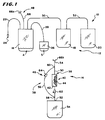
- a blood collection system 10 is shown in Fig. 1.
- the system 10 comprises a blood collection, processing and storage assembly 12 and a separation assembly 14.
- the separation assembly 14 serves to remove undesired matter from blood cells by filtration. For this reason, it will be referred to as a "filtration" assembly. It should be appreciated, however, that separation can occur by various centrifugal and non-centrifugal techniques, and not merely “filtration” in the technical sense. Separation can occur by absorption, columns, chemical, electrical, and electromagnetic means.
- the term “filtration assembly” is broadly used in this specification encompass all of these separation techniques as well.
- the filtration assembly 14 comprises an initially separate subassembly not joined to the blood processing assembly 12. This arrangement serves to reduce the regulatory requirements for the filtration assembly 14. It should be appreciated, however, that the filtration assembly 14 can be made as an integral part of the processing assembly 12.
- the blood collection and storage assembly 12 comprises a multiple blood bag system having a primary bag or container 16 and one or more integrally attached transfer bags or containers 18 and 20.
- the primary bag 16 (which is typically also called a donor bag) receives whole blood from a donor through integrally attached donor tubing 22 that carries an phlebotomy needle 24.
- a suitable anticoagulant A is contained in the primary bag 16.
- the primary bag 16 also serves as the storage container for the red blood cells processed in the assembly 12.
- a satellite bag 26 is attached to the primary bag 16 by integrally attached tubing 28.
- the satellite bag 26 contains a suitable storage solution S for the red blood cells.
- One such solution is disclosed in Grode et al U.S. Patent 4,267,269.
- the transfer bags 18 and 20 are attached to the primary bag 16 by integrally attached transfer tubing 30 and 32.
- the transfer bags 18 and 20 are intended to receive the platelet and plasma blood components for processing.
- the first transfer bag 18 ultimately serves as the storage container for the platelet concentrate
- the second transfer bag 20 ultimately serves as the storage container for the platelet-poor plasma.
- All of the bags and tubing associated with the processing assembly 12 can be made from conventional approved medical grade plastic materials, such as polyvinyl chloride plasticized with di-2-ethylhexylphthalate (DEHP).
- the first transfer container 18, which is intended to store the platelet concentrate can be made of polyolefin material (as disclosed in Gajewski et al U.S. Patent 4,140,162) or a polyvinyl chloride material plasticized with tri-2-ethylhexyl trimellitate (TEHTH). These materials, when compared to DEHP-plasticized polyvinyl chloride materials, have greater gas permeability that is beneficial for platelet storage.
- the blood collection and storage assembly 12 once sterilized, constitutes a sterile, "closed” system, as judged by the applicable standards in the United States.
- Whole blood is collected and then separated into its various therapeutic components within the assembly 12. These therapeutic components are typically red blood cells, plasma, and platelets.
- therapeutic components are typically red blood cells, plasma, and platelets.
- the collected whole blood is centrifugally separated within the primary bag 16 into red blood cells and platelet-rich plasma.
- the platelet-rich plasma is transferred by conventional techniques into the first transfer bag 18, leaving the red blood cells in the primary bag.
- the transfer bags 18 and 20 are detached in a sterile fashion using a conventional heat sealing device (for example, the Hematron® dielectric sealer sold by Baxter Healthcare Corporation), which forms a hermetic, snap-apart seal in the tubing 30 (this seal is schematically shown by an "x" in Figs. 2 to 4).
- the red blood cell storage solution S is transferred into the primary container 16, and the satellite bag 26 is also disconnected using the snap-apart seal "x" (as shown in Fig. 2).
- the donor tubing 22 is sealed and disconnected in the same fashion (as also shown in Fig. 2).
- the platelet-rich plasma undergoes subsequent centrifugal separation within the first transfer bag 18 into platelet concentrate and platelet-poor plasma.
- the platelet-poor plasma is transferred into the second transfer bag 20, leaving the platelet concentrate in the first transfer bag 18.
- the transfer bags 18 and 20 are then separated by the snap-apart seals "x" in the tubing 32 (as shown in Fig. 2) for subsequent storage of the collected components.
- the filtration assembly 14 includes a temporary transfer container 34 and two associated fluid flow paths 36 and 38.
- the temporary transfer container 34, as well as the entire filtration assembly 14 itself, are preferably provided in a "dry" condition, free of any fluids, storage mediums, and the like (except for any entrapped air), thereby avoiding regulatory requirements governing fluid-containing systems.
- the first fluid path 36 includes an inline filtration device 40 for separating undesired matter from blood cells.
- the second fluid path 38 bypasses the filtration device 40.
- the transfer container 34 and fluid paths 36 and 38 are all made of low cost medical grade plastic materials, such as polyvinyl chloride plasticized with DEHP.
- the filtration assembly 14 can be used to remove all types of undesired materials from different types blood cells, depending upon its particular construction.
- the filtration assembly 14 is intended to remove white blood cells (and preferably also platelets) from the red blood cells prior to storage.
- the filtration device 40 includes a housing 42 containing a conventional filtration medium 44 suited for the removal of white blood cells and platelets from red blood cells.
- the filtration medium 44 can include cotton wool, cellulose acetate or another synthetic fiber like polyester.
- the filtration assembly 14 includes flow control means 46 associated with the first and second flow paths 36 and 38.
- the flow control means 46 is operable in a first mode for directing flow through the first flow path 36, and thus through filtration device 40 (as shown in Fig. 2).
- the flow control means 46 is also operable in a second mode for directing flow through the second flow path 38, thereby bypassing the filtration device 40 (as shown in Fig. 3).
- connection assembly 48 is associated with the initially separate blood collection and filtration assemblies 12 and 14.
- the connection assembly 48 permits selective attachment of the filtration assembly 14 to the blood collection assembly 12.
- red blood cells can be conveyed from the primary container 16 through the first flow path 36 and filtration device 40 into the temporary transfer container 34.
- the undesired white cells (and platelets) are removed by the filtration device 40 from the blood cells.
- the flow control means 46 is placed in its second mode, as shown in Fig. 3.
- the red blood cells now substantially free of undesired white cells (and platelets), are returned from the temporary transfer container 34 through the second flow path 38, bypassing the filtration device 40, and back into the primary container 16.
- the filtration assembly 14 is then detached from the blood collection assembly 12, as shown in Fig. 4.
- the filtration assembly 14 can be variously constructed.
- the first fluid path 36 takes the form of a length of flexible tubing 50 made of a medical grade plastic material like polyvinyl chloride.
- the tubing 50 includes first and second opposite end portions 52 and 54.
- the first end portion 52 is integrally connected to the transfer container 34.
- the filtration device 40 is located inline between the opposite end portion 54 and the transfer container 34.
- the second fluid path 38 also includes a length of flexible tubing 56 made of a medical grade plastic material like polyvinyl chloride.
- the tubing 56 also includes opposite end portions 58 and 60.
- One end portion 60 joins the first fluid path tubing 50 between its second opposite end portion 54 and the filtration device 40.
- the other end portion 58 joins the first fluid path tubing 50 between the filtration device 40 and the transfer container 34.
- the flow control means 46 includes a first flow control device 62 in the first flow path 36 between the filtration device 40 and the transfer container 34.
- the flow control means 46 also includes a second flow control device 64 in the second flow path 38 between the opposite tubing ends 58 and 60.
- the second flow control device 64 is preferably located adjacent the tubing end portion 60 that joins the first flow path tubing 50 between its second end portion 54 and the filtration device 40.
- the flow control devices 62 and 64 are conventional roller clamps that are manually operated to open and close the associated tubing path 50 and 56. In the first mode of operation, the first roller clamp 62 is opened, and the second roller clamp 64 is closed. In the second mode of operation, the opposite is true.
- the filtration assembly 14 once sterilized, comprises a sterile, "closed” system (like the processing and storage assembly 12), as judged by the applicable United States standards.
- the connection assembly 48 serves to attach and detach the collection and filtration assembly in a manner that preserves the sterile integrity of the closed systems 12 and 14.
- connection assembly 48 comprises two mating sterile connection devices (designated 66a and 66b).
- the devices 66a and 66b are described in Granzow et al U.S. Patents 4,157,723 and 4,265,280, which are incorporated herein by reference.
- One device 66a is carried by tubing 68 attached to the primary bag 16.
- the other device 66b is carried at the tubing end 54 of the filtration assembly 14.
- the sterile connection devices 66a and 66b each generally includes a housing 70 having a normally closed, meltable wall 72 made of a radiant energy absorbing material.
- the housings 70 are joined together with mating bayonet-type couplers 74a and 74b, with the walls 72 placed in facing contact. When connected and exposed to radiant energy, the walls 72 melt at temperatures that result in the destruction of bacteria, while at the same time opening a fluid path between the connected housings 70.
- the devices 66a and 66b normally close the associated assemblies 12 and 14 from communication with the atmosphere and are opened in conjunction with an active sterilization step which serves to sterilize the regions adjacent to the interconnecting fluid path as the fluid path is being formed. These devices 66a and 66b also hermetically seal the interconnecting fluid path at the time it is formed. The use of these sterile connection devices 66a and 66b assures a probability of non-sterility that exceeds one in a million. The devices 66a and 66b thus serve to connect the two assemblies 12 and 14 without compromising the sterile integrity of either.
- connection assembly 48 can comprise the sterile connecting system disclosed in Spencer U.S. Patent 4,412,835 (not shown). In this arrangement, this system forms a molten seal between the transfer tubing 30 of the primary bag 16 with the tubing end portion 54 of the filtration assembly 14. Once cooled, a sterile weld is formed.
- whole blood is collected in the donor bag 16 that forms a part of a blood collection assembly 12.
- the donor bag 16 is temporarily attached to the filtration assembly 14 using the associated sterile connection devices 66a and 66b.
- the first roller clamp 62 is opened, and the second roller clamp 64 is closed.
- the donor bag 16 is lifted above the temporary transfer bag 34, and the red blood cells are conveyed by gravity flow from the donor bag 16 through the first fluid path 36 and filtration device 40 and into the transfer bag 34.
- the undesired matter i.e., white blood cells and platelets
- the filtration device 40 removes the red blood cells from the red blood cells by the filtration device 40.
- the first roller clamp 62 is closed, and the second roller clamp 64 is opened.
- the transfer bag 34 is lifted above the donor bag 12, and the red blood cells, now substantially free of the undesired matter, are returned by gravity flow from the temporary transfer bag 34 through the second fluid path 38, altogether bypassing the filtration device 40, and back into the donor bag 16.
- the filtration assembly 14 is then separated from the blood collection assembly 12. This is accomplished by forming snap-apart seals "x" in the tubing 68 of the primary bag 16 and in the tubing 50 of the filtration assembly 14 to remove the connected sterile connection devices 66a and 66b.
- the entire filtration process (including the attachment and detachment of the filtration assembly 14) can be accomplished in less than five minutes.
- the red blood cells, now substantially free of the undesired matter, can be stored in the primary bag 16 for transfusion. And, in the preferred embodiment, where the transfer is made using sterile connection techniques, the filtration has occurred without compromising the sterile integrity of the red blood cells or reducing its storage life.
Landscapes
- Health & Medical Sciences (AREA)
- Heart & Thoracic Surgery (AREA)
- Vascular Medicine (AREA)
- Engineering & Computer Science (AREA)
- Anesthesiology (AREA)
- Biomedical Technology (AREA)
- Hematology (AREA)
- Life Sciences & Earth Sciences (AREA)
- Animal Behavior & Ethology (AREA)
- General Health & Medical Sciences (AREA)
- Public Health (AREA)
- Veterinary Medicine (AREA)
- External Artificial Organs (AREA)
Claims (18)
- Verfahren zum Sammeln von Blutzellen, die im wesentlichen frei von unerwünschten Substanzen sind, wobei das Verfahren die folgenden Schritte aufweist: Sammeln einer Menge von Blutzellen in einem ersten Behälter (16), der einen Teil eines Blutsammelsystems (12) bildet, Öffnen einer Verbindung zwischen dem ersten Behälter (16) und einem Trennsystem (14), das einen zweiten Behälter (34) und eine erste Durchflußbahn (36) aufweist, die eine Trenneinrichtung (40) aufweist, um die unerwünschten Substanzen von den Blutzellen zu trennen, wobei die erste Durchflußbahn in den zweiten Behälter (34) führt, Transportieren der Blutzellen aus dem ersten Behälter (16) durch die erste Durchflußbahn (36) und die Trenneinrichtung (40) und in den zweiten Behälter (34), so daß die unerwünschten Substanzen von den Blutzellen getrennt werden,
gekennzeichnet durch Rückführen der Blutzellen, die nun im wesentlichen frei von den unerwünschten Substanzen sind, aus dem zweiten Behälter (34) zurück in den ersten Behälter (16) durch eine zweite Durchflußbahn (38), die von dem zweiten Behälter (34) ausgeht und die Trenneinrichtung (40) umgeht. - Verfahren nach Anspruch 1, wobei der Schritt des Öffnens einer Verbindung mit dem Trennsystem (14) den Schritt des Anbringens des Trennsystems (14) an dem Blutsammelsystem (12) aufweist.
- Verfahren nach Anspruch 2, wobei der Schritt des Anbringens des Trennsystems (14) den Schritt des Verwendens einer sterilen Verbindungsanordnung (48) aufweist, die dem Trenn- und dem Blutsammelsystem (12, 14) zugeordnet ist.
- Verfahren nach einem der vorhergehenden Ansprüche, wobei während des Schritts des Transportierens von Blutzellen aus dem ersten Behälter (16) und in den zweiten Behälter (34) der erste Behälter (16) über dem zweiten Behälter (34) angeordnet ist, um die Blutzellen durch Gravitationsströmung zu transportieren.
- Verfahren nach einem der vorhergehenden Ansprüche, wobei während des Schritts des Rückführens von Blutzellen aus dem zweiten Behälter (34) zurück zu dem ersten Behälter (16) der zweite Behälter (34) über dem ersten Behälter (16) angeordnet ist, um die Blutzellen durch Gravitationsströmung rückzuführen.
- Verfahren nach einem der vorhergehenden Ansprüche, das ferner den folgenden Schritt aufweist, der vor dem Schritt des Rückführens von Blutzellen aus dem zweiten Behälter (34) zurück zu dem ersten Behälter (16) durchgeführt wird: Austreiben von Luft aus dem ersten Behälter (16) in den zweiten Behälter (34) durch die zweite Durchflußbahn (38).
- Verfahren nach einem der vorhergehenden Ansprüche, das ferner den folgenden Schritt aufweist: Aufbewahren der Blutzellen in dem ersten Behälter (16), die im wesentlichen frei von den unerwünschten Substanzen sind.
- Verfahren nach einem der vorhergehenden Ansprüche, wobei die Blutzellen Erythrozyten und die unerwünschten Substanzen Leukozyten aufweisen.
- Bluttrennanordnung (14), die einen Kurzzeit-Überführungsbehälter (34) aufweist, der mit der ersten und der zweiten Durchflußbahn (36, 38) in Durchflußverbindung verbunden ist, wobei die erste Durchflußbahn (36) eine Inline-Trenneinrichtung (40) hat, um unerwünschte Substanzen aus Blutzellen zu entfernen, und durch einen Verbinder (66b) an ihrem Ende, das zu dem Überführungsbehälter entgegengesetzt ist, mit einem Blutzellenbehälter verbunden oder verbindbar ist,
dadurch gekennzeichnet, daß die zweite Durchflußbahn (38) die Trenneinrichtung (40) umgeht und sich mit der ersten Durchflußbahn (36) zwischen der Trenneinrichtung und demjenigen Ende der ersten Durchflußbahn (36), das zu dem Überführungsbehälter (34) entgegengesetzt ist, vereinigt, wobei eine Durchflußregeleinrichtung (46) der ersten und der zweiten Durchflußbahn (36, 38) zugeordnet und in einer ersten Betriebsart zum Leiten von Strömung durch die erste Bahn (36) und einer zweiten Betriebsart zum Leiten von Strömung durch die zweite Bahn (38) betätigbar ist. - Anordnung nach Anspruch 9, wobei der Überführungsbehälter (34) vor dem Gebrauch frei von Fluid ist.
- Anordnung nach Anspruch 9 oder 10, wobei die erste Durchflußbahn (36) einen ersten und einen zweiten Endbereich (52, 54) aufweist, die einander entgegengesetzt sind, wobei der erste entgegengesetzte Endbereich (52) mit dem Überführungsbehälter (34) verbunden ist und die Trenneinrichtung (40) in der ersten Durchflußbahn (36) zwischen dem zweiten entgegengesetzten Endbereich (54) und dem Überführungsbehälter (34) liegt, wobei die zweite Durchflußbahn (38) entgegengesetzte Endbereiche (58, 60) aufweist, wobei einer der Endbereiche mit der ersten Durchflußbahn (36) zwischen dem zweiten entgegengesetzten Endbereich (54) und der Trenneinrichtung (40) in Verbindung ist und der andere der Endbereiche mit der ersten Durchflußbahn (36) zwischen der Trenneinrichtung (40) und dem Überführungsbehälter (34) in Verbindung ist.
- Anordnung nach Anspruch 11, wobei die Durchflußregeleinrichtung (46) einen ersten Durchflußeinstellmechanismus (62) in der ersten Durchflußbahn (36) zwischen der Trenneinrichtung (40) und dem Überführungsbehälter (34) und einen zweiten Durchflußeinstellmechanismus (64) in der zweiten Durchflußbahn (38) zwischen deren entgegengesetzten Enden (58, 60) aufweist.
- Anordnung nach Anspruch 12, wobei der zweite Durchflußeinstellmechanismus (64) angrenzend an den einen Endbereich (60) der zweiten Durchflußbahn (38) angeordnet ist, der mit der ersten Durchflußbahn (36) zwischen deren zweitem Endbereich (52) und der Trenneinrichtung (40) in Verbindung ist.
- Blutsammelvorrichtung, die eine Blutsammelanordnung (12) in Kombination mit der Bluttrennanordnung (14) nach einem der Ansprüche 9 bis 13 aufweist, wobei die Blutsammelanordnung (12) einen Blutsammelbehälter (16) hat, der mit der Bluttrennanordnung (14) in Fluidverbindung verbunden ist.
- Vorrichtung nach Anspruch 14, wobei die Trennanordnung eine erste Verbindungseinrichtung (66b) und die Blutsammelanordnung eine zweite Verbindungseinrichtung (66a) aufweist, die abnehmbar mit der ersten Verbindungseinrichtung (66b) verbunden ist.
- Vorrichtung nach Anspruch 15, wobei jede Anordnung ein getrenntes geschlossenes System aufweist und die Verbindungseinrichtungen (66a, 66b) voneinander trennbar sind, um die Sammel- und die Trennanordnung (12, 14) auf eine Weise abzunehmen, die die sterile Integrität der geschlossenes Systeme bewahrt.
- Verwendung der Bluttrennanordnung nach einem der Ansprüche 9 bis 14 oder der Vorrichtung nach einem der Ansprüche 14 bis 16, wobei die Verwendung das Überführen von Blut durch die zweite Durchflußbahn (38) aufweist.
- Verwendung der Bluttrennanordnung nach einem der Ansprüche 9 bis 13 oder der Vorrichtung nach einem der Ansprüche 14 bis 16, die das Überführen von Luft durch die zweite Durchflußbahn (38) aufweist.
Applications Claiming Priority (3)
| Application Number | Priority Date | Filing Date | Title |
|---|---|---|---|
| US453952 | 1982-12-28 | ||
| US07/453,952 US4997577A (en) | 1989-12-20 | 1989-12-20 | Systems and methods for removing undesired matter from blood cells |
| PCT/US1990/006924 WO1991008820A1 (en) | 1989-12-20 | 1990-11-28 | Systems and methods for removing undesired matter from blood cells |
Publications (3)
| Publication Number | Publication Date |
|---|---|
| EP0458944A1 EP0458944A1 (de) | 1991-12-04 |
| EP0458944A4 EP0458944A4 (en) | 1992-06-03 |
| EP0458944B1 true EP0458944B1 (de) | 1996-06-05 |
Family
ID=23802703
Family Applications (1)
| Application Number | Title | Priority Date | Filing Date |
|---|---|---|---|
| EP91901424A Expired - Lifetime EP0458944B1 (de) | 1989-12-20 | 1990-11-28 | Vorrichtungen und verfahren zum entfernen unerwünschter bestandteile aus blutzellen |
Country Status (6)
| Country | Link |
|---|---|
| US (2) | US4997577A (de) |
| EP (1) | EP0458944B1 (de) |
| JP (1) | JP2952433B2 (de) |
| CA (1) | CA2045587C (de) |
| DE (1) | DE69027306T2 (de) |
| WO (1) | WO1991008820A1 (de) |
Families Citing this family (113)
| Publication number | Priority date | Publication date | Assignee | Title |
|---|---|---|---|---|
| AU578554B2 (en) * | 1986-01-24 | 1988-10-27 | Japanese Red Cross Society | Centrifugal method of separating blood components |
| US5229012A (en) * | 1989-05-09 | 1993-07-20 | Pall Corporation | Method for depletion of the leucocyte content of blood and blood components |
| US5344561A (en) * | 1989-05-09 | 1994-09-06 | Pall Corporation | Device for depletion of the leucocyte content of blood and blood components |
| US5300060A (en) * | 1989-06-12 | 1994-04-05 | Miles Inc. | Blood bag system for separation and isolation of neocytes and gerocytes |
| US5316674A (en) * | 1989-09-12 | 1994-05-31 | Pall Corporation | Device for processing blood for human transfusion |
| US5100564A (en) * | 1990-11-06 | 1992-03-31 | Pall Corporation | Blood collection and processing system |
| US5360545A (en) * | 1989-09-12 | 1994-11-01 | Pall Corporation | Filter for obtaining platelets |
| US5152905A (en) * | 1989-09-12 | 1992-10-06 | Pall Corporation | Method for processing blood for human transfusion |
| US5089146A (en) * | 1990-02-12 | 1992-02-18 | Miles Inc. | Pre-storage filtration of platelets |
| US5102407A (en) * | 1990-03-13 | 1992-04-07 | Miles Inc. | Blood separation system |
| US5863436A (en) * | 1990-05-24 | 1999-01-26 | Pall Corporation | Venting system |
| US5302299A (en) * | 1990-05-24 | 1994-04-12 | Pall Corporation | Biological semi-fluid processing assembly |
| US5126054A (en) * | 1990-05-24 | 1992-06-30 | Pall Corporation | Venting means |
| US5217627A (en) * | 1990-11-06 | 1993-06-08 | Pall Corporation | System and method for processing biological fluid |
| US5154716A (en) * | 1990-11-06 | 1992-10-13 | Miles Inc. | Bottom blood bag separation system |
| CA2074830C (en) * | 1990-12-20 | 1999-03-02 | Daniel F. Bischof | Systems and methods for simultaneously removing free and entrained contaminants in fluid like blood using photoactive therapy and cellular separation techniques |
| WO1992019355A1 (en) * | 1991-05-08 | 1992-11-12 | Baxter International Inc. | Methods for processing red blood cell products for long term storage free of microorganisms |
| US5128048A (en) * | 1991-05-22 | 1992-07-07 | Baxter International Inc. | Systems and methods for removing undesired matter from blood cells |
| US5269946A (en) * | 1991-05-22 | 1993-12-14 | Baxter Healthcare Corporation | Systems and methods for removing undesired matter from blood cells |
| US5180504A (en) * | 1991-05-22 | 1993-01-19 | Baxter International Inc. | Systems and methods for removing undesired matter from blood cells |
| FR2677883B1 (fr) * | 1991-06-24 | 1997-07-18 | Maco Pharma Sa | Poche filtrante destinee a permettre la filtration sterile du sang et ensemble de poches de prelevement de sang. |
| US5334315A (en) * | 1992-01-17 | 1994-08-02 | Pall Corporation | Priming system |
| US5288605A (en) * | 1992-03-02 | 1994-02-22 | Steritech, Inc. | Methods for inactivating bacteria in blood preparations with 8-methoxypsoralen |
| GR930100237A (el) * | 1992-06-10 | 1994-02-28 | Pall Corp | Σύστημα δια την επεξεργασίαν υλικού ζώνης μεταπτώσεως. |
| CA2083075A1 (en) * | 1992-06-10 | 1993-12-11 | Vlado I. Matkovich | System for treating transition zone material |
| ES2147203T3 (es) * | 1992-08-07 | 2000-09-01 | Cerus Corp | Procedimientos de inactivacion de bacterias en las preparaciones a base de sangre con la ayuda de 8-metoxipsoraleno. |
| GB9218581D0 (en) * | 1992-09-02 | 1992-10-14 | Pall Corp | Removal of unwanted fluids from processed blood products |
| DE69324754T2 (de) * | 1992-10-07 | 2000-01-13 | Asahi Medical Co. Ltd., Tokio/Tokyo | Filter und System zur Trennung der Leukozyten |
| US5523004A (en) * | 1992-12-04 | 1996-06-04 | Terumo Kabushiki Kaisha | Method for treatment of blood using a blood bag |
| US5547591A (en) * | 1993-06-01 | 1996-08-20 | Asahi Medical Co., Ltd. | Method for separating a blood material into blood components by centrifugation, and centrifugal apparatus |
| US5527472A (en) * | 1993-06-14 | 1996-06-18 | Baxter International Inc. | Closed systems and methods for removing undesired matter from blood cells |
| US5591337A (en) * | 1993-09-14 | 1997-01-07 | Baxter International Inc. | Apparatus for filtering leukocytes from blood cells |
| AU678537B2 (en) * | 1993-09-14 | 1997-05-29 | Baxter International Inc. | Medical container port |
| WO1995017234A1 (en) | 1993-12-22 | 1995-06-29 | Baxter International Inc. | Methods for characterizing complex filtration media |
| US6422397B1 (en) * | 1993-12-22 | 2002-07-23 | Baxter International, Inc. | Blood collection systems including an integral, flexible filter |
| US6367634B1 (en) | 1993-12-22 | 2002-04-09 | Baxter International Inc. | Blood collection systems including an integral, flexible filter |
| US20010037978A1 (en) * | 1999-04-20 | 2001-11-08 | Daryl R. Calhoun | Filter assembly having a flexible housing and method of making same |
| US6010633A (en) * | 1997-03-06 | 2000-01-04 | Hemasure Inc. | Method of preventing air from becoming entrapped within a filtration device |
| US6251292B1 (en) | 1994-03-10 | 2001-06-26 | Hemasure, Inc. | Method of preventing air from becoming entrapped within a filtration device |
| US5472605A (en) * | 1994-03-10 | 1995-12-05 | Hemasure, Inc. | Filtration device useable for removal of leukocytes and other blood components |
| US5776338A (en) * | 1994-08-18 | 1998-07-07 | Biofil S.R.L. | Disposable sterile apparatus for blood filtration with a system for optimizing the recovery of blood between pouches |
| US5655961A (en) * | 1994-10-12 | 1997-08-12 | Acres Gaming, Inc. | Method for operating networked gaming devices |
| US6746482B2 (en) | 1994-10-17 | 2004-06-08 | Baxter International Inc. | Method for producing medical devices and devices so produced |
| US6306454B1 (en) | 1994-10-17 | 2001-10-23 | Baxter International Inc. | Method for producing improved medical devices and devices so produced |
| US5972217A (en) * | 1994-10-17 | 1999-10-26 | Baxter International Inc. | Blood cell separation devices having a membrane with particular coating |
| US5647985A (en) * | 1994-10-17 | 1997-07-15 | Baxter International Inc. | Whole blood leukodepletion and platelet filter |
| US5728306A (en) * | 1994-12-23 | 1998-03-17 | Baxter International Inc. | Leukodepletion filter and method for filtering leukocytes from freshly drawn blood |
| US5836934A (en) | 1995-06-07 | 1998-11-17 | Baxter International Inc. | Closed system and methods for mixing additive solutions while removing undesired matter from blood cells |
| US6190855B1 (en) | 1996-10-28 | 2001-02-20 | Baxter International Inc. | Systems and methods for removing viral agents from blood |
| DE19712298C2 (de) * | 1997-03-24 | 1999-05-20 | Fresenius Ag | Vorrichtung und Verfahren zum Trennen von Blut in Blutkomponenten |
| CA2327665C (en) * | 1998-03-20 | 2007-08-28 | Lexion Medical, Llc | Biological fluid filtration method and apparatus |
| US6123859A (en) | 1998-04-22 | 2000-09-26 | Hemasure Inc. | Method for in-line filtering biological liquid |
| US6358420B2 (en) | 1998-06-01 | 2002-03-19 | Baxter International Inc. | Blood collection method employing an air venting blood sample tube |
| US6908770B1 (en) * | 1998-07-16 | 2005-06-21 | Board Of Regents, The University Of Texas System | Fluid based analysis of multiple analytes by a sensor array |
| US7445756B2 (en) * | 1999-06-03 | 2008-11-04 | Fenwal, Inc. | Fluid processing sets and organizers for the same |
| US7025877B1 (en) * | 1999-06-03 | 2006-04-11 | Baxter International Inc. | Processing set for processing and treating a biological fluid |
| US7022517B1 (en) | 1999-07-16 | 2006-04-04 | Board Of Regents, The University Of Texas System | Method and apparatus for the delivery of samples to a chemical sensor array |
| AU1325201A (en) | 1999-07-16 | 2001-02-05 | Board Of Regents, The University Of Texas System | Detection system based on an analyte reactive particle |
| US20030176813A1 (en) * | 1999-07-29 | 2003-09-18 | Jean-Marie Mathias | Biological fluid sampling apparatus |
| US7435231B2 (en) * | 1999-07-29 | 2008-10-14 | Fenwal, Inc. | Biological sample device receiver |
| CA2373689A1 (en) * | 1999-07-29 | 2001-02-08 | Thomas W. Coneys | Sampling tube holder for blood sampling system |
| US7824343B2 (en) | 1999-07-29 | 2010-11-02 | Fenwal, Inc. | Method and apparatus for blood sampling |
| US7651474B2 (en) | 1999-10-01 | 2010-01-26 | Caridianbct, Inc. | Method and apparatus for leukoreduction of red blood cells |
| US7686779B1 (en) | 1999-10-01 | 2010-03-30 | Caridian BCT, Inc | Extracorporeal blood processing methods and apparatus |
| CN1407995A (zh) | 1999-12-10 | 2003-04-02 | 埃克森化学专利公司 | 丙烯-二烯共聚的聚合物 |
| ATE403145T1 (de) * | 2000-01-31 | 2008-08-15 | Univ Texas | Tragbare vorrichtung mit einer sensor-array- anordnung |
| US6428712B1 (en) | 2000-04-06 | 2002-08-06 | Hemasure, Inc. | Gravity driven liquid filtration system and method for filtering biological liquid |
| DE60143894D1 (de) | 2000-05-26 | 2011-03-03 | Asahi Kasei Medical Co Ltd | Blutfilter und blutaufbereitungssysteme |
| US20030209479A1 (en) * | 2000-07-10 | 2003-11-13 | Lynn Daniel R | Blood filters, blood collection and processing systems, and methods therefore |
| CA2437057C (en) * | 2001-01-31 | 2012-04-24 | Hemerus Medical, Llc | Biological fluid filtration system |
| US20020197622A1 (en) * | 2001-01-31 | 2002-12-26 | Mcdevitt John T. | Method and apparatus for the confinement of materials in a micromachined chemical sensor array |
| US7727219B2 (en) * | 2001-10-22 | 2010-06-01 | Vita 34 Ag | Sterile system and methods for collecting, transporting, storing and cyropreserving body fluids |
| DE10151343A1 (de) * | 2001-10-22 | 2003-05-08 | Vita 34 Ag | Beutelsystem für die Kryokonservierung von Körperflüssigkeiten |
| US7264608B2 (en) * | 2001-12-05 | 2007-09-04 | Fenwal, Inc. | Manual processing systems and methods for providing blood components conditioned for pathogen inactivation |
| EP1455860B1 (de) * | 2001-12-10 | 2011-08-31 | CaridianBCT, Inc. | Verfahren zur verminderung des gehalts an leukozyten in einer komponente aus roten blutkörperchen |
| US7479123B2 (en) | 2002-03-04 | 2009-01-20 | Therakos, Inc. | Method for collecting a desired blood component and performing a photopheresis treatment |
| US7211037B2 (en) * | 2002-03-04 | 2007-05-01 | Therakos, Inc. | Apparatus for the continuous separation of biological fluids into components and method of using same |
| US8257967B2 (en) | 2002-04-26 | 2012-09-04 | Board Of Regents, The University Of Texas System | Method and system for the detection of cardiac risk factors |
| US6982038B2 (en) * | 2002-06-14 | 2006-01-03 | Medtronic, Inc. | Centrifuge system utilizing disposable components and automated processing of blood to collect platelet rich plasma |
| WO2004072613A2 (en) * | 2003-02-07 | 2004-08-26 | Board Of Regents, The University Of Texas System | Multi-shell microspheres with integrated chomatographic and detection layers for use in array sensors |
| US20060180526A1 (en) * | 2003-03-20 | 2006-08-17 | Terumo Kabushiki Kaisha | Blood treating set and cell treating set |
| US20050049539A1 (en) * | 2003-09-03 | 2005-03-03 | O'hara Gerald P. | Control system for driving fluids through an extracorporeal blood circuit |
| EP1671664B1 (de) * | 2003-10-02 | 2017-05-03 | Terumo Kabushiki Kaisha | Verfahren zur herstellung von blutaufbereitungskreisläufen und filtereinheit |
| US20050137517A1 (en) * | 2003-12-19 | 2005-06-23 | Baxter International Inc. | Processing systems and methods for providing leukocyte-reduced blood components conditioned for pathogen inactivation |
| US8101431B2 (en) * | 2004-02-27 | 2012-01-24 | Board Of Regents, The University Of Texas System | Integration of fluids and reagents into self-contained cartridges containing sensor elements and reagent delivery systems |
| US8105849B2 (en) | 2004-02-27 | 2012-01-31 | Board Of Regents, The University Of Texas System | Integration of fluids and reagents into self-contained cartridges containing sensor elements |
| US7476209B2 (en) * | 2004-12-21 | 2009-01-13 | Therakos, Inc. | Method and apparatus for collecting a blood component and performing a photopheresis treatment |
| WO2007053186A2 (en) | 2005-05-31 | 2007-05-10 | Labnow, Inc. | Methods and compositions related to determination and use of white blood cell counts |
| EP1899450A4 (de) * | 2005-06-24 | 2010-03-24 | Univ Texas | Systeme und verfahren einschliesslich in sich geschlossener kassetten mit nachweissystemen und flüssigkeitszufuhrsystemen |
| WO2007005666A2 (en) * | 2005-07-01 | 2007-01-11 | Board Of Regents, The University Of Texas System | System and method of analyte detection using differential receptors |
| WO2007041716A1 (en) * | 2005-10-05 | 2007-04-12 | Gambro Bct, Inc. | Method and apparatus for leukoreduction of red blood cells |
| US8631683B2 (en) | 2007-02-06 | 2014-01-21 | Fresenius Medical Care Holdings, Inc. | Dialysis systems including non-invasive multi-function sensor systems |
| US20080300798A1 (en) * | 2007-04-16 | 2008-12-04 | Mcdevitt John T | Cardibioindex/cardibioscore and utility of salivary proteome in cardiovascular diagnostics |
| EP2219704B1 (de) | 2007-11-16 | 2018-08-29 | Fresenius Medical Care Holdings, Inc. | Dialysesysteme und verfahren |
| US8889004B2 (en) | 2007-11-16 | 2014-11-18 | Fresenius Medical Care Holdings, Inc. | Dialysis systems and methods |
| DE102008047068B4 (de) * | 2008-09-12 | 2015-02-26 | Walter Pobitschka | Verfahren und Vorrichtung zur Trennung von Blut unter Einsatz einer Zentrifuge |
| USD611152S1 (en) | 2009-05-18 | 2010-03-02 | Fresenius Medical Care Holdings, Inc. | Dialysis system sorbent cartridge mount |
| WO2011017215A1 (en) | 2009-08-04 | 2011-02-10 | Fresenius Medical Care Holdings, Inc. | Dialysis systems, components, and methods |
| US8449686B2 (en) | 2010-04-26 | 2013-05-28 | Fresenius Medical Care Holdings, Inc. | Methods for cleaning a drain line of a dialysis machine |
| US8784668B2 (en) | 2010-10-12 | 2014-07-22 | Fresenius Medical Care Holdings, Inc. | Systems and methods for compensation of compliant behavior in regenerative dialysis systems |
| US9333286B2 (en) | 2011-05-12 | 2016-05-10 | Fresenius Medical Care Holdings, Inc. | Medical tubing installation detection |
| US8836519B2 (en) | 2011-05-12 | 2014-09-16 | Fresenius Medical Care Holdings, Inc. | Determining the absence or presence of fluid in a dialysis system |
| US8906240B2 (en) | 2011-08-29 | 2014-12-09 | Fresenius Medical Care Holdings, Inc. | Early detection of low bicarbonate level |
| US8992777B2 (en) | 2011-11-18 | 2015-03-31 | Fresenius Medical Care Holdings, Inc. | Systems and methods for providing notifications in dialysis systems |
| US9165112B2 (en) | 2012-02-03 | 2015-10-20 | Fresenius Medical Care Holdings, Inc. | Systems and methods for displaying objects at a medical treatment apparatus display screen |
| US9414752B2 (en) | 2012-11-09 | 2016-08-16 | Elwha Llc | Embolism deflector |
| US9782707B2 (en) | 2014-03-24 | 2017-10-10 | Fenwal, Inc. | Biological fluid filters having flexible walls and methods for making such filters |
| US9968738B2 (en) | 2014-03-24 | 2018-05-15 | Fenwal, Inc. | Biological fluid filters with molded frame and methods for making such filters |
| US9796166B2 (en) | 2014-03-24 | 2017-10-24 | Fenwal, Inc. | Flexible biological fluid filters |
| US10159778B2 (en) | 2014-03-24 | 2018-12-25 | Fenwal, Inc. | Biological fluid filters having flexible walls and methods for making such filters |
| US10376627B2 (en) | 2014-03-24 | 2019-08-13 | Fenwal, Inc. | Flexible biological fluid filters |
| US11504517B2 (en) | 2015-12-11 | 2022-11-22 | Nxstage Medical, Inc. | Fluid line connector devices methods and systems |
| US11883570B2 (en) * | 2017-09-28 | 2024-01-30 | Terumo Kabushiki Kaisha | Blood transfusion kit and system and method |
Citations (1)
| Publication number | Priority date | Publication date | Assignee | Title |
|---|---|---|---|---|
| US4439179A (en) * | 1982-02-16 | 1984-03-27 | Baxter Travenol Laboratories, Inc. | Dual tubing clamp |
Family Cites Families (12)
| Publication number | Priority date | Publication date | Assignee | Title |
|---|---|---|---|---|
| US4157723A (en) * | 1977-10-19 | 1979-06-12 | Baxter Travenol Laboratories, Inc. | Method of forming a connection between two sealed conduits using radiant energy |
| US4265280A (en) * | 1979-01-23 | 1981-05-05 | Baxter Travenol Laboratories, Inc. | Connector member for sealed conduits |
| US4396382A (en) * | 1981-12-07 | 1983-08-02 | Travenol European Research And Development Centre | Multiple chamber system for peritoneal dialysis |
| US4919823A (en) * | 1982-06-04 | 1990-04-24 | Miles Inc. | Blood bag system with integral filtering means |
| US4596657A (en) * | 1982-06-04 | 1986-06-24 | Miles Laboratories, Inc. | Blood bag system with integral filtering means |
| US4767541A (en) * | 1982-06-04 | 1988-08-30 | Miles Laboratories, Inc. | Method of removing platelets and white cells from a red cell concentrate |
| US4412835A (en) * | 1982-07-06 | 1983-11-01 | E. I. Du Pont De Nemours & Company | Sterile docking process, apparatus and system |
| US4810378A (en) * | 1986-04-21 | 1989-03-07 | Miles Laboratories, Inc. | Red blood cell filtering system |
| US4915848A (en) * | 1986-04-21 | 1990-04-10 | Miles Laboratories, Inc. | Red blood cell filtering system |
| US4855063A (en) * | 1986-04-21 | 1989-08-08 | Miles Laboratories, Inc. | Red blood cell filtering system |
| US4917804A (en) * | 1986-10-31 | 1990-04-17 | Baxter International Inc. | Method and vessel for separation of cryoglobin |
| US4915847A (en) * | 1987-08-04 | 1990-04-10 | Baxter International Inc. | Cryoglobulin separation |
-
1989
- 1989-12-20 US US07/453,952 patent/US4997577A/en not_active Ceased
-
1990
- 1990-11-28 CA CA002045587A patent/CA2045587C/en not_active Expired - Lifetime
- 1990-11-28 JP JP3501938A patent/JP2952433B2/ja not_active Expired - Lifetime
- 1990-11-28 WO PCT/US1990/006924 patent/WO1991008820A1/en not_active Ceased
- 1990-11-28 DE DE69027306T patent/DE69027306T2/de not_active Expired - Lifetime
- 1990-11-28 EP EP91901424A patent/EP0458944B1/de not_active Expired - Lifetime
-
1993
- 1993-03-04 US US08/026,516 patent/USRE35804E/en not_active Expired - Lifetime
Patent Citations (1)
| Publication number | Priority date | Publication date | Assignee | Title |
|---|---|---|---|---|
| US4439179A (en) * | 1982-02-16 | 1984-03-27 | Baxter Travenol Laboratories, Inc. | Dual tubing clamp |
Also Published As
| Publication number | Publication date |
|---|---|
| CA2045587C (en) | 2000-11-14 |
| WO1991008820A1 (en) | 1991-06-27 |
| JPH04504532A (ja) | 1992-08-13 |
| USRE35804E (en) | 1998-05-26 |
| EP0458944A1 (de) | 1991-12-04 |
| JP2952433B2 (ja) | 1999-09-27 |
| EP0458944A4 (en) | 1992-06-03 |
| CA2045587A1 (en) | 1991-06-21 |
| US4997577A (en) | 1991-03-05 |
| DE69027306T2 (de) | 1997-02-06 |
| DE69027306D1 (de) | 1996-07-11 |
Similar Documents
| Publication | Publication Date | Title |
|---|---|---|
| EP0458944B1 (de) | Vorrichtungen und verfahren zum entfernen unerwünschter bestandteile aus blutzellen | |
| EP0540731B1 (de) | Vorrichtung und verfahren zum entfernen unerwünschter bestandteile aus blutzellen | |
| EP0540732B1 (de) | Vorrichtungen und verfahren zum entfernen unerwünschter bestandteile aus blutzellen | |
| EP0540734B1 (de) | Vorrichtungen und verfahren zum entfernen unerwünschter bestandteile aus blutzellen | |
| US6053885A (en) | Closed system and methods for mixing additive solutions while removing undesired matter from blood cells | |
| EP0655012B1 (de) | Vorrichtung und verfahren zur verarbeitung von blut | |
| US6358420B2 (en) | Blood collection method employing an air venting blood sample tube |
Legal Events
| Date | Code | Title | Description |
|---|---|---|---|
| PUAI | Public reference made under article 153(3) epc to a published international application that has entered the european phase |
Free format text: ORIGINAL CODE: 0009012 |
|
| 17P | Request for examination filed |
Effective date: 19910809 |
|
| AK | Designated contracting states |
Kind code of ref document: A1 Designated state(s): BE DE FR GB IT |
|
| A4 | Supplementary search report drawn up and despatched |
Effective date: 19920413 |
|
| AK | Designated contracting states |
Kind code of ref document: A4 Designated state(s): BE DE FR GB IT |
|
| 17Q | First examination report despatched |
Effective date: 19931028 |
|
| GRAH | Despatch of communication of intention to grant a patent |
Free format text: ORIGINAL CODE: EPIDOS IGRA |
|
| GRAH | Despatch of communication of intention to grant a patent |
Free format text: ORIGINAL CODE: EPIDOS IGRA |
|
| GRAA | (expected) grant |
Free format text: ORIGINAL CODE: 0009210 |
|
| AK | Designated contracting states |
Kind code of ref document: B1 Designated state(s): BE DE FR GB IT |
|
| REF | Corresponds to: |
Ref document number: 69027306 Country of ref document: DE Date of ref document: 19960711 |
|
| ET | Fr: translation filed | ||
| ITF | It: translation for a ep patent filed | ||
| PLBE | No opposition filed within time limit |
Free format text: ORIGINAL CODE: 0009261 |
|
| STAA | Information on the status of an ep patent application or granted ep patent |
Free format text: STATUS: NO OPPOSITION FILED WITHIN TIME LIMIT |
|
| 26N | No opposition filed | ||
| REG | Reference to a national code |
Ref country code: GB Ref legal event code: IF02 |
|
| REG | Reference to a national code |
Ref country code: GB Ref legal event code: 732E |
|
| REG | Reference to a national code |
Ref country code: FR Ref legal event code: TP |
|
| PGFP | Annual fee paid to national office [announced via postgrant information from national office to epo] |
Ref country code: DE Payment date: 20091127 Year of fee payment: 20 |
|
| PGFP | Annual fee paid to national office [announced via postgrant information from national office to epo] |
Ref country code: IT Payment date: 20091128 Year of fee payment: 20 Ref country code: GB Payment date: 20091125 Year of fee payment: 20 Ref country code: FR Payment date: 20091201 Year of fee payment: 20 |
|
| PGFP | Annual fee paid to national office [announced via postgrant information from national office to epo] |
Ref country code: BE Payment date: 20091224 Year of fee payment: 20 |
|
| BE20 | Be: patent expired |
Owner name: *FENWAL INC. Effective date: 20101128 |
|
| REG | Reference to a national code |
Ref country code: GB Ref legal event code: PE20 Expiry date: 20101127 |
|
| PG25 | Lapsed in a contracting state [announced via postgrant information from national office to epo] |
Ref country code: GB Free format text: LAPSE BECAUSE OF EXPIRATION OF PROTECTION Effective date: 20101127 |
|
| PG25 | Lapsed in a contracting state [announced via postgrant information from national office to epo] |
Ref country code: DE Free format text: LAPSE BECAUSE OF EXPIRATION OF PROTECTION Effective date: 20101128 |