EP0458971B1 - Inosine guanosine kinase - Google Patents
Inosine guanosine kinase Download PDFInfo
- Publication number
- EP0458971B1 EP0458971B1 EP90917691A EP90917691A EP0458971B1 EP 0458971 B1 EP0458971 B1 EP 0458971B1 EP 90917691 A EP90917691 A EP 90917691A EP 90917691 A EP90917691 A EP 90917691A EP 0458971 B1 EP0458971 B1 EP 0458971B1
- Authority
- EP
- European Patent Office
- Prior art keywords
- inosine
- guanosine
- atp
- imp
- enzyme
- Prior art date
- Legal status (The legal status is an assumption and is not a legal conclusion. Google has not performed a legal analysis and makes no representation as to the accuracy of the status listed.)
- Expired - Lifetime
Links
- 0 C*(CCCC(C)(C)C1)C1(C)C(C*)CCC(CC(*)CC(P)=C=C)S(*)c1ccccc1 Chemical compound C*(CCCC(C)(C)C1)C1(C)C(C*)CCC(CC(*)CC(P)=C=C)S(*)c1ccccc1 0.000 description 1
- ZAGHKONXGGSVDV-UHFFFAOYSA-N CCCCC1CCCC1 Chemical compound CCCCC1CCCC1 ZAGHKONXGGSVDV-UHFFFAOYSA-N 0.000 description 1
Images


Classifications
-
- C—CHEMISTRY; METALLURGY
- C12—BIOCHEMISTRY; BEER; SPIRITS; WINE; VINEGAR; MICROBIOLOGY; ENZYMOLOGY; MUTATION OR GENETIC ENGINEERING
- C12N—MICROORGANISMS OR ENZYMES; COMPOSITIONS THEREOF; PROPAGATING, PRESERVING, OR MAINTAINING MICROORGANISMS; MUTATION OR GENETIC ENGINEERING; CULTURE MEDIA
- C12N15/00—Mutation or genetic engineering; DNA or RNA concerning genetic engineering, vectors, e.g. plasmids, or their isolation, preparation or purification; Use of hosts therefor
- C12N15/09—Recombinant DNA-technology
- C12N15/11—DNA or RNA fragments; Modified forms thereof; Non-coding nucleic acids having a biological activity
- C12N15/52—Genes encoding for enzymes or proenzymes
-
- C—CHEMISTRY; METALLURGY
- C12—BIOCHEMISTRY; BEER; SPIRITS; WINE; VINEGAR; MICROBIOLOGY; ENZYMOLOGY; MUTATION OR GENETIC ENGINEERING
- C12N—MICROORGANISMS OR ENZYMES; COMPOSITIONS THEREOF; PROPAGATING, PRESERVING, OR MAINTAINING MICROORGANISMS; MUTATION OR GENETIC ENGINEERING; CULTURE MEDIA
- C12N9/00—Enzymes; Proenzymes; Compositions thereof; Processes for preparing, activating, inhibiting, separating or purifying enzymes
- C12N9/10—Transferases (2.)
- C12N9/12—Transferases (2.) transferring phosphorus containing groups, e.g. kinases (2.7)
- C12N9/1205—Phosphotransferases with an alcohol group as acceptor (2.7.1), e.g. protein kinases
-
- C—CHEMISTRY; METALLURGY
- C12—BIOCHEMISTRY; BEER; SPIRITS; WINE; VINEGAR; MICROBIOLOGY; ENZYMOLOGY; MUTATION OR GENETIC ENGINEERING
- C12N—MICROORGANISMS OR ENZYMES; COMPOSITIONS THEREOF; PROPAGATING, PRESERVING, OR MAINTAINING MICROORGANISMS; MUTATION OR GENETIC ENGINEERING; CULTURE MEDIA
- C12N9/00—Enzymes; Proenzymes; Compositions thereof; Processes for preparing, activating, inhibiting, separating or purifying enzymes
- C12N9/10—Transferases (2.)
- C12N9/12—Transferases (2.) transferring phosphorus containing groups, e.g. kinases (2.7)
-
- C—CHEMISTRY; METALLURGY
- C12—BIOCHEMISTRY; BEER; SPIRITS; WINE; VINEGAR; MICROBIOLOGY; ENZYMOLOGY; MUTATION OR GENETIC ENGINEERING
- C12P—FERMENTATION OR ENZYME-USING PROCESSES TO SYNTHESISE A DESIRED CHEMICAL COMPOUND OR COMPOSITION OR TO SEPARATE OPTICAL ISOMERS FROM A RACEMIC MIXTURE
- C12P19/00—Preparation of compounds containing saccharide radicals
- C12P19/26—Preparation of nitrogen-containing carbohydrates
- C12P19/28—N-glycosides
- C12P19/30—Nucleotides
- C12P19/32—Nucleotides having a condensed ring system containing a six-membered ring having two N-atoms in the same ring, e.g. purine nucleotides, nicotineamide-adenine dinucleotide
Definitions
- the present invention relates to an inosine-guanosine kinase which catalyzes the reaction of forming 5'-inosinic acid (5'-IMP) from inosine and adenosine triphosphate (ATP) or deoxyadenosine triphosphate (dATP) and the reaction of forming 5'-guanylic acid (5'-GMP) from guanosine and ATP or dATP, and to a process for producing 5'-nucleotides using the enzyme.
- 5'-IMP 5'-inosinic acid
- ATP adenosine triphosphate
- dATP deoxyadenosine triphosphate
- 5'-GMP 5'-guanylic acid
- 5'-Nucleotides inter alia , 5'-IMP and 5'-GMP have a flavor enhancing activity and are widely used as a seasoning agent.
- As the method for producing 5'-nucleotides there are known a method for enzymatically decomposing RNA present in yeast cells (Journal of Agricultural and Chemical Society of Japan, 34, 489, 1969), a method for culturing a microorganism having an ability to produce 5'-IMP [Agricultural and Biological Chemistry, 46, 2557 (1982)], a method for chemical phosphorylation of nucleosides such as inosine and guanosine [Bulletin of the Chemical Society of Japan, 42, 3505-3508 (1969)], and the like.
- inosine kinase As an inosine-phosphorylating enzyme, inosine kinase (EC 2.7.1.73) is known but the crude active fraction derived from animal tissues or microorganisms is only reported [The Enzymes, Vol. IX, 54-56 (1973), Academic Press; Nucleosides and Nucleobases in Microorganisms, pp. 66, (1983), Academic Press]. The presence of a guanosine kinase activity which phosphorylates guanosine in E. coli is also suggested [J. Gen. Microbiol., 135, 1263-1273 (1989)]. However, the activity is low and it is extremely difficult to purify the enzyme so that it is far beyond industrial utilization. In addition, physicochemical properties of the enzyme are not clarified. In any event, inosine-guanosine kinase is an enzyme that has been neither isolated nor purified.
- An object of the present invention is to provide an inosine-guanosine kinase and also to provide a method for preparing 5'-nucleotides, inter alia, 5'-IMP and 5'-GMP, which have been widely utilized as a seasoning agent, industrially at low costs.
- an inosine-guanosine kinase derived from a microorganism belonging to the genus Escherichia which catalyzes the reaction of forming 5'-IMP from inosine and ATP or dATP and the reaction of forming 5'-GMP from guanosine and ATP or dATP, a process for producing the enzyme and a process for preparing 5'-nucleotides using the enzyme.
- the inosine-guanosine kinase in accordance with the present invention can be obtained by culturing in a medium a microorganism belonging to the genus Escherichia having an ability to produce the inosine-guanosine kinase, producing and accumulating the inosine-guanosine kinase in cultured cells and recovering the inosine-guanosine kinase therefrom.
- microorganism to be used it may be any of the microorganisms which are obtainable from the natural world or constructed by genetic engineering so long as it belongs to the genus Escherichia and has an ability to produce the inosine-guanosine kinase.
- the inosine-guanosine kinase may be obtained by isolating chromosomal DNA from a microorganism belonging to the genus Escherichia, cloning a gene encoding the inosine-guanosine kinase to produce a bacterial strain having an enhanced inosine-guanosine kinase activity using genetic engineering and culturing the strain.
- Isolation and cloning of the gene encoding the inosine-guanosine kinase derived from a strain belonging to the genus Escherichia can be carried out as described below. That is, chromosomal DNA from strains of the genus Escherichia is isolated by a conventional method for isolation of DNA, for example, the phenol method [Biochim. Biophys. Acta, 72, 619-629 (1963)]. The resulting chromosomal DNA is cleaved with a suitable restriction enzyme, for example, Bam HI, Sau3 AI, Bgl II, etc.
- a suitable restriction enzyme for example, Bam HI, Sau3 AI, Bgl II, etc.
- a recombinant DNA in which the DNA fragment containing the gene encoding the inosine-guanosine kinase derived from a strain of the genus Escherichia has been inserted can be obtained, together in a mixture with various other recombinant DNAs.
- the recombinant DNA mixture described above is the recombinant DNA comprising the DNA fragment containing the gene encoding the inosine-guanosine kinase.
- a host microorganism is transformed according to the method of Cohen et al. [Proc. Natl. Acad. Sci. U.S.A., 69, 2110 (1979)].
- chromosomal DNA of a microorganism belonging to the genus Escherichia there is mentioned chromosomal DNA of a microorganism belonging to the genus Escherichia.
- Escherichia coli HM70 strain Escherichia coli W3110 strain [Molecular Cloning, Cold Spring Harbor Laboratory (1982); ATCC 14948], etc.
- any vector among phage vectors, plasmid vectors, etc. may be used as long as the vector is autonomously replicated in a strain belonging to the genus Escherichia .
- Preferred examples are pBR322 [Gene, 2 , 95 (1977)], pUC19 [Gene, 33 , 103 (1985)], pTrS30 [Doctoral Thesis by Tatsuya Nishi (1988), pp. 130, Tokyo University], etc.
- Any host microorganism may be used as long as it belongs to the genus Escherichia and is capable of carrying a recombinant DNA obtained by inserting, into a vector, the gene encoding the inosine-guanosine kinase derived from a strain belonging to the genus Escherichia.
- Specific examples are Escherichia coli HM70 strain, Escherichia coli MC1000 strain [J. of Molecular Biology, 138, 179-207 (1980)], Escherichia coli DH1 strain [Molecular Cloning, 505, Cold Spring Harbor Laboratory (1982)], etc.
- the gene may also be inserted into another bacterial species by subcloning the gene from the thus obtained recombinant DNA containing the gene encoding the inosine-guanosine kinase derived from a strain belonging to the genus Escherichia , by use of the host-vector system of the other species.
- the host-vector system all known systems may be used. Examples include the host-vector systems of the genus Serratia , the genus Corynebacterium , the genus Brevibacterium , the genus Pseudomonas , the genus Bacillus, etc.
- Escherichia coli HM70 strain which is one of the sources for the gene encoding the inosine-guanosine kinase is a strain obtained by disrupting, on a genetic level, a part of the nucleoside-degrading activity of Escherichia coli S ⁇ 609 strain [Molec. Gen. Genet., 143, 85-91 (1975)] obtained from National Genetics Research Institute, Japan, through treatment with UV rays.
- the HM70 strain is used not only as a source for the gene but also as a host for cloning of the gene.
- HM70 strain has an inosine-degrading activity and therefore, when the strain is allowed to grow on a plate medium supplemented with inosine, it degrades inosine into hypoxanthine and ribose. Furthermore, the S ⁇ 609 strain can use ribose as a sugar source and thus, when it is allowed to grow on a sugar metabolism assay plate supplemented with inosine (MacCONKEY plate supplemented with inosine), it assimilates ribose so that red colonies are formed.
- S ⁇ 609 strain is smeared on inosine-supplemented MacCONKEY plate and UV rays are irradiated to such a degree that a killing rate becomes about 95%, whereby mutation is induced.
- the appearing white colonies are strains having a lowered ribose productivity, namely, strains having a decreased inosine-degrading activity.
- a strain having the lowest inosine-degrading activity is selected from the colonies and named HM70 strain.
- HM70 strain and HM70 strain cannot grow on the minimum agar plate medium supplemented with hypoxanthine since these strains lack the purine nucleotide biosynthesis pathway and the salvage pathway which produces 5'-IMP from hypoxanthine.
- HM70 strain having a decreased inosine-degrading activity which is about one fourth of that of S ⁇ 609 strain can utilize inosine.
- HM70 strain can grow even on inosine-supplemented minimum agar plate medium [plate medium prepared by dissolving 6 g of Na 2 HPO 4 , 3 g of KH 2 PO 4 , 0.5 g of NaCl, 1 g of NH 4 Cl and 15 g of agar in 1 liter of distilled water, adjusting pH to 7.4 with 1N NaOH, then sterilized by autoclaving and then adding a sterile solution of 2 ml of 1M MgSO 4 , 10 ml of 20% glucose and 0.1 ml of 1M CaCl 2 (inosine was supplemented in a final concentration of 5 mM)], while S ⁇ 609 strain cannot grow on that medium.
- plate medium prepared by dissolving 6 g of Na 2 HPO 4 , 3 g of KH 2 PO 4 , 0.5 g of NaCl, 1 g of NH 4 Cl and 15 g of agar in 1 liter of distilled water, adjusting pH to 7.4 with 1
- the parent strain S ⁇ 609 since the parent strain S ⁇ 609 has a strong inosine-degrading activity, even though a recombinant DNA comprising the inosine-guanosine kinase gene and a plasmid vector is introduced into the parent strain, the parent strain cannot grow on inosine-supplemented minimum agar plate medium because of degradation of inosine in the medium.
- a strain having an activity which catalyzes the reaction of forming 5'-IMP from inosine and ATP or dATP and the reaction of forming 5′-GMP from guanosine and ATP or dATP is selected as follows.
- the obtained transformants are treated with an organic solvent to afford membrane permeability thereto.
- the reaction of forming 5'-IMP from inosine and ATP or dATP or the reaction of forming 5′-GMP from guanosine and ATP or dATP is carried out.
- An amount of 5'-IMP or 5'-GMP produced is quantitatively determined by high performance liquid chromatography (HPLC).
- HPLC high performance liquid chromatography
- a strain which shows an increased amount of 5'-IMP or 5'-GMP produced is an inosine-guanosine kinase clone.
- HM70 strain constructed by using HM70 strain as a host is inoculated on an inosine-supplemented minimum agar plate medium and kept at 30°C, a few colonies showing a fast growth appear in 2 to 3 days. Most of these strains showing a fast growth are inosine-guanosine kinase clones. From the obtained transformants, recombinant DNA molecules are isolated to obtain a recombinant DNA comprising the gene encoding the inosine-guanosine kinase derived from a strain belonging to the genus Escherichia.
- strains in which inosine-guanosine kinase activity has been enhanced include Escherichia coli HM70/pBM2 carrying a recombinant DNA constructed by inserting into a vector a gene encoding the inosine-guanosine kinase derived from Escherichia coli HM70 strain, Escherichia coli DH1/pBM1 carrying a recombinant DNA constructed by inserting into a vector a gene encoding the inosine-guanosine kinase derived from Escherichia coli W3110, etc.
- Escherichia coli HM70/pBM2 and Escherichia coli DH1/pBM1 have respectively been deposited as Escherichia coli HM72 and Escherichia coli HM1 with the Fermentation Research Institute, Agency of Industrial Science & Technology, Japan, under the Budapest Treaty, as shown in Table 1.
- strains having an enhanced inosine-guanosine kinase activity are cultured in accordance with a conventional method for culturing bacteria. That is, the microorganism may be cultured in a conventional medium containing carbon sources, nitrogen sources, inorganic compounds, amino acids, vitamins, etc. under aerobic conditions, while controlling temperature, pH, etc.
- carbon sources used in a medium carbohydrates such as glucose, fructose, sucrose, molasses, blackstrap molasses, starch hydrolyzate, etc. alcohols such as ethanol, glycerine, sorbitol, etc., organic acids such as pyruvic acid, lactic acid, acetic acid, etc. amino acids such as glycine, alanine, glutamic acid, aspartic acid, etc. can be used so long as the microorganism can assimilate them.
- a concentration of these carbon sources used is preferably 5 to 30%.
- ammonia, ammonium salts of various inorganic and organic compounds such as ammonium chloride, ammonium sulfate, ammonium nitrate, ammonium carbonate, ammonium acetate, ammonium phosphate, etc.
- nitrogen-containing organic compounds such as urea, peptone, NZ amine, meat extract, yeast extract, corn steep liquor, casein hydrolyzate, fish meal or its digested products, etc.
- various amino acids such as glycine, glutamic acid, etc.
- a concentration of these nitrogen sources used is generally 0.1 to 10%.
- potassium dihydrogen phosphate dipotassium hydrogen phosphate
- magnesium sulfate magnesium phosphate
- sodium chloride ferrous sulfate
- manganese sulfate zinc sulfate
- calcium carbonate etc.
- the microorganism to be used requires a specific nutrient such as amino acid, nucleic acid, vitamin, etc. for its growth, these substances are supplemented to the medium in a suitable amount.
- Culturing is carried out under aerobic conditions such as shaking culture, agitation submerged culture, etc.
- a preferred temperature for culturing is generally 28 to 32°C.
- a period for culturing is generally 1 to 24 hours.
- a pH of medium is desirably kept neutral with ammonia, urea, a sodium hydroxide solution, etc.
- the inosine-guanosine kinase may be isolated from the cultured cells in a conventional manner for collecting an enzyme, for example, as follows. Firstly the resulting cells are thoroughly washed and then ultrasonicated to give cell-free extract. After centrifugation, protamine sulfate is added to the resulting supernatant. The mixture is centrifuged to remove high molecular nucleic acid as precipitates. The supernatant is added to Sephadex G-50 followed by desalting through gel filtration. Subsequently, an anion exchange chromatography treatment using DEAE Sepharose and gel filtration through Sephacryl S-200 are carried out to give the purified product.
- reaction solution a A reaction solution having a composition of 100 mM HEPES buffer (pH 7.2), 10 mM MgSO 4 , 50 mM KCl, 1 mM ATP and 1 mM inosine is brought into contact with the inosine-guanosine kinase in a concentration of about 10 ⁇ g protein/ml followed by reaction at 30°C for about 30 minutes. During the course of reaction, a part of the reaction solution is subjected to sampling intermittently.
- an amount of 5'-IMP in the stopped reaction solution is quantitatively determined by HPLC.
- Analysis by HPLC is made by using 0.2M NaH 2 PO 4 (pH 2.6) at a flow rate of 1 ml/min. as an eluting solution and Asahipak GS-320H (manufactured by Asahi Chemical Co., Ltd.) as a column. Detection of components was made by using the UV absorbance at 254 nm as an index. Quantitative determination was made by comparing absorbancy with that of the standard.
- the enzyme has an action of forming ADP and 5'-IMP from ATP and inosine, an action of forming dADP and 5'-IMP from dATP and inosine, an action of forming ADP and 5'-GMP from ATP and guanosine, and an action of forming dADP and 5'-GMP from dATP and guanosine.
- reaction was carried out at 30°C for 20 minutes in a manner similar to the method for determination of inosine-guanosine kinase activity described above, except that PIPES (pH 6.6-7.1), HEPES (pH 6.9-8.3), TAPS (pH 7.9-8.8) and CHES (pH 8.7-10.1) were used in replacement of the buffer component (100 mM) in the composition of reaction solution a .
- the optimum pH was 6.9-8.2.
- This enzyme is treated at 4°C for 16 hours in an aqueous solution containing 50 mM buffer (CHES; pH 10.0-9.0, TAPS; pH 8.2, HEPES; pH 8.3-7.3 or PIPES; pH 6.6) and 5 mM ⁇ -mercaptoethanol under both conditions in the absence of KCl and in the presence of 250 mM KCl.
- 50 mM buffer CHES; pH 10.0-9.0, TAPS; pH 8.2, HEPES; pH 8.3-7.3 or PIPES; pH 6.6
- 5 mM ⁇ -mercaptoethanol under both conditions in the absence of KCl and in the presence of 250 mM KCl.
- the activity is determined.
- the treated enzyme maintains the residual activity of 90% or more of the activity of intact standard enzyme and stably keeps its activity in a pH range of 6.6 to 9.0.
- the addition of KCl ameliorates storage stability.
- the activity is determined by varying the temperature of 0 to 50°C and 31 to 41°C.
- the optimum temperature is 25 to 40°C.
- a reaction solution composed of 20% glycerol, 50 mM Tris-hydrochloride buffer (pH 8), 5 mM ⁇ -mercaptoethanol and 100 mM NaCl is contacted with inosine-guanosine kinase in a concentration of about 10 ⁇ g protein/ml and treated at a temperature of 26 to 50°C for 15 minutes to determine the residual activity at each temperature.
- inosine-guanosine kinase in a concentration of about 10 ⁇ g protein/ml and treated at a temperature of 26 to 50°C for 15 minutes to determine the residual activity at each temperature.
- a reaction is carried out at 30°C by changing the concentration of KCl to 300 mM in the composition of reaction solution a and adding various neutralized phosphate sources to the reaction solution instead of ATP in a final concentration of 5 mM.
- the reaction proceeds well when using ATP or dATP as substrate for phosphate-donor. Further in the case of uridine triphosphate (UTP), the reaction proceeds a little bit.
- adenosine diphosphate ADP
- adenosine monophosphate 5'-AMP
- guanosine triphosphate GTP
- orotic acid monophosphate 5'-OMP
- cytidine monophosphate 5'-CMP
- PNPP p-nitrophenyl phosphate
- acetylphosphoric acid tripolyphosphoric acid
- tetrapolyphosphoric acid pyrophosphoric acid and phosphoric acid
- pyrophosphoric acid and phosphoric acid could not act as phosphate-donor substrates for this enzyme in this reaction.
- This indicates that the enzyme is classified in an enzyme group called kinases and clearly distinguished from enzymes which govern transphosphorylation used in Japanese Published Unexamined Patent Application Nos.
- nucleoside phosphotransferases EC 2.7.1.77
- ATP or dATP is used as phosphate-donor
- inosine and guanosine are preferred as phosphate-acceptor.
- the activity is determined by reacting at 30°C for 30 minutes except that the concentration of KCl is changed to 300 mM and 1 mM metal salt is added to the composition of reaction solution a .
- the activity is determined as a standard when no metal salt is added. The results are shown in Table 2.
- the enzyme is inhibited by metal ions such as Co 2+ , Cu 2+ , Zn 2+ , etc.
- a reaction is carried out by changing the buffer to Tris-hydrochloride buffer (pH 8.0), and varying the concentration of KCl in the composition of reaction solution a .
- the results are shown in Fig. 2.
- 100 mM NaCl is added instead of KCl, no reaction proceeds. This reveals that the enzyme requires K + for activation.
- activation is examined in the system where the concentration of KCl is changed to 300 mM in the composition of reaction solution a , by adding various divalent or trivalent metal ion salts instead of MgSO 4 . As shown in Table 3, Mg 2+ and Mn 2+ exhibit an activating action.
- Km value in the reaction solution composed of 2 mM ATP, 10 mM MgSO 4 , 300 mM KCl and 0.1 M HEPES buffer (pH 7.2) was 2.1 mM for inosine and 6.1 ⁇ M for guanosine.
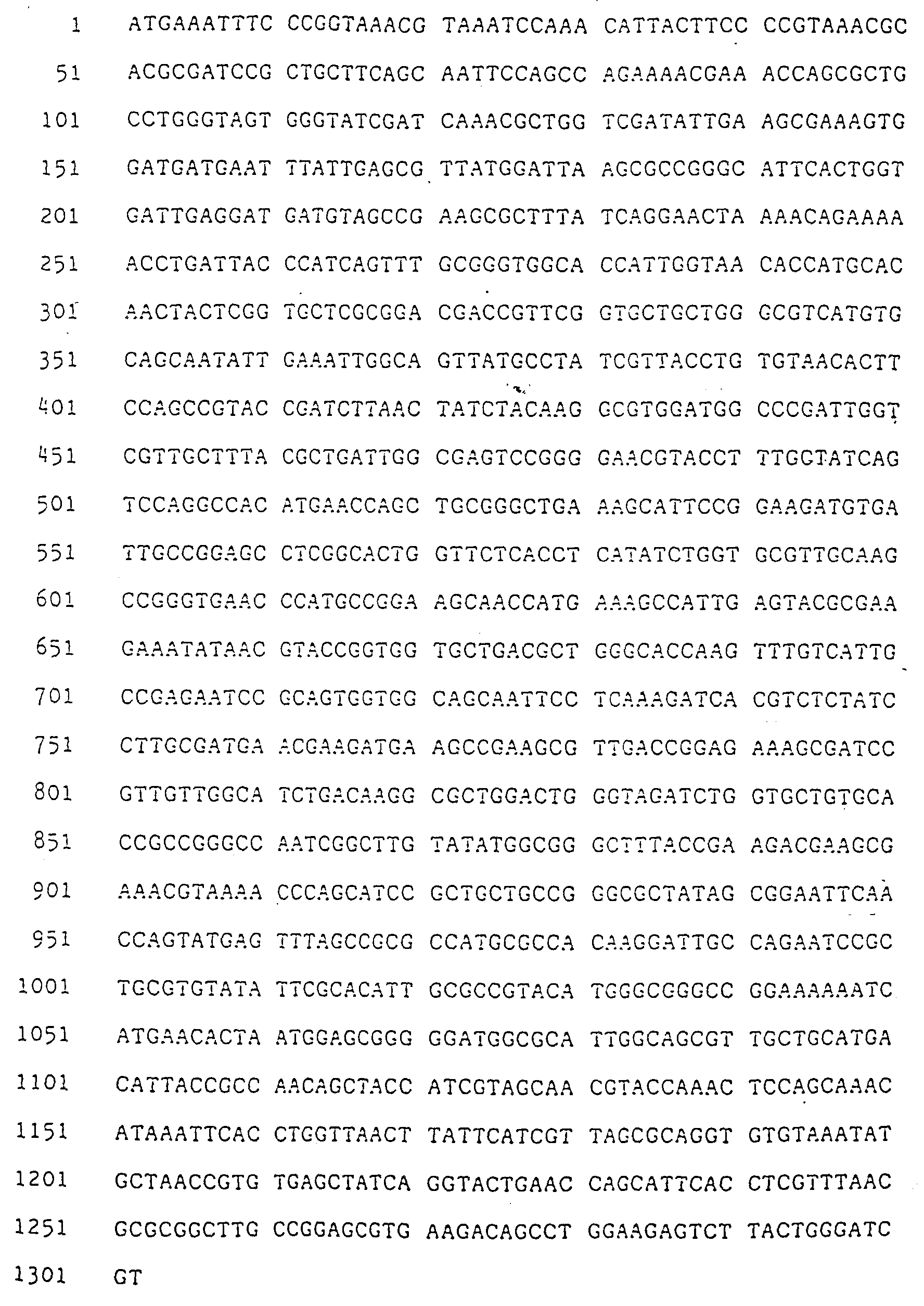
- Nucleotide sequence of the structural gene coding for this enzyme was determined by the dideoxy chain terminator method [Science, 214 , 1205-1210 (1981), Gene, 19 , 269-276 (1982)] and its amino acid sequence was deduced from the nucleotide sequence. The amino acid sequence and the nucleotide sequence are shown in Tables 4 and 5, respectively.
- Molecular weight deduced from the amino acid sequence is about 48400 daltons; according to measurement by SDS-polyacrylamide electrophoresis (manufactured by Biorad Co., Ltd., standard for low molecular weight, catalogue No. 161-0304 was used), molecular weight is about 43000 daltons.
- the nucleotide sequence shown in Table 5 corresponds to the inosine-guanosine kinase represented by the amino acid sequence shown in Table 4. However, unless the inosine-guanosine kinase activity is lost, a strain carrying a recombinant DNA inserted with a gene obtained by modifying the nucleotide sequence may similarly be used as a strain having an increased inosine-guanosine kinase activity. Even a mutated enzyme produced by modifying guanine at the 1282nd position and its subsequent nucleotide sequence as shown in Table 6 exhibits an inosine-guanosine kinase activity.
- 5'-nucleotides can be obtained by contacting nucleosides with ATP or dATP in an aqueous medium in the presence of an enzyme source having the enzyme activity which catalyzes the reaction of forming 5'-nucleotides from nucleosides and ATP or dATP.
- nucleoside inosine or guanosine is mentioned.
- 5'-nucleotides 5'-IMP or 5'-GMP is mentioned.
- inosine-guanosine kinase As the enzyme source, inosine-guanosine kinase, bacterial cells having an ability to produce the enzyme, bacterial cells carrying a recombinant DNA obtained by inserting into a vector a DNA fragment containing a gene encoding the enzyme involved in the reaction of forming 5'-nucleotides from nucleosides and ATP or dATP, a culture thereof or treated matters thereof, etc. may be used.
- a concentrate of the culture or a dried culture, a culture treated with surfactant and/or organic solvent or lytic enzyme, bacterial cells obtained by centrifuging the culture, dried bacterial cells, acetone-treated cells, cells treated with surfactants and/or organic solvents, lytic enzyme-treated cells, immobilized bacterial cells or enzyme preparation extracted from bacterial cells, etc. may be used.
- any of purified or crude products, fermentation broth or cell-free supernatant of inosine and guanosine can be used for the reaction so long as they do not interfere the reaction of forming 5'-nucleotides.
- concentration of nucleosides is in the range of from 10 to 80 g/l.
- ATP or dATP As the phosphate donor, there are ATP or dATP. Any of purified and crude ATP and dATP or materials containing ATP or dATP may be used as ATP or dATP source so long as they do not contain any substance that interferes the reaction.
- an ATP precursor, an ATP regeneration energy donor, a phosphate donor and a microorganism having an ATP biosynthesis activity are allowed to exist in the reaction solution, instead of ATP.
- the reaction system coupled with the ATP regeneration system it is sufficient to use ATP in a catalytic amount (1.0 g/l or less).
- a necessary amount is supplied and brought into the reaction system from bacteria or a culture, it is unnecessary to particularly supplement ATP.
- the strains having an ATP regenerating activity are Brevibacterium ammoniagenes KY13761 strain [Agric. Biol. Chem., 42 , 399-405 (1978)], Brevibacterium ammoniagenes ATCC 21477 strain, etc.
- Brevibacterium ammoniagenes KY13761 produce inosine by fermentation, Therefore, when inosine fermentation broth (containing cells) obtained by culturing this KY13761 strain is used as a source of nucleoside and as a source of ATP regeneration, inosine in the fermentation broth can directly be phosphorylated without requiring purification of inosine, so that an efficient process for producing 5'-IMP can be provided in a less expensive way.
- the reaction for forming 5'-nucleotides from inosine or guanosine, and ATP or dATP is carried out at a temperature of 20 to 40°C for 1 to 48 hours while adjusting pH to 6-8, preferably by adding a surfactant and/or an organic solvent.
- surfactant useful for treating the bacterial cells and for the reaction there may be used surfactants including cationic surfactants such as polyoxyethylene stearylamine (e.g., Nymeen S-215, manufactured by Nippon Oil and Fats, Co., Ltd.; hereafter the same shall be used unless otherwise indicated), cetyltrimethylammonium bromide, cation FB, cation F2-40E, etc.; anionic surfactants such as sodium oleylamide sulfate, Newrex TAB, Rapizole 80, etc.; amphoteric surfactants such as polyoxyethylene sorbitan monostearate (e.g., Nonion ST221), etc.; tertiary amine PB, hexadecyldimethylamine, etc.; any other surfactants may be used so long as they accelerate the reaction of forming 5'-nucleotides from nucleosides and ATP or dATP.
- cationic surfactants such as poly
- organic solvent toluene, xylene, aliphatic alcohols, benzene, ethyl acetate may be used.
- the organic solvent may be used generally in a concentration of 0.1 to 50 ⁇ l/ml, preferably 1 to 20 ⁇ l/ml.
- Fig. 1 relates to substrate specificity for inosine-guanosine kinase, wherein the ordinate represents an amount of 5'-IMP produced and the abscissa represents time.
- Fig. 2 relates to KCl dependency of inosine-guanosine kinase, wherein the ordinate represents an amount of 5'-IMP produced and the abscissa represents an amount of KCl added.
- Fig. 3 is a restriction enzyme map of plasmid pBM2 containing a gene encoding inosine-guanosine kinase derived from Escherichia coli HM70 strain.
- Fig. 4 is a restriction enzyme map of mutant plasmid pBM ⁇ 14 in which deletion in the structural gene of inosine-guanosine kinase has occurred up to the 5' end.
- Fig. 5 is a restriction enzyme map of mutant plasmid pBMM5 in which deletion in the structural gene of inosine-guanosine kinase has occurred up to the 3' end.
- Fig. 6 is a restriction enzyme map of vector pTrS30.
- Fig. 7 is a restriction enzyme map of plasmid pIK75 which efficiently expresses inosine-guanosine kinase.
- Fig. 8 shows a nucleotide sequence at the junction between the tryptophan promoter and the structural gene of inosine-guanosine kinase.
- Fig. 9 is a restriction enzyme map of plasmid pBM1 containing a gene encoding inosine-guanosine kinase derived from Escherichia coli W3110 strain.
- reagents and vectors used in genetic engineering experiments are all manufactured by Takara Shuzo Co., Ltd.
- Other reagents are those manufactured by Nakarai Tesque Co., Ltd.
- Escherichia coli HM70 strain was inoculated into LB liquid medium [1% trypton, 0.5% yeast extract and 1% sodium chloride (pH 7.5)] followed by culturing at 37°C overnight. After 15 g of the cultured cells was suspended in 120 ml of 20 mM Tris-hydrochloride buffer (pH 7.5) containing 2 mM EDTA, 15 ml of lysozyme solution (20 mg/ml lysozyme was dissolved in 20 mM Tris-hydrochloride buffer (pH 7.5) containing 2 mM EDTA) was added to the suspension. The mixture was allowed to stand at 30°C for an hour.
- chromosomal DNA was dissolved in 30 ml of 10 mM Tris-hydrochloride buffer containing 1 mM EDTA and 50 ⁇ g/ml ribonuclease was added to the solution. The mixture was allowed to stand at 37°C for 30 minutes. After the same procedure for phenol extraction as described above was performed, 3 ml of 2.5 M sodium acetate solution and 60 ml of ethanol were added to the aqueous layer followed by standing at -20°C for 16 hours. After centrifugation, the obtained pellet was washed with 70% ethanol solution and dried to give purified chromosomal DNA. The chromosomal DNA was suspended in 10 mM Tris-hydrochloride buffer containing 1 mM EDTA.
- Sau 3AI was added to the suspension containing 1 ⁇ g of chromosomal DNA obtained in (1) to perform partial digestion. Separately, Bam HI was added to 20 ⁇ l of a solution containing 1 ⁇ g of vector pUC19 for digestion. Then, 2 ⁇ l of 1 M Tris-hydrochloride buffer (pH 8.0) was added thereto and the mixture was treated with alkaline phosphatase at 65°C for an hour. The digested chromosomal DNA and vector DNA described above were purified by the same procedures for phenol extraction and ethanol precipitation as in (1).
- Escherichia coli HM70 strain was inoculated in 50 ml of LB liquid medium followed by culturing at 37°C for 4 hours.
- the bacteria harvested by centrifugation at 3000 rpm for 7 minutes were suspended at 0°C in 20 ml of 50 mM calcium chloride solution. After the suspension was allowed to stand at 0°C for 20 minutes, the cells were collected by the same centrifugation as described above and suspended at 0°C in 40 ml of 50 mM calcium chloride solution.
- the suspension was mixed with the solution containing the recombinant DNA obtained in (2) and the mixture was allowed to stand at 0°C for 10 minutes.
- the mixture was smeared on minimum agar plate medium containing 50 ⁇ g/ml ampicillin and 5 mM inosine. This plate medium was kept at 30°C for 48 to 72 hours.
- pBM2 The thus obtained recombinant DNA containing the gene encoding inosine-guanosine kinase derived from Escherichia coli HM70 strain was named pBM2.
- a restriction enzyme map of pBM2 is shown in Fig. 3.
- Fig. 3 part indicated with black bold line is the structural gene encoding inosine-guanosine kinase derived from Escherichia coli HM70 strain.
- the direction of transcription of the gene is from Cla I site to Bgl II site in the figure.
- inosine-guanosine kinase The structural gene of inosine-guanosine kinase is ligated downstream of tryptophan promoter of Escherichia coli , whereby inosine-guanosine kinase can be expressed in high efficiency.
- plasmid pBM2 obtained in (4) was purified. Using restriction enzymes Sma I (5 units) and Kpn I (5 units), 10 ⁇ g of pBM2 was fully digested. The resulting digested product was treated with Exo III nuclease to prepare a mutant in which nucleotides located in the direction of the inserted fragment are deleted. Mutant plasmid pBM ⁇ 14 (Fig. 4) in which the deletion had occurred up to 5' end of the inosine-guanosine kinase structural gene was selected. For construction of the deletion mutant, Deletion Kit for Kilo sequencing (manufactured by Takara, Japan) was used according to the brochure attached.
- This plasmid pBM ⁇ 14 was digested with Pst I and Xba I and a mutant in which nucleotides located to the direction of the inserted fragment were digested by Exo III nuclease, was prepared in the same way.
- mutant plasmid pBMM5 (Fig. 5) in which the deletion had occurred up to 3' end of the inosine-guanosine kinase structural gene was obtained.
- 10 ⁇ g of pBMM5 was digested with 10 units of restriction enzyme Hind III, the digested end was made to be a blunt end using the DNA blunting kit.
- Ethanol was added to collect the DNA having a blunt end as a precipitate and this DNA was digested with restriction enzyme Sac I.
- the digested product was isolated by agarose gel electrophoresis and a fragment containing the inosine-guanosine kinase structural gene was recovered from the gel (using DNA Prep manufactured by Asahi Glass Co., Ltd.) The recovered fragment was inserted into Sac I- Nru I site of vector pTrS30 (Fig. 6) to give plasmid pIK1.
- 10 ⁇ g of pIK1 was digested with 5 units of Cla I ( Cla I site in the inosine-guanosine kinase structural gene does not undergo digestion since it is generally modified by methylation).
- deletion was introduced at both of the digestion ends using nuclease BAL31.
- the deletion plasmid was recovered by precipitation by addition of ethanol followed by ligation treatment (ligation kit).
- the deletion plasmid was used for transformation of MC1000 strain. From the obtained transformants, various deletion plasmids were obtained. From these plasmids, plasmid pIK75 (Fig. 7) in which the inosine-guanosine kinase structural gene had been ligated right downstream of the Shine-Dalgarno sequence derived from the vector was selected.
- nucleotide sequence at the junction between the tryptophan promoter and the inosine-guanosine kinase structural gene is shown in Fig. 8. Genetic engineering techniques such as digestion with restriction enzymes, etc. used in this section were performed according to Molecular Cloning, unless otherwise indicated.
- MC1000(pIK75) When MC1000 strain carrying plasmid pIK75 obtained in (5) [hereafter referred to as MC1000(pIK75)] is cultured, high density culture method [Biotechnol. Bioeng., 17 , 227-239 (1975)] is appropriate. MC1000(pIK75) strain was cultured by the high density culture method.
- MC1000(pIK75) strain was inoculated into 500 ml of seed medium having the following composition followed by culturing at 30°C for 16 hours.
- composition of seed medium 3.5 g/l KH 2 PO 4 , 3.5 g/l (NH 4 ) 2 HPO 4 , 1.0 g/l MgSO 4 ⁇ 7H 2 0, 5.0 g/l glucose, 5.0 g/l yeast extract, 3 ml/l trace element solution (sterilized at 120°C for 30 minutes by steam)
- composition of trace element solution 27 g/l FeCl 3 ⁇ 6H 2 O, 2 g/l ZnCl 2 ⁇ 4H 2 O, 2 g/l CoCl 2 ⁇ 6H 2 O, 2 g/l Na 2 MoO 4 ⁇ 2H 2 O, 1 g/l CaCl 2 ⁇ 2H 2 O, 1 g/l CuCl 2 , 0.5 g/l H 3 BO 3 , 100 ml/l conc. HCl
- 3 l of a fermentation medium (medium obtained by further adding 10 g of KH 2 PO 4 ⁇ 3H 2 O and 5 g of MgSO 4 ⁇ 7H 2 O to 3 l of seed medium having the composition described above) was charged in a fermentation tank of 7.5 l volume followed by sterilization at 120°C for 30 minutes with steam. After 150 ml of 50% (w/v) sterile glucose solution was added to the fermentation tank, 500 ml of the seed medium in which MC1000 (pIK75) had been cultured was added.
- the resulting supernatant was passed through Sephadex G-50 column which had been previously equilibrated with the purification buffer.
- the column was eluted with the purification buffer to give about 30 ml of desalted active fraction.
- 60 ml of the purification buffer containing 0.1 M NaCl was added thereto.
- the desired enzyme was eluted with 200 ml of the purification buffer having an NaCl linear concentration gradient of 0.1 M to 0.6 M. From the active fractions eluted, 3 ml of the fraction having the highest enzyme concentration was collected.
- This active fraction was passed through Sephacryl S-200 column and eluted with the purification buffer containing 0.1 M NaCl. By gel filtration, the active fraction was collected. Finally 10 ml of solution of purified enzyme (1.4 ⁇ g protein/ml) was obtained. This purified enzyme was analyzed by SDS-polyacrylamide electrophoresis and no impurity was detected. The enzyme is stably stored at -20°C in the purification buffer containing 0.1 M NaCl.
- Brevibacterium ammoniagenes KY13761 strain was cultured at 30°C for 2 days on a seed agar medium plate prepared by adding 25 g/l agar to a seed medium having the composition described in Table 7. The obtained cells were inoculated into 30 ml of seed medium contained in an Erlenmeyer's flask of 250 ml volume followed by shaking culture at 30°C for 24 hours.
- the 30 ml of the resulting culture was inoculated into 3 l of seed medium having the composition described in Table 7, in a fermentation tank of 5 l volume. While adjusting pH to 6.8 with 5.5 M aqueous ammonia, culture was continued for 24 hours with agitation at 600 rpm and aeration of 3 l/min.
- 300 ml of the obtained culture was inoculated into 3 l of fermentation medium having a composition described in Table 7,in a fermentation tank of 5 l volume. While adjusting pH to 6.8 with 5.5 M aqueous ammonia, culture was continued at 32°C for 42 hours with agitation at 600 rpm and aeration of 3 l/min. [The medium was centrifuged and the cells recovered as precipitates were stored at -20°C. The cells were used in the following (9). Furthermore the medium (containing about 30 g/l of inosine) after completion of the culture was directly frozen at -20°C and thawed at 30°C immediately before use in the following (10)].
- reaction was carried out for 24 hours, while keeping pH at 7.2 using 4 N NaOH.
- a small amount of the reaction mixture was subjected to sampling intermittently to determine concentrations of phosphoric acid, inosine and 5'-IMP in the mixture.
- Phospho B-test WAKO manufactured by Wako Pure Chemical Industry Co., Ltd.
- a difference between measurement data every time and initial addition was complemented to keep the concentration of phosphate ion constant by adding monopotassium phosphate.
- Concentrations of inosine and 5'-IMP were quantitatively determined by HPLC according to a modification of the method described hereinbefore.
- 5'-IMP (calculated as disodium 7.5 hydrate) was produced from about 50 g/l of initial inosine 24 hours after starting the reaction. In this case, the molar conversion rate was 90% or more. When guanosine was added instead of inosine, 5'-GMP was produced in a molar conversion rate of 90% or more with similar time course.
- Table 8 Composition of reaction solution KY13761 strain 200 g wet cell weight/l MC1000 (pIK75) strain 20 g wet cell weight/l Inosine 50 g/l Monopotassium phosphate 20 g/l Glucose 30 g/l Magnesium sulfate 5 g/l Xylene 10 ml/l Nymeen S-215 4 g/l Phytic acid 5 g/l
- chromosomal DNA was obtained in a manner similar to Example 1 (1) except for using Escherichia coli W3110 strain in place of Escherichia coli HM70 strain.
- the chromosomal DNA was suspended in 10 mM Tris-hydrochloride buffer containing 1 mM EDTA.
- a recombinant DNA was obtained in a manner similar to Example 1 (2) except for using the suspension containing 1 ⁇ g of chromosomal DNA obtained in Example 2 (1) in place of the suspension obtained in Example 1 (1).
- Escherichia coli DH1 strain was inoculated into 50 ml of LB liquid medium followed by culturing at 37°C for 4 hours.
- the bacteria harvested by centrifugation at 3000 rpm for 7 minutes were suspended at 0°C in 20 ml of 50 mM calcium chloride solution.
- the suspension was allowed to stand at 0°C for 20 minutes, the cells were collected by the same centrifugation as described above and suspended at 0°C in 40 ml of 50 mM calcium chloride solution.
- the suspension was mixed with the solution containing recombinant DNA obtained in Example 2 (2) and the mixture was allowed to stand at 0°C for 10 minutes.
- LB agar medium plate (LB liquid medium containing 1.5% agar) supplemented with 50 ⁇ g/ml of ampicillin, 0.1 mM isopropylthiogalactoside (IPTG) and 0.004% of 5-bromo-4-chloro-3-indolyl- ⁇ -D-galactopyranoside.
- the resulting white colony was cultured at 30°C overnight in 10 ml of LB liquid medium and the cells were isolated by centrifugation. These isolated cells were stored at -20°C and their inosine-guanosine kinase activity was determined by the method shown below.
- Escherichia coli cells containing the recombinant DNA collected in Example 2 (3) were suspended (cell concentration was 100 g wet cell weight/ml) in 100 mM Tris-hydrochloride buffer (pH 8.0) containing 10 mM ATP, 10 mM inosine and 5 mM magnesium sulfate. Xylene was added to the suspension in a concentration of 10 ml/l. After thoroughly stirring, the mixture was allowed to stand at 30°C for an hour. The reaction solution was analyzed by HPLC and the amount of 5'-IMP in the reaction solution was quantitatively determined. Almost all transformants did not produce 5'-IMP but 5'-IMP-producing bacteria were obtained in a proportion of 1 out of 50,000 samples. The thus obtained 5'-IMP-producing bacteria are transformants carrying a recombinant DNA containing an inosine-guanosine kinase gene.
- pBM1 The thus obtained recombinant DNA containing the gene encoding inosine-guanosine kinase derived from Escherichia coli W3110 strain was named pBM1.
- a restriction enzyme map of pBM1 is shown in Fig. 9.
- Transformant Escherichia coli HM1 (FERM BP-2669) transformed with recombinant DNA pBM1 obtained in Example 2 (4) was cultured at 30°C for 16 hours in 400 ml of LB liquid medium (containing 50 ⁇ g/ml of ampicillin). The medium was then centrifuged to recover the cells. For control, the culture cells of Escherichia coli DH1/pUC19 containing vector pUC19 alone were obtained in a manner similar to the above. After 20 ml of a solution of Table 10 containing the obtained cells was reacted at 30°C for an hour, the amount of 5'-IMP produced in the solution was quantitatively determined by HPLC and found to be 5 mg.
- Transformant Escherichia coli HM1 carrying recombinant DNA pBM1 obtained in Example 2 (4) was cultured at 30°C for 16 hours in 400 ml of LB liquid medium (containing 50 ⁇ g/ml ampicillin). The medium was then centrifuged to recover the cells.
- the culture cells of Escherichia coli DH1/pUC19 containing vector pUC19 alone were obtained in a manner similar to the above. After 20 ml of a solution of Table 11 containing the obtained cells was incubated at 30°C for an hour, the amount of 5'-GMP produced in the solution was quantitatively determined by HPLC and found to be 2 mg.
- inosine-guanosine kinase structural gene By ligating SD sequence and strong promoter sequence upstream the inosine-guanosine kinase structural gene by genetic engineering technique, expression of inosine-guanosine kinase can be amplified.
- the amplification can be made as follows.
- the mixture was reacted at 14°C for 16 hours to ligate both DNAs, thereby to obtain a recombinant DNA.
- the recombinant DNA was introduced into Escherichia coli DH1 strain in a manner similar to Example 2 (3).
- the obtained transformants were cultured in a manner similar to Example 2 (3).
- the inosine-guanosine kinase activity was determined in a manner similar to Example 2 (4) and a strain having a high 5'-IMP productivity was selected.
- the strain was named Escherichia coli BM100 strain.
- lactose promoter sequence was ligated upstream the inosine-guanosine kinase structural gene in a correct direction.
- Escherichia coli BM100 strain was cultured in 400 ml of LB liquid medium (containing 50 ⁇ g/ml ampicillin) at 30°C for 16 hours. Centrifugation gave the cells. After 20 ml of a solution given by Table 12 containing the obtained cells and a strain having ATP regenerating activity (Japanese Published Unexamined Patent Application No. 74595/86) was incubated at 30°C for 20 hours at pH of 7.6, the amount of 5'-IMP produced in the solution was quantitatively assayed and found to be 25 g/l (calculated as the hydrate).
- a similar titer in which part of the structural gene, i.e., the DNA sequence coding for the amino-acid sequence subsequent to the 8th Leu from the C terminal is modified to code for the following amino acid sequence: a similar titer can be obtained.
- inosine-guanosine kinase derived from a microorganism belonging to the genus Escherichia can be provided.
- clarification of various properties of the enzyme for the first time has led to industrial utilization thereof.
- DNA encoding the enzyme has been isolated.
- 5'-nucleotides e.g., 5'-IMP or 5'-GMP
- nucleosides e.g., inosine or guanosine
Landscapes
- Life Sciences & Earth Sciences (AREA)
- Health & Medical Sciences (AREA)
- Chemical & Material Sciences (AREA)
- Genetics & Genomics (AREA)
- Engineering & Computer Science (AREA)
- Organic Chemistry (AREA)
- Wood Science & Technology (AREA)
- Zoology (AREA)
- Bioinformatics & Cheminformatics (AREA)
- Molecular Biology (AREA)
- Biomedical Technology (AREA)
- Biotechnology (AREA)
- General Engineering & Computer Science (AREA)
- Biochemistry (AREA)
- Microbiology (AREA)
- General Health & Medical Sciences (AREA)
- Medicinal Chemistry (AREA)
- General Chemical & Material Sciences (AREA)
- Chemical Kinetics & Catalysis (AREA)
- Physics & Mathematics (AREA)
- Biophysics (AREA)
- Plant Pathology (AREA)
- Preparation Of Compounds By Using Micro-Organisms (AREA)
- Saccharide Compounds (AREA)
- Micro-Organisms Or Cultivation Processes Thereof (AREA)
Claims (12)
- Inosine-guanosine kinase purifiée, présentant les propriétés physico-chimiques suivantes :a) action : cette enzyme exerce une action de formation d'adénosine-diphosphate (ADP) et d'acide 5'-inosinique (5'-IMP) à partir d'adénosine-triphosphate (ATP) et d'inosine, une action de formation de désoxyadénosine-diphosphate (dADP) et de 5'-IMP à partir de désoxyadénosine-triphosphate (dATP) et d'inosine, une action de formation d'ADP et d'acide 5'-guanylique (5'-GMP) à partir d'ATP et de guanosine, et une action de formation de dADP et de 5'-GMP à partir de dATP et de guanosine ;b) pH optimal : 6,9-8,2 ;c) stabilité vis-à-vis du pH : cette enzyme est stable dans le domaine de pH allant de 6,6 à 9,0, lors d'un traitement à 4°C pendant 16 heures ; l'addition de KCl améliore la stabilité en cours de conservation ;d) température optimale : 25-40°C ;e) stabilité vis-à-vis de la température : cette enzyme est stable jusqu'à 40°C, lors d'un traitement de 15 minutes à pH 8,0 ;f) spécificité pour le substrat : le résidu d'acide phosphorique situé en position γ dans l'ATP ou le dATP, utilisés comme donneurs de phosphate, est transféré sur l'inosine ou la guanosine, utilisées comme accepteurs de phosphate ;g) inhibiteurs : ions métalliques Co2+, Cu2+ et Zn2+ ;h) activation : cette enzyme a besoin de l'une des deux paires d'ions suivantes : (K+, Mg2+) et (K+, Mn2+) ;i) valeur de Km : dans un mélange réactionnel contenant 2 mM d'ATP, 10 mM de MgSO4, 300 mM de KCl et 0,1 M de tampon HEPES (pH 7,2), Km vaut 2,1 mM dans le cas de l'inosine, et 6,1 µM dans le cas de la guanosine ;j) masse moléculaire : la masse moléculaire déduite de la séquence d'acides aminés vaut environ 48400 daltons, et d'après les mesures effectuées par électrophorèse en gel de polyacrylamide-SDS, la masse moléculaire vaut environ 43000 daltons.
- Inosine-guanosine kinase purifiée, représentée par la séquence suivante de résidus d'acides aminés :

- Gène codant une inosine-guanosine kinase présentant la séquence de résidus d'acides aminés indiquée dans la revendication 2.
- Gène conforme à la revendication 3, qui présente la séquence suivante de nucléotides :
- Gène conforme à la revendication 3 ou 4, qui provient d'Escherichia coli.
- ADN recombiné obtenu par insertion, dans un vecteur, d'un fragment d'ADN contenant un gène conforme à l'une des revendications 3 à 5.
- Microorganisme hébergeant un ADN recombiné conforme à la revendication 6.
- Microorganisme conforme à la revendication 7, appartenant à l'espèce Escherichia coli.
- Procédé de préparation d'une inosine-guanosine kinase, lequel procédé comporte le fait de cultiver, dans un milieu, un microorganisme appartenant au genre Escherichia et hébergeant un ADN recombiné conforme à la revendication 6, de façon à produire et laisser s'accumuler de l'inosine-guanosine kinase dans les cellules cultivées, et le fait de récupérer l'inosine-guanosine kinase dans la culture.
- Procédé de préparation de 5'-IMP ou de 5'-GMP, lequel procédé comporte le fait de faire réagir de l'inosine ou de la guanosine avec un donneur de phosphate, dans un milieu aqueux et en présence d'une source d'enzyme qui est (1) une inosine-guanosine kinase purifiée conforme à la revendication 1 ou 2, ou (2) des cellules, un bouillon de culture ou un produit de traitement d'un microorganisme conforme à la revendication 7, de façon à produire et laisser s'accumuler du 5'-IMP ou du 5'-GMP dans le mélange réactionnel, et le fait de récupérer le 5'-IMP ou le 5'-GMP dans le mélange réactionnel.
- Procédé de préparation de 5'-IMP ou de 5'-GMP, conforme à la revendication 10, dans lequel ledit donneur de phosphate est de l'ATP ou du dATP.
- Procédé de préparation de 5'-IMP ou de 5'-GMP, conforme à la revendication 10, dans lequel ledit microorganisme est un microorganisme appartenant au genre Escherichia.
Applications Claiming Priority (3)
| Application Number | Priority Date | Filing Date | Title |
|---|---|---|---|
| JP31553789 | 1989-12-05 | ||
| JP315537/89 | 1989-12-05 | ||
| PCT/JP1990/001567 WO1991008286A1 (fr) | 1989-12-05 | 1990-12-04 | Inosine guanosine kinase |
Publications (3)
| Publication Number | Publication Date |
|---|---|
| EP0458971A1 EP0458971A1 (fr) | 1991-12-04 |
| EP0458971A4 EP0458971A4 (en) | 1993-03-31 |
| EP0458971B1 true EP0458971B1 (fr) | 1996-01-03 |
Family
ID=18066533
Family Applications (1)
| Application Number | Title | Priority Date | Filing Date |
|---|---|---|---|
| EP90917691A Expired - Lifetime EP0458971B1 (fr) | 1989-12-05 | 1990-12-04 | Inosine guanosine kinase |
Country Status (7)
| Country | Link |
|---|---|
| EP (1) | EP0458971B1 (fr) |
| KR (1) | KR0145418B1 (fr) |
| AT (1) | ATE132528T1 (fr) |
| CA (1) | CA2046865C (fr) |
| DE (1) | DE69024639T2 (fr) |
| ES (1) | ES2084046T3 (fr) |
| WO (1) | WO1991008286A1 (fr) |
Families Citing this family (9)
| Publication number | Priority date | Publication date | Assignee | Title |
|---|---|---|---|---|
| GB9208135D0 (en) * | 1992-04-13 | 1992-05-27 | Ludwig Inst Cancer Res | Polypeptides having kinase activity,their preparation and use |
| HUP9801687A3 (en) * | 1995-03-24 | 2000-06-28 | Ajinomoto Kk | Process for producing nucleic acids |
| TWI222464B (en) * | 1999-02-08 | 2004-10-21 | Kyowa Hakko Kogyo Kk | Process for producing purine nucleotides |
| BRPI0509056A (pt) | 2004-03-31 | 2007-08-21 | Ajinomoto Kk | bactéria pertencendo ao gênero bacillus ou ao gênero escherichia, e, métodos para produzir um nucleosìdeo de purina, para produzir um nucleotìdeo de purina e para produzir ácido 5'-guanìlico |
| BRPI0709635A2 (pt) | 2006-04-24 | 2011-07-19 | Ajinomoto Kk | bactéria pertencendo ao gênero bacillus, e, métodos para produzir uma substáncia derivada de purina, e um nucleotìdeo de purina |
| ES2401607T3 (es) | 2006-04-24 | 2013-04-23 | Ajinomoto Co., Inc. | Bacteria que puede producir una sustancia de purina y procedimiento para producir una sustancia de purina |
| JP2010110216A (ja) | 2007-02-20 | 2010-05-20 | Ajinomoto Co Inc | L−アミノ酸または核酸の製造方法 |
| JP2011067095A (ja) | 2008-01-10 | 2011-04-07 | Ajinomoto Co Inc | 発酵法による目的物質の製造法 |
| JP6519476B2 (ja) | 2013-10-23 | 2019-05-29 | 味の素株式会社 | 目的物質の製造法 |
Family Cites Families (2)
| Publication number | Priority date | Publication date | Assignee | Title |
|---|---|---|---|---|
| US4152209A (en) * | 1974-03-29 | 1979-05-01 | Sanraku-Ocean Co., Ltd. | Nucleotide pyrophosphotransferase and method of preparation |
| JPS57110194A (en) * | 1980-12-27 | 1982-07-08 | Ajinomoto Co Inc | Preparation of purine nucleoside-5'-monophosphate |
-
1990
- 1990-12-04 CA CA002046865A patent/CA2046865C/fr not_active Expired - Fee Related
- 1990-12-04 DE DE69024639T patent/DE69024639T2/de not_active Expired - Fee Related
- 1990-12-04 EP EP90917691A patent/EP0458971B1/fr not_active Expired - Lifetime
- 1990-12-04 KR KR1019910700840A patent/KR0145418B1/ko not_active Expired - Fee Related
- 1990-12-04 ES ES90917691T patent/ES2084046T3/es not_active Expired - Lifetime
- 1990-12-04 AT AT90917691T patent/ATE132528T1/de not_active IP Right Cessation
- 1990-12-04 WO PCT/JP1990/001567 patent/WO1991008286A1/fr not_active Ceased
Also Published As
| Publication number | Publication date |
|---|---|
| DE69024639D1 (de) | 1996-02-15 |
| DE69024639T2 (de) | 1996-06-05 |
| CA2046865C (fr) | 2001-04-24 |
| EP0458971A1 (fr) | 1991-12-04 |
| ES2084046T3 (es) | 1996-05-01 |
| WO1991008286A1 (fr) | 1991-06-13 |
| KR920701444A (ko) | 1992-08-11 |
| KR0145418B1 (ko) | 1998-07-15 |
| EP0458971A4 (en) | 1993-03-31 |
| ATE132528T1 (de) | 1996-01-15 |
| CA2046865A1 (fr) | 1991-06-06 |
Similar Documents
| Publication | Publication Date | Title |
|---|---|---|
| KR100458970B1 (ko) | 뉴클레오사이드-5'-포스페이트에스테르의제조방법 | |
| US20080280329A1 (en) | Enzymatic synthesis of deoxyribonucleosides | |
| JPWO1996037603A1 (ja) | ヌクレオシド−5′−燐酸エステルの製造法 | |
| US20080108111A1 (en) | Novel polyphosphate: amp phosphotransferase | |
| WO1996037603A1 (fr) | Procede de production du nucleoside-5'-phosphate | |
| KR100400338B1 (ko) | 푸린 뉴클레오티드의 제조법 | |
| EP0458971B1 (fr) | Inosine guanosine kinase | |
| JP2000295996A (ja) | プリンヌクレオチドの製造法 | |
| US6673576B1 (en) | Process for producing nucleic acids | |
| US5756315A (en) | Inosine-guanosine kinase | |
| JPWO1996030501A1 (ja) | 核酸類の製造方法 | |
| JP3941390B2 (ja) | 変異型酸性フォスファターゼ | |
| Kawai et al. | Establishment of a mass-production system for NADP using bacterial inorganic polyphosphate/ATP-NAD kinase | |
| JP2999256B2 (ja) | イノシングアノシンキナーゼ | |
| EP0417953A1 (fr) | Procédé de production de phosphates de thiamine | |
| US20050170470A1 (en) | Process for producing 2'-deoxyguanosine | |
| KR100237091B1 (ko) | 플라빈 뉴클레오타이드의 제조방법 | |
| EP0406436A1 (fr) | Procede de preparation d'acide 5'-inosinique | |
| JPWO1991008286A1 (ja) | イノシングアノシンキナーゼ | |
| HK1027381A (en) | Process for producing purine nucleotides | |
| JPWO1990005784A1 (ja) | 5´―イノシン酸の製造法 |
Legal Events
| Date | Code | Title | Description |
|---|---|---|---|
| PUAI | Public reference made under article 153(3) epc to a published international application that has entered the european phase |
Free format text: ORIGINAL CODE: 0009012 |
|
| 17P | Request for examination filed |
Effective date: 19910813 |
|
| AK | Designated contracting states |
Kind code of ref document: A1 Designated state(s): AT BE CH DE ES FR GB GR IT LI LU NL SE |
|
| A4 | Supplementary search report drawn up and despatched |
Effective date: 19930208 |
|
| AK | Designated contracting states |
Kind code of ref document: A4 Designated state(s): AT BE CH DE ES FR GB GR IT LI LU NL SE |
|
| 17Q | First examination report despatched |
Effective date: 19940317 |
|
| RBV | Designated contracting states (corrected) |
Designated state(s): AT BE CH DE ES FR GB IT LI LU NL SE |
|
| GRAA | (expected) grant |
Free format text: ORIGINAL CODE: 0009210 |
|
| AK | Designated contracting states |
Kind code of ref document: B1 Designated state(s): AT BE CH DE ES FR GB IT LI LU NL SE |
|
| REF | Corresponds to: |
Ref document number: 132528 Country of ref document: AT Date of ref document: 19960115 Kind code of ref document: T |
|
| ITF | It: translation for a ep patent filed | ||
| ET | Fr: translation filed | ||
| REF | Corresponds to: |
Ref document number: 69024639 Country of ref document: DE Date of ref document: 19960215 |
|
| REG | Reference to a national code |
Ref country code: CH Ref legal event code: NV Representative=s name: BOVARD AG PATENTANWAELTE |
|
| PG25 | Lapsed in a contracting state [announced via postgrant information from national office to epo] |
Ref country code: SE Effective date: 19960403 |
|
| REG | Reference to a national code |
Ref country code: ES Ref legal event code: FG2A Ref document number: 2084046 Country of ref document: ES Kind code of ref document: T3 |
|
| PLBE | No opposition filed within time limit |
Free format text: ORIGINAL CODE: 0009261 |
|
| STAA | Information on the status of an ep patent application or granted ep patent |
Free format text: STATUS: NO OPPOSITION FILED WITHIN TIME LIMIT |
|
| 26N | No opposition filed | ||
| K2C3 | Correction of patent specification (complete document) published |
Effective date: 19960103 |
|
| PG25 | Lapsed in a contracting state [announced via postgrant information from national office to epo] |
Ref country code: LU Free format text: LAPSE BECAUSE OF NON-PAYMENT OF DUE FEES Effective date: 19961231 |
|
| REG | Reference to a national code |
Ref country code: GB Ref legal event code: IF02 |
|
| PGFP | Annual fee paid to national office [announced via postgrant information from national office to epo] |
Ref country code: GB Payment date: 20051130 Year of fee payment: 16 |
|
| PGFP | Annual fee paid to national office [announced via postgrant information from national office to epo] |
Ref country code: DE Payment date: 20051201 Year of fee payment: 16 |
|
| PGFP | Annual fee paid to national office [announced via postgrant information from national office to epo] |
Ref country code: FR Payment date: 20051208 Year of fee payment: 16 |
|
| PGFP | Annual fee paid to national office [announced via postgrant information from national office to epo] |
Ref country code: AT Payment date: 20051213 Year of fee payment: 16 |
|
| PGFP | Annual fee paid to national office [announced via postgrant information from national office to epo] |
Ref country code: NL Payment date: 20051215 Year of fee payment: 16 Ref country code: CH Payment date: 20051215 Year of fee payment: 16 |
|
| PGFP | Annual fee paid to national office [announced via postgrant information from national office to epo] |
Ref country code: ES Payment date: 20060104 Year of fee payment: 16 |
|
| PGFP | Annual fee paid to national office [announced via postgrant information from national office to epo] |
Ref country code: BE Payment date: 20060216 Year of fee payment: 16 |
|
| PG25 | Lapsed in a contracting state [announced via postgrant information from national office to epo] |
Ref country code: BE Free format text: LAPSE BECAUSE OF NON-PAYMENT OF DUE FEES Effective date: 20061231 Ref country code: LI Free format text: LAPSE BECAUSE OF NON-PAYMENT OF DUE FEES Effective date: 20061231 Ref country code: CH Free format text: LAPSE BECAUSE OF NON-PAYMENT OF DUE FEES Effective date: 20061231 |
|
| PGFP | Annual fee paid to national office [announced via postgrant information from national office to epo] |
Ref country code: IT Payment date: 20061231 Year of fee payment: 17 |
|
| PG25 | Lapsed in a contracting state [announced via postgrant information from national office to epo] |
Ref country code: NL Free format text: LAPSE BECAUSE OF NON-PAYMENT OF DUE FEES Effective date: 20070701 |
|
| PG25 | Lapsed in a contracting state [announced via postgrant information from national office to epo] |
Ref country code: DE Free format text: LAPSE BECAUSE OF NON-PAYMENT OF DUE FEES Effective date: 20070703 |
|
| REG | Reference to a national code |
Ref country code: CH Ref legal event code: PL |
|
| GBPC | Gb: european patent ceased through non-payment of renewal fee |
Effective date: 20061204 |
|
| NLV4 | Nl: lapsed or anulled due to non-payment of the annual fee |
Effective date: 20070701 |
|
| REG | Reference to a national code |
Ref country code: FR Ref legal event code: ST Effective date: 20070831 |
|
| PG25 | Lapsed in a contracting state [announced via postgrant information from national office to epo] |
Ref country code: AT Free format text: LAPSE BECAUSE OF NON-PAYMENT OF DUE FEES Effective date: 20061204 Ref country code: GB Free format text: LAPSE BECAUSE OF NON-PAYMENT OF DUE FEES Effective date: 20061204 |
|
| BERE | Be: lapsed |
Owner name: *KYOWA HAKKO KOGYO CO. LTD Effective date: 20061231 |
|
| REG | Reference to a national code |
Ref country code: ES Ref legal event code: FD2A Effective date: 20061205 |
|
| PG25 | Lapsed in a contracting state [announced via postgrant information from national office to epo] |
Ref country code: ES Free format text: LAPSE BECAUSE OF NON-PAYMENT OF DUE FEES Effective date: 20061205 Ref country code: FR Free format text: LAPSE BECAUSE OF NON-PAYMENT OF DUE FEES Effective date: 20070102 |
|
| PG25 | Lapsed in a contracting state [announced via postgrant information from national office to epo] |
Ref country code: IT Free format text: LAPSE BECAUSE OF NON-PAYMENT OF DUE FEES Effective date: 20071204 |