EP0459020A2 - Circuit opto-électronique - Google Patents
Circuit opto-électronique Download PDFInfo
- Publication number
- EP0459020A2 EP0459020A2 EP90123134A EP90123134A EP0459020A2 EP 0459020 A2 EP0459020 A2 EP 0459020A2 EP 90123134 A EP90123134 A EP 90123134A EP 90123134 A EP90123134 A EP 90123134A EP 0459020 A2 EP0459020 A2 EP 0459020A2
- Authority
- EP
- European Patent Office
- Prior art keywords
- diode
- cladding layer
- diodes
- waveguide
- amplifier
- Prior art date
- Legal status (The legal status is an assumption and is not a legal conclusion. Google has not performed a legal analysis and makes no representation as to the accuracy of the status listed.)
- Granted
Links
Images
Classifications
-
- G—PHYSICS
- G02—OPTICS
- G02B—OPTICAL ELEMENTS, SYSTEMS OR APPARATUS
- G02B6/00—Light guides; Structural details of arrangements comprising light guides and other optical elements, e.g. couplings
- G02B6/10—Light guides; Structural details of arrangements comprising light guides and other optical elements, e.g. couplings of the optical waveguide type
- G02B6/12—Light guides; Structural details of arrangements comprising light guides and other optical elements, e.g. couplings of the optical waveguide type of the integrated circuit kind
- G02B6/122—Basic optical elements, e.g. light-guiding paths
- G02B6/125—Bends, branchings or intersections
Definitions
- a route switchover function for network configuration is required at network nodes.
- An optical signal is to be used for switching, which is routed to the node via the communication link fiber. It is conceivable to send this switchover signal with a different wavelength than that of the message channel or to send it as a time-coded command in the message channel.
- a module for network configuration should basically be able to perform the following functions: Function as an optoelectronic detector that receives a (small) part of the incoming signal and passes it on for command decoding, function as an optical switch that switches the light path from one branch to the other, and function as an amplifier that reduces the losses that are inevitable in these components Coupling in and out of the light at least compensated.
- Detector, switching, amplifier and waveguide functions can generally be implemented with III-V semiconductor components.
- OEIC optoelectronic circuit
- Such an NCM-OEIC based on semiconductor material of the InP / InGaAsP / InGaAlAs system would be particularly advantageous because of the single-mode quartz fibers and wavelengths in the range from 1.3 ⁇ m to 1.55 ⁇ m that are essentially used in optical communications technology.
- the object of the present invention is to provide a monolithically integrated optoelectronic amplifier circuit for the function as a network configuration module.
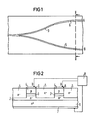
- FIGS. 1 and 2 show the NCM according to the invention in a top view, in which the course of the waveguide is visible.
- FIG. 2 shows the NCM according to the invention in the cross section drawn in FIG. 1.
- the essence of the present invention is the idea of building special diodes, which are integrated in an optical waveguide as optoelectronic amplifiers, in such a way that they also function as a photodetector with appropriate electrical polarity reversal.
- the complete NCM function with the exception of the purely electronic evaluation and control part, can then be achieved with an arrangement consisting of a branching waveguide made of a material which is transparent to the radiation to be guided, and two suitable optoelectronic amplifier diodes in each output branch of the Waveguide exists.
- FIG. 1 shows a top view of a semiconductor component according to the invention with the optoelectronic circuit integrated therein, reference numerals 6 and 9 each denoting metal contacts which are applied to the surface of the semiconductor material above the waveguides.
- the two amplifier diodes designated A and B in FIG. 1, are integrated in the two branches of the waveguide.
- FIG. 2 shows the cross section through the arrangement indicated by the broken line in FIG. 2.
- a first cladding layer 2, an active layer 3, which is laterally delimited in strips for each diode, a second cladding layer 4 and a third cladding layer 5 are grown on a substrate 1.
- the active layer 3 can have a quantum well structure.
- the second cladding layer 4 is laterally limited by the third cladding layer 5 to the strip-shaped regions occupied by the active layer. This limitation happens through the third cladding layer 5 by simultaneously filling the areas located between the waveguides.
- a first metal contact 7 is applied to the substrate 1.
- a strip-shaped second metal contact 6 is applied separately for each diode above the active layer 3.
- the first cladding layer 2 and the third cladding layer 5 are each doped with low n-conductivity.
- the second cladding layer is doped p-type. The signs of the doping can also be reversed. It is essential for the invention that the diodes for the double function as an amplifier on the one hand and a photodetector on the other hand consist of a nominally undoped active layer 3 between a first cladding layer 4 doped low for a first conductivity type and a second cladding layer 4 doped for a second conductivity type.
- diodes A and B The radiation, which is split into two parts at the junction of the waveguide, reaches diodes A and B. If the message is to pass through the output of diode A, only diode A is operated as an amplifier. The active layer 3 of the diodes is absorbing for the wavelength in question. The respective diode is therefore only permeable to the radiation if it is operated with an operating current in the direction of flow as an amplifier. If, in the present example, diode B is not operated as an amplifier, but is either polarized in the reverse direction or operated at a voltage of 0 volt, it represents a strongly absorbing waveguide. This diode B then functions as a photodetector.
- diode B can receive a signal that can be decrypted as a switchover signal.
- This switchover signal can be passed to an external control circuit 8 (see FIG. 2), after which this control circuit causes a switchover of diode A from amplifier operation to detector operation and a switchover of diode B from detector operation to amplifier operation. Doing so Voltage applied to diode B in the flow direction, while diode A now works without voltage or with a voltage in the reverse direction. Diode A now functions as a photodetector that can receive a corresponding switch signal for switching in the opposite direction. If this signal arrives in the diode A, which is now operated as a photodetector, the downstream control circuit 8 causes a renewed switching from diode A to amplifier operation and diode B to detector operation.
- the diodes As a detector or amplifier, a separation of the potentials of the two diodes must be ensured, since otherwise cross currents will occur through the semiconductor material between the two diodes.
- an electrical separation of the two diodes can be achieved by different doping of the second cladding layer 4 and the third cladding layer 5.
- the third cladding layer 5 is doped low for electrical conduction of the first conduction type (n-conduction in FIG. 2).
- the n-doping of the pn junction is chosen to be lower than is customary for optical amplifiers.
- the lower limit for doping in amplifiers is usually 2 x 1017 cm ⁇ 3.
- the n-doping of the first cladding layer 2 is chosen to be less than 2 x 1017 cm ⁇ 3.
- One embodiment of the NCM-OEIC according to the invention comprises a passive waveguide region made of a semiconductor material which is transparent for the intended wavelength range from 1.3 ⁇ m to 1.55 ⁇ m.
- This passive waveguide is applied to the active layer 3 of the one representing the active area Diodes coupled.
- This active layer 3 is e.g. B. composed of quaternary material.
- NCM-OEIC can also be constructed from a semiconductor wafer with homogeneously distributed material intended for active operation. Then the portion of the waveguide located outside the diodes must also be supplied with an operating voltage, which takes place via a third metal contact 9 (see FIG. 1). As a result, this region of the waveguide becomes amplifying (as a preamplifier, so to speak) or is at least pumped by current injection to such an extent that it becomes transparent for the intended wavelength. The attenuation in the narrow transition areas from this waveguide to the diodes A and B is negligible. In this embodiment, the technologically complex coupling between a passive and an active area is therefore omitted.
- the optoelectronic circuit according to the invention can be used in the operating modes described below in addition to the route switching function described above. If the diode A or diode B is operated alternately as an amplifier, the component works as a lossless optical switch. A switch signal is then z. B. externally fed into the control circuit 8. If diodes A and B are operated as amplifiers in both branches of the waveguide, the component acts as a distributor from one waveguide to two. The component according to the invention can also be operated simply as a receiver if the diode is switched in a branch as a photodetector. Another possibility is to detect a signal that should not be absorbed. For this purpose, the radiation is split at the fork of the waveguide.
- One portion is passed through the relevant branch of the waveguide after it has been amplified by the diode integrated therein.
- the other part is in the other branch of the waveguide from that in it as a detector receive operated diode and the signal is detected.
Landscapes
- Physics & Mathematics (AREA)
- Engineering & Computer Science (AREA)
- Microelectronics & Electronic Packaging (AREA)
- General Physics & Mathematics (AREA)
- Optics & Photonics (AREA)
- Optical Integrated Circuits (AREA)
- Networks Using Active Elements (AREA)
- Polysaccharides And Polysaccharide Derivatives (AREA)
- Solid State Image Pick-Up Elements (AREA)
- Amplifiers (AREA)
- Light Receiving Elements (AREA)
Applications Claiming Priority (2)
| Application Number | Priority Date | Filing Date | Title |
|---|---|---|---|
| DE4017157 | 1990-05-28 | ||
| DE4017157 | 1990-05-28 |
Publications (3)
| Publication Number | Publication Date |
|---|---|
| EP0459020A2 true EP0459020A2 (fr) | 1991-12-04 |
| EP0459020A3 EP0459020A3 (en) | 1992-03-18 |
| EP0459020B1 EP0459020B1 (fr) | 1995-03-08 |
Family
ID=6407347
Family Applications (1)
| Application Number | Title | Priority Date | Filing Date |
|---|---|---|---|
| EP90123134A Expired - Lifetime EP0459020B1 (fr) | 1990-05-28 | 1990-12-03 | Circuit opto-électronique |
Country Status (5)
| Country | Link |
|---|---|
| US (1) | US5065207A (fr) |
| EP (1) | EP0459020B1 (fr) |
| JP (1) | JPH04232926A (fr) |
| AT (1) | ATE119678T1 (fr) |
| DE (1) | DE59008666D1 (fr) |
Families Citing this family (8)
| Publication number | Priority date | Publication date | Assignee | Title |
|---|---|---|---|---|
| US6087703A (en) * | 1994-06-07 | 2000-07-11 | Mitsubishi Denki Kabushiki Kaisha | Photodetector and photodetection circuit |
| EP1014455B1 (fr) | 1997-07-25 | 2006-07-12 | Nichia Corporation | Dispositif a semi-conducteur en nitrure |
| JP3770014B2 (ja) | 1999-02-09 | 2006-04-26 | 日亜化学工業株式会社 | 窒化物半導体素子 |
| WO2000052796A1 (fr) | 1999-03-04 | 2000-09-08 | Nichia Corporation | Element de laser semiconducteur au nitrure |
| US6463193B2 (en) * | 2000-12-06 | 2002-10-08 | Intel Corporation | Method and apparatus for switching an optical beam using a phase array disposed in a higher doped well region |
| US6775425B2 (en) * | 2002-06-26 | 2004-08-10 | Intel Corporation | Method and apparatus for adjusting the phase of an optical beam |
| US7206471B2 (en) * | 2004-12-23 | 2007-04-17 | Lucent Technologies Inc. | Integrated circuit having an optical core |
| TWI362769B (en) | 2008-05-09 | 2012-04-21 | Univ Nat Chiao Tung | Light emitting device and fabrication method therefor |
Family Cites Families (7)
| Publication number | Priority date | Publication date | Assignee | Title |
|---|---|---|---|---|
| US4292512A (en) * | 1978-06-19 | 1981-09-29 | Bell Telephone Laboratories, Incorporated | Optical monitoring photodiode system |
| JPS63224252A (ja) * | 1987-02-06 | 1988-09-19 | シーメンス、アクチエンゲゼルシヤフト | 導波路−ホトダイオードアレー |
| US4787691A (en) * | 1987-03-26 | 1988-11-29 | The United States Of America As Represented By The Secretary Of The Air Force | Electro-optical silicon devices |
| JPS6447910A (en) * | 1987-08-18 | 1989-02-22 | Matsushita Electric Industrial Co Ltd | Magnetic type rotary angle detecting apparatus |
| JPH01200233A (ja) * | 1988-02-04 | 1989-08-11 | Fujitsu Ltd | 光スイッチ |
| US5013113A (en) * | 1989-08-31 | 1991-05-07 | The United States Of America As Represented By The Secretary Of The Air Force | Lossless non-interferometric electro-optic III-V index-guided-wave switches and switching arrays |
| US5004447A (en) * | 1989-09-06 | 1991-04-02 | The United States Of America As Represented By The Secretary Of The Air Force | Low loss semiconductor directional coupler switches including gain method of switching light using same |
-
1990
- 1990-12-03 EP EP90123134A patent/EP0459020B1/fr not_active Expired - Lifetime
- 1990-12-03 AT AT90123134T patent/ATE119678T1/de active
- 1990-12-03 DE DE59008666T patent/DE59008666D1/de not_active Expired - Fee Related
-
1991
- 1991-02-05 US US07/655,138 patent/US5065207A/en not_active Expired - Fee Related
- 1991-05-24 JP JP3148101A patent/JPH04232926A/ja active Pending
Also Published As
| Publication number | Publication date |
|---|---|
| EP0459020B1 (fr) | 1995-03-08 |
| JPH04232926A (ja) | 1992-08-21 |
| EP0459020A3 (en) | 1992-03-18 |
| ATE119678T1 (de) | 1995-03-15 |
| DE59008666D1 (de) | 1995-04-13 |
| US5065207A (en) | 1991-11-12 |
Similar Documents
| Publication | Publication Date | Title |
|---|---|---|
| EP0600267B1 (fr) | Module optique émetteur-récepteur bidirectionnel | |
| DE60026367T2 (de) | Integrierter opto-elektronischer wellenlängenwandler | |
| DE69309410T2 (de) | Optische Vielfachschalteranordnung unter Verwendung halbleitender Wellenleiterverstärker | |
| DE69529626T2 (de) | Optischer wellenleiterkreuzungspunktschalter | |
| DE69125888T2 (de) | Verfahren zur Lichtmodulation und optischer Modulator | |
| DE69805048T2 (de) | Photodiode | |
| DE2816312C2 (fr) | ||
| DE102019135282B4 (de) | Optoelektronische Komponente mit Strom, der auf Pfade mit hoher Verstärkung abgelenkt wird | |
| DE3210980A1 (de) | Optisches schaltelement und optische schaltmatrix | |
| DE69429416T2 (de) | Vollständig optisches Flip-Flop | |
| DE69109553T2 (de) | Wellenlängenselektive optische Halbleitervorrichtung und Verfahren zur Verstärkung oder Ausstrahlung von Licht unter Verwendung derselben. | |
| EP0459020B1 (fr) | Circuit opto-électronique | |
| DE69103959T2 (de) | Optische Verstärker, optisches Übertragungssystem und Netzwerke unter Verwendung des Verstärkers und integrierte optische Knoten, die den Verstärker enthalten. | |
| DE69409329T2 (de) | Feldeffekttransistorbasierter optischer Empfänger | |
| DE102009041774B4 (de) | Photoempfängeranordnung und Verfahren zum Betreiben eines Photoempfängers | |
| DE69807882T2 (de) | Lichtemittierende vorrichtung und transistor | |
| DE3928116A1 (de) | Datennetz mit lichtwellenleitern | |
| DE69305036T2 (de) | Optischer Sender-Empfänger für optische Datenübertragung und Schalteinrichtung | |
| DE68905896T2 (de) | Laseranordnung in einem optischen verbindungssystem. | |
| DE69114593T2 (de) | Optisches Vermittlungssystem für Frequenzmultiplexsignale. | |
| DE69721618T2 (de) | Halbleiter-Photodetektor mit Wellenleiter | |
| DE10213045B4 (de) | Integrierter optischer Faser-Empfänger | |
| DE10135958B4 (de) | Elektroabsorptionsmodulator, Modulator-Laser-Vorrichtung und Verfahren zum Herstellen eines Elektroabsorptionsmodulators | |
| EP0598855B1 (fr) | Laser a semiconducteur a commande optique | |
| DE69808574T2 (de) | Optischer Vorverstärker |
Legal Events
| Date | Code | Title | Description |
|---|---|---|---|
| PUAI | Public reference made under article 153(3) epc to a published international application that has entered the european phase |
Free format text: ORIGINAL CODE: 0009012 |
|
| 17P | Request for examination filed |
Effective date: 19901220 |
|
| AK | Designated contracting states |
Kind code of ref document: A2 Designated state(s): AT BE CH DE FR GB IT LI NL SE |
|
| PUAL | Search report despatched |
Free format text: ORIGINAL CODE: 0009013 |
|
| AK | Designated contracting states |
Kind code of ref document: A3 Designated state(s): AT BE CH DE FR GB IT LI NL SE |
|
| 17Q | First examination report despatched |
Effective date: 19940112 |
|
| GRAA | (expected) grant |
Free format text: ORIGINAL CODE: 0009210 |
|
| AK | Designated contracting states |
Kind code of ref document: B1 Designated state(s): AT BE CH DE FR GB IT LI NL SE |
|
| REF | Corresponds to: |
Ref document number: 119678 Country of ref document: AT Date of ref document: 19950315 Kind code of ref document: T |
|
| REF | Corresponds to: |
Ref document number: 59008666 Country of ref document: DE Date of ref document: 19950413 |
|
| ITF | It: translation for a ep patent filed | ||
| GBT | Gb: translation of ep patent filed (gb section 77(6)(a)/1977) |
Effective date: 19950518 |
|
| ET | Fr: translation filed | ||
| PLBE | No opposition filed within time limit |
Free format text: ORIGINAL CODE: 0009261 |
|
| STAA | Information on the status of an ep patent application or granted ep patent |
Free format text: STATUS: NO OPPOSITION FILED WITHIN TIME LIMIT |
|
| 26N | No opposition filed | ||
| PGFP | Annual fee paid to national office [announced via postgrant information from national office to epo] |
Ref country code: GB Payment date: 19981210 Year of fee payment: 9 Ref country code: BE Payment date: 19981210 Year of fee payment: 9 |
|
| PGFP | Annual fee paid to national office [announced via postgrant information from national office to epo] |
Ref country code: AT Payment date: 19981211 Year of fee payment: 9 |
|
| PGFP | Annual fee paid to national office [announced via postgrant information from national office to epo] |
Ref country code: NL Payment date: 19981217 Year of fee payment: 9 |
|
| PGFP | Annual fee paid to national office [announced via postgrant information from national office to epo] |
Ref country code: FR Payment date: 19981218 Year of fee payment: 9 |
|
| PGFP | Annual fee paid to national office [announced via postgrant information from national office to epo] |
Ref country code: SE Payment date: 19981222 Year of fee payment: 9 |
|
| PGFP | Annual fee paid to national office [announced via postgrant information from national office to epo] |
Ref country code: DE Payment date: 19990219 Year of fee payment: 9 |
|
| PGFP | Annual fee paid to national office [announced via postgrant information from national office to epo] |
Ref country code: CH Payment date: 19990311 Year of fee payment: 9 |
|
| PG25 | Lapsed in a contracting state [announced via postgrant information from national office to epo] |
Ref country code: GB Free format text: LAPSE BECAUSE OF NON-PAYMENT OF DUE FEES Effective date: 19991203 Ref country code: AT Free format text: LAPSE BECAUSE OF NON-PAYMENT OF DUE FEES Effective date: 19991203 |
|
| PG25 | Lapsed in a contracting state [announced via postgrant information from national office to epo] |
Ref country code: SE Free format text: LAPSE BECAUSE OF NON-PAYMENT OF DUE FEES Effective date: 19991204 |
|
| PG25 | Lapsed in a contracting state [announced via postgrant information from national office to epo] |
Ref country code: LI Free format text: LAPSE BECAUSE OF NON-PAYMENT OF DUE FEES Effective date: 19991231 Ref country code: CH Free format text: LAPSE BECAUSE OF NON-PAYMENT OF DUE FEES Effective date: 19991231 Ref country code: BE Free format text: LAPSE BECAUSE OF NON-PAYMENT OF DUE FEES Effective date: 19991231 |
|
| BERE | Be: lapsed |
Owner name: SIEMENS A.G. Effective date: 19991231 |
|
| PG25 | Lapsed in a contracting state [announced via postgrant information from national office to epo] |
Ref country code: NL Free format text: LAPSE BECAUSE OF NON-PAYMENT OF DUE FEES Effective date: 20000701 |
|
| GBPC | Gb: european patent ceased through non-payment of renewal fee |
Effective date: 19991203 |
|
| EUG | Se: european patent has lapsed |
Ref document number: 90123134.0 |
|
| PG25 | Lapsed in a contracting state [announced via postgrant information from national office to epo] |
Ref country code: FR Free format text: LAPSE BECAUSE OF NON-PAYMENT OF DUE FEES Effective date: 20000831 |
|
| NLV4 | Nl: lapsed or anulled due to non-payment of the annual fee |
Effective date: 20000701 |
|
| PG25 | Lapsed in a contracting state [announced via postgrant information from national office to epo] |
Ref country code: DE Free format text: LAPSE BECAUSE OF NON-PAYMENT OF DUE FEES Effective date: 20001003 |
|
| REG | Reference to a national code |
Ref country code: FR Ref legal event code: ST |
|
| PG25 | Lapsed in a contracting state [announced via postgrant information from national office to epo] |
Ref country code: IT Free format text: LAPSE BECAUSE OF NON-PAYMENT OF DUE FEES;WARNING: LAPSES OF ITALIAN PATENTS WITH EFFECTIVE DATE BEFORE 2007 MAY HAVE OCCURRED AT ANY TIME BEFORE 2007. THE CORRECT EFFECTIVE DATE MAY BE DIFFERENT FROM THE ONE RECORDED. Effective date: 20051203 |