EP0459276A2 - Datenverarbeitungsanlage - Google Patents
Datenverarbeitungsanlage Download PDFInfo
- Publication number
- EP0459276A2 EP0459276A2 EP91108209A EP91108209A EP0459276A2 EP 0459276 A2 EP0459276 A2 EP 0459276A2 EP 91108209 A EP91108209 A EP 91108209A EP 91108209 A EP91108209 A EP 91108209A EP 0459276 A2 EP0459276 A2 EP 0459276A2
- Authority
- EP
- European Patent Office
- Prior art keywords
- neurons
- layer
- neuron
- input
- neuron group
- Prior art date
- Legal status (The legal status is an assumption and is not a legal conclusion. Google has not performed a legal analysis and makes no representation as to the accuracy of the status listed.)
- Ceased
Links
Images



Classifications
-
- G—PHYSICS
- G06—COMPUTING OR CALCULATING; COUNTING
- G06N—COMPUTING ARRANGEMENTS BASED ON SPECIFIC COMPUTATIONAL MODELS
- G06N3/00—Computing arrangements based on biological models
- G06N3/02—Neural networks
- G06N3/04—Architecture, e.g. interconnection topology
-
- G—PHYSICS
- G06—COMPUTING OR CALCULATING; COUNTING
- G06V—IMAGE OR VIDEO RECOGNITION OR UNDERSTANDING
- G06V30/00—Character recognition; Recognising digital ink; Document-oriented image-based pattern recognition
- G06V30/10—Character recognition
- G06V30/18—Extraction of features or characteristics of the image
- G06V30/1801—Detecting partial patterns, e.g. edges or contours, or configurations, e.g. loops, corners, strokes or intersections
- G06V30/18019—Detecting partial patterns, e.g. edges or contours, or configurations, e.g. loops, corners, strokes or intersections by matching or filtering
- G06V30/18038—Biologically-inspired filters, e.g. difference of Gaussians [DoG], Gabor filters
- G06V30/18048—Biologically-inspired filters, e.g. difference of Gaussians [DoG], Gabor filters with interaction between the responses of different filters, e.g. cortical complex cells
- G06V30/18057—Integrating the filters into a hierarchical structure, e.g. convolutional neural networks [CNN]
-
- G—PHYSICS
- G06—COMPUTING OR CALCULATING; COUNTING
- G06N—COMPUTING ARRANGEMENTS BASED ON SPECIFIC COMPUTATIONAL MODELS
- G06N3/00—Computing arrangements based on biological models
- G06N3/02—Neural networks
- G06N3/04—Architecture, e.g. interconnection topology
- G06N3/045—Combinations of networks
-
- G—PHYSICS
- G06—COMPUTING OR CALCULATING; COUNTING
- G06N—COMPUTING ARRANGEMENTS BASED ON SPECIFIC COMPUTATIONAL MODELS
- G06N3/00—Computing arrangements based on biological models
- G06N3/02—Neural networks
- G06N3/04—Architecture, e.g. interconnection topology
- G06N3/0464—Convolutional networks [CNN, ConvNet]
-
- G—PHYSICS
- G06—COMPUTING OR CALCULATING; COUNTING
- G06N—COMPUTING ARRANGEMENTS BASED ON SPECIFIC COMPUTATIONAL MODELS
- G06N3/00—Computing arrangements based on biological models
- G06N3/02—Neural networks
- G06N3/04—Architecture, e.g. interconnection topology
- G06N3/0495—Quantised networks; Sparse networks; Compressed networks
-
- G—PHYSICS
- G06—COMPUTING OR CALCULATING; COUNTING
- G06N—COMPUTING ARRANGEMENTS BASED ON SPECIFIC COMPUTATIONAL MODELS
- G06N3/00—Computing arrangements based on biological models
- G06N3/02—Neural networks
- G06N3/08—Learning methods
- G06N3/09—Supervised learning
-
- G—PHYSICS
- G06—COMPUTING OR CALCULATING; COUNTING
- G06V—IMAGE OR VIDEO RECOGNITION OR UNDERSTANDING
- G06V10/00—Arrangements for image or video recognition or understanding
- G06V10/70—Arrangements for image or video recognition or understanding using pattern recognition or machine learning
- G06V10/82—Arrangements for image or video recognition or understanding using pattern recognition or machine learning using neural networks
-
- G—PHYSICS
- G06—COMPUTING OR CALCULATING; COUNTING
- G06V—IMAGE OR VIDEO RECOGNITION OR UNDERSTANDING
- G06V30/00—Character recognition; Recognising digital ink; Document-oriented image-based pattern recognition
- G06V30/10—Character recognition
- G06V30/19—Recognition using electronic means
- G06V30/191—Design or setup of recognition systems or techniques; Extraction of features in feature space; Clustering techniques; Blind source separation
-
- G—PHYSICS
- G06—COMPUTING OR CALCULATING; COUNTING
- G06V—IMAGE OR VIDEO RECOGNITION OR UNDERSTANDING
- G06V30/00—Character recognition; Recognising digital ink; Document-oriented image-based pattern recognition
- G06V30/10—Character recognition
Definitions
- the present invention relates to a data processing system based on the concept of the neural network.
- the neural network according to a data processing system of this type is structured with layers by preparing neuron model (hereinafter called “neuron")1, shown in Figure 4, in parallel. Neurons in each layer is synapse connected to all neurons in other adjacent layers, so as to input and output data. According to neuron1, data O is output in accordance with the comparison result between the sum of multiplied input data from outside I1, I2, I3...In by weights W1, W2, W3...Wn and threshold ⁇ .
- neuron1 neuron model
- a conventional neural network is structured to form neural layers by preparing above neurons in parallel and to connect the above neural layers in series.
- Neural layer for example, comprises 3 layers, input layer, middle layer and output layer, as it is described by Perceptrons proposed by Rosenblatt, in which neurons of each layer are synapse connected to all neurons of other adjacent layer.
- the present invention is to solve the above problems of the prior art and has an object to provide a data processing system comprising the necessary minimum number of neurons for the processing objects.
- Figure 1 shows a character recognition system comprising a data processing system according to a first embodiment of the present invention.
- This character recognition system comprises a video camera 10, a preprocessing system 20, a data processing system 30, a pro-processing system 40 and a display 50.
- the video camera 10 is prepared for inputting characters and is connected to the preprocessing system 20.
- the preprocessing system 20 is, for example, a conventional image processing system that extracts the characteristic data of input characters (for example, number of end points, number of branch points, etc.) and outputs these characteristic data to the data processing system 30.
- the data processing system 30 structures the neural network, as it is described later, and recognizes an input character from the preprocessing system 20 with respect to its characteristic data, then outputs data to the pro-processing system 40 according to the above recognition result.
- the recognition signal is, for example, a character code.
- the pro-processing system 40 stores the above output data as, for example, data of a word processor, and outputs it to the display 50, simultaneously.
- Display 50 for example, includes a CRT and displays the characters recognized by the data processing system 30 onto a screen.
- the neural network structuring the data processing system 30 is structured as a part of a hardware.
- This data processing system 30, typically indicated in Figure 1, comprises 3 neural layers, an input layer 31, a middle layer 32 and an output layer 33, in which the middle layer 32 is arranged between the input layer 31 and the output layer 33.
- Each layer 31, 32 and 33 comprises a plurality of neurons n and the neurons n of input layer 31 are connected to all neurons n of middle neural layer 32, and the neurons n of the middle neural layer 32 are connected to all neurons n of the output layer 33.
- Each neuron n outputs either "1" or “0” according to the formula (1) of the normalization function, as it is described with reference to Figure 4.
- Neuron n is structured, for example, by operational amplifiers. Weight Wn to be multiplied to a data input to each neuron n is obtained, for example, by a variable resistance connected to an input terminal of an operation amplifier. Threshold function is realized by, for example, switching elements. Accordingly, weight Wn is changed and output data is connected by changing variable resistance with respect to the output data of each neuron, so as to perform the learning control.
- Figure 2 shows a typical input layer 31, a middle layer 32 and an output layer 33. They show the successive decrease in numbers of neurons in input layer 31, middle layer 32 and output layer 33.
- numbers of neurons in input layer 31, middle layer 32, and output layer 33 are determined to be 64, 49, and 36, respectively, for the simple explanation, in which 8x8 neurons, 7x7 neurons and 6x6 neurons in both vertical and horizontal directions are respectively arranged.
- the location of a neuron at the down left corner in this figure is determined as an origin, a neuron at the ith and jth location from left and from down, respectively, is determined as nij.
- Each neuron of input layer 31 ignites with respect to characteristic data of character input through a video camera 10. For example, it is deemed that number of end points is expressed by ignition pattern of n11, n12, n21 and n22; and number of branch points is expressed by ignition patterns of n13, n14, n23 and n24. For example, it is deemed that Euler number is expressed by ignition patterns of n11, n21...n82. Accordingly, ignition pattern of neurons of input layer 31 is determined in accordance with an input character, artificially.
- a character or numerical value is expressed, for example, by nueron nii on a diagonal line connecting neurons at down left corner and down right corner (neurons in the broken frame). Accordingly, neurons on the above diagonal line express character codes of a character or the numerical values from 1 to 64.
- the ignition pattern of neurons of an output layer 33 is determined artificially. According to the present embodiment, number of ignition patterns of neuron nii on the diagonal line is 64 ways. Therefore, it is possible to recognize 64 kinds of characters, according to the present embodiment, so that recognition of, for example, the alphabet is possible.
- the numerical values indicate clustering results; i.e. clusters, of characters input from a video camera 10 by the predetermined method, as it will be described later.
- Neurons of output layer 33 never ignite until learning of character recognition is performed, even if character data is input to a data processing system 30.
- the ignition of a neuron becomes possible by learning, and learning will be completed when the predetermined ignition pattern is output in accordance with input character data.
- the input and output patterns for learning is the representative data to be processed at the neural network. Data to be processed actually covers a wide area. Learning is continuously executed until an adaptable association is performed with respect to the above representative input and output data. Therefore, when learning is completed, input layer 31 and output layer 33 output artificially determined ignition pattern, as it is described above, according to input character data.
- Neurons in each layer are divided into the neuron groups with a fixed number of neurons.
- one neuron group is comprised with 4 neurons.
- neuron group a1 for example, comprises neurons n16, n26, n17 and n27; and neuron group a2 comprises neurons n26, n36, n27 and n37.
- neuron groups a3, a4, a5, a6 and a7 can be defined by shifting one neuron column to the right, successively.
- Each neuron group a1 to a7 corresponds to neuron n16, n26, n36, n45, n56, n66 and n76 in middle layer 32, respectively. That is, a neuron group in input layer 31 corresponds to a neuron in middle layer 32 which locates at the same coordinates as the neuron at lower left corner of a neuron group in input layer 31 (as to neuron group a1, it corresponds to neuron n16).
- neurons in middle layer 32 are also divided into neuron groups each of which comprises 4 neurons.
- Each neuron group corresponds to a neuron in output layer 33 as the same manner as it is described above.
- neurons in a part of each neuron group belong to the adjacent neuron group at the same time.
- neurons n26 and n27 of neuron group a1 also belong to neuron group a2 which locates right next to neuron group a1.
- Nuerons n16 and n26 of neuron group a1 also belong to neuron group a8 which locates below the neuron group a1. Therefore, each neuron group overlaps to the adjacent neuron groups.
- each numerical value Ni, a, and v should be selected so that x becomes an integral number. According to a numerical value a, however, it is possible to determine the number of neurons of a neuron group locating at the very corner part to be different to that of the other neuron groups.
- Nm ⁇ ( ⁇ Ni ⁇ - v)/( ⁇ a - v) ⁇ 2 (2)
- N n ⁇ ( ⁇ N n-1 ⁇ - v)/( ⁇ a - v) ⁇ 2 (3)
- N n-1 is the number of neurons in (n-1)th neural layer.
- Number of neurons in input layer 31 is determined according to the contents of the processing for an input data. That is, in the case of character recognition, for example, number of neurons in input layer 31 is determined with respect to the kinds of characteristic data of a character. On the other hand, number of neurons in output layer 33 is determined according to the output contents. As for the character recognition, number of neurons are determined according to the kinds of character codes or cluster of characteristic data. For example, 64 neurons are to be prepared to the system for the alphabet recognition. Therefore, number of neurons in input layer 31 and output layer 33 are determined according to the processing contents of the present data processing system. On the other hand, number of neurons in middle layer 32 are determined, as it is indicated by the formula (2), according to the number of neurons in input layer 31 and number of neurons in neuron group, etc. Of course, the relationship between the number of neurons in middle layer 32 and output layer 33 are similar to the relationship between input layer and middle layer, so that the formula (3) has to be fulfilled.
- numbers of neurons in input layer 31, Ni, and in output layer 33, No are determined according to an object of a data processing system.
- number of neurons included in a neuron group, a, and number of neuron strings belong to another adjacent neuron group, v, at the same time are calculated at experimental basis. For example, a is "4" and v is "1" (in this case, the percentage of overlapping is 50%).
- The, number of neurons in the 3rd layer (the 2nd middle layer), N3, is determined from the formula (3). The above calculation is proceeded until the number of neurons in the (n+1)th layer become smaller than the number of neurons in output layer 33, No, so that the nth layer becomes the middle layer at just before output layer 33.
- number of neurons included in a neuron group was determined to 4, it is possible to determine preferable number of neurons as it is necessary. Also, it does not have to set up the same value for the number of neurons in a neuron group, a, and the percentage of overlapping, v, with respect to the layers from input layer 31 to output layer 33. It may be necessary that when a plurality of middle layers 32 is prepared, the last middle layer has to have the different number of neurons, a, and the different percentage of overlapping than the other middle layers, so that each neuron in the last middle layer will correspond perfectly to each nueron in output layer 33.
- output layer it does not have to be structured to express the character codes in accordance with the neurons on the diagonal line. It is possible to be structured to define the recognized character according to all neurons.
- each layer is figured as a square and neurons are arranged as a neat grid.
- the arrangements may be different physically.
- a neuron is structured by a computer memory.
- the physical arrangement of neurons on the memory is not to be concerned.
- the character recognition system comprises a video camera 10, a preprocessing system 20, a data processing system 100, a pro-processing system 40 and a display 50.
- Video camera 10 is prepared for inputting characters and is connected to a preprocessing system 20.
- a preprocessing system 20 is, for example, a known image processing system that performs the filtering processing onto the data of input character and binarizes the data as well as extracts the characteristic data of input character (for example, number of end points, number of branch points, etc.) and outputs these characteristic data to the data processing system 100.
- the data processing system 100 structures the neural network, as it is described later, and recognizes an input character from the preprocessing system 20 with respect to its characteristic data, then outputs data to the pro-processing system 40 according to the above recognition result.
- the recognition signal is, for example, a character code.
- the pro-processing system 40 stores the above output data as, for example, data of word processor, and outputs it to the display 50 simultaneously.
- Display 50 for example, is structured by CRT, and displays recognized character by a data processing system 100 onto an image.
- the neural network structuring a data processing system 100 is structured, for example, as a part of a hardware.
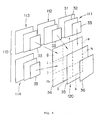
- This data processing system 100 typically indicated in Figure 6, comprises preprocessing portion 110 and pro-processing portion 120.
- Preprocessing portion 110 actually comprises 9 data processing portions, as it is described later; however, 3 data processing portions 111, 112, and 113 are shown in Figure 6.
- pro-processing portion 120 comprises one data processing portion.
- Each data processing portion comprises 3 neural layers, respectively.
- the structure of data processing portion is described with reference to data processing portion 111.
- Data processing portion 111 comprises 3 neural layers; input layer 31, middle layer 32 and output layer 33, in which middle layer 32 is arranged between input layer 31 and output layer 33.
- Each layer 31, 32 and 33 comprise a plurality of neurons n, respectively, in which neurons n of input layer 31 are connected to all neurons n of middle layer 32, and neurons n of middle layer 32 is connected to all neurons n of output layer 33.
- the structures of other data processing portions, such as 112 and 113 are similar to the data processing portion 111, as well as pro-processing portion 120. It comprises input layer 34, middle layer 35 and output layer 36.
- Neurons n of input layer 34 are connected to all neurons n in middle layer 35, and neurons n of middle layer are connected to all neurons n of output layer 36.
- the number of neurons in input layer 34 of pro-processing portion 120 is equivalent to the total number of neurons in each output layer 33 of preprocessing portion 110.
- Neuron of each output layer 33 is connected to one of neurons in input layer 34.
- FIG. 6 shows the structures of preprocessing portion 110 and pro-processing portion 120, solidly.
- preprocessing portion 110 actually comprises 9 data processing portions, as described above; however, only 4 data processing portions 111, 112, 113 and 114 are indicated in this figure.
- each neuron in output layer 33 of each data processing of preprocessing portion 110 is connected to one neuron in input layer 34 of pro-processing portion 120, respectively.
- neurons in output layer 33 of preprocessing portion 110 and neurons in input layer 34 of pro-processing portion 120 perfectly correspond to each other.
- Input layer 34 of pro-processing portion 120 is divided into the same numbers of area; e, f, g, h, i, j, k, l and m, as the number of data processing portions of preprocessing portion 110 (as to the present embodiment, it is 9), each of which corresponds to output layers 33 of data processing portions 111, 112, 113 and 114 of preprocessing portion 110, respectively.
- pro-processing portion 120 clusters with respect to input characters are input to input layer 34 from preprocessing portion 110, and character codes with respect to input characters are output from output layer 36. These character codes are expressed by, for example, neurons on a diagonal line connecting neurons at down left corner and down right corner, as it is shown in figure 2 (c).
- neurons in a part of each neuron group belong to the adjacent neuron group at the same time.
- neurons n26 and n27 of neuron group a1 also belong to neuron group a2 which locates right next to neuron group a1.
- the number of neurons in input layer 31, 34 and output layer 33, 36 are determined according to the processing contents of the present data processing system.
- number of neurons in middle layer 32, 35 are determined, as it is indicated by the formula (2), according to the number of neurons in input layer 31 and number of neurons in neuron group, etc.
- the relationship between the number of neuron in middle layer 32, 35 and output layer 33, 36 are similar to the relationship between input layer 31, 34 and middle layer 32, 35, so that the formula (3) has to be fulfilled.
- numbers of neurons in input layer 31 and 34, Ni, and in output layer 33 and 36, No are determined according to an object of a data processing system.
- number of neurons included in a neuron group, a, and number of neuron strings belong to another adjacent neuron group, v, at the same time are calculated at experimental basis. For example, a is "4" and v is "1" (in this case, the percentage of overlapping is 50%).
- N3 number of neurons in the 3rd layer (the 2nd middle layer), N3, is determined from the formula (3). The above calculation is proceeded until the number of neurons in output layer 33, No, so that the nth layer becomes the middle layer at just before output layer 33, 35.
- Euler number, area and number of groups are input as the characteristics data from preprocessing system 20 to the 1st data processing portion 111 to be clustered.
- the 1st data processing portion is for the judgment of input characters, such as Chinese characters and hiragana characters that belong to which clusters with respect to Euler number, area and number of groups as the parameters, so as to classify confusing characters into the same cluster group. For example, and are classified into the same cluster group.
- Such clustering as above is possible from learning by inputting print characters from a video camera, as it will be described later.
- each output layer 33 of preprocessing portion 110 will never ignite until learning of character recognition is performed, even the character data is input to data processing system 30. This neuron is ignitable by learning. Learning will be completed when a neuron indicates the predetermined ignition pattern according to the input character data. According to the above learning, each output layer 33 is connected to pro-processing system 40 and the clustering result output from output layer 33 is indicated at CRT 50. As it is described above, characters input from a video camera 10 are the print characters and clusters with respect to each characteristics data is predetermined for each print character. Accordingly, learning is proceeded until preprocessing portion 110 outputs predetermined clusters according to the input characters.
- Input layer 31 and output layer 33 will indicate the artificially determined ignition pattern according to the input character data, when learning is completed, as it is described above. Then, it is assumed that ignition patter will smoothly change over each layer of input layer 31, middle layer 32, and output layer 33, successively. According to the present embodiment, weights of middle layer 32 and output layer 33 are changed so that ignition pattern will smoothly change over those layers during the learning process.
- a data processing portion comprises as many number of middle layers calculated by the formula (3) at the end of learning; however, it comprises only one middle layer at the beginning of learning.
- the decision of whether the neurons in middle layer 32 should ignite or not is made, concerning the ignitions of a plurality of corresponding neurons in input layer 31 and output layer 33.
- neurons in middle layer 32 are determined to have a tendency to ignite, so that weights of predetermined neurons in middle layer 32 and output layer 33 are increased for the above ignitions.
- Fig.7 (a), (b) and (c) show ignition patterns of input layer 31, middle layer 32 and output layer 33, respectively.
- black circles indicate igniting neurons and white circle indicate neurons other than igniting neurons.
- input layer 31 expresses the ignition pattern as shown in figure according to the characteristics data of input character.
- output layer 33 has to express the ignition pattern as shown in figure so as to output clusters according to the characteristics data of the above character. Accordingly, the ignition pattern of input layer 31 in the figure is fixed with respect to the input character, and the ignition pattern of output layer 33 indicates the ignition pattern when learning is completed.
- the ignition pattern tendency of middle layer 32 will be determined according to the ignition patterns of input layer 31 and output layer 33, as it will be described later.
- neurons locating at corner n11, n71, n17 and n77 correspond to 4 neurons in input layer 31, respectively, and neurons in output layer 33 locating at corner n11, n61, n16 and n66.
- neurons in middle layer 32 locating on outer truck ni1, ni7, n1j and n7j correspond to 4 neurons in input layer 31, respectively as above, and to neurons n(i-1)1 and ni1, and neurons n6(j-1) and n6j in output layer 33, respectively.
- neurons in middle layer 32 are judged to have the tendency to ignite when more than 40% of a plurality of corresponding neurons in input layer 31 and output layer 33 ignite.
- Fig.7 (b) three neurons are igniting among corresponding neurons in input layer 31 and output layer 33 to a neuron n26 in middle layer 32 (totally 8 neurons in the areas a2 and f2). Therefore, neuron n26 in middle layer 32 is judged to have the tendency to ignite.
- two neurons are igniting among corresponding neurons in input layer 31 and output layer 33 to a neuron n15 in middle layer 32 (totally 6 neurons in the areas g and h). Therefore, neuron n15 in middle layer 32 is judged not to have the tendency to ignite. Accordingly, neurons in middle layer 32 is judged to have the tendency to express the ignition pattern as shown in Fig. 7 (b).
- weight of each neuron in middle layer 32 and output layer 33 is increased up to the predetermined value so as to obtain the ignition pattern as it is obtained above.
- Such weight increase can be described as follows with referring to Fig.7.
- output data O of neuron 1 in middle layer is the value at the ignition (for example, "1")
- the weights of synapses in this case, ""W2" and “W3" corresponding to data (for example, "I2" and "I3" input from igniting neuron among neurons in input layer connecting to the above neuron 1 is increased by, for example, 5%.
- Weights of synapses of neurons in output layer are processed in the same manner, so that weights of synapses with respect to the neurons in middle layer that is determined to be ignited are increased by, for example, 5%.
- middle layer 32 and output layer 33 are increased so that ignition pattern over layers of input layer 31, middle layer 32 and output layer 33 changes smoothly.
- each neuron in input layer 31 and output layer 33 is determined to ignite with the same frequency with respect to all input characters, equable ignition of each neuron in middle layer will be possible. According to the above, it become possible to prevent falling into local minimum. Furthermore, each neuron in middle layer 31 will ignite equally. That is, it is possible to prevent the occurrence of neurons that does not ignite, so as to have the efficient performance of neurons in middle layer 32.
- Increase in weight of synapse according to one learning time is changed as shown in Fig.8, with respect to the number of learnings. Total learning is gradually performed after a plurality of learnings, and minor adjustment for the small change is performed at the end of learning. Learning speed is heightened by the rapid increase in weight at the beginning of learning.
- the middle layers are being added as many number as it is determined by the above formula (3).
- input layer 31 and output layer 33 will express the artificially determined ignition pattern according to the input characters.
- learning of pro-processing portion 120 is performed. As it is shown in Fig.5. learning of pro-processing portion 120 is performed by connecting preprocessing portion 110 and by increasing middle layers one by one as the same manner as the learning of preprocessing portion 110.
- the characters input from a video camera 10, according to the 1st stage of learning of pro-processing portion 120 are the print characters, and pro-processing portion 120 performs character recognition with respect to the clusters of the characteristics data input to input layer 34.
- the 1st stage of learning is completed, when the character codes corresponding to the characters are output from output layer 36.
- handwriting characters are input to perform the 2nd stage of learning as the same manner. At the beginning of learning with respect to the handwriting characters, characters resemble to the print characters will be input. However, as the learning is proceeded, various forms of characters are input so as to proceed the learning to the predetermined level.
- number of neurons included in a neuron group was determined to 4, according to the embodiment as it is described with referring to Fig.2 (a) to (c), it is possible to determined preferable number of neurons as it is necessary. Also, it does not have to set up the same value for the number of neurons in a neuron group, a, and the percentage of overlapping, v, with respect to the layers from input layer to output layer. It may be necessary that when a plurality of middle layers are prepared, the last middle layer has to have the different number of neurons, a, and the different percentage of overlapping than the other middle layers, so that each neuron in the last middle layer will correspond perfectly to each neuron in output layer.
- output layer 36 it does not have to be structured to express the character codes in accordance with the neurons on the diagonal line. It is possible to be structured to define the recognized character according to all neurons.
- each layer is figured as a square and neurons are arranged as a neat grid.
- the arrangements may be different physically.
- a neuron is structured by a computer memory.
- the physical arrangement of neurons on the memory is not to be concerned.
- the present invention is applicable not only to the character recognition, but also to configuration recognition and voice recognition.
- a data processing system can be structured with a necessary minimum number of neurons with respect to the processing object.
Landscapes
- Engineering & Computer Science (AREA)
- Theoretical Computer Science (AREA)
- Physics & Mathematics (AREA)
- General Physics & Mathematics (AREA)
- Evolutionary Computation (AREA)
- Health & Medical Sciences (AREA)
- General Health & Medical Sciences (AREA)
- Artificial Intelligence (AREA)
- Biomedical Technology (AREA)
- Molecular Biology (AREA)
- Life Sciences & Earth Sciences (AREA)
- Software Systems (AREA)
- Computing Systems (AREA)
- General Engineering & Computer Science (AREA)
- Biophysics (AREA)
- Computational Linguistics (AREA)
- Data Mining & Analysis (AREA)
- Mathematical Physics (AREA)
- Multimedia (AREA)
- Computer Vision & Pattern Recognition (AREA)
- Biodiversity & Conservation Biology (AREA)
- Databases & Information Systems (AREA)
- Medical Informatics (AREA)
- Character Discrimination (AREA)
- Machine Translation (AREA)
- Image Analysis (AREA)
Applications Claiming Priority (4)
| Application Number | Priority Date | Filing Date | Title |
|---|---|---|---|
| JP129155/90 | 1990-05-21 | ||
| JP2129155A JPH0424864A (ja) | 1990-05-21 | 1990-05-21 | データ処理装置 |
| JP2145986A JPH0438556A (ja) | 1990-06-04 | 1990-06-04 | データ処理装置 |
| JP145986/90 | 1990-06-04 |
Publications (2)
| Publication Number | Publication Date |
|---|---|
| EP0459276A2 true EP0459276A2 (de) | 1991-12-04 |
| EP0459276A3 EP0459276A3 (en) | 1994-05-11 |
Family
ID=26464637
Family Applications (1)
| Application Number | Title | Priority Date | Filing Date |
|---|---|---|---|
| EP19910108209 Ceased EP0459276A3 (en) | 1990-05-21 | 1991-05-21 | Data processing system |
Country Status (3)
| Country | Link |
|---|---|
| US (1) | US5355437A (de) |
| EP (1) | EP0459276A3 (de) |
| KR (1) | KR910020571A (de) |
Cited By (5)
| Publication number | Priority date | Publication date | Assignee | Title |
|---|---|---|---|---|
| WO1994010635A3 (en) * | 1992-11-02 | 1994-07-21 | Univ Boston | Neural networks with subdivision |
| EP0595033A3 (de) * | 1992-10-27 | 1994-11-09 | Eastman Kodak Co | Segmentiertes neuronales Hochgeschwindigkeitsnetzwerk und Fabrikationsverfahren. |
| EP0727748A1 (de) * | 1995-02-17 | 1996-08-21 | BODAMER, Edgar | Verfahren und Anordnung zum mehrstufigen unüberwachten Lernen unter Verwendung einer Hierarchie von neuronalen Netzen |
| WO1999028859A1 (en) * | 1997-12-01 | 1999-06-10 | Chris Alan Kortge | Pattern recognizer with independent feature learning |
| EP1298581A1 (de) | 2001-09-27 | 2003-04-02 | C.S.E.M. Centre Suisse D'electronique Et De Microtechnique Sa | Verfahren und Anlage zum Berechnen von Neuronenwerten in einem neuronalen Netzwerk |
Families Citing this family (11)
| Publication number | Priority date | Publication date | Assignee | Title |
|---|---|---|---|---|
| US5920851A (en) * | 1991-08-13 | 1999-07-06 | The Research Foundation Of State University Of Ny | Method for generating a representation of an environment |
| EP0602717B1 (de) * | 1992-12-16 | 1997-10-01 | Laboratoires D'electronique Philips S.A.S. | Neuronalanlage und -Bauverfahren |
| US5517667A (en) * | 1993-06-14 | 1996-05-14 | Motorola, Inc. | Neural network that does not require repetitive training |
| US5486999A (en) * | 1994-04-20 | 1996-01-23 | Mebane; Andrew H. | Apparatus and method for categorizing health care utilization |
| KR960025218A (ko) * | 1994-12-06 | 1996-07-20 | 양승택 | 패턴의 분리 및 인식을 위한 발진기 회로망 |
| US5812813A (en) * | 1996-07-29 | 1998-09-22 | Integrated Device Technology, Inc. | Apparatus and method for of register changes during execution of a micro instruction tracking sequence |
| US8947736B2 (en) * | 2010-11-15 | 2015-02-03 | Konica Minolta Laboratory U.S.A., Inc. | Method for binarizing scanned document images containing gray or light colored text printed with halftone pattern |
| US9319556B2 (en) | 2011-08-31 | 2016-04-19 | Konica Minolta Laboratory U.S.A., Inc. | Method and apparatus for authenticating printed documents that contains both dark and halftone text |
| CN106033554A (zh) * | 2015-03-13 | 2016-10-19 | 中国科学院声学研究所 | 一种基于分段的两级深度学习模型的大数据处理方法 |
| US11227176B2 (en) * | 2019-05-16 | 2022-01-18 | Bank Of Montreal | Deep-learning-based system and process for image recognition |
| WO2021214944A1 (ja) | 2020-04-23 | 2021-10-28 | 三菱電機株式会社 | 構成変換装置、構成変換方法、および構成変換プログラム |
Family Cites Families (3)
| Publication number | Priority date | Publication date | Assignee | Title |
|---|---|---|---|---|
| US4760604A (en) * | 1985-02-15 | 1988-07-26 | Nestor, Inc. | Parallel, multi-unit, adaptive, nonlinear pattern class separator and identifier |
| US5067164A (en) * | 1989-11-30 | 1991-11-19 | At&T Bell Laboratories | Hierarchical constrained automatic learning neural network for character recognition |
| US5058179A (en) * | 1990-01-31 | 1991-10-15 | At&T Bell Laboratories | Hierarchical constrained automatic learning network for character recognition |
-
1991
- 1991-05-20 KR KR1019910008284A patent/KR910020571A/ko not_active Abandoned
- 1991-05-21 EP EP19910108209 patent/EP0459276A3/en not_active Ceased
-
1993
- 1993-02-16 US US08/022,438 patent/US5355437A/en not_active Expired - Fee Related
Non-Patent Citations (3)
| Title |
|---|
| 1989 IEEE INTERNATIONAL SYMPOSIUM ON CIRCUITS AND SYSTEMS vol. 2 , 8 May 1989 , PORTLAND , USA pages 774 - 777 SHIH 'Image morphological operations by neural circuits' * |
| IEEE INTERNATIONAL CONFERENCE ON NEURAL NETWORKS vol. 1 , 24 July 1988 , SAN DIEGO , USA pages 363 - 370 KUNG 'An algebraic projection analysis for optimal hidden units size and learning rates in back-propagation learning' * |
| IMAGES OF THE TWENTY-FIRST CENTURY PROCEEDINGS OF THE ANNUAL INTERNATIONAL CONFERENCE OF THE IEEE ENGINEERING IN MEDICINE AND BIOLOGY SOCIETY vol. 11, no. 6 , 9 November 1989 , SEATTLE , USA pages 2038 - 2039 MUKHERJEE 'Decomposing neural networks into systems of cooperating subnets' * |
Cited By (7)
| Publication number | Priority date | Publication date | Assignee | Title |
|---|---|---|---|---|
| EP0595033A3 (de) * | 1992-10-27 | 1994-11-09 | Eastman Kodak Co | Segmentiertes neuronales Hochgeschwindigkeitsnetzwerk und Fabrikationsverfahren. |
| US5586223A (en) * | 1992-10-27 | 1996-12-17 | Eastman Kodak Company | High speed segmented neural network and fabrication method |
| WO1994010635A3 (en) * | 1992-11-02 | 1994-07-21 | Univ Boston | Neural networks with subdivision |
| EP0727748A1 (de) * | 1995-02-17 | 1996-08-21 | BODAMER, Edgar | Verfahren und Anordnung zum mehrstufigen unüberwachten Lernen unter Verwendung einer Hierarchie von neuronalen Netzen |
| WO1999028859A1 (en) * | 1997-12-01 | 1999-06-10 | Chris Alan Kortge | Pattern recognizer with independent feature learning |
| EP1298581A1 (de) | 2001-09-27 | 2003-04-02 | C.S.E.M. Centre Suisse D'electronique Et De Microtechnique Sa | Verfahren und Anlage zum Berechnen von Neuronenwerten in einem neuronalen Netzwerk |
| US7143072B2 (en) | 2001-09-27 | 2006-11-28 | CSEM Centre Suisse d′Electronique et de Microtechnique SA | Method and a system for calculating the values of the neurons of a neural network |
Also Published As
| Publication number | Publication date |
|---|---|
| KR910020571A (ko) | 1991-12-20 |
| US5355437A (en) | 1994-10-11 |
| EP0459276A3 (en) | 1994-05-11 |
Similar Documents
| Publication | Publication Date | Title |
|---|---|---|
| US5355437A (en) | Neural network architecture for pattern recognition | |
| US5555317A (en) | Supervised training augmented polynomial method and apparatus for character recognition | |
| US5255347A (en) | Neural network with learning function | |
| US5371809A (en) | Neural network for improved classification of patterns which adds a best performing trial branch node to the network | |
| JP2940933B2 (ja) | パターン認識方式 | |
| US5511134A (en) | Image recognition device and image recognition method | |
| EP0450522B1 (de) | Lernverfahren für Datenverarbeitungsanlage | |
| CN113076926A (zh) | 一种带语义引导的多尺度目标检测方法及系统 | |
| CN121236595B (zh) | 基于轻量化cnn与注意力机制的道路病害实时识别嵌入式方法及系统 | |
| EP0453939A2 (de) | Lernverfahren fÜr Datenverarbeitungssystem | |
| JPH06161981A (ja) | ニューラルネットワーク回路 | |
| EP0450521B1 (de) | Lernverfahren für Datenverarbeitungsanlage | |
| CN118505658B (zh) | 基于改进YOLOv5s模型的轻量型实时带钢表面缺陷检测方法 | |
| JPH08329032A (ja) | ニュ−ラルネット型パターン認識装置及びニュ−ラルネットの学習方法 | |
| JP3222699B2 (ja) | パターン認識装置 | |
| EP0435099A2 (de) | Kenndatenauswahlverfahren für Datenverarbeitungssystem | |
| JPH08329196A (ja) | 文字認識装置およびその学習方法 | |
| CN113673667B (zh) | 一种车辆检测训练中网络结构的设计方法 | |
| Hwang et al. | An efficient method to construct a radial basis function neural network classifier and its application to unconstrained handwritten digit recognition | |
| JP2682203B2 (ja) | 文字認識方法 | |
| EP0650136B1 (de) | Auf einer Ungleichheitsfunktion basierendes Vergleichsverfahren und Vorrichtung zur beschleunigten OCR-Korrelation | |
| JP2797721B2 (ja) | 文字認識装置 | |
| JP7775043B2 (ja) | 情報処理装置および情報処理装置の制御方法 | |
| CN113673543B (zh) | 一种车辆检测训练中损失函数的二级计算的方法 | |
| JPH07113917B2 (ja) | ニューラル・ネットワーク及びその制御方法及びニューラル・ネットワーク用演算装置 |
Legal Events
| Date | Code | Title | Description |
|---|---|---|---|
| PUAI | Public reference made under article 153(3) epc to a published international application that has entered the european phase |
Free format text: ORIGINAL CODE: 0009012 |
|
| AK | Designated contracting states |
Kind code of ref document: A2 Designated state(s): BE DE FR GB IT NL SE |
|
| RAP1 | Party data changed (applicant data changed or rights of an application transferred) |
Owner name: SHARP KABUSHIKI KAISHA Owner name: YOZAN INC. |
|
| PUAL | Search report despatched |
Free format text: ORIGINAL CODE: 0009013 |
|
| AK | Designated contracting states |
Kind code of ref document: A3 Designated state(s): BE DE FR GB IT NL SE |
|
| 17P | Request for examination filed |
Effective date: 19940506 |
|
| 17Q | First examination report despatched |
Effective date: 19961031 |
|
| GRAG | Despatch of communication of intention to grant |
Free format text: ORIGINAL CODE: EPIDOS AGRA |
|
| STAA | Information on the status of an ep patent application or granted ep patent |
Free format text: STATUS: THE APPLICATION HAS BEEN REFUSED |
|
| 18R | Application refused |
Effective date: 19990102 |