EP0650136B1 - Auf einer Ungleichheitsfunktion basierendes Vergleichsverfahren und Vorrichtung zur beschleunigten OCR-Korrelation - Google Patents
Auf einer Ungleichheitsfunktion basierendes Vergleichsverfahren und Vorrichtung zur beschleunigten OCR-Korrelation Download PDFInfo
- Publication number
- EP0650136B1 EP0650136B1 EP94307758A EP94307758A EP0650136B1 EP 0650136 B1 EP0650136 B1 EP 0650136B1 EP 94307758 A EP94307758 A EP 94307758A EP 94307758 A EP94307758 A EP 94307758A EP 0650136 B1 EP0650136 B1 EP 0650136B1
- Authority
- EP
- European Patent Office
- Prior art keywords
- template
- calculation
- bound
- correlation
- cumulative
- Prior art date
- Legal status (The legal status is an assumption and is not a legal conclusion. Google has not performed a legal analysis and makes no representation as to the accuracy of the status listed.)
- Expired - Lifetime
Links
Images



Classifications
-
- G—PHYSICS
- G06—COMPUTING OR CALCULATING; COUNTING
- G06V—IMAGE OR VIDEO RECOGNITION OR UNDERSTANDING
- G06V10/00—Arrangements for image or video recognition or understanding
- G06V10/70—Arrangements for image or video recognition or understanding using pattern recognition or machine learning
- G06V10/74—Image or video pattern matching; Proximity measures in feature spaces
- G06V10/75—Organisation of the matching processes, e.g. simultaneous or sequential comparisons of image or video features; Coarse-fine approaches, e.g. multi-scale approaches; using context analysis; Selection of dictionaries
- G06V10/751—Comparing pixel values or logical combinations thereof, or feature values having positional relevance, e.g. template matching
Definitions
- This invention relates to the OCR classification of input symbols, and more particularly to a method and apparatus based on comparison inequality function which employs an exclusion threshold for accelerating the correlation calculations, "OCR” stands for Optical Character Recognition.
- comparison functions have been employed to classify input symbol bit maps against a library of character template bit maps.
- the summation of all of the pixel comparisons in each of the input/template correlations produced correlation values which revealed the closest match.
- these prior correlation techniques did not employ a comparison inequality function and underlying "Exclusion Inequality Principle" for excluding low correlation templates in order to accelerate the classification process.
- these prior art techniques employ pixel intensity sorting and pixel discrimination sorting.
- European application EP-A-0586217 teaches the use of a comparison function to enhance a library of character templates with respect to a particular font or variation range of the input symbols.
- European application EP-A-0608148 teaches enhancement of library character templates with a provision for template sub-classes to accommodate multiple representations of each input symbol.
- European application EP-A-0625764 teaches the use of the "Triangle of Inequality Principle" in order to exclude distant templates and accelerate the classification process.
- a preferred embodiment of this invention provides a comparison inequality function (CIF) based method for accelerated OCR vector classification with accelerated correlation calculations for classifying an unclassified input symbol into a library of pre-classified character templates.
- CIF comparison inequality function
- a further alternative embodiment provides such a CIF based method which is accelerated by discrimination power sorting.
- the preferred embodiment further provides such a CIF based method in which template data is pre-calculated and stored for immediate use in the correlation calculations.
- a method of accelerating the classification of an unclassified input symbol S into a library of pre-classified templates A correlation calculation is initiated between the input symbol S and templates retrieved from the library of templates. Templates with a low degree of correlation are excluded prior to completion of the correlation calculation.
- a library of T templates (T 1 , T 2 , T 3 , ... T i ... T T ) are provided which are retrieved for correlation with the input vector.
- a comparison inequality function is provided for correlating the input vector with the template vectors, which defines an element by element correlation calculation (s,t i ).
- the comparison inequality function executes an element calculation cycle for each of the "q" pairs of corresponding elements of the input vector and each retrieved template vector to yield an element term for each pair of corresponding elements.
- the comparison inequality function sums the element terms from previous calculation cycles of the correlation calculation (s,t i ) to yield a cumulative bound after "k" calculation cycles and to yield a final bound after the completion of "q" calculation cycles.
- An exclusion threshold is determined for excluding the retrieved template if the cumulative bound crosses the exclusion threshold and non-excluding the retrieved template if the cumulative bound does not cross the exclusion threshold.
- An initial template is retrieved from the library of templates. The element by element correlation calculation (s,t i ) is initiated for the "q" pairs of corresponding elements to yield the cumulative bound. The retrieved template is excluded if the cumulative bound crosses the exclusion threshold.
- the correlation calculation and excluding steps are repeated until the retrieved template has been excluded or until the correlation calculation (s,t i ) for the retrieved template has proceeded to completion to yield the final bound.
- Non-excluded retrieved templates are saved.
- a next template is retrieved from the library of templates.
- the correlation-calculation and excluding and saving and retrieving steps are repeated until all of the template vectors have been correlated with the input vector.
- the unclassified input symbol is classified against the non-excluded pre-classified templates on the basis of the numerical values of the final bound yielded by the correlation calculations.
- each reference numeral in the above-figures indicates the figure in which that element is most prominently shown.
- the second digit indicates related structural elements, and the final letter indicates a sub-portion of an element.
- the accelerated classification of an unclassified input symbol into a library of pre-classified character templates is based on an inequality principle developed from a suitable Comparison Function (CF) such as an equality Cauchy-Schwartz function.
- the Comparison Function provides an element by element correlation in which each element of the input symbol vector is combined with the corresponding element of the template vector to yield a correlation coefficient.
- the Cauchy-Schwartz (C-S) Equality Correlation Function (Symbol, ith Template) format for correlating an unclassified input symbol vector (S s 1 , s 2 , s 3 , ... s k ... s j ...
- CF(S,T 1 ) (dot product sum) / (image intensity sum)
- the input vector is equivalent to the memory bit map of the input symbol, with each individual element representing the image intensity (the binary or greyscale contrast level) of an individual pixel within the bit map.
- the elements of the template vector represent pixels in the character template bit map.
- the dot product sum (numerator of Equation 1) is the summation of all the individual (S,T 1 ) element calculations for corresponding pairs of elements from the first element pair (s 1 , t 1 ) to the last element pair (s q , t q ). In the Cauchy-Schwartz case this element calculation is a simple multiplication.
- the image intensity sum (denominator of Equation 1) in the Cauchy-Schwartz case involves the square of each s j and t j element.
- the unclassified input character S is classified as the template character having the highest correlation therewith.
- the image intensity sum in the denominator of Equation 2 has been normalized to unity.
- the dot product sum in the numerator remains unchanged, except that the "s" and “t” elements now refer to a normalized "s” and "t” values.
- the input vector and the template vectors may be separated into a Leading Partial Vector (LPV) and a Tailing Partial Vector (TPV) by the kth element calculation: for any k between 1 and q.
- LPC Leading Partial Correlation
- TPC Tailing Partial Correlation
- the LPC sum is updated after each element calculation cycle by summation of the current element calculation with the prior (k-1) LPC sum.
- the TPC containing the remaining k+1 elements is never calculated. Instead the TPC is replaced by a Residual Intensity sum (see equations 4, 5, and 6).
- Comparison Function (CF) of Equation 3 becomes the Cauchy-Schwartz Comparison Inequality Function (CIF) of Equation 4 by replacing the TPC with a compound residual intensity sum formed by a Symbol Residual Intensity sum and a Template Residual Intensity sum.
- the Symbol Residual Intensity (SRI) sum is the image intensity data (or input symbol information) remaining in the TPC after the kth calculation cycle.
- the Template Residual Intensity (TRI) sum is the image intensity data (or template character information) remaining in the TPC after the kth calculation cycle.
- Equation 4 inequality is based on the normalized Equation 2 equality, the residual sums SRI and TRI are necessarily less than unity.
- LPC increases at a faster rate than (SRI)(TRI) decreases. Both the SRI sum and the TRI sum approach zero as "k” approaches “q”, causing the inequality bound to become "tighter”. At "k” equal "q”, LPC becomes the complete correlation. The uncertainty introduced by the residual sums is self-removing.
- the Equation 4 inequality becomes an equality.
- the SRI inequality of Equation 5 has more uncertainty than the (SRI)(TRI) inequality of Equation 4.
- LPC becomes the complete correlation and the SRI sum becomes zero.
- the Equation 5 inequality becomes an equality.
- the TRI inequality of Equation 6 also has more uncertainty than the (SRI)(TRI) inequality of Equation 4. At "k” equal "q”, the TRI sum becomes zero, and the Equation 6 inequality becomes an equality.
- the element by element correlation of input symbol "E” (see pixel bit map, Figure 1A) and template character “T” (see pixel bit map, Figure 1B) may be illustrated by a correlation graph 10 (see Figure 1C).
- Leading partial correlation sum LPC 12 (bold plot) of the TRI inequality (Eq-6) is cumulative and increases stepwise monotonically as the E/T correlation calculation (s,t i ) proceeds to completion.
- TRI sum 14 (medium plot) decreases stepwise monotonically, and comparison inequality function CIF 16 (light plot) decreases at a slower rate.
- the pixels are considered in the ordinary raster scan order from the first pixel (number 01, upper lefthand corner) to the last pixel (number 70, lower righthand corner); and are sequentially accessed from the bit map memory.
- the effect of sorting the pixels based on binary light/dark (or on greyscale intensity) is discussed in the GREYSCALE EMBODIMENTS section. Double sorting is discussed in the DOUBLE TEMPLATE SORT section.
- the remaining pixels 61 through 70 are background pixels and do not contain useful data for the Cauchy-Schwartz TRI inequality embodiment (Eq-6).
- the vertical axis of Figure 1C shows the value of LPC 12 and TRI 14 and CIF 16 normalized between 0.00 and 1.00.
- the binary embodiment given above presents four classes of conflict situations (shown in the Binary Conflict Table below) between input pixels (light or dark) and template pixels (light or dark).
- BINARY CONFLICT TABLE CLASS A (Absent Conflict) Input Light - Template Light (includes the light margin region around the perimeter of the bit map, Rows 1, 2, and 10, Columns 1 and 7, and some interior pixels).
- LPC 12 does not change at Class A absent conflict pixels because "s" and "t” are zero. TRI 14 does not change because "t” is zero. CIF 16 does not change because neither LPC 12 nor TRI 14 changes.
- CLASS B Overt Conflict
- Input Light - Template Dark Includes pixels 25, 32, 46, and 53. LPC 12 does not change at Class B overt conflict pixels because "s" is zero. TRI 14 decreases because "t” is non-zero. CIF 16 decreases because only TRI 14 changes.
- CLASS C Covert Conflict
- Input Dark - Template Light includes pixels 23, 30, 37, 38, 44, 51, 58, 59, 61, and 62). LPC 12 does not change at Class C covert conflict pixels because "t" is zero.
- TRI 14 does not change because "t” is zero. CIF 16 does not change neither LPC 12 nor TRI 14 changes. CLASS D (Absent Conflict) Input Dark - Template Dark (includes pixels 16, 17, 18, 19, 20, 39, and 60). LPC 12 increases because both "s" and "t" are non-zero. TRI 14 decreases because "t" is non-zero. CIF 16 does not change because LPC 12 and TRI 14 make offsetting changes.
- TRI 14 step decreases eleven times during the correlation calculation, when "t" is non-zero (Classes B and D).
- LPC 12 step increases only seven times, when both "s” and “t” are non-zero (Class D).
- TRI 14 is a "t” square summation and is not affected by the zero status of "s”. While LPC 12 is an "s" times “t” product summation and is zero when either "s" or "t” is zero.
- the size of the step changes in LPC 12 and TRI 14 and CIF 16 are not drawn to scale in Figure 1C.
- the step sizes are presented as equal and constant for simplicity of illustration.
- the step sizes are actually a function of the intensity information (the number of foreground pixels) in the bit maps.
- the normalized step size of the LPC 12 plot is one over the square root of the number of foreground pixels in the "E" input symbol bit map, and is constant throughout the correlation calculations.
- the TRI step progressively decreases as the correlation calculation proceeds to completion.
- the step size of the CIF plot tracks the varying difference in the LPC and TRI step sizes.
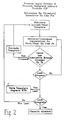
- a general method of accelerating the classification of an unclassified input symbol S into a library of pre-classified templates is shown in Figure 2.
- the correlation calculation (s,t i ) is initiated between the input symbol S and templates retrieved from the library of templates. Templates with a low degree of correlation are excluded prior to completion of the correlation calculation in order to accelerate the correlation.
- the basic steps of the OCR method are shown in Figure 2 and described below.
- Exclusion thresholds may be employed for excluding the retrieved template if the cumulative bound crosses the threshold.
- An ETH of 0.78 (as shown in Figures 1 and 3 and 4) is a suitable value for excluding low correlation templates early in the correlation calculation. If the cumulative bound does not cross the exclusion threshold, then the retrieved template is not excluded.
- the exclusion threshold may be cumulative and determined by replacing an initial exclusion threshold with the final bound of each non-excluded template during the classification process of the input vector with the template vectors. All of the retrieved templates are excluded during a typical classification process except for a single non-excluded template. The cumulative bound progresses toward the final bound of the single non-excluded template.
- the initial cumulative bound for each correlation calculation may be high and form an upper bound which progresses downward toward the final bound.
- the cumulative bound is initially 1.00, and decreases until the correlation calculation is complete or the cumulative bound crosses the ETH of 0.78.
- the initial exclusion threshold may be zero, and may build up a little (or a lot) for each non-excluded template.
- the correlation calculation (s,t i ) for the initial template yields the first finite exclusion threshold.
- the initial exclusion threshold may be finite, in which case correlation acceleration is in effect from the initial calculation cycle.
- the initial exclusion threshold may be greater than zero but less than (or equal to) a minimum acceptable final bound. The greatest acceleration is provided by an exclusion threshold equal to the minimum acceptable final bound. This high exclusion threshold does not require a build-up time as does the zero initial exclusion threshold; and rapidly excluded the hopeless low correlation templates from the very first calculation cycle.
- exclusion check points 58 may be provided at intervals during each correlation calculation for comparing the decreasing cumulative bound with the exclusion threshold to determine whether the cumulative bound has crossed the exclusion threshold. If the exclusion threshold has been crossed the correlation calculation for that template vector is terminated, and the next template vector is retrieved.
- the excluding step (see Figure 2) may include the additional steps described below.
- the number of element calculation cycles within each interval of calculation cycles between the exclusion check points may be fixed providing a linear series of exclusion check points equally spaced along the horizontal axis of the correlation plot (as shown in Figure 5). Short intervals with a few calculation cycles involve frequent checking, and minimizes overshoot of the cumulative bound beyond the exclusion threshold.
- the fixed number of calculation cycles in each interval may be one, in which case the checking step occurs after every calculation cycle, and overshoot is prevented. If the bit map matrix is large (high resolution), checking the present cumulative bound may require less computer time than calculating the next cumulative bound.
- the number of calculation cycles in each interval may be variable, or adaptive as the element by element correlation calculation (s,t 1 ) proceeds providing a nonlinear series of exclusion check points.
- the number of calculation cycles in each interval between exclusion check points 68 may become smaller as the element by element correlation calculation (s,t i ) proceeds.
- the correlation calculation is checked less frequently at the start of the correlation calculation, and more frequently as the cumulative bound approaches the exclusion threshold.
- the exclusion check point interval may be based on the change in the TRI sum or the cumulative bound instead of the number of calculation cycles executed in the correlation calculation.
- the change in the cumulative bound during each interval of element calculation cycles between the exclusion check points may be fixed providing a linear series of exclusion check points equally spaced along the vertical axis of the correlation plot.
- the change in the cumulative bound during each interval may be adaptive, and for example become progressively smaller as the LPC sum approaches the CIF sum.
- the q pairs of corresponding elements in the input vector and the template vector may be unsorted and correlated by the correlation calculation (s,t i ) in sequential order of position within the input vector bit map and the template vector bit map.
- the q pairs of corresponding elements may be sorted and correlated in the order of the sort to accelerate the correlation calculation Figure 3.
- the vector elements have numerical values indicating intensity, and the pixels in the bit map may be sorted by numerical value prior to the correlation calculation to determine the correlation order.
- the sort may be by background pixels (majority population) or by foreground pixels (minority population) in either the input vector or the template vector.
- the numerical sort may be in forward numerical order (lowest intensity first) or in reverse order (highest intensity first).
- Binary bit maps require a simple two level sort.
- Greyscale bit maps may be sorted by all (or some) intensity levels, or digitized to binary for sorting.
- Figure 3C illustrates the E/T correlation plot 30 of a low resolution binary template which has been foreground sorted.
- the strokes of template "T" contain eleven foreground pixels which form the first eleven elements of the correlation calculation (see Figure 3B).
- ETH exclusion threshold
- the template vector is excluded at the ninth calculation cycle as shown in Figure 3C.
- the E/T unsorted correlation of Figure 1 required 46 calculation cycles before CIF 16 crossed the ETH at 0.78.
- Sorting by template foreground pixels as shown in Figure 3 has several advantages.
- a bit map normally has fewer foreground pixels than background pixels, and therefore fewer calculation cycles required for completion. Only the stroke pixels (dark) must be sorted and correlated. The large area forming the peripheral background margins (white) are not applicable to foreground sorting and may be disregarded. Also the intensity sort order of each template may be predetermined and stored in memory for retrieval with the template bit map.
- the q pairs of corresponding elements in the input vector and the template vector may be double sorted, first by intensity and then by discrimination power.
- Each pixel in a character bit map has a certain probability of being in overt conflict (see conflict table - Class B) with the corresponding pixel in another bit map.
- the pixels within the central background area of the bit map that are less likely to contain a stroke pixel have the highest discrimination power, and are correlated first in the double sort embodiment.
- Figure 4C illustrates the E/T correlation plot 40 of a low resolution binary template in which foreground pixels have been double sorted.
- the template "T" contains eleven pixels which form the first eleven elements of the correlation calculation (see Figure 4B), as determined by the first sort (the same intensity sort as shown in Figure 3).
- CIF 46 and leading partial correlation LPC 42 behave differently in the double sort embodiment.
- CIF 46 decreases at each of the first four calculation cycles, and LPC 42 has remained at 0.00.
- Pixels 01, 02, 03, and 04 of the "T" template are off the common stroke paths. Most characters including input symbol "E” do not have a central vertical stroke forming a column of background pixels in the center of the bit map. Further, the heights of these four template pixels are slightly displaced from the heights of most horizontal strokes. Of all of the pixels in the "T” template, these four are the most likely to be in overt conflict (Class B) with the pixels of an input symbol presented at random.
- the template vector is excluded at the third calculation cycle as shown in Figure 4C.
- the E/T single sorted correlation of Figure 3 required nine calculation cycles before CIF 36 crossed the ETH at 0.78.
- the unsorted correlation of Figure 1 required 46 calculation cycles.
- FIG. 5 shows E/T correlation graph 50 based on high resolution bit maps (60 rows by 50 columns) with greyscale (256 levels).
- the three plots LPC 52 and TRI 54 and CIP 56 are flat during the intial correlation calculations due to the low intensity top margins of the "E" and "T" bit maps.
- the last 400 pixels or so are template bottom margin.
- Figure 6 shows E/T correlation graph 60 with the same bit map base as graph 50 but with intensity sorting for accelerating the correlation calculations.
- the three plots LPC 62 and TRI 64 and CIP 66 progress at a faster rate.
Landscapes
- Engineering & Computer Science (AREA)
- Computer Vision & Pattern Recognition (AREA)
- Theoretical Computer Science (AREA)
- Medical Informatics (AREA)
- Computing Systems (AREA)
- Databases & Information Systems (AREA)
- Evolutionary Computation (AREA)
- General Health & Medical Sciences (AREA)
- Artificial Intelligence (AREA)
- Software Systems (AREA)
- Health & Medical Sciences (AREA)
- Physics & Mathematics (AREA)
- General Physics & Mathematics (AREA)
- Multimedia (AREA)
- Image Analysis (AREA)
- Character Discrimination (AREA)
Claims (37)
- Verfahren zur Symbolklassifizierung zur Verwendung bei einer optischen Zeichenerkennung, mit den Schritten:Bereitstellen eines Eingangssymbols S in der Form eines ein nicht-klassifiziertes Zeichen definierenden Eingangsvektors mit "q" Elementen (Bereitstellen einer Bibliothek aus T Mustern (T1, T2, T3, ... Ti ... TT), die zur Korrelation mit dem Eingangsvektor abrufbar sind, wobei jedes Muster in der Form eines jeweils ein vorklassifiziertes Zeichen definierenden Mustervektors mit "q" Elementen (Korrelieren des Eingangsvektors mit den Mustervektoren mittels einer elementweisen Korrelationsberechnung (s, ti), die einen Elementberechnungszyklus für aufeinanderfolgende Paare entsprechender Elemente des Eingangsvektors und jedes abgerufenen Mustervektors ausführt, um jeweils einen Elementterm für jedes Paar entsprechender Elemente zu erhalten,Summieren der Elementterme von vorherigen Berechnungszyklen der Korrelationsberechnung (s, ti) zum Erhalten einer kumulativen Grenze nach "k" Berechnungszyklen und zum Erhalten einer endgültigen Grenze nach dem Abschluss von "q" Berechnungszyklen,Bestimmen eines Ausschlussschwellenwerts zum Ausschließen des abgerufenen Musters, wenn die kumulative Grenze den Ausschlussschwellenwert schneidet und zum Nichtausschließen des abgerufenen Musters, wenn die kumulative Grenze den Ausschlussschwellenwert nicht schneidet,Abrufen eines Anfangsmusters aus der Musterbibliothek,Initiieren der elementweisen Korrelationsberechnung (s, ti) für die "q" Paare entsprechender Elemente zum Erhalten der kumulativen Grenze,Ausschließen des abgerufenen Musters, wenn die kumulative Grenze den Ausschlussschwellenwert schneidet,Wiederholen der Korrelationsberechnung und der Ausschlussschritte, bis das abgerufene Muster ausgeschlossen wurde, oder bis die Korrelationsberechnung (s, ti) für das abgerufene Muster zu ihrem Abschluss vorgerückt ist, um die endgültige Grenze zu erhalten,Speichern nichtausgeschlossener abgerufener Muster,Abrufen eines nächsten Musters aus der Musterbibliothek,Wiederholen der Korrelationsberechnung und der Ausschluss-, Sicherungs- und Abrufschritte, bis alle Mustervektoren mit dem Eingangsvektor korreliert wurden, undKlassifizieren des nicht-klassifizierten Eingangssymbols gegenüber den nichtausgeschlossenen vorklassifizierten Mustern auf der Grundlage numerischer Werte der durch die Korrelationsberechnungen erhaltenen endgültigen Grenze,
dadurch gekennzeichnet, dassdie Korrelationen und Summierschritte durch die Berechnung der kumulativen Grenze als Wert einer Vergleichs-Ungleichheitsfunktion (CIF; 16, 36, 46, 56, 66) ausgestaltet sind, die umfasst:a) eine monoton steigende führende partielle Korrelationssumme (12; 32, 42, 52, 62), die die kumulative Summe der ersten k Elementterme darstellt, undb) eine monoton fallende Restintensitätssumme (14, 34, 44, 54, 64), die die Bildintensitätsdaten darstellt, die nach dem k-ten Berechnungszyklus verbleiben. - Verfahren nach Anspruch 1, wobei der Ausschlussschwellenwert kumulativ ist und durch Ersetzen eines Anfangsausschlussschwellenwerts mit der endgültigen Grenze jedes nichtausgeschlossenen Musters während des Klassifizierungsvorgangs des Eingangsvektors mit den Mustervektoren bestimmt wird.
- Verfahren nach Anspruch 2, wobei alle abgerufenen Muster während des Klassifizierungsvorgangs außer einem einzelnen nichtausgeschlossenen Muster ausgeschlossen werden.
- Verfahren nach Anspruch 3, wobei die kumulative Grenze monoton in Richtung der endgültigen Grenze des einzelnen nichtausgeschlossenen Musters strebt.
- Verfahren nach einem der Ansprüche 3 und 4, wobei die kumulative Anfangsgrenze für jede Korrelationsberechnung (s, ti) eine obere Grenze bildet, die sich abwärts in Richtung der endgültigen Grenze bewegt.
- Verfahren nach einem der Ansprüche 2 bis 4, wobei der Anfangsausschlussschwellenwert null ist.
- Verfahren nach Anspruch 6, wobei die Korrelationsberechnung (s, ti) für das Anfangsmuster den ersten endlichen Ausschlussschwellenwert liefert.
- Verfahren nach einem der Ansprüche 2 bis 4, wobei der Anfangsausschlussschwellenwert endlich ist.
- Verfahren nach einem der Ansprüche 2 bis 4, wobei der Anfangsausschlussschwellenwert größer als Null aber kleiner als eine minimal annehmbare endgültige Grenze ist.
- Verfahren nach einem der vorhergehenden Ansprüche, wobei die Korrelationsberechnung (s, ti) abgeschlossen ist, wenn die Restintensitätssumme sich auf Null verringert.
- Verfahren nach einem der vorhergehenden Ansprüche, wobei die Vergleichs-Ungleichheitsfunktion die Beziehung aufweist:CIF die Vergleichs-Ungleichheitsfunktion,LPC eine führende partielle Korrelationssumme,SRI eine Symbolrestintensitätssumme, die die Symbolbildintensitätsdaten darstellt, die bei der CIF verbleiben, wenn die Korrelationsberechnung fortschreitet, undTRI eine Musterrestintensitätssumme ist, die die Musterbildintensitätsdaten darstellt, die bei der CIF verbleiben, wenn die Korrelationsberechnung fortschreitet.
- Verfahren nach Anspruch 11, wobei die Vergleichs-Ungleichheitsfunktion die Beziehung hat:
- Verfahren nach einem der Ansprüche 1 bis 9, wobei die Vergleichs-Ungleichheitsfunktion die Beziehung hat:CIF die Vergleichs-Ungleichheitsfunktion,LPC eine führende partielle Korrelationssumme undSRI eine Symbolrestintensitätssumme ist, die die Symbolbildintensitätsdaten darstellt, die bei der CIF verbleiben, wenn die Korrelationsberechnung fortschreitet.
- Verfahren nach Anspruch 13, wobei die Vergleichs-Ungleichheitsfunktion die Beziehung hat:
- Verfahren nach einem der Ansprüche 1 bis 9, wobei die Vergleichs-Ungleichheitsfunktion die Beziehung hat:CIF die Vergleichs-Ungleichheitsfunktion,LPC eine führende partielle Korrelationssumme undTRI eine Musterrestintensitätssumne ist, die die Musterbildintensitätsdaten darstellt, die bei der CIF verbleiben, wenn die Korrelationsberechnung fortschreitet.
- Verfahren nach Anspruch 15, wobei die Vergleichs-Ungleichheitsfunktion die Beziehung hat:
- Verfahren nach Anspruch 15, wobei der Wert der LPC-Summe durch die Korrelationsberechnung (s, ti) jedes Berechnungszyklus bestimmt wird, und der Wert der TRI-Summe beruhend auf den Mustervektoren in der Musterbibliothek vorab berechnet und aus der Bibliothek abgerufen wird.
- Verfahren nach einem der vorhergehenden Ansprüche, ferner mit dem Schritt vor der Initiierung der elementweisen Korrelationsberechnung (s, ti)Bestimmen einer Folge von aufeinanderfolgenden Ausschlussüberprüfungspunkten (58) mit dazwischenliegenden Intervallen von Elementberechnungszyklen zum Vergleich der kumulativen Grenze mit dem Ausschlussschwellenwert, wenn die Korrelationsberechnung (s, ti) fortschreitet.
- Verfahren nach Anspruch 18, wobei der Ausschlussschritt ferner die zusätzlichen SchritteÜberprüfen des abgerufenen Musters auf Ausschluss an dem ersten Ausschlussüberprüfungspunkt durch Vergleich der kumulativen Grenze mit dem Ausschlussschwellenwert,Ausschließen des abgerufenen Musters durch Beenden der elementweisen Korrelationsberechnung (s, ti), wenn die kumulative Grenze den Schwellenwert geschnitten hat, undFortfahren mit der elementweisen Korrelationsberechnung (s, ti) bis zu einem nächsten Ausschlussüberprüfungspunkt, wenn die kumulative Grenze den Ausschlussschwellenwert nicht geschnitten hat.
- Verfahren nach einem der Ansprüche 18 und 19, wobei die Anzahl der Elementberechnungszyklen in jedem Intervall der Berechnungszyklen zwischen den Ausschlussüberprüfungspunkten fest ist.
- Verfahren nach Anspruch 20, wobei die feste Anzahl der Elementberechnungszyklen in jedem Intervall der Berechnungszyklen 1 ist, und der Überprüfungsschritt nach jedem Berechnungszyklus auftritt.
- Verfahren nach einem der Ansprüche 18 und 19, wobei die Anzahl der Elementberechnungszyklen in jedem Intervall der Berechnungszyklen zwischen den Ausschlussüberprüfungspunkten variabel ist.
- Verfahren nach Anspruch 22, wobei die Anzahl der Elementberechnungszyklen in jedem Intervall adaptiv ist, wenn die elementweise Korrelationsberechnung (s, ti) fortschreitet.
- Verfahren nach einem der Ansprüche 22 und 23, wobei die Anzahl der Elementberechnungszyklen in jedem Intervall der Berechnungszyklen kleiner wird, wenn die elementweise Korrelationsberechnung (s, ti) fortschreitet.
- Verfahren nach Anspruch 18, wobei die Änderung der kumulativen Grenze während jedes Intervalls der Elementberechnungszyklen zwischen den Ausschlussüberprüfungspunkten fest ist.
- Verfahren nach einem der vorhergehenden Ansprüche, wobei die q Paare der entsprechenden Elemente in dem Eingangsvektor und dem Mustervektor nicht sortiert sind, und durch die Korrelationsberechnung (s, ti) in aufeinanderfolgender Reihenfolge der Position in dem Eingangsvektor und dem Mustervektor korreliert werden.
- Verfahren nach einem der Ansprüche 1 bis 25, wobei die q Paare der entsprechenden Elemente in dem Eingangsvektor und dem Mustervektor sortiert sind, und durch die Korrelationsberechnung (s, ti) in der Sortierreihenfolge korreliert werden.
- Verfahren nach Anspruch 27, wobei die Vektorelemente in dem Eingangsvektor und dem Mustervektor numerische Werte aufweisen, und die Sortierung anhand des numerischen Werts ausgebildet ist.
- Verfahren nach Anspruch 28, wobei die numerischen Werte binäre Werte sind.
- Verfahren nach Anspruch 28, wobei die numerischen Werte Grauskalen-Pegel darstellen.
- Verfahren nach Anspruch 28, wobei die q Paare entsprechender Elemente mittels der numerischen Werte der den Eingangsvektor bildenden Elemente sortiert sind.
- Verfahren nach Anspruch 28, wobei die q Paare entsprechender Elemente mittels der numerischen Werte der den Mustervektor bildenden Elemente sortiert sind.
- Verfahren nach Anspruch 28, wobei die den Vordergrund der Mustervektoren bildenden Elemente durch die Unterscheidungskraft charakterisiert sind, und die q Paare der entsprechenden Elemente doppelsortiert sind,zum einen durch die numerischen Werte der den Mustervektor bildenden Elemente undzum anderen durch die Unterscheidungskraft der den Mustervektor bildenden Vordergrundelemente.
- Verfahren nach Anspruch 33, wobei die einem Zentralbereich eines Bitmaps entsprechenden Elemente, der durch den Mustervektor definiert ist, die höchste Unterscheidungskraft besitzen.
- Verfahren nach Anspruch 28, wobei die q Paare entsprechender Elemente durch die numerischen Werte der den Vordergrund bildenden Elemente sortiert sind.
- Verfahren nach Anspruch 28, wobei die q Paare entsprechender Elemente durch die numerischen Werte der den Hintergrund bildenden Elemente sortiert sind.
- Vorrichtung zur Durchführung einer Symbolklassifizierung bei einer optischen Zeichenerkennung miteiner Eingabeeinrichtung zum Empfangen eines Eingangssymbols S in der Form eines ein nichtklassifiziertes Zeichen definierenden Eingangsvektors mit "q" Elementen (einer Bibliothek aus T Mustern (T1, T2, T3, ... Ti ... TT), die zur Korrelation mit dem Eingangsvektor abrufbar sind, wobei jedes Muster in der Form eines jeweils ein vorklassifiziertes Zeichen definierenden Mustervektors mit "q" Elementen (einer Korrelationseinrichtung zur Korrelation des Eingangsvektors mit den Mustervektoren durch eine elementweise Korrelationsberechnung (s, ti), die einen Elementberechnungszyklus für aufeinanderfolgende Paare entsprechender Elemente des Eingangsvektors und jedes abgerufenen Mustervektors zum Erhalten eines jeweiligen Elementterms für jedes Paar entsprechender Elemente ausführt,einer Summationseinrichtung zur Summation der Elementterme von vorherigen Berechnungszyklen der Korrelationsberechnung (s, ti) zum Erhalten einer kumulativen Grenze nach "k" Berechnungszyklen und zum Erhalten einer endgültigen Grenze nach dem Abschluss von "q" Berechnungszyklen,einer Bestimmungseinrichtung zur Bestimmung eines Ausschlussschwellenwerts zum Ausschließen des abgerufenen Musters, wenn die kumulative Grenze den Ausschlussschwellenwert schneidet, und zum Nichtausschließen des abgerufenen Musters, wenn die kumulative Grenze den Ausschlussschwellenwert nicht schneidet,einer Abrufeinrichtung zum Abrufen von Mustern aus der Musterbibliothek,einer Speichereinrichtung zur Speicherung nichtausgeschlossener abgerufener Muster,einer Steuereinrichtung zur Steuerung der Korrelationseinrichtung, Summationseinrichtung, Abrufeinrichtung und Speichereinrichtung zum Abrufen eines Anfangsmusters, Initiieren der elementweisen Korrelationsberechnung (s, ti) für die "q" Paare entsprechender Elemente zum Erhalten der kumulativen Grenze, Ausschließen des abgerufenen Musters, wenn die kumulative Grenze den Ausschlussschwellenwert schneidet, Wiederholen der Korrelationsberechnung und der Ausschlussschritte, bis das abgerufene Muster ausgeschlossen ist, oder bis die Korrelationsberechnung (s, ti) für das abgerufene Muster zu ihrer Beendigung vorgerückt ist, um die endgültige Grenze zu erhalten, und zum Speichern nichtausgeschlossener abgerufener Muster, Abrufen eines nächsten Musters aus der Musterbibliothek und Wiederholen der Korrelationsberechnung und der Ausschluss-, Speicher- und Abrufschritte, bis alle Mustervektoren mit dem Eingangsvektor korreliert wurden, undeiner Klassifizierungseinrichtung zur Klassifizierung des nicht-klassifizierten Eingangssymbols gegenüber den nichtausgeschlossenen vorklassifizierten Mustern auf der Grundlage der numerischen Werte der durch die Korrelationsberechnungen erhaltenen endgültigen Grenze,
dadurch gekennzeichnet, dassdie Korrelationseinrichtung und die Summationseinrichtung zum Berechnen der kumulativen Grenze als Wert einer Vergleichs-Ungleichheitsfunktion (CIF; 16, 36, 46, 56, 66) betreibbar sind, die umfasst:a) eine monoton steigende führende partielle Korrelationssumme (12; 32, 42, 52, 62), die die kumulative Summe der ersten k Elementsterme darstellt, undb) eine monoton fallende Restintensitätssumme (14, 34, 44, 54, 64), die die Bildintensitätsdaten darstellt, die nach dem k-ten Berechnungszyklus verbleiben.
Applications Claiming Priority (2)
| Application Number | Priority Date | Filing Date | Title |
|---|---|---|---|
| US14031093A | 1993-10-22 | 1993-10-22 | |
| US140310 | 1993-10-22 |
Publications (3)
| Publication Number | Publication Date |
|---|---|
| EP0650136A2 EP0650136A2 (de) | 1995-04-26 |
| EP0650136A3 EP0650136A3 (de) | 1995-12-13 |
| EP0650136B1 true EP0650136B1 (de) | 2000-12-27 |
Family
ID=22490670
Family Applications (1)
| Application Number | Title | Priority Date | Filing Date |
|---|---|---|---|
| EP94307758A Expired - Lifetime EP0650136B1 (de) | 1993-10-22 | 1994-10-21 | Auf einer Ungleichheitsfunktion basierendes Vergleichsverfahren und Vorrichtung zur beschleunigten OCR-Korrelation |
Country Status (4)
| Country | Link |
|---|---|
| US (1) | US5559898A (de) |
| EP (1) | EP0650136B1 (de) |
| JP (1) | JP3706646B2 (de) |
| DE (1) | DE69426481D1 (de) |
Families Citing this family (3)
| Publication number | Priority date | Publication date | Assignee | Title |
|---|---|---|---|---|
| US6023530A (en) * | 1995-11-13 | 2000-02-08 | Applied Intelligent Systems, Inc. | Vector correlation system for automatically locating patterns in an image |
| US6473524B1 (en) | 1999-04-14 | 2002-10-29 | Videk, Inc. | Optical object recognition method and system |
| US9652690B2 (en) * | 2015-02-27 | 2017-05-16 | Lexmark International, Inc. | Automatically capturing and cropping image of check from video sequence for banking or other computing application |
Family Cites Families (8)
| Publication number | Priority date | Publication date | Assignee | Title |
|---|---|---|---|---|
| NL274810A (de) * | 1961-02-16 | |||
| JPS57147781A (en) * | 1981-03-06 | 1982-09-11 | Nec Corp | Pattern matching device |
| US4672678A (en) * | 1984-06-25 | 1987-06-09 | Fujitsu Limited | Pattern recognition apparatus |
| JPH0642268B2 (ja) * | 1986-10-31 | 1994-06-01 | 日本電気株式会社 | 文字認識装置 |
| DE68928703T2 (de) * | 1988-07-20 | 1998-12-10 | Fujitsu Ltd., Kawasaki, Kanagawa | Buchstabenerkennungsvorrichtung |
| JPH0782544B2 (ja) * | 1989-03-24 | 1995-09-06 | インターナショナル・ビジネス・マシーンズ・コーポレーション | マルチテンプレートを用いるdpマツチング方法及び装置 |
| DE69026668T2 (de) * | 1989-09-20 | 1996-10-02 | Nippon Electric Co | Genaue Erkennung von Eingabemustern |
| US5077805A (en) * | 1990-05-07 | 1991-12-31 | Eastman Kodak Company | Hybrid feature-based and template matching optical character recognition system |
-
1994
- 1994-10-21 EP EP94307758A patent/EP0650136B1/de not_active Expired - Lifetime
- 1994-10-21 JP JP25662794A patent/JP3706646B2/ja not_active Expired - Fee Related
- 1994-10-21 DE DE69426481T patent/DE69426481D1/de not_active Expired - Lifetime
-
1995
- 1995-06-05 US US08/461,924 patent/US5559898A/en not_active Expired - Lifetime
Also Published As
| Publication number | Publication date |
|---|---|
| JPH07152866A (ja) | 1995-06-16 |
| US5559898A (en) | 1996-09-24 |
| DE69426481D1 (de) | 2001-02-01 |
| JP3706646B2 (ja) | 2005-10-12 |
| EP0650136A3 (de) | 1995-12-13 |
| EP0650136A2 (de) | 1995-04-26 |
Similar Documents
| Publication | Publication Date | Title |
|---|---|---|
| CN109977943B (zh) | 一种基于yolo的图像目标识别方法、系统和存储介质 | |
| CA2049758C (en) | Optical character recognition system and method | |
| US9910829B2 (en) | Automatic document separation | |
| US4630308A (en) | Character reader | |
| EP1096391A2 (de) | Automatisches Kategorisieren von Dokumenten mit Dokumentenunterschriften | |
| US6055332A (en) | Handwritten character and symbol processing apparatus and medium which stores control program of handwritten character and symbol processing apparatus | |
| JP2000512046A (ja) | 統計に基づくパターン識別のための方法及び装置 | |
| CN110929621B (zh) | 一种基于拓扑信息细化的道路提取方法 | |
| EP1314129B1 (de) | Zeichenerkennungssystem | |
| US5621818A (en) | Document recognition apparatus | |
| CN112365451A (zh) | 图像质量等级的确定方法、装置、设备及计算机可读介质 | |
| EP0450522A2 (de) | Lernverfahren für Datenverarbeitungsanlage | |
| EP0650136B1 (de) | Auf einer Ungleichheitsfunktion basierendes Vergleichsverfahren und Vorrichtung zur beschleunigten OCR-Korrelation | |
| EP0613101B1 (de) | Verfahren und Gerät zur Mustererkennung | |
| EP0586217B1 (de) | Verfahren und Gerät zum Verbessern von Standardmustern für Erkennung | |
| JP2986074B2 (ja) | 近傍点検出方法及びパターン認識装置 | |
| EP1010128B1 (de) | Verfahren zur karaktererkennung auf einer pixelmatrix | |
| US6961465B2 (en) | System and method for efficient determination of recognition initial conditions | |
| JP3009078B2 (ja) | 文字認識装置 | |
| CN112883901A (zh) | 一种基于ResNet的天体光谱分类方法及其系统 | |
| EP0625764A2 (de) | Beschleunigte optische Zeichenerkennungsklassifikation | |
| EP4668238A1 (de) | Computerimplementiertes verfahren zur gewinnung von informationen über biometrische merkmale eines benutzers | |
| CN119131326B (zh) | 基于不确定性感知和互补信息的噪声目标框修正方法 | |
| JP3106080B2 (ja) | 画像処理装置及びその方法 | |
| JP3333671B2 (ja) | パタン認識装置と方法及びパタン認識用距離比較方法 |
Legal Events
| Date | Code | Title | Description |
|---|---|---|---|
| PUAI | Public reference made under article 153(3) epc to a published international application that has entered the european phase |
Free format text: ORIGINAL CODE: 0009012 |
|
| AK | Designated contracting states |
Kind code of ref document: A2 Designated state(s): DE FR GB IT |
|
| PUAL | Search report despatched |
Free format text: ORIGINAL CODE: 0009013 |
|
| AK | Designated contracting states |
Kind code of ref document: A3 Designated state(s): DE FR GB IT |
|
| 17P | Request for examination filed |
Effective date: 19960424 |
|
| 17Q | First examination report despatched |
Effective date: 19981208 |
|
| RTI1 | Title (correction) |
Free format text: A COMPARISON INEQUALITY FUNCTION BASED METHOD AND APPARATUS FOR ACCELERATED OCR CORRELATION |
|
| GRAG | Despatch of communication of intention to grant |
Free format text: ORIGINAL CODE: EPIDOS AGRA |
|
| RTI1 | Title (correction) |
Free format text: A COMPARISON INEQUALITY FUNCTION BASED METHOD AND APPARATUS FOR ACCELERATED OCR CORRELATION |
|
| GRAG | Despatch of communication of intention to grant |
Free format text: ORIGINAL CODE: EPIDOS AGRA |
|
| GRAG | Despatch of communication of intention to grant |
Free format text: ORIGINAL CODE: EPIDOS AGRA |
|
| GRAH | Despatch of communication of intention to grant a patent |
Free format text: ORIGINAL CODE: EPIDOS IGRA |
|
| GRAG | Despatch of communication of intention to grant |
Free format text: ORIGINAL CODE: EPIDOS AGRA |
|
| GRAG | Despatch of communication of intention to grant |
Free format text: ORIGINAL CODE: EPIDOS AGRA |
|
| GRAH | Despatch of communication of intention to grant a patent |
Free format text: ORIGINAL CODE: EPIDOS IGRA |
|
| GRAA | (expected) grant |
Free format text: ORIGINAL CODE: 0009210 |
|
| AK | Designated contracting states |
Kind code of ref document: B1 Designated state(s): DE FR GB IT |
|
| PG25 | Lapsed in a contracting state [announced via postgrant information from national office to epo] |
Ref country code: IT Free format text: LAPSE BECAUSE OF FAILURE TO SUBMIT A TRANSLATION OF THE DESCRIPTION OR TO PAY THE FEE WITHIN THE PRESCRIBED TIME-LIMIT;WARNING: LAPSES OF ITALIAN PATENTS WITH EFFECTIVE DATE BEFORE 2007 MAY HAVE OCCURRED AT ANY TIME BEFORE 2007. THE CORRECT EFFECTIVE DATE MAY BE DIFFERENT FROM THE ONE RECORDED. Effective date: 20001227 Ref country code: FR Free format text: LAPSE BECAUSE OF FAILURE TO SUBMIT A TRANSLATION OF THE DESCRIPTION OR TO PAY THE FEE WITHIN THE PRESCRIBED TIME-LIMIT Effective date: 20001227 |
|
| REF | Corresponds to: |
Ref document number: 69426481 Country of ref document: DE Date of ref document: 20010201 |
|
| PG25 | Lapsed in a contracting state [announced via postgrant information from national office to epo] |
Ref country code: DE Free format text: LAPSE BECAUSE OF FAILURE TO SUBMIT A TRANSLATION OF THE DESCRIPTION OR TO PAY THE FEE WITHIN THE PRESCRIBED TIME-LIMIT Effective date: 20010328 |
|
| EN | Fr: translation not filed | ||
| PLBE | No opposition filed within time limit |
Free format text: ORIGINAL CODE: 0009261 |
|
| STAA | Information on the status of an ep patent application or granted ep patent |
Free format text: STATUS: NO OPPOSITION FILED WITHIN TIME LIMIT |
|
| 26N | No opposition filed | ||
| REG | Reference to a national code |
Ref country code: GB Ref legal event code: IF02 |
|
| PGFP | Annual fee paid to national office [announced via postgrant information from national office to epo] |
Ref country code: GB Payment date: 20121016 Year of fee payment: 19 |
|
| GBPC | Gb: european patent ceased through non-payment of renewal fee |
Effective date: 20131021 |
|
| PG25 | Lapsed in a contracting state [announced via postgrant information from national office to epo] |
Ref country code: GB Free format text: LAPSE BECAUSE OF NON-PAYMENT OF DUE FEES Effective date: 20131021 |