EP0459561B1 - Dioxo-tetrahydrochinolinderivate - Google Patents
Dioxo-tetrahydrochinolinderivate Download PDFInfo
- Publication number
- EP0459561B1 EP0459561B1 EP91201216A EP91201216A EP0459561B1 EP 0459561 B1 EP0459561 B1 EP 0459561B1 EP 91201216 A EP91201216 A EP 91201216A EP 91201216 A EP91201216 A EP 91201216A EP 0459561 B1 EP0459561 B1 EP 0459561B1
- Authority
- EP
- European Patent Office
- Prior art keywords
- dioxo
- tetrahydroquinoline
- chloro
- carbonyl
- alkyl
- Prior art date
- Legal status (The legal status is an assumption and is not a legal conclusion. Google has not performed a legal analysis and makes no representation as to the accuracy of the status listed.)
- Expired - Lifetime
Links
- 0 *C(C(Nc1c2c(*)c(*)c(*)c1*)=O)*2=O Chemical compound *C(C(Nc1c2c(*)c(*)c(*)c1*)=O)*2=O 0.000 description 6
Classifications
-
- C—CHEMISTRY; METALLURGY
- C07—ORGANIC CHEMISTRY
- C07D—HETEROCYCLIC COMPOUNDS
- C07D401/00—Heterocyclic compounds containing two or more hetero rings, having nitrogen atoms as the only ring hetero atoms, at least one ring being a six-membered ring with only one nitrogen atom
- C07D401/02—Heterocyclic compounds containing two or more hetero rings, having nitrogen atoms as the only ring hetero atoms, at least one ring being a six-membered ring with only one nitrogen atom containing two hetero rings
- C07D401/10—Heterocyclic compounds containing two or more hetero rings, having nitrogen atoms as the only ring hetero atoms, at least one ring being a six-membered ring with only one nitrogen atom containing two hetero rings linked by a carbon chain containing aromatic rings
-
- C—CHEMISTRY; METALLURGY
- C07—ORGANIC CHEMISTRY
- C07D—HETEROCYCLIC COMPOUNDS
- C07D215/00—Heterocyclic compounds containing quinoline or hydrogenated quinoline ring systems
- C07D215/02—Heterocyclic compounds containing quinoline or hydrogenated quinoline ring systems having no bond between the ring nitrogen atom and a non-ring member or having only hydrogen atoms or carbon atoms directly attached to the ring nitrogen atom
- C07D215/16—Heterocyclic compounds containing quinoline or hydrogenated quinoline ring systems having no bond between the ring nitrogen atom and a non-ring member or having only hydrogen atoms or carbon atoms directly attached to the ring nitrogen atom with hetero atoms or with carbon atoms having three bonds to hetero atoms with at the most one bond to halogen, e.g. ester or nitrile radicals, directly attached to ring carbon atoms
- C07D215/20—Oxygen atoms
- C07D215/22—Oxygen atoms attached in position 2 or 4
-
- A—HUMAN NECESSITIES
- A61—MEDICAL OR VETERINARY SCIENCE; HYGIENE
- A61P—SPECIFIC THERAPEUTIC ACTIVITY OF CHEMICAL COMPOUNDS OR MEDICINAL PREPARATIONS
- A61P25/00—Drugs for disorders of the nervous system
- A61P25/08—Antiepileptics; Anticonvulsants
-
- A—HUMAN NECESSITIES
- A61—MEDICAL OR VETERINARY SCIENCE; HYGIENE
- A61P—SPECIFIC THERAPEUTIC ACTIVITY OF CHEMICAL COMPOUNDS OR MEDICINAL PREPARATIONS
- A61P25/00—Drugs for disorders of the nervous system
- A61P25/18—Antipsychotics, i.e. neuroleptics; Drugs for mania or schizophrenia
-
- A—HUMAN NECESSITIES
- A61—MEDICAL OR VETERINARY SCIENCE; HYGIENE
- A61P—SPECIFIC THERAPEUTIC ACTIVITY OF CHEMICAL COMPOUNDS OR MEDICINAL PREPARATIONS
- A61P25/00—Drugs for disorders of the nervous system
- A61P25/20—Hypnotics; Sedatives
-
- A—HUMAN NECESSITIES
- A61—MEDICAL OR VETERINARY SCIENCE; HYGIENE
- A61P—SPECIFIC THERAPEUTIC ACTIVITY OF CHEMICAL COMPOUNDS OR MEDICINAL PREPARATIONS
- A61P25/00—Drugs for disorders of the nervous system
- A61P25/28—Drugs for disorders of the nervous system for treating neurodegenerative disorders of the central nervous system, e.g. nootropic agents, cognition enhancers, drugs for treating Alzheimer's disease or other forms of dementia
-
- C—CHEMISTRY; METALLURGY
- C07—ORGANIC CHEMISTRY
- C07D—HETEROCYCLIC COMPOUNDS
- C07D215/00—Heterocyclic compounds containing quinoline or hydrogenated quinoline ring systems
- C07D215/02—Heterocyclic compounds containing quinoline or hydrogenated quinoline ring systems having no bond between the ring nitrogen atom and a non-ring member or having only hydrogen atoms or carbon atoms directly attached to the ring nitrogen atom
- C07D215/16—Heterocyclic compounds containing quinoline or hydrogenated quinoline ring systems having no bond between the ring nitrogen atom and a non-ring member or having only hydrogen atoms or carbon atoms directly attached to the ring nitrogen atom with hetero atoms or with carbon atoms having three bonds to hetero atoms with at the most one bond to halogen, e.g. ester or nitrile radicals, directly attached to ring carbon atoms
- C07D215/48—Carbon atoms having three bonds to hetero atoms with at the most one bond to halogen
- C07D215/54—Carbon atoms having three bonds to hetero atoms with at the most one bond to halogen attached in position 3
- C07D215/56—Carbon atoms having three bonds to hetero atoms with at the most one bond to halogen attached in position 3 with oxygen atoms in position 4
-
- C—CHEMISTRY; METALLURGY
- C07—ORGANIC CHEMISTRY
- C07D—HETEROCYCLIC COMPOUNDS
- C07D401/00—Heterocyclic compounds containing two or more hetero rings, having nitrogen atoms as the only ring hetero atoms, at least one ring being a six-membered ring with only one nitrogen atom
- C07D401/02—Heterocyclic compounds containing two or more hetero rings, having nitrogen atoms as the only ring hetero atoms, at least one ring being a six-membered ring with only one nitrogen atom containing two hetero rings
- C07D401/04—Heterocyclic compounds containing two or more hetero rings, having nitrogen atoms as the only ring hetero atoms, at least one ring being a six-membered ring with only one nitrogen atom containing two hetero rings directly linked by a ring-member-to-ring-member bond
-
- C—CHEMISTRY; METALLURGY
- C07—ORGANIC CHEMISTRY
- C07D—HETEROCYCLIC COMPOUNDS
- C07D401/00—Heterocyclic compounds containing two or more hetero rings, having nitrogen atoms as the only ring hetero atoms, at least one ring being a six-membered ring with only one nitrogen atom
- C07D401/02—Heterocyclic compounds containing two or more hetero rings, having nitrogen atoms as the only ring hetero atoms, at least one ring being a six-membered ring with only one nitrogen atom containing two hetero rings
- C07D401/06—Heterocyclic compounds containing two or more hetero rings, having nitrogen atoms as the only ring hetero atoms, at least one ring being a six-membered ring with only one nitrogen atom containing two hetero rings linked by a carbon chain containing only aliphatic carbon atoms
-
- C—CHEMISTRY; METALLURGY
- C07—ORGANIC CHEMISTRY
- C07D—HETEROCYCLIC COMPOUNDS
- C07D401/00—Heterocyclic compounds containing two or more hetero rings, having nitrogen atoms as the only ring hetero atoms, at least one ring being a six-membered ring with only one nitrogen atom
- C07D401/02—Heterocyclic compounds containing two or more hetero rings, having nitrogen atoms as the only ring hetero atoms, at least one ring being a six-membered ring with only one nitrogen atom containing two hetero rings
- C07D401/12—Heterocyclic compounds containing two or more hetero rings, having nitrogen atoms as the only ring hetero atoms, at least one ring being a six-membered ring with only one nitrogen atom containing two hetero rings linked by a chain containing hetero atoms as chain links
-
- C—CHEMISTRY; METALLURGY
- C07—ORGANIC CHEMISTRY
- C07D—HETEROCYCLIC COMPOUNDS
- C07D405/00—Heterocyclic compounds containing both one or more hetero rings having oxygen atoms as the only ring hetero atoms, and one or more rings having nitrogen as the only ring hetero atom
- C07D405/02—Heterocyclic compounds containing both one or more hetero rings having oxygen atoms as the only ring hetero atoms, and one or more rings having nitrogen as the only ring hetero atom containing two hetero rings
- C07D405/04—Heterocyclic compounds containing both one or more hetero rings having oxygen atoms as the only ring hetero atoms, and one or more rings having nitrogen as the only ring hetero atom containing two hetero rings directly linked by a ring-member-to-ring-member bond
-
- C—CHEMISTRY; METALLURGY
- C07—ORGANIC CHEMISTRY
- C07D—HETEROCYCLIC COMPOUNDS
- C07D405/00—Heterocyclic compounds containing both one or more hetero rings having oxygen atoms as the only ring hetero atoms, and one or more rings having nitrogen as the only ring hetero atom
- C07D405/02—Heterocyclic compounds containing both one or more hetero rings having oxygen atoms as the only ring hetero atoms, and one or more rings having nitrogen as the only ring hetero atom containing two hetero rings
- C07D405/06—Heterocyclic compounds containing both one or more hetero rings having oxygen atoms as the only ring hetero atoms, and one or more rings having nitrogen as the only ring hetero atom containing two hetero rings linked by a carbon chain containing only aliphatic carbon atoms
-
- C—CHEMISTRY; METALLURGY
- C07—ORGANIC CHEMISTRY
- C07D—HETEROCYCLIC COMPOUNDS
- C07D409/00—Heterocyclic compounds containing two or more hetero rings, at least one ring having sulfur atoms as the only ring hetero atoms
- C07D409/02—Heterocyclic compounds containing two or more hetero rings, at least one ring having sulfur atoms as the only ring hetero atoms containing two hetero rings
- C07D409/04—Heterocyclic compounds containing two or more hetero rings, at least one ring having sulfur atoms as the only ring hetero atoms containing two hetero rings directly linked by a ring-member-to-ring-member bond
-
- C—CHEMISTRY; METALLURGY
- C07—ORGANIC CHEMISTRY
- C07D—HETEROCYCLIC COMPOUNDS
- C07D409/00—Heterocyclic compounds containing two or more hetero rings, at least one ring having sulfur atoms as the only ring hetero atoms
- C07D409/02—Heterocyclic compounds containing two or more hetero rings, at least one ring having sulfur atoms as the only ring hetero atoms containing two hetero rings
- C07D409/06—Heterocyclic compounds containing two or more hetero rings, at least one ring having sulfur atoms as the only ring hetero atoms containing two hetero rings linked by a carbon chain containing only aliphatic carbon atoms
-
- C—CHEMISTRY; METALLURGY
- C07—ORGANIC CHEMISTRY
- C07D—HETEROCYCLIC COMPOUNDS
- C07D409/00—Heterocyclic compounds containing two or more hetero rings, at least one ring having sulfur atoms as the only ring hetero atoms
- C07D409/02—Heterocyclic compounds containing two or more hetero rings, at least one ring having sulfur atoms as the only ring hetero atoms containing two hetero rings
- C07D409/12—Heterocyclic compounds containing two or more hetero rings, at least one ring having sulfur atoms as the only ring hetero atoms containing two hetero rings linked by a chain containing hetero atoms as chain links
-
- C—CHEMISTRY; METALLURGY
- C07—ORGANIC CHEMISTRY
- C07D—HETEROCYCLIC COMPOUNDS
- C07D413/00—Heterocyclic compounds containing two or more hetero rings, at least one ring having nitrogen and oxygen atoms as the only ring hetero atoms
- C07D413/02—Heterocyclic compounds containing two or more hetero rings, at least one ring having nitrogen and oxygen atoms as the only ring hetero atoms containing two hetero rings
- C07D413/04—Heterocyclic compounds containing two or more hetero rings, at least one ring having nitrogen and oxygen atoms as the only ring hetero atoms containing two hetero rings directly linked by a ring-member-to-ring-member bond
Definitions
- This invention relates to a class of 3-substituted 2,4-dioxo-1,2,3,4-tetrahydroquinolines which are selective non-competitive antagonists of N-methyl-D-aspartate (NMDA) receptors.
- NMDA N-methyl-D-aspartate
- the class of compounds provided by the present invention are ligands for the strychnine-insensitive glycine modulatory site of the NMDA receptor and are therefore useful in the treatment and/or prevention of neurodegenerative disorders arising as a consequence of such pathological conditions as stroke, hypoglycaemia, cerebral palsy, transient cerebral ischaemic attack, cerebral ischaemia during cardiac pulmonary surgery or cardiac arrest, perinatal asphyxia, epilepsy, Huntington's chorea, Alzheimer's disease, Amyotrophic Lateral Sclerosis, Parkinson's disease, Olivo-ponto-cerebellar atrophy, anoxia such as from drowning, spinal cord and head injury, and poisoning by exogenous and endogenous NMDA receptor agonists and neurotoxins, including environmental neurotoxins.
- the compounds according to the present invention are also useful as anticonvulsant agents, as well as being of value in the prevention or reduction of dependence on dependence-inducing agents such as narcotics.
- NMDA receptor antagonists have recently been shown to possess analgesic (see, for example, Dickenson and Aydar, Neuroscience Lett. , 1991, 121 , 263; Murray et al. , Pain , 1991, 44 , 179; and Woolf and Thompson, Pain , 1991, 44 , 293), antidepressant (see, for example, Trullas and Skolnick, Eur. J. Pharmacol. , 1990, 185 , 1) and anxiolytic (see, for example, Kehne et al. , 1991, 193 , 283) effects, and the compounds of the present invention may accordingly be useful in the management of pain, depression and anxiety.
- analgesic see, for example, Dickenson and Aydar, Neuroscience Lett. , 1991, 121 , 263; Murray et al. , Pain , 1991, 44 , 179; and Woolf and Thompson, Pain , 1991, 44 , 293
- antidepressant see, for example, Trulla
- the compounds of the present invention may be effective in controlling the manifestations of neuroviral diseases such as measles, rabies, tetanus (cf. Bagetta et al. , Br. J. Pharmacol. , 1990, 101 , 776) and AIDS (cf. Lipton et al. , Society for Neuroscience Abstracts , 1990, 16 , 128.11).
- neuroviral diseases such as measles, rabies, tetanus (cf. Bagetta et al. , Br. J. Pharmacol. , 1990, 101 , 776) and AIDS (cf. Lipton et al. , Society for Neuroscience Abstracts , 1990, 16 , 128.11).
- NMDA antagonists have, moreover, been shown to have an effect on the neuroendocrine system (see, for example, van den Pol et al. , Science , 1990, 250 , 1276; and Urbanski, Endocrinology , 1990, 127 , 2223), and the compounds of this invention may therefore also be effective in the control of seasonal breeding in mammals.
- certain compounds of the invention are antagonists of 2-amino-3-hydroxy-5-methyl-4-isoxazolepropionic acid (AMPA) receptors, also known as quisqualate receptors.
- AMPA 2-amino-3-hydroxy-5-methyl-4-isoxazolepropionic acid
- An excitatory amino acid projection from the prefrontal cortex to the nucleus accumbens is well known to exist (see, for example, J. Neurochem ., 1985, 45 , 477). It is also well known that dopaminergic transmission in the striatum is modulated by glutamate (see, for example, Neurochem.
- This class of compounds is alleged to have analgesic, antinociceptive, anti-inflammatory, antimicrobial, antibacterial, fungistatic, antiviral, coccidiostatic and antiallergic properties, with low toxicity.
- EP-A-0059698 A class of 2,4-dioxo-1,2,3,4-tetrahydroquinoline-3-carboxamide derivatives is described in EP-A-0059698. These compounds are alleged to demonstrate an enhancing effect upon cell-mediated immunity, whilst also having a low toxicity, resulting in a favourable therapeutic index. EP-A-0059698 also discloses N-substituted 3-carboxy-2,4-dioxo-1,2,3,4-tetrahydroquinolines, and reactive derivatives thereof, as intermediates.
- JP-A-59-16878 describes a process for producing 3-acetyl-2,4-dioxo-1,2,3,4-tetrahydroquinoline derivatives carrying a range of substituents on the benzo moiety.
- the compounds prepared by this process are stated to be useful intermediates in the production of therapeutic agents for allergic asthma.
- EP-A-0303387 describes a class of 4-oxo-1,4-dihydroquinoline derivatives which are stated to be specific antagonists of NMDA receptors as well as being, in some cases, potent kainate/quisqualate antagonists. These compounds are stated therein to be useful in the treatment of a variety of neurodegenerative disorders.
- the present invention further provides the use of a compound of formula IA as defined above or a pharmaceutically acceptable salt thereof or a prodrug thereof for the manufacture of a medicament for the treatment and/or prevention of conditions, such as schizophrenia, which require the administration of an antagonist of AMPA receptors.
- the compound of formula IA will in general exist in equilibrium with its other tautomeric forms, including those structures of formulae A to D: wherein R1 to R5 are as defined with reference to formula IA above. Indeed, in the prior art references cited above, the compounds disclosed therein are variously designated by reference to one or other of these tautomeric forms. It is to be understood that all tautomeric forms of the compounds of formula IA, as well as all possible mixtures thereof, are included within the scope of the present invention.
- hydrocarbon refers to straight-chained, branched and cyclic groups containing up to 18 carbon atoms. Within the scope of the expression “cyclic groups” are included heterocyclic groups. The hydrocarbon groups contain suitably up to 15 carbon atoms and conveniently up to 12 carbon atoms.
- Suitable hydrocarbon groups include C1 ⁇ 6 alkyl, C2 ⁇ 6 alkenyl, C2 ⁇ 6 alkynyl, C3 ⁇ 7 cycloalkyl, C3 ⁇ 7 cycloalkyl(C1 ⁇ 6)alkyl, aryl, aryl(C1 ⁇ 6)alkyl, aryl(C2 ⁇ 6)-alkenyl, aryl(C2 ⁇ 6)alkynyl, C3 ⁇ 7 heterocycloalkyl, C3 ⁇ 7 heterocycloalkyl(C1 ⁇ 6)alkyl, heteroaryl, heteroaryl-(C1 ⁇ 6)alkyl and heteroaryl(C2 ⁇ 6)alkenyl.
- Suitable alkyl groups include straight-chained and branched alkyl groups containing from 1 to 6 carbon atoms. Typical examples include methyl and ethyl groups, and straight-chained or branched propyl and butyl groups. Particular alkyl groups are methyl, ethyl, n-propyl, isopropyl and t-butyl.
- Suitable alkenyl groups include straight-chained and branched alkenyl groups containing from 2 to 6 carbon atoms. Typical examples include vinyl and allyl groups.
- Suitable alkynyl groups include straight-chained and branched alkynyl groups containing from 2 to 6 carbon atoms. Typical examples include ethynyl and propargyl groups.
- Suitable cycloalkyl groups include groups containing from 3 to 7 carbon atoms. Particular cycloalkyl groups are cyclopropyl and cyclohexyl.
- Suitable aryl groups include phenyl and naphthyl groups.
- Particular aryl(C1 ⁇ 6)alkyl groups include benzyl, phenethyl, phenylpropyl and phenylbutyl.
- a particular aryl(C2 ⁇ 6)alkenyl group is phenylallyl.
- a particular aryl(C2 ⁇ 6)alkynyl group is phenylpropargyl.
- Suitable heterocycloalkyl groups include piperidyl, piperazinyl and morpholinyl groups.
- Suitable heteroaryl groups include pyridyl, quinolyl, isoquinolyl, pyridazinyl, pyrimidinyl, pyrazinyl, pyranyl, furyl, benzofuryl, thienyl, benzthienyl, pyrrolyl, indolyl, imidazolyl, oxadiazolyl and thiadiazolyl groups.
- Particular heteroaryl groups are pyridyl, furyl, benzofuryl, thienyl, benzthienyl, pyrrolyl, indolyl and oxadiazolyl.
- heteroaryl(C1 ⁇ 6)alkyl groups include indolylethyl, indolylpropyl and thienylethyl.
- a particular heteroaryl(C2 ⁇ 6)alkenyl group is thienylvinyl.
- the hydrocarbon group may in turn be optionally substituted by one or more groups selected from C1 ⁇ 6 alkyl, adamantyl, phenyl, halogen, C1 ⁇ 6 haloalkyl, trifluoromethyl, hydroxy, C1 ⁇ 6 alkoxy, C1 ⁇ 6 alkoxy-(C1 ⁇ 6)alkoxy, aryloxy, keto, C1 ⁇ 3 alkylenedioxy, nitro, cyano, carboxy, C2 ⁇ 6 alkoxycarbonyl, C2 ⁇ 6 alkoxycarbonyl-(C1 ⁇ 6)alkyl, C2 ⁇ 6 alkylcarbonyloxy, optionally substituted arylcarbonyloxy, C2 ⁇ 6 alkylcarbonyl, optionally substituted arylcarbonyl, C1 ⁇ 6 alkylcarbonyl, optionally substituted arylcarbonyl, C1 ⁇ 6 alkylthio, C1 ⁇ 6 alkylsulphinyl, C1 ⁇ 6 alkylsulphonyl, aryl
- halogen as used herein includes fluorine, chlorine, bromine and iodine, especially chlorine.
- the five-membered heteroaromatic ring containing the ring atoms W to Z may be, for example, a furan, thiophene, pyrrole, oxazole, thiazole, isoxazole, isothiazole, oxadiazole or thiadiazole ring, in particular a furan, thiophene, pyrrole, 1,2,4-oxadiazole, 1,3,4-oxadiazole, 1,2,4-thiadiazole or 1,3,4-thiadiazole ring.
- the ring is a furan, thiophene, pyrrole, 1,2,4-oxadiazole or 1,2,4-thiadiazole ring.
- the six-membered heteroaromatic ring containing the ring atoms E, F and G is a pyridine, pyrazine, pyrimidine or pyridazine ring, preferably pyridine or pyrazine.
- E, F and G each represents carbon.
- G represents nitrogen, and E and F each represents carbon.
- the number of substituents A1, A2 and/or A3 present on the five- or six-membered heteroaromatic ring containing the ring atoms W to Z or E to G respectively is one, two or three depending upon the disposition of heteroatoms in the heteroaromatic ring concerned.
- the five-membered heteroaromatic ring is an oxadiazole or thiadiazole ring
- only one substituent will be permitted; where, for example, the five-membered heteroaromatic ring is an oxazole or thiazole ring, one or two substituents will be permitted; and where, for example, the five-membered heteroaromatic ring is a furan, thiophene or pyrrole ring, one, two or three substituents will be permitted.
- the heteroaromatic ring is a six-membered ring containing the ring atoms E, F and G it will be appreciated that one, two or three substituents A1, A2 and/or A3 will be permitted.
- Suitable values for the groups A1, A2 and/or A3 include hydrogen, C1 ⁇ 6 alkyl, C2 ⁇ 6 alkenyl, C2 ⁇ 6 alkynyl, C3 ⁇ 7 cycloalkyl, C3 ⁇ 7 cycloalkyl(C1 ⁇ 6)alkyl, optionally substituted aryl, optionally substituted aryl(C1 ⁇ 6)alkyl, halogen, cyano, trifluoromethyl, nitro, C1 ⁇ 6 alkoxy, C2 ⁇ 6 alkenyloxy, C1 ⁇ 6 alkylthio, C2 ⁇ 6 alkenylthio, -COR a or -NR a R b , in which R a and R b are as defined above.
- R6 suitably represents C1 ⁇ 6 alkyl, C2 ⁇ 6 alkenyl, C2 ⁇ 6 alkynyl, C3 ⁇ 7 cycloalkyl, C3 ⁇ 7 cycloalkyl(C1 ⁇ 6)alkyl, aryl, aryl-(C1 ⁇ 6)alkyl, aryl(C2 ⁇ 6)alkenyl, aryl(C2 ⁇ 6)alkynyl, C3 ⁇ 7 heterocycloalkyl(C1 ⁇ 6)alkyl, heteroaryl, heteroaryl-(C1 ⁇ 6)alkyl or heteroaryl(C2 ⁇ 6)alkenyl, any of which groups may be optionally substituted.
- the benzo moiety of the tetrahydroquinoline ring system shown in formula IA above preferably contains at least one non-hydrogen substituent.
- Particular substituents include halogen, cyano, trifluoromethyl, nitro, hydroxy, amino, carboxy, C1 ⁇ 6 alkyl, C1 ⁇ 6 alkoxy, C1 ⁇ 6 alkylthio and C2 ⁇ 6 alkoxycarbonyl.
- R5 represents hydrogen and R2, R3 and R4 independently represent hydrogen, halogen, nitro, amino or C1 ⁇ 6 alkyl, provided that at least one of R2, R3 and R4 is other than hydrogen.
- R3 and R5 each represents hydrogen and R2 and R4 independently represent hydrogen, nitro, amino, methyl or halogen, especially chlorine, provided that at least one of R2 and R4 is other than hydrogen.
- R4 represents chlorine.
- R2 and R3, R3 and R4, R4 and R5, A1 and A2 or A2 and A3 represent the residue of an aromatic or heteroaromatic ring
- this is suitably an optionally substituted benzene, pyridine, thiophene, thiazole or thiadiazole ring.
- substituents on the aromatic or heteroaromatic ring may be mentioned nitro, and C1 ⁇ 6 alkoxy such as methoxy.
- the substituents R11 to R15 in the compounds of formula IB correspond to the substituents R1 to R5 respectively as defined with reference to the compounds of formula IA.
- R11 include cyano, carboxy, cyclopropylcarbonyl, benzylcarbonyl, thienylvinylcarbonyl, methoxycarbonyl, ethoxycarbonyl, phenylthio-ethoxycarbonyl, propoxycarbonyl, allyloxycarbonyl, hydroxyphenyl-ethoxycarbonyl, bis(methoxymethoxy)phenyl-ethoxycarbonyl, (t-butoxycarbonylaminomethyl)phenyl-ethoxycarbonyl, hydroxyphenyl-propoxycarbonyl, hydroxyphenyl-butoxycarbonyl, methoxyphenyl-propenyloxycarbonyl, hydroxyphenyl-propynyloxycarbonyl, methoxyphenyl-propynyloxycarbonyl, thienyl-ethoxycarbonyl, indolyl-ethoxycarbonyl, methoxyindolyl-ethoxycarbonyl,
- the salts of the compounds of formula IB will be non-toxic pharmaceutically acceptable salts.
- Other salts may, however, be useful in the preparation of the compounds according to the invention or of their non-toxic pharmaceutically acceptable salts.
- Suitable pharmaceutically acceptable salts of the compounds of formulae IA and IB above include alkali metal salts, e.g. sodium or potassium salts; alkaline earth metal salts, e.g. calcium or magnesium salts; and salts formed with suitable organic ligands, e.g. quaternary ammonium salts.
- acid addition salts may, for example, be formed by mixing a solution of the compound according to the invention with a solution of a pharmaceutically acceptable non-toxic acid such as hydrochloric acid, fumaric acid, maleic acid, succinic acid, acetic acid, citric acid, tartaric acid, carbonic acid or phosphoric acid.
- the present invention includes within its scope prodrugs of the compounds of formulae IA and IB above.
- prodrugs will be functional derivatives of the compounds of formulae IA and IB which are readily convertible in vivo into the required compound.
- Conventional procedures for the selection and preparation of suitable prodrug derivatives are described, for example, in "Design of Prodrugs", ed. H. Bundgaard, Elsevier, 1985.
- the compounds according to the invention may accordingly exist as enantiomers. Where the compounds according to the invention possess two or more asymmetric centres, they may additionally exist as diastereoisomers. It is to be understood that all such isomers and mixtures thereof are encompassed within the scope of the present invention.
- R21 represents -COR26 or -CO2R26
- R22, R23 and R24 independently represent hydrogen, halogen, cyano, trifluoromethyl, nitro, hydroxy, amino, carboxy, C1 ⁇ 6 alkyl, C1 ⁇ 6 alkoxy, C1 ⁇ 6 alkylthio or C2 ⁇ 6 alkoxycarbonyl, provided that at least one of R22, R23 and R24 is other than hydrogen
- R26 represents C3 ⁇ 7 cycloalkyl, aryl(C1 ⁇ 6)-alkyl, aryl(C2 ⁇ 6)alkenyl, aryl(C2 ⁇ 6)alkynyl, heteroaryl(C1 ⁇ 6)alkyl or heteroaryl(C2 ⁇ 6)alkenyl, any of which groups may be optionally substituted.
- optional subtituents on the group R26 suitably include hydroxy, C1 ⁇ 6 alkoxy, C1 ⁇ 6 alkoxy(C1 ⁇ 6)alkoxy and C2 ⁇ 6 alkoxycarbonylamino(C1 ⁇ 6)-alkyl, especially hydroxy, methoxy, methoxymethoxy and t-butoxycarbonylaminomethyl.
- R26 with respect to formula IIA include cyclopropyl, benzyl, phenethyl, hydroxyphenethyl, bis(methoxymethoxy)phenethyl, (t-butoxycarbonylaminomethyl)phenethyl, phenylpropyl, hydroxyphenylpropyl, phenylbutyl, hydroxyphenylbutyl, phenylallyl, methoxyphenylallyl, phenylpropargyl, hydroxyphenylpropargyl, methoxyphenylpropargyl, indolylethyl, methoxyindolylethyl, indolylpropyl, thienylethyl and thienylvinyl.
- a preferred group R26 is cyclopropyl.
- R22, R23 and R24 are independently selected from hydrogen, halogen, nitro, amino and C1 ⁇ 6 alkyl, provided that at least one of R22, R23 and R24 is other than hydrogen.
- R23 represents hydrogen
- one of R22 and R24 represents halogen or nitro
- the other of R22 and R24 represents hydrogen, halogen or nitro.
- R22 and R23 each represents hydrogen and R24 represents halogen, especially chlorine.
- W1 represents oxygen, sulphur or N-A13
- A11 and A12 independently represent hydrogen, halogen, cyano, trifluoromethyl, nitro, hydroxy, amino, carboxy, C1 ⁇ 6 alkyl, C2 ⁇ 6 alkenyl, C2 ⁇ 6 alkynyl, C3 ⁇ 7 cycloalkyl, C3 ⁇ 7 cycloalkyl(C1 ⁇ 6)alkyl, aryl, aryl(C1 ⁇ 6)alkyl, C1 ⁇ 6 alkoxy, C2 ⁇ 6 alkenyloxy, C1 ⁇ 6 alkylthio, C2 ⁇ 6 alkenylthio, C2 ⁇ 6 alkylcarbonyl, arylcarbonyl or C2 ⁇ 6 alkoxycarbonyl; or A11 and A12 together represent the residue of an optionally substituted aromatic or heteroaromatic ring;
- A13 represents hydrogen, C1 ⁇ 6
- suitable values for the groups A11 and A12 include hydrogen, halogen, C1 ⁇ 6 alkyl, C2 ⁇ 6 alkenyl, C2 ⁇ 6 alkynyl, C3 ⁇ 7 cycloalkyl, C3 ⁇ 7 cycloalkyl(C1 ⁇ 6)alkyl, aryl, aryl(C1 ⁇ 6)alkyl, C1 ⁇ 6 alkoxy, C2 ⁇ 6 alkenyloxy, C1 ⁇ 6 alkylthio, C2 ⁇ 6 alkenylthio and arylcarbonyl.
- Particular values of A11 and A12 include hydrogen, bromo, methyl, ethyl, isopropyl, vinyl, allyl, cyclopropyl, cyclopropylmethyl, phenyl, benzyl, allyloxy, allylthio and benzoyl.
- A11 and A12 together represent the residue of an optionally subtituted aromatic or heteroaromatic ring, this is preferably an optionally substituted benzene ring.
- optional substituents on the aromatic or heteroaromatic ring suitably include nitro, and C1 ⁇ 6 alkoxy such as methoxy.
- A13 represents hydrogen or methyl, preferably methyl.
- R32, R33 and R34 are independently selected from hydrogen, halogen, nitro, amino and C1 ⁇ 6 alkyl, provided that at least one of R32, R33 and R34 is other than hydrogen.
- R33 represents hydrogen
- one of R32 and R34 represents halogen or nitro
- the other of R32 and R34 represents hydrogen, halogen or nitro.
- R32 and R33 each represents hydrogen and R34 represents halogen, especially chlorine.
- suitable values for the group A21 include hydrogen, halogen, C1 ⁇ 6 alkyl and arylcarbonyl.
- A21 is hydrogen.
- R42, R43 and R44 are independently selected from hydrogen, halogen, nitro, amino and C1 ⁇ 6 alkyl, provided that at least one of R42, R43 and R44 is other than hydrogen.
- R43 represents hydrogen
- one of R42 and R44 represents halogen or nitro
- the other of R42 and R44 represents hydrogen, halogen or nitro.
- R42 and R43 each represents hydrogen and R44 represents halogen, especially chlorine.
- Specific compounds within the scope of the present invention include: 3-benzyloxycarbonyl-7-chloro-2,4-dioxo-1,2,3,4-tetrahydroquinoline; 7-chloro-2,4-dioxo-3-(2-phenylethoxy)carbonyl-1,2,3,4-tetrahydroquinoline; 7-chloro-2,4-dioxo-3-(3-phenylpropoxy)carbonyl-1,2,3,4-tetrahydroquinoline; 7-chloro-2,4-dioxo-3-[2-(3-hydroxyphenyl)ethoxy]carbonyl-1,2,3,4-tetrahydroquinoline; 7-chloro-2,4-dioxo-3-[3-(4-hydroxyphenyl)propoxy]carbonyl-1,2,3,4-tetrahydroquinoline; 7-chloro-2,4-dioxo-3-[3-(4-hydroxyphenyl)propoxy]
- the present invention also provides pharmaceutical compositions comprising at least one of the novel compounds according to the invention in association with a pharmaceutically acceptable carrier.
- compositions of this invention are preferably in unit dosage forms such as tablets, pills, capsules, powders, granules, sterile parenteral solutions or suspensions, or suppositories, for oral, parenteral or rectal administration.
- a pharmaceutical carrier e.g. conventional tableting ingredients such as corn starch, lactose, sucrose, sorbitol, talc, stearic acid, magnesium stearate, dicalcium phosphate or gums, and other pharmaceutical diluents, e.g.
- a solid preformulation composition containing a homogeneous mixture of a compound of the present invention, or a non-toxic pharmaceutically acceptable salt thereof.
- preformulation compositions as homogeneous, it is meant that the active ingredient is dispersed evenly throughout the composition so that the composition may be readily subdivided into equally effective unit dosage forms such as tablets, pills and capsules.
- This solid preformulation composition is then subdivided into unit dosage forms of the type described above containing from 0.1 to about 500 mg of the active ingredient of the present invention.
- the tablets or pills of the novel composition can be coated or otherwise compounded to provide a dosage form affording the advantage of prolonged action.
- the tablet or pill can comprise an inner dosage and an outer dosage component, the latter being in the form of an envelope over the former.
- the two components can be separated by an enteric layer which serves to resist disintegration in the stomach and permits the inner component to pass intact into the duodenum or to be delayed in release.
- enteric layers or coatings such materials including a number of polymeric acids and mixtures of polymeric acids with such materials as shellac, cetyl alcohol and cellulose acetate.
- liquid forms in which the novel compositions of the present invention may be incorporated for administration orally or by injection include aqueous solutions, suitably flavoured syrups, aqueous or oil suspensions, and flavoured emulsions with edible oils such as cottonseed oil, sesame oil, coconut oil or peanut oil, as well as elixirs and similar pharmaceutical vehicles.
- Suitable dispersing or suspending agents for aqueous suspensions include synthetic and natural gums such as tragacanth, acacia, alginate, dextran, sodium carboxymethylcellulose, methylcellulose, polyvinyl-pyrrolidone or gelatin.
- a suitable dosage level is about 0.01 to 250 mg/kg per day, preferably about 0.05 to 100 mg/kg per day, and especially about 0.05 to 5 mg/kg per day.
- the compounds may be administered on a regimen of 1 to 4 times per day.
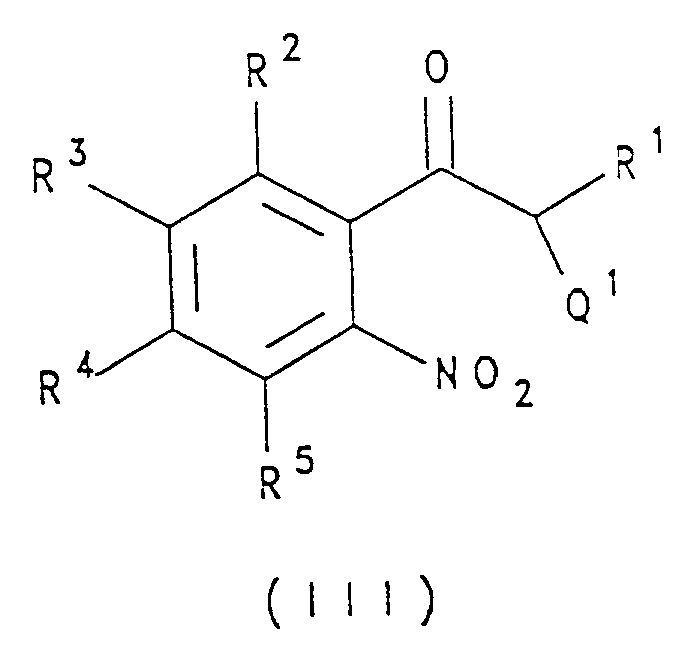
- the compounds of formula IA above may be prepared by a process which comprises the reductive cyclisation of a compound of formula III: wherein R1, R2, R3, R4 and R5 are as defined above; and Q1 represents a reactive carboxylate moiety.
- the reaction is conveniently carried out using hydrogen as reducing agent in the presence of a suitable hydrogenation catalyst such as palladium on charcoal, in an inert solvent such as ether, at room temperature at a pressure in the region of 50 p.s.i.
- a suitable hydrogenation catalyst such as palladium on charcoal
- an inert solvent such as ether
- Suitable values for the reactive carboxylate moiety Q1 include esters, for example C1 ⁇ 4 alkyl esters; acid anhydrides, for example mixed anhydrides with C1 ⁇ 4 alkanoic acids; acid halides, for example acid chlorides; orthoesters; and primary, secondary and tertiary amides.
- the group Q1 represents methoxycarbonyl or ethoxycarbonyl.
- the intermediates of formula III above may conveniently be prepared by reacting a compound of formula Q1-CH2-R1 with a compound of formula IV: wherein R1, R2, R3, R4, R5 and Q1 are as defined above, and Q2 represents a reactive carboxylate moiety; in the presence of a strong base.
- R1 represents a C2 ⁇ 7 alkoxycarbonyl group, e.g. ethoxycarbonyl
- the reagent of formula Q1-CH2-R1 is suitably diethyl malonate, and the strong base employed will advantageously be magnesium ethoxide.
- Suitable values for the reactive carboxylate moiety Q2 correspond to those defined above for Q1.
- the group Q2 is an acid halide group, in particular an acid chloride group.
- a compound of formula IV wherein Q2 represents an acid chloride group may conveniently be prepared from the corresponding compound of formula IV wherein Q2 represents a carboxy group -CO2H by treatment with thionyl chloride under standard conditions well known from the art.
- the compounds of formula IA above may be prepared by cyclisation of a compound of formula V: wherein R1, R2, R3, R4 and R5 are as defined above; and Q3 represents a reactive carboxylate moiety.
- the cyclisation is conveniently effected by treatment of the compound of formula V with at least one equivalent of a strong base.
- the reaction conditions employed will vary depending upon the nature of the strong base utilised. For example, where potassium hexamethyldisilazide is utilised as the strong base, the reaction will suitably be effected at room temperature in tetrahydrofuran. Alternatively, where, for example, the strong base utilised is sodium methoxide or sodium ethoxide, the reaction will suitably be carried out at room temperature in an alcoholic solvent such as methanol or ethanol.
- Suitable values for the reactive carboxylate moiety Q3 correspond to those defined above for Q1.
- the group Q3 is a C1 ⁇ 4 alkyl ester such as methoxycarbonyl or ethoxycarbonyl.
- the intermediates of formula V above may conveniently be prepared by reacting a compound of formula Q4-CH2-R1 with a compound of formula VI: wherein R1, R2, R3, R4, R5 and Q3 are as defined above; and Q4 represents a reactive carboxylate moiety.
- the reaction is conveniently effected in dichloromethane at room temperature or in 1,2-dichloroethane at reflux temperature, advantageously in the presence of a mild organic base such as triethylamine and/or 4-dimethylaminopyridine.
- a mild organic base such as triethylamine and/or 4-dimethylaminopyridine.
- Suitable values for the reactive carboxylate moiety Q4 correspond to those defined above for Q1.
- the group Q4 is an acid halide group, in particular an acid chloride group.
- An alternative preferred species of formula Q4-CH2-R1 is the activated ester derivative formed upon reaction of the carboxy compound HO2C-CH2-R1 with bis(2-oxo-3-oxazolidinyl)-phosphinic chloride (BOP-Cl).
- aromatic intermediates of formulae IV and VI above including the precursors of formula IV wherein Q2 represents -CO2H, where they are not commercially available, may be prepared by the methods described in the accompanying Examples, or by methods analogous thereto which will be readily apparent to those skilled in the art.
- the compounds of formula IA above may be prepared by reacting a compound of formula Q1-CH2-R1 with a compound of formula VII: wherein R1, R2, R3, R4, R5 and Q1 are as defined above; in the presence of a strong base such as sodium methoxide or sodium ethoxide.
- a compound of formula IA or IB initially obtained wherein R1 represents a group of formula -CO2R6 may subsequently be converted into the desired compound of formula IA or IB wherein R1 represents a different group -CO2R6 by conventional transesterification procedures known from the art.
- this transesterification can be brought about simply by heating the ester of formula IA or IB initially obtained, at a temperature in excess of 130°C, in an alcohol of formula R6OH in which R6 represents the residue of the ester group -CO2R6 in the desired final product of formula IA or IB, the alcohol R6OH itself simultaneously serving as the solvent.
- a compound of formula IA or IB wherein R1 represents a five-membered heteroaromatic ring containing the ring atoms W to Z as defined above may suitably be prepared from a corresponding compound of formula IA or IB wherein R1 represents -CO2R6 by standard methods well known from the art.
- the compounds may be prepared in racemic form, or individual enantiomers may be prepared either by enantiospecific synthesis or by resolution.
- the compounds may, for example, be resolved into their component enantiomers by standard techniques, such as the formation of diastereomeric pairs by salt formation with an optically active acid, such as (-)-di-p-toluoyl-d-tartaric acid and/or (+)-di-p-toluoyl-l-tartaric acid followed by fractional crystallization and regeneration of the free base.
- the compounds may also be resolved by formation of diastereomeric esters or amides, followed by chromatographic separation and removal of the chiral auxiliary.
- any of the above synthetic sequences it may be necessary and/or desirable to protect sensitive or reactive groups on any of the molecules concerned. This may be achieved by means of conventional protecting groups, such as those described in Protective Groups in Organic Chemistry , ed. J.F.W. McOmie, Plenum Press, 1973; and T.W. Greene, Protective Groups in Organic Synthesis , John Wiley & Sons, 1981.
- the protecting groups may be removed at a convenient subsequent stage using methods known from the art.
- the compounds useful in this invention potently and selectively block responses to NMDA and/or AMPA in a brain slice from rat cortex, and inhibit glycine binding to the strychnine-insensitive site present on the NMDA receptor and/or AMPA binding to rat forebrain membranes.
- test compounds to displace either 3H-glycine binding or 3H-L-689,560 ( trans -2-carboxy-5,7-dichloro-4-phenylaminocarbonylamino-1,2,3,4-tetrahydroquinoline) binding to the strychnine-insensitive site present on the NMDA receptor of rat forebrain membranes was determined.
- 3H-Glycine binding was measured by the method of Donald et al ., Proceedings of The British Pharmacological Society , University of Nottingham, September 1988, Abstract P122.
- test compounds to displace 3H-AMPA binding to rat forebrain membranes was determined by the method of Honore et al ., Neurosci. Lett ., 1985, 54 , 27.
- the compound of accompanying Example 50 was tested and was found to possess an IC50 value of below 50 ⁇ M.
- test compounds to block the potentiation of NMDA responses by glycine in cultured cortical neurones was measured using patch-clamp techniques as described by Foster and Kemp, J. Neurosci ., 1989, 9 , 2191.
- the compound of accompanying Example 26 was tested and was active at concentrations below 20 ⁇ M.
- Triethylamine (1.04ml) was added to a stirred solution of bis(2-oxo-3-oxazolidinyl)phosphinic chloride (1.03g), methyl-4-chloroanthranilate (0.68g) and 5-methylfuranyl-2-acetic acid (0.52g) in 1,2-dichloroethane (50ml). The solution was warmed to reflux overnight. The reaction mixture was cooled to room temperature and washed with water. The organic layer was separated, dried over MgSO4, filtered and the solvent removed under reduced pressure.
- the suspension was evaporated in vacuo , diluted with ethyl acetate, washed twice with 1M citric acid, then saturated sodium bicarbonate solution, water and brine, dried (MgSO4) and evaporated in vacuo to give an oil (53g). 47g of this oil was dissolved in ethanol (500ml) then sodium methoxide (16.2g) was added. After 30 min the mixture was diluted with water, washed with ethyl acetate, and the aqueous layer acidified with concentrated hydrochloric acid. The resulting precipitate was collected and dried to give 19g of white solid.
- Ethyl 7-chloro-2,4-dioxo-3-(1,2,3,4-tetrahydroquinoline)carboxylate (0.42g) and dry methanol (25ml) were heated in a sealed apparatus with an internal temperature of 130°C for 20 min. The mixture was cooled, the solid collected and recrystallised from dimethylformamide, keeping the temperature below 110°C, to give the ester (107mg) as white needles, sublimes 240°C; (Found: C, 52.04; H, 3.27; N, 5.63.
- Ethyl 7-chloro-2,4-dioxo-3-(1,2,3,4-tetrahydroquinoline)carboxylate (0.42g) and 1-propanol (4ml) were heated in a sealed apparatus with an internal temperature of 160°C for 20 min. The mixture was cooled and the ester collected as fine white needles, m.p. >320°C (Found: C, 55.39; H, 4.32; N, 4.96.
- n-Butyl chloroformate (1.5ml) was added to cyanoacetic acid (1g) and triethylamine (1.65ml) in dry dichloromethane (20ml) at -23°C. Alter 15 min ethyl 4-chloroathranilate (901mg), triethylamine (1.65ml) and 4-dimethylaminopyridine (100mg) in dry dichloromethane (7ml) were added.
- Ethyl malonyl chloride (3.15g) in dry dichloromethane (10ml) was added dropwise to a stirred solution of ethyl-4-nitroanthranilate (2.01g), triethylamine (4.7ml) and 4-dimethylaminopyridine (0.080g) in dry dichloromethane (10ml) at 0°C under N2. After complete addition the reaction was maintained at 0°C for 45 min before further triethylamine (4.7ml) was introduced, followed by dropwise addition of ethyl malonyl chloride (3.15g) in dry dichloromethane (10ml). The reaction was stirred at 0°C for 45 min.
- the suspension was concentrated in vacuo , diluted with ethyl acetate, washed twice with 10% citric acid followed by saturated sodium hydrogen carbonate solution, water and brine.
- the organics were dried (MgSO4) and concentrated in vacuo to give a deep orange oil (2.51g).
- the oil was dissolved in ethanol (15ml) and a solution of sodium methoxide (0.84g) in ethanol (15ml) added with vigorous stirring. After 1 hour the mixture was diluted with ethyl acetate and extracted three times with 1N sodium hydroxide solution.
- Tryptophol (0.68g) and ethyl 7-chloro-2,4-dioxo-5-iodo-3-(1,2,3,4-tetrahydroquinoline) carboxylate (0.160g) were mixed together as a slurry in diethyl ether and the solvent removed in vacuo to leave the reactants as a finely blended residue. This was then heated under nitrogen at 150°C for 40 mins before introducing a further 0.65g of tryptophol and heating at 150°C for 25 mins. The reaction was allowed to cool to room temperature before washing with diethyl ether.
- Vinyltributyltin (1.6ml), lithium chloride (dried at 100°C under vacuum for 18h) (780g) and bis triphenylphosphine palladium (II) dichloride (265mg) were added to a stirred solution of methyl 4-chloro-6-iodoanthranilate (1.63g) in dry dimethyl formamide (20ml) at room temperature. The mixture was heated under nitrogen at 60°C for 40 mins. After cooling, the solution was diluted with ethyl acetate (125ml), washed with water (3 x 100ml) and brine, dried (Na2SO4) and evaporated in vacuo to give an oil.
- Methyl malonyl chloride 140 ⁇ l was added to a solution of methyl 4-chloro-6-ethaylanthranilate (250mg) in dry dichloromethane (10ml). The mixture was heated at reflux under nitrogen to redissolve the precipitate. After 2h, the solution was cooled and evaporated in vacuo . The residue was diluted with ethyl acetate, washed with 0.5N citric acid, saturated sodium bicarbonate solution and brine, dried (Na2SO4) and reduced in vacuo to give a clear colourless oil (340mg). 300mg of this oil was dissolved in dry methanol (10ml) then sodium methoxide (90mg) was added.
- Ethyl-7-chloro-2,4-dioxo-3-(1,2,3,4-tetrahydroquinoline)carboxylate (0.40g) and acetamide oxime (1.1g) were heated at 130°C in dimethylformamide (10ml) for 4h. The mixture was cooled, water (25ml) and 1M hydrochloric acid (2ml) were added, and the solid collected, washed with water and ethanol, dried and recrystallised from dimethylsulphoxide to give the tetrahydroquinoline (107mg) as a tan solid, m.p. >320°C, (Found: C, 51.09; H, 3.06; N, 14.61.
- All of the active compound, cellulose, and a portion of the corn starch are mixed and granulated to 10% corn starch paste.
- the resulting granulation is sieved, dried and blended with the remainder of the corn starch and the magnesium stearate.
- the resulting granulation is then compressed into tablets containing 1.0mg, 2.0mg, 25.0mg, 26.0mg, 50.0mg and 100mg of the active ingredient per tablet.
Landscapes
- Organic Chemistry (AREA)
- Chemical & Material Sciences (AREA)
- Health & Medical Sciences (AREA)
- Engineering & Computer Science (AREA)
- Bioinformatics & Cheminformatics (AREA)
- Neurosurgery (AREA)
- Biomedical Technology (AREA)
- Neurology (AREA)
- Nuclear Medicine, Radiotherapy & Molecular Imaging (AREA)
- Public Health (AREA)
- General Chemical & Material Sciences (AREA)
- Medicinal Chemistry (AREA)
- Veterinary Medicine (AREA)
- Pharmacology & Pharmacy (AREA)
- Life Sciences & Earth Sciences (AREA)
- Animal Behavior & Ethology (AREA)
- General Health & Medical Sciences (AREA)
- Chemical Kinetics & Catalysis (AREA)
- Psychiatry (AREA)
- Anesthesiology (AREA)
- Pain & Pain Management (AREA)
- Hospice & Palliative Care (AREA)
- Pharmaceuticals Containing Other Organic And Inorganic Compounds (AREA)
- Nitrogen Condensed Heterocyclic Rings (AREA)
- Organic Low-Molecular-Weight Compounds And Preparation Thereof (AREA)
- Quinoline Compounds (AREA)
- Plural Heterocyclic Compounds (AREA)
Claims (10)
- Die Verwendung einer Verbindung der Formel IA oder eines pharmazeutisch annehmbaren Salzes hiervon oder eines Prodrugs hiervon:

R¹ eine Gruppe mit der Teilformel (i) oder (ii) ist:
-(CH=CH)n-T (i)

U und V unabhängig voneinander Cyan, Carboxy, COR⁶, CO₂R⁶, CO.SR⁶, -CONHOH oder -CONHNH₂ bedeuten;
n Null oder 1 ist;
T bedeutet Cyan, Carboxy, COR⁶, CO₂R⁶, CO.SR⁶, -CONHOH, -CONHNH₂ oder eine Gruppe der Formel
B bedeutet eine Bindung oder eine Carbonylgruppe (C=O);
W, X, Y und Z bedeuten unabhängig voneinander Sauerstoff, Schwefel, Stickstoff oder Kohlenstoff, unter der Bedingung, daß nicht mehr als einer der Reste W, X, Y und Z Sauerstoff oder Schwefel bedeutet, mindestens einer von W, X, Y und Z Kohlenstoff bedeutet und mindestens einer von W, X, Y und Z eine andere Bedeutung als Kohlenstoff besitzt;
einer der Reste E, F und G bedeutet Stickstoff oder Kohlenstoff und die restlichen bedeuten Kohlenstoff;
A¹, A² und A³ bedeuten einen, zwei oder drei Substituenten, welche die maximale Zahl, die durch die Anordnung der Heteroatome in dem fünf- oder sechsgliedrigen Ring zulässig ist, nicht überschreiten, wobei diese Substituenten unabhängig voneinander aus Wasserstoff, Halogen, Cyan, Trifluormethyl, Nitro, -ORa, -SRa, -SORa, -SO₂Ra, -SO₂NRaRb, -NRaRb, -NRaCORb, -NRaCO₂Rb, -CORa, -CO₂Ra, -CONRaRb, oder aus einer Kohlenwasserstoffgruppe, die eine geradkettige, verzweigte oder cyclische Gruppe, die bis zu 18 Kohlenstoffatome enthält, umfaßt, ausgewählt sind; oder A¹ und A² oder A² und A³ bedeuten zusammen den Rest eines aromatischen oder heteroaromatischen Ringes;
R², R³, R⁴ und R⁵ bedeuten unabhängig voneinander Wasserstoff, Halogen, Cyan, Trifluormethyl, Nitro, -ORa, -SRa, -SORa, -SO₂Ra, -SO₂NRaRb, -NRaRb, -NRaCORb, -NRaCO₂Rb, -CORa, - CO₂Ra, -CONRaRb, oder eine Kohlenwasserstoffgruppe, die eine geradkettige, verzweigte oder cyclische Gruppe, die bis zu 18 Kohlenstoffatome enthält, umfaßt, oder R² und R³, R³ und R⁴ oder R⁴ und R⁵ bedeuten zusammen den Rest eines aromatischen oder heteroaromatischen Ringes;
R⁶ bedeutet eine Kohlenwasserstoffgruppe, die eine geradkettige, verzweigte oder cyclische Gruppe, die bis zu 18 Kohlenstoffatome enthält, umfaßt; und
Ra und Rb bedeuten unabhängig voneinander Wasserstoff oder eine Kohlenwasserstoffgruppe, die eine geradkettige, verzweigte oder cyclische Gruppe, die bis zu 18 Kohlenstoffatome enthält, umfaßt;
für die Herstellung eines Arzneimittels zur Behandlung und/oder Vorbeugung von Zuständen, welche die Verabreichung eines selektiven, nicht kompetitiven Antagonisten von NMDA-Rezeptoren erfordern. - Die Verwendung einer Verbindung der Formel IA, wie sie im Anspruch 1 definiert ist, oder eines pharmazeutisch annehmbaren Salzes hiervon oder eines Prodrugs hiervon für die Herstellung eines Arzneimittels zur Behandlung und/oder Vorbeugung von Zuständen, welche die Verabreichung eines Antagonisten von AMPA-Rezeptoren erfordern.
- Eine Verbindung der Formel IB oder ein Salz oder ein Prodrug hiervon:

R¹¹ eine Gruppe mit der Teilformel (i) oder (ii) ist:
-(CH=CH)n-T (i)

U und V unabhängig voneinander Cyan, Carboxy, COR⁶, CO₂R⁶ , CO.SR⁶, -CONHOH oder -CONHNH₂ bedeuten;
n Null oder 1 ist;
T bedeutet Cyan, Carboxy, COR⁶, CO₂R⁶, CO.SR⁶, -CONHOH, -CONHNH₂ oder eine Gruppe der Formel
B bedeutet eine Bindung oder eine Carbonylgruppe (C=O);
W, X, Y und Z bedeuten unabhängig voneinander Sauerstoff, Schwefel, Stickstoff oder Kohlenstoff, unter der Bedingung, daß nicht mehr als einer der Reste W, X, Y und Z Sauerstoff oder Schwefel bedeutet, mindestens einer von W, X, Y und Z Kohlenstoff bedeutet und mindestens einer von W, X, Y und Z eine andere Bedeutung als Kohlenstoff besitzt;
einer der Reste E, F und G bedeutet Stickstoff oder Kohlenstoff und die restlichen bedeuten Kohlenstoff;
A¹, A² und A³ bedeuten einen, zwei oder drei Substituenten, welche die maximale Zahl, die durch die Anordnung der Heteroatome in dem fünf- oder sechsgliedrigen Ring zulässig ist, nicht überschreiten, wobei diese Substituenten unabhängig voneinander aus Wasserstoff, Halogen, Cyan, Trifluormethyl, Nitro, -ORa, -SRa, -SORa, -SO₂Ra, -SO₂NRaRb, -NRaRb, -NRaCORb, -NRaCO₂Rb, -CORa, -CO₂Ra, -CONRaRb, oder aus einer Kohlenwasserstoffgruppe, die eine geradkettige, verzweigte oder cyclische Gruppe, die bis zu 18 Kohlenstoffatome enthält, umfaßt, ausgewählt sind; oder A¹ und A² oder A² und A³ bedeuten zusammen den Rest eines aromatischen oder heteroaromatischen Ringes;
R¹², R¹³, R¹⁴ und R¹⁵ bedeuten unabhängig voneinander Wasserstoff, Halogen, Cyan, Trifluormethyl, Nitro, -ORa, -SRa, -SORa, -SO₂Ra, -SO₂NRaRb, -NRaRb, -NRaCORb, -NRaCO₂Rb, -CORa, -CO₂Ra, -CONRaRb, oder eine Kohlenwasserstoffgruppe, die eine geradkettige, verzweigte oder cyclische Gruppe, die bis zu 18 Kohlenstoffatome enthält, umfaßt, oder R¹² und R¹³, R¹³ und R¹⁴ oder R¹⁴ und R¹⁵ bedeuten zusammen den Rest eines aromatischen oder heteroaromatischen Ringes;
R⁶ bedeutet eine Kohlenwasserstoffgruppe, die eine geradkettige, verzweigte oder cyclische Gruppe, die bis zu 18 Kohlenstoffatome enthält, umfaßt; und
Ra und Rb bedeuten unabhängig voneinander Wasserstoff oder eine Kohlenwasserstoffgruppe, die eine geradkettige, verzweigte oder cyclische Gruppe, die bis zu 18 Kohlenstoffatome enthält, umfaßt;
unter der Bedingung, daß(a) wenn zwei der Substituenten R¹² bis R¹⁵ Wasserstoff bedeuten und die anderen beiden Substituenten R¹² bis R¹⁵ unabhängig voneinander Wasserstoff, C₁₋₈ Alkyl, Halogen, C₁₋₅ Alkoxy, Nitro, Cyan, C₁₋₃ Halogenalkyl, Carboxy oder C₂₋₄ Alkoxycarbonyl bedeuten, dann bedeutet R¹¹ nicht eine Benzoylgruppe, die gegebenenfalls durch C₁₋₈ Alkyl, Halogen, C₁₋₅ Alkoxy, Nitro, Cyan, C₁₋₃ Halogenalkyl, Carboxy oder C₂₋₄ Alkoxycarbonyl mono-, di- oder trisubstituiert ist;(b) wenn R¹² bis R¹⁵ unabhängig voneinander Wasserstoff, C₁₋₅ Alkyl, C₁₋₅ Alkoxy, Benzyloxy, C₂₋₆ Alkoxycarbonyl, Nitro oder Halogen bedeuten, dann bedeutet R¹¹ nicht Acetyl;(c) wenn einer der Substituenten R¹² bis R¹⁵ Wasserstoff oder Methoxy und die restlichen Wasserstoff bedeuten, dann bedeutet R¹¹ nicht -CONHNH₂ oder -COR⁶, worin R⁶ C₂₋₉ Alkyl ist;(d) wenn zwei der Substituenten R¹² bis R¹⁵ Wasserstoff bedeuten und die anderen beiden Substituenten R¹² bis R¹⁵ unabhängig voneinander Wasserstoff, Halogen, C₁₋₄ Alkyl, C₁₋₄ Alkoxy, Nitro oder Trifluormethyl oder zusammen Methylendioxy bedeuten, dann bedeutet R¹¹ nicht Cyan, Carboxy oder -CO₂R⁶, worin R⁶ C₁₋₉ Alkyl, C₃₋₆ Alkenyl oder C₃₋₆ Alkinyl ist;(e) wenn zwei der Substituenten R¹² bis R¹⁵ Wasserstoff bedeuten, ein dritter Substituent R¹² bis R¹⁵ eine gegebenenfalls substituierte C₅₋₈ Cycloalkyl- oder Cycloalkenylgruppe oder Adamantyl bedeutet, und der restliche Substituent R¹² bis R¹⁵ Wasserstoff, Halogen, niederes Alkyl oder niederes Alkoxy bedeutet, dann bedeutet R¹¹ nicht Carboxy oder -COR¹⁶, worin R¹⁶ eine veretherte Hydroxylgruppe ist;(f) wenn jeder der Substituenten R¹² bis R¹⁵ Wasserstoff bedeutet und R¹¹ eine Gruppe der Teilformel (ii), wie sie oben definiert, ist, dann sind U und V nicht gleichzeitig Carboxy, und U ist nicht Carboxy oder Ethoxycarbonyl, wenn V Cvan ist; und(g) wenn jeder der Substituenten R¹² bis R¹⁵ Wasserstoff bedeutet, dann bedeutet R¹¹ nicht unsubstituiertes 2-Pyridyl, 3-Pyridyl, 2-Furyl oder 2-Benzothiazolyl. - Eine Verbindung, wie sie im Anspruch 3 beansprucht wird, dargestellt durch die Formel IIA, und Salze und Prodrugs hiervon:

R²¹ -COR²⁶ oder -CO₂R²⁶ bedeutet;
R²², R²³ und R²⁴ unabhängig voneinander Wasserstoff, Halogen, Cyan, Trifluormethyl, Nitro, Hydroxy, Amino, Carboxy, C₁₋₆ Alkyl, C₁₋₆ Alkoxy, C₁₋₆ Alkylthio oder C₂₋₆ Alkoxycarbonyl bedeuten, unter der Bedingung, daß mindestens einer der Reste R²², R²³ und R²⁴ eine andere Bedeutung als Wasserstoff aufweist; und
R²⁶ C₃₋₇ Cycloalkyl, Aryl-(C₁₋₆)alkyl, Aryl-(C₂₋₆)alkenyl, Aryl-(C₂₋₆)alkinyl, Heteroaryl-(C₁₋₆)alkyl oder Heteroaryl-(C₂₋₆)alkenyl bedeutet, wobei jede dieser Gruppen gegebenenfalls substituiert sein kann. - Eine Verbindung, wie sie im Anspruch 3 beansprucht wird, dargestellt durch die Formel IIB, und Salze und Prodrugs hiervon:

W¹ Sauerstoff, Schwefel oder N-A¹³ bedeutet,
A¹¹ und A¹² bedeuten unabhängig voneinander Wasserstoff, Halogen, Cyan, Trifluormethyl, Nitro, Hydroxy, Amino, Carboxy, C₁₋₆ Alkyl, C₂₋₆ Alkenyl, C₂₋₆ Alkinyl, C₃₋₇ Cycloalkyl, C₃₋₇ Cycloalkyl-(C₁₋₆)alkyl, Aryl, Aryl-(C₁₋₆)-alkyl, C₁₋₆ Alkoxy, C₂₋₆ Alkenyloxy, C₁₋₆ Alkylthio, C₂₋₆ Alkenylthio, C₂₋₆ Alkylcarbonyl, Arylcarbonyl oder C₂₋₆ Alkoxycarbonyl; oder A¹¹ und A¹² bedeuten zusammen den Rest eines gegebenenfalls substituierten aromatischen oder heteroaromatischen Ringes;
A¹³ bedeutet Wasserstoff, C₁₋₆ Alkyl oder Aryl-(C₁₋₆)alkyl;
B bedeutet eine Bindung oder eine Carbonylgruppe (C=O); und
R³², R³³ und R³⁴ bedeuten unabhängig voneinander Wasserstoff, Halogen, Cyan, Trifluormethyl, Nitro, Hydroxy, Amino, Carboxy, C₁₋₆ Alkyl, C₁₋₆ Alkoxy, C₁₋₆ Alkylthio oder C₂₋₆ Alkoxycarbonyl, unter der Bedingung, daß mindestens einer der Reste R³², R³³ und R³⁴ eine andere Bedeutung als Wasserstoff aufweist. - Eine Verbindung, wie sie im Anspruch 3 beansprucht wird, dargestellt durch die Formel IIC, und Salze und Prodrugs hiervon:

A²¹ Wasserstoff, Halogen, Cyan, Trifluormethyl, Nitro, Hydroxy, Amino, Carboxy, C₁₋₆ Alkyl, C₁₋₆ Alkoxy, C₁₋₆ Alkylthio, C₂₋₆ Alkylcarbonyl, Arylcarbonyl oder C₂₋₆ Alkoxycarbonyl bedeutet;
B bedeutet eine Bindung oder eine Carbonylgruppe (C=O);
R⁴², R⁴³ und R⁴⁴ bedeuten unabhängig voneinander Wasserstoff, Halogen, Cyan, Trifluormethyl, Nitro, Hydroxy, Amino, Carboxy, C₁₋₆ Alkyl, C₁₋₆ Alkoxy, C₁₋₆ Alkylthio oder C₂₋₆ Alkoxycarbonyl, unter der Bedingung, daß mindestens einer der Reste R⁴², R⁴³ und R⁴⁴ eine andere Bedeutung als Wasserstoff aufweist. - Eine Verbindung, wie sie im Anspruch 3 beansprucht wird, ausgewählt aus:
3-Benzyloxycarbonyl-7-chlor-2,4-dioxo-1,2,3,4-tetrahydrochinolin;
7-Chlor-2,4-dioxo-3-(2-phenylethoxy)carbonyl-1,2,3,4-tetrahydrochinolin;
7-Chlor-2,4-dioxo-3-(3-phenylpropoxy)carbonyl-1,2,3,4-tetrahydrochinolin;
7-Chlor-2,4-dioxo-3-[2-(3-hydroxyphenyl)-ethoxy]carbonyl-1,2,3,4-tetrahydrochinolin;
7-Chlor-2,4-dioxo-3-[3-(4-hydroxyphenyl)-propoxy]carbonyl-1,2,3,4-tetrahydrochinolin;
7-Chlor-2,4-dioxo-3-[2-(2-hydroxyphenyl)-ethoxy]carbonyl-1,2,3,4-tetrahydrochinolin;
7-Chlor-3-cyclopropylmethoxycarbonyl-2,4,-dioxo-1,2,3,4-tetrahydrochinolin;
7-Chlor-2,4-dioxo-3-[2-(4-hydroxyphenyl)-ethoxy]carbonyl-1,2,3,4-tetrahydrochinolin;
7-Chlor-2,4-dioxo-3-(3-hydroxyphenylmethoxy)carbonyl-1,2,3,4-tetrahydrochinolin;
7-Chlor-2,4-dioxo-3-(3-pyrid-2-yl-methoxy)carbonyl-1,2,3,4-tetrahydrochinolin;
2,4-Dioxo-3-[3-(4-hydroxyphenyl)-propoxy]carbonyl-7-nitro-1,2,3,4-tetrahydrochinolin;
7-Chlor-2,4-dioxo-3-(2-hydroxyethoxy)carbonyl-1,2,3,4-tetrahydrochinolin;
7-Chlor-2,4-dioxo-3-(3-thienyl)carbonyl-1,2,3,4-tetrahydrochinolin;
7-Chlor-2,4-dioxo-3-(2-furyl)carbonyl-1,2,3,4-tetrahydrochinolin;
7-Chlor-2,4-dioxo-3-(2-thienyl)carbonyl-1,2,3,4-tetrahydrochinolin;
7-Chlor-3-(2,5-dimethyl-3-furyl)carbonyl-2,4-dioxo-1,2,3,4-tetrahydrochinolin;
7-Chlor-2,4-dioxo-3-(5-methyl-2-furyl)carbonyl-1,2,3,4-tetrahydrochinolin;
7-Chlor-2,4-dioxo-3-[2-(5-nitrobenzofuryl)carbonyl-1,2,3,4-tetrahydrochinolin;
3-[2-(Benzofuryl)carbonyl]-7-chlor-2,4-dioxo-1,2,3,4-tetrahydrochinolin;
3-[2-(Benzo[b]thienyl)carbonyl]-7-chlor-2,4-dioxo-1,2,3,4-tetrahydrochinolin;
3-Benzylcarbonyl-7-chlor-2,4-dioxo-1,2,3,4-tetrahydrochinolin;
7-Chlor-2,4-dioxo-3-(5-methyl-2-thienyl)carbonyl-1,2,3,4-tetrahydrochinolin;
7-Chlor-2,4-dioxo-3-(3-methyl-2-thienyl)carbonyl-1,2,3,4-tetrahydrochinolin;
7-Chlor-3-(2,5-dimethyl-3-thienyl)carbonyl-2,4-dioxo-1,2,3,4-tetrahydrochinolin;
7-Chlor-2,4-dioxo-3-[2-(3-thienyl)ethenyl]carbonyl-1,2,3,4-tetrahydrochinolin;
3-(5-Brom-2-thienyl)carbonyl-7-chlor-2,4-dioxo-1,2,3,4-tetrahydrochinolin;
7-Chlor-2,4-dioxo-3-(1-methylpyrrol-2-yl)carbonyl-1,2,3,4-tetrahydrochinolin;
7-Chlor-2,4-dioxo-3-(1-methylpyrrol-3-yl)carbonyl-1,2,3,4-tetrahydrochinolin;
7-Chlor-2,4-dioxo-3-(1-methylindol-3-yl)carbonyl-1,2,3,4-tetrahydrochinolin;
7-Chlor-3-cyclopropylcarbonyl-2,4-dioxo-1,2,3,4-tetrahydrochinolin;
7-Chlor-2,4-dioxo-3-(5-methyl-2-furyl)-1,2,3,4-tetrahydrochinolin;
7-Chlor-2,4-dioxo-3-(5-ethyl-2-furyl)-1,2,3,4-tetrahydrochinolin;
7-Chlor-2,4-dioxo-3-(1-methylpyrrol-2-yl)-1,2,3,4-tetrahydrochinolin;
7-Chlor-2,4-dioxo-3-(2-furyl)-1,2,3,4-tetrahydrochinolin;
3-(4-Benzoyl-1-methylpyrrol-2-yl)-7-chlor-2,4-dioxo-1,2,3,4-tetrahydrochinolin;
3-(5-Benzoyl-1-methylpyrrol-2-yl)-7-chlor-2,4-dioxo-1,2,3,4-tetrahydrochinolin;
7-Chlor-2,4-dioxo-3-[2-(5-methoxyindol-3-yl)-ethoxy]carbonyl-1,2,3,4-tetrahydrochinolin;
7-Chlor-2,4-dioxo-3-[3-(3-methoxyphenyl)-prop-2-inyloxy]carbonyl-1,2,3,4-tetrahydrochinolin;
7-Chlor-2,4-dioxo-3- (3-indol-3-yl-propoxy)carbonyl-1,2,3,4-tetrahydrochinolin;
3-[2-[3,4-Bis-(methoxymethoxy)phenyl]-ethoxy]carbonyl-7-chlor-2,4-dioxo-1,2,3,4-tetrahydrochinolin;
7-Chlor-2,4-dioxo-3-[4-(3-hydroxyphenyl)-butoxy]carbonyl-1,2,3,4-tetrahydrochinolin;
7-Chlor-2,4-dioxo-3-[3-(3-hydroxyphenyl)-propoxy]carbonyl-1,2,3,4-tetrahydrochinolin;
7-Chlor-2,4-dioxo-3-(2-indol-3-yl-ethoxy)carbonyl-1,2,3,4-tetrahydrochinolin;
7-Chlor-2,4-dioxo-3-[3-(2-hydroxyphenyl)-propoxy]carbonyl-1,2,3,4-tetrahydrochinolin;
3-[2-[4-(N-tert.Butoxycarbonylaminomethyl)phenyl]-ethoxy]carbonyl-7-chlor-2,4-dioxo-1,2,3,4-tetrahydrochinolin;
7-Chlor-2,4-dioxo-3-[2-(3-thienyl)-ethoxy]carbonyl-1,2,3,4-tetrahydrochinolin;
7-Chlor-2,4-dioxo-3-[2-(2-thienyl)-ethoxy]carbonyl-1,2,3,4-tetrahydrochinolin;
7-Chlor-2,4-dioxo-3-[3-(3-hydroxyphenyl)-prop-2-inyloxy]carbonyl-1,2,3,4-tetrahydrochinolin;
7-Chlor-2,4-dioxo-3-[3-(3-methoxyphenyl)-prop-2-enyloxy]carbonyl-1,2,3,4-tetrahydrochinolin;
7-Chlor-2,4-dioxo-3-[2-(phenylthio)-ethoxy]carbonyl-1,2,3,4-tetrahydrochinolin;
7-Chlor-2,4-dioxo-3-[2-(phenyl)-ethylthio]carbonyl-1,2,3,4-tetrahydrochinolin;
7-Chlor-2,4-dioxo-3-(2-indol-3-yl-ethoxy)carbonyl-5-iod-1,2,3,4-tetrahydrochinolin;
7-Chlor-2,4-dioxo-3-(3-methyl-1,2,4-oxadiazol-5-yl)-1,2,3,4-tetrahydrochinolin;
7-Chlor-2,4-dioxo-3-[2-(ethoxycarbonyl)-ethenyl]-1,2,3,4-tetrahydrochinolin;
7-Chlor-2,4-dioxo-1,2,3,4-tetrahydrochinolin-3-hydroxamsäure;
7-Chlor-2,4-dioxo-5-iod-1,2,3,4-tetrahydrochinolin-3-hydroxamsäure;
7-Chlor-2,4-dioxo-1,2,3,4-tetrahydrochinolin-3-carbonsäure-hydrazid;
7-Chlor-2,4-dioxo-3-(3-thienyl)-1,2,3,4-tetrahydrochinolin;
7-Chlor-2,4-dioxo-3-(2-thienyl)-1,2,3,4-tetrahydrochinolin;
7-Chlor-2,4-dioxo-3-(2-pyridyl)-1,2,3,4-tetrahydrochinolin;
7-Chlor-2,4-dioxo-3-(3-pyridyl)-1,2,3,4-tetrahydrochinolin;
7-Chlor-2,4-dioxo-3-(4-pyridyl)-1,2,3,4-tetrahydrochinolin;
3-(2-Benzofuryl)-7-chlor-2,4-dioxo-1,2,3,4-tetrahydrochinolin;
3-(3-Benzofuryl)-7-chlor-2,4-dioxo-1,2,3,4-tetrahydrochinolin;
7-Chlor-2,4-dioxo-3-(3-methyl-2-furyl)-1,2,3,4-tetrahydrochinolin;
7-Chlor-2,4-dioxo-3-(2-methyl-3-furyl)-1,2,3,4-tetrahydrochinolin;
7-Chlor-2,4-dioxo-3-(4-isopropyl-2-furyl)-1,2,3,4-tetrahydrochinolin;
7-Chlor-2,4-dioxo-3-(4-methyl-2-furyl)-1,2,3,4-tetrahydrochinolin;
7-Chlor-2,4-dioxo-3-(5-phenyl-2-furyl)-1,2,3,4-tetrahydrochinolin;
7-Chlor-2,4-dioxo-3-(5-methyl-2-thienyl)-1,2,3,4-tetrahydrochinolin;
3-(5-Benzyl-2-thienyl)-7-chlor-2,4-dioxo-1,2,3,4-tetrahydrochinolin;
3-(3-Benzo[b]thienyl)-7-chlor-2,4-dioxo-1,2,3,4-tetrahydrochinolin;
und aus Salzen und Prodrugs hiervon. - Eine Verbindung ausgewählt aus:
7-Chlor-3-cyan-2,4-dioxo-1,2,3,4-tetrahydrochinolin;
2,4-Dioxo-3-ethoxycarbonyl-6-nitro-1,2,3,4-tetrahydrochinolin;
7-Chlor-2,4-dioxo-3-methoxycarbonyl-1,2,3,4-tetrahydrochinolin;
7-Chlor-2,4-dioxo-3-n-propoxycarbonyl-1,2,3,4-tetrahydrochinolin;
6,7-Dinitro-2,4-dioxo-3-ethoxycarbonyl-1,2,3,4-tetrahydrochinolin;
7-Chlor-2,4-dioxo-3-ethoxycarbonyl-1,2,3,4-tetrahydro-chinolin;
2,4-Dioxo-3-ethoxycarbonyl-7-nitro-1,2,3,4-tetrahydrochinolin;
7-Chlor-2,4-dioxo-3-n-pentyloxycarbonyl-1,2,3,4-tetrahydrochinolin;
7-Chlor-2,4-dioxo-3-(2-propenyloxy)carbonyl-1,2,3,4-tetrahydrochinolin;
7-Chlor-2,4-dioxo-3-ethoxycarbonyl-5-iod-1,2,3,4-tetrahydrochinolin;
7-Chlor-2,4-dioxo-5-ethyl-3-methoxycarbonyl-1,2,3,4-tetrahydrochinolin;
3-Carboxy-7-chlor-2,4-dioxo-1,2,3,4-tetrahydrochinolin;
und aus Salzen und Prodrugs hiervon. - Eine pharmazeutische Zusammensetzung, umfassend mindestens eine Verbindung, wie sie in irgendeinem der Ansprüche 3 bis 8 beansprucht wird, oder ein pharmazeutisch annehmbares Salz hiervon oder ein Prodrug hiervon in Verbindung mit einem oder mehreren pharmazeutisch annehmbaren Trägern und/oder Vehikeln.
- Ein Verfahren zur Herstellung einer Verbindung der Formel IB, wie sie im Anspruch 3 definiert ist, wobei dieses Verfahren:(A) die reduktive Cyclisierung einer Verbindung der Formel III:
 (B) Cyclisierung einer Verbindung der Formel V:
 (C) Reagieren einer Verbindung der Formel Q¹-CH₂-R¹ mit einer Verbindung der Formel VII:
 (D) gewünschtenfalls Überführung einer Verbindung der Foreml IB, die ursprünglich erhalten wurde, in eine weitere Verbindung der Formel IB unter Verwendung an sich bekannter Methoden umfaßt.
Applications Claiming Priority (4)
| Application Number | Priority Date | Filing Date | Title |
|---|---|---|---|
| GB9012165 | 1990-05-31 | ||
| GB909012165A GB9012165D0 (en) | 1990-05-31 | 1990-05-31 | Therapeutic agents |
| GB9108356 | 1991-04-18 | ||
| GB919108356A GB9108356D0 (en) | 1991-04-18 | 1991-04-18 | Therapeutic agents |
Publications (3)
| Publication Number | Publication Date |
|---|---|
| EP0459561A2 EP0459561A2 (de) | 1991-12-04 |
| EP0459561A3 EP0459561A3 (en) | 1992-04-29 |
| EP0459561B1 true EP0459561B1 (de) | 1995-09-20 |
Family
ID=26297133
Family Applications (1)
| Application Number | Title | Priority Date | Filing Date |
|---|---|---|---|
| EP91201216A Expired - Lifetime EP0459561B1 (de) | 1990-05-31 | 1991-05-22 | Dioxo-tetrahydrochinolinderivate |
Country Status (12)
| Country | Link |
|---|---|
| EP (1) | EP0459561B1 (de) |
| JP (1) | JPH04235970A (de) |
| KR (1) | KR910020001A (de) |
| AT (1) | ATE128136T1 (de) |
| AU (1) | AU639337B2 (de) |
| CA (1) | CA2043367A1 (de) |
| DE (1) | DE69113115T2 (de) |
| FI (1) | FI912598A7 (de) |
| IE (1) | IE911849A1 (de) |
| IL (1) | IL98246A0 (de) |
| NO (1) | NO912089L (de) |
| PT (1) | PT97797A (de) |
Families Citing this family (16)
| Publication number | Priority date | Publication date | Assignee | Title |
|---|---|---|---|---|
| DE4138820A1 (de) * | 1991-11-26 | 1993-05-27 | Basf Ag | Chinolin-3-carbonsaeureamide, deren herstellung und verwendung |
| GB9200781D0 (en) * | 1992-01-15 | 1992-03-11 | Merck Sharp & Dohme | Therapeutic agents |
| US5622965A (en) * | 1993-03-12 | 1997-04-22 | State Of Oregon, Acting By And Through The Oregon State Board Of Higher Education, Acting For And On Behalf Of The Oregon Health Sciences University And The University Of Oregon, Eugene Oregon | 4-hydroxy-3-nitro-1,2-dihydroquinolin-2-ones and the use thereof as excitatory amino acid and glycine receptor antagonists |
| US5475007A (en) * | 1993-05-28 | 1995-12-12 | The Regents Of The University Of California | 1,2,3,4-tetrahydroquinoline-2,3,4-trione-3 or 4-oximes and the use thereof |
| GB9311948D0 (en) * | 1993-06-10 | 1993-07-28 | Zeneca Ltd | Substituted nitrogen heterocycles |
| EP0760819B1 (de) * | 1994-05-24 | 2000-07-19 | F. Hoffmann-La Roche Ag | Tricyclische dicarbonylderivate |
| EP0685466A1 (de) * | 1994-06-02 | 1995-12-06 | Ciba-Geigy Ag | 3-Heteroaliphatyl- und 3-Hetero-(aryl)aliphatyl-2(1H)-chinolonderivate |
| US5801168A (en) * | 1994-06-09 | 1998-09-01 | Zeneca Limited | Substituted nitrogen heterocycles |
| US5801183A (en) * | 1995-01-27 | 1998-09-01 | State Of Oregon, Acting By And Through The Oregon State Board Of Higher Education, Acting For And On Behalf Of The Oregon Health Sciences University And The University Of Oregon | Aza and aza (N-oxy) analogs of glycine/NMDA receptor antagonists |
| JP2943725B2 (ja) | 1996-01-17 | 1999-08-30 | 大日本インキ化学工業株式会社 | キノリノン誘導体及びそれを有効成分とする抗アレルギー剤 |
| DE19601782A1 (de) * | 1996-01-19 | 1997-07-24 | Merck Patent Gmbh | Chinolin-2-(1H)one |
| GB9604400D0 (en) | 1996-03-01 | 1996-05-01 | Pfizer Ltd | Compounds useful in therapy |
| DE69809827D1 (de) * | 1997-03-31 | 2003-01-16 | Korea Res Inst Chem Tech | Chinolinische Sulfid-Derivate als NMDA Rezeptor-Antagonisten und Verfahren zu ihrer Herstellung |
| DE69831446T2 (de) * | 1997-06-09 | 2006-06-14 | Pfizer Prod Inc | Chinazolin-4-on AMPA Antagonisten |
| US6627755B1 (en) | 1997-06-09 | 2003-09-30 | Pfizer Inc | Quinazolin-4-one AMPA antagonists |
| EP2338492A1 (de) | 2009-12-24 | 2011-06-29 | Universidad del Pais Vasco | Verfahren und Zusammensetzung zur Behandlung von Alzheimer |
Family Cites Families (1)
| Publication number | Priority date | Publication date | Assignee | Title |
|---|---|---|---|---|
| GB8719102D0 (en) * | 1987-08-12 | 1987-09-16 | Merck Sharp & Dohme | Therapeutic agents |
-
1991
- 1991-05-22 DE DE69113115T patent/DE69113115T2/de not_active Expired - Fee Related
- 1991-05-22 EP EP91201216A patent/EP0459561B1/de not_active Expired - Lifetime
- 1991-05-22 AT AT91201216T patent/ATE128136T1/de not_active IP Right Cessation
- 1991-05-23 IL IL98246A patent/IL98246A0/xx unknown
- 1991-05-28 CA CA002043367A patent/CA2043367A1/en not_active Abandoned
- 1991-05-29 PT PT97797A patent/PT97797A/pt not_active Application Discontinuation
- 1991-05-30 NO NO91912089A patent/NO912089L/no unknown
- 1991-05-30 FI FI912598A patent/FI912598A7/fi not_active Application Discontinuation
- 1991-05-30 KR KR1019910008876A patent/KR910020001A/ko not_active Withdrawn
- 1991-05-30 IE IE184991A patent/IE911849A1/en unknown
- 1991-05-30 AU AU78075/91A patent/AU639337B2/en not_active Ceased
- 1991-05-31 JP JP3130095A patent/JPH04235970A/ja not_active Withdrawn
Also Published As
| Publication number | Publication date |
|---|---|
| JPH04235970A (ja) | 1992-08-25 |
| CA2043367A1 (en) | 1991-12-01 |
| DE69113115T2 (de) | 1996-06-13 |
| EP0459561A3 (en) | 1992-04-29 |
| DE69113115D1 (de) | 1995-10-26 |
| IL98246A0 (en) | 1992-06-21 |
| AU7807591A (en) | 1991-12-05 |
| EP0459561A2 (de) | 1991-12-04 |
| NO912089L (no) | 1991-12-02 |
| AU639337B2 (en) | 1993-07-22 |
| IE911849A1 (en) | 1991-12-04 |
| NO912089D0 (no) | 1991-05-30 |
| PT97797A (pt) | 1992-02-28 |
| ATE128136T1 (de) | 1995-10-15 |
| FI912598L (fi) | 1991-12-01 |
| FI912598A7 (fi) | 1991-12-01 |
| KR910020001A (ko) | 1991-12-19 |
| FI912598A0 (fi) | 1991-05-30 |
Similar Documents
| Publication | Publication Date | Title |
|---|---|---|
| EP0459561B1 (de) | Dioxo-tetrahydrochinolinderivate | |
| US5268378A (en) | Dioxo-tetrahydroquinoline derivatives | |
| DE69315920T2 (de) | Kondensierte heterozyklische Verbindungen, deren Herstellung und Verwendung | |
| JP6466171B2 (ja) | 新規アミン誘導体またはその塩 | |
| EP0481676B1 (de) | Hydroxychinolonderivate | |
| RU2408586C2 (ru) | Конденсированные гетероциклические соединения | |
| WO1993011115A2 (en) | Quinolone derivatives and their use as nmda and ampa receptor antagonists | |
| JPH07138232A (ja) | ベンゾヘテロ環化合物 | |
| JPWO2000071517A1 (ja) | フェノキシプロピルアミン化合物 | |
| CN109942523A (zh) | 一类苯并呋喃及苯并呋喃香豆素衍生物及其制备方法和应用 | |
| MX2013010572A (es) | Compuestos de sulfonamida que tienen actividad antagonista de canales de potencial de receptor transitorio melastanina 8. | |
| JP2005508952A (ja) | 尿路障害の処置における使用のためのヘテロ環式化合物 | |
| CA2056808A1 (en) | Hydroxyquinolone derivatives | |
| KR20060127886A (ko) | 5-ht6 수용체-관련 장애의 예방 및 치료에 사용될 수있는, 신규한 벤조퓨란 유도체 | |
| TW201039822A (en) | Dihydroquinolinone derivatives | |
| KR101987514B1 (ko) | 이환식 헤테로환 화합물 | |
| AU2021410119A9 (en) | Tetrahydroquinoline derivative and medicinal use thereof | |
| CN102781914B (zh) | 吲哚衍生物 | |
| JP4530663B2 (ja) | イミダゾキノリン誘導体 | |
| US5376748A (en) | Nitroquinolone derivatives | |
| AU2023286251A1 (en) | Therapeutic agent or prophylactic agent for amyotrophic lateral sclerosis | |
| JPH0747575B2 (ja) | ベンゼン誘導体 | |
| JPH07165636A (ja) | ベンゼン誘導体 |
Legal Events
| Date | Code | Title | Description |
|---|---|---|---|
| PUAI | Public reference made under article 153(3) epc to a published international application that has entered the european phase |
Free format text: ORIGINAL CODE: 0009012 |
|
| AK | Designated contracting states |
Kind code of ref document: A2 Designated state(s): AT BE CH DE DK ES FR GB GR IT LI LU NL SE |
|
| PUAL | Search report despatched |
Free format text: ORIGINAL CODE: 0009013 |
|
| AK | Designated contracting states |
Kind code of ref document: A3 Designated state(s): AT BE CH DE DK ES FR GB GR IT LI LU NL SE |
|
| 17P | Request for examination filed |
Effective date: 19920908 |
|
| 17Q | First examination report despatched |
Effective date: 19930921 |
|
| GRAA | (expected) grant |
Free format text: ORIGINAL CODE: 0009210 |
|
| AK | Designated contracting states |
Kind code of ref document: B1 Designated state(s): AT BE CH DE DK ES FR GB GR IT LI LU NL SE |
|
| PG25 | Lapsed in a contracting state [announced via postgrant information from national office to epo] |
Ref country code: NL Free format text: LAPSE BECAUSE OF FAILURE TO SUBMIT A TRANSLATION OF THE DESCRIPTION OR TO PAY THE FEE WITHIN THE PRESCRIBED TIME-LIMIT Effective date: 19950920 Ref country code: GR Free format text: LAPSE BECAUSE OF FAILURE TO SUBMIT A TRANSLATION OF THE DESCRIPTION OR TO PAY THE FEE WITHIN THE PRESCRIBED TIME-LIMIT Effective date: 19950920 Ref country code: ES Free format text: THE PATENT HAS BEEN ANNULLED BY A DECISION OF A NATIONAL AUTHORITY Effective date: 19950920 Ref country code: DK Effective date: 19950920 Ref country code: BE Effective date: 19950920 Ref country code: AT Effective date: 19950920 |
|
| REF | Corresponds to: |
Ref document number: 128136 Country of ref document: AT Date of ref document: 19951015 Kind code of ref document: T |
|
| REF | Corresponds to: |
Ref document number: 69113115 Country of ref document: DE Date of ref document: 19951026 |
|
| ITF | It: translation for a ep patent filed | ||
| ET | Fr: translation filed | ||
| PG25 | Lapsed in a contracting state [announced via postgrant information from national office to epo] |
Ref country code: SE Effective date: 19951220 |
|
| NLV1 | Nl: lapsed or annulled due to failure to fulfill the requirements of art. 29p and 29m of the patents act | ||
| PG25 | Lapsed in a contracting state [announced via postgrant information from national office to epo] |
Ref country code: LU Free format text: LAPSE BECAUSE OF NON-PAYMENT OF DUE FEES Effective date: 19960531 |
|
| PLBE | No opposition filed within time limit |
Free format text: ORIGINAL CODE: 0009261 |
|
| STAA | Information on the status of an ep patent application or granted ep patent |
Free format text: STATUS: NO OPPOSITION FILED WITHIN TIME LIMIT |
|
| 26N | No opposition filed | ||
| PGFP | Annual fee paid to national office [announced via postgrant information from national office to epo] |
Ref country code: GB Payment date: 19980320 Year of fee payment: 8 |
|
| PGFP | Annual fee paid to national office [announced via postgrant information from national office to epo] |
Ref country code: FR Payment date: 19980420 Year of fee payment: 8 |
|
| PGFP | Annual fee paid to national office [announced via postgrant information from national office to epo] |
Ref country code: DE Payment date: 19980421 Year of fee payment: 8 |
|
| PGFP | Annual fee paid to national office [announced via postgrant information from national office to epo] |
Ref country code: CH Payment date: 19980506 Year of fee payment: 8 |
|
| PG25 | Lapsed in a contracting state [announced via postgrant information from national office to epo] |
Ref country code: GB Free format text: LAPSE BECAUSE OF NON-PAYMENT OF DUE FEES Effective date: 19990522 |
|
| PG25 | Lapsed in a contracting state [announced via postgrant information from national office to epo] |
Ref country code: LI Free format text: LAPSE BECAUSE OF NON-PAYMENT OF DUE FEES Effective date: 19990531 Ref country code: CH Free format text: LAPSE BECAUSE OF NON-PAYMENT OF DUE FEES Effective date: 19990531 |
|
| REG | Reference to a national code |
Ref country code: CH Ref legal event code: PL |
|
| GBPC | Gb: european patent ceased through non-payment of renewal fee |
Effective date: 19990522 |
|
| PG25 | Lapsed in a contracting state [announced via postgrant information from national office to epo] |
Ref country code: FR Free format text: LAPSE BECAUSE OF NON-PAYMENT OF DUE FEES Effective date: 20000131 |
|
| PG25 | Lapsed in a contracting state [announced via postgrant information from national office to epo] |
Ref country code: DE Free format text: LAPSE BECAUSE OF NON-PAYMENT OF DUE FEES Effective date: 20000301 |
|
| REG | Reference to a national code |
Ref country code: FR Ref legal event code: ST |
|
| PG25 | Lapsed in a contracting state [announced via postgrant information from national office to epo] |
Ref country code: IT Free format text: LAPSE BECAUSE OF NON-PAYMENT OF DUE FEES;WARNING: LAPSES OF ITALIAN PATENTS WITH EFFECTIVE DATE BEFORE 2007 MAY HAVE OCCURRED AT ANY TIME BEFORE 2007. THE CORRECT EFFECTIVE DATE MAY BE DIFFERENT FROM THE ONE RECORDED. Effective date: 20050522 |