EP0459689A2 - Dispositif de découpage de matières avec allocation automatisée de ressources, utilisant des modèles de découpage aléatoires - Google Patents
Dispositif de découpage de matières avec allocation automatisée de ressources, utilisant des modèles de découpage aléatoires Download PDFInfo
- Publication number
- EP0459689A2 EP0459689A2 EP91304594A EP91304594A EP0459689A2 EP 0459689 A2 EP0459689 A2 EP 0459689A2 EP 91304594 A EP91304594 A EP 91304594A EP 91304594 A EP91304594 A EP 91304594A EP 0459689 A2 EP0459689 A2 EP 0459689A2
- Authority
- EP
- European Patent Office
- Prior art keywords
- feasible
- patterns
- generating
- pattern
- multiplicity
- Prior art date
- Legal status (The legal status is an assumption and is not a legal conclusion. Google has not performed a legal analysis and makes no representation as to the accuracy of the status listed.)
- Granted
Links
Images


Classifications
-
- G—PHYSICS
- G06—COMPUTING OR CALCULATING; COUNTING
- G06Q—INFORMATION AND COMMUNICATION TECHNOLOGY [ICT] SPECIALLY ADAPTED FOR ADMINISTRATIVE, COMMERCIAL, FINANCIAL, MANAGERIAL OR SUPERVISORY PURPOSES; SYSTEMS OR METHODS SPECIALLY ADAPTED FOR ADMINISTRATIVE, COMMERCIAL, FINANCIAL, MANAGERIAL OR SUPERVISORY PURPOSES, NOT OTHERWISE PROVIDED FOR
- G06Q10/00—Administration; Management
- G06Q10/04—Forecasting or optimisation specially adapted for administrative or management purposes, e.g. linear programming or "cutting stock problem"
- G06Q10/043—Optimisation of two dimensional placement, e.g. cutting of clothes or wood
Definitions
- This invention relates to resource allocation and, more particularly, to allocating a constrained common resource among a plurality of demands for the resource.
- resource allocation problem applies to that class of problems, which has as a common characteristic the need to physically allocate a restricted or constrained common resource among a plurality of demands for the resource.
- cutting stock problem relates to a kind of resource allocation problem, which is usually found in a manufacturing or transportation environment, where the common resource and the demands for the resource have geometric meaning or interpretation.
- pp 1460 - 1471 discloses a cutting stock problem that relates to a paper mill, which produces large rolls of paper, and specifically to a heuristic procedure for solving one-dimensional roll trimming, or cutting, or slicing a large width roll or rolls of paper into a plurality of smaller width rolls of paper.
- the pragmatic significance of the heuristic procedure is keyed to the fact that it is common in the paper mill industry to cut a large width roll or rolls into a plurality of smaller width rolls of paper. Relating the resource allocation problem and the cutting stock problem to the paper mill example, it may be noted that the large roll corresponds to a constrained common resource while the smaller rolls correspond to a plurality of demands for the resource.
- This and other problems are solved in accord with the principles of our invention which includes a method and apparatus for allocating a constrained common resource among a plurality of demands for the resource.
- the arrangement includes generating a set of patterns as candidates for a recommended solution, setting goals or constraints for a pattern to meet before the pattern becomes a candidate for the recommended solution, searching the set of patterns and determining those patterns that meet the goals, and appending those patterns that meet the goals to the recommended solution.
- a random distribution based on the demand for the resource over a multi-dimension space can be generated. Responsive to the random distribution, a plurality of feasible patterns can be generated. Responsive to the feasible patterns, a multiplicity ratio may be generated.
- a log-roll is to be cut into a plurality of smaller width rolls, each smaller roll having its own width W i where equals 1 through I, in order to meet the plurality of demands D i that are placed on the common resource, i.e. on the log-roll.
- W i For any specific width W i , it may be desired that there be one or more rolls of that width W i .
- the symbol D i identifies the total number of smaller rolls of width W i required to meet the demand of the customer while the symbol I identifies the total number of different widths W i such that each width W i is different than another width W j if i and j are different.
- the demand of one or more customers can be viewed as a demand vector D with I demand elements D i where each demand element D i could be the sum of the demands of several customers, while the smaller widths can be viewed as a width vector W with I smaller width elements W i .
- the total demand TD of one or more customers may be said to be equal to a vector product D x W, or.
- any cut of the log-roll can include one or more cute of any specific width W i , e.g. a single cut of the log-roll could include a plurality of cuts of the same width W i . Indeed, a single cut of the log-roll could include up to D i cuts of the same width W i .
- a cut pattern identifies a specific setting of the knives so as to cut a specific pattern of smaller rolls from the log-roll.
- the length of the cut pattern will be some normalized length.
- a cut pattern may be expressed as a cut pattern vector Y of integer numbers where the cut pattern vector Y is also of dimension I and where each respective element Y i of cut pattern vector Y identifies the number of smaller rolls of width W i which are to be cut from the log-roll of width W during one roll trimming operation, i.e. during one cut of one normalized length of the log-roll.
- a feasible cut pattern is a specific kind of cut pattern, i.e. a feasible cut pattern is a cut pattern that satisfies certain constraints, which constraints are one form of goal to be satisfied.
- One constraint or goal that must be satisfied by a feasible cut pattern is that the vector product Y x W must not exceed the width W of the log-roll, i.e.: Y x W ⁇ W ⁇ , or Y1 x W1 + Y2 x W2 +...+ Y I x W I ⁇ W ⁇
- a feasible cut pattern Y may not satisfy all of the demand D because it must also satisfy one or more constraints such as the constraint of equation (2).
- the feasible cut pattern Y may have one or more of its elements Y i , which have a value of Y i that is less than the corresponding demand D i .
- a unique cut pattern is said to have a multiplicity of value one.
- the problem to be solved in accord with the principles of our invention can be restated to be the timely generating of feasible cut patterns together with their respective multiplicities so as to satisfy the demand of one or more customers on the one hand, consistent with reducing waste on the other hand.
- the proposed arrangement includes a recursive solution that includes four sets of rules, which can be arranged as illustrated in FIG. 1, and five memories, all of which may be suitably embodied in software and memory devices.
- the four sets of rules are embodied respectively in goal identifier 120, goal selector 140, adapter 160 and reducer 180, while the five memories are embodied in first demand memory 110, second cut pattern distribution memory 130, third feasible cut pattern memory 150, fourth multiplicity memory 170 and fifth data base memory 190.
- the first memory 110 contains the customer demand vector D and, hence, its plurality of demand elements D i for the common resource.
- goal identifier 120 Responsive to demand vector D, goal identifier 120 generates a multi-dimension random distribution function of a cut pattern as the multi-dimensional random variable and stores the multi-dimension random distribution function in second memory 130.
- goal selector 140 randomly generates a plurality of feasible cut patterns, which are stored in third memory 150.
- adapter 160 Responsive to the feasible cut pattern vectors Y and to the customer's demand D, adapter 160 generates multiplicity values M for the respective feasible cut patterns and stores the multiplicity values in fourth memory 170.
- reducer 180 Responsive to the multiplicity values M and to the feasible cut patterns Y and to the customer's demand D, reducer 180 generates residual demands RD, which are hereinafter defined, and selects a recommended feasible cut pattern Y, its multiplicity value M and its residual demand RD.
- the recommended feasible cut pattern and its multiplicity are stored in data base 190 for later use in adjusting the knives to cut the log-roll, i.e., they become part of a recommended solution for allocating the common resource among the plurality of demands.
- the respective residual demands RD from reducer 180 are substituted for the demand D in first memory 110 and the arrangement iterates until goal identifier 120 detects the customer's residual demand RD to be equal to or less than a design parameter, which reflects an allowable and acceptable tolerance for the waste, which in an ideal case would be zero.
- goal identifier 120 could generate a random distribution function, for example, a uniform random distribution function over a multi-dimensional interval, which would take the shape of a hyper-cube with vertices specified by the demand elements D i , when viewed as coordinates in an I dimensional vector space. For example, if I equals two, then the hyper-cube is a two dimensional square with the vertices having the coordinates (0,0), (0,D2), (D1,0), and (D1,D2).
- a random distribution function for example, a uniform random distribution function over a multi-dimensional interval, which would take the shape of a hyper-cube with vertices specified by the demand elements D i , when viewed as coordinates in an I dimensional vector space. For example, if I equals two, then the hyper-cube is a two dimensional square with the vertices having the coordinates (0,0), (0,D2), (D1,0), and (D1,D2).
- the hyper-cube is a three dimensional cube with the vertices having the coordinates (0,0,0), (0,D2,0), (D1,0,0), (D1,D20), (0,0,D3), (0,D2,D3), (D1,0,D3), and (D1,D2,D3).
- goal selector 140 could randomly generate a plurality of feasible cut patterns in the following manner.
- goal selector 140 generates a cut pattern vector Y with elements Y i for each i from 1 through I according to the random distribution function stored in second memory 130.
- a cut pattern vector Y to be a random variable distributed according to the random distribution function in second memory 130.
- a value for the cut pattern vector Y can be generated as a corresponding value for the random variable using a method for random variable generation such as may be found in the above-mentioned standard textbook by Rubinstein.
- goal selector 140 analyzes the generated cut pattern to determine whether or not the generated cut pattern satisfies the imposed constraints or goals such as the constraint represented by equation (2) as well as any other constraints or goals, i.e. goal selector 140 determines whether or not the generated cut pattern is a feasible cut pattern.
- goal selector 140 repeats the above two stages until a predetermined number of feasible cut patterns is obtained and the generated plurality of feasible cut patterns is stored in the memory 150.
- the first and second stages could be intertwined or could be done concurrently as a parallel process to more timely generate a predetermined number of feasible cut patterns.
- an empty cut pattern vector Y i.e. all elements of the cut pattern vector are zero
- P i probability elements
- element Y i of the empty cut pattern vector Y is incremented by the integer one and the thusly uptated cut pattern vector Y is analyzed to determine whether or not the imposed constraints or goals are satisfied.
- the immediately prior non-empty cut pattern is saved as a feasible cut pattern, the initial customer demand vector D is reloaded, the current cut pattern is rejected and we restart the iterative process with a new empty cut pattern.
- the discrete probability distribution vector P is updated by decrementing demand element D i by one and recalculating the distribution vector P and thereafter randomly selecting another integer i accordingly to updated probability element P i . The process iterates until predetermined number of feasible cut patterns is generated.
- adapter 160 could generate a multiplicity value M for each of the plurality of feasible cut patterns stored in third memory 150 by the following methodology.
- adapter 160 selects the smallest multiplicity ratio X i corresponding to a feasible cut pattern Y, truncates any fractional remainder from the smallest multiplicity ratio X i from equation (3), and assigns the integer part of the smallest X i as an upper limit M of the multiplicity value M for that feasible cut pattern Y. Accordingly, the multiplicity value for a feasible cut pattern Y is symbolized as M where M can have any value between zero and the upper limit M , i.e., 0 ⁇ M ⁇ M .
- adapter 160 repeats the above two stages until a multiplicity value M is generated for every feasible cut pattern Y and the generated plurality of multiplicity values is stored in fourth memory 170.
- reducer 180 could generate residual demands RD by using customer demand D from first memory 110 and the plurality of multiplicity values M from fourth memory 170 and the plurality of feasible cut patterns Y from third memory 150 to update the customer demand in first memory 110 and to select one multiplicity value M as well as its corresponding feasible cut pattern Y to be stored in data base 190 as a part of the recommended solution to the allocation of the constrained common resource among the plurality of demands for the resource.
- D the demand vector
- Y the feasible cut pattern vector
- M the multiplicity scalar value
- reducer 180 evaluates each of the plurality of residual demands in the following manner.
- Each residual demand vector RD also has I residual demand elements RD i .
- Reducer 180 selects the largest residual demand element in the residual demand vector, called Max RD i , and divides the value of the largest element Max RD i by the multiplicity value M of the feasible cut pattern Y that was used in generating the residual demand RD according to equation (5).
- ER Max RD i M
- the evaluation ratio is temporarily stored.
- any polynomial function of MaxRD i and M would be a satisfactory evaluation ratio, consistent with the principles of our invention.
- Reducer 180 repeats the evaluation process for each of the plurality of residual demands RD (there being a residual demand vector RD for each feasible cut pattern Y), which results in a corresponding plurality of corresponding evaluation ratios.
- reducer 180 selects (a) the residual demand vector RD, (b) the feasible cut pattern vector Y used to generate that residual demand vector, and (c) the multiplicity value M of that feasible cut pattern vector, all of which are in one-to-one correspondence with the smallest quotient generated in the evaluation process, i.e. the smallest of the evaluation ratios.
- reducer 180 (a) replaces the demand D stored in first memory 110 with the residual demand RD selected in the third stage above, i.e. with that residual demand corresponding to the smallest evaluation ratio, and (b) stores, in data base 190, the feasible cut pattern Y and its multiplicity value M selected in the third stage above as a part of the recommended solution.
- FIG. 2 For a numerical example that illustrates the principles articulated above.
- a large width roll of paper i.e. the log-roll
- width W equal to 91 units.
- each generated cut pattern is to be examined for the purpose of determining which one or ones of the generated cut patterns is or are also a feasible cut pattern or patterns.
- item 230 illustrates still another feasible cut pattern.
- Adapter 160 generates multiplicity value M for each feasible cut pattern Y.
- M the multiplicity value of the feasible cut pattern Y in item 220.
- Reducer 180 generates residual demand vector RD by using initial customer demand vector D from first memory 110 and the plurality of multiplicity values M from fourth memory 170 and the plurality of feasible cut patterns Y from third memory 150 to update the initial demand D in first memory 110 and to select one multiplicity value M as well as its corresponding feasible cut pattern Y to be stored in data base 190 as a part of the recommended solution.
- reducer 180 generates the residual demand vectors RD illustrated in items 220 and 230 by determining the difference between the demand D in item 210 and the amount of that demand D that is satisfied by the multiplicity value M of the feasible cut pattern Y when that multiplicity value is applied to the feasible cut pattern.
- the residual demand RD that remains to be satisfied after eight, i.e. M 8
- the evaluation ratio ER here in our example, on the smallest ratio of the maximum residual demand element Max RD i to the multiplicity value M, i.e. upon the smallest evaluation ratio determined pursuant to equation (6).
- the maximum residual demand element of item 220 is seven, i.e.
- the foregoing process then identifies item 220 as being a part of the recommended solution. Thereafter, the arrangement repeats the process to obtain items 240 and 250. Since item 250 has a feasible cut pattern and has the smaller evaluation ratio, it, i.e. item 250, is added or appended to the recommended solution and again the process repeats to items 260 and 270.
- the arrangement repeats the methodology until goal identifier 120 detects some predetermined tolerance that is deemed acceptable.
- the acceptable tolerance is set in such a manner that no residual demand element shall exceed a value of one. That means that either of items 260 or 270 can be added to the recommended solution since they both include feasible cut patterns and since no element in their resistive residual demands exceeds one.
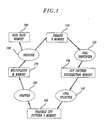
- FIG. 3 the results of the numerical example in FIG. 2 are summarized in FIG. 3, i.e. we use FIG. 3 to illustrate how the iterative methodology combines the results to obtain a completed recommended solution.
- W (30,20,10).
- the recommended solution includes the knives being set to cut the log-roll for one width of 30 units, two widths of 20 units, and two widths of 10 units. That cut is repeated eight times, each cut being of the aforesaid normalized length.
- the recommended solution includes the knives being set to cut the log-roll for one width of 30 units, three widths of 20 units, and zero widths of 10 units. That cut is repeated two times, each cut being of the aforesaid normalized length.
- the recommended solution includes the knives being set to cut the log-roll for two widths of 30 units, one width of 20 units, and one width of 10 units. That cut is performed one time and the one cut is of the aforesaid normalized length. Note here that we could have, alternatively, used the solution shown in item 270 as a part of the recommended solution.
Landscapes
- Business, Economics & Management (AREA)
- Human Resources & Organizations (AREA)
- Engineering & Computer Science (AREA)
- Strategic Management (AREA)
- Economics (AREA)
- Quality & Reliability (AREA)
- Physics & Mathematics (AREA)
- Entrepreneurship & Innovation (AREA)
- Marketing (AREA)
- Operations Research (AREA)
- Development Economics (AREA)
- Tourism & Hospitality (AREA)
- Game Theory and Decision Science (AREA)
- General Business, Economics & Management (AREA)
- General Physics & Mathematics (AREA)
- Theoretical Computer Science (AREA)
- Management, Administration, Business Operations System, And Electronic Commerce (AREA)
- Complex Calculations (AREA)
- Feedback Control In General (AREA)
- General Factory Administration (AREA)
- Electron Beam Exposure (AREA)
Applications Claiming Priority (2)
| Application Number | Priority Date | Filing Date | Title |
|---|---|---|---|
| US531174 | 1983-09-08 | ||
| US07/531,174 US5235508A (en) | 1990-05-31 | 1990-05-31 | Automated resource allocation cutting stock arrangement using random cut patterns |
Publications (3)
| Publication Number | Publication Date |
|---|---|
| EP0459689A2 true EP0459689A2 (fr) | 1991-12-04 |
| EP0459689A3 EP0459689A3 (en) | 1993-10-06 |
| EP0459689B1 EP0459689B1 (fr) | 1999-03-31 |
Family
ID=24116554
Family Applications (1)
| Application Number | Title | Priority Date | Filing Date |
|---|---|---|---|
| EP91304594A Expired - Lifetime EP0459689B1 (fr) | 1990-05-31 | 1991-05-21 | Dispositif de découpage de matières avec allocation automatisée de ressources, utilisant des modèles de découpage aléatoires |
Country Status (5)
| Country | Link |
|---|---|
| US (1) | US5235508A (fr) |
| EP (1) | EP0459689B1 (fr) |
| JP (1) | JPH04232502A (fr) |
| CA (1) | CA2038005C (fr) |
| DE (1) | DE69131060D1 (fr) |
Cited By (2)
| Publication number | Priority date | Publication date | Assignee | Title |
|---|---|---|---|---|
| EP0516333A3 (en) * | 1991-05-31 | 1994-12-21 | American Telephone & Telegraph | Automated resource allocation system employing a learning arrangement |
| WO1998009239A1 (fr) * | 1996-08-28 | 1998-03-05 | Siemens Aktiengesellschaft | Procede et dispositif pour la determination et l'optimisation d'un trace de coupe pour une coupeuse longitudinale |
Families Citing this family (18)
| Publication number | Priority date | Publication date | Assignee | Title |
|---|---|---|---|---|
| SE9103210L (sv) * | 1991-11-01 | 1993-05-02 | Televerket | Anordning foer tillverkning av styrmedel |
| JP3165254B2 (ja) * | 1992-07-27 | 2001-05-14 | シスメックス株式会社 | 粒子の多次元分布の表示方法 |
| US5548518A (en) * | 1994-05-31 | 1996-08-20 | International Business Machines Corporation | Allocation method for generating a production schedule |
| US5909371A (en) * | 1995-04-19 | 1999-06-01 | Siemens Aktiengesellschaft | Process of operating a numerical control with critical-time and non-critical-time processes in a real time system |
| US6085216A (en) * | 1997-12-31 | 2000-07-04 | Xerox Corporation | Method and system for efficiently allocating resources for solving computationally hard problems |
| US6457008B1 (en) * | 1998-08-28 | 2002-09-24 | Oracle Corporation | Pluggable resource scheduling policies |
| US6842899B2 (en) | 1999-12-21 | 2005-01-11 | Lockheed Martin Corporation | Apparatus and method for resource negotiations among autonomous agents |
| JP3609315B2 (ja) * | 2000-02-28 | 2005-01-12 | 富士通株式会社 | プリント配線板の製造データ作成システム、及びプリント配線板の製造システム |
| US6696060B2 (en) * | 2001-06-14 | 2004-02-24 | Clearant, Inc. | Methods for sterilizing preparations of monoclonal immunoglobulins |
| US6584370B2 (en) | 2001-06-26 | 2003-06-24 | International Business Machines Corporation | Method of calculating low level codes for considering capacities |
| US7197469B2 (en) | 2001-06-26 | 2007-03-27 | International Business Machines Corporation | Method for allocating limited component supply and capacity to optimize production scheduling |
| US6701201B2 (en) | 2001-08-22 | 2004-03-02 | International Business Machines Corporation | Decomposition system and method for solving a large-scale semiconductor production planning problem |
| EP1679595A4 (fr) * | 2003-10-29 | 2008-06-04 | Ibm | Systeme d'information, procede et programme de controle de charge et support d'enregistrement |
| JP4117299B2 (ja) * | 2005-02-28 | 2008-07-16 | インターナショナル・ビジネス・マシーンズ・コーポレーション | サーバの多重度の上限値を制御するための方法、管理サーバ、サーバ、およびプログラム |
| US20060197769A1 (en) * | 2005-03-02 | 2006-09-07 | International Business Machines Corporation | Method and apparatus for generating profile of solutions trading off number of activities utilized and objective value for bilinear integer optimization models |
| US8266289B2 (en) * | 2009-04-23 | 2012-09-11 | Microsoft Corporation | Concurrent data processing in a distributed system |
| US10029379B2 (en) * | 2016-01-19 | 2018-07-24 | Greycon Ltd. | Pattern transformation |
| US10373117B1 (en) * | 2016-11-15 | 2019-08-06 | Amazon Technologies, Inc. | Inventory optimization based on leftover demand distribution function |
Family Cites Families (10)
| Publication number | Priority date | Publication date | Assignee | Title |
|---|---|---|---|---|
| GB1052596A (fr) * | 1964-06-30 | 1900-01-01 | ||
| US3488479A (en) * | 1966-01-05 | 1970-01-06 | Marion A Keyes | Automated slitting system |
| UST918013I4 (en) * | 1973-06-28 | 1974-01-22 | Gjgis sihi no swjii | |
| FR2458834A1 (fr) * | 1979-06-05 | 1981-01-02 | Ramain Philippe | Systeme de commande automatique ou semi-automatique de machines a reports ou similaires a partir de l'implantation automatique ou semi-automatique d'amalgames d'apres les donnees initiales de mise en fabrication |
| JPS61131814A (ja) * | 1984-11-30 | 1986-06-19 | Nippon Steel Corp | 形鋼の最適鋸断方法 |
| JPS6393515A (ja) * | 1986-10-09 | 1988-04-23 | Mitsubishi Electric Corp | 棒鋼ラインにおける最適切断制御方法 |
| US4885686A (en) * | 1987-01-12 | 1989-12-05 | American Telephone And Telegraph At&T Bell Laboratories | Methods and apparatus for efficient resource allocation |
| GB2205184A (en) * | 1987-04-20 | 1988-11-30 | Hitachi Ltd | Method of managing layout of goods |
| US5128860A (en) * | 1989-04-25 | 1992-07-07 | Motorola, Inc. | Manufacturing or service system allocating resources to associated demands by comparing time ordered arrays of data |
| US5077661A (en) * | 1989-05-03 | 1991-12-31 | Hewlett-Packard Company | Assignment-dependent resource allocation method |
-
1990
- 1990-05-31 US US07/531,174 patent/US5235508A/en not_active Expired - Lifetime
-
1991
- 1991-03-11 CA CA002038005A patent/CA2038005C/fr not_active Expired - Fee Related
- 1991-05-21 DE DE69131060T patent/DE69131060D1/de not_active Expired - Lifetime
- 1991-05-21 EP EP91304594A patent/EP0459689B1/fr not_active Expired - Lifetime
- 1991-05-28 JP JP3150953A patent/JPH04232502A/ja active Pending
Cited By (2)
| Publication number | Priority date | Publication date | Assignee | Title |
|---|---|---|---|---|
| EP0516333A3 (en) * | 1991-05-31 | 1994-12-21 | American Telephone & Telegraph | Automated resource allocation system employing a learning arrangement |
| WO1998009239A1 (fr) * | 1996-08-28 | 1998-03-05 | Siemens Aktiengesellschaft | Procede et dispositif pour la determination et l'optimisation d'un trace de coupe pour une coupeuse longitudinale |
Also Published As
| Publication number | Publication date |
|---|---|
| DE69131060D1 (de) | 1999-05-06 |
| EP0459689A3 (en) | 1993-10-06 |
| JPH04232502A (ja) | 1992-08-20 |
| EP0459689B1 (fr) | 1999-03-31 |
| US5235508A (en) | 1993-08-10 |
| CA2038005C (fr) | 1996-01-16 |
| CA2038005A1 (fr) | 1991-12-01 |
Similar Documents
| Publication | Publication Date | Title |
|---|---|---|
| US5235508A (en) | Automated resource allocation cutting stock arrangement using random cut patterns | |
| US5289370A (en) | Automated resource allocation method employing a learning arrangement | |
| CA2436352C (fr) | Procede et systeme de mise au point d'un modele predictif | |
| Jalilvand-Nejad et al. | A mathematical model and genetic algorithm to cyclic flexible job shop scheduling problem | |
| US20040102867A1 (en) | Constraint based material trimming controller | |
| US8730503B2 (en) | Methods and systems for balancing job assignments to machines in a production environment | |
| CN112199407B (zh) | 一种数据分组排序方法、装置、设备及存储介质 | |
| EP0416635A2 (fr) | Générateur de motif de caractères | |
| Angra et al. | Cellular manufacturing—A time-based analysis to the layout problem | |
| US20060179045A1 (en) | Retail store recommendation engine | |
| Cunha Campos et al. | NSGA-II with iterated greedy for a bi-objective three-stage assembly flowshop scheduling problem | |
| US5341306A (en) | Blank layout method for plate-glass cutters | |
| JPH06203054A (ja) | 代替部品引当方法とその装置 | |
| Kalir et al. | Optimal design of flexible production lines with unreliable machines and infinite buffers | |
| Farley et al. | Fixed charge problems with identical fixed charges | |
| US6321132B1 (en) | Efficient method for designing slabs for production from an order book | |
| Hidri et al. | Near-optimal solutions and tight lower bounds for the parallel machines scheduling problem with learning effect | |
| US5386506A (en) | Plotting and editing apparatus | |
| JP3039348B2 (ja) | 生産計画方法及び板取り方法 | |
| US6615163B1 (en) | System and method for developing testing configurations | |
| Khorasanian et al. | An iterated greedy algorithm for solving the blocking flow shop scheduling problem with total flow time criteria | |
| Vembu et al. | Heuristics for operator allocation and sequencing in product-line-cells with manually operated machines | |
| JP2865520B2 (ja) | ロット製品割付装置 | |
| JPH08278997A (ja) | カテゴリーマネジメントによる棚割方法 | |
| US8243744B2 (en) | Priority sorting |
Legal Events
| Date | Code | Title | Description |
|---|---|---|---|
| PUAI | Public reference made under article 153(3) epc to a published international application that has entered the european phase |
Free format text: ORIGINAL CODE: 0009012 |
|
| AK | Designated contracting states |
Kind code of ref document: A2 Designated state(s): DE FR GB |
|
| PUAL | Search report despatched |
Free format text: ORIGINAL CODE: 0009013 |
|
| AK | Designated contracting states |
Kind code of ref document: A3 Designated state(s): DE FR GB |
|
| 17P | Request for examination filed |
Effective date: 19940324 |
|
| RAP3 | Party data changed (applicant data changed or rights of an application transferred) |
Owner name: AT&T CORP. |
|
| 17Q | First examination report despatched |
Effective date: 19970207 |
|
| GRAG | Despatch of communication of intention to grant |
Free format text: ORIGINAL CODE: EPIDOS AGRA |
|
| GRAG | Despatch of communication of intention to grant |
Free format text: ORIGINAL CODE: EPIDOS AGRA |
|
| GRAH | Despatch of communication of intention to grant a patent |
Free format text: ORIGINAL CODE: EPIDOS IGRA |
|
| GRAH | Despatch of communication of intention to grant a patent |
Free format text: ORIGINAL CODE: EPIDOS IGRA |
|
| GRAA | (expected) grant |
Free format text: ORIGINAL CODE: 0009210 |
|
| PGFP | Annual fee paid to national office [announced via postgrant information from national office to epo] |
Ref country code: FR Payment date: 19990318 Year of fee payment: 9 |
|
| PGFP | Annual fee paid to national office [announced via postgrant information from national office to epo] |
Ref country code: GB Payment date: 19990330 Year of fee payment: 9 |
|
| AK | Designated contracting states |
Kind code of ref document: B1 Designated state(s): DE FR GB |
|
| PG25 | Lapsed in a contracting state [announced via postgrant information from national office to epo] |
Ref country code: FR Free format text: LAPSE BECAUSE OF FAILURE TO SUBMIT A TRANSLATION OF THE DESCRIPTION OR TO PAY THE FEE WITHIN THE PRESCRIBED TIME-LIMIT Effective date: 19990331 |
|
| REF | Corresponds to: |
Ref document number: 69131060 Country of ref document: DE Date of ref document: 19990506 |
|
| PG25 | Lapsed in a contracting state [announced via postgrant information from national office to epo] |
Ref country code: DE Free format text: LAPSE BECAUSE OF FAILURE TO SUBMIT A TRANSLATION OF THE DESCRIPTION OR TO PAY THE FEE WITHIN THE PRESCRIBED TIME-LIMIT Effective date: 19990701 |
|
| EN | Fr: translation not filed | ||
| PLBE | No opposition filed within time limit |
Free format text: ORIGINAL CODE: 0009261 |
|
| STAA | Information on the status of an ep patent application or granted ep patent |
Free format text: STATUS: NO OPPOSITION FILED WITHIN TIME LIMIT |
|
| 26N | No opposition filed | ||
| PG25 | Lapsed in a contracting state [announced via postgrant information from national office to epo] |
Ref country code: GB Free format text: LAPSE BECAUSE OF NON-PAYMENT OF DUE FEES Effective date: 20000521 |
|
| GBPC | Gb: european patent ceased through non-payment of renewal fee |
Effective date: 20000521 |