EP0459824A2 - Telekommunikations-Netzwerk - Google Patents
Telekommunikations-Netzwerk Download PDFInfo
- Publication number
- EP0459824A2 EP0459824A2 EP91304949A EP91304949A EP0459824A2 EP 0459824 A2 EP0459824 A2 EP 0459824A2 EP 91304949 A EP91304949 A EP 91304949A EP 91304949 A EP91304949 A EP 91304949A EP 0459824 A2 EP0459824 A2 EP 0459824A2
- Authority
- EP
- European Patent Office
- Prior art keywords
- channels
- subscribers
- cell
- systems
- available
- Prior art date
- Legal status (The legal status is an assumption and is not a legal conclusion. Google has not performed a legal analysis and makes no representation as to the accuracy of the status listed.)
- Withdrawn
Links
- 230000001413 cellular effect Effects 0.000 claims abstract description 10
- 230000000903 blocking effect Effects 0.000 abstract 1
- 238000010586 diagram Methods 0.000 description 3
- 238000004891 communication Methods 0.000 description 2
- 102000047724 Member 2 Solute Carrier Family 12 Human genes 0.000 description 1
- 108091006621 SLC12A1 Proteins 0.000 description 1
- 108091006620 SLC12A2 Proteins 0.000 description 1
- 230000001419 dependent effect Effects 0.000 description 1
- 230000001788 irregular Effects 0.000 description 1
- 238000012423 maintenance Methods 0.000 description 1
- 238000005259 measurement Methods 0.000 description 1
- 238000000034 method Methods 0.000 description 1
- 238000000926 separation method Methods 0.000 description 1
Images

Classifications
-
- H—ELECTRICITY
- H04—ELECTRIC COMMUNICATION TECHNIQUE
- H04W—WIRELESS COMMUNICATION NETWORKS
- H04W16/00—Network planning, e.g. coverage or traffic planning tools; Network deployment, e.g. resource partitioning or cells structures
- H04W16/14—Spectrum sharing arrangements between different networks
Definitions
- the invention relates to telecommunications networks by means of which a plurality of subscribers may communicate with each other.
- Embodiments of the invention to be described relate to telecommunications networks in the form of telephone networks and more especially to such networks involving mobiles (such as in a cellular network) which can communicate with each other and with fixed telephones.
- the invention may be applied to any other type of telecommunications network.
- a telecommunications network serving a predetermined plurality of different systems of subscribers, the network having a predetermined plurality of interconnection channels by means of which the subscribers can communicate with each other, and control means limiting to a predetermined maximum the number of interconnection channels which can be used at any time by the subscribers of each system.
- a cellular telephone network for serving the subscribers of at least two separate subscriber systems, each cell of the network having a predetermined total number of available channels each of which can be used by a subscriber to both or all of the subscriber systems, and including means for each cell for restricting the number of radio channels therein which can be used at any time by the subscribers of each of the systems such that at no time can the subscribers of one system use all the available radio channels in any particular cell.
- FIG. 1 illustrates a somewhat generalised example of a network embodying the invention.
- the network serves a number of different subscribers.
- subscribers A1,A2,A3...An subscribe to system A
- subscribers B1,B2,B3....Bn subscribe to system B
- subscribers C1,C2,C3 subscribe to system C.
- the systems may differ from each other in, for example, the type or quality of the service offered or the geographical area covered, or may be basically similar but providing competing services.
- all three systems use the same telecommunications network which is generally illustrated as a group 10 of channels which are controlled by an exchange control 12.
- Each of the subscribers in the systems A,B and C is connected into the group of channels 10 by a respective link, as illustrated.
- These links may be wire links or wireless links such as radio links, and the group of channels 10 may be wired or wireless channels or a combination of such channels.
- the network 10 may be arranged such that each subscriber in a particular system can only communicate, via the network, with other subscribers in his own system, or he may be able to communicate with subscribers in all, or perhaps only some, of the other systems.
- the network 10 will in principle only have available a fixed number of intercomunication channels by which it can connect one subscriber to another.
- the network therefore incorporates means to prevent all available intercommunication channels being used at any one time by the subscribers of just one of the systems; if that were to happen, the subscribers of the other systems would be completely prevented from making calls.
- X+Y+Z could be more than N, where N is the total number of interconnection channels available in the network.
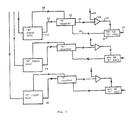
- Figure 2 illustrates in block diagram form the operations carried out by the exchange control 12. Requests from subscribers to system A for calls are received by an "A" input unit 14, while similar requests from subscribers to system B are received by a "B" input unit 16 and from subscribers to network C by a "C” input unit 18.
- unit 14 In response to a request for a call to be set up by a subscriber to system A, unit 14 sends a "read" signal on a line 20 to an "A" counter 22 which records the number of calls currently being made by subscribers to system A. This causes the counter to read out its count on a line 24 to a comparator 26 where the count value is compared with the limit X which is input on a line 28. If the count value on line 24 is not more than the limit X on line 28, the comparator signals accordingly on a line 30 to a call setting up unit 32 which produces the required signals on a line 34 to permit the call to be set up to the called subscriber in the conventional way (assuming a channel is available). At the same time, the unit 32 increments the counter 22 by a signal on a line 36. When the call is completed, the unit 14 decrements the counter 22 by a signal on a line 38.
- Figure 2 is intended to be illustrative of the operations carried out by the exchange control which could alternatively be implemented partly or substantially wholly by software.
- the exchange control 12 can be arranged to maintain a record of the number of calls made by the subscribers in each system, to enable the values of X,Y and Z to be varied to maintain optimum values.
- X,Y and Z can be varied from time to time in accordance with certain criteria such as an increase or decrease in the number of subscribers on a particular one of the systems, time of day or time of week (if, for example, one of the systems was used primarily by businesses while others were used primarily by residential users, it could be appropriate to vary X,Y and Z according to the time of day and the time of week).
- the network 10 could be or include a PSTN.
- the systems A,B,C could be of any suitable type. For example, they could be different types of mobile radio systems such as cellular systems.
- GSM planned pan-European digital telephone system
- PCN's personal communication networks
- All three systems A,B,C could be PCN's. However, many other arrangements are possible.
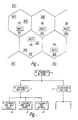
- FIG. 3 shows a cellular telephone network in diagrammatic form.
- the network provides geographical areas or "cells" P1,P2... Pn each served by a respective radio transmitter/receiver and controlled by a respective base station controller BSC1, BSC2...BSCn.
- Mobiles M1,M2...Mn moving within and between the cells can communicate with each other and with fixed telephones F1,F2...Fn in a PSTN in known manner by radio communication with the radio transmitter/receiver of the cell in which they are located, under control of the relevant base station controller. Thence they can communicate by radio link to a mobile in the same cell or via landline and corresponding radio link to a mobile in another cell (under control of its base station controller) or by landline to the PSTN and one of the fixed telephones.
- each cell p1, P2...Pn The geographical extent of each cell p1, P2...Pn is dependent on the geographical conditions, and the characteristics of the radio transmitter/receiver in each cell and of the mobile and other factors. In practice, the cells will be of irregular and varying shape rather than the regular arrangement shown and the cells may well overlap.
- each cell a predetermined plurality of radio channels is available for use for calls, the cellular arrangement enabling frequencies to be re-used within the network provided that the power and geographical separation between re-used frequencies is such as to prevent interference.
- the cellular network is conventional. However, it will now be assumed that it serves subscribers to two different subscriber systems. For example, it will be assumed that it serves subscribers both to the planned pan-European digital telephone (GSM) and to a PCN.
- GSM pan-European digital telephone
- each cell has available to it only a certain number of radio channels, it is necessary to ensure that neither one of the two systems (GSM and PCN in this example) can at any time use so many of the available channels in any cell that effective use of the cell by the other system is blocked.
- the number of radio channels which may be used by each of the GSM and PCN systems is fixed.
- up to X channels at any time may be used by PCN traffic and up to Y channels at any time may be used by GSM traffic. (X+Y) can be greater than or equal to N, where N is the total number of channels available in any particular cell. In this way, therefore, neither of the systems can use all the channels available in a particular cell.
- a channel When a call is to be set up, a channel will be allocated to the call, provided that the number of allocated channels in the cell will not exceed the maximum allowable number of channels (X or Y) for the particular system (PCN or GSM).
- PCN or GSM maximum allowable number of channels
- the call may be handed over to an adjacent cell which may be able to accept the call. Such hand-over may be possible because of overlap between adjacent cells.
- a call involving a mobile moving out of one cell into another may be handed over to that other cell in known manner.
- the new cell would only accept the handed-over call if the maximum number of channels available in that new cell for calls from the particular system involved (PCN or GSM in this example) would not be exceeded.
- Bids for acceptance of calls which are blocked because of the restriction on the number of channels available to the particular system (GSM or PCN) in the cell are treated as congestion, and re-bids may be made on adjacent cells ("directed re-try"). Any such re-bids are of course subject in the adjacent cells to the channel availability limits applying to the new cell.
- the allocation of available channels may be made on a hierarchical basis as illustrated in Figure 4. Thus, in any particular cell there may be (say) twelve channels available in total, as indicated in block 45.
- the maximum number (10) of channels allocated to GSM traffic may be further specified.
- a maximum of 8 channels may be available for new calls, as indicated by box 50 in Figure 4.
- the maximum number of channels available for calls handed-over from adjacent cells might be specified as 4, as indicated by box 52.
- the maximum number of channels available for re-tries might be specified as 2, as indicated by box 54.
- the channels available for PCN traffic could be further specified in the same way.
- the channel allocations can be designed to keep the level of congestion in the individual systems (e.g. GSM and PCN in the example being considered) below predetermined thresholds, such as below 2% for GSM and below 10% for PCN.
- the base station controller for each cell makes separate measurements of the traffic on the various systems in that cell.
- GSM and PCN traffic can be distinguished by the fact that GSM has a station class mark less than 4 whereas PCN has a station class mark greater than 4.
Landscapes
- Engineering & Computer Science (AREA)
- Computer Networks & Wireless Communication (AREA)
- Signal Processing (AREA)
- Mobile Radio Communication Systems (AREA)
Applications Claiming Priority (4)
| Application Number | Priority Date | Filing Date | Title |
|---|---|---|---|
| GB909012313A GB9012313D0 (en) | 1990-06-01 | 1990-06-01 | Telecommunication network |
| GB9012313 | 1990-06-01 | ||
| GB9015937 | 1990-07-20 | ||
| GB9015937A GB2244627A (en) | 1990-06-01 | 1990-07-20 | "Telecommunications network" |
Publications (2)
| Publication Number | Publication Date |
|---|---|
| EP0459824A2 true EP0459824A2 (de) | 1991-12-04 |
| EP0459824A3 EP0459824A3 (en) | 1992-08-12 |
Family
ID=26297143
Family Applications (1)
| Application Number | Title | Priority Date | Filing Date |
|---|---|---|---|
| EP19910304949 Withdrawn EP0459824A3 (en) | 1990-06-01 | 1991-05-31 | Telecommunications network |
Country Status (5)
| Country | Link |
|---|---|
| EP (1) | EP0459824A3 (de) |
| FI (1) | FI912617A7 (de) |
| IE (1) | IE911871A1 (de) |
| NO (1) | NO912102L (de) |
| PT (1) | PT97829A (de) |
Cited By (2)
| Publication number | Priority date | Publication date | Assignee | Title |
|---|---|---|---|---|
| WO1997044979A3 (en) * | 1996-05-17 | 1997-12-24 | Motorola Ltd | Base site controller and system selection method |
| WO1998015133A3 (en) * | 1996-09-17 | 1998-05-28 | Nokia Telecommunications Oy | Method and arrangement for controlling subscriber registrations in a mobile communication system |
Family Cites Families (4)
| Publication number | Priority date | Publication date | Assignee | Title |
|---|---|---|---|---|
| US3786199A (en) * | 1971-10-22 | 1974-01-15 | Bell Telephone Labor Inc | Mixed traffic mobile radio system |
| US4612415A (en) * | 1984-08-03 | 1986-09-16 | Motorola, Inc. | Dynamic control of telephone traffic in a trunked radio system |
| US4670899A (en) * | 1985-05-31 | 1987-06-02 | Northern Telecom Limited | Load balancing for cellular radiotelephone system |
| JPH01147928A (ja) * | 1987-12-04 | 1989-06-09 | Mitsubishi Electric Corp | マルチチャネルアクセス通信方式 |
-
1991
- 1991-05-31 FI FI912617A patent/FI912617A7/fi not_active Application Discontinuation
- 1991-05-31 IE IE187191A patent/IE911871A1/en unknown
- 1991-05-31 NO NO91912102A patent/NO912102L/no unknown
- 1991-05-31 EP EP19910304949 patent/EP0459824A3/en not_active Withdrawn
- 1991-05-31 PT PT97829A patent/PT97829A/pt not_active Application Discontinuation
Cited By (4)
| Publication number | Priority date | Publication date | Assignee | Title |
|---|---|---|---|---|
| WO1997044979A3 (en) * | 1996-05-17 | 1997-12-24 | Motorola Ltd | Base site controller and system selection method |
| WO1998015133A3 (en) * | 1996-09-17 | 1998-05-28 | Nokia Telecommunications Oy | Method and arrangement for controlling subscriber registrations in a mobile communication system |
| AU727610B2 (en) * | 1996-09-17 | 2000-12-14 | Nokia Telecommunications Oy | Method and arrangement for controlling subscriber registrations in a mobile communication system |
| US6324399B1 (en) | 1996-09-17 | 2001-11-27 | Nokia Telecommunications Oy | Method and arrangement for controlling subscriber registrations in a mobile communication system |
Also Published As
| Publication number | Publication date |
|---|---|
| NO912102D0 (no) | 1991-05-31 |
| EP0459824A3 (en) | 1992-08-12 |
| IE911871A1 (en) | 1991-12-04 |
| FI912617A7 (fi) | 1991-12-02 |
| FI912617A0 (fi) | 1991-05-31 |
| NO912102L (no) | 1991-12-02 |
| PT97829A (pt) | 1993-06-30 |
Similar Documents
| Publication | Publication Date | Title |
|---|---|---|
| US6418317B1 (en) | Method and system for managing frequencies allocated to a base station | |
| JP2699934B2 (ja) | 通信規制制御方式 | |
| CA2124556C (en) | Communication channel selection in cellular radio communication systems | |
| US4669107A (en) | Method of increasing the number of call options in a mobile telephone system | |
| RU2139632C1 (ru) | Улучшение характеристик системы подвижной сотовой связи | |
| US6014564A (en) | Method and apparatus for determining virtual cell area | |
| RU2197791C2 (ru) | Автоматическое планирование каналов управления в системах с адаптивным распределением каналов | |
| US6360103B2 (en) | Cellular telephone system which increases efficiency of reserved channel usage | |
| JP3881027B2 (ja) | マルチユーザ通信システムで選択的に通信を許可する方法および回線装置 | |
| EP1006745A1 (de) | Funkkommunikationssystem sowie verfahren und vorrichtung zur frequenzvergabe | |
| NZ255006A (en) | Cellular mobile radio channel rearranging | |
| JPWO1999059362A1 (ja) | 無線通信システム、その周波数割り当て方法および周波数割り当て装置 | |
| IE920898A1 (en) | Cellular telecommunications networks and methods | |
| AU727610B2 (en) | Method and arrangement for controlling subscriber registrations in a mobile communication system | |
| KR19990087406A (ko) | 원격 통신 시스템에서의 적응성 주파수 할당 | |
| JP2001522567A (ja) | チャネル割り当て方法 | |
| EP0505105A2 (de) | Wiederholung eines Kommunikationswunsches in zellularen Telekommunikationsnetzwerken und Verfahren dafür | |
| WO1996034500A1 (en) | System and method for restricting mobility of subscribers assigned to fixed subscription areas in a cellular telecommunications network | |
| JP2921739B2 (ja) | 呼受付制御方法および装置 | |
| EP0501807A2 (de) | Kanalzuteilung in Fernsprechnetzen und Verfahren dafür | |
| US6496497B1 (en) | Method for managing walsh code channels in mobile communication system | |
| GB2244627A (en) | "Telecommunications network" | |
| IE911871A1 (en) | Telecommunications network | |
| US7245921B2 (en) | Channel reservation in a location area | |
| WO1991011890A1 (en) | Method and arrangement for increasing the capacity in a mobile telephone system |
Legal Events
| Date | Code | Title | Description |
|---|---|---|---|
| PUAI | Public reference made under article 153(3) epc to a published international application that has entered the european phase |
Free format text: ORIGINAL CODE: 0009012 |
|
| AK | Designated contracting states |
Kind code of ref document: A2 Designated state(s): AT BE CH DE DK ES FR GR IT LI LU NL SE |
|
| PUAL | Search report despatched |
Free format text: ORIGINAL CODE: 0009013 |
|
| AK | Designated contracting states |
Kind code of ref document: A3 Designated state(s): AT BE CH DE DK ES FR GR IT LI LU NL SE |
|
| STAA | Information on the status of an ep patent application or granted ep patent |
Free format text: STATUS: THE APPLICATION IS DEEMED TO BE WITHDRAWN |
|
| 18D | Application deemed to be withdrawn |
Effective date: 19930213 |