EP0505105A2 - Wiederholung eines Kommunikationswunsches in zellularen Telekommunikationsnetzwerken und Verfahren dafür - Google Patents
Wiederholung eines Kommunikationswunsches in zellularen Telekommunikationsnetzwerken und Verfahren dafür Download PDFInfo
- Publication number
- EP0505105A2 EP0505105A2 EP92302164A EP92302164A EP0505105A2 EP 0505105 A2 EP0505105 A2 EP 0505105A2 EP 92302164 A EP92302164 A EP 92302164A EP 92302164 A EP92302164 A EP 92302164A EP 0505105 A2 EP0505105 A2 EP 0505105A2
- Authority
- EP
- European Patent Office
- Prior art keywords
- cell
- cii
- adjacent
- network
- communication
- Prior art date
- Legal status (The legal status is an assumption and is not a legal conclusion. Google has not performed a legal analysis and makes no representation as to the accuracy of the status listed.)
- Withdrawn
Links
Images



Classifications
-
- H—ELECTRICITY
- H04—ELECTRIC COMMUNICATION TECHNIQUE
- H04W—WIRELESS COMMUNICATION NETWORKS
- H04W16/00—Network planning, e.g. coverage or traffic planning tools; Network deployment, e.g. resource partitioning or cells structures
- H04W16/02—Resource partitioning among network components, e.g. reuse partitioning
- H04W16/06—Hybrid resource partitioning, e.g. channel borrowing
-
- H—ELECTRICITY
- H04—ELECTRIC COMMUNICATION TECHNIQUE
- H04W—WIRELESS COMMUNICATION NETWORKS
- H04W16/00—Network planning, e.g. coverage or traffic planning tools; Network deployment, e.g. resource partitioning or cells structures
- H04W16/24—Cell structures
- H04W16/32—Hierarchical cell structures
Definitions
- the invention relates to cellular telecommunications networks and methods.
- Embodiments of the invention to be described relate to cellular telephone networks involving mobiles, including hand-held portable telephones, which can communicate with each other and with fixed telephones.
- the invention may be applied to any other type of cellular telecommunications networks.
- a cellular telecommunications network for permitting communication with mobile subscriber equipment of at least two separate subscriber systems, in which the cells of the network are not all permitted for use by the mobile equipment of each of the systems, including means for each cell for receiving a request for communication from or with mobile equipment, measuring means responsive to such a request in respect of a particular cell which is permitted for use by the requesting equipment to carry out respective measurements of the radio signal strengths between the equipment and cells adjacent to the particular cell, means operative when there is an available communication channel within the particular cell to set up the requested communication by means of that channel, and means operative in the event of absence of such an available communication channel to set up the requested communication via an unoccupied one of the communication channels of any of the adjacent cells in respect of which the said radio signal strength exceeds a predetermined minimum and which is also a cell permitted for use by the requesting equipment.
- a cellular telecommunications network comprising means defining a plurality of cells each having a predetermined plurality of communication channels by means of a selected one of which a mobile station can communicate by radio with another party, means for each cell for receiving a request for communication from or with a mobile station, measuring means responsive to such a request in respect of a particular cell to measure the radio signal strengths between the mobile station and cells adjacent to the particular cell, and selective means operative in response to absence of an available communication channel in the particular cell to establish communication with the mobile station via an available communication channel in one of the adjacent cells provided that the respective measured radio signal strength relating to that cell exceeds a predetermined minimum.
- a method of operating a GSM cellular telephone network so as to permit it also to offer service over part, only, of its area to subscribers to a microcellular system, in which a predetermined plurality of communications channels are provided within each cell by means of which a mobile subscriber equipment may communicate with another party via the network, and comprising the steps of responding in each cell to a request for service in that cell from mobile equipment belonging to the microcellular system by (a) denying such service if that cell does not lie in the said part of the area, (b) providing such service if that cell does lie in the said part and a communications channel is available in that cell, and (c) providing the said service to that subscriber equipment via an unoccupied communications channel in an adjacent cell if that adjacent cell lies in the said part of the area and the radio signal strength between that adjacent cell and the mobile equipment exceeds a predetermined minimum.
- FIG. 1 shows cells C of a cellular network.
- each cell has a respective base station BS (only one indicated) comprising a radio transmitter/receiver which is controlled by a base station controller.
- Mobile equipment MS located within a cell of the network can communicate by radio with the base station of that cell and thence to the called party, such further communication being by radio and/or land line.
- the geographical extent of each cell is dependent on the geographical conditions and the characteristics of the radio transmitter/receiver in each cell and that of the radio transmitter/receiver of the MS.
- the cells will be of irregular and varying shape and overlapping as indicated.
- a predetermined plurality of radio channels is available for use for calls, the cellular arrangement enabling frequencies to be re-used within the network provided that the power and geographical separation between re-used frequencies is such as to prevent interference.
- Operation of the network requires, of course, that the location of each MS be known within the network so that, when a call to an MS is to be made via the network, a radio signal can be directed to and received by the MS so that the call can be set up.
- groups of cells can be arranged together as respective "location Areas", all the cells within a particular Location Area being arranged to broadcast the same "Location Area Identity" signal or LAI, the LAI for each Location Area differing from the LAI of the other adjacent Location Areas.
- an MS When an MS enters a cell in a particular Location Area, or when the MS becomes switched on, it receives the LAI of that Location Area from the base station of the cell in which it is located and, in response to this, transmits an identifying signal back to the base station and in this way the network knows the position of the MS (that is, the Location Area in which the MS is located is known though the actual cell is not known).
- the network knows that it must be made via a cell of the particular Location Area and a connection is established with the MS by means of a broadcast signal sent from all the cells in that particular Location Area.
- the MS receives the signal and responds to the BS of the nearest cell (that is, the cell from which the strongest signal is received). In this way the particular cell in which the MS is located is identified and the call is set up through that cell's base station.
- the call is "handed over" to the base station of another cell when the MS moves there from the initial cell.
- the cells in a particular Location Area broadcast on a "broadcast control channel” (BCCH), certain information including the LAI.
- BCCH broadcast control channel
- a call When a call is to be set up by an MS, it accesses the BS whose radio signal is strongest and is allocated a signalling channel known as a "stand alone dedicated control channel” (SDCCH) with an associated “slow associated control channel” (SACCH).
- SDCCH stand alone dedicated control channel
- SACCH slow associated control channel
- each cell has a fixed maximum number of radio channels through which calls can be made. If all such channels for the cell through which the MS makes initial access are occupied, the call clearly cannot be set up through any of them.
- the network is arranged so that, upon such occurrence, it attempts to set up the call through a radio channel of another cell. It will be appreciated that the areas covered by adjacent cells may often overlap, the extent of such overlap depending on geographical and topographical factors and the powers of the transmitters and receivers.
- an MS during the call set-up procedure, transmits to the BS, on the SACCH, the respective signal strengths and cell identities of the BCCH's of adjacent cells.
- the MS monitors the BCCH's of all the adjacent cells, assesses the strengths of the radio signals being received, and transmits this information to the BS.
- the BS finds that there are no available radio channels within its own cell on which to set up the call to the MS, it can automatically set up the call through a radio channel of one of the adjacent cells - provided that (a) the signal strength of that adjacent cell with reference to the MS is sufficiently strong (as indicated by the signal strength information previously transmitted to the BS by the MS), and (b) there is a free radio channel in that adjacent cell.
- This "re-try" process can therefore be set up without the MS having itself to carry out any re-accessing steps; that is, for example, it does not have to establish communication with the BS of an adjacent cell and then go through a setting up process using a different SDCCH and SACCH with that BS - instead, the call can be set up with the adjacent cell directly by the BS of the initial cell.
- the process described enables other factors to be taken into account. For example, there may be several adjacent cells with sufficient strength to enable the call to be set up. In choosing the particular adjacent cell for setting up the call, the BS can therefore choose a particular one of the cells with a relatively large amount of free capacity, in preference to one which is nearly fully occupied.
- a cellular network may also be arranged to provide different levels of service to different subscribers.
- certain subscribers may be permitted to make calls only within restricted geographical areas, that is, only via cells encompassing such restrictive geographical areas.
- the "re-try" process described above can therefore also take this into account: that is, if a BS cannot set up a call to an MS through the initial cell, it will not transfer the call to an adjacent cell if that adjacent cell is outside the restricted area applicable to that MS.
- the network has GSM cells (termed “macrocells”) CI and CII, the group of cells CI covering a particular geographical area I corresponding to a first Location Area, and the group of cells CII covering a different, and adjacent, geographical area II - that is, a different Location Area.
- the network would also include other groups of macrocells forming further Location Areas, with a single country within the network being covered by a number of different Location Areas each of which would comprise a relatively large number of separate macrocells.
- Subscribers to the GSM system can communicate with each other and with fixed and other telephones (primarily using mobiles but also including hand-held portables) over a wide geographical area which can in principle encompass the whole of the network.
- the network provides a more restricted service to subscribers to another system, primarily for personal communication using hand-held portable units and in this specification termed a micro-cellular network (MCN) system.
- MCN micro-cellular network
- Subscribers to the MCN system are able to use the network only when they are present in a restricted part of the total area covered by the network - though, when they are provided with service, they can communicate with other subscribers to the MCN system as well as with fixed and other telephones (and, including, in principle, subscribers to other cellular systems including the GSM system).
- MCN subscribers might be restricted to service within a particular part, only, of a particular one of the countries or one or more cities or towns within one or possibly more than one such country.
- FIG 2 shows, by way of example, three particular areas intended to be available to MCN subscribers, these being indicated at X,Y and Z. These areas could, for example, be areas encompassing relatively large cities or towns and are the areas which are intended to be available to the MCN subscribers.
- Each of the areas X,y and Z is made up of a number of microcells, that is, cells of smaller power and smaller geographical area than the macrocells of the GSM network; in principle, an area X,Y or Z could consist of only a single microcell, though in practice it is likely that it would comprise several such microcells.
- the microcells forming a particular area e.g. areas X and Y) could lie wholly within a corresponding macrocell or could fall within two or three macrocells (see area Y).
- Co-pending United Kingdom Patent Application No. 9107148.1 discloses how such a network can differentiate between an MS of a GSM subscriber and an MS of an MCN subscriber and can provide the correct level of service to each. In particular, it describes how, in principle, service to an MCN MS will only be provided when the MS is able to set up a call through a microcell within one of the areas X,Y and Z (in this example). Reference is made to that co-pending application for a fuller description.
- each subscriber's MS issues a signal identifying whether it is a GSM MS or an MCN MS.
- a convenient method of distinguishing between GSM and MCN MS is by reference to the "Classmark" or RF transmitter power of each MS.
- GSM MS have a Class number of 1,2,3 or 4 (indicating an RF power varying in the range 20 to 2 watts).
- MCN subscribers have a Classmark number of 5 (0.8 watts).
- Each MS equipment issues a signal identifying its Classmark and this enables the network to distinguish between GSM and MCN MS in a simple way.
- a BS in a particular cell accessed by a GSM MS follows through the process described above in relation to Figure 1 in order to set up a requested call - by setting up the SDCCH and the SACCH.
- the GSM MS measures the signal strengths of the signals on the BCCH's of adjacent cells and transmits this information to the BS on the SACCH. If, because there are no free communication channels, the BS cannot set the call up through the initial cell, it therefore carries out the re-try process described with reference to Figure 1 and sets up the call through a channel in an adjacent cell - assuming, of course, that there is such an adjacent channel with sufficient strength and with a free channel.
- the same process is, in principle, carried out when an MCN MS attempts to set up a call with the BS of a microcell.
- the MS measures the signal strength of the signals on the BCCH's of adjacent cells and transmits this information to the MS. If the BS cannot set up the call through the initial cell, because of the absence of a free radio channel, it will then set up the call through an adjacent cell if there is one with sufficient signal strength and also a free channel. However, in this case, the BS will only permit such a re-try process to involve adjacent microcells. In other words, it will not permit the call to be set up through a cell which is not included within the ambit of the subscription paid for by the MCN subscriber.
- the microcells within areas X,Y and Z can be used not only by the MCN subscribers but also by GSM subscribers.
- the re-try process described above can be used to re-direct calls from GSM subscribers according to the power of their MS.
- a GSM MS of relatively high power (Classmark 1 - 3) is requesting a call but which cannot be set up through the initial cell because of congestion
- the BS will normally re-direct the call so that it is established through the adjacent macrocell rather than through any adjacent microcell. This is because the higher power of the MS will enable such an MS to make such a call without having to use a channel in a microcell.
- the GSM MS is of low power (e.g. a hand-held portable, Classmark 4)
- the BS may re-direct the call to a microcell.
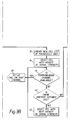
- Figure 3 is a flow-chart for illustrating this process.
- Block 10 indicates a request by an MS to make a call.
- the SDCCH and the accompanying SACCH between the MS and the BS of the accessed cell are therefore set up (block 12).
- the normal process of setting up the call including the checking of the identity and authenticity of the MS, now starts. This process includes the measurement by the MS of the signal strengths of the adjacent cells, and these measurements are sent to the BS by the MS (block 14).
- the MS continues to send to the BS further checks on the signal strengths for adjacent cells. These are averaged over a period of (say) three to five seconds and normalised in relation to the power of the MS. They are listed in order of average power (block 16).
- the network determines whether the MS is an MCN MS or a GSM MS on the basis of its transmitter power.
- the BS therefore checks the power of the MS (block 18) and determines whether it is an MCN MS (Class 5) or a GSM MS (Classes 1 - 4).
- the network assesses the list of the powers of adjacent cells (established at block 16), and creates a new cell list, of microcells only (block 20).
- the network selects the microcell with the highest signal strength.
- the network checks whether a communication channel is available in this cell. If the answer is "yes”, then the communication is set up via that communication channel (block 26). If the answer is "no”, the network checks whether there is another suitable cell (Block 26). If the answer is "no”, the cell is rejected (Block-28). If the answer is "yes”, the cell with the next highest power is selected (Block 30) and the network proceeds again from Block 24.
- the network uses the measurement information established at block 16, and creates a list in signal strength order of macrocells (only) (block 32). The cell with the highest average signal strength is then selected (block 34).
- the network establishes a list of adjacent microcells in signal strength order (block 44), again using the information established at block 20.
- the microcell with the highest average signal strength is then selected (block 46) and a check made whether a communication channel is available (block 48). If the answer is "yes”, this channel is allocated and communication starts (block 50).
- the network checks (block 52) whether another suitable microcell is available in the list. If the answer is "no", the call is rejected (block 54).
- the adjacent microcell with the next highest average signal strength is selected (block 52) and the network goes back to block 48 and checks whether a communication channel is available.
Landscapes
- Engineering & Computer Science (AREA)
- Computer Networks & Wireless Communication (AREA)
- Signal Processing (AREA)
- Mobile Radio Communication Systems (AREA)
Applications Claiming Priority (2)
| Application Number | Priority Date | Filing Date | Title |
|---|---|---|---|
| GB9106149 | 1991-03-22 | ||
| GB9106149A GB2255474B (en) | 1991-03-22 | 1991-03-22 | Cellular telecommunications networks and methods |
Publications (2)
| Publication Number | Publication Date |
|---|---|
| EP0505105A2 true EP0505105A2 (de) | 1992-09-23 |
| EP0505105A3 EP0505105A3 (en) | 1993-05-05 |
Family
ID=10692049
Family Applications (1)
| Application Number | Title | Priority Date | Filing Date |
|---|---|---|---|
| EP19920302164 Withdrawn EP0505105A3 (en) | 1991-03-22 | 1992-03-13 | Communication request retry in cellular telecommunications networks and methods therefor |
Country Status (5)
| Country | Link |
|---|---|
| EP (1) | EP0505105A3 (de) |
| FI (1) | FI921172A7 (de) |
| GB (1) | GB2255474B (de) |
| IE (1) | IE69015B1 (de) |
| NO (1) | NO921092L (de) |
Cited By (11)
| Publication number | Priority date | Publication date | Assignee | Title |
|---|---|---|---|---|
| WO1993012589A1 (en) * | 1991-12-12 | 1993-06-24 | Telefonaktiebolaget Lm Ericsson | Listening control channel in a cellular mobile radiotelephone system |
| WO1994006220A1 (en) * | 1992-09-10 | 1994-03-17 | Nokia Telecommunications Oy | Cellular radio network |
| FR2717970A1 (fr) * | 1994-03-22 | 1995-09-29 | Tassy Alain | Système et architecture de réseau pour offrir un service de téléphonie personnelle. |
| WO1996034499A1 (en) * | 1995-04-28 | 1996-10-31 | Telefonaktiebolaget Lm Ericsson (Publ) | A system and method for restricting call setup to a fixed subscription area in a cellular telecommunications network |
| WO1997029607A1 (en) * | 1996-02-09 | 1997-08-14 | Telecom Finland Oy | Method for restricting or preventing a service in a mobile phone network |
| WO1998008349A3 (en) * | 1996-08-16 | 1998-04-23 | Northern Telecom Ltd | Spatially-oriented subscriber configuration in a fixed wireless system |
| WO1998025431A1 (en) * | 1996-12-03 | 1998-06-11 | Telefonaktiebolaget Lm Ericsson (Publ) | Apparatus and method for controlling communications in a multi-network, wireless communication system |
| WO1998030056A3 (en) * | 1997-01-03 | 1998-09-03 | Nokia Telecommunications Oy | Localised special services in a mobile communications system |
| US5915219A (en) * | 1992-09-10 | 1999-06-22 | Nokia Telecommunications Oy | Cellular radio network divided into a primary network covering a selected operating area and at least one subsystem covering possibly overlapping area, with possibility of handoff and registration between primary network and subsystem |
| FR2790633A1 (fr) * | 1999-03-05 | 2000-09-08 | Cit Alcatel | Procede d'acces ou de transfert inter-cellulaire dans un systeme cellulaire de radiocommunications mobiles |
| CN1071533C (zh) * | 1994-06-13 | 2001-09-19 | 诺基亚电信公司 | 分级移动通信系统中的业务控制方法 |
Families Citing this family (7)
| Publication number | Priority date | Publication date | Assignee | Title |
|---|---|---|---|---|
| JP2809872B2 (ja) * | 1990-11-29 | 1998-10-15 | 松下電器産業株式会社 | 移動体通信装置 |
| JP2836651B2 (ja) * | 1991-10-11 | 1998-12-14 | 松下電器産業株式会社 | 広域系/閉域系共用携帯無線電話機 |
| US5842129A (en) * | 1991-10-11 | 1998-11-24 | Matsushita Electric Industrial Co., Ltd. | Portable radio telephone equipment used for CMTS/MCS in common |
| JP2643689B2 (ja) * | 1991-10-21 | 1997-08-20 | 松下電器産業株式会社 | マイクロセルラーシステムにおけるチャネル割り当て方法 |
| US5504803A (en) * | 1991-11-25 | 1996-04-02 | Matsushita Electric Industrial Co., Ltd. | Method for automatic mode selection for a dual-mode telephone handset for use in a cellular mobile telephone system and in a wireless telephone system |
| GB2308042B (en) * | 1995-12-05 | 2000-02-16 | Motorola Ltd | Radio communication system |
| GB2320991A (en) * | 1996-12-20 | 1998-07-08 | Dsc Telecom Lp | Channel selection control in a cellular radio communications system |
Family Cites Families (6)
| Publication number | Priority date | Publication date | Assignee | Title |
|---|---|---|---|---|
| US3898390A (en) * | 1973-05-15 | 1975-08-05 | Martin Marietta Corp | Multiple zone communications system and method |
| JPS5287904A (en) * | 1976-01-19 | 1977-07-22 | Nippon Telegr & Teleph Corp <Ntt> | Moving communication circuit assignment system |
| US4670899A (en) * | 1985-05-31 | 1987-06-02 | Northern Telecom Limited | Load balancing for cellular radiotelephone system |
| DE3786726T2 (de) * | 1986-08-25 | 1993-11-25 | Nippon Electric Co | Endgerät für ein Funkverbindungsnetz mit Verwendung von zu dem Netz zugewiesenen Radiokanälen. |
| US4797947A (en) * | 1987-05-01 | 1989-01-10 | Motorola, Inc. | Microcellular communications system using macrodiversity |
| SE500827C2 (sv) * | 1989-09-13 | 1994-09-12 | Ericsson Telefon Ab L M | Förfarande för kommunikation mellan en mobilstation och en fast radiostation |
-
1991
- 1991-03-22 GB GB9106149A patent/GB2255474B/en not_active Expired - Fee Related
-
1992
- 1992-03-13 EP EP19920302164 patent/EP0505105A3/en not_active Withdrawn
- 1992-03-18 FI FI921172A patent/FI921172A7/fi not_active Application Discontinuation
- 1992-03-19 NO NO92921092A patent/NO921092L/no unknown
- 1992-03-20 IE IE920899A patent/IE69015B1/en not_active IP Right Cessation
Cited By (20)
| Publication number | Priority date | Publication date | Assignee | Title |
|---|---|---|---|---|
| GB2268855B (en) * | 1991-12-12 | 1996-03-06 | Ericsson Telefon Ab L M | Listening control channel in a cellular mobile radiotelephone system |
| GB2268855A (en) * | 1991-12-12 | 1994-01-19 | Ericsson Telefon Ab L M | Listening control channel in a cellular mobile radiotelephone system |
| US5357559A (en) * | 1991-12-12 | 1994-10-18 | Telefonaktiebolaget L M Ericsson | Listening control channel in a cellular mobile radiotelephone system |
| AU663548B2 (en) * | 1991-12-12 | 1995-10-12 | Telefonaktiebolaget Lm Ericsson (Publ) | Listening control channel in a cellular mobile radiotelephone system |
| WO1993012589A1 (en) * | 1991-12-12 | 1993-06-24 | Telefonaktiebolaget Lm Ericsson | Listening control channel in a cellular mobile radiotelephone system |
| WO1994006220A1 (en) * | 1992-09-10 | 1994-03-17 | Nokia Telecommunications Oy | Cellular radio network |
| US5915219A (en) * | 1992-09-10 | 1999-06-22 | Nokia Telecommunications Oy | Cellular radio network divided into a primary network covering a selected operating area and at least one subsystem covering possibly overlapping area, with possibility of handoff and registration between primary network and subsystem |
| FR2717970A1 (fr) * | 1994-03-22 | 1995-09-29 | Tassy Alain | Système et architecture de réseau pour offrir un service de téléphonie personnelle. |
| CN1071533C (zh) * | 1994-06-13 | 2001-09-19 | 诺基亚电信公司 | 分级移动通信系统中的业务控制方法 |
| WO1996034499A1 (en) * | 1995-04-28 | 1996-10-31 | Telefonaktiebolaget Lm Ericsson (Publ) | A system and method for restricting call setup to a fixed subscription area in a cellular telecommunications network |
| US5850604A (en) * | 1995-04-28 | 1998-12-15 | Telefonaktiebologet Lm Ericsson (Publ) | System and method for restricting call setup to a fixed subscription area in a cellular telecommunications network |
| WO1997029607A1 (en) * | 1996-02-09 | 1997-08-14 | Telecom Finland Oy | Method for restricting or preventing a service in a mobile phone network |
| WO1998008349A3 (en) * | 1996-08-16 | 1998-04-23 | Northern Telecom Ltd | Spatially-oriented subscriber configuration in a fixed wireless system |
| WO1998025431A1 (en) * | 1996-12-03 | 1998-06-11 | Telefonaktiebolaget Lm Ericsson (Publ) | Apparatus and method for controlling communications in a multi-network, wireless communication system |
| US5920818A (en) * | 1996-12-03 | 1999-07-06 | Telefonaktiebolaget L M Ericsson (Publ) | Apparatus and method for controlling communications in a multi-network, wireless communication system |
| AU728514B2 (en) * | 1997-01-03 | 2001-01-11 | Nokia Telecommunications Oy | Localised special services in a mobile communications system |
| WO1998030056A3 (en) * | 1997-01-03 | 1998-09-03 | Nokia Telecommunications Oy | Localised special services in a mobile communications system |
| US6516193B1 (en) | 1997-01-03 | 2003-02-04 | Nokia Telecommunications Oy | Localized special services in a mobile communications system |
| CN1243647B (zh) * | 1997-01-03 | 2012-07-18 | 高智发明第一有限责任公司 | 用于移动通信系统中的本地化特定业务的方法和设备 |
| FR2790633A1 (fr) * | 1999-03-05 | 2000-09-08 | Cit Alcatel | Procede d'acces ou de transfert inter-cellulaire dans un systeme cellulaire de radiocommunications mobiles |
Also Published As
| Publication number | Publication date |
|---|---|
| EP0505105A3 (en) | 1993-05-05 |
| NO921092D0 (no) | 1992-03-19 |
| FI921172A0 (fi) | 1992-03-18 |
| IE920899A1 (en) | 1992-09-23 |
| GB2255474A (en) | 1992-11-04 |
| FI921172A7 (fi) | 1992-09-23 |
| NO921092L (no) | 1992-09-23 |
| GB2255474B (en) | 1995-06-14 |
| GB9106149D0 (en) | 1991-05-08 |
| IE69015B1 (en) | 1996-07-24 |
Similar Documents
| Publication | Publication Date | Title |
|---|---|---|
| EP0505106A2 (de) | Dienstaufspaltung in Zellularen Telekommunikationsnetzwerken und Verfahren dafür | |
| CN1132440C (zh) | 用于进行在蜂窝电话网络之内本地业务测量的方法及装置 | |
| EP0505105A2 (de) | Wiederholung eines Kommunikationswunsches in zellularen Telekommunikationsnetzwerken und Verfahren dafür | |
| KR100489861B1 (ko) | 상이한 등록 구역에 속하는 셀 간의 제어/파일럿 채널 재선택방법 및 시스템 | |
| JP3881027B2 (ja) | マルチユーザ通信システムで選択的に通信を許可する方法および回線装置 | |
| EP0986929B1 (de) | Angepasste hierarchische zellenstrukturen in einem kommunikationssystem | |
| US6073010A (en) | System and method for restricting mobility of subscribers assigned to fixed subscription areas in a cellular telecommunications network | |
| US7215962B2 (en) | Method for an intersystem connection handover | |
| US6178326B1 (en) | Cell selection influenced by stored data and mobile station using same | |
| EP1013126A2 (de) | Verfahren und anordnung zur übertragung spezieller zellinformation in einem zellularen system | |
| EP1847146B1 (de) | Einschränkung der verwendung von mobilen endgeräten auf der basis einer erzwungenen ortsaktualisierung | |
| WO1996034500A1 (en) | System and method for restricting mobility of subscribers assigned to fixed subscription areas in a cellular telecommunications network | |
| WO1992011736A1 (en) | Quality check for a mobile cellular radio system | |
| GB2285900A (en) | Communications system | |
| EP0919102B1 (de) | Verfahren zur Versorgung einer Radioeinheit mit zellularen Radiodiensten in einem festen zellularen Funksystem | |
| WO1998019474A2 (en) | A method for accessing a microcell using analog control channels | |
| EP0993752B1 (de) | Verfahren zum weiterreichen in einem kommunikationssystem, ein derartiges system und ein base station controller | |
| EP0541767B1 (de) | Verbesserte anwendung des leistungspegels in einem funktelefonsystem | |
| EP1779696A1 (de) | Verfahren und vorrichtung zur zellenneuauswahl in einem mobilkommunikationsnetz | |
| EP0459824A2 (de) | Telekommunikations-Netzwerk | |
| MXPA99008671A (en) | Method and apparatus for performing local traffic measurements in a cellular telephone network |
Legal Events
| Date | Code | Title | Description |
|---|---|---|---|
| PUAI | Public reference made under article 153(3) epc to a published international application that has entered the european phase |
Free format text: ORIGINAL CODE: 0009012 |
|
| AK | Designated contracting states |
Kind code of ref document: A2 Designated state(s): AT BE CH DE DK ES FR GR IT LI LU NL PT SE |
|
| PUAL | Search report despatched |
Free format text: ORIGINAL CODE: 0009013 |
|
| AK | Designated contracting states |
Kind code of ref document: A3 Designated state(s): AT BE CH DE DK ES FR GR IT LI LU NL PT SE |
|
| 17P | Request for examination filed |
Effective date: 19931026 |
|
| 17Q | First examination report despatched |
Effective date: 19960529 |
|
| STAA | Information on the status of an ep patent application or granted ep patent |
Free format text: STATUS: THE APPLICATION IS DEEMED TO BE WITHDRAWN |
|
| 18D | Application deemed to be withdrawn |
Effective date: 19961210 |