EP0460667A2 - Arrangement de câble en spirale - Google Patents
Arrangement de câble en spirale Download PDFInfo
- Publication number
- EP0460667A2 EP0460667A2 EP91109285A EP91109285A EP0460667A2 EP 0460667 A2 EP0460667 A2 EP 0460667A2 EP 91109285 A EP91109285 A EP 91109285A EP 91109285 A EP91109285 A EP 91109285A EP 0460667 A2 EP0460667 A2 EP 0460667A2
- Authority
- EP
- European Patent Office
- Prior art keywords
- line
- arrangement according
- rotation
- rotatable
- spirals
- Prior art date
- Legal status (The legal status is an assumption and is not a legal conclusion. Google has not performed a legal analysis and makes no representation as to the accuracy of the status listed.)
- Withdrawn
Links
Images



Classifications
-
- H—ELECTRICITY
- H01—ELECTRIC ELEMENTS
- H01R—ELECTRICALLY-CONDUCTIVE CONNECTIONS; STRUCTURAL ASSOCIATIONS OF A PLURALITY OF MUTUALLY-INSULATED ELECTRICAL CONNECTING ELEMENTS; COUPLING DEVICES; CURRENT COLLECTORS
- H01R35/00—Flexible or turnable line connectors, i.e. the rotation angle being limited
- H01R35/02—Flexible line connectors without frictional contact members
- H01R35/025—Flexible line connectors without frictional contact members having a flexible conductor wound around a rotation axis
-
- H—ELECTRICITY
- H02—GENERATION; CONVERSION OR DISTRIBUTION OF ELECTRIC POWER
- H02G—INSTALLATION OF ELECTRIC CABLES OR LINES, OR OF COMBINED OPTICAL AND ELECTRIC CABLES OR LINES
- H02G11/00—Arrangements of electric cables or lines between relatively-movable parts
Definitions
- the invention relates to a spiral line arrangement according to the preamble of claim 1.
- a line arrangement is known for example from DE-37 15 118C2.
- Robots for example, require a diverse supply of electrical and / or pneumatic and / or hydraulic types. A large number of electrical and / or fluid lines are therefore required in order to connect the rotating robot to stationary supply and signal reception sources.
- slip ring In the case of electrical cables, there is a small space requirement when using a slip ring with sliding contacts.
- the slip ring can be arranged on a swivel base of the rotatable device. Since a large number of control and supply lines are often required, such a slip ring must have a large number of sliding contacts.
- the slip ring solution is mechanically complex and cost-intensive and, in addition, durability and reliability leave something to be desired, since the slip rings are subject to high abrasion and a high risk of contamination.
- a cable containing the lines is arranged spirally around the rotatable device or a rotating foot of the rotatable device.
- One end of the line coil is connected to the rotatable device, while the other end of the line coil is connected to a fixed device.
- the spiral of the line is correspondingly turned in and out.
- angles of rotation of over Realize 360 °. The higher the required angle of rotation, the more turns the cable spiral must have.
- rotation angles have to be realized that are significantly higher than 360 °, often a multiple of 360 °.
- a heavy spiral due to the many spiral layers would have to be pulled or pushed over the lines of the line arrangement. This led to a high load on the line arrangement, compressions in the line spiral and thus to unclean guidance and excessive wear of the line arrangement.
- the object of the invention is to make a spiral line arrangement available which, with a relatively small radial space requirement, permits very high angles of rotation and thus maximum rotations and thereby avoids excessive loading and unclean routing of the line arrangement.
- the basic idea of the invention is to connect two or more line spirals in cascade, that is to say one after the other, and the individual line spirals when the rotatable device rotates by means of a drive forced to turn.
- This enables the device which can be rotated back and forth in each direction of rotation to have a total number of revolutions which corresponds to the sum of the number of revolutions of the individual line spirals connected in cascade.
- the maximum achievable total number of revolutions is therefore dependent on the number of line spirals connected in cascade and on the number of spiral layers per line spiral or cascade unit. Since in principle any number of line spirals can be connected in series, any number of rectified rotations can theoretically be achieved.
- the individual cascade units are constructed as follows: Between two levels, which are each formed by a circular disk in a preferred embodiment and which are arranged on the same axis of rotation so that both can be rotated independently of one another, are lines for the transmission of any energy and media in a helical manner Spiral form laid, one end of the conduit spiral is connected to one level and the other end to the other level and rotated with this. This arrangement allows a certain number of rotations of one level relative to the other level due to given dimensions.
- a second cascade unit is connected in series with the first cascade unit by arranging a further, third level on the same axis of rotation so that apart from a level connected to the non-rotatable device, each level can be rotated independently of the other levels.
- the line spirals of adjacent cascade units are connected via the middle level belonging to the two cascade units.
- the adjoining ends of two adjacent line spirals are fastened to the circular disk located between them, preferably by means of intermediate connectors which are arranged on the circular disk and connect the corresponding lines of the adjacent line spirals to one another.
- further rotatable levels can be arranged until the desired number of cascade units is reached, which is required for a certain maximum angle of rotation.
- One of the levels which is not rotatable, is firmly connected to the stationary or fixed device.
- One of the rotatable levels is fixed to the rotatable device. Connections are preferably provided in this rotatable plane and in the fixed plane, by means of which the two ends of the line arrangement can be connected to the rotatable or the fixed device.
- the individual levels must be driven when the rotatable device rotates so that they assume different rotational speeds.
- the drive is preferably effected by the back and forth rotatable device, the rotation of which is transmitted to the individual rotatable planes by means of a gear.
- Gear, belt, chain gear or other corresponding gear are suitable as gear.
- the difference in the rotational speeds of adjacent planes is decisive for the number of revolutions that the relevant spiral of line performs.
- the lengths of the lines of the individual line spirals should be selected so that the line spirals of each cascade unit can carry out the maximum number of revolutions required.
- the difference in the rotational speeds of adjacent planes is constant. In this case, all line spirals should allow the same number of revolutions.
- the rotation speed of each rotatable plane is half the speed of the faster rotating neighboring plane.
- the line spirals can be constructed with any lines. Ribbon cables are preferably used.
- the line arrangement according to the invention enables the transmission of any media, energies and / or signals. Liquid or gaseous substances can be transported via one or more fluid lines which are integrated in the line spirals. However, it is often beneficial to run the fluid lines separately.
- the cascade arrangement according to the invention provides for the design of the axis of rotation as a hollow tube through which the fluid lines are guided from the fixed device to the rotating device. In order to avoid twisting of the fluid lines, their connection to the rotating device is most suitably via rotary couplings.
- the cascade arrangement can be constructed with a fixed axis of rotation, the individual levels being rotatably mounted about them, with the exception of the level connected to the fixed device.
- One of the rotatable planes can also be connected in a rotationally fixed manner to the axis of rotation. Then the axis of rotation must be rotatably mounted in the plane connected to the fixed device.
- the axis of rotation is preferably supported by ball bearings.
- the individual line spirals can simply consist of spirally wound lines or spirals which, according to DE-37 15 118C2, are held in spiral form by means of prestressing elastic additional strands. The latter may be advantageous for large diameter spirals.
- the individual cascade units can also be constructed with a cable routing according to P 40 01 880.6.
- FIG. 1 shows a perspective illustration of a two-stage cascade arrangement which is constructed with two line spirals or with two units, each with two U-line loops concentric with the axis of rotation. The lines are not shown.
- a lower level E0 in FIG. 1 there is a lower disk S0, which is connected in a rotationally fixed manner to a fixed device (not shown).
- An axis of rotation DA is rotatably mounted in the disk S0.
- a rotatable disk S1 is rotatably fixed to the axis of rotation DA connected.
- an upper rotatable disk S2 which is connected in a rotationally fixed manner to a rotatable device (not shown) and is rotatably mounted about the axis of rotation DA.
- the disks S1 and S2 are provided on their peripheries with toothed rings ZK, which mesh with pinions R of a gearbox G such that the disk S1 is rotated in the same direction when the disk S2 is rotated.
- the upper disk S2 is driven by the rotatable device. The drive from the rotatable device to the transmission can also take place elsewhere.
- the washers S2 and S0 are provided with connection connectors AV2 and AV0, by means of which the corresponding ends of the line arrangement can be connected to the rotatable device or the fixed device.
- connection connectors AV2 and AV0 The lines leading away from the two connection connectors AV2 and AV0 are indicated in FIG.
- FIG. 2 shows a cascade arrangement made up of two cascade units, but with a line arrangement.
- the axis of rotation DA is formed by a hollow tube which is rotatably mounted in the fixed lower disk S0 and on which the upper rotatable disk S2 can rotate.
- the disc S1 is connected to the hollow tube in a rotationally fixed manner.
- the lower line spiral LS in FIG. 2 is connected with its outer end facing a housing GH to the fixed disk S0 and via the lower connection connector AV0 to the fixed device.
- the line spiral LS1 is non-rotatably connected to the middle disk S1 and, via an intermediate connector ZV located there, to the inner end of the one shown in FIG upper spiral spiral LS2 connected, the inner end of which is also rotatably connected to the disc S1 via the intermediate connector ZV.
- the outer end of the upper spiral spiral VS2 is connected to the upper disk S2, by means of the upper connector AV2.
- the two line spirals VS1 and VS2 of the two cascade units have the same number of spiral layers. Therefore, the difference in the rotational speeds between the disks S2 and S1 is equal to the relative rotational speed of the disk S1 compared to the fixed disk S0.
- the gear ratio is to be selected so that the disc S1 rotates at half the speed of rotation of the disc S2.
- Fluid lines FL or the like can be guided through the axis of rotation DA designed as a hollow tube for the hydraulic or pneumatic supply of the rotatable device.
- the fluid lines are provided at their ends with rotary couplings DK in order to prevent the fluid lines from twisting during rotation.
- FIG. 3 shows top views of the line spirals VS1 and VS2 of the cascade arrangement shown in FIG. 2. Since the two line spirals VS1 and VS2 are connected to each other at their respective inner ends via the disk S1, they must have opposite winding senses, so that when the disks S2 and S1 rotate in the same direction through the transmission G, the two line spirals VS1 are screwed in and out synchronously and VS2 is guaranteed. With the same winding direction of the two line spirals VS1 and VS2, provided that the disks S1 and S2 are rotated in the same direction, the other line spiral would turn when one of the line spirals was screwed in turn out at the same time. The outer ends of the two line spirals VS1 and VS2 lead to the connection connectors AV0 and AV2 for connection to the fixed device or the rotatable device.
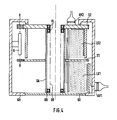
- Figure 4 shows a sectional view corresponding to Figure 2, but here the bearing of the axis of rotation DA is shown.
- the axis of rotation DA which is connected in a rotationally fixed manner to the disk S1, is designed as a hollow tube HR which is rotatably supported by means of ball bearings KL.
- the hollow tube HL is lined with a standpipe SR through which fluid lines (FIG. 2) or the like can be guided.
- FIG. 5 shows a cascade unit of another embodiment of a cascade arrangement according to the invention.
- the cascade unit shown in FIG. 5 can be used instead of the cascade units with line spirals shown in FIG.
- the spaces between the panes S0, S1 and S2 in FIG. 1 can each be provided with a cascade unit according to FIG. 5.
- FIG. 5 shows a line routing arrangement as shown in FIG. 8 of the above-mentioned P 40 01 880.6 and described in more detail there.
- This line guide arrangement comprises a rotatable body 111 and a housing body 113 arranged concentrically outside of it.
- the housing body 113 is arranged fixedly on the fixed disk S0 or on the rotatable disk S1, while the rotatable body 111 is rotatably fixed is connected to the axis of rotation DA.
- the line guide arrangement according to FIG. 5 comprises two lines, each of which is guided in a U-loop shape 115 or 117 around guide rollers 119, which are kept at a distance from one another by means of spacer rollers 163.
- Each loop 115, 117 has an end 121 which rotates with the rotatable body 111 and an end which is fixed to the fixed housing 113 by means of connectors 123.
- the rotatable body 111 and the guide rollers 119 are provided with ring gears 165 and 167 on their outer peripheries. Rotation of the rotatable body 111 is thereby transmitted to the guide rollers 119.
- the inner strand of one of the two loops 115 and 117 is shortened and its outer strand lengthened, depending on the direction of rotation, while the outer strand is lengthened and the inner strand is shortened in the other loop.
- the loop ends 121 lying on the rotatable body 111 are connected to the corresponding loop ends 121 of an adjacent line routing arrangement of this type.
- the fixed body 113 When the fixed body 113 is mounted on the pane S0, it would remain with a fixed body. When it is mounted on the pane S1 or S2, the body 113 would become a body which is firmly connected to this pane and is stationary relative to this pane. But you could also use the body 113 instead of a disc. The body 113 would then in the event that it disc S1 or S2 replaced, driven at the appropriate rotational speed.
Landscapes
- Transmission Devices (AREA)
- Storing, Repeated Paying-Out, And Re-Storing Of Elongated Articles (AREA)
Applications Claiming Priority (2)
| Application Number | Priority Date | Filing Date | Title |
|---|---|---|---|
| DE4018440 | 1990-06-08 | ||
| DE19904018440 DE4018440A1 (de) | 1990-06-08 | 1990-06-08 | Spiralige leitungsanordnung |
Publications (2)
| Publication Number | Publication Date |
|---|---|
| EP0460667A2 true EP0460667A2 (fr) | 1991-12-11 |
| EP0460667A3 EP0460667A3 (en) | 1993-01-27 |
Family
ID=6408073
Family Applications (1)
| Application Number | Title | Priority Date | Filing Date |
|---|---|---|---|
| EP19910109285 Withdrawn EP0460667A3 (en) | 1990-06-08 | 1991-06-06 | Spiral cable arrangement |
Country Status (3)
| Country | Link |
|---|---|
| EP (1) | EP0460667A3 (fr) |
| JP (1) | JPH0585672A (fr) |
| DE (1) | DE4018440A1 (fr) |
Cited By (3)
| Publication number | Priority date | Publication date | Assignee | Title |
|---|---|---|---|---|
| FR2703522A1 (fr) * | 1993-03-31 | 1994-10-07 | Valeo Electronique | Contacteur tournant, notamment pour véhicule automobile. |
| EP0900626A1 (fr) * | 1997-09-04 | 1999-03-10 | IEMCA Giuliani Macchine Italia S.p.A. | Couplage hydraulique pour actionneurs entraínés par fluide, en particulier pour moteurs hydrauliques, montés sur une structure rotative |
| WO2013007631A3 (fr) * | 2011-07-11 | 2013-08-22 | Igus Gmbh | Système de guidage de câbles |
Families Citing this family (2)
| Publication number | Priority date | Publication date | Assignee | Title |
|---|---|---|---|---|
| DE202004007741U1 (de) | 2004-05-11 | 2005-09-15 | Wampfler Ag | Drehübertrager für Kabelverbindungen |
| DE202011004776U1 (de) * | 2011-04-01 | 2012-07-04 | Tsubaki Kabelschlepp GmbH | Energieführungsvorrichtung für große Verdrehwinkel |
Family Cites Families (6)
| Publication number | Priority date | Publication date | Assignee | Title |
|---|---|---|---|---|
| SU603036A1 (ru) * | 1976-05-26 | 1978-04-15 | Предприятие П/Я В-8117 | Устройство дл соединени гибкими проводами неподвижной части механизма с поворотной |
| DE7732412U1 (de) * | 1977-10-20 | 1982-02-11 | Paul Vahle Gmbh & Co Kg, 4618 Kamen | Führung für sich zwischen einem stationären Anschluss und einem Drehteil erstreckende Leitungen |
| JPS60217092A (ja) * | 1984-04-13 | 1985-10-30 | ファナック株式会社 | 産業用ロボツトのケ−ブル支持装置 |
| US4721469A (en) * | 1986-10-10 | 1988-01-26 | Teleflex Incorporated | Turning cord |
| DE3715118A1 (de) * | 1987-05-06 | 1988-11-17 | Gore W L & Co Gmbh | Versorgungsleitungsanordnung fuer einen roboter |
| US5098028A (en) * | 1989-06-05 | 1992-03-24 | Alps Electric Co., Ltd. | Clock spring connector including cable stowage grooves |
-
1990
- 1990-06-08 DE DE19904018440 patent/DE4018440A1/de not_active Withdrawn
-
1991
- 1991-06-06 EP EP19910109285 patent/EP0460667A3/de not_active Withdrawn
- 1991-06-07 JP JP13666291A patent/JPH0585672A/ja active Pending
Cited By (7)
| Publication number | Priority date | Publication date | Assignee | Title |
|---|---|---|---|---|
| FR2703522A1 (fr) * | 1993-03-31 | 1994-10-07 | Valeo Electronique | Contacteur tournant, notamment pour véhicule automobile. |
| EP0900626A1 (fr) * | 1997-09-04 | 1999-03-10 | IEMCA Giuliani Macchine Italia S.p.A. | Couplage hydraulique pour actionneurs entraínés par fluide, en particulier pour moteurs hydrauliques, montés sur une structure rotative |
| US6253650B1 (en) | 1997-09-04 | 2001-07-03 | Iemca Giuliani Macchine Italia S.P.A. | Hydraulic coupling for feeding fluid-driven actuators-particularly hydraulic motors, mounted on a rotating structure |
| WO2013007631A3 (fr) * | 2011-07-11 | 2013-08-22 | Igus Gmbh | Système de guidage de câbles |
| AU2012283214B2 (en) * | 2011-07-11 | 2015-06-11 | Igus Gmbh | Line guiding system |
| US9287694B2 (en) | 2011-07-11 | 2016-03-15 | Igus Gmbh | Line guiding system |
| RU2581624C2 (ru) * | 2011-07-11 | 2016-04-20 | Игус Гмбх | Система электропроводки |
Also Published As
| Publication number | Publication date |
|---|---|
| DE4018440A1 (de) | 1991-12-12 |
| JPH0585672A (ja) | 1993-04-06 |
| EP0460667A3 (en) | 1993-01-27 |
Similar Documents
| Publication | Publication Date | Title |
|---|---|---|
| DE4111699C2 (de) | Übertragungsvorrichtung | |
| EP2732519B1 (fr) | Système de guidage de câbles | |
| DE102014202471B3 (de) | Abdeckvorrichtung für Öffnungen, insbesondere für Maschinenöffnungen | |
| DE4004233A1 (de) | Verbindungsvorrichtung | |
| DE19708310A1 (de) | Untersetzungsgetriebe | |
| EP0679569B1 (fr) | Organe de commande pour engrenage à changement de vitesse dans des moyeux à plusieurs vitesses pour bicyclettes | |
| DE3438749C2 (fr) | ||
| EP3807556B1 (fr) | Entraînement à broche et rouleaux pour un actionneur d'une direction steer-by-wire ainsi qu'une direction steer-by-wire | |
| EP0439102A1 (fr) | Dispositif de guidage de conduites | |
| WO1992017718A1 (fr) | Roue dentee a nombre de dents variable | |
| EP0537212B1 (fr) | Dispositif servant a abriter un cable epais | |
| DE1301682B (de) | Schneckengetriebe | |
| DE3014860A1 (de) | Uebersetzungsgetriebe | |
| EP0460667A2 (fr) | Arrangement de câble en spirale | |
| DE3008544C2 (fr) | ||
| EP0663556B1 (fr) | Jonction rotative | |
| EP0135518A1 (fr) | Dispositif d'entrainement pour stores a lamelles | |
| DE19831027A1 (de) | Effektscheibenrotationssystem | |
| DE4018435A1 (de) | Leitungsfuehrungsvorrichtung | |
| DE2111798B2 (de) | Transportfuehrung zum weiterfuehren von gegenstaenden unter drehung um die fuehrungsachse | |
| DE4317461C2 (de) | Selbsteinstellendes Kettenrad | |
| DE19961985C1 (de) | Flexibler Leitungsstrang und Leitungstrommel zur Aufnahme des Leitungsstrangs | |
| EP3776777A1 (fr) | Passage tournant modulaire avec chaînes de guidage d'énergie | |
| EP1747609B1 (fr) | Transmetteur rotatif pour des raccords de cable | |
| EP2343431B1 (fr) | Dispositif de réglage et procédé d'activation et de désactivation de la position de fonctionnement d'un store vénitien |
Legal Events
| Date | Code | Title | Description |
|---|---|---|---|
| PUAI | Public reference made under article 153(3) epc to a published international application that has entered the european phase |
Free format text: ORIGINAL CODE: 0009012 |
|
| AK | Designated contracting states |
Kind code of ref document: A2 Designated state(s): CH DE FR GB IT LI |
|
| PUAL | Search report despatched |
Free format text: ORIGINAL CODE: 0009013 |
|
| AK | Designated contracting states |
Kind code of ref document: A3 Designated state(s): CH DE FR GB IT LI |
|
| STAA | Information on the status of an ep patent application or granted ep patent |
Free format text: STATUS: THE APPLICATION IS DEEMED TO BE WITHDRAWN |
|
| 18D | Application deemed to be withdrawn |
Effective date: 19930728 |