EP0460937A2 - Verfahren zur Herstellung eines Halbleiterlasers - Google Patents
Verfahren zur Herstellung eines Halbleiterlasers Download PDFInfo
- Publication number
- EP0460937A2 EP0460937A2 EP91305081A EP91305081A EP0460937A2 EP 0460937 A2 EP0460937 A2 EP 0460937A2 EP 91305081 A EP91305081 A EP 91305081A EP 91305081 A EP91305081 A EP 91305081A EP 0460937 A2 EP0460937 A2 EP 0460937A2
- Authority
- EP
- European Patent Office
- Prior art keywords
- clad layer
- clad
- hour
- layer
- active layer
- Prior art date
- Legal status (The legal status is an assumption and is not a legal conclusion. Google has not performed a legal analysis and makes no representation as to the accuracy of the status listed.)
- Granted
Links
Images

Classifications
-
- H—ELECTRICITY
- H01—ELECTRIC ELEMENTS
- H01S—DEVICES USING THE PROCESS OF LIGHT AMPLIFICATION BY STIMULATED EMISSION OF RADIATION [LASER] TO AMPLIFY OR GENERATE LIGHT; DEVICES USING STIMULATED EMISSION OF ELECTROMAGNETIC RADIATION IN WAVE RANGES OTHER THAN OPTICAL
- H01S5/00—Semiconductor lasers
- H01S5/30—Structure or shape of the active region; Materials used for the active region
- H01S5/32—Structure or shape of the active region; Materials used for the active region comprising PN junctions, e.g. hetero- or double- heterostructures
- H01S5/323—Structure or shape of the active region; Materials used for the active region comprising PN junctions, e.g. hetero- or double- heterostructures in AIIIBV compounds, e.g. AlGaAs-laser, InP-based laser
- H01S5/32308—Structure or shape of the active region; Materials used for the active region comprising PN junctions, e.g. hetero- or double- heterostructures in AIIIBV compounds, e.g. AlGaAs-laser, InP-based laser emitting light at a wavelength less than 900 nm
- H01S5/32325—Structure or shape of the active region; Materials used for the active region comprising PN junctions, e.g. hetero- or double- heterostructures in AIIIBV compounds, e.g. AlGaAs-laser, InP-based laser emitting light at a wavelength less than 900 nm red laser based on InGaP
-
- H—ELECTRICITY
- H10—SEMICONDUCTOR DEVICES; ELECTRIC SOLID-STATE DEVICES NOT OTHERWISE PROVIDED FOR
- H10H—INORGANIC LIGHT-EMITTING SEMICONDUCTOR DEVICES HAVING POTENTIAL BARRIERS
- H10H20/00—Individual inorganic light-emitting semiconductor devices having potential barriers, e.g. light-emitting diodes [LED]
- H10H20/01—Manufacture or treatment
- H10H20/011—Manufacture or treatment of bodies, e.g. forming semiconductor layers
- H10H20/013—Manufacture or treatment of bodies, e.g. forming semiconductor layers having light-emitting regions comprising only Group III-V materials
-
- H—ELECTRICITY
- H01—ELECTRIC ELEMENTS
- H01S—DEVICES USING THE PROCESS OF LIGHT AMPLIFICATION BY STIMULATED EMISSION OF RADIATION [LASER] TO AMPLIFY OR GENERATE LIGHT; DEVICES USING STIMULATED EMISSION OF ELECTROMAGNETIC RADIATION IN WAVE RANGES OTHER THAN OPTICAL
- H01S5/00—Semiconductor lasers
- H01S5/30—Structure or shape of the active region; Materials used for the active region
- H01S5/305—Structure or shape of the active region; Materials used for the active region characterised by the doping materials used in the laser structure
- H01S5/3054—Structure or shape of the active region; Materials used for the active region characterised by the doping materials used in the laser structure p-doping
Definitions
- This invention relates to a method for fabricating a semiconductor laser device.
- (AlGa) 0.5 In 0.5 compounds exhibit the highest band gap energy except for nitrides of the element. Accordingly, they are usually applied as a semiconductor laser device capable of emitting light or beam a red color region.
- a GaAs substrate is first provided, on which the above compound semiconductors are epitaxially grown to form a compound semiconductor structure including a pair of clad layers sandwiching an active layer therebetween.
- the epitaxial growth is usually effected on the plane (001) of the GaAs substrate because of the ease in the preparation of such a substrate and also in the epitaxial growth.
- a so-called “monolayer supperlattice structure or ordered structure” is automatically formed wherein in atom-planes and Ga atom-planes are alternately arranged in the directions of [ 1 11] and [1 1 1] while intervening a P atom-plane therebetween.
- This "monolayer superlattice structure" strongly appears in the vicinity of the growth temperature at which crystals of good quality are obtained.
- the completeness of the structure depends greatly on growth conditions including a feed ratio (i.e. a ratio between the atoms of Group V and the atom of Group III), the growth temperature and the like.
- the area, in which the "monolayer superlattice” is formed, and the completeness of the arrangement depend on these conditions.
- the formation of the "monolayer superlattice structure” has been observed not only in the GaInP/(001)GaAs system, but also in (Al x Ga 1-x ) 0.5 In 0.5 P/(001)GaAs systems.
- the "monolayer superlattice structure” has relation to the magnitude of band gap energy (Eg), the acceptor level (Ea) and the donor level (Ed). It is known that if the degree of the completeness of the arrangement becomes high, the values of Eg, Ea and Ed become small. On the other hand, a low degree of the completeness results in large values of Eg, Ea and Ed.
- the band gap energy amounts to 1.91 eV, which corresponds to a wavelength of 649 nm.
- the lasing wavelength of a semiconductor laser device which has been fabricated using the GaInP ranges approximately from 670 to 680 nm. This means that the band gap energy becomes smaller by from 50 to 90 meV.
- the difference in the wavelength corresponds to a difference in the visibility by about ten times. This presents one of problems to solve under circumstances where there is a strong demand for shorter lasing wavelength. The problem is also involved in the case where AlGaInP is used as the active layer.
- the clad layer consisting of a GaInP or AlGaInP compound is doped at high concentrations, a so-called “disordering" takes place to destroy the "monolayer supperlattice structure, resulting in crystals having an ordinary band gap energy.
- This entails larger values of Eg, Ea and Ed with the reduction of an apparent activity of the dopant.
- AlInP is grown on a GaAs substrate according to gas source molecular beam epitaxy (GSMBE) while doping with a P-type beryllium dopant.
- the relation between the electrical activity (i.e. the ratio in concentration between the acceptor and Be) and the concentration of Be is shown in Fig. 1.
- the figure reveals that as the concentration of Be is increased, the electrical activity is abruptly decreased.
- the "monolayer superlattice structure" is disordered when the concentration of Be is in the range of from 1 x 10¹⁸ to 2 x 1019 cm ⁇ 3, so that the acceptor level becomes deep and thus, thermal excitation of positive holes takes place satisfactorily with the concentration of the holes being not increased.
- the clad layers become thick owing to the doping with a dopant. This leads to a high electric resistance in the layers to such an extent that most of the element resistance is concentrated on the clad portion.
- the Joule heat is generated with the attendant problem that the power consumption is increased along with an increase of threshold current.
- Fig. 2 shows a variation curve of band gap energy, Eg, for different growth conditions used in an metalorganic vapor phase epitaxy (MOVPE).
- MOVPE metalorganic vapor phase epitaxy
- a method for fabricating a semiconductor laser device which comprises: providing a GaAs monocrystal substrate of one conductivity type; epitaxially growing a first clad layer of a compound semiconductor of one conductivity type represented by the formula, (Al x Ga 1-x ) 0.5 In 0.5 P, wherein 0.4 ⁇ x ⁇ 1 on a plane (001) of the substrate; epitaxially growing, on the first clad layer, an active layer of a compound semiconductor of the fornula, (Al y Ga 1-y ) 0.5 In 0.5 P, wherein 0 ⁇ y ⁇ 0.35 provided that x and y are so selected that the value of (x - y) is not less than 0,4, the active layer being grown at a rate of not less than 2.0 ⁇ m/hour; and epitaxially growing, on the active layer, a second clad layer of a compound semiconductor of the other conductivity type represented by the formula defined with respect to the first clad layer
- the growth rates of the first and second clad layers are preferably in the range of not larger than 0.5 ⁇ m/hour.
- a GaAs monocrystal substrate of one conductivity type is first provided.
- the substrate Prior to formation of a clad layer, the substrate is treated by a usual manner, e.g. it is washed with an organic solvent and then with water, followed by etching with an acid solution in order to remove strain from the surface thereof.
- the substrate is further subjected to removal of an oxide film from the surface in an atmosphere of a vapor such as of As at an appropriate temperature of from 500 to 550°C.
- a first clad layer of one conductivity type is subsequently formed on the plane (001) of the substrate by a gas source molecular beam epitaxy using solid gallium having a purity of 99.99999% and solid indium having a purity of 99.99999% as the elements of Group III and also P2 obtained by thermal decomposition of phosphine gas (PH3) having a purity of 100%.
- the epitaxy is carried out at a reduced pressure of 5 x 10 ⁇ 5 to 1 x 10 -(-4) Torr.
- the clad layer formed should have a composition of the formula, (Al x Ga 1-x ) 0.5 In 0.5 P, wherein 0.4 ⁇ x ⁇ 1.
- the conductivity of the clad layer may be either of the n type or the p-type.
- a Si, S) or the like impurity may be doped at a level of 2 to 50 x 1017 cm ⁇ 3.
- an impurity such as Be, Mg or the like may be doped at a level of 2 to 50 x 1017 cm ⁇ 3.
- the formation of the "monolayer superlattice structure" be controlled by controlling the growing rates of the first and second clad layers and an active layer provided therebetween. More particularly, for the clad layers, the formation of the superlattice structure" is necessary. On the contrary, for the active layer, such formation is rather undesirable for the reason discussed hereinafter.
- the clad layer is made of the AlGaInP which is doped with an impurity.
- concentration of the dopant is increased to a range of 1 x 10¹⁸ to 1 x 1019 cm ⁇ 3
- the electrical activity is lowered due to disordering of the "monolayer superlattice structure".
- the acceptor level becomes so deep that positive holes cannot be not thermally excited sufficiently.
- the electrical activity can be increased by controlling the growing rate of the clad layer. in other words, the clad layers, particularly, a p-type clad layer, should be formed to have the "monolayer superlattice structure".
- the p-type clad layer should be grown at a rate of not larger than 0.5 ⁇ m/hour, preferably not less than 0.2 ⁇ m/hour, and more preferably from 0.1 to 0.2 ⁇ m/hour.
- the clad layer is of the n-type conductivity, a high activity is attained easier than in the case of the p-type clad layer because of the physical aspect of the n-type clad layer.
- a high electrical activity is difficult to obtain for the p-type clad layer.
- the formation of the "monolayer superlattice structure" requires a slow growth rate as defined above although the activity of about 1 is obtained for the n-type clad layer at a growth rate of not larger than 1 ⁇ m/hour.
- a buffer layer made, for example, of GaAs may be provided between the substrate and the first clad layer.
- the active layer On the first clad layer, which is either of the n-type or the p-type conductivity, is further formed an active layer.
- the active layer is epitaxially grown by use of a compound semiconductor of the formula, (Al y Ga 1-y ) 0.5 In 0.5 P, wherein 0 ⁇ y ⁇ 0.35.
- the value of y is so selected that the value of x for the semiconductor used as the clad layer minus the value of y is not less than 0.4. By this, a satisfactory band gap between the clad layer and the active layer is ensured.
- the active layer should be grown at a rate lower than the clad layer.
- the completeness in arrangement of the "monolayer superlattice structure” depends greatly on the growth rate of crystals. If the growth rate is high, the degree of the completeness is lowered. This is because the elements of Group III arriving at the growing surface have to be in position of atom sites forming the "monolayer superlattice structure" after movement through the surface, so that the time required for bonding and crystallization of the phosphorus atoms arriving at the surface becomes shorter than an average time necessary for the completeness. Accordingly, when the growth rate of the active layer is large, the reduction in the band gap due to the ordering of the crystals derived from the "monolayer superlattice structure" is prevented. As a result, an inherent band gap is obtained, making it possible to make a short lasing wavelength of the resultant semiconductor laser device.
- the growth rate of the active layer should preferably be not less than 2.0 ⁇ m/hour, more preferably not less than 3,0 ⁇ m/hour and most preferably from 3.0 ⁇ m to 5.0 ⁇ m/hour.
- the active layer is lattice matched with the plane (001) of the substrate.
- the elements of Group III and the element of Group V are provided at a predetermined ratios in the same manner as for the first clad layer and epitaxially grown by molecular beam epitaxy under conditions of a temperature of from 450 to 530°C at a reduced pressure of from 5 x 10 ⁇ 5 to 1 x 10 ⁇ 4 Torr.
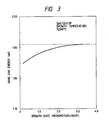
- the band gap energy of the active layer can be varied within a range of 1.85 eV to 1.91 eV.
- a second clad layer which is opposite in the conductivity type to the first layer, is formed on the active layer in the same manner as the first clad layer while care should be taken to the growth rate depending on the conductivity type.
- the semiconductor having the same composition as in the first clad layer is used except that an impurity capable of imparting the other conductivity type is doped in the compound semiconductor used for the second clad layer.
- the conductivity type if the substrate is made of an n-type semiconductor, the first clad layer should be made of an n-type semiconductor and the second clad layer should be made of a p-type semiconductor.
- the first clad layer should be of the p-type and the second clad layer should of the n-type.
- at least a p-type clad layer should be grown at a rate of not larger than 0.5 ⁇ m/hour.
- both clad layers are grown at a rate of not less than 0.5 ⁇ m/hour.
- the semiconductor laser device where the active layer and the first and second clad layers are formed in such a way as set forth above, a short lasing wavelength of 650 to 660nm is ensured and the device has a low threshold value, a low power consumption, a high operation temperature and good reliability.
- the active layer and the first and second clad layers may be formed by molecular beam epitaxial techniques including not only gas source MBE, but also metalorganic molecular beam epitaxy (MOMBE), chemical beam epitaxy (CBE) and metalorganic vapor phase epitaxy (MOVPE).
- MOMBE metalorganic molecular beam epitaxy
- CBE chemical beam epitaxy
- MOVPE metalorganic vapor phase epitaxy
- the thickness of the active layer is generally in the range of from 0.04 to 0.1 ⁇ m and the thickness of the first and second clad layers is generally in the range of from 0.6 to 1.0 ⁇ m.
- the present invention is more particularly described by way of example.
- a GaAs substrate which had been washed with trichloroethane, acetone or methanol and then with water-was provided.
- the substrate was etched with a mixed solution of H2SO4, H2SO2 and H2O at a mixing ratio by volume of 3:1:1 in order to remove the surface strain produced during processing.
- the GaAs substrate was placed in a molecular beam epitaxy chamber and subjected to treatment in an atmosphere of As at a temperature of from 500 to 550°C to remove an oxide film from the surface thereof.
- the thus treated substrate was maintained at 600°C, on which GaAs was grown in a thickness of about 0.2 ⁇ m as a buffer layer.
- Ga 0.5 In 0.5 P single crystals were formed on the plane (001) of the substrate as an active layer at a rate of 3 ⁇ m/hour to a thickness of about 1 ⁇ m.
- a second clad layer was formed in the same manner as the first clad layer except that an impurity of Be was doped at a concentration of 1 x 1018 cm ⁇ 3.
- the compound semiconductors for the active layer and the first and second clad layers were formed according to a gas source molecular beam epitaxial procedure using solid gallium having a purity of 99.99999% maintained at 930°C, solid indium having a purity of 99.99999% maintained at 730°C and P2 obtained by thermal decomposition of 100% phosphine (PH3) gas at 900°C under conditions of about 8 x 10 ⁇ 5 Torr.
- PH3 phosphine
- the band gap energy is changed from 1.85 eV to 1,19 eV.
- the band gap energy reached approximately 1.9 eV which is inherent to Ga 0.5 In 0.5 P. It will be noted that when the growth rate was about 2 ⁇ m, the band gap energy was about 1.9 eV.
- the laser beam emitted at 650 nm could be obtained.
- the growth rate is made higher than the clad layer and is sufficient for disordering the "monolayer superlattice structure"
- the reduction of the band gap can be prevented, so that a short lasing wavelength is attained.
- This example illustrates the electrical activity of a clad layer of a p-type conductivity doped with Be by changing a growth rate of the clad layer.
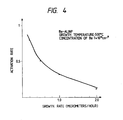
- the buffer layer was formed on the GaAs substrate, on which Al 0.5 In 0.5 P was grown at a temperature of 500°C while doping with a Be concentration of 1 x 1019 cm ⁇ 3 at a growth rate of from 0.1 ⁇ m to 2.0 ⁇ m.
- the activity of the p-type clad layer was determined by the Hall measurement and a secondary ion mass spectrometry (SIMS).
- the electrical activity is about 0.8.
- Be is doped
- an appropriate concentration of holes is ensured.
- the electrical activity is closer to 1.
- the activity is 0.5.
- the rate is below 0.1 ⁇ m, it will take a relatively long time.
- the resistivity is changed from 0.3 ⁇ ⁇ cm obtained at a growth rate of 1 ⁇ m/hour, to 0.1 ⁇ ⁇ cm.
- the resistivity is lower than 0.3 ⁇ ⁇ cm attained at a growth rate of 1 ⁇ m/hour and is close to 0.1 ⁇ ⁇ cm with little problem in practical application. If the activity is 0.5 or over. a satisfactory low resistivity is obtained.
- the growth rate of at least the p-type clad layer is defined as not large than 0.5 ⁇ m/hour.
- the growth rate of not larger than 0.5 ⁇ m gives favorable results and is preferably determined as such.
- the growth rate of the clad layer is not larger than 0.5 ⁇ m/hour, preferably not larger than 0.2 ⁇ m/hour and more preferably from 0.1 to 0.2 ⁇ m/hour and and also when the growth rate of the active layer is not less than 2,0 ⁇ m/hour, preferably not less than 3.0 ⁇ m/hour.
- the resultant semiconductor laser device can be excited at a short wavelength of about 649 nm.
- the growth rate is most preferably from 3.0 to 5.0 ⁇ m in consideration of the crystallinity of the active layer.
Landscapes
- Physics & Mathematics (AREA)
- Condensed Matter Physics & Semiconductors (AREA)
- General Physics & Mathematics (AREA)
- Electromagnetism (AREA)
- Optics & Photonics (AREA)
- Semiconductor Lasers (AREA)
Applications Claiming Priority (4)
| Application Number | Priority Date | Filing Date | Title |
|---|---|---|---|
| JP14830090 | 1990-06-05 | ||
| JP14829990 | 1990-06-05 | ||
| JP148300/90 | 1990-06-05 | ||
| JP148299/90 | 1990-06-05 |
Publications (3)
| Publication Number | Publication Date |
|---|---|
| EP0460937A2 true EP0460937A2 (de) | 1991-12-11 |
| EP0460937A3 EP0460937A3 (en) | 1992-09-09 |
| EP0460937B1 EP0460937B1 (de) | 1994-10-19 |
Family
ID=26478545
Family Applications (1)
| Application Number | Title | Priority Date | Filing Date |
|---|---|---|---|
| EP91305081A Expired - Lifetime EP0460937B1 (de) | 1990-06-05 | 1991-06-05 | Verfahren zur Herstellung eines Halbleiterlasers |
Country Status (3)
| Country | Link |
|---|---|
| US (1) | US5190891A (de) |
| EP (1) | EP0460937B1 (de) |
| DE (1) | DE69104650T2 (de) |
Families Citing this family (4)
| Publication number | Priority date | Publication date | Assignee | Title |
|---|---|---|---|---|
| JP2737477B2 (ja) * | 1991-09-27 | 1998-04-08 | 日本電気株式会社 | 半導体レーザの製造方法 |
| JP3423203B2 (ja) * | 1997-03-11 | 2003-07-07 | シャープ株式会社 | 半導体レーザ素子の製造方法 |
| JP3525141B2 (ja) * | 1997-08-20 | 2004-05-10 | 独立行政法人 科学技術振興機構 | 抵抗率が低いn型又はp型金属シリコンの製造方法 |
| JP3472714B2 (ja) * | 1999-01-25 | 2003-12-02 | シャープ株式会社 | 半導体発光素子の製造方法 |
Family Cites Families (14)
| Publication number | Priority date | Publication date | Assignee | Title |
|---|---|---|---|---|
| JPH0654821B2 (ja) * | 1985-06-05 | 1994-07-20 | 日本電気株式会社 | 半導体発光素子 |
| JPS63162598A (ja) * | 1986-12-25 | 1988-07-06 | Nec Corp | Ga↓0.↓5In↓0.↓5P結晶の成長方法 |
| JPS63236314A (ja) * | 1987-03-25 | 1988-10-03 | Hitachi Ltd | GaAlInP結晶膜の製造方法 |
| JPH0196982A (ja) * | 1987-10-08 | 1989-04-14 | Sharp Corp | 半導体レーザ素子 |
| DE68917941T2 (de) * | 1988-01-20 | 1995-04-20 | Nippon Electric Co | Sichtbares Licht ausstrahlender Halbleiterlaser mit (AlxGa1-x)0.5In0.5P-Kristallschichten und Verfahren zum Züchten eines (AlxGa1-x)0.5In0.5P-Kristalls. |
| DE68909632T2 (de) * | 1988-02-09 | 1994-03-10 | Toshiba Kawasaki Kk | Halbleiterlaser-Vorrichtung und deren Herstellungsverfahren. |
| JPH01286480A (ja) * | 1988-05-13 | 1989-11-17 | Toshiba Corp | 可視光発光素子 |
| JPH069282B2 (ja) * | 1988-09-09 | 1994-02-02 | 株式会社東芝 | 半導体レーザ装置 |
| US5016252A (en) * | 1988-09-29 | 1991-05-14 | Sanyo Electric Co., Ltd. | Semiconductor laser device |
| JPH0298984A (ja) * | 1988-10-06 | 1990-04-11 | Denki Kagaku Kogyo Kk | InGaAlp 半導体発光素子 |
| JP2831667B2 (ja) * | 1988-12-14 | 1998-12-02 | 株式会社東芝 | 半導体レーザ装置及びその製造方法 |
| JPH02178918A (ja) * | 1988-12-28 | 1990-07-11 | Toshiba Corp | 化合物半導体結晶層の製造方法 |
| US5048035A (en) * | 1989-05-31 | 1991-09-10 | Kabushiki Kaisha Toshiba | Semiconductor light emitting device |
| US5202895A (en) * | 1990-05-07 | 1993-04-13 | Kabushiki Kaisha Toshiba | Semiconductor device having an active layer made of ingaalp material |
-
1991
- 1991-06-05 EP EP91305081A patent/EP0460937B1/de not_active Expired - Lifetime
- 1991-06-05 US US07/710,483 patent/US5190891A/en not_active Expired - Lifetime
- 1991-06-05 DE DE69104650T patent/DE69104650T2/de not_active Expired - Fee Related
Also Published As
| Publication number | Publication date |
|---|---|
| US5190891A (en) | 1993-03-02 |
| EP0460937A3 (en) | 1992-09-09 |
| DE69104650T2 (de) | 1995-03-30 |
| EP0460937B1 (de) | 1994-10-19 |
| DE69104650D1 (de) | 1994-11-24 |
Similar Documents
| Publication | Publication Date | Title |
|---|---|---|
| EP0234955B1 (de) | Halbleiterlaser mit streifenförmiger Mesa-Wellenleiterstruktur und dessen Herstellungsverfahren | |
| EP0232431B1 (de) | Halbleitervorrichtung | |
| US5904549A (en) | Methods for growing semiconductors and devices thereof from the alloy semiconductor GaInNAs | |
| JP2001210863A (ja) | 選択的にドーピングされたiii−v窒化物層を有する半導体装置 | |
| CN115249947B (zh) | 一种InGaAs高应变变温量子阱大功率激光器外延片及其制备方法 | |
| JPH06296060A (ja) | 半導体可視光レーザダイオードの製造方法 | |
| Pessa et al. | All-solid-source molecular beam epitaxy for growth of III–V compound semiconductors | |
| EP0460937B1 (de) | Verfahren zur Herstellung eines Halbleiterlasers | |
| EP0293000B1 (de) | Lichtemittierende Vorrichtung | |
| JP2001196694A (ja) | 半導体レーザ素子及びその製造方法 | |
| US4939102A (en) | Method of growing III-V semiconductor layers with high effective hole concentration | |
| EP0188352B1 (de) | Verfahren zur Herstellung von Halbleiteranordnungen mittels flüssiger Epitaxie | |
| JP3192560B2 (ja) | 半導体発光素子 | |
| WO2004027126A1 (ja) | Iii−v族化合物半導体結晶 | |
| US4835583A (en) | Semiconductor device having strained superlattice buffer layers with In-doped GaAs substrate | |
| JP2002231705A (ja) | エッチング方法および半導体装置の製造方法 | |
| US5585306A (en) | Methods for producing compound semiconductor devices | |
| US20070053396A1 (en) | Semiconductor lasers utilizing AlGaAsP | |
| Su et al. | The fabrication of single heterojunction AlGaAs/InGaP electroluminescent diodes | |
| Bedair et al. | A new GaAsP—InGaAs strained-layer super-lattice light-emitting diode | |
| JP4040310B2 (ja) | 結晶の熱処理方法 | |
| JP2512223B2 (ja) | 半導体レ―ザおよびその製造方法 | |
| JP2000261037A (ja) | 半導体発光素子 | |
| Weimann et al. | Molecular Beam Epitaxy of GaAs and AlGaAs for Optoelectronic Devices and Modulation Doped Heterostructures | |
| EP1115145A1 (de) | Verfahren zur herstellung einer verbindungshalbleitersichcht und verbindungshalbleiterbauelement |
Legal Events
| Date | Code | Title | Description |
|---|---|---|---|
| PUAI | Public reference made under article 153(3) epc to a published international application that has entered the european phase |
Free format text: ORIGINAL CODE: 0009012 |
|
| 17P | Request for examination filed |
Effective date: 19910615 |
|
| AK | Designated contracting states |
Kind code of ref document: A2 Designated state(s): DE FR GB |
|
| PUAL | Search report despatched |
Free format text: ORIGINAL CODE: 0009013 |
|
| AK | Designated contracting states |
Kind code of ref document: A3 Designated state(s): DE FR GB |
|
| 17Q | First examination report despatched |
Effective date: 19930324 |
|
| GRAA | (expected) grant |
Free format text: ORIGINAL CODE: 0009210 |
|
| AK | Designated contracting states |
Kind code of ref document: B1 Designated state(s): DE FR GB |
|
| ET | Fr: translation filed | ||
| REF | Corresponds to: |
Ref document number: 69104650 Country of ref document: DE Date of ref document: 19941124 |
|
| PLBE | No opposition filed within time limit |
Free format text: ORIGINAL CODE: 0009261 |
|
| STAA | Information on the status of an ep patent application or granted ep patent |
Free format text: STATUS: NO OPPOSITION FILED WITHIN TIME LIMIT |
|
| 26N | No opposition filed | ||
| PGFP | Annual fee paid to national office [announced via postgrant information from national office to epo] |
Ref country code: GB Payment date: 19960528 Year of fee payment: 6 |
|
| PGFP | Annual fee paid to national office [announced via postgrant information from national office to epo] |
Ref country code: FR Payment date: 19960611 Year of fee payment: 6 |
|
| PGFP | Annual fee paid to national office [announced via postgrant information from national office to epo] |
Ref country code: DE Payment date: 19960612 Year of fee payment: 6 |
|
| PG25 | Lapsed in a contracting state [announced via postgrant information from national office to epo] |
Ref country code: GB Free format text: LAPSE BECAUSE OF NON-PAYMENT OF DUE FEES Effective date: 19970605 |
|
| GBPC | Gb: european patent ceased through non-payment of renewal fee |
Effective date: 19970605 |
|
| PG25 | Lapsed in a contracting state [announced via postgrant information from national office to epo] |
Ref country code: FR Free format text: LAPSE BECAUSE OF NON-PAYMENT OF DUE FEES Effective date: 19980227 |
|
| PG25 | Lapsed in a contracting state [announced via postgrant information from national office to epo] |
Ref country code: DE Free format text: LAPSE BECAUSE OF NON-PAYMENT OF DUE FEES Effective date: 19980303 |
|
| REG | Reference to a national code |
Ref country code: FR Ref legal event code: ST |
|
| REG | Reference to a national code |
Ref country code: FR Ref legal event code: ST |