EP0461079B1 - Substituierte Phthalide und heterozyklische Phthalide - Google Patents
Substituierte Phthalide und heterozyklische Phthalide Download PDFInfo
- Publication number
- EP0461079B1 EP0461079B1 EP91810428A EP91810428A EP0461079B1 EP 0461079 B1 EP0461079 B1 EP 0461079B1 EP 91810428 A EP91810428 A EP 91810428A EP 91810428 A EP91810428 A EP 91810428A EP 0461079 B1 EP0461079 B1 EP 0461079B1
- Authority
- EP
- European Patent Office
- Prior art keywords
- alkyl
- compound
- formula
- alkoxy
- hydrogen
- Prior art date
- Legal status (The legal status is an assumption and is not a legal conclusion. Google has not performed a legal analysis and makes no representation as to the accuracy of the status listed.)
- Expired - Lifetime
Links
Classifications
-
- C—CHEMISTRY; METALLURGY
- C07—ORGANIC CHEMISTRY
- C07D—HETEROCYCLIC COMPOUNDS
- C07D401/00—Heterocyclic compounds containing two or more hetero rings, having nitrogen atoms as the only ring hetero atoms, at least one ring being a six-membered ring with only one nitrogen atom
- C07D401/02—Heterocyclic compounds containing two or more hetero rings, having nitrogen atoms as the only ring hetero atoms, at least one ring being a six-membered ring with only one nitrogen atom containing two hetero rings
- C07D401/06—Heterocyclic compounds containing two or more hetero rings, having nitrogen atoms as the only ring hetero atoms, at least one ring being a six-membered ring with only one nitrogen atom containing two hetero rings linked by a carbon chain containing only aliphatic carbon atoms
-
- C—CHEMISTRY; METALLURGY
- C07—ORGANIC CHEMISTRY
- C07D—HETEROCYCLIC COMPOUNDS
- C07D403/00—Heterocyclic compounds containing two or more hetero rings, having nitrogen atoms as the only ring hetero atoms, not provided for by group C07D401/00
-
- A—HUMAN NECESSITIES
- A01—AGRICULTURE; FORESTRY; ANIMAL HUSBANDRY; HUNTING; TRAPPING; FISHING
- A01N—PRESERVATION OF BODIES OF HUMANS OR ANIMALS OR PLANTS OR PARTS THEREOF; BIOCIDES, e.g. AS DISINFECTANTS, AS PESTICIDES OR AS HERBICIDES; PEST REPELLANTS OR ATTRACTANTS; PLANT GROWTH REGULATORS
- A01N43/00—Biocides, pest repellants or attractants, or plant growth regulators containing heterocyclic compounds
- A01N43/34—Biocides, pest repellants or attractants, or plant growth regulators containing heterocyclic compounds having rings with one nitrogen atom as the only ring hetero atom
- A01N43/40—Biocides, pest repellants or attractants, or plant growth regulators containing heterocyclic compounds having rings with one nitrogen atom as the only ring hetero atom six-membered rings
-
- A—HUMAN NECESSITIES
- A01—AGRICULTURE; FORESTRY; ANIMAL HUSBANDRY; HUNTING; TRAPPING; FISHING
- A01N—PRESERVATION OF BODIES OF HUMANS OR ANIMALS OR PLANTS OR PARTS THEREOF; BIOCIDES, e.g. AS DISINFECTANTS, AS PESTICIDES OR AS HERBICIDES; PEST REPELLANTS OR ATTRACTANTS; PLANT GROWTH REGULATORS
- A01N43/00—Biocides, pest repellants or attractants, or plant growth regulators containing heterocyclic compounds
- A01N43/48—Biocides, pest repellants or attractants, or plant growth regulators containing heterocyclic compounds having rings with two nitrogen atoms as the only ring hetero atoms
- A01N43/54—1,3-Diazines; Hydrogenated 1,3-diazines
-
- A—HUMAN NECESSITIES
- A01—AGRICULTURE; FORESTRY; ANIMAL HUSBANDRY; HUNTING; TRAPPING; FISHING
- A01N—PRESERVATION OF BODIES OF HUMANS OR ANIMALS OR PLANTS OR PARTS THEREOF; BIOCIDES, e.g. AS DISINFECTANTS, AS PESTICIDES OR AS HERBICIDES; PEST REPELLANTS OR ATTRACTANTS; PLANT GROWTH REGULATORS
- A01N43/00—Biocides, pest repellants or attractants, or plant growth regulators containing heterocyclic compounds
- A01N43/48—Biocides, pest repellants or attractants, or plant growth regulators containing heterocyclic compounds having rings with two nitrogen atoms as the only ring hetero atoms
- A01N43/60—1,4-Diazines; Hydrogenated 1,4-diazines
-
- A—HUMAN NECESSITIES
- A01—AGRICULTURE; FORESTRY; ANIMAL HUSBANDRY; HUNTING; TRAPPING; FISHING
- A01N—PRESERVATION OF BODIES OF HUMANS OR ANIMALS OR PLANTS OR PARTS THEREOF; BIOCIDES, e.g. AS DISINFECTANTS, AS PESTICIDES OR AS HERBICIDES; PEST REPELLANTS OR ATTRACTANTS; PLANT GROWTH REGULATORS
- A01N43/00—Biocides, pest repellants or attractants, or plant growth regulators containing heterocyclic compounds
- A01N43/64—Biocides, pest repellants or attractants, or plant growth regulators containing heterocyclic compounds having rings with three nitrogen atoms as the only ring hetero atoms
- A01N43/66—1,3,5-Triazines, not hydrogenated and not substituted at the ring nitrogen atoms
-
- A—HUMAN NECESSITIES
- A01—AGRICULTURE; FORESTRY; ANIMAL HUSBANDRY; HUNTING; TRAPPING; FISHING
- A01N—PRESERVATION OF BODIES OF HUMANS OR ANIMALS OR PLANTS OR PARTS THEREOF; BIOCIDES, e.g. AS DISINFECTANTS, AS PESTICIDES OR AS HERBICIDES; PEST REPELLANTS OR ATTRACTANTS; PLANT GROWTH REGULATORS
- A01N43/00—Biocides, pest repellants or attractants, or plant growth regulators containing heterocyclic compounds
- A01N43/72—Biocides, pest repellants or attractants, or plant growth regulators containing heterocyclic compounds having rings with nitrogen atoms and oxygen or sulfur atoms as ring hetero atoms
- A01N43/74—Biocides, pest repellants or attractants, or plant growth regulators containing heterocyclic compounds having rings with nitrogen atoms and oxygen or sulfur atoms as ring hetero atoms five-membered rings with one nitrogen atom and either one oxygen atom or one sulfur atom in positions 1,3
-
- A—HUMAN NECESSITIES
- A01—AGRICULTURE; FORESTRY; ANIMAL HUSBANDRY; HUNTING; TRAPPING; FISHING
- A01N—PRESERVATION OF BODIES OF HUMANS OR ANIMALS OR PLANTS OR PARTS THEREOF; BIOCIDES, e.g. AS DISINFECTANTS, AS PESTICIDES OR AS HERBICIDES; PEST REPELLANTS OR ATTRACTANTS; PLANT GROWTH REGULATORS
- A01N43/00—Biocides, pest repellants or attractants, or plant growth regulators containing heterocyclic compounds
- A01N43/72—Biocides, pest repellants or attractants, or plant growth regulators containing heterocyclic compounds having rings with nitrogen atoms and oxygen or sulfur atoms as ring hetero atoms
- A01N43/80—Biocides, pest repellants or attractants, or plant growth regulators containing heterocyclic compounds having rings with nitrogen atoms and oxygen or sulfur atoms as ring hetero atoms five-membered rings with one nitrogen atom and either one oxygen atom or one sulfur atom in positions 1,2
-
- A—HUMAN NECESSITIES
- A01—AGRICULTURE; FORESTRY; ANIMAL HUSBANDRY; HUNTING; TRAPPING; FISHING
- A01N—PRESERVATION OF BODIES OF HUMANS OR ANIMALS OR PLANTS OR PARTS THEREOF; BIOCIDES, e.g. AS DISINFECTANTS, AS PESTICIDES OR AS HERBICIDES; PEST REPELLANTS OR ATTRACTANTS; PLANT GROWTH REGULATORS
- A01N43/00—Biocides, pest repellants or attractants, or plant growth regulators containing heterocyclic compounds
- A01N43/72—Biocides, pest repellants or attractants, or plant growth regulators containing heterocyclic compounds having rings with nitrogen atoms and oxygen or sulfur atoms as ring hetero atoms
- A01N43/82—Biocides, pest repellants or attractants, or plant growth regulators containing heterocyclic compounds having rings with nitrogen atoms and oxygen or sulfur atoms as ring hetero atoms five-membered rings with three ring hetero atoms
-
- A—HUMAN NECESSITIES
- A01—AGRICULTURE; FORESTRY; ANIMAL HUSBANDRY; HUNTING; TRAPPING; FISHING
- A01N—PRESERVATION OF BODIES OF HUMANS OR ANIMALS OR PLANTS OR PARTS THEREOF; BIOCIDES, e.g. AS DISINFECTANTS, AS PESTICIDES OR AS HERBICIDES; PEST REPELLANTS OR ATTRACTANTS; PLANT GROWTH REGULATORS
- A01N43/00—Biocides, pest repellants or attractants, or plant growth regulators containing heterocyclic compounds
- A01N43/90—Biocides, pest repellants or attractants, or plant growth regulators containing heterocyclic compounds having two or more relevant hetero rings, condensed among themselves or with a common carbocyclic ring system
-
- C—CHEMISTRY; METALLURGY
- C07—ORGANIC CHEMISTRY
- C07D—HETEROCYCLIC COMPOUNDS
- C07D239/00—Heterocyclic compounds containing 1,3-diazine or hydrogenated 1,3-diazine rings
- C07D239/02—Heterocyclic compounds containing 1,3-diazine or hydrogenated 1,3-diazine rings not condensed with other rings
- C07D239/24—Heterocyclic compounds containing 1,3-diazine or hydrogenated 1,3-diazine rings not condensed with other rings having three or more double bonds between ring members or between ring members and non-ring members
- C07D239/28—Heterocyclic compounds containing 1,3-diazine or hydrogenated 1,3-diazine rings not condensed with other rings having three or more double bonds between ring members or between ring members and non-ring members with hetero atoms or with carbon atoms having three bonds to hetero atoms with at the most one bond to halogen, directly attached to ring carbon atoms
- C07D239/46—Two or more oxygen, sulphur or nitrogen atoms
- C07D239/52—Two oxygen atoms
-
- C—CHEMISTRY; METALLURGY
- C07—ORGANIC CHEMISTRY
- C07D—HETEROCYCLIC COMPOUNDS
- C07D403/00—Heterocyclic compounds containing two or more hetero rings, having nitrogen atoms as the only ring hetero atoms, not provided for by group C07D401/00
- C07D403/02—Heterocyclic compounds containing two or more hetero rings, having nitrogen atoms as the only ring hetero atoms, not provided for by group C07D401/00 containing two hetero rings
- C07D403/04—Heterocyclic compounds containing two or more hetero rings, having nitrogen atoms as the only ring hetero atoms, not provided for by group C07D401/00 containing two hetero rings directly linked by a ring-member-to-ring-member bond
-
- C—CHEMISTRY; METALLURGY
- C07—ORGANIC CHEMISTRY
- C07D—HETEROCYCLIC COMPOUNDS
- C07D405/00—Heterocyclic compounds containing both one or more hetero rings having oxygen atoms as the only ring hetero atoms, and one or more rings having nitrogen as the only ring hetero atom
- C07D405/02—Heterocyclic compounds containing both one or more hetero rings having oxygen atoms as the only ring hetero atoms, and one or more rings having nitrogen as the only ring hetero atom containing two hetero rings
- C07D405/04—Heterocyclic compounds containing both one or more hetero rings having oxygen atoms as the only ring hetero atoms, and one or more rings having nitrogen as the only ring hetero atom containing two hetero rings directly linked by a ring-member-to-ring-member bond
-
- C—CHEMISTRY; METALLURGY
- C07—ORGANIC CHEMISTRY
- C07D—HETEROCYCLIC COMPOUNDS
- C07D405/00—Heterocyclic compounds containing both one or more hetero rings having oxygen atoms as the only ring hetero atoms, and one or more rings having nitrogen as the only ring hetero atom
- C07D405/02—Heterocyclic compounds containing both one or more hetero rings having oxygen atoms as the only ring hetero atoms, and one or more rings having nitrogen as the only ring hetero atom containing two hetero rings
- C07D405/06—Heterocyclic compounds containing both one or more hetero rings having oxygen atoms as the only ring hetero atoms, and one or more rings having nitrogen as the only ring hetero atom containing two hetero rings linked by a carbon chain containing only aliphatic carbon atoms
-
- C—CHEMISTRY; METALLURGY
- C07—ORGANIC CHEMISTRY
- C07D—HETEROCYCLIC COMPOUNDS
- C07D413/00—Heterocyclic compounds containing two or more hetero rings, at least one ring having nitrogen and oxygen atoms as the only ring hetero atoms
- C07D413/02—Heterocyclic compounds containing two or more hetero rings, at least one ring having nitrogen and oxygen atoms as the only ring hetero atoms containing two hetero rings
- C07D413/10—Heterocyclic compounds containing two or more hetero rings, at least one ring having nitrogen and oxygen atoms as the only ring hetero atoms containing two hetero rings linked by a carbon chain containing aromatic rings
-
- C—CHEMISTRY; METALLURGY
- C07—ORGANIC CHEMISTRY
- C07D—HETEROCYCLIC COMPOUNDS
- C07D417/00—Heterocyclic compounds containing two or more hetero rings, at least one ring having nitrogen and sulfur atoms as the only ring hetero atoms, not provided for by group C07D415/00
- C07D417/02—Heterocyclic compounds containing two or more hetero rings, at least one ring having nitrogen and sulfur atoms as the only ring hetero atoms, not provided for by group C07D415/00 containing two hetero rings
- C07D417/06—Heterocyclic compounds containing two or more hetero rings, at least one ring having nitrogen and sulfur atoms as the only ring hetero atoms, not provided for by group C07D415/00 containing two hetero rings linked by a carbon chain containing only aliphatic carbon atoms
-
- C—CHEMISTRY; METALLURGY
- C07—ORGANIC CHEMISTRY
- C07D—HETEROCYCLIC COMPOUNDS
- C07D471/00—Heterocyclic compounds containing nitrogen atoms as the only ring hetero atoms in the condensed system, at least one ring being a six-membered ring with one nitrogen atom, not provided for by groups C07D451/00 - C07D463/00
- C07D471/02—Heterocyclic compounds containing nitrogen atoms as the only ring hetero atoms in the condensed system, at least one ring being a six-membered ring with one nitrogen atom, not provided for by groups C07D451/00 - C07D463/00 in which the condensed system contains two hetero rings
- C07D471/04—Ortho-condensed systems
-
- C—CHEMISTRY; METALLURGY
- C07—ORGANIC CHEMISTRY
- C07D—HETEROCYCLIC COMPOUNDS
- C07D491/00—Heterocyclic compounds containing in the condensed ring system both one or more rings having oxygen atoms as the only ring hetero atoms and one or more rings having nitrogen atoms as the only ring hetero atoms, not provided for by groups C07D451/00 - C07D459/00, C07D463/00, C07D477/00 or C07D489/00
- C07D491/02—Heterocyclic compounds containing in the condensed ring system both one or more rings having oxygen atoms as the only ring hetero atoms and one or more rings having nitrogen atoms as the only ring hetero atoms, not provided for by groups C07D451/00 - C07D459/00, C07D463/00, C07D477/00 or C07D489/00 in which the condensed system contains two hetero rings
- C07D491/04—Ortho-condensed systems
Definitions
- the present invention concerns substituted phthalides and heterocyclic phthalides and derivatives thereof, processes for their production, compositions containing them and their use in agriculture.
- the invention concerns compounds of formula I wherein ring system A is selected from
- R is carboxyl in salt form
- the salt is preferably formed with an alkali metal, alkali earth metal, optionally substituted ammonium cation, a trialkyl sulfonium cation, a trialkylsulfoxonium cation or a phosphonium cation, especially the cation of an alkali metal (e.g. the Li or Na cation) or of an earth alkali metal (e.g.
- the Ca or Mg cation the ammonium cation; a substituted ammonium cation [such as a C 1-5 alkylammonium cation, a di-C 1-5 alkylammonium cation, a tri-C 1-5 alkylammonium cation, a tetra-C 1-5 ammonium cation, a (C 1-5 alkoxy-alkyl)ammonium cation, a (hydroxy-C 1-5 alkyl)ammonium cation]; a phosphonium cation; a tri(C 1-8 akyl)sulfonium cation; or a tri(C 1-8 alkyl)sulfoxonium cation.
- a substituted ammonium cation such as a C 1-5 alkylammonium cation, a di-C 1-5 alkylammonium cation, a tri-C 1-5 alkylammonium cation, a
- Y 1 , Y 2 and/or Y 3 is a carboxyl group this may be in ester or salt form or in amide form (i.e. a carbamoyl) and as such is as described above for R in these forms.
- A has meaning g) it contains one to three heteroatoms and signifies for example thienyl, furanyl, pyrrolyl, oxazolyl, thiazolyl, isoxazolyl, isothiazolyl, imidazolyl, pyrazolyl, oxadiazolyl or thiadiozalyl.
- the substituted hetero ring is particularly selected from pyridyl, quinolyl, pyridyl-N-oxide, pyrimidinyl, pyrazinyl, thienyl or furyl, more particularly from pyridyl or thienyl.
- Alkyl moieties unless otherwise specified contain 1 to 8 carbon atoms, preferably 1 to 5, especially 1 to 4, e.g. 1 or 2 carbon atoms. Lower alkyl moieties contain 1 to 4, e.g. 1 or 2 carbon atoms.
- Alkyl moieties as present in R 5 , R 7 or R 8 contain preferably 1 to 12, especially 1 to 6 whereby one of R 7 and R 8 is preferably hydrogen when the other is alkyl.
- Alkyl moieties as bridging groups may be straight chain or branched and preferably contain 1 to 4, e.g. 1 or 2 carbon atoms. They may be optionally substituted by aryl or substituted aryl and may optionally be interrupted by or attached via an oxygen or sulfur atom.
- Conjugated alkoxy stands for an alkoxy group interrupted in its alkyl moiety by one or more oxygen atoms eg alkoxyalkoxy, alkoxyalkoxyalkoxy, etc.
- Alkenyl and alkynyl moieties contain 2 to 8, preferably 2 to 4, especially 2 or 3 carbon atoms.
- Halogen is preferably F, Cl or Br, especially for Cl.
- Aryl moieties are preferably as defined for meanings a) of ring system A, especially phenyl.
- Substituted amino, -amido, -aminoxy, -aminoalkyl, - iminoxy, -carbamyl is preferably substituted by one or two substituents selected from alkyl, alkoxy, haloalkyl, acyl, alkoxyalkyl, unsubstituted or substituted aryl or unsubstituted or substituted aralkyl.
- R''' is as defined for Y 1 (for example alkyl, haloalkyl, cycloalkyl, alkoxyalkyl, unsubstituted or substituted aryl (especially phenyl).
- acyl include acetyl, propionyl, butyryl, unsubstituted or substituted benzoyl, pivaloyl or chloracetyl, especially acetyl or unsubstituted or substituted benzoyl.
- Cycloalkyl is preferably of 3 to 6 carbon atoms especially cyclopropyl, cyclopentyl or cyclohexyl.
- heterocyclo is preferably 5 or 6 membered and as defined for A definitions b) to g) and preferences or saturated and containing O, S or N as heteroatom, eg tetrahydrofuryl, piperidinyl, morpholinyl.
- Carbamoyl or substituted carbamoyl moieties are attached to the molecule which they substitute via their carbonyl.
- Amido or substituted amido moieties are attached to the molecule which they substitute via their nitrogen atom.
- a particular group of compounds of formula I comprises those wherein ring system A is selected from phenyl, pyridyl or pyridyl-N-oxide.
- R is a carboxyl group which may be in the form of the free acid or in ester or salt form, a thiocarboxyl group which may be in the form of the free acid or in ester form, a carbamoyl group or a mono- or di- substituted carbamoyl group.
- R is carboxyl or thiocarboxyl in ester form it is preferably of formula -COOR 5 or COSR 5 ; wherein each R 5 is independently alkyl, alkoxyalkyl, alkenyl, alkynyl, substituted aryl or unsubstituted or substituted aralkyl.
- the salt is preferably formed with an alkali metal, alkali earth metal, optionally substituted ammonium cation especially the cation of an alkali metal (e.g. the Li or Na cation) or of an earth alkali metal (e.g. the Ca or Mg cation); the ammonium cation; a substituted ammonium cation [such as a C 1-5 alkylammonium cation, a di-C 1-5 alkylammonium cation, a tri-C 1-5 alkylammonium cation, a tetra-C 1-5 ammonium cation.
- an alkali metal e.g. the Li or Na cation
- an earth alkali metal e.g. the Ca or Mg cation
- the ammonium cation e.g. the Li or Na cation
- an earth alkali metal e.g. the Ca or Mg cation
- the ammonium cation
- R is carbamoyl or mono- or di- substituted carbamoyl it is preferably of formula CONR 7 R 8 wherein R 7 is hydrogen, alkyl, haloalkyl, alkoxyalkyl, unsubstituted oil substituted aryl or unsubstituted or substituted aralkyl and R 8 is hydrogen, alkyl, NH 2 , NHR 6 or OR 6 wherein R 6 is as defined for R 7 .
- a particular compound group comprises those compounds of formula I wherein ring system A represents phenyl, pyridyl or thienyl; B represents pyrimidinyl or triazinyl; R represents a ring C especially oxazole, oxazolone, oxazolidine or oxazolidinone; carboxyl in the form of the free acid or in ester or salt form; -CONR 7 R 8 , cyano or together with X represent Y 1 , Y 2 and Y 3 each represent independently hydrogen, halogen, C 1-8 alkyl, C 1-8 alkoxy, C 1-8 alkylthio or arylthio.
- a further compound group comprises compounds Ib wherein Y 1 , Y 2 and Y 3 additionally may each represent independently aryl-C 1-8 alkoxy, C 2-8 alkenyloxy or C 2-8 alkynyloxy.
- B is especially pyrimidinyl, particularly 4,6-dimethoxy-2-pyrimidinyl.
- A is especially phenyl or pyridyl substituted as defined above.
- A is 2- or 3-pyridyl
- R 7 is hydrogen or alkyl especially methyl
- R 8 is phenyl or benzoyl which may be unsubstituted or substituted eg 1-3 times by halogen, alkyl and/or alkoxy. The following meanings are preferred independently for each substituent.
- Examples of preferred compounds according to the invention are compound nos. 13, 40, 53, 55, 58, 64, 77, 78, 82, 91, 111, 124, 125, 130, 143, 149, 163, 170, 175, 199, 204, 205, 247, 249, 258, 262, 263, 265, 266, 267 and 277.
- the compounds of formula I according to the invention may be prepared as follows.
- Process a) through p) also form part of the invention.
- the starting materials of formula II or III are either known or may be prepared analogously to known methods.
- the compounds of formula I have herbicidal activity as observed after their pre-emergent or post-emergent application to weeds or a weed locus.
- herbicide refers to an active ingredient (or an effect) which modifies the growth of plants because of plant growth regulating or phytotoxic properties so as to retard the growth of the plant or damage the plant sufficiently to kill it.
- a compound of formula I is made according to conventional procedure to the weeds or their locus using a herbicidally effective amount of the compound, usually from 10 g to 10 kg/ha.
- Compounds according to the invention may be used in the control of both broad-leaf and grassy weeds on both pre- and post-emergent application. Compounds may also exhibit selectivity in various crops and are thus suited for use in weed control in crops such as corn, cotton, wheat and soybean.
- a compound of formula I is readily determined by one of ordinary skill in the art using routine testing such as greenhouse testing and small plot testing. It will depend on the compound employed, the desired effect (a phytotoxic effect requiring a higher rate than a plant growth regulating effect), the conditions of treatment and the like. In general satisfactory phytotoxic effects are obtained when the compound of formula I is applied at a rate in the range of from 0.01 to 5.0 kg, more preferably of from 0.05 to 2.5 kg per hectare, eg 0.05 to 5.0 kg per hectare, especially 0.1 to 2.5 kg kper hectare.
- the compounds of formula I may be advantageously combined with other herbicides for broadspectrum weed control.
- herbicides which can be combined with a compound of the present invention include those selected from the carbamates, thiocarbamates, chloroacetamides, dinitroanilines, benzoic acids, glycerol ethers, pyridazinones, semicarbazones, uracils and ureas for controlling a broad spectrum of weeds.
- the compounds of formula I are conveniently employed as herbicidal compositions in association with agriculturally acceptable diluents. Such compositions also form part of the present invention. They may contain, aside from a compound of formula I as active agent, other active agents, such as herbicides or compounds having antidotal, fungicidal, insecticidal or insect attractant activity. They may be employed in either solid or liquid forms eg in the form of a wettable powder or an emulsifiable concentrate incorporating conventional diluents. Such compositions may be produced in conventional manner, eg by mixing the active ingredient with a diluent and optionally other formulating ingredients such as surfactants.
- Agriculturally acceptable additives may be employed in herbicidal compositions to improve the performance of the active ingredient and to reduce foaming, caking and corrosion, for example.
- liquid or solid agriculturally acceptable material which may be added to the active constituent to bring it in an easier or improved applicable form, respectively, to a usable or desirable strength of activity. It can for example be talc, kaolin, diatomaceous earth, xylene or water.
- surfactant as used herein means an agriculturally acceptable material which imparts emulsifiability, spreading, wetting, dispersibility or other surface-modifying properties.
- surfactants are sodium lignin sulfonate and lauryl sulfate.
- Particularly formulations to be applied in spraying forms such as water dispersible concentrates or wettable powders may contain surfactants such as wetting and dispersing agents, for example the condensation product of formaldehyde with naphthylene sulphonate, an ethoxylated alkylphenol and an ethoxylated fatty alcohol.
- surfactants such as wetting and dispersing agents, for example the condensation product of formaldehyde with naphthylene sulphonate, an ethoxylated alkylphenol and an ethoxylated fatty alcohol.
- the formulations include from 0.01 to 90% by weight of active agent and from 0 to 20% by weight of agriculturally acceptable surfactant, the active agent consisting either of at least one compound of formula I or mixtures thereof with other active agents.
- Concentrate forms of compositions generally contain between about 2 and 90%, preferably between about 5 and 70% by weight of active agent.
- Application forms of formulation may for example contain from 0.01 to 20% by weight of active agent.
- Typical herbicidal compositions are illustrated by the following Examples A, B and C in which the quantities are in parts by weight.
- 25 Parts of a compound according to this invention are mixed and milled with 25 parts of synthetic fine silica, 2 parts of sodium lauryl sulphate, 3 parts of sodium ligninsulphonate and 45 parts of finely divided kaolin until the mean particle size is about 5 micron.
- the resulting wettable powder is diluted with water before use to a spray liquor with the desired concentration.
- Toximul 360A a mixture of anionic and nonionic surfactants containing largely anionic surfactants
- 5.61 parts of Toximul 360A a mixture of anionic and non-ionic surfactants containing largely non-ionic surfactants
- 23.79 parts of dimethylformamide 23.8 parts of Tenneco 500-100 (predominantly a mixture of alkylated aromatics such as xylene and ethylbenzene) until solution is effected.
- Tenneco 500-100 predominantly a mixture of alkylated aromatics such as xylene and ethylbenzene
- the concentrate is partitioned between CH 2 Cl 2 /H 2 O (50 ml each) and the aqueous phase separated and treated with further 30 ml of CH 2 Cl 2 .
- the combined CH 2 Cl 2 phases are washed with 30 ml of water, separated and concentrated.
- the concentrate was flash chromatographed on silica gel using 80/20 hexane/ethyl acetate (500 ml), 50/50 hexane/ethyl acetate (500 ml) and 80/20 acetone/methanol (500 ml) (30 fractions X 50 ml).
- the title compound (fractions 9-23) was obtained after recrystalization from hexane/CH 2 Cl 2 as a white solid, m.p. 148-149°C.
- a mixture of 0.5 g of 7-chloro-3-hydroxy-3-(4,6-dimethoxy-2-pyrimidinyl)phthalide, 30 ml of CCl 4 , 2 ml of SOCl 2 and 4 drops of DMF is heated at 65°C for 11 ⁇ 2 hrs, cooled and excess SOCl 2 and CCl 4 removed on a rotovaporator.
- the residue is diluted with 20 ml of CH 2 Cl 2 and added to a mixture of 5 ml of 40% aq methylamine and 10 ml of methanol with stirring over 1 ⁇ 2 hr.
- the mixture is placed on a rotovaporator and the residue partitioned between 50 ml each of CH 2 Cl 2 and water.
- a mixture of 1.8 g of 7-chloro-3-cyano-3-(4,6-dimethoxy-2-pyrimidinyl)phthalide, 50 ml of 1% NaOH and 50 ml of THF are stirred at room temperature for 3 hrs.
- the THF is removed by evaporation and the mixture is diluted with water and extracted twice with ethyl acetate.
- the aqueous solution is acidified with 2N-H 2 SO 4 .
- the resulting acid solution is extracted with 3 x 100 ml ethyl acetate and the organic phases combined, dried over Na 2 SO 4 and concentrated to give a pale yellow solid. This residue is taken up in ethyl acetate and treated with activated charcoal until the yellow base line material is removed to give the title product as a white solid m.p. 188-190°C.
- a mixture of 0.7 g of 7-chloro-3-hydroxy-3-(4,6-dimethoxy-2-pyrimidinyl)phthalide, 30 ml of CCl 4 , 2 ml of SOCl 2 and 4 drops of DMF are refluxed at 60° for 11 ⁇ 2 hrs.
- the mixture is then cooled, excess SOCl 2 and CCl 4 removed on a rotovaporator.
- the residue is diluted with 20 ml of CH 2 Cl 2 and added to a stirred mixture of 10 ml of methanol and 2 ml of diethylamine.
- reaction mixture is quenched with acetic acid (0.4 ml) and water (0.1 ml) in THF (1.3 ml) and then treated with 1.5 g of 2,3-dichloro-5,6-dicyanobenzoquinone (DDQ) in 6 ml of THF.
- DDQ 2,3-dichloro-5,6-dicyanobenzoquinone
- the temperature is brought to RT and the mixture stirred for 5 min after cooling to 0°C. 7.6 ml of 1N NaOH (cooled) are added and the mixture stirred for 5 min.
- the organic phase is separated and dried over Na 2 SO 4 filtered and the solvent removed. Following chromatography (10/90 ether/hexane) the title product is obtained.
- 1.1gof7-chloro-3-(4,6-dimethoxy-2-pyrimidinyl)-3-hydroxy-phthalide is dissolved in 20 ml of pyridine and 0.3 ml of acetic anhydride added with stirring. After stirring for 20 min the mixture is poured into 2N HCl and extracted with two portions of ethylacetate. The combined ethyl acetate extracts are washed once with 2N HCl, once with H 2 O and once with brine and dried over magnesium sulfate. Filtration and evaporation produced the title compound as a white solid, m.p. 213-215°.
- the concentrate is digested with v/v mixture of hexane-toluene, 10 ml, at 50°C, cooled to RT and filtered to isolate 0.45 g of the title compound as a yellow solid, m.p. 112-114°C.
- the concentrate is flash chromoatographed through 300 ml silica gel, 230-400 mesh, using 1 L 50/50 hexane-ethyl acetate, 500 ml ethyl acetate, 500 ml 80/20 ethyl acetate methanol taking 34 fractions (50 m/m). Fractions 21-25 give 0.4 g of the title product as a yellow gum.
Landscapes
- Chemical & Material Sciences (AREA)
- Organic Chemistry (AREA)
- Life Sciences & Earth Sciences (AREA)
- Dentistry (AREA)
- Wood Science & Technology (AREA)
- Plant Pathology (AREA)
- Health & Medical Sciences (AREA)
- Engineering & Computer Science (AREA)
- Agronomy & Crop Science (AREA)
- General Health & Medical Sciences (AREA)
- Pest Control & Pesticides (AREA)
- Zoology (AREA)
- Environmental Sciences (AREA)
- Plural Heterocyclic Compounds (AREA)
- Agricultural Chemicals And Associated Chemicals (AREA)
- Pyridine Compounds (AREA)
- Nitrogen And Oxygen Or Sulfur-Condensed Heterocyclic Ring Systems (AREA)
- Polymers With Sulfur, Phosphorus Or Metals In The Main Chain (AREA)
Claims (10)
- Verbindungen der Formel I
 a) Phenyl oder Naphthyl;b) Pyridyl, das an seiner Seite (b) oder (c) mit Benzol verschmolzen sein kann,c) Pyridyl-N-oxid oder Pyrazinyl-N-oxid,d) Pyrimidinyl,e) Pyrazinyl,f) 3- oder 4-Cinnolinyl oder 2-Chinoxalinyl, oderg) einem fünfgliedrigen heteroaromatischen Ring, der Sauerstoff Schwefel oder Stichstoff als Heteroatome enthält und der mit einem Benzolring verschmolzen sein kann oder als weiteres Heteroatom Stickstoff enthalten kann.R steht für Cyano, Formyl, CX1X2X3, -C(O)R'', worin R'' C1-C8-Alkyl, C1-8-Halogenalkyl, C1-C8-AlkoxyC1-C8-alkyl, C2-C8-Alkenyl, C2-C8-Alkinyl, Aryl oder Aryl-C1-C8-alkyl ist, eine Carboxylgruppe, die in Form der freien Säure oder eines Esters oder Salzes hiervon vorliegen kann, eine Thiocarboxylgruppe, die in Form der freien Säure oder in Form eines Esters vorliegen kann, eine Carbamoylgruppe oder eine Gruppe -CONR7R8, Hydroxy-C1-C8-alkyl, Hydroxybenzyl, -CH=NOH, -CH=NO-C1-C8-Alkyl oder einen Ring C
 Y1, Y2 und Y3 an Kohlenstoffatome gebunden sind und unabhängig voneinander stehen für Wasserstoff. Halogen, Hydroxy, C1-C8-Alkyl, C2-C8-Alkenyl, C2-C8-Alkinyl, C1-C8-Alkoxy, C2-C8-Alkenyloxy, C2-C8-Alkinyloxy, C1-C8-Alkylsulfonyloxy, Di-(C1-C8-alkyl)-sulfamoyloxy, C1-C8-Alkylsulfonyl, C1-C8-Alkylsulfinyl, Di-(C1-C8-alkyl)-carbamoyloxy, C1-C8-Alkylthio, C2-C8-Alkenylthio oder C2-C8-Alkinylthio, wobei jede dieser Gruppen wiederum substituiert sein kann durch 1 bis 6 Halogenatome, Di-(C1-C8-alkoxy)-methyl, konjugiertes C1-C8-Alkoxy, Hydroxy, C1-C8-Alkyl, C2-C8-Aryl, C2-C8-Acyloxy, Tri-(C1-C8-alkyl)-silyloxy, Tri-(C1-C8-alkyl)-silyl, Cyano, Nitro, Amino, Aryl, Aryl-C1-C8-alkyl, Aryloxy, ArylC1-C8-alkoxy, Arylsulfonyl, Arylsulfinyl, Arylthio oder Aryl-C1-C8-alkylthio, wobei diese Gruppen jeweils durch ein bis drei Substituenten substituiert sein können, die ausgewählt sind aus Halogen, C1-C8-Alkyl, C1-C8-Halogenalkyl, C1-C8-Alkoxy, C1-C8-Halogenalkoxy, Nitro, Cyano, C1-C8-Alkylthio, C2-C8-Acyl, Amino oder eine Gruppe -C(O)-R', worin R' Wasserstoff, C1-C8-Alkyl oder C1-C8-Alkoxy ist, oderY1 und R zusammengenommen an benachbarten Kohlenstoffatomen eine Brücke der Formel -C(S)-O-, -C(O)-O-E-oder -C(O)-N(R2)-E- bilden, worin E eine direkte Bindung oder eine ein- bis dreigliedrige Verknüpfungsgruppe ist, deren Elemente ausgewählt sind aus Methylen, -N(R2)- und Sauerstoff, oderY1 und Y2 zusammengenommen an benachbarten Kohlenstoffatomen eine drei- bis fünfgliedrige Brücke bilden, die Elemente umfaßt, welche ausgewählt sind aus Methylen. -CH=, -C(R4)=, -NH-, Sauerstoff und -S(O)n-,jede der Gruppen W1, W2, W3, W4 und W5 unabhängig CH, CR3 oder Stickstoff ist,W6 für NH, Sauerstoff, Schwefel, -CR4=, -CH= oder -C(O)- steht,Z eine zwei- oder dreigliedrige Brücke ist, welche Elemente umfaßt, die ausgewählt sind aus Methylen, -CH=, -C(R4)=, -C(O)-, -NH-, -N=, Sauerstoff und -S(O)n-,R1 und R3 jeweils unabhängig stehen für Wasserstoff, Halogen, C1-C8-Alkyl, C2-C8-Alkenyl, C2-C8-Alkinyl, C1-C8-Alkoxy, C2-C8-Alkenyloxy, C2-C8-Alkinyloxy, C1-C8-Alkylthio, C2-C8-Alkenylthio oder C2-C8-Alkinylthio, wobei jeder dieser Reste wiederum durch 1 bis 6 Halogenatome substituiert sein kann, C3-C6-Cycloalkyl, fünf- oder sechsgliedriges heterocyclisches C1-C8-Alkoxy, Aryloxy, Aryl-C1-C8-alkoxy oder Aryl-C1-C8-alkylthio, wovon jeder dieser Reste durch ein bis drei Substituenten substituiert sein kann, die ausgewählt sind aus Halogen. C1-C8-Alkyl, C1-C8-Halogenalkyl, C1-C8-Alkoxy, C1-C8-Halogenalkoxy, Nitro, Cyano, C1-C8-Alkylthio, C2-C8-Acyl oder Amino, Aminoxy, Iminoxy, Amido, C1-C8-Alkylsulfonylmethyl, Cyano, Nitro oder -C(O)-Y4, worin Y Wasserstoff, C1-C8-Alkyl, C1-C8-Alkoxy, Hydroxy oder Phenyl ist,R2 für Wasserstoff, C1-C8-Alkyl, C1-C8-Halogenalkyl, C1-C8-Alkoxyalkyl, Aryl oder Aryl-C1-C8-alkyl steht,R4 der Definition des Restes Y1 entspricht, jedoch nicht Wasserstoffbedeuten kann,Y und X jeweils unabhängig stehen für Wasserstoff, Hydroxy, Halogen, Cyano, C1-C8-Alkyl, C1-C8-Alkoxy, C1-C8-Alkoxycarbonyl, C1-C8-Alkoxycarbonyloxy, Hydroxy-C1-C8alkyl, C1-C8-Halogenalkyl, C2-C8-Acyl, C2-C8-Acyloxy, Carbamoyl, Carbamoyloxy, C1-C8-Alkylthio, C1-C8-Alkylsulfinyl, C1-C8-Alkylsulfonyl oder C1-C8-Alkylsulfonyloxy, Aryl, Aryloxy, Aryl-S(O)p, Arylsulfonyloxy, wovon jeder dieser Reste wiederum durch ein bis drei Substituenten substituiert sein kann, die ausgewählt sind aus Halogen, C1-C8-Alkyl, C1-C8-Halogenalkyl, C1-C8-Alkoxy, C1-C8-Halogenalkoxy, Nitro, Cyano, C1-C8-Alkylthio oder C2-C8-Aryl, oder Amino oder zusammengenommen stehen für =O, =S, =NH, =NOR12 oder =CR13R14, oderX und R zusammen eine Brücke der Formeln -C(O)-O-, -C(O)-S- oder -C(O)-NR2- bilden, worin das Carbonyl an das Ringsystem A gebunden ist.p für 0, 1 oder 2 steht.X1, X2 und X3 unabhängig Wasserstoff, Hydroxy, C1-C8-Alkoxy, C1-C8-Alkylthio, Hydroxy-C1-C8-alkyl oder Hydroxybenzyl sind, wobei wenigstens einer der Substituenten X1, X2 und X3 etwas anderes als Wasserstoffbedeutet, oderX3 für Wasserstoff steht und X1 und X2 zusammen eine viergliedrige oder fünfgliedrige Brücke aus Elementen bilden, die ausgewählt sind aus -O(CH2)n, -O-, -OC(O)(CH2)mO- und -S(CH2)n'S-,R7 und R8 jeweils unabhängig stehen für (a) Wasserstoff oder Halogen, (b) C1-C24-Alkyl, C2-C8-Alkenyl, C2-C8-Alkinyl, C1-C8-Alkoxy, C1-C8-Alkoxy-C1-C8-alkoxy, C2-C8-Alkenyloxy, C2-C8-Alkinyloxy, C1-C8-Alkylthio, C2-C8-Alkenylthio oder C2-C8-Alkinylthio, wobei jeder dieser Reste wiederum durch 1 bis 6 Halogenatome substituiert sein kann, (c) C3-C6-Cycloalkyl, C3-C6-Cycloalkyl-C1-C8-alkyl, Heterocyclyl, Heterocyclo-C1-C8-alkyl, Heterocyclo-C1-C8-alkoxy, Aryloxy, Aryl-C1-C8-alkoxy oder Aryl-C1-C8-alkylthio, wobei jeder dieser Reste unsubstituiert oder durch ein bis drei Substituenten substituiert sein kann, die ausgewählt sind aus (i) Halogen, (ii) C1-C8-Alkyl, C1-C8-Alkoxy, C1-C8-Halogenalkoxy, C1-C8-Halogenalkyl, C1-C8-Alkylthio, C1-C8-Alkylsulfonyl oder C1-C8-Alkylsulfonylmethyl und (iii) Nitro, Cyano, Acyl oder Amino oder (d) Amino, Amido. Aminosulfonyl, Cyano, Nitro oder -(CHR4')n'''-C(O)Y4', worin Y4' Wasserstoff, C1-C8-Alkyl, C1-C8-Alkoxy oder Hydroxy ist und n''' für 0, 1, 2 oder 3 steht und R4' die Definition von Y1 hat,R12 Wasserstoff oder C1-C8-Alkyl bedeutet.R13 und R14 unabhängig Wasserstoff, C1-C8-Alkyl oder Halogen sind.m für 1 oder 2 steht,n für 0, 1 oder 2 steht undn' für 2 oder 3 steht,mit der Maßgabe, daß, falls R Carboxyl in freier Esterform oder Salzform ist und X sowie Y zusammen für =O stehen, einer der Ringe A und B dann ein Heteroatom enthält.
 - Verbindung der Formel 1 nach Ansprich 1, worin A für Pyridyl, Chinoly, Pyridyl-N-oxid, Pyrimidinyl, Pyrazinyl, Thienyl oder Furyl steht.
- Verbindung der Formel I nach Anspruch 1, worindas Ringsstem A ausgewählt ist aus Phenyl, Pyridyl oder Pyridyl-N-oxid,R eine Carboxylgruppe, die in Form der freien Säure oder in Form eines Esters oder Salzes hiervon vorliegen kann, eine Thiocarboxylgruppe, die in Form der freien Säure oder in Form eines Esters hiervon vorliegen kann, eine Carbamoylgruppe oder eine Gruppe der Formel -CONR7R8 ist,Y1, Y2 und Y3 an Kohlenstoffatome gebunden sind und unabhängig voneinander Wasserstoff, Halogen, C1-C8-Alkyl oder C1-C8-Alkoxy bededeuten.W1, W2, W3 und W4 jeweils unabhängig CH, CR3 oder Stickstoff sind,R1 und R3 jeweils unabhängig Wasserstoff, Halogen, C1-C8-Alkyl, C1-C8-Alkoxy, Aryloxy oder Aryl-C1-C8-alkoxy darstellen.X und Y jeweils unabhängig Wasserstoff, Hydroxy, Cyano, C1-C8-Alkoxy oder C2-C8-Acyloxy sind oder zusammen für =O stehen, oderX und R zusammen eine Brücke der Formeln -C(O)-O- oder -C(O)NR2- bilden, worin die Carbonylgruppe an das Ringsystem A gebunden ist.
- Verbindung der Formel I nach Anspruch 1, worindas Ringsystem A Phenyl, Pyridyl oder Thienyl bedeutet,der Ring B Pyrimidinyl oder Triazinyl ist,R steht für einen Ring C, insbesondere Oxazol, Oxazolon, Oxazolidin oder Oxazolidinon, Carboxyl in Form der freien Säure oder in Form eines Esters oder Salzes hiervon, -CONR7R8 oder Cyano oder R zusammen mit X für -C(O)-O- oder -C(O)NR2-,Y1, Y2 und Y3 jeweils unabhängig Wasserstoff, Halogen, C1-C8-Alkyl, C1-C8-Alkoxy, C1-C8-Alkylthio oder Arylthio sind.X und Y jeweils unabhängig Halogen, Hydroxy, C1-C8-Alkoxy, C1-C8-Acyloxy, einen Ring B, Halogen, C1-C8-Alkylthio oder Arylthio bedeuten oder zusammen für, =O oder =NH stehen, undR1 und R3 jeweils unabhängig Halogen, C1-C8-Alkoxy, C1-C8-Alkyl, C1-C8-Halogenalkoxy, Aryloxy, Aryl-C1-C8-alkoxy, C2-C8-Alkinyloxy oder C2-C8-Alkenyloxy bedeuten.
- Verbindung nach Anspruch 4, worinY1, Y2 und Y3 zusätzlich jeweils unabhängig Aryl-C1-C8-alkoxy, C2-C8-Alkenyloxy oder C2-C8-Alkinyloxy sein können,der Ring B insbsondere Pyrimidinyl, vor allem 4,6-Dimethoxy-2-pyrimidyl ist,der Ring A insbesondere Phenyl oder Pyridyl mit der oben definierten Substitution bedeutet, undX und Y vorzugsweise Wasserstoff, Halogen, Cyano, Hydroxy oder Alkoxy sind oder zusammen für =O stehen, und insbesondere Wasserstoff oder Hydroxy sind oder zusammen für =O stehen.
- Verbindung nach Anspruch 1, worin X und Y zusammen für =O stehen.
- Verbindung nach Anspruch 1, nämlich Natrium-3,6-dichlor-2-[(4,6-dimethoxypyrimidin-2-yl)carbonyl]benzoat.
- Herbizide Zusammensetzung aus einer herbizid wirksamen Menge einer Verbindung der Formel I nach Anspruch 1 bis 7.
- Verfahren zur Bekämpfung von Unkräutern, dadurch gekennzeichnet, daß solche Unkräuter oder solche Unkräuter enthaltende Stellen mit einer herbizid wirksamen Menge einer Verbindung der Formel I nach Anspruch 1 bis 7 behandelt werden.
- Verfahren zur Herstellung einer Verbindung der Formel I gemaß Definition von Anspruch 1,
gekennzeichnet durcha) falls X und R zusammen eine Brückengruppe gemäß obiger Definition bilden und X Wasserstoff, Cyano, Arylthio, Arylsulfinyl oder Arylsulfonyl ist, Umsetzung einer Verbindung der Formel II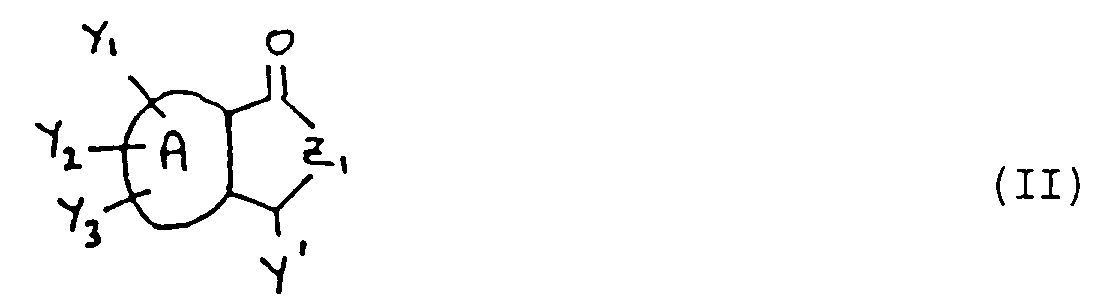

 b) Behandlung einer Verbindung der Formel Ip, worin Y' Cyano oder Arylsulfonyl ist und Z1 Sauerstoff bedeutet und die anderen Symbole wie in Anspruch 1 definiert sind, durch(i) Hydrolyse unter Bildung einer entsprechenden Verbindung der Formel I, worin R und X eine Brücke bilden und Y Hydroxy ist oder eine Verbindung der Formel I, worin X und Y zusmmen für =O stehen,(ii) Umsetzung mit einem Amin unter Bildung einer entsprechenden Verbindung der Formel I, worin R eine gegebenenfalls substituierte Carbamoylgruppe ist und X und Y zusammen für =O stehen, oder(iii) Umsetzung mit einer Gruppe der Formel
MOR22
worin M ein Alkalimetall ist und R22 für Wasserstoff oder C1-C8-Alkyl steht, unter Bildung einer entsprechenden Verbindung, worin R und X eine Brücke bilden und Y Hydroxy oder C1-C8-Alkoxy ist,c) Hydrolyse einer Verbindung der Formel Ip, worin Y' Hydroxy ist und Z1 Sauerstoff bedeutet und die anderen Symbole 'wie in Anspruch 1 definiert sind, unter Bildung einer Verbindung der Formel I, worin R eine Carboxylgruppe ist, die gegebenenfalls in Salzform vorliegt, X für Wasserstoff steht und Y Hydroxy ist,d) Ringöffnung einer Verbindung der Formel Ip, worin Y' Wasserstoff ist und Z1 Sauerstoff bedeutet und die anderen Symbole wie in Anspruch 1 definiert sind, unter Bildung einer Verbindung der Formel I, worin R eine Carboxylgruppe ist, die gegebenenfalls in Salzform vorliegt, und X und Y zusammen für =O stehen,e) Veresterung einer Verbindung der Formel I, worin X eine Carboxylgruppe ist, die gegebenenfalls in Salzform vorliegt, X und Y für =O stehen und die anderen Symbole wie in Anspruch 1 definiert sind, unter Bildung der entsprechenden Verbindung, worin R eine Carboxylgruppe in Esterform ist.f) Halogenierung einer Verbindung der Formel Ip, worin Y' Hydroxy ist, Z1 wie im Teil a) definiert ist und die anderen Symbole wie in Anspruch 1 definiert sind, unter Bildung einer Verbindung der Formel I, worin X und R zusammen eine Brücke bilden und Y' Halogen ist,g) Umsetzung einer Verbindung der Formel Ip, worin Z1 Sauerstoff ist, Y' Halogen bedeutet und die anderen Symbole wie in Anspruch 1 definiert sind mit einer Gruppe R2NH2 oder einer Gruppe HOR23, worin R23 C1-C8-Alkyl, C2-C8-Acyl oder Aryl bedeutet und R2 wie in Anspruch 1 definiert ist, unter Bildung der entsprechenden Verbindung, worin Z1 für NR2 steht und Y' C1-C8-Alkoxy, Aryloxy oder C2-C8-Acyloxy ist.h) Oxidation einer Verbindung der Formel Ip, worin Y' Wasserstoff ist, Z1 wie in Teil a) definiert ist und die anderen Symbole wie in Anspruch 1 definiert sind, unter Bildung der entsprechenden Verbindung, worin Y' Hydroxy bedeutet,i) Umsetzung einer Verbindung der Formel IV

 j) Mono- oder Dihalogenierung einer Verbindung der Formel Iq, worin X'' und Y'' Wasserstoff sind und die anderen Symbole wie in Teil i) definiert sind, unter Bildung der entsprechenden Verbindung der Formel Iq, worin einer oder beide der Substituenten X'' und Y'' Halogen sind,k) Oxidation einer Verbindung der Formel Iq, worin X'' und Y'' beide Wasserstoff sind oder X'' Halogen ist und Y'' Wasserstoff bedeutet, und die anderen Symbole wie in Anspruch 1 definiert sind, unter Bildung der entsprechenden Verbindung, worin X'' und Y'' zusammen für =O stehen oder einer dieser Reste Wasserstoff ist und der andere Hydroxy bedeutet,l) Alkylierung einer Verbindung der Formel Iq, worin X'' Wasserstoff ist und Y'' Wasserstoff bedeutet, und die anderen Symbole wie in Anspruch 1 definiert sind, unter Bildung der entsprechenden Verbindung, worin X'' C1-C8-Alkyl ist und Y'' Wasserstoff darstellt,m) Einführung einer C1-C8-Alkoxygruppe oder C1-C8-Alkylthiogruppe in eine Verbindung der Formel Iq, worin X'' Halogen ist und Y'' Wasserstoff bedeutet, und die anderen Symbole wie in Anspruch 1 definiert sind, unter Bildung der entsprechenden Verbindung, worin X'' C1-C8-Alkoxy oder C1-C8-Alkylthio ist und Y'' für Wasserstoff steht,n) Acylierung einer Verbindung der Formel Iq, worin X'' Hydroxy ist und Y'' Wasserstoff darstellt, und die anderen Symbole wie in Anspruch 1 definiert sind, unter Bildung der entsprechenden Verbindung, worin X'' Acyloxy ist und Y'' Wasserstoff bedeutet,o) Umsetzung einer Verbindung der Formel Ip, worin Z1 Sauerstoff ist und Y' für Wasserstoff steht, und die anderen Symbole wie in Anspruch 1 definiert sind, mit einer Gruppe der Formel R7NH2, worin R7 steht für (a) Wasserstoff oder Halogen, (b) C1-C24-Alkyl, C2-C8-Alkenyl, C2-C8-Alkinyl, C1-C8-Alkoxy, C1-C8-Alkoxy-C1-C8-alkoxy, C2-C8-Alkenyloxy, C2-C8-Alkinyloxy, C1-C8-Alkylthio, C2-C8-Alkenylthio oder C2-C8-Alkinylthio, wobei jeder dieser Reste wiederum durch 1 bis 6 Halogenatome substituiert sein kann, (c) C3-C6-Cycloalkyl, C3-C6-Cycloalkyl-C1-C8-alkyl, Heterocyclyl, Heterocyclo-C1-C8-alkyl, Heterocyclo-C1-C8-alkoxy, Aryloxy, Aryl-C1-C8-alkoxy oder Aryl-C1-C8-alkylthio, wobei jeder dieser Reste unsubstituiert oder durch ein bis drei Substituenten substituiert sein kann, die ausgewählt sind aus (i) Halogen, (ii) C1-C8-Alkyl, C1-C8-Alkoxy, C1-C8-Halogenalkoxy, C1-C8-Halogenalkyl, C1-C8-Alkylthio, C1-C8-Alkylsulfonyl oder C1-C8-Alkylsulfonylmethyl und (iii) Nitro, Cyano, Acyl oder Amino oder (d) Amino, Amido, Aminosulfonyl, Cyano, Nitro oder -(CHR4')n'''-C(O)Y4', worin Y4' Wasserstoff, C1-C8-Alkyl, C1-C8-Alkoxy oder Hydroxy ist und n''' für 0, 1, 2 oder 3 steht und R4' die Definition von Y1 hat unter Bildung einer Verbindung der Formel I, worin R für monosubstituiertes Carbamoyl steht, X Wasserstoff ist und Y Hydroxy darstellt,p) Sulfonylierung, Carbamoylierung, Acylierung oder Carbalkoxylierung einer Verbindung der Formel Ip, worin Z1 Sauerstoff ist und Y' Hydroxy bedeutet, und die anderen Symbole wie in Anspruch 1 definiert sind, unter Bildung der entsprechenden Verbindung der Formel I, worin R und X die Brücke -C(O)-O bilden und Y Sulfonyloxy, Carbamoyloxy, C2-C8-Acyloxy oder C1-C8-Alkoxycarbonyloxy sind,q) Umsetzung einer Verbindung der Formel Ip, worin Z1 Sauerstoff ist und Y' für Halogen steht, und die anderen Symbole wie in Anspruch 1 definiert sind, mit einer Gruppe der Formel R7R8NH, worin R7 wie in Teil o) definiert ist und R8 wie für den Rest R7 definiert ist, unter Bildung einer Verbindung der Formel I, worin R disubstituiertes Carbamoyl bedeutet und X und Y zusammen für =O stehen,und Gewinnung irgendeiner Verbindung, worin R eine Carboxylgruppe oder Thiocarboxylgruppe in freier Form oder in Esterform ist, und irgendeiner Verbindung, worin R Carboxyl in freier Form oder in Salzform darstellt.
Applications Claiming Priority (4)
| Application Number | Priority Date | Filing Date | Title |
|---|---|---|---|
| US53479490A | 1990-06-07 | 1990-06-07 | |
| US534794 | 1990-06-07 | ||
| US633592 | 1990-06-07 | ||
| US63359290A | 1990-12-21 | 1990-12-21 |
Publications (3)
| Publication Number | Publication Date |
|---|---|
| EP0461079A2 EP0461079A2 (de) | 1991-12-11 |
| EP0461079A3 EP0461079A3 (en) | 1992-03-04 |
| EP0461079B1 true EP0461079B1 (de) | 1997-07-16 |
Family
ID=27064591
Family Applications (1)
| Application Number | Title | Priority Date | Filing Date |
|---|---|---|---|
| EP91810428A Expired - Lifetime EP0461079B1 (de) | 1990-06-07 | 1991-06-05 | Substituierte Phthalide und heterozyklische Phthalide |
Country Status (29)
| Country | Link |
|---|---|
| EP (1) | EP0461079B1 (de) |
| JP (1) | JPH04235967A (de) |
| KR (1) | KR920000752A (de) |
| CN (1) | CN1033735C (de) |
| AT (1) | ATE155466T1 (de) |
| AU (1) | AU649448B2 (de) |
| BG (1) | BG61245B2 (de) |
| BR (1) | BR9102386A (de) |
| CA (1) | CA2043976C (de) |
| CS (1) | CS173791A3 (de) |
| DE (1) | DE69126825T2 (de) |
| DK (1) | DK0461079T3 (de) |
| EG (1) | EG19649A (de) |
| ES (1) | ES2107447T3 (de) |
| GR (1) | GR3025004T3 (de) |
| HR (1) | HRP930488B1 (de) |
| HU (1) | HU212435B (de) |
| IE (1) | IE911911A1 (de) |
| IL (1) | IL98378A (de) |
| MY (1) | MY109606A (de) |
| NZ (1) | NZ238403A (de) |
| PL (1) | PL170729B1 (de) |
| PT (1) | PT97890B (de) |
| RU (1) | RU2040522C1 (de) |
| SG (1) | SG43838A1 (de) |
| SI (1) | SI9111017A (de) |
| SK (1) | SK278746B6 (de) |
| TR (1) | TR25270A (de) |
| YU (1) | YU101791A (de) |
Cited By (2)
| Publication number | Priority date | Publication date | Assignee | Title |
|---|---|---|---|---|
| US7002025B2 (en) | 2000-03-07 | 2006-02-21 | Resolution Chemicals Limited | Process for the preparation of citalopram |
| US7459283B2 (en) | 2002-02-04 | 2008-12-02 | Elan Pharma International Limited | Nanoparticulate compositions having lysozyme as a surface stabilizer |
Families Citing this family (45)
| Publication number | Priority date | Publication date | Assignee | Title |
|---|---|---|---|---|
| US6107248A (en) * | 1988-12-29 | 2000-08-22 | Anderson; Richard J. | Potentiating herbicidal compositions of auxin transport inhibitors and growth regulators |
| US5665673A (en) * | 1988-12-29 | 1997-09-09 | Anderson; Richard J. | Potentiating herbicidal compositions |
| US5403816A (en) * | 1990-10-25 | 1995-04-04 | Kumiai Chemical Industry Co., Ltd. | Picolinic acid derivative and herbicidal composition |
| JPH05301872A (ja) * | 1992-04-23 | 1993-11-16 | Kumiai Chem Ind Co Ltd | ピコリン酸誘導体及び除草剤 |
| GB9105297D0 (en) * | 1991-03-13 | 1991-04-24 | Schering Agrochemicals Ltd | Herbicides |
| HU213178B (en) * | 1991-12-06 | 1997-03-28 | Sandoz Ag | Herbicid composition containing phthalide derivative as active ingredient, process for thereof and preparing the active ingredients |
| DE4202526A1 (de) * | 1992-01-30 | 1993-08-05 | Bayer Ag | Neue 4-cinnolinyl- und 4-naphthyridinyl-dihydropyridine, verfahren zu ihrer herstellung und ihre verwendung in arzneimitteln |
| WO1993024468A1 (en) * | 1992-06-02 | 1993-12-09 | Ciba-Geigy Ag | Pyrimidinyl- and triazinyl- salicyl- and picolylamides and the use, as herbicides, and preparation thereof |
| AU661159B2 (en) * | 1992-07-15 | 1995-07-13 | Sumitomo Chemical Company, Limited | N-acyldihydroquinoline derivatives, a method for producing the same and their use as herbicides |
| GB9219779D0 (en) * | 1992-09-18 | 1992-10-28 | Rhone Poulenc Agriculture | Compositions of new matter |
| WO1994008975A1 (fr) * | 1992-10-16 | 1994-04-28 | Nippon Soda Co., Ltd. | Derive de pyrimidine |
| EP0614606B1 (de) | 1993-02-18 | 2003-09-10 | Basf Aktiengesellschaft | Herbizide Mischungen |
| US5716901A (en) * | 1993-02-18 | 1998-02-10 | Sandoz Ltd. | Synergistic herbicidal compositions of dimethenamid, sulcotrione, and atrazine |
| US5888936A (en) * | 1993-02-18 | 1999-03-30 | Sandoz Ltd. | Synergistic herbicidal compositions of dimethenamid and phenmedipham |
| US5721191A (en) * | 1993-02-18 | 1998-02-24 | Sandoz Ltd. | Synergistic herbicidal compositions of dimethenamid and sulfonylureas |
| US5877115A (en) * | 1993-02-18 | 1999-03-02 | Sandoz Ltd. | Dicamba and dimethenamid synergistic herbicidal compositions |
| DE4305696A1 (de) * | 1993-02-25 | 1994-09-01 | Hoechst Ag | Nachweisverfahren zur Identifizierung von Inhibitoren |
| RU2133746C1 (ru) * | 1994-03-22 | 1999-07-27 | Кумиай Кемикал Индастри Ко., Лтд. | Производные никотиновой кислоты, способ их получения и гербицидная композиция |
| US5595958A (en) * | 1994-05-02 | 1997-01-21 | Zeneca Limited | 3-substituted pyridine compounds and derivatives thereof |
| DE19521355A1 (de) * | 1995-06-12 | 1996-12-19 | Hoechst Schering Agrevo Gmbh | Sulfonamide, Verfahren zu deren Herstellung und ihre Verwendung als Herbizide und Pflanzenwachstumsregulatoren |
| DE19521653A1 (de) * | 1995-06-14 | 1996-12-19 | Hoechst Schering Agrevo Gmbh | Substituierte Tetrazole, Verfahren zu ihrer Herstellung und ihre Verwendung als Herbizide und Pflanzenwachstumsregulatoren |
| US5698694A (en) * | 1996-10-25 | 1997-12-16 | Sandoz Ltd. | Process for preparing substituted pyrimidines |
| WO1998042671A1 (de) * | 1997-03-20 | 1998-10-01 | Basf Aktiengesellschaft | Substituierte 2-benz(o)ylpyridin derivate, deren herstellung und deren verwendung als herbizide |
| US5977024A (en) * | 1997-11-03 | 1999-11-02 | Basf Corporation | Mixtures and methods for suppressing precipitation of chloroacetamides |
| EP1361218A1 (de) | 1998-07-29 | 2003-11-12 | IHARA CHEMICAL INDUSTRY Co., Ltd. | Trifluormethansulfonylanilidderivate, Verfahren zu deren Herstellung und sia als aktiven Bestandteil enthaltende Herbizide |
| US6428814B1 (en) | 1999-10-08 | 2002-08-06 | Elan Pharma International Ltd. | Bioadhesive nanoparticulate compositions having cationic surface stabilizers |
| AU2001267442B2 (en) * | 2000-05-17 | 2004-07-01 | Syngenta Participations Ag | Process for the preparation of aniline compounds |
| AR035884A1 (es) | 2001-05-18 | 2004-07-21 | Nihon Nohyaku Co Ltd | Derivado de amida aromatico sustituido, derivado de amina aromatico sustituido con un grupo fluoroalquilo util como intermediario para obtener el mismo, insecticida para agrohorticultura que lo contiene y metodo para usar este ultimo |
| DE50200390D1 (de) | 2001-10-31 | 2004-06-03 | Basf Ag | Benzhydrylderivate |
| SE0201976D0 (sv) * | 2002-06-24 | 2002-06-24 | Astrazeneca Ab | Novel compounds |
| CA2524161C (en) | 2003-05-08 | 2013-01-15 | Applied Research Systems Ars Holding N.V. | Pyridinyl acetonitriles |
| WO2005103051A1 (en) * | 2004-04-26 | 2005-11-03 | Pfizer Inc. | Inhibitors of the hiv integrase enzyme |
| GB0808664D0 (en) * | 2008-05-13 | 2008-06-18 | Syngenta Ltd | Chemical compounds |
| GB0811643D0 (en) | 2008-06-25 | 2008-07-30 | Cancer Rec Tech Ltd | New therapeutic agents |
| US20110178299A1 (en) * | 2008-10-17 | 2011-07-21 | Kumiai Chemical Industry Co., Ltd. | Optically active difluoromethanesulfonanilide derivative and herbicide |
| US8754228B2 (en) | 2011-11-16 | 2014-06-17 | Paresh T. Gandhi | Nicotine derivatives |
| RU2583058C1 (ru) * | 2015-04-28 | 2016-05-10 | Федеральное государственное бюджетное образовательное учреждение высшего профессионального образования "Кубанский государственный технологический университет" (ФГБОУ ВПО "КубГТУ") | Способ получения производных 3-(2-фурил)фталида |
| GB201517216D0 (en) | 2015-09-29 | 2015-11-11 | Cancer Res Technology Ltd And Astex Therapeutics Ltd | Pharmaceutical compounds |
| GB201517217D0 (en) | 2015-09-29 | 2015-11-11 | Astex Therapeutics Ltd And Cancer Res Technology Ltd | Pharmaceutical compounds |
| GB201704965D0 (en) | 2017-03-28 | 2017-05-10 | Astex Therapeutics Ltd | Pharmaceutical compounds |
| GB201704966D0 (en) | 2017-03-28 | 2017-05-10 | Astex Therapeutics Ltd | Pharmaceutical compounds |
| PE20231066A1 (es) | 2020-02-07 | 2023-07-17 | Gasherbrum Bio Inc | Agonistas heterociclicos de glp-1 |
| JP7858636B2 (ja) | 2020-09-10 | 2026-05-14 | ガシャーブラム・バイオ・インコーポレイテッド | ヘテロ環glp-1アゴニスト |
| CN112970759A (zh) * | 2021-01-25 | 2021-06-18 | 浙江农林大学 | 一种新型除草制剂及其制备方法 |
| IL322686A (en) | 2023-02-16 | 2025-10-01 | Gasherbrum Bio Inc | Heterocyclic glp-1 agonists |
Family Cites Families (5)
| Publication number | Priority date | Publication date | Assignee | Title |
|---|---|---|---|---|
| DE3526017A1 (de) * | 1985-07-20 | 1987-01-22 | Thomson Brandt Gmbh | Recorder |
| JPS6484465A (en) * | 1987-09-28 | 1989-03-29 | Hitachi Ltd | Rotary head device |
| JP2898991B2 (ja) * | 1988-06-21 | 1999-06-02 | キヤノン株式会社 | 回転制御装置 |
| GB8917222D0 (en) * | 1989-07-27 | 1989-09-13 | Schering Agrochemicals Ltd | Herbicides |
| AU7077091A (en) * | 1990-01-11 | 1991-08-05 | E.I. Du Pont De Nemours And Company | Herbicidal pyrimidines and triazines |
-
1991
- 1991-05-27 HU HU911771A patent/HU212435B/hu not_active IP Right Cessation
- 1991-06-05 KR KR1019910009443A patent/KR920000752A/ko not_active Ceased
- 1991-06-05 AU AU78204/91A patent/AU649448B2/en not_active Ceased
- 1991-06-05 AT AT91810428T patent/ATE155466T1/de not_active IP Right Cessation
- 1991-06-05 IL IL9837891A patent/IL98378A/en not_active IP Right Cessation
- 1991-06-05 DE DE69126825T patent/DE69126825T2/de not_active Expired - Fee Related
- 1991-06-05 ES ES91810428T patent/ES2107447T3/es not_active Expired - Lifetime
- 1991-06-05 IE IE191191A patent/IE911911A1/en unknown
- 1991-06-05 SG SG1996001881A patent/SG43838A1/en unknown
- 1991-06-05 EP EP91810428A patent/EP0461079B1/de not_active Expired - Lifetime
- 1991-06-05 DK DK91810428.2T patent/DK0461079T3/da active
- 1991-06-05 NZ NZ238403A patent/NZ238403A/xx unknown
- 1991-06-05 RU SU914895617A patent/RU2040522C1/ru active
- 1991-06-06 CS CS911737A patent/CS173791A3/cs unknown
- 1991-06-06 CA CA002043976A patent/CA2043976C/en not_active Expired - Lifetime
- 1991-06-06 EG EG35391A patent/EG19649A/xx active
- 1991-06-06 JP JP3163978A patent/JPH04235967A/ja active Pending
- 1991-06-06 PL PL91290573A patent/PL170729B1/pl unknown
- 1991-06-06 SK SK1737-91A patent/SK278746B6/sk unknown
- 1991-06-06 CN CN91104849A patent/CN1033735C/zh not_active Expired - Fee Related
- 1991-06-06 PT PT97890A patent/PT97890B/pt not_active IP Right Cessation
- 1991-06-07 YU YU101791A patent/YU101791A/sh unknown
- 1991-06-07 TR TR91/0592A patent/TR25270A/xx unknown
- 1991-06-07 MY MYPI91001007A patent/MY109606A/en unknown
- 1991-06-07 SI SI9111017A patent/SI9111017A/sl unknown
- 1991-06-07 BR BR919102386A patent/BR9102386A/pt not_active Application Discontinuation
-
1993
- 1993-03-23 HR HRP-1017/91A patent/HRP930488B1/xx not_active IP Right Cessation
-
1994
- 1994-02-14 BG BG098477A patent/BG61245B2/bg unknown
-
1997
- 1997-10-09 GR GR970402647T patent/GR3025004T3/el unknown
Non-Patent Citations (2)
| Title |
|---|
| Aldrich Catalogue, Seite 148, 1994/95 * |
| IUPAC, Nomenclature of Organic Chemistry , Sections A,B,C,D,E,F and H Pergamon Press, 1979 Edition, page 20 * |
Cited By (4)
| Publication number | Priority date | Publication date | Assignee | Title |
|---|---|---|---|---|
| US7002025B2 (en) | 2000-03-07 | 2006-02-21 | Resolution Chemicals Limited | Process for the preparation of citalopram |
| US7459283B2 (en) | 2002-02-04 | 2008-12-02 | Elan Pharma International Limited | Nanoparticulate compositions having lysozyme as a surface stabilizer |
| US8323641B2 (en) | 2002-02-04 | 2012-12-04 | Alkermes Pharma Ireland Limited | Nanoparticulate compositions having lysozyme as a surface stabilizer |
| US8652464B2 (en) | 2002-02-04 | 2014-02-18 | Alkermes Pharma Ireland Limited | Method of treatment using nanoparticulate compositions having lysozyme as a surface stabilizer |
Also Published As
Similar Documents
| Publication | Publication Date | Title |
|---|---|---|
| EP0461079A2 (de) | Substituierte Phthaliden und heterozyklische Phthaliden | |
| ES2539517T3 (es) | Piridonacarboxamidas, agentes protectores de plantas útiles que contienen las mismas y procedimiento para su preparación y su uso | |
| KR100229087B1 (ko) | 제초제로서의 카복스아미드 유도체,그들의 제법 및 이를 함유하는 제초 조성물 | |
| EP0739341B1 (de) | Aryl- und heteroaryl- pyrimidine als herbizide | |
| JP5183735B2 (ja) | 置換ピリミジンエーテル化合物及びそれらの使用 | |
| EP0776894A1 (de) | Oxazol-derivate, verfahren zu deren herstellung und herbizide | |
| CN101747306B (zh) | 取代醚类化合物及其应用 | |
| EP0254951B1 (de) | 5(und/oder6) Substituierte 2-(2-Imidazolin-2-yl)nicotinsäuren, Ester und Salze, verwendbar als herbizide Mittel und Zwischenverbindungen für die Herstellung dieser Nikotinsäuren, Ester und Salze | |
| JPH0826008B2 (ja) | 除草剤としてのベンゼンスルホンアミド誘導体 | |
| HK1000037B (en) | 5(and/or 6)substituted 2-(2-imidazolin-2-yl)nicotinic acids, esters and salts,useful as herbicidal agents and intermediates for the preparation of said nicotinic acids, esters and salts | |
| BG60497B2 (bg) | Семикарбазони и тиосемикарбазони | |
| CN119059936A (zh) | 间胺基苯甲酸双酰胺类化合物 | |
| CN101875639A (zh) | 取代嘧啶醚类化合物及其应用 | |
| JP2946656B2 (ja) | ウラシル誘導体および除草剤 | |
| IL103980A (en) | Ammonium salts of benzoic pyrimidinecarbonyl acids, their preparations and pharmaceutical preparations containing them | |
| CN102827071B (zh) | 取代氰基苯胺类化合物及其应用 | |
| US5536703A (en) | Herbicidal substituted benzoyl bicycloalkanediones | |
| DE19909541A1 (de) | Herbizide 2-Aryloxy- bzw. 2-Arylthio-6-arylpyrimidine | |
| EP0608862A1 (de) | 6-Chloro-2-(4,6-dimethoxypyrimidin-2-yl)oxybenzoesäure Ester Derivate, Verfahren zu deren Erzeugung und Methode zu deren Verwendung als herbizides Mittel | |
| RU2266904C2 (ru) | Производные сульфонамидов, способ их получения, композиция и способ уничтожения сорняков | |
| JPH072778A (ja) | 新規なニコチン酸誘導体 | |
| CN113387900A (zh) | 一种环烯酰胺类化合物及其应用 |
Legal Events
| Date | Code | Title | Description |
|---|---|---|---|
| PUAI | Public reference made under article 153(3) epc to a published international application that has entered the european phase |
Free format text: ORIGINAL CODE: 0009012 |
|
| AK | Designated contracting states |
Kind code of ref document: A2 Designated state(s): AT BE CH DE DK ES FR GB GR IT LI LU NL SE |
|
| PUAL | Search report despatched |
Free format text: ORIGINAL CODE: 0009013 |
|
| AK | Designated contracting states |
Kind code of ref document: A3 Designated state(s): AT BE CH DE DK ES FR GB GR IT LI LU NL SE |
|
| 17P | Request for examination filed |
Effective date: 19920807 |
|
| 17Q | First examination report despatched |
Effective date: 19941108 |
|
| GRAG | Despatch of communication of intention to grant |
Free format text: ORIGINAL CODE: EPIDOS AGRA |
|
| GRAH | Despatch of communication of intention to grant a patent |
Free format text: ORIGINAL CODE: EPIDOS IGRA |
|
| GRAH | Despatch of communication of intention to grant a patent |
Free format text: ORIGINAL CODE: EPIDOS IGRA |
|
| RAP1 | Party data changed (applicant data changed or rights of an application transferred) |
Owner name: SANDOZ-ERFINDUNGEN VERWALTUNGSGESELLSCHAFT M.B.H. Owner name: SANDOZ-PATENT-GMBH Owner name: NOVARTIS AG |
|
| GRAA | (expected) grant |
Free format text: ORIGINAL CODE: 0009210 |
|
| AK | Designated contracting states |
Kind code of ref document: B1 Designated state(s): AT BE CH DE DK ES FR GB GR IT LI LU NL SE |
|
| REF | Corresponds to: |
Ref document number: 155466 Country of ref document: AT Date of ref document: 19970815 Kind code of ref document: T |
|
| REG | Reference to a national code |
Ref country code: CH Ref legal event code: EP |
|
| REF | Corresponds to: |
Ref document number: 69126825 Country of ref document: DE Date of ref document: 19970821 |
|
| ITF | It: translation for a ep patent filed | ||
| ET | Fr: translation filed | ||
| REG | Reference to a national code |
Ref country code: ES Ref legal event code: FG2A Ref document number: 2107447 Country of ref document: ES Kind code of ref document: T3 |
|
| REG | Reference to a national code |
Ref country code: GR Ref legal event code: FG4A Free format text: 3025004 |
|
| REG | Reference to a national code |
Ref country code: DK Ref legal event code: T3 |
|
| PLBE | No opposition filed within time limit |
Free format text: ORIGINAL CODE: 0009261 |
|
| PGFP | Annual fee paid to national office [announced via postgrant information from national office to epo] |
Ref country code: GR Payment date: 19980527 Year of fee payment: 8 |
|
| PGFP | Annual fee paid to national office [announced via postgrant information from national office to epo] |
Ref country code: CH Payment date: 19980528 Year of fee payment: 8 |
|
| PG25 | Lapsed in a contracting state [announced via postgrant information from national office to epo] |
Ref country code: LU Free format text: LAPSE BECAUSE OF NON-PAYMENT OF DUE FEES Effective date: 19980605 Ref country code: GB Free format text: LAPSE BECAUSE OF NON-PAYMENT OF DUE FEES Effective date: 19980605 Ref country code: AT Free format text: LAPSE BECAUSE OF NON-PAYMENT OF DUE FEES Effective date: 19980605 |
|
| PG25 | Lapsed in a contracting state [announced via postgrant information from national office to epo] |
Ref country code: SE Free format text: LAPSE BECAUSE OF NON-PAYMENT OF DUE FEES Effective date: 19980606 |
|
| PGFP | Annual fee paid to national office [announced via postgrant information from national office to epo] |
Ref country code: ES Payment date: 19980611 Year of fee payment: 8 |
|
| PG25 | Lapsed in a contracting state [announced via postgrant information from national office to epo] |
Ref country code: DK Free format text: LAPSE BECAUSE OF NON-PAYMENT OF DUE FEES Effective date: 19980630 Ref country code: BE Free format text: LAPSE BECAUSE OF NON-PAYMENT OF DUE FEES Effective date: 19980630 |
|
| 26N | No opposition filed | ||
| BERE | Be: lapsed |
Owner name: NOVARTIS A.G. Effective date: 19980630 |
|
| PG25 | Lapsed in a contracting state [announced via postgrant information from national office to epo] |
Ref country code: NL Free format text: LAPSE BECAUSE OF NON-PAYMENT OF DUE FEES Effective date: 19990101 |
|
| GBPC | Gb: european patent ceased through non-payment of renewal fee |
Effective date: 19980605 |
|
| PG25 | Lapsed in a contracting state [announced via postgrant information from national office to epo] |
Ref country code: FR Free format text: LAPSE BECAUSE OF NON-PAYMENT OF DUE FEES Effective date: 19990226 |
|
| EUG | Se: european patent has lapsed |
Ref document number: 91810428.2 |
|
| NLV4 | Nl: lapsed or anulled due to non-payment of the annual fee |
Effective date: 19990101 |
|
| PG25 | Lapsed in a contracting state [announced via postgrant information from national office to epo] |
Ref country code: DE Free format text: LAPSE BECAUSE OF NON-PAYMENT OF DUE FEES Effective date: 19990401 |
|
| REG | Reference to a national code |
Ref country code: FR Ref legal event code: ST |
|
| PG25 | Lapsed in a contracting state [announced via postgrant information from national office to epo] |
Ref country code: ES Free format text: LAPSE BECAUSE OF NON-PAYMENT OF DUE FEES Effective date: 19990607 |
|
| PG25 | Lapsed in a contracting state [announced via postgrant information from national office to epo] |
Ref country code: LI Free format text: LAPSE BECAUSE OF NON-PAYMENT OF DUE FEES Effective date: 19990630 Ref country code: GR Free format text: LAPSE BECAUSE OF NON-PAYMENT OF DUE FEES Effective date: 19990630 Ref country code: CH Free format text: LAPSE BECAUSE OF NON-PAYMENT OF DUE FEES Effective date: 19990630 |
|
| REG | Reference to a national code |
Ref country code: CH Ref legal event code: PL |
|
| REG | Reference to a national code |
Ref country code: DK Ref legal event code: EBP |
|
| REG | Reference to a national code |
Ref country code: ES Ref legal event code: FD2A Effective date: 20010503 |
|
| PG25 | Lapsed in a contracting state [announced via postgrant information from national office to epo] |
Ref country code: IT Free format text: LAPSE BECAUSE OF NON-PAYMENT OF DUE FEES;WARNING: LAPSES OF ITALIAN PATENTS WITH EFFECTIVE DATE BEFORE 2007 MAY HAVE OCCURRED AT ANY TIME BEFORE 2007. THE CORRECT EFFECTIVE DATE MAY BE DIFFERENT FROM THE ONE RECORDED. Effective date: 20050605 |