EP0461108B1 - Teilweise geschmolzenes peptidpellet - Google Patents
Teilweise geschmolzenes peptidpellet Download PDFInfo
- Publication number
- EP0461108B1 EP0461108B1 EP89905911A EP89905911A EP0461108B1 EP 0461108 B1 EP0461108 B1 EP 0461108B1 EP 89905911 A EP89905911 A EP 89905911A EP 89905911 A EP89905911 A EP 89905911A EP 0461108 B1 EP0461108 B1 EP 0461108B1
- Authority
- EP
- European Patent Office
- Prior art keywords
- pellet
- peptide
- partially
- carrier
- hormone
- Prior art date
- Legal status (The legal status is an assumption and is not a legal conclusion. Google has not performed a legal analysis and makes no representation as to the accuracy of the status listed.)
- Expired - Lifetime
Links
Images

Classifications
-
- A—HUMAN NECESSITIES
- A61—MEDICAL OR VETERINARY SCIENCE; HYGIENE
- A61K—PREPARATIONS FOR MEDICAL, DENTAL OR TOILETRY PURPOSES
- A61K9/00—Medicinal preparations characterised by special physical form
- A61K9/0012—Galenical forms characterised by the site of application
- A61K9/0019—Injectable compositions; Intramuscular, intravenous, arterial, subcutaneous administration; Compositions to be administered through the skin in an invasive manner
- A61K9/0024—Solid, semi-solid or solidifying implants, which are implanted or injected in body tissue
-
- A—HUMAN NECESSITIES
- A61—MEDICAL OR VETERINARY SCIENCE; HYGIENE
- A61K—PREPARATIONS FOR MEDICAL, DENTAL OR TOILETRY PURPOSES
- A61K9/00—Medicinal preparations characterised by special physical form
- A61K9/14—Particulate form, e.g. powders, Processes for size reducing of pure drugs or the resulting products, Pure drug nanoparticles
- A61K9/16—Agglomerates; Granulates; Microbeadlets ; Microspheres; Pellets; Solid products obtained by spray drying, spray freeze drying, spray congealing,(multiple) emulsion solvent evaporation or extraction
- A61K9/1605—Excipients; Inactive ingredients
- A61K9/1617—Organic compounds, e.g. phospholipids, fats
-
- A—HUMAN NECESSITIES
- A61—MEDICAL OR VETERINARY SCIENCE; HYGIENE
- A61K—PREPARATIONS FOR MEDICAL, DENTAL OR TOILETRY PURPOSES
- A61K9/00—Medicinal preparations characterised by special physical form
- A61K9/14—Particulate form, e.g. powders, Processes for size reducing of pure drugs or the resulting products, Pure drug nanoparticles
- A61K9/16—Agglomerates; Granulates; Microbeadlets ; Microspheres; Pellets; Solid products obtained by spray drying, spray freeze drying, spray congealing,(multiple) emulsion solvent evaporation or extraction
- A61K9/1682—Processes
- A61K9/1694—Processes resulting in granules or microspheres of the matrix type containing more than 5% of excipient
Definitions
- This invention relates generally to drug delivery systems and particularly to a bioerodible pellet capable of delivering a peptide when implanted subcutaneously.
- Efforts have been made to employ existing drug delivery systems based on biodegradable polymers as subcutaneous implants for the controlled release of peptides.
- Current polymer-based systems are typically combined with a drug in one of the following ways: (1) Diffusion systems in which a reservoir of drug is contained in a polymer capsule and drug delivery is by the slow diffusion of the drug through the interstices of the polymer capsule wall; (2) matrix erosional systems (monolithic systems) in which a drug is evenly distributed in a polymer matrix and is released as the polymer breaks down in biological fluid; and (3) diffusion/erosion systems in which drug release occurs as a result of diffusion of the drug through the polymer matrix and release of the drug as the surface of the device continually erodes.
- capsules present a synthetic diffusion layer having pores of specific size and frequency whereby biological fluids first seep into the capsule, dissolve the encapsulated drug and then carry the drug back out to a saturated reservoir (formed by the normal reaction of subcutaneous fibrous tissue to the presence of the capsule) surrounding the implant.
- a saturated reservoir formed by the normal reaction of subcutaneous fibrous tissue to the presence of the capsule
- enough biological fluid will enter the capsule to reach a critical point at which aggregation takes place and the drug assumes the consistency of a thick gel that resists diffusion from the capsule.
- Difficulties with polymer-based delivery systems also may arise from a reaction between the peptide and the hydrolized by-product of the polymer or some additive used as a wetting agent, or a confluence of such circumstances.
- the known monolithic polymer systems exhibit a bulk erosion, thus releasing too much (or all) of the drug and cannot be relied upon to provide appropriate release kinetics over long periods of time.
- Nonpolymer-based devices have also been used as subcutaneous implants for delivering a drug. Initially, pellets formed by compressing mixtures of a drug and an excipient were attempted. Such pellets, however, tended to disintegrate after a short time and thus exhibited an undesirable burst effect of the active ingredient and short duration of action. Later, pellets formed by "fusing", rather than compressing, mixtures of a drug and an excipient were attempted. In particular, fused pellets for the controlled release of steroid hormones were made by melting a mixture of cholesterol and a steroidal hormone under strictly controlled conditions. The completely melted mixture would be allowed to cool and recrystallize. See WO 88/07816.
- WO 88/07816 also discloses a method for accurately dispensing relative amounts of drug and carrier starting materials, by combining known proportions thereof into a paste which can then be used for any purpose, including the formation of a fused pellet.
- Fused implants have never been used as a system for delivering peptides.
- the hard, final matrix is arrived at by the creation of a complete melt that recrystallizes during cooling. This is not possible with a peptide molecule which, if melted, may fragment and lose its bioactivity.
- the present invention provides a simple, inexpensive, nonpolymer, erodible pellet for subcutaneous implantation providing continuous parenteral release of peptides.
- the present invention also provides a method and apparatus for the preparation of such bioerodible pellets.
- a bioerodible pellet capable of administering an even and continuous dose of a peptide over a period of up to a year when subcutaneously implanted is provided.
- the bioerodible implant is a partially fused pellet, which pellet has a peptide drug homogenously bound in a matrix of a melted and recrystallized, nonpolymer carrier.
- the carrier is bioerodable, highly crystalline and lipophilic.
- the partially-fused pellet is made by forming a homogenous mixture of a bioerodible nonpolymer carrier and a peptide, the carrier having a lower melting temperature than the peptide. The mixture is then heated to a temperature to cause the carrier to melt, but not so high as to cause the peptide to melt or degrade. Thus a partially-melted solution is formed, substantially all of the carrier being melted and substantially all of the peptide not melted. Then, the partially-melted solution is allowed to cool into a hardened pellet.
- the carrier is a sterol (i.e., cholesterol or a cholesterol derivative or an ester thereof).
- sterol carriers having properties similar to the foregoing sterols when melted, recrystallized and implanted in the body may be substituted.
- the peptide drug may be any bioactive peptide, and according to one preferred embodiment, is growth hormone-releasing hormone (GHRH).
- GHRH growth hormone-releasing hormone
- the peptide and carrier must be selected such that the peptide will not melt, degrade or otherwise lose its bioactivity when in a suspension of the melted carrier at about the melting temperature of the carrier for a short duration.
- the pellet may be formed in a chamber having a fluorocarbon surface to avoid sticking.
- the homogeneous mixture of the carrier and peptide may be added to the chamber as a paste.
- an alcohol paste may be formed from the mixture and a measured amount of the paste may be added to the chamber. Then the alcohol is evaporated out of the mixture leaving the carrier and the peptide in the chamber.
- the homogeneous mixture is compressed in the chamber prior to forming the partial melt.
- the homogeneous mixture of carrier and peptide is introduced into a fluorocarbon tube having a lumen of specific diameter. Then, one end of the tube is fitted with a plug, the plug sized to fit totally and sealingly within a portion of the tube. Next the tube is placed such that the plugged end abuts a solid surface. Then a compression pin is introduced into the bore at the opposite end of the tube, and the homogeneous mixture is compressed by applying pressure via the compression pin. The tube is then introduced into an oven and left in the oven until the partial melt is formed. Then the tubing is removed from the oven.
- the plugged end of the tubing is placed to abut a solid surface and pressure is applied to the partially-melted solution via the compression pin while said partially-melted solution cools into a hardened pellet. Then the plug and hardened pellet may be expelled from the tube.
- the hardened pellet may be used in treating various health conditions that require an even and continuous dose of a peptide drug, including endocrinologically-mediated disorders, disorders of aging and certain cancers.
- the pellet is implanted subdermally.
- the pellet undergoes surface erosion releasing the peptide continuously for an extended period of time. Because the means of drug release is based on pure surface erosion, the pellet does not exhibit a significant burst effect and does not result in the aggregation of peptide once implanted.
- an apparatus for making such a pellet is provided.
- a peptide drug is homogeneously distributed and captured in a matrix of a melted and recystallized nonpolymer carrier.
- a carrier having a lower melting point than the peptide is selected so that when a homogeneous mixture of the carrier and peptide is heated, a partial melt may be formed with substantially all of the carrier melting and substantially all of the peptide drug not melting. The partial melt then is allowed to cool, with the carrier recrystallizing to form the hardened pellet and capture the peptide drug.
- the nonpolymer carriers according to the invention are lipophilic. They also are bioerodible and, therefore, do not have to be removed surgically when the drug has been depleted as is the case with many of the prior art devices.
- the nonpolymer carrier is metabolized or excreted as the pellet erodes.
- the nonpolymer carrier is one that occurs naturally in the human body.
- the nonpolymer carriers according to the invention are of relatively small molecular weight as compared to the macromolecular polymer carriers of the prior art.
- the molecular weight of a preferred carrier, cholesterol acetate is approximately 428 daltons, whereas the molecular weight of the typical polymer carrier of the prior art is believed to be on the order of 103 - 106 daltons, depending on the degree of polymerization.
- the nonpolymer carriers according to the invention also are typically smaller than the peptide drug that is captured in the matrix of the recrystallized carrier.
- the nonpolymer carriers also are highly crystalline, especially as compared with the typical polymer carriers of the prior art. The foregoing properties contribute to the favorable characteristics of the formed pellet.
- One embodiment of the invention is a partially fused pellet consisting essentially of pure cholesterol acetate as the carrier and growth hormone releasing hormone, which has approximately 40 amino acids, as the bioactive peptide drug.
- Powdered GHRH is mixed with powdered cholesterol acetate. The mixture is heated until the cholesterol acetate, but not the GHRH, melts. The partial melt is then allowed to cool, with the cholesterol acetate recrystallizing to form a pellet.
- Recrystallization of cholesterol has been observed to follow a "ferning" pattern, beginning at the center of the melt and branching outwardly in all directions with increasing geometric complexity until all of the melted material has hardened.
- the GHRH is thus bound in a complex skeletal network of the recrystallized carrier.
- the GHRH/cholesterol acetate pellet erodes slowly in vitro due to the lipophilicity and high crystallinity of the carrier.
- the rate of release of GHRH from the pellet is consistent with pure surface erosion.
- the relatively larger size of the GHRH, as compared to the cholesterol acetate, makes escape of the GHRH through the crystal matrix of the cholesterol acetate unlikely, if not impossible.
- the GHRH/cholesterol acetate pellet has other favorable properties. Because the carrier and the drug order are both naturally occurring substances, the time and expense associated with determining the potential toxicity of a synthetic substance are eliminated. Likewise, the costs associated with synthesizing a high or complex polymer carrier are avoided. Further, the disparity in molecular weight between the GHRH and the cholesterol acetate allows a superb surface ratio of active ingredient to carrier as well as great flexibility for surface area adjustment by regulation of both pellet size and the ratio of active ingredient to carrier.
- the nonpolymer carrier is cholesterol or a cholesterol derivative including, but not limited to, cholesterol acetate and cholesterol chloride.
- Other preferred nonpolymer carriers include sterols other than cholesterol, steroids, steroid derivatives and analogues and other bioerodable compounds having lipohilic and crystalline properties, size and a melting temperature similar to cholesterol and cholesterol derivatives.
- Other carriers that may be substituted include certain fatty acids or neutral fats such as mono-, di- or triglycerides (or a combination of two or more of such lipid molecules) that have erosion properties and release kinetics similar to the foregoing sterols when combined with a peptide, melted, recrystallized and implanted in the body.
- the carrier must have a melting temperature such that it is a solid at body temperature (above about 40° C) and such that the peptide of choice will not melt, degrade or otherwise lose its bioactivity when in a suspension of the melted carrier at about the melting temperature of the carrier for a short duration.
- the peptide may be any bioactive peptide, naturally occurring or synthetic. Included are the classes of peptides known as neuropeptides and regulatory peptides. Specific examples of such factors include growth hormone and growth hormone-releasing hormone, gonadotropin-releasing hormone, and its agonist and antagonist analogues, somatostatin and its analogues, gonadotropins such as luteinizing hormone and follicle-stimulating hormone, peptide-T, thyrocalcitonin, parathyroid hormone, glucagon, vasopressin, oxytocin, alpha and beta melanocyte-stimulating hormones, peptide molecules which stimulate erythrocyte, leucocyte and immunocyte growth and function such as colony stimulating factors (CFS 1 and 2), erythropoietin and lymphokines (including interleukin I and II), angiotensin I and II, bradykinin, kallidin, adrenocorticotropic hormone, thyroid
- Accurate dispensing of the starting materials may be achieved by forming a paste made from a powdered mixture of the starting materials and a liquid such as ethyl alcohol, which alcohol may be dried out of the starting materials after dispensing, utilizing, for example, a standard vacuum oven.
- a paste By forming a paste, the material can be dispensed accurately from a standard, automated device such as a micropipetter.
- the paste may be manufactured to have the flow characteristics of ordinary toothpaste.
- the formation of the paste clearly overcomes problems of the prior art. Where drugs such as peptides are concerned, anything but a precise dosage could either be ineffective or harmful to the user.
- the standard pharmaceutical-dispensing machinery for powders does not dispense the very small quantities of powder required for the individual pellets of the invention with sufficient accuracy. This is especially true when the active ingredient comprises 50% or more of the total pellet volume. Therefore, according to the prior art, the materials must be measured and carefully allocated separately for each pellet. By forming a paste, the precise relative amounts of drug and carrier are maintained homogeneously throughout the paste and individual manual measurements are thus obviated.
- the liquid agents used to formulate the paste may be ethyl alcohol or any volatile organic solvent which can be evaporated completely prior to forming the partial melt and which by combining with the starting materials yields suitable flow characteristics.
- the liquid agent should be of a nature that promotes quick drying of the paste once the paste is dispensed.
- the liquid agent of course, should not be of a nature which affects the activity of the active agent in the pellet.
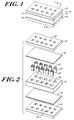
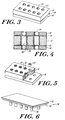
- the drawings illustrate a preferred method and apparatus for forming the peptide pellet of the invention. Since the mixture of the peptide and carrier will be allocated as a paste, an evaporation assembly 10 for drying the paste is provided (FIGS. 1-4).
- the evaporation assembly 10 includes a rectangular holding block 12 sandwiched in face-to-face relation between a top plate 14 and a bottom plate 16.
- a filter sheet 18 lays between the facing surfaces of the top plate 14 and the holding block 12.
- a filter sheet 18 lays between the facing surfaces of bottom plate 16 and the holding block 12.
- the holding block 12 is made of lucite and is 15.9 mm (.625 inches) thick. Other materials, of course, may be substituted for lucite.
- a plurality of bores extends through the holding block 12. These block bores 20 are sized to matingly receive fluorocarbon tubes in which the peptide pellets will be formed.
- the block bores 20 have a diameter slightly greater than the outer diameter of the fluorocarbon tubes, or slightly greater than .135 inches so that the tubes will move freely in the block bores 20.
- the top plate 14 and the bottom plate 16 also are made of lucite and are about 3.18 mm (.125 inches) thick.
- These plate bores 22 are positioned in the top and bottom plates 14, 16 such that they can be aligned to mate concentrically with the block bores 20 when the top and bottom plates 14, 16 are positioned to sandwich the holding block 12.
- the aligned plate and block bores 22, 20 will define passages extending completely through the assembled evaporation chamber.
- the fluorocarbon tubes 24 will be placed in the block bores 12, held in place by the top and bottom plates 14, 16.
- the fluorocarbon tubes are straight cylinders having an inner diameter of 2.41 mm (.095 inches) and an outer diameter of 3.43 mm (.135 inches). They are cut to a length of 15.9 mm (.625 inches). This length is the same as the length of the block bores 12 such that the ends of the fluorocarbon tubes 24 lie flush with the plate-facing surfaces of the holding block 12.
- Fluorocarbon tubing sold under the name of Teflon-TFE, Norton Chemplast, Inc., of Wayne, New Jersey has been used successfully.
- the tube may be made from nearly any material that is at least semi-rigid so long as the material will accept a fluorocarbon coating and will not melt or soften under the conditions applied in forming the melt.
- the diameter of the plate bores 22 is smaller than the diameter of the block bores 20.
- the ends 26 of the fluorocarbon tubes 24 will abut the facing surfaces of the top and bottom plates 14, 16 about the periphery of plate bores 22, and the top and bottom plates 14, 16 will hold the fluorocarbon tubes 24 within the block bores 20.
- the diameter of the plate bores 22 is equal to the inner diameter of the fluorocarbon tubes such that a passage of uniform diameter defined by the plate bores 20, 22 and lumen of the fluorocarbon tubing extends through the assembled device.
- the operation of the evaporation assembly 10 is as follows.
- a filter sheet is placed between the facing surfaces of the bottom plate 16 and the holding block 12.
- the filter sheet is a porous polymer filter having a pore size of 10 ⁇ m (microns).
- Such a filter is obtainable under the trade name Gelman Versapore, 10-micron, sold by Gelman Sciences, Inc. of Ann Arbor, Michigan.
- the bottom plate 16 then is attached to the holding block 12 such that the plate bores 22 and block bores 20 are aligned, with the filter sheet 18 separating the aligned bores.
- the fluorocarbon tubes 24 are placed into the open end of the block bores 22, one end 26 of each fluorocarbon tube 24 lying flush with the surface of the holding block 12 facing the bottom plate 16 and the other end 27 of each fluorocarbon tube 24 lying flush with the surface of the holding block 12 facing the top plate 14.
- an alcohol paste 28 containing the peptide and carrier is prepared. An aloquot of the paste 28 is dispensed into the top plate fading end 27 of each of the fluorocarbon tubes 24.
- a filter sheet 18 is placed on the top plate-facing surface of the holding block 12 and the top plate 14 is attached to the holding block 12.
- the assembled device containing the fluorocarbon tubes is shown in cross section in FIG. 4. This evaporation assembly 10 containing the filled fluorocarbon tubes 24 then is placed in a vacuum oven to evaporate the alcohol completely out of the paste 28 (approximately 24 hours), leaving a homogeneous dry mixture 30 of the carrier and peptide.
- one end of the fluorocarbon tubes 24 is plugged with a plug 32 having a non-stick surface (such as Teflon TFE beading) and a compression pin is introduced into the opposite end of the fluorocarbon tubes 24 to densely pack the dry mixture 30 of the peptide and carrier against the plug 32.
- a plug 32 having a non-stick surface such as Teflon TFE beading
- the top plate 14 and filter sheet 18 between the top plate 14 and holding block 12 are removed to expose the end 27 of the fluorocarbon tubes 24 facing the top plate 14. Then, a 3 millimeter long plug 32 of Teflon beading is friction-fit into the exposed end 27 of the fluorocarbon tubes 24. After plugging each of the fluorocarbon tubes 24, a solid top plate 36 then is attached in face-to-face relation to the holding block 12 to cover the plugged end of the flourocarbon tubes 24 and the holding block 12 is flipped over so that the solid plate 36 is on the bottom and the bottom plate 16 is on top.
- the pin-block 40 preferably is a rectangular solid block carrying a plurality of pins 38.
- the pins 38 are spaced and aligned to mate with the fluorocarbon tubes 24.
- Each pin 38 is sized such that it friction-fits within the lumen of a fluorocarbon tube 24.
- stainless steel pins are carried on a Teflon block 42, friction fit into bores in the block, and the Teflon block is backed by a steel plate 43 which limits the travel of the pins.
- FIG. 7 illustrates in cross section the pin-block 40 and solid plate 36 assembled onto the holding block 12 during the pre-melt compression step.
- the solid plate 36 and pin-block 40 sandwich the holding block 12.
- the plugs 32 of Teflon beading block one end of the fluorocarbon tubes 24.
- the plugs 32 abut the surface of the solid plate 36 facing the holding block 12.
- the compression pins 38 extend into the opposite end of the fluorocarbon tubes 24.
- Pressure is applied to the surface 44 of the pin-block 40 opposite pins 38 to compress the dry mixture 30 of the carrier and peptide against the plugs 38.
- the fluorocarbon tubes 24 containing the compressed dry mixture may be placed in an oven 46 to form the partial melt.
- the pinblock 40 is withdrawn from the holding block 12. Because of the friction fit between the pins 38 and the fluorocarbon tubes 24, the plugged fluorocarbon tubes are withdrawn from the holding block 12 along with the pins 38.
- the oven 46 is an aluminum block containing individual heating chambers 48 sized to receive and mate with the pins 38 and fluorocarbon tubes carried on the pins 38.
- the oven is heated by one or more resistance heating elements 47 under thermostatic control 48 and maintained at a temperature above the melting point of the carrier but below that which will melt or degrade the peptide.
- each of the heating chambers 48 in the oven 46 receives an individual compression pin 38 carrying a fluorocarbon tube 24 containing the compressed dry mixture 30.
- the rectangular block 42 mates with the upwardly-facing surface 50 of the oven 46 to seal the individual fluorocarbon tubes 24 within their respective heating chambers 48.
- the compressed dry mixture 30 is left in the oven 46 until a partial melt is formed, that is, long enough until substantially all of the carrier melts but not so long as to melt any of the peptide.
- the pin-block 40 carrying the fluorocarbon tubes 24 is withdrawn from the oven 46 and immediately placed back into the compression chambers formed by the holding block 12 and solid plate 36.
- a slight compression (about 1 mPa (150 p.s.i.)) is applied to the partial melt to ensure that as the partial melt cools and recrystallizes into a hardened pellet, the dimensions of the pellet and the surface characteristics of the pellet will not be affected by any fluctuation in the volume of the material as it cools. It is to be noted that the dose delivered by the hardened pellet depends, among other factors, on the surface area of the pellet.
- the surface of the pellet may have irregularities, as for example, in the form of valleys, bumps or a characteristic funnel-shaped impression at one end of the pellet.
- irregularities affect the structural integrity and the total surface area of the pellet and, correspondingly, the release kinetics of the pellet resulting from the erosion of the surface of the pellet.
- the surface area be accurately calculated and the release kinetics accurately predicted.
- Using a plug with a non-stick surface also helps to eliminate irregularities in the final product.
- the material expands.
- the non-stick plug is responsive to this expansion. That is, the plug moves in response to the expanding material. This movement prevents the expanding material from being forced between the facing surfaces of the plug and the tube and the pin and the tube.
- the material contracts and the plug is moved inwardly by the vacuum force created by this contraction. If the plug did not move, then air might be drawn into the pellet-forming chamber by the vacuum force prior to applying pressure in a second compression step. Likewise, if the plug did not move, the funnel-shaped impression might begin to form prior to applying pressure in a second compression step.
- the plug is sufficiently free to move responsively with the contracting material in the tube, it may not be necessary to have a second compression step, although a second compression step is preferable.
- the plug and compression pin arrangement offers another, important advantage by facilitating unidirectional compression. Compression causes pressure waves in the melted material. These waves affect the crystal lattice that forms as the material cools. If the compression is from both sides, the pellet may be weakened by fracture surfaces.
- the pellet is not quenched during the cooling step as it has been discovered that quenching may cause sudden contraction resulting in fractures in the hardened pellet.
- the pellet Once the pellet has hardened, it may be expelled from the fluorocarbon tube. The pellet then may be implanted subcutaneously and is capable of delivering a dose of peptide for up to a year.
- Powdered cholesterol acetate obtained from Sigma Chemical Co. of St. Louis, Missouri and growth hormone-releasing hormone obtained from Bissendorf Peptides of Gros Burgwedel, German Bundes Republik were combined in approximate proportions of 30% growth hormone-releasing hormone and 70% cholesterol acetate.
- the powder was dispensed into a fluorocarbon tube in an amount such that when dried, the remaining powder equaled approximately 2 millimeters in depth after the first compression phase. Approximately 20 mg of powder was added to the tube.
- the powder was added to the tube by placing the filter sheet described above at one end of the tube. A vacuum force then was applied across the filter sheet to suck the powder into the tube.
- the tube was plugged with a 3 millimeter piece of Teflon beading and the dry mixture was then compressed against the plug by hand, using a steel pin inserted into the end of the tube opposite the plug. The plugged end was held against a table top to prevent the plug from being expelled from the tube.
- the degree of compression corresponded to about 15 mPa (2200 p.s.i.) for 3 seconds.
- the tube containing the compressed dry mixture was transferred on the pin to an oven preheated to 180°F (82°C). The tube was exposed to this environment for 30 seconds.
- the tube then was removed from the oven and compressed by hand at about 1 mPa (150 p.s.i.) for about 6 seconds as the partially-melted material cooled and recrystallized to form a hardened pellet. The mixture was allowed to cool for an additional 3 minutes without any compression and, finally, the plugs and pellet were ejected from the Teflon tube.
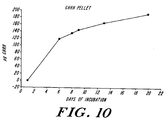
- Pellets having a length of 2 mm were placed in in-vitro baths of 1 milliliter of physiologic, buffered saline at 25° centrigrade. The amount of GHRH released was measured periodically over a period of 20 days. The pellets were placed in fresh physiological, buffered saline after each measurement. After an initial release at a slightly elevated level, the pellets released growth hormone-releasing hormone at an average of approximately 5.7 micrograms per millimeter of pellet per day (days 6-20). The results are shown in FIG 10.
- lipid carrier cholesterol acetate
- Other carriers are contemplated by the invention.
- pure cholesterol or cholesterol derivatives including cholesteric esters such as cholesterol chloride may be substituted for cholesterol acetate.
- sterol carriers other than cholesterol or bioerodable carriers with properties substantially equivalent to cholesterol and cholesterol derivatives in terms of size, lipophilicity, crystallinity and melting point may be substituted.
- Other carriers that may be substituted also include certain fatty acids and neutral fats as described above. While the steroidal carrier described in the example is essentially non-bioactive, bioactive steroidal carriers may be substituted or added and the formed pellet, thus, would deliver two bioactive molecules.
- Steroids include aldosterone, androstane, androstene, androstenedione, androsterone, cholecalciferol, cholestane, cholic acid, corticosterone, cortisol, cortisol acetate, cortisone, cortisone acetate, deoxycorticosterone, digitoxigenin, ergocalciferol, ergosterol, estradiol, 17- ⁇ , estradiol-17 ⁇ , estriol, estrane, estrone, hydrocortisone, lanosterol, lithocholic acid, mestranol, ⁇ -methasone, norethindrone, prednisolone, pregnane, pregnenolone, progesterone, spironolactone, testosterone, triamcinolone and their derivatives.
- growth hormone-releasing hormone only a particular active ingredient, growth hormone-releasing hormone, has been described in the examples.
- bioactive peptide having a higher melting point than the carrier may be substituted for growth hormone-releasing hormone.
- more than one peptide may be combined to yield a pellet capable of delivering two peptides having differing bioactivity.
- luteinizing hormone and follicle-stimulating hormone may be combined advantageously.
- small glycoproteins may be substituted or added as an active ingredient.
- constituents may be added to the pellet to advantageously affect the properties of the pellet. For example, adding or substituting substances that are less water soluble than cholesterol will cause the pellet to erode more slowly and release drug over a longer period of time. Likewise, erosion of the pellet may be quickened by substituting or adding a substance having a higher water solubility than cholesterol, such as ethyl stearate, stearic acid or fatty acids in their mono-, di- and tri-glyceride forms, as well as alcohol esters. Also, emulsifiers (such as lecithin) and antioxidants (such as Vitamin A) may be added for specific applications.
- emulsifiers such as lecithin
- antioxidants such as Vitamin A
- the apparatus and method for forming a partial melt to produce a partially-fused pellet containing a peptide may be adapted for bioactive molecules other than peptides. It is only necessary that the bioactive molecule have a lower melting temperature than the lipid carrier and that the bioactive molecule retain its bioactive properties under the conditions of forming the partial melt.
- nonpolymer While the term nonpolymer has been used to describe the carrier, it was selected in part to distinguish the carrier according to the invention from the macromolecular polymer carriers of the prior art. Thus, it is believed that very small polymers such as a dimer of a steroid may function equivalently to the "nonpolymer" carriers described above.
Landscapes
- Health & Medical Sciences (AREA)
- Engineering & Computer Science (AREA)
- Life Sciences & Earth Sciences (AREA)
- Bioinformatics & Cheminformatics (AREA)
- Animal Behavior & Ethology (AREA)
- Veterinary Medicine (AREA)
- Epidemiology (AREA)
- Medicinal Chemistry (AREA)
- Chemical & Material Sciences (AREA)
- General Health & Medical Sciences (AREA)
- Public Health (AREA)
- Pharmacology & Pharmacy (AREA)
- Biophysics (AREA)
- Molecular Biology (AREA)
- Biomedical Technology (AREA)
- Neurosurgery (AREA)
- Dermatology (AREA)
- Medicinal Preparation (AREA)
- Medicines That Contain Protein Lipid Enzymes And Other Medicines (AREA)
Claims (18)
- Teilweise geschmolzenes Pellet, das zur verzögerten Freigabe eines Peptids fähig ist, wenn es in den Körper implantiert ist, umfassend einen Peptid-Arzneistoff, homogen gebunden in eine Matrix aus einem geschmolzenen und rekristallisierten Nicht-Polymer-Träger, wobei der Peptid-Arzneistoff eine höhere Schmelztemperatur als der Nicht-Polymer-Träger hat und der Nicht-Polymer-Träger bioerodierbar, hochkristallin und lipophil ist.
- Teilweise geschmolzenes Pellet nach Anspruch 1, worin der Träger ein Steroid oder Steroidderivat ist.
- Teilweise geschmolzenes Pellet nach Anspruch 2, worin der Träger Cholesterin oder ein Cholesterinderivat ist.
- Teilweise geschmolzenes Pellet nach Anspruch 1, worin der Träger ausgewählt ist aus der Gruppe bestehend aus Cholesterin, Cholesterinacetat und Cholesterinchlorid.
- Teilweise geschmolzenes Pellet nach Anspruch 1, worin der Träger ein Steroid umfaßt, ausgewählt aus der Gruppe bestehend aus Aldosteron, Androstan, Androsten, Androstendion, Androsteron, Cholecalciferol, Cholestan, Cholsäure, Corticosteron, Cortisol, Cortisolacetat, Cortison, Cortisonacetat, Desoxycorticosteron, Digitoxigenin, Ergocalciferol, Ergosterol, Östradiol-17α, Östradiol-17β, Östriol, Östran, Östron, Hydrocortison, Lanosterol, Lithocholsäure, Mestranol, β-Methason, Norethindron, Prednisolon, Pregnan, Pregnenolon, Progesteron, Spironolacton, Testosteron, Triamcinolon und deren Derivaten.
- Teilweise geschmolzenes Pellet nach Anspruch 2, worin das Peptid ausgewählt ist aus der Gruppe bestehend aus Wachstumshormon und Wachstumshormon-Releasing Hormon, Gonadotropin-Releasing Hormon und dessen Agonisten- und Antagonisten-Analoga, Somatostatin und dessen Analoga, Gonadotropinen, wie Luteinisierungshormon und Follikel-stimulierendem Hormon, Peptid-T, Thyrocalcitonin, Parathyroid-Hormon, Glucagon, Vasopressin, Oxytocin, alpha- und beta-Melanocytenstimulierenden Hormonen, Peptidmolekülen, welche das Wachstum und die Funktion von Erythrocyten, Leukocyten und Immunocyten stimulieren, z.B. Koloniestimulierenden Faktoren (CFS 1 und 2), Erythropoietin und Lymphokinen (einschließlich Interleukin I und II), Angiotensin I und II, Bradykinin, Kallidin, adrenocorticotropem Hormon, Thyroid-stimulierendem Hormon, und Insulin.
- Teilweise geschmolzenes Pellet nach Anspruch 3, 4 oder 5, worin das Peptid ausgewählt ist aus der Gruppe bestehend aus Wachstumshormon-Faktoren, Wachstumshormon und Wachstumshormon-Releasing Hormon, Gonadotropin-Releasing Hormon und dessen Agonisten- und Antagonisten-Analoga, Somatostatin und dessen Analoga, Gonadotropinen, wie Luteinisierungshormon und Follikel-stimulierendem Hormon, Peptid-T, Thyrocalcitonin, Parathyroid-Hormon, Glucagon, Vasopressin, Oxytocin, alpha- und beta-Melanocytenstimulierenden Hormonen, Peptidmolekülen, welche das Wachstum und die Funktion von Erythrocyten, Leukocyten und Immunocyten stimulieren, z.B. Koloniestimulierenden Faktoren (CFS 1 und 2), Erythropoietin und Lymphokinen (einschließlich Interleukin I und II), Angiotensin I und II, Bradykinin, Kallidin, adrenocorticotropem Hormon, Thyroid-stimulierendem Hormon,und Insulin.
- Teilweise geschmolzenes Pellet nach Anspruch 1, worin der Träger Cholesterinacetat ist und der Peptid-Arzneistoff Wachstumshormon-Releasing Hormon ist.
- Verfahren zur Herstellung eines teilweise geschmolzenen Pellets, das zur verzögerten Freigabe eines Peptids fähig ist, wenn es in den Körper implantiert ist, umfassend
die Bildung einer homogenen Mischung eines bioerodierbaren Nicht-Polymer-Trägers mit einer ersten Schmelztemperatur und eines Peptids mit einer zweiten Schmelztemperatur, wobei die erste Schmelztemperatur niedriger ist als die zweite Schmelztemperatur,
Erwärmen der Mischung zumindest auf die erste Schmelztemperatur, um den Träger zu schmelzen, jedoch nicht auf die zweite Schmelztemperatur, so daß das Peptid nicht schmilzt, und
Abkühlenlassen der teilweise geschmolzenen Mischung zu einem gehärteten Pellet. - Verfahren zur Herstellung eines teilweise geschmolzenen Pellets, das zur verzögerten Freigabe eines Peptids fähig ist, wenn es in den Körper implantiert ist, nach Anspruch 9, ferner umfassend den Schritt des Pressens der teilweise geschmolzenen Mischung in einer Pellet-Formkammer mit einer Fluorkohlenstoff-Oberfläche unmittelbar nach dem Schmelzen des Trägers und bis zum Härten des Pellets, wodurch das gehärtete Pellet eine glatte Oberfläche entsprechend den Wänden der Pellet-Formkammer hat.
- Verfahren zur Herstellung eines teilweise geschmolzenen Pellets, das zur verzögerten Freigabe eines Peptids fähig ist, wenn es in den Körper implantiert ist, nach Anspruch 9, ferner umfassend den Schritt des Pressens der homogenen Mischung in einer Pellet-Formkammer mit einer Fluorkohlenstoff-Oberfläche vor dem Schmelzen des Trägers.
- Verfahren zur Herstellung eines teilweise geschmolzenen Pellets, das zur verzögerten Freigabe eines Peptids fähig ist, wenn es in den Körper implantiert ist, nach Anspruch 11, worin der Träger in der Pellet-Formkammer geschmolzen wird, und ferner umfassend den Schritt des Pressens der teilweise geschmolzenen Mischung in der Pellet-Formkammer unmittelbar nach dem Schmelzen des Trägers und bis zur Härtung des Pellets, wodurch das gehärtete Pellet eine glatte Oberfläche entsprechend den Wänden der Pellet-Formkammer hat.
- Verfahren zur Herstellung eines teilweise geschmolzenen Pellets, das zur verzögerten Freigabe eines Peptids fähig ist, wenn es in den Körper implantiert ist, nach Anspruch 9, umfassend die Schritte:
Bilden einer alkoholischen Paste der homogenen Mischung,
anschließendes Eingeben einer bestimmten Menge der Paste in eine Pellet-Formkammer und
dann Trocknenlassen der Paste, wobei der Alkohol aus der Paste verdampft und den Träger und das Peptid in der Pellet-Formkammer zurückläßt, wobei die vorgenannten Schritte vor dem Formen der teilweise geschmolzenen Mischung in der Pellet-Formkammer durchgeführt werden. - Verfahren zur Herstellung eines teilweise geschmolzenen Pellets, das zur verzögerten Freigabe eines Peptids fähig ist, wenn es in den Körper implantiert ist, nach Anspruch 12, worin die homogene Mischung mit etwa 15 mPa (2200 psi) für etwa 3 Sekunden gepreßt wird und die teilweise geschmolzene Lösung mit etwa 1 mPa (150 psi) für etwa 6 Sekunden gepreßt wird.
- Verfahren zur Herstellung eines teilweise geschmolzenen Pellets, das zur verzögerten Freigabe eines Peptids fähig ist, wenn es in den Körper implantiert ist, nach Anspruch 9, worin die homogene Mischung unter Verwendung von Cholesterin oder eines Cholesterinderivats als Träger gebildet wird.
- Verfahren zur Herstellung eines teilweise geschmolzenen Pellets, das zur verzögerten Freigabe eines Peptids fähig ist, wenn es in den Körper implantiert ist, nach Anspruch 9 oder 13, worin die homogene Mischung unter Verwendung eines Peptids gebildet wird, das ausgewählt ist aus der Gruppe bestehend aus Wachstumshormon und Wachstumshormon-Releasing Hormon, Gonadotropin-Releasing Hormon und dessen Agonisten- und Antagonisten-Analoga, Somatostatin und dessen Analoga, Gonadotropinen, wie Luteinisierungshormon und Follikel-stimulierendem Hormon, Peptid-T, Thyrocalcitonin, Parathyroid-Hormon, Glucagon, Vasopressin, Oxytocin, alpha- und beta-Melanocyten-stimulierenden Hormonen, Peptidmolekülen, welche das Wachstum und die Funktion von Erythrocyten, Leukocyten und Immunocyten stimulieren, z.B. Koloniestimulierenden Faktoren (CFS 1 und 2), Erythropoietin und Lymphokinen (einschließlich Interleukin I und II), Angiotensin I und II, Bradykinin, Kallidin, adrenocorticotropem Hormon, Thyroid-stimulierendem Hormon und Insulin.
- Verfahren zur Herstellung eines teilweise geschmolzenen Pellets, das zur verzögerten Freigabe eines Peptids fähig ist, wenn es in den Körper implantiert ist, umfassend
Bilden einer homogenen Mischung eines bioerodierbaren, lipophilen Nicht-Polymer-Trägers und eines Peptids, wobei der Nicht-Polymer-Träger eine niedrigere Schmelztemperatur hat als das Peptid,
Einführen einer abgemessenen Menge der Mischung in ein Rohr mit einer Öffnung und mindestens einer Innenoberfläche aus Fluorkohlenstoff,
Verschließen eines Endes des Rohres mit einem Stopfen, der so dimensioniert ist, daß er in einen Teil der Öffnung vollständig und dicht eingepaßt ist,
Positionieren des Rohres derart, daß das verstopfte Ende an eine feste Oberfläche anstößt,
Einführen eines Preßstiftes in die Öffnung am entgegengesetzten Ende des Rohres,
Pressen der Mischung durch Druckbeaufschlagung über den Preßstift,
Einbringen des Rohres in einen Ofen, der zumindest auf die Schmelztemperatur des Trägers erhitzt ist,
Belassen des Rohres in dem Ofen über ausreichende Zeit, damit sich eine teilweise geschmolzene Suspension bildet, wobei im wesentlichen der gesamte Träger geschmolzen ist und im wesentlichen das gesamte Peptid nicht geschmolzen ist,
Entfernen des Rohres aus dem Ofen,
Positionieren des Rohres derart, daß das verstopfte Ende an eine feste Oberfläche anstößt,
Druckbeaufschlagung der teilweise geschmolzenen Suspension über den Preßstift, während die teilweise geschmolzene Suspension zu einem gehärteten Pellet abkühlt, wobei der Träger eine Kristallmatrix bildet, welche das Peptid einschließt. - Teilweise geschmolzenes Pellet zur Implantation in den Körper, dadurch gekennzeichnet, daß das teilweise geschmolzene Pellet einen Peptid-Arzneistoff enthält, der in einer Matrix aus einem geschmolzenen und rekristallisierten Nicht-Polymer-Träger gebunden ist.
Priority Applications (1)
| Application Number | Priority Date | Filing Date | Title |
|---|---|---|---|
| AT89905911T ATE106238T1 (de) | 1989-03-09 | 1989-03-09 | Teilweise geschmolzenes peptidpellet. |
Applications Claiming Priority (2)
| Application Number | Priority Date | Filing Date | Title |
|---|---|---|---|
| PCT/US1989/000949 WO1990010437A1 (en) | 1989-03-09 | 1989-03-09 | Partially fused peptide pellet |
| CA000594474A CA1337588C (en) | 1989-03-09 | 1989-03-22 | Partially fused pellet as a subcutaneous drug delivery |
Publications (3)
| Publication Number | Publication Date |
|---|---|
| EP0461108A1 EP0461108A1 (de) | 1991-12-18 |
| EP0461108A4 EP0461108A4 (en) | 1992-03-18 |
| EP0461108B1 true EP0461108B1 (de) | 1994-06-01 |
Family
ID=25672543
Family Applications (1)
| Application Number | Title | Priority Date | Filing Date |
|---|---|---|---|
| EP89905911A Expired - Lifetime EP0461108B1 (de) | 1989-03-09 | 1989-03-09 | Teilweise geschmolzenes peptidpellet |
Country Status (5)
| Country | Link |
|---|---|
| EP (1) | EP0461108B1 (de) |
| CN (1) | CN1046098A (de) |
| CA (1) | CA1337588C (de) |
| DE (1) | DE68915784T2 (de) |
| WO (1) | WO1990010437A1 (de) |
Families Citing this family (8)
| Publication number | Priority date | Publication date | Assignee | Title |
|---|---|---|---|---|
| HUT69680A (en) * | 1990-08-09 | 1995-09-28 | Endocon Inc | Implant and apparatus for delivering multiple drug and process for production of theese |
| HUT67238A (en) * | 1991-05-14 | 1995-03-28 | Endocon Inc | Controlled realising implant preparations |
| WO1993023012A1 (en) * | 1992-05-14 | 1993-11-25 | Endocon, Inc. | Liquid-containing drug delivery system |
| CN101787347B (zh) * | 2009-12-30 | 2012-12-26 | 华东医学生物技术研究所 | 一种通过温度控制反应进程的反应管 |
| WO2018064556A1 (en) | 2016-09-29 | 2018-04-05 | Gesea Biosciences Inc. | Bioerodible implant for long-term drug delivery and associated methods of manufacture and use |
| US12473326B2 (en) | 2019-02-01 | 2025-11-18 | Ripple Therapeutics Corporation | Crystalline forms of dexamethasone dimers and uses thereof |
| JP2022541341A (ja) * | 2019-07-25 | 2022-09-22 | リップル セラピューティクス コーポレーション | ステロイド二量体を含む物品と治療剤の送達におけるそれらの使用 |
| US20220347305A1 (en) | 2019-08-07 | 2022-11-03 | Ripple Therapeutics Corporation | Controlled release drug dimers |
Family Cites Families (11)
| Publication number | Priority date | Publication date | Assignee | Title |
|---|---|---|---|---|
| US4391797A (en) * | 1977-01-05 | 1983-07-05 | The Children's Hospital Medical Center | Systems for the controlled release of macromolecules |
| US4164560A (en) * | 1977-01-05 | 1979-08-14 | Folkman Moses J | Systems for the controlled release of macromolecules |
| DE3378250D1 (en) * | 1982-04-22 | 1988-11-24 | Ici Plc | Continuous release formulations |
| US4452775A (en) * | 1982-12-03 | 1984-06-05 | Syntex (U.S.A.) Inc. | Cholesterol matrix delivery system for sustained release of macromolecules |
| US4591496A (en) * | 1984-01-16 | 1986-05-27 | Massachusetts Institute Of Technology | Process for making systems for the controlled release of macromolecules |
| US4659693A (en) * | 1984-04-30 | 1987-04-21 | Syntex (U.S.A.) Inc. | N,N'-dialkyl substituted guanidino amino acyl residue substituted GRF-analog peptides |
| US4690916A (en) * | 1984-11-13 | 1987-09-01 | Syntex (U.S.A.) Inc. | Nona and decapeptide analogs of LHRH useful as LHRH antagonists |
| US4686283A (en) * | 1985-04-16 | 1987-08-11 | Syntex (U.S.A.) Inc. | Analogs of transforming and epidermal growth factor fragments for therapy and diagnosis |
| CA1257199A (en) * | 1986-05-20 | 1989-07-11 | Paul Y. Wang | Preparation containing bioactive macromolecular substance for multi-months release in vivo |
| US4801577A (en) * | 1987-02-05 | 1989-01-31 | Syntex (U.S.A.) Inc. | Nonapeptide and decapeptide analogs of LHRH useful as LHRH antagonists |
| EP0357644B1 (de) * | 1987-04-06 | 1994-08-17 | Aberlyn Capital Management Limited Partnership | Durch schnellschmelzen hergestellte medizinische implantate |
-
1989
- 1989-03-09 EP EP89905911A patent/EP0461108B1/de not_active Expired - Lifetime
- 1989-03-09 DE DE68915784T patent/DE68915784T2/de not_active Expired - Fee Related
- 1989-03-09 WO PCT/US1989/000949 patent/WO1990010437A1/en not_active Ceased
- 1989-03-22 CA CA000594474A patent/CA1337588C/en not_active Expired - Fee Related
- 1989-04-07 CN CN89102237.6A patent/CN1046098A/zh active Pending
Also Published As
| Publication number | Publication date |
|---|---|
| WO1990010437A1 (en) | 1990-09-20 |
| EP0461108A1 (de) | 1991-12-18 |
| DE68915784T2 (de) | 1994-09-29 |
| DE68915784D1 (de) | 1994-07-07 |
| CN1046098A (zh) | 1990-10-17 |
| EP0461108A4 (en) | 1992-03-18 |
| CA1337588C (en) | 1995-11-21 |
Similar Documents
| Publication | Publication Date | Title |
|---|---|---|
| US5039660A (en) | Partially fused peptide pellet | |
| US5137669A (en) | Manufacture of partially fused peptide pellet | |
| CA1257199A (en) | Preparation containing bioactive macromolecular substance for multi-months release in vivo | |
| US3800038A (en) | Uterine administraton of eutectic solid solutions of steroid hormones in a steroidal lipid carrier | |
| US11833244B2 (en) | Bioerodible implant for long-term drug delivery and associated methods of manufacture and use | |
| WO1992011843A1 (en) | Bioerodible devices and compositions for diffusional release of agents | |
| CN104323981A (zh) | 基本稳态药物递送的快速建立和/或终止 | |
| US6238702B1 (en) | High load formulations and methods for providing prolonged local anesthesia | |
| CN101816662A (zh) | 由雌二醇和胆固醇组成的稳定形状颗粒的制备方法 | |
| CA1337588C (en) | Partially fused pellet as a subcutaneous drug delivery | |
| US4892734A (en) | Dispensing paste for forming medicinal pellets | |
| CA1330940C (en) | Dispensing paste for forming medicinal pellets | |
| HUT69680A (en) | Implant and apparatus for delivering multiple drug and process for production of theese | |
| Beck et al. | Controlled-release delivery systems for hormones: a review of their properties and current therapeutic use | |
| EP0357644B1 (de) | Durch schnellschmelzen hergestellte medizinische implantate | |
| JPH04506508A (ja) | 部分融合ペプチドペレット | |
| US5688519A (en) | Flash-flow fused medicinal implants | |
| EP3943073B1 (de) | Biologisch abbaubares polymermikropartikel mit einem steroidbasierten arzneimittel und verfahren zu seiner herstellung | |
| Simon | Estrogen pharmacokinetics: interindividual variations | |
| CN1037456A (zh) | 快速流动融合的药物植入剂 | |
| WO2008015238A2 (en) | Subcutaneous implants releasing an active principle over an extended period of time |
Legal Events
| Date | Code | Title | Description |
|---|---|---|---|
| PUAI | Public reference made under article 153(3) epc to a published international application that has entered the european phase |
Free format text: ORIGINAL CODE: 0009012 |
|
| 17P | Request for examination filed |
Effective date: 19910823 |
|
| AK | Designated contracting states |
Kind code of ref document: A1 Designated state(s): AT BE CH DE FR GB IT LI LU NL SE |
|
| A4 | Supplementary search report drawn up and despatched |
Effective date: 19920129 |
|
| AK | Designated contracting states |
Kind code of ref document: A4 Designated state(s): AT BE CH DE FR GB IT LI LU NL SE |
|
| 17Q | First examination report despatched |
Effective date: 19930212 |
|
| GRAA | (expected) grant |
Free format text: ORIGINAL CODE: 0009210 |
|
| AK | Designated contracting states |
Kind code of ref document: B1 Designated state(s): AT BE CH DE FR GB IT LI LU NL SE |
|
| REF | Corresponds to: |
Ref document number: 106238 Country of ref document: AT Date of ref document: 19940615 Kind code of ref document: T |
|
| REF | Corresponds to: |
Ref document number: 68915784 Country of ref document: DE Date of ref document: 19940707 |
|
| ET | Fr: translation filed | ||
| ITF | It: translation for a ep patent filed | ||
| EAL | Se: european patent in force in sweden |
Ref document number: 89905911.7 |
|
| K2C2 | Correction of patent specification (partial reprint) published |
Effective date: 19940601 |
|
| PG25 | Lapsed in a contracting state [announced via postgrant information from national office to epo] |
Ref country code: LU Free format text: LAPSE BECAUSE OF NON-PAYMENT OF DUE FEES Effective date: 19950331 |
|
| PLBE | No opposition filed within time limit |
Free format text: ORIGINAL CODE: 0009261 |
|
| STAA | Information on the status of an ep patent application or granted ep patent |
Free format text: STATUS: NO OPPOSITION FILED WITHIN TIME LIMIT |
|
| K2C2 | Correction of patent specification (partial reprint) published |
Effective date: 19940601 |
|
| 26N | No opposition filed | ||
| NLR4 | Nl: receipt of corrected translation in the netherlands language at the initiative of the proprietor of the patent | ||
| BERE | Be: lapsed |
Owner name: ENDOCON INC. Effective date: 19960331 |
|
| GBPC | Gb: european patent ceased through non-payment of renewal fee |
Effective date: 19960309 |
|
| REG | Reference to a national code |
Ref country code: CH Ref legal event code: PL |
|
| NLV4 | Nl: lapsed or anulled due to non-payment of the annual fee |
Effective date: 19961001 |
|
| EUG | Se: european patent has lapsed |
Ref document number: 89905911.7 |
|
| REG | Reference to a national code |
Ref country code: CH Ref legal event code: AEN Free format text: LA POURSUITE DE LA PROCEDURE REQUISE LE 15.11.1996 A ETEACCORDEE. LE BREVET EST REACTIVE. |
|
| REG | Reference to a national code |
Ref country code: GB Ref legal event code: 728V |
|
| REG | Reference to a national code |
Ref country code: FR Ref legal event code: ST |
|
| NLXE | Nl: other communications concerning ep-patents (part 3 heading xe) |
Free format text: A REQUEST FOR RESTORATION TO THE PRIOR STATE HAS BEEN FILED ON 961216 |
|
| REG | Reference to a national code |
Ref country code: CH Ref legal event code: AEN Free format text: POURSUITE DE LA PROCEDURE ACCORDEE |
|
| REG | Reference to a national code |
Ref country code: GB Ref legal event code: 728Y |
|
| REG | Reference to a national code |
Ref country code: FR Ref legal event code: RN |
|
| REG | Reference to a national code |
Ref country code: FR Ref legal event code: FC |
|
| PGFP | Annual fee paid to national office [announced via postgrant information from national office to epo] |
Ref country code: BE Payment date: 19971028 Year of fee payment: 9 |
|
| NLXE | Nl: other communications concerning ep-patents (part 3 heading xe) |
Free format text: THE REQUEST FOR RESTORATION TO THE PRIOR STATE AS PROVIDED FOR IN ART.17A OF PATENTS ACT(SEE PUBLICATION IN HEADING XE OF THE PATENT BULLETIN OF 030297/02)HAS BEEN GRANTED;THE RESTORATION OF THE PATENT HAS BEEN ENTERED IN THE PATENT REGISTER |
|
| BERR | Be: reestablished | ||
| PG25 | Lapsed in a contracting state [announced via postgrant information from national office to epo] |
Ref country code: BE Free format text: LAPSE BECAUSE OF NON-PAYMENT OF DUE FEES Effective date: 19980331 |
|
| BERE | Be: lapsed |
Owner name: ENDOCON INC. Effective date: 19980331 |
|
| PGFP | Annual fee paid to national office [announced via postgrant information from national office to epo] |
Ref country code: AT Payment date: 20000911 Year of fee payment: 12 |
|
| PGFP | Annual fee paid to national office [announced via postgrant information from national office to epo] |
Ref country code: SE Payment date: 20000920 Year of fee payment: 12 |
|
| PG25 | Lapsed in a contracting state [announced via postgrant information from national office to epo] |
Ref country code: AT Free format text: LAPSE BECAUSE OF NON-PAYMENT OF DUE FEES Effective date: 20010309 |
|
| PG25 | Lapsed in a contracting state [announced via postgrant information from national office to epo] |
Ref country code: SE Free format text: THE PATENT HAS BEEN ANNULLED BY A DECISION OF A NATIONAL AUTHORITY Effective date: 20010330 |
|
| EUG | Se: european patent has lapsed |
Ref document number: 89905911.7 |
|
| REG | Reference to a national code |
Ref country code: GB Ref legal event code: IF02 |
|
| PGFP | Annual fee paid to national office [announced via postgrant information from national office to epo] |
Ref country code: GB Payment date: 20030822 Year of fee payment: 15 |
|
| PGFP | Annual fee paid to national office [announced via postgrant information from national office to epo] |
Ref country code: CH Payment date: 20030825 Year of fee payment: 15 |
|
| PGFP | Annual fee paid to national office [announced via postgrant information from national office to epo] |
Ref country code: FR Payment date: 20030826 Year of fee payment: 15 |
|
| PGFP | Annual fee paid to national office [announced via postgrant information from national office to epo] |
Ref country code: NL Payment date: 20030828 Year of fee payment: 15 |
|
| PGFP | Annual fee paid to national office [announced via postgrant information from national office to epo] |
Ref country code: DE Payment date: 20030901 Year of fee payment: 15 |
|
| PG25 | Lapsed in a contracting state [announced via postgrant information from national office to epo] |
Ref country code: GB Free format text: LAPSE BECAUSE OF NON-PAYMENT OF DUE FEES Effective date: 20040309 |
|
| PG25 | Lapsed in a contracting state [announced via postgrant information from national office to epo] |
Ref country code: LI Free format text: LAPSE BECAUSE OF NON-PAYMENT OF DUE FEES Effective date: 20040331 Ref country code: CH Free format text: LAPSE BECAUSE OF NON-PAYMENT OF DUE FEES Effective date: 20040331 |
|
| PG25 | Lapsed in a contracting state [announced via postgrant information from national office to epo] |
Ref country code: NL Free format text: LAPSE BECAUSE OF NON-PAYMENT OF DUE FEES Effective date: 20041001 Ref country code: DE Free format text: LAPSE BECAUSE OF NON-PAYMENT OF DUE FEES Effective date: 20041001 |
|
| GBPC | Gb: european patent ceased through non-payment of renewal fee | ||
| REG | Reference to a national code |
Ref country code: CH Ref legal event code: PL |
|
| PG25 | Lapsed in a contracting state [announced via postgrant information from national office to epo] |
Ref country code: FR Free format text: LAPSE BECAUSE OF NON-PAYMENT OF DUE FEES Effective date: 20041130 |
|
| NLV4 | Nl: lapsed or anulled due to non-payment of the annual fee |
Effective date: 20041001 |
|
| REG | Reference to a national code |
Ref country code: FR Ref legal event code: ST |
|
| PG25 | Lapsed in a contracting state [announced via postgrant information from national office to epo] |
Ref country code: IT Free format text: LAPSE BECAUSE OF NON-PAYMENT OF DUE FEES;WARNING: LAPSES OF ITALIAN PATENTS WITH EFFECTIVE DATE BEFORE 2007 MAY HAVE OCCURRED AT ANY TIME BEFORE 2007. THE CORRECT EFFECTIVE DATE MAY BE DIFFERENT FROM THE ONE RECORDED. Effective date: 20050309 |