EP0462504A2 - Procédé de revêtement d'un matériau, finement divisé avec du dioxyde de titane et matériaux luminscents à base de sulfure de zinc insensibles à l'humidité fabriqués ainsi - Google Patents
Procédé de revêtement d'un matériau, finement divisé avec du dioxyde de titane et matériaux luminscents à base de sulfure de zinc insensibles à l'humidité fabriqués ainsi Download PDFInfo
- Publication number
- EP0462504A2 EP0462504A2 EP91109665A EP91109665A EP0462504A2 EP 0462504 A2 EP0462504 A2 EP 0462504A2 EP 91109665 A EP91109665 A EP 91109665A EP 91109665 A EP91109665 A EP 91109665A EP 0462504 A2 EP0462504 A2 EP 0462504A2
- Authority
- EP
- European Patent Office
- Prior art keywords
- phosphor
- titania
- coating
- particles
- fluidized bed
- Prior art date
- Legal status (The legal status is an assumption and is not a legal conclusion. Google has not performed a legal analysis and makes no representation as to the accuracy of the status listed.)
- Granted
Links
Images



Classifications
-
- C—CHEMISTRY; METALLURGY
- C09—DYES; PAINTS; POLISHES; NATURAL RESINS; ADHESIVES; COMPOSITIONS NOT OTHERWISE PROVIDED FOR; APPLICATIONS OF MATERIALS NOT OTHERWISE PROVIDED FOR
- C09K—MATERIALS FOR MISCELLANEOUS APPLICATIONS, NOT PROVIDED FOR ELSEWHERE
- C09K11/00—Luminescent materials, e.g. electroluminescent or chemiluminescent
- C09K11/08—Luminescent materials, e.g. electroluminescent or chemiluminescent containing inorganic luminescent materials
- C09K11/58—Luminescent materials, e.g. electroluminescent or chemiluminescent containing inorganic luminescent materials containing copper, silver or gold
- C09K11/582—Chalcogenides
- C09K11/584—Chalcogenides with zinc or cadmium
-
- C—CHEMISTRY; METALLURGY
- C09—DYES; PAINTS; POLISHES; NATURAL RESINS; ADHESIVES; COMPOSITIONS NOT OTHERWISE PROVIDED FOR; APPLICATIONS OF MATERIALS NOT OTHERWISE PROVIDED FOR
- C09K—MATERIALS FOR MISCELLANEOUS APPLICATIONS, NOT PROVIDED FOR ELSEWHERE
- C09K11/00—Luminescent materials, e.g. electroluminescent or chemiluminescent
- C09K11/02—Use of particular materials as binders, particle coatings or suspension media therefor
- C09K11/025—Use of particular materials as binders, particle coatings or suspension media therefor non-luminescent particle coatings or suspension media
-
- C—CHEMISTRY; METALLURGY
- C23—COATING METALLIC MATERIAL; COATING MATERIAL WITH METALLIC MATERIAL; CHEMICAL SURFACE TREATMENT; DIFFUSION TREATMENT OF METALLIC MATERIAL; COATING BY VACUUM EVAPORATION, BY SPUTTERING, BY ION IMPLANTATION OR BY CHEMICAL VAPOUR DEPOSITION, IN GENERAL; INHIBITING CORROSION OF METALLIC MATERIAL OR INCRUSTATION IN GENERAL
- C23C—COATING METALLIC MATERIAL; COATING MATERIAL WITH METALLIC MATERIAL; SURFACE TREATMENT OF METALLIC MATERIAL BY DIFFUSION INTO THE SURFACE, BY CHEMICAL CONVERSION OR SUBSTITUTION; COATING BY VACUUM EVAPORATION, BY SPUTTERING, BY ION IMPLANTATION OR BY CHEMICAL VAPOUR DEPOSITION, IN GENERAL
- C23C16/00—Chemical coating by decomposition of gaseous compounds, without leaving reaction products of surface material in the coating, i.e. chemical vapour deposition [CVD] processes
- C23C16/22—Chemical coating by decomposition of gaseous compounds, without leaving reaction products of surface material in the coating, i.e. chemical vapour deposition [CVD] processes characterised by the deposition of inorganic material, other than metallic material
- C23C16/30—Deposition of compounds, mixtures or solid solutions, e.g. borides, carbides, nitrides
- C23C16/40—Oxides
- C23C16/405—Oxides of refractory metals or yttrium
-
- C—CHEMISTRY; METALLURGY
- C23—COATING METALLIC MATERIAL; COATING MATERIAL WITH METALLIC MATERIAL; CHEMICAL SURFACE TREATMENT; DIFFUSION TREATMENT OF METALLIC MATERIAL; COATING BY VACUUM EVAPORATION, BY SPUTTERING, BY ION IMPLANTATION OR BY CHEMICAL VAPOUR DEPOSITION, IN GENERAL; INHIBITING CORROSION OF METALLIC MATERIAL OR INCRUSTATION IN GENERAL
- C23C—COATING METALLIC MATERIAL; COATING MATERIAL WITH METALLIC MATERIAL; SURFACE TREATMENT OF METALLIC MATERIAL BY DIFFUSION INTO THE SURFACE, BY CHEMICAL CONVERSION OR SUBSTITUTION; COATING BY VACUUM EVAPORATION, BY SPUTTERING, BY ION IMPLANTATION OR BY CHEMICAL VAPOUR DEPOSITION, IN GENERAL
- C23C16/00—Chemical coating by decomposition of gaseous compounds, without leaving reaction products of surface material in the coating, i.e. chemical vapour deposition [CVD] processes
- C23C16/44—Chemical coating by decomposition of gaseous compounds, without leaving reaction products of surface material in the coating, i.e. chemical vapour deposition [CVD] processes characterised by the method of coating
- C23C16/442—Chemical coating by decomposition of gaseous compounds, without leaving reaction products of surface material in the coating, i.e. chemical vapour deposition [CVD] processes characterised by the method of coating using fluidised bed process
-
- H—ELECTRICITY
- H05—ELECTRIC TECHNIQUES NOT OTHERWISE PROVIDED FOR
- H05B—ELECTRIC HEATING; ELECTRIC LIGHT SOURCES NOT OTHERWISE PROVIDED FOR; CIRCUIT ARRANGEMENTS FOR ELECTRIC LIGHT SOURCES, IN GENERAL
- H05B33/00—Electroluminescent light sources
- H05B33/12—Light sources with substantially two-dimensional [2D] radiating surfaces
- H05B33/14—Light sources with substantially two-dimensional [2D] radiating surfaces characterised by the chemical or physical composition or the arrangement of the electroluminescent material, or by the simultaneous addition of the electroluminescent material in or onto the light source
Definitions
- Titania titanium dioxide, TiO2
- TiO2 titanium dioxide
- titania and titania-coated surfaces are employed in a wide range of commercial and industrial applications including the catalysis and photocatalysis of chemical reactions, pigmentation, the filtering or reflection of electromagnetic radiation, modification of the electrical properties of surfaces, chemical resistance and absorbancy, and so forth.
- Vast quantities of pure titania and of titania-coated materials are employed around the world in such applications.
- the great commercial importance of titania and titania-modified materials provides the motivation behind research and development efforts directed towards new and improved techniques for the creation and processing of such materials.
- zinc sulfide-based phosphors may be stimulated to emit visible light either by the absorption of ultraviolet radiation (as in a fluorescent lamp) or by the use of electrical energy in a so-called electroluminescent lamp, where a layer of the phosphor is sandwiched between a front transparent electrode and a back non-transparent electrode, with a layer of insulating material (typically barium titanate) sandwiched between the phosphor layer and the back electrode.
- insulating material typically barium titanate
- the luminescent efficiency of the phosphor degrades much more rapidly if the phosphor is exposed to a moisture-containing atmosphere than if it is exposed only to a very dry atmosphere (while being stimulated by ultraviolet radiation or by the application of an alternating electromagnetic field).
- the formation of a thin continuous and conformal coating of titania on the surfaces of zinc sulfide phosphor particles protects the particles from the effects of atmospheric moisture.
- Continuous and conformal titania films may be formed by a variety of processes including the oxidation of evaporated titanium films, the reactive sputtering of titanium in an oxygen-containing atmosphere, the anodic oxidation of a titanium surface, and by the oxidation of a gaseous titanium compound such as titanium tetrachloride or titanium isopropoxide (Ti[(CH3)2CHO]4).
- a gaseous titanium compound such as titanium tetrachloride or titanium isopropoxide (Ti[(CH3)2CHO]4
- the gas-phase oxidation of a titanium compound to form a titanium oxide film is an example of chemical vapor deposition (CVD).
- Such reactive CVD processes with inorganic or organometallic titanium precursors typically require relatively high temperatures (in the vicinity of 400°C or above) and they typically require a source of gaseous oxygen, in addition to the gaseous titanium-containing precursor.
- the disclosed invention provides a method for the formation of continuous and conformal titania coatings of any desired thickness upon the surfaces of finely divided materials without exposing the powdered material to an oxidizing atmosphere and without exposing the material to temperatures in excess of 300°C.
- a method for forming a continuous coating of titania on particles of a phosphor powder comprising: a) vaporizing titanium isopropoxide in an inert carrier gas to form a carrier gas containing vaporized titanium isopropoxide; b) passing said carrier gas containing vaporised titanium isopropoxide through particles of a phosphor powder to form a fluidized bed in which the particles of the phosphor powder are suspended in the carrier gas and to envelop the fluidized particles in the carrier gas containing titanium isopropoxide said fluidized bed being maintained at a nearly isothermal condition at a temperature of approximately 300°C or less; c) reacting the vaporized titanium isopropoxide on the particles of the phosphor powder to from a coating of titania of predetermined thickness on the particles.
- a particle of a finely divided phosphor having a coating comprising a layer of titania which surrounds the particle.
- an electroluminescent device comprising: a first transparent electrode and a second electrode; a electroluminescent phosphor layer disposed between said first electrode and second electrode wherein said phosphor layer comprises titania coated zinc sulfide phosphor; and a transparent substrate supporting said first electrode, said first electrode being disposed between said transparent substrate and said phosphor layer.
- FIG. 1 shows the apparatus used to carry out the method of the present invention.
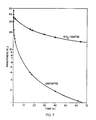
- FIG. 2 shows the relative brightness of visible light emitted by titania coated and uncoated copper activated zinc sulfide phosphors under high relative humidity conditions.
- FIG. 3 shows a schematic of an electroluminescent lamp made from titania coated copper activated zinc sulfide phosphors.
- FIG. 4 shows brightness versus time profiles of unpackaged electroluminescent lamps containing uncoated copper activated zinc sulfide phosphor for dry and humid ambient conditions.
- FIG. 5 shows brightness versus time profiles of unpackaged electroluminescent lamps containing titania coated copper activated zinc sulfide phosphor for dry and humid ambient conditions.
- FIG. 6 shows brightness versus time profiles of unpackaged electroluminescent lamps containing titania coated and uncoated copper activated zinc sulfide phosphors in humid ambient conditions.
- FIG. 7 shows brightness versus time profiles of unpackaged electroluminescent lamps containing titania coated and uncoated copper activated zinc sulfide phosphors in humid ambient conditions.
- FIG. 1 shows the apparatus used to implement the method of the present invention.
- the finely divided material 16 is suspended in a gas-fluidized bed 15 using an inert carrier gas such as nitrogen or argon. Titanium isopropoxide (Ti[(CH3)2CHO]4) is used as the organometallic coating precursor.
- an inert carrier gas such as nitrogen or argon. Titanium isopropoxide (Ti[(CH3)2CHO]4) is used as the organometallic coating precursor.
- Ti[(CH3)2CHO]4 Titanium isopropoxide
- Prior to entering the fluidized bed 15 through distributor 14 part or all of the inert carrier gas is passed through the bubbler 12 through line 11. The remaining carrier gas is passed through line 111 to the fluidized bed.
- Valves 54 and 55 are used to control the flow rates of the inert gas passed through the bubbler and the inert gas which bypasses the bubbler.
- the bubbler 12 is filled with liquid titanium isopropoxide (TIP) heated by heating tape or other means (not shown) to a temperature high enough to produce a TIP equilibrium vapor pressure sufficient to yield a desired coating rate.
- TIP liquid titanium isopropoxide
- the bubbler temperature is typically between 100°C and 140°C.
- the portion of the fluidizing gas line located between the bubbler outlet and the fluidized bed inlet is heated to a temperature a few degrees above the bubbler temperature by heating tape 30 in order to prevent condensation of the TIP within the gas lines.
- the fluidized bed itself is heated to a temperature of approximately 300°C or less by means of an external furnace 20.
- Thermocouples (not shown) positioned at various heights within the fluidized powder bed 15 are used to verify that an essentially isothermal condition exists within the bed during the coating process.
- An agitator (not shown) can be used to aid in the fluidization of the particles.
- the highest coating efficiencies are obtained with fluidized bed temperatures between 250°C and 300°C.
- Optimal coating efficiencies are obtained if the first few minutes of the coating process are carried out with a fluidized bed temperature in the vicinity of 300°C, with the remainder of the coating process proceeding at a temperature in the vicinity of 250°C.
- the titania coatings formed under these conditions are both continuous and conformal. The coating thickness increases linearly with coating time.
- the TIP bubbler temperature was 120°C the fluidized bed diameter was 3.5 cm
- the fluidizing gas bubbler gas and carrier gas
- the fluidizing gas flow rate was 0.75 1/min. Two-thirds of the fluidizing gas passed through the TIP bubbler on its way to the inlet of the fluidized powder bed, one third of the fluidizing gas bypassed the bubbler through line 111 and valve 55.
- the titania-coated finely divided calcium halophosphate materials described in Example 1 were examined by high resolution scanning electron microscopy. Also examined was a sample of the uncoated halophosphate. Even at magnifications as high as 50,000X, no differences were detected in the scanning electron micrographs obtained with the uncoated and coated materials. Since two of the coated materials contained in excess of 3 w/o TiO2, enough to form relatively thick coatings upon the surfaces of the halophosphate particles, it was concluded that the titania coatings are conformal. They conform to the contoured surface features of the underlying halophosphate particles.
- Titania is an excellent filter for ultraviolet light, the property responsible for its wide use as an ingredient of sun-screen products.
- the thicker the titania coating the more the incident ultraviolet radiation will be absorbed before it reaches the interface between the coating and the halophosphate.
- the thicker the coating the lower the intensity of the visible light emitted by the titania-coated halophosphate material.
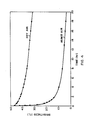
- the visible light emitted by the halophosphate decreases approximately logarithmically with increasing w/o TiO2 i.e., with increasing thickness of the titania coating. Further, all of the incident ultraviolet radiation is apparently absorbed by the titania coatings present in the materials containing at least 3 w/o TiO2. These data demonstrate that the coatings are continuous i.e., that they cover the entire surface of the underlying finely divided material.
- the titania-coated calcium halophosphate materials described in Example 1 were also examined via x-ray photoelectron spectroscopy.
- the relative atomic concentrations of titanium, oxygen, calcium, and phosphorous detected on or near the surface of each coated material are listed in Table 3. In each case, the data have been normalized by dividing by the quantities corresponding to the photoelectron detected from the surface oxygen. Also shown are the corresponding data obtained with a sample of the uncoated calcium halophosphate material.
- the relative surface concentration of titanium increases and the surface concentrations of calcium and phosphorous decrease as the amount of titania applied to the surface of the finely divided material increases. Further, no calcium or phosphorous could be detected at or near to the surfaces of the materials containing at least 3 w/o TiO2. Moreover, for these materials, the measured Ti:O atomic ratio is close to that expected for titanium dioxide.
- the quantity of titania produced during the coating process increases linearly with coating time.
- Example 5 The materials described in Example 5 were all examined by x-ray photoelectron spectroscopy in order to determine their surface compositions. Also examined was a sample of the virgin (uncoated) ZnS:Cu phosphor. The measured XPS intensities were analyzed to yield the atomic percent data listed in Table 5. As indicated in Table 5, no sulfur or copper was detected in the materials containing more than 0.26 w/o TiO2. Further, only a very small amount of zinc was detected in any of these materials. On the other hand, high concentrations of titanium and oxygen were detected in all of the coated materials. These data indicate that, for materials containing more than about 0.26 w/o TiO2, the surfaces of the ZnS:Cu particles are coated with a virtually continuous layer of titanium dioxide.
- a pressed sample of the TiO2-coated material described in Example 5 (Run #6) processed for 1/4 hour (containing 0.26 w/o titania) and a pressed sample of the virgin (uncoated) phosphor were both exposed to a broadband source of ultraviolet radiation centered at about 365 nm. Both materials were exposed to room air of relatively high humidity throughout the test. Periodically, the brightnesses of the visible light emitted by the two samples were measured relative to that of a fresh sample of the virgin phosphor. The relative brightnesses of the two samples (expressed as a percentage of the brightness of a fresh sample of uncoated phosphor) are plotted as a function of time of exposure to the 365 nm UV source in Figure 2.
- the brightness of the uncoated phosphor decreases rapidly with increasing time of exposure to ultraviolet light. This loss in brightness is also accompanied by a darkening of the material thought to be due to the deposition of finely-divided metallic zinc.
- the brightness of the TiO2-coated phosphor does not decrease with prolonged exposure to UV radiation. Further, the brightness of the coated phosphor is about 30% greater than that of the virgin phosphor. Similar results are obtained with all of the TiO2-coated materials listed in Table 4. It is well known that the degradation of a ZnS-based phosphor by UV light is greatly accelerated by the presence of moisture in the atmosphere surrounding the phosphor. This example demonstrates that coating the phosphor with a thin layer of titanium oxide renders the material insensitive to the normally degrading effects of ultraviolet light, even if the irradiation of the phosphor occurs in a moisture-containing atmosphere.
- the electroluminescent brightnesses of TiO2-coated ZnS:Cu materials containing up to 0.5 w/o TiO2 were determined using the standard castor oil cell methodology. Also examined was the virgin (uncoated) phosphor. The materials were excited with 60 Hz and 400 Hz a.c. sources with amplitudes of 150 V, 200 V, and 400 V. The oil cell brightnesses measured with the coated materials are listed in Table 6, expressed as percentages of the brightnesses measured with the uncoated phosphor. These data indicate that the electroluminescent brightnesses of the coated phosphors are comparable to those of the uncoated phosphor.
- Two sets of electroluminescent lamps were fabricated.
- the uncoated copper-doped zinc sulfide phosphor was employed as the luminescent material.
- the ZnS:Cu phosphor coated with titania using a 1/4 hour process (Run #6) (described in Examples 5 and 6) was employed as the luminescent ingredient in the other set of lamps.
- the phosphor particles 30 are dispersed in a polymeric organic binder 31, and were coated upon the surface of a transparent glass plate 32 that had first been coated with a thin, transparent electrode 33 composed of indium-tin oxide (ITO).
- ITO indium-tin oxide
- Lamps from both sets of phosphors were driven using a.c. power supplies which delivered 120 V at 400 Hz.
- the brightness of the visible light emitted by each lamp was measured as a function of time using a calibrated photodiode detector.
- Half of the lamps of each type were operated while exposed to dry air (less than 2% relative humidity).
- the other half of each set of lamps were operated while exposed to humid air (70% - 80% relative humidity).
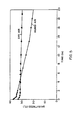
- Typical brightness versus time curves obtained with lamps containing the uncoated EL phosphor tested in both dry and humid environments are compared in Fig. 4.
- the corresponding data obtained with lamps containing the TiO2-coated phosphor are similarly compared in Fig. 5.
- the output of a lamp containing the uncoated phosphor deteriorates very rapidly when the lamp is operated in a humid atmosphere, a reflection of the extreme moisture sensitivity of the uncoated phosphor.
- the output of a lamp containing the TiO2-coated phosphor is relatively insensitive to the moisture content of its environment, a reflection of the relative moisture insensitivity of the coated phosphor.
- the moisture insensitivity of the coated phosphor is clearly demonstrated by the fact that the slope of the brightness versus time curve obtained with a lamp containing the coated phosphor operated in a humid atmosphere (shown in Fig. 5) is very similar to that obtained with a lamp containing the uncoated phosphor operated in a very dry environment (shown in Fig. 4).
- Electroluminescent lamps of the type described in Example 9 were operated in a humid environment (70% - 80% relative humidity), driven by a 120 V/ 400 Hz a.c. power supply. As before, some of the lamps contained the uncoated ZnS:Cu phosphor, while the others contained the titania-coated phosphor. Typical brightness versus time data obtained with lamps of each set during the first two hours of operation are compared in Fig. 6. The brightness versus time data obtained over a three day period with lamps containing the uncoated and TiO2-coated phosphors are similarly compared in Fig. 7.
- Unpackaged electroluminescent lamps of the type employed in Examples 9 and 10 were operated in a humid environment (70% - 80% relative humidity), driven by a 120 V/ 400 Hz power supply. Some of the lamps contained an uncoated ZnS:Cu phosphor, while others contained the same phosphor coated with various amounts of TiO2.
- the half-life of the electroluminescent lamp may be increased by over two orders of magnitude via the application of a TiO2 coating to the surface of the ZnS:Cu phosphor.
- the optimal coating thickness appears to be in the 50 A° - 100 A° range.
Landscapes
- Chemical & Material Sciences (AREA)
- Organic Chemistry (AREA)
- Engineering & Computer Science (AREA)
- Materials Engineering (AREA)
- Chemical Kinetics & Catalysis (AREA)
- General Chemical & Material Sciences (AREA)
- Inorganic Chemistry (AREA)
- Mechanical Engineering (AREA)
- Metallurgy (AREA)
- Luminescent Compositions (AREA)
- Electroluminescent Light Sources (AREA)
- Chemical Vapour Deposition (AREA)
- Vessels And Coating Films For Discharge Lamps (AREA)
Applications Claiming Priority (2)
| Application Number | Priority Date | Filing Date | Title |
|---|---|---|---|
| US539761 | 1990-06-18 | ||
| US07/539,761 US5118529A (en) | 1990-06-18 | 1990-06-18 | Process for coating finely divided material with titania |
Publications (3)
| Publication Number | Publication Date |
|---|---|
| EP0462504A2 true EP0462504A2 (fr) | 1991-12-27 |
| EP0462504A3 EP0462504A3 (en) | 1992-03-25 |
| EP0462504B1 EP0462504B1 (fr) | 1995-06-21 |
Family
ID=24152532
Family Applications (1)
| Application Number | Title | Priority Date | Filing Date |
|---|---|---|---|
| EP91109665A Expired - Lifetime EP0462504B1 (fr) | 1990-06-18 | 1991-06-12 | Procédé de revêtement d'un matériau, finement divisé avec du dioxyde de titane et matériaux luminscents à base de sulfure de zinc insensibles à l'humidité fabriqués ainsi |
Country Status (5)
| Country | Link |
|---|---|
| US (1) | US5118529A (fr) |
| EP (1) | EP0462504B1 (fr) |
| JP (1) | JP3130079B2 (fr) |
| CA (1) | CA2043987C (fr) |
| DE (1) | DE69110553T2 (fr) |
Cited By (5)
| Publication number | Priority date | Publication date | Assignee | Title |
|---|---|---|---|---|
| US5156885A (en) * | 1990-04-25 | 1992-10-20 | Minnesota Mining And Manufacturing Company | Method for encapsulating electroluminescent phosphor particles |
| US5593782A (en) * | 1992-07-13 | 1997-01-14 | Minnesota Mining And Manufacturing Company | Encapsulated electroluminescent phosphor and method for making same |
| US5958591A (en) * | 1997-06-30 | 1999-09-28 | Minnesota Mining And Manufacturing Company | Electroluminescent phosphor particles encapsulated with an aluminum oxide based multiple oxide coating |
| EP1215268A3 (fr) * | 2000-12-18 | 2003-03-05 | Osram Sylvania Inc. | Phosphore électroluminescent recouvert |
| US20210252486A1 (en) * | 2018-06-22 | 2021-08-19 | The Curators Of The University Of Missouri | Novel method of manufacture of metal nanoparticles and metal single-atom materials on various substrates and novel compositions |
Families Citing this family (14)
| Publication number | Priority date | Publication date | Assignee | Title |
|---|---|---|---|---|
| US5871810A (en) | 1995-06-05 | 1999-02-16 | International Business Machines Corporation | Plating on nonmetallic disks |
| US5792509A (en) * | 1997-02-07 | 1998-08-11 | Industrial Technology Research Institute | Phosphor particle with antireflection coating |
| US6110544A (en) * | 1997-06-26 | 2000-08-29 | General Electric Company | Protective coating by high rate arc plasma deposition |
| DE19849581B4 (de) * | 1997-10-27 | 2005-05-12 | Osram Sylvania Inc., Danvers | Verfahren zur Herstellung eines elektrolumineszenten Phosphors mit langer Lebensdauer |
| US6064150A (en) | 1998-01-12 | 2000-05-16 | Osram Sylvania Inc. | Nitride coated particle and composition of matter comprised of such particles |
| US5985175A (en) * | 1998-08-19 | 1999-11-16 | Osram Sylvania Inc. | Boron oxide coated phosphor and method of making same |
| US6171650B1 (en) * | 1999-09-28 | 2001-01-09 | Osram Sylvania Inc. | Moisture insensitive electroluminescent phosphor |
| KR100791564B1 (ko) * | 1999-12-21 | 2008-01-03 | 삼성에스디아이 주식회사 | 희토류 산화물이 코팅된 형광체 및 그의 제조방법 |
| CN100447298C (zh) * | 2005-11-16 | 2008-12-31 | 北京化工大学 | 在硫化锌荧光粉表面包覆二氧化钛纳米薄膜的方法 |
| TWI478990B (zh) | 2009-04-09 | 2015-04-01 | Sicpa Holding Sa | 明亮之磁性凹刻印刷油墨 |
| NZ602674A (en) | 2010-03-22 | 2013-10-25 | Mjr Pharmjet Gmbh | Method and device for producing microparticles or nanoparticles |
| US20130092964A1 (en) * | 2011-10-13 | 2013-04-18 | Intematix Corporation | Highly reliable photoluminescent materials having a thick and uniform titanium dioxide coating |
| BR112015024868A2 (pt) | 2013-03-28 | 2017-07-18 | Instillo Gmbh | método para produzir dispersões e matérias sólidas através de precipitação, coprecipitação e processo de auto-organização controlados e método para produzir dispersões e matérias sólidas através de precipitação controlada, coprecipitação e processo de auto-organização em um reator de microjato |
| US10253257B2 (en) | 2015-11-25 | 2019-04-09 | Intematix Corporation | Coated narrow band red phosphor |
Family Cites Families (2)
| Publication number | Priority date | Publication date | Assignee | Title |
|---|---|---|---|---|
| EP0160856B1 (fr) * | 1984-05-07 | 1990-07-11 | GTE Laboratories Incorporated | Méthode d'enduction de particules de matière luminescente, particule de matière luminescente, lampe fluorescente et méthode de fabrication |
| US4999219A (en) * | 1989-11-07 | 1991-03-12 | Gte Laboratories Incorporated | Method for coating phosphor particles using aluminum isopropoxide precursors and an isothermal fluidized bed |
-
1990
- 1990-06-18 US US07/539,761 patent/US5118529A/en not_active Expired - Lifetime
-
1991
- 1991-06-06 CA CA002043987A patent/CA2043987C/fr not_active Expired - Lifetime
- 1991-06-12 EP EP91109665A patent/EP0462504B1/fr not_active Expired - Lifetime
- 1991-06-12 DE DE69110553T patent/DE69110553T2/de not_active Expired - Lifetime
- 1991-06-17 JP JP03170385A patent/JP3130079B2/ja not_active Expired - Lifetime
Cited By (8)
| Publication number | Priority date | Publication date | Assignee | Title |
|---|---|---|---|---|
| US5156885A (en) * | 1990-04-25 | 1992-10-20 | Minnesota Mining And Manufacturing Company | Method for encapsulating electroluminescent phosphor particles |
| US5418062A (en) * | 1990-04-25 | 1995-05-23 | Minnesota Mining And Manufacturing Company | Encapsulated electroluminescent phosphor particles |
| US5439705A (en) * | 1990-04-25 | 1995-08-08 | Minnesota Mining And Manufacturing Company | Encapsulated electroluminescent phosphor and method for making same |
| US5908698A (en) * | 1990-04-25 | 1999-06-01 | Minnesota Mining And Manufacturing Company | Encapsulated electroluminescent phosphor and method for making same |
| US5593782A (en) * | 1992-07-13 | 1997-01-14 | Minnesota Mining And Manufacturing Company | Encapsulated electroluminescent phosphor and method for making same |
| US5958591A (en) * | 1997-06-30 | 1999-09-28 | Minnesota Mining And Manufacturing Company | Electroluminescent phosphor particles encapsulated with an aluminum oxide based multiple oxide coating |
| EP1215268A3 (fr) * | 2000-12-18 | 2003-03-05 | Osram Sylvania Inc. | Phosphore électroluminescent recouvert |
| US20210252486A1 (en) * | 2018-06-22 | 2021-08-19 | The Curators Of The University Of Missouri | Novel method of manufacture of metal nanoparticles and metal single-atom materials on various substrates and novel compositions |
Also Published As
| Publication number | Publication date |
|---|---|
| CA2043987C (fr) | 2002-06-04 |
| CA2043987A1 (fr) | 1991-12-19 |
| JPH0625857A (ja) | 1994-02-01 |
| US5118529A (en) | 1992-06-02 |
| JP3130079B2 (ja) | 2001-01-31 |
| DE69110553T2 (de) | 1995-11-02 |
| DE69110553D1 (de) | 1995-07-27 |
| EP0462504B1 (fr) | 1995-06-21 |
| EP0462504A3 (en) | 1992-03-25 |
Similar Documents
| Publication | Publication Date | Title |
|---|---|---|
| EP0462504B1 (fr) | Procédé de revêtement d'un matériau, finement divisé avec du dioxyde de titane et matériaux luminscents à base de sulfure de zinc insensibles à l'humidité fabriqués ainsi | |
| US5220243A (en) | Moisture insensitive zinc sulfide electroluminescent materials and an electroluminescent device made therefrom | |
| US5080928A (en) | Method for making moisture insensitive zinc sulfide based luminescent materials | |
| US5439705A (en) | Encapsulated electroluminescent phosphor and method for making same | |
| US5593782A (en) | Encapsulated electroluminescent phosphor and method for making same | |
| CA2345743C (fr) | Particules de phosphore electroluminescentes encapsulees dans un revetement d'oxynitrure | |
| FI121962B (fi) | Menetelmä runsaasti luminoivan loisteaineen valmistamiseksi | |
| JP4795501B2 (ja) | 酸化アルミニウムをベースとする多酸化物被覆でカプセル化したエレクトロルミネセンス蛍光体粒子 | |
| US5244750A (en) | Coated electroluminescent phosphor | |
| JP2002527569A5 (fr) | ||
| KR20080089337A (ko) | 초기 명도가 높은 방습성 전계발광 인광물질 및 이의제조방법 | |
| KR101451992B1 (ko) | 초기 명도가 높은 방습성 전계발광 인광물질 및 이의제조방법 | |
| JP2001212457A (ja) | 可視光型光触媒及びその製造方法 | |
| US20040161631A1 (en) | Fine-grained rare earth activated zinc sulfide phosphors for electroluminescent displays | |
| US7556721B2 (en) | Thiosilicate phosphor compositions and deposition methods using barium-silicon vacuum deposition sources for deposition of thiosilicate phosphor films | |
| Mikhailov et al. | Improvement of radiation stability of ZnO powder by modification with CeO2 nanoparticles | |
| Kitazawa et al. | Radiation-induced luminescence from sol–gel anatase TiO2 by 10 keV O+ irradiation | |
| Xu et al. | Ultraviolet-blue electroluminescence from Gd 3 Ga 5 O 12: Ag | |
| MXPA01003696A (en) | Oxynitride encapsulated electroluminescent phosphor particles | |
| Vecht et al. | Preparation and Investigation of Improved Low Voltage Electron Excitable Phosphors | |
| Liu et al. | Developing High-Efficiency Zn2SiO4: Mn Thin-Film Phosphors for Flat-Panel Cathodoluminescent Displays | |
| JPS603437B2 (ja) | 低速電子線螢光体 | |
| JPH04345683A (ja) | 分散型el発光素子用蛍光体の表面処理と、これから得られる発光素子 |
Legal Events
| Date | Code | Title | Description |
|---|---|---|---|
| PUAI | Public reference made under article 153(3) epc to a published international application that has entered the european phase |
Free format text: ORIGINAL CODE: 0009012 |
|
| AK | Designated contracting states |
Kind code of ref document: A2 Designated state(s): BE DE FR GB NL |
|
| PUAL | Search report despatched |
Free format text: ORIGINAL CODE: 0009013 |
|
| AK | Designated contracting states |
Kind code of ref document: A3 Designated state(s): BE DE FR GB NL |
|
| RAP1 | Party data changed (applicant data changed or rights of an application transferred) |
Owner name: GTE PRODUCTS CORPORATION |
|
| 17P | Request for examination filed |
Effective date: 19920924 |
|
| 17Q | First examination report despatched |
Effective date: 19930930 |
|
| GRAA | (expected) grant |
Free format text: ORIGINAL CODE: 0009210 |
|
| AK | Designated contracting states |
Kind code of ref document: B1 Designated state(s): BE DE FR GB NL |
|
| REF | Corresponds to: |
Ref document number: 69110553 Country of ref document: DE Date of ref document: 19950727 |
|
| ET | Fr: translation filed | ||
| PLBE | No opposition filed within time limit |
Free format text: ORIGINAL CODE: 0009261 |
|
| STAA | Information on the status of an ep patent application or granted ep patent |
Free format text: STATUS: NO OPPOSITION FILED WITHIN TIME LIMIT |
|
| 26N | No opposition filed | ||
| REG | Reference to a national code |
Ref country code: GB Ref legal event code: IF02 |
|
| PGFP | Annual fee paid to national office [announced via postgrant information from national office to epo] |
Ref country code: NL Payment date: 20060616 Year of fee payment: 16 |
|
| PGFP | Annual fee paid to national office [announced via postgrant information from national office to epo] |
Ref country code: BE Payment date: 20060620 Year of fee payment: 16 |
|
| PGFP | Annual fee paid to national office [announced via postgrant information from national office to epo] |
Ref country code: FR Payment date: 20060623 Year of fee payment: 16 |
|
| BERE | Be: lapsed |
Owner name: *GTE PRODUCTS CORP. Effective date: 20070630 |
|
| NLV4 | Nl: lapsed or anulled due to non-payment of the annual fee |
Effective date: 20080101 |
|
| PG25 | Lapsed in a contracting state [announced via postgrant information from national office to epo] |
Ref country code: BE Free format text: LAPSE BECAUSE OF NON-PAYMENT OF DUE FEES Effective date: 20070630 |
|
| REG | Reference to a national code |
Ref country code: FR Ref legal event code: ST Effective date: 20080229 |
|
| PG25 | Lapsed in a contracting state [announced via postgrant information from national office to epo] |
Ref country code: NL Free format text: LAPSE BECAUSE OF NON-PAYMENT OF DUE FEES Effective date: 20080101 |
|
| PG25 | Lapsed in a contracting state [announced via postgrant information from national office to epo] |
Ref country code: FR Free format text: LAPSE BECAUSE OF NON-PAYMENT OF DUE FEES Effective date: 20070702 |
|
| PGFP | Annual fee paid to national office [announced via postgrant information from national office to epo] |
Ref country code: GB Payment date: 20100617 Year of fee payment: 20 Ref country code: DE Payment date: 20100820 Year of fee payment: 20 |
|
| REG | Reference to a national code |
Ref country code: DE Ref legal event code: R071 Ref document number: 69110553 Country of ref document: DE |
|
| REG | Reference to a national code |
Ref country code: DE Ref legal event code: R071 Ref document number: 69110553 Country of ref document: DE |
|
| REG | Reference to a national code |
Ref country code: GB Ref legal event code: PE20 Expiry date: 20110611 |
|
| PG25 | Lapsed in a contracting state [announced via postgrant information from national office to epo] |
Ref country code: GB Free format text: LAPSE BECAUSE OF EXPIRATION OF PROTECTION Effective date: 20110611 |
|
| PG25 | Lapsed in a contracting state [announced via postgrant information from national office to epo] |
Ref country code: DE Free format text: LAPSE BECAUSE OF EXPIRATION OF PROTECTION Effective date: 20110613 |