EP0462857B2 - Färbemittel, enthaltend 5-6-Dihydroxyindoline und Färbungsverfahren für keratinische Fasern - Google Patents
Färbemittel, enthaltend 5-6-Dihydroxyindoline und Färbungsverfahren für keratinische Fasern Download PDFInfo
- Publication number
- EP0462857B2 EP0462857B2 EP91401399A EP91401399A EP0462857B2 EP 0462857 B2 EP0462857 B2 EP 0462857B2 EP 91401399 A EP91401399 A EP 91401399A EP 91401399 A EP91401399 A EP 91401399A EP 0462857 B2 EP0462857 B2 EP 0462857B2
- Authority
- EP
- European Patent Office
- Prior art keywords
- composition
- dyeing
- dihydroxyindoline
- salts
- chosen
- Prior art date
- Legal status (The legal status is an assumption and is not a legal conclusion. Google has not performed a legal analysis and makes no representation as to the accuracy of the status listed.)
- Expired - Lifetime
Links
- 0 *CCc(cc1O)c(*(*)I)cc1O Chemical compound *CCc(cc1O)c(*(*)I)cc1O 0.000 description 2
Classifications
-
- A—HUMAN NECESSITIES
- A61—MEDICAL OR VETERINARY SCIENCE; HYGIENE
- A61K—PREPARATIONS FOR MEDICAL, DENTAL OR TOILETRY PURPOSES
- A61K8/00—Cosmetics or similar toiletry preparations
- A61K8/18—Cosmetics or similar toiletry preparations characterised by the composition
- A61K8/30—Cosmetics or similar toiletry preparations characterised by the composition containing organic compounds
- A61K8/49—Cosmetics or similar toiletry preparations characterised by the composition containing organic compounds containing heterocyclic compounds
- A61K8/4906—Cosmetics or similar toiletry preparations characterised by the composition containing organic compounds containing heterocyclic compounds with one nitrogen as the only hetero atom
- A61K8/4913—Cosmetics or similar toiletry preparations characterised by the composition containing organic compounds containing heterocyclic compounds with one nitrogen as the only hetero atom having five membered rings, e.g. pyrrolidone carboxylic acid
- A61K8/492—Cosmetics or similar toiletry preparations characterised by the composition containing organic compounds containing heterocyclic compounds with one nitrogen as the only hetero atom having five membered rings, e.g. pyrrolidone carboxylic acid having condensed rings, e.g. indol
-
- A—HUMAN NECESSITIES
- A61—MEDICAL OR VETERINARY SCIENCE; HYGIENE
- A61Q—SPECIFIC USE OF COSMETICS OR SIMILAR TOILETRY PREPARATIONS
- A61Q5/00—Preparations for care of the hair
- A61Q5/06—Preparations for styling the hair, e.g. by temporary shaping or colouring
- A61Q5/065—Preparations for temporary colouring the hair, e.g. direct dyes
-
- A—HUMAN NECESSITIES
- A61—MEDICAL OR VETERINARY SCIENCE; HYGIENE
- A61Q—SPECIFIC USE OF COSMETICS OR SIMILAR TOILETRY PREPARATIONS
- A61Q5/00—Preparations for care of the hair
- A61Q5/10—Preparations for permanently dyeing the hair
-
- C—CHEMISTRY; METALLURGY
- C07—ORGANIC CHEMISTRY
- C07D—HETEROCYCLIC COMPOUNDS
- C07D209/00—Heterocyclic compounds containing five-membered rings, condensed with other rings, with one nitrogen atom as the only ring hetero atom
- C07D209/02—Heterocyclic compounds containing five-membered rings, condensed with other rings, with one nitrogen atom as the only ring hetero atom condensed with one carbocyclic ring
- C07D209/04—Indoles; Hydrogenated indoles
- C07D209/08—Indoles; Hydrogenated indoles with only hydrogen atoms or radicals containing only hydrogen and carbon atoms, directly attached to carbon atoms of the hetero ring
-
- A—HUMAN NECESSITIES
- A61—MEDICAL OR VETERINARY SCIENCE; HYGIENE
- A61K—PREPARATIONS FOR MEDICAL, DENTAL OR TOILETRY PURPOSES
- A61K2800/00—Properties of cosmetic compositions or active ingredients thereof or formulation aids used therein and process related aspects
- A61K2800/80—Process related aspects concerning the preparation of the cosmetic composition or the storage or application thereof
- A61K2800/87—Application Devices; Containers; Packaging
Definitions
- the present invention relates to the use for dyeing keratin fibers, in particular human keratin fibers such as the hair, of 5,6-dihydroxyindolines, with dye compositions and to the dyeing processes using these compounds.
- the subject of the invention is therefore the use for dyeing keratin fibers, in particular hair, of 5,6-dihydroxyindolines and their salts.
- Another subject of the invention consists of dye compositions intended for dyeing fibers keratin and in particular human hair, containing at least one 5,6-dihydroxy indoline.
- a subject of the invention is also dyeing processes using these compounds and 5,6-dihydroxyindoline.
- Other objects of the invention will appear on reading the description and examples that follow.
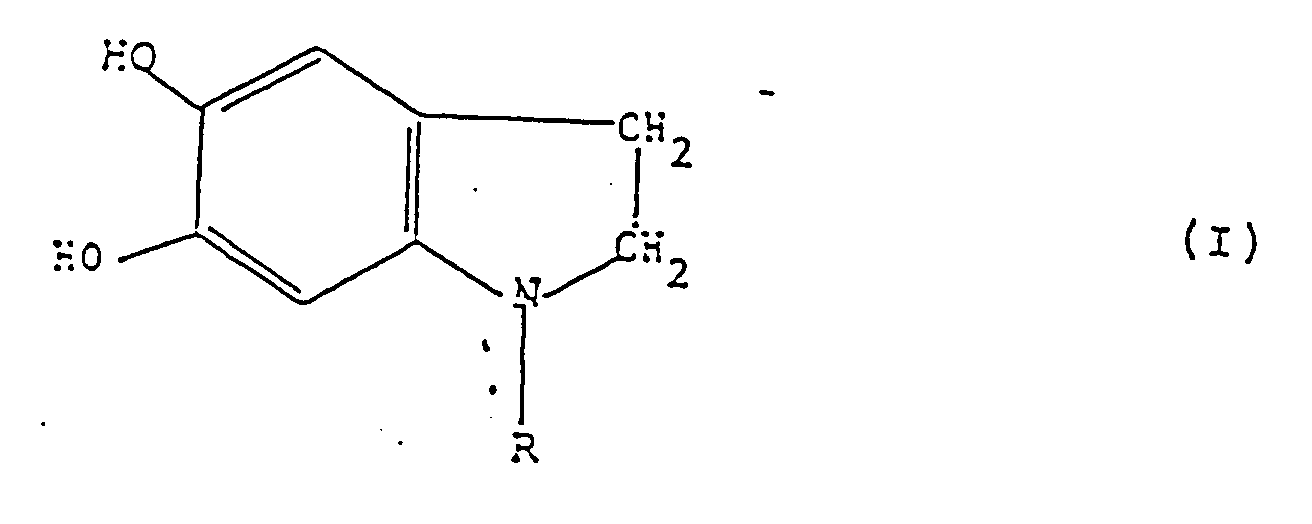
- the 5,6-dihydroxyindolines used for dyeing keratin fibers and in particular human keratin fibers such as the hair, according to the invention, are essentially characterized by the fact that they correspond to the formula: in which R represents a C 2 -C 4 alkyl group and the acid addition salts of these compounds.
- the preferred salts are the hydrochlorides or hydrobromides.
- the preferred compounds used in accordance with the invention are N-ethyl 5,6-dihydroxyindoline, and N-butyl 5,6-dihydroxyindoline.
- 5,6-dihydroxyindoline and the compounds of formula (I) in which R is a C 1 -C 4 alkyl group are synthesized by demethylation of the optionally N-alkylated 5,6-dimethoxyindole, in the presence of HCl by heating at 140-150 ° C in a sealed tube as described in J. Chem. Soc. (C) 1424 (1967) SWAN or by reflux heating in concentrated HBr at normal pressure.
- 5,6-dihydroxy N-alkyl indolines can be prepared by direct alkylation of 5,6-dihydroxyindoline which can be synthesized according to the SWAN method mentioned above.
- N-alkyls (C 2 -C 4 ) 5,6-dihydroxyindolines are new compounds as well as their salts, and constitute another object of the invention.
- Dye compositions intended to be used for dyeing keratin fibers and in particular human keratin fibers such as the hair, in accordance with the invention are characterized by the fact that they contain in a medium suitable for dyeing, at least one 5,6-dihydroxy indoline having the formula (I) defined above.
- the subject of the invention is also a dye composition intended to be used for dyeing keratin fibers, in particular human keratin fibers containing, in a medium suitable for dyeing, comprising water and at least one solvent chosen from ethyl alcohol, propyl or isopropyl alcohol, tert-butyl alcohol, ethylene glycol, mono methyl, monoethyl and monobutyl ethers of ethylene glycol, monoethyl ether acetate of ethylene glycol, propylene glycol, the monomethyl ether of propylene glycol and of diproprylene glycol, methyl lactate, at least one compound of formula in which R denotes C 1 -C 4 alkyl as well as the acid addition salts of these compounds.
- a medium suitable for dyeing comprising water and at least one solvent chosen from ethyl alcohol, propyl or isopropyl alcohol, tert-butyl alcohol, ethylene glycol, mono methyl, monoethyl and monobut
- the amount of 5,6-dihydroxyindoline (s) of formula (I) used in the composition is generally understood in proportions of 0.01 to 8% by weight relative to the total weight of the composition and preferably from 0.03 to 5% by weight.
- compositions can be in various forms, in particular in the form of lotions more or less thickened, creams, foams and gels, possibly packaged in the form of aerosols.
- They can also constitute an element of a multi-component dyeing agent arranged in a multi-compartment device or dye kit.
- the medium suitable for dyeing is preferably an aqueous medium which must be cosmetically acceptable when the compositions are intended to be used for dyeing living human hair.
- This aqueous medium can consist of water or a water / solvent mixture.
- the pH of the compositions is between 3 and 12.
- the solvents are chosen from organic solvents and preferably from ethyl alcohol, alcohol propyl or isopropyl, tert-butyl alcohol, ethylene glycol, monomethyl, monoethyl ethers and ethylene glycol monobutyl, ethylene glycol monoethyl ether acetate, propylene glycol, the monomethyl ethers of propylene glycol and of dipropylene glycol, methyl lactate.
- Particularly preferred solvents are ethyl alcohol and propylene glycol.
- the compounds according to the invention have the advantage of being able to be used in a medium essentially aqueous.
- composition is in this case either mixed at the time of use with an aqueous medium, is applied to the keratin fibers wet beforehand with an aqueous composition.
- an anhydrous solvent medium is called a medium containing less than 1% of water.
- the medium suitable for dyeing consists of a water / solvent (s) mixture
- the solvents are used in concentrations of between 0.5 and 75% by weight relative to the total weight of the composition, and preferably in proportions of less than 20% by weight.
- compositions in accordance with the invention may contain adjuvants usually used for the dyeing of keratin fibers and in particular cosmetically acceptable adjuvants when these compositions are applied for dyeing living human hair.
- compositions can in particular contain fatty amides in preferential proportions of 0.05 to 10% by weight, anionic, cationic, nonionic, amphoteric surfactants or mixtures thereof preferably present in proportions of between 0.1 and 50% by weight, thickening agents, perfumes, sequestering agents, film-forming agents, treatment agents, dispersing agents, conditioning agents, preserving agents, opacifying agents, keratin fiber swelling agents.
- the thickening agents are chosen from sodium alginate, gum arabic, guar gum, heterobiopolysaccharides, such as xanthan gum, scleroglucans, cellulose derivatives, such as methylcellulose, hydroxyethylcellulose, hydroxypropylmethylcellulose, sodium salt of carboxymethylcellulose and preferably crosslinked acrylic acid polymers.
- Mineral thickeners can also be used, such as bentonite.
- thickeners are used alone or as a mixture and are preferably present in proportions between 0.1 and 5% by weight relative to the total weight of the composition and advantageously between 0.5 and 3% by weight.
- the basifying agents which can be used in the compositions may in particular be amines, such as as alkanolamines, alkylamines, alkali or ammonium hydroxides or carbonates.
- the acidifying agents which can be used in these compositions can be chosen from lactic acid, acetic acid, tartaric acid, phosphoric acid, hydrochloric acid, citric acid.
- compositions When used in the form of foam, they can be packaged in pressure and in an aerosol device in the presence of a propellant and at least one foam generator.
- the foaming agents can be anionic, cationic, non-foaming polymers. ionic, amphoteric or mixtures thereof or surfactants of the type of those defined above.
- the process for dyeing keratin fibers is essentially characterized in that it consists in applying to these fibers a composition (A) defined above and containing in a medium suitable for dyeing, at least one 5,6-dihydroxyindoline corresponding to formula (I ') in which R represents hydrogen or a C 1 -C 4 alkyl group as well as the acid addition salts of these compounds, to maintain the composition in contact with the fibers for a time sufficient to develop the coloring, ie air, either using an oxidizing system, to rinse and possibly wash the fibers thus dyed.
- a composition (A) defined above and containing in a medium suitable for dyeing, at least one 5,6-dihydroxyindoline corresponding to formula (I ') in which R represents hydrogen or a C 1 -C 4 alkyl group as well as the acid addition salts of these compounds to maintain the composition in contact with the fibers for a time sufficient to develop the coloring, ie air, either using an oxidizing system, to rinse and possibly
- the coloring of the fibers can be carried out without addition of an external oxidizing agent, only on contact with air.
- compositions (A) and (B) are separated by a step water rinse.
- composition (A) containing in a medium suitable for dyeing, at at least one compound of formula (I ') in combination with iodide ions, the application of composition (A) being preceded or followed by the application of a composition (B) which contains in a medium suitable for dyeing, hydrogen peroxide.
- This process can also be implemented by applying to the keratin fibers at least one composition (A) containing, in a medium suitable for dyeing, the compound of formula (I ') in combination with hydrogen peroxide, having a pH between 2 and 7 and preferably between 3.5 and 7, the application of composition (A) being preceded or followed by the application of a composition (B) which contains in a medium suitable for dyeing, iodide ions.
- composition (A) containing, in a medium suitable for dyeing, the compound of formula (I ') in combination with hydrogen peroxide, having a pH between 2 and 7 and preferably between 3.5 and 7, the application of composition (A) being preceded or followed by the application of a composition (B) which contains in a medium suitable for dyeing, iodide ions.
- the iodide ion in this variant of the process is preferably chosen from alkali metal iodides, alkaline earth or ammonium.
- the iodide is more particularly constituted by potassium iodide.
- compositions (A) or (B) are present in compositions (A) or (B) in proportions generally between 0.007 and 4% by weight expressed in ions I - and preferably between 0.08 and 1.5% by weight relative to the weight total of composition (A) or (B).
- nitrites are sodium, potassium or ammonium nitrites.
- This variant of the process is carried out by applying the composition to the keratin materials.
- Nitrites are generally used in proportions of between 0.02 and 1 mole / liter.
- the oxidants are chosen from hydrogen peroxide, the chloramine T, chloramine B, periodic acid and its water-soluble salts, sodium hypochlorite, ferricyanide potassium, silver oxide, Fenton's reagent, lead (IV) oxide, cesium sulfate, ammonium persulfate.
- These agents are preferably applied to the fibers by means of a composition (B) and after the application of the composition (A).
- oxidizing agents are present in sufficient proportions to develop coloring and preferably in proportions of between 0.004 mole and 0.7 mole, in particular between 0.01 mole and 0.04 mole per 100 g of composition.
- the keratin fibers are applied, a composition containing in a medium suitable for dyeing, at a pH between 2 and 10, a anion of a metal with a good affinity for keratin having a redox potential greater than that compounds of formula (I ').
- This anion is preferably chosen from permanganates or dichromates and more particularly potassium permanganate and sodium dichromate.
- metal anions are generally used with molalities in anions greater than 10 -3 moles / 1000 g up to preferably 1 mole / 1000 g.
- a composition is applied containing in a medium suitable for dyeing, at a pH between 4 and 10, a compound corresponding to the formula (I ') defined above.
- compositions containing the anions must not contain organic agents having a reducing effect on the anions.
- oxidation catalysts chosen from metal salts such as manganese, cobalt, iron, copper and silver salts.
- manganese sulphate manganese lactate
- cobalt chloride ferric chloride
- cupric chloride ammoniacal silver nitrate
- the preferred salts are the copper salts. These salts are used in proportions of 0.01 to 2% expressed in metal ions relative to the total weight of the composition used and containing these salts.
- the keratin fibers in particular the hair, are brought into contact with a composition (B) containing in a medium suitable for dyeing, metal salt, before or after application of composition (A) containing the compound of formula (I ') and it is preferably rinsed between the two stages.
- the preferred embodiment is to apply a cupric salt first and the composition (A) containing 5,6-dihydroxyindoline of formula (I ′), in a second step.
- This dye can be followed after rinsing with the application of a solution of hydrogen peroxide to possibly lighten the color obtained.
- rare earth salts are used.
- the rare earth salts which can be used in accordance with the invention are chosen from the lanthanide salts, and in particular the cerium salts Ce 3+ , Ce 4+ , Lanthane La 3+ , Europium Eu 2+ , Eu 3+ , Gadolinium Gd 3+ , Ytterbium Yb 2+ , Yb 3+ , Dysprosium Dy 3+ .
- the preferred salts are in particular the sulfates, chlorides or nitrates.
- These rare earth salts are present in proportions of between 0.1 and 8% by weight relative to the total weight of the composition.
- Cerium Ce 3+ and Ce 4+ salts are preferably used in the form of sulfates and chlorides.
- composition containing the quinone derivative is applied before or after composition (A) containing the compound of formula (I ').
- the concentration of quinone derivatives is preferably between 0.005 and 1 mole / liter in the composition (B).
- the pH of the composition (B) is between 2 and 10 and preferably less than 7.
- the hydrogen peroxide content is generally between 1 and 40 volumes and preferably between 2 and 10 volumes and more particularly between 3 and 10 volumes.
- the medium suitable for dyeing comprises water and at least one solvent chosen from ethyl alcohol, propyl alcohol or isopropyl, tetriobutyl alcohol, ethylene glycol, mono methyl, monoethyl ethers and ethylene glycol monobutyls, ethylene glycol monoethyl ether acetate, propylene glycol, the monomethyl ether of propylene glycol and of diproprylene glycol, methyl lactate,
- a subject of the invention is also an agent for coloring keratin fibers and in particular fibers.
- Human keratin with several components, intended in particular to be used in the implementation of dyeing process defined above and using an oxidizing system.
- the dyeing agent understands at least two components, a first of which consists of the composition (A) defined above and containing 5,6-dihydroxyindoline of formula (I ') and the other component consists of one of the compositions (B) also defined above.
- the invention also relates to a device with several compartments or else "dye kit” or “dye kit”, comprising all the components intended to be applied in the same dye on keratin fibers in single or successive applications with or without premix as mentioned above.
- Such devices are known in themselves and may include a first compartment containing composition (A) containing 5,6-dihydroxyindoline of formula (I ') in a medium suitable for dyeing, and in a second compartment a composition (B) of the type defined above and containing the oxidizing agent such as defined above.
- compositions with several compartments which can be used in accordance with the invention can be fitted mixing means at the time of use and their content can be conditioned under an inert atmosphere.
- a third can be provided compartment containing an aqueous medium suitable for dyeing and intended for just mixing before use with the composition of the first compartment.
- the 5,6-dihydroxyindoline of formula (I '), the compositions and the process in accordance with the invention can be used to dye natural or already dyed hair, permed or not, straightened or not, or strongly or slightly discolored and possibly permed hair.
- composition (A5) is applied for 5 minutes to permed gray hair. After rinsing, we apply the following composition (A5):
- This composition is applied to gray hair containing 90% white hair for 15 minutes. After rinsing, a solution of hydrogen peroxide at 12.5 volumes is applied for 5 minutes. After rinsing, washing and drying, the hair is colored in dark ash blonde.
- a 2.5% solution of 5,6-dihydroxyindoline hydrobromide is prepared in a 90/10 hydroalcoholic medium. This solution is left in contact with a lock of hair containing 90% white hairs for 15 minutes at temperature. ambient. Rinsed, wrung, then the coloring is revealed by a 60/40 hydroalcoholic solution at 2% of 1,4-benzoquinone.
- the exposure time is 8 minutes.
- the solution (A9) is applied to hair containing 90% white hairs for 10 minutes. After rinsing, we apply the solution (B9) for 10 minutes. After rinsing, washing and drying, the hair is colored in Blue green.
- composition (A9) It is similar to composition (A9) in which the 0.5 g of N-butyl 5,6-dihydroxyindoline is replaced per 1 g of N-methyl 5,6-dihydroxyindoline.
- the dyeing conditions are identical to those described for Example 9.
- the hair is colored in golden matt ash.
- composition (A9) It is similar to composition (A9) in which the 0.5 g of N-butyl 5,6-dihydroxyindoline is replaced per 1 g of N-ethyl 5,6-dihydroxyindoline.
- the dyeing conditions are identical to those of Example 9.
- the hair is colored blue green.
- This composition is applied to gray hair containing 90% white hair for 10 minutes.
- the hair After rinsing, the hair is dried. This composition is successively applied twice, after what, the hair is colored in matt gray blue.
- This composition is applied to gray hair containing 90% white hair for 15 minutes.
- the hair After rinsing, washing and drying, the hair is colored in light ash blonde.
- Example 13 It is similar to Example 13, in which the 1 g of N-ethyl 5,6-dihydroxyindoline is replaced by 1 g of N-methyl 5,6-dihydroxyindoline.
- the dyeing conditions are those described in Example 13.
- the hair is colored in mat ash golden.
- Example 13 It is similar to Example 13, in which the 1 g of N-ethyl 5,6-dihydroxyindoline is replaced by 0.5 g of N-butyl 5,6-dihydroxyindoline.
- the dyeing conditions are those of Example 13.
- the hair is colored blue green.
Landscapes
- Life Sciences & Earth Sciences (AREA)
- Organic Chemistry (AREA)
- Health & Medical Sciences (AREA)
- Chemical & Material Sciences (AREA)
- Public Health (AREA)
- General Health & Medical Sciences (AREA)
- Animal Behavior & Ethology (AREA)
- Veterinary Medicine (AREA)
- Epidemiology (AREA)
- Birds (AREA)
- Cosmetics (AREA)
- Coloring (AREA)
- Indole Compounds (AREA)
Claims (40)
- Verwendung eines 5,6-Dihydroxyindolins der Formel (I):worin R eine C2-4-Alkylgruppe darstellt, sowie der Säureadditionssalze dieser Verbindungen
zur Färbung keratinischer Fasern, insbesondere menschlicher keratinischer Fasern. - Verwendung gemäß Anspruch 1,
dadurch gekennzeichnet, daß
die Salze aus Hydrochloriden oder Hydrobromiden ausgewählt sind. - Verwendung von N-Ethyl-5,6-dihydroxyindolin und N-Butyl-5,6-dihydroxyindolin zur Färbung keratinischer Fasern.
- Färbezusammensetzung zur Verwendung zur Färbung keratinischer Fasern, insbesondere menschlicher keratinischer Fasern,
dadurch gekennzeichnet, daß
sie in einem zur Färbung geeigneten Milieu mindestens ein in jedem der Ansprüche 1 bis 3 definiertes 5,6-Dihydroxyindolin enthält. - Zusammensetzung gemäß Anspruch 4,
dadurch gekennzeichnet, daß
das 5,6-Dihydroxyindolin in der Zusammensetzung in Mengenverhältnissen von 0,01 bis 8 Gew.%, vorzugsweise von 0,03 bis 5 Gew.%, bezogen auf das Gesamtgewicht der Zusammensetzung, vorhanden ist. - Zusammensetzung gemäß Anspruch 4 oder 5,
dadurch gekennzeichnet, daß
das zur Färbung geeignete Milieu ein wässriges Milieu aus Wasser oder einer Mischung aus Wasser/Lösungsmittel(n) ist. - Zusammensetzung gemäß Anspruch 6,
dadurch gekennzeichnet, daß
die Lösungsmittel aus Ethylalkohol, Propyl- oder Isopropylalkohol, t-Butylalkohol, Ethylenglycol, Monomethyl-, Monoethyl- und Monobutylethern von Ethylenglycol, Monoethyletherethylenglycolacetat, Propylenglycol, Monomethylethern von Propylenglycol oder Dipropylenglycol, Methyllactat ausgewählt sind. - Färbezusammensetzung zur Färbung keratinischer Fasern und insbesondere menschlicher keratinischer Fasern,
dadurch gekennzeichnet, daß
sie, in einem zur Färbung geeigneten Milieu, das Wasser und mindestens ein Lösungsmittel umfaßt, ausgewählt aus Ethylalkohol, Propyl- oder Isopropylalkohol, t-Butylalkohol, Ethylenglycol, Monomethyl-, Monoethyl- und Monobutylethern von Ethylenglycol, Monoethyletherethylenglycolacetat, Propylenglycol, Monomethylethern von Propylenglycol und Dipropylenglycol und aus Methyllactat, mindestens eine Verbindung der Formel:worin R einen C1-4-Alkylrest bedeutet, sowie die Säureadditionssalze dieser Verbindungen enthält.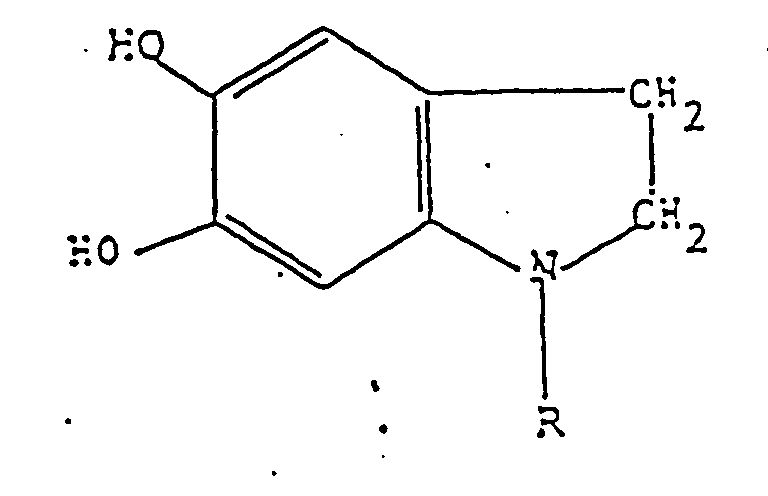
- Zusammensetzung gemäß jedem der Ansprüche 4 bis 8,
dadurch gekennzeichnet, daß
die Zusammensetzung Fettamide, anionische, kationische, nicht-ionische, amphotere oberflächenaktive Mittel oder deren Mischungen, Verdickungsmittel, Parfüm-Produkte, Sequestriermittel, filmbildende Mittel, Behandlungsmittel, Dispergiermittel, Konditioniermittel, Konservierungsmittel, opak machende Mittel, Mittel zur Auflockerung keratinischer Fasern oder deren Mischungen enthält. - Zusammensetzung gemäß jedem der Ansprüche 4 bis 9,
dadurch gekennzeichnet, daß
der pH der Zusammensetzung 3 bis 12 beträgt. - Verfahren zur Färbung keratinischer Fasern, insbesondere menschlicher keratinischer Fasern,
dadurch gekennzeichnet, daß
man auf die Fasern mindestens eine Zusammensetzung aufträgt, die in einem zur Färbung geeigneten Milieu mindestens ein 5,6-Dihydroxyindolin der Formel (I'):worin R Wasserstoff oder eine C1-4-Alkylgruppe darstellt, sowie die Säureadditionssalze dieser Verbindungen enthält, und daß man diese Zusammensetzung in Kontakt mit den Fasern während einer Zeitdauer hält, die zur Entwicklung einer Färbung ausreicht, und zwar entweder an der Luft oder mittels eines chemischen oxidierenden Systems, das dargestellt ist durch: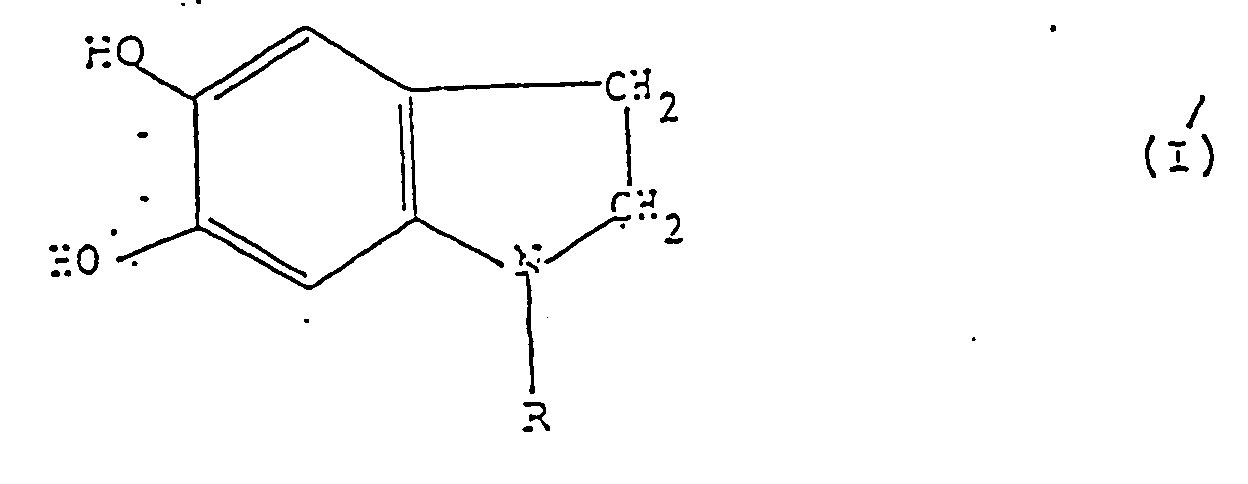 (i) Jodidionen und Wasserstoffperoxid, wobei die Zusammensetzung (A) in diesem Fall, zusätzlich, entweder (a) Jodidionen oder (b) Wasserstoffperoxid enthält, und wobei vor oder nach der Aufbringung der Zusammensetzung (A) die Aufbringung einer Zusammensetzung (B) erfolgt, die in einem zur Färbung geeigneten Milieu entweder:(a) Wasserstoffperoxid bei einem pH von 2 bis 12, wenn die Zusammensetzung (A) Jodidionen enthält, oder:(b) Jodidionen bei einem pH von 3 bis 11 enthält, wenn die Zusammensetzung (A) Wasserstoffperoxid enthält;(ii) Nitrite, wobei nach der Aufbringung der Zusammensetzung (A) die Aufbringung einer wässrigen Zusammensetzung (B) erfolgt, die einen sauren pH aufweist, wobei die Zusammensetzung (A) oder die Zusammensetzung (B) mindestens ein Nitrit enthalten;(iii) Oxidationsmittel aus Wasserstoffperoxid, Periodsäure und ihren wasserlöslichen Salzen, Natriumhyypochlorit, Chloramin T, Chloramin B, Kaliumferricyanid, Silberoxid, Fenton-Reagens, Blei(IV)oxid, Cäsiumsulfat, Ammoniumpersulfat, wobei diese Oxidationsmittel in der Zusammensetzung (A) vorliegen, oder gleichzeitig oder anschließend mittels einer Zusammensetzung (B) aufgebracht werden, welche jene in einem zur Färbung geeigenten Milieu enthält;(iv) Metallanionen aus Permanganaten oder Bichromaten, wobei diese Oxidationsmittel mittels einer wässrigen Zusammensetzung (B) bei einem pH von 2 bis 10 vor der Aufbringung der Zusammensetzung (A) aufgebracht werden;(v) Metallsalze der Gruppen 3 bis 8 des Periodensystems, wobei die Metallsalze in einer getrennten Stufe mittels einer Zusammensetzung (B) aufgebracht werden, die diese Salze in einem zur Färbung geeigneten Milieu enthält;(vi) seltene Erdmetallsalze, wobei die Salze der seltenen Erden mittels einer Zusammensetzung (B) aufgebracht werden, die jene in einem zur Färbung geeigneten Milieu enthält, wobei die Zusammensetzung (B) vor oder nach der Aufbringung der Zusammensetzung (A) aufgebracht wird;(vii) ein Chinonderivat aus o- oder p-Benzochinonen, o- oder p-Benzochinonmonoiminen oder -diiminen, 1,2- oder 1,4-Naphthochinonen, o- oder p-Benzochinonsulfonimiden, α- ω-Alkylenbis-1,4-benzochinonen oder 1,2- oder 1,4-Naphthochinonmonoiminen oder -diiminen, wobei das 5,6-Dihydroxyindolin der Formel (I') und die Chinonderivate so ausgewählt sind, daß die Redox-Potentialdifferenz ΔE zwischen dem Redox-Potential Ei des 5,6-Dihydroxyindolins der Formel (I'), bestimmt bei pH 7 in einem Phosphat-Milieu durch Voltametrie an einer Elektrode aus glasartigem Kohlenstoff, und dem Redox-Potential Eq des Chinonderivats, bestimmt bei pH 7 in einem Phosphat-Milieu durch Polarographie an einer Hg-Elektrode gegen eine gesättigte Kalomel-Elektrode, beträgt:
- Verfahren zur Färbung keratinischer Fasern, insbesondere menschlicher keratinischer Fasern,
dadurch gekennzeichnet, daß
man auf diese Fasern mindestens eine Zusammensetzung aufträgt, die in einem zur Färbung geeigneten Milieu, das Wasser und mindestens ein Lösungsmittel oder alleiniglich ein oder mehrere wasserfreie Lösungsmittel umfaßt, wobei diese Lösungsmittel aus Ethylalkohol, Propyl- oder Isopropylalkohol, t-Butylalkohol, Ethylenglycol, Monomethyl-, Monoethyl- und Monobutylethern von Ethylenglycol, Monoethyletherethylenglycolacetat, Propylenglycol, Monomethylethern von Propylenglycol und Dipropylenglycol und aus Methyllactat ausgewählt sind, mindestens ein 5,6-Dihydroxyindolin der Formel (I'):worin R Wasserstoff oder eine C1-4-Alkylgruppe darstellt, sowie die Säureadditionssalze dieser Verbindungen enthält, und daß man diese Zusammensetzung in Kontakt mit den Fasern während einer Zeitdauer hält, die zur Entwicklung einer Färbung ausreicht, und zwar entweder an der Luft oder mittels eines chemischen oxidierenden Systems, das dargestellt ist durch: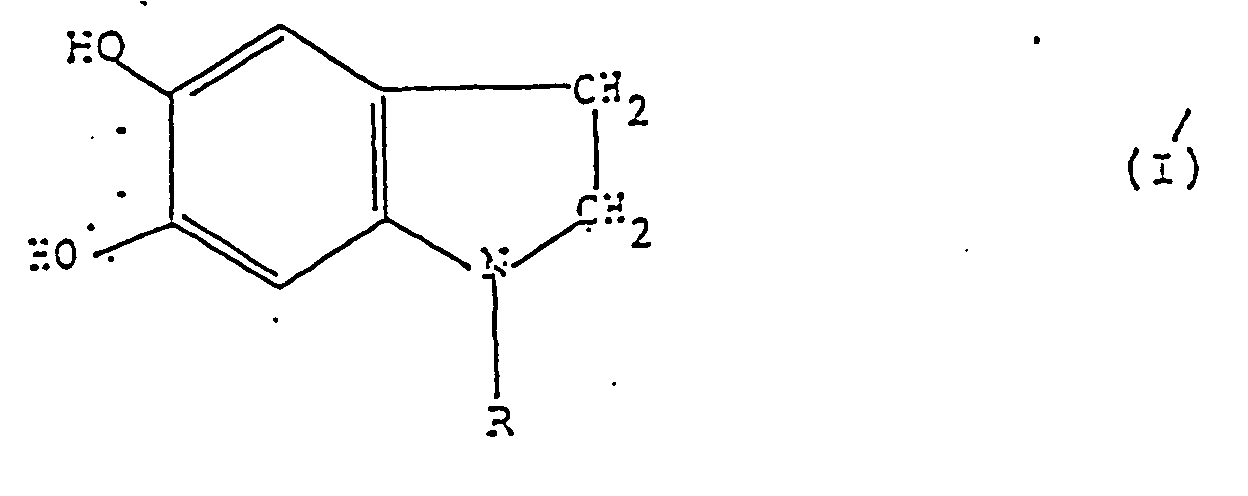 (i) Jodidionen und Wasserstoffperoxid, wobei die Zusammensetzung (A) in diesem Fall, zusätzlich, entweder (a) Jodidionen oder (b) Wasserstoffperoxid enthält, und wobei vor oder nach der Aufbringung der Zusammensetzung (A) die Aufbringung einer Zusammensetzung (B) erfolgt, die in einem zur Färbung geeigneten Milieu entweder:(a) Wasserstoffperoxid bei einem pH von 2 bis 12, wenn die Zusammensetzung (A) Jodidionen enthält, oder:(b) Jodidionen bei einem pH von 3 bis 11 enthält, wenn die Zusammensetzung (A) Wasserstoffperoxid enthält;(ii) Nitrite, wobei nach der Aufbringung der Zusammensetzung (A) die Aufbringung einer wässrigen Zusammensetzung (B) erfolgt, die einen sauren pH aufweist, wobei die Zusammensetzung (A) oder die Zusammensetzung (B) mindestens ein Nitrit enthalten;(iii) Oxidationsmittel aus Wasserstoffperoxid, Perjodsäure und ihren wasserlöslichen Salzen, Natriumhyypochlorit, Chloramin T, Chloramin B, Kaliumferricyanid, Silberoxid, Fenton-Reagens, Blei(IV)oxid, Cäsiumsulfat, Ammoniumpersulfat, wobei diese Oxidationsmittel in der Zusammensetzung (A) vorliegen, oder gleichzeitig oder anschließend mittels einer Zusammensetzung (B) aufgebracht werden, welche jene in einem zur Färbung geeigenten Milieu enthält;(iv) Metallanione aus Permanganaten oder Bichromaten, wobei diese Oxidationsmittel mittels einer wässrigen Zusammensetzung (B) bei einem pH von 2 bis 10 vor der Aufbringung der Zusammensetzung (A) aufgebracht werden;(v) Metallsalze der Gruppen 3 bis 8 des Periodensystems, wobei die Metallsalze in einer getrennten Stufe mittels einer Zusammensetzung (B) aufgebracht werden, die diese Salze in einem zur Färbung geeigneten Milieu enthält;(vi) seltene Erdmetallsalze, wobei die Salze der seltenen Erden mittels einer Zusammensetzung (B) aufgebracht werden, die jene in einem zur Färbung geeigneten Milieu enthält, wobei die Zusammensetzung (B) vor oder nach der Aufbringung der Zusammensetzung (A) aufgebracht wird;(vii) ein Chinonderivat aus o- oder p-Benzochinonen, o- oder p-Benzochinonmonoiminen oder -diiminen, 1-2, oder 1,4-Naphthochinonen, o- oder p-Benzochinonsulfonimiden, α- ω-Alkylenbis-1,4-benzochinonen oder 1,2- oder 1,4-Naphthochinonmonoiminen oder -diiminen, wobei das 5,6-Dihydroxyindolin der Formel (I') und die Chinonderivate so ausgewählt sind, daß die Redox-Potentialdifferenz ΔE zwischen dem Redox-Potential Ei des 5,6-Dihydroxyindolins der Formel (I'), bestimmt bei pH 7 in einem Phosphat-Milieu durch Voltametrie an einer Elektrode aus glasartigem Kohlenstoff, und dem Redox-Potential Eq des Chinonderivats, bestimmt bei pH 7 in einem Phosphat-Milieu durch Polarographie an einer Hg-Elektrode gegen eine gesättigte Kalomel-Elektrode, beträgt:
- Verfahren gemäß Anspruch 11 oder 12,
dadurch gekennzeichnet, daß
man die Färbung sich entwickeln läßt durch Kontakt an der Luft, ohne ein äußeres oxidierendes Mittel zuzufügen. - Verfahren gemäß Anspruch 11 oder 12,
dadurch gekennzeichnet, daß
man auf die keratinischen Materien eine Zusammensetzung (A) aufträgt, die in einem zur Färbung geeigneten Milieu mindestens ein 5,6-Dihydroxyindolin der Formel (I') zusammen mit Jodidionen enthält, wobei die Aufbringung der Zusammensetzung (A) vor oder nach der Aufbringung einer Zusammensetzung (B) erfolgt, die in einem zur Färbung geeigneten Milieu Wasserstoffperoxid enthält. - Verfahren gemäß Anspruch 11 oder 12,
dadurch gekennzeichnet, daß
man auf die keratinischen Fasern mindestens eine Zusammensetzung (A) aufträgt, die in einem zur Färbung geeigneten Milieu mindestens ein 5,6-Dihydroxyindolin der Formel (I') zusammen mit Wasserstoffperoxid enthält und einen pH von 2 bis 7 aufweist, wobei die Aufbringung der Zusammensetzung (A) vor oder nach der Aufbingung einer Zusammensetzung (B) erfolgt, die in einem zur Färbung geeigneten Milieu Jodidionen enthält. - Verfahren gemäß Anspruch 14 oder 15,
dadurch gekennzeichnet, daß
die Jodidionen in der Zusammensetzung (A) oder (B) in Mengenverhältnissen von 0,007 bis 4 Gew.%, ausgedrückt in J--Ionen, bezogen auf Gesamtgewicht der Zusammensetzung (A) oder (B), vorliegen. - Verfahren gemäß Anspruch 11 oder 12,
dadurch gekennzeichnet, daß
man auf die keratinischen Materien eine Zusammensetzung (A) aufträgt, die das 5,6-Dihydroxyindolin (I') enthält, und daß man dann eine saure wässrige Zusammensetzung (B) aufbringt, wobei die Zusammensetzung (A) oder die Zusammensetzung (B) mindestens ein Nitrit enthalten, ausgewählt aus Alkali-, Erdalkalimetall-oder Ammoniumnitriten oder aus Nitriten eines jeden weiteren kosmetisch verträglichen Kations, aus einem organischen Nitritderivat und aus Vektoren von Nitrit, die ein Nitrit des oben definierten Typs erzeugen. - Verfahren gemäß Anspruch 17,
dadurch gekennzeichnet, daß
die Nitrite in Mengenverhältnissen von 0,02 bis 1 Mol/l vorhanden sind. - Verfahren gemäß Anspruch 11 oder 12,
dadurch gekennzeichnet, daß
man auf die keratinischen Fasern eine Zusammensetzung (B) aufbringt, die in einem zur Färbung geeigneten Milieu bei einem pH von 2 bis 10 ein Metallanion mit einer guten Affinität für Keratin enthält, ausgewählt aus Permanganaten oder Bichromaten, und daß man zu einem zweiten Zeitpunkt eine Zusammensetzung (A) aufträgt, die in einem zur Färbung geeigneten Milieu bei einem pH von 4 bis 10 ein 5,6-Dihydroxyindolin der Formel (I') enthält. - Verfahren gemäß Anspruch 19,
dadurch gekennzeichnet, daß
die Permanganate oder Bichromate in Molalitäten an Anionen oberhalb 10-3 Mol/1000 g bis vorzugsweise 1 Mol/1000 g verwendet werden, und daß die Zusammensetzungen kein organisches Agens enthalten, das eine reduzierende Wirkung auf die Anionen aufweist. - Vefahren gemäß Anspruch 11 oder 12,
dadurch gekennzeichnet, daß
man auf die keratinischen Fasern eine Zusammensetzung (A) aufträgt, die in einem zur Färbung geeigneten Milieu ein 5,6-Dihydroxyindolin der Formel (I') enthält, und daß man vor oder nach der Zusammensetzung (A) eine Zusammensetzung (B) aufbringt, die in einem zur Färbung geeigneten Milieu ein Metallsalz enthält, ausgewählt aus Salzen von Mangan, Kobalt, Eisen, Kupfer und Silber. - Verfahren gemäß Anspruch 21,
dadurch gekennzeichnet, daß
die Metallsalze in Mengenverhältnissen von 0,01 bis 2 Gew.%, ausgedrückt in Metallionen, bezogen auf Gesamtgewicht der Zusammensetzung, verwendet werden. - Verfahren gemäß Anspruch 11 oder 12,
dadurch gekennzeichnet, daß
man eine Zusammensetzung (A) aufträgt, die in einem zur Färbung geeigneten Milieu mindestens ein 5,6-Dihydroxyindolin der Formel (I') enthält, und daß man vor oder nach dieser Zusammensetzung eine Zusammensetzung (B) aufbringt, die in einem zur Färbung geeigneten Milieu ein Salz der seltenen Erden enthält, ausgewählt aus Salzen von Cer, Lanthan, Europium, Gadolinium, Ytterbium, Dysprosium. - Verfahren gemäß Anspruch 23,
dadurch gekennzeichnet, daß
die Salze der seltenen Erden in Mengenverhältnissen von 0,1 bis 8 Gew.%, bezogen auf Gesamtgewicht der Zusammensetzung, vorhanden sind. - Verfahren gemäß Anspruch 11 oder 12,
dadurch gekennzeichnet, daß,
wenn man als oxidierendes Mittel eine Zusammensetzung auf Basis von Wasserstoffperoxid verwendet, der Gehalt an Wasserstoffperoxid in der Zusammensetzung 1 bis 40 Volumina, vorzugsweise 2 bis 10 Volumina, beträgt. - Mittel aus mehreren Bestandteilen zur Färbung keratinischer Fasern, insbesondere menschlicher keratinischer Fasern,
dadurch gekennzeichnet, daß
es einen ersten Bestandteil aus einer Zusammensetzung (A), enthaltend ein in Anspruch 11 definiertes 5,6-Dihydroxyindolin der Formel (I'), und einen zweiten Bestandteil aus einer der in jedem der Ansprüche 11 bis 25 definierten Zusammensetzungen (B) umfaßt, mit der Maßgabe, daß, wenn die Verbindung der Formel (I') 5,6-Dihydroxyindolin oder N-Methyl-5,6-dihydroxyindolin oder eines von deren Säureadditionssalzen ist, das oxidierende System verschieden von Wasser, Wasserstoffperoxid, Perjodsäure und ihren wasserlöslichen Salzen, von Ammonium- oder Kaliumpersulfat ist. - Mittel zur Färbung keratinischer Fasern, insbesondere menschlicher keratinischer Fasern, aus mehreren Teilen,
dadurch gekennzeichnet, daß
es einen ersten Bestandteil aus einer Zusammensetzung (A), die ein 5,6-Dihydroxyindolin der Formel (I'):worin R Wasserstoff oder eine C1-4-Alkylgruppe darstellt, sowie die Säureadditionssalze dieser Verbindungen in einem Milieu enthält, umfassend Wasser und mindestens ein Lösungsmittel oder alleiniglich ein oder mehrere wasserfreie Lösungsmittel, wobei diese Lösungsmittel aus Ethylalkohol, Propyl- oder Isopropylalkohol, t-Butylalkohol, Ethylenglycol, Monomethyl-, Monoethyl- und Monobutylethern von Ethylenglycol, Monoethyletherethylenglycolacetat, Propylenglycol, Monomethylethern von Propylenglycol und Dipropylenglycol und aus Methyllactat ausgewählt sind, und einen zweiten Bestandteil aus einem oxidierenden chemischen System umfaßt, ausgewählt aus: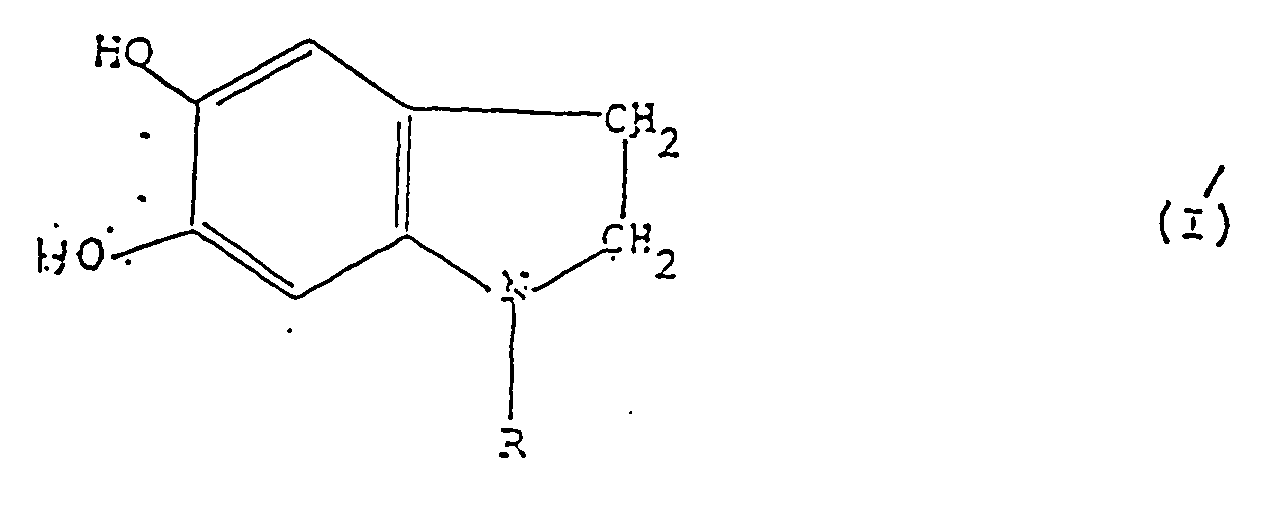 (i) einer Zusammensetzung (B), die in einem zur Färbung geeigneten Milieu entweder:a) Wasserstoffperoxid bei einem pH von 2 bis 12, wenn die Zusammensetzung (A) Jodidionen enthält, oderb) Jodidionen bei einem pH von 3 bis 11 enthält, wenn die Zusammensetzung (A) Wasserstoffperoxid enthält;(ii) einer wässrigen Zusammensetzung (B), die einen sauren pH-Wert aufweist, wenn die Zusammensetzung (A) ein Nitrit enthält, oder einer wässrigen Zusammensetzung (B) bei einem sauren pH-Wert, die mindestens ein Nitrit enthält;(iii) einer Zusammensetzung (B), enthaltend ein Oxidiermittel, ausgewählt aus Wasserstoffperoxid, Perjodsäure und ihren wasserlöslichen Salzen, Natriumhypochlorit, Chloramin T, Chloramin B, Kaliumferricyanid, Silberoxid, Fenton-Reagens, Blei(IV)oxid, Cäsiumsulfat und aus Ammoniumpersulfat, in einem zur Färbung geeigneten Milieu;(iv) einer wässrigen Zusammensetzung (B), enthaltend Metallanionen, ausgewählt aus Permanganat oder Bichromat, bei einem pH von 2 bis 10;(v) einer Zusammensetzung (B), enthaltend Metallsalze der Gruppe III bis VIII des Periodensystems in einem zur Färbung geeigneten Milieu;(vi) einer Zusammensetzung (B), enthaltend Salze seltener Erden in einem zur Färbung geeigneten Milieu;(vii) einer Zusammensetzung (B), enthaltend ein Chinonderivat, ausgewählt aus o- oder p-Benzochinonen, o- oder p-Benzochinonmonoiminen oder -diiminen, 1,2- oder 1,4-Naphthochinonen, o- oder p-Benzochinonsulfonimiden, α,ω-Alkylenbis-1,4-benzochinonen oder 1,2- oder 1,4-Naphthochinonmonoiminen, wobei das 5,6-Dihydroxyindolin der Formel (I') der Zusammensetzung (A) und die Chinonderivate der Zusammensetzung (B) so ausgewählt sind, daß die Differenz des Redox-Potentials ΔE zwischen dem Redox-Potential Ei des 5,6-Dihydroxyindolins der Formel (I'), bestimmt bei pH 7 in einem Phosphat-Milieu durch Voltametrie an einer Elektrode aus glasartigem Kohlenstoff, und dem Redox-Potential Eq des Chinonderivats, bestimmt bei pH 7 in einem Phosphat-Milieu durch Polarographie an einer Hg-Elektrode gegen eine gesättigte Kalomel-Elektrode, beträgt:
- Mittel gemäß Anspruch 27,
dadurch gekennzeichnet, daß
die Zusammensetzung (A) in einem zur Färbung geeigneten Milieu mindestens ein 5,6-Dihydroxyindolin der Formel (I') zusammen mit Jodidionen und die Zusammensetzung (B) in einem zur Färbung geeigneten Mileiu Wasserstoffperoxid enthalten. - Mittel gemäß Anspruch 27,
dadurch gekennzeichnet, daß
die Zusammensetzung (A) in einem zur Färbung geeigneten Milieu mindestens ein 5,6-Dihydroxyindolin der Formel (I') zusammen mit Wasserstoffperoxid bei einem pH von 2 bis 7 und die Zusammensetzung (B) in einem zur Färbung geeigneten Milieu Jodidionen enthalten. - Mittel gemäß Anspruch 28 oder 29,
dadurch gekennzeichnet, daß
die Jodidionen in der Zusammensetzung (A) oder (B) in Mengenverhältnissen von 0,007 bis 4 Gew.%, ausgedrückt in Jodidionen, bezogen auf das Gesamtgewicht der Zusammensetzung (A) oder (B), vorhanden sind. - Mittel gemäß Anspruch 27,
dadurch gekennzeichnet, daß
die Zusammensetzung (A) das 5,6-Dihydroxyindolin der Formel (I') enthält und die Zusammensetzung (B) wässrig sauer ist, wobei die Zusammensetzung (A) oder die Zusammensetzung (B) mindestens ein Nitrit enthalten, ausgewählt aus Alkalimetall-, Erdalkali- oder Ammoniumnitriten oder aus jedem weiteren Nitrit eines kosmetisch geeigneten Kations, aus einem organischen Derivat von Nitrit und aus Vektoren von Nitrit, die ein Nitrit des oben definierten Typs erzeugen. - Mittel gemäß Anspruch 31,
dadurch gekennzeichnet, daß
die Nitrite in Mengenverhältnissen von 0,02 bis 1 Mol/l vorhanden sind. - Mittel gemäß Anspruch 27,
dadurch gekennzeichnet, daß
die Zusammensetzung (B) in einem zur Färbung geeigneten Milieu bei einem pH von 2 bis 10 einen Anion eines Metalls, das eine gute Affinität für Keratin aufweist, enthält, wobei das Anion aus Permanganat oder Bichromaten ausgewählt ist. - Mittel gemäß Anspruch 33,
dadurch gekennzeichnet, daß
die Permanganate oder Bichromate in Molalitäten an Anionen oberhalb 10-3 Mol/1000 g bis vorzugsweise 1 Mol/1000 g verwendet werden und die Zusammensetzungen kein organisches Mittel enthalten, das gegenüber den Anionen eine Reduzierwirkung aufweist. - Mittel gemäß Anspruch 27,
dadurch gekennzeichnet, daß
die Zusammensetzung (B) in einem zur Färbung geeigneten Milieu ein Metallsalz enthält, ausgewählt aus Salzen von Mangan, Kobalt, Eisen, Kupfer und Silber. - Mittel gemäß Anspruch 35,
dadurch gekennzeichnet, daß
die Metallsalze in Mengenverhältnissen von 0,01 bis 2 Gew.%, ausgedrückt in Metallionen, bezogen auf Gesamtgewicht der Zusammensetzung, verwendet werden. - Mittel gemäß Anspruch 27,
dadurch gekennzeichnet, daß
die Zusammensetzung (B) in einem zur Färbung geeigneten Milieu ein Salz von seltenen Erden enthält, ausgewählt aus den Salzen von Cer, Lanthan, Europium, Gadolinium, Ytterbium und Dysprosium. - Mittel gemäß Anspruch 37,
dadurch gekennzeichnet, daß
die Salze der seltenen Erden in Mengenverhältnissen von 0,1 bis 8 Gew.%, bezogen auf Gesamtgewicht der Zusammensetzung, vorhanden sind. - Mittel gemäß Anspruch 27,
dadurch gekennzeichnet, daß
die Zusammensetzung (B) auf Wasserstoffperoxid beruht, wobei der Gehalt an Wasserstoffperoxid in der Zusammensetzung 1 bis 40 und vorzugsweise 2 bis 10 Volumina beträgt. - Vorrichtung aus mehreren Teilen oder "Kit zur Färbung",
dadurch gekennzeichnet, daß
die verschiedenen Teile die verschiedenen Bestandteile des in jedem der Ansprüche 26 bis 39 definierten Färbemittels enthalten.
Applications Claiming Priority (2)
| Application Number | Priority Date | Filing Date | Title |
|---|---|---|---|
| FR9006803A FR2662701B1 (fr) | 1990-05-31 | 1990-05-31 | Composition tinctoriale a base de 5,6-dihydroxyindolines et procede de teinture des fibres keratiniques. |
| FR9006803 | 1990-05-31 |
Publications (3)
| Publication Number | Publication Date |
|---|---|
| EP0462857A1 EP0462857A1 (de) | 1991-12-27 |
| EP0462857B1 EP0462857B1 (de) | 1994-08-17 |
| EP0462857B2 true EP0462857B2 (de) | 1998-03-04 |
Family
ID=9397159
Family Applications (1)
| Application Number | Title | Priority Date | Filing Date |
|---|---|---|---|
| EP91401399A Expired - Lifetime EP0462857B2 (de) | 1990-05-31 | 1991-05-30 | Färbemittel, enthaltend 5-6-Dihydroxyindoline und Färbungsverfahren für keratinische Fasern |
Country Status (12)
| Country | Link |
|---|---|
| US (1) | US5178637A (de) |
| EP (1) | EP0462857B2 (de) |
| JP (1) | JP2997564B2 (de) |
| KR (1) | KR100222017B1 (de) |
| CN (1) | CN1047592C (de) |
| AT (1) | ATE109967T1 (de) |
| AU (1) | AU641605B2 (de) |
| CA (1) | CA2043672A1 (de) |
| DE (1) | DE69103481T3 (de) |
| ES (1) | ES2057809T5 (de) |
| FR (1) | FR2662701B1 (de) |
| ZA (1) | ZA914148B (de) |
Cited By (2)
| Publication number | Priority date | Publication date | Assignee | Title |
|---|---|---|---|---|
| US6537330B1 (en) | 1998-06-23 | 2003-03-25 | Henkel Kommanditgesellschaft Auf Aktien | Colorants |
| EP0970685B2 (de) † | 1998-07-09 | 2016-10-19 | L'Oréal | Färbemittel für Keratinfasern, das ein Kationischer Farbstoffe und eine Verdickendes Polymer enthält |
Families Citing this family (31)
| Publication number | Priority date | Publication date | Assignee | Title |
|---|---|---|---|---|
| DE4016177A1 (de) * | 1990-05-19 | 1991-11-21 | Henkel Kgaa | Oxidationsfaerbemittel fuer keratinfasern |
| FR2663651B1 (fr) * | 1990-06-21 | 1992-10-09 | Oreal | Procede de teinture des fibres keratiniques avec des composes indoliques, compositions et dispositifs de mises en óoeuvre. |
| DE4129122A1 (de) * | 1991-09-02 | 1993-03-04 | Henkel Kgaa | Verfahren zur herstellung von 5,6-dihydroxyindolinen |
| FR2681318A1 (fr) * | 1991-09-12 | 1993-03-19 | Oreal | Composition tinctoriale a base de derives d'hydroxyindoline, procede de teinture des fibres keratiniques et nouveaux derives d'hydroxyindoline. |
| US6569211B2 (en) | 1991-11-19 | 2003-05-27 | Henkel Kommanditgesellschaft Auf Aktien | 5,6-dihydroxyindolines as additives for hair dyeing preparations |
| FR2686248B1 (fr) * | 1992-01-16 | 1994-04-15 | Oreal | Produit a base de particules minerales ou organiques portant un produit indolinique, son procede de preparation et son utilisation en cosmetique. |
| FR2686344B1 (fr) * | 1992-01-16 | 1994-04-15 | Oreal | Produits indoliniques, leurs procedes de preparation et leur utilisation en cosmetique. |
| DE4208297A1 (de) * | 1992-03-16 | 1993-09-23 | Henkel Kgaa | Faerben von keratinischen fasern mit indolinen unter metallkatalyse |
| FR2692782B1 (fr) * | 1992-06-25 | 1995-06-23 | Oreal | Procede de teinture des fibres keratiniques avec des derives indoliques ou indoliniques, du peroxyde d'hydrogene et une peroxydase. |
| US5716418A (en) * | 1992-08-22 | 1998-02-10 | Henkel Kommanditgesellschaft Auf Aktien | Coloring of keratin-containing fibers with preparations which contain alkyl glycosides and oxidation dye precursors |
| FR2699532B1 (fr) * | 1992-12-18 | 1995-02-24 | Oreal | Nouveaux composés indolines, compositions tinctoriales à base de ces composés et procédé de teinture des fibres kératiniques. |
| DE4331136C1 (de) * | 1993-09-14 | 1994-08-25 | Goldwell Ag | Mittel zum gleichzeitigen Färben und Aufhellen von menschlichen Haaren |
| US5731841A (en) * | 1994-05-25 | 1998-03-24 | Wavephore, Inc. | High performance data tuner for video systems |
| FR2727314B1 (fr) * | 1994-11-24 | 1997-01-03 | Oreal | Procede pour la deformation permanente des matieres keratiniques |
| US6036729A (en) * | 1995-12-22 | 2000-03-14 | Novo Nordisk A/S | Enzymatic method for textile dyeing |
| FR2752578B1 (fr) * | 1996-08-23 | 1998-09-25 | Oreal | Produit derives de 2-imino-2,3-dihydro-1h-indoles, procedes de preparation, utilisation en cosmetique et compositions cosmetiques les mettant en oeuvre |
| DE19653292C1 (de) * | 1996-12-20 | 1998-04-09 | Wella Ag | Mittel und Verfahren zum Färben von Keratinfasern |
| US5792220A (en) * | 1997-05-16 | 1998-08-11 | Bristol-Myers Squibb Company | Dyeing hair with melanin procursors in the presence of iodate and peroxide |
| DE19732975A1 (de) * | 1997-07-31 | 1999-02-04 | Henkel Kgaa | Färbemittel |
| US6613442B2 (en) | 2000-12-29 | 2003-09-02 | Lam Research Corporation | Boron nitride/yttria composite components of semiconductor processing equipment and method of manufacturing thereof |
| JP5002091B2 (ja) * | 2001-04-23 | 2012-08-15 | 花王株式会社 | 染毛剤組成物 |
| EP1254650B1 (de) * | 2001-04-23 | 2007-07-18 | Kao Corporation | Haarfärbemittel |
| JP4886117B2 (ja) * | 2001-04-23 | 2012-02-29 | 花王株式会社 | エアゾール染毛剤組成物 |
| JP4800502B2 (ja) * | 2001-04-23 | 2011-10-26 | 花王株式会社 | 染毛剤組成物 |
| DE102006026342A1 (de) * | 2006-06-02 | 2007-12-06 | Henkel Kgaa | Applikationsvorrichtung zur Anwendung einer Applikationsflüssigkeit auf keratinischen Fasern |
| JP5309469B2 (ja) * | 2007-04-27 | 2013-10-09 | 花王株式会社 | 酸化染毛剤又は脱色剤組成物 |
| KR101877238B1 (ko) * | 2011-10-14 | 2018-07-11 | (주)아모레퍼시픽 | 모발 염색용 화장료 조성물 및 이를 이용한 염색방법 |
| CN103965122B (zh) * | 2014-03-18 | 2016-03-30 | 浙江工业大学 | 一种喹喔啉取代烷烃的硝化方法 |
| CN110575402A (zh) * | 2019-11-05 | 2019-12-17 | 四川大学 | 一种人造黑色素彩色染发剂 |
| CN120676928A (zh) * | 2023-01-30 | 2025-09-19 | 花王株式会社 | 毛发的处理方法 |
| KR20250149864A (ko) | 2024-04-10 | 2025-10-17 | (주) 에프엔지리서치 | 모발 염색용 조성물 |
Family Cites Families (15)
| Publication number | Priority date | Publication date | Assignee | Title |
|---|---|---|---|---|
| GB726078A (en) * | 1952-02-08 | 1955-03-16 | Ciba Ltd | Manufacture of indolines |
| LU56102A1 (de) * | 1968-05-17 | 1970-01-14 | ||
| US3989447A (en) * | 1970-10-19 | 1976-11-02 | Societe Anonyme Dite: L'oreal | Process for nonpermanently dyeing human hair with indamine indoaniline and indophenol hair dyes |
| US4013404A (en) * | 1970-12-06 | 1977-03-22 | American Cyanamid Company | Method of dyeing hair with indolines, indoles and indazoles |
| US3963764A (en) * | 1970-12-30 | 1976-06-15 | L'oreal | Indoanilines |
| US4045170A (en) * | 1970-12-30 | 1977-08-30 | L'oreal | Hair dye composition containing an indoaniline |
| CA1005444A (fr) * | 1970-12-30 | 1977-02-15 | Societe Anonyme Dite: L'oreal | Indoanilines utilisables pour la teinture des fibres keratiniques, en particulier des cheveux humains |
| US3984402A (en) * | 1970-12-30 | 1976-10-05 | L'oreal | Indoanilines for dyeing keratinous fibers |
| LU67859A1 (de) * | 1973-06-22 | 1975-03-27 | ||
| US4595765A (en) * | 1983-09-19 | 1986-06-17 | Clairol Incorporated | Process for preparing 5,6-dihydroxyindole |
| FR2588473B1 (fr) * | 1985-10-16 | 1988-06-10 | Oreal | Utilisation de la 2,3-indolinedione pour la coloration des fibres keratiniques |
| US4776857A (en) * | 1986-11-21 | 1988-10-11 | Repligen Corporation | Use of hydroxylated indoles as dye precursors |
| LU87097A1 (fr) * | 1987-12-30 | 1989-07-07 | Oreal | Procede de teinture des fibres keratiniques et composition de teinture mettant en oeuvre du 5,6-dihydroxyindole,un colorant direct nitre et un iodure |
| US4921503A (en) * | 1988-09-12 | 1990-05-01 | Clairol Incorporated | Novel dyeing system |
| LU87403A1 (fr) * | 1988-12-06 | 1990-07-10 | Oreal | Procede de teinture de fibres keratiniques avec un hydroxyindole,associe a un derive quinonique |
-
1990
- 1990-05-31 FR FR9006803A patent/FR2662701B1/fr not_active Expired - Fee Related
-
1991
- 1991-05-30 EP EP91401399A patent/EP0462857B2/de not_active Expired - Lifetime
- 1991-05-30 AU AU78012/91A patent/AU641605B2/en not_active Ceased
- 1991-05-30 KR KR1019910008863A patent/KR100222017B1/ko not_active Expired - Fee Related
- 1991-05-30 AT AT91401399T patent/ATE109967T1/de not_active IP Right Cessation
- 1991-05-30 ES ES91401399T patent/ES2057809T5/es not_active Expired - Lifetime
- 1991-05-30 DE DE69103481T patent/DE69103481T3/de not_active Expired - Fee Related
- 1991-05-30 ZA ZA914148A patent/ZA914148B/xx unknown
- 1991-05-31 US US07/707,130 patent/US5178637A/en not_active Expired - Lifetime
- 1991-05-31 JP JP3129400A patent/JP2997564B2/ja not_active Expired - Fee Related
- 1991-05-31 CA CA002043672A patent/CA2043672A1/fr not_active Abandoned
- 1991-05-31 CN CN91103575A patent/CN1047592C/zh not_active Expired - Fee Related
Cited By (2)
| Publication number | Priority date | Publication date | Assignee | Title |
|---|---|---|---|---|
| US6537330B1 (en) | 1998-06-23 | 2003-03-25 | Henkel Kommanditgesellschaft Auf Aktien | Colorants |
| EP0970685B2 (de) † | 1998-07-09 | 2016-10-19 | L'Oréal | Färbemittel für Keratinfasern, das ein Kationischer Farbstoffe und eine Verdickendes Polymer enthält |
Also Published As
| Publication number | Publication date |
|---|---|
| ATE109967T1 (de) | 1994-09-15 |
| AU641605B2 (en) | 1993-09-23 |
| CN1047592C (zh) | 1999-12-22 |
| KR910019595A (ko) | 1991-12-19 |
| CN1056874A (zh) | 1991-12-11 |
| KR100222017B1 (ko) | 1999-10-01 |
| DE69103481D1 (de) | 1994-09-22 |
| ES2057809T5 (es) | 1998-05-01 |
| DE69103481T2 (de) | 1994-12-08 |
| EP0462857B1 (de) | 1994-08-17 |
| JP2997564B2 (ja) | 2000-01-11 |
| CA2043672A1 (fr) | 1991-12-01 |
| ES2057809T3 (es) | 1994-10-16 |
| US5178637A (en) | 1993-01-12 |
| FR2662701B1 (fr) | 1997-07-18 |
| DE69103481T3 (de) | 1998-06-18 |
| ZA914148B (en) | 1992-03-25 |
| JPH04227974A (ja) | 1992-08-18 |
| FR2662701A1 (fr) | 1991-12-06 |
| AU7801291A (en) | 1991-12-05 |
| EP0462857A1 (de) | 1991-12-27 |
Similar Documents
| Publication | Publication Date | Title |
|---|---|---|
| EP0462857B1 (de) | Färbemittel, enthaltend 5-6-Dihydroxyindoline und Färbungsverfahren für keratinische Fasern | |
| BE1000073A4 (fr) | Procede de teinture des fibres keratiniques avec le 5-6-dihydroxyindole associe a un iodure et composition tinctoriale mise en oeuvre. | |
| EP0918053B1 (de) | Azoverbindungen, ihre Verwendung zum Färben, diese enthaltende Zusammensetzungen und Farbverfahren | |
| EP0425345B1 (de) | Verfahren zur Färbung von keratinischen Fasern mit Aminoindolen, dazu gehörige Mittel und Vorrichtungen | |
| BE1003574A5 (fr) | Procede de teinture des fibres keratiniques avec un monohydroxyindole associe a un iodure et compositions mises en oeuvre. | |
| FR2626173A1 (fr) | Procede de teinture des fibres keratiniques et composition de teinture mettant en oeuvre un derive d'indole, un colorant quinonique et un systeme oxydant | |
| EP0604278B1 (de) | Indoline Derivate und Färbemittel für Keratinfasern | |
| EP1056435B9 (de) | Verfahren zur haarfärbung unter verwendung von einem kationischen heterocyklichen amin und einem aldehyd oder einem keton, einer chinoverbindung oder derivaten von diimino-isoindolin oder 3-amino-isoindolon | |
| FR2787705A1 (fr) | Procede de teinture mettant en oeuvre une amine cationique aliphatique et un compose choisi parmi un aldehyde, une cetone, une quinone et un derive de la di-imino-isoindoline ou de la 3-amino-isoindolone | |
| EP0415802B1 (de) | Verfahren zum Färben von Keratinfasern mit Monohydroxyindol und hydroxyindol 5,6-disubstituiert und Zusammensetzung | |
| CA2167647C (fr) | Composition de teinture d'oxydation des fibres keratiniques et procede de teinture mettant en oeuvre cette composition | |
| US5354870A (en) | Indole derivatives for dyeing keratin materials | |
| EP0603322B1 (de) | Färbemittel auf basis von hydroxyindolinderivaten | |
| EP0446131B1 (de) | Verfahren zur Färbung von keratinischen Fasern mit substituierten Monohydroxyindolen und Zusammensetzungen | |
| EP0826668B1 (de) | 2-Imino-2,3-Dihydro-1H-Indolderivate und deren Verwendung in Haarfärbemittel | |
| EP0722712B1 (de) | Oxidationsfärbemittel für keratinische Fasern sowie Färbungsverfahren unter Verwendung dieser Zusammensetzung | |
| CA2005822A1 (fr) | Procede de teinture des fibres keratiniques avec des derives d'indole associes a des nitrites et composition de mise en oeuvre | |
| FR2653332A1 (fr) | Procedes de teinture des fibres keratiniques avec des amino indoles, compositions et dispositifs de mise en óoeuvre. | |
| WO1998019662A1 (fr) | Composition de teinture d'oxydation des fibres keratiniques comprenant un derive de paraphenylenediamine et procede de teinture mettant en oeuvre cette composition |
Legal Events
| Date | Code | Title | Description |
|---|---|---|---|
| PUAI | Public reference made under article 153(3) epc to a published international application that has entered the european phase |
Free format text: ORIGINAL CODE: 0009012 |
|
| AK | Designated contracting states |
Kind code of ref document: A1 Designated state(s): AT BE CH DE DK ES FR GB GR IT LI NL SE |
|
| 17P | Request for examination filed |
Effective date: 19920211 |
|
| 17Q | First examination report despatched |
Effective date: 19930309 |
|
| GRAA | (expected) grant |
Free format text: ORIGINAL CODE: 0009210 |
|
| AK | Designated contracting states |
Kind code of ref document: B1 Designated state(s): AT BE CH DE DK ES FR GB GR IT LI NL SE |
|
| PG25 | Lapsed in a contracting state [announced via postgrant information from national office to epo] |
Ref country code: DK Effective date: 19940817 Ref country code: GR Free format text: LAPSE BECAUSE OF FAILURE TO SUBMIT A TRANSLATION OF THE DESCRIPTION OR TO PAY THE FEE WITHIN THE PRESCRIBED TIME-LIMIT Effective date: 19940817 Ref country code: AT Effective date: 19940817 |
|
| REF | Corresponds to: |
Ref document number: 109967 Country of ref document: AT Date of ref document: 19940915 Kind code of ref document: T |
|
| ITF | It: translation for a ep patent filed | ||
| GBT | Gb: translation of ep patent filed (gb section 77(6)(a)/1977) |
Effective date: 19940815 |
|
| REF | Corresponds to: |
Ref document number: 69103481 Country of ref document: DE Date of ref document: 19940922 |
|
| REG | Reference to a national code |
Ref country code: ES Ref legal event code: FG2A Ref document number: 2057809 Country of ref document: ES Kind code of ref document: T3 |
|
| PG25 | Lapsed in a contracting state [announced via postgrant information from national office to epo] |
Ref country code: SE Effective date: 19941117 |
|
| PLBI | Opposition filed |
Free format text: ORIGINAL CODE: 0009260 |
|
| PG25 | Lapsed in a contracting state [announced via postgrant information from national office to epo] |
Ref country code: BE Effective date: 19950531 |
|
| 26 | Opposition filed |
Opponent name: HENKEL KOMMANDITGESELLSCHAFT AUF AKTIEN Effective date: 19950512 |
|
| NLR1 | Nl: opposition has been filed with the epo |
Opponent name: HENKEL KOMMANDITGESELLSCHAFT AUF AKTIEN |
|
| BERE | Be: lapsed |
Owner name: L' OREAL Effective date: 19950531 |
|
| PLBF | Reply of patent proprietor to notice(s) of opposition |
Free format text: ORIGINAL CODE: EPIDOS OBSO |
|
| PLAW | Interlocutory decision in opposition |
Free format text: ORIGINAL CODE: EPIDOS IDOP |
|
| PLAW | Interlocutory decision in opposition |
Free format text: ORIGINAL CODE: EPIDOS IDOP |
|
| PUAH | Patent maintained in amended form |
Free format text: ORIGINAL CODE: 0009272 |
|
| STAA | Information on the status of an ep patent application or granted ep patent |
Free format text: STATUS: PATENT MAINTAINED AS AMENDED |
|
| 27A | Patent maintained in amended form |
Effective date: 19980304 |
|
| AK | Designated contracting states |
Kind code of ref document: B2 Designated state(s): AT BE CH DE DK ES FR GB GR IT LI NL SE |
|
| ITF | It: translation for a ep patent filed | ||
| GBTA | Gb: translation of amended ep patent filed (gb section 77(6)(b)/1977) | ||
| REG | Reference to a national code |
Ref country code: CH Ref legal event code: AEN Free format text: MAINTIEN DU BREVET DONT L'ETENDUE A ETE MODIFIEE |
|
| REG | Reference to a national code |
Ref country code: ES Ref legal event code: DC2A Kind code of ref document: T5 Effective date: 19980324 |
|
| NLR2 | Nl: decision of opposition | ||
| NLR3 | Nl: receipt of modified translations in the netherlands language after an opposition procedure | ||
| PGFP | Annual fee paid to national office [announced via postgrant information from national office to epo] |
Ref country code: CH Payment date: 20000526 Year of fee payment: 10 |
|
| PGFP | Annual fee paid to national office [announced via postgrant information from national office to epo] |
Ref country code: NL Payment date: 20000531 Year of fee payment: 10 |
|
| PG25 | Lapsed in a contracting state [announced via postgrant information from national office to epo] |
Ref country code: CH Free format text: LAPSE BECAUSE OF NON-PAYMENT OF DUE FEES Effective date: 20010629 Ref country code: LI Free format text: LAPSE BECAUSE OF NON-PAYMENT OF DUE FEES Effective date: 20010629 |
|
| PG25 | Lapsed in a contracting state [announced via postgrant information from national office to epo] |
Ref country code: NL Free format text: LAPSE BECAUSE OF NON-PAYMENT OF DUE FEES Effective date: 20011201 |
|
| REG | Reference to a national code |
Ref country code: GB Ref legal event code: IF02 |
|
| REG | Reference to a national code |
Ref country code: CH Ref legal event code: PL |
|
| NLV4 | Nl: lapsed or anulled due to non-payment of the annual fee |
Effective date: 20011201 |
|
| PGFP | Annual fee paid to national office [announced via postgrant information from national office to epo] |
Ref country code: ES Payment date: 20020522 Year of fee payment: 12 |
|
| PGFP | Annual fee paid to national office [announced via postgrant information from national office to epo] |
Ref country code: FR Payment date: 20040510 Year of fee payment: 14 |
|
| PGFP | Annual fee paid to national office [announced via postgrant information from national office to epo] |
Ref country code: GB Payment date: 20040526 Year of fee payment: 14 |
|
| PG25 | Lapsed in a contracting state [announced via postgrant information from national office to epo] |
Ref country code: ES Free format text: LAPSE BECAUSE OF NON-PAYMENT OF DUE FEES Effective date: 20040531 |
|
| PG25 | Lapsed in a contracting state [announced via postgrant information from national office to epo] |
Ref country code: IT Free format text: LAPSE BECAUSE OF NON-PAYMENT OF DUE FEES;WARNING: LAPSES OF ITALIAN PATENTS WITH EFFECTIVE DATE BEFORE 2007 MAY HAVE OCCURRED AT ANY TIME BEFORE 2007. THE CORRECT EFFECTIVE DATE MAY BE DIFFERENT FROM THE ONE RECORDED. Effective date: 20050530 Ref country code: GB Free format text: LAPSE BECAUSE OF NON-PAYMENT OF DUE FEES Effective date: 20050530 |
|
| REG | Reference to a national code |
Ref country code: ES Ref legal event code: FD2A Effective date: 20040531 |
|
| GBPC | Gb: european patent ceased through non-payment of renewal fee |
Effective date: 20050530 |
|
| PG25 | Lapsed in a contracting state [announced via postgrant information from national office to epo] |
Ref country code: FR Free format text: LAPSE BECAUSE OF NON-PAYMENT OF DUE FEES Effective date: 20060131 |
|
| REG | Reference to a national code |
Ref country code: FR Ref legal event code: ST Effective date: 20060131 |
|
| PGFP | Annual fee paid to national office [announced via postgrant information from national office to epo] |
Ref country code: DE Payment date: 20090529 Year of fee payment: 19 |
|
| PG25 | Lapsed in a contracting state [announced via postgrant information from national office to epo] |
Ref country code: DE Free format text: LAPSE BECAUSE OF NON-PAYMENT OF DUE FEES Effective date: 20101201 |