EP0462928A2 - Indoliniminfarbstoffe - Google Patents
Indoliniminfarbstoffe Download PDFInfo
- Publication number
- EP0462928A2 EP0462928A2 EP91810438A EP91810438A EP0462928A2 EP 0462928 A2 EP0462928 A2 EP 0462928A2 EP 91810438 A EP91810438 A EP 91810438A EP 91810438 A EP91810438 A EP 91810438A EP 0462928 A2 EP0462928 A2 EP 0462928A2
- Authority
- EP
- European Patent Office
- Prior art keywords
- alkyl
- hydrogen
- formula
- alkoxy
- dyes
- Prior art date
- Legal status (The legal status is an assumption and is not a legal conclusion. Google has not performed a legal analysis and makes no representation as to the accuracy of the status listed.)
- Withdrawn
Links
- 0 *C(CC1)=C(*)C2=C1*CCN2* Chemical compound *C(CC1)=C(*)C2=C1*CCN2* 0.000 description 2
- TYYCVUGFHDUGAS-UHFFFAOYSA-N CC(N(C1)c2ccccc2C1=C(C#N)C#N)=O Chemical compound CC(N(C1)c2ccccc2C1=C(C#N)C#N)=O TYYCVUGFHDUGAS-UHFFFAOYSA-N 0.000 description 1
Classifications
-
- G—PHYSICS
- G11—INFORMATION STORAGE
- G11B—INFORMATION STORAGE BASED ON RELATIVE MOVEMENT BETWEEN RECORD CARRIER AND TRANSDUCER
- G11B7/00—Recording or reproducing by optical means, e.g. recording using a thermal beam of optical radiation by modifying optical properties or the physical structure, reproducing using an optical beam at lower power by sensing optical properties; Record carriers therefor
- G11B7/24—Record carriers characterised by shape, structure or physical properties, or by the selection of the material
- G11B7/241—Record carriers characterised by shape, structure or physical properties, or by the selection of the material characterised by the selection of the material
- G11B7/242—Record carriers characterised by shape, structure or physical properties, or by the selection of the material characterised by the selection of the material of recording layers
- G11B7/244—Record carriers characterised by shape, structure or physical properties, or by the selection of the material characterised by the selection of the material of recording layers comprising organic materials only
- G11B7/246—Record carriers characterised by shape, structure or physical properties, or by the selection of the material characterised by the selection of the material of recording layers comprising organic materials only containing dyes
-
- C—CHEMISTRY; METALLURGY
- C09—DYES; PAINTS; POLISHES; NATURAL RESINS; ADHESIVES; COMPOSITIONS NOT OTHERWISE PROVIDED FOR; APPLICATIONS OF MATERIALS NOT OTHERWISE PROVIDED FOR
- C09B—ORGANIC DYES OR CLOSELY-RELATED COMPOUNDS FOR PRODUCING DYES, e.g. PIGMENTS; MORDANTS; LAKES
- C09B55/00—Azomethine dyes
- C09B55/009—Azomethine dyes, the C-atom of the group -C=N- being part of a ring (Image)
-
- G—PHYSICS
- G11—INFORMATION STORAGE
- G11B—INFORMATION STORAGE BASED ON RELATIVE MOVEMENT BETWEEN RECORD CARRIER AND TRANSDUCER
- G11B7/00—Recording or reproducing by optical means, e.g. recording using a thermal beam of optical radiation by modifying optical properties or the physical structure, reproducing using an optical beam at lower power by sensing optical properties; Record carriers therefor
- G11B7/24—Record carriers characterised by shape, structure or physical properties, or by the selection of the material
- G11B7/241—Record carriers characterised by shape, structure or physical properties, or by the selection of the material characterised by the selection of the material
- G11B7/242—Record carriers characterised by shape, structure or physical properties, or by the selection of the material characterised by the selection of the material of recording layers
- G11B7/244—Record carriers characterised by shape, structure or physical properties, or by the selection of the material characterised by the selection of the material of recording layers comprising organic materials only
-
- G—PHYSICS
- G11—INFORMATION STORAGE
- G11B—INFORMATION STORAGE BASED ON RELATIVE MOVEMENT BETWEEN RECORD CARRIER AND TRANSDUCER
- G11B7/00—Recording or reproducing by optical means, e.g. recording using a thermal beam of optical radiation by modifying optical properties or the physical structure, reproducing using an optical beam at lower power by sensing optical properties; Record carriers therefor
- G11B7/24—Record carriers characterised by shape, structure or physical properties, or by the selection of the material
- G11B7/241—Record carriers characterised by shape, structure or physical properties, or by the selection of the material characterised by the selection of the material
- G11B7/252—Record carriers characterised by shape, structure or physical properties, or by the selection of the material characterised by the selection of the material of layers other than recording layers
- G11B7/253—Record carriers characterised by shape, structure or physical properties, or by the selection of the material characterised by the selection of the material of layers other than recording layers of substrates
- G11B7/2531—Record carriers characterised by shape, structure or physical properties, or by the selection of the material characterised by the selection of the material of layers other than recording layers of substrates comprising glass
-
- G—PHYSICS
- G11—INFORMATION STORAGE
- G11B—INFORMATION STORAGE BASED ON RELATIVE MOVEMENT BETWEEN RECORD CARRIER AND TRANSDUCER
- G11B7/00—Recording or reproducing by optical means, e.g. recording using a thermal beam of optical radiation by modifying optical properties or the physical structure, reproducing using an optical beam at lower power by sensing optical properties; Record carriers therefor
- G11B7/24—Record carriers characterised by shape, structure or physical properties, or by the selection of the material
- G11B7/241—Record carriers characterised by shape, structure or physical properties, or by the selection of the material characterised by the selection of the material
- G11B7/252—Record carriers characterised by shape, structure or physical properties, or by the selection of the material characterised by the selection of the material of layers other than recording layers
- G11B7/258—Record carriers characterised by shape, structure or physical properties, or by the selection of the material characterised by the selection of the material of layers other than recording layers of reflective layers
- G11B7/2585—Record carriers characterised by shape, structure or physical properties, or by the selection of the material characterised by the selection of the material of layers other than recording layers of reflective layers based on aluminium
-
- G—PHYSICS
- G11—INFORMATION STORAGE
- G11B—INFORMATION STORAGE BASED ON RELATIVE MOVEMENT BETWEEN RECORD CARRIER AND TRANSDUCER
- G11B7/00—Recording or reproducing by optical means, e.g. recording using a thermal beam of optical radiation by modifying optical properties or the physical structure, reproducing using an optical beam at lower power by sensing optical properties; Record carriers therefor
- G11B7/24—Record carriers characterised by shape, structure or physical properties, or by the selection of the material
- G11B7/241—Record carriers characterised by shape, structure or physical properties, or by the selection of the material characterised by the selection of the material
- G11B7/252—Record carriers characterised by shape, structure or physical properties, or by the selection of the material characterised by the selection of the material of layers other than recording layers
- G11B7/258—Record carriers characterised by shape, structure or physical properties, or by the selection of the material characterised by the selection of the material of layers other than recording layers of reflective layers
- G11B7/2595—Record carriers characterised by shape, structure or physical properties, or by the selection of the material characterised by the selection of the material of layers other than recording layers of reflective layers based on gold
Definitions
- the present invention relates to new indolinimine dyes, processes for their preparation and their use as NIR-absorbing substances in optical recording media.
- the dyes according to the invention correspond to the formula wherein R1 is alkyl or aryl, R2 is hydrogen, alkyl, alkoxy, -NH-CO-alkyl or -NH-CO-aryl, R3 is hydrogen, alkoxy, aryloxy, alkylthio, arylthio or R3 and R4, together with the nitrogen atom and the two of them connecting carbon atoms, a 5- or 6-membered ring, which may have a fused-on benzene ring, R4 hydrogen, alkyl, aralkyl or R4 and R5 together with the nitrogen atom to which they are attached, a 5- or 6-membered ring , R5 is hydrogen, alkyl or aralkyl, R6 is hydrogen or R5 and R6, together with the nitrogen atom and the two carbon atoms connecting them, are a 5-
- alkyl radicals are generally understood to mean straight-chain, branched or cyclic alkyl groups. It is, for example, methyl, ethyl, propyl, i-propyl, butyl, i-butyl, tert-butyl, amyl, tert-amyl (1,1-dimethylpropyl), 1,1,3,3-tetramethylbutyl, Hexyl, 1-methylpentyl, neopentyl, 1-, 2- or 3-methylhexyl, heptyl, n-octyl, tert-octyl, 2-ethylhexyl, n-nonyl, isononyl, decyl, dodecyl, cyclopentyl, cyclohexyl, methylcyclohexyl and the associated isomers.
- the alkyl radicals preferably contain 1 to 6 carbon atoms, especially 1 to 4 carbon
- alkyl radicals can be substituted, e.g. by halogen, hydroxy, alkoxy, cyan or phenyl.
- substituted alkyl radicals are hydroxyethyl, methoxymethyl, ethoxyethyl, cyanoethyl, propoxypropyl, benzyl, chloroethyl or cyanoethoxyethyl.
- Suitable alkoxy radicals are preferably those with 1-4 C atoms, e.g. Methoxy, ethoxy, propoxy, iso-propoxy, n-butoxy, iso-butoxy or tert-butoxy.
- Halogen in this application generally means fluorine, bromine, iodine or, above all, chlorine.
- the aryl radicals represent aromatic carbocyclic or heterocyclic radicals. phenyl, naphthyl-1, naphthyl-2, pyridyl-2, pyridyl-3, pyridyl-4, pyrimidyl-2 or thienyl-2. These residues can be substituted, e.g. by halogen, C1-C6-alkyl, C1-C4-alkoxy, nitro or CN.
- R3 and R4 as well as R5 and R6 together with the nitrogen atom and the two carbon atoms connecting them can form a 5- or 6-membered ring which is another heteroatom, e.g. May contain oxygen or sulfur.
- the ring can also be substituted, e.g. by hydroxy, alkoxy, alkyl, halogen CN or phenyl, or another fused benzene ring.
- Preferred rings, which are formed by R3, R4, or R5, R6, and the connecting carbon atoms and the nitrogen atom are dihydrooxazine and di- or tetrahydropyridine rings which carry 0 to 4 methyl groups.
- R4 and R5 can also form a piperidine, morpholine or piperazine residue together with the N atom connecting them.
- the piperazine radical can be substituted on the N atom not connected to the triazinrinb by C1-C4-alkyl or hydroxy-C1C4-alkyl or amino-C1-C4-alkyl.
- the preferred substituent is hydroxyethyl.
- R1 represents an unsubstituted C1-C Alkylalkyl radical, in particular methyl.
- R2 is preferably hydrogen, C1-C4-alkyl, C1-C4-alkoxy, C1-C4-alkylcarbonylamino or phenylcarbonylamino, where hydrogen, methyl, Methoxy, acetylamino and propionylamino are particularly preferred.
- R3 are hydrogen, C1-C4-alkyl, C1-C4-alkoxy or R3 and R4 together with the nitrogen atom and the carbon atoms connecting them form a dihydrooxazine or tetrahydropyridine ring which carries 1 to 3 methyl groups.
- R4 are hydrogen, unsubstituted C1-C4-alkyl or C1-C4-alkyl, which is substituted by hydroxy, C1-C4-alkoxy, chlorine, cyano, phenyl or cyanoethoxy.
- R5 is preferably hydrogen, unsubstituted C1-C4-alkyl or C1-C4-alkyl, which is substituted by hydroxy, C1-C4-alkoxy, chlorine, cyan, phenyl or cyanoethoxy.
- R6 is preferably hydrogen or R6 forms together with R5 and the nitrogen atom and the carbon atoms connecting them a tetrahydropyridine ring which is unsubstituted or substituted by hydroxy or chlorine.
- R7 is hydrogen
- Particularly preferred dyes according to the invention are those of the formula (1) in which R1 is C1-C4 alkyl, R2 is hydrogen, C1-C4-alkyl, C1-C4-alkoxy or C1-C4-alkylcarbonylamino, R3 is hydrogen, C1-C4-alkyl or C1 -C4-alkoxy, R4 hydrogen, C1-C4-alkyl or C1-C4-alkyl, which is substituted by hydroxy, C1-C4-alkoxy, chlorine, cyano, phenyl or cyanoethoxy, or R3 and R4 together with the nitrogen atom and both carbon atoms connecting them a dihydrooxazine or tetrahydropyridine ring which carries 1 to 3 methyl groups, R5 is hydrogen, C1-C4-alkyl or C1-C4-alkyl which is substituted by hydroxy, C1-C4-alkoxy, chlorine, cyan,
- R1 is methyl and R2 is hydrogen, methyl, methoxy, acetylamino or propionylamino.
- the dyes according to the invention are prepared, for example, by using a compound of the formula with a compound of the formula implements, wherein R1, R2, R3, R4, R5, R6 and R7 have the meanings given under the formula (1).
- the reaction of the compound (2) with the compound (3) takes place under conditions analogous to those known for similar condensation reactions, for example by stirring at room temperature in the presence of a dehydrating solvent or by azeotropically distilling off the water of reaction.
- the compounds of the formula (2) are obtained, for example, by using a compound of the formula condensed with malononitrile.
- This condensation is carried out analogously to known reactions of a similar type (Knoevenagel condensation), preferably in an inert organic solvent, e.g. Ethanol, butanol, benzene, toluene or chlorobenzene, at temperatures between 20 and 150 ° C, the presence of a catalyst, e.g. Piperidine or a mixture of piperidine and glacial acetic acid is advantageous.
- an inert organic solvent e.g. Ethanol, butanol, benzene, toluene or chlorobenzene
- the compounds of formula (4) are known or can be obtained in a manner known per se.
- nitroso compounds of the formula (3) are also known or can be prepared in a known manner. This applies to those compounds of formula (3) in which R6 is hydrogen and R3 is hydrogen, alkoxy, aryloxy, alkylthio or arylthio.
- R2 is hydrogen, alkyl, alkoxy, -NH-CO-alkyl or -NH-CO-aryl
- R5 hydrogen, alkyl or aralkyl
- R6 hydrogen or R5 and R6, together with the nitrogen atom and the two carbon atoms connecting them, a 5- or 6-membered rinb and
- the compounds of the formula (5) are prepared in a manner known per se, for example by using a compound of the formula wherein R2, R5, R6 and X have the meanings given under formula (5), nitrosated.
- the nitrosation is carried out in a manner known per se, for example by reacting a compound of the formula (6) in aqueous hydrochloric acid medium with sodium nitrite at low temperature, for example between 0 and 5 ° C.
- the compounds of formula (6) are known or can be prepared in a manner known per se.
- the compounds of the formula (1) according to the invention are used as light-absorbing substances in optical recording media.
- the structure of the recording media is known per se.
- Suitable carriers are, for example, glass plates or panes and plastic plates / panes, such as those made of polystyrene, polycarbonate and in particular of polymethyl methacrylate.
- Suitable light reflecting materials are e.g. Metals such as aluminum, rhodium, gold, tin, lead, bismuth or copper; Dielectric mirrors are also suitable.
- the light-absorbing layer can consist only of a compound of the formula (1).
- the light-absorbing layer contains a thermoplastic binder, e.g. Polystyrene, polyvinyl acetate, polyvinyl pyrrolidone, cellulose acetate butyrate, polysulfonamide, polycarbonate or cellulose nitrate.
- a thermoplastic binder e.g. Polystyrene, polyvinyl acetate, polyvinyl pyrrolidone, cellulose acetate butyrate, polysulfonamide, polycarbonate or cellulose nitrate.
- the thickness of the light-absorbing layer can vary within wide limits; A thickness of 5 to 350 nm is advantageous.
- the light-absorbing layer preferably has a thickness of 10 to 200 nm. If the light-absorbing layer consists only of dye alone, it is preferably 10 to 100 nm thick.
- the recording medium according to the invention can be written on and read using the focused radiation from a light source.
- light sources come e.g. Lasers and in particular those in question which emit in the wavelength range from 600 to 850 nm.
- Examples are the Ga-Al-As diode laser and in particular the He-Ne laser.
- the compounds of the formula (1) used according to the invention for the light-absorbing layer have broad absorption bands in the NIR range (near infrared range) with a maximum in the wavelength range from approximately 600 to 800 nm.
- optical recording media which are equipped with these compounds have an extremely high sensitivity to the radiation from light sources, in particular lasers, which emit in the wavelength range from 600 to 800 nm.
- light sources in particular lasers, which emit in the wavelength range from 600 to 800 nm.
- lasers which emit in the wavelength range from 600 to 800 nm.
- the thickness of the layer growing on evaporation can be monitored using known methods, e.g. with the help of an optical system that measures the reflectivity of the reflective surface covered with the absorption material.
- the growth of the layer thickness is preferably monitored with a quartz crystal.
- a solution or, if appropriate, a dispersion of the compound according to the invention is prepared in a suitable solvent, such as methylene chloride, chloroform, acetone, methyl ethyl ketone, cyclohexanone, toluene, acetonitrile, ethyl acetate or methanol, and one of the aforementioned thermoplastic is optionally used Binders or mixtures of several binders.
- This dye preparation can be applied to a previously cleaned substrate by spinning, knife coating or dipping, and the layer can be air-dried.
- the film can also be dried in vacuo and / or at elevated temperature.
- the dye is applied first and then the reflector or, preferably, the other way round.
- a reflective layer can optionally be dispensed with.
- Example 2 the 13 parts of the nitroso derivative mentioned are replaced by 13.5 parts of the nitroso derivative of the formula so you get the dye of the formula
- a solution of the dye obtained in Example 3 in trichlorethylene is spun onto a round glass pane. An approximately 60 nm thick light-absorbing layer is obtained on the surface.
- the energy set creates a circular depression with steep walls and no bulge on the surface per pulse.
- a glass pane is placed on the reflector layer with an approximately 60 nm thick layer of a dye of the formula vaporized, where X has the meanings given in the table.
- the recording media obtained each have properties similar to those obtained in Example 4.
Landscapes
- Chemical & Material Sciences (AREA)
- Organic Chemistry (AREA)
- Thermal Transfer Or Thermal Recording In General (AREA)
- Nitrogen Condensed Heterocyclic Rings (AREA)
- Optical Record Carriers And Manufacture Thereof (AREA)
- Non-Silver Salt Photosensitive Materials And Non-Silver Salt Photography (AREA)
- Quinoline Compounds (AREA)
- Heterocyclic Carbon Compounds Containing A Hetero Ring Having Nitrogen And Oxygen As The Only Ring Hetero Atoms (AREA)
- Indole Compounds (AREA)
- Plural Heterocyclic Compounds (AREA)
- Nitrogen And Oxygen Or Sulfur-Condensed Heterocyclic Ring Systems (AREA)
Abstract
Die Farbstoffe der Formel <IMAGE> worin R1 Alkyl oder Aryl, R2 Wasserstoff, Alkyl, Alkoxy, -NH-CO-Alkyl oder -NH-CO-Aryl, R3 Wasserstoff, Alkoxy, Aryloxy, Alkylthio, Arylthio oder R3 und R4, zusammen mit dem Stickstoffatom und den beiden sie verbindenden C-Atomen, einen 5- oder 6- gliedrigen Ring, welcher einen ankondensierten Benzolring aufweisen kann, R4 Wasserstoff, Alkyl, Aralkyl oder R4 und R5 zusammen mit dem Stickstoffatom, an das sie gebunden sind, einen 5- oder 6-gliedringen Ring, R5 Wasserstoff, Alkyl oder Aralkyl, R6 Wasserstoff oder R5 und R6, zusammen mit dem Stickstoffatom und den beiden sie verbindenden C-Atomen, einen 5- oder 6-gliedrigen Ring und R7 Wasserstoff, Alkyl, Hydroxy, Alkoxy, Halogen oder Nitro bedeuten, eignen sich als lichtabsorbierende Substanzen in optischen Aufzeichnungsmedien.
Description
- Die vorliegende Erfindung betrifft neue Indoliniminfarbstoffe, Verfahren zu ihrer Herstellung sowie ihre Verwendung als NIR-absorbierende Substanzen in optischen Aufzeichnungsmedien.
Die erfindungsgemässen Farbstoffe entsprechen der Formel
worin R₁ Alkyl oder Aryl, R₂ Wasserstoff, Alkyl, Alkoxy, -NH-CO-Alkyl oder -NH-CO-Aryl, R₃ Wasserstoff, Alkoxy, Aryloxy, Alkylthio, Arylthio oder R₃ und R₄, zusammen mit dem Stickstoffatom und den beiden sie verbindenden C-Atomen, einen 5-oder 6-gliedrigen Ring, welcher einen ankondensierten Benzolring aufweisen kann, R₄ Wasserstoff, Alkyl, Aralkyl oder R₄ und R₅ zusammen mit dem Stickstoffatom, an das sie gebunden sind, einen 5- oder 6-gliedrigen Ring, R₅ Wasserstoff, Alkyl oder Aralkyl, R₆ Wasserstoff oder R₅ und R₆, zusammen mit dem Stickstoffatom und den beiden sie verbindenden C-Atomen, einen 5- oder 6-gliedrigen Ring und R₇ Wasserstoff, Alkyl, Hydroxy, Alkoxy, Halogen oder Nitro bedeuten. - Unter Alkylresten sind erfindungsgemäss generell geradkettige, verzweigte oder cyclische Alkylgruppen zu verstehen. Es handelt sich z.B. um Methyl, Ethyl, Propyl, i-Propyl, Butyl, i-Butyl, tert.-Butyl, Amyl, tert.-Amyl (1,1-Dimethylpropyl), 1,1,3,3-Tetramethylbutyl, Hexyl, 1-Methylpentyl, Neopentyl, 1-, 2- oder 3-Methylhexyl, Heptyl, n-Octyl, tert.-Octyl, 2-Ethylhexyl, n-Nonyl, Isononyl, Decyl, Dodecyl, Cyclopentyl, Cyclohexyl, Methylcyclohexyl sowie die dazugehörenden Isomeren. Die Alkylreste enthalten vorzubsweise 1 bis 6 C-Atome, vor allem 1 bis 4 C-Atome.
- Diese Alkylreste können substituiert sein, z.B. durch Halogen, Hydroxy, Alkoxy, Cyan oder Phenyl. Beispiele für solche substituierten Alkylreste sind Hydroxyethyl, Methoxymethyl, Ethoxyethyl, Cyanethyl, Propoxypropyl, Benzyl, Chlorethyl oder Cyanethoxyethyl.
- Geeignete Alkoxyreste sind vorzugsweise solche mit 1-4 C-Atomen z.B. Methoxy, Ethoxy, Propoxy, iso-Propoxy, n-Butoxy, iso-Butoxy oder tert.-Butoxy.
- Unter Halogen ist in dieser Anmeldung generell Fluor, Brom, Jod oder vor allem Chlor zu verstehen.
- Die Arylreste stellen aromatische carbocyclische oder heterocyclische Reste dar. Es handelt sich z.B. um Phenyl, Naphthyl- 1, Naphthyl-2, Pyridyl-2, Pyridyl-3, Pyridyl-4, Pyrimidyl-2 oder Thienyl-2. Diese Reste können substituiert sein, z.B. durch Halogen, C₁-C₆-Alkyl, C₁-C₄-Alkoxy, Nitro oder CN.
- R₃ und R₄ können ebenso wie R₅ und R₆ zusammen mit dem Stickstoffatom und den beiden sie verbindenden Kohlenstoffatomen einen 5- oder 6-gliedrigen Ring bilden, welcher ein weiteres Heteroatom, z.B. Sauerstoff oder Schwefel, enthalten kann. Ausserdem kann der Ring substituiert sein, z.B. durch Hydroxy, Alkoxy, Alkyl, Halogen CN oder Phenyl, oder einen weiteren ankondensierten Benzolring tragen. Bevorzugte Ringe, welche durch R₃, R₄, bzw. R₅, R₆, und die verbindenden Kohlenstoffatome und das Stickstoffatom gebildet werden, sind Dihydrooxazin- und Di- oder Tetrahydropyridinringe, welche 0 bis 4 Methylgruppen tragen.
- R₄ und R₅ können auch zusammen mit dem sie verbindenden N-Atom einen Piperidin-, Morpholin- oder Piperazinrest bilden. Der Piperazinrest kann am nicht mit dem Triazinrinb verbundenen N-Atom durch C₁-C₄-Alkyl oder Hydroxy-C₁C₄-Alkyl oder Amino-C₁-C₄-Alkyl substituiert sein. Der bevorzubte Substituent ist Hydroxyethyl.
- In besonders wertvollen Farbstoffen der Formel (1) stellt R₁ einen unsubstituierten C₁-C₄-Alkylrest, insbesondere Methyl, dar.
- R₂ bedeutet vorzugsweise Wasserstoff, C₁-C₄-Alkyl, C₁-C₄-Alkoxy, C₁-C₄-Alkylcarbonylamino oder Phenylcarbonylamino, wobei Wasserstoff, Methyl, Methoxy, Acetylamino und Propionylamino besonders bevorzugt sind.
- Die bevorzubten Bedeutungen von R₃ sind Wasserstoff, C₁-C₄-Alkyl, C₁-C₄-Alkoxy oder R₃ und R₄ bilden zusammen mit dem Stickstoffatom und den sie verbindenden Kohlenstoffatomen einen Dihydrooxazin- oder Tetrahydropyridinring, welcher 1 bis 3 Methylgruppen trägt.
- Weitere bevorzugte Bedeutungen von R₄ sind Wasserstoff, unsubstituiertes C₁-C₄-Alkyl oder C₁-C₄-Alkyl, welches durch Hydroxy, C₁-C₄-Alkoxy, Chlor, Cyan, Phenyl oder Cyanethoxy substituiert ist.
- R₅ bedeutet vorzugsweise Wasserstoff, unsubstituiertes C₁-C₄-Alkyl oder C₁-C₄-Alkyl, welches durch Hydroxy, C₁-C₄-Alkoxy, Chlor, Cyan, Phenyl oder Cyanethoxy substituiert ist.
- R₆ ist vorzubsweise Wasserstoff oder R₆ bildet zusammen mit R₅ und dem Stickstoffatom und den sie verbindenden Kohlenstoffatomen einen Tetrahydropyridinring, welcher unsubstituiert oder durch Hydroxy oder Chlor substituiert ist.
- Die bevorzubte Bedeutung von R₇ ist Wasserstoff.
- Besonders bevorzugte erfindungsgemässe Farbstoffe sind solche der Formel (1), worin R₁ C₁-C₄ Alkyl, R₂ Wasserstoff, C₁-C₄-Alkyl, C₁-C₄-Alkoxy oder C₁-C₄-Alkylcarbonylamino, R₃ Wasserstoff, C₁-C₄-Alkyl oder C₁-C₄-Alkoxy, R₄ Wasserstoff, C₁-C₄-Alkyl oder C₁-C₄-Alkyl, welches durch Hydroxy, C₁-C₄-Alkoxy, Chlor, Cyan, Phenyl oder Cyanethoxy substituiert ist, oder R₃ und R₄ zusammen mit dem Stickstoffatom und den beiden sie verbindenden Kohlenstoffatomen einen Dihydrooxazin- oder Tetrahydropyridinring, welcher 1 bis 3 Methylgruppen trägt, R₅ Wasserstoff, C₁-C₄-Alkyl oder C₁-C₄-Alkyl, welches durch Hydroxy, C₁-C₄-Alkoxy, Chlor, Cyan, Phenyl oder Cyan-ethoxy substituiert ist, R₆ Wasserstoff oder R₅ und R₆ zusammen mit dem Stickstoffatom und den beiden sie verbindenden Kohlenstoffatomen einen Tetrahydropyridinring und R₇ Wasserstoff bedeutet.
- Unter diesen sind jene besonders bevorzugt, bei denen R₁ Methyl und R₂ Wasserstoff, Methyl, Methoxy, Acetylamino oder Propionylamino bedeutet.
- Die erfindungsgemässen Farbstoffe werden z.B. herbestellt, indem man eine Verbindung der Formel

mit einer Verbindung der Formel
umsetzt, wobei R₁, R₂, R₃, R₄, R₅, R₆ und R₇ die unter der Formel (1) angegebenen Bedeutungen aufweisen. Die Umsetzung der Verbindung (2) mit der Verbindung (3) geschieht unter analogen Bedingungen wie sie für ähnliche Kondensationsreaktionen bekannt sind, beispielsweise durch Rühren bei Raumtemperatur in Gegenwart eines wasserentziehenden Lösungsmittels oder indem man das Reaktionswasser azeotrop abdestilliert. - Die Verbindungen der Formel

worin R₁ Alkyl oder Aryl und R₇ Wasserstoff, Alkyl, Alkoxy, Halogen oder Nitro bedeutet, sind neu und stellen einen weiteren Gegenstand der vorliegenden Erfindung dar. - Man erhält die Verbindungen der Formel (2) z.B., indem man eine Verbindung der Formel

mit Malonsäuredinitril kondensiert. - Diese Kondensation erfolgt analog zu bekannten Reaktionen ähnlicher Art (Knoevenagel-Kondensation), vorzugsweise in einem inerten organischen Lösungsmittel, z.B. Ethanol, Butanol, Benzol, Toluol oder Chlorbenzol, bei Temperaturen zwischen 20 und 150°C, wobei die Anwesenheit eines Katalysators, z.B. Piperidin oder ein Gemisch aus Piperidin und Eisessig, vorteilhaft ist.
- Die Verbindungen der Formel (4) sind bekannt oder können auf an sich bekannte Art und Weise erhalten werden.
- Die Nitrosoverbindungen der Formel (3) sind zum Teil ebenfalls bekannt oder können auf bekannte Art und Weise hergestellt werden. Dies trifft für jene Verbindungen der Formel (3) zu, bei denen R₆ Wasserstoff und R₃ Wasserstoff, Alkoxy, Aryloxy, Alkylthio oder Arylthio bedeutet.
- Neu sind die Verbindungen der Formel

worin R₂ Wasserstoff, Alkyl, Alkoxy, -NH-CO-Alkyl oder -NH-CO-Aryl, R₅ Wasserstoff, Alkyl oder Aralkyl, R₆ Wasserstoff oder R₅ und R₆, zusammen mit dem Stickstoffatom und den beiden sie verbindenden Kohlenstoffatomen, einen 5- oder 6-gliedrigen Rinb und - X die direkte Bindung, -O- oder

bedeuten, wobei der stickstoffhaltige Ring in der Formel (5) noch einen ankondensierten Benzolring oder 1 oder 2 Methylgruppen tragen kann. - Die Verbindungen der Formel (5) werden auf an sich bekannte Art hergestellt, beispielsweise indem man eine Verbindung der Formel

worin R₂, R₅, R₆ und X die unter der Formel (5) angegebenen Bedeutungen aufweisen, nitrosiert. Die Nitrosierung erfolgt auf an sich bekannte Weise, z.B. durch Umsetzen einer Verbindung der Formel (6) in wässrigem salzsaurem Medium mit Natriumnitrit bei niedriger Temperatur, z.B. zwischen 0 und 5°C. Die Verbindungen der Formel (6) sind bekannt oder können auf an sich bekannte Art und Weise hergestellt werden. - Die erfindungsgemässen Verbindungen der Formel (1) finden Verwendung als lichtabsorbierende Substanzen in optischen Aufzeichnungsmedien.
- Der Aufbau der Aufzeichnungsmedien ist an sich bekannt.
- Als Träger kommen z.B. Glasplatten oder -scheiben sowie Kunststoffplatten/-scheiben, wie solche aus Polystyrol, Polycarbonat und insbesondere aus Polymethylmethacrylat in Frage.
- Die erfindungsgemässen Aufzeichnungsmedien enthalten ausserdem bevorzugt eine lichtreflektierende Schicht, so dass das eingestrahlte und durch die farbige Schicht wandernde Licht (soweit es nicht absorbiert wird) an der Reflektorschicht reflektiert wird und nochmals durch die gefärbte Schicht wandert. Dabei ist es vorteilhaft, in diesen Fällen der Farbstoffschicht die Dicke λ/4 (λ = Wellenlänge des eingestrahlten Lichts) zu geben, da dann durch Interferenz eine besonders hohe Nutzung (Schwächung) des eingestrahlten Lichts erreicht wird. Bei Verwendung der erfindungsgemässen Farbstoffe werden jedoch auch mit Schichtdicken, die deutlich unter λ/4 liegen, sehr empfindliche Aufzeichnungsträger erhalten, was überraschend ist.
- Geeignete lichtreflektierende Materialien sind z.B. Metalle wie Aluminium, Rhodium, Gold, Zinn, Blei, Wismut oder Kupfer; in Frage kommen auch dielektrische Spiegel.
- Die lichtabsorbierende Schicht kann in einer Ausführungsform der erfindungsgemässen Aufzeichnungsmedien nur aus einer Verbindung der Formel (1) bestehen.
- In einer weiteren Ausführungsform enthält die lichtabsorbierende Schicht neben einer dieser Verbindungen ein thermoplastisches Bindemittel, z.B. Polystyrol, Polyvinylacetat, Polyvinylpyrrolidon, Celluloseacetatbutyrat, Polysulfonamid, Polycarbonat oder Cellulosenitrat.
- Die Dicke der lichtabsorbierenden Schicht kann in weiten Grenzen variieren; vorteilhaft ist eine Dicke von 5 bis 350 nm. Bevorzugt weist die lichtabsorbierende Schicht eine Dicke von 10 bis 200 nm auf. Besteht die lichtabsorbierende Schicht nur aus Farbstoff allein, so ist sie bevorzugt 10 bis 100 nm dick.
- Das erfindungsgemässe Aufzeichnungsmedium lässt sich mit der fokussierten Strahlung einer Lichtquelle beschreiben und lesen. Als Lichtquellen kommen z.B. Laser und hierbei insbesondere solche in Frage, die im Wellenlängenbereich von 600 bis 850 nm emittieren. Beispiele sind der Ga-Al-As-Diodenlaser und insbesondere der He-Ne-Laser.
- Die erfindungsgemäss für die lichtabsorbierende Schicht verwendeten Verbindungen der Formel (1) weisen breite Absorptionsbanden im NIR-Bereich (naher Infrarot-Bereich) mit einem Maximum im Wellenlängenbereich von etwa 600 bis 800 nm auf.
- Aufgrund der beschilderten Absorptionseigenschaften weisen optische Aufzeichnungsmedien, die mit diesen Verbindungen ausgerüstet sind, eine ügeraus grosse Empfindlichkeit gegenüber der Strahlung von Lichtquellen, insbesondere Lasern, auf, die im Wellenlängenbereich von 600 bis 800 nm emittieren. So ist es bei der Verwendung z.B. eines Ga-Al-As-Diodenlaser und insbesondere eines He-Ne-Lasers möglich, die erfindungsgemässen Aufzeichnungsmedien mit Lichtpulsen von geringer Energie zu beschreiben und zu lesen.
- Die Dicke der beim Aufdampfen aufwachsenden Schicht kann mit Hilfe bekannter Verfahren überwacht werden, z.B. mit Hilfe eines optischen Systems, welches das Reflexionsvermögen der mit dem Absorptionsmaterial bedeckten Reflexionsobefläche misst. Vorzugsweise wird das Wachsen der Schichtdicke mit einem Schwingquarz verfolgt.
- Für das Aufbringen der Schichten aus Lösung bereitet man in einem geeigneten Lösungsmittel, wie Methylenchlorid, Chloroform, Aceton, Methylethylketon, Cyclohexanon, Toluol, Acetonitril, Essigester oder Methanol, eine Lösung oder gegebenenfalls eine Dispersion der erfindungsgemässen Verbindung und setzt gegebenenfalls eines der zuvor genannten thermoplastischen Bindemittel bzw. Gemische aus mehreren Bindemitteln zu.
- Diese Farbstoffzubereitung kann durch Schleudern, Rakeln oder Tauchen auf ein zuvor gereinigtes Substrat aufgebracht und die Schicht an der Luft getrocknet werden. Der Film kann auch im Vakuum un/oder bei erhöhter Temperatur getrocknet werden.
- Je nach Systemaufbau wird zuerst der Farbstoff und dann der Reflektor aufgebracht oder, vorzugsweise, umgekehrt verfahren. Auf das Aufbringen einer reflektierenden Schicht kann gegebenenfalls verzichtet werden.
- Die nachfolgenden Beispiele dienen der Erläuterung der Erfindung, ohne sie darauf zu beschränken.
-
- A) 52 Teile 1-Acetyl-3-oxo-2,3-dihydroindol werden in 500 Teilen n-Butanol verrührt und mit 18 Teilen Eisessig, 5 Teilen Piperidin und 80 Teilen Malonsäuredinitril versetzt. Das Gemisch wird auf 90°C geheizt und 2 Stunden bei dieser Temperatur gerührt. Dann wird das Reaktionsgemisch abgekühlt, abgenutscht, mit Methanol gewaschen und getrocknet. Man erhält 30 Teile der Verbindung der Formel:

- B) 10 Teile des oben beschriebenen Produktes werden mit 12 Teilen 4-Nitroso-3-acetyl-amino-N,N-diethylanilin in 300 Teilen Essigsäureanhydrid gelöst und 2 Stunden bei Raumtemperatur gerührt. Das ausgefallene Reaktionsprodukt wird abgenutscht, mit Ethanol gewaschen und getrocknet. Man erhält 12 Teile des Farbstoffes der Formel:

-
- A) 100 Teile der Verbindung der Formel

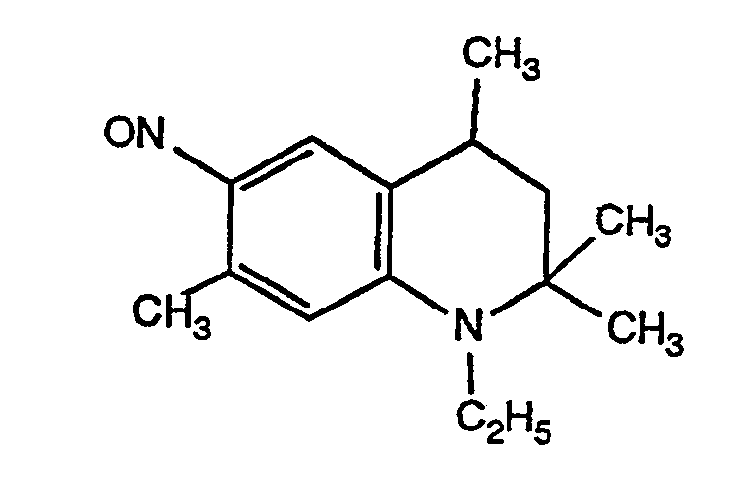
- B) 10 Teile des gemäss Beispiel 1 A erhaltenen Dicyanmethylenindols und 13 Teile der gemäss Beispiel 2 A erhaltenen Nitrosoverbindung werden in 300 Teilen Essigsäureanhydrid gelöst und 2 Stunden bei Raumtemperatur gerührt. Das ausgefallene Reaktionsprodukt wird abgenutscht, mit Ethanol gewaschen und getrocknet. Man erhält 10 Teile des Farbstoffes der Formel

- Ersetzt man im Beispiel 2 die 13 Teile des erwähnten Nitrosoderivates durch 13,5 Teile des Nitrosoderivates der Formel

so erhält man den Farbstoff der Formel
- Eine Lösung des gemäss Beispiel 3 erhaltenen Farbstoffes in Trichlorethylen wird auf eine runde Glasscheibe aufgeschleudert. Man erhält eine ca. 60 nm dicke lichtabsorbierende Schicht auf der Oberfläche.
- Der erhaltene Aufzeichnungsträger wird mit den Lichtpulsen eines Dioden-Lasers (λ = 780 nm) bestrahlt, der auf die Oberfläche der Beschichtung fokussiert ist. Durch die eingestellte Energie wird pro Puls eine kreisrunde Vertiefung mit steilen Wänden und ohne Wulst an der Oberfläche erzeugt.
- Eine Glasscheibe wird auf der Reflektorschicht mit einer ca. 60 nm dicken Schicht eines Farbstoffes der Formel

bedampft, wobei X die in der Tabelle angegebenen Bedeutungen hat. Die erhaltenen Aufzeichnungsträber weisen jeweils ähnlich gute Eigenschaften auf wie die gemäss Beispiel 4 erhaltenen.


- Arbeitet man wie in Beispiel 1A) beschrieben, verwendet jedoch anstelle von 1-Acetyl-3-oxo-2,3-dihydroindol äquivalente Mengen 1-Propionyl-, 1-Valeryl- oder 1-Benzoyl-3-oxo-2,3-dihydroindol und setzt die erhaltenen Produkte mit der im Beispiel 3 aufgeführten Nitrosoverbindung um, so erhält man die Farbstoffe der Formel

Claims (18)
- Farbstoffe der Formel

- Farbstoffe gemäss Anspruch 1, worin R₁ einen unsubstituierten C₁-C₄-Alkylrest, insbesondere Methyl bedeutet.
- Farbstoffe gemäss einem der Ansprüche 1 oder 2, worin R₂ Wasserstoff, C₁-C₄-Alkyl, C₁-C₄-Alkoxy, C₁-C₄-Alkylcarbonylamino oder Phenylcarbonylamino bedeutet.
- Farbstoffe gemäss Anspruch 3, worin R₂ Wasserstoff, Methyl, Methoxy, Acetylamino oder Propionylamino bedeutet.
- Farbstoffe gemäss einem der Ansprüche 1 bis 4, worin R₃ Wasserstoff, C₁-C₄-Alkyl oder C₁-C₄-Alkoxy, bedeuten oder worin R₃ und R₄ zusammen mit dem Stickstoffatom 4 und den sie verbindenden Kohlenstoffatomen einen Dihydrooxazin- oder Tetrahydropyridinring, welcher 1 bis 3 Methylgruppen trägt, bilden.
- Farbstoffe gemäss einem der Ansprüche 1 bis 5, worin R₄ Wasserstoff, unsubstituiertes C₁-C₄-Alkyl oder C₁-C₄-Alkyl, welches durch Hydroxy, C₁-C₄-Alkoxy, Chlor, Cyan, Phenyl oder Cyanethoxy substituiert ist, bedeutet.
- Farbstoffe gemäss einem der Ansprüche 1 bis 6, worin R₅ Wasserstoff, unsubstituiertes C₁-C₄-Alkyl oder C₁-C₄-Alkyl, welches durch Hydroxy, C₁-C₄-Alkoxy, Chlor, Cyan, Phenyl oder Cyanethoxy substituiert ist, bedeutet oder worin R₅ und R₆, zusammen mit dem Stickstoffatom und den sie verbindenden Kohlenstoffatomen einen Tetrahydropyridinring, welcher unsubstituiert oder durch Hydroxy oder Chlor substituiert ist, bildet.
- Farbstoffe gemäss einem der Ansprüche 1 bis 7, worin R₆ Wasserstoff bedeutet.
- Farbstoffe gemäss einem der Ansprüche 1 bis 8, worin R₇ Wasserstoff bedeutet.
- Farbstoffe gemäss Anspruch 1, worin R₁ C₁-C₄ Alkyl, R₂ Wasserstoff, C₁-C₄-Alkyl, C₁-C₄-Alkoxy oder C₁-C₄-Alkylcarbonylamino, R₃ Wasserstoff, C₁-C₄-Alkyl oder C₁-C₄-Alkoxy, R₄ Wasserstoff, C₁-C₄-Alkyl oder C₁-C₄-Alkyl, welches durch Hydroxy, C₁-C₄-Alkoxy, Chlor, Cyan, Phenyl oder Cyanethoxy substituiert ist, oder R₃ und R₄ zusammen mit dem Stickstoffatom und den beiden sie verbindenden Kohlenstoffatomen einen Dihydrooxazin- oder Tetrahydropyridinring, welcher 1 bis 3 Methylgruppen trägt, R₅ Wasserstoff, C₁-C₄-Alkyl oder C₁-C₄-Alkyl, welches durch Hydroxy, C₁-C₄-Alkoxy, Chlor, Cyan, Phenyl oder Cyanethoxy substituiert ist, R₆ Wasserstoff oder R₅ und R₆ zusammen mit dem Stickstoffatom und den beiden sie verbindenden Kohlenstoffatomen einen Tetrahydropyridinring und R₇ Wasserstoff bedeuten.
- Farbstoffe gemäss Anspruch 10, worin R₁ Methyl und R₂ Wasserstoff, Methyl, Methoxy, Acetylamino oder Propionylamino bedeutet.
- Verfahren zur Herstellung von Farbstoffen der Formel (1) gemäss Anspruch 1, dadurch gekennzeichnet, dass man eine Verbindung der Formel


- Verbindungen der Formel
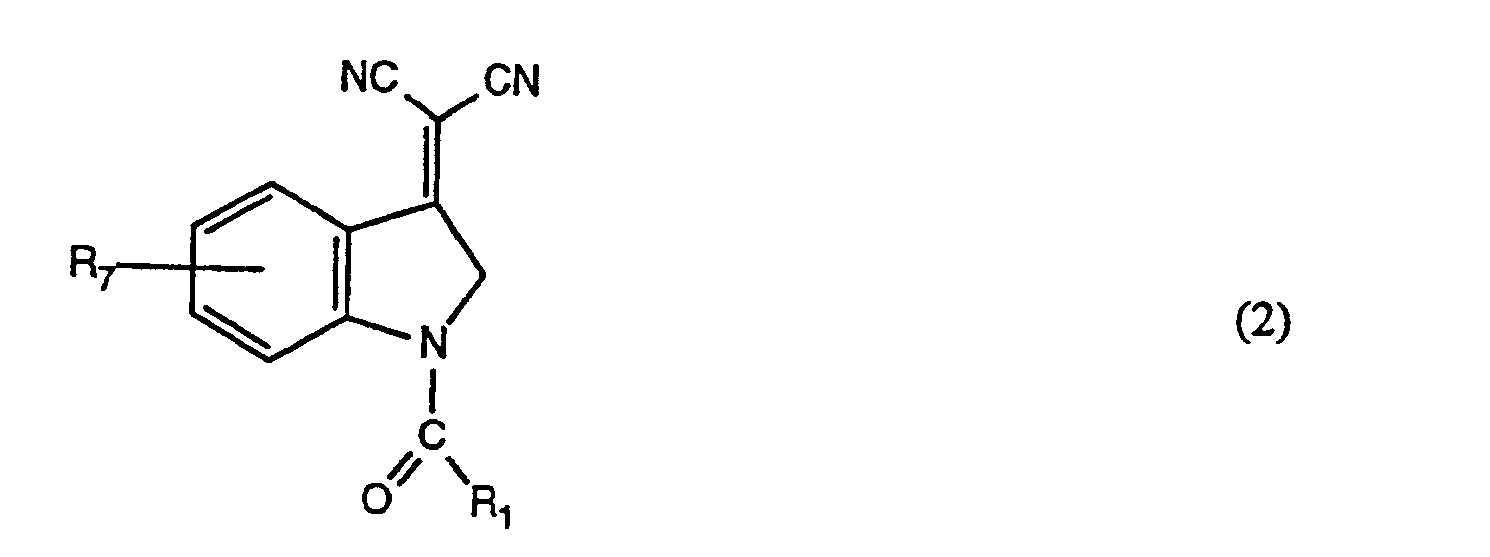
- Verfahren zur Herstellung von Verbindungen der Formel (2) gemäss Anspruch 13, dadurch gekennzeichnet, dass man eine Verbindung der Formel
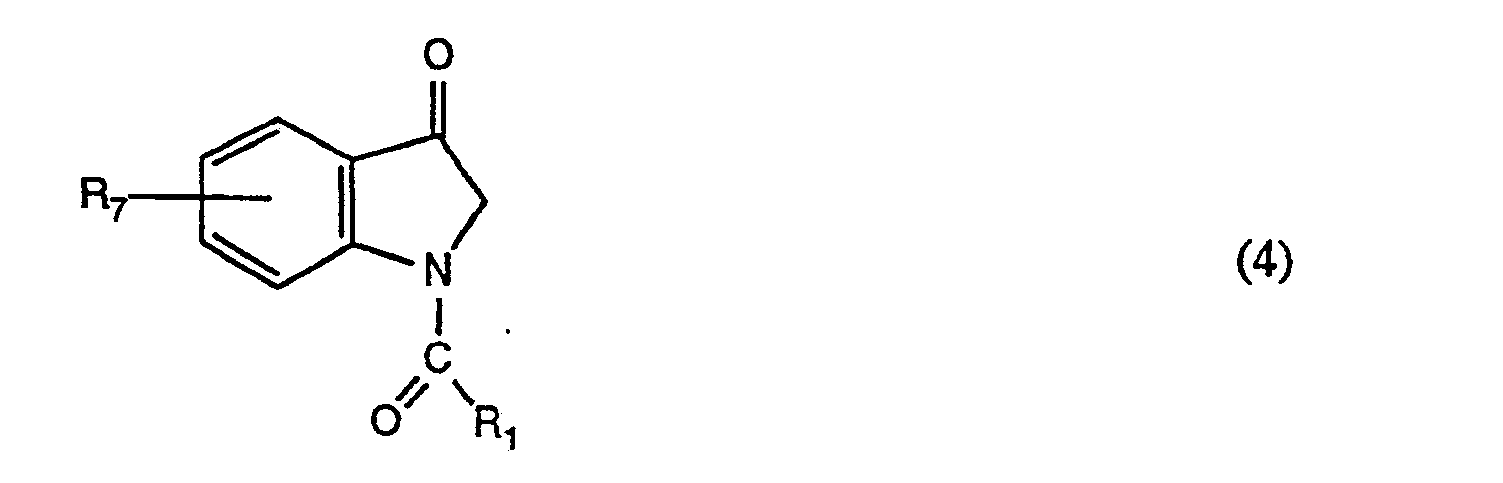
- Verbindungen der Formel


- Verfahren zur Herstellung von Verbindungen der Formel (5) gemäss Anspruch 15, dadurch gekennzeichnet, dass man eine Verbindung der Formel
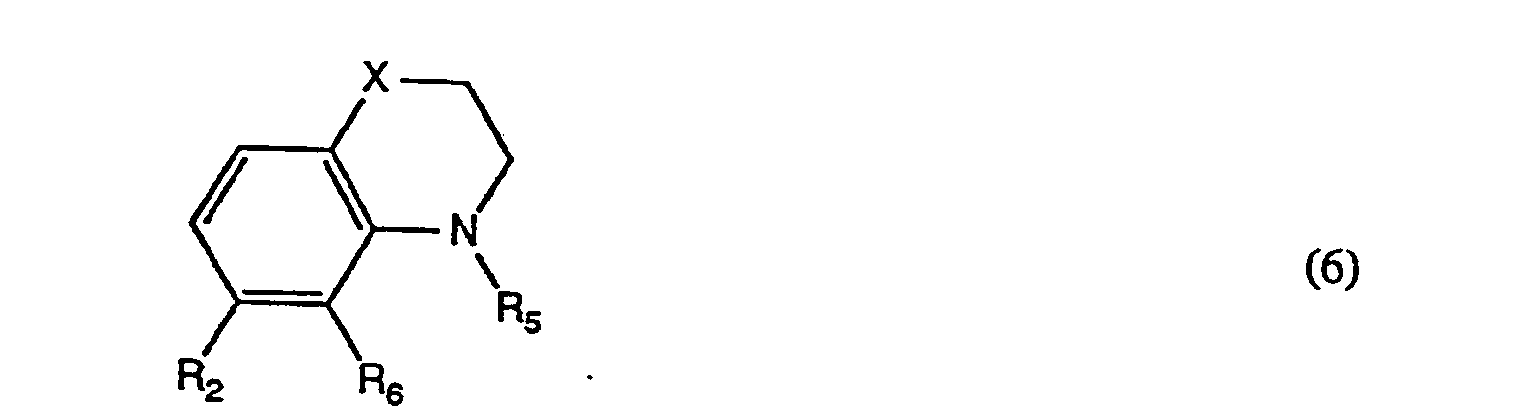
- Verwendung von Farbstoffen der Formel (1) gemäss Anspruch 1 als NIR-absorbierende Substanz in optischen Aufzeichnungsmedien.
- Optische Aufzeichnungsmedien, enthaltend eine Verbindung der Formel (1) gemäss Anspruch 1.
Applications Claiming Priority (2)
| Application Number | Priority Date | Filing Date | Title |
|---|---|---|---|
| CH2036/90 | 1990-06-19 | ||
| CH203690 | 1990-06-19 |
Publications (2)
| Publication Number | Publication Date |
|---|---|
| EP0462928A2 true EP0462928A2 (de) | 1991-12-27 |
| EP0462928A3 EP0462928A3 (en) | 1992-05-27 |
Family
ID=4224433
Family Applications (1)
| Application Number | Title | Priority Date | Filing Date |
|---|---|---|---|
| EP19910810438 Withdrawn EP0462928A3 (en) | 1990-06-19 | 1991-06-11 | Indolinimin dyes |
Country Status (2)
| Country | Link |
|---|---|
| EP (1) | EP0462928A3 (de) |
| JP (1) | JPH04252272A (de) |
Cited By (2)
| Publication number | Priority date | Publication date | Assignee | Title |
|---|---|---|---|---|
| WO1995028447A1 (en) * | 1994-04-19 | 1995-10-26 | Zeneca Limited | Disperse dyes derived from hindered indoline couplers |
| WO2002082438A3 (en) * | 2001-03-21 | 2003-08-28 | Ciba Sc Holding Ag | Optical recording materials having high storage density |
Family Cites Families (1)
| Publication number | Priority date | Publication date | Assignee | Title |
|---|---|---|---|---|
| US5028708A (en) * | 1987-04-14 | 1991-07-02 | Sumitomo Chemical Company, Limited | Azamethinyl quinoline derivatives |
-
1991
- 1991-06-11 EP EP19910810438 patent/EP0462928A3/de not_active Withdrawn
- 1991-06-19 JP JP3146398A patent/JPH04252272A/ja not_active Withdrawn
Cited By (2)
| Publication number | Priority date | Publication date | Assignee | Title |
|---|---|---|---|---|
| WO1995028447A1 (en) * | 1994-04-19 | 1995-10-26 | Zeneca Limited | Disperse dyes derived from hindered indoline couplers |
| WO2002082438A3 (en) * | 2001-03-21 | 2003-08-28 | Ciba Sc Holding Ag | Optical recording materials having high storage density |
Also Published As
| Publication number | Publication date |
|---|---|
| EP0462928A3 (en) | 1992-05-27 |
| JPH04252272A (ja) | 1992-09-08 |
Similar Documents
| Publication | Publication Date | Title |
|---|---|---|
| DE69223089T2 (de) | Sulfonamido- oder amidosubstituierte Phthalocyanine für optische Aufzeichnungen | |
| DE3876717T2 (de) | Optischer informationsaufzeichnungstraeger. | |
| EP0540468B1 (de) | NIR-Farbstoffe, Verfahren zu ihrer Herstellung und ihre Verwendung | |
| DE3927872C2 (de) | Dithiolat-Metallkomplexverbindungen, Verfahren zu ihrer Herstellung und sie enthaltendes optisches Informationsaufzeichnungsmaterial | |
| EP0192215B1 (de) | Neue Tetraphenyldithiolen-Komplexe, unsymmetrisch substituierte Benzoine sowie die neuen Komplexe enthaltende optische Aufzeichnungsmedien | |
| US5886183A (en) | Naphthalenelactamimide fluorescence dyes | |
| US4675423A (en) | Camphordithiolene complexes | |
| EP0335236B1 (de) | Methinfarbstoffe sowie optisches Aufzeichnungsmedium, enthaltend die neuen Farbstoffe | |
| Ahmed et al. | Synthesis of IR‐sensitive photoswitchable molecules: photochromic 9′‐styrylquinolinedihydroindolizines | |
| US4139274A (en) | Apparatus for changing color | |
| EP0613889A2 (de) | Thermochrome Verbindungen deren Herstellung und deren Verwendung | |
| EP0462928A2 (de) | Indoliniminfarbstoffe | |
| EP0464543A1 (de) | Polymethinfarbstoffe | |
| EP1795525B1 (de) | Heterocyclische verbindungen und optische aufzeichnungsmaterialien | |
| US4882428A (en) | Azaporphyrin compounds | |
| EP0557820B1 (de) | Azinneutromethine | |
| JPH02101080A (ja) | スピロオキサジン系化合物 | |
| JPH0688970B2 (ja) | フオトクロミツク3−ピリルフルギド乃至フルギイミド | |
| DE3783529T2 (de) | Optisches aufzeichnungsmedium. | |
| EP0356971B1 (de) | Tetraazaporphyrine sowie optisches Aufzeichnungsmedium | |
| EP0319728B1 (de) | Naphtholactamtrimethinfarbstoffe sowie optisches Aufzeichnungsmedium, enthaltend die neuen Farbstoffe | |
| US3534092A (en) | Dispiropyran compounds having photochromic properties | |
| CH670912A5 (de) | ||
| DE3521432A1 (de) | Verfahren zur herstellung von (1,8a)-dihydroindolizinen, dadurch herstellbare neue photochrome verbindungen und deren verwendung | |
| JP2762478B2 (ja) | フォトクロミック材料 |
Legal Events
| Date | Code | Title | Description |
|---|---|---|---|
| PUAI | Public reference made under article 153(3) epc to a published international application that has entered the european phase |
Free format text: ORIGINAL CODE: 0009012 |
|
| 17P | Request for examination filed |
Effective date: 19910613 |
|
| AK | Designated contracting states |
Kind code of ref document: A2 Designated state(s): CH DE FR GB LI |
|
| PUAL | Search report despatched |
Free format text: ORIGINAL CODE: 0009013 |
|
| AK | Designated contracting states |
Kind code of ref document: A3 Designated state(s): CH DE FR GB LI |
|
| 18D | Application deemed to be withdrawn |
Effective date: 19921128 |