EP0463513A2 - Benzylketone und diese enthaltende Fungizide - Google Patents
Benzylketone und diese enthaltende Fungizide Download PDFInfo
- Publication number
- EP0463513A2 EP0463513A2 EP91109806A EP91109806A EP0463513A2 EP 0463513 A2 EP0463513 A2 EP 0463513A2 EP 91109806 A EP91109806 A EP 91109806A EP 91109806 A EP91109806 A EP 91109806A EP 0463513 A2 EP0463513 A2 EP 0463513A2
- Authority
- EP
- European Patent Office
- Prior art keywords
- alkyl
- halogen
- alkoxy
- aryl
- methyl
- Prior art date
- Legal status (The legal status is an assumption and is not a legal conclusion. Google has not performed a legal analysis and makes no representation as to the accuracy of the status listed.)
- Granted
Links
- 0 *CC1=CCCCC1C(C(*)=O)=** Chemical compound *CC1=CCCCC1C(C(*)=O)=** 0.000 description 2
Classifications
-
- C—CHEMISTRY; METALLURGY
- C07—ORGANIC CHEMISTRY
- C07C—ACYCLIC OR CARBOCYCLIC COMPOUNDS
- C07C69/00—Esters of carboxylic acids; Esters of carbonic or haloformic acids
- C07C69/66—Esters of carboxylic acids having esterified carboxylic groups bound to acyclic carbon atoms and having any of the groups OH, O—metal, —CHO, keto, ether, acyloxy, groups, groups, or in the acid moiety
- C07C69/73—Esters of carboxylic acids having esterified carboxylic groups bound to acyclic carbon atoms and having any of the groups OH, O—metal, —CHO, keto, ether, acyloxy, groups, groups, or in the acid moiety of unsaturated acids
- C07C69/738—Esters of keto-carboxylic acids or aldehydo-carboxylic acids
-
- A—HUMAN NECESSITIES
- A01—AGRICULTURE; FORESTRY; ANIMAL HUSBANDRY; HUNTING; TRAPPING; FISHING
- A01N—PRESERVATION OF BODIES OF HUMANS OR ANIMALS OR PLANTS OR PARTS THEREOF; BIOCIDES, e.g. AS DISINFECTANTS, AS PESTICIDES OR AS HERBICIDES; PEST REPELLANTS OR ATTRACTANTS; PLANT GROWTH REGULATORS
- A01N37/00—Biocides, pest repellants or attractants, or plant growth regulators containing organic compounds containing a carbon atom having three bonds to hetero atoms with at the most two bonds to halogen, e.g. carboxylic acids
- A01N37/42—Biocides, pest repellants or attractants, or plant growth regulators containing organic compounds containing a carbon atom having three bonds to hetero atoms with at the most two bonds to halogen, e.g. carboxylic acids containing within the same carbon skeleton a carboxylic group or a thio analogue, or a derivative thereof, and a carbon atom having only two bonds to hetero atoms with at the most one bond to halogen, e.g. keto-carboxylic acids
-
- A—HUMAN NECESSITIES
- A01—AGRICULTURE; FORESTRY; ANIMAL HUSBANDRY; HUNTING; TRAPPING; FISHING
- A01N—PRESERVATION OF BODIES OF HUMANS OR ANIMALS OR PLANTS OR PARTS THEREOF; BIOCIDES, e.g. AS DISINFECTANTS, AS PESTICIDES OR AS HERBICIDES; PEST REPELLANTS OR ATTRACTANTS; PLANT GROWTH REGULATORS
- A01N37/00—Biocides, pest repellants or attractants, or plant growth regulators containing organic compounds containing a carbon atom having three bonds to hetero atoms with at the most two bonds to halogen, e.g. carboxylic acids
- A01N37/44—Biocides, pest repellants or attractants, or plant growth regulators containing organic compounds containing a carbon atom having three bonds to hetero atoms with at the most two bonds to halogen, e.g. carboxylic acids containing at least one carboxylic group or a thio analogue, or a derivative thereof, and a nitrogen atom attached to the same carbon skeleton by a single or double bond, this nitrogen atom not being a member of a derivative or of a thio analogue of a carboxylic group, e.g. amino-carboxylic acids
- A01N37/50—Biocides, pest repellants or attractants, or plant growth regulators containing organic compounds containing a carbon atom having three bonds to hetero atoms with at the most two bonds to halogen, e.g. carboxylic acids containing at least one carboxylic group or a thio analogue, or a derivative thereof, and a nitrogen atom attached to the same carbon skeleton by a single or double bond, this nitrogen atom not being a member of a derivative or of a thio analogue of a carboxylic group, e.g. amino-carboxylic acids the nitrogen atom being doubly bound to the carbon skeleton
-
- C—CHEMISTRY; METALLURGY
- C07—ORGANIC CHEMISTRY
- C07C—ACYCLIC OR CARBOCYCLIC COMPOUNDS
- C07C251/00—Compounds containing nitrogen atoms doubly-bound to a carbon skeleton
- C07C251/32—Oximes
- C07C251/34—Oximes with oxygen atoms of oxyimino groups bound to hydrogen atoms or to carbon atoms of unsubstituted hydrocarbon radicals
- C07C251/48—Oximes with oxygen atoms of oxyimino groups bound to hydrogen atoms or to carbon atoms of unsubstituted hydrocarbon radicals with the carbon atom of at least one of the oxyimino groups bound to a carbon atom of a six-membered aromatic ring
-
- C—CHEMISTRY; METALLURGY
- C07—ORGANIC CHEMISTRY
- C07C—ACYCLIC OR CARBOCYCLIC COMPOUNDS
- C07C255/00—Carboxylic acid nitriles
- C07C255/63—Carboxylic acid nitriles containing cyano groups and nitrogen atoms further bound to other hetero atoms, other than oxygen atoms of nitro or nitroso groups, bound to the same carbon skeleton
- C07C255/64—Carboxylic acid nitriles containing cyano groups and nitrogen atoms further bound to other hetero atoms, other than oxygen atoms of nitro or nitroso groups, bound to the same carbon skeleton with the nitrogen atoms further bound to oxygen atoms
-
- C—CHEMISTRY; METALLURGY
- C07—ORGANIC CHEMISTRY
- C07C—ACYCLIC OR CARBOCYCLIC COMPOUNDS
- C07C2601/00—Systems containing only non-condensed rings
- C07C2601/02—Systems containing only non-condensed rings with a three-membered ring
-
- C—CHEMISTRY; METALLURGY
- C07—ORGANIC CHEMISTRY
- C07C—ACYCLIC OR CARBOCYCLIC COMPOUNDS
- C07C2601/00—Systems containing only non-condensed rings
- C07C2601/12—Systems containing only non-condensed rings with a six-membered ring
- C07C2601/14—The ring being saturated
Definitions
- the present invention relates to benzyl ketones, fungicides containing these compounds and methods of combating fungi with these compounds.
- the object of the invention was to provide active ingredients and fungicides with a better action.
- the new compounds of the general formula I can exist as both E and Z isomers, which can be separated in a conventional manner. Both the individual isomeric compounds and their mixtures are encompassed by the invention and are useful as fungicides.
- X, R1, R2 and R3 have the same meaning as in formula I, Y means O; Hal in formula II, III is halogen, preferably bromine; Hal in formula IV is halogen, preferably chlorine.
- the benzyl halides II are generally at temperatures from -5 to 10 ° C, preferably at 0 ° C with activated zinc (P. Knochel, MCP Yeh, SC Berk, J. Talbert, J. Org. Chem. 53, 2390, 1988) reacted.
- activated zinc P. Knochel, MCP Yeh, SC Berk, J. Talbert, J. Org. Chem. 53, 2390, 1988
- the reaction to the copper / zinc organic compound with the tetrahydrofuran-soluble CuCN.2LiCl complex then takes place at temperatures from -80 to -10 ° C.
- the reaction with the carboxylic acid halides IV takes place e.g. in an inert, anhydrous solvent, e.g. Tetrahydrofuran at temperatures from -70 to 30 ° C.
- anhydrous solvent e.g. Tetrahydrofuran at temperatures from -70 to 30 ° C.
- the starting compounds II can be present as E / Z isomer mixtures or else as pure E or Z isomers, so that the corresponding secondary products, including the benzyl ketones I, either as E / Z isomer mixtures or as E - or Z isomers are obtained. Both the individual isomeric compounds and their mixtures are encompassed by the invention.
- the carboxylic acid halides of the general formula IV are either known or can be prepared by processes analogous to known processes. Corresponding manufacturing instructions are described, for example, in Houben-Weyl, Methods of Organic Chemistry, Vol. E5, p. 587.
- the new compounds are distinguished by excellent activity against a broad spectrum of phytopathogenic fungi, in particular from the classes of the Ascomycetes and Basidiomycetes. Some of them are systemically effective and can be used as foliar and soil fungicides.
- the fungicidal compounds are particularly interesting for combating a large number of fungi on various crop plants or their seeds, in particular wheat, rye, barley, oats, rice, corn, lawn, cotton, soybeans, coffee, sugar cane, fruit and ornamental plants in horticulture and viticulture as well as vegetables - such as cucumbers, beans and pumpkin plants -.
- the new compounds are particularly suitable for controlling the following plant diseases: Erysiphe graminis (powdery mildew) in cereals, Erysiphe cichoracearum and Sphaerotheca fuliginea on pumpkin plants, Podosphaera leucotricha on apples, Uncinula necator on vines, Puccinia species on cereals, Rhizoctonia species on cotton and lawn, Ustilago species on cereals and sugar cane, Venturia inaequalis (scab) on apples, Helminthosporium species on cereals, Septoria nodorum on wheat, Botrytis cinerea (gray mold) on strawberries, vines, Cercospora arachidicola on peanuts, Pseudocercosporella herpotrichoides on wheat, barley, Pyricularia oryzae on rice, Phytophthora infestans on potatoes and tomatoes, Fusarium and Verticillium species on different plants, Plasmopara viticola
- the compounds are applied by spraying or dusting the plants with the active compounds or by treating the seeds of the plants with the active compounds. It is used before or after the plants or seeds are infected by the fungi.
- the fungi or the plants, seeds, materials or the soil to be protected against fungal attack are treated with a fungicidally effective amount of the active ingredient.
- the new substances can be converted into the usual formulations, such as solutions, emulsions, suspensions, dusts, powders, pastes and granules.
- the application forms depend entirely on the purposes; in any case, they should ensure a fine and uniform distribution of the active substance.
- the formulations are prepared in a known manner, e.g. by stretching the active ingredient with solvents and / or carriers, if appropriate using emulsifiers and dispersants, where, if water is used as the diluent, other organic solvents can also be used as auxiliary solvents.
- solvents such as aromatics (e.g. xylene), chlorinated aromatics (e.g.
- chlorobenzenes paraffins (e.g. petroleum fractions), alcohols (e.g. methanol, butanol), ketones (e.g. cyclohexanone), amines (e.g. ethanolamine, dimethylformamide) ) and water;
- Carriers such as natural stone powder (e.g. kaolins, clays, talc, chalk) and synthetic stone powder (e.g. highly disperse silica, silicates);
- Emulsifiers such as non-ionic and anionic emulsifiers (e.g. polyoxyethylene fatty alcohol ethers, alkyl sulfonates and aryl sulfonates) and dispersants such as lignin sulfite liquors and methyl cellulose.
- the fungicidal compositions generally contain between 0.1 and 95, preferably between 0.5 and 90% by weight of active ingredient.
- the application rates are between 0.02 and 3 kg of active ingredient or more per hectare.
- the new compounds can also be used in material protection (wood protection), e.g. against Paecilomyces variotii.
- material protection wood protection
- amounts of active ingredient of 0.001 to 50 g, preferably 0.01 to 10 g, are generally required per kilogram of seed.
- agents or the ready-to-use preparations produced therefrom such as solutions, emulsions, suspensions, powders, dusts, pastes or granules, are used in a known manner, for example by spraying, atomizing, dusting, scattering, pickling or pouring.
- the agents according to the invention can also be present together with other active ingredients, such as e.g. Herbicides, insecticides, growth regulators and fungicides, or also mixed with fertilizers and applied. When mixed with fungicides, the fungicidal spectrum of activity is enlarged in many cases.
- active ingredients such as e.g. Herbicides, insecticides, growth regulators and fungicides, or also mixed with fertilizers and applied.
- Pepper seedlings of the "Neusiedler Ideal Elite" variety after 4-5 leaves had developed well, were sprayed to runoff point with aqueous suspensions which contained 80% active ingredient and 20% emulsifier in the dry matter. After the spray coating had dried on, the plants were sprayed with a conidia suspension of the botrytis cinerea fungus and placed at 22-24 ° C. in a chamber with high atmospheric humidity. After 5 days the disease had developed so strongly on the untreated control plants that the leaf necrosis formed covered the majority of the leaves.
- Barley seedlings of the "Igri" variety were sprayed to runoff point in the two-leaf stage with aqueous suspensions containing 80% active ingredient and 20% emulsifier in the dry matter. After 24 hours, the plants were inoculated with a spore suspension of the fungus Pyrenophora teres and placed in a climatic chamber with high atmospheric humidity at 18 ° C. for 48 hours. The plants were then cultivated in a greenhouse at 20-22 ° C. and 70% relative atmospheric humidity for a further 5 days. The extent of leaf infestation was then determined.
Landscapes
- Organic Chemistry (AREA)
- Chemical & Material Sciences (AREA)
- Life Sciences & Earth Sciences (AREA)
- Health & Medical Sciences (AREA)
- Environmental Sciences (AREA)
- Engineering & Computer Science (AREA)
- Dentistry (AREA)
- General Health & Medical Sciences (AREA)
- Wood Science & Technology (AREA)
- Zoology (AREA)
- Plant Pathology (AREA)
- Pest Control & Pesticides (AREA)
- Agronomy & Crop Science (AREA)
- Agricultural Chemicals And Associated Chemicals (AREA)
- Organic Low-Molecular-Weight Compounds And Preparation Thereof (AREA)
- Acyclic And Carbocyclic Compounds In Medicinal Compositions (AREA)
- Preparation Of Compounds By Using Micro-Organisms (AREA)
Abstract
Description
- Die vorliegende Erfindung betrifft Benzylketone, Fungizide, die diese Verbindungen enthalten, und Verfahren zur Bekämpfung von Pilzen mit diesen Verbindungen.
- Es ist bekannt, 2-(Phenoxymethyl)-phenylglyoxylsäure-methylester-O-methyloxim als Fungizid zu verwenden (EP 253 213). Die Verbindung läßt jedoch hinsichtlich ihrer fungiziden Wirkung zu wünschen übrig.
- Der Erfindung lag die Aufgabe zugrunde, Wirkstoffe und Fungizide mit besserer Wirkung bereitzustellen.
- Es wurde nun gefunden, daß Benzylketone der allgemeinen Formel I

in der - X
- CH oder N,
- Y
- O oder NR⁴
- R¹, R²
- H oder C₁-C₄-Alkyl
- R³
- H, Halogen, Cyano, Nitro, C₁-C₆-Alkyl, C₃-C₆-Cycloalkyl, C₁-C₆-Alkoxy, Halogen-C₁-C₂-alkyl, Aryl-C₁-C₂-alkyl, Aryl-C₁-C₂-alkoxy, Aryloxy oder Aryl bedeutet, wobei die Arylgruppen ihrerseits durch einen bis zu drei der Reste Halogen, Cyano, Nitro, C₁-C₆-Alkyl, C₁-C₆-Alkoxy oder Halogen-C₁-C₂-alkyl substituiert sein können,
- R⁴
- OH, C₁-C₆-Alkoxy oder Aryl-C₁-C₂-alkoxy und
- R⁵
- H, Methyl, Halogen oder Methoxy bedeutet,
- Von den Benzylketonen der allgemeinen Strukturformel I

sind diejenigen bevorzugt, bei denen die Substituenten die folgende Bedeutung haben: - X
- CH oder N,
- Y
- O oder NR⁴
- R¹, R²
- H oder C₁-C₄-Alkyl (z.B. Methyl, Ethyl, n-, iso-Propyl, n-, iso-, sec- und tert-Butyl),
- R³
- H, Halogen (z.B. F, Cl, Br und j), Nitro, Cyano, C₁-C₆-Alkyl (z.B. Methyl, Ethyl, n-, iso-Propyl, n-, iso-, sec- und tert.-Butyl, n-Pentyl und n-Hexyl), C₃-C₆-Cycloalkyl (z.B. Cyclopropyl, Cyclobutyl, Cyclopentyl, Cyclohexyl), C₁-C₆-Alkoxy (z.B. Methoxy, Ethoxy, n-, iso-Propoxy, n-, iso-, sec- und tert.-Butoxy, Pentyloxy und Hexyloxy), Halogen-C₁-C₂-alkyl (z.B. Trifluormethyl, Trichlormethyl, Pentafluorethyl), Aryl-C₁-C₂-alkyl (z.B. Benzyl, Phenylethyl), Aryl-C₁-C₂-alkoxy (z.B. Benzyloxy, Phenylethoxy), Aryloxy (z.B. Phenoxy) und Aryl (z.B. Phenyl) bedeutet, wobei die Arylgruppe ihrerseits durch einen bis zu drei der Reste Halogen, Cyano, Nitro, C₁-C₆-Alkyl, C₁-C₆-Alkoxy oder Halogen-C₁-C₂-alkyl substituiert sein kann und
- R⁴
- OH, C₁-C₆-Alkoxy oder Aryl-C₁-C₂-alkoxy und
- R⁵
- Wasserstoff bedeutet.
- Besonders bevorzugt sind Verbindungen der allgemeinen Strukturformel I, in der
- X
- CH oder N
- Y
- O
- R¹, R²
- Methyl und
- R³
- die oben angegebene Bedeutung hat und
- R⁵
- Wasserstoff bedeutet.
- Die neuen Verbindungen der allgemeinen Formel I können aufgrund der C=X-Doppelbindung sowohl als E- als auch als Z-Isomere vorliegen, die in üblicher Weise getrennt werden können. Sowohl die einzelnen isomeren Verbindungen, als auch ihre Gemische werden von der Erfindung umfaßt und sind als Fungizide brauchbar.
- Man erhält die neuen Benzylketone I, mit Y=O beispielsweise dadurch, daß man ein Benzylhalogenid der allgemeinen Formel II in an sich bekannter Weise (vgl. Houben-Weyl Bd. 13/2 a S. 553 ff; P. Knochel, J. Org. Chem. 53, 2390 (1988)) in eine Zink-Kupfer-organische Verbindung der allgemeinen Formel III überführt und diese mit Carbonsäurehalogeniden der allgemeinen Formel IV zur Reaktion bringt (S.C. Berk, P. Knochel, M.C.P. Yeh, J. Org. Chem. 53, 5789 (1988)).

X, R¹, R² und R³ haben die gleiche Bedeutung wie in der Formel I, Y bedeutet O; Hal in Formel II, III ist Halogen, vorzugsweise Brom; Hal in Formel IV ist Halogen, vorzugsweise Chlor. - Die Benzylhalogenide II werden in der Regel bei Temperaturen von -5 bis 10°C, vorzugsweise bei 0°C mit aktiviertem Zink (P. Knochel, M.C.P. Yeh, S.C. Berk, J. Talbert, J. Org. Chem. 53, 2390, 1988) zur Reaktion gebracht. Anschließend erfolgt die Reaktion zur Kupfer/Zink-organischen Verbindung mit dem in Tetrahydrofuran löslichen CuCN·2LiCl-Komplex bei Temperaturen von -80 bis -10°C.
- Die Umsetzung mit den Carbonsäurehalogeniden IV erfolgt z.B. in einem inerten, wasserfreien Lösungsmittel, wie z.B. Tetrahydrofuran bei Temperaturen von -70 bis 30°C.
- Alternativ hierzu lassen sich die Verbindungen der allgemeinen Strukturformel I, mit Y=0 auch dadurch herstellen, daß man ein Benzylhalogenid der Formel II mit einem Carbonsäurehalogenid der Formel IV in Gegenwart von Zink und einem Übergangsmetall-Katalysator, wie z. B. Pd (Ph₃P)₄, PdCl₂, Pd (Ph₃P)₂Cl₂, Pd (PhCN)₂Cl₂, Pd (OAc)₂ oder Ni (PPh₃)₂Cl₂ in einem inerten Lösungmittel wie z.B. THF, Toluol oder bevorzugt Dimethoxyethan bei Temperaturen von -10 bis +100°C zur Reaktion bringt (vgl. T. Fujisawa et al., Chem. Lett., 1135 (1981)). Ph = Phenyl.
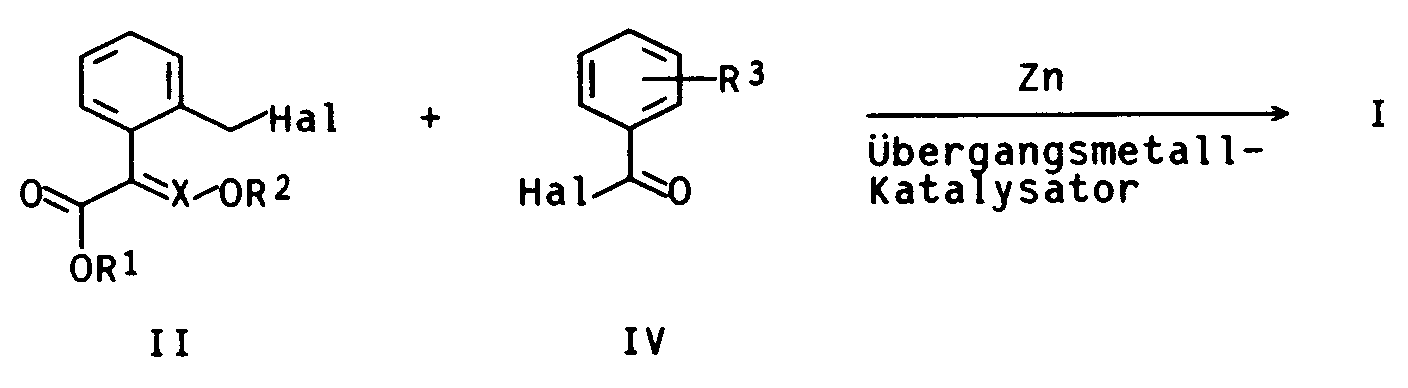
- Die Ausgangsverbindungen II können aufgrund der C=X-Doppelbildung als E/Z-Isomerengemische oder aber als reine E- oder Z-Isomere vorliegen, so daß die entsprechenden Folgeprodukte, einschließlich der Benzylketone I, entweder als E/Z-Isomerengemische oder als E- oder Z-Isomere anfallen. Sowohl die einzelnen isomeren Verbindungen als auch ihre Gemische werden von der Erfindung umfaßt.
- Die Darstellung der Ausgangsverbindungen II (X=CH) ist in EP 226917 beschrieben; die der Verbindungen II (X=N) in EP 354571.
- Die Carbonsäurehalogenide der allgemeinen Formel IV (R³ hat die oben angegebene Bedeutung) sind entweder bekannt oder können durch Verfahren analog zu bekannten Verfahren hergestellt werden. Entsprechende Herstellvorschriften sind z.B. beschrieben in Houben-Weyl, Methoden der organischen Chemie, Bd. E5, S. 587.
- Die Verbindungen der allgemeinen Formel I, wobei Y NR⁴ bedeutet, lassen sich aus den entsprechenden Verbindungen der Formel I, mit Y=0 herstellen, indem man diese in an sich bekannter Weise mit einem Amin der allgemeinen Struktur NH₂R⁴ (R⁴ hat die im Anspruch 1 angegebene Bedeutung) zur Reaktion bringt (vgl. Houben-Weyl, Methoden der organischen Chemie, Band X/4, S. 1).
- Die folgenden Beispiele erläutern die Herstellung der Benzylketone.
- Herstellung von 2-(2-Chlorphenylcarbonylmethyl)-phenyl-ß-methoxyacrylsäure-methylester (Verb. 5, Tab. 2)
- 2.3 g Zinkpulver wird in 20 ml THF (Tetrahydrofuran) mit 700 mg 1,2-Dibromethan versetzt. Man erhitzt bis zum Ende der Gasentwicklung unter Rückfluß, läßt auf Raumtemperatur (20°C) abkühlen und gibt 0.2 ml Trimethylchlorsilan zu. Zu dieser Lösung tropft man bei 0°C eine Lösung von 10 g (35 mmol) α-(2-Brommethyl-phenyl)-ß-methoxyacrylsäure-methylester in 40 ml THF und rührt 3 h bei 5°C nach. Anschließend wird auf -78°C abgekühlt und man gibt eine Lösung von 3.2 g Kupfercyanid und 3 g Lithiumchlorid in 40 ml THF zu. Man läßt 5 min auf -20°C auftauen, kühlt erneut auf -78°C ab und tropft eine Lösung von 6.1 g 2-Chlorbenzoylchlorid in 20 ml THF zu. Man rührt über Nacht bei Raumtemperatur. Der Reaktionsansatz wird auf Wasser gegossen, mit Essigester extrahiert, getrocknet und eingeengt. Chromatographie an Kieselgel mit Hexan/Essigester liefert 4.1 g der Verbindung Nr. 5, Tab. 2 als farblosen Feststoff mit einem Schmelzpunkt von 70-75°C. Ausbeute 35 %.
- 2-(Phenylcarbonylmethyl)-phenyl-ß-methoxyacrylsäure-methylester (Verb. 1, Tab. 2)
- Unter Stickstoff tropft man zu 2.3 g (0.035 mol) Zinkpulver und 600 mg (0.9 mmol) Pd (Ph₃P)₂Cl₂ eine Lösung von 5 g (17.5 mmol) α-(2-Brommethylphenyl)-ß-methoxyacrylsäure-methylester und 2.5 g (17.8 mmol) Benzoylchlorid in 50 ml Dimethoxyethan zu und erhitzt anschließend 30 min auf 50°C. Man versetzt mit Wasser, extrahiert mit Essigester, trocknet und engt ein. Der Rückstand wird an Kieselgel mit Hexan/Essigester chromatographiert. Man erhält 1.6 g der Verbindung Nr. 1, Tab. 1 als hellgelben Feststoff mit einem Schmelzpunkt von 97-99°C. Ausbeute 29 %.
- In entsprechender Weise können die in den folgenden Tabellen aufgeführten Verbindungen hergestellt werden.


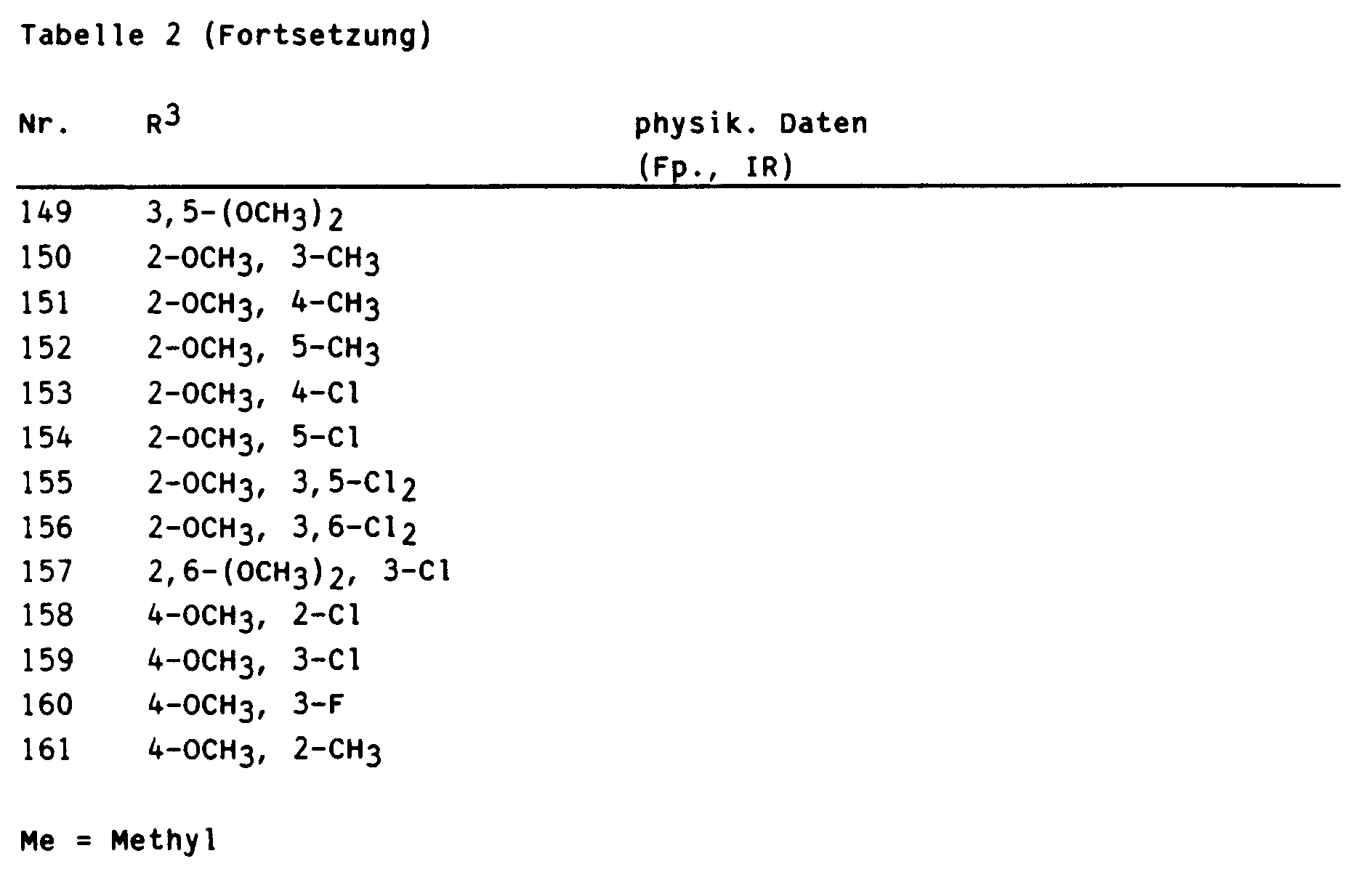


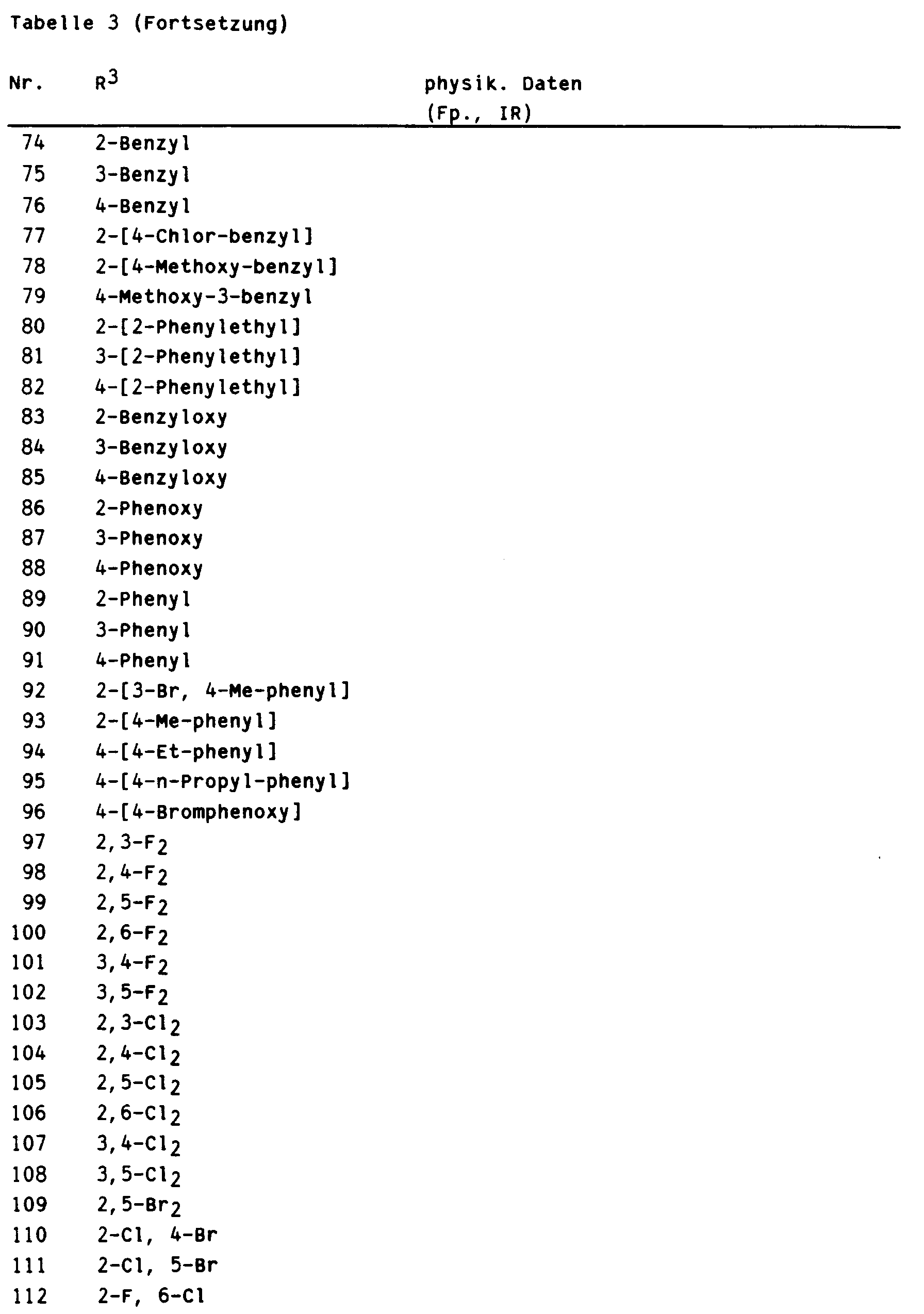


- Die neuen Verbindungen zeichnen sich, allgemein ausgedrückt, durch eine hervorragende Wirksamkeit gegen ein breites Spektrum von pflanzenpathogenen Pilzen, insbesondere aus der Klasse der Ascomyceten und Basidiomyceten, aus. Sie sind zum Teil systemisch wirksam und können als Blatt- und Bodenfungizide eingesetzt werden.
- Besonders interessant sind die fungiziden Verbindungen für die Bekämpfung einer Vielzahl von Pilzen an verschiedenen Kulturpflanzen oder ihren Samen, insbesondere Weizen, Roggen, Gerste, Hafer, Reis, Mais, Rasen, Baumwolle, Soja, Kaffee, Zuckerrohr, Obst und Zierpflanzen im Gartenbau, Weinbau sowie Gemüse - wie Gurken, Bohnen und Kürbisgewächse -.
- Die neuen Verbindungen sind insbesondere geeignet zur Bekämpfung folgender Pflanzenkrankheiten:
Erysiphe graminis (echter Mehltau) in Getreide,
Erysiphe cichoracearum und Sphaerotheca fuliginea an Kürbisgewächsen,
Podosphaera leucotricha an Äpfeln,
Uncinula necator an Reben,
Puccinia-Arten an Getreide,
Rhizoctonia-Arten an Baumwolle und Rasen,
Ustilago-Arten an Getreide und Zuckerrohr,
Venturia inaequalis (Schorf) an Äpfeln,
Helminthosporium-Arten an Getreide,
Septoria nodorum an Weizen,
Botrytis cinerea (Grauschimmel) an Erdbeeren, Reben,
Cercospora arachidicola an Erdnüssen,
Pseudocercosporella herpotrichoides an Weizen, Gerste,
Pyricularia oryzae an Reis,
Phytophthora infestans an Kartoffeln und Tomaten,
Fusarium- und Verticillium-Arten an verschiedenen Pflanzen,
Plasmopara viticola an Reben,
Alternaria-Arten an Gemüse und Obst. - Die Verbindungen werden angewendet, indem man die Pflanzen mit den Wirkstoffen besprüht oder bestäubt oder die Samen der Pflanzen mit den Wirkstoffen behandelt. Die Anwendung erfolgt vor oder nach der Infektion der Pflanzen oder Samen durch die Pilze. Es werden die Pilze oder die vor Pilzbefall zu schützenden Pflanzen, Saatgüter, Materialien oder der Erdboden mit einer fungizid wirksamen Menge des Wirkstoffs behandelt.
- Die neuen Substanzen können in die üblichen Formulierungen übergeführt werden, wie Lösungen, Emulsionen, Suspensionen, Stäube, Pulver, Pasten und Granulate. Die Anwendungsformen richten sich ganz nach den Verwendungszwecken; sie sollen in jedem Fall eine feine und gleichmäßige Verteilung der wirksamen Substanz gewährleisten. Die Formulierungen werden in bekannter Weise hergestellt, z.B. durch Verstrecken des Wirkstoffs mit Lösungsmitteln und/oder Trägerstoffen, gegebenenfalls unter Verwendung von Emulgiermitteln und Dispergiermitteln, wobei im Falle der Benutzung von Wasser als Verdünnungsmittel auch andere organische Lösungsmittel als Hilfslösungsmittel verwendet werden können. Als Hilfsstoffe kommen dafür im wesentlichen in Frage: Lösungsmittel wie Aromaten (z.B. Xylol), chlorierte Aromaten (z.B. Chlorbenzole), Paraffine (z.B. Erdölfraktionen), Alkohole (z.B. Methanol, Butanol), Ketone (z.B. Cyclohexanon), Amine (z.B. Ethanolamin, Dimethylformamid) und Wasser; Trägerstoffe wie natürliche Gesteinsmehle (z.B. Kaoline, Tonerden, Talkum, Kreide) und synthetische Gesteinsmehle (z.B. hochdisperse Kieselsäure, Silikate) ; Emulgiermittel, wie nichtionogene und anionische Emulgatoren (z.B. Polyoxyethylen-Fettalkohol-Ether, Alkylsulfonate und Arylsulfonate) und Dispergiermittel, wie Lignin-Sulfitablaugen und Methylcellulose.
- Die fungiziden Mittel enthalten im allgemeinen zwischen 0,1 und 95, vorzugsweise zwischen 0,5 und 90 Gew.% Wirkstoff.
- Die Aufwandmengen liegen je nach Art des gewünschten Effektes zwischen 0,02 und 3 kg Wirkstoff oder mehr je ha. Die neuen Verbindungen können auch im Materialschutz (Holzschutz) eingesetzt werden, z.B. gegen Paecilomyces variotii. Bei der Saatgutbehandlung werden im allgemeinen Wirkstoffmengen von 0,001 bis 50 g, vorzugsweise 0,01 bis 10 g, je Kilogramm Saatgut benötigt.
- Die Mittel bzw. die daraus hergestellten gebrauchsfertigen Zubereitungen, wie Lösungen, Emulsionen, Suspensionen, Pulver, Stäube, Pasten oder Granulate werden in bekannter Weise angewendet, beispielsweiise durch Versprühen, Vernebeln, Verstäuben, Verstreuen, Beizen oder Gießen.
- Beispiele für solche Zubereitungen sind:
- I. Man vermischt 90 Gew.-Teile der Verbindung Nr. 20 (Tab. 3) mit 10 Gew.-Teilen N-Methyl-α-pyrrolidon und erhält eine Lösung, die zur Anwendung in Form kleinster Tropfen geeignet ist.
- II. 20 Gew.-Teile der Verbindung Nr. 5 (Tab. 2) werden in einer Mischung gelöst, die aus 80 Gew.-Teilen Xylol, 10 Gew.-Teilen des Anlagerungsproduktes von 8 bis 10 Mol Ethylenoxid an 1 Mol Ölsäure-N-monoethanolamid, 5 Gew.-Teilen Calciumsalz der Dodecylbenzolsulfonsäure und 5 Gew.-Teilen des Anlagerungsproduktes und 40 Mol Ethylenoxid an 1 Mol Ricinusöl besteht. Durch Ausgießen und feines Verteilen der Lösung in Wasser erhält man eine wäßrige Dispersion.
- III. 20 Gew.-Teile der Verbindung Nr. 6 (Tab. 2) werden in einer Mischung gelöst, die aus 40 Gew.-Teilen Cyclohexanon, 30 Gew.-Teilen Isobutanol, 20 Gew.-Teilen des Anlagerungsproduktes von 40 Mol Ethylenoxid an 1 Mol Ricinusöl besteht. Durch Eingießen und feines Verteilen der Lösung in Wasser erhält man eine wäßrige Dispersion.
- IV. 20 Gew.-Teile der Verbindung Nr. 20 (Tab. 2) werden in einer Mischung gelöst, die aus 25 Gew.-Teilen Cyclohexanol, 65 Gew.-Teilen einer Mineralölfraktion vom Siedepunkt 210 bis 280°C und 10 Gew.-Teilen des Anlagerungsproduktes von 40 Mol Ethylenoxid an 1 Mol Ricinusöl besteht. Durch Eingießen und feines Verteilen der Lösung in Wasser erhält man eine wäßrige Dispersion.
- V. 80 Gew.-Teile der Verbindung Nr. 20 (Tab. 3) werden mit 3 Gew.-Teilen des Natriumsalzes der Diisobutylnaphthalin-α-sulfonsäure, 10 Gew.-Teilen des Natriumsalzes einer Ligninsulfonsäure aus einer Sulfitablauge und 7 Gew.-Teilen pulverförmigem Kieselsäuregel gut vermischt und in einer Hammermühle vermahlen. Durch feines Verteilen der Mischung in Wasser erhält man eine Spritzbrühe.
- VI. 3 Gew.-Teile der Verbindung Nr. 21 (Tab. 3) werden mit 97 Gew.-Teilen feinteiligem Kaolin innig vermischt. Man erhält auf diese Weise ein Stäubemittel, das 3 Gew.% des Wirkstoffs enthält.
- VII. 30 Gew.-Teile der Verbindung Nr. 20 (Tab. 3) werden mit einer Mischung aus 92 Gew.-Teilen pulverförmigem Kieselsäuregel und 8 Gew.-Teilen Paraffinöl, das auf die Oberfläche dieses Kieselsäuregels gesprüht wurde, innig vermischt. Man erhält auf diese Weise eine Aufbereitung des Wirkstoffs mit guter Haftfähigkeit.
- VIII. 40 Gew.-Teile der Verbindung Nr. 21 (Tab. 3) werden mit 10 Gew.-Teilen Natriumsalz eines Phenolsulfonsäure-harnstoff-formaldehyd-Kondensates, 2 Gew.-Teilen Kieselgel und 48 Gew.-Teilen Wasser innig vermischt. Man erhält eine stabile wäßrige Dispersion. Durch Verdünnen mit Wasser erhält man eine wäßrige Dispersion.
- IX. 20 Gew.-Teile der Verbindung Nr. 20 (Tab. 2) werden mit 2 Gew.-Teilen Calciumsalz der Dodecylbenzolsulfonsäure, 8 Gew.-Teilen Fettalkoholpolyglykolether, 2 Gew.-Teilen Natriumsalz eines Phenolsulfonsäure-harnstoff-formaldehyd-Kondensats und 68 Gew.-Teilen eines paraffinischen Mineralöls innig vermischt. Man erhält eine stabile ölige Dispersion.
- Die erfindungsgemäßen Mittel können in diesen Anwendungsformen auch zusammen mit anderen Wirkstoffen vorliegen, wie z.B. Herbiziden, Insektiziden, Wachstumsregulatoren und Fungiziden, oder auch mit Düngemitteln vermischt und ausgebracht werden. Beim Vermischen mit Fungiziden erhält man dabei in vielen Fällen eine Vergrößerung des fungiziden Wirkungsspektrums.
- Als Vergleichswirkstoff wurde 2-(Phenoxymethyl)-phenylglyoxylsäure-methylester-O-methyloxim (A) - bekannt aus EP 253 213 - verwendet.
- Paprikasämlinge der Sorte "Neusiedler Ideal Elite" wurden, nachdem sich 4-5 Blätter gut entwickelt hatten, mit wäßrigen Suspensionen, die 80 % Wirkstoff und 20 % Emulgiermittel in der Trockensubstanz enthielten, tropfnaß gespritzt. Nach dem Antrocknen des Spritzbelages wurden die Pflanzen mit einer Konidienaufschwemmung des Pilzes Botrytis cinerea besprüht und bei 22-24°C in eine Kammer mit hoher Luftfeuchtigkeit gestellt. Nach 5 Tagen hatte sich die Krankheit auf den unbehandelten Kontrollpflanzen so stark entwickelt, daß die entstandenen Blattnekrosen den überwiegenden Teil der Blätter bedeckten.
- Das Ergebnis zeigt, daß der Wirkstoff Nr. 20 (Tabelle 3) bei der Anwendung als 0,05 %ige (Gew.%) Spritzbrühe eine bessere fungizide Wirkung zeigt (55 %) als der bekannte Vergleichswirkstoff A (30 %).
- Gerstenkeimlinge der Sorte "Igri" wurden im Zweiblattstadium mit wäßrigen Suspensionen, die 80 % Wirkstoff und 20 % Emulgator in der Trockensubstanz enthielten, tropfnaß gespritzt. Nach 24 Stunden wurden die Pflanzen mit einer Sporensuspension des Pilzes Pyrenophora teres inokuliert und für 48 Stunden in eine Klimakammer mit hoher Luftfeuchtigkeit bei 18°C gestellt. Anschließend wurden die Pflanzen im Gewächshaus bei 20-22°C und 70 % relativer Luftfeuchtigkeit für weitere 5 Tage kultiviert. Dann wurde das Ausmaß des Blattbefalls ermittelt.
- Das Ergebnis zeigt, daß die Wirkstoffe Nr. 5, 6 und 20 aus Tabelle 2 und Nr. 20 und 21 aus Tabelle 3 bei der Anwendung als 0,05 %ige Spritzbrühe eine bessere fungizide Wirkung zeigen (65 %) als der bekannte Vergleichswirkstoff A (30 %).
Claims (7)
- Benzylketone der allgemeinen Formel Iin der
 X CH oder N,Y O oder NR⁴R¹, R² H oder C₁-C₄-AlkylR³ H, Halogen, Cyano, Nitro, C₁-C₆-Alkyl, C₃-C₆-Cycloalkyl, C₁-C₆-Alkoxy, Halogen-C₁-C₂-alkyl, Aryl-C₁-C₂-alkyl, Aryl-C₁-C₂-alkoxy, Aryloxy oder Aryl bedeutet, wobei die Arylgruppen ihrerseits durch einen bis zu drei der Reste Halogen, Cyano, Nitro, C₁-C₆-Alkyl, C₁-C₆-Alkoxy oder Halogen-C₁-C₂-alkyl substituiert sein können,R⁴ OH, C₁-C₆-Alkoxy oder Aryl-C₁-C₂-alkoxy undR⁵ H, Methyl, Halogen oder Methoxy bedeutet.
 - Fungizide Mittel, enthaltend einen inerten Trägerstoff und eine fungizid wirksame Menge einer Verbindung der Formel I
 X CH oder N,Y O oder NR⁴R¹, R² H oder C₁-C₄-AlkylR³ H, Halogen, Cyano, Nitro, C₁-C₆-Alkyl, C₃-C₆-Cycloalkyl, C₁-C₆-Alkoxy, Halogen-C₁-C₂-alkyl, Aryl-C₁-C₂-alkyl, Aryl-C₁-C₂-alkoxy, Aryloxy oder Aryl bedeutet, wobei die Arylgruppen ihrerseits durch einen bis zu drei der Reste Halogen, Cyano, Nitro, C₁-C₆-Alkyl, C₁-C₆-Alkoxy oder Halogen-C₁-C₂-alkyl substituiert sein können,R⁴ OH, C₁-C₆-Alkoxy oder Aryl-C₁-C₂-alkoxy undR⁵ H, Methyl, Halogen oder Methoxy bedeutet.
 - Verfahren zur Bekämpfung von Pilzen dadurch gekennzeichnet, daß man die Pilze oder die von Pilzbefall bedrohten Pflanzen, Samen, Materialien oder Flächen mit einer fungizid wirksamen Menge einer Verbindung der Formel I
 X CH oder N,Y O oder NR⁴R¹, R² H oder C₁-C₄-AlkylR³ H, Halogen, Cyano, Nitro, C₁-C₆-Alkyl, C₃-C₆-Cycloalkyl, C₁-C₆-Alkoxy, Halogen-C₁-C₂-alkyl, Aryl-C₁-C₂-alkyl, ArylC₁-C₂-alkoxy, Aryloxy oder Aryl bedeutet, wobei die Aryl-gruppen ihrerseits durch einen bis zu drei der Reste Halogen, Cyano, Nitro, C₁-C₆-Alkyl, C₁-C₆-Alkoxy oder Halogen-C₁-C₂-alkyl substituiert sein können,R⁴ OH, C₁-C₆-Alkoxy oder Aryl-C₁-C₂-alkoxy undR⁵ H, Methyl, Halogen oder Methoxy bedeutet.behandelt.
 - Verbindung der Formel I gemäß Anspruch 1, in der R¹ und R² Methyl, Y O, X CH und R³ Wasserstoff bedeutet.
- Verbindung der Formel I gemäß Anspruch 1, in der R¹ und R² Methyl, Y O, X N und R³ Methyl in 2-Stellung bedeutet.
- Verbindung der Formel I gemäß Anspruch 1, in der R¹ und R² Methyl, Y O, X CH und R³ Methyl in 2-Stellung bedeutet.
- Verfahren zur Herstellung der Benzylketone der allgemeinen Formel I
 X CH oder N,Y O oder NR⁴R¹, R² H oder C₁-C₄-AlkylR³ H, Halogen, Cyano, Nitro, C₁-C₆-Alkyl, C₃-C₆-Cycloalkyl, C₁-C₆-Alkoxy, Halogen-C₁-C₂-alkyl, Aryl-C₁-C₂-alkyl, Aryl-C₁-C₂-alkoxy, Aryloxy oder Aryl bedeutet, wobei die Arylgruppen ihrerseits durch einen bis zu drei der Reste Halogen, Cyano, Nitro, C₁-C₆-Alkyl, C₁-C₆-Alkoxy oder Halogen-C₁-C₂-alkyl substituiert sein können,R⁴ OH, C₁-C₆-Alkoxy oder Aryl-C₁-C₂-alkoxy undR⁵ H, Methyl, Halogen oder Methoxy bedeutet,dadurch gekennzeichnet, daß man ein Benzylhalogenid der allgemeinen Formel II mit Zink und CuCN·2LiCl in eine Zink-Kupfer-organische Verbindung der allgemeinen Formel III überführt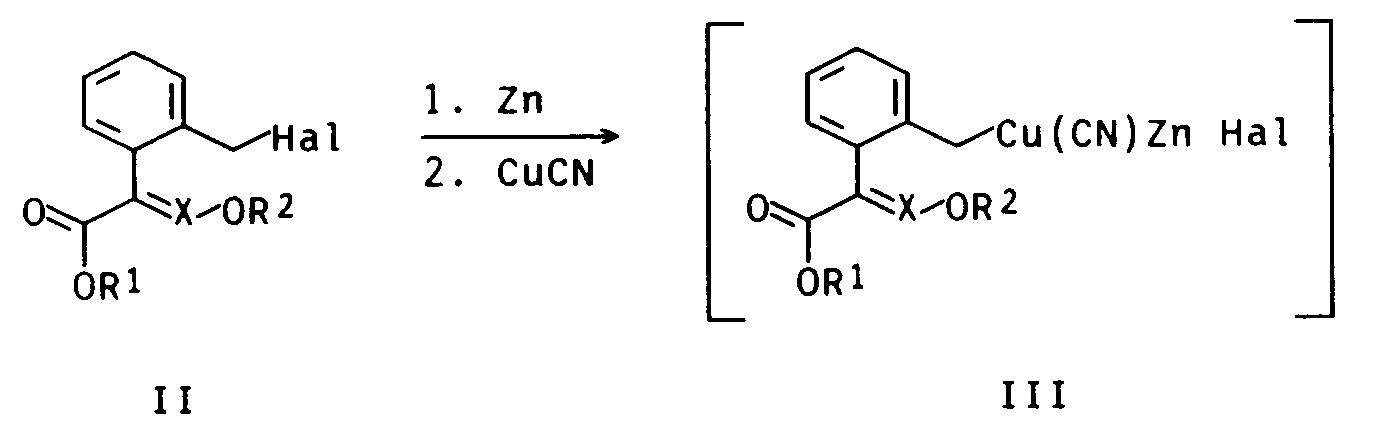

Applications Claiming Priority (2)
| Application Number | Priority Date | Filing Date | Title |
|---|---|---|---|
| DE4020397A DE4020397A1 (de) | 1990-06-27 | 1990-06-27 | Benzylketone und diese enthaltende fungizide |
| DE4020397 | 1990-06-27 |
Publications (3)
| Publication Number | Publication Date |
|---|---|
| EP0463513A2 true EP0463513A2 (de) | 1992-01-02 |
| EP0463513A3 EP0463513A3 (en) | 1992-10-07 |
| EP0463513B1 EP0463513B1 (de) | 1995-04-12 |
Family
ID=6409146
Family Applications (1)
| Application Number | Title | Priority Date | Filing Date |
|---|---|---|---|
| EP91109806A Expired - Lifetime EP0463513B1 (de) | 1990-06-27 | 1991-06-14 | Benzylketone und diese enthaltende Fungizide |
Country Status (15)
| Country | Link |
|---|---|
| US (1) | US5147892A (de) |
| EP (1) | EP0463513B1 (de) |
| JP (1) | JPH04230234A (de) |
| KR (1) | KR920000688A (de) |
| AT (1) | ATE121071T1 (de) |
| AU (1) | AU630819B2 (de) |
| CA (1) | CA2045044A1 (de) |
| DE (2) | DE4020397A1 (de) |
| DK (1) | DK0463513T3 (de) |
| ES (1) | ES2071167T3 (de) |
| GR (1) | GR3015774T3 (de) |
| HU (1) | HU208665B (de) |
| IL (1) | IL98628A (de) |
| NZ (1) | NZ238713A (de) |
| ZA (1) | ZA914916B (de) |
Cited By (1)
| Publication number | Priority date | Publication date | Assignee | Title |
|---|---|---|---|---|
| EP0564928A2 (de) | 1992-04-04 | 1993-10-13 | BASF Aktiengesellschaft | Derivate der Phenylessigsäure, ihre Herstellung und Verwendung als Schädlingsbekämpfungsmittel |
Families Citing this family (1)
| Publication number | Priority date | Publication date | Assignee | Title |
|---|---|---|---|---|
| US20070111519A1 (en) * | 2003-10-15 | 2007-05-17 | Applied Materials, Inc. | Integrated electroless deposition system |
Family Cites Families (5)
| Publication number | Priority date | Publication date | Assignee | Title |
|---|---|---|---|---|
| DE3623921A1 (de) * | 1986-07-16 | 1988-01-21 | Basf Ag | Oximether und diese enthaltende fungizide |
| ES2059527T3 (es) * | 1987-09-09 | 1994-11-16 | Zeneca Ltd | Fungicidas. |
| DE3816577A1 (de) * | 1988-05-14 | 1989-11-16 | Basf Ag | Acrylester und diese enthaltende fungizide |
| DE3827361A1 (de) * | 1988-08-12 | 1990-03-01 | Basf Ag | Oximether, verfahren zu ihrer herstellung und diese verbindungen enthaltende fungizide |
| IL93765A (en) * | 1989-04-11 | 1995-08-31 | Basf Ag | Oxirane Phenyl Esters and fungicides containing them |
-
1990
- 1990-06-27 DE DE4020397A patent/DE4020397A1/de not_active Withdrawn
-
1991
- 1991-06-14 DE DE59105144T patent/DE59105144D1/de not_active Expired - Lifetime
- 1991-06-14 DK DK91109806.9T patent/DK0463513T3/da active
- 1991-06-14 AT AT91109806T patent/ATE121071T1/de not_active IP Right Cessation
- 1991-06-14 EP EP91109806A patent/EP0463513B1/de not_active Expired - Lifetime
- 1991-06-14 ES ES91109806T patent/ES2071167T3/es not_active Expired - Lifetime
- 1991-06-19 JP JP3147249A patent/JPH04230234A/ja not_active Withdrawn
- 1991-06-20 CA CA002045044A patent/CA2045044A1/en not_active Abandoned
- 1991-06-26 IL IL9862891A patent/IL98628A/en not_active IP Right Cessation
- 1991-06-26 HU HU912140A patent/HU208665B/hu not_active IP Right Cessation
- 1991-06-26 AU AU79295/91A patent/AU630819B2/en not_active Ceased
- 1991-06-26 NZ NZ238713A patent/NZ238713A/en unknown
- 1991-06-26 ZA ZA914916A patent/ZA914916B/xx unknown
- 1991-06-26 KR KR1019910010705A patent/KR920000688A/ko not_active Abandoned
- 1991-06-27 US US07/722,504 patent/US5147892A/en not_active Expired - Fee Related
-
1995
- 1995-04-13 GR GR950400820T patent/GR3015774T3/el unknown
Cited By (4)
| Publication number | Priority date | Publication date | Assignee | Title |
|---|---|---|---|---|
| EP0564928A2 (de) | 1992-04-04 | 1993-10-13 | BASF Aktiengesellschaft | Derivate der Phenylessigsäure, ihre Herstellung und Verwendung als Schädlingsbekämpfungsmittel |
| EP0564928A3 (en) * | 1992-04-04 | 1993-11-24 | Basf Ag | Phenylacetic acid derivatives, their preparation and use as pesticides |
| US5389619A (en) * | 1992-04-04 | 1995-02-14 | Basf Aktiengesellschaft | Derivatives of phenylacetic acid, their preparation and their use as pesticides |
| AU658279B2 (en) * | 1992-04-04 | 1995-04-06 | Basf Aktiengesellschaft | Derivatives of phenylacetic acid, their preparation and their use as pesticides |
Also Published As
| Publication number | Publication date |
|---|---|
| ES2071167T3 (es) | 1995-06-16 |
| IL98628A0 (en) | 1992-07-15 |
| US5147892A (en) | 1992-09-15 |
| IL98628A (en) | 1995-05-26 |
| ZA914916B (en) | 1993-03-31 |
| DK0463513T3 (da) | 1995-06-26 |
| HUT58034A (en) | 1992-01-28 |
| DE4020397A1 (de) | 1992-01-02 |
| AU7929591A (en) | 1992-01-02 |
| CA2045044A1 (en) | 1991-12-28 |
| HU912140D0 (en) | 1991-12-30 |
| DE59105144D1 (de) | 1995-05-18 |
| AU630819B2 (en) | 1992-11-05 |
| KR920000688A (ko) | 1992-01-29 |
| HU208665B (en) | 1993-12-28 |
| ATE121071T1 (de) | 1995-04-15 |
| JPH04230234A (ja) | 1992-08-19 |
| NZ238713A (en) | 1992-06-25 |
| GR3015774T3 (en) | 1995-07-31 |
| EP0463513B1 (de) | 1995-04-12 |
| EP0463513A3 (en) | 1992-10-07 |
Similar Documents
| Publication | Publication Date | Title |
|---|---|---|
| EP0363818B1 (de) | Oximether-Derivate, Verfahren zu ihrer Herstellung und diese enthaltende Fungizide | |
| EP0280185B1 (de) | Substituierte Crotonsäureester und diese enthalende Fungizide | |
| EP0386561B1 (de) | Substituierte Oximether und Fungizide, die diese Verbindungen enthalten | |
| EP0432503B1 (de) | Thiolcarbonsäureester und diese enthaltende Fungizide | |
| DE4318917A1 (de) | 2-Oximino-2-phenyl-acetamide | |
| EP0407891B1 (de) | Neue 3-Methoximinopropionsäureester und diese enthaltende Fungizide | |
| EP0531821B1 (de) | 1-Alkoxyhexatrien-2-carbonsäureester | |
| EP0374811B1 (de) | Schwefelhaltige Oximether und diese enthaltende Fungizide | |
| EP0302366B1 (de) | Substituierte Pyridin-Derivate | |
| EP0385224B1 (de) | Substituierte N-Hydroxypyrazole und Fungizide, die diese Verbindungen enthalten | |
| EP0379098B1 (de) | Schwefelhaltige Acrylsäureester und diese enthaltende Fungizide | |
| EP0463513B1 (de) | Benzylketone und diese enthaltende Fungizide | |
| EP0602514B1 (de) | Thioamide und deren Verwendung als Pflanzenschutzmittel | |
| EP0420091B1 (de) | Neue Anilinderivate und diese enthaltende Fungizide | |
| EP0438726B1 (de) | Ungesättigte Cyclohexylessigsäurederivate und diese enthaltende Pflanzenschutzmittel | |
| EP0385357B1 (de) | Ortho-substituierte 1-Naphthylether und diese enthaltende Fungizide | |
| EP0406700B1 (de) | 3-Anilino-benzisothiazole und diese enthaltende Fungizide | |
| EP0442339B1 (de) | Neue 3-substituierte Pyridinmethanole und diese enthaltende Fungizide | |
| EP0400344B1 (de) | Pyridinderivate und ihre Verwendung als Fungizide | |
| EP0393428B1 (de) | Oxiran-phenylester und diese enthaltende Fungizide | |
| EP0311907B1 (de) | 3-substituierte Pyridine und diese enthaltende Fungizide | |
| DE4229643A1 (de) | Substituierte Hydroxyalkylpyridine | |
| EP0461487A2 (de) | Derivate des beta-Picolins und diese enthaltende Pflanzenschutzmittel | |
| EP0384365B1 (de) | 0-(1,2,4-Triazolyl-1)-0-Phenyl-Acetale und diese enthaltende Fungizide | |
| EP0234255B1 (de) | N-(Alkylamino)-azolylharnstoffe und diese enthaltende Fungizide |
Legal Events
| Date | Code | Title | Description |
|---|---|---|---|
| PUAI | Public reference made under article 153(3) epc to a published international application that has entered the european phase |
Free format text: ORIGINAL CODE: 0009012 |
|
| AK | Designated contracting states |
Kind code of ref document: A2 Designated state(s): AT BE CH DE DK ES FR GB GR IT LI NL SE |
|
| PUAL | Search report despatched |
Free format text: ORIGINAL CODE: 0009013 |
|
| AK | Designated contracting states |
Kind code of ref document: A3 Designated state(s): AT BE CH DE DK ES FR GB GR IT LI NL SE |
|
| 17P | Request for examination filed |
Effective date: 19920911 |
|
| 17Q | First examination report despatched |
Effective date: 19940217 |
|
| GRAA | (expected) grant |
Free format text: ORIGINAL CODE: 0009210 |
|
| AK | Designated contracting states |
Kind code of ref document: B1 Designated state(s): AT BE CH DE DK ES FR GB GR IT LI NL SE |
|
| REF | Corresponds to: |
Ref document number: 121071 Country of ref document: AT Date of ref document: 19950415 Kind code of ref document: T |
|
| REF | Corresponds to: |
Ref document number: 59105144 Country of ref document: DE Date of ref document: 19950518 |
|
| GBT | Gb: translation of ep patent filed (gb section 77(6)(a)/1977) |
Effective date: 19950428 |
|
| ITF | It: translation for a ep patent filed | ||
| REG | Reference to a national code |
Ref country code: ES Ref legal event code: FG2A Ref document number: 2071167 Country of ref document: ES Kind code of ref document: T3 |
|
| REG | Reference to a national code |
Ref country code: DK Ref legal event code: T3 |
|
| REG | Reference to a national code |
Ref country code: GR Ref legal event code: FG4A Free format text: 3015774 |
|
| ET | Fr: translation filed | ||
| PLBE | No opposition filed within time limit |
Free format text: ORIGINAL CODE: 0009261 |
|
| STAA | Information on the status of an ep patent application or granted ep patent |
Free format text: STATUS: NO OPPOSITION FILED WITHIN TIME LIMIT |
|
| 26N | No opposition filed | ||
| PGFP | Annual fee paid to national office [announced via postgrant information from national office to epo] |
Ref country code: FR Payment date: 19980522 Year of fee payment: 8 |
|
| PGFP | Annual fee paid to national office [announced via postgrant information from national office to epo] |
Ref country code: SE Payment date: 19980525 Year of fee payment: 8 |
|
| PGFP | Annual fee paid to national office [announced via postgrant information from national office to epo] |
Ref country code: GR Payment date: 19980528 Year of fee payment: 8 |
|
| PGFP | Annual fee paid to national office [announced via postgrant information from national office to epo] |
Ref country code: GB Payment date: 19980601 Year of fee payment: 8 |
|
| PGFP | Annual fee paid to national office [announced via postgrant information from national office to epo] |
Ref country code: DK Payment date: 19980603 Year of fee payment: 8 |
|
| PGFP | Annual fee paid to national office [announced via postgrant information from national office to epo] |
Ref country code: CH Payment date: 19980604 Year of fee payment: 8 Ref country code: AT Payment date: 19980604 Year of fee payment: 8 |
|
| PGFP | Annual fee paid to national office [announced via postgrant information from national office to epo] |
Ref country code: BE Payment date: 19980609 Year of fee payment: 8 |
|
| PGFP | Annual fee paid to national office [announced via postgrant information from national office to epo] |
Ref country code: ES Payment date: 19980611 Year of fee payment: 8 |
|
| PGFP | Annual fee paid to national office [announced via postgrant information from national office to epo] |
Ref country code: NL Payment date: 19980618 Year of fee payment: 8 |
|
| PGFP | Annual fee paid to national office [announced via postgrant information from national office to epo] |
Ref country code: DE Payment date: 19980626 Year of fee payment: 8 |
|
| PG25 | Lapsed in a contracting state [announced via postgrant information from national office to epo] |
Ref country code: GB Free format text: LAPSE BECAUSE OF NON-PAYMENT OF DUE FEES Effective date: 19990614 Ref country code: AT Free format text: LAPSE BECAUSE OF NON-PAYMENT OF DUE FEES Effective date: 19990614 |
|
| PG25 | Lapsed in a contracting state [announced via postgrant information from national office to epo] |
Ref country code: ES Free format text: LAPSE BECAUSE OF NON-PAYMENT OF DUE FEES Effective date: 19990615 |
|
| PG25 | Lapsed in a contracting state [announced via postgrant information from national office to epo] |
Ref country code: DE Free format text: LAPSE BECAUSE OF THE APPLICANT RENOUNCES Effective date: 19990619 |
|
| PG25 | Lapsed in a contracting state [announced via postgrant information from national office to epo] |
Ref country code: SE Free format text: THE PATENT HAS BEEN ANNULLED BY A DECISION OF A NATIONAL AUTHORITY Effective date: 19990629 |
|
| PG25 | Lapsed in a contracting state [announced via postgrant information from national office to epo] |
Ref country code: LI Free format text: LAPSE BECAUSE OF NON-PAYMENT OF DUE FEES Effective date: 19990630 Ref country code: GR Free format text: LAPSE BECAUSE OF NON-PAYMENT OF DUE FEES Effective date: 19990630 Ref country code: FR Free format text: THE PATENT HAS BEEN ANNULLED BY A DECISION OF A NATIONAL AUTHORITY Effective date: 19990630 Ref country code: DK Free format text: LAPSE BECAUSE OF NON-PAYMENT OF DUE FEES Effective date: 19990630 Ref country code: CH Free format text: LAPSE BECAUSE OF NON-PAYMENT OF DUE FEES Effective date: 19990630 Ref country code: BE Free format text: LAPSE BECAUSE OF NON-PAYMENT OF DUE FEES Effective date: 19990630 |
|
| BERE | Be: lapsed |
Owner name: BASF A.G. Effective date: 19990630 |
|
| PG25 | Lapsed in a contracting state [announced via postgrant information from national office to epo] |
Ref country code: NL Free format text: LAPSE BECAUSE OF NON-PAYMENT OF DUE FEES Effective date: 20000101 |
|
| GBPC | Gb: european patent ceased through non-payment of renewal fee |
Effective date: 19990614 |
|
| REG | Reference to a national code |
Ref country code: CH Ref legal event code: PL |
|
| EUG | Se: european patent has lapsed |
Ref document number: 91109806.9 |
|
| NLV4 | Nl: lapsed or anulled due to non-payment of the annual fee |
Effective date: 20000101 |
|
| REG | Reference to a national code |
Ref country code: DK Ref legal event code: EBP |
|
| REG | Reference to a national code |
Ref country code: FR Ref legal event code: ST |
|
| REG | Reference to a national code |
Ref country code: ES Ref legal event code: FD2A Effective date: 20010503 |
|
| PG25 | Lapsed in a contracting state [announced via postgrant information from national office to epo] |
Ref country code: IT Free format text: LAPSE BECAUSE OF NON-PAYMENT OF DUE FEES;WARNING: LAPSES OF ITALIAN PATENTS WITH EFFECTIVE DATE BEFORE 2007 MAY HAVE OCCURRED AT ANY TIME BEFORE 2007. THE CORRECT EFFECTIVE DATE MAY BE DIFFERENT FROM THE ONE RECORDED. Effective date: 20050614 |