EP0463679A1 - Verfahren zur Erzeugung von Benzinkomponenten - Google Patents
Verfahren zur Erzeugung von Benzinkomponenten Download PDFInfo
- Publication number
- EP0463679A1 EP0463679A1 EP91201517A EP91201517A EP0463679A1 EP 0463679 A1 EP0463679 A1 EP 0463679A1 EP 91201517 A EP91201517 A EP 91201517A EP 91201517 A EP91201517 A EP 91201517A EP 0463679 A1 EP0463679 A1 EP 0463679A1
- Authority
- EP
- European Patent Office
- Prior art keywords
- hydrocarbons
- carbon atoms
- fraction
- stream
- process according
- Prior art date
- Legal status (The legal status is an assumption and is not a legal conclusion. Google has not performed a legal analysis and makes no representation as to the accuracy of the status listed.)
- Granted
Links
Images

Classifications
-
- C—CHEMISTRY; METALLURGY
- C10—PETROLEUM, GAS OR COKE INDUSTRIES; TECHNICAL GASES CONTAINING CARBON MONOXIDE; FUELS; LUBRICANTS; PEAT
- C10G—CRACKING HYDROCARBON OILS; PRODUCTION OF LIQUID HYDROCARBON MIXTURES, e.g. BY DESTRUCTIVE HYDROGENATION, OLIGOMERISATION, POLYMERISATION; RECOVERY OF HYDROCARBON OILS FROM OIL-SHALE, OIL-SAND, OR GASES; REFINING MIXTURES MAINLY CONSISTING OF HYDROCARBONS; REFORMING OF NAPHTHA; MINERAL WAXES
- C10G59/00—Treatment of naphtha by two or more reforming processes only or by at least one reforming process and at least one process which does not substantially change the boiling range of the naphtha
- C10G59/06—Treatment of naphtha by two or more reforming processes only or by at least one reforming process and at least one process which does not substantially change the boiling range of the naphtha plural parallel stages only
-
- C—CHEMISTRY; METALLURGY
- C10—PETROLEUM, GAS OR COKE INDUSTRIES; TECHNICAL GASES CONTAINING CARBON MONOXIDE; FUELS; LUBRICANTS; PEAT
- C10L—FUELS NOT OTHERWISE PROVIDED FOR; NATURAL GAS; SYNTHETIC NATURAL GAS OBTAINED BY PROCESSES NOT COVERED BY SUBCLASSES C10G OR C10K; LIQUIFIED PETROLEUM GAS; USE OF ADDITIVES TO FUELS OR FIRES; FIRE-LIGHTERS
- C10L1/00—Liquid carbonaceous fuels
- C10L1/04—Liquid carbonaceous fuels essentially based on blends of hydrocarbons
- C10L1/06—Liquid carbonaceous fuels essentially based on blends of hydrocarbons for spark ignition
Definitions
- the present invention is concerned with producing gasoline components from a hydrocarbonaceous feed containing hydrocarbons comprising 4 carbon atoms and higher boiling hydrocarbons.
- the present invention relates to a process for producing gasoline components from a hydrocarbonaceous feed containing hydrocarbons comprising at least 4 carbon atoms, which process comprises the following steps:
- the process further comprises isomerizing at least part of the intermediate fraction, before the intermediate fraction is separated in separation step c) together with effluent of step b).
- the heavy fraction which can be subjected to catalytic reforming has a lower content of compounds which will be present in the product stream as benzene, such as (cyclo)hexanes and benzene itself, in comparison with a conventional isomerization process.
- the intermediate fraction of the process according to the present invention contains relatively heavy compounds which enhance coke make in conventional isomerization, resulting in deactivation of the catalyst.
- the amount of hydrocarbons comprising 7 carbon atoms present in the intermediate fraction is reduced by passing the fraction containing mainly hydrocarbons comprising 6 or 7 carbon atoms to the separation step before isomerization.
- the amount of hydrocarbons comprising 7 carbon atoms sent to the isomerization step is reduced.
- the intermediate fraction is isomerized before being sent to the separation step, resulting in an increased amount of branched C 7 -hydrocarbons.
- the isomerization of the intermediate fraction is preferably carried out at lower temperature than applied in conventional isomerization.
- the feed which is sent to fractionation step a) contains hydrocarbons comprising at least 4 carbon atoms. Generally, the feed contains mainly hydrocarbon comprising at least 5 carbon atoms.
- the catalytic reforming can suitably be carried out at a temperature of between 400 and 600 ° C and a pressure of between 1 and 50 bar.
- the heavy fraction is catalytically reformed by contacting with a reforming catalyst containing platinum and optionally at least one other metal.
- effluent from reforming step e) is suitably distilled and separated into at least a stream containing hydrocarbons comprising at most 4 carbon atoms and a stream containing hydrocarbons comprising at least 4 carbon atoms.
- a further enhancement of the octane number of the gasoline components finally obtained in the process according to the present invention can be obtained by further processing at least part of the effluent of the reforming step to the separation step c), with or without previous isomerization.
- at least part of the effluent of reforming step e) is distilled and separated into a stream containing hydrocarbons comprising at most 4 carbon atoms, a reformate stream containing mainly hydrocarbons comprising 5 to 7 carbon atoms and a stream containing hydrocarbons comprising at least 7 carbon atoms, at least part of which reformate stream is passed to separation step c), with or without previous isomerization.
- Isomerization step b) is suitably carried out at a temperature between 100 and 320 C and a pressure between 10 and 60 bar.
- the catalyst present in the isomerization step suitably is catalytically active in isomerization of hydrocarbons comprising 5 to 7 carbon atoms.
- the intermediate fraction is suitably isomerized at a temperature between 50 and 300 ° C and a pressure between 10 and 60 bar.
- this isomerization is carried out at a lower temperature than isomerization step b).
- the isomerization is carried out by contacting with a catalyst which is catalytically active in isomerization of hydrocarbons comprising 6 or 7 carbon atoms.
- the catalyst is catalytically active in isomerization of hydrocarbons comprising 6 or 7 carbon atoms and in hydrogenating aromatic compounds.
- the catalyst employed in the isomerization step(s) suitably is a heterogeneous hydroisomerization catalyst having an acid activity and a hydrogenation activity and comprising one or more metals from Group VIII of the Periodic Table of the Elements on a carrier material.
- the carrier material has acidic properties and may suitably consist of silica-alumina, in particular zeolites (e.g. mordenite, faujasite or zeolite Y) in the hydrogen form or exchanged with rare earth ions, or of alumina rendered acidic by combination with halogen (e.g. chlorine).
- the employed catalyst comprises at least one noble metal from Group VIII (in particular platinum) on mordenite as carrier material.
- a catalyst is used containing H-mordenite which is prepared by treating mordenite one or more times with an aqueous solution of an ammonium compound (e.g. ammonium nitrate), followed by drying (e.g. at 100-200 C) and calcining (e.g. at 400-700 C) of the treated mordenite.
- the catalyst can comprise a binder material such as alumina, silica or silica-alumina.
- a separatory molecular sieve capable of separating a hydrocarbon species via selective adsorption.
- the molecular sieve which is applied is selective with respect to the degree of branching of the hydrocarbons applied, i.e. unbranched hydrocarbons should be substantially adsorbed, whereas branched and cyclic hydrocarbons should not be retained in any substantial amount in the molecular sieve.
- the selectivity is dependent to a large extent on the pore diameters of the molecular sieve.
- a separatory molecular sieve having a pore size which is sufficient to permit entry of normal hydrocarbons containing 4-7 carbon atoms, but restrictive to prohibit entry of such cyclic, mono-methyl branched and dimethyl branched hydrocarbons.
- Suitable pore diameters are in the range from 0.3-0.8 nm, and preferably from 0.4-0.6 nm.
- Synthetic or natural zeolites can be used as molecular sieve; preferably zeolite 5A is used.
- the particles which comprise molecular sieve material may in addition comprise a binder material such as alumina, silica or silica-alumina, in order to improve the crushing strength of the particles; said particles may also be mixed with particles which do not contain molecular sieve material.
- a binder material such as alumina, silica or silica-alumina
- the invention also relates to hydrocarbons whenever obtained by a process as described hereinbefore.
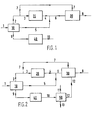
- a feed (1) is passed to fractionation unit (10).
- fractionation unit (10) the feed is separated into a heavy fraction (9), containing hydrocarbons comprising at least 7 carbon atoms, an intermediate fraction (5), containing mainly hydrocarbons comprising 6 or 7 carbon atoms, and a light fraction (2), containing hydrocarbons comprising at most 6 carbon atoms.
- Light fraction (2) is sent to first isomerization unit (20) together with recycle stream (7), discussed hereinafter.
- Effluent of the isomerization unit (4) is sent to separation unit (30) together with intermediate fraction (5).
- Separation unit (30) comprises a separatory molecular sieve, with the help of which normal hydrocarbons are separated from cyclic and mono-and multi-branched hydrocarbons, thereby producing a stream (8), mainly comprising cyclic and branched hydrocarbons and a stream (7), mainly comprising normal hydrocarbons.
- Stream (7) is combined with stream (2) and sent to the isomerization unit (20).
- the heavy fraction (9) is sent to reforming unit (40), where the fraction is contacted with a reforming catalyst at reforming conditions.
- the process schematically shown in figure 2 resembles the process schematically shown in figure 1.
- the processes differ in that in the process shown in figure 2 the effluent of the reforming unit (40) is sent to distillation unit (50), in which stream (10) is separated into a stream (11) containing hydrocarbons comprising at most 4 carbon atoms, a reformate stream (12) containing mainly hydrocarbons comprising 5 to 7 carbon atoms and a stream (13) containing hydrocarbons comprising at least 7 carbon atoms.
- the reformate stream (12) is sent, possibly together with streams (4) and/or (5) to separation unit (30).
- a feed (1) is passed to fractionation unit (10).
- fractionation unit (10) the feed is separated into a heavy fraction (9), containing hydrocarbons comprising at least 7 carbon atoms, an intermediate fraction (5), containing mainly hydrocarbons comprising 6 or 7 carbon atoms, and a light fraction (2), containing hydrocarbons comprising at most 6 carbon atoms.
- Light fraction (2) is sent to first isomerization unit (20) together with recycle stream (7), discussed hereinafter.
- Intermediate fraction (5) is sent to second isomerization unit (60).
- the effluent of the second isomerization unit (14) is sent, together with the effluent of the isomerization unit (4), to separation unit (30).
- Separation unit (30) comprises a separatory molecular sieve, with the help of which stream (8), mainly comprising branched and cyclic hydrocarbons, and a stream (7), mainly comprising normal hydrocarbons, are produced.
- Stream (7) is sent to the isomerization unit (20).
- Heavy fraction (9) is sent to reforming unit (40), in which the fraction is contacted with a reforming catalyst at reforming conditions.
- the effluent of the reforming unit (40) is sent to distillation unit (50), in which stream (10) is separated into a stream (16) containing hydrocarbons comprising at most 4 carbon atoms and a product stream (17).
- the process shown in figure 4 differs from the process of figure 3, in that the effluent of reforming unit (40) is sent to distillation unit (50), in which stream (10) is separated into a stream (11) containing hydrocarbons comprising at most 4 carbon atoms, a reformate stream (12) containing mainly hydrocarbons comprising 5 to 7 carbon atoms and a stream (13) containing hydrocarbons comprising at least 7 carbon atoms. Reformate stream (12) is sent, together with streams (2) and (7), to the first isomerization unit (20).
- the invention will now be further illustrated with the aid of the following examples, in which hydrogen addition and removal have not been indicated.
- the hydrocarbon feed used had a RON of 58 and a benzene content of 1.1 % by weight.
- a feed containing 100 pbw of hydrocarbons which hydrocarbons comprise at least 4 carbon atoms, which feed had a final boiling point of 200 ° C was split by fractional distillation into a heavy fraction boiling above 93 ° C and containing 52 pbw of hydrocarbons, mainly hydrocarbons comprising at least 7 carbon atoms, and an intermediate fraction, boiling between 70 ° C and 93 ° C and containing 20 pbw of hydrocarbons, mainly hydrocarbons comprising 6 or 7 carbon atoms, and a light fraction boiling below 70 ° C and containing 28 bw of hydrocarbons, mainly hydrocarbons comprising at most 6 carbon atoms.
- the light fraction was combined with stream (7) and isomerized at a temperature of 260 °C and a pressure of 25 bar in the presence of a catalyst containing 0.3 pbw of platinum on mordenite, amount of metal on amount of mordenite.
- Hydrocarbons comprising at most 4 carbon atoms were removed from the effluent obtained and the remaining effluent was combined with the intermediate fraction and separated in a separation unit with the help of 5A zeolite as separatory molecular sieve, by which a stream containing branched and cyclic hydrocarbons was separated off, containing 45 pbw of hydrocarbons and 2.1 % by weight (%wt) of benzene, and a stream containing normal hydrocarbons containing 14 pbw of hydrocarbons.
- the stream containing normal hydrocarbons was combined with the light fraction.
- the heavy fraction was reformed at a temperature of 500 ° C and a pressure of 8 bar in the presence of a catalyst containing 0.3 pbw of platinum on alumina (amount of metal on amount of alumina). Hydrocarbons comprising at most 4 carbon atoms were removed, and effluent containing 47 pbw of hydrocarbons and 0.8 % by weight of benzene was obtained.
- the light fraction was combined with stream (7) and isomerized at a temperature of 260 °C and a pressure of 25 bar in the presence of a catalyst containing 0.3 pbw of platinum on mordenite (amount of metal on amount of mordenite).
- Hydrocarbons comprising at most 4 carbon atoms were removed from the effluent obtained and the remaining effluent was combined with the intermediate fraction and reformate stream (12), discussed hereinafter, and separated in a separation unit with the help of 5A zeolite as separatory molecular sieve, by which a stream containing branched and cyclic hydrocarbons was separated off, containing 53 pbw of hydrocarbons and 2.5 %wt of benzene, and a stream containing normal hydrocarbons, containing 17 pbw of hydrocarbons. The stream containing normal hydrocarbons was combined with the light fraction.
- the heavy fraction was reformed at a temperature of 500 ° C and a pressure of 8 bar in the presence of a catalyst containing 0.3 pbw of platinum on alumina (amount of metal on amount of alumina). Hydrocarbons comprising at most 4 carbon atoms were removed, which stream contained 3 pbw of hydrocarbons; a reformate stream containing hydrocarbons comprising 5 to 7 carbon atoms, which stream contained 9 pbw of hydrocarbons; and a stream containing hydrocarbons comprising at least 7 carbon atoms, which latter stream contained 38 pbw of hydrocarbons and 0.0 %wt of benzene.
- a feed containing 100 pbw of hydrocarbons which hydrocarbons comprised at least 4 carbon atoms, which feed had a final boiling point of 200 ° C was split by fractional distillation into a heavy fraction boiling above 93 ° C and containing 52 pbw of hydrocarbons, mainly hydrocarbons comprising at least 7 carbon atoms and an intermediate fraction, boiling between 70 ° C and 93 ° C and containing 20 pbw of hydrocarbons, mainly hydrocarbons comprising 6 or 7 carbon atoms, and a light fraction boiling below 70 °C and containing 28 pbw of hydrocarbons, mainly hydrocarbons comprising at most 6 carbon atoms.
- the light fraction was combined with stream (7) and isomerized at a temperature of 260 °C and a pressure of 25 bar in the presence of a catalyst containing 0.3 pbw of platinum on mordenite, amount of metal on amount of mordenite.
- the intermediate fraction was isomerized at a temperature of 220 °C and a pressure of 25 bar in the presence of a catalyst containing 0.3 pbw of platinum on mordenite.
- Hydrocarbons comprising at most 4 carbon atoms were removed from the effluents obtained, and the remaining effluents were combined and separated in a separation unit with the help of 5A zeolite as separatory molecular sieve, by which a stream containing branched and cyclic hydrocarbons was separated off, containing 45 pbw of hydrocarbons and 0.0 %wt of benzene, and a stream containing normal hydrocarbons, containing 12 pbw of hydrocarbons. The stream containing normal hydrocarbons was combined with the light fraction.
- the heavy fraction was reformed at a temperature of 500 °C and a pressure of 8 bar in the presence of a catalyst containing 0.3 pbw of platinum on alumina (amount of metal on amount of alumina). Hydrocarbons comprising at most 4 carbon atoms were removed, and effluent containing 47 pbw of hydrocarbons and 0.8 % by weight of benzene was obtained.
- a feed containing 100 pbw of hydrocarbons which hydrocarbons comprised at least 4 carbon atoms, which feed had a final boiling point of 200 ° C was split by fractional distillation into a heavy fraction boiling above 93 °C and containing 52 pbw of hydrocarbons, mainly hydrocarbons comprising at least 7 carbon atoms and an intermediate fraction, boiling between 70 °C and 93 °C and containing mainly hydrocarbons comprising 6 or 7 carbon atoms, and a light fraction boiling below 70 ° C and containing 28 pbw of hydrocarbons, mainly hydrocarbons comprising at most 6 carbon atoms.
- the light fraction was combined with stream (7) and stream (12) discussed hereinafter, and were together isomerized at a temperature of 260 °C and a pressure of 25 bar in the presence of a catalyst containing 0.3 pbw of platinum on mordenite, amount of metal on amount of mordenite.
- the intermediate fraction was isomerized at a temperature of 220 °C and a pressure of 25 bar in the presence of a catalyst containing 0.3 pbw of platinum on mordenite.
- Hydrocarbons comprising at most 4 carbon atoms were removed from the effluents obtained, and the remaining effluents were combined and separated in a separation unit with the help of 5A zeolite as separatory molecular sieve, by which a stream containing branched and cyclic hydrocarbons was separated off, containing 51 pbw of hydrocarbons and 0.0 % by weight (%wt) of benzene, and a stream containing normal hydrocarbons, containing 13 pbw of hydrocarbons. The stream containing normal hydrocarbons was combined with the light fraction.
- the heavy fraction was reformed at a temperature of 500 ° C and a pressure of 8 bar in the presence of a catalyst containing 0.3 pbw of platinum on alumina (amount of metal on amount of alumina). Hydrocarbons comprising at most 4 carbon atoms were removed, which stream contained 3 pbw of hydrocarbons; a reformate stream containing hydrocarbons comprising 5 to 7 carbon atoms, which stream contained 9 pbw of hydrocarbons; and a stream containing hydrocarbons comprising at least 7 carbon atoms, which latter stream contained 38 pbw of hydrocarbons and 0.0 %wt of benzene.
- the light fraction was isomerized in a first isomerization step at a temperature of 260 ° C and a pressure of 25 bar in the presence of a catalyst containing 0.3 pbw of platinum on mordenite (amount of metal on amount of mordenite).
- Hydrocarbons comprising at most 4 carbon atoms were removed from the effluent obtained and the remaining effluent was separated with the help of zeolite 5A as separatory molecular sieve.
- a stream containing branched and cyclic hydrocarbons was separated off, which stream contained 26 pbw of hydrocarbons and 0.0 %wt of benzene, and a stream containing normal hydrocarbons, which latter stream contained 9 pbw of hydrocarbons.
- the heavy fraction was reformed at a temperature of 500 °C and a pressure of 8 bar, with the help of a catalyst containing 0.3 pbw of platinum on alumina (amount of platinum on amount of alumina).
- the effluent obtained was distilled to give a stream containing hydrocarbons comprising at most 4 carbon atoms, which stream contained 4 pbw of hydrocarbons, and a stream containing hydrocarbons comprising at least 4 carbon atoms, which latter stream contained 66 pbw of hydrocarbons and 9.7 % by weight of benzene.
Landscapes
- Chemical & Material Sciences (AREA)
- Oil, Petroleum & Natural Gas (AREA)
- Engineering & Computer Science (AREA)
- Chemical Kinetics & Catalysis (AREA)
- General Chemical & Material Sciences (AREA)
- Organic Chemistry (AREA)
- Production Of Liquid Hydrocarbon Mixture For Refining Petroleum (AREA)
- Organic Low-Molecular-Weight Compounds And Preparation Thereof (AREA)
- Glass Compositions (AREA)
- Low-Molecular Organic Synthesis Reactions Using Catalysts (AREA)
- Fuel-Injection Apparatus (AREA)
- Luminescent Compositions (AREA)
Applications Claiming Priority (2)
| Application Number | Priority Date | Filing Date | Title |
|---|---|---|---|
| GB909013565A GB9013565D0 (en) | 1990-06-18 | 1990-06-18 | Process for producing gasoline components |
| GB9013565 | 1990-06-18 |
Publications (2)
| Publication Number | Publication Date |
|---|---|
| EP0463679A1 true EP0463679A1 (de) | 1992-01-02 |
| EP0463679B1 EP0463679B1 (de) | 1994-06-01 |
Family
ID=10677807
Family Applications (1)
| Application Number | Title | Priority Date | Filing Date |
|---|---|---|---|
| EP91201517A Expired - Lifetime EP0463679B1 (de) | 1990-06-18 | 1991-06-17 | Verfahren zur Erzeugung von Benzinkomponenten |
Country Status (12)
| Country | Link |
|---|---|
| US (1) | US5091074A (de) |
| EP (1) | EP0463679B1 (de) |
| JP (1) | JP2987601B2 (de) |
| AT (1) | ATE106437T1 (de) |
| AU (1) | AU639112B2 (de) |
| CA (1) | CA2043189C (de) |
| DE (1) | DE69102209T2 (de) |
| DK (1) | DK0463679T3 (de) |
| ES (1) | ES2054431T3 (de) |
| FI (1) | FI104258B1 (de) |
| GB (1) | GB9013565D0 (de) |
| NO (1) | NO303130B1 (de) |
Families Citing this family (7)
| Publication number | Priority date | Publication date | Assignee | Title |
|---|---|---|---|---|
| US5242576A (en) * | 1991-11-21 | 1993-09-07 | Uop | Selective upgrading of naphtha fractions by a combination of reforming and selective isoparaffin synthesis |
| AU690397B2 (en) * | 1994-12-01 | 1998-04-23 | Mobil Oil Corporation | Integrated process for the production of reformate having reduced benzene content |
| FR2776667B1 (fr) * | 1998-03-31 | 2000-06-16 | Total Raffinage Distribution | Procede et dispositif d'isomerisation d'essences a teneur elevee en benzene |
| US6126812A (en) * | 1998-07-14 | 2000-10-03 | Phillips Petroleum Company | Gasoline upgrade with split feed |
| ATE302254T1 (de) * | 2002-03-20 | 2005-09-15 | Shell Int Research | Verfahren zur katalytischen reformierung eines kohlenwasserstoffhaltigen einsatzstoffs |
| US8808534B2 (en) * | 2011-07-27 | 2014-08-19 | Saudi Arabian Oil Company | Process development by parallel operation of paraffin isomerization unit with reformer |
| US10941352B2 (en) * | 2019-06-27 | 2021-03-09 | Uop Llc | Processes for increasing an octane value of a gasoline component |
Citations (2)
| Publication number | Priority date | Publication date | Assignee | Title |
|---|---|---|---|---|
| DE1125102B (de) * | 1959-06-26 | 1962-03-08 | Universal Oil Prod Co | Verbundverfahren zur Aufwertung von C- und schwerere Kohlenwasserstoffe enthaltendemparaffinischem Benzin |
| GB1363044A (en) * | 1971-06-30 | 1974-08-14 | Texaco Development Corp | Hydrotreating and hydroisomerizing c5 and c6 hydrocarbon streams |
Family Cites Families (2)
| Publication number | Priority date | Publication date | Assignee | Title |
|---|---|---|---|---|
| US3753891A (en) * | 1971-01-15 | 1973-08-21 | R Graven | Split-stream reforming to upgrade low-octane hydrocarbons |
| US3761392A (en) * | 1972-05-08 | 1973-09-25 | Sun Oil Co Pennsylvania | Upgrading wide range gasoline stocks |
-
1990
- 1990-06-18 GB GB909013565A patent/GB9013565D0/en active Pending
-
1991
- 1991-04-09 US US07/682,174 patent/US5091074A/en not_active Expired - Fee Related
- 1991-05-24 CA CA002043189A patent/CA2043189C/en not_active Expired - Fee Related
- 1991-06-17 DK DK91201517.9T patent/DK0463679T3/da active
- 1991-06-17 EP EP91201517A patent/EP0463679B1/de not_active Expired - Lifetime
- 1991-06-17 FI FI912934A patent/FI104258B1/fi active
- 1991-06-17 DE DE69102209T patent/DE69102209T2/de not_active Expired - Fee Related
- 1991-06-17 AU AU78472/91A patent/AU639112B2/en not_active Ceased
- 1991-06-17 ES ES91201517T patent/ES2054431T3/es not_active Expired - Lifetime
- 1991-06-17 NO NO912342A patent/NO303130B1/no unknown
- 1991-06-17 JP JP3170377A patent/JP2987601B2/ja not_active Expired - Fee Related
- 1991-06-17 AT AT91201517T patent/ATE106437T1/de not_active IP Right Cessation
Patent Citations (2)
| Publication number | Priority date | Publication date | Assignee | Title |
|---|---|---|---|---|
| DE1125102B (de) * | 1959-06-26 | 1962-03-08 | Universal Oil Prod Co | Verbundverfahren zur Aufwertung von C- und schwerere Kohlenwasserstoffe enthaltendemparaffinischem Benzin |
| GB1363044A (en) * | 1971-06-30 | 1974-08-14 | Texaco Development Corp | Hydrotreating and hydroisomerizing c5 and c6 hydrocarbon streams |
Also Published As
| Publication number | Publication date |
|---|---|
| FI104258B (fi) | 1999-12-15 |
| GB9013565D0 (en) | 1990-08-08 |
| NO303130B1 (no) | 1998-06-02 |
| JP2987601B2 (ja) | 1999-12-06 |
| FI912934L (fi) | 1991-12-19 |
| FI912934A0 (fi) | 1991-06-17 |
| US5091074A (en) | 1992-02-25 |
| AU639112B2 (en) | 1993-07-15 |
| NO912342L (no) | 1991-12-19 |
| CA2043189C (en) | 2001-09-11 |
| DE69102209T2 (de) | 1994-09-15 |
| AU7847291A (en) | 1991-12-19 |
| ES2054431T3 (es) | 1994-08-01 |
| CA2043189A1 (en) | 1991-12-19 |
| NO912342D0 (no) | 1991-06-17 |
| EP0463679B1 (de) | 1994-06-01 |
| ATE106437T1 (de) | 1994-06-15 |
| DE69102209D1 (de) | 1994-07-07 |
| FI104258B1 (fi) | 1999-12-15 |
| DK0463679T3 (da) | 1994-06-20 |
| JPH04226190A (ja) | 1992-08-14 |
Similar Documents
| Publication | Publication Date | Title |
|---|---|---|
| JP2727349B2 (ja) | 限定されたc▲下9▼+含量を有する炭化水素留分 | |
| CA1263672A (en) | Reforming process for enhanced benzene yield | |
| US5525209A (en) | Process for the improved production of middle distillates jointly with the production of high viscosity oils with high viscosity indices from heavy petroleum cuts | |
| US4282085A (en) | Petroleum distillate upgrading process | |
| EP0303332B1 (de) | Hydrierverfahren für Kohlenwasserstofföle | |
| US4251348A (en) | Petroleum distillate upgrading process | |
| US4118429A (en) | Production and recovery of para-xylene | |
| EP0462673B1 (de) | Verfahren zur Erzeugung von Benzinkomponenten | |
| EP0463679B1 (de) | Verfahren zur Erzeugung von Benzinkomponenten | |
| US4665273A (en) | Isomerization of high sulfur content naphthas | |
| WO1994000409A1 (en) | Nonextractive processes for producing high purity aromatics | |
| US7037422B2 (en) | Process for producing high RON gasoline using CFI Zeolite | |
| CA2068174C (en) | Hydrodecyclization process | |
| US5073667A (en) | Process for the isomerization of a hydrocarbon feed | |
| KR890014415A (ko) | 디메틸부탄-비함유 탄화수소 분류물의 개질방법 | |
| JPH05263083A (ja) | 炭化水素質供給原料の品質向上法 | |
| EP0629681B1 (de) | Verfahren zur Verbesserung eines Kohlenwasserstoffeinsatzes | |
| US3256353A (en) | Preparation of dimethyldecalins | |
| CA2125740C (en) | Process for upgrading a hydrocarbonaceous feedstock | |
| US4444652A (en) | Upgrading gasoline derived from synthesis gas | |
| CA1180296A (en) | Method for treating shale oil and producing liquid transport fuel therefrom | |
| JPH01163291A (ja) | 芳香族炭化水素の製造方法 | |
| EP0653400A1 (de) | Verfahren zur Herstellung von Paraffinen mit mehreren Verzweigungen | |
| JPH05247473A (ja) | 炭化水素質供給原料の品質向上法 | |
| WO1996002612A1 (en) | Shape selective hydrogenation of aromatics |
Legal Events
| Date | Code | Title | Description |
|---|---|---|---|
| PUAI | Public reference made under article 153(3) epc to a published international application that has entered the european phase |
Free format text: ORIGINAL CODE: 0009012 |
|
| AK | Designated contracting states |
Kind code of ref document: A1 Designated state(s): AT BE CH DE DK ES FR GB GR IT LI LU NL SE |
|
| 17P | Request for examination filed |
Effective date: 19920518 |
|
| 17Q | First examination report despatched |
Effective date: 19921201 |
|
| GRAA | (expected) grant |
Free format text: ORIGINAL CODE: 0009210 |
|
| AK | Designated contracting states |
Kind code of ref document: B1 Designated state(s): AT BE CH DE DK ES FR GB GR IT LI LU NL SE |
|
| REF | Corresponds to: |
Ref document number: 106437 Country of ref document: AT Date of ref document: 19940615 Kind code of ref document: T |
|
| REG | Reference to a national code |
Ref country code: DK Ref legal event code: T3 |
|
| REF | Corresponds to: |
Ref document number: 69102209 Country of ref document: DE Date of ref document: 19940707 |
|
| ITF | It: translation for a ep patent filed | ||
| EPTA | Lu: last paid annual fee | ||
| REG | Reference to a national code |
Ref country code: ES Ref legal event code: FG2A Ref document number: 2054431 Country of ref document: ES Kind code of ref document: T3 |
|
| ET | Fr: translation filed | ||
| REG | Reference to a national code |
Ref country code: GR Ref legal event code: FG4A Free format text: 3012481 |
|
| EAL | Se: european patent in force in sweden |
Ref document number: 91201517.9 |
|
| PLBE | No opposition filed within time limit |
Free format text: ORIGINAL CODE: 0009261 |
|
| STAA | Information on the status of an ep patent application or granted ep patent |
Free format text: STATUS: NO OPPOSITION FILED WITHIN TIME LIMIT |
|
| 26N | No opposition filed | ||
| PGFP | Annual fee paid to national office [announced via postgrant information from national office to epo] |
Ref country code: LU Payment date: 19990528 Year of fee payment: 9 |
|
| PG25 | Lapsed in a contracting state [announced via postgrant information from national office to epo] |
Ref country code: LU Free format text: LAPSE BECAUSE OF NON-PAYMENT OF DUE FEES Effective date: 20000617 |
|
| REG | Reference to a national code |
Ref country code: GB Ref legal event code: IF02 |
|
| PGFP | Annual fee paid to national office [announced via postgrant information from national office to epo] |
Ref country code: BE Payment date: 20070601 Year of fee payment: 17 |
|
| PGFP | Annual fee paid to national office [announced via postgrant information from national office to epo] |
Ref country code: CH Payment date: 20070615 Year of fee payment: 17 |
|
| PGFP | Annual fee paid to national office [announced via postgrant information from national office to epo] |
Ref country code: AT Payment date: 20070618 Year of fee payment: 17 |
|
| PGFP | Annual fee paid to national office [announced via postgrant information from national office to epo] |
Ref country code: ES Payment date: 20070628 Year of fee payment: 17 |
|
| PGFP | Annual fee paid to national office [announced via postgrant information from national office to epo] |
Ref country code: GR Payment date: 20070626 Year of fee payment: 17 |
|
| PGFP | Annual fee paid to national office [announced via postgrant information from national office to epo] |
Ref country code: DK Payment date: 20080609 Year of fee payment: 18 |
|
| PGFP | Annual fee paid to national office [announced via postgrant information from national office to epo] |
Ref country code: IT Payment date: 20080624 Year of fee payment: 18 |
|
| PGFP | Annual fee paid to national office [announced via postgrant information from national office to epo] |
Ref country code: NL Payment date: 20080630 Year of fee payment: 18 Ref country code: DE Payment date: 20080630 Year of fee payment: 18 Ref country code: SE Payment date: 20080610 Year of fee payment: 18 |
|
| PGFP | Annual fee paid to national office [announced via postgrant information from national office to epo] |
Ref country code: FR Payment date: 20080424 Year of fee payment: 18 |
|
| BERE | Be: lapsed |
Owner name: *SHELL INTERNATIONALE RESEARCH MAATSCHAPPIJ B.V. Effective date: 20080630 |
|
| PGFP | Annual fee paid to national office [announced via postgrant information from national office to epo] |
Ref country code: GB Payment date: 20080529 Year of fee payment: 18 |
|
| REG | Reference to a national code |
Ref country code: CH Ref legal event code: PL |
|
| PG25 | Lapsed in a contracting state [announced via postgrant information from national office to epo] |
Ref country code: BE Free format text: LAPSE BECAUSE OF NON-PAYMENT OF DUE FEES Effective date: 20080630 |
|
| PG25 | Lapsed in a contracting state [announced via postgrant information from national office to epo] |
Ref country code: AT Free format text: LAPSE BECAUSE OF NON-PAYMENT OF DUE FEES Effective date: 20080617 |
|
| PG25 | Lapsed in a contracting state [announced via postgrant information from national office to epo] |
Ref country code: GR Free format text: LAPSE BECAUSE OF NON-PAYMENT OF DUE FEES Effective date: 20090107 Ref country code: CH Free format text: LAPSE BECAUSE OF NON-PAYMENT OF DUE FEES Effective date: 20080630 Ref country code: LI Free format text: LAPSE BECAUSE OF NON-PAYMENT OF DUE FEES Effective date: 20080630 |
|
| REG | Reference to a national code |
Ref country code: ES Ref legal event code: FD2A Effective date: 20080618 |
|
| PG25 | Lapsed in a contracting state [announced via postgrant information from national office to epo] |
Ref country code: ES Free format text: LAPSE BECAUSE OF NON-PAYMENT OF DUE FEES Effective date: 20080618 |
|
| REG | Reference to a national code |
Ref country code: DK Ref legal event code: EBP |
|
| GBPC | Gb: european patent ceased through non-payment of renewal fee |
Effective date: 20090617 |
|
| NLV4 | Nl: lapsed or anulled due to non-payment of the annual fee |
Effective date: 20100101 |
|
| REG | Reference to a national code |
Ref country code: FR Ref legal event code: ST Effective date: 20100226 |
|
| PG25 | Lapsed in a contracting state [announced via postgrant information from national office to epo] |
Ref country code: FR Free format text: LAPSE BECAUSE OF NON-PAYMENT OF DUE FEES Effective date: 20090630 |
|
| PG25 | Lapsed in a contracting state [announced via postgrant information from national office to epo] |
Ref country code: GB Free format text: LAPSE BECAUSE OF NON-PAYMENT OF DUE FEES Effective date: 20090617 |
|
| PG25 | Lapsed in a contracting state [announced via postgrant information from national office to epo] |
Ref country code: DE Free format text: LAPSE BECAUSE OF NON-PAYMENT OF DUE FEES Effective date: 20100101 |
|
| PG25 | Lapsed in a contracting state [announced via postgrant information from national office to epo] |
Ref country code: NL Free format text: LAPSE BECAUSE OF NON-PAYMENT OF DUE FEES Effective date: 20100101 Ref country code: DK Free format text: LAPSE BECAUSE OF NON-PAYMENT OF DUE FEES Effective date: 20090630 |
|
| PG25 | Lapsed in a contracting state [announced via postgrant information from national office to epo] |
Ref country code: IT Free format text: LAPSE BECAUSE OF NON-PAYMENT OF DUE FEES Effective date: 20090617 |
|
| PG25 | Lapsed in a contracting state [announced via postgrant information from national office to epo] |
Ref country code: SE Free format text: LAPSE BECAUSE OF NON-PAYMENT OF DUE FEES Effective date: 20090618 |