EP0463728A2 - Erhöhung der Speicherdichte von Informationsspeichermedien - Google Patents
Erhöhung der Speicherdichte von Informationsspeichermedien Download PDFInfo
- Publication number
- EP0463728A2 EP0463728A2 EP91304415A EP91304415A EP0463728A2 EP 0463728 A2 EP0463728 A2 EP 0463728A2 EP 91304415 A EP91304415 A EP 91304415A EP 91304415 A EP91304415 A EP 91304415A EP 0463728 A2 EP0463728 A2 EP 0463728A2
- Authority
- EP
- European Patent Office
- Prior art keywords
- light
- light beam
- image
- storage medium
- accordance
- Prior art date
- Legal status (The legal status is an assumption and is not a legal conclusion. Google has not performed a legal analysis and makes no representation as to the accuracy of the status listed.)
- Granted
Links
- 238000001514 detection method Methods 0.000 claims abstract description 61
- 238000003384 imaging method Methods 0.000 claims abstract description 40
- 230000003287 optical effect Effects 0.000 claims abstract description 25
- 238000013500 data storage Methods 0.000 claims abstract description 8
- 238000011896 sensitive detection Methods 0.000 claims description 47
- 238000000034 method Methods 0.000 claims description 44
- 230000010287 polarization Effects 0.000 claims description 36
- 230000002093 peripheral effect Effects 0.000 claims description 18
- 230000000903 blocking effect Effects 0.000 claims 7
- 239000011248 coating agent Substances 0.000 description 8
- 238000000576 coating method Methods 0.000 description 8
- 239000000463 material Substances 0.000 description 4
- 238000003491 array Methods 0.000 description 3
- 230000000694 effects Effects 0.000 description 3
- 238000002955 isolation Methods 0.000 description 3
- 238000006073 displacement reaction Methods 0.000 description 2
- 230000003068 static effect Effects 0.000 description 2
- 229910052581 Si3N4 Inorganic materials 0.000 description 1
- 229910052799 carbon Inorganic materials 0.000 description 1
- 230000003750 conditioning effect Effects 0.000 description 1
- 230000003247 decreasing effect Effects 0.000 description 1
- 230000001066 destructive effect Effects 0.000 description 1
- 238000010586 diagram Methods 0.000 description 1
- 239000003989 dielectric material Substances 0.000 description 1
- 229920003023 plastic Polymers 0.000 description 1
- HQVNEWCFYHHQES-UHFFFAOYSA-N silicon nitride Chemical compound N12[Si]34N5[Si]62N3[Si]51N64 HQVNEWCFYHHQES-UHFFFAOYSA-N 0.000 description 1
Images




Classifications
-
- G—PHYSICS
- G11—INFORMATION STORAGE
- G11B—INFORMATION STORAGE BASED ON RELATIVE MOVEMENT BETWEEN RECORD CARRIER AND TRANSDUCER
- G11B7/00—Recording or reproducing by optical means, e.g. recording using a thermal beam of optical radiation by modifying optical properties or the physical structure, reproducing using an optical beam at lower power by sensing optical properties; Record carriers therefor
- G11B7/12—Heads, e.g. forming of the optical beam spot or modulation of the optical beam
- G11B7/13—Optical detectors therefor
- G11B7/131—Arrangement of detectors in a multiple array
-
- G—PHYSICS
- G11—INFORMATION STORAGE
- G11B—INFORMATION STORAGE BASED ON RELATIVE MOVEMENT BETWEEN RECORD CARRIER AND TRANSDUCER
- G11B11/00—Recording on or reproducing from the same record carrier wherein for these two operations the methods are covered by different main groups of groups G11B3/00 - G11B7/00 or by different subgroups of group G11B9/00; Record carriers therefor
- G11B11/10—Recording on or reproducing from the same record carrier wherein for these two operations the methods are covered by different main groups of groups G11B3/00 - G11B7/00 or by different subgroups of group G11B9/00; Record carriers therefor using recording by magnetic means or other means for magnetisation or demagnetisation of a record carrier, e.g. light induced spin magnetisation; Demagnetisation by thermal or stress means in the presence or not of an orienting magnetic field
- G11B11/105—Recording on or reproducing from the same record carrier wherein for these two operations the methods are covered by different main groups of groups G11B3/00 - G11B7/00 or by different subgroups of group G11B9/00; Record carriers therefor using recording by magnetic means or other means for magnetisation or demagnetisation of a record carrier, e.g. light induced spin magnetisation; Demagnetisation by thermal or stress means in the presence or not of an orienting magnetic field using a beam of light or a magnetic field for recording by change of magnetisation and a beam of light for reproducing, i.e. magneto-optical, e.g. light-induced thermomagnetic recording, spin magnetisation recording, Kerr or Faraday effect reproducing
- G11B11/10532—Heads
- G11B11/10541—Heads for reproducing
- G11B11/10543—Heads for reproducing using optical beam of radiation
-
- G—PHYSICS
- G11—INFORMATION STORAGE
- G11B—INFORMATION STORAGE BASED ON RELATIVE MOVEMENT BETWEEN RECORD CARRIER AND TRANSDUCER
- G11B7/00—Recording or reproducing by optical means, e.g. recording using a thermal beam of optical radiation by modifying optical properties or the physical structure, reproducing using an optical beam at lower power by sensing optical properties; Record carriers therefor
- G11B7/12—Heads, e.g. forming of the optical beam spot or modulation of the optical beam
- G11B7/135—Means for guiding the beam from the source to the record carrier or from the record carrier to the detector
- G11B7/1372—Lenses
-
- G—PHYSICS
- G11—INFORMATION STORAGE
- G11B—INFORMATION STORAGE BASED ON RELATIVE MOVEMENT BETWEEN RECORD CARRIER AND TRANSDUCER
- G11B7/00—Recording or reproducing by optical means, e.g. recording using a thermal beam of optical radiation by modifying optical properties or the physical structure, reproducing using an optical beam at lower power by sensing optical properties; Record carriers therefor
- G11B7/12—Heads, e.g. forming of the optical beam spot or modulation of the optical beam
- G11B7/135—Means for guiding the beam from the source to the record carrier or from the record carrier to the detector
- G11B7/1381—Non-lens elements for altering the properties of the beam, e.g. knife edges, slits, filters or stops
-
- G—PHYSICS
- G11—INFORMATION STORAGE
- G11B—INFORMATION STORAGE BASED ON RELATIVE MOVEMENT BETWEEN RECORD CARRIER AND TRANSDUCER
- G11B7/00—Recording or reproducing by optical means, e.g. recording using a thermal beam of optical radiation by modifying optical properties or the physical structure, reproducing using an optical beam at lower power by sensing optical properties; Record carriers therefor
- G11B7/12—Heads, e.g. forming of the optical beam spot or modulation of the optical beam
- G11B7/14—Heads, e.g. forming of the optical beam spot or modulation of the optical beam specially adapted to record on, or to reproduce from, more than one track simultaneously
Definitions
- This invention relates to increasing the storage density of optical drives, for example, magneto-optical, compact disk, and write-once-read-many (WORM) drives.
- optical drives for example, magneto-optical, compact disk, and write-once-read-many (WORM) drives.
- WORM write-once-read-many
- a laser produces a light beam that passes through an objective lens that focuses the light beam onto a magneto-optical disk.
- the central portion of the light beam heats a microscopic spot on a magnetic layer within the magneto-optical disk, while a biased magnetic field is applied in the vicinity of the light spot on the disk.
- the heat of the light spot temporarily lowers the coercivity of the magnetic layer.
- the coercivity of the magnetic layer is lowered enough that the magnetic field causes the magnetic orientation of the magnetic layer to reverse direction.
- the local orientation of the magnetic layer becomes fixed to form a domain on the disk representing a bit of information.
- the presence of a domain having a reversed magnetic orientation at a given location on the disk represents a "1" while the absence of such a domain represents a "0.”
- a laser In the reading process of typical magneto-optical drives, a laser produces a polarized light beam that passes through a first polarized beam splitter and passes through an objective lens that focuses the light beam onto a magneto-optical disk.
- the information stored at the point on the magneto-optical disk at which the light beam is focused causes the polarization of the light beam to shift slightly clockwise or slightly counterclockwise, depending on whether the information stored on the disk is a "1" or a "0,” as the light beam reflects off of the disk.
- the reflected light beam passes back through the objective lens along the same path as the path of the incident light beam.
- the objective lens collimates the reflected light beam, which returns to a light detector assembly.
- the number of concentric tracks (or the number of turns of a spiral track) can be increased, because the guard band can be located under an upper portion of the light spot as the drive reads one track (or turn of a spiral track), and under a lower portion of the light spot as the drive reads a neighboring track (or turn of a spiral track), without interference occurring between domains of information in neighboring tracks (or neighboring turns of the spiral track).
- the light beam is not affected by the domains of more than one track (or turn of a spiral track) at a time.
- the invention provides a new method of reading information in which, instead of analyzing the polarization of the entire reflected light beam, the reflected light beam is re-imaged to form a picture of the read spot.
- the re-imaged light spot contains more than one bit of information.
- the isolation of one or more details of the re-imaged spot is analogous to isolation of one or more details of a photograph.
- This invention is motivated by the realization that a domain can be written much smaller than a conventional reading process can resolve it.
- the invention enables densely written domains to be resolved, thereby increasing the range of useful recording densities for a given size of a read/write light spot.
- the invention features a light detection apparatus that includes at least one re-imaging lens that re-images a light beam reflected from an optical storage medium, to form an image of a light spot formed by the light beam on the storage medium. At least one detector detects a selected portion of the image. The selected portion of the image contains only such information as is encoded on a region of the optical data storage medium that is illuminated by a corresponding portion of the light spot.
- the re-imaging lens re-images the light beam onto a plate having a pinhole aperture.
- the re-imaging lens preferably has a focal length that is greater than a focal length of an objective lens that focuses the light beam on the storage medium and that collimates the light beam after reflection from the storage medium.
- the image on the plate is a magnified image of the light spot on the storage medium.
- the image on the plate is centered on the aperture.
- a central portion of the light beam that includes a central portion of the image passes through the aperture.
- the corresponding central portion of the light spot on the storage medium covers a location at which a domain of information is stored.
- a peripheral portion of the light beam that includes a peripheral portion of the image is blocked by the plate.
- the corresponding peripheral portion of the light spot covers locations on the storage medium at which domains of information other than the domain covered by the central portion of the light spot are stored.
- a collimating lens collimates the portion of the light beam that passes through the aperture.
- the storage medium is a magneto-optical disk.
- the magneto-optical disk contains domains that rotate an angle of polarization of the light beam as the light beam reflects off of the magneto-optical disk.
- a polarization beam splitter splits the portion of the light beam that passes through the aperture and the collimating lens into two parts having intensities proportional to the horizontal and vertical components of polarization of the reflected light beam.
- Two detectors respectively detect the two parts of the light beam.
- a polarization beam splitter splits the light beam reflected from the magneto-optical disk into two parts.
- Two re-imaging lenses re-image the two parts of the light beam in a manner such that the two parts of the light beam form images on a pair of respective combination detectors (detector arrays).
- Each combination detector includes an array of light-sensitive detection elements.
- the image on each combination detector includes a plurality of image portions covering a plurality of respective light-sensitive detection elements. Each image portion is an image of a portion of the light spot formed by the light beam on the storage medium.
- the polarization splitter splits the re-imaged light beam into the two parts, which are respectively detected by the two combination detectors.
- the invention provides detection systems that can resolve domains having dimensions smaller than the dimensions of the light spot on the disk by processing and conditioning the light beam after it is reflected from the storage media.
- the invention allows both the track density and the density of domains within each track to be increased without requiring structural changes to the information storage media or to the recording head. Only the detection apparatus need be modified.
- the invention reduces the cost per MBit of disk drives.
- the invention can be coupled with other schemes directed at increasing storage density, including the schemes outlined above in the Background section, to further increase storage density.
- the embodiments of the invention that utilize combination detectors improve the performance of magneto-optical drives by enabling multiple tracks of information on the disk to be read simultaneously.
- Fig. 1 is a graphical representation of the intensity of a light spot on a disk as a function of displacement.
- Fig. 2 is a schematic representation of a disk drive according to the invention.
- Fig. 3 is a schematic representation of one embodiment of a light detection apparatus according to the invention.
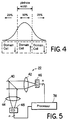
- Fig. 4 is a graphical representation of an example of the intensity of a re-imaged light spot versus displacement, according to the embodiment of the invention shown in Fig. 3.
- Fig. 5 is a schematic representation of another embodiment of a light detection apparatus according to the invention.
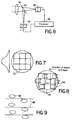
- Fig. 6 is a schematic representation of yet another embodiment of a light detection apparatus according to the invention.
- Fig. 7 is a graphical representation of the intensity and spatial distribution of a re-imaged light spot according to the embodiments of the invention shown in Figs. 5 and 6.
- Fig. 8 is a graphical representation of the spatial distribution of a re-imaged light spot according to the embodiments of the invention shown in Figs. 5 and 6, showing the locations at which domains are re-imaged.
- Fig. 9 is a schematic representation of servo pads that are encoded on a magneto-optical disk in order to enable tracking in the embodiments of the invention shown in Figs. 5 and 6.
- Fig. 10 is a flowchart diagram of the tracking procedure for the embodiments of the invention shown in Figs. 5 and 6.
- Fig. 11 is a schematic representation of a signal enhancement apparatus for use in conjunction with the embodiments of the invention shown in Figs. 5 and 6.
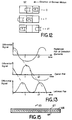
- Fig. 12 is a graphical representation of a re-imaged light spot according to the embodiments of the invention shown in Figs. 5 and 6, showing the relative positions of detector elements and images of domains at selected points in time.
- Fig. 13 is a graphical representation of differential signals corresponding to pairs of detector elements in the embodiments of the invention shown in Figs. 5 and 6.
- Fig. 14 is a schematic representation of a signal enhancement apparatus that reads multiple tracks of information simultaneously, for use in conjunction with the embodiments of the invention shown in Figs. 5 and 6.
- Fig. 15 is a schematic representation of a magneto-optical disk for use with a disk drive according to the invention.
- a light spot having a Gaussian distribution represented by curve 60 is formed on a magnetic layer of magneto-optical disk.
- the portion of the light spot that has an intensity greater than I threshold heats the underlying magnetic layer above a threshold at which the magnetic field causes the local orientation of the magnetic layer to reverse direction.
- a domain forms on the disk, having dimensions that match with the portion of the light spot having an intensity greater than I threshold .
- a laser 12 in a static optics package 14 produces a polarized light beam that passes through a polarized beam splitter 16.
- An objective lens 18 focuses the polarized light beam onto magneto-optical disk 20.
- the light beam reflects back through objective lens 18, which collimates the reflected light beam.
- the light beam returns to static optics package 14, within which polarized beam splitter 16 deflects the reflected light beam to light detection apparatus 22.
- light detection apparatus 22 includes a re-imaging lens 24 that re-images the reflected light beam onto a plate 26 having a pinhole aperture 28.
- Re-imaging lens 24 preferably has a focal length that is greater than the focal length of objective lens 18. Consequently, according to principles of microscope enlarging, the re-imaged light spot on plate 26 has a greater variance in its Gaussian distribution than the light spot on the magneto-optical disk. In other words, the light spot on plate 26 is a magnified image of the light spot that is formed on magneto-optical disk 20.
- a portion of the light beam corresponding to the central portion of the light spot on plate 26 passes through aperture 28.
- Collimating lens 30 collimates the portion of the light beam that passes through aperture 28.
- a polarized beam splitter 32 splits the collimated light beam into two parts each having an intensity proportional to a respective component of polarization of the reflected light beam.
- polarized beam splitter 32 might transmit the vertical component of polarization of the light and reflect the horizontal component of polarization of the light, in which case detectors 34 and 36 detect the intensity of the vertically polarized and horizontally polarized parts, respectively, of the light beam.
- Processor 38 subtracts the output of one of the detectors from the output of the other to obtain a differential signal representative of the angle of polarization of the reflected light beam.
- the differential signal indicates whether the location on magneto-optical disk 20 that is illuminated by the central portion of the light spot contains a "1" or a "0.”
- the light spot on plate 26 is a magnified image of the light spot on magneto-optical disk 20, which covers more than one domain.
- Fig. 4 shows a numerical example of the spatial distribution of the intensity of light incident on a spot that covers three domain cells on disk 20. Approximately twenty-five percent of the total light intensity of the light spot on disk 20 illuminates the leftmost domain cell, approximately twenty-five percent of the total light intensity illuminates the rightmost domain cell, and fifty percent of the total light intensity illuminates the central domain cell.
- the signal-to-noise ratio would be 0 dB, because the polarization of light reflected from the leftmost and rightmost domain cells would in effect cancel the polarization of light reflected from the central domain cell.
- the detection method of the invention only the central portion of the image of the light spot covers aperture 28.
- the portion of the light beam that corresponds to the portion of the light spot that illuminates the central domain cell on the disk reaches detectors 34 and 36.
- the dimensions of aperture 28 should match exactly the dimensions of a portion of the light spot that illuminates a domain of information on disk 20, so that the signal-to-noise ratio is maximized.
- the leftmost and rightmost domains do not interfere with the central portion of the re-imaged light beam that reaches detectors 34 and 36, and hence aperture 28 reduces cross-talk between the domains.
- the apparatus of Fig. 3 can resolve domains having dimensions smaller than the "read" light spot, at a cost of a slight reduction in the intensity of light reaching the detectors and hence a slight reduction in the signal-to-noise ratio.
- the signal-to-noise ratio is only 3 dB less than the signal-to-noise ratio associated with an ideal, infinitely large domain.
- light detection apparatus 22 includes a polarized beam splitter 40 that splits the reflected light beam into two parts each having an intensity proportional to a respective component of polarization of the reflected light beam.
- Re-imaging lenses 42 and 44 respectively re-image the two parts to the reflected light beam onto two combination detectors 46 and 48.
- Re-imaging lenses 42 and 44 each preferably have a focal length that is greater than the focal length of objective lens 18. Consequently, the re-imaged light spots on combination detectors 46 and 48 are magnified images of the light spot that is formed on magneto-optical disk 20.
- Combination detectors 46 and 48 each contain an array of light-sensitive detection elements that are illuminated by the re-imaged light spots.
- Processor 38 subtracts the outputs of light-sensitive detection elements in one array from the outputs of corresponding light-sensitive detection elements in the other array to obtain a set of differential signals representative of the angle of polarization of various portions of the reflected light beam.
- a single re-imaging lens 50 re-images the reflected light beam onto combination detectors 46 and 48 via polarized beam splitter 40, which splits the light beam into the two parts that are detected by combination detectors 46 and 48.
- the magnified re-imaged light spot on a combination detector 46 or 48 illuminates the array of light-sensitive detection elements 52 that are contained within the combination detector.
- the light spot has a Gaussian distribution of intensity on the combination detector as shown.
- Each light-sensitive detection element 52 in the array has a counterpart in the other array that is illuminated by the same portion of the re-imaged light spot.
- the magnified re-imaged light spot on a combination detector 46 or 48 can contain images 54 of several domains that are located on magneto-optical disk 20.
- domains of information are written onto magneto-optical disk 20 using a light beam that forms a light spot on the magneto-optical disk having approximately the same dimensions as the light spot that is used during the reading process.
- the cross-track size of the domains may be controlled by controlling the intensity of the light beam.
- the linear size of the domains along a track may be controlled by controlling the duration of pulses of a magnetic coil that causes dipoles in the magneto-optical disk to flip as the disk turns under the light beam.
- processor 38 subtracts the output of one of the detectors 34 or 36 from the output of the other detector to obtain a differential signal representative of the angle of polarization of the reflected light beam.
- the differential signal indicates whether the location on magneto-optical disk 20 that is illuminated by the central portion of the light spot contains a "1" or a "0.”
- tracking may be accomplished by means of a conventional sample servo tracking method or a pre-grooved disk tracking method.
- Figs. 9 and 10 illustrate an example of a sample servo tracking method that is used in conjunction with the embodiments of the invention shown in Figs. 5 and 6.
- Each track has a pair of servo pads 56 that are encoded in proximity to the center line 58 of the track, at the head of each sector of data on the magneto optical disk.
- one servo pad is encoded slightly above the center line and the other servo pad is encoded slightly below the center line of the track and displaced longitudinally along the track from the first servo pad.
- the servo pads may be domains similar to the domains of information encoded along the center line of the track, or may be structures, such as pits, that utilize destructive interference to change the amplitude of the reflected light beam.
- the light-sensitive detection elements in the central row detect light reflected from the servo pad.
- the processor produces a signal having an intensity proportional to the amount of light reflected from the servo pad that hits the detection elements in the central row.
- the processor produces another signal having an intensity proportional to the amount of light reflected from the servo pad that hits the detection elements in the central row.
- the processor adjusts the fine tracking by an amount proportional to the difference between the two signals, in order to align the central row of elements with the center line of the central track.
- the light-sensitive detection elements are constructed in a manner such that when the central track is properly aligned with the central row of elements, the tracks other than the central track will line up with the other rows of elements. Thus, alignment of the central row of elements with the central track is sufficient to align all of the rows of elements.
- Figs. 11, 12, and 13 illustrate the reading process of the embodiments of the invention shown in Figs. 5 and 6, in a mode of operation in which only one track of information is read at a time.
- processor 38 includes a set of comparator circuits 70 that subtract the outputs of light-sensitive detection elements 52 in the central row of one combination detector 46 from the outputs of corresponding light-sensitive detection elements 52 in the central row of the other combination detector 48. All but one of the resulting differential signals pass through a set of delay circuits 72.
- Delay circuits 72 delay each differential signal by an amount of time equal to NT, where T is the amount of time that it takes for the image of a domain to pass from one detector element 52 to an adjacent detector element, and N is the number of positions away from the leftmost detector element in Fig. 11 of a detector element that is associated with the differential signal.
- a summer 74 sums the outputs of delay circuits 72 with the undelayed output of the leftmost detector element in Fig. 11.
- FIG. 14 illustrates a signal enhancement arrangement that reads multiple tracks of information simultaneously, for use in conjunction with the embodiments of the invention shown in Figs. 5 and 6.
- Processor 38 includes comparator circuits 70 that subtract the outputs of light-sensitive detection elements 52 in each row of one combination detector 46 from the outputs of corresponding light-sensitive detection elements 52 in each row of the other combination detector 48. The resulting differential signals pass through a set of delay circuits 72.
- a set of summers 74 sum the outputs of the delay circuits 72 for each of the rows of detection elements.
- the resolution of the image of the domains depends on the wavelength of the light inside of the storage media. Since the wavelength of light for a given light source is less in material having a high index of refraction than in a material having a low index of refraction, it is desirable to use a material having a high index of refraction. As shown in Fig. 15, the minimum dimensions of the domains can be decreased by coating the thin magnetic layer 64 within magneto-optical disk 20 with a dielectric material 66 having a high index of refraction, such as a diamond-like treated-carbon coating, or a silicon nitride coating. An overcoat 67 of material such as transparent plastic protects both magnetic layer 64 and coating 66.
- the wavelength of the "read" light beam within coating 66 which is the wavelength of the incident light on magnetic layer 64, is less than the wavelength of the light in air.
- coating 66 enables resolution of domains having dimensions smaller than the wavelength of the light in air, but not smaller than the wavelength of the light as it passes through coating 66.
- the effect of using coating 66 is similar to the effect of using a shorter-wavelength laser.
Landscapes
- Physics & Mathematics (AREA)
- Optics & Photonics (AREA)
- Optical Recording Or Reproduction (AREA)
- Optical Head (AREA)
Applications Claiming Priority (2)
| Application Number | Priority Date | Filing Date | Title |
|---|---|---|---|
| US07/545,873 US5247510A (en) | 1990-06-29 | 1990-06-29 | Increasing storage density of optical data media by detecting a selected portion of a light spot image corresponding to a single domain |
| US545873 | 1990-06-29 |
Publications (3)
| Publication Number | Publication Date |
|---|---|
| EP0463728A2 true EP0463728A2 (de) | 1992-01-02 |
| EP0463728A3 EP0463728A3 (en) | 1993-01-13 |
| EP0463728B1 EP0463728B1 (de) | 1997-04-09 |
Family
ID=24177887
Family Applications (1)
| Application Number | Title | Priority Date | Filing Date |
|---|---|---|---|
| EP91304415A Expired - Lifetime EP0463728B1 (de) | 1990-06-29 | 1991-05-16 | Erhöhung der Speicherdichte von Informationsspeichermedien |
Country Status (5)
| Country | Link |
|---|---|
| US (1) | US5247510A (de) |
| EP (1) | EP0463728B1 (de) |
| JP (1) | JPH0896434A (de) |
| CA (1) | CA2043969A1 (de) |
| DE (1) | DE69125533T2 (de) |
Cited By (2)
| Publication number | Priority date | Publication date | Assignee | Title |
|---|---|---|---|---|
| EP0574886A3 (de) * | 1992-06-15 | 1994-01-26 | Sony Corp | |
| EP0658884A1 (de) * | 1993-12-09 | 1995-06-21 | Canon Kabushiki Kaisha | Optisches Aufzeichnungswiedergabegerät |
Families Citing this family (27)
| Publication number | Priority date | Publication date | Assignee | Title |
|---|---|---|---|---|
| JP3066118B2 (ja) * | 1991-07-19 | 2000-07-17 | パイオニア株式会社 | 光検出装置 |
| IL101570A0 (en) * | 1992-04-10 | 1992-12-30 | Amir Alon | Method and apparatus for reading data |
| US5363363A (en) * | 1992-10-16 | 1994-11-08 | Eastman Kodak Company | Apparatus and method for laser noise cancellation in an optical storage system using a front facet monitor signal |
| IL106009A0 (en) * | 1993-06-14 | 1993-10-20 | Amir Alon | Method and apparatus for the simultaneous writing of data on an optical disk |
| JP2664327B2 (ja) * | 1993-06-21 | 1997-10-15 | 富士通株式会社 | 光学的ヘッド及び光学的記録再生方法 |
| IL107181A0 (en) * | 1993-10-04 | 1994-01-25 | Nogatech Ltd | Optical disk reader |
| JPH07141687A (ja) * | 1993-11-17 | 1995-06-02 | Pioneer Video Corp | 光学装置 |
| US5612942A (en) * | 1993-11-19 | 1997-03-18 | Nec Corporation | Optical head |
| JPH07169129A (ja) * | 1993-12-13 | 1995-07-04 | Canon Inc | 光ヘッド |
| JPH07234382A (ja) * | 1994-02-24 | 1995-09-05 | Matsushita Electric Ind Co Ltd | 超解像走査光学装置 |
| US5619371A (en) * | 1995-03-02 | 1997-04-08 | Southern Research Institute | Confocal optical microscopy system for multi-layer data storage and retrieval |
| US5754512A (en) * | 1995-05-30 | 1998-05-19 | Matsushita Electric Industrial Co., Ltd. | Correction elements to lower light intensity around an optical axis of an optical head with a plurality of focal points |
| US5708648A (en) * | 1995-05-31 | 1998-01-13 | Nec Corporation | Optical head apparatus including light focusing and refocusing lens systems |
| US5828482A (en) * | 1997-02-05 | 1998-10-27 | Terastor Corporation | Apparatus and method for directing a beam of light to a surface of an optical disk |
| US5936928A (en) * | 1996-10-01 | 1999-08-10 | Terastor Corporation | Multilayer media and use with flying head having solid immersion lens |
| US6270696B1 (en) | 1996-06-03 | 2001-08-07 | Terastor Corporation | Method of fabricating and integrating an optical assembly into a flying head |
| ID16848A (id) * | 1996-05-01 | 1997-11-13 | Terastor Corp | Kepala layang dengan lensa padat yang terbenam |
| US6243350B1 (en) * | 1996-05-01 | 2001-06-05 | Terastor Corporation | Optical storage systems with flying optical heads for near-field recording and reading |
| US5793584A (en) * | 1996-12-13 | 1998-08-11 | Terastor Corporation | Device and method for electrostatically cleaning a disk mounted in a removable cartridge |
| US5910940A (en) | 1996-10-08 | 1999-06-08 | Polaroid Corporation | Storage medium having a layer of micro-optical lenses each lens generating an evanescent field |
| US5963532A (en) * | 1998-01-21 | 1999-10-05 | Terastor Corporation | Polarization rotation and phase compensation in near-field electro-optical system |
| US6009064A (en) * | 1997-11-05 | 1999-12-28 | Terastor Corporation | Optical head having dielectric transition layer in near-field optical storage system |
| US6104675A (en) * | 1998-02-20 | 2000-08-15 | Maxoptix Corporation | Method and apparatus for reading and writing magneto-optical media |
| US6330209B1 (en) | 1998-02-20 | 2001-12-11 | Maxoptix Corporation | Load and unload control for magneto-optical disk drive |
| US6172944B1 (en) | 1998-02-20 | 2001-01-09 | Maxoptix Corporation | Magneto-optical recording apparatus with magnetic head decoupled from objective lens focus actuator |
| US6172945B1 (en) | 1998-09-04 | 2001-01-09 | Maxoptix Corporation | Double-sided magneto-optical recording disk |
| US6324130B1 (en) | 1999-01-21 | 2001-11-27 | Maxoptix Corporation | Disc drive suspension and head |
Family Cites Families (17)
| Publication number | Priority date | Publication date | Assignee | Title |
|---|---|---|---|---|
| NL7212044A (de) * | 1972-09-05 | 1974-03-07 | ||
| US3812477A (en) * | 1973-04-09 | 1974-05-21 | Ibm | Method for superresolution in an optical memory |
| US3919562A (en) * | 1974-05-20 | 1975-11-11 | Zenith Radio Corp | Slit detector for optical detector system |
| US4536866A (en) * | 1978-11-30 | 1985-08-20 | Videonics Of Hawaii, Inc. | Information retrieval system and apparatus |
| US4349901A (en) * | 1980-06-20 | 1982-09-14 | Eastman Kodak Company | Apparatus and method for reading optical discs |
| US4375096A (en) * | 1981-03-10 | 1983-02-22 | Rca Corporation | Multi-bandwidth optical playback apparatus with elongated read spot |
| NL8104946A (nl) * | 1981-11-02 | 1983-06-01 | Philips Nv | Inrichting voor het uitlezen en/of inschrijven van een optisch uitleesbare informatiestructuur op een registratiedrager. |
| FR2526987B1 (fr) * | 1982-05-14 | 1987-07-03 | Bull Sa | Procede opto-electronique de lecture d'informations contenues sur un support magnetique et circuit pour le mettre en oeuvre |
| JPS58203646A (ja) * | 1982-05-21 | 1983-11-28 | Canon Inc | 光磁気再生装置 |
| JPS6124033A (ja) * | 1984-07-13 | 1986-02-01 | Sony Corp | 光学式ヘツドのトラツキング誤差検出装置 |
| JPH0792916B2 (ja) * | 1985-02-08 | 1995-10-09 | 松下電器産業株式会社 | 光学記録信号再生方法 |
| NL8801327A (nl) * | 1988-05-24 | 1989-12-18 | Philips Nv | Methode voor het optisch aftasten van een informatievlak en optische registratiedragers en aftastinrichtingen geschikt voor toepassing van de methode. |
| DE68924303T2 (de) * | 1988-06-14 | 1996-02-29 | Nippon Electric Co | Optische Kopfanordnung. |
| JP2657413B2 (ja) * | 1989-03-03 | 1997-09-24 | パイオニア株式会社 | 光ヘッド |
| US5153870A (en) * | 1989-06-29 | 1992-10-06 | Digital Equipment Corporation | Rotary head actuator for optical disk |
| US5161134A (en) * | 1989-06-29 | 1992-11-03 | Digital Equipment Corporation | Method for increasing linear bit density in magneto-optical storage media |
| US5081617A (en) * | 1990-09-24 | 1992-01-14 | Creo Products Inc. | Optical system for simultaneous reading of multiple data tracks |
-
1990
- 1990-06-29 US US07/545,873 patent/US5247510A/en not_active Expired - Lifetime
-
1991
- 1991-05-16 DE DE69125533T patent/DE69125533T2/de not_active Expired - Fee Related
- 1991-05-16 EP EP91304415A patent/EP0463728B1/de not_active Expired - Lifetime
- 1991-06-05 CA CA002043969A patent/CA2043969A1/en not_active Abandoned
- 1991-06-28 JP JP3159096A patent/JPH0896434A/ja active Pending
Cited By (9)
| Publication number | Priority date | Publication date | Assignee | Title |
|---|---|---|---|---|
| EP0574886A3 (de) * | 1992-06-15 | 1994-01-26 | Sony Corp | |
| US5416766A (en) * | 1992-06-15 | 1995-05-16 | Sony Corporation | Optical recording medium and playback method thereof |
| US5553046A (en) * | 1992-06-15 | 1996-09-03 | Sony Corporation | Optical recording medium and playback method utilizing pits on track center and wobble pits |
| US5557600A (en) * | 1992-06-15 | 1996-09-17 | Sony Corporation | Optical recording medium with trays located so that multiple tracks can be scanned simultaneously |
| EP0658884A1 (de) * | 1993-12-09 | 1995-06-21 | Canon Kabushiki Kaisha | Optisches Aufzeichnungswiedergabegerät |
| US6141302A (en) * | 1993-12-09 | 2000-10-31 | Canon Kabushiki Kaisha | Optical recording/reproducing apparatus including a mask device for masking marginal rays, in a direction perpendicular to a recording medium track, of a light beam returned from the recording medium |
| US6282165B1 (en) | 1993-12-09 | 2001-08-28 | Canon Kabushiki Kaisha | Optical recording/reproducing apparatus including a mask device for masking marginal rays, in a direction perpendicular to a recording medium track, of a light beam returned from the recording medium |
| EP1174867A1 (de) * | 1993-12-09 | 2002-01-23 | Canon Kabushiki Kaisha | Optisches Aufzeichnungs-/Wiedergabegerät |
| US6418109B2 (en) | 1993-12-09 | 2002-07-09 | Canon Kabushiki Kaisha | Optical recording/reproducing apparatus including a mask device for masking marginal rays, in a direction perpendicular to a recording medium track, of a light beam returned from the recording medium |
Also Published As
| Publication number | Publication date |
|---|---|
| US5247510A (en) | 1993-09-21 |
| DE69125533T2 (de) | 1997-10-23 |
| CA2043969A1 (en) | 1991-12-30 |
| DE69125533D1 (de) | 1997-05-15 |
| EP0463728B1 (de) | 1997-04-09 |
| EP0463728A3 (en) | 1993-01-13 |
| JPH0896434A (ja) | 1996-04-12 |
Similar Documents
| Publication | Publication Date | Title |
|---|---|---|
| US5247510A (en) | Increasing storage density of optical data media by detecting a selected portion of a light spot image corresponding to a single domain | |
| EP0414380B1 (de) | Gerät zur optischen Aufnahme und Wiedergabe und Adaptor zum Gebrauch mit diesem Gerät | |
| EP0745980B1 (de) | Optische Abtasteinrichtung | |
| US5056080A (en) | Optical recording/reproducing system using interference techniques | |
| US4521680A (en) | System for focusing a light beam on a light reflecting surface | |
| US4797868A (en) | Optical system employing a laser beam for focusing, tracking and transferring information signals with respect to a magneto-optical memory | |
| KR890002318B1 (ko) | 광학 디스크의 결함을 광학적으로 검출하는 장치 및 방법 | |
| US4847823A (en) | Method and apparatus for reading or measuring magneto-optical storage media using pinhole aperture | |
| US4534021A (en) | Angularly multiplexed optical recording medium | |
| JPH0714231A (ja) | 光磁気ディスク、光ピックアップ及び光磁気ディスク装置 | |
| US5070490A (en) | Optical recording medium with tracking tracks extending beyond the recording layer and a method for detecting tracking signal from said medium | |
| US7391700B2 (en) | Optical storage in discs having multiple data layers | |
| US6400670B1 (en) | Device for the writing and/or reading of optical recording media of various structures | |
| EP0440963B1 (de) | Verbesserter Focusfühler für optische Informationspeicherungssysteme | |
| US5953304A (en) | Optical disc recording or playback device with corrected focus optical scanning | |
| JPH04252425A (ja) | 情報記録装置 | |
| EP1005031A2 (de) | Mehrstrahlabtastgerät zur geeigneten Kontrolle des Abstands zwischen der Objektivlinse und dem optischen Informationsaufzeichnungsmedium | |
| KR100781186B1 (ko) | 자기 주사 시스템 | |
| US5490129A (en) | Optical head and optical information reading apparatus | |
| JPH04363649A (ja) | 光情報記録媒体の欠陥検査方法 | |
| JPH05151593A (ja) | 光ピツクアツプ | |
| JPH0711874B2 (ja) | 光磁気信号検出装置 | |
| JPH0863765A (ja) | 光学的情報記録再生方法 | |
| JPH0235637A (ja) | 光情報記録媒体 | |
| JPH08203095A (ja) | 光学的情報記録再生装置 |
Legal Events
| Date | Code | Title | Description |
|---|---|---|---|
| PUAI | Public reference made under article 153(3) epc to a published international application that has entered the european phase |
Free format text: ORIGINAL CODE: 0009012 |
|
| 17P | Request for examination filed |
Effective date: 19910531 |
|
| AK | Designated contracting states |
Kind code of ref document: A2 Designated state(s): DE FR GB NL |
|
| PUAL | Search report despatched |
Free format text: ORIGINAL CODE: 0009013 |
|
| AK | Designated contracting states |
Kind code of ref document: A3 Designated state(s): DE FR GB NL |
|
| RAP1 | Party data changed (applicant data changed or rights of an application transferred) |
Owner name: QUANTUM CORPORATION |
|
| 17Q | First examination report despatched |
Effective date: 19950404 |
|
| GRAG | Despatch of communication of intention to grant |
Free format text: ORIGINAL CODE: EPIDOS AGRA |
|
| GRAH | Despatch of communication of intention to grant a patent |
Free format text: ORIGINAL CODE: EPIDOS IGRA |
|
| GRAH | Despatch of communication of intention to grant a patent |
Free format text: ORIGINAL CODE: EPIDOS IGRA |
|
| GRAA | (expected) grant |
Free format text: ORIGINAL CODE: 0009210 |
|
| AK | Designated contracting states |
Kind code of ref document: B1 Designated state(s): DE FR GB NL |
|
| REF | Corresponds to: |
Ref document number: 69125533 Country of ref document: DE Date of ref document: 19970515 |
|
| ET | Fr: translation filed | ||
| PLBE | No opposition filed within time limit |
Free format text: ORIGINAL CODE: 0009261 |
|
| STAA | Information on the status of an ep patent application or granted ep patent |
Free format text: STATUS: NO OPPOSITION FILED WITHIN TIME LIMIT |
|
| 26N | No opposition filed | ||
| PGFP | Annual fee paid to national office [announced via postgrant information from national office to epo] |
Ref country code: FR Payment date: 19990430 Year of fee payment: 9 |
|
| PGFP | Annual fee paid to national office [announced via postgrant information from national office to epo] |
Ref country code: NL Payment date: 19990510 Year of fee payment: 9 |
|
| PG25 | Lapsed in a contracting state [announced via postgrant information from national office to epo] |
Ref country code: NL Free format text: LAPSE BECAUSE OF NON-PAYMENT OF DUE FEES Effective date: 20001201 |
|
| PG25 | Lapsed in a contracting state [announced via postgrant information from national office to epo] |
Ref country code: FR Free format text: LAPSE BECAUSE OF NON-PAYMENT OF DUE FEES Effective date: 20010131 |
|
| NLV4 | Nl: lapsed or anulled due to non-payment of the annual fee |
Effective date: 20001201 |
|
| REG | Reference to a national code |
Ref country code: FR Ref legal event code: ST |
|
| PGFP | Annual fee paid to national office [announced via postgrant information from national office to epo] |
Ref country code: GB Payment date: 20010504 Year of fee payment: 11 |
|
| PGFP | Annual fee paid to national office [announced via postgrant information from national office to epo] |
Ref country code: DE Payment date: 20010508 Year of fee payment: 11 |
|
| REG | Reference to a national code |
Ref country code: GB Ref legal event code: IF02 |
|
| PG25 | Lapsed in a contracting state [announced via postgrant information from national office to epo] |
Ref country code: GB Free format text: LAPSE BECAUSE OF NON-PAYMENT OF DUE FEES Effective date: 20020516 |
|
| PG25 | Lapsed in a contracting state [announced via postgrant information from national office to epo] |
Ref country code: DE Free format text: LAPSE BECAUSE OF NON-PAYMENT OF DUE FEES Effective date: 20021203 |
|
| GBPC | Gb: european patent ceased through non-payment of renewal fee |
Effective date: 20020516 |