EP0464276A1 - Système de modelisation par ordinateur - Google Patents
Système de modelisation par ordinateur Download PDFInfo
- Publication number
- EP0464276A1 EP0464276A1 EP90307226A EP90307226A EP0464276A1 EP 0464276 A1 EP0464276 A1 EP 0464276A1 EP 90307226 A EP90307226 A EP 90307226A EP 90307226 A EP90307226 A EP 90307226A EP 0464276 A1 EP0464276 A1 EP 0464276A1
- Authority
- EP
- European Patent Office
- Prior art keywords
- object surface
- function
- points
- computer modelling
- values
- Prior art date
- Legal status (The legal status is an assumption and is not a legal conclusion. Google has not performed a legal analysis and makes no representation as to the accuracy of the status listed.)
- Withdrawn
Links
Images

Classifications
-
- G—PHYSICS
- G06—COMPUTING OR CALCULATING; COUNTING
- G06T—IMAGE DATA PROCESSING OR GENERATION, IN GENERAL
- G06T17/00—Three-dimensional [3D] modelling for computer graphics
Definitions
- the invention relates to a computer modelling system for making a gnomonic projection of a function defined at a surface.
- the invention finds particular, though not exclusive, application in the comparison of properties, such as the electrostatic field, at the surfaces of molecules.
- gnomonic projection It involves the projection of a scalar surface property onto a spherical surface.
- the sphere nay be of arbitrary radius.
- the centre of the sphere defines a point of interest.
- a ray from the centre of the sphere meets the surface of the solid body at a pierce point; the value of the surface property at this point is then projected onto the sphere. If a gnomonic projection is performed for two different objects then the projections may be compared directly.
- a computer modelling system comprising means for representing a first object surface and means for gnomonic projection of a function defined at the first object surface, the gnomonic projection being performed at a plurality of pierce points on the object surface centred on a predetermined point of interest, the gnomonic projection means comprising: logic for determining values of the function at a plurality of points on the object surface; storage means for storing an array of determined values, indexed by angular coordinates of the points on the object surface in a first polar coordinate system having the origin at the point of interest; logic for determining the angular coordinates of the pierce points in a second polar coordinate system having the origin at the point of interest; logic for extracting values from the array corresponding to the angular coordinates of the pierce points to determine the function at the pierce points.
- a two dimensional map of the values of the field at the chosen surface is created, similar to the two dimensional representation of height on a map of the world.
- This map is used as a look-up table when the gnomonic projection is carried out for an arbitrary orientation of the object with respect to a reference coordinate system.
- the present invention provides an improvement to the prior art technique.
- the cartesian coordinates of the pierce points on the molecular surface do not have to be calculated explicitly to perform the gnomonic projection.
- the recomputation of the difference between surface property projections for two objects as their relative orientation is altered is thereby simplified and the process speeded up sufficiently to enable its use in an interactive system.
- the invention takes advantage of the fact that although the difference in the projections change as their relative orientation is altered, the individual projections remain unchanged.
- the surface is fixed with respect to the second polar coordinate system and the computer modelling system comprises means for specifying the orientation of the second polar coordinate system with respect to the first polar coordinate system.
- the means for specifying the orientation of the second polar coordinate system can be a user input means, such as a set of dials.
- the computer modelling system can further comprise means for representing a second object surface, means for gnomonic projection of a second object surface and means for comparing the gnomonic projection of the first object surface with the gnomonic projection of the second object surface.
- the comparing means can comprise logic for subtracting the function values at the pierce points for two surfaces to determine a difference function for the two surfaces and logic for combining the values of the difference function at the pierce points to determine an index of similarity for the two surfaces.
- a computer modelling system comprising means for representing a first object surface, a method for gnomonic projection of a function defined at the first object surface, the gnomonic projection being performed at a plurality of pierce points on the object surface centred on a predetermined point of interest, the method comprising the steps of: determining values of the function at a plurality of points on the object surface; storing an array of determined values, indexed by angular coordinates of the points on the object surface in a first polar coordinate system having the origin at the point of interest; determining the angular coordinates of the pierce points in a second polar coordinate system having the origin at the point of interest; extracting values from the array corresponding to the angular coordinates of the pierce points to determine the function at the pierce points.
- the computer modelling system is a graphics workstation and is shown in block diagram form in Fig. 1. It comprises a central processing unit 2, a disk storage device 4, user input devices such as a keyboard 6, set of dials 7 and a mouse 8 connected via a user interface adapter 9, random access memory 10, a read only store 12 and a display device 14 connected via a display adapter 16 to allow the data to be displayed. Data is transferred between the components of the data processor via a system bus 18.
- the computer modelling system is for the display and comparison of molecules and properties defined on the surfaces of molecules, thus data regarding molecular structures and properties are stored in either the random access memory 10 or the disk storage device 4 and manipulated in the modelling system.
- a property defined at the surface of a molecule such as the electrostatic field, is gnomonically projected. If this is performed for the same property for more than one molecule then the molecules, which may be of different shapes, may be compared. The difference between the property for the two molecules over the surface of the sphere may be displayed and the sum of the absolute differences over the surface of the sphere may be calculated and used to give an index of similarity between the molecules for that property.
- the property is stored as a function F(x,y,z) for each molecule, where x, y, and z are cartesian coordinates for the three spatial directions, at a finite set of points ⁇ (x i ,y i ,z i ) ⁇ distributed on a grid.
- a point of interest is defined within the molecule for the gnomonic projection. This is chosen by a user using the keyboard 6.
- the function F is first projected onto the sphere for a set of points on the surface with a regular grid of values of 0 and ⁇ , where 0 and & are the spherical polar coordinates of the point on the sphere in a spherical polar coordinate system centred on the point of interest.
- the set of points have 0 and & coordinates with constant increments although any regular distribution of points could be used.
- This projection of the function at the surface is thus represented as a set of values ⁇ F( ⁇ i , ⁇ j ) ⁇ where ⁇ i ⁇ and ⁇ j ⁇ represent the set of discrete values of 0 and ⁇ .
- the values, ⁇ F( ⁇ i , ⁇ j ) ⁇ are stored in a 2-D array as a map of the surface.
- the map of the molecular surface is used as a look-up table each time the gnomonic projection is calculated.
- the gnomonic projection is performed for a set of points which sample appropriately the surface of the sphere. It is impossible to generate an arbitrary number of precisely equally spaced points on a sphere.
- the sample points are distributed as a tessellation of triangles on each face of an icosahedral surface. The distance of each vertex from the centre of the icosahedron is normalised to be equal to the desired radius of the sphere. It should be noted that this is only one of many ways that a spherical surface may be approximated by a polyhedron.
- the advantage of the present invention is that the cartesian coordinates of the pierce points on the molecular surface do not have to be calculated explicitly to perform the gnomonic projection.
- the gnomonic projection is performed by calculating the values of 0 and & for each q. These are calculated using the following equations: where R is the radius of the sphere. The value of & can be calculated from sin ⁇ and cos$.
- the value of the function at the surface for particular values of 0 and ⁇ is then looked up in the 2-D array.
- the function value at an arbitrary point on the surface defined by (0, ⁇ ) is found by linear interpolation between the four values of the field at the nearest stored ⁇ i and ⁇ j map positions.
- the result of this process is a list of function values at the surface corresponding to the pierce points.
- Fig 2 is a flow chart showing the logical steps involved in performing the gnomonic projection.
- a map is created 32 of the surface of the molecule and stored 34 in an array.
- the map contains values of the function for regularly spaced values of 0 and ⁇ .
- the values of 0 and ⁇ are calculated 36 and the corresponding function values looked up, 38, in the map array. If these steps are carried out for two molecules then an index of similarity may be calculated, 40, from the function values.
- the projected values may then be displayed, 42, on a display device. This may be carried out in a number of ways but in this particular embodiment the projection is displayed on the display device as a coloured sphere with the different function values represented, as will be described below, by different colours.
- the orientation of the molecule may be altered, 44, interactively using the set of dials 7. As the orientation of the molecule changes the information displayed on the display device is updated in real time i.e., steps 36 to 42 are repeated. If two molecules are simultaneously displayed then this allows the user to compare the molecule in a completely interactive way. If an index of similarity is displayed then the real time updating of the display gives a visual cue for the exploration of local minima in the index of similarity.
- the map, stored in the 2-D array, is still used to perform the gnomonic projection.
- a particular q refers to a different point on the map.
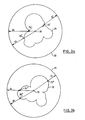
- FIG 3a and 3b show two orientations of a molecule 20 with respect to three of the q vectors 22, 24 and 26, which are fixed with respect to the reference coordinate system.
- the pierce points are represented by the circles 22' 24' and 26'.
- the new pierce points are represented by the circles 22", 24" and 26".
- the gnomonic projection is made from the point of interest 30 onto the sphere 28.
- the 0 and ⁇ coordinates of the new pierce points can be calculated as follows.
- the transformed angular coordinates, ( ⁇ ', ⁇ ') can be calculated as above.
- the value of the function at the pierce point corresponding to q' can be recalculated by looking up the function in the 2-D array at the four nearest stored ⁇ i and ⁇ j map positions to 6' and ⁇ ' and interpolating as before.
- the process of recalculating the difference between the properties of two molecules involves the following steps: the transformed cartesian vectors q' are calculated for the first molecule; the spherical coordinates 6' and ⁇ ' are calculated for each q'; The value of the surface field at each vector q is calculated for the first molecule by linear interpolation; these steps are repeated for the second molecule which may have been reoriented by a different amount or whose orientation may be unchanged; the difference between the surface field for the two molecules is then recalculated by direct subtraction of the values for each q'; the sum of the absolute or mean-squared differences between the values at each of the points can then be calculated to give the index of similarity between the two surface properties.
- the gnomonic projection of the function over the surface is presented in the display system of the present invention by using a coloured sphere, the different values of the function are represented by different colours on the surface of the sphere. This involves choosing an appropriate mapping from the scalar value in the data to the colour in the graphical representation.
- a value-colour mapping scheme is used which allows for the ability of the human eye to differentiate more finely between colours in the green-yellow range of the spectrum than it can between colours in the red-blue ranges of the spectrum.
- mapping the greater proportion of the scalar values into the green-yellow area of the spectrum an apparently linear scale of value versus colour is achieved.
- the mapping is adapted to emphasise the colour variation in sub-ranges of the scalar values which are of particular interest, and de-emphasise the colour variation in areas of less interest.
- the gnomonic projection involves the projection of a surface onto a spherical surface.
- a projection can be made in the same manner onto an ellipsoidal surface.
- the procedure is the same as for a spherical surface except that ellipsoidal polar coordinates are used instead of spherical polar coordinates.
- This is equivalent to performing length scale transformations in directions corresponding to the major axes of the ellipsoid.
- This extension of the invention is useful in situations where one length dimension of the molecule is much greater than the others, for example in the case of polymeric or chain molecules.
- a map of the surface may be stored in an (n-1)-dimensional array indexed by the angular coordinates of a polar coordinate system in n-dimensions.
- the invention is an improvement to the prior art technique, simplifying the recomputation of the difference between the two surface property projections as their relative orientation is altered thereby speeding up the process sufficiently to enable its use in an interactive system.
- a two dimensional map of the values of the field at the chosen surface is created, similar to the two dimensional representation of height on a map of the world.
- This map is then used as a look-up table in subsequent calculations of the gnomonic projections for arbitrary orientations of the pierce points with respect to a reference coordinate system.
- the invention finds particular application to the comparison of properties, such as the electrostatic field, at the surfaces of a molecule, but many other application are possible, for example the comparison of temperature distributions over the surfaces of a metal components.
Landscapes
- Physics & Mathematics (AREA)
- Engineering & Computer Science (AREA)
- Computer Graphics (AREA)
- Geometry (AREA)
- Software Systems (AREA)
- General Physics & Mathematics (AREA)
- Theoretical Computer Science (AREA)
- Processing Or Creating Images (AREA)
- Management, Administration, Business Operations System, And Electronic Commerce (AREA)
- Length Measuring Devices With Unspecified Measuring Means (AREA)
Priority Applications (2)
| Application Number | Priority Date | Filing Date | Title |
|---|---|---|---|
| EP90307226A EP0464276A1 (fr) | 1990-07-02 | 1990-07-02 | Système de modelisation par ordinateur |
| JP12969791A JP2501676B2 (ja) | 1990-07-02 | 1991-05-31 | コンピュ―タモデリングシステム |
Applications Claiming Priority (1)
| Application Number | Priority Date | Filing Date | Title |
|---|---|---|---|
| EP90307226A EP0464276A1 (fr) | 1990-07-02 | 1990-07-02 | Système de modelisation par ordinateur |
Publications (1)
| Publication Number | Publication Date |
|---|---|
| EP0464276A1 true EP0464276A1 (fr) | 1992-01-08 |
Family
ID=8205475
Family Applications (1)
| Application Number | Title | Priority Date | Filing Date |
|---|---|---|---|
| EP90307226A Withdrawn EP0464276A1 (fr) | 1990-07-02 | 1990-07-02 | Système de modelisation par ordinateur |
Country Status (2)
| Country | Link |
|---|---|
| EP (1) | EP0464276A1 (fr) |
| JP (1) | JP2501676B2 (fr) |
Cited By (4)
| Publication number | Priority date | Publication date | Assignee | Title |
|---|---|---|---|---|
| US6001823A (en) * | 1993-11-18 | 1999-12-14 | Hultgren; Scott | Treatment or prophylaxis of diseases caused by pilus-forming bacteria |
| US6420127B1 (en) | 1994-11-18 | 2002-07-16 | Washington University | Compounds and pharmaceutical compositions for the treatment and prophylaxis of bacterial infections |
| WO2004088565A1 (fr) * | 2003-04-04 | 2004-10-14 | Korea Institute Of Science And Technology | Equipement peripherique pour systeme d'ordinateur de modelisation moleculaire et procede de conception de celui-ci |
| US6872542B1 (en) | 1993-11-18 | 2005-03-29 | Siga Pharmaceuticals, Inc. | Treatment or prophylaxis of diseases caused by pilus-forming bacteria |
Citations (2)
| Publication number | Priority date | Publication date | Assignee | Title |
|---|---|---|---|---|
| FR2555754A1 (fr) * | 1983-11-28 | 1985-05-31 | Inter Inf | Procede et dispositif d'analyse automatique d'echantillons biologiques |
| FR2596182A1 (fr) * | 1986-03-21 | 1987-09-25 | Inst Geographique Nal | Maillage de la sphere et carte geographique associee |
-
1990
- 1990-07-02 EP EP90307226A patent/EP0464276A1/fr not_active Withdrawn
-
1991
- 1991-05-31 JP JP12969791A patent/JP2501676B2/ja not_active Expired - Lifetime
Patent Citations (2)
| Publication number | Priority date | Publication date | Assignee | Title |
|---|---|---|---|---|
| FR2555754A1 (fr) * | 1983-11-28 | 1985-05-31 | Inter Inf | Procede et dispositif d'analyse automatique d'echantillons biologiques |
| FR2596182A1 (fr) * | 1986-03-21 | 1987-09-25 | Inst Geographique Nal | Maillage de la sphere et carte geographique associee |
Non-Patent Citations (2)
| Title |
|---|
| JOURNAL OF MOLECULAR GRAPHICS, vol. 5, no. 2, June 1987, pages 97-100; P.L. CHAU et al.: "Molecular recognition: 3D surface structure comparison by gnomonic projection" * |
| PROCEEDINGS CVPR, IEEE COMPUTER SOCIETY CONFERENCE ON COMPUTER VISION AND PATTERN RECOGNITION, Washington, DC, 19th - 23rd June 1983, pages 89-94; L. O'GORMAN et al.: "Image segmentation and nucleus classification for automated tissue section analysis" * |
Cited By (8)
| Publication number | Priority date | Publication date | Assignee | Title |
|---|---|---|---|---|
| US6001823A (en) * | 1993-11-18 | 1999-12-14 | Hultgren; Scott | Treatment or prophylaxis of diseases caused by pilus-forming bacteria |
| US6153396A (en) * | 1993-11-18 | 2000-11-28 | Siga Pharmaceuticals, Inc. | Treatment or prophylaxis of diseases caused by pilus-forming bacteria |
| US6548265B2 (en) | 1993-11-18 | 2003-04-15 | Washington University | Treatment or prophylaxis of diseases caused by pilus-forming bacteria |
| US6872542B1 (en) | 1993-11-18 | 2005-03-29 | Siga Pharmaceuticals, Inc. | Treatment or prophylaxis of diseases caused by pilus-forming bacteria |
| US6962791B2 (en) | 1993-11-18 | 2005-11-08 | Washington University | Treatment or prophylaxis of diseases caused by pilus-forming bacteria |
| US7025971B2 (en) | 1993-11-18 | 2006-04-11 | Washington University | Treatment or prophylaxis of diseases caused by pilus-forming bacteria |
| US6420127B1 (en) | 1994-11-18 | 2002-07-16 | Washington University | Compounds and pharmaceutical compositions for the treatment and prophylaxis of bacterial infections |
| WO2004088565A1 (fr) * | 2003-04-04 | 2004-10-14 | Korea Institute Of Science And Technology | Equipement peripherique pour systeme d'ordinateur de modelisation moleculaire et procede de conception de celui-ci |
Also Published As
| Publication number | Publication date |
|---|---|
| JPH06259401A (ja) | 1994-09-16 |
| JP2501676B2 (ja) | 1996-05-29 |
Similar Documents
| Publication | Publication Date | Title |
|---|---|---|
| US6434278B1 (en) | Generating three-dimensional models of objects defined by two-dimensional image data | |
| US6300965B1 (en) | Visible-object determination for interactive visualization | |
| Bloomenthal | Polygonization of implicit surfaces | |
| US6437796B2 (en) | Multiple processor visibility search system and method | |
| EP0311081B1 (fr) | Appareil et procédé d'affichage pour graphiques d'ordinateur en trois dimensions | |
| US6373483B1 (en) | Method, system and computer program product for visually approximating scattered data using color to represent values of a categorical variable | |
| US5379371A (en) | Displaying method and apparatus for three-dimensional computer graphics | |
| US6373485B2 (en) | Mitigating the effects of object approximations | |
| US6266062B1 (en) | Longest-edge refinement and derefinement system and method for automatic mesh generation | |
| Carlbom et al. | A hierarchical data structure for representing the spatial decomposition of 3D objects | |
| Razdan et al. | Curvature estimation scheme for triangle meshes using biquadratic Bézier patches | |
| US5594844A (en) | Three dimensional view using ray tracing through voxels subdivided numerically using object based parameters | |
| US20020033835A1 (en) | Size conditioned visibility search system and method | |
| EP0422866A2 (fr) | Méthode et appareil de génération d'images | |
| US6876361B2 (en) | Architecture for real-time texture look up's for volume rendering | |
| Bidasaria | Defining and rendering of textured objects through the use of exponential functions | |
| CN116129082B (zh) | 一种面向无人货柜的TIN-NeRF新视角图像标注方法 | |
| JP2501676B2 (ja) | コンピュ―タモデリングシステム | |
| Nagy et al. | New algorithm to find isoptic surfaces of polyhedral meshes | |
| Wood | Visualization and modeling of 3-D structures (medical imaging) | |
| US20110074777A1 (en) | Method For Displaying Intersections And Expansions of Three Dimensional Volumes | |
| Andrews | Simplifying terrain models and measuring terrain model accuracy | |
| Noble et al. | On computing aspect graphs of smooth shapes from volumetric data | |
| Sabella et al. | Toward fast color-shaded images of CAD/CAM geometry | |
| EP1297495B1 (fr) | Determination des objets visibles |
Legal Events
| Date | Code | Title | Description |
|---|---|---|---|
| PUAI | Public reference made under article 153(3) epc to a published international application that has entered the european phase |
Free format text: ORIGINAL CODE: 0009012 |
|
| AK | Designated contracting states |
Kind code of ref document: A1 Designated state(s): DE FR GB |
|
| 17P | Request for examination filed |
Effective date: 19920521 |
|
| STAA | Information on the status of an ep patent application or granted ep patent |
Free format text: STATUS: THE APPLICATION IS DEEMED TO BE WITHDRAWN |
|
| 18D | Application deemed to be withdrawn |
Effective date: 19950201 |