EP0422866A2 - Méthode et appareil de génération d'images - Google Patents
Méthode et appareil de génération d'images Download PDFInfo
- Publication number
- EP0422866A2 EP0422866A2 EP90310997A EP90310997A EP0422866A2 EP 0422866 A2 EP0422866 A2 EP 0422866A2 EP 90310997 A EP90310997 A EP 90310997A EP 90310997 A EP90310997 A EP 90310997A EP 0422866 A2 EP0422866 A2 EP 0422866A2
- Authority
- EP
- European Patent Office
- Prior art keywords
- iso
- generating
- tetrahedral
- points
- position data
- Prior art date
- Legal status (The legal status is an assumption and is not a legal conclusion. Google has not performed a legal analysis and makes no representation as to the accuracy of the status listed.)
- Granted
Links
Images




Classifications
-
- G—PHYSICS
- G06—COMPUTING OR CALCULATING; COUNTING
- G06T—IMAGE DATA PROCESSING OR GENERATION, IN GENERAL
- G06T17/00—Three-dimensional [3D] modelling for computer graphics
- G06T17/20—Finite element generation, e.g. wire-frame surface description, tesselation
Definitions
- the invention relates to a method for generating image data of an iso-valued surface, which is a set of points with a specified scalar value, when a scalar value is given to each of the points distributed in a 3D space beforehand by methods such as the three-dimensional finite element method (3D FEM).
- 3D FEM three-dimensional finite element method
- volume Rendering has recently been studied in the field of medical image processing, and some applications to the visualization of numerical simulation results have been reported. Though volume rendering is applicable to the three-dimensional finite difference method (3D FDM), it cannot be applied directly to the 3D FEM, which has no regular connections among neighboring grids points (elements), because it assumes that a scalar field is defined on an orthogonal grid. Details are given below.
- the FEN divides an area to be analysed into polyhedrons called elements, approximates the potential distribution in each element to a simple function, and obtains a scalar value at each node point.
- this method defines node points P irregularly, depending upon the nature of the area to be analyzed, as shown in Fig. 10.
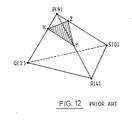
- Fig. 12 shows one example of a created tetrahedral element.
- the scalar values of vertices P, Q, R, and S are 8, 2, 4, and 0, respectively.
- Visualization of the iso-valued surface with the scalar value 6 is considered below.
- Points X, Y, and Z, where the scalar value is 6, are searched by linear interpolation.
- the triangle defined by those three points X, Y, and Z is the approximation of the iso-valued surface within the tetrahedron PQRS.
- the prior art method obtains geometric data of the iso-valued surface approximated by triangles, in other words, position data and connection data of the triangles, and performs shading on the basis of the data.
- the volume of the geometric data of the triangles is apt to be enormous.
- a large volume of storage is required, and it takes a lot of time to generate image data, because the geometric data of triangles have to be generated for each iso-valued surface.
- a method for generating an image of an iso-valued surface in a 3-D space from position data and scalar values corresponding to a plurality of points distributed in the 3-D space and stored in a storage means of a computer system the image generation being in response to an arbitrary scalar value being specified, the iso-valued surface being a set of points to which the arbitrary specified scalar value corresponds, the method comprising the steps of:
- the invention therefore provides a method for generating image data of a shaded iso-valued surface directly, without using intermediate geometric data of triangles to represent the iso-valued surface.
- Position data and scalar values are given to the points distributed in a 3D space, and stored in a storage device beforehand.
- the space may be divided into tetrahedral elements only as defined by the points provided with scalar values beforehand.
- new node points may be added so that the space may be divided into tetrahedral elements as defined by the node points, including the new ones.
- the image generation step (d) comprises the steps of:
- step d(i) comprises the steps of selecting, for each of a plurality of viewing rays starting from a predetermined viewing point, a candidate tetrahedral element through which the viewing ray passes; generating position data of two intersections of the viewing ray and the boundary of the candidate tetrahedral element; determining the respective two scalar values corresponding to the positions of the two intersections in accordance with the position data and scalar values corresponding to the vertices of the candidate tetrahedral element and the position data of the two intersections; determining whether the specified scalar value lies in the range defined by the respective two scalar values; and, on determination that the specified scalar value is in the range defined by the respective two scalar values,
- Step d(ii) comprises the steps of: generating the position data of a point p in the candidate tetrahedron, lying on a line joining the two intersections and corresponding to the specified scalar value; and the generated
- an image generator for generating, in response to an arbitrary scalar value being specified, an image of an iso-valued surface, all points on which have the arbitrary scalar value associated therewith, in a 3-D space from position data and scalar values corresponding to a plurality of points distributed in the 3-D space, the image generator comprising: means for dividing the 3-D space into tetrahedral elements by generating a list relating each tetrahedral element to its vertices; means for referring to the list for generating a vector for each tetrahedral element from the position data and the scalar values corresponding to the vertices of the tetrahedral element, the vector being representative of the normal vectors of iso-valued surfaces contained in the tetrahedral element; means for generating, for each vertex of each tetrahedral element, data of a normal vector associated therewith from the vectors associated with the
- the means for generating, from the list and the normal vectors associated with the vertices, the image data of the iso-valued surface comprises: means for selecting a candidate tetrahedral element, through which a viewing ray, starting from a predetermined viewing point, passes; means for generating position data of two intersection points of the viewing ray and the boundary of the candidate tetrahedral element; means for determining the respective two scalar values corresponding to the positions of the two intersection points, from the position data and the scalar values corresponding to the vertices of the candidate tetrahedral element and the position data of the two intersection points; means for determining whether the specified scalar value lies in the range defined by the respective two scalar values; means for generating in response to determination that the specified scalar value lies in the range defined by the respective two scalar values, the position data of a point p in the candidate tetrahedron, lying on a line joining the two intersection points and corresponding
- the image generator can comprise a display device for displaying the image to a user and can form part of a data processing system, which may comprise other components such as a keyboard and/or a mouse, further storage devices, communications links and the like.
- the data processing system could, for example, take the form of a graphics workstation.
- Tetrahedral model data that is, (i) data of each vertex of a tetrahedron, (ii) a list of the IDs of vertices defining the tetrahedron, and (iii) the scalar value at each vertex of the tetrahedron, are generated from 3D FEM analysis results. Since the method for generating the model from the general 3D FEM results consisting of various finite elements without regular connection was explained simply with reference to Fig. 11 and a paper describing the details was referred to, no explanation is given here.
- a0, a x , a y and a z are determined uniquely by solving four simultaneous equations set up by substituting the position data of the four vertices of the tetrahedron, (X1, Y1, Z1), (X2, Y2, Z2), (X3, Y3 Z3), (X4, Y4, Z4) and their scalar values, SCAL1, SCAL2, SCAL3, and SCAL4, which are known beforehand, for equation (1).
- Such representation of the scalar values within the tetrahedron in the form of equation (1) makes it possible to think of the tetrahedron as a heap of iso-valued surfaces with a normal vector (a x , a y , a z ).
- the vector (a x , a y , a z ) can be regarded as a representative of the normal vectors of the iso-valued surfaces actually contained in the tetrahedron.
- (a x , a y , a z ) is the tetrahedral element representative vector.
- vertex representative normal vector data are generated for each vertex of the tetrahedron.
- a vertex of a tetrahedron is generally shared with adjacent tetrahedral elements. Therefore, the simple average of normalized normal vector data of the tetrahedron that are defined by the vertex is regarded as the vertex representative normal vector data in this embodiment. If the vertex is on the edge of the 3D space and defines only one tetrahedral element, the representative normal vector of the tetrahedral element directly becomes the representative normal vector of the vertex. For further details, see Appendix Section II-5 below.
- a tetrahedron is searched for each of viewing rays starting from a given view-point, if
- Process (2) is carried out by referring to the tetrahedral element list and classifying the tetrahedral elements according to their relation to the scalar value to be visualized beforehand.
- Process (2) is carried out by referring to the tetrahedral element list and classifying the tetrahedral elements according to their relation to the scalar value to be visualized beforehand.
- Appendix Section II-3 See Appendix Section II-3 below.
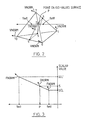
- Scalar values are distributed linearly on a segment piercing a tetrahedron, because scalar values are given by a linear expression of x, y, and Z (formula 1) at points within it. Accordingly, evaluation of the scalar values at the entry and exit points of a ray to a tetrahedron, fent and fext, and comparison of the results with a scalar value C (five, for example), determine whether the iso-valued surface intersects the ray.
- a cubic equation has to be solved, because the distribution of scalar values on the segment is represented by a cubic function in a coordinate system with the segment as a coordinate axis. In other words, more than one iso-valued surface may be found on the segment.
- the calculation necessary to solve a cubic equation is very expensive in time and cost.
- the space is divided into tetrahedral elements as in the present invention (the tetrahedral model)
- the tetrahedral model it can easily be judged whether the iso-valued surface intersects the viewing ray with only the scalar values at fent and fext. This is an advantage of the tetrahedral model over the hexahedral model.
- Fig. 2 For ease of understanding, an iso-valued surface with scalar value five that comprises two triangles is illustrated in Fig. 2.
- geometric data on the iso-valued surface (triangle data) are never generated in the present invention.
- normal vector data on the iso-valued surface at the intersection with the viewing ray are generated by using vertex representative normal vector data, which are given to each vertex. Because one vertex is typically shared by more than four tetrahedral elements, the volume of vertex representative normal vector data never becomes large relative to the number of tetrahedral elements. Further, vertex representative normal vector data are used in common for any iso-valued surfaces with any scalar values.
- the prior art method when multiple iso-valued surfaces are displayed semi-transparently, the prior art method generates a large volume of triangle data for each of the iso-valued surfaces, while the present invention utilizes vertex representative normal vector data repeatedly, which results in a much smaller volume of data being required for image generation.
- Pixel value calculation is performed according to the position data of the intersection between the viewing ray and the iso-valued surface and the normal vector data of the iso-valued surface at the intersection. Such calculation is done in accordance with a known method such as Phong's model. For further details, see the description relating to Fig. 7 and see Appendix Section II-7 below.
- different viewing rays have intersections at different positions on the same iso-valued surface in the same tetrahedral element, so that the interpolated normal vector data are also different. Therefore, the edges of triangles displayed on the screen are not highlighted relative to the enclosed areas. It is of course possible to modify the calculated pixel values in order to smooth the displayed image.
- Process (1) is performed in a perspective coordinate system and processes (3) to (6) are performed in an eye coordinate system.
- Process (3) to (6) are performed in an eye coordinate system.
- the processes in each coordinate system are described below in detail.
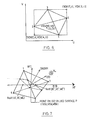
- a viewing ray is mapped to coordinates (IU, IV), as shown in Fig. 6.
- a search is made to determine which tetrahedron intersects the viewing ray.
- the viewing ray enters triangle 1-2-3 and exits triangle 4-1-2.
- Z values (IV, IW′) are interpolated on each of the triangles intersected by the viewing ray.
- IFLUG is used to determine whether the viewing ray is inside or outside the triangle.
- IW and IW′ are interpolated according to (S,T).
- the position data of fent and fext namely (UE, VE, WE) and (UE′, VE′, WE′), are obtained by transforming the two points (IU, IV, IW), (IU, IV, IW′) into the eye coordinate system (see Fig. 7).
- a point (X C , Y C , Z C ) on the segment that links point A, (X A , Y A , Z A ) and point B, (X B , Y B , Z B ), is represented as follows:
- the vertex representative normal vector is calculated by obtaining a simple average of the representative normal vectors of the tetrahedrons sharing the vertex.
- it can be calculated by obtaining the average of the representative normal vectors weighted by the solid angles of the tetrahedrons.
- the weighting factor can be the distance between the vertex and the gravity centre of the tetrahedron sharing it in still another embodiment.
- the space is virtually divided into tetrahedral elements as defined by the node points that are generated and distributed irregularly by 3D FEM and those that are added later in the above embodiment.
- the invention can be applied to the case where scalar values are provided with the points on the structured grid.
- Koide et al. in "Tetrahedral Grid Method for Equi-valued Surface Generation," Proceedings of the 35th annual convention of Information Processing Society of Japan, 13G-10 (1987), disclose a method for the division of such a structured grid space into tetrahedral elements.
- grid point addition which is equivalent to node point addition in the above embodiment, is never performed.
- the process after the division of the structured grid space into tetrahedral elements is the same as in the above embodiment.
- the said points provided with scalar values beforehand can be node points for a 3D finite element method, and in said step (a), new node points can be added and position data and scalar values for them generated, after which the 3D space is divided virtually into tetrahedral elements as defined by the node points.
- the image generation step (c) can comprise the steps of:
- the invention further provides,for a plurality of points being distributed in a 3D space, and position data and scalar values being given to the points and stored in a storage device beforehand, apparatus, in response to an arbitrary scalar value being specified, for generating an iso-valued surface, which is a set of points with the specified scalar value, in said space, comprising:
- image data of an iso-valued surface formed by a set of points with the same scalar value are generated at high speed and without the need for much memory when scalar values are provided beforehand with points distributed in 3D space.
Landscapes
- Physics & Mathematics (AREA)
- Engineering & Computer Science (AREA)
- Computer Graphics (AREA)
- Geometry (AREA)
- Software Systems (AREA)
- General Physics & Mathematics (AREA)
- Theoretical Computer Science (AREA)
- Image Generation (AREA)
Applications Claiming Priority (2)
| Application Number | Priority Date | Filing Date | Title |
|---|---|---|---|
| JP1265309A JPH0792840B2 (ja) | 1989-10-13 | 1989-10-13 | 画像生成方法及び装置 |
| JP265309/89 | 1989-10-13 |
Publications (3)
| Publication Number | Publication Date |
|---|---|
| EP0422866A2 true EP0422866A2 (fr) | 1991-04-17 |
| EP0422866A3 EP0422866A3 (en) | 1992-08-12 |
| EP0422866B1 EP0422866B1 (fr) | 1996-02-07 |
Family
ID=17415409
Family Applications (1)
| Application Number | Title | Priority Date | Filing Date |
|---|---|---|---|
| EP90310997A Expired - Lifetime EP0422866B1 (fr) | 1989-10-13 | 1990-10-08 | Méthode et appareil de génération d'images |
Country Status (4)
| Country | Link |
|---|---|
| US (1) | US5222202A (fr) |
| EP (1) | EP0422866B1 (fr) |
| JP (1) | JPH0792840B2 (fr) |
| DE (1) | DE69025259D1 (fr) |
Cited By (1)
| Publication number | Priority date | Publication date | Assignee | Title |
|---|---|---|---|---|
| EP0501716A3 (en) * | 1991-02-25 | 1994-11-17 | Ibm | Scientific visualisation system |
Families Citing this family (29)
| Publication number | Priority date | Publication date | Assignee | Title |
|---|---|---|---|---|
| JPH07120434B2 (ja) * | 1992-01-29 | 1995-12-20 | インターナショナル・ビジネス・マシーンズ・コーポレイション | ボリュームレンダリングを行う方法及び装置 |
| JP2713323B2 (ja) * | 1992-03-02 | 1998-02-16 | インターナショナル・ビジネス・マシーンズ・コーポレイション | 等値サーフェイスを効率的に生成し等値サーフェイス画像データ及び表面等値線画像データをディスプレイするための方法及び装置 |
| US5739820A (en) * | 1992-11-19 | 1998-04-14 | Apple Computer Inc. | Method and apparatus for specular reflection shading of computer graphic images |
| US5390035A (en) * | 1992-12-23 | 1995-02-14 | International Business Machines Corporation | Method and means for tetrahedron/octahedron packing and tetrahedron extraction for function approximation |
| US5553206A (en) * | 1993-02-12 | 1996-09-03 | International Business Machines Corporation | Method and system for producing mesh representations of objects |
| DE69406296T2 (de) * | 1993-07-27 | 1998-05-14 | Taligent, Inc., Cupertino, Calif. | Objekorientiertes anzeigesystem |
| US5649079A (en) * | 1994-02-28 | 1997-07-15 | Holmes; David I. | Computerized method using isosceles triangles for generating surface points |
| US5798765A (en) * | 1994-03-21 | 1998-08-25 | Motorola, Inc. | Three dimensional light intensity display map |
| US5570460A (en) * | 1994-10-21 | 1996-10-29 | International Business Machines Corporation | System and method for volume rendering of finite element models |
| US6201879B1 (en) * | 1996-02-09 | 2001-03-13 | Massachusetts Institute Of Technology | Method and apparatus for logo hiding in images |
| JP3323738B2 (ja) * | 1996-06-14 | 2002-09-09 | インターナショナル・ビジネス・マシーンズ・コーポレーション | ボリューム・データ計算方法及び装置並びにボリューム・データ可視化方法及び装置 |
| US9098297B2 (en) * | 1997-05-08 | 2015-08-04 | Nvidia Corporation | Hardware accelerator for an object-oriented programming language |
| US6044210A (en) * | 1997-06-05 | 2000-03-28 | Hibbitt Karlsson & Sorensen, Inc. | Computer process for prescribing second-order tetrahedral elements during deformation simulation in the design analysis of structures |
| US6041132A (en) * | 1997-07-29 | 2000-03-21 | General Electric Company | Computed tomography inspection of composite ply structure |
| US6480205B1 (en) | 1998-07-22 | 2002-11-12 | Nvidia Corporation | Method and apparatus for occlusion culling in graphics systems |
| US6646639B1 (en) | 1998-07-22 | 2003-11-11 | Nvidia Corporation | Modified method and apparatus for improved occlusion culling in graphics systems |
| US6230101B1 (en) * | 1999-06-03 | 2001-05-08 | Schlumberger Technology Corporation | Simulation method and apparatus |
| US6939303B2 (en) * | 1999-07-23 | 2005-09-06 | Provecto Tecnico R-2000, Ca | Method and system of determining cardiac contractility |
| US7209140B1 (en) | 1999-12-06 | 2007-04-24 | Nvidia Corporation | System, method and article of manufacture for a programmable vertex processing model with instruction set |
| US6198488B1 (en) * | 1999-12-06 | 2001-03-06 | Nvidia | Transform, lighting and rasterization system embodied on a single semiconductor platform |
| US6844880B1 (en) | 1999-12-06 | 2005-01-18 | Nvidia Corporation | System, method and computer program product for an improved programmable vertex processing model with instruction set |
| US6353439B1 (en) | 1999-12-06 | 2002-03-05 | Nvidia Corporation | System, method and computer program product for a blending operation in a transform module of a computer graphics pipeline |
| US6593923B1 (en) | 2000-05-31 | 2003-07-15 | Nvidia Corporation | System, method and article of manufacture for shadow mapping |
| US7787696B2 (en) * | 2000-08-28 | 2010-08-31 | University Of North Carolina At Charlotte | Systems and methods for adaptive sampling and estimating a systematic relationship between a plurality of points |
| US7006101B1 (en) | 2001-06-08 | 2006-02-28 | Nvidia Corporation | Graphics API with branching capabilities |
| US7893938B2 (en) * | 2005-05-04 | 2011-02-22 | Siemens Medical Solutions Usa, Inc. | Rendering anatomical structures with their nearby surrounding area |
| US10102654B1 (en) | 2015-07-28 | 2018-10-16 | Cascade Technologies, Inc. | System and method for a scalable interactive image-based visualization environment of computational model surfaces |
| JP6650848B2 (ja) * | 2016-08-22 | 2020-02-19 | 株式会社ソニー・インタラクティブエンタテインメント | 情報処理装置、情報処理システム、および情報処理方法 |
| US10783708B2 (en) * | 2017-03-14 | 2020-09-22 | Siemens Industry Software Inc. | Systems and methods for determining mass properties of a modeled object |
Family Cites Families (4)
| Publication number | Priority date | Publication date | Assignee | Title |
|---|---|---|---|---|
| US4275413A (en) * | 1978-03-30 | 1981-06-23 | Takashi Sakamoto | Linear interpolator for color correction |
| JPH0746391B2 (ja) * | 1984-09-14 | 1995-05-17 | 株式会社日立製作所 | 図形シエ−デイング装置 |
| US4710876A (en) * | 1985-06-05 | 1987-12-01 | General Electric Company | System and method for the display of surface structures contained within the interior region of a solid body |
| US5113490A (en) * | 1989-06-19 | 1992-05-12 | Silicon Graphics, Inc. | Method for forming a computer model from an intersection of a cutting surface with a bounded volume |
-
1989
- 1989-10-13 JP JP1265309A patent/JPH0792840B2/ja not_active Expired - Lifetime
-
1990
- 1990-10-08 EP EP90310997A patent/EP0422866B1/fr not_active Expired - Lifetime
- 1990-10-08 DE DE69025259T patent/DE69025259D1/de not_active Expired - Lifetime
- 1990-10-11 US US07/596,144 patent/US5222202A/en not_active Expired - Fee Related
Cited By (1)
| Publication number | Priority date | Publication date | Assignee | Title |
|---|---|---|---|---|
| EP0501716A3 (en) * | 1991-02-25 | 1994-11-17 | Ibm | Scientific visualisation system |
Also Published As
| Publication number | Publication date |
|---|---|
| DE69025259D1 (de) | 1996-03-21 |
| EP0422866B1 (fr) | 1996-02-07 |
| JPH03127188A (ja) | 1991-05-30 |
| JPH0792840B2 (ja) | 1995-10-09 |
| EP0422866A3 (en) | 1992-08-12 |
| US5222202A (en) | 1993-06-22 |
Similar Documents
| Publication | Publication Date | Title |
|---|---|---|
| EP0422866A2 (fr) | Méthode et appareil de génération d'images | |
| US6300965B1 (en) | Visible-object determination for interactive visualization | |
| Carlbom et al. | A hierarchical data structure for representing the spatial decomposition of 3D objects | |
| US6750859B2 (en) | Size conditioned visibility search system and method | |
| US6448968B1 (en) | Method for rendering graphical objects represented as surface elements | |
| US7027050B1 (en) | 3D computer graphics processing apparatus and method | |
| US6342886B1 (en) | Method for interactively modeling graphical objects with linked and unlinked surface elements | |
| US6373485B2 (en) | Mitigating the effects of object approximations | |
| US20080129731A1 (en) | System and Method For Approximating an Editable Surface | |
| WO1994017486A1 (fr) | Systeme de tessellation | |
| EP1024436A2 (fr) | Méthode de génération d'objets graphiques représentés par des éléments de surface | |
| US6396496B1 (en) | Method for modeling graphical objects represented as surface elements | |
| US6480190B1 (en) | Graphical objects represented as surface elements | |
| EP0727764A1 (fr) | Appareil graphique 3D | |
| US6043825A (en) | Method of displaying 3D networks in 2D with out false crossings | |
| Fellner | Extensible image synthesis | |
| US5821942A (en) | Ray tracing through an ordered array | |
| Max et al. | Approximate volume rendering for curvilinear and unstructured grids by hardware‐assisted polyhedron projection | |
| Szirmay-Kalos et al. | Hardware implementation of Phong shading using spherical interpolation | |
| Ke et al. | A journey into the fourth dimension (visualization) | |
| US20110074777A1 (en) | Method For Displaying Intersections And Expansions of Three Dimensional Volumes | |
| Chakravarty et al. | The integration of computer graphics and image processing techniques for the display and manipulation of geophysical data | |
| Lischinski | Accurate and Reliable Algorithms for Global Illumination | |
| Kappel | Shading: fitting a smooth intensity surface | |
| Thomas | Scene Capture and Modeling for Three-Dimensional Interactive Stereo Television Broadcasting |
Legal Events
| Date | Code | Title | Description |
|---|---|---|---|
| PUAI | Public reference made under article 153(3) epc to a published international application that has entered the european phase |
Free format text: ORIGINAL CODE: 0009012 |
|
| 17P | Request for examination filed |
Effective date: 19901213 |
|
| AK | Designated contracting states |
Kind code of ref document: A2 Designated state(s): DE FR GB IT |
|
| PUAL | Search report despatched |
Free format text: ORIGINAL CODE: 0009013 |
|
| AK | Designated contracting states |
Kind code of ref document: A3 Designated state(s): DE FR GB IT |
|
| 17Q | First examination report despatched |
Effective date: 19950427 |
|
| GRAA | (expected) grant |
Free format text: ORIGINAL CODE: 0009210 |
|
| AK | Designated contracting states |
Kind code of ref document: B1 Designated state(s): DE FR GB IT |
|
| PG25 | Lapsed in a contracting state [announced via postgrant information from national office to epo] |
Ref country code: IT Free format text: LAPSE BECAUSE OF FAILURE TO SUBMIT A TRANSLATION OF THE DESCRIPTION OR TO PAY THE FEE WITHIN THE PRE;WARNING: LAPSES OF ITALIAN PATENTS WITH EFFECTIVE DATE BEFORE 2007 MAY HAVE OCCURRED AT ANY TIME BEFORE 2007. THE CORRECT EFFECTIVE DATE MAY BE DIFFERENT FROM THE ONE RECORDED.SCRIBED TIME-LIMIT Effective date: 19960207 Ref country code: FR Effective date: 19960207 |
|
| REF | Corresponds to: |
Ref document number: 69025259 Country of ref document: DE Date of ref document: 19960321 |
|
| PG25 | Lapsed in a contracting state [announced via postgrant information from national office to epo] |
Ref country code: DE Effective date: 19960508 |
|
| EN | Fr: translation not filed | ||
| PG25 | Lapsed in a contracting state [announced via postgrant information from national office to epo] |
Ref country code: GB Effective date: 19961008 |
|
| PLBE | No opposition filed within time limit |
Free format text: ORIGINAL CODE: 0009261 |
|
| STAA | Information on the status of an ep patent application or granted ep patent |
Free format text: STATUS: NO OPPOSITION FILED WITHIN TIME LIMIT |
|
| 26N | No opposition filed | ||
| GBPC | Gb: european patent ceased through non-payment of renewal fee |
Effective date: 19961008 |