EP0464487A1 - Optische aktive Alpha-Fluoracrylsäureamide, ihre Herstellung, ihre Polymerisation zu optisch aktiven Polymeren und deren Verwendung zur Trennung von Racematen - Google Patents
Optische aktive Alpha-Fluoracrylsäureamide, ihre Herstellung, ihre Polymerisation zu optisch aktiven Polymeren und deren Verwendung zur Trennung von Racematen Download PDFInfo
- Publication number
- EP0464487A1 EP0464487A1 EP91110141A EP91110141A EP0464487A1 EP 0464487 A1 EP0464487 A1 EP 0464487A1 EP 91110141 A EP91110141 A EP 91110141A EP 91110141 A EP91110141 A EP 91110141A EP 0464487 A1 EP0464487 A1 EP 0464487A1
- Authority
- EP
- European Patent Office
- Prior art keywords
- dioxan
- cyclohexyl
- phenyl
- cyclopentyl
- cycloalkyl
- Prior art date
- Legal status (The legal status is an assumption and is not a legal conclusion. Google has not performed a legal analysis and makes no representation as to the accuracy of the status listed.)
- Withdrawn
Links
- 229920000642 polymer Polymers 0.000 title claims abstract description 41
- QLGUMAKHZODJET-UHFFFAOYSA-N 2-fluoroprop-2-enamide Chemical class NC(=O)C(F)=C QLGUMAKHZODJET-UHFFFAOYSA-N 0.000 title claims abstract description 9
- 238000002360 preparation method Methods 0.000 title claims abstract description 8
- 238000000926 separation method Methods 0.000 title claims description 13
- 238000000034 method Methods 0.000 claims abstract description 12
- -1 cycloalkyl radical Chemical class 0.000 claims description 181
- 125000004432 carbon atom Chemical group C* 0.000 claims description 28
- 125000000217 alkyl group Chemical group 0.000 claims description 21
- 125000000753 cycloalkyl group Chemical group 0.000 claims description 17
- 239000000741 silica gel Substances 0.000 claims description 17
- 229910002027 silica gel Inorganic materials 0.000 claims description 17
- ZAMOUSCENKQFHK-UHFFFAOYSA-N Chlorine atom Chemical compound [Cl] ZAMOUSCENKQFHK-UHFFFAOYSA-N 0.000 claims description 16
- 229910052731 fluorine Inorganic materials 0.000 claims description 15
- 125000001997 phenyl group Chemical group [H]C1=C([H])C([H])=C(*)C([H])=C1[H] 0.000 claims description 13
- 150000003254 radicals Chemical class 0.000 claims description 13
- PXGOKWXKJXAPGV-UHFFFAOYSA-N Fluorine Chemical compound FF PXGOKWXKJXAPGV-UHFFFAOYSA-N 0.000 claims description 12
- 239000000460 chlorine Substances 0.000 claims description 12
- 229910052801 chlorine Inorganic materials 0.000 claims description 12
- 150000001875 compounds Chemical class 0.000 claims description 12
- 239000011737 fluorine Substances 0.000 claims description 12
- 239000011324 bead Substances 0.000 claims description 11
- 125000003545 alkoxy group Chemical group 0.000 claims description 10
- 150000001412 amines Chemical class 0.000 claims description 9
- 125000001153 fluoro group Chemical group F* 0.000 claims description 9
- 229910052739 hydrogen Inorganic materials 0.000 claims description 9
- 239000003960 organic solvent Substances 0.000 claims description 9
- TYCFGHUTYSLISP-UHFFFAOYSA-N 2-fluoroprop-2-enoic acid Chemical class OC(=O)C(F)=C TYCFGHUTYSLISP-UHFFFAOYSA-N 0.000 claims description 8
- UFHFLCQGNIYNRP-UHFFFAOYSA-N Hydrogen Chemical compound [H][H] UFHFLCQGNIYNRP-UHFFFAOYSA-N 0.000 claims description 8
- 229910052736 halogen Inorganic materials 0.000 claims description 8
- 150000002367 halogens Chemical group 0.000 claims description 8
- 239000001257 hydrogen Substances 0.000 claims description 8
- 239000002253 acid Substances 0.000 claims description 7
- 125000001624 naphthyl group Chemical group 0.000 claims description 7
- DTGKSKDOIYIVQL-WEDXCCLWSA-N (+)-borneol Chemical group C1C[C@@]2(C)[C@@H](O)C[C@@H]1C2(C)C DTGKSKDOIYIVQL-WEDXCCLWSA-N 0.000 claims description 6
- WKBOTKDWSSQWDR-UHFFFAOYSA-N Bromine atom Chemical compound [Br] WKBOTKDWSSQWDR-UHFFFAOYSA-N 0.000 claims description 6
- 125000004076 pyridyl group Chemical group 0.000 claims description 6
- GDTBXPJZTBHREO-UHFFFAOYSA-N bromine Substances BrBr GDTBXPJZTBHREO-UHFFFAOYSA-N 0.000 claims description 5
- 125000000229 (C1-C4)alkoxy group Chemical group 0.000 claims description 4
- 125000000051 benzyloxy group Chemical group [H]C1=C([H])C([H])=C(C([H])=C1[H])C([H])([H])O* 0.000 claims description 4
- 229910052794 bromium Inorganic materials 0.000 claims description 4
- 239000003431 cross linking reagent Substances 0.000 claims description 4
- 125000001443 terpenyl group Chemical group 0.000 claims description 4
- 125000001637 1-naphthyl group Chemical group [H]C1=C([H])C([H])=C2C(*)=C([H])C([H])=C([H])C2=C1[H] 0.000 claims description 3
- 125000001622 2-naphthyl group Chemical group [H]C1=C([H])C([H])=C2C([H])=C(*)C([H])=C([H])C2=C1[H] 0.000 claims description 3
- 125000004105 2-pyridyl group Chemical group N1=C([*])C([H])=C([H])C([H])=C1[H] 0.000 claims description 3
- 125000003349 3-pyridyl group Chemical group N1=C([H])C([*])=C([H])C([H])=C1[H] 0.000 claims description 3
- 125000000339 4-pyridyl group Chemical group N1=C([H])C([H])=C([*])C([H])=C1[H] 0.000 claims description 3
- 239000011230 binding agent Substances 0.000 claims description 3
- 125000000484 butyl group Chemical group [H]C([*])([H])C([H])([H])C([H])([H])C([H])([H])[H] 0.000 claims description 3
- 125000000113 cyclohexyl group Chemical group [H]C1([H])C([H])([H])C([H])([H])C([H])(*)C([H])([H])C1([H])[H] 0.000 claims description 3
- 125000001511 cyclopentyl group Chemical group [H]C1([H])C([H])([H])C([H])([H])C([H])(*)C1([H])[H] 0.000 claims description 3
- 125000001301 ethoxy group Chemical group [H]C([H])([H])C([H])([H])O* 0.000 claims description 3
- 125000002496 methyl group Chemical group [H]C([H])([H])* 0.000 claims description 3
- 230000003287 optical effect Effects 0.000 claims description 3
- 125000001436 propyl group Chemical group [H]C([*])([H])C([H])([H])C([H])([H])[H] 0.000 claims description 3
- NIXOWILDQLNWCW-UHFFFAOYSA-N acrylic acid group Chemical group C(C=C)(=O)O NIXOWILDQLNWCW-UHFFFAOYSA-N 0.000 claims description 2
- 150000002222 fluorine compounds Chemical class 0.000 claims description 2
- 150000002431 hydrogen Chemical class 0.000 claims description 2
- 239000000463 material Substances 0.000 claims description 2
- 125000000956 methoxy group Chemical group [H]C([H])([H])O* 0.000 claims description 2
- SNOOUWRIMMFWNE-UHFFFAOYSA-M sodium;6-[(3,4,5-trimethoxybenzoyl)amino]hexanoate Chemical compound [Na+].COC1=CC(C(=O)NCCCCCC([O-])=O)=CC(OC)=C1OC SNOOUWRIMMFWNE-UHFFFAOYSA-M 0.000 claims description 2
- 125000001424 substituent group Chemical group 0.000 claims description 2
- 238000010557 suspension polymerization reaction Methods 0.000 claims description 2
- 125000003003 spiro group Chemical group 0.000 claims 2
- 239000012876 carrier material Substances 0.000 claims 1
- 238000003776 cleavage reaction Methods 0.000 claims 1
- 125000000449 nitro group Chemical group [O-][N+](*)=O 0.000 claims 1
- 230000007017 scission Effects 0.000 claims 1
- HBAQYPYDRFILMT-UHFFFAOYSA-N 8-[3-(1-cyclopropylpyrazol-4-yl)-1H-pyrazolo[4,3-d]pyrimidin-5-yl]-3-methyl-3,8-diazabicyclo[3.2.1]octan-2-one Chemical class C1(CC1)N1N=CC(=C1)C1=NNC2=C1N=C(N=C2)N1C2C(N(CC1CC2)C)=O HBAQYPYDRFILMT-UHFFFAOYSA-N 0.000 abstract description 12
- 239000003463 adsorbent Substances 0.000 abstract description 11
- YXFVVABEGXRONW-UHFFFAOYSA-N Toluene Chemical compound CC1=CC=CC=C1 YXFVVABEGXRONW-UHFFFAOYSA-N 0.000 description 39
- VYPSYNLAJGMNEJ-UHFFFAOYSA-N Silicium dioxide Chemical compound O=[Si]=O VYPSYNLAJGMNEJ-UHFFFAOYSA-N 0.000 description 18
- RTZKZFJDLAIYFH-UHFFFAOYSA-N Diethyl ether Chemical compound CCOCC RTZKZFJDLAIYFH-UHFFFAOYSA-N 0.000 description 17
- UHOVQNZJYSORNB-UHFFFAOYSA-N Benzene Chemical compound C1=CC=CC=C1 UHOVQNZJYSORNB-UHFFFAOYSA-N 0.000 description 15
- 239000000203 mixture Substances 0.000 description 15
- IJGRMHOSHXDMSA-UHFFFAOYSA-N Atomic nitrogen Chemical compound N#N IJGRMHOSHXDMSA-UHFFFAOYSA-N 0.000 description 14
- 229910052757 nitrogen Inorganic materials 0.000 description 13
- 238000006116 polymerization reaction Methods 0.000 description 13
- CSCPPACGZOOCGX-UHFFFAOYSA-N Acetone Chemical compound CC(C)=O CSCPPACGZOOCGX-UHFFFAOYSA-N 0.000 description 9
- ZMANZCXQSJIPKH-UHFFFAOYSA-N Triethylamine Chemical compound CCN(CC)CC ZMANZCXQSJIPKH-UHFFFAOYSA-N 0.000 description 9
- OZAIFHULBGXAKX-UHFFFAOYSA-N 2-(2-cyanopropan-2-yldiazenyl)-2-methylpropanenitrile Chemical compound N#CC(C)(C)N=NC(C)(C)C#N OZAIFHULBGXAKX-UHFFFAOYSA-N 0.000 description 8
- YMWUJEATGCHHMB-UHFFFAOYSA-N Dichloromethane Chemical compound ClCCl YMWUJEATGCHHMB-UHFFFAOYSA-N 0.000 description 8
- 230000000694 effects Effects 0.000 description 8
- 238000013375 chromatographic separation Methods 0.000 description 7
- 239000002904 solvent Substances 0.000 description 7
- HEDRZPFGACZZDS-UHFFFAOYSA-N Chloroform Chemical compound ClC(Cl)Cl HEDRZPFGACZZDS-UHFFFAOYSA-N 0.000 description 6
- LFQSCWFLJHTTHZ-UHFFFAOYSA-N Ethanol Chemical compound CCO LFQSCWFLJHTTHZ-UHFFFAOYSA-N 0.000 description 6
- XEKOWRVHYACXOJ-UHFFFAOYSA-N Ethyl acetate Chemical compound CCOC(C)=O XEKOWRVHYACXOJ-UHFFFAOYSA-N 0.000 description 6
- KFZMGEQAYNKOFK-UHFFFAOYSA-N Isopropanol Chemical compound CC(C)O KFZMGEQAYNKOFK-UHFFFAOYSA-N 0.000 description 6
- OKKJLVBELUTLKV-UHFFFAOYSA-N Methanol Chemical compound OC OKKJLVBELUTLKV-UHFFFAOYSA-N 0.000 description 6
- WYURNTSHIVDZCO-UHFFFAOYSA-N Tetrahydrofuran Chemical compound C1CCOC1 WYURNTSHIVDZCO-UHFFFAOYSA-N 0.000 description 6
- ADIMAYPTOBDMTL-UHFFFAOYSA-N oxazepam Chemical compound C12=CC(Cl)=CC=C2NC(=O)C(O)N=C1C1=CC=CC=C1 ADIMAYPTOBDMTL-UHFFFAOYSA-N 0.000 description 6
- 239000003208 petroleum Substances 0.000 description 6
- QTBSBXVTEAMEQO-UHFFFAOYSA-N Acetic acid Chemical compound CC(O)=O QTBSBXVTEAMEQO-UHFFFAOYSA-N 0.000 description 5
- 150000003926 acrylamides Chemical class 0.000 description 5
- 229960001701 chloroform Drugs 0.000 description 5
- 239000000178 monomer Substances 0.000 description 5
- 229960004535 oxazepam Drugs 0.000 description 5
- XLYOFNOQVPJJNP-UHFFFAOYSA-N water Substances O XLYOFNOQVPJJNP-UHFFFAOYSA-N 0.000 description 5
- RYHBNJHYFVUHQT-UHFFFAOYSA-N 1,4-Dioxane Chemical compound C1COCCO1 RYHBNJHYFVUHQT-UHFFFAOYSA-N 0.000 description 4
- VEXZGXHMUGYJMC-UHFFFAOYSA-N Hydrochloric acid Chemical compound Cl VEXZGXHMUGYJMC-UHFFFAOYSA-N 0.000 description 4
- 239000003795 chemical substances by application Substances 0.000 description 4
- 239000003480 eluent Substances 0.000 description 4
- 239000002245 particle Substances 0.000 description 4
- 239000000243 solution Substances 0.000 description 4
- 230000008961 swelling Effects 0.000 description 4
- DVWQNBIUTWDZMW-UHFFFAOYSA-N 1-naphthalen-1-ylnaphthalen-2-ol Chemical compound C1=CC=C2C(C3=C4C=CC=CC4=CC=C3O)=CC=CC2=C1 DVWQNBIUTWDZMW-UHFFFAOYSA-N 0.000 description 3
- WEVYAHXRMPXWCK-UHFFFAOYSA-N Acetonitrile Chemical compound CC#N WEVYAHXRMPXWCK-UHFFFAOYSA-N 0.000 description 3
- 239000013543 active substance Substances 0.000 description 3
- 238000006243 chemical reaction Methods 0.000 description 3
- WEQAYVWKMWHEJO-UHFFFAOYSA-N chlormezanone Chemical compound O=S1(=O)CCC(=O)N(C)C1C1=CC=C(Cl)C=C1 WEQAYVWKMWHEJO-UHFFFAOYSA-N 0.000 description 3
- 239000012043 crude product Substances 0.000 description 3
- 239000011521 glass Substances 0.000 description 3
- 150000008282 halocarbons Chemical class 0.000 description 3
- 239000007791 liquid phase Substances 0.000 description 3
- VLKZOEOYAKHREP-UHFFFAOYSA-N n-Hexane Chemical compound CCCCCC VLKZOEOYAKHREP-UHFFFAOYSA-N 0.000 description 3
- 238000003756 stirring Methods 0.000 description 3
- YDZNRNHKJQTGCG-UHFFFAOYSA-N 1,1'-binaphthyl-2,2'-dicarboxylic acid Chemical compound C1=CC=C2C(C3=C4C=CC=CC4=CC=C3C(=O)O)=C(C(O)=O)C=CC2=C1 YDZNRNHKJQTGCG-UHFFFAOYSA-N 0.000 description 2
- MYRTYDVEIRVNKP-UHFFFAOYSA-N 1,2-Divinylbenzene Chemical compound C=CC1=CC=CC=C1C=C MYRTYDVEIRVNKP-UHFFFAOYSA-N 0.000 description 2
- RQEUFEKYXDPUSK-UHFFFAOYSA-N 1-phenylethylamine Chemical compound CC(N)C1=CC=CC=C1 RQEUFEKYXDPUSK-UHFFFAOYSA-N 0.000 description 2
- VBCIFBPXQPTIJL-MYWSLZCHSA-N 3-[(3R)-3-[(4-fluorophenyl)sulfonylamino]-1,2,3,4,4a,9a-hexahydrocarbazol-9-yl]propanoic acid Chemical compound FC1=CC=C(C=C1)S(=O)(=O)N[C@@H]1CCC2N(C3=CC=CC=C3C2C1)CCC(=O)O VBCIFBPXQPTIJL-MYWSLZCHSA-N 0.000 description 2
- MPQLTJWLSAHBTO-MYWSLZCHSA-N C1(=CC=CC=C1)S(=O)(=O)N[C@@H]1CCC2N(C3=CC=CC=C3C2C1)CCC(=O)O Chemical compound C1(=CC=CC=C1)S(=O)(=O)N[C@@H]1CCC2N(C3=CC=CC=C3C2C1)CCC(=O)O MPQLTJWLSAHBTO-MYWSLZCHSA-N 0.000 description 2
- CPELXLSAUQHCOX-UHFFFAOYSA-N Hydrogen bromide Chemical compound Br CPELXLSAUQHCOX-UHFFFAOYSA-N 0.000 description 2
- DGAQECJNVWCQMB-PUAWFVPOSA-M Ilexoside XXIX Chemical compound C[C@@H]1CC[C@@]2(CC[C@@]3(C(=CC[C@H]4[C@]3(CC[C@@H]5[C@@]4(CC[C@@H](C5(C)C)OS(=O)(=O)[O-])C)C)[C@@H]2[C@]1(C)O)C)C(=O)O[C@H]6[C@@H]([C@H]([C@@H]([C@H](O6)CO)O)O)O.[Na+] DGAQECJNVWCQMB-PUAWFVPOSA-M 0.000 description 2
- CSNNHWWHGAXBCP-UHFFFAOYSA-L Magnesium sulfate Chemical compound [Mg+2].[O-][S+2]([O-])([O-])[O-] CSNNHWWHGAXBCP-UHFFFAOYSA-L 0.000 description 2
- LRHPLDYGYMQRHN-UHFFFAOYSA-N N-Butanol Chemical compound CCCCO LRHPLDYGYMQRHN-UHFFFAOYSA-N 0.000 description 2
- IMNFDUFMRHMDMM-UHFFFAOYSA-N N-Heptane Chemical compound CCCCCCC IMNFDUFMRHMDMM-UHFFFAOYSA-N 0.000 description 2
- CTQNGGLPUBDAKN-UHFFFAOYSA-N O-Xylene Chemical compound CC1=CC=CC=C1C CTQNGGLPUBDAKN-UHFFFAOYSA-N 0.000 description 2
- NBIIXXVUZAFLBC-UHFFFAOYSA-N Phosphoric acid Chemical compound OP(O)(O)=O NBIIXXVUZAFLBC-UHFFFAOYSA-N 0.000 description 2
- 239000004372 Polyvinyl alcohol Substances 0.000 description 2
- JUJWROOIHBZHMG-UHFFFAOYSA-N Pyridine Chemical compound C1=CC=NC=C1 JUJWROOIHBZHMG-UHFFFAOYSA-N 0.000 description 2
- UIIMBOGNXHQVGW-UHFFFAOYSA-M Sodium bicarbonate Chemical compound [Na+].OC([O-])=O UIIMBOGNXHQVGW-UHFFFAOYSA-M 0.000 description 2
- WQDUMFSSJAZKTM-UHFFFAOYSA-N Sodium methoxide Chemical compound [Na+].[O-]C WQDUMFSSJAZKTM-UHFFFAOYSA-N 0.000 description 2
- QAOWNCQODCNURD-UHFFFAOYSA-N Sulfuric acid Chemical compound OS(O)(=O)=O QAOWNCQODCNURD-UHFFFAOYSA-N 0.000 description 2
- 229910052783 alkali metal Inorganic materials 0.000 description 2
- 150000001340 alkali metals Chemical class 0.000 description 2
- 125000003368 amide group Chemical group 0.000 description 2
- 239000007864 aqueous solution Substances 0.000 description 2
- 229950005499 carbon tetrachloride Drugs 0.000 description 2
- 238000004587 chromatography analysis Methods 0.000 description 2
- 229920001577 copolymer Polymers 0.000 description 2
- 238000009826 distribution Methods 0.000 description 2
- 150000002170 ethers Chemical class 0.000 description 2
- 229940052308 general anesthetics halogenated hydrocarbons Drugs 0.000 description 2
- 229930195733 hydrocarbon Natural products 0.000 description 2
- 150000002430 hydrocarbons Chemical class 0.000 description 2
- 238000004519 manufacturing process Methods 0.000 description 2
- FQPSGWSUVKBHSU-UHFFFAOYSA-N methacrylamide Chemical compound CC(=C)C(N)=O FQPSGWSUVKBHSU-UHFFFAOYSA-N 0.000 description 2
- VNWKTOKETHGBQD-UHFFFAOYSA-N methane Chemical compound C VNWKTOKETHGBQD-UHFFFAOYSA-N 0.000 description 2
- 150000007524 organic acids Chemical class 0.000 description 2
- 235000005985 organic acids Nutrition 0.000 description 2
- 239000012074 organic phase Substances 0.000 description 2
- 239000012071 phase Substances 0.000 description 2
- 229920002451 polyvinyl alcohol Polymers 0.000 description 2
- BWHMMNNQKKPAPP-UHFFFAOYSA-L potassium carbonate Chemical compound [K+].[K+].[O-]C([O-])=O BWHMMNNQKKPAPP-UHFFFAOYSA-L 0.000 description 2
- BDERNNFJNOPAEC-UHFFFAOYSA-N propan-1-ol Chemical compound CCCO BDERNNFJNOPAEC-UHFFFAOYSA-N 0.000 description 2
- 239000007858 starting material Substances 0.000 description 2
- 239000000725 suspension Substances 0.000 description 2
- VZGDMQKNWNREIO-UHFFFAOYSA-N tetrachloromethane Chemical compound ClC(Cl)(Cl)Cl VZGDMQKNWNREIO-UHFFFAOYSA-N 0.000 description 2
- YLQBMQCUIZJEEH-UHFFFAOYSA-N tetrahydrofuran Natural products C=1C=COC=1 YLQBMQCUIZJEEH-UHFFFAOYSA-N 0.000 description 2
- 238000005406 washing Methods 0.000 description 2
- 239000008096 xylene Substances 0.000 description 2
- ILNGCJMEDIBPTL-QWRGUYRKSA-N (4s,5s)-2,2-dimethyl-4-phenyl-1,3-dioxan-5-amine Chemical compound O1C(C)(C)OC[C@H](N)[C@@H]1C1=CC=CC=C1 ILNGCJMEDIBPTL-QWRGUYRKSA-N 0.000 description 1
- 125000004178 (C1-C4) alkyl group Chemical group 0.000 description 1
- SCYULBFZEHDVBN-UHFFFAOYSA-N 1,1-Dichloroethane Chemical compound CC(Cl)Cl SCYULBFZEHDVBN-UHFFFAOYSA-N 0.000 description 1
- WSLDOOZREJYCGB-UHFFFAOYSA-N 1,2-Dichloroethane Chemical compound ClCCCl WSLDOOZREJYCGB-UHFFFAOYSA-N 0.000 description 1
- 125000000424 1,2-diol group Chemical group 0.000 description 1
- IROFMMHLTOVXFS-UHFFFAOYSA-N 1-chloro-2,3-bis(ethenyl)benzene Chemical compound ClC1=CC=CC(C=C)=C1C=C IROFMMHLTOVXFS-UHFFFAOYSA-N 0.000 description 1
- XBWOPGDJMAJJDG-UHFFFAOYSA-N 1-cyclohexylethanamine Chemical compound CC(N)C1CCCCC1 XBWOPGDJMAJJDG-UHFFFAOYSA-N 0.000 description 1
- FFHGJCBXRQUCED-UHFFFAOYSA-N 1-methyl-2-(2-methylphenyl)peroxybenzene Chemical compound CC1=CC=CC=C1OOC1=CC=CC=C1C FFHGJCBXRQUCED-UHFFFAOYSA-N 0.000 description 1
- DRKSMCFPUOMHMK-UHFFFAOYSA-N 2,3,4,5,6,9-hexahydro-1h-carbazole Chemical class C1=CCCC2=C1NC1=C2CCCC1 DRKSMCFPUOMHMK-UHFFFAOYSA-N 0.000 description 1
- ARKDCHXUGNPHJU-UHFFFAOYSA-N 2,7-dimethylocta-2,6-dienediamide Chemical compound NC(=O)C(C)=CCCC=C(C)C(N)=O ARKDCHXUGNPHJU-UHFFFAOYSA-N 0.000 description 1
- UEJJHQNACJXSKW-UHFFFAOYSA-N 2-(2,6-dioxopiperidin-3-yl)-1H-isoindole-1,3(2H)-dione Chemical compound O=C1C2=CC=CC=C2C(=O)N1C1CCC(=O)NC1=O UEJJHQNACJXSKW-UHFFFAOYSA-N 0.000 description 1
- HCUHAHONSFXZMF-UHFFFAOYSA-N 2-(2-carboxy-6-methylphenyl)-3-methylbenzoic acid Chemical compound CC1=CC=CC(C(O)=O)=C1C1=C(C)C=CC=C1C(O)=O HCUHAHONSFXZMF-UHFFFAOYSA-N 0.000 description 1
- LBLYYCQCTBFVLH-UHFFFAOYSA-N 2-Methylbenzenesulfonic acid Chemical compound CC1=CC=CC=C1S(O)(=O)=O LBLYYCQCTBFVLH-UHFFFAOYSA-N 0.000 description 1
- KFRVYYGHSPLXSZ-UHFFFAOYSA-N 2-ethoxy-2-methylbutane Chemical compound CCOC(C)(C)CC KFRVYYGHSPLXSZ-UHFFFAOYSA-N 0.000 description 1
- GTJOHISYCKPIMT-UHFFFAOYSA-N 2-methylundecane Chemical compound CCCCCCCCCC(C)C GTJOHISYCKPIMT-UHFFFAOYSA-N 0.000 description 1
- KUDUQBURMYMBIJ-UHFFFAOYSA-N 2-prop-2-enoyloxyethyl prop-2-enoate Chemical compound C=CC(=O)OCCOC(=O)C=C KUDUQBURMYMBIJ-UHFFFAOYSA-N 0.000 description 1
- HTWRFCRQSLVESJ-UHFFFAOYSA-N 3-(2-methylprop-2-enoyloxy)propyl 2-methylprop-2-enoate Chemical compound CC(=C)C(=O)OCCCOC(=O)C(C)=C HTWRFCRQSLVESJ-UHFFFAOYSA-N 0.000 description 1
- BMYNFMYTOJXKLE-UHFFFAOYSA-N 3-azaniumyl-2-hydroxypropanoate Chemical compound NCC(O)C(O)=O BMYNFMYTOJXKLE-UHFFFAOYSA-N 0.000 description 1
- QUUHHGJGUTUFSA-WHRKIXHSSA-N 3-deuterio-3-fluoro-N-(5-methyl-2-propan-2-ylcyclohexyl)prop-2-enamide Chemical compound FC(=CC(=O)NC1CC(CCC1C(C)C)C)[2H] QUUHHGJGUTUFSA-WHRKIXHSSA-N 0.000 description 1
- XMIIGOLPHOKFCH-UHFFFAOYSA-N 3-phenylpropionic acid Chemical compound OC(=O)CCC1=CC=CC=C1 XMIIGOLPHOKFCH-UHFFFAOYSA-N 0.000 description 1
- GFLJTEHFZZNCTR-UHFFFAOYSA-N 3-prop-2-enoyloxypropyl prop-2-enoate Chemical compound C=CC(=O)OCCCOC(=O)C=C GFLJTEHFZZNCTR-UHFFFAOYSA-N 0.000 description 1
- XOJWAAUYNWGQAU-UHFFFAOYSA-N 4-(2-methylprop-2-enoyloxy)butyl 2-methylprop-2-enoate Chemical compound CC(=C)C(=O)OCCCCOC(=O)C(C)=C XOJWAAUYNWGQAU-UHFFFAOYSA-N 0.000 description 1
- DBCAQXHNJOFNGC-UHFFFAOYSA-N 4-bromo-1,1,1-trifluorobutane Chemical compound FC(F)(F)CCCBr DBCAQXHNJOFNGC-UHFFFAOYSA-N 0.000 description 1
- JHWGFJBTMHEZME-UHFFFAOYSA-N 4-prop-2-enoyloxybutyl prop-2-enoate Chemical compound C=CC(=O)OCCCCOC(=O)C=C JHWGFJBTMHEZME-UHFFFAOYSA-N 0.000 description 1
- MGKIILPLEOSHBL-UHFFFAOYSA-N 5-ethoxycarbonyl-2,6-dimethyl-4-[2-(trifluoromethyl)phenyl]-1,4-dihydropyridine-3-carboxylic acid Chemical compound CCOC(=O)C1=C(C)NC(C)=C(C(O)=O)C1C1=CC=CC=C1C(F)(F)F MGKIILPLEOSHBL-UHFFFAOYSA-N 0.000 description 1
- RBMUAGDCCJDQLE-UHFFFAOYSA-N 5-methyl-2-propan-2-ylcyclohexan-1-amine Chemical compound CC(C)C1CCC(C)CC1N RBMUAGDCCJDQLE-UHFFFAOYSA-N 0.000 description 1
- FIHBHSQYSYVZQE-UHFFFAOYSA-N 6-prop-2-enoyloxyhexyl prop-2-enoate Chemical compound C=CC(=O)OCCCCCCOC(=O)C=C FIHBHSQYSYVZQE-UHFFFAOYSA-N 0.000 description 1
- OMPJBNCRMGITSC-UHFFFAOYSA-N Benzoylperoxide Chemical compound C=1C=CC=CC=1C(=O)OOC(=O)C1=CC=CC=C1 OMPJBNCRMGITSC-UHFFFAOYSA-N 0.000 description 1
- DKPFZGUDAPQIHT-UHFFFAOYSA-N Butyl acetate Natural products CCCCOC(C)=O DKPFZGUDAPQIHT-UHFFFAOYSA-N 0.000 description 1
- NLZUEZXRPGMBCV-UHFFFAOYSA-N Butylhydroxytoluene Chemical compound CC1=CC(C(C)(C)C)=C(O)C(C(C)(C)C)=C1 NLZUEZXRPGMBCV-UHFFFAOYSA-N 0.000 description 1
- OYPRJOBELJOOCE-UHFFFAOYSA-N Calcium Chemical compound [Ca] OYPRJOBELJOOCE-UHFFFAOYSA-N 0.000 description 1
- 239000004971 Cross linker Substances 0.000 description 1
- OTMSDBZUPAUEDD-UHFFFAOYSA-N Ethane Chemical compound CC OTMSDBZUPAUEDD-UHFFFAOYSA-N 0.000 description 1
- SGVYKUFIHHTIFL-UHFFFAOYSA-N Isobutylhexyl Natural products CCCCCCCC(C)C SGVYKUFIHHTIFL-UHFFFAOYSA-N 0.000 description 1
- YIVJZNGAASQVEM-UHFFFAOYSA-N Lauroyl peroxide Chemical compound CCCCCCCCCCCC(=O)OOC(=O)CCCCCCCCCCC YIVJZNGAASQVEM-UHFFFAOYSA-N 0.000 description 1
- WHXSMMKQMYFTQS-UHFFFAOYSA-N Lithium Chemical compound [Li] WHXSMMKQMYFTQS-UHFFFAOYSA-N 0.000 description 1
- CERQOIWHTDAKMF-UHFFFAOYSA-N Methacrylic acid Chemical compound CC(=C)C(O)=O CERQOIWHTDAKMF-UHFFFAOYSA-N 0.000 description 1
- VVQNEPGJFQJSBK-UHFFFAOYSA-N Methyl methacrylate Chemical compound COC(=O)C(C)=C VVQNEPGJFQJSBK-UHFFFAOYSA-N 0.000 description 1
- BZLVMXJERCGZMT-UHFFFAOYSA-N Methyl tert-butyl ether Chemical compound COC(C)(C)C BZLVMXJERCGZMT-UHFFFAOYSA-N 0.000 description 1
- JBMQRDLXBXNCBX-UHFFFAOYSA-N OC(=O)Cc1ccc2ccccc2c1-c1c(CC(O)=O)ccc2ccccc12 Chemical compound OC(=O)Cc1ccc2ccccc2c1-c1c(CC(O)=O)ccc2ccccc12 JBMQRDLXBXNCBX-UHFFFAOYSA-N 0.000 description 1
- ZLMJMSJWJFRBEC-UHFFFAOYSA-N Potassium Chemical compound [K] ZLMJMSJWJFRBEC-UHFFFAOYSA-N 0.000 description 1
- 229910000831 Steel Inorganic materials 0.000 description 1
- XSTXAVWGXDQKEL-UHFFFAOYSA-N Trichloroethylene Chemical group ClC=C(Cl)Cl XSTXAVWGXDQKEL-UHFFFAOYSA-N 0.000 description 1
- 150000008065 acid anhydrides Chemical class 0.000 description 1
- 150000007513 acids Chemical class 0.000 description 1
- 230000004913 activation Effects 0.000 description 1
- 150000001298 alcohols Chemical class 0.000 description 1
- 150000001338 aliphatic hydrocarbons Chemical class 0.000 description 1
- 239000003513 alkali Substances 0.000 description 1
- 229910001854 alkali hydroxide Inorganic materials 0.000 description 1
- 229910052784 alkaline earth metal Inorganic materials 0.000 description 1
- 229910001860 alkaline earth metal hydroxide Inorganic materials 0.000 description 1
- 229910000147 aluminium phosphate Inorganic materials 0.000 description 1
- 239000008346 aqueous phase Substances 0.000 description 1
- 150000004945 aromatic hydrocarbons Chemical class 0.000 description 1
- 125000000751 azo group Chemical group [*]N=N[*] 0.000 description 1
- RQPZNWPYLFFXCP-UHFFFAOYSA-L barium dihydroxide Chemical compound [OH-].[OH-].[Ba+2] RQPZNWPYLFFXCP-UHFFFAOYSA-L 0.000 description 1
- 229910001863 barium hydroxide Inorganic materials 0.000 description 1
- 235000019400 benzoyl peroxide Nutrition 0.000 description 1
- 230000004071 biological effect Effects 0.000 description 1
- PIPBVABVQJZSAB-UHFFFAOYSA-N bis(ethenyl) benzene-1,2-dicarboxylate Chemical class C=COC(=O)C1=CC=CC=C1C(=O)OC=C PIPBVABVQJZSAB-UHFFFAOYSA-N 0.000 description 1
- IHXBXGHGYCSRAP-UHFFFAOYSA-N bis(ethenyl) benzene-1,4-dicarboxylate Chemical class C=COC(=O)C1=CC=C(C(=O)OC=C)C=C1 IHXBXGHGYCSRAP-UHFFFAOYSA-N 0.000 description 1
- JZQAAQZDDMEFGZ-UHFFFAOYSA-N bis(ethenyl) hexanedioate Chemical class C=COC(=O)CCCCC(=O)OC=C JZQAAQZDDMEFGZ-UHFFFAOYSA-N 0.000 description 1
- 235000010354 butylated hydroxytoluene Nutrition 0.000 description 1
- 239000011575 calcium Substances 0.000 description 1
- 229910001861 calcium hydroxide Inorganic materials 0.000 description 1
- 239000001913 cellulose Substances 0.000 description 1
- 229920002678 cellulose Polymers 0.000 description 1
- 229960002810 chlormezanone Drugs 0.000 description 1
- 239000000084 colloidal system Substances 0.000 description 1
- 238000004440 column chromatography Methods 0.000 description 1
- 238000001816 cooling Methods 0.000 description 1
- 238000007334 copolymerization reaction Methods 0.000 description 1
- 229920006037 cross link polymer Polymers 0.000 description 1
- 238000002425 crystallisation Methods 0.000 description 1
- 230000008025 crystallization Effects 0.000 description 1
- 125000004386 diacrylate group Chemical group 0.000 description 1
- 125000004925 dihydropyridyl group Chemical group N1(CC=CC=C1)* 0.000 description 1
- 238000000921 elemental analysis Methods 0.000 description 1
- 230000008030 elimination Effects 0.000 description 1
- 238000003379 elimination reaction Methods 0.000 description 1
- 238000010828 elution Methods 0.000 description 1
- 150000002148 esters Chemical class 0.000 description 1
- 125000001495 ethyl group Chemical group [H]C([H])([H])C([H])([H])* 0.000 description 1
- STVZJERGLQHEKB-UHFFFAOYSA-N ethylene glycol dimethacrylate Substances CC(=C)C(=O)OCCOC(=O)C(C)=C STVZJERGLQHEKB-UHFFFAOYSA-N 0.000 description 1
- 238000001704 evaporation Methods 0.000 description 1
- 230000008020 evaporation Effects 0.000 description 1
- 230000007717 exclusion Effects 0.000 description 1
- 238000001914 filtration Methods 0.000 description 1
- 239000000499 gel Substances 0.000 description 1
- PUYCICVJCRLABY-UHFFFAOYSA-N heptane;oxolane Chemical compound C1CCOC1.CCCCCCC PUYCICVJCRLABY-UHFFFAOYSA-N 0.000 description 1
- FUZZWVXGSFPDMH-UHFFFAOYSA-N hexanoic acid Chemical compound CCCCCC(O)=O FUZZWVXGSFPDMH-UHFFFAOYSA-N 0.000 description 1
- 238000004128 high performance liquid chromatography Methods 0.000 description 1
- 125000004435 hydrogen atom Chemical group [H]* 0.000 description 1
- 239000011261 inert gas Substances 0.000 description 1
- 239000003999 initiator Substances 0.000 description 1
- 150000007529 inorganic bases Chemical class 0.000 description 1
- 229910052500 inorganic mineral Inorganic materials 0.000 description 1
- VKPSKYDESGTTFR-UHFFFAOYSA-N isododecane Natural products CC(C)(C)CC(C)CC(C)(C)C VKPSKYDESGTTFR-UHFFFAOYSA-N 0.000 description 1
- WMFOQBRAJBCJND-UHFFFAOYSA-M lithium hydroxide Inorganic materials [Li+].[OH-] WMFOQBRAJBCJND-UHFFFAOYSA-M 0.000 description 1
- 229910052943 magnesium sulfate Inorganic materials 0.000 description 1
- 235000019341 magnesium sulphate Nutrition 0.000 description 1
- 230000014759 maintenance of location Effects 0.000 description 1
- 150000002734 metacrylic acid derivatives Chemical class 0.000 description 1
- 229920003145 methacrylic acid copolymer Polymers 0.000 description 1
- DCUFMVPCXCSVNP-UHFFFAOYSA-N methacrylic anhydride Chemical compound CC(=C)C(=O)OC(=O)C(C)=C DCUFMVPCXCSVNP-UHFFFAOYSA-N 0.000 description 1
- 239000011707 mineral Substances 0.000 description 1
- 235000010755 mineral Nutrition 0.000 description 1
- 150000007522 mineralic acids Chemical class 0.000 description 1
- ZIUHHBKFKCYYJD-UHFFFAOYSA-N n,n'-methylenebisacrylamide Chemical compound C=CC(=O)NCNC(=O)C=C ZIUHHBKFKCYYJD-UHFFFAOYSA-N 0.000 description 1
- CIEVJWJHXXAHRP-JSGCOSHPSA-N n-[(4s,5s)-2,2-dimethyl-4-phenyl-1,3-dioxan-5-yl]-3-fluoroprop-2-enamide Chemical compound O1C(C)(C)OC[C@H](NC(=O)C=CF)[C@@H]1C1=CC=CC=C1 CIEVJWJHXXAHRP-JSGCOSHPSA-N 0.000 description 1
- 150000002796 natural product derivatives Chemical class 0.000 description 1
- 229920006113 non-polar polymer Polymers 0.000 description 1
- 150000007530 organic bases Chemical class 0.000 description 1
- 239000003791 organic solvent mixture Substances 0.000 description 1
- 230000001151 other effect Effects 0.000 description 1
- DBSDMAPJGHBWAL-UHFFFAOYSA-N penta-1,4-dien-3-ylbenzene Chemical compound C=CC(C=C)C1=CC=CC=C1 DBSDMAPJGHBWAL-UHFFFAOYSA-N 0.000 description 1
- 150000002978 peroxides Chemical class 0.000 description 1
- 229940117803 phenethylamine Drugs 0.000 description 1
- 229920002401 polyacrylamide Polymers 0.000 description 1
- 229920000036 polyvinylpyrrolidone Polymers 0.000 description 1
- 239000001267 polyvinylpyrrolidone Substances 0.000 description 1
- 235000013855 polyvinylpyrrolidone Nutrition 0.000 description 1
- 239000011591 potassium Substances 0.000 description 1
- 229910000027 potassium carbonate Inorganic materials 0.000 description 1
- KWYUFKZDYYNOTN-UHFFFAOYSA-M potassium hydroxide Inorganic materials [OH-].[K+] KWYUFKZDYYNOTN-UHFFFAOYSA-M 0.000 description 1
- BDAWXSQJJCIFIK-UHFFFAOYSA-N potassium methoxide Chemical compound [K+].[O-]C BDAWXSQJJCIFIK-UHFFFAOYSA-N 0.000 description 1
- LPNYRYFBWFDTMA-UHFFFAOYSA-N potassium tert-butoxide Chemical compound [K+].CC(C)(C)[O-] LPNYRYFBWFDTMA-UHFFFAOYSA-N 0.000 description 1
- 239000002243 precursor Substances 0.000 description 1
- 239000000047 product Substances 0.000 description 1
- 230000001681 protective effect Effects 0.000 description 1
- 238000000746 purification Methods 0.000 description 1
- UMJSCPRVCHMLSP-UHFFFAOYSA-N pyridine Natural products COC1=CC=CN=C1 UMJSCPRVCHMLSP-UHFFFAOYSA-N 0.000 description 1
- 239000011541 reaction mixture Substances 0.000 description 1
- 238000001953 recrystallisation Methods 0.000 description 1
- 238000010992 reflux Methods 0.000 description 1
- 150000003839 salts Chemical class 0.000 description 1
- 239000011734 sodium Substances 0.000 description 1
- 229910000030 sodium bicarbonate Inorganic materials 0.000 description 1
- 235000017557 sodium bicarbonate Nutrition 0.000 description 1
- CDBYLPFSWZWCQE-UHFFFAOYSA-L sodium carbonate Substances [Na+].[Na+].[O-]C([O-])=O CDBYLPFSWZWCQE-UHFFFAOYSA-L 0.000 description 1
- 229910000029 sodium carbonate Inorganic materials 0.000 description 1
- HEMHJVSKTPXQMS-UHFFFAOYSA-M sodium hydroxide Inorganic materials [OH-].[Na+] HEMHJVSKTPXQMS-UHFFFAOYSA-M 0.000 description 1
- 239000007787 solid Substances 0.000 description 1
- 239000010959 steel Substances 0.000 description 1
- 239000000126 substance Substances 0.000 description 1
- 229960003433 thalidomide Drugs 0.000 description 1
- 239000002396 thromboxane receptor blocking agent Substances 0.000 description 1
- 229940125725 tranquilizer Drugs 0.000 description 1
- 239000003204 tranquilizing agent Substances 0.000 description 1
- 230000002936 tranquilizing effect Effects 0.000 description 1
- 229920001567 vinyl ester resin Polymers 0.000 description 1
- 125000000391 vinyl group Chemical group [H]C([*])=C([H])[H] 0.000 description 1
Classifications
-
- B—PERFORMING OPERATIONS; TRANSPORTING
- B01—PHYSICAL OR CHEMICAL PROCESSES OR APPARATUS IN GENERAL
- B01J—CHEMICAL OR PHYSICAL PROCESSES, e.g. CATALYSIS OR COLLOID CHEMISTRY; THEIR RELEVANT APPARATUS
- B01J20/00—Solid sorbent compositions or filter aid compositions; Sorbents for chromatography; Processes for preparing, regenerating or reactivating thereof
- B01J20/281—Sorbents specially adapted for preparative, analytical or investigative chromatography
- B01J20/282—Porous sorbents
- B01J20/285—Porous sorbents based on polymers
-
- B—PERFORMING OPERATIONS; TRANSPORTING
- B01—PHYSICAL OR CHEMICAL PROCESSES OR APPARATUS IN GENERAL
- B01J—CHEMICAL OR PHYSICAL PROCESSES, e.g. CATALYSIS OR COLLOID CHEMISTRY; THEIR RELEVANT APPARATUS
- B01J20/00—Solid sorbent compositions or filter aid compositions; Sorbents for chromatography; Processes for preparing, regenerating or reactivating thereof
- B01J20/22—Solid sorbent compositions or filter aid compositions; Sorbents for chromatography; Processes for preparing, regenerating or reactivating thereof comprising organic material
- B01J20/26—Synthetic macromolecular compounds
- B01J20/261—Synthetic macromolecular compounds obtained by reactions only involving carbon to carbon unsaturated bonds
-
- B—PERFORMING OPERATIONS; TRANSPORTING
- B01—PHYSICAL OR CHEMICAL PROCESSES OR APPARATUS IN GENERAL
- B01J—CHEMICAL OR PHYSICAL PROCESSES, e.g. CATALYSIS OR COLLOID CHEMISTRY; THEIR RELEVANT APPARATUS
- B01J20/00—Solid sorbent compositions or filter aid compositions; Sorbents for chromatography; Processes for preparing, regenerating or reactivating thereof
- B01J20/281—Sorbents specially adapted for preparative, analytical or investigative chromatography
- B01J20/286—Phases chemically bonded to a substrate, e.g. to silica or to polymers
-
- B—PERFORMING OPERATIONS; TRANSPORTING
- B01—PHYSICAL OR CHEMICAL PROCESSES OR APPARATUS IN GENERAL
- B01J—CHEMICAL OR PHYSICAL PROCESSES, e.g. CATALYSIS OR COLLOID CHEMISTRY; THEIR RELEVANT APPARATUS
- B01J20/00—Solid sorbent compositions or filter aid compositions; Sorbents for chromatography; Processes for preparing, regenerating or reactivating thereof
- B01J20/281—Sorbents specially adapted for preparative, analytical or investigative chromatography
- B01J20/29—Chiral phases
-
- B—PERFORMING OPERATIONS; TRANSPORTING
- B01—PHYSICAL OR CHEMICAL PROCESSES OR APPARATUS IN GENERAL
- B01J—CHEMICAL OR PHYSICAL PROCESSES, e.g. CATALYSIS OR COLLOID CHEMISTRY; THEIR RELEVANT APPARATUS
- B01J20/00—Solid sorbent compositions or filter aid compositions; Sorbents for chromatography; Processes for preparing, regenerating or reactivating thereof
- B01J20/30—Processes for preparing, regenerating, or reactivating
- B01J20/32—Impregnating or coating ; Solid sorbent compositions obtained from processes involving impregnating or coating
- B01J20/3231—Impregnating or coating ; Solid sorbent compositions obtained from processes involving impregnating or coating characterised by the coating or impregnating layer
- B01J20/3242—Layers with a functional group, e.g. an affinity material, a ligand, a reactant or a complexing group
- B01J20/3268—Macromolecular compounds
- B01J20/327—Polymers obtained by reactions involving only carbon to carbon unsaturated bonds
-
- C—CHEMISTRY; METALLURGY
- C07—ORGANIC CHEMISTRY
- C07B—GENERAL METHODS OF ORGANIC CHEMISTRY; APPARATUS THEREFOR
- C07B57/00—Separation of optically-active compounds
-
- C—CHEMISTRY; METALLURGY
- C07—ORGANIC CHEMISTRY
- C07C—ACYCLIC OR CARBOCYCLIC COMPOUNDS
- C07C233/00—Carboxylic acid amides
- C07C233/01—Carboxylic acid amides having carbon atoms of carboxamide groups bound to hydrogen atoms or to acyclic carbon atoms
- C07C233/02—Carboxylic acid amides having carbon atoms of carboxamide groups bound to hydrogen atoms or to acyclic carbon atoms having nitrogen atoms of carboxamide groups bound to hydrogen atoms or to carbon atoms of unsubstituted hydrocarbon radicals
- C07C233/09—Carboxylic acid amides having carbon atoms of carboxamide groups bound to hydrogen atoms or to acyclic carbon atoms having nitrogen atoms of carboxamide groups bound to hydrogen atoms or to carbon atoms of unsubstituted hydrocarbon radicals with carbon atoms of carboxamide groups bound to carbon atoms of an acyclic unsaturated carbon skeleton
-
- C—CHEMISTRY; METALLURGY
- C07—ORGANIC CHEMISTRY
- C07D—HETEROCYCLIC COMPOUNDS
- C07D319/00—Heterocyclic compounds containing six-membered rings having two oxygen atoms as the only ring hetero atoms
- C07D319/04—1,3-Dioxanes; Hydrogenated 1,3-dioxanes
- C07D319/06—1,3-Dioxanes; Hydrogenated 1,3-dioxanes not condensed with other rings
-
- C—CHEMISTRY; METALLURGY
- C08—ORGANIC MACROMOLECULAR COMPOUNDS; THEIR PREPARATION OR CHEMICAL WORKING-UP; COMPOSITIONS BASED THEREON
- C08F—MACROMOLECULAR COMPOUNDS OBTAINED BY REACTIONS ONLY INVOLVING CARBON-TO-CARBON UNSATURATED BONDS
- C08F20/00—Homopolymers and copolymers of compounds having one or more unsaturated aliphatic radicals, each having only one carbon-to-carbon double bond, and only one being terminated by only one carboxyl radical or a salt, anhydride, ester, amide, imide or nitrile thereof
- C08F20/02—Monocarboxylic acids having less than ten carbon atoms, Derivatives thereof
- C08F20/52—Amides or imides
- C08F20/54—Amides, e.g. N,N-dimethylacrylamide or N-isopropylacrylamide
-
- B—PERFORMING OPERATIONS; TRANSPORTING
- B01—PHYSICAL OR CHEMICAL PROCESSES OR APPARATUS IN GENERAL
- B01D—SEPARATION
- B01D15/00—Separating processes involving the treatment of liquids with solid sorbents; Apparatus therefor
- B01D15/08—Selective adsorption, e.g. chromatography
- B01D15/26—Selective adsorption, e.g. chromatography characterised by the separation mechanism
- B01D15/38—Selective adsorption, e.g. chromatography characterised by the separation mechanism involving specific interaction not covered by one or more of groups B01D15/265 and B01D15/30 - B01D15/36, e.g. affinity, ligand exchange or chiral chromatography
- B01D15/3833—Chiral chromatography
-
- C—CHEMISTRY; METALLURGY
- C07—ORGANIC CHEMISTRY
- C07C—ACYCLIC OR CARBOCYCLIC COMPOUNDS
- C07C2601/00—Systems containing only non-condensed rings
- C07C2601/12—Systems containing only non-condensed rings with a six-membered ring
- C07C2601/14—The ring being saturated
Definitions
- the invention relates to new optically active ⁇ -fluoroacrylic acid amides, a process for their preparation, their polymerization to form optically active polymers and the use of these optically active polymers as adsorbents for the chromatographic separation of racemates into their enantiomers.
- the a-fluoroacrylamide polymers according to the invention show good separation effects for many active substance racemates from the most diverse classes of substances, in many cases in particular the separation selectivity for one Series of the racemates unsatisfactorily separable on the corresponding (meth) acrylamide derivatives is significantly improved.
- Very particularly preferred optically active ⁇ -fluoroacrylic acid amides of the formula (I) according to the invention are 1-phenylethyl-, 1-phenylpropyl-, 1- (1-naphthyl) -ethyl-, 1- (2-naphthyl) -ethyl-, 1- Cyclohexylethyl, menthyl, carvomenthyl, fenchyl, 2,2-dimethyl-4-phenyl-1,3-dioxane-5 and 2,2-dimethyl-4-cyclohexyl-1,3-dioxane-5-a- fluoroacrylic acid amide.
- optically active amines of the formula (11) used as starting compounds are known or can be prepared by processes known per se (see Tetrahedron Lett. 1989, 317).
- Suitable acid addition compounds of the amines to be used as starting compounds are salts of these amines with inorganic or organic acids.
- Mineral acids such as hydrochloric acid, hydrobromic acid, sulfuric acid, phosphoric acid or organic acids such as acetic acid, methane, ethane, benzene or toluenesulfonic acid are preferred.
- Suitable solvents are all organic solvents which are inert under the reaction conditions. Preference is given to hydrocarbons such as benzene, toluene, xylene or petroleum fractions, or halogenated hydrocarbons such as di-, tri- or tetrachloromethane, dichloroethane or trichlorethylene or ethers such as tert-butyl methyl ether or tert-amyl ethyl ether.
- hydrocarbons such as benzene, toluene, xylene or petroleum fractions
- halogenated hydrocarbons such as di-, tri- or tetrachloromethane, dichloroethane or trichlorethylene or ethers such as tert-butyl methyl ether or tert-amyl ethyl ether.
- the usual inorganic or organic bases are particularly suitable as acid binders; alkali or alkaline earth metal hydroxides such as sodium, potassium, lithium, calcium or barium hydroxide, alkali metal or alkaline earth metal carbonates such as sodium or potassium carbonate or sodium hydrogen carbonate, alkali metal alcoholates such as sodium methylate, ethylate, potassium methylate, ethylate, t butylate or amines such as triethylamine or pyridine used.
- alkali or alkaline earth metal hydroxides such as sodium, potassium, lithium, calcium or barium hydroxide
- alkali metal or alkaline earth metal carbonates such as sodium or potassium carbonate or sodium hydrogen carbonate
- alkali metal alcoholates such as sodium methylate, ethylate, potassium methylate, ethylate, t butylate or amines such as triethylamine or pyridine used.
- reaction of the ⁇ -fluoroacrylic acid derivatives of the formula (III) with the amine derivatives of the formula (11) is preferably carried out at temperatures from -78 to + 100 ° C., in particular from -20 ° C. to + 60 ° C.
- the invention also relates to the optically active polymers and copolymers obtainable by polymerization or copolymerization of the optically active ⁇ -fluoroacrylic acid derivatives of the formula (I) which contain at least 40 mol%, preferably at least 50 mol%, of structural units of the formula (V) contain, in which R 1 and R 2 have the meaning given under formula (I).
- optically active polymers of the formula (V) according to the invention are preferably in the form of crosslinked insoluble or swellable bead polymers or in finely divided inorganic support materials such as e.g. Silica gel bound form. They can also be prepared as linear polymers which are soluble in suitable organic solvents. It is also possible to co-polymerize various a-fluoroacrylic acid derivatives of the formula (I) according to the invention, and to incorporate 0.1 to 60, preferably 0.1 to 20 mol% of copolymerizable, other monomers into the polymer.
- the crosslinked polymers are preferably in the form of small particles (beads) with 5 to 200 ⁇ m particle diameter. You will e.g. by suspension polymerization of the optically active ⁇ -fluoroacrylic acid derivatives of the formula (I) with 0.5 to 50 mol%, preferably 1 to 30 mol%, particularly preferably 3 to 20 mol% (based on the total amount [mol] of the used monomers) of a suitable crosslinker in a manner known per se.
- crosslinking agents allow the degree of swelling of the (pearl) polymers to be adjusted by customary methods.
- the degree of swelling Q is determined as follows:
- crosslinking agents are alkanediol diacrylates such as 1,6-hexanediol diacrylate, 1,4-butanediol diacrylate, 1,3-propanediol diacrylate or 1,2-ethylene glycol diacrylate, or alkanediol methacrylates such as 1,4-butanediol dimethacrylate, 1,3-propanediol dimethacrylate or 1,2-ethylene glycol dimethacrylate aromatic divinyl compounds such as, for example, divinylbenzene, divinylchlorobenzene or divinyltoluene, dicarboxylic acid vinyl esters such as adipic acid divinyl esters, benzene dicarboxylic acid divinyl esters, terephthalic acid divinyl esters, N, N'-alkylenediacrylamides such as N, N'
- radical formers are suitable as radical formers.
- Peroxides such as dibenzoyl peroxide, dilauroyl peroxide or di-orthotolyl peroxide or azo compounds such as azobisisobutyronitrile (AIBN) are preferred. Mixtures of different radical formers can also be used.
- the polymerization components are in a water-immiscible organic solvent, preferably an aliphatic or aromatic hydrocarbon such as hexane, heptane, isododecane, benzene or toluene, a halogenated hydrocarbon such as di-, tri-, tetrachloromethane or 1,2-dichloroethane or an ester such as ethyl acetate or butyl acetate dissolved.
- a water-immiscible organic solvent preferably an aliphatic or aromatic hydrocarbon such as hexane, heptane, isododecane, benzene or toluene, a halogenated hydrocarbon such as di-, tri-, tetrachloromethane or 1,2-dichloroethane or an ester such as ethyl acetate or butyl acetate dissolved.
- the organic phase is uniformly distributed with the aid of an effective stirrer in the aqueous solution of a protective colloid, preferably in an aqueous solution of polyvinyl alcohol, polyvinylpyrrolidone or a copolymer of methacrylic acid and methyl methacrylate.
- aqueous solution preferably in an aqueous solution of polyvinyl alcohol, polyvinylpyrrolidone or a copolymer of methacrylic acid and methyl methacrylate.
- About 1 to 20, preferably 2 to 10 parts by weight of aqueous phase are used per part by weight of organic phase.
- the polymerization mixture is heated to temperatures of 30 ° C. to 100 ° C., preferably 40 ° C. to 80 ° C., with stirring in an inert gas atmosphere, preferably under nitrogen.
- the polymerization time is between 2 and 24, preferably 4 and 12 hours.
- the copolymer obtained in this way is separated from the liquid phase by filtration, purified by thorough washing with water and with organic solvents such as methanol, ethanol, benzene, toluene, di-, trichloromethane or acetone and then dried.
- organic solvents such as methanol, ethanol, benzene, toluene, di-, trichloromethane or acetone
- optically active polymers according to the invention are preferably used in a form bound to finely divided inorganic supports.
- Such optically active chromatography phases can be produced, for example, by the processes described in DE-A 3 706 890.
- Polymerization of the optically active ⁇ -fluoroacrylic acid derivatives of the formula (I) in the presence of silica gel diol phases which have been esterified with (meth) acrylic acid is preferred.
- the polymerization can be carried out in the absence of solvents or in the presence of solvents or of precipitants for the poly-a-fluoroacrylamides.
- the free radical formers used to prepare the bead polymers can also be used as initiators.
- the polymer-modified silica gels preferably contain 1 to 40% by weight, in particular 5 to 30% by weight, of optically active polymer (V), based on the total weight. They are washed intensively with solvents for the polymer and dried in vacuo.
- V optically active polymer
- the invention further relates to the use of the polymers according to the invention as such or in crosslinked form or bound to silica gel for the chromatographic separation of racemic mixtures into the optical antipodes.
- Easily separable racemates are, for example, oxazepam, binaphthol, 1,1'-binaphthyl-2,2'-dicarboxylic acid, thalidomide, chlormezanone, hexahydrocarbazole derivatives such as e.g. 3-r- (benzenesulfonamido) -9- (2-carboxyethyl) -1,2,3,4,4a, 9a-hexahydrocarbazole and dihydropyridines such as e.g. 1,4-Dihydro-2,6-dimethyl-4- (2-trifluoromethylphenyl) pyridine-3,5-dicarboxylic acid 5-ethyl ester.
- composition of the flow agent can be selected and optimized in the usual way depending on the type and property of the racemate to be separated.
- the poly-a-fluoroacrylic acid derivatives according to the invention bound to silica gel can be used for chromatographic racemate separations under HPLC conditions.
- the ability of the polymers to separate racemates is expressed by the capacity ratios (k ', ( 2 ) values) for the two enantiomers (1) and (2) and the resulting enantioselectivity value a.
- the preparative separation of racemic mixtures into their optical antipodes using the polymers according to the invention is preferably carried out by column chromatography. For this it is particularly advantageous to carry out the chromatographic separation using bead polymers of a certain particle size distribution; good separation performances are obtained with bead polymers with a particle size distribution of 5 to 200 ⁇ m, preferably 15 to 100 ⁇ m.
- the working methodology of column chromatographic separation is known.
- the polymer is usually suspended in the flow agent and the suspension is filled into a glass column. After the eluent has run off, the racemate to be separated, dissolved in as little eluent as possible, is applied to the column. Then eluting with eluent and the enantiomers in the eluate are detected photometrically and / or polarimetrically by means of suitable flow cells.
- organic solvents or solvent mixtures are used as flow agents, which swell the polymer used as adsorbent and dissolve the racemate to be separated.
- hydrocarbons such as benzene, toluene or xylene, ethers such as diethyl ether, dioxane or tetrahydrofuran, halogenated hydrocarbons such as di- or trichloromethane, acetone, acetonitrile or ethyl acetate, alcohols such as methanol, ethanol, n-propanol, isopropanol or n-butanol, or else Mixtures of the solvents mentioned. Mixtures of toluene with tetrahydrofuran, dioxane or isopropanol have proven to be particularly suitable.
- silica gel modified with 1,2-diol groups (average grain size: 5 ⁇ m, analytical values C: 7.7%, H: 1.5%) are suspended in 500 ml of dioxane with exclusion of moisture and under nitrogen. 16 ml of methacrylic anhydride and 12.5 ml of triethylamine are added to the suspension. The mixture is stirred at room temperature for 1 hour and kept at room temperature for 24 hours. Then the silica gel is suctioned off through a glass frit (G4), stirred 3 times with 500 ml of dioxane for 30 minutes and sucked dry well in between. The silica gel modified by methacryloyl groups is dried at room temperature in a vacuum ⁇ 0.005 at.
- the bead polymer is freed from fine grain (polymer with a grain size of ⁇ 10 ⁇ m) by suspending it in water 3 to 4 times and decanting the liquid phase, and after intensive washing with acetone at 60 ° C. it is dried to constant weight.
- optically active polymers of the a-fluoroacrylic acid derivatives as adsorbents for the resolution of racemates
- the polymers bound to silica gel were used in steel columns (inner diameter: 4 mm; length: 25 cm). Elution was carried out with n-heptane-tetrahydrofuran mixtures: a) 3: 2 v / v; b) 1: 1 v / v.
- the tranquilizer oxazepam (test racemate 1) on the polyfluoroacrylamide according to the invention of optically active 1-phenethylamine (adsorbent 5) can be almost completely separated into the enantiomers, while neither the polymeric acrylic nor the methacrylamide of 1-phenethylamine show a separating action.
- the above polyfluoroacrylamide (adsorbent 5) for the thromboxane antagonist present as racemate shows 3-r- (benzenesulfonamido) -9- (2-carboxyethyl) -1,2,3,4,4a, 9a-hexahydrocarbazole (test racemate 6) a separation effect, while the corresponding polyacrylamide shows no separation.
- the polyfluoroacrylamide according to the invention of the optically active 1-cyclohexylethylamine (adsorbent 6) oxazepam (test racemate 1) almost completely separates into the enantiomers, while the corresponding polymethacrylamide has only a very poor separation effect for the oxazepam racemate.
- the polymeric fluoroacrylamide according to the invention of optically active menthylamine shows a clear separating effect for 6,6'-dimethylbiphenyl-2,2'-dicarboxylic acid (test racemate 4), while the corresponding polymeric methacrylamide shows only a slight activation for this racemate (example 4).
Landscapes
- Chemical & Material Sciences (AREA)
- Organic Chemistry (AREA)
- Analytical Chemistry (AREA)
- Chemical Kinetics & Catalysis (AREA)
- Health & Medical Sciences (AREA)
- Medicinal Chemistry (AREA)
- Polymers & Plastics (AREA)
- Organic Low-Molecular-Weight Compounds And Preparation Thereof (AREA)
- Addition Polymer Or Copolymer, Post-Treatments, Or Chemical Modifications (AREA)
- Pyridine Compounds (AREA)
Abstract
Die Erfindung betrifft neue optisch tive α-Fluoracrylsäureamide der allgemeinen Formel (I) <IMAGE> in welcher R1und R2die in der Beschreibung angegebene Bedeutung haben, ein Verfahren zu ihrer Herstellung, ihre Polymerisation zu optisch aktiven Polymeren und die Verwendung dieser optisch aktiven Polymere als Adsorbentien für die chromatographische Trennung von Racematen in ihre Enantiomere.
Description
- Die Erfindung betrifft neue optisch aktive a-Fluoracrylsäureamide, ein Verfahren zu ihrer Herstellung, ihre Polymerisation zu optisch aktiven Polymeren und die Verwendung dieser optisch aktiven Polymere als Adsorbentien für die chromatographische Trennung von Racematen in ihre Enantiomere.
- In den letzten Jahren gewinnt die Trennung von Wirkstoff-Racematen zunehmend an Bedeutung, weil sich gezeigt hat, daß die Enantiomere eines Wirkstoff-Racemats sich häufig in ihren biologischen Wirkungen und Nebenwirkungen unterscheiden.
- Neben den klassischen Verfahren zur Racematspaltung hat sich in letzter Zeit die chromatographische Racemattrennung besonders bewährt. Neben Naturstoff-Derivaten z.B. auf Cellulose-Basis sind vermehrt synthetische optisch aktive polymere (Meth)acrylamide als Adsorbentien eingesetzt worden (vgl. G. Blaschke, Chromatogr. Sci. 1988, 40, 179 bis 198).
- Bei der Anwendung der bekannten Methoden hat sich jedoch gezeigt, daß diese entweder nur eine unzureichende Wirkung aufweisen oder nur eine auf bestimmte Racemate begrenzte Wirksamkeit aufweisen.
- Es wurde nun überraschend gefunden, daß Polymere aus optisch aktiven a-Fluoracrylsäureamiden Adsorbentien mit sehr guten Racemattrenneigenschaften darstellen.
- Überraschenderweise führt der Ersatz des Wasserstoffatoms bzw. der Methylgruppe in den (Meth)-acrylamiden durch das stark elektronegative Fluoratom nicht zu einem Verlust an Trennwirkung, wie man aufgrund des gegensätzlichen elektronischen Effekts und der Nähe des Fluoratoms zur Amidgruppe, die ja über Wasserstoffbrücken mit den Enantiomeren des zu trennenden Racemats wechselwirken muß, annehmen würde.
- Es wurde gefunden, daß trotz der drastisch veränderten sterischen und elektronischen Umgebung der für die Trennung relevanten Amid-Gruppe die erfindungsgemäßen a-Fluoracrylamid-Polymere gute Trennwirkungen für viele Wirkstoff-Racemate aus den verschiedensten Substanzklassen zeigen, wobei in vielen Fällen insbesondere die Trennselektivität für eine Reihe der an den entsprechenden (Meth)acrylamid-Derivaten unbefriedigend trennbaren Racemate deutlich verbessert wird.
- Dies ist überraschend, da man den anderen durch das Fluoratom erwarteten Effekt, nämlich ein lipophileres unpolares Polymer zu erhalten, durchaus beobachtet. Auch die Monomere sind viel unpolarer und besser in Solventien wie Petrolether und Toluol löslich, als die entsprechenden (Meth)acrylamide.
- Die Erfindung betrifft optisch aktive a-Fluoracrylsäureamide der Formel (I)

in welcher - R1 für einen Phenyl-, Naphthyl-, Pyridyl- oder C3-C10-Cycloalkylrest steht, der gegebenenfalls substituiert ist durch Halogen, C1-C4-Alkoxy, NR3COR4, Dioxyalkylen mit 1 bis 2 C-Atomen, Alkyl oder Cycloalkyl mit jeweils bis zu 10 C-Atomen, wobei
- R3 für Wasserstoff oder C1-C4-Alkyl steht und
- R4 für Alkyl oder Alkoxy mit jeweils 1 bis 6 C-Atomen, für Phenyl oder Benzoxy steht,
- R2 für Alkyl oder Cycloalkyl mit jeweils bis zu 8 C-Atomen, gegebenenfalls substituiert durch Halogen oder durch C1-C4-Alkoxy steht, oder
- R1 und R2 gemeinsam für einen cyclischen Rest aus der Gruppe Terpenyl, 8-Alkyl(C1-C4)-menthyl, 8-Aryl(C6-C10)-menthyl, Tetrahydropyryl, 2,2-Dialkyl(C1-C4)-4-aryl(C6-C10)-1,3-dioxan-5-yl, 2,2-Dialkyl(C1 -C4)-4-cycloalkyl(C3-C8)-1,3-dioxan-5-yl, 2-Spiro-cycloalkyl(C3-C8)-aryl-(C6-C10)-1,3-dioxan-5-yl, 2-Spiro-cycloalkyl-(C3-C8)-4-cycloalkyl(C3-C8)-1,3-dioxan-5-yl, C1-C4- alkylsubstituierter C3-C8-Cycloalkylrest steht. Von besonderem Interesse sind Verbindungen der allgemeinen Formel (I), in welcher
- R1 für Naphthyl, Pyridyl oder Phenyl steht, welches gegebenenfalls ein- oder zweifach substituiert ist durch gleiche oder verschiedene Substituenten aus der Gruppe Fluor, Chlor, Alkyl mit 1 bis 4 C-Atomen, Alkoxy mit 1 bis 4 C-Atomen, Cycloalkyl mit 3 bis 6 C-Atomen, Methylendioxy, Ethylendioxy, Acetamido, Benzamido, Carbomethoxyamino, Carboethoxyamino, Carbobenzoxyamino oder für einen Cycloalkylrest mit 3 bis 7 C-Atomen oder für einen Decahydronaphthylrest steht,
- R2 für Alkyl oder Cycloalkyl mit jeweils bis zu 8 C-Atomen steht, wobei der Alkylrest gegebenenfalls durch Fluor, Chlor oder Alkoxy mit 1 bis 2 C-Atomen substituiert ist, oder
- R1 und R2 gemeinsam für einen Rest stehen aus der Gruppe Menthyl, Neomenthyl, Isomenthyl, Neoisomenthyl, Carvomenthyl, Bornyl, Fenchyl, Pinanyl, Isopinocampheyl, 8-Methylmenthyl, 8-Ethyl-menthyl, 8-n-Propyl-menthyl, 8-i-Propylmenthyl, 8-n-Butylmenthyl, 8-i-Butylmenthyl, 8-s-Butylmenthyl, 8-t-Butylmenthyl, 8-Phenylmenthyl, 8-Naphthylmenthyl, Tetrahydropyryl, 2,2-Dimethyl-4-phenyl-1,3-dioxan-5-yl, 2,2-Dimethyl-4-naphthyl-1,3-dioxan-5-yl, 2,2-Diethyl-4-phenyl-1,3-dioxan-5-yl, 2,2-Diethyl-4-naphthyl-1,3-dioxan-5-yl, 2,2-Dipropyl-4-phenyl-1,3-dioxan-5-yl, 2,2-Dipropyl-4-naphthyl-1,3-dioxan-5-yl, 2,2-Dibutyl-4-phenyl-1,3-dioxan-5-yl, 2,2-Dibutyl-4-naphthyl-1,3-dioxan-5-yl analog mit 2,2-Dibutyl-4-cyclohexyl-1,3-dioxan-5-yl, Spirocyclopentyl-4,2'-4-phenyl-1,3-dioxan-5-yl, Spiro- cyclopentyl-4,2'-4-naphthyl-1,3-dioxan-5-yl, Spiro-cyclopentyl-4,2'-4-cyclohexyl-1,3-dioxan-5-yl, Spiro-cyclohexyl-5,2'-4-phenyl-1,3-dioxan-5-yl, Spiro-cyclohexyl-5,2'-4-naphthyl-1,3-dioxan-5-yl, Spiro-cyclohexyl-5,2'-4-cyclohexyl-1,3-dioxan-5-yl, 2-Methyl-cyclopentyl, 2-Ethyl-cyclopentyl, 2-Propyl-cyclopentyl, 2-i-Propyl-cyclopentyl, 2-n-Butyl-cyclopentyl, 2-i-Butyl-cyclopentyl, 2-s-Butyl-cyclopentyl, 2-t-Butyl-cyclopentyl, 2-Methyl-cyclohexyl, 2-Ethyl-cyclohexyl, 2-Propyl-cyclohexyl, 2-i-Propyl-cyclohexyl, 2-n-Butyl-cyclohexyl, 2-i-Butyl-cyclohexyl, 2-s-Butyl-cyclohexyl, 2-t-Butyl-cyclohexyl.
- Von ganz besonderem Interesse sind Verbindungen der allgemeinen Formel (I), in welcher
- R1 für Phenyl steht, welches gegebenenfalls einfach substituiert ist durch Fluor, Chlor, Methyl, Methoxy, Nitro, Acetamido, Benzamido, Carbomethoxyamino, Carboethoxyamino, Ethyl, Propyl oder Butyl oder für 1-Naphthyl, 2-Naphthyl, 2-Pyridyl, 3-Pyridyl, 4-Pyridyl, Decahydronaphthyl oder Cycloalkyl mit 3 bis 6 C-Atomen steht,
- R2 für Alkyl mit 1 bis 4 C-Atomen, welches gegebenenfalls durch Fluor, Chlor, Methoxy oder Ethoxy substituiert ist oder für Cyclopentyl oder Cyclohexyl steht oder
- R1 und R2 gemeinsam für einen Rest stehen aus der Gruppe Menthyl, Neomenthyl, Isomenthyl, Neoisomenthyl, Carvomenthyl, Bornyl, Fenchyl, Pinanyl, Isopinocampheyl, 8-Methylmenthyl, 8-Phenylmenthyl, Tetrahydropyryl, 2,2-Dimethyl-4-phenyl-1,3-dioxan-5-yl, 2,2-Diethyl-4-phenyl-1,3-dioxan-5-yl, 2,2-Diethyl-4-phenyl-1,3-dioxan-5-yl, 2,2-Dipropyl-4-phenyl-1,3-dioxan-5-yl, 2,2-Dibutyl-4-phenyl-1,3-dioxan-5-yl, 2,2-Dimethyl-4-cyclohexyl-1,3-dioxan-5-yl, 2,2-Diethyl-4-cyclohexyl-1,3-dioxan-5-yl, 2,2-Dipropyl-4-cyclohexyl-1,3-dioxan-5-yl, 2,2-Dibutyl-4-cyclohexyl-1,3-dioxan-5-yl, Spiro-cyclopentyl-4,2'-4-phenyl-1,3-dioxan-5-yl, Spiro-cyclopentyl-4,2'-4-cyclohexyl-1,3-dioxan-5-yl, Spiro-cyclohexyl-5,2'-4-phenyl-1,3-dioxan-5-yl, Spiro-cyclohexyl-5,2'-4-cyclohexyl-1,3-dioxan-5-yl, 2-Methyl-cyclopentyl, 2-Methyl-cyclohexyl.
- Ganz besonders bevorzugte erfindungsgemäße optisch aktive a-Fluoracrylsäureamide der Formel (I) sind das 1-Phenylethyl-, 1-Phenylpropyl-, 1-(1-Naphthyl)-ethyl-, 1-(2-Naphthyl)-ethyl-, 1-Cyclohexylethyl, Menthyl-, Carvomenthyl-, Fenchyl-, 2,2-Dimethyl-4-phenyl-1,3-dioxan-5- und 2,2-Dimethyl-4-cyclohexyl-1,3-dioxan-5-a-fluoracrylsäureamid.
- Die erfindungsgemäßen optisch aktiven a-Fluoracrylsäure-Derivate der Formel (I) werden erhalten, indem man
- A) optisch aktive Amine der Formel (11)

in der- R1 und R2 die unter der Formel (I) angegebene Bedeutung haben, oder deren Säureadditionsprodukte mit Fluoracrylsäure-Derivaten der Formel (111)
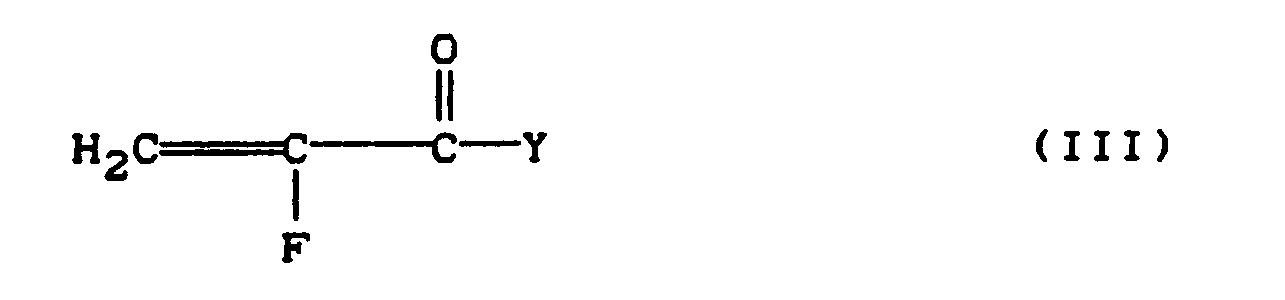
in der Y für Fluor, Chlor oder Brom steht, gegebenenfalls in Gegenwart eines Säurebindemittels in inerten organischen Lösungsmitteln umsetzt, oder - B) Verbindungen der Formel (11) mit einer Fluorverbindung der Formel

in der- Y die oben angegebene Bedeutung hat, und
- A und Z jeweils für Wasserstoff, Fluor, Chlor oder Brom stehen, wobei A und Z nie gleichzeitig Wasserstoff bedeuten,
umsetzt,
so daß die Fluoracryloyl-Verbindung (III) durch AZ-Abspaltung freigesetzt werden kann,
wobei AZ bevorzugt HF, HCI, HBr, Br2 oder C12 bedeutet.- a-Fluoracrylsäure-Derivate der Formel (III) oder deren Vorstufen (IV) können nach an sich bekannten Verfahren hergestellt werden [Zh. Org. Khim. 28, 1173 (1983)] und gegebenenfalls auch als Säureanhydride eingesetzt werden.
- R1 und R2 die unter der Formel (I) angegebene Bedeutung haben, oder deren Säureadditionsprodukte mit Fluoracrylsäure-Derivaten der Formel (111)
- Die als Ausgangsverbindungen verwendeten optisch aktiven Amine der Formel (11) sind bekannt oder können nach an sich bekannten Verfahren hergestellt werden (siehe Tetrahedron Lett. 1989, 317).
- Geeignete Säureadditionsverbindungen der als Ausgangsverbindungen zu verwendenden Amine sind Salze dieser Amine mit anorganischen oder organischen Säuren. Bevorzugt sind Mineralsäuren wie Salzsäure, Bromwasserstoffsäure, Schwefelsäure, Phosphorsäure oder organische Säuren wie Essigsäure, Methan-, Ethan-, Benzol- oder Toluolsulfonsäure.
- Als Lösungsmittel eignen sich alle unter den Reaktionsbedingungen inerten organischen Lösungsmittel. Bevorzugt sind Kohlenwasserstoffe wie Benzol, Toluol, Xylol oder Erdölfraktionen, oder Halogenkohlenwasserstoffe wie Di-, Tri- oder Tetrachlormethan, Dichlorethan oder Trichlorethylen oder Ether wie tert.-Butylmethylether oder tert.-Amyl-ethylether.
- Als Säurebindemittel kommen vor allem die üblichen anorganischen oder organischen Basen in Betracht; bevorzugt werden Alkali- oder Erdalkalihydroxide wie Natrium-, Kalium-, Lithium-, Calcium- oder Barium-hydroxid, Alkali- oder Erdalkalicarbonate wie Natrium- oder Kaliumcarbonat oder Natriumhydrogencarbonat, Alkalialkoholate wie Natriummethylat, -ethylat, Kaliummethylat, -ethylat, -t-butylat oder Amine wie Triethylamin oder Pyridin, verwendet.
- Die Umsetzung der a-Fluoracrylsäure-Derivate der Formel (III) mit den Amin-Derivaten der Formel (11) wird bevorzugt bei Temperaturen von -78 bis +100°C, insbesondere von -20 C bis +60°C vorgenommen.
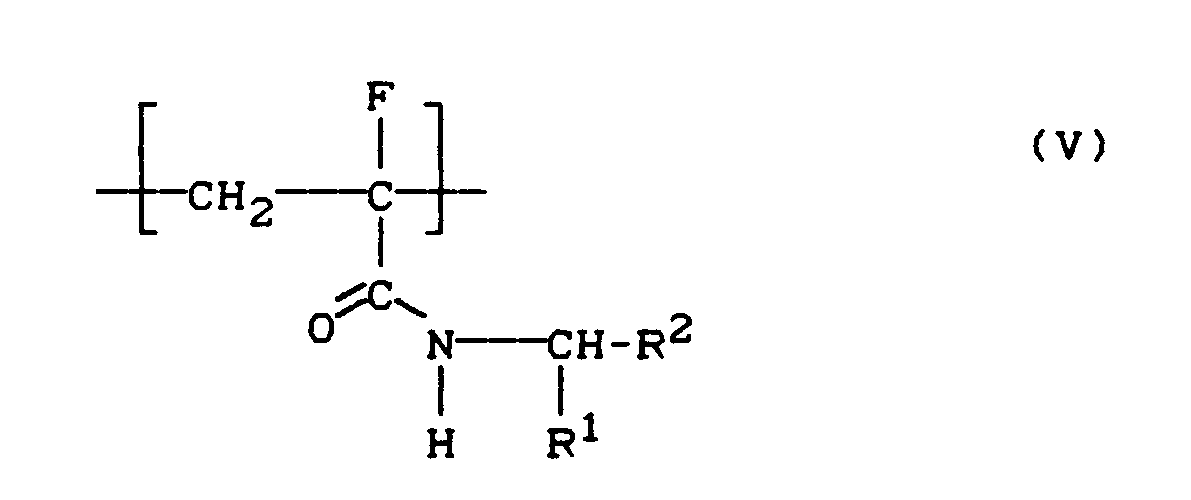
- Die Erfindung betrifft auch die durch Polymerisation bzw. Copolymerisation der optisch aktiven a-Fluoracrylsäure-Derivateder Formel (I) erhältlichen optisch aktiven Polymere und Copolymere, die mindestens 40 Mol-%, vorzugsweise mindestens 50 Mol-% Struktureinheiten der Formel (V)
enthalten,
in der R1 und R2 die unter Formel (I) angegebene Bedeutung haben. - Die erfindungsgemäßen optisch aktiven Polymere der Formel (V) liegen vorzugsweise in Form von vernetzten unlöslichen oder quellbaren Perl-Polymerisaten oder in an feinteilige anorganische Trägermaterialien wie z.B. Kieselgel gebundener Form vor. Sie können auch als lineare, in geeigneten organischen Lösungsmitteln lösliche Polymere hergestellt werden. Es ist ferner möglich, verschiedene erfindungsgemäße a-Fluoracrylsäure-Derivateder Formel (I) cozupolymerisieren, sowie 0,1 bis 60, vorzugsweise 0,1 bis 20 Mol-% copolymerisierbarer, anderer Monomere in das Polymere einzubauen.
- Die vernetzten Polymerisate liegen vorzugsweise in Form kleiner Teilchen (Perlen) mit 5 bis 200 um Teilchendurchmesser vor. Sie werden z.B. durch Suspensionspolymerisation der optisch aktiven a-Fluoracrylsäure-Derivate der Formel (I) mit 0,5 bis 50 Mol-%, vorzugsweise 1 bis 30 Mol-%, besonders bevorzugt 3 bis 20 Mol-% (bezogen auf die Gesamtmenge [Mol] der eingesetzten Monomere) eines geeigneten Vernetzers in an sich bekannter Weise hergestellt.
- Durch die Art und Menge der Vernetzer läßt sich der Quellungsgrad der (Perl)Polymerisate nach üblichen Methoden einstellen.
- Bei der praktischen Verwendung haben sich (Perl)Polymerisate mit einem Quellungsgrad (Q) von 1.1 bis 10, bevorzugt von 2.0 bis 7,0 bewährt.
- Der Quellungsgrad Q wird wie folgt bestimmt:

- Als Vernetzungsmittel kommen Verbindungen in Frage, die mindestens zwei polymerisierbare Vinylgruppen enthalten. Bevorzugte Vernetzungsmittel sind Alkandioldiacrylate wie 1,6-Hexandioldiacrylat, 1,4-Butandioldiacrylat, 1,3-Propandioldiacrylat oder 1,2-Ethylenglykoldiacrylat, oder Alkandiolmethacrylate wie 1,4-Butandioldimethacrylat, 1,3-Propandioldimethacrylat oder 1,2-Ethylenglykoldimethacrylat, aromatische Divinylverbindungen wie beispielsweise Divinylbenzol, Divinylchlorbenzol oder Divinyltoluol, Dicarbonsäurevinylester wie Adipinsäuredivinylester, Benzoldicarbonsäuredivinylester, Terephthalsäuredivinylester, N,N'-Alkylendiacrylamide wie N,N'-Methylendiacrylamid, N,N'-Ethylendiacrylamid, N,N'-Methylendimethacrylamidoder N,N'-Ethylendimethacrylamid.
- Als Radikalbildner kommen die üblichen Radikalbildner in Frage. Bevorzugt sind Peroxide wie beispielsweise Dibenzoylperoxid, Dilauroylperoxid oder Di-orthotolylperoxid oder Azoverbindungen wie beispielsweise Azobisisobuttersäurenitril (AIBN). Auch Gemische verschiedener Radikalbildner sind verwendbar.
- Die Polymerisationskomponenten werden in einem nicht mit Wasser mischbaren organischen Lösungsmittel, vorzugsweise einem aliphatischen oder aromatischen Kohlenwasserstoff wie Hexan, Heptan, Isododecan, Benzol oder Toluol, einem Halogenkohlenwasserstoff wie Di-, Tri-, Tetrachlormethan oder 1,2-Dichlorethan oder einem Ester wie Essigsäureethylester bzw. Essigsäurebutylester gelöst.
- Die organische Phase wird mit Hilfe eines wirksamen Rührers in der wäßrigen Lösung eines Schutzkolloids, bevorzugt in einer wäßrigen Lösung von Polyvinylalkohol, Polyvinylpyrrolidon oder eines Copolymers aus Methacrylsäure und Methylmethacrylat, gleichmäßig verteilt. Je Gewichtsteil organische Phase verwendet man etwa 1 bis 20, bevorzugt 2 bis 10 Gew.-Teile wäßrige Phase. Das Polymerisationsgemisch wird unter Rühren in einer Inertgasatmosphäre, vorzugsweise unter Stickstoff, auf Temperaturen von 30 C bis 100°C, vorzugsweise 40 C bis 80 C erhitzt. Die Polymerisationsdauer beträgt zwischen 2 und 24, bevorzugt 4 und 12 Stunden. Das auf diese Weise erhaltene Copolymerisat wird durch Filtration von der flüssigen Phase getrennt, durch gründliches Waschen mit Wasser und mit organischen Lösungsmitteln wie Methanol, Ethanol, Benzol, Toluol, Di-, Trichlormethan oder Aceton gereinigt und anschließend getrocknet.
- Insbesondere für analytische Anwendungen werden die erfindungsgemäßen optisch aktiven Polymere vorzugsweise in an feinteilige anorganische Träger gebundener Form eingesetzt. Die Herstellung solcher optisch aktiver Chromatographiephasen kann beispielsweise nach den in DE-A 3 706 890 beschriebenen Verfahren erfolgen.
- Bevorzugt ist die Polymerisation der optisch aktiven a-Fluoracrylsäure-Derivate der Formel (I) in Gegenwart von Kieselgel-Diolphasen, die mit (Meth)acrylsäure verestert wurden. Die Polymerisation kann dabei in Abwesenheit von Lösungsmitteln oder in Gegenwart von Lösungsmitteln oder von Fällungsmitteln für die Poly-a-fluoracrylamide durchgeführt werden. Als Initiatoren können die zur Herstellung der Perlpolymerisate verwendeten Radikalbildner ebenfalls eingesetzt werden.
- Die polymermodifizierten Kieselgele enthalten vorzugsweise 1 bis 40 Gew.-%, insbesondere 5 bis 30 Gew.-% an optisch aktivem Polymer (V), bezogen auf das Gesamtgewicht. Sie werden intensiv mit Lösungsmitteln für das Polymere gewaschen und im Vakuum getrocknet.
- Selbstverständlich können auch hier Gemische von zwei oder mehreren der erfindungsgemäßen a-Fluoracrylsäure-Derivate, gegebenenfalls auch mit weiteren copolymerisierbaren Monomeren eingesetzt werden.
- Die Erfindung betrifft ferner die Verwendung der erfindungsgemäßen Polymere als solche oder in vernetzter bzw. an Kieselgel gebundener Form zur chromatographischen Trennung von racemischen Gemischen in die optischen Antipoden. Gut trennbare Racemate sind beispielsweise Oxazepam, Binaphthol, 1,1'-Binaphthyl-2,2'-dicarbonsäure, Thalidomid, Chlormezanon, Hexahydrocarbazolderivate wie z.B. 3-r-(Benzol-sulfonamido)-9-(2-carboxyethyl)-1,2,3,4,4a,9a-hexahydrocarbazol und Dihydropyridine wie z.B. 1,4-Dihydro-2,6-dimethyl-4-(2-trifluormethylphenyl)-pyridin-3,5-dicarbonsäure-5-ethylester.
- Die Zusammensetzung des Fließmittels kann je nach Art und Eigenschaft des zu trennenden Racemates in üblicher Weise ausgewählt und optimiert werden. Die an Kieselgel gebundenen erfindungsgemäßen Poly-a-fluoracrylsäurederivate können für chromatographische Racemattrennungen unter HPLC-Bedingungen eingesetzt werden.
- Die Fähigkeit der Polymerisate zur Racemattrennung wird durch die Kapazitätsverhältnisse (k',(2)-Werte) für die beiden Enantiomere (1) und (2) und den daraus resultierenden Enantioselektivitätswert a ausgedrückt. Diese chromatographischen Parameter sind wie folgt definiert:


to = Totzeit der Säule
t1 (2) = Retentionszeit des zuerst eluierten Enantiomers 1 bzw. des später eluierten Enantiomers 2 Die präparative Trennung von racemischen Gemischen in ihre optischen Antipoden unter Verwendung der erfindungsgemäßen Polymerisate wird vorzugsweise säulenchromatographisch vorgenommen. Besonders vorteilhaft ist es hierfür, die chromatographische Trennung mit Perlpolymerisaten einer bestimmten Korngrößenverteilung vorzunehmen; gute Trennleistungen werden mit Perlpolymerisaten einer Korngrößenverteilung von 5 bis 200 um, bevorzugt 15 bis 100 um erhalten. - Die Arbeitsmethodik der säulenchromatographischen Trennung ist bekannt. Üblicherweise wird das Polymerisat im Fließmittel suspendiert und die Suspension in eine Glassäule gefüllt. Nach Ablaufen des Fließmittels wird das zu trennende Racemat, gelöst in möglichst wenig Fließmittel, auf die Säule aufgebracht. Dann wird mit Fließmittel eluiert und die Enantiomeren im Eluat photometrisch und/oder polarimetrisch mittels geeigneter Durchflußzellen detektiert.
- Als Fließmittel werden übliche organische Lösungsmittel bzw. Lösungsmittelgemische verwendet, die das als Adsorbens eingesetzte Polymerisat anquellen und das zu trennende Racemat lösen. Beispielsweise seien genannt: Kohlenwasserstoffe wie Benzol, Toluol oder Xylol, Ether wie Diethylether, Dioxan oder Tetrahydrofuran, Halogenkohlenwasserstoffe wie Di- oder Trichlormethan, Aceton, Acetonitril oder Essigester, Alkohole wie Methanol, Ethanol, n-Propanol, Isopropanol oder n-Butanol, oder aber Gemische der genannten Lösungsmittel. Als besonders geeignet haben sich Mischungen aus Toluol mit Tetrahydrofuran, Dioxan oder Isopropanol erwiesen.
- Zu einer Lösung von 26,6 g (0,22 Mol) S-Phenethylamin und 22,2 g (0,22 Mol) Triethylamin in 400 ml abs. Dichlormethan tropfte man bei -10 C eine Lösung von 20,8 g (0,22 Mol) a-Fluoracrylsäurechlorid in 20 ml abs. Dichlormethan. Man ließ 2 Stunden ohne Kühlbad nachrühren, wusch erst mit Wasser, dann mit 1 N HCI (2 x) und trocknete den organischen Extrakt über Magnesiumsulfat. Nach Evaporieren des Solvens verblieben 41,8 g Feststoff vom Fp. 87° C. Umkristallisation aus Petrolether/Toluol 2:1 ergab 29,7 g (70 % d. Th.) reines Fluoracrylamid vom Fp. 93°C.
- Drehwert (c = 1, CHCl3) -175,7
- Analog erhielt man aus 26,16 g (0,206 Mol) S-Cyclohexylethylamin 38,6 g Rohprodukt. Kristallisation aus Petrolether/Toluol 15:1 ergab 23 g (58 % d. Th.) Fluoracrylamid vom Fp. 86°C.
- Drehwert (c = 1, CHCl3) -37,9
- Durch Einsatz von 31 g (0,2 Mol) d-Menthylamin wurden 37,5 g Rohprodukt isoliert, das durch Chromatographie an Silicagel mit Ether/Petrolether 1:2 gereinigt wurde.
- Ausbeute: 24 g (52 %), Fp.: 36 C
- Drehwert (c = 1, CHCl3) + 48,6
- Führt man die Reaktion mit 41 g (0,2 Mol) (4S,5S)-5-Amino-2,2-dimethyl-4-phenyl-1,3-dioxan durch, so erhält man 51 g Rohprodukt. Reinigung an Silicagel mit Ether/Petrolether 7:2 ergab 29,4 g Fluoracrylamid vom Fp. 94°C.
- Drehwert (c = 1, CHCl3) + 30,5
- 2. Polymerisation der N-a-Fluoracrylsäureamide
- 2.1 Herstellung in an Kieselgel gebundener Form
- a) 25 g mit 1,2-Diolgruppen modifiziertes Kieselgel (mittlere Korngröße: 5 um, Analysenwerte C: 7,7 %, H: 1,5 %) werden unter Feuchtigkeitsausschluß und unter Stickstoff in 500 ml Dioxan suspendiert. Die Suspension wird mit 16 ml Methacrylsäureanhydrid und 12,5 ml Triethylamin versetzt. Die Mischung wird 1 Stunde bei Raumtemperatur gerührt und 24 Stunden bei Raumtemperatur aufbewahrt. Dann wird das Kieselgel über eine Glasfritte (G4) abgesaugt, 3 x mit je 500 ml Dioxan 30 Minuten lang verrührt und zwischendurch gut trockengesaugt. Das durch Methacryloyl-Gruppen modifizierte Kieselgel wird bei Raumtemperatur im Vakuum <0,005 at getrocknet.
- Ausbeute: 24,8 g
- Elementaranalyse: C 9,2 %; H 1,7 %
- b) In einem mit Rückflußkühler und Magnetrührer versehenen 100 ml-Rundkolben werden 3 g des mit Methacryloylgruppen modifizierten Kieselgels, dessen Herstellung unter a) beschrieben ist, 6,0 g optisch aktives N-a-Fluoracryloyl-amin und 60 mg Azobisisobutyronitril in 25 ml trockenem Toluol gelöst bzw. suspendiert. Die Apparatur wird durch dreimaliges Evakuieren und mit Stickstoffüllen von Luft befreit und abschließend mit Stickstoff befüllt. Das Polymerisationsgemisch wird 1 Stunde bei Raumtemperatur gerührt und dann rasch auf 80 C erhitzt. Nach 45-minütigem Rühren bei 80 C werden 200 mg 2,6-Di- tert.-butyl-4-methylphenol zugesetzt und das Reaktionsgemisch rasch abgekühlt. Das Kieselgel wird über eine Glasfritte (G4) abgesaugt, mit Toluol gewaschen und 2 x mit je 50 ml Chloroform, 1 x mit 50 ml Toluol und 1 x mit 50 ml Isopropanol je 30 Minuten verrührt und zwischendurch abgesaugt. Das Kieselgel wird abschließend bei Raumtemperatur im Vakuum <0,005 at getrocknet. In der nachstehenden Tabelle 1 sind die auf das modifizierte Kieselgel aufpolymerisierten N-a-Fluoracryloyl-amine, die Ausbeuten an optisch aktive Verbindungen enthaltendem Kieselgel, dessen Stickstoffgehalt und dessen Gehalt an gebundenem Polymer zusammengestellt.

- 3. Herstellung in Form von Perlpolymerisaten
- Die Lösung von 13,5 g optisch aktiven N-a-Fluoracryloylamin, 1,5 g Ethylenglykoldimethacrylat und 0,3 g Azobisisobutyronitril in 37,5 g Trichlormethan wird unter Rühren (350 bis 500 U/min) in einer Lösung von 3 g Polyvinylalkohol in 130 ml entmineralisiertem Wasser dispergiert. Die Apparatur wird mehrmals evakuiert und mit Stickstoff gefüllt. Das Polymerisationsgemisch wird unter Stickstoff zunächst 30 Minuten bei Raumtemperatur und anschließend 16 Stunden bei 55 C (Innentemperatur) gerührt. Das Polymerisationsgemisch wird dann in 2 bis 3 I Wasser eingerührt und die flüssige Phase nach dem Absitzen des Perlpolymerisates dekantiert. Das Perlpolymerisat wird durch 3 bis 4-maliges Suspendieren in Wasser und Abdekantieren der flüssigen Phase vom Feinkorn (Polymerisat mit einer Korngröße von <10 um) befreit und nach intensivem Waschen mit Aceton bei 60°C bis zur Gewichtskonstanz getrocknet.
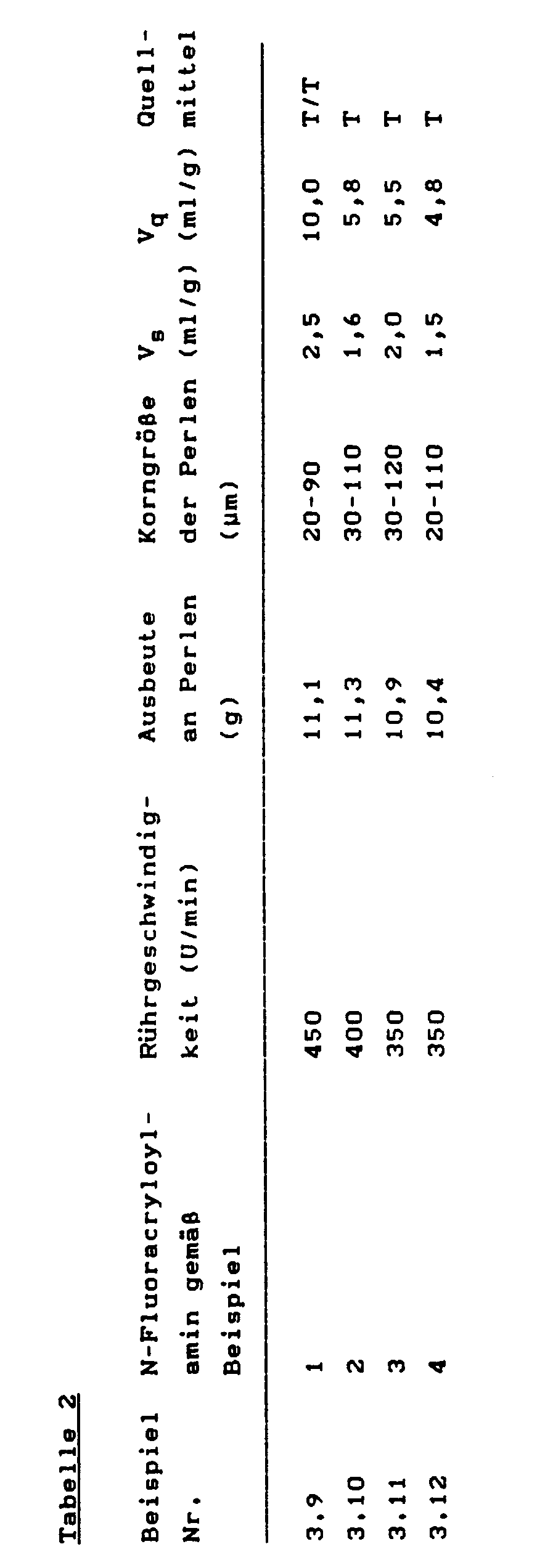
- In der nachstehenden Tabelle 2 sind die für die Polymerisation verwendeten N-a-Fluoracryloyl-amine, die Rührgeschwindigkeit, bei der die Polymerisation durchgeführt wurde, die Ausbeuten, in denen die Polymerisate erhalten wurden, deren Korngröße und das Volumen der erhaltenen Perlpolymerisate in trockenem (Vs) und gequollenem (Vq) Zustand (Quellmittel: Toluol = T bzw. Toluol/THF = 3:2 v/v-Gemisch = T/T) zusammengestellt.
- Verwendung der optisch aktiven Polymerisate der a-Fluoracrylsäure-Derivate als Adsorbentien für die Racemattrennung
- Für die chromatographischen Trennungen wurden folgende Testracemate verwendet:
- Racemat Nr. 1: Oxazepam
- Racemat Nr. 2: Binaphthol
- Racemat Nr. 3: Chlormezanon
- Racemat Nr. 4: 1,1'-Binaphthyl-2,2'-dicarbonsäure
- Racemat Nr. 5: 1,4-Dihydro-2,6-dimethyl-5-nitro-4-(2-trifluormethylphenyl)-pyridin-3-carbonsäureethylester
- Racemat Nr. 6: 3-r-(4-Fluorphenylsulfonamido)-9-(2-carboxyethyl)-1 ,2,3,4,4a, 9a-hexahydrocarbazol Die bei der chromatographischen Trennung der verschiedenen Testracemate 1 bis 6 mit Hilfe der erfindungsgemäßen Adsorbentien erhaltenen Ergebnisse (Enantioselektivität a und Kapazitätsverhältnis k1 und die verwendeten Elutionsmittel sind in der folgenden Tabelle zusammengestellt.
- Die an Kieselgel gebundenen Polymerisate wurden in Stahlsäulen (Innendurchmesser: 4 mm; Länge: 25 cm) eingesetzt. Eluiert wurde mit n-Heptan-Tetrahydrofuran-Gemischen: a) 3:2 v/v; b) 1:1 v/v.
- Die überraschende Trennwirkung der erfindungsgemäßen polymeren Fluoracrylamide wird durch direkten Vergleich mit den entsprechenden polymeren (Meth)Acrylamiden offensichtlich, die den gleichen optisch aktiven Rest enthalten.
- Die Vergleiche wurden mit den an Kieselgel fixierten chiralen Polymeren durchgeführt.
- So läßt sich beispielsweise der Tranquilizer Oxazepam (Testracemat 1) am erfindungsgemäßen Polyfluoracrylamid des optisch aktiven 1-Phenethylamins (Adsorbens 5) fast vollständig in die Enantiomere trennen, während weder das polymere Acryl- noch das Methacrylamid des 1-Phenethylamins eine Trennwirkung zeigen.
- In einem anderen Fall zeigt obiges Polyfluoracrylamid (Adsorbens 5) für den als Racemat vorliegenden Thromboxan-Antagonisten 3-r-(Benzolsulfonamido)-9-(2-carboxyethyl)-1,2,3,4,4a,9a-hexahydrocarbazol (Testracemat 6) eine Trennwirkung, während das entsprechende Polyacrylamid keinerlei Antrennung erkennen läßt.
- In ähnlicher Weise trennt das erfindungsgemäße Polyfluoracrylamid des optisch aktiven 1-Cyclohexylethylamins (Adsorbens 6) Oxazepam (Testracemat 1) fast vollständig in die Enantiomere, während das entsprechende Polymethacrylamid nur eine sehr schlechte Trennwirkung für das Oxazepam-Racemat aufweist.
- Das erfindungsgemäße polymere Fluoracrylamid des optisch aktiven Menthylamins (Adsorbens 7) zeigt eine deutliche Trennwirkung für 6,6'-Dimethylbiphenyl-2,2'-dicarbonsäure (Testracemat 4), während das entsprechende polymere Methacrylamid nur eine geringe Aktivierung für dieses Racemat zeigt (Beispiel 4).

Claims (9)
1. Optisch aktive a-Fluoracrylsäureamide der Formel (I)

in welcher
in welcher
R1 für einen Phenyl-, Naphthyl-, Pyridyl- oder C3-C10-Cycloalkylrest steht, der gegebenenfalls substituiert ist durch Halogen, C1-C4-Alkoxy, NR3COR4, Dioxyalkylen mit 1 bis 2 C-Atomen, Alkyl oder Cycloalkyl mit jeweils bis zu 10 C-Atomen, wobei
R3 für Wasserstoff oder C1-C4-Alkyl steht und
R4 für Alkyl oder Alkoxy mit jeweils 1 bis 6 C-Atomen, für Phenyl oder Benzoxy steht,
R2 für Alkyl oder Cycloalkyl mit jeweils bis zu 8 C-Atomen, gegebenenfalls substituiert durch Halogen oder durch C1-C4-Alkoxy steht, oder
R1 und R2 gemeinsam für einen cyclischen Rest aus der Gruppe Terpenyl, 8-Alkyl(C1-C4)-menthyl, 8-Aryl(C6-Cio)-menthyl, Tetrahydropyryl, 2,2-Dialkyl(C1-C4)-4-aryl-(C6-C10)-1,3-dioxan-5-yl, 2,2-Dialkyl-(C1-C4)-4-cycloalkyl(C3-C8)-1,3-dioxan-5-yl, Spiro- cycloalkyl(C3-C8)-2'-4-aryl-(C6-C10)-1,3-dioxan-5-yl, Spiro-cycloalkyl(C3-C8)-2'-4-cycloalkyl(C3-C8)-1,3-dioxan-5-yl, Cl-C4-alkylsubstituierter C3-C8-Cycloalkylrest steht.
2. Verbindungen der Formel (I) gemäß Anspruch 1, in welcher
R1 für Naphthyl, Pyridyl oder Phenyl steht, welches gegebenenfalls ein- oder zweifach substituiert ist durch gleiche oder verschiedene Substituenten aus der Gruppe Fluor, Chlor, Alkyl mit 1 bis 4 C-Atomen, Alkoxy mit 1 bis 4 C-Atomen, Cycloalkyl mit 3 bis 6 C-Atomen, Methylendioxy, Ethylendioxy, Acetamido, Benzamido, Carbomethoxyamino, Carboethoxyamino, Carbobenzoxyamino oder für einen Cycloalkylrest mit 3 bis 7 C-Atomen oder für einen Decahydronaphthylrest steht,
R2 für Alkyl oder Cycloalkyl mit jeweils bis zu 8 C-Atomen steht, wobei der Alkylrest gegebenenfalls durch Fluor, Chlor oder Alkoxy mit 1 bis 2 C-Atomen substituiert ist, oder
R1 und R2 gemeinsam für einen Rest stehen aus der Gruppe Menthyl, Neomenthyl, Isomenthyl, Neoisomenthyl, Carvomenthyl, Bornyl, Fenchyl, Pinanyl, Isopinocampheyl, 8-Methylmenthyl, 8-Ethyl-menthyl, 8-n-Propyl-menthyl, 8-i-Propylmenthyl, 8-n-Butylmenthyl, 8-i-Butylmenthyl, 8-s-Butylmenthyl, 8-t-Butylmenthyl, 8-Phenylmenthyl, 8-Naphthylmenthyl, Tetrahydropyryl, 2,2-Dimethyl-4-phenyl-1,3-dioxan-5-yl, 2,2-Dimethyl-4-naphthyl-1,3-dioxan-5-yl, 2,2-Diethyl-4-phenyl-1,3-dioxan-5-yl, 2,2-Diethyl-4-naphthyl-1,3-dioxan-5-yl, 2,2-Dipropyl-4-phenyl-1,3-dioxan-5-yl, 2,2-Dipropyl-4-naphthyl-1,3-dioxan-5-yl, 2,2-Dibutyl-4-phenyl-1,3-dioxan-5-yl, 2,2-Dibutyl-4-naphthyl-1,3-dioxan-5-yl analog mit 2,2-Dibutyl-4-cyclohexyl-1,3-dioxan-5-yl, Spiro-cyclopentyl-4,2'-4-phenyl-1,3-dioxan-5-yl, Spiro-cyclopentyl-4,2'-4-naphthyl-1,3-dioxan-5-yl, Spiro-cyclopentyl-4,2'-4-cyclohexyl-1,3-dioxan-5-yl, Spiro-cyclohexyl-5,2'-4-phenyl-1,3-dioxan-5-yl, Spiro- cyclohexyl-5,2'-4-naphthyl-1,3-dioxan-5-yl, Spiro-cyclohexyl-5,2'-4-cyclohexyl-1,3-dioxan-5-yl, 2-Methyl-cyclopentyl, 2-Ethyl-cyclopentyl, 2-Propyl-cyclopentyl, 2-i-Propyl-cyclopentyl, 2-n-Butyl-cyclopentyl, 2-i-Butyl-cyclopentyl, 2-s-Butyl-cyclopentyl, 2-t-Butyl-cyclopentyl, 2-Methyl-cyclohexyl, 2-Ethyl-cyclohexyl, 2-Propyl-cyclohexyl, 2-i-Propyl-cyclohexyl, 2-n-Butyl-cyclohexyl, 2-i-Butyl-cyclohexyl, 2-s-Butyl-cyclohexyl, 2-t-Butyl-cyclohexyl.
3. Verbindungen der allgemeinen Formel (I) gemäß Anspruch 1, in welcher
R1 für Phenyl steht, welches gegebenenfalls einfach substituiert ist durch Fluor, Chlor, Methyl, Methoxy, Nitro, Acetamido, Benzamido, Carbomethoxyamino, Carboethoxyamino, Ethyl, Propyl oder Butyl oder für 1-Naphthyl, 2-Naphthyl, 2-Pyridyl, 3-Pyridyl, 4-Pyridyl, Decahydronaphthyl oder Cycloalkyl mit 3 bis 6 C-Atomen steht,
R2 für Alkyl mit 1 bis 4 C-Atomen, welches gegebenenfalls durch Fluor, Chlor, Methoxy oder Ethoxy substituiert ist oder für Cyclopentyl oder Cyclohexyl steht oder
R1 und R2 gemeinsam für einen Rest stehen aus der Gruppe Menthyl, Neomenthyl, Isomenthyl, Neoisomenthyl, Carvomenthyl, Bornyl, Fenchyl, Pinanyl, Isopinocampheyl, 8-Methylmenthyl, 8-Phenylmenthyl, Tetrahydropyryl, 2,2-Dimethyl-4-phenyl-1,3-dioxan-5-yl, 2,2-Diethyl-4-phenyl-1,3-dioxan-5-yl, 2,2-Diethyl-4-phenyl-1,3-dioxan-5-yl, 2,2-Dipropyl-4-phenyl-1,3-dioxan-5-yl, 2,2-Dibutyl-4-phenyl-1,3-dioxan-5-yl, 2,2-Dimethyl-4-cyclohexyl-1,3-dioxan-5-yl, 2,2-Diethyl-4-cyclohexyl-1,3-dioxan-5-yl, 2,2-Dipropyl-4-cyclohexyl-1,3-dioxan-5-yl, 2,2-Dibutyl-4-cyclohexyl-1,3-dioxan-5-yl, Spiro-cyclopentyl-4,2'-4-phenyl-1,3-dioxan-5-yl, Spiro-cyclopentyl-4,2'-4-cyclohexyl-1,3-dioxan-5-yl, Spiro-cyclohexyl-5,2'-4-phenyl-1,3-dioxan-5-yl, Spiro-cyclohexyl-5,2'-4-cyclohexyl-1,3-dioxan-5-yl, 2-Methyl-cyclopentyl, 2-Methyl-cyclohexyl.
4. Verfahren zur Herstellung von optisch aktiven a-Fluoracrylsäureamiden der allgemeinen Formel (I)

in welcher
in welcher
R1 für einen Phenyl-, Naphthyl-, Pyridyl- oder C3-C10-Cycloalkylrest steht, der gegebenenfalls substituiert ist durch Halogen, Nitro, C1-C4-Alkoxy, NR3COR4, Dioxyalkylen mit 1 bis 2 C-Atomen, Alkyl oder Cycloalkyl mit jeweils bis zu 10 C-Atomen, wobei
R3 für Wasserstoff oder C1-C4-Alkyl steht und
R4 für Alkyl oder Alkoxy mit jeweils 1 bis 6 C-Atomen, für Phenyl oder Benzoxy steht,
R2 für Alkyl oder Cycloalkyl mit jeweils bis zu 8 C-Atomen, gegebenenfalls substituiert durch Halogen oder durch C1-C4-Alkoxy steht, oder
R1 und R2 gemeinsam für einen cyclischen Rest aus der Gruppe Terpenyl, 8-Alkyl(C1-C4)-menthyl, 8-Aryl(C6-Cio)-menthyl, Tetrahydropyryl, 2,2-Dialkyl(C1-C4)-4-aryl(C6-C10)-1,3-dioxan-5-yl, 2,2-Dialkyl(C1-C4)-4-cycloalkyl(C3-C8)-1,3-dioxan-5-yl, Spiro- cycloalkyl(C3-C8)-2'-4-aryl(C6-C10)-1,3-dioxan-5-yl, Spiro-cycloalkyl(C3-C8)-2'-4-cycloalkyl(C3-C8)-1,3-dioxan-5-yl, Cl-C4-alkylsubstituierter C3-C8-Cycloalkylrest steht, dadurch gekennzeichnet, daß man optisch aktive Amine der Formel (II)

in der
in der
R1 und R2 die unter der Formel (I) angegebene Bedeutung haben, oder deren Säureadditionsprodukte
mit Fluoracrylsäure-Derivaten der Formel (III)

in der
in der
Y für Fluor, Chlor oder Brom steht,
gegebenenfalls in Gegenwart eines Säurebindemittels in inerten organischen Lösungsmitteln umsetzt, oder
B) Verbindungen der Formel (II) mit einer Fluorverbindung der Formel
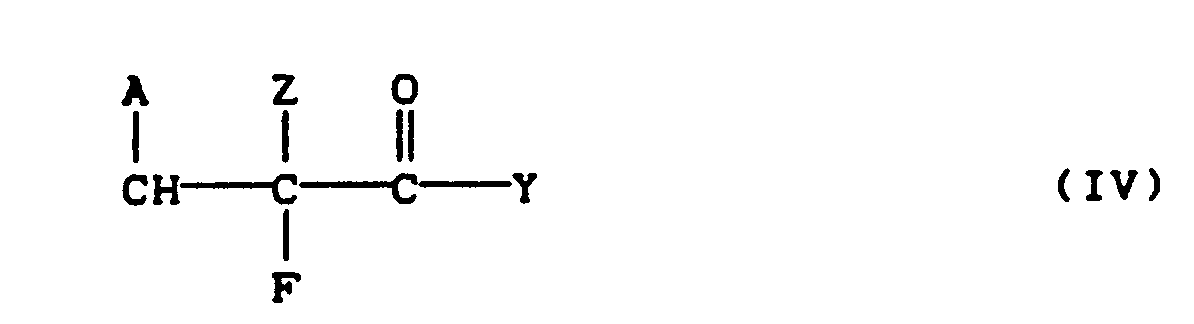
in der
Y die oben angegebene Bedeutung hat, und
A und Z jeweils für Wasserstoff, Fluor, Chlor oder Brom stehen, wobei A und Z nie gleichzeitig Wasserstoff bedeuten,
umsetzt,
so daß die Fluoracryl-Verbindung (111) durch AZ-Abspaltung freigesetzt werden kann.
5. Optisch aktive Polymere enthaltend mindestens 40 Mol-% von Struktureinheiten der Formel (V)

in welcher
R1 und R2 die in Anspruch 1 angegebene Bedeutung haben.
in welcher
R1 und R2 die in Anspruch 1 angegebene Bedeutung haben.
6. Optisch aktive Polymere gemäß Anspruch 5, dadurch gekennzeichnet, daß sie in Form von vernetzten unlöslichen oder quellbaren Perlpolymerisaten oder in an feinteilige anorganische Trägermaterialien gebundener Form vorliegen.
7. Verfahren zur Herstellung von vernetzten Perlpolymerisaten gemäß Anspruch 6, dadurch gekennzeichnet, daß man die N-a-Fluoracrylsäure-Derivate der allgemeinen Formel (I) mit 0,5 bis 50 Mol-% eines Vernetzers durch Suspensionspolymerisation, gegebenenfalls in Anwesenheit von Radikalbildnern und inerten organischen Lösungsmitteln herstellt.
8. Verfahren zur Herstellung von an anorganische Trägermaterialien gebundenen optisch aktiven Polymere gemäß Anspruch 6, dadurch gekennzeichnet, daß man Verbindungen der allgemeinen Formel (I) gemäß Anspruch 1 in Gegenwart von gegebenenfalls (Meth)-acrylsäure-substituierten Kieselgel-Diolphasen gegebenenfalls in Anwesenheit von Radikalbildnern und gegebenenfalls in Anwesenheit von inerten organischen Lösungsmitteln verestert.
9. Verwendung von Polymeren gemäß Anspruch 7 zur Trennung von optischen Isomeren.
Applications Claiming Priority (2)
| Application Number | Priority Date | Filing Date | Title |
|---|---|---|---|
| DE4021106 | 1990-07-03 | ||
| DE4021106A DE4021106A1 (de) | 1990-07-03 | 1990-07-03 | Optisch aktive (alpha)-fluoracrylsaeureamide, ihre herstellung, ihre polymerisation zu optisch aktiven polymeren und deren vewendung zur trennung von racematen |
Publications (1)
| Publication Number | Publication Date |
|---|---|
| EP0464487A1 true EP0464487A1 (de) | 1992-01-08 |
Family
ID=6409541
Family Applications (1)
| Application Number | Title | Priority Date | Filing Date |
|---|---|---|---|
| EP91110141A Withdrawn EP0464487A1 (de) | 1990-07-03 | 1991-06-20 | Optische aktive Alpha-Fluoracrylsäureamide, ihre Herstellung, ihre Polymerisation zu optisch aktiven Polymeren und deren Verwendung zur Trennung von Racematen |
Country Status (4)
| Country | Link |
|---|---|
| EP (1) | EP0464487A1 (de) |
| JP (1) | JPH04230349A (de) |
| CA (1) | CA2045971A1 (de) |
| DE (1) | DE4021106A1 (de) |
Cited By (1)
| Publication number | Priority date | Publication date | Assignee | Title |
|---|---|---|---|---|
| WO1994012275A1 (en) * | 1992-12-03 | 1994-06-09 | Eka Nobel Ab | Chiral adsorbents and preparation thereof as well as compounds on which the adsorbents are based and preparation of these compounds |
Citations (5)
| Publication number | Priority date | Publication date | Assignee | Title |
|---|---|---|---|---|
| JPS5933307A (ja) * | 1982-08-20 | 1984-02-23 | Japan Synthetic Rubber Co Ltd | エラストマ−の分離方法 |
| EP0218089A1 (de) * | 1985-09-11 | 1987-04-15 | Bayer Ag | Optisch aktive (Meth)-Acrylamide, Polymere daraus, Verfahren zu ihrer Herstellung und ihre Verwendung zur Racematspaltung |
| JPS62255548A (ja) * | 1986-04-29 | 1987-11-07 | Mitsubishi Electric Corp | 内燃機関の燃料制御装置 |
| EP0249078A2 (de) * | 1986-06-07 | 1987-12-16 | MERCK PATENT GmbH | Optisch aktive Adsorbentien |
| EP0279331A2 (de) * | 1987-02-17 | 1988-08-24 | Daikin Industries, Limited | Alpha-Fluoroacrylssäuresalzpolymer und seine Verwendung |
-
1990
- 1990-07-03 DE DE4021106A patent/DE4021106A1/de not_active Withdrawn
-
1991
- 1991-06-20 EP EP91110141A patent/EP0464487A1/de not_active Withdrawn
- 1991-06-26 CA CA002045971A patent/CA2045971A1/en not_active Abandoned
- 1991-06-27 JP JP3181590A patent/JPH04230349A/ja active Pending
Patent Citations (5)
| Publication number | Priority date | Publication date | Assignee | Title |
|---|---|---|---|---|
| JPS5933307A (ja) * | 1982-08-20 | 1984-02-23 | Japan Synthetic Rubber Co Ltd | エラストマ−の分離方法 |
| EP0218089A1 (de) * | 1985-09-11 | 1987-04-15 | Bayer Ag | Optisch aktive (Meth)-Acrylamide, Polymere daraus, Verfahren zu ihrer Herstellung und ihre Verwendung zur Racematspaltung |
| JPS62255548A (ja) * | 1986-04-29 | 1987-11-07 | Mitsubishi Electric Corp | 内燃機関の燃料制御装置 |
| EP0249078A2 (de) * | 1986-06-07 | 1987-12-16 | MERCK PATENT GmbH | Optisch aktive Adsorbentien |
| EP0279331A2 (de) * | 1987-02-17 | 1988-08-24 | Daikin Industries, Limited | Alpha-Fluoroacrylssäuresalzpolymer und seine Verwendung |
Non-Patent Citations (2)
| Title |
|---|
| PATENT ABSTRACTS OF JAPAN, Band 12. Nr. 139 (C-491)[2986], 27. April 1988; & JP-A-62 255 548 (DAIKIN IND., LTD) 07-11-1987 * |
| PATENT ABSTRACTS OF JAPAN, Band 8, Nr. 122 (C-227)[1559], 8. Juni 1984; & JP-A-59 33 307 (NIPPON GOSEI GOMU K.K.) 23-02-1984 * |
Cited By (3)
| Publication number | Priority date | Publication date | Assignee | Title |
|---|---|---|---|---|
| WO1994012275A1 (en) * | 1992-12-03 | 1994-06-09 | Eka Nobel Ab | Chiral adsorbents and preparation thereof as well as compounds on which the adsorbents are based and preparation of these compounds |
| US6277782B1 (en) | 1992-12-03 | 2001-08-21 | Eka Nobel Ab | Chiral adsorbents and preparation thereof as well as compounds on which the adsorbents are based and preparation of these compounds |
| US6333426B1 (en) | 1992-12-03 | 2001-12-25 | Eka Nobel Ab | Chiral adsorbents and preparation thereof as well as compounds on which the absorbents are based and preparation of the compounds |
Also Published As
| Publication number | Publication date |
|---|---|
| CA2045971A1 (en) | 1992-01-04 |
| DE4021106A1 (de) | 1992-01-09 |
| JPH04230349A (ja) | 1992-08-19 |
Similar Documents
| Publication | Publication Date | Title |
|---|---|---|
| EP0379917B1 (de) | Optisch aktive (Meth)Acrylsäure-Derivate, ihre Herstellung, ihre Polymerisation zu optisch aktiven Polymeren und deren Verwendung | |
| EP0249078B1 (de) | Optisch aktive Adsorbentien | |
| EP0282770A1 (de) | Optisch aktive (Meth)acrylamide, Verfahren zu ihrer Herstellung und ihre Verwendung zur Racematspaltung | |
| EP0218089B1 (de) | Optisch aktive (Meth)-Acrylamide, Polymere daraus, Verfahren zu ihrer Herstellung und ihre Verwendung zur Racematspaltung | |
| DE69319922T3 (de) | Chirale adsorbentien und deren herstellung, sowie verbindungen auf welche die adsorbetntien sich gründen und die herstellung dieser verbindungen | |
| EP0520242B1 (de) | Optisch aktive schwefelhaltige Aminosäure-Derivate, ihre Herstellung, ihre Polymerisation zu optisch aktiven Polymeren und deren Verwendung | |
| EP0464488B1 (de) | Optisch aktive N-aplha-Fluoracryloylaminosäure-Derivate, ihre Herstellung, die daraus hergestellten optisch aktiven Polymeren und deren Verwendung zur Spaltung von Racematen | |
| EP0425848A1 (de) | Säulenpackungsmaterial für die Gelpermeationschromatographie, Verfahren zu dessen Herstellung sowie dessen Verwendung | |
| EP0576949B1 (de) | Optisch aktive Aminosäuresulfoxid- und -sulfon-Derivate, ihre Herstellung, ihre Polymerisation und Verwendung als Adsorbentien für die chromatographische Racematspaltung | |
| EP0545168B1 (de) | Füllstoffhaltige, optisch aktive Perlpolymerisate | |
| DE2500523C2 (de) | Vernetzte Polymerisate, Verfahren zu ihrer Herstellung und ihre Verwendung | |
| DE4021106A1 (de) | Optisch aktive (alpha)-fluoracrylsaeureamide, ihre herstellung, ihre polymerisation zu optisch aktiven polymeren und deren vewendung zur trennung von racematen | |
| EP0135162B1 (de) | Weinsäuremonoester von optisch aktiven Alkanolaminen, Verfahren zu ihrer Herstellung und ihre Verwendung | |
| EP0584664B1 (de) | Polymerisierbare Dipeptide:Synthese, Polymerisation und Verwendung der Polymere zur chromatographischen Enantiomerentrennung | |
| Xu et al. | Preparation of highly selective stationary phases for high-performance liquid chromatographic separation of enantiomers by direct copolymerization of monomers with single or twin chiral ligands | |
| DE19718119A1 (de) | Ungesättigte Urethane von Chinaalkaloiden und ihre Polymerisate | |
| EP0161547A2 (de) | Neue, optisch aktive Polymere für die chromatographische Racemattrennung |
Legal Events
| Date | Code | Title | Description |
|---|---|---|---|
| PUAI | Public reference made under article 153(3) epc to a published international application that has entered the european phase |
Free format text: ORIGINAL CODE: 0009012 |
|
| AK | Designated contracting states |
Kind code of ref document: A1 Designated state(s): AT BE CH DE DK ES FR GB GR IT LI LU NL SE |
|
| STAA | Information on the status of an ep patent application or granted ep patent |
Free format text: STATUS: THE APPLICATION HAS BEEN WITHDRAWN |
|
| 18W | Application withdrawn |
Withdrawal date: 19920109 |