EP0135162B1 - Weinsäuremonoester von optisch aktiven Alkanolaminen, Verfahren zu ihrer Herstellung und ihre Verwendung - Google Patents
Weinsäuremonoester von optisch aktiven Alkanolaminen, Verfahren zu ihrer Herstellung und ihre Verwendung Download PDFInfo
- Publication number
- EP0135162B1 EP0135162B1 EP84109849A EP84109849A EP0135162B1 EP 0135162 B1 EP0135162 B1 EP 0135162B1 EP 84109849 A EP84109849 A EP 84109849A EP 84109849 A EP84109849 A EP 84109849A EP 0135162 B1 EP0135162 B1 EP 0135162B1
- Authority
- EP
- European Patent Office
- Prior art keywords
- tartaric acid
- group
- radical
- acid monoesters
- substituted
- Prior art date
- Legal status (The legal status is an assumption and is not a legal conclusion. Google has not performed a legal analysis and makes no representation as to the accuracy of the status listed.)
- Expired - Lifetime
Links
- 238000000034 method Methods 0.000 title claims abstract description 27
- 239000002253 acid Substances 0.000 title claims abstract description 23
- 238000002360 preparation method Methods 0.000 title description 7
- 150000001414 amino alcohols Chemical class 0.000 title 1
- FEWJPZIEWOKRBE-UHFFFAOYSA-N Tartaric acid Natural products [H+].[H+].[O-]C(=O)C(O)C(O)C([O-])=O FEWJPZIEWOKRBE-UHFFFAOYSA-N 0.000 claims abstract description 59
- 235000002906 tartaric acid Nutrition 0.000 claims abstract description 56
- 239000011975 tartaric acid Substances 0.000 claims abstract description 56
- 239000000203 mixture Substances 0.000 claims abstract description 43
- 238000000926 separation method Methods 0.000 claims abstract description 35
- 238000006243 chemical reaction Methods 0.000 claims abstract description 21
- 150000007513 acids Chemical class 0.000 claims abstract description 13
- 150000002148 esters Chemical class 0.000 claims abstract description 11
- 239000000010 aprotic solvent Substances 0.000 claims abstract description 10
- 238000000605 extraction Methods 0.000 claims abstract description 7
- FEWJPZIEWOKRBE-LWMBPPNESA-N levotartaric acid Chemical class OC(=O)[C@@H](O)[C@H](O)C(O)=O FEWJPZIEWOKRBE-LWMBPPNESA-N 0.000 claims abstract description 3
- CSCPPACGZOOCGX-UHFFFAOYSA-N Acetone Chemical compound CC(C)=O CSCPPACGZOOCGX-UHFFFAOYSA-N 0.000 claims description 54
- -1 phenyl acetyl group Chemical group 0.000 claims description 45
- YMWUJEATGCHHMB-UHFFFAOYSA-N Dichloromethane Chemical compound ClCCl YMWUJEATGCHHMB-UHFFFAOYSA-N 0.000 claims description 44
- 229910052739 hydrogen Inorganic materials 0.000 claims description 30
- 239000001257 hydrogen Substances 0.000 claims description 30
- 125000003118 aryl group Chemical group 0.000 claims description 26
- 125000000217 alkyl group Chemical group 0.000 claims description 25
- UFHFLCQGNIYNRP-UHFFFAOYSA-N Hydrogen Chemical compound [H][H] UFHFLCQGNIYNRP-UHFFFAOYSA-N 0.000 claims description 22
- 239000000243 solution Substances 0.000 claims description 21
- IAZDPXIOMUYVGZ-UHFFFAOYSA-N Dimethylsulphoxide Chemical compound CS(C)=O IAZDPXIOMUYVGZ-UHFFFAOYSA-N 0.000 claims description 19
- 125000004432 carbon atom Chemical group C* 0.000 claims description 19
- WYURNTSHIVDZCO-UHFFFAOYSA-N Tetrahydrofuran Chemical compound C1CCOC1 WYURNTSHIVDZCO-UHFFFAOYSA-N 0.000 claims description 16
- 125000003710 aryl alkyl group Chemical group 0.000 claims description 16
- VEXZGXHMUGYJMC-UHFFFAOYSA-N Hydrochloric acid Chemical compound Cl VEXZGXHMUGYJMC-UHFFFAOYSA-N 0.000 claims description 15
- 150000002431 hydrogen Chemical class 0.000 claims description 13
- WEVYAHXRMPXWCK-UHFFFAOYSA-N Acetonitrile Chemical compound CC#N WEVYAHXRMPXWCK-UHFFFAOYSA-N 0.000 claims description 12
- YXFVVABEGXRONW-UHFFFAOYSA-N Toluene Chemical compound CC1=CC=CC=C1 YXFVVABEGXRONW-UHFFFAOYSA-N 0.000 claims description 12
- VYPSYNLAJGMNEJ-UHFFFAOYSA-N Silicium dioxide Chemical compound O=[Si]=O VYPSYNLAJGMNEJ-UHFFFAOYSA-N 0.000 claims description 11
- 150000008064 anhydrides Chemical class 0.000 claims description 11
- 150000003839 salts Chemical class 0.000 claims description 11
- XEKOWRVHYACXOJ-UHFFFAOYSA-N Ethyl acetate Chemical compound CCOC(C)=O XEKOWRVHYACXOJ-UHFFFAOYSA-N 0.000 claims description 10
- KFZMGEQAYNKOFK-UHFFFAOYSA-N Isopropanol Chemical compound CC(C)O KFZMGEQAYNKOFK-UHFFFAOYSA-N 0.000 claims description 10
- 238000013375 chromatographic separation Methods 0.000 claims description 10
- RTZKZFJDLAIYFH-UHFFFAOYSA-N ether Substances CCOCC RTZKZFJDLAIYFH-UHFFFAOYSA-N 0.000 claims description 10
- JOATXPAWOHTVSZ-UHFFFAOYSA-N Celiprolol Chemical compound CCN(CC)C(=O)NC1=CC=C(OCC(O)CNC(C)(C)C)C(C(C)=O)=C1 JOATXPAWOHTVSZ-UHFFFAOYSA-N 0.000 claims description 9
- ZMXDDKWLCZADIW-UHFFFAOYSA-N N,N-Dimethylformamide Chemical compound CN(C)C=O ZMXDDKWLCZADIW-UHFFFAOYSA-N 0.000 claims description 9
- 229960002320 celiprolol Drugs 0.000 claims description 9
- 239000000741 silica gel Substances 0.000 claims description 9
- 229910002027 silica gel Inorganic materials 0.000 claims description 9
- 125000003277 amino group Chemical group 0.000 claims description 8
- 238000004519 manufacturing process Methods 0.000 claims description 8
- 125000001997 phenyl group Chemical group [H]C1=C([H])C([H])=C(*)C([H])=C1[H] 0.000 claims description 8
- 230000000707 stereoselective effect Effects 0.000 claims description 8
- 125000000484 butyl group Chemical group [H]C([*])([H])C([H])([H])C([H])([H])C([H])([H])[H] 0.000 claims description 6
- 238000002425 crystallisation Methods 0.000 claims description 6
- 230000008025 crystallization Effects 0.000 claims description 6
- 230000007062 hydrolysis Effects 0.000 claims description 6
- 238000006460 hydrolysis reaction Methods 0.000 claims description 6
- 125000001624 naphthyl group Chemical group 0.000 claims description 6
- 238000004809 thin layer chromatography Methods 0.000 claims description 6
- SCYULBFZEHDVBN-UHFFFAOYSA-N 1,1-Dichloroethane Chemical compound CC(Cl)Cl SCYULBFZEHDVBN-UHFFFAOYSA-N 0.000 claims description 5
- RYHBNJHYFVUHQT-UHFFFAOYSA-N 1,4-Dioxane Chemical compound C1COCCO1 RYHBNJHYFVUHQT-UHFFFAOYSA-N 0.000 claims description 5
- YBYIRNPNPLQARY-UHFFFAOYSA-N 1H-indene Natural products C1=CC=C2CC=CC2=C1 YBYIRNPNPLQARY-UHFFFAOYSA-N 0.000 claims description 5
- DTQVDTLACAAQTR-UHFFFAOYSA-N Trifluoroacetic acid Chemical class OC(=O)C(F)(F)F DTQVDTLACAAQTR-UHFFFAOYSA-N 0.000 claims description 5
- 125000002252 acyl group Chemical group 0.000 claims description 5
- 125000000753 cycloalkyl group Chemical group 0.000 claims description 5
- 125000003454 indenyl group Chemical group C1(C=CC2=CC=CC=C12)* 0.000 claims description 5
- 150000007522 mineralic acids Chemical class 0.000 claims description 5
- 150000007524 organic acids Chemical class 0.000 claims description 5
- 239000003960 organic solvent Substances 0.000 claims description 5
- 125000002924 primary amino group Chemical group [H]N([H])* 0.000 claims description 5
- 125000000467 secondary amino group Chemical group [H]N([*:1])[*:2] 0.000 claims description 5
- YLQBMQCUIZJEEH-UHFFFAOYSA-N tetrahydrofuran Natural products C=1C=COC=1 YLQBMQCUIZJEEH-UHFFFAOYSA-N 0.000 claims description 5
- WSLDOOZREJYCGB-UHFFFAOYSA-N 1,2-Dichloroethane Chemical compound ClCCCl WSLDOOZREJYCGB-UHFFFAOYSA-N 0.000 claims description 4
- YFLNJJKTPHFLHP-UHFFFAOYSA-N C12=CC=CC=C2CC2=C1C=CC(=C)C2=NO Chemical compound C12=CC=CC=C2CC2=C1C=CC(=C)C2=NO YFLNJJKTPHFLHP-UHFFFAOYSA-N 0.000 claims description 4
- HEDRZPFGACZZDS-UHFFFAOYSA-N Chloroform Chemical compound ClC(Cl)Cl HEDRZPFGACZZDS-UHFFFAOYSA-N 0.000 claims description 4
- 239000003795 chemical substances by application Substances 0.000 claims description 4
- 239000000460 chlorine Substances 0.000 claims description 4
- 125000001495 ethyl group Chemical group [H]C([H])([H])C([H])([H])* 0.000 claims description 4
- 125000002887 hydroxy group Chemical group [H]O* 0.000 claims description 4
- 235000005985 organic acids Nutrition 0.000 claims description 4
- YNJBWRMUSHSURL-UHFFFAOYSA-N trichloroacetic acid Chemical class OC(=O)C(Cl)(Cl)Cl YNJBWRMUSHSURL-UHFFFAOYSA-N 0.000 claims description 4
- XDTMQSROBMDMFD-UHFFFAOYSA-N Cyclohexane Chemical compound C1CCCCC1 XDTMQSROBMDMFD-UHFFFAOYSA-N 0.000 claims description 3
- 238000005377 adsorption chromatography Methods 0.000 claims description 3
- 239000012062 aqueous buffer Substances 0.000 claims description 3
- 125000003236 benzoyl group Chemical group [H]C1=C([H])C([H])=C(C([H])=C1[H])C(*)=O 0.000 claims description 3
- 229910052801 chlorine Inorganic materials 0.000 claims description 3
- 238000004440 column chromatography Methods 0.000 claims description 3
- 238000005886 esterification reaction Methods 0.000 claims description 3
- 239000000155 melt Substances 0.000 claims description 3
- 125000002496 methyl group Chemical group [H]C([H])([H])* 0.000 claims description 3
- 125000006239 protecting group Chemical group 0.000 claims description 3
- 125000005425 toluyl group Chemical group 0.000 claims description 3
- 230000002378 acidificating effect Effects 0.000 claims description 2
- 239000012736 aqueous medium Substances 0.000 claims description 2
- 125000000499 benzofuranyl group Chemical group O1C(=CC2=C1C=CC=C2)* 0.000 claims description 2
- 125000001309 chloro group Chemical group Cl* 0.000 claims description 2
- 230000007071 enzymatic hydrolysis Effects 0.000 claims description 2
- 238000006047 enzymatic hydrolysis reaction Methods 0.000 claims description 2
- 125000001041 indolyl group Chemical group 0.000 claims description 2
- 150000002500 ions Chemical class 0.000 claims description 2
- 125000001449 isopropyl group Chemical group [H]C([H])([H])C([H])(*)C([H])([H])[H] 0.000 claims description 2
- 125000001436 propyl group Chemical group [H]C([*])([H])C([H])([H])C([H])([H])[H] 0.000 claims description 2
- 238000005809 transesterification reaction Methods 0.000 claims description 2
- 125000000391 vinyl group Chemical group [H]C([*])=C([H])[H] 0.000 claims description 2
- PNEYBMLMFCGWSK-UHFFFAOYSA-N Alumina Chemical compound [O-2].[O-2].[O-2].[Al+3].[Al+3] PNEYBMLMFCGWSK-UHFFFAOYSA-N 0.000 claims 3
- XTHFKEDIFFGKHM-UHFFFAOYSA-N Dimethoxyethane Chemical compound COCCOC XTHFKEDIFFGKHM-UHFFFAOYSA-N 0.000 claims 2
- 125000002777 acetyl group Chemical group [H]C([H])([H])C(*)=O 0.000 claims 2
- 125000004103 aminoalkyl group Chemical group 0.000 claims 2
- CIUQDSCDWFSTQR-UHFFFAOYSA-N [C]1=CC=CC=C1 Chemical compound [C]1=CC=CC=C1 CIUQDSCDWFSTQR-UHFFFAOYSA-N 0.000 claims 1
- 125000001797 benzyl group Chemical group [H]C1=C([H])C([H])=C(C([H])=C1[H])C([H])([H])* 0.000 claims 1
- 150000001735 carboxylic acids Chemical class 0.000 claims 1
- 238000009833 condensation Methods 0.000 claims 1
- 230000005494 condensation Effects 0.000 claims 1
- 125000000113 cyclohexyl group Chemical group [H]C1([H])C([H])([H])C([H])([H])C([H])(*)C([H])([H])C1([H])[H] 0.000 claims 1
- 230000032050 esterification Effects 0.000 claims 1
- 235000019439 ethyl acetate Nutrition 0.000 claims 1
- 125000000623 heterocyclic group Chemical group 0.000 claims 1
- MYWUZJCMWCOHBA-VIFPVBQESA-N methamphetamine Chemical compound CN[C@@H](C)CC1=CC=CC=C1 MYWUZJCMWCOHBA-VIFPVBQESA-N 0.000 claims 1
- 238000004810 partition chromatography Methods 0.000 claims 1
- NIXKBAZVOQAHGC-UHFFFAOYSA-N phenylmethanesulfonic acid Chemical class OS(=O)(=O)CC1=CC=CC=C1 NIXKBAZVOQAHGC-UHFFFAOYSA-N 0.000 claims 1
- 238000003797 solvolysis reaction Methods 0.000 claims 1
- 230000002194 synthesizing effect Effects 0.000 claims 1
- 229910052760 oxygen Inorganic materials 0.000 abstract description 45
- 230000003287 optical effect Effects 0.000 abstract description 22
- 230000015572 biosynthetic process Effects 0.000 abstract description 7
- 238000005755 formation reaction Methods 0.000 abstract description 6
- 239000003153 chemical reaction reagent Substances 0.000 abstract description 4
- BOGVTNYNTGOONP-UHFFFAOYSA-N 3,4-dihydroxyoxolane-2,5-dione Chemical class OC1C(O)C(=O)OC1=O BOGVTNYNTGOONP-UHFFFAOYSA-N 0.000 abstract description 3
- JXTHNDFMNIQAHM-UHFFFAOYSA-N dichloroacetic acid Chemical compound OC(=O)C(Cl)Cl JXTHNDFMNIQAHM-UHFFFAOYSA-N 0.000 abstract 2
- 238000000944 Soxhlet extraction Methods 0.000 abstract 1
- 229960005215 dichloroacetic acid Drugs 0.000 abstract 1
- 238000010931 ester hydrolysis Methods 0.000 abstract 1
- OKKJLVBELUTLKV-UHFFFAOYSA-N Methanol Chemical compound OC OKKJLVBELUTLKV-UHFFFAOYSA-N 0.000 description 59
- 229960001367 tartaric acid Drugs 0.000 description 31
- 239000012071 phase Substances 0.000 description 25
- LFQSCWFLJHTTHZ-UHFFFAOYSA-N Ethanol Natural products CCO LFQSCWFLJHTTHZ-UHFFFAOYSA-N 0.000 description 18
- 229910052717 sulfur Inorganic materials 0.000 description 18
- 150000003254 radicals Chemical class 0.000 description 17
- QTBSBXVTEAMEQO-UHFFFAOYSA-N Acetic acid Chemical compound CC(O)=O QTBSBXVTEAMEQO-UHFFFAOYSA-N 0.000 description 13
- 239000002904 solvent Substances 0.000 description 13
- 239000000126 substance Substances 0.000 description 13
- QGZKDVFQNNGYKY-UHFFFAOYSA-N Ammonia Chemical compound N QGZKDVFQNNGYKY-UHFFFAOYSA-N 0.000 description 10
- XLYOFNOQVPJJNP-UHFFFAOYSA-N water Substances O XLYOFNOQVPJJNP-UHFFFAOYSA-N 0.000 description 10
- HEMHJVSKTPXQMS-UHFFFAOYSA-M Sodium hydroxide Chemical compound [OH-].[Na+] HEMHJVSKTPXQMS-UHFFFAOYSA-M 0.000 description 9
- 210000002196 fr. b Anatomy 0.000 description 8
- 239000002244 precipitate Substances 0.000 description 8
- 238000004007 reversed phase HPLC Methods 0.000 description 8
- 150000001298 alcohols Chemical class 0.000 description 6
- 125000004435 hydrogen atom Chemical group [H]* 0.000 description 6
- 150000003899 tartaric acid esters Chemical class 0.000 description 6
- 230000005526 G1 to G0 transition Effects 0.000 description 5
- 238000004587 chromatography analysis Methods 0.000 description 5
- 238000003776 cleavage reaction Methods 0.000 description 5
- 150000001875 compounds Chemical class 0.000 description 5
- 210000003918 fraction a Anatomy 0.000 description 5
- 239000000047 product Substances 0.000 description 5
- 229960003712 propranolol Drugs 0.000 description 5
- 230000007017 scission Effects 0.000 description 5
- LBLYYCQCTBFVLH-UHFFFAOYSA-N 2-Methylbenzenesulfonic acid Chemical compound CC1=CC=CC=C1S(O)(=O)=O LBLYYCQCTBFVLH-UHFFFAOYSA-N 0.000 description 4
- QOSSAOTZNIDXMA-UHFFFAOYSA-N Dicylcohexylcarbodiimide Chemical compound C1CCCCC1N=C=NC1CCCCC1 QOSSAOTZNIDXMA-UHFFFAOYSA-N 0.000 description 4
- 239000007795 chemical reaction product Substances 0.000 description 4
- 238000004128 high performance liquid chromatography Methods 0.000 description 4
- 230000003301 hydrolyzing effect Effects 0.000 description 4
- 230000014759 maintenance of location Effects 0.000 description 4
- 238000002844 melting Methods 0.000 description 4
- 230000008018 melting Effects 0.000 description 4
- 229910000069 nitrogen hydride Inorganic materials 0.000 description 4
- IUBSYMUCCVWXPE-AWEZNQCLSA-N (2s)-1-[4-(2-methoxyethyl)phenoxy]-3-(propan-2-ylamino)propan-2-ol Chemical compound COCCC1=CC=C(OC[C@@H](O)CNC(C)C)C=C1 IUBSYMUCCVWXPE-AWEZNQCLSA-N 0.000 description 3
- JUJWROOIHBZHMG-UHFFFAOYSA-N Pyridine Chemical compound C1=CC=NC=C1 JUJWROOIHBZHMG-UHFFFAOYSA-N 0.000 description 3
- 229910021529 ammonia Inorganic materials 0.000 description 3
- 150000005840 aryl radicals Chemical class 0.000 description 3
- 239000000872 buffer Substances 0.000 description 3
- 239000013078 crystal Substances 0.000 description 3
- 229960002237 metoprolol Drugs 0.000 description 3
- 238000003756 stirring Methods 0.000 description 3
- 238000003786 synthesis reaction Methods 0.000 description 3
- AQHHHDLHHXJYJD-AWEZNQCLSA-N (2s)-1-naphthalen-1-yloxy-3-(propan-2-ylamino)propan-2-ol Chemical compound C1=CC=C2C(OC[C@@H](O)CNC(C)C)=CC=CC2=C1 AQHHHDLHHXJYJD-AWEZNQCLSA-N 0.000 description 2
- 238000005160 1H NMR spectroscopy Methods 0.000 description 2
- YYROPELSRYBVMQ-UHFFFAOYSA-N 4-toluenesulfonyl chloride Chemical compound CC1=CC=C(S(Cl)(=O)=O)C=C1 YYROPELSRYBVMQ-UHFFFAOYSA-N 0.000 description 2
- FBPFZTCFMRRESA-KVTDHHQDSA-N D-Mannitol Chemical compound OC[C@@H](O)[C@@H](O)[C@H](O)[C@H](O)CO FBPFZTCFMRRESA-KVTDHHQDSA-N 0.000 description 2
- IAZDPXIOMUYVGZ-WFGJKAKNSA-N Dimethyl sulfoxide Chemical compound [2H]C([2H])([2H])S(=O)C([2H])([2H])[2H] IAZDPXIOMUYVGZ-WFGJKAKNSA-N 0.000 description 2
- UEZVMMHDMIWARA-UHFFFAOYSA-N Metaphosphoric acid Chemical compound OP(=O)=O UEZVMMHDMIWARA-UHFFFAOYSA-N 0.000 description 2
- KDLHZDBZIXYQEI-UHFFFAOYSA-N Palladium Chemical compound [Pd] KDLHZDBZIXYQEI-UHFFFAOYSA-N 0.000 description 2
- PMZURENOXWZQFD-UHFFFAOYSA-L Sodium Sulfate Chemical compound [Na+].[Na+].[O-]S([O-])(=O)=O PMZURENOXWZQFD-UHFFFAOYSA-L 0.000 description 2
- GOEMGAFJFRBGGG-UHFFFAOYSA-N acebutolol Chemical compound CCCC(=O)NC1=CC=C(OCC(O)CNC(C)C)C(C(C)=O)=C1 GOEMGAFJFRBGGG-UHFFFAOYSA-N 0.000 description 2
- 229960002122 acebutolol Drugs 0.000 description 2
- 150000001340 alkali metals Chemical class 0.000 description 2
- 150000001408 amides Chemical class 0.000 description 2
- 150000001412 amines Chemical group 0.000 description 2
- 150000008280 chlorinated hydrocarbons Chemical class 0.000 description 2
- 150000002169 ethanolamines Chemical class 0.000 description 2
- 150000002170 ethers Chemical class 0.000 description 2
- 238000001640 fractional crystallisation Methods 0.000 description 2
- 229910052736 halogen Inorganic materials 0.000 description 2
- 150000002367 halogens Chemical class 0.000 description 2
- 238000011065 in-situ storage Methods 0.000 description 2
- 150000002576 ketones Chemical class 0.000 description 2
- IUBSYMUCCVWXPE-UHFFFAOYSA-N metoprolol Chemical compound COCCC1=CC=C(OCC(O)CNC(C)C)C=C1 IUBSYMUCCVWXPE-UHFFFAOYSA-N 0.000 description 2
- 239000012452 mother liquor Substances 0.000 description 2
- TWNQGVIAIRXVLR-UHFFFAOYSA-N oxo(oxoalumanyloxy)alumane Chemical compound O=[Al]O[Al]=O TWNQGVIAIRXVLR-UHFFFAOYSA-N 0.000 description 2
- DGTNSSLYPYDJGL-UHFFFAOYSA-N phenyl isocyanate Chemical compound O=C=NC1=CC=CC=C1 DGTNSSLYPYDJGL-UHFFFAOYSA-N 0.000 description 2
- HHAVHBDPWSUKHZ-UHFFFAOYSA-N propan-2-ol;propan-2-one Chemical compound CC(C)O.CC(C)=O HHAVHBDPWSUKHZ-UHFFFAOYSA-N 0.000 description 2
- 150000003152 propanolamines Chemical class 0.000 description 2
- 239000000376 reactant Substances 0.000 description 2
- JOXIMZWYDAKGHI-UHFFFAOYSA-N toluene-4-sulfonic acid Chemical compound CC1=CC=C(S(O)(=O)=O)C=C1 JOXIMZWYDAKGHI-UHFFFAOYSA-N 0.000 description 2
- QAEDZJGFFMLHHQ-UHFFFAOYSA-N trifluoroacetic anhydride Chemical compound FC(F)(F)C(=O)OC(=O)C(F)(F)F QAEDZJGFFMLHHQ-UHFFFAOYSA-N 0.000 description 2
- IUBSYMUCCVWXPE-CQSZACIVSA-N (2r)-1-[4-(2-methoxyethyl)phenoxy]-3-(propan-2-ylamino)propan-2-ol Chemical compound COCCC1=CC=C(OC[C@H](O)CNC(C)C)C=C1 IUBSYMUCCVWXPE-CQSZACIVSA-N 0.000 description 1
- HNERUQGVRKFROS-RKDXNWHRSA-N (2r,3r)-2,3-dihydroxy-4-oxo-4-phenylmethoxybutanoic acid Chemical compound OC(=O)[C@H](O)[C@@H](O)C(=O)OCC1=CC=CC=C1 HNERUQGVRKFROS-RKDXNWHRSA-N 0.000 description 1
- VTVJMWZZVJSEMO-BYPYZUCNSA-N (2s)-pyrrolidine-2-carbonyl chloride Chemical compound ClC(=O)[C@@H]1CCCN1 VTVJMWZZVJSEMO-BYPYZUCNSA-N 0.000 description 1
- AQHHHDLHHXJYJD-CQSZACIVSA-N (R)-(+)-propranolol Chemical compound C1=CC=C2C(OC[C@H](O)CNC(C)C)=CC=CC2=C1 AQHHHDLHHXJYJD-CQSZACIVSA-N 0.000 description 1
- MIOPJNTWMNEORI-GMSGAONNSA-N (S)-camphorsulfonic acid Chemical compound C1C[C@@]2(CS(O)(=O)=O)C(=O)C[C@@H]1C2(C)C MIOPJNTWMNEORI-GMSGAONNSA-N 0.000 description 1
- 0 *C1CCCCC1 Chemical compound *C1CCCCC1 0.000 description 1
- JJSCUXAFAJEQGB-UHFFFAOYSA-N 1-isocyanatoethylbenzene Chemical compound O=C=NC(C)C1=CC=CC=C1 JJSCUXAFAJEQGB-UHFFFAOYSA-N 0.000 description 1
- 238000001644 13C nuclear magnetic resonance spectroscopy Methods 0.000 description 1
- UTQNKKSJPHTPBS-UHFFFAOYSA-N 2,2,2-trichloroethanone Chemical compound ClC(Cl)(Cl)[C]=O UTQNKKSJPHTPBS-UHFFFAOYSA-N 0.000 description 1
- CSJCEQXZVMIHRX-UHFFFAOYSA-N 2,3-dibenzyl-2,3-dihydroxybutanedioic acid Chemical class C=1C=CC=CC=1CC(O)(C(O)=O)C(O)(C(=O)O)CC1=CC=CC=C1 CSJCEQXZVMIHRX-UHFFFAOYSA-N 0.000 description 1
- UUWVJXZLAWXQBU-UHFFFAOYSA-N 2,3-dihydroxybutanedial Chemical class O=CC(O)C(O)C=O UUWVJXZLAWXQBU-UHFFFAOYSA-N 0.000 description 1
- ZPKLKQNMZTUIFZ-UHFFFAOYSA-N 2-phenylethanone Chemical compound O=[C]CC1=CC=CC=C1 ZPKLKQNMZTUIFZ-UHFFFAOYSA-N 0.000 description 1
- SLRMQYXOBQWXCR-UHFFFAOYSA-N 2154-56-5 Chemical compound [CH2]C1=CC=CC=C1 SLRMQYXOBQWXCR-UHFFFAOYSA-N 0.000 description 1
- 125000004070 6 membered heterocyclic group Chemical group 0.000 description 1
- 239000004254 Ammonium phosphate Substances 0.000 description 1
- VEXZGXHMUGYJMC-UHFFFAOYSA-M Chloride anion Chemical compound [Cl-] VEXZGXHMUGYJMC-UHFFFAOYSA-M 0.000 description 1
- ZAMOUSCENKQFHK-UHFFFAOYSA-N Chlorine atom Chemical compound [Cl] ZAMOUSCENKQFHK-UHFFFAOYSA-N 0.000 description 1
- 206010013786 Dry skin Diseases 0.000 description 1
- BZLVMXJERCGZMT-UHFFFAOYSA-N Methyl tert-butyl ether Chemical compound COC(C)(C)C BZLVMXJERCGZMT-UHFFFAOYSA-N 0.000 description 1
- MDXGYYOJGPFFJL-QMMMGPOBSA-N N(alpha)-t-butoxycarbonyl-L-leucine Chemical compound CC(C)C[C@@H](C(O)=O)NC(=O)OC(C)(C)C MDXGYYOJGPFFJL-QMMMGPOBSA-N 0.000 description 1
- 238000005481 NMR spectroscopy Methods 0.000 description 1
- OXIKRMSPXYQFOT-ZIAGYGMSSA-N [(3r,4r)-4-benzoyloxy-2,5-dioxooxolan-3-yl] benzoate Chemical class O([C@@H]1[C@H](C(OC1=O)=O)OC(=O)C=1C=CC=CC=1)C(=O)C1=CC=CC=C1 OXIKRMSPXYQFOT-ZIAGYGMSSA-N 0.000 description 1
- YUDRVAHLXDBKSR-UHFFFAOYSA-N [CH]1CCCCC1 Chemical compound [CH]1CCCCC1 YUDRVAHLXDBKSR-UHFFFAOYSA-N 0.000 description 1
- NAXIYRBRIZMECB-UHFFFAOYSA-N ac1l4cin Chemical compound C1=CC=CC23CC3=C(C=CC=C3)C3=C21 NAXIYRBRIZMECB-UHFFFAOYSA-N 0.000 description 1
- TUCNEACPLKLKNU-UHFFFAOYSA-N acetyl Chemical compound C[C]=O TUCNEACPLKLKNU-UHFFFAOYSA-N 0.000 description 1
- 239000012042 active reagent Substances 0.000 description 1
- 239000003463 adsorbent Substances 0.000 description 1
- 239000003513 alkali Substances 0.000 description 1
- 229910052783 alkali metal Inorganic materials 0.000 description 1
- 229910000272 alkali metal oxide Inorganic materials 0.000 description 1
- 229910052784 alkaline earth metal Inorganic materials 0.000 description 1
- 229910001860 alkaline earth metal hydroxide Inorganic materials 0.000 description 1
- 150000003862 amino acid derivatives Chemical class 0.000 description 1
- 229910000148 ammonium phosphate Inorganic materials 0.000 description 1
- 235000019289 ammonium phosphates Nutrition 0.000 description 1
- 238000004458 analytical method Methods 0.000 description 1
- 238000013459 approach Methods 0.000 description 1
- 239000007864 aqueous solution Substances 0.000 description 1
- 238000011914 asymmetric synthesis Methods 0.000 description 1
- 239000002585 base Substances 0.000 description 1
- 239000002876 beta blocker Substances 0.000 description 1
- 229940097320 beta blocking agent Drugs 0.000 description 1
- 235000015895 biscuits Nutrition 0.000 description 1
- 238000009835 boiling Methods 0.000 description 1
- 239000007853 buffer solution Substances 0.000 description 1
- 239000006227 byproduct Substances 0.000 description 1
- 125000000609 carbazolyl group Chemical group C1(=CC=CC=2C3=CC=CC=C3NC12)* 0.000 description 1
- 150000001718 carbodiimides Chemical class 0.000 description 1
- 125000003178 carboxy group Chemical group [H]OC(*)=O 0.000 description 1
- 238000006555 catalytic reaction Methods 0.000 description 1
- 235000014510 cooky Nutrition 0.000 description 1
- 238000001816 cooling Methods 0.000 description 1
- 238000005520 cutting process Methods 0.000 description 1
- VGHOWOWLIXPTOA-UHFFFAOYSA-N cyclohexane;toluene Chemical compound C1CCCCC1.CC1=CC=CC=C1 VGHOWOWLIXPTOA-UHFFFAOYSA-N 0.000 description 1
- 238000011161 development Methods 0.000 description 1
- MNNHAPBLZZVQHP-UHFFFAOYSA-N diammonium hydrogen phosphate Chemical compound [NH4+].[NH4+].OP([O-])([O-])=O MNNHAPBLZZVQHP-UHFFFAOYSA-N 0.000 description 1
- 238000004821 distillation Methods 0.000 description 1
- 238000009826 distribution Methods 0.000 description 1
- 238000001035 drying Methods 0.000 description 1
- 239000003480 eluent Substances 0.000 description 1
- 238000005516 engineering process Methods 0.000 description 1
- NHDWCGUTEPRCSH-UHFFFAOYSA-N ethane-1,2-diol 2-methylpropane Chemical compound CC(C)C.OCCO NHDWCGUTEPRCSH-UHFFFAOYSA-N 0.000 description 1
- 239000000706 filtrate Substances 0.000 description 1
- 238000001914 filtration Methods 0.000 description 1
- 239000012634 fragment Substances 0.000 description 1
- 125000000524 functional group Chemical group 0.000 description 1
- 238000004817 gas chromatography Methods 0.000 description 1
- 125000003055 glycidyl group Chemical group C(C1CO1)* 0.000 description 1
- 150000004820 halides Chemical class 0.000 description 1
- 150000003977 halocarboxylic acids Chemical class 0.000 description 1
- 238000005984 hydrogenation reaction Methods 0.000 description 1
- 239000005457 ice water Substances 0.000 description 1
- 230000006698 induction Effects 0.000 description 1
- 229910052500 inorganic mineral Inorganic materials 0.000 description 1
- 230000003993 interaction Effects 0.000 description 1
- 239000000543 intermediate Substances 0.000 description 1
- 239000012948 isocyanate Substances 0.000 description 1
- 238000004811 liquid chromatography Methods 0.000 description 1
- 235000010355 mannitol Nutrition 0.000 description 1
- 239000000463 material Substances 0.000 description 1
- 239000002609 medium Substances 0.000 description 1
- 239000011707 mineral Substances 0.000 description 1
- 239000002808 molecular sieve Substances 0.000 description 1
- SYSQUGFVNFXIIT-UHFFFAOYSA-N n-[4-(1,3-benzoxazol-2-yl)phenyl]-4-nitrobenzenesulfonamide Chemical class C1=CC([N+](=O)[O-])=CC=C1S(=O)(=O)NC1=CC=C(C=2OC3=CC=CC=C3N=2)C=C1 SYSQUGFVNFXIIT-UHFFFAOYSA-N 0.000 description 1
- SQDFHQJTAWCFIB-UHFFFAOYSA-N n-methylidenehydroxylamine Chemical compound ON=C SQDFHQJTAWCFIB-UHFFFAOYSA-N 0.000 description 1
- 229930014626 natural product Natural products 0.000 description 1
- 239000012074 organic phase Substances 0.000 description 1
- LEVJVKGPFAQPOI-UHFFFAOYSA-N phenylmethanone Chemical compound O=[C]C1=CC=CC=C1 LEVJVKGPFAQPOI-UHFFFAOYSA-N 0.000 description 1
- 230000000704 physical effect Effects 0.000 description 1
- UMJSCPRVCHMLSP-UHFFFAOYSA-N pyridine Natural products COC1=CC=CN=C1 UMJSCPRVCHMLSP-UHFFFAOYSA-N 0.000 description 1
- 230000006340 racemization Effects 0.000 description 1
- 239000011541 reaction mixture Substances 0.000 description 1
- 230000035484 reaction time Effects 0.000 description 1
- 238000010992 reflux Methods 0.000 description 1
- 238000004366 reverse phase liquid chromatography Methods 0.000 description 1
- 238000012552 review Methods 0.000 description 1
- 238000007127 saponification reaction Methods 0.000 description 1
- 238000010956 selective crystallization Methods 0.000 description 1
- URGAHOPLAPQHLN-UHFFFAOYSA-N sodium aluminosilicate Chemical compound [Na+].[Al+3].[O-][Si]([O-])=O.[O-][Si]([O-])=O URGAHOPLAPQHLN-UHFFFAOYSA-N 0.000 description 1
- 229910052938 sodium sulfate Inorganic materials 0.000 description 1
- 235000011152 sodium sulphate Nutrition 0.000 description 1
- 239000007787 solid Substances 0.000 description 1
- 238000009987 spinning Methods 0.000 description 1
- 230000003335 steric effect Effects 0.000 description 1
- 125000001424 substituent group Chemical group 0.000 description 1
- 150000003460 sulfonic acids Chemical class 0.000 description 1
- YBBRCQOCSYXUOC-UHFFFAOYSA-N sulfuryl dichloride Chemical compound ClS(Cl)(=O)=O YBBRCQOCSYXUOC-UHFFFAOYSA-N 0.000 description 1
- 229920002554 vinyl polymer Polymers 0.000 description 1
- 238000005406 washing Methods 0.000 description 1
- 238000010626 work up procedure Methods 0.000 description 1
Classifications
-
- C—CHEMISTRY; METALLURGY
- C07—ORGANIC CHEMISTRY
- C07C—ACYCLIC OR CARBOCYCLIC COMPOUNDS
- C07C255/00—Carboxylic acid nitriles
-
- C—CHEMISTRY; METALLURGY
- C07—ORGANIC CHEMISTRY
- C07C—ACYCLIC OR CARBOCYCLIC COMPOUNDS
- C07C275/00—Derivatives of urea, i.e. compounds containing any of the groups, the nitrogen atoms not being part of nitro or nitroso groups
- C07C275/28—Derivatives of urea, i.e. compounds containing any of the groups, the nitrogen atoms not being part of nitro or nitroso groups having nitrogen atoms of urea groups bound to carbon atoms of six-membered aromatic rings of a carbon skeleton
- C07C275/38—Derivatives of urea, i.e. compounds containing any of the groups, the nitrogen atoms not being part of nitro or nitroso groups having nitrogen atoms of urea groups bound to carbon atoms of six-membered aromatic rings of a carbon skeleton being further substituted by doubly-bound oxygen atoms
-
- C—CHEMISTRY; METALLURGY
- C07—ORGANIC CHEMISTRY
- C07D—HETEROCYCLIC COMPOUNDS
- C07D209/00—Heterocyclic compounds containing five-membered rings, condensed with other rings, with one nitrogen atom as the only ring hetero atom
- C07D209/56—Ring systems containing three or more rings
- C07D209/80—[b, c]- or [b, d]-condensed
- C07D209/82—Carbazoles; Hydrogenated carbazoles
- C07D209/88—Carbazoles; Hydrogenated carbazoles with hetero atoms or with carbon atoms having three bonds to hetero atoms with at the most one bond to halogen, e.g. ester or nitrile radicals, directly attached to carbon atoms of the ring system
Definitions
- the invention relates to tartaric acid monoesters of optically active, substituted alkanolamines, a process for their preparation and their use for the production of the optically pure alkanolamines from the tartaric acid monoesters.
- Group a includes the possibility of starting from an optically active connection, e.g. is an optically pure natural product, e.g. D-mannitol, which is then oxidatively split into the optically active C3 fragment, the glycidyl group. Optically active ethanolamines or propanolamines are then synthesized from this. (See DE-OS 28 10 732). There is also the possibility of using stereospecific reactions, e.g. stereospecific catalysis, induction or inversion to arrive at optically active compounds. In contrast to the above process, however, this route hardly leads to optical yields of> 98% of the end products if racemate separation processes, as in process b), are not used directly or indirectly. (See D. Valentine and I. W. Scott, Review "Asymmetric Organic Synthesis", Synthesis (1978) 329).
- racemate separations have already been described using examples of the alkanolamines used as ⁇ -blockers.
- the route of indirect racemate separation consists in producing diastereomeric reaction products from racemic product (e.g. with a free primary or secondary amino group) with optically pure reactants, and then preferably separating them chromatographically into their optical isomers.
- Arylalkyl isocyanates for example S (-) - 1-phenylethyl isocyanate) (cf. W. Dieterle and W. Faigle, J. Chromatogr. 259 (1983) 311)
- acid halides of optically active acids for example N-trifluoroacetyl are used as optically active reagents.
- the selectivity factors a are usually sufficient to achieve a baseline separation in analytical separation systems. Hydrolysis of the amide structural elements to the optically pure alkanolamines is only possible under more stringent reaction conditions, which means that there is always the risk of racemization.
- Another direct racemate separation method is to react racemic alkanolamines with optically active acids to form diastereomeric salts, which are different crystals have different lipophilicity (method of stereospecific fractional crystallization).
- lossy repeated crystallization steps are usually necessary in order to obtain end products with high optical purity.
- the alkanolamines can easily be released from the salts in a basic medium.
- camphor-10-sulfonic acid see P. Newman, Optical Resolution Procedures for Chemical Compounds, Vol.
- the diastereomeric tartaric acid monoesters obtained the diastereomer which contains the kinetically preferentially reacting alcohol enantiomer predominates.
- the optically pure tartaric acid monoesters or alcohols there is no separation of racemates into the optically pure tartaric acid monoesters or alcohols, but only a shift in the enantiomer ratio of the racemic alcohol to a slight excess of the one enantiomer.
- the optical purity after the hydrolysis of the ester is only 12.1%.
- Optically pure tartaric acid monoesters are therefore not named in this publication, nor can they be produced using the technology described.
- the object of the present invention is to provide diastereomeric tartaric acid monoesters of optically active racemic alkanolamines. Furthermore, according to the invention, a way to separate the optically active racemic alkanolamines is to be found which is easy to carry out and leads to products with good optical purity.
- Celiprolol is an alkanolamine of the formula 11 in which R 3 , R 4 and R 5 are hydrogen, n is zero, R 6 is tert. Butyl and R 2 the group is.
- optical isomers of the diastereomeric tartaric acid monoesters according to the invention surprisingly have very different chemical and physical properties which they now have enable the isomers to be separated into the optically pure compounds in a simple manner.
- the separated and now optically pure tartaric acid monoesters can be hydrolyzed or alcoholized in a simple manner while preserving the optically active center to give the corresponding optically pure alkanolamines.
- High optical yields can be obtained, with this method the optical purity of the products can also be checked in a simple manner.
- the tartaric acid monoesters according to the invention are thus valuable intermediates for the production of alkanolamines with high optical purity.
- the present invention further provides the optically pure tartaric acid monoesters of the formula I which are obtained from the diastereomeric tartaric acid monoesters by separation, and the salts thereof, the tartaric acid monoesters of celiprolol being excluded.
- n is preferably zero, one or two. N is particularly preferably zero.
- R 5 and R 6 which may be the same or different, are preferably hydrogen, a branched or straight-chain alkyl radical having 1 to 4 carbon atoms, a cyclic alkyl radical having 4 to 6 carbon atoms, a phenylalkyl radical having 7 to 12 carbon atoms Atoms or an aminoalkylcarbonyl radical.
- R s is preferably hydrogen and R 6 is hydrogen, the ethyl, propyl, isopropyl, tert. Butyl or aminomethylcarbonyl group.
- R 6 can also be the 1-phenyl-3-methyl-propyl, methyl or dimethoxyphenylethyl group.
- R 4 and R 5 are particularly preferably hydrogen and R 6 isopropyl and tert. Butyl group.
- R 2 and R 5 can be linked to one another via a bridge with 2 to 5 carbon atoms.
- R s and R 6 can also be linked to one another.
- alkanolamines for the preparation of the tartaric acid monoesters according to the invention are given in Table I.
- the tartaric acid monoesters according to the invention can be prepared in the form of the diastereomeric ester mixture by using a racemic alkanolamine of the general formula in which R 2 to R 6 and n have the meanings given above, with the exception of celiprolol, with an (R, R) - or (S, S) -O, O-disubstituted tartaric acid or with its anhydride in the melt or is reacted in an aprotic solvent, and if the free disubstituted tartaric acid is used, the reaction is carried out in the presence of a condensing agent.
- O, O-disubstituted (R, R) or (S, S) -tartaric acid or its anhydrides are used to produce the tartaric acid monoesters according to the invention.
- the substituents for the hydrogen of the hydroxyl groups are the acyl, alkyl, aralkyl, N-arylcarbamoyl or alkenyl radical, which can each be substituted.
- Suitable acyl radicals in the O, O-diacyltartaric acids are, in particular, an optionally substituted alkanoyl radical and an optionally substituted aroyl radical and a cycloalkanoyl radical.
- the alkanoyl radical can be substituted, for example, with an aryl radical or halogen, the trichloroacetyl radical, the phenylacetyl radical and the dinitrophenylacetyl radical being emphasized as examples. Unsubstituted alkanoyl radicals having 1 to 4 carbon atoms are preferred, with the acetyl radical again being particularly preferred.
- the toluoyl, nitrobenzoyl and dinitrobenzoyl radicals can be used as the aroyl radical, the benzoyl and toluoyl radical being particularly preferred.
- the cyclohexylcarbonyl radical is particularly suitable as the cycloalkanoyl radical.
- the alkyl radicals in the O, O-dialkyl tartaric acids are preferably alkyl radicals having 1 to 5 carbon atoms, particularly preferably having 1 to 4 carbon atoms, the methyl, ethyl and tert. Butyl groups are again particularly preferred, each of which can be substituted.
- the benzyl radical is preferred as the aralkyl radical. Groups with 2 to 5 carbon atoms are preferred as alkenyl radicals.
- the vinyl and allyl radicals which can be substituted by halogen and in particular by chlorine, are particularly preferred.
- the N-arylcarbamoyl radical in particular is the N-phenylcarbamoyl radical and the N-naphthylcarbamoly radical.
- Possible condensing agents are dicyclohexylcarbodiimide, tosyl chloride, trifluoroacetic anhydride, sulfuryl chloride, a mixture of dimethylformamide and thinoyl chloride, aluminum oxide and molecular sieves, the carbodiimide method being preferred.
- the reaction with the anhydride of the acids is preferably carried out in an aprotic solvent at temperatures from room temperature to 150 ° C.
- the temperature used depends on the solvent used and the reactants. It is preferably in the range from room temperature to 90 ° C., in particular 40 ° to 90 ° C.
- the acids or acid derivatives are used in equimolar amounts or in excess.
- Preferred aprotic solvents are dichloromethane, 1,2-dichloroethane, acetone, acetonitrile, toluene, dimethylformamide, dimethyl sulfoxide, tetrahydrofuran, dioxane, ethylene glycol dimethylethane or N-methyl-pyrrolidone-2.
- the solvents are used in an anhydrous state.
- any protective group which is customary for amino groups and which can be split off by saponification or hydrogenation is suitable.
- the cleavage can take place immediately after the esterification reaction or after the isomer mixture of the tartaric acid monoesters has been separated.
- the amino groups can also be converted into the free form during the hydrolytic cleavage of the tartaric acid monoesters in order to obtain the optically pure alkanolamines.
- the amino group is preferably protected by salt formation. Strong inorganic or organic acids are used for salt formation, which enter into an ion pair bond with the amino group, which only weakly dissociates in the aprotic solvent.
- organic acids are sulfonic acids and halocarboxylic acids, and inorganic acids.
- Acids are primarily mineral acids, such as hydrohalic acids. Toluene sulfonic acid, trichloroacetic acid and trifluoroacetic acid and hydrochloric acid are preferably used.
- the amino groups protected by salt formation can be converted into the free form immediately after the esterification reaction by water or by weak bases, such as, for example, aqueous NaHCO 3 solutions.
- the tartaric acid monoesters of the alkanolamines formed can be crystallized from an aqueous medium, preferably in the pH range from 0 to 9, or extracted using organic solvents, preferably dichloromethane or dichloroethane.
- optically pure isomers can be obtained from the resulting isomer mixture of the diastereomeric esters by subjecting the isomer mixture to a selective crystallization or extraction or by chromatographic separation.
- a solvent which dissolves the isomers differently well. Chlorinated hydrocarbons, ketones such as acetone, ether, ester, sec. And tert. Alcohols, such as isopropanol, or water or aqueous buffer solutions. The most suitable solvent depends on the tartaric acid ester in question. In most cases, optically pure tartaric acid esters are obtained after 1 to 4 crystallization steps.
- the separation is preferably carried out by extraction or by chromatography.
- an extracting agent is used in which the esters cannot be solvolysed or only slowly.
- the extractants are chlorinated hydrocarbons, ketones, ethers, esters, sec. And tert. Alcohols or water (aqueous buffer solution) in question.
- Both thin-layer chromatography, column chromatography (LC) and high-pressure liquid chromatography (HPLC) are suitable as chromatographic separation processes.
- high pressure liquid chromatography with reversed phase system e.g. with RP 18 (Reversed Phase-Octadecyl) as stationary phase.
- RP 18 Reversed Phase-Octadecyl
- LC liquid chromatography
- stationary phase e.g RP 18, and defined mobile phase, eg certain methanol-buffer mixture
- retention time behavior of a substance is described over its total retention time. This depends on various column parameters and the flow rate of the mobile phase.
- High a values therefore mean a very selective separation of a particular mixture of substances, which in the examples below each represents a diastereomeric pair of isomers.
- the k 'and a values thus represent chemical-physical parameters, which are substance-specific and substance-characteristic in a given chromatography system (stationary phase in combination with a certain mobile phase). (Literature: Chromatogr. Separation Methods, G. Schwendt, Georg Thieme Verlag Stuttgart, 1979).
- optically pure alkanolamine tartaric acid monoesters separated in one of the ways mentioned can be processed under acidic conditions, e.g. with 0.1 to 1N aqueous or ethanolic hydrochloric acid, or under basic conditions, e.g. with 0.1 to 1N aqueous or methanolic NaOH, or by transesterification e.g. be solvolytically cleaved in methanol in the temperature range between -10 ° and 40 ° C.
- optically pure alkanolamines Another possibility for producing the optically pure alkanolamines is to subject the mixture of the diastereomeric alkanolamine tartaric acid monoesters to stereospecific, pH-controlled hydrolysis or to stereospecific enzymatic hydrolysis.
- the route outlined above via the separation of the tartaric acid monoesters with subsequent hydrolysis is preferred.
- the tartaric acid monoesters obtainable from the reaction of (R, S) -propranolol with (S, S) - O, O-diacetyltartaric anhydride instead of (R, R) -O, O-diacetyltartaric anhydride behave in their lipophilicity or extractability inverse to the above work-up scheme, ie the Soxhlet residue is then (S) -propranolol- (S, S) -O, O-diacetyltartaric acid monoester, whereas the more easily extractable fraction of the (R) -propranolol- (S, S) -O , O-diacetyltartaric acid monoester.
- alkanolamine tartaric acid monoesters Due to the chemical structure of the alkanolamine tartaric acid monoesters, they are zwitterionic or form internal salts.
- the hydrochloride can also be prepared in non-aqueous aprotic solvents.
- alkali metal or alkaline earth metal salts of the carboxyl function can be prepared by the equivalent addition of alkali metal or alkaline earth metal hydroxides.
- Thin-layer chromatography on silica gel can be viewed without restriction as a pilot technique for preparative and analytical column chromatography, with silica gel as an adsorbent, whereby at least similar selectivity factors can be obtained.
- reaction of the (R, S) -alkanolamines with (R, R) -O, O-diacetyltartaric anhydride is carried out according to Examples 1 or 2, but for analytical purposes in smaller amounts and optionally with the anhydrous solvents dichloromethane, dichloroethane, tetrahydrofuran, acetone , Acetonitrile, dioxane, carried out, the respective solvents being removed after the reaction, and the residue taken up in methanol. If protective groups are used, the acids toluenesulfonic acid, trichloro or trifluoroacetic acid are used.
- the methanolic solutions of the mixtures of the diastereomeric tartaric acid monoesters obtained are added directly to the chromatography column.
- the reaction temperature is between room temperature and 80 ° C and the reaction times between 0.2 and 36 hours.
- the organic phase is dried and the solvent is removed on a rotary evaporator; the residue is treated with aqueous NaHCO 3 solution.
- the filtered aqueous solution is acidified to pH 3 and the diastereomer mixture of the tartaric acid ester is extracted with dichloromethane, which is then concentrated and the residue is suspended in acetone.
- the reaction product can be worked up further to separate the diastereomer mixture into fractions I and II in accordance with Examples 3 to 8.
- the residue is taken up with 50 ml of acetone and 100 ml of aqueous 10% NaHCO 3 solution, a precipitate forming which is a mixture of the tartaric acid monoesters of (R) - and (S) -metoprolol.
- the total pH of the mobile phase is 4.7 or is set to this value.
- Mobile phase 01, M phosphoric acid adjusted to pH 3.6 with NH 3 - MeOH / 30-70.
Landscapes
- Chemical & Material Sciences (AREA)
- Organic Chemistry (AREA)
- Organic Low-Molecular-Weight Compounds And Preparation Thereof (AREA)
- Indole Compounds (AREA)
- Pyrrole Compounds (AREA)
- Nitrogen- Or Sulfur-Containing Heterocyclic Ring Compounds With Rings Of Six Or More Members (AREA)
- Hydrogenated Pyridines (AREA)
- Acyclic And Carbocyclic Compounds In Medicinal Compositions (AREA)
- Magnetic Resonance Imaging Apparatus (AREA)
- Pharmaceuticals Containing Other Organic And Inorganic Compounds (AREA)
Description
- Die Erfindung betrifft Weinsäuremonoester von optisch aktiven, substituierten Alkanolaminen, ein Verfahren zu ihrer Herstellung sowie ihre Verwendung zur Herstellung der optisch reinen Alkanolamine aus den Weinsäuremonoestern.
- Einige substituierte Alkanolamine der allgemeinen Formel

- n null bis vier bedeutet,
- R2 Alkyl, Aralkyl, Aryl, Methylenfluorenonoximether, die Gruppe R7-oxyalkyl, in der R7 Aryl oder ein heterocyclischer Rest ist, wobei die Reste jeweils substituiert sein können, oder Wasserstoff bedeutet,
- R3 Aryl, Alkyl, Cycloalkyl, wobei die Reste jeweils substituiert sein können, oder Wasserstoff bedeutet,
- R4 Alkyl, Aryl, wobei die Reste substituiert sein können, oder Wasserstoff bedeutet,
- Rs und R6, die gleich oder verschieden sein können, geradkettiges, verzweigtes oder cyclisches Alkyl, einen 5- oder 6-gliedrigen stickstoffhaltigen Heterocyclus, Aralkyl oder Aminoalkylcarbonyl, wobei die Reste jeweils substituiert sein können, oder Wasserstoff bedeutet, und in der die Reste R2 und R5 und/oder R5 und R6 ringförmig miteinander verknüpt sein können, sind bekannt.
- Insbesondere substituierte Ethanol- und Propanolamine haben als Cardiaca pharmazeutische große Bedeutung.
- Es sind verschiedene Verfahren bekannt, um optisch reine substituierte Alkanolamine herzustellen. So .. kann man
- a) entweder über die asymmetrische Synthese zu optisch mehr oder weniger reinen Alkanolaminen gelangen oder aber
- b) das racemische Gemisch synthetisieren und anschliessend auf direktem oder indirektem Weg einer Racematrennung unterziehen.
- Zur Gruppe a) zählt die Möglichkeit, von einer optisch aktiven Verbindung auszugehen, dei z.B. als optisch reines Naturprodukt vorliegt, z.B. D-Mannitol, das dann oxidativ zum optisch aktiven C3-Bruchstück, der Glycidyl-Gruppe, gespalten wird. Aus diesem werden dann optisch aktive Ethanol- bzw. Propanolamine synthetisiert. (Vgl. DE-OS 28 10 732). Es besteht auch die Möglichkeit, über stereospezifische Reaktionen, z.B. stereospezifische Katalyse, Induktion oder Inversion zu optisch aktiven Verbindungen zu gelangen. Im Gegensatz zum obigen Verfahren führt dieser Weg jedoch kaum zu optischen Ausbeuten der Endprodukte von >98%, wenn man nicht Racemattrennverfahren wie im Verfahren b) auf direktem oder indirektem Weg mitverwendet. (Vgl. D. Valentine und I. W. Scott, Review "Assymmetric Organic Synthesis", Synthesis (1978) 329).
- Nach dem Verfahren b) sind bereits Racemattrennungen an Beispielen der als β-Blocker verwendeten Alkanolamine beschrieben. Der Weg der indirekten Racemattrennung besteht darin, daß von racemischen Produkt (z.B. mit freier primärer oder sekundärer Aminogruppe) mit optisch reinen Reaktionspartnern diastereomere Reaktionsprodukte hergestellt, und diese dann bevorzugt chromatographisch in ihre optischen Isomeren aufgetrennt werden. Als optisch aktive Reagenzien werden Arylalkylisocyanate (z.B. S(-)-1-Phenylethylisocycanat) (vgl. W. Dieterle und W. Faigle, J. Chromatogr. 259 (1983) 311), Säurehaiogenide von optisch aktiven Säuren (z.B. N-Trifluoracetyl-L-Prolyl-chlorid) (vgl. S. Caccia et al., J. Chromatgr. Science (1978) 543) oder reaktive N-blockierte Aminosäurederivate (z.B. symmetrisches Anhydrid von BOC-L-Leucin) (vgl. J. Hermansson und C. von Bahr, J. Chromatogr. 227 (1982) 113) verwendet. Alle diese Reagenzien haben für präparative Zwecke dan Nachteil eines hohen Preises und führen gewöhnlich zu Produkten mit einem Amidstrukturelement. Die nach diesen Verfahren hergestellten diastereomeren Derivate dienen bevorzugt analaytischen Zwecken und sind auf Normalphase-, z.B. Kieselgel oder Reversed-Phase-, z.B. RP 18-Trennsystemen zu chromatographieren. Auch die Gas-Chromatographie kann in besonderen Fällen eingesetzt werden. Die Selektivitätsfaktoren a, als Maß für die Trennung der diastereomeren Gemische, reichen meist aus, aum eine Basislinientrennung in analytischen Trennsystemen zu erzielen. Eine Hydrolyse der Amidstrukturelemente zu den optisch reinen Alkanolaminen gelingt nur unter verschärften Reaktionsbedingungen, wodurch stets die Gefahr einer Racemisierung besteht.
- Eine andere direkte Racemattrennmethode besteht darin, racemische Alkanolamine mit optisch aktiven Säuren unter Bildung von diastereomeren Salzen umzusetzen, die unterschiedliche Kristalleigenschaften (unterschiedliche Lipophilie) aufweisen (Verfahren der stereospezifischen fraktionierten Kristallisation). Hier sind jedoch meist verlustreiche wiederholte Kristallisationsschritte notwendig, um Endprodukte mit hoher optischer Reinheit zu erhalten. Nach der Trennung können aus den Salzen leicht im basischen Milieu die Alkanolamine freigesetzt werden. Als optisch aktive Säuren dienen z.B. Campher-10-sulfonsäure (vgl. P. Newman, Optical Resolution Procedures for Chemical Compounds, Vol. 1, Optical Resolution Information Center, New York, 10471), (R,R)- bzw. (S,S)-O,O-Dibenzoyl- oder O,O-Ditoluoyl-Weinsäure (vgl. T. Leigh, Chem. Ind. London, 36 (1977) oder R. Howe, British Patent 1,069,343 (1967)). Statt der stereospezifischen Kristallisation kann unter bestimmten Voraussetzungen bei diesen Salzen auch die chromatographische Enantiomerentrennung verwendet werden, wobei es sich hierbei nun ebenfalls um eine direkte Racemattrennungsmethode handelt. Die Selektivitätsfaktoren sind jedoch meist zu gering, und eine präparative Anwendung ist nur schwer gangbar.
- In Aust. J. Chem., 1979, 32, Seite 65-70 wird eine als "Kinetic Resolution" bezeichnete Technik beschrieben, bei der verschiedene racemische Alkohole, also Verbindungen mit nur einer funktionellen Gruppe, mit (2R,3R)-2,3-Diacetoxy- und (2R,3R)-2,3-Dibenzoyloxy-bernsteinsäureanhydriden umgesetzt werden. Bei diesem Verfahren wird ein kleiner Teil der großem Überschuß eingesetzten racemischen Alkohole mit einem der genannten Anhydride zum entsprechenden Weinsäuremonoester umgesetzt, wobei die Reaktion des einen Enantiomeren des racemischen Alkohols als Folge sterischer Effekte kinetisch bevorzugt ist. Bei den erhaltenen diastereomeren Weinsäuremonoestern überwiegt das Diastereomere, welches das kinetisch bevorzugt reagierende Alkohol-Enantiomer enthält. Somit erfolgt keine Racemattrennung in die optisch reinen Weinsäuremonoester oder Alkohole, sondern nur eine Verschiebung des Enantiomerenverhältnis des racemischen Alkohols zu einem leichten überschuß des einen Enantiomeren. Im Fall des Oktan-2-oi beträgt die optische Reinheit nach der Hydroylyse des Esters nur 12,1 %. Optisch reine Weinsäuremonoester sind in dieser Druckschrift somit weder gennant noch sind sie mit beschriebenen Technik herstellbar.
- Aufgabe der vorliegenden Erfindung ist es, diastereomere Weinsäuremonoester von optisch aktiven racemischen Alkanolaminen bereitzustellen. Ferner soll erfindungsgemäß ein Weg zur Trennung der optisch aktiven racemischen Alkanolamine gefunden werden, der leicht durchführbar ist und Produkten mit guter optischer Reinheit führt.
- Erfindungsgemäß werden Weinsäuremonoester von optisch aktiven, substituierten Alkanolaminen der allgemeinen Formel

- n null bis vier bedeutet,
- R1 (R,R)- oder (S,S)-tartryl bedeutet, in dem der Wasserstoff der Hydroxylgruppen durch eine Acyl-, Alkyl-, Aralkyl-, N-Arylcarbamoyl- oder Alkenylrest, die jeweils substituiert sein können, substituiert ist,
- R2 Alkyl, Aralkyl, Aryl, Methylenfluorenonoximether, die Gruppe R7-oxyalkyl, in der R7 Aryl oder eine heterocyclischer Rest ist, wobei die Reste jeweils substituiert sein können, oder Wasserstoff bedeutet,
- R3 Aryl, Alkyl, Cycloalkyl, wobei Reste jeweils substituiert sein können, oder Wasserstoff bedeutet,
- R4 Alkyl, Aryl, wobei die Reste substituiert sein können, oder Wasserstoff bedeutet,
- R5 und R6, die gleich oder verschieden sein können, geradkettiges, verzweigtes oder cyclisches Alkyl, einen 5- oder 6-gliedrigen stickstoffhaltigen Heterocyclus, Aralkyl oder Aminoalkylcarbonyl, wobei.die Reste jeweils substituiert sein können, oder Wasserstoff bedeutet, und in der die Reste R2 und Rs oder R5 und R6 ringförmig miteinander verknüpft sein können, wobei die Weinsäuremonoester des Celiprolols ausgenommen sind.
- Celiprolol ist ein Alkanolamin der Formel 11, in der R3, R4 und R5 Wasserstoff sind, n null, R6 tert. Butyl und R2 die Gruppe

- Die optischen Isomeren der erfindungsgemäßen diastereomeren Weinsäuremonoester weisen überraschend stark unterschiedliche chemische und physikalische Eigenschaften auf, die es nun ermöglichen, die Isomeren auf einfache Weise in die optisch reinen Verbindungen aufzutrennen. Schließlich kann man die getrennten und nun optisch reinen Weinsäuremonoester auf einfache Weise unter Bewahrung des optisch aktiven Zentrums zu den entsprechenden optischen reinen Alkanolaminen hydrolisieren oder alkoholysieren. Hohe optische Ausbeuten sind erhaltbar, wobei mit dieser Methode gleichzeitig auch die optische Reinheit der Produkte in einfacher Weise kontrolliert werden kann.
- Die erfindungsgemäßen Weinsäuremonoester sind somit wertvolle Zwischenprodukte zur Herstellung von Alkanolaminen mit hoher optischer Reinheit.
- Ein weiterer Gegenstand der vorliegenden Erfindung sind die optisch reinen Weinsäuremonoester der Formel I, die aus den diastereomeren Weinsäuremonoestern durch Trennung erhalten werden, sowie deren Salze, wobei die Weinsäuremonoester des Celiprolols ausgenommen sind.
- In der allgemeinen Formel I ist n vorzugsweise null, eins oder zwei. Besonders bevorzugt ist n null.
- R2 ist vorzugsweise ein Alkylrest mit 1 bis 3 C-Atomen, ein Aralkylrest mit 7 bis 10 C-Atomen, Aryl, Methylenfluorenonoximether, die Gruppe R7-oxymethyl, wobei die Reste jeweils substituiert sein können, oder Wasserstoff. Der Alkylrest ist vorzugsweise mit Chlor oder dem Tosyloxyrest substituiert. Der Aryl rest ist vorzugsweise die Phenyl-, Indenyl- oder Naphthylgruppe, die jeweils substituiert sein kann. Wenn R7 ein Arylrest ist, ist er vorzugsweise die Phenyl-, Naphthyl-, Indenyl- oder eine Benzocycloalkylgruppe, wie Tetralonyl, die jeweils substituiert sein kann. Besonders bevorzugt ist R7 eine substituierte Phenyl-, Naphthyl- oder Indenylgruppe. Wenn R7 ein heterocyclischer Rest ist, ist er vorzugsweise ein fünf- oder sechsgliedriger Heterocyclus oder ein Benzoheterocyclus, Bevorzugte hereocyclische Reste sind die Thiodiazolyl-, Carbazolyl-, Benzofuranyl-, Indolyl-, Dihydrocarbostyrinlgruppe, die jeweils substituiert sein kann
- R3 ist vorzugsweise der Phenyl- oder Cyclohexylrest oder Wasserstoff,
- Der R4-Rest ist vorzugsweise Wasserstoff oder ein Alkylrest mit 1 bis 3 C-Atomen.
- Die Reste R5 und R6, die gleich oder verschieden sein können, sind vorzugsweise Wasserstoff, ein verzweigter oder geradkettiger Alkylrest mit 1 bis 4 C-Atomen, ein cyclischer Alkylrest mit 4 bis 6 C-Atomen, ein Phenylalkylrest mit 7 bis 12 C-Atomen oder ein Aminoalkylcarbonylrest. Bevorzugt ist Rs Wasserstoff und R6 Wasserstoff, die Ethyl, Propyl-, Isopropyl-, tert. Butyl- oder Aminomethylcarbonylgruppe. R6 kann auch die 1-Phenyl-3-methyl-propyl, Methyl- oder Dimethoxyphenylethylgruppe sein. Besonders bevorzugt sind R4 und R5 Wasserstoff und R6 die lsopropyl- und tert. Butylgruppe.
- R2 und R5 können über eine Brücke mit 2 bis 5 C-Atomen miteinander verknüpft sein. Ebenso können Rs und R6 miteinander verknüpft sein.
- Besonders bevorzugte Alkanolamine zur Herstellung der erfindungsgemäßen Weinsäuremonoester sind in der Tabelle I angegeben.
- Die erfindungsgemäßen Weinsäuremonoester können in Form des diastereomeren Estergemisches hergestellt werden, indem ein racemisches Alkanolamin der allgemeinen Formel

- Zur Herstellung der erfindungsgemäßen Weinsäuremonoester werden O,O-disubstituierte (R,R) oder (S,S)-Weinsäure oder deren Anhydride verwendet. Die Substituenten für den Wasserstoff der Hydroxylgruppen sind der Acyl-, Alkyl-, Aralkyl-, N-Arylcarbamoyl- oder Alkenylrest, die jeweils substituiert sein können. Als Acylreste in den O,O-Diacylweinsäuren kommen insbesondere ein ggf. substituierter Alkanoylrest und ein ggf. substituierter Aroylrest sowie ein Cycloalkanoylrest infrage. Der Alkanoylrest kann beispielsweise mit einem Arylrest oder Halogen substituiert sein, wobei als Beispiel der Trichloroacetylrest, der Phenylacetylrest und der Dinitrophenylacetylrest, hervorzuheben sind. Bevorzugt sind unsubstituierte Alkanoylreste mit 1 bis 4 C-Atomen, wobei wiederum der Acetyl rest besonders bevorzugt ist. Als Aroylrest kommen neben dem Benzoylrest der Toluoyl-, Nitrobenzoyl- und Dinitrobenzoylrest infrage, wobei der Benzoyl- und Toluoylrest besonders bevorzugt sind. Als Cycloalkanoylrest kommt insbesondere der Cyclohexylcarbonylrest in Betracht. Als Alkylreste in den O,O-Dialkylweinsäuren werden vorzugsweise Alkylreste mit 1 bis 5 C-Atomen verwendet, besonders bevorzugt mit 1 bis 4 C-Atomen, wobei die Methyl-, Ethyl- und tert. Butylgruppe wiederum besonders bevorzugt sind, die jeweils substituiert sein können. Als Aralkylrest ist der Benzylrest bevorzugt. Als Alkenylrest kommen vorzugsweise Gruppen mit 2 bis 5 C-Atomen infrage.
- Besonders bevorzugt sind der Vinyl- und Allylrest, die mit Halogen und insbesondere mit Chlor substituiert sein können. Als N-Arylcarbamoylrest sind besonders der N-Phenylcarbamoylrest und der N-Naphthylcarbamolyrest zu nennen.
- Als Kondensationsmittel kommen Dicyclohexylcarbodiimid, Tosylchlorid, Trifluoressigsäureanhydid, Sulfurylchlorid, ein Gemisch von Dimethylformamid und Thinoylchlorid, Aluminiumoxid sowie Molekularsiebe infrage, wobei die Carbodiimid-Methode bevorzugt ist.
- Vorzugsweise erfolgt die Umsetzung mit dem Anhydrid der Säuren in einem aprotische Lösungmittel bei Temperaturen von Raumtemperatur bis 150°C. Die jeweils verwendete Temperatur hängt von dem verwendeten Lösungsmittel sowie den Reaktionspartnern ab. Sie liegt vorzugsweise im Bereich von Raumtemperatur bis 90°C, insbesondere 40° bis 90°C. Die Säuren bzw. Säurederivate werden äquimolar oder im Überschuß eingesetzt.
- Als aprotische Lösungsmittel können bevorzugt Dichlormethan, 1,2-Dichlorethan, Aceton, Acetonitril, Toluol, Dimethylformamid, Dimethylsulfoxid, Tetrahydrofuran, Dioxan, Ethylenglykoldimethylethan oder N-Methyl-pyrrolidon-2 verwendet werden. Die Lösungsmittel werden in wasserfreiem Zustand eingesetzt.
- Auch wenn die Aminfunktion von racemischen Alkanolaminen mit primärer oder sekundärer Aminogruppe (R3 und/oder R6 Wasserstoff) nicht geschützt wird, entstehen bei der Umsetzung mit optisch reinen O,O-disubstituierten Weinsäurederivaten, z.B. den Annydriden, überraschenderweise bevorzugt die diastereomeren Monoester, währen die Monoamide un doppelt substituierten Derivate nur als Nebenprodukte entstehen. Aus solchen Reaktionsgemischen können die Monoester relativ leicht isoliert werden.
- Vorzugsweise wird man jedoch die Aminfunktion im Falle von primären und sekundären Aminogruppen bei der Umsetzung schützen, wozu jede für Aminogruppen übliche Schutzgruppe geeignet ist, die durch Verseifung oder Hydrierung abgespalten werden kann. Die Abspaltung kann unmittelbar nach der Veresterungsreaktion oder nach der Auftrennung des Isomerengemisches der Weinsäuremonoester erfolgen. Die Aminogruppen können auch gleichzeitig bei der hydrolytischen Spaltung der Weinsäuremonoester zur Gewinnung der optisch reinen Alkanolamine in die freie Form überführt werden. Vorzugsweise wird die Aminogruppe durch Salzbildung geschützt. Zur Salzbildung werden starke anorganische oder organische Säuren verwendet, die mit der Aminogruppe eine lonenpaarbindung eingehen, die in dem aprotischen Lösgungsmittel nur schwach dissoziiert. Als organische Säuren kommen z.B. Sulfonsäuren und Halogencarbonsäuren, als anorganische. Säuren kommen vor allem Mineralsäuren, wie Halogenwasserstoffsäuren, infrage. Vorzugsweise verwendet man Toluolsulfonsäure, Trichloressigsäure und Trifluoressigsäure und Salzsäure. Die durch Salzbildung geschützten Aminogruppen können unmittelbar nach der Veresterungsreaktion durch Wasser oder durch schwäche Basen, wie z.B. wäßrige NaHCO3-Lösungen, in die freie Form überführt werden.
- Die gebildeten Weinsäuremonoester der Alkanolamine können aus wäßrigem Medium, bevorzugt im pH-Bereich von 0 bis 9, kristalliert oder mittels organischer Lösungsmittel, bevorzugt Dichlormethan oder Dichlorethan, extrahiert werden.
- Aus dem erhaltenen Isomerengemisch der diastereomeren Ester können die optisch reinen Isomeren erhalten werden, indem das isomerengemisch einer selektiven Kristallisation oder Extraktion unterworfen oder auf chromatographischem Weg getrennt wird.
- Bei der fraktionierten Kristallisation wird ein Lösungsmittel gewählt, das die isomeren unterschiedlich gut löst. Als Lösungsmittel kommen Chlorkohlenwasserstoffe, Ketone, wie Aceton, Ether, Ester, sec. und tert. Alkohole, wie Isopropanol, oder Wasser bzw. wäßrige Pufferlösungen infrage. Das jeweils geeignetste Lösungsmittel hängt von dem betreffenden Weinsäureester ab. Meist gelangt man nach bereits 1 bis 4 Kristallisationsschritten zu optisch reinen Weinsäureestern.
- Vorzugsweise erfolgt die Trennung durch Extraktion oder chromatographisch. Für die Extraktion wird ein Extraktionsmittel verwendet, in dem die Ester nicht oder nur langsam solvolysierbar sind. Als Extraktionsmittel kommen Chlorkohlenwasserstoffe, Ketone, Ether, Ester, sec. und tert. Alkohole oder Wasser (wäßrige Pufferlösung) infrage. Vorzugsweise werden Aceton, lsopropanol Dichlormethan, Dichlorethan, Chloroform, Essigester, Cyclohexan-Toluol, Tetrahydrofuran, Dioxan, verschiedene Ether, wie z.B. Methyl-tert. butylether, oder wäßrige organische oder anorganische Pufferlösungen, wie Alkäli- oder Ammoniumphosphatpuffer, verwendet.
- Als chromatographische Trennverfahren sind sowohl die Dünnschichtchromatographie, die Säulenchromatographie (LC) als auchy die Hochdruckflüssigkeits-Chromatographie (HPLC) geeignet. Bevorzugt sind die Adsorptionschromatographie an Kieselgelsäulen oder Aluminiumoxidsäulen mit organischen Laufmitteln, die nicht oder nur schwach die Weinsäuremonoester solvolysieren, wie z.B. Aceton, Isopropanol, Dichlormethan, Cyclohexan oder Toluol, vorzugsweise Aceton/lsopropanol, und die Hockdruckflüssigkeitschromatographie mit Reversed Phase-System, z.B. mit RP 18 (Reversed Phase-Octadecyl) als stationäre Phase. Als mobile Phase können im letzteren Fall saure Puffer mit Methanol oder Acetonitril gemischt dienen.
- In der Flüssig-Chromatographie (LC oder HPLC) erreicht man Stofftrennungen aufgrund unterschiedlicher chemischphysikalischer Wechselwirkungen innerhalb eines 3-Compartment Systems, den zu trennenden Substanzen, der stationären Phase und der mobilen Phase. In einem Reversed-Phase-System beruht die Auftrennung eines Gemisches z.B. bevorzugt aufgrund unterschiedlicher Lipophilie der Substanzen in der mobilen und stationären Phase, was auch durch unterschiedliche Verteilungskoeffizienten zu beschreiben ist. Unter konstanten isokratischen und isothermen Bedingungen (definierte stationäre Phase, z.B. RP 18, und definierte mobile Phase, z.B. bestimmtes Methanol-Puffer Gemisch) wird das Retentionszeitverhalten einer Substanz über inhre Gesamt-retentionszeit beschrieben. Diese ist von diversen Säulenparametern und der Fließgeschwindigkeit der mobilen Phase abhängig. Um eine weitgehend unabhängige Beschreibung des Substanzverhaltens in einem Chromatographiesystem zu erhalten, formulierte man den Kapazitätsfaktor kl'.

- Um das Verhalten zweier Substanzen in ein und demselben Chromatographie-System auf einfache Weise zu beschreiben, definierte man die "Relative Retention", oder auch "Selektivitätsfaktor a", der somit die Auftrennbarkeit eines Substanzgemisches i-j angibt

- Hohe a-Werte bedeuten somit eine sehr selektive Auftrennung eines bestimmten Substanzgemisches, welches in den nachfolgenden Beispielen jeweils ein diastereomeres Isomerenpaar darstellt. Die k' und a-Werte stellen somit chemisch-physiskalische Größen dar, welche substanzspezifisch und substanzcharackteristisch in einem gegebenen Chromatographiesystem (stationäre Phase in Kombination mit einer bestimmten mobilen Phase) sind. (Literatur: Chromatogr. Trennmethoden, G. Schwendt, Georg Thieme Verlag Stuttgart, 1979).
- Die auf einem der genannten Wege getrennten optisch reinen Alkanolaminweinsäuremonoester können unter sauren Bedingungen, z.B. mit 0,1 bis 1 n wäßriger oder ethanolischer Salzsäure, oder unter basischen Bedingungen, z.B. mit 0,1 bis 1 n wäßriger oder methanolischer NaOH, oder durch Umesterung z.B. in Methanol im Temperaturbereich zwischen -10° und 40°C solvolytisch gespalten werden.
- Eine andere Möglichkeit zur Herstellung der optisch reinen Alkanolamine besteht darin, daß man das Gemisch der diastereomeren Alkanolaminweinsäuremonoester einer stereospezifischen, pH-kontrollierten Hydrolyse oder einer stereospezifischen enzymatischen Hydrolyse unterwirft. Der oben aufgezeigte Weg über die Trennung der Weinsäuremonoester mit anschließender Hydrolyse ist jedoch bevorzugt.
- Die Erfindung wird anhand der folgenden Beispiele näher erläutert.
- 25,9 g (0,1 Mol) trockenes (R,S)-Propanolol bas. werden mit 20,0 g (0,105 Mol) p-Toluolsulfonsäure·H2O in 300 ml 1,2-Dichlorethan bei Raumtemperatur gelöst und das Kristallwasser der Toluolsulfonsäure durch Abdestillieren entfernt. Zu der filtrierten Lösung werden 32,4 (0.15 Mol) (R,R)-(+)-O,O-Diacetyl- weinsäureanhydrid bei Raumtemperatur zugegeben und die Mischung dann am Rückfluß bei ca. 80°C 24 h gerührt. Nach Entfernung des Lösungsmittels im Vakuum wird der feste Rückstand in 5% waßriger NaHCO3-Lösung bis zur Lösung aufgenommen (ca. 200 ml) und anschließend mit In HCI bis zu einem pH von 2,5 acidifiziert. Das Diastereomerengemisch des (R,S)-Propanolol-(R,R)-O,O-Diacetylweinsäuremono- esters fällt aus bzw. wird mit CH2Cl2 (3 x 100 ml) extrahiert. Nach Entfernung des Extraktionsmittels erhält man einen Rückstand (Ausbeute 38 g, 80% der Theorie), welcher in Aceton zur Kristallisation gerbracht wird.
- Obiger Ansatz ist unter völlig gleichen Bedingungen auch mit (S,S)-(―)-O,O-Diacetylweinsäure- anhydrid als Reagens durchführbar, und man erhält ebenfalls 80% Ausbeute des entsprechenden Diastereomerengemisches. Zur Auftrennung der Gemische siehe Beispiele 3 bis 8.
- 1,81 g (7 mM) trockenes (R,S)-Propranolol bas. werden in 20 ml Dichlormethan gelöst und bei Reaumtemperatur mit 3,02 g (14 mM) (R,R)-(+)-O,O-Diacetylweinsäureanhydrid versetz und 48 Stunden bei Raumtemperatur gerührt. Nach Entfernung des Lösungsmittels im Vakuum wird der Rückstand mit 16 mM NaHC03, gelöst in 50 ml Wasser, unter Rühren und bei Raumptemperatur versetzt, wobei ein kristalliner Niederschlag anfällt. Dieser wird abgesaugt, mit H20 gewaschen und stellt reinen (S)-Propranolol-(R,R)-O,O-Diacetylweinsäuremonoester (vgl. Fraktion II Beispiel 3) dar, welcher bei der Hydrolyse optisch reines (>98%) (S)-(-)-Propranolol ergibt. Die Lösung enthält ein Gemisch von diastereomerem (R)- und (S)-Propranolol-(R,R)-O,O-Diacetylweinsäuremonoester und kann nach einem der Beispiele 3 bis 8 in die optischen Isomeren aufgetrennt werden.
- Ausbeute an Fraktion II: 0,7 g, 42% der Theorie.
- 15 g der aus dem Diastereomerengemisch bestehenden Kristallmasse werden in einer Soxhlet-Apparatur in der Hülse vorgelegt und mit Aceton wiederholt und unter Rühren extrahiert. Nach ca. 10 Überführungen bei einem Lösungsmittelvolumen von ca. 300 ml, kristallisiert in der Vorlage reiner (S)-Propranolol-(R,R)-O,O-Diacetylweinsäuremonoester (Fraktion II) aus, wohingegen reiner (R)-Propranolol-(R,R)-O,O-Diacetylweinsäuremonoester (Fraktion I) in der Soxhlethülse zurückbleibt.
- Fraktion I:
- (R)-Propranolol-(R,R)-0,0-Diacetylweinsäuremonoester
- Ausbeute 7g; Schmelzpunkt 196°-198°C.
- [α]22 546 = +13,5° (c = 0,405 in DMSO) optische Reinheit >98%
- Fraktion II:
- (S)-Propranolol-(R,R)-O,O-Diacetylweinsäuremonoester
- Ausbeute 5 g; Schmelzpunkt 176°-177°C.
- [αl22 546 = +33,3° (c = 0,98 in DMSO) optische Reinheit >98%.
- In der Aceton-Mutterlauge verbleiben 3 g eines Gemisches aus Fraktion I und Fraktion II. Spektrokopische Daten:
- 13C NMR, XL 200·DMSO d6,
- TMS als Innerer Standard,
- δ (ppm)

- Formelschema A(R)- bzw. (S)Propranolol-(R,R)-0,0-Diacetylweinsäuremonoester (Fraktion I bzw. Fraktion II)

- Die bei der Umsetzung von (R,S)-Propranolol mit (S,S)--O,O-Diacetylweinsäure-anhydrid, statt (R,R)-O,O-Diacetylweinsäure-anhydrid, erhältlichen Weinsäuremonoester verhalten sich in ihrer Lipophilie bzw. Extrahierbarkeit invers zu vorstehendem Aufarbeitungsschema, d.h. der Soxhletrückstand ist dann (S)-Propranolol-(S,S)-O,O-Diacetylweinsäuremonoester, wohingegen die leichter extrahierbare Fraktion der (R)-Propranolol-(S,S)-O,O-Diacetylweinsäuremonoester ist. Derartige Inversionseigenschaften diastereomerer Verbindungen haben Allgemeingültigkeit und gelten somit auch für alle anderen (R,R)- bzw. (S,S)-0,0-Diacetylweinsä"urederivate von Alkanolaminen. Auch für die Analytik hat dies Bedeutung, denn unter Zuhilfenahme dieser Regel gelingt es relativ einfach, zusammenhängende Isomerenpaare aufgrund der Inversion deren Peakverhältnisse zu identifizieren.
- Aufgrund der chemischen Struktur der Alkanolaminweinsäuremonoester liegen dises zwitterionisch vor bzw. bilden innere Salze.
- Mit starken Säuren, z.B. Salzsäure, können auch die Hydrochloride in nichtwäßrigen aprotischen Lösungsmitteln hergestellt werden.
- Ebenso können Alkali- oder Erdalkali-Salze der Carboxylfunktion durch äquivalente Zugabe von Alkali-oder Erdalkalihydroxiden hergestellt werden.
- DC-Platte:
- Kieselgel Si 60 (Merck); Laufmittel: Aceton Isopropanol 1:1
- Entwicklunqsstrecke: 8cm

- Die Dünnschicht-Chromatographie auf Kieselgel kann uneingeschränkt als Pilottechnik für die präparative und analytische Säulenchromatographie, mit Kieselgel als Adsorbens, angesehen werden, wobei zumindest ähnliche Selektivitätsfaktoren zu erhalten sind.
- Die Umsetzung der (R,S)-Alkanolamine mit (R,R)-O,O-Diacetylweinsäureanhydrid wird gemäß den Beispielen 1 oder 2, jedoch für analytische Zwecke in geringeren Mengen und wahlweise mit den wassserfreien Lösungsmitteln Dichlormethan, Dichlorethan, Tetrahydrofuran, Aceton, Acetonitril, Dioxan, durchgeführt, wobei die jeweiligen Lösungsmittel nach der Reaktion entfernt werden, und der Rückstand in Methanol aufgenommen wird. Sofern Schutzgruppen angewendet werden, dienen wahlweise die Säuren Toluolsulfonsäure, Trichlor- bzw. Trifluoressigsäure.
- Die methanolischen Lösungen der jeweils erhaltenen Gemische der diastereomeren Weinsäuremonoester werden direkt auf die Chromatographiesäule gegeben. Die Reaktionstemperatur liegt in Abhängigkeit der Siedepunkte der Lösungsmittel zwischen Raumtemperatur und 80°C und die Reaktionszeiten zwischen 0,2 und 36 Stunden.
- Chromatographisches Trennsystem:
- Säule 250 x 4,6 mm 1.D. gepackt mit Spherisorb RP 18, 5 um.
- Mobile Phase:
- 2% Essigsäure in H20 bidest. mit NH3 auf pH 3,7 eingestellt - Methanol/50-50; Flußrate: 1,5 ml/ min.

- Die Umsetzung der (R,S)-Alkanolamine. mit (R,R)-O,O-Dibenzoylweinsäureanhydrid wird gemäß dem Beispiel 5 durchgeführt.
- Säule wie Beispiel 5; Mobile Phase: 2% Essigsäure in H2O bidest. mit NH3 auf pH 3,7 eingestellt - Methanol/35―65.

- Die Umsetzung des (R,S)-Propranolols mit (R,R)-0,0-Ditoluoylweinsäureanhydrid wird gemäß dem Beispiel 5 durchgeführt.
- Chromatographisches Trennsystem:
- Säule wie Beispiel 5; Mobile Phase: wie Beispiel 6.

- Trennung der Gemische der diastereomeren (R,R)-O,O-Dimethylweinsäuremonoester der in der Tabelle IV angegebenen (R,S)-Alkanolamine mittels Reversed-Phase-HPLC:
- Die Umsetzung der (R,S)-Alkanolamine mit (R,R)-O,O-Dimethylweinsäureanhydrid wird gemäß dem Beispiel 5 durchgeführt.
- Chromatographisches Trennsystem:
- Säule wie in Beispiel 5; Mobile Phase: 2% AmmonAc (ph 3,7) - MeOH/65―35.

- 5 g (R)-Propranolol-(R,R)-O,O-Diacetylweinsäuremonoester (vgl. Fraktion I von Beispiel 3) werden bei Raumtemperature in 50 ml methanolische NaOH (1,5 g NaOH Plätzchen gelöst in 50 ml Methanol) eingetragen. Nach einer Stunde Reaktionsdauer wird der entstandene Niederschlag abgetrennt und die Mutterlauge im Vakuum zur Trockene eingeengt. Der Rückstand wird mit In wäßriger HCl gelöst und mit Ammoniak bis zu einem pH von 9,0 versetzt. Reines (R)-(+)-Propranolol fällt aus.
- Ausbeute 2,5 g (88% de Theorie); Schmelzpunkt 73°C
- [α]+ 8,33° (c = 1,0 in EtOH 95%)

- Optische Reinheit >98%.
- 2,5 g (S)-Propranolol-(R,R)-0,0-Diacetylweinsäuremonoester (vgl. Fraktion II von Beispiel 3) werden in 30 ml ca. In methanolischer Salzsäure bein Raumtemperatur gelöst und 24 h stehen gelassen. Die Lösung wird im Vakuum zur Trockene eingeengt, der Rückstand in Wasser aufgenommen und mit Ammoniak versetzt, wobei reines (S)-(―)-Propranolol ausfällt.
- Ausbeute 1,2 g (85% de Theorie); Schmelzpunkt 72° bis 73°C
- [α]20 D + 8,32° (c = 1,0 in EtOH 95%)
- Optische Reinheit >98%.
- 2,34 g (10 mMol) (R,R)-O,O-Diacetylweinsäure werden in 15 ml Dichlormethan suspendiert und mit 1,72 g (10 mMol) wasserfreier Toluolsulfonsäure versetzt. Dazu wird unter Rühren eine Lösung von 1,3 g (R,S)-Propranolol (5 mMol) in 10 ml Dichlormethan getropft und anschliessend eine Lösung von 2,06 g Dicyclohexylcarbodiimid in 15 ml Dichlormethan. Es wird 24 Stunden bei Raumtemperatur gerührt, dann wird abgesaugt und das Filtrat mit 15 ml und 10 ml Wasser gewaschen. Die organische Phase wird getrocknet und das Lösungsmittel am Rotationsverdampfer abgezogen; der Rückstand wird mit wäßriger NaHCO3-Lösung behandelt. Die filtrierte wäsrige Lösung wird auf pH 3 angesäuert, und das Diastereomerengemisch des Weinsäureesters wird mit Dichlormethan extrahiert, welches man danach einengt und den Rückstand in Aceton suspendiert. Die weitere Aufarbeitung des Reaktionsproduktes zur Trennung des Diastereomerengemisches in die Fraktionen I und II kann gemäß der Beispiele 3 bis 8 erfolgen.
- 7g (26 mMol) (R,S)-Metoprolol bas. werden gemeinsam mit 4,4 g (27 mMol) Trichloressigsäure in 150 ml 1,2-Dichlorethan bei Raumtemperatur gelöst. Am Rotationsverdampfer wird azeotrop eine Fraktion von ca. 30 ml abgedampft und dient der Entwässerung. Zur verbleibenden Lösung gibt man 18 g (53 mMol) (R,R)-O,O-Dibenzoylweinsäureanhydrid und erwärmt die Lösung auf ca. 80°C für 2 Stunden. Nach Abkühlung filtriert man die Lösung von überschüssigem Reagens ab und engt die verbleibende Lösung am Rotationsverdampfer zur Trockene ein. Der Rückstand wird mit 50 ml Aceton und 100 ml wäßrige 10% NaHCO3-Lösung aufgenommen, wobei sich ein Niederschlag bildet, welcher ein Gemisch aus den Weinsäuremonoestern von (R)- und (S)-Metoprolol darstellt.
- Nach dem Abnutschen und Waschen des Niederschlags mit H20 wird dieser in 100 ml Aceton suspendiert und ca 1 Stunde bei Raumtemperatur gerührt. Der Niederschlag wird wiederum abfiltriert und stellt oben genanntes Estergemisch dar, wobei der Anteil an (R)-Metoprolol-(R,R)-O,O-Dibenzoylwein- säuremonoester (Fraktion A) überwiegt. Der korrespondierende (S)-Metoprololester (Fraktion B) liegt angereichert in der Acetonphase vor, welche zur Trockene eingeengt wird.
- Die Reinigung der enzelnen Metoprolol Fraktionen A) und B) erfolgt nach Beispiel 13.
- Gesamtausbeute an Fraktion A) gemeinsam mit Fraktion B): 12,8 g (80% der Theorie).
- Formelschema: (R)- bzw. (S)-Metoprolol-(R,R)-O,O-Dibenzoylweinsäuremonoester (Fraktion A) bzw. Fraktion B))

- Trennung des Diastereomerengemisches von (R)- und (S)-Metoprolol-(R,R)-0,0-Dibenzoylweinsäuremonoester in die optischen Isomeren mittels Adsorptions-Chromatographie:
- 5 g Gemisch aus Fraktion A) und Fraktion B) (siehe Beispiel 12) werden in 20 ml Aceton gelöst und auf eine präp. Kieselgelsäule (Inhalt ca. 350 g Kieselgel 70-230 mesh), welche in Aceton vorliegt, aufgebracht und mit Aceton eluiert. Fraktion B) eluiert vor Fraktion A), und es gelingt auf diese Weise, in guter Ausbeute Fraktion B) mittels Fraktionsschneidens rein zu isolieren.
- Fraktion B): (S)-Metoprolol-(R,R)-O,O-Dibenzoylweinsäuremonoester.
- Ausbeute: 1,1 g
- [α]= -57,2° (c = 1 CHCI3) optische Reinheit >98%

- 'H-NMR (DMSO-d6), ö, ppm, TMS als Innerer Standard.

- Trennung des Diastereomerengemisches von (R)- und (S)-Metoprolol-(R,R)-O,O-Dibenzolylweinsäuremonoester in die optischen Isomeren mittels Dünnschicht-Chromatographie:
- DC-Platte: Kieselgel
- Laufmittel: Rf Werte

- 2,3 g (S)-Metoprolol-(R,R)-0,0-Dibenzoylweinsäuremonoester ester (vgl. Beispiel 13, Fraktion B) werden bei Raumtemperatur in 70 ml methanolischer KOH (0,84 g KOH Plätzchen, gelöst in 70 ml Methanol) eingetragen und 30 Minuten gerührt. Danach wird die Lösung mit Salzsäure auf einen pH-Wert von 7,0 gebracht und das Methanol am Rotationsverdampfer abgezogen. Der Rückstand wird mit 70 ml Wasser aufgenommen, mit verdünntem Ammoniak basifiziert und die Lösung mit Ether extrahiert. Aus der getrockneten Etherlösung erhält man reines (S)-(-)-Metoprolol (bas.).
- [α]= -9,0 (c = 1,0 CHCI3)
- Trennung der Gemische der diastereomeren (R,R)-0,0-Dibenzylweinsäuremonoester der in der Tabelle V angegebenen (R,S)-Alkanolamine mittels Reversed-Phase-HPLC: Die Umsetzung der Alkanolamine mit (R,R)-O,O-Dibenzylweinsäureanhydrid wird gemäß Beispiel 5 durchgeführt.
- Chromatographisches Trennsystem:
- Mobile Phase: 2% Essigsäure in H20 bidest. mit NH3 aus pH 3,7 eingestellt - Methanol/65-35 Säule wie in Beispiel 5.Acebutolol


- Reversed-Phase HPLCTrennung derdiasteromeren (R,R)-O,O-Diethylweinsäuremonoester der in der Tabelle VI angegebenen (R,S)-Alkanolamine:
- Die Umsetzung der (R,S)-Alkanolamine mit der (R,R)-0,0-Diethylweinsäureanhydrid wird gemäß dem Beispiel 5 durchgeführt.
- Chromatographisches Trennsystem:
- Säulen wie in Beispiel 5;
- Mobile Phase: 0,1 M Phosphorsäure mit wäßriger NH3 auf pH 3,6 eingestellt - MeOH/50―50.

- Die (R,R)- bzw. gegebenenfalls (S,S)-O,O-Diacyl-, Dialkyl- sowie Dibenzylweinsäuren bzw. deren Anhydride, welche in den verschiedenen Beispielen Verwendung finden, wurden gemäß bekannter Literaturverfahren hergestellt.
- Reversed-Phase HPLC Trennung der in der Tabelle VII angegebenen (R,S)-Alkanolamine als deren (R,R)-O,O-Diacetyl-bzw. (R,R)-O,O-Dibenzoylweinsäuremonoester
- Die Umsetzung der (R,S)-Alkanolamine erfolgt mit den entsprechenden Weinsäureahydriden gemäß dem Beispiel 5.
- Die chromatographischen Bedingungen sind:
- Säule wie Beispiel 5;
- Mobile Phase 1: 0,1 M H3P04, mit NH3 auf pH 3,7 eingestellt - MeOH/50-50;
- Mobile Phase 2: 0,1 M H3P04, mit NH3 auf pH 3,7 eingestellt - MeOH/30-70.
- Der Gesamt-pH der mobilen Phase beträgt 4,7 bzw. wird auf diesen Wert eingestellt.

- Reversed-Phase HPLC Trennung der diastereomeren (R,R)-O,O-Diarylcarbamoylweinsäuremonoester von untenstehenden (R,S)-Alkanolaminen
- Die Umsetzung der (R,S)-Alkanolamine mit a) (R,R)-O,O-Di-(N-phenylcarbamoyl)-weinsäureanhydride und b) (R,R)-0,0-Di-(1-naphthyl-carbamonyl)weinsäureanhydrid wird gemäß dem Beispiel 5, jedoch mit THF als Lösungsmittel, durchgeführt.
- Chromatographisches Trennsystem:
- Säule wie in Biepiel 5;
- Mobile Phase: 01, M Phosphorsäure mit NH3 auf pH 3,6 eingestellt - MeOH/30-70.

- Die (R,R)-0,0-Di-(N-phenylcarbamoyl)-weinsäure kann wie folgt hergestellt werden:
- 10 g (R,R)-Weinsäurebenzylester werden in 50 ml Pyridin gelöst, auf 5°C abgekühlt und 10 g Phenylisocyanat werden zugegeben. nach 24 h bei Raumtemperatur wird auf Eiswasser gegossen. Der ölige Ruckstand wird mit Wasser gewaschen, in Dichlormethan aufgenommen un vom Ungelösten abegtrennt. Nach dem Trocknen mit Natriumsulfat und Einrotieren wird aus Ethanol umkristallisiert (14 g farblose Kristalle, Schmp. 145°C).
- 5 g (R,R)-O,O-Di-(N-phenylcarbamoyl)weinsäuredibenzylester werden in 50 ml Essigester gelöst und mit Pd/C 10% bei Normaldruck hydriert. Es entsteht quantitativ (R,R)-O,O-Di-(N-phenylcarbamoyl)weinsäure, Fp 200°C, Zers.
- [α]23 546 = -88,6 (c = 1,0, Methanol).
- Das entsprechende Anhydrid wird in situ bei der Umsetzung mit den Alkanolaminen mit der equimolaren Menge Dicyclohexylcarbodiimid in THF hergestellt. Vollkommen analog wird die (R,R)-O,O-Di-(N-naphthylcarbamboyl)weinsäure hergestellt. Schmp. 185°C, Zer.
- [α]= 29,5 (c = 1,0, Methanol).


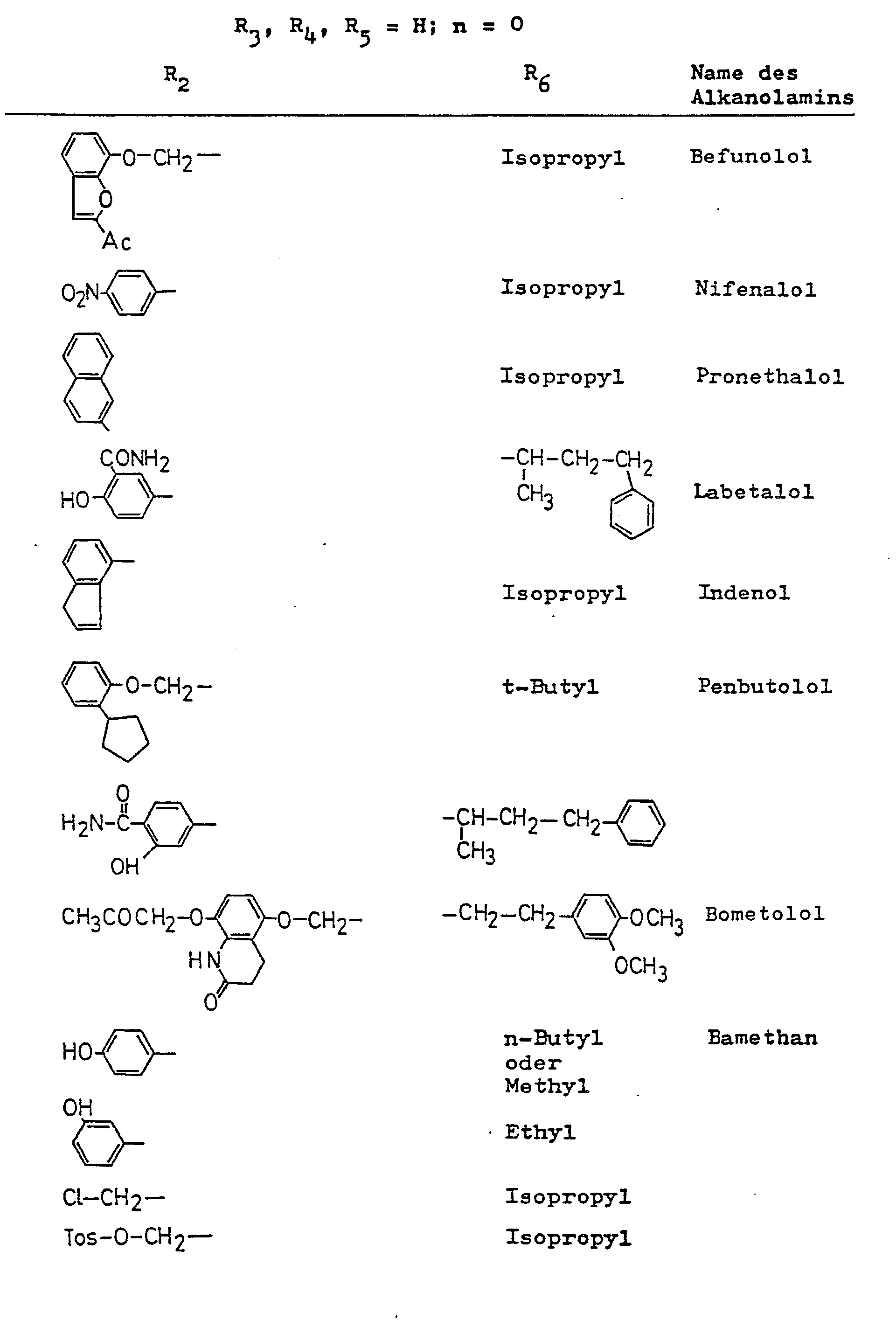

Claims (24)


Applications Claiming Priority (2)
| Application Number | Priority Date | Filing Date | Title |
|---|---|---|---|
| DE3330005 | 1983-08-19 | ||
| DE3330005A DE3330005A1 (de) | 1983-08-19 | 1983-08-19 | Weinsaeuremonoester von optisch aktiven alkanolaminen, verfahren zu ihrer herstellung und ihre verwendung |
Publications (3)
| Publication Number | Publication Date |
|---|---|
| EP0135162A2 EP0135162A2 (de) | 1985-03-27 |
| EP0135162A3 EP0135162A3 (en) | 1986-04-16 |
| EP0135162B1 true EP0135162B1 (de) | 1990-04-04 |
Family
ID=6206976
Family Applications (2)
| Application Number | Title | Priority Date | Filing Date |
|---|---|---|---|
| EP84109849A Expired - Lifetime EP0135162B1 (de) | 1983-08-19 | 1984-08-17 | Weinsäuremonoester von optisch aktiven Alkanolaminen, Verfahren zu ihrer Herstellung und ihre Verwendung |
| EP84109848A Expired EP0145840B1 (de) | 1983-08-19 | 1984-08-17 | Monoester von Celiprolol mit optisch aktiven disubstituierten Weinsäuren, deren Herstellung und Verwendung |
Family Applications After (1)
| Application Number | Title | Priority Date | Filing Date |
|---|---|---|---|
| EP84109848A Expired EP0145840B1 (de) | 1983-08-19 | 1984-08-17 | Monoester von Celiprolol mit optisch aktiven disubstituierten Weinsäuren, deren Herstellung und Verwendung |
Country Status (22)
| Country | Link |
|---|---|
| US (1) | US4652672A (de) |
| EP (2) | EP0135162B1 (de) |
| JP (1) | JPS6048954A (de) |
| AT (2) | ATE51614T1 (de) |
| AU (1) | AU573242B2 (de) |
| CA (1) | CA1239646A (de) |
| CS (1) | CS271307B2 (de) |
| DD (1) | DD231068A1 (de) |
| DE (3) | DE3330005A1 (de) |
| DK (2) | DK395884A (de) |
| ES (1) | ES535243A0 (de) |
| FI (1) | FI84910C (de) |
| GR (1) | GR82176B (de) |
| HU (1) | HU193587B (de) |
| IL (1) | IL72634A (de) |
| NO (1) | NO159083C (de) |
| PL (1) | PL146074B1 (de) |
| PT (1) | PT79044B (de) |
| RO (1) | RO91183B (de) |
| SU (1) | SU1297723A3 (de) |
| YU (1) | YU45646B (de) |
| ZA (1) | ZA846225B (de) |
Families Citing this family (9)
| Publication number | Priority date | Publication date | Assignee | Title |
|---|---|---|---|---|
| US5198448A (en) * | 1988-08-10 | 1993-03-30 | Otsuka Pharmaceutical Company, Limited | Cardiotonics |
| DK391189A (da) * | 1988-08-10 | 1990-02-11 | Otsuka Pharma Co Ltd | Carbostyrilderivater |
| AU5546490A (en) * | 1989-04-24 | 1990-11-16 | Wilhelm Fleischhacker | Enantiomer-free 1,2-aminoalcohols acetalically protected on the oxygen, their production and use |
| JPH0674243B2 (ja) * | 1989-12-27 | 1994-09-21 | ダイソー株式会社 | 光学純度の高い光学活性アテノロール塩及びアテノロールの製法 |
| JP2801768B2 (ja) | 1990-11-17 | 1998-09-21 | 日東電工株式会社 | 新規な光学活性メトプロロール・酒石酸誘導体塩及びその製法、並びにこの塩を用いる光学活性メトプロロールの製法 |
| FI93833C (fi) * | 1992-05-14 | 1995-06-12 | Orion Yhtymae Oy | Menetelmä propionihappojohdosten valmistamiseksi |
| WO2003029199A1 (en) * | 2001-09-28 | 2003-04-10 | Takeda Chemical Industries, Ltd. | Benzene derivatives, process for preparing the same and use thereof |
| RU2245868C2 (ru) * | 2003-04-09 | 2005-02-10 | Институт органической и физической химии (ИОФХ) им. А.Е. Арбузова Казанского научного центра РАН | Способ разделения на энантиомеры рацемического 1-(изопропиламино)-3-(1-нафтилокси)-2-пропанола |
| JP2005104895A (ja) * | 2003-09-30 | 2005-04-21 | Nippon Kayaku Co Ltd | 光学活性なアミノアルコール化合物の製造法 |
Family Cites Families (4)
| Publication number | Priority date | Publication date | Assignee | Title |
|---|---|---|---|---|
| NL300886A (de) * | 1962-11-23 | |||
| US3541130A (en) * | 1967-02-06 | 1970-11-17 | Boehringer Sohn Ingelheim | 1-(cyanophenoxy)-2-hydroxy-3-tert.-butylamine propanes |
| CH635573A5 (en) * | 1977-03-24 | 1983-04-15 | Sandoz Ag | Process for preparing novel 1,2-dihydroxypropane derivatives |
| GB8315495D0 (en) * | 1983-06-06 | 1983-07-13 | Sumitomo Chemical Co | Fungicidal aniline derivatives |
-
1983
- 1983-08-19 DE DE3330005A patent/DE3330005A1/de not_active Ceased
- 1983-10-17 US US06/542,729 patent/US4652672A/en not_active Expired - Fee Related
-
1984
- 1984-02-22 JP JP59032264A patent/JPS6048954A/ja active Pending
- 1984-07-27 GR GR75435A patent/GR82176B/el unknown
- 1984-08-08 PT PT79044A patent/PT79044B/pt not_active IP Right Cessation
- 1984-08-09 AU AU31762/84A patent/AU573242B2/en not_active Ceased
- 1984-08-09 IL IL72634A patent/IL72634A/xx unknown
- 1984-08-10 ZA ZA846225A patent/ZA846225B/xx unknown
- 1984-08-10 FI FI843148A patent/FI84910C/fi not_active IP Right Cessation
- 1984-08-14 CA CA000461001A patent/CA1239646A/en not_active Expired
- 1984-08-16 DD DD84266331A patent/DD231068A1/de not_active IP Right Cessation
- 1984-08-16 NO NO843285A patent/NO159083C/no unknown
- 1984-08-16 RO RO115505A patent/RO91183B/ro unknown
- 1984-08-16 YU YU142784A patent/YU45646B/sh unknown
- 1984-08-17 EP EP84109849A patent/EP0135162B1/de not_active Expired - Lifetime
- 1984-08-17 DK DK395884A patent/DK395884A/da not_active Application Discontinuation
- 1984-08-17 DE DE8484109848T patent/DE3463500D1/de not_active Expired
- 1984-08-17 HU HU843126A patent/HU193587B/hu not_active IP Right Cessation
- 1984-08-17 SU SU843783004A patent/SU1297723A3/ru active
- 1984-08-17 PL PL1984249228A patent/PL146074B1/pl unknown
- 1984-08-17 EP EP84109848A patent/EP0145840B1/de not_active Expired
- 1984-08-17 DE DE8484109849T patent/DE3481839D1/de not_active Expired - Lifetime
- 1984-08-17 CS CS846251A patent/CS271307B2/cs unknown
- 1984-08-17 AT AT84109849T patent/ATE51614T1/de not_active IP Right Cessation
- 1984-08-17 AT AT84109848T patent/ATE26974T1/de active
- 1984-08-17 ES ES535243A patent/ES535243A0/es active Granted
-
1992
- 1992-12-18 DK DK151892A patent/DK151892A/da not_active IP Right Cessation
Also Published As
Similar Documents
| Publication | Publication Date | Title |
|---|---|---|
| DE69711395T2 (de) | Verfahren zur herstellung von cyclohexen-carboxylatderivate | |
| DE60034155T2 (de) | Adamantanderivate zur Behandlung von entzündlichen, immunologischen und kardiovaskulären Erkrankungen | |
| DE69426520T2 (de) | Neues verfahren zur herstellung von ergothionein | |
| DE69016946T2 (de) | Verfahren zur Herstellung von 4-O-Dopaminphosphaten und Dopaminderivate. | |
| EP0574808A1 (de) | Amidin-Biphenylderivate, diese Verbindungen enthaltende Arzneimittel und Verfahren zu ihrer Herstellung | |
| EP0135162B1 (de) | Weinsäuremonoester von optisch aktiven Alkanolaminen, Verfahren zu ihrer Herstellung und ihre Verwendung | |
| EP0603649A1 (de) | Substituierte 4-Phenyl-pyridone und 4-Phenyl-2-alkoxypyridine als HMG-CoA-Reductase-Inhitoren | |
| WO1994014807A1 (de) | Substituierte triole | |
| DE69401177T2 (de) | 1-Aryloxy-3-alkylamino-2 propanol nitrat Ester, ihre Anwendung und korrespondierende pharmazeutische Zusammensetzungen | |
| DE4319038A1 (de) | Verwendung von teilweise bekannten substituierten Chromanen als Arzneimittel, neue Wirkstoffe und Verfahren zu ihrer Herstellung | |
| EP0237902A2 (de) | Verfahren zur Herstellung des (-)-Antipoden des (E)-1-Cyclohexyl-4,4-dimethyl-3-hydroxy-2-(1,2,4-triazol-1-yl)-pent-1-ens | |
| DE3624376A1 (de) | Glycosylamine und deren n-alkyliden-derivate | |
| DE3132221A1 (de) | Neue cyclophosphamid-derivate, verfahren zu ihrer herstellung und ihre verwendung | |
| EP0435153A2 (de) | R-(-)-1-(5-Hydroxyhexyl)-3-methyl-7-propylxanthin, Verfahren zu dessen Herstellung und diese Verbindung enthaltende Arzneimittel | |
| DE3625738A1 (de) | 2-acyloxypropylamin-derivate, verfahren zu deren herstellung und deren verwendung | |
| DE602004009831T2 (de) | Verfahren zur gewinnung von tolterodin | |
| DE202005020841U1 (de) | Formen von Atorvastatin-Calcium, die im wesentlichen frei von Verunreinigungen sind | |
| DE69023408T2 (de) | Glykosidasehemmende Piperidinverbindungen. | |
| EP0293814A1 (de) | Neue Mono- und Polyhydroxyacyl-Derivate polyoxygenierter Labdane, ein Verfahren zu deren Herstellung und ihre Verwendung als Medikamente | |
| DE112020004177T5 (de) | Verfahren zur herstellung des natriumsalzes von 4-[[(1r)-2-[5-(2-fluor-3-methoxyphenyl)-3-[[2-fluor-6-(trifluormethyl)-phenyl]methyl]-3,6-dihydro-4-methyl-2,6-dioxo-1(2h)-pyrimidinyl]-1-phenylethyl]amino]butansäure (elagolix-natriumsalz) und zwischenstufen dieses verfahrens | |
| DE69609202T2 (de) | Stereoselektive herstellung von 2-substituierten succinatderivaten | |
| DE2409675B2 (de) | 5-Hydroxytryptophan-Derivate und Verfahren zu ihrer Herstellung | |
| EP0603699B1 (de) | Substituierte Pyridine als HMG-CoA-Reduktase-Inhitoren | |
| EP0162235B1 (de) | Enantiomerenreine acetalisch mono-geschützte Diole, deren Herstellung und Verwendung | |
| EP0042054B1 (de) | 1-Amino-3-phenyl-indole, deren Salze und diese Indole enthaltende Arzneimittel |
Legal Events
| Date | Code | Title | Description |
|---|---|---|---|
| PUAI | Public reference made under article 153(3) epc to a published international application that has entered the european phase |
Free format text: ORIGINAL CODE: 0009012 |
|
| AK | Designated contracting states |
Designated state(s): AT BE CH DE FR GB IT LI LU NL SE |
|
| PUAL | Search report despatched |
Free format text: ORIGINAL CODE: 0009013 |
|
| AK | Designated contracting states |
Kind code of ref document: A3 Designated state(s): AT BE CH DE FR GB IT LI LU NL SE |
|
| 17P | Request for examination filed |
Effective date: 19860911 |
|
| 17Q | First examination report despatched |
Effective date: 19890302 |
|
| GRAA | (expected) grant |
Free format text: ORIGINAL CODE: 0009210 |
|
| AK | Designated contracting states |
Kind code of ref document: B1 Designated state(s): AT BE CH DE FR GB IT LI LU NL SE |
|
| REF | Corresponds to: |
Ref document number: 51614 Country of ref document: AT Date of ref document: 19900415 Kind code of ref document: T |
|
| ITF | It: translation for a ep patent filed | ||
| REF | Corresponds to: |
Ref document number: 3481839 Country of ref document: DE Date of ref document: 19900510 |
|
| ET | Fr: translation filed | ||
| GBT | Gb: translation of ep patent filed (gb section 77(6)(a)/1977) | ||
| PLBE | No opposition filed within time limit |
Free format text: ORIGINAL CODE: 0009261 |
|
| STAA | Information on the status of an ep patent application or granted ep patent |
Free format text: STATUS: NO OPPOSITION FILED WITHIN TIME LIMIT |
|
| 26N | No opposition filed | ||
| PGFP | Annual fee paid to national office [announced via postgrant information from national office to epo] |
Ref country code: LU Payment date: 19910829 Year of fee payment: 8 |
|
| ITTA | It: last paid annual fee | ||
| EPTA | Lu: last paid annual fee | ||
| PG25 | Lapsed in a contracting state [announced via postgrant information from national office to epo] |
Ref country code: LU Free format text: LAPSE BECAUSE OF NON-PAYMENT OF DUE FEES Effective date: 19920817 |
|
| PGFP | Annual fee paid to national office [announced via postgrant information from national office to epo] |
Ref country code: GB Payment date: 19940728 Year of fee payment: 11 |
|
| PGFP | Annual fee paid to national office [announced via postgrant information from national office to epo] |
Ref country code: FR Payment date: 19940817 Year of fee payment: 11 |
|
| PGFP | Annual fee paid to national office [announced via postgrant information from national office to epo] |
Ref country code: AT Payment date: 19940823 Year of fee payment: 11 |
|
| PGFP | Annual fee paid to national office [announced via postgrant information from national office to epo] |
Ref country code: SE Payment date: 19940824 Year of fee payment: 11 |
|
| PGFP | Annual fee paid to national office [announced via postgrant information from national office to epo] |
Ref country code: NL Payment date: 19940831 Year of fee payment: 11 |
|
| PGFP | Annual fee paid to national office [announced via postgrant information from national office to epo] |
Ref country code: BE Payment date: 19940902 Year of fee payment: 11 |
|
| PGFP | Annual fee paid to national office [announced via postgrant information from national office to epo] |
Ref country code: CH Payment date: 19940921 Year of fee payment: 11 |
|
| PGFP | Annual fee paid to national office [announced via postgrant information from national office to epo] |
Ref country code: DE Payment date: 19941014 Year of fee payment: 11 |
|
| EAL | Se: european patent in force in sweden |
Ref document number: 84109849.4 |
|
| PG25 | Lapsed in a contracting state [announced via postgrant information from national office to epo] |
Ref country code: GB Effective date: 19950817 Ref country code: AT Effective date: 19950817 |
|
| PG25 | Lapsed in a contracting state [announced via postgrant information from national office to epo] |
Ref country code: SE Effective date: 19950818 |
|
| PG25 | Lapsed in a contracting state [announced via postgrant information from national office to epo] |
Ref country code: LI Effective date: 19950831 Ref country code: CH Effective date: 19950831 Ref country code: BE Effective date: 19950831 |
|
| BERE | Be: lapsed |
Owner name: LINDNER WOLFGANG Effective date: 19950831 |
|
| PG25 | Lapsed in a contracting state [announced via postgrant information from national office to epo] |
Ref country code: NL Effective date: 19960301 |
|
| REG | Reference to a national code |
Ref country code: CH Ref legal event code: PL |
|
| GBPC | Gb: european patent ceased through non-payment of renewal fee |
Effective date: 19950817 |
|
| PG25 | Lapsed in a contracting state [announced via postgrant information from national office to epo] |
Ref country code: FR Effective date: 19960430 |
|
| NLV4 | Nl: lapsed or anulled due to non-payment of the annual fee |
Effective date: 19960301 |
|
| PG25 | Lapsed in a contracting state [announced via postgrant information from national office to epo] |
Ref country code: DE Effective date: 19960501 |
|
| EUG | Se: european patent has lapsed |
Ref document number: 84109849.4 |
|
| REG | Reference to a national code |
Ref country code: FR Ref legal event code: ST |