EP0464983A1 - Système de câble sous-marin muni d'un dispositif pour éviter les formations de couple de torsion lors du déroulement - Google Patents
Système de câble sous-marin muni d'un dispositif pour éviter les formations de couple de torsion lors du déroulement Download PDFInfo
- Publication number
- EP0464983A1 EP0464983A1 EP91302439A EP91302439A EP0464983A1 EP 0464983 A1 EP0464983 A1 EP 0464983A1 EP 91302439 A EP91302439 A EP 91302439A EP 91302439 A EP91302439 A EP 91302439A EP 0464983 A1 EP0464983 A1 EP 0464983A1
- Authority
- EP
- European Patent Office
- Prior art keywords
- cable
- section
- rods
- array
- cable section
- Prior art date
- Legal status (The legal status is an assumption and is not a legal conclusion. Google has not performed a legal analysis and makes no representation as to the accuracy of the status listed.)
- Granted
Links
- 230000007704 transition Effects 0.000 claims description 20
- 230000000452 restraining effect Effects 0.000 claims description 6
- 238000000034 method Methods 0.000 claims description 5
- 238000003491 array Methods 0.000 claims 4
- 229910000831 Steel Inorganic materials 0.000 abstract description 4
- 239000010959 steel Substances 0.000 abstract description 4
- 239000000945 filler Substances 0.000 description 7
- 238000010586 diagram Methods 0.000 description 4
- 230000008439 repair process Effects 0.000 description 3
- 230000008901 benefit Effects 0.000 description 2
- DMFGNRRURHSENX-UHFFFAOYSA-N beryllium copper Chemical compound [Be].[Cu] DMFGNRRURHSENX-UHFFFAOYSA-N 0.000 description 2
- 238000013461 design Methods 0.000 description 2
- 238000003780 insertion Methods 0.000 description 2
- 230000037431 insertion Effects 0.000 description 2
- 230000008569 process Effects 0.000 description 2
- 230000008878 coupling Effects 0.000 description 1
- 238000010168 coupling process Methods 0.000 description 1
- 238000005859 coupling reaction Methods 0.000 description 1
- 230000003247 decreasing effect Effects 0.000 description 1
- 230000001419 dependent effect Effects 0.000 description 1
- 230000008030 elimination Effects 0.000 description 1
- 238000003379 elimination reaction Methods 0.000 description 1
- 238000012886 linear function Methods 0.000 description 1
- 238000004519 manufacturing process Methods 0.000 description 1
- 239000011159 matrix material Substances 0.000 description 1
- 230000007246 mechanism Effects 0.000 description 1
- 229910052751 metal Inorganic materials 0.000 description 1
- 239000002184 metal Substances 0.000 description 1
- -1 or alternatively Polymers 0.000 description 1
- 229920001084 poly(chloroprene) Polymers 0.000 description 1
- 229920002635 polyurethane Polymers 0.000 description 1
- 239000004814 polyurethane Substances 0.000 description 1
- 238000012552 review Methods 0.000 description 1
- 238000012546 transfer Methods 0.000 description 1
Images


Classifications
-
- H—ELECTRICITY
- H02—GENERATION; CONVERSION OR DISTRIBUTION OF ELECTRIC POWER
- H02G—INSTALLATION OF ELECTRIC CABLES OR LINES, OR OF COMBINED OPTICAL AND ELECTRIC CABLES OR LINES
- H02G15/00—Cable fittings
- H02G15/08—Cable junctions
- H02G15/10—Cable junctions protected by boxes, e.g. by distribution, connection or junction boxes
- H02G15/12—Cable junctions protected by boxes, e.g. by distribution, connection or junction boxes for incorporating transformers, loading coils or amplifiers
- H02G15/14—Cable junctions protected by boxes, e.g. by distribution, connection or junction boxes for incorporating transformers, loading coils or amplifiers specially adapted for submarine cables
Definitions
- This invention relates to undersea cable deployment, and more particularly, to the transitioning of a cable-to-cable junction consisting of a torque-balanced section and a non-torque-balanced section of cable traveling between the cable engine sheave and the overboarding sheave without damaging the torque-balanced section.
- Modern undersea armored cable systems sometimes require the connection of a torque-balanced section to one that is not torque-balanced.
- An example of such a transition is the connection of a medium armor (MA) non torque-balanced cable to a light armor (LA) torque-balanced cable.
- MA medium armor
- LA light armor
- the torque-induced rotation can be substantial.
- MA/LA transition rotations in excess of 400 degrees can occur.
- the resultant stress in the lower torqued, less torsionally rigid cable can be substantial because this torque-induced rotation takes place over a very short length of the less resistant cable as it disengages from the cable engine drum. Permanent and possibly undetected strain damage can easily result, which undermines the structural and functional integrity of the entire cable system.
- one object of the invention is to provide a transition device that allows deployment of cable systems comprising sections of differing torsional rigidities and structures from a cable tank into the ocean, with decreased risk of twist damage due to sudden torque-induced rotation.
- a further object of the invention is to allow the deployment of an ocean cable consisting of sections having differing armor layers while avoiding the risk of twist damage due to sudden torque-induced rotation.
- An additional object of the invention is to allow rapid and positive application of a torque restraining device, either at the cable manufacturing factory prior to shipment, or on board ship just prior to deployment.
- a specific object of the invention is to spread or distribute torque-induced rotation over a substantial length of a less resistant cable section.
- the device which prevents the torque build-up in a heavy cable section from being abruptly applied to a light cable section at the transition point between the two cable sections.
- the device consists of a set of steel armor rods rigidly attached to the heavier cable section, which form a tube-like extension over the initial several feet of the lighter cable section.
- the tube is rotation-resistant even though the torque buildup in the heavier cable section is imparted to the tube.
- the rod-tube structure takes place. The rotation that does occur over the increased length of the lighter cable, is well distributed, controllable, and most importantly, non-damaging.
- the torque restraining device hereinafter referred to as a Transition Torque Relief Device (“TTRD”) in one embodiment comprises an array of helically-wound steel armor rods connected to the rigid cable junction member that is normally installed at the transition point between the two cable sections.
- the armor rod set extends over a predetermined length of the lower torqued, less torsionally stiff cable.
- the armor rod diameters and length can be sized to reduce the transfer torque and twist from virtually any size of cable containing higher torsional energy build-up to an acceptable level when the cable transition junction is well beyond the cable engine drum.
- rods of a preselected diameter are preformed to a desired helical pitch and inner diameter. The rods are inserted into receiving holes of a flange portion of the cable junction, to which the non-torque balanced cable is rigidly connected. Rod insertion may be performed on board ship during the cable-laying or repair operation, or at the cable manufacturer.
- the mechanism on which the rods depend to achieve the foregoing, is the tube-like behavior of the helically-wound applied rods, in combination with the metal-to-metal friction between the armor rods and the surface of the cable engine drum. That frictional force or traction has been determined to be more than sufficient to limit and delay the torque-induced rotation.
- an initial layer of smaller-diameter helically-wound filler rods are first applied over the cable to be protected.
- the inner filler rods make intimate contact with both the cable and outer tube rods acting to further assure that no damaging rotation occurs as the beginning of the less torsionally rigid cable first transitions over the cable engine sheave.
- the torque is directly proportional to the applied tension.
- the MA cable ends are not rotationally restrained in some manner, as in the case when the MA/LA transition leaves the cable drum, the MA cable will have relative rotations occur between its ends.
- FIG. 1 illustrates deployment from a cable-laying ship of an undersea cable consisting of a light armor section 11 and a medium armor section 12.
- the cable transition travels over a cable engine drum 13 and then over a bow sheave 14.
- the drum 13 and sheave 14 are typically separated on board ship by about 100 feet.
- Cable section 12 is under tension from the weight of heavier overboarded cable. That tension is present in the length of cable between the drum 13 and sheave 14.
- the TTRD denoted 20
- the TTRD 20 consists of a plurality of steel armor rods 21 inserted into receiving holes formed in a flange 42 that engages the end portion of assembly 33.
- helically-wound rods 22 are applied in a tubular helix directly and loosely around an initial portion of cable 11.
- TTRD 20 does not carry any appreciable axial load, because that load is still carried by cable 11.
- TTRD 20 serves the purpose of relieving cable 11 of the induced torsional load to eliminate twist-induced damage to cable 11.
- FIG. 4 illustrates the cable-to-cable junction member 30 which mechanically connects the two nonuniform cable sections 11, 12.
- Junction 30 consists of strength by-pass assembly 33 and two strain relief end members 36. These are shown in fuller detail in FIG. 5, which shows assembly 33 comprising an elongated tube fabricated of beryllium-copper, with end flanges 41 that are provided with interior threads.
- Four torque pin grooves 39 are provided in the interior surface of assembly 33, each extending inwardly one or two inches from the end of assembly 33. Grooves 39 are formed 90 degrees apart; two such grooves 39 are shown in FIG. 5.
- Cable 11 is rigidly terminated to a cable anchor 32.
- the termination may, for example, be achieved by fanning the light armor wires of the cable into receiving holes in anchor 32, in a manner not shown but well-known to workers in the art.
- Anchor 32 includes termination torque pins 38, which engage the grooves 39 when anchor 32 is inserted into the end of by-pass assembly 33.
- the flange 42 includes a bearing surface 43.
- the TTRD tubular armor rods 21 frictionally contact surface 22 of cable drum 13.
- a normal force N is generated by the axial tension caused by the weight of the cable extending to the ocean floor.
- a torque 7 imparted by the non-torque balanced cable 12 under tension generates a rotational vector which is substantially countered by the friction component F t at the interface of drum surface 22 and the contacting armor rods 21.
- a variation of the invention, depicted in FIG. 5, employs an inner layer of filler rods 23, which provide the TTRD 20 with increased resistance to rotation.
- Rods 23 anchor in flange 42 by insertion into a set of receiving holes in flange 42, which are interior and concentric to the holes which receive rods 21.
- Rods 23 are pre-formed with a helical lay that is opposite in direction to the lay of the armor tube rods 21.
- Rods 23 envelop cable 11 for a distance of, for example 3-5 feet.
- the preform inner diameter of filler rods 23 is chosen such that when applied, the helix tightly grips the outer surface of the cable section 11.
- the preform inner diameter of the outer armor rods 21 is slightly less than the outer diameter of the installed filler rods 23. Once installed, the armor rods 21 make intimate gripping contact with the filler rods 23, but then extend beyond the ends of rods 23 in a loose-fitting helix around the outer jacket of cable section 11.
- An advantage of both embodiments of the invention is that the rods 21, 23 and the related apparatus can be installed on board ship as cable deployment proceeds.
- the process of inserting the rods into their retaining holes takes typically less than an hour, making it particularly suitable for cable repair operations.
- strain relief member 36 may be afforded through a strain relief member 36 and a bell mouth 34, shown in FIG. 5.
- Bell mouth 34 is a beryllium copper part having a flange 44 with internal threads to engage external threads on flange 42.
- Strain relief member 36 is formed of polyurethane, or alternatively, neoprene.
- a number of strain relief rods 31, for example twelve, with tapered ends (not shown) are embedded in the member 36.
- the rods 31 and bell mouth 34 are joined as a unit by extruding strain relief member 36 around them in a separate forming process.
- strain relief member 36 advantageously is formed with a taper which approximates, in its final inside diameter, the outside diameter of the rods 21.
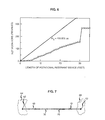
- FIG. 6 graphically illustrates the twist or rotation that occurs in a cable section protected by the present invention, as a function of how far the protected cable's leading end has traveled from the current point of contact of the rods 21 with the cable drum.
- the graph of FIG. 6 plots the safe rotation allowed for a particular cable, which in this illustrative case is a specific structure of light armor cable. Pursuant to the design curve of FIG. 6, the safe net rotation for a tension level of 100,000 PSI is shown as a positive straight line plot. For any value of applied tension, the maximum amount of twist that can be tolerated by the exemplary cable will be limited by the stresses experienced by the outer armor layers.
- the twist limit in the exemplary cable is the amount which causes the tensile stress in the outer layer of armor to be limited to some specified value, for example, one-half of the tensile yield stress or 100,000 psi.
- the TTRD of the present invention becomes a permanent element of the deployed cable system, as depicted in FIG. 7, to which it poses no disadvantage. If a cable deployed with the TTRD installed is later recovered for repairs, the TTRD can be reused.
- a system comprises, for example, first and second cable sections 60, 61, connected through the junction member 30 and protected by the TTRD 20.
- the system is connected to a first terminus 62 on land mass 64, and a second terminus 63 located on land mass 65. It is understood that the system comprising sections 60 and 61 may also have further sections which are not shown.
Landscapes
- Engineering & Computer Science (AREA)
- Power Engineering (AREA)
- Electric Cable Installation (AREA)
- Laying Of Electric Cables Or Lines Outside (AREA)
- Insulated Conductors (AREA)
- Flexible Shafts (AREA)
Applications Claiming Priority (2)
| Application Number | Priority Date | Filing Date | Title |
|---|---|---|---|
| US546174 | 1990-06-29 | ||
| US07/546,174 US5175989A (en) | 1990-06-29 | 1990-06-29 | Apparatus for avoiding torque build-ups in deploying ocean cable |
Publications (2)
| Publication Number | Publication Date |
|---|---|
| EP0464983A1 true EP0464983A1 (fr) | 1992-01-08 |
| EP0464983B1 EP0464983B1 (fr) | 1995-07-05 |
Family
ID=24179191
Family Applications (1)
| Application Number | Title | Priority Date | Filing Date |
|---|---|---|---|
| EP91302439A Expired - Lifetime EP0464983B1 (fr) | 1990-06-29 | 1991-03-20 | Système de câble sous-marin muni d'un dispositif pour éviter les formations de couple de torsion lors du déroulement |
Country Status (5)
| Country | Link |
|---|---|
| US (1) | US5175989A (fr) |
| EP (1) | EP0464983B1 (fr) |
| JP (1) | JPH06105563B2 (fr) |
| CA (1) | CA2034420C (fr) |
| DE (1) | DE69110984T2 (fr) |
Families Citing this family (4)
| Publication number | Priority date | Publication date | Assignee | Title |
|---|---|---|---|---|
| US5624207A (en) * | 1995-09-13 | 1997-04-29 | Regional Fabricators, Inc. | Ocean bottom cable handling system and method of using same |
| US5655753A (en) * | 1995-09-13 | 1997-08-12 | Regional Fabricators, Inc. | Ocean bottom cable handling system and method of using same |
| US6070857A (en) * | 1996-11-12 | 2000-06-06 | Odim Holding A/S | Device for the storage and deployment of ocean bottom seismic cable |
| US9715038B2 (en) * | 2013-09-30 | 2017-07-25 | Sercel Inc. | Marine cable support system and method |
Citations (3)
| Publication number | Priority date | Publication date | Assignee | Title |
|---|---|---|---|---|
| DE377926C (de) * | 1921-10-25 | 1923-06-29 | Siemens & Halske Akt Ges | Federung fuer Seekabelmuffen |
| DE877467C (de) * | 1946-10-16 | 1953-05-26 | Comp Generale Electricite | Nachgiebige Kabelverbindung fuer Unterwasserkabel |
| US4189620A (en) * | 1978-04-10 | 1980-02-19 | Stange William F | Cable termination device |
Family Cites Families (12)
| Publication number | Priority date | Publication date | Assignee | Title |
|---|---|---|---|---|
| US2348100A (en) * | 1940-10-24 | 1944-05-02 | George B Wadsworth | Splicing device for electrical conductors |
| US2526740A (en) * | 1945-02-16 | 1950-10-24 | American Chain & Cable Co | Cable connector |
| US3015205A (en) * | 1958-01-16 | 1962-01-02 | Comp Generale Electricite | Axial carrier steel cable with a plurality of wires for a submarine cable |
| DE1243467B (de) * | 1963-06-07 | 1967-06-29 | Vdo Schindling | Biegsames Kabel |
| US3339012A (en) * | 1963-07-29 | 1967-08-29 | Simplex Wire & Cable Co | Composite stranded conductor cable |
| US3786554A (en) * | 1968-05-16 | 1974-01-22 | Chance Co | Method of fabricating a field-applied gripping device |
| US3573346A (en) * | 1969-07-24 | 1971-04-06 | Preformed Line Products Co | Strain relief coupling |
| US3813772A (en) * | 1970-06-30 | 1974-06-04 | Reynolds Metals Co | Method of forming steel supported aluminum overhead conductors |
| US3858992A (en) * | 1971-10-07 | 1975-01-07 | Preformed Line Products Co | Strain relief coupling |
| US4129468A (en) * | 1977-04-13 | 1978-12-12 | Bell Telephone Laboratories, Incorporated | Method and apparatus for manufacturing optical communication cables |
| US4441309A (en) * | 1981-07-17 | 1984-04-10 | Bell Telephone Laboratories, Incorporated | Zero torque helically wrapped cable |
| US4714110A (en) * | 1984-11-04 | 1987-12-22 | Dysarz Edward D | Device to relieve sucker rod torque below ground level in a petroleum well |
-
1990
- 1990-06-29 US US07/546,174 patent/US5175989A/en not_active Expired - Lifetime
-
1991
- 1991-01-17 CA CA002034420A patent/CA2034420C/fr not_active Expired - Fee Related
- 1991-03-20 EP EP91302439A patent/EP0464983B1/fr not_active Expired - Lifetime
- 1991-03-20 DE DE69110984T patent/DE69110984T2/de not_active Expired - Fee Related
- 1991-06-06 JP JP16079691A patent/JPH06105563B2/ja not_active Expired - Fee Related
Patent Citations (3)
| Publication number | Priority date | Publication date | Assignee | Title |
|---|---|---|---|---|
| DE377926C (de) * | 1921-10-25 | 1923-06-29 | Siemens & Halske Akt Ges | Federung fuer Seekabelmuffen |
| DE877467C (de) * | 1946-10-16 | 1953-05-26 | Comp Generale Electricite | Nachgiebige Kabelverbindung fuer Unterwasserkabel |
| US4189620A (en) * | 1978-04-10 | 1980-02-19 | Stange William F | Cable termination device |
Non-Patent Citations (1)
| Title |
|---|
| PATENT ABSTRACTS OF JAPAN, vol. 3, no. 17 (E-90), 14th February 1979; & JP-A-53 145 094 (NIPPON DENSHIN DENWA KOSHA) 16-12-1978 * |
Also Published As
| Publication number | Publication date |
|---|---|
| JPH06105563B2 (ja) | 1994-12-21 |
| JPH04229904A (ja) | 1992-08-19 |
| CA2034420A1 (fr) | 1991-12-30 |
| US5175989A (en) | 1993-01-05 |
| CA2034420C (fr) | 1994-08-02 |
| EP0464983B1 (fr) | 1995-07-05 |
| DE69110984D1 (de) | 1995-08-10 |
| DE69110984T2 (de) | 1996-04-04 |
Similar Documents
| Publication | Publication Date | Title |
|---|---|---|
| TWI784011B (zh) | 拉入式頭部總成及纜線保護系統之安裝方法 | |
| US5062085A (en) | Vibration isolation module for towed seismic arrays | |
| US11107604B2 (en) | Cable or flexible pipe with improved tensile elements | |
| TWI788371B (zh) | 拉入式頭部總成 | |
| JPS58172613A (ja) | 水中光フアイバケ−ブル用接続装置 | |
| TWI788372B (zh) | 拉入式頭部總成 | |
| JPH0570884B2 (fr) | ||
| JPH04216503A (ja) | 光ケーブル引張りヘッド | |
| US6353695B1 (en) | Method and apparatus for joining underwater cable | |
| US6058603A (en) | Method for terminating non-metallic transmission cables | |
| US5175989A (en) | Apparatus for avoiding torque build-ups in deploying ocean cable | |
| US4644097A (en) | Armored submarine power cable | |
| JPS59110312A (ja) | 2本の電気ケ−ブルの外装の接続装置 | |
| US9506583B2 (en) | Extruded encapsulated fillers to provide crush protection | |
| US4116153A (en) | Elastic electrically-conductive strain cable | |
| IE57483B1 (en) | Armoured cables | |
| US2894057A (en) | Submarine cables having anti kink armouring | |
| JPH0136328B2 (fr) | ||
| US20250075564A1 (en) | Bend resistor | |
| Yoshizawa | Estimation of submarine optical-fiber cable elongation | |
| GB2208912A (en) | Cable grip devices | |
| JPH0358083B2 (fr) | ||
| EP1325373B1 (fr) | Procede et dispositif destines a assurer une resistance a la traction satisfaisante lors d'une jonction de cable sous-marin | |
| JPH0113290B2 (fr) | ||
| NZ755622B2 (en) | Cable or flexible pipe with improved tensile elements |
Legal Events
| Date | Code | Title | Description |
|---|---|---|---|
| PUAI | Public reference made under article 153(3) epc to a published international application that has entered the european phase |
Free format text: ORIGINAL CODE: 0009012 |
|
| AK | Designated contracting states |
Kind code of ref document: A1 Designated state(s): DE GB NL |
|
| 17P | Request for examination filed |
Effective date: 19920701 |
|
| RAP3 | Party data changed (applicant data changed or rights of an application transferred) |
Owner name: AT&T CORP. |
|
| 17Q | First examination report despatched |
Effective date: 19940517 |
|
| GRAA | (expected) grant |
Free format text: ORIGINAL CODE: 0009210 |
|
| AK | Designated contracting states |
Kind code of ref document: B1 Designated state(s): DE GB NL |
|
| REF | Corresponds to: |
Ref document number: 69110984 Country of ref document: DE Date of ref document: 19950810 |
|
| PLBE | No opposition filed within time limit |
Free format text: ORIGINAL CODE: 0009261 |
|
| STAA | Information on the status of an ep patent application or granted ep patent |
Free format text: STATUS: NO OPPOSITION FILED WITHIN TIME LIMIT |
|
| 26N | No opposition filed | ||
| REG | Reference to a national code |
Ref country code: GB Ref legal event code: IF02 |
|
| PGFP | Annual fee paid to national office [announced via postgrant information from national office to epo] |
Ref country code: GB Payment date: 20030319 Year of fee payment: 13 |
|
| PGFP | Annual fee paid to national office [announced via postgrant information from national office to epo] |
Ref country code: NL Payment date: 20030327 Year of fee payment: 13 Ref country code: DE Payment date: 20030327 Year of fee payment: 13 |
|
| PG25 | Lapsed in a contracting state [announced via postgrant information from national office to epo] |
Ref country code: GB Free format text: LAPSE BECAUSE OF NON-PAYMENT OF DUE FEES Effective date: 20040320 |
|
| PG25 | Lapsed in a contracting state [announced via postgrant information from national office to epo] |
Ref country code: NL Free format text: LAPSE BECAUSE OF NON-PAYMENT OF DUE FEES Effective date: 20041001 Ref country code: DE Free format text: LAPSE BECAUSE OF NON-PAYMENT OF DUE FEES Effective date: 20041001 |
|
| GBPC | Gb: european patent ceased through non-payment of renewal fee |
Effective date: 20040320 |
|
| NLV4 | Nl: lapsed or anulled due to non-payment of the annual fee |
Effective date: 20041001 |