EP0465189A2 - Rekombinante DNS-Expressionsvektoren und DNS-Zusammensetzungen, die Deacetylcephalosporin C-Synthetase-Aktivität kodieren - Google Patents
Rekombinante DNS-Expressionsvektoren und DNS-Zusammensetzungen, die Deacetylcephalosporin C-Synthetase-Aktivität kodieren Download PDFInfo
- Publication number
- EP0465189A2 EP0465189A2 EP91305939A EP91305939A EP0465189A2 EP 0465189 A2 EP0465189 A2 EP 0465189A2 EP 91305939 A EP91305939 A EP 91305939A EP 91305939 A EP91305939 A EP 91305939A EP 0465189 A2 EP0465189 A2 EP 0465189A2
- Authority
- EP
- European Patent Office
- Prior art keywords
- residue
- hydroxylase
- dna
- streptomyces
- host cell
- Prior art date
- Legal status (The legal status is an assumption and is not a legal conclusion. Google has not performed a legal analysis and makes no representation as to the accuracy of the status listed.)
- Withdrawn
Links
Images
Classifications
-
- C—CHEMISTRY; METALLURGY
- C12—BIOCHEMISTRY; BEER; SPIRITS; WINE; VINEGAR; MICROBIOLOGY; ENZYMOLOGY; MUTATION OR GENETIC ENGINEERING
- C12N—MICROORGANISMS OR ENZYMES; COMPOSITIONS THEREOF; PROPAGATING, PRESERVING, OR MAINTAINING MICROORGANISMS; MUTATION OR GENETIC ENGINEERING; CULTURE MEDIA
- C12N9/00—Enzymes; Proenzymes; Compositions thereof; Processes for preparing, activating, inhibiting, separating or purifying enzymes
- C12N9/0004—Oxidoreductases (1.)
- C12N9/0071—Oxidoreductases (1.) acting on paired donors with incorporation of molecular oxygen (1.14)
Definitions
- the natural sulfur-containing ⁇ -lactam antibiotics are the most important clinically, and the isolation of novel ⁇ -lactam compounds continues six decades after the discovery of the penicillins by Fleming.
- the common structural feature of the penicillins and cephalosporins (including cephamycins) is the ⁇ -lactam ring.
- antibiotics are produced by a variety of prokaryotes and lower eukaryotes.
- the penicillins exemplified by the compounds penicillin G or penicillin V, are produced by filamentous fungi, most notably Penicillium chrysogenum .
- the cephalosporins first isolated as a product from the lower eukaryote, Cephalosporium acremonium (syn. Acremonium chrysogenum ), are also metabolites of many prokaryotes but especially Streptomyces clavuligerus , S . lipmanii and S . cattleya that also produce cephamycins and other ⁇ -lactams such as oxypenams (clavulanic acid) and carbapenems (thienamycin).
- penicillins in filamentous fungi e.g. P . chrysogenum
- cephalosporins e.g. , S . clavuligerus
- prokaryotes e.g. , C . acremonium
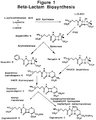
- ACV synthetase catalyzes the condensation of the amino acid precursors L- ⁇ -aminoadipate, L-cysteine, and L-valine to the tripeptide LLD-ACV.
- the next step forms the first ⁇ -lactam in the pathway by the cyclization of the tripeptide yielding isopenicillin N (IPN), a precursor to all penicillins, cephalosporins and cephamycins.
- IPN isopenicillin N
- Penicillium chrysogenum for example, the ⁇ -aminoadipyl side chain of IPN can be exchanged for one of many (nearly 100 to date) hydrophobic side chains derived from the corresponding acyl CoA.
- One of the most familiar examples is,the formation of penicillin G from phenylacetyl CoA and IPN.
- the ⁇ -aminoadipyl side chain is isomerized to produce penicillin N.
- DOCS deacetoxycephalosporin C synthetase
- the present invention provides DNA compounds comprising isolated DNA sequences encoding an activity involved in the production of cephalosporins, deacetylcephalosporin C synthase (hydroxylase).
- the present invention expands the repertoire of beta-lactam biosynthetic enzymes which can be overproduced. This ability facilitates the bioconversion of substrate analogs to novel beta-lactams and strain improvement by increased gene dosage.
- the present invention provides DNA compounds comprising isolated DNA sequences that encode hydroxylase activity from Streptomyces clavuligerus .
- Hydroxylase catalyzes the reaction in which DAOC is hydroxylated at the 3-methyl group to form deacetylcephalosporin C (DAC).
- DAC deacetylcephalosporin C
- the reaction catalyzed is a critical step in the biosynthesis of important antibiotics, such as cephalosporins from Cephalosporium acremonium and 7 ⁇ -methoxycephalosporins or cephamycins from Streptomyces clavuligerus and S . lipmanii .
- antibiotics such as cephalosporins from Cephalosporium acremonium and 7 ⁇ -methoxycephalosporins or cephamycins from Streptomyces clavuligerus and S . lipmanii .
- the DNA compounds of the present invention encode the hydroxylase activity in a single open reading frame. Transcription of this open reading frame, followed by translation of the resulting mRNA, yields a single polypeptide chain that possesses hydroxylase activity.
- a preferred DNA compound of the invention that encodes the hydroxylase activity was isolated from Streptomyces clavuligerus genomic DNA and used to construct a recombinant DNA expression vector called pOW399. Plasmid pOW399 is part of the present invention.
- the cloned hydroxylase gene is useful for increasing the yield of cephalosporins in fungi and bacteria, particularly if the reaction catalyzed by hydroxylase is a rate-limiting step.
- the E . coli -produced hydroxylase activity likewise catalyzes the formation of DAC from DAOC. Crude cell extracts of the E . coli transformants of the invention exhibit hydroxylase activity. These E . coli expression vectors and transformants provide an efficient means for obtaining large amounts of active hydroxylase.
- the hydroxylase is useful not only for the production of DAC but also for the increased yield in production of other compounds of the beta-lactam antibiotic pathway.
- the DNA compound encoding the hydroxylase activity is readily modified to construct expression vectors that increase the yield of hydroxylase in a variety of other organisms, including, for example, Escherichia , Penicillium , Cephalosporium , Paecilomyces and Streptomyces , especially S . clavuligerus .
- the construction protocols utilized for the E. coli vector of the invention can be followed to construct analogous vectors for other organisms, merely by substituting, if necessary, the appropriate regulatory elements using techniques well-known to skilled artisans.
- the present invention also provides a method for constructing a recombinant host cell capable of expressing hydroxylase activity of Streptomyces clavuligerus , said method comprising transforming a host cell with a recombinant DNA vector that comprises an isolated DNA sequence encoding hydroxylase activity of Streptomyces clavuligerus .
- Preferred host cells include E . coli , Cephalosporium , Streptomyces , Aspergillus and Penicillium .
- Such transformed host cells may be cultured under conditions well-known to skilled artisans such that the hydroxylase gene is expressed, thus producing hydroxylase activity in the recombinant host cell.
- a method for expressing hydroxylase activity of Streptomyces clavuligerus in a recombinant host cell comprising culturing said transformed host cell under conditions suitable for gene expression.
- cI857 - a gene encoding a temperature sensitive repressor of the ⁇ pL promoter.
- DACS or DACS Activity - deacetylcephalosporin C synthase the enzymatic activity that catalyzes conversion of DAOC to DAC, also called hydroxylase.
- Hydroxylase or Hydroxylase Activity the enzymatic activity that catalyzes conversion of DAOC to DAC; also called DACS.
- ORI - a plasmid or vector origin of replication the DNA sequence that serves as an attachment or start site for DNA polymerase.
- Isolated DNA Sequence Any DNA sequence, however constructed or synthesized, which is locationally distinct from its natural location in genomic DNA.
- the definition includes the isolated DNA sequence in all its forms other than the natural state.
- the DNA sequence may be inserted into a plasmid or phage vector or inserted into the genome of the organism from which it came or any other organism to increase the gene dosage.
- TcR - the tetracycline resistance-conferring gene.
- restriction site and function maps presented in the accompanying drawings is an approximate representation of the recombinant DNA vectors discussed herein.
- the restriction site information is not exhaustive; therefore, there may be more restriction sites of a given type on the vector than actually shown on the map.
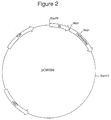
- Figure 2 A restriction site and function map of plasmid pOW399.
- the present invention provides DNA compounds and recombinant DNA cloning and expression vectors that comprise isolated DNA sequences encoding the hydroxylase activity of Streptomyces clavuligerus .
- the sequence of the S . clavuligerus hydroxylase-encoding DNA is depicted below. In the depiction, only the "sense" or coding strand of the double-stranded DNA molecule is shown, and the DNA is depicted from left to right in the 5′ ⁇ 3′ orientation.
- the nucleotide sequence is numbered; the numbers appear to the left of the DNA sequence.
- the amino acid residue sequence of hydroxylase encoded by the DNA is listed, following the DNA sequence, from left to right in the amino-terminus ⁇ carboxyl-terminus direction. wherein A is a deoxyadenyl residue, G is a deoxyguanyl residue, C is a deoxycytidyl residue, and T is a thymidyl residue.
- Ala is an alanine residue
- Arg is an arginine residue
- Asn is an asparagine residue
- Asp is an aspartic acid residue
- Cys is a cysteine residue
- Gln is a glutamine residue
- Glu is a glutamic acid residue
- Gly is a glycine residue
- His is a histidine residue
- Ile is an isoleucine residue
- Leu is a leucine residue
- Lys is a lysine residue
- Met is a methionine residue
- Phe is a phenylalanine residue
- Pro is a proline residue
- Ser is a serine residue
- Thr is a threonine residue
- Trp is a tryptophan residue
- Tyr is a tyrosine residue
- Val is a valine residue.
- DNA sequence can be synthesized using automated DNA synthesizers, such as the ABS (Applied Biosystems, 850 Lincoln Centre Drive, Foster City, CA 94404) 380B DNA Synthesizers.
- amino acid residue sequence of the hydroxylase enzyme depicted above can be encoded by a multitude of different DNA sequences. Because these alternate DNA sequences would encode the same amino acid residue sequence of the present invention, the present invention further comprises these alternate sequences.
- a preferred hydroxylase activity-encoding DNA compound was isolated from a strain of Streptomyces clavuligerus .
- a genomic library of the total genomic DNA of the S . clavuligerus strain was constructed and examined for the presence of sequences homologous to a deoxyribooligonucleotide probe. This probe was constructed in accordance with information obtained about the amino-terminal amino acid sequence of the S . clavuligerus hydroxylase, with kowledge of the genetic code, and with kowledge of codon usage preferences of Streptomyces . DNA sequencing revealed which clone encoded the S . clavuligerus hydroxylase.
- E . coli K12 JM109/pOW399 which contains the plasmid with the hydroxylase gene under the control of the ⁇ pL promoter, was deposited and made part of the stock culture collection of the Northern Regional Research Laboratories (NRRL), Peoria, IL 61604, on June 4, 1990, under the accession number NRRL B-18658.
- Plasmid pOW399 can be isolated from E . coli K12 JM109 by procedures well-kown by those skilled in the art. Plasmid pOW399 contains the intact Streptomyces clavuligerus hydroxylase gene, which can be isolated, for example, from the plasmid on an ⁇ 2.5 kb Eco RI/ Bam HI restriction fragment.
- a restriction site and function map of plasmid pOW399 is presented in Figure 2 of the accompanying drawings.
- the cI857 protein encoded on plasmid pOW399 or its derivatives is active and able to repress activity of the ⁇ pL promoter, but when the temperature is raised to about 42°C, the cI857 protein is inactivated, and the ⁇ pL promoter drives transcription of large amounts of mRNA encoding the gene product of interest.
- E . coli K12 JM109/pOW399 expresses hydroxylase activity at high levels, approaching ⁇ 5% of the total cell protein. Crude cell extracts from these E .
- Plasmid pOW399 is especially preferred for driving expression of hydroxylase activity in E . coli not only because of the high expression levels achieved when using the plasmid but also because of the selectable marker present on the plasmid.
- Many recombinant DNA vectors encode a ⁇ -lactamase, so that cells containing the vector can grow in the presence of certain ⁇ -lactam antibiotics, such as ampicillin.
- ⁇ -lactam antibiotics such as ampicillin.
- one desires to use a cell-free extract containing hydroxylase activity for purposes of constructing ⁇ -lactams one does not want the extract to contain ⁇ -lactamase activity.
- plasmid pOW399 does not encode a ⁇ -lactamase for a selectable marker but rather employs a tetracycline resistance-conferring gene, which encodes a protein that does not react with ⁇ -lactams.
- E . coli is an efficient organism for producing large amounts of hydroxylase activity. Because culturing E . coli is less complex than culturing organisms that naturally produce hydroxylase, E . coli K12 JM109/pOW399 can be used to produce recombinant hydroxylase more efficiently and economically than non-recombinant or "natural" hydroxylase producers. This hydroxylase activity can be used for in vitro experiments to modify DAOC to form novel antibiotics or antibiotic core structures.
- the present invention is not limited to the particular vector exemplified herein. Instead, the present invention comprises DNA compounds that encode the hydroxylase activity of Streptomyces clavuligerus .
- the DNA compounds of the present invention can be used to construct expression vectors that drive expression of hydroxylase activity in any host cell in which the expression vector replicates or integrates and in which the promoter and translational activating sequence are functional.
- the present invention can therefore be used to increase the natural amounts of hydroxylase activity in the cell by increasing the number of genes which code for the hydroxylase enzyme. As a result, more DAOC can be converted to DAC. An increase in DAC could ultimately result in an increased yield of cephalosporin C and cephamycin C in the cell. Cephalosporin C and cephamycin are both antibiotics with known utility. This invention could also facilitate production of other antibiotics in which the hydroxylase enzyme or derivatives thereof function to catalyze intermediate steps in biosynthesis.
- Another use of the present invention is to halt biosynthesis at DAOC so that DAOC can be used to generate new and useful cephalosporins.
- the biosynthetic pathway can be halted by disrupting or displacing the functional hydroxylase gene. Unstable vectors containing a mutated hydroxylase gene may undergo single or double cross-over events with the genomic copy of the hydroxylase gene when introduced into the cell. If a selectable marker is integrated into the hydroxylase coding sequence, some cells which retain the ability to grow under selective conditions will have had the hydroxylase gene disrupted.
- the DNA compounds of the present invention can also be used as a probe to find hydroxylase, expandase (European Patent Publication No. 0341892, published November 15, 1989) or expandase/hydroxylase (European Patent Publication No. 0281391, published September 7, 1988) genes in other microorganisms.
- hydroxylase expression vectors of the present invention are not limited to a tetracycline resistance gene as the selectable marker.
- selectable markers include, for example, genes that confer kanamycin or chloramphenicol resistance, or other antibiotic resistance-conferring genes.
- the present invention comprises any E . coli expression plasmid or vector that drives expression of hydroxylase activity in E . coli .
- the present invention comprises expression vectors that drive expression of hydroxylase activity and utilize a replicon functional in E . coli , such as, for example, a replicon from such plasmids as pBR322 or the pUC series of plasmids.
- a replicon functional in E . coli such as, for example, a replicon from such plasmids as pBR322 or the pUC series of plasmids.
- the present invention solely limited to plasmid vectors, because the present invention also comprises expression vectors that express hydroxylase activity and utilize integration or viral replication to provide for replication and maintenance in the host cell.
- the present invention is not limited to a particular promoter and translational activating sequence to drive expression of the hydroxylase activity-encoding DNA.
- the present invention comprises the use of any promoter and translational activating sequence that function in E . coli and are used to express hydroxylase activity in E . coli .
- Many promoter and translational activating sequences functional in E . coli are known and are suitable for driving expression of hydroxylase activity in E . coli .
- Such transcriptional and translational activating sequences include, but are not limited to, the lpp , lac , trp , tac , ⁇ pL, and ⁇ pR promoter and translational activating sequences.
- promoter of the IPNS gene from Penicillium chrysogenum examples of suitable promoter sequences functional in other organisms are the promoter of the IPNS gene from Penicillium chrysogenum and the promoter from the amdS gene in Aspergillus nidulans both of which are disclosed in U.S. Patent 4,892,819, herein incorporated by reference. Also useful is the promoter of the IPNS gene in Cephalosporium aeremonium , disclosed in U.S. Patent 4,885,251, herein incorporated by reference.
- transcriptional and translational activating sequences from other organisms can be ligated to the present hydroxylase activity-encoding DNA compounds to form expression vectors that drive expression of hydroxylase activity in host cells in which the activating sequence functions.
- E . coli is the host best suited for hydroxylase production and subsequent purification for in vitro use
- vectors that drive expression of hydroxylase activity in host cells other than E . coli are also useful, especially for purposes of increasing the antibiotic-producing ability and efficiency of a given organism.
- ⁇ -lactam antibiotic-producing organisms are used in the pharmaceutical industry for purposes of antibiotic production.
- the antibiotic-producing ability of these organisms can be increased and made more efficient by increasing the intracellular concentration of the antibiotic biosynthetic enzymes during the fermentation.
- the hydroxylase activity-encoding DNA compounds of the present invention can be used to construct expression vectors that, when transformed into the appropriate host cell, increase the intracellular concentration of hydroxylase activity of the transformed host cell and thereby increase the antibiotic-producing ability and efficiency of that cell.
- a vector that will increase the intracellular concentration of hydroxylase activity of a given host cell into which the vector is transformed requires the following elements: 1) a hydroxylase activity-encoding DNA compound of the present invention; and 2) a promoter and translational activating sequence that not only function in the host cell to be transformed, but also are positioned in the correct orientation and position to drive expression of the hydroxylase activity-encoding DNA.
- a preferred vector might contain sequences that specifically direct replication or integration of the vector in the host cell.
- a hydroxylase expression vector could also comprise an antibiotic resistance-conferring gene or some other element that provides a means of selecting for host cells which contain the vector, but such selectable elements may neither be necessary nor desired when the vector integrates into the chromosomal DNA of the host cell.
- E . coli K12 strains contain an endogenous ⁇ -lactamase activity, probably encoded by the ampC locus. For this reason it is desirable to effect a partial purification of the hydroxylase polypeptide so that optimal hydroxylase activity is observed. Purification of the enzyme can be used to separate the endogenous E . coli ⁇ -lactamase activity from the desired hydroxylase activity.
- An alternative to the use of partial purification to overcome the deleterious effects of the ⁇ -lactamase is to use a strain defective in the production of this activity.
- the present invention provides hydroxylase expression vectors for any organism susceptible to transformation.
- the E . coli hydroxylase expression vectors described above illustrate the wide variety of expression vectors of the present invention. However, many of the preferred vectors of the invention are designed to drive expression of hydroxylase in a ⁇ -lactam antibiotic (including penicillins and cephalosporins) producing cell.
- Example 1 The vector described above and in Example 1 is merely illustrative of the wide variety of hydroxylase expression vectors provided by the present invention.
- U.S. Patent 4,885,251 describes the 5′ and 3′ regulatory signals of the Cephalosporium acremonium IPNS gene. The signals can be combined with the hydroxylase coding sequence of the present invention to yield hydroxylase expression vectors of the invention especially suited for use in Cephalosporium .
- the hydroxylase expression vectors of the present invention are useful for increasing the intracellular concentration of hydroxylase activity in any cell, especially ⁇ -lactam antibiotic-producing cells.
- Plasmid pOW399 comprises the coding sequence of the hydroxylase gene of Streptomyces clavuligerus , so plasmid pOW399 can be used to construct vectors for increasing the copy number of the hydroxylase gene, which in turn increases the intracellular concentration of the enzyme. Because the hydroxylase coding sequence of the invention was isolated from a Streptomyces host cell, the hydroxylase coding sequence is particularly well-suited for use in expression vectors designed to drive high-level expression of hydroxylase activity in Streptomyces host cells.
- the literature is replete with techniques for constructing Streptomyces expression vectors and for transforming Streptomyces host cells. See , e.g. , Garcia-Dominguez et al ., 1987, Applied and Environmental Microbiology 53(6):1376-1381.
- the hydroxylase coding sequence of the invention can be readily incorporated into an expression vector that comprises a Streptomyces promoter and replicon.
- a variety of known Streptomyces promoters and replicons are available for such use.
- Table II is an illustrative, but not comprehensive, listing of Streptomyces plasmids from which Streptomyces replicons can be obtained.
- the Streptomyces clavuligerus hydroxylase coding sequence of the invention can also be put under the control of transcription and translation activating sequences derived from other strains of Streptomyces , as well as from Penicillium , Cephalosporium , or any other host cell to construct a recombinant hydroxylase gene for use in the given organism.
- a lyophil of E . coli K12 JM109/pOW399 can be obtained from the Northern Regional Research Laboratories (NRRL), Peoria, IL 61604, under the accession number NRRL B-18658 (date of deposit: June 4, 1990) and used directly as the "culture" in the process described below.
- NRRL Northern Regional Research Laboratories
- Peoria Peoria
- IL 61604 under the accession number NRRL B-18658 (date of deposit: June 4, 1990) and used directly as the "culture” in the process described below.
- E . coli K12 JM109/pOW399 was grown in 3 liters of TY broth and 5 ⁇ g/ml tetracycline at 30°C until the cells reached mid-log phase. The temperature of the mixture was raised to 42°C and incubation continued for about 4 more hours.
- Granules containing hydroxylase are isolated. First, the whole cells are centrifuged, then resuspended in water at 10°C. The cell slurry is homogenized in a Gaulin homogenizer at 8000 psig. The homogenized slurry is then diluted in water and agitated for 10 minutes, followed by adjustment of the pH to 8.4-8.6 with 10% sodium hydroxide. The mixture is then centrifuged. The solids represent the hydroxylase containing granules, which are frozen at -70°C until further use.
- Active hydroxylase was prepared from 0.5 g of washed granules by resuspending the granules in 8 ml folding buffer containing 0.5 M urea, 0.5 ml dithiothreitol (DTT) and 5 mM Tris base (tris(hydroxymethyl)aminomethane). The pH was not adjusted. When the granules were resuspended, the pH was raised to 11.7 with sodium hydroxide and the solution was stirred for 5 minutes. After stirring, the pH was lowered to 9.5 with hydrochloric acid. The mixture was then subjected to centrifugation at 48,000 x g for 10 minutes. The supernatant was saved for use in the hydroxylase assay.
- DTT dithiothreitol
- Tris base tris(hydroxymethyl)aminomethane
- the hydroxylase activity was determined by monitoring DAC formation from DAOC at 260 nm with HPLC as described by Dotzlaf, J.E., and Yeh, W.-K. (1987) J. Bacteriol ., 169 , 1611-1618.
- the assay mixture volume was 1 ml and contained 0.3 ⁇ mol of DAOC, 0.3 ⁇ mol of ⁇ -ketoglutarate, 0.1 ⁇ mol of ferrous sulfate, 0.25 ⁇ mol of ascorbate, 1 ⁇ mol of DTT, 0.05 ⁇ mol of adenosine triphosphate (ATP), and 8.4 ⁇ g of protein sample in 15 mM MOPS (3-[N-morpholino]propanesulfonic acid) buffer, pH 7.3.
- MOPS 3-[N-morpholino]propanesulfonic acid
- the enzymatic reaction was initiated by adding the DAOC and the reaction was conducted for 20 minutes at 29°C.
- DAC formation was linear with reaction time for up to 40 minutes.
- One unit of enzyme activity is defined as the amount of hydroxylase required to cause formation of one ⁇ mol of DAC per minute from DAOC under the above-described assay conditions.
- the specific activity of the hydroxylase is defined as units per milligram of protein.
- the protein content was determined by the method of Bradford using bovine serum albumin as the standard (Bradford, M.M., 1979, Anal . Biochem ., 72, 248-254).
- the hydroxylase produced from E . coli K12 JM109/pOW399 had a specific activity of 60-80 mUnits/mg protein.
Landscapes
- Life Sciences & Earth Sciences (AREA)
- Chemical & Material Sciences (AREA)
- Health & Medical Sciences (AREA)
- Genetics & Genomics (AREA)
- Organic Chemistry (AREA)
- Zoology (AREA)
- Engineering & Computer Science (AREA)
- Bioinformatics & Cheminformatics (AREA)
- Wood Science & Technology (AREA)
- Microbiology (AREA)
- Biotechnology (AREA)
- Biomedical Technology (AREA)
- Molecular Biology (AREA)
- Biochemistry (AREA)
- General Engineering & Computer Science (AREA)
- General Health & Medical Sciences (AREA)
- Medicinal Chemistry (AREA)
- Micro-Organisms Or Cultivation Processes Thereof (AREA)
- Enzymes And Modification Thereof (AREA)
- Peptides Or Proteins (AREA)
- Preparation Of Compounds By Using Micro-Organisms (AREA)
Applications Claiming Priority (2)
| Application Number | Priority Date | Filing Date | Title |
|---|---|---|---|
| US549502 | 1983-11-07 | ||
| US54950290A | 1990-07-06 | 1990-07-06 |
Publications (2)
| Publication Number | Publication Date |
|---|---|
| EP0465189A2 true EP0465189A2 (de) | 1992-01-08 |
| EP0465189A3 EP0465189A3 (en) | 1992-03-04 |
Family
ID=24193271
Family Applications (1)
| Application Number | Title | Priority Date | Filing Date |
|---|---|---|---|
| EP19910305939 Withdrawn EP0465189A3 (en) | 1990-07-06 | 1991-07-01 | Recombinant dna expression vectors and dna compounds that encode deacetylcephalosporin c synthase activity |
Country Status (4)
| Country | Link |
|---|---|
| EP (1) | EP0465189A3 (de) |
| JP (1) | JPH067172A (de) |
| CA (1) | CA2045951A1 (de) |
| IL (1) | IL98701A0 (de) |
Cited By (4)
| Publication number | Priority date | Publication date | Assignee | Title |
|---|---|---|---|---|
| WO1993008287A1 (en) * | 1991-10-15 | 1993-04-29 | Merck & Co., Inc. | Novel bioprocesses for preparing 7-aca and 7-adac |
| WO1999010499A1 (en) * | 1997-08-22 | 1999-03-04 | Dsm N.V. | Statin production by fermentation |
| WO2013105030A1 (en) | 2012-01-10 | 2013-07-18 | Orchid Chemicals And Pharmaceuticals Limited | Mutated cephalosporin hydroxylase and its application in deacetylcephalosporanic acid synthesis |
| US10822631B2 (en) | 2016-07-01 | 2020-11-03 | Bioright Worldwide Co., Ltd. | Deacetoxycephalosporin C hydroxylase mutants, DNA encoding the mutants, method for utilizing the mutants and application thereof |
Family Cites Families (2)
| Publication number | Priority date | Publication date | Assignee | Title |
|---|---|---|---|---|
| CA1327170C (en) * | 1987-03-04 | 1994-02-22 | Stephen Wyatt Queener | Recombinant dna expression vectors and dna compounds that encode deacetoxycephalosporin c synthetase and deacetylcephalosporin c synthetase |
| US5070020A (en) * | 1988-05-09 | 1991-12-03 | Eli Lilly And Company | Recombinant dna expression vectors and dna compounds that encode deacetoxycephalosporin c synthetase |
-
1991
- 1991-06-28 CA CA002045951A patent/CA2045951A1/en not_active Abandoned
- 1991-07-01 IL IL98701A patent/IL98701A0/xx unknown
- 1991-07-01 EP EP19910305939 patent/EP0465189A3/en not_active Withdrawn
- 1991-07-06 JP JP3166001A patent/JPH067172A/ja active Pending
Cited By (8)
| Publication number | Priority date | Publication date | Assignee | Title |
|---|---|---|---|---|
| WO1993008287A1 (en) * | 1991-10-15 | 1993-04-29 | Merck & Co., Inc. | Novel bioprocesses for preparing 7-aca and 7-adac |
| EP0540210A1 (de) * | 1991-10-15 | 1993-05-05 | Merck & Co. Inc. | Neues biologisches Verfahren zur Herstellung von 7-ACA und 7-ADAC |
| US5559005A (en) * | 1991-10-15 | 1996-09-24 | Merck & Co., Inc. | Bioprocess for preparing 7-ACA and 7-ADAC |
| US5629171A (en) * | 1991-10-15 | 1997-05-13 | Gist-Brocades B.V. | Recombinant bioprocess for the preparation of 7-amino cephalosporanic acid (7-ACA) |
| WO1999010499A1 (en) * | 1997-08-22 | 1999-03-04 | Dsm N.V. | Statin production by fermentation |
| WO2013105030A1 (en) | 2012-01-10 | 2013-07-18 | Orchid Chemicals And Pharmaceuticals Limited | Mutated cephalosporin hydroxylase and its application in deacetylcephalosporanic acid synthesis |
| US9404139B2 (en) | 2012-01-10 | 2016-08-02 | Orchid Chemicals & Pharmaceuticals Limited | Mutated cephalosporin hydroxylase and its application in deacetylcephalosporanic acid synthesis |
| US10822631B2 (en) | 2016-07-01 | 2020-11-03 | Bioright Worldwide Co., Ltd. | Deacetoxycephalosporin C hydroxylase mutants, DNA encoding the mutants, method for utilizing the mutants and application thereof |
Also Published As
| Publication number | Publication date |
|---|---|
| IL98701A0 (en) | 1992-07-15 |
| CA2045951A1 (en) | 1992-01-07 |
| EP0465189A3 (en) | 1992-03-04 |
| JPH067172A (ja) | 1994-01-18 |
Similar Documents
| Publication | Publication Date | Title |
|---|---|---|
| Kennedy et al. | δ-(L-α-Aminoadipyl)-L-cysteinyl-D-valine synthetase is a rate limiting enzyme for penicillin production in Aspergillus nidulans | |
| KR100648480B1 (ko) | 세팔로스포린의 개선된 생체내 생산 | |
| CA2080573C (en) | Novel bioprocesses for preparing 7-aca and 7-adac | |
| Queener | Molecular biology of penicillin and cephalosporin biosynthesis | |
| Martin et al. | Molecular genetics of penicillin and cephalosporin antibiotic biosynthesis | |
| JPH0227984A (ja) | デアセトキシセファロスポリンc合成酵素をコードする組換えdna発現ベクターおよびdna化合物 | |
| IL103076A (en) | Bioprocess for preparing 7-aminodesacetoxy cephalosporanic acid | |
| EP0377295B1 (de) | Rekombinante DNA enthaltende Expressionsvektoren und für Isopenicillin-N-Epimerase-(Racemase)-Aktivität kodierende DNS-Verbindungen | |
| US6284483B1 (en) | Modified synthetases to produce penicillins and cephalosporins under the control of bicarbonate | |
| WO1997020053A2 (en) | Improved process for the production of semi-synthetic cephalosporins via expandase activity on penicillin g | |
| WO2001085951A1 (en) | A modified expandase and uses thereof | |
| EP0444775B1 (de) | Rekombinante DNA-Expressionsvektoren und DNA-Zusammensetzungen, die Isopenizillin N-Epimerase-Aktivität kodieren | |
| EP0783582B1 (de) | Verfahren zur herstellung von beta lactam antibiotika durch mikroorganismen mit erhoehter ligaseaktivitaet | |
| CA2045951A1 (en) | Recombinant dna expression vectors and dna compounds that encode deacetylcephalosporin c synthase activity | |
| KR101444483B1 (ko) | β-락탐 항생제의 제조 | |
| HU205626B (en) | Process for producing recombinant exprassive dns-vectors coding isopenicillin-n synthetase enzyme of aspergillus nidulans or for producing dns-molekules | |
| EP0444758A1 (de) | Verfahren zur Modifikation der ACV-Synthetase und Verwendung des modifizierten Enzyms zur Herstellung von beta-Laktam-Antibiotika | |
| Isogai et al. | Direct production of 7-aminocephalosporanic acid and 7-aminodeacetylcephalosporanic acid by recombinant Acremonium chrysogenum | |
| WO1997038107A1 (en) | An enzyme with high adipoyl-coenzyme a synthetase activity and uses thereof | |
| KR20080028924A (ko) | 변이주 익스팬다제 및 베타-락탐 화합물의 생성에 있어서이들의 용도 | |
| Demain | Edward P. Abraham, cell-free systems and the fungal biosynthesis of beta-lactams | |
| US6322998B1 (en) | Recombinant DNA compounds that encode ACV synthetase activity of Cephalosporium acremonium | |
| Dotzlaf et al. | Metabolic Engineering for Cephalosporin C Yield Improvement | |
| Ghosh | Strategies for manipulation of genes in microbes for production of β-lactam antibiotics | |
| WO2005019468A1 (en) | Modified dacs/daoc enzymes |
Legal Events
| Date | Code | Title | Description |
|---|---|---|---|
| PUAI | Public reference made under article 153(3) epc to a published international application that has entered the european phase |
Free format text: ORIGINAL CODE: 0009012 |
|
| 17P | Request for examination filed |
Effective date: 19910709 |
|
| AK | Designated contracting states |
Kind code of ref document: A2 Designated state(s): AT BE CH DE DK ES FR GB GR IT LI NL SE |
|
| PUAL | Search report despatched |
Free format text: ORIGINAL CODE: 0009013 |
|
| AK | Designated contracting states |
Kind code of ref document: A3 Designated state(s): AT BE CH DE DK ES FR GB GR IT LI NL SE |
|
| 17Q | First examination report despatched |
Effective date: 19941209 |
|
| GRAG | Despatch of communication of intention to grant |
Free format text: ORIGINAL CODE: EPIDOS AGRA |
|
| GRAG | Despatch of communication of intention to grant |
Free format text: ORIGINAL CODE: EPIDOS AGRA |
|
| GRAH | Despatch of communication of intention to grant a patent |
Free format text: ORIGINAL CODE: EPIDOS IGRA |
|
| GRAG | Despatch of communication of intention to grant |
Free format text: ORIGINAL CODE: EPIDOS AGRA |
|
| GRAH | Despatch of communication of intention to grant a patent |
Free format text: ORIGINAL CODE: EPIDOS IGRA |
|
| STAA | Information on the status of an ep patent application or granted ep patent |
Free format text: STATUS: THE APPLICATION IS DEEMED TO BE WITHDRAWN |
|
| 18D | Application deemed to be withdrawn |
Effective date: 19980804 |