EP0465203B1 - Nappe améliorée non tissée liée formée humide contenant fibres bi-composants LLDPE inclus - Google Patents
Nappe améliorée non tissée liée formée humide contenant fibres bi-composants LLDPE inclus Download PDFInfo
- Publication number
- EP0465203B1 EP0465203B1 EP91305970A EP91305970A EP0465203B1 EP 0465203 B1 EP0465203 B1 EP 0465203B1 EP 91305970 A EP91305970 A EP 91305970A EP 91305970 A EP91305970 A EP 91305970A EP 0465203 B1 EP0465203 B1 EP 0465203B1
- Authority
- EP
- European Patent Office
- Prior art keywords
- fibers
- range
- wet laid
- thermally bonded
- grafted
- Prior art date
- Legal status (The legal status is an assumption and is not a legal conclusion. Google has not performed a legal analysis and makes no representation as to the accuracy of the status listed.)
- Expired - Lifetime
Links
Images
Classifications
-
- D—TEXTILES; PAPER
- D21—PAPER-MAKING; PRODUCTION OF CELLULOSE
- D21H—PULP COMPOSITIONS; PREPARATION THEREOF NOT COVERED BY SUBCLASSES D21C OR D21D; IMPREGNATING OR COATING OF PAPER; TREATMENT OF FINISHED PAPER NOT COVERED BY CLASS B31 OR SUBCLASS D21G; PAPER NOT OTHERWISE PROVIDED FOR
- D21H15/00—Pulp or paper, comprising fibres or web-forming material characterised by features other than their chemical constitution
- D21H15/02—Pulp or paper, comprising fibres or web-forming material characterised by features other than their chemical constitution characterised by configuration
- D21H15/10—Composite fibres
-
- D—TEXTILES; PAPER
- D01—NATURAL OR MAN-MADE THREADS OR FIBRES; SPINNING
- D01F—CHEMICAL FEATURES IN THE MANUFACTURE OF ARTIFICIAL FILAMENTS, THREADS, FIBRES, BRISTLES OR RIBBONS; APPARATUS SPECIALLY ADAPTED FOR THE MANUFACTURE OF CARBON FILAMENTS
- D01F8/00—Conjugated, i.e. bi- or multicomponent, artificial filaments or the like; Manufacture thereof
- D01F8/04—Conjugated, i.e. bi- or multicomponent, artificial filaments or the like; Manufacture thereof from synthetic polymers
- D01F8/06—Conjugated, i.e. bi- or multicomponent, artificial filaments or the like; Manufacture thereof from synthetic polymers with at least one polyolefin as constituent
-
- D—TEXTILES; PAPER
- D04—BRAIDING; LACE-MAKING; KNITTING; TRIMMINGS; NON-WOVEN FABRICS
- D04H—MAKING TEXTILE FABRICS, e.g. FROM FIBRES OR FILAMENTARY MATERIAL; FABRICS MADE BY SUCH PROCESSES OR APPARATUS, e.g. FELTS, NON-WOVEN FABRICS; COTTON-WOOL; WADDING ; NON-WOVEN FABRICS FROM STAPLE FIBRES, FILAMENTS OR YARNS, BONDED WITH AT LEAST ONE WEB-LIKE MATERIAL DURING THEIR CONSOLIDATION
- D04H1/00—Non-woven fabrics formed wholly or mainly of staple fibres or like relatively short fibres
- D04H1/40—Non-woven fabrics formed wholly or mainly of staple fibres or like relatively short fibres from fleeces or layers composed of fibres without existing or potential cohesive properties
- D04H1/54—Non-woven fabrics formed wholly or mainly of staple fibres or like relatively short fibres from fleeces or layers composed of fibres without existing or potential cohesive properties by welding together the fibres, e.g. by partially melting or dissolving
-
- D—TEXTILES; PAPER
- D21—PAPER-MAKING; PRODUCTION OF CELLULOSE
- D21H—PULP COMPOSITIONS; PREPARATION THEREOF NOT COVERED BY SUBCLASSES D21C OR D21D; IMPREGNATING OR COATING OF PAPER; TREATMENT OF FINISHED PAPER NOT COVERED BY CLASS B31 OR SUBCLASS D21G; PAPER NOT OTHERWISE PROVIDED FOR
- D21H13/00—Pulp or paper, comprising synthetic cellulose or non-cellulose fibres or web-forming material
- D21H13/02—Synthetic cellulose fibres
- D21H13/06—Cellulose esters
-
- D—TEXTILES; PAPER
- D21—PAPER-MAKING; PRODUCTION OF CELLULOSE
- D21H—PULP COMPOSITIONS; PREPARATION THEREOF NOT COVERED BY SUBCLASSES D21C OR D21D; IMPREGNATING OR COATING OF PAPER; TREATMENT OF FINISHED PAPER NOT COVERED BY CLASS B31 OR SUBCLASS D21G; PAPER NOT OTHERWISE PROVIDED FOR
- D21H13/00—Pulp or paper, comprising synthetic cellulose or non-cellulose fibres or web-forming material
- D21H13/10—Organic non-cellulose fibres
- D21H13/20—Organic non-cellulose fibres from macromolecular compounds obtained otherwise than by reactions only involving carbon-to-carbon unsaturated bonds
- D21H13/24—Polyesters
-
- D—TEXTILES; PAPER
- D21—PAPER-MAKING; PRODUCTION OF CELLULOSE
- D21H—PULP COMPOSITIONS; PREPARATION THEREOF NOT COVERED BY SUBCLASSES D21C OR D21D; IMPREGNATING OR COATING OF PAPER; TREATMENT OF FINISHED PAPER NOT COVERED BY CLASS B31 OR SUBCLASS D21G; PAPER NOT OTHERWISE PROVIDED FOR
- D21H13/00—Pulp or paper, comprising synthetic cellulose or non-cellulose fibres or web-forming material
- D21H13/10—Organic non-cellulose fibres
- D21H13/20—Organic non-cellulose fibres from macromolecular compounds obtained otherwise than by reactions only involving carbon-to-carbon unsaturated bonds
- D21H13/26—Polyamides; Polyimides
-
- D—TEXTILES; PAPER
- D21—PAPER-MAKING; PRODUCTION OF CELLULOSE
- D21H—PULP COMPOSITIONS; PREPARATION THEREOF NOT COVERED BY SUBCLASSES D21C OR D21D; IMPREGNATING OR COATING OF PAPER; TREATMENT OF FINISHED PAPER NOT COVERED BY CLASS B31 OR SUBCLASS D21G; PAPER NOT OTHERWISE PROVIDED FOR
- D21H13/00—Pulp or paper, comprising synthetic cellulose or non-cellulose fibres or web-forming material
- D21H13/36—Inorganic fibres or flakes
-
- D—TEXTILES; PAPER
- D21—PAPER-MAKING; PRODUCTION OF CELLULOSE
- D21H—PULP COMPOSITIONS; PREPARATION THEREOF NOT COVERED BY SUBCLASSES D21C OR D21D; IMPREGNATING OR COATING OF PAPER; TREATMENT OF FINISHED PAPER NOT COVERED BY CLASS B31 OR SUBCLASS D21G; PAPER NOT OTHERWISE PROVIDED FOR
- D21H13/00—Pulp or paper, comprising synthetic cellulose or non-cellulose fibres or web-forming material
- D21H13/36—Inorganic fibres or flakes
- D21H13/38—Inorganic fibres or flakes siliceous
- D21H13/40—Inorganic fibres or flakes siliceous vitreous, e.g. mineral wool, glass fibres
Definitions
- the present invention relates to a thermally bonded fibrous wet laid web containing a specific bicomponent fiber.
- This thermally bonded fibrous wet laid web not only has increased web strength, but also is found to provide greater web uniformity. Furthermore, the web is found to be much softer than a regular paper web.
- the bicomponent fiber consists essentially of a first component consisting of polyester or polyamide and a second component consisting of linear low density polyethylene.
- the thermally bonded fibrous wet laid web may further include a matrix fiber selected from a group consisting of cellulose paper making fibers, cellulose acetate fibers, glass fibers, polyester fibers, ceramic fibers, metal fibers, mineral wool fibers, polyamide fibers, and other naturally occurring fibers.
- flocculation causes a nonuniform distribution of fibers in the paper product produced therefrom and manifests not only a mottled, uneven appearance, but is also defective in such important physical properties as tear, burst, and tensile strength.
- Another problem in making wet laid fibrous webs is a tendency of the fibers to float to the surface of the furnish.
- Fibrous wet laid webs may also be made from other natural or synthetic fibers in addition to the wood cellulose paper-making fibers.
- a water furnish of the fibers is generally made up with an associative thickener and a dispersant.
- the cellulose pulp is dispersed in water prior to adding the dispersant, followed by the addition of the associative thickener in an amount in the range up to 150 pounds per ton of dry fiber making up the water furnish and then the addition and dispersion of the natural and/or synthetic fibers.
- the dispersion of mixed fibers in a water carrier is diluted to the desired headbox consistency and dispensed onto the forming wire of a conventional paper-making machine.
- An anti-foam agent may be added to the dispersion to prevent foaming, if necessary, and a wetting agent may be employed to assist in wetting the fibers if desired.
- a bonded fibrous web may be formed from the fiber furnish on a high speed conventional Fourdrinier paper making machine to produce a strong, thermally bonded fibrous wet laid web.
- water-based binders are generally added to the process to insure adhesion between the cellulose fibers and the polyester fibers. Generally, from about 4% to about 35% binder material is employed.
- binder leaches out of the resultant web in such applications as filters. Addition of binders increases cost and results in environmental problems.
- latex binders have a short shelf life and require special storage conditions. Also, the latex binders may be sensitive to the condition of the diluent water employed.
- Such nonwoven textile fabrics are normally manufactured by laying down one or more fibrous layers or webs of textile length fibers by dry textile carding techniques which normally align the majority of the individual fibers more or less generally in the machine direction.
- the individual textile length fibers of these carded fibrous webs are then bonded by conventional bonding (heating) techniques, such as, for example by point pattern bonding, whereby a unitary, self-sustaining nonwoven textile fabric is obtained.
- Such manufacturing techniques are relatively slow and it has been desired that manufacturing processes having greater production rates be devised. Additionally, it is to be noted that such dry textile carding and bonding techniques are normally applicable only to fibers having a textile cardable length of at least about 1,27 cm (1/2 inch) and preferably longer and are not applicable to short fibers such as wood pulp fibers which have very short lengths of from about 0,42 cm (1/6 inch) down to about 0,10 cm (1/25 inch) or less.
- European Patent Application 0 311 860 discloses a bicomponent fiber having a polyester or polyamide core and a sheath component consisting of a copolymer straight-chain low density polyethylene; and the bicomponent fiber can be formed into a web through the use of known methods of making nonwoven fabrics including wet laying.
- the copolymer polyethylene is defined as consisting of ethylene and at least one member selected from the class consisting of an unsaturated carboxylic acid, a derivative from said carboxylic acid and a carboxylic acid and a carboxylic acid anhydride.
- the application fails to provide any details regarding the copolymer polyethylene into a wet lay process or the resulting properties of the web produced therefrom.
- GB-A-2 125 458 discloses a thermally bonded fibrous web consisting essentially of a bicomponent fiber comprising a polyester or polyamide component and a second component consisting essentially of a linear low density polyethylene having a density in the range of 0.910 to 0.940 g/cc.
- the web may also include a matrix fiber.
- the present invention is directed to a thermally bonded fibrous wet laid web including a specific bicomponent fiber so as to yield a thermally bonded web not only having increased strength, but also greater web uniformity and softer than a regular paper web.
- the thermally bonded fibrous wet laid web of the present invention consists essentially of a bicomponent fiber comprising a first fiber component of polyester or polyamide, and a second component consisting essentially of a linear low density polyethylene (LLDPE) having a density in the range of 0.88 g/cc to 0.945 g/cc and a grafted high density polyethylene (HDPE) having initially a density in the range of 0.94 g/cc to 0.965 g/cc, which has been grafted with maleic acid or maleic anhydride, thereby providing succinic acid or succinic anhydride groups grafted along the HDPE polymer.
- LLDPE linear low density polyethylene
- HDPE grafted high density polyethylene
- the present invention includes a thermally bonded fibrous wet laid web comprising a bicomponent fiber consisting essentially of a first component of polyester or polyamide, and a second component consisting essentially of a linear low density polyethylene having a density in the range of 0.88 g/cc to 0.945 g/cc and a grafted high density polyethylene (HDPE) having initially a density in the range of 0.94 g/cc to 0.965 g/cc, which has been grafted with maleic acid or maleic anhydride, thereby providing succinic acid or succinic anhydride groups grafted along the HDPE polymer chain; and a matrix fiber selected from the group consisting essentially of cellulose paper making fibers, cellulose acetate fibers, glass fibers, polyester fibers, ceramic fibers, mineral wool fibers, polyamide fibers and other naturally occurring fibers.
- a matrix fiber selected from the group consisting essentially of cellulose paper making fibers, cellulose acetate fibers, glass fibers,
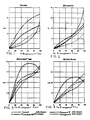
- Figure 1 shows a graph illustrating the relationship of tensile strength to various levels of bicomponent fibers in a thermally bonded web as described in Example 2.
- Figure 2 shows a graph illustrating the relationship of elongation to various levels of bicomponent fibers in a thermally bonded web as described in Example 2.
- Figure 3 shows a graph illustrating the relationship of the Elmendorf tear tests to various levels of bicomponent fibers in a thermally bonded web as described in Example 2.
- Figure 4 shows a graph illustrating the relationship of the Mullen Burst test to various levels of bicomponent fibers in a thermally bonded web as described in Example 2.
- a thermally bonded fibrous wet laid web of the present invention is prepared from a specific bicomponent fiber and optionally a matrix fiber. Processes to make such thermally bonded fibrous wet laid web would also use suitable dispersant and thickeners.
- Bicomponent fibers suitable for the present invention include a first component or a backbone polymer of polyester or polyamide or polypropylene.
- Polyester, polyamides and polypropylene are well known textile materials used in the manufacture of fabrics and other applications.
- polyester and polyamides have been listed, any suitable backbone polymer would include polymers having a higher melting point than the LLDPE.
- the backbone polymer has a melting point at least 30°C higher than that of the second component.
- a second component consisting essentially of a linear low density polyethylene.
- linear low density polyethylene Such polymers are termed “linear” because of the substantial absence of branched chains of polymerized monomer units pendant from the main polymer "backbone". It is these linear polymers to which the present invention applies.
- ethylene has been copolymerized along with minor amounts of alpha, beta-ethylenically unsaturated alkenes having from 3 to 12 carbons per alkene molecule, preferably 4 to 8.
- the amount of the alkene comonomer is generally sufficient to cause the density of the polymer to be substantially in the same density range of LDPE, due to the alkyl sidechains on the polymer molecule, yet the polymer remains in the "linear" classification; they are conveniently referred to as "linear" low density polyethylene.
- the LLDPE polymer may have a density in the range of about 0.88 g/cc to about 0.945 g/cc, preferably about 0.90 g/cc to about 0.940 g/cc. It is evident to practitioners of the relevant arts that the density will depend, in large part, on the particular alkene(s) incorporated into the polymer.
- the alkenes copolymerized with ethylene to make LLDPE comprises a minor amount of at least one olefinically unsaturated alkene of the form C3 - C12, most preferably from C4 - C8; 1-octene is especially preferred.
- the amount of said alkene may constitute about 0.5% to about 35% by weight of the copolymer, preferably about 1% to about 20%, most preferably about 1% to about 10%.
- the LLDPE polymer may have a melt flow value (MFV) in the range of about 5 gm/10 min to about 200 gm/10 min as measured in accordance with ASTM D-1238(E) at 190°C.
- MMV melt flow value
- the melt flow value is in the range of about 7 gm/10 min to about 120 gm/10 min, most preferably about 10 gm/10 min to about 105 gm/10 min. Practitioners of the relevant arts are aware that the melt flow value is inversely related to the molecular weight of the polymer.
- the second component of the bicomponent fiber also include a grafted high density polyethylene (HDPE), in a blend with the LLDPE wherein the HDPE has been grafted with maleic acid or maleic anhydride, thereby providing succinic acid of succinic anhydride groups grafted along the HDPE polymer chain.
- the HDPE for use in the present invention is a normally solid, high molecular weight polymer prepared using a coordination-type catalyst in a process wherein ethylene is homopolymerized.
- the HDPE which is used in making the grafted HDPE in accordance with the present invention is characterized as having a melt flow value in the range of about 5 g/10 min to about 500 g/10 min according to ASTM D-1238(E) at 190°C and a density in the range of about 0.94 g/cc to about 0.965 g/cc, preferably a MFV about 7 gms/10 min to about 150 gms/10 min and a density of about 0.945 g/cc to about 0.960 g/cc.
- the anhydride or acid groups generally comprise about 0.0001 to about 10 wt. percent, preferably about 0.01 to about 5 wt. percent of the HDPE.
- the ratio of grafted-HDPE/ungrafted LLDPE of the present blend is in the range of about 2/98 to about 30/70, preferably about 5/95 to about 20/80.
- maleic acid and maleic anhydride compounds are known in these relevant arts as having their olefin unsaturation sites conjugated to the acid groups, in contradistinction to the fused ring and bicyclo structures of the non-conjugated unsaturated acids of e.g., U. S. Pat. No. 3,873,643 and U. S. Pat. No. 3,882,194 and the like.
- Fumaric acid like maleic acid of which it is an isomer, is also conjugated. Fumaric acid, when heated rearranges and gives off water to form maleic anhydride, thus is operable in the present invention.
- Other alpha, beta unsaturated acids may be used.
- the grafting of the succinic acid or succinic anhydride groups onto ethylene polymer may be done by methods described in the art, which involve reacting maleic acid or maleic anhydride in admixture with heated polymer, generally using a peroxide or other free-radical initiator to expedite the grafting.
- Grafting may be effected in the presence of oxygen, air hydroperoxides, or other free radical initiators, or in the essential absence of these materials when the mixture of monomer and polymer is maintained under high shear in the absence of heat.
- a convenient method for producing the graft copolymer is the use of extrusion machinery, however, Banbury mixers, roll mills and the like may also be used for forming the graft copolymers.
- Another method is to employ a twin-screw devolatilizing extruder (such as a Werner-Pfleider twin-screw extruder) wherein maleic acid (or maleic anhydride) is mixed and reacted with the HDPE at molten temperatures, thereby producing and extruding the grafted polymer.
- a twin-screw devolatilizing extruder such as a Werner-Pfleider twin-screw extruder
- maleic acid or maleic anhydride
- a conventional spinning process for manufacturing a fiber with a sheath/core configuration involves feeding the sheath-forming material to the spinneret orifices in a direction perpendicular to the orifices, and injecting the core-forming material into the sheath-forming material as it flows into the spinneret orifices.
- U. S. Patent Nos. 4,406,850 and 4,251,200 discloses bicomponent spinning assemblies and describe the production of bicomponent fibers.
- Bicomponent fibers of the present invention may be either eccentric or concentric. It is understood, however, that the bicomponent fibers having side-by-side configurations or multi-segmented bicomponent fibers are also considered to be within the scope of the present invention.
- bicomponent fibers generally have a length to diameter ratio of between about 100:1 and about 2000:1. Such lengths are generally found to be about 1 mm to about 75 mm and preferably about 10 mm to 15 mm long. Diameters of the fibers are from about 0.5 dpf to about 50 dpf. Such bicomponent fibers are generally cut on conventional process machines wall known in the art.
- the second ingredient that may be used in the present invention is the matrix fibers.
- Such fibers can be generally characterized by the fact that all these fibers provide chemical bonding sites through hydroxyl or amine groups present in the fiber.
- Included in the class of such matrix fibers are the cellulose paper making fibers, cellulose acetate fibers, glass fibers, polyester fibers, metal fibers, ceramic fibers, mineral wool fibers, polyamide fibers, and other naturally occurring fibers.
- a whitewater system of water, thickener and dispersant is employed.
- the dispersant acts first to separate fibers and wet out the surface of the fibers.
- the thickener acts to increase the viscosity of the water carrier medium and also acts as a lubricant for the fibers. Through these actions, the thickener acts to combat flocculation of the fibers.
- Various ingredients may be used as a thickener.
- One class of nonionic associative thickeners comprise relatively low (10,000 - 200,000) molecular weight ethylene oxide based urethane block copolymers and are disclosed in U. S. Patent Nos. 4,079,028 and 4,155,892, incorporated herein by reference. These associative thickeners are particularly effective when the fiber furnish contains 10% or more staple length hydrophobic fibers.
- Commercial formulations of these copolymers are sold by Rohm and Haas, Philadelphia, PA, under the trade names ACRYSOL RM-825 and ACRYSOL RHEOLOGY MODIFIER QR-708, QR-735, and QR-1001 which comprise urethane block copolymers into carrier fluids.
- ACRYSOL RM-825 is 25% solids grade of polymer in a mixture of 25% butyl carbitol (a diethylene glycol monobutylether) and 75% water.
- ACRYSOL RHEOLOGY MODIFIER QR-708 a 35% solids grade in a mixture of 60% propylene glycol and 40% water can also be used.
- cellulose fibers e.g. rayon fibers or a blend of wood fibers and synthetic cellulosic fibers such as rayon
- rayon fibers e.g. rayon fibers or a blend of wood fibers and synthetic cellulosic fibers such as rayon
- modified nonionic cellulose ethers of the type disclosed in U. S. Patent No. 4,228,277 incorporated herein by reference and sold under the trade name AQUALON by Hercules Inc., Wilmington, Delaware.
- AQUALON WSP M-1017 a hydroxy ethyl cellulose modified with a C-10 to C-24 side chain alkyl group and having a molecular weight in the range of 50,000 to 400,000 may be used in the whitewater system.
- the dispersing agents that may be used in the present invention are synthetic, long-chain, linear molecules having an extremely high molecular weight, say on the order of at least 1 million and up to about 15 million, or 20 million, or even higher.
- Such dispersing agents are oxygen-containing and/or nitrogen-containing with the nitrogen present, for example, as an amine.
- the dispersing agents have excellent hydrogen bonding properties in water.
- the dispersing agents are water soluble and very hydrophylic.
- dispersant agents examples include polyethylene oxide which is a nonionic long chain homopolymer and has an average molecular weight of from about 1 million to about 7 million or higher; polyacrylamide which is a long straight chain nonionic or slightly anionic homopolymer and has an average molecular weight of from about 1 million up to about 15 million or higher, acrylamide-acrylic acid copolymers which are long, straight chain anionic polyelectrolytes in neutral and alkaline solutions, but nonionic under acid conditions, and possess an average molecular weight in the range of about 2 - 3 million, or higher; polyamines which are long straight chain cationic polyelectrolytes and have a high molecular weight of from about 1 million to about 5 million or higher; etc.
- a preferred dispersant is an oxyalkylated fatty amine.
- concentration of the dispersing agents in the aqueous media may be varied within relatively wide limits and may be as low as 1 ppm and up to as high as about 200 ppm. Higher concentrations up to about 600 ppm may be used but tend to become uneconomical due to the cost of the dispersing agent and may cause low wet web strength. However, if recovering means is provided whereby the aqueous medium and the dispersing agent therein is recycled and reused, then concentrations up to 1,000 ppm or even higher can result.
- the fiber concentration in the fiber slurry may also be varied within relatively wide limits. Concentrations as low as about 0.1% to 6.0% by weight of the furnish are suitable. Lighter or heavier ranges may be employed for special products intended for special purposes.
- the bicomponent and matrix fibers may be equally dispersed through an aqueous medium by adding a suitable dispersing agent and thickener to the resulting fiber slurry stirring and agitation of the slurry.
- the dispersing agent is added to the aqueous medium first and then the bicomponent fibers followed by the thickener and the matrix fibers are subsequently added thereto.
- the individual bicomponent fibers and matrix fiber are dispersed in the furnish uniformly through stirring with a minimum amount of fiber flocculation and clumping.
- the fibers enter a favorable aqueous environment containing the dispersing agent which is immediately conducive to their maintaining their individuality with respect to each other whereby there is substantially no tendency to flocculate or form clumps, tangles or bundles.
- This is to be contrasted to the prior situation wherein when bicomponent fibers are initially placed in an unfavorable aqueous environment not containing any high molecular weight, linear polymeric, water soluble, hydrophilic dispersing agent, which environment is conducive to the loss of fiber individuality whereby the fibers flocculate and form clumps, tangles, and bundles and tend to migrate either to the top or the bottom of the furnish.
- the web After the wet laid web has been formed, execess water is removed from the web by passing the web over a suction slot. Then the web is dried and thermally bonded by passing the web through a drying machine raised to sufficient temperature to melt the second component of the bicomponent fiber which then acts as an adhesive to bond the bicomponent fiber to other bicomponent fibers and matrix fibers upon cooling.
- a drying machine is a Honeycomb System Through-air Dryer.
- the heating temperature may be from 140°C to 220°C, preferably 145°C to 200°C.
- the thermally bonded web is then cooled with the adhesive bonds forming at below the resolidification of the second component.
- Bicomponent fibers were made having a substantially concentric sheath/core configuration.
- the core was made from a standard 0.64 IV semi-dull polyethylene terephthalate.
- the sheath was made from a polymer described for the specific bicomponent fiber.
- Bicomponent fiber A was made having a sheath of linear low density polyethylene containing from 1 - 7% 1-octene wherein the polymer had a density of 0.930 g/cc, a melt flow value of 18 gm/10 min at 190°C according to ASTM D-1236(E).
- LLDPE is commercially available from Dow Chemical Company or Aspun Resin 6813.
- Bicomponent fiber B was made having a sheath made from a blend of LLDPE and grafted HDPE wherein the blend had a density of .932 g/cc and a melt flow value of 16 gm/10 min at 190°C.
- the HDPE was grafted with maleic anhydride to contain 1 wt.% succinic anhydride groups. This sheath material is described in U. S. Patent No. 4,684,576.
- the ratio of grafted HDPE/LLDPE was 10/90.
- Each type of the bicomponent fibers were made by coextruding the core and sheath polymers, and drawing the resulting filaments by processes well known to those skilled in the art, to obtain the desired denier and sheath/core ratio.
- the bicomponent fibers were cut to have a length of about 0.5 inch.
- a batch fiber-water furnish was made with 500 liters of water at an ambient temperature in a mix tank equipped with an agitator rotating at 500 rpm. To the furnish was added in the following order:
- the bonded web was then tested for such properties including tensile strength, tear strength, elongation and Mullen Burst and the strength tests were done in the machine direction (MD) and the cross direction (CD).
- MD machine direction
- CD cross direction
- the tensile strength test is used to show the strength of a specimen when subjected to tension wherein a 1 inch wide sample by 7 inches long was pulled at 12 inch/min with a 5 inch jaw space. Elongation is the deformation in the direction of the load caused by tensile force and the reading is taken at the breaking load during the tensile test.
- the tear tester used was an Elmendorf Tear Tester which is a tester designed to determine the strength of the thermally bonded wet laid fabric.
- the Mullen Burst Test is an instrumental test method that measure the ability of a fabric to resist rupture by pressure exerted by an inflated diaphragm.
- wet laid webs were made up of bicomponent fibers and glass fibers and thermally bonded at 204°C into a thermally bonded web.
- the thermally bonded web was tested to demonstrate the present invention and compare it to a wet laid web made using a commercially available HDPE/PET bicomponent fiber.
- the glass fibers are made from silica base, having a thickness of 15 microns and a length of 12,7 cm (0.5 inch). Such fibers are commercially available from Grupo Protexa, Mexico. The ratio of bicomponent fibers to glass fibers was 50/50. The bicomponent fibers and glass fibers were added to the water furnish as described in the wet lay process.
- a bicomponent fiber was used having a PET core and a HDPE sheath, wherein the sheath/core ratio was 50/50 and the fiber has a denier of 2 dpf and a cut length of 3/8 inches.
- Such bicomponent fibers are commercially available as K-56 fiber type from Hoechst Celanese Corporation.
- Experiment 2 was similar to Experiment 1, but the bicomponent fiber was replaced with bicomponent fiber A having sheath/core ratio of 50/50, a denier of 2 dpf, and a cut length of (0.5 inches) 12,7 cm.
- Experiment 3 was similar to Experiment 1 and 2, but the bicomponent fiber used was bicomponent fiber B having a denier of 3 dpf, a cut length of 12,7 cm (0.5 inches) and a sheath core ratio of 50/50.
- the webs were tested for the tensile strength and tear strength in both the machine direction and cross direction. Also, the webs were tested for the Mullen Burst test. The results of the example are set forth in Table 1.
- Thermally bonded wet laid web produced in Experiment 1 was the control using a prior art bicomponent fiber of a HDPE sheath and PET core. It's tensile strength was 37g/cm (2.09 lbs./in). in the machine direction, 38 g/cm (2.15 lbs./in) in the cross direction; the tear strength was 217.3 grams in the machine direction and 213.3 grams in the cross direction; and the Mullen Burst test value of 503 kPa (7.3 PSI) .
- Experiment 2 demonstrates that by replacement of the prior art HDPE/PET bicomponent fiber with bicomponent fiber A in the wet laid web of the present invention, the tensile strength and tear strength in both the machine and cross directions significantly increase as does the Mullen Burst Test value which indicates improved adhesion of the bicomponent fiber to the glass fiber in this case. In fact, the strength increase is about 50% over the control.
- Experiment 3 demonstrates that employing a bicomponent fiber having a PET core and a sheath made from a blend of granted HDPE and LLDPE in the wet laid web of the present invention again significantly increases the tensile strength value 200% of the values for the control while maintaining high tear strength and Mullen Burst value.
- the slightly lower tear strength when compared to Experiment 2 is a further indication of superior bonding between the glass fibers and this bicomponent fiber.
- Thermally bonded wet laid webs were made up of varying amounts of bicomponent fibers and varying amounts of PET fibers used as matrix fibers. The webs were thermally bonded at 160°C. The thermally bonded webs were tested for strength, elongation and Mullen Burst. These values were compared to a wet laid web made up with a commercially available PET/HDPE bicomponent fiber (K-56) and varying amounts of PET matrix fiber.
- Experiments 1 A-D (the controls) a bicomponent fiber having a PET core and HDPE sheath as described in Example 1, Experiment 1, was used.
- the PET matrix fibers had a denier of 1.5 dpf and a cut length of 12,7 cm (0.5 inches).
- Experiments 2 were similar to Experiment 1, but the bicomponent fiber was replaced with bicomponent fiber B having a sheath core ratio of 40:60, a denier of 3 dpf, and a cut length of 0.5 inches.
- Experiments 3 were similar to Experiment 2 except the bicomponent fiber B had a sheath core ratio of 30:70.
- Experiments 4 A-D were similar to Experiment 2, except the bicomponent fiber B had a sheath core ratio of 20:80.
- Experiments 1 A-D were the controls using a commercially available bicomponent fiber of a HDPE sheath and PET core. When only PET fiber is used in the wet lay, the web has no strength. At 60% bicomponent fiber, 40% PET matrix fiber, the web has only 2.6 lbs. of strength and a Mullen Burst value of 16.6.
- Experiments 2 A-D demonstrates that by replacement of the HDPE/PET bicomponent fiber with bicomponent fiber B having a 40% sheath of the present invention, the strength of the web increases significantly as do the values for the Mullen Burst test.
- Experiments 3 A-C demonstrates that by using the bicomponent fiber B having a 30% sheath, that 100% bicomponent fiber B web has a strength of 11.2 lbs., which is significantly higher than the Experiment 1-D.
- Experiments 4 A-D demonstrates that using the bicomponent fiber B having only 20% sheath still results in a strength superior to that of the Experiment 1-C at 60% bicomponent: 40% PET fiber mix.
- Thermally bonded wet laid webs were made up of varying amounts of bicomponent fibers and PET fibers such that the total of the two fibers is 100%.
- the webs were thermally bonded at 370°F and were tested for tensile, elongation, Mullen Burst and tear.
- Experiments 1, 2 and 3 were similar in that each contained 100% bicomponent fiber and no matrix fiber.
- Experiment 1 (control) contained a bicomponent fiber as described in Example 1, Experiment 1.
- Experiment 2 contained bicomponent fiber A and Experiment 3 contained bicomponent fiber B.
- Experiments 4, 5 and 7 were similar in that each contained 75% bicomponent fiber and 25% PET fiber of 1.5 dpf and cut length of 1,27 cm (0.5 inches).
- Experiment 4 (control) contained the PET/HDPE bicomponent fiber;
- Experiment 5 contained bicomponent fiber A and
- Experiment 6 contained bicomponent fiber B.
- Experiments 7, 8 and 9 each contained 50% bicomponent fiber and 50% PET fiber.
- Experiment 7 (control) contained the PET/HDPE bicomponent fiber;
- Experiment 8 contained bicomponent fiber A and
- Experiment 9 contained bicomponent fiber B.
- Experiments 10, 11 and 12 each contained 25% bicomponent fiber and 75% PET fiber.
- Experiment 10 (control) contained the PET/HDPE bicomponent fiber;
- Experiment 11 contained bicomponent fiber A and
- Experiment 12 contained bicomponent fiber B.
Landscapes
- Chemical & Material Sciences (AREA)
- Chemical Kinetics & Catalysis (AREA)
- Engineering & Computer Science (AREA)
- Textile Engineering (AREA)
- Inorganic Chemistry (AREA)
- General Chemical & Material Sciences (AREA)
- Paper (AREA)
- Multicomponent Fibers (AREA)
- Nonwoven Fabrics (AREA)
Claims (18)
- Nappe fibreuse liée thermiquement, établie par voie humide, consistant essentiellement en une fibre à deux composants comprenant un premier composant polyester ou polyamide et un second composant comprenant un copolymère de polyéthylène linéaire basse densité, PELBD, ayant une masse volumique comprise dans la plage de 0,88 à 0,945 g/cm³, caractérisée en ce que le second composant comprend aussi un polyéthylène haute densité, PEHD, greffé, ayant initialement une masse volumique comprise dans la plage de 0,94 à 0,965 g/cm³, qui a été greffé avec de l'acide maléique ou de l'anhydride maléique de manière qu'il présente des groupes acide succinique ou anhydride succinique greffé le long du polymère PEHD.
- Nappe fibreuse liée thermiquement établie par voie humide suivant la revendication 1, dans laquelle le rapport du PEHD greffé au PELBD non greffé est compris dans la plage de 2:98 à 30:70.
- Nappe fibreuse liée thermiquement établie par voie humide suivant la revendication 1 ou 2, dans laquelle l'indice d'écoulement à l'état fondu du polymère PELBD se situe dans la plage de 7 g/10 min à 120 g/10 min et l'indice d'écoulement à l'état fondu du PEHD greffé se situe dans la plage de 5 g/10 min à 500 g/10 min.
- Nappe fibreuse liée thermiquement établie par voie humide suivant la revendication 3, dans laquelle l'indice d'écoulement à l'état fondu du PELBD se situe dans la plage de 10 g/10 min à 105 g/10 min et l'indice d'écoulement à l'état fondu du PEHD greffé se situe dans la plage de 7 g/10 min à 150 g/10 min.
- Nappe fibreuse liée thermiquement établie par voie humide suivant l'une quelconque des revendications 1 à 5, dans laquelle le PELBD non greffé a une masse volumique comprise dans la plage de 0,90 g/cm³ à 0,940 g/cm³ et a une teneur en comonomère alcénique en C₄ à C₈ de 1 à 20 % en poids du PELBD.
- Nappe fibreuse liée thermiquement établie par voie humide suivant la revendication 6, dans laquelle le comonomère alcénique comprend du 1-octène.
- Nappe fibreuse liée thermiquement établie par voie humide suivant l'une quelconque des revendications 1 à 5, dans laquelle le copolymère PELBD a une masse volumique comprise dans la plage de 0,88 g/cm³ à 0,945 g/cm³ et contient 0,5 à 35 % en poids de comonomère alcénique en C₃ à C₁₂.
- Nappe fibreuse liée thermiquement établie par voie humide suivant la revendication 7, dans laquelle le copolymère PELBD non greffé contient 2 à 15 % en poids de 1-octène comonomère.
- Nappe fibreuse liée thermiquement établie par voie humide consistant essentiellement en une fibre à deux composants comprenant un premier composant polyester ou polyamide ; et un second composant comprenant un copolymère de polyéthylène linéaire basse densité ayant une masse volumique comprise dans la plage de 0,88 à 0,945 g/cm³; et une matrice de fibres choisies dans le groupe consistant essentiellement en fibres cellulosiques de fabrication du papier, fibres d'acétate de cellulose, fibres de verre, fibres de polyester, fibres métalliques, fibres de laine minérale, fibres de polyamide ou autres fibres naturelles ; caractérisée en ce que le second composant comprend aussi un polyéthylène haute densité, PEHD, greffé, ayant initialement une masse volumique comprise dans la plage de 0,94 à 0,965 g/cm³ qui a été greffé avec de l'acide maléique ou de l'anhydride maléique, de manière que des groupes acide succinique ou anhydride succinique soient présents le long de la chaîne de polymère PEHD.
- Nappe fibreuse liée thermiquement établie par voie humide suivant la revendication 9, dans laquelle le rapport du PEHD greffé au PELBD non greffé se situe dans la plage de 2:98 à 30;70.
- Nappe fibreuse liée thermiquement établie par voie humide suivant la revendication 9 ou 10, dans laquelle l'indice d'écoulement à l'état fondu du polymère PELBD se situe dans la plage de 7 g/10 min à 120 g/10 min et l'indice d'écoulement à l'état fondu du PEHD greffé se situe dans la plage de 5 g/10 min à 500 g/10 min.
- Nappe fibreuse liée thermiquement établie par voie humide suivant la revendication 11, dans laquelle l'indice d'écoulement à l'état fondu du PELBD se situe dans la plage de 10 g/10 min à 105 g/10 min et l'indice d'écoulement à l'état fondu du PEHD greffé se situe dans la plage de 7 g/10 min à 150 g/10 min.
- Nappe fibreuse liée thermiquement établie par voie humide suivant l'une quelconque des revendications 9 à 12, dans laquelle le PELBD a une masse volumique comprise dans la plage de 0,90 g/cm³ à 0,940 g/cm³ et une teneur en comonomère alcénique en C₄ à C₈ de 1 à 20 % en poids du PELBD.
- Nappe fibreuse liée thermiquement établie par voie humide suivant la revendication 13, dans laquelle le comonomère alcénique comprend du 1-octène.
- Nappe fibreuse liée thermiquement établie par voie humide suivant l'une quelconque des revendications 9 à 12, dans laquelle le copolymère PELBD est un copolymère ayant une masse volumique comprise dans la plage de 0,88 g/cm³ à 0,945 g/cm³ contenant 0,5 à 35 % en poids d'un comonomère alcénique en C₃ à C₁₂.
- Nappe fibreuse liée thermiquement établie par voie humide suivant la revendication 15, dans laquelle le copolymère PELBD contient 2 à 15 % en poids de 1-octène comme comonomère.
- Nappe fibreuse liée thermiquement établie par voie humide comprenant une fibre à deux composants comportant un noyau en un polyester ou polyamide ; et une gaine consistant en un copolymère de polyéthylène linéaire basse densité ayant une masse volumique comprise dans la plage de 0,88 g/cm³ à 0,945 g/cm³ et un polyéthylène haute densité, PEHD, greffé, ayant initialement une masse volumique comprise dans la plage de 0,94 à 0,965 g/cm³, qui a été greffé avec de l'acide maléique ou de l'anhydride maléique de manière que des groupes acide succinique ou anhydride succinique soient présents à l'état greffé le long de la chaîne du polymère PEHD, la fibre à deux composants ayant un rapport longueur:diamètre compris entre 100:1 et 2000:1 ; et une matrice de fibres choisies dans le groupe essentiellement constitué de fibres d'acétate de cellulose, de fibres de verre, de fibres de polyester, de fibres céramiques, de fibres de laine, de fibres de polyamide et d'autres fibres naturelles.
- Procédé pour établir par voie humide une nappe fibreuse liée thermiquement par dépôt de fibres par voie humide sur une installation de fabrication de papier ou une installation de fabrication d'un non-tissé établi par voie humide, la bande comprenant des fibres à deux composants comportant un premier composant de polyester ou polyamide et un second composant consistant essentiellement en un copolymère de polyéthylène linéaire basse densité ayant une masse volumique comprise dans la plage de 0,88 à 0,945 g/cm³ et un polyéthylène haute densité, PEHD, greffé ayant initialement une masse volumique comprise dans la plage de 0,94 à 0,965 g/cm³, qui a été greffé avec de l'acide maléique ou de l'anhydride maléique de manière que des groupes acide succinique ou anhydride succinique soient présents à l'état greffé le long du polymère PEHD ; et une matrice de fibres, comprenant les étapes de formation d'une charge fibreuse par dispersion des fibres à deux composants et des fibres formant la matrice dans un véhicule consistant essentiellement en eau contenant un dispersant et un agent épaississant, et l'amenée de la charge fibreuse, à une consistance comprise dans la plage de 0,01 à 0,5 % en poids de fibres, à la toile métallique d'une machine de formation d'une nappe fibreuse, puis chauffage de la nappe fibreuse, pour faire fondre le second composant et pour lier thermiquement la nappe fibreuse.
Applications Claiming Priority (2)
| Application Number | Priority Date | Filing Date | Title |
|---|---|---|---|
| US547731 | 1990-07-02 | ||
| US07/547,731 US5167765A (en) | 1990-07-02 | 1990-07-02 | Wet laid bonded fibrous web containing bicomponent fibers including lldpe |
Publications (2)
| Publication Number | Publication Date |
|---|---|
| EP0465203A1 EP0465203A1 (fr) | 1992-01-08 |
| EP0465203B1 true EP0465203B1 (fr) | 1996-03-13 |
Family
ID=24185910
Family Applications (1)
| Application Number | Title | Priority Date | Filing Date |
|---|---|---|---|
| EP91305970A Expired - Lifetime EP0465203B1 (fr) | 1990-07-02 | 1991-07-01 | Nappe améliorée non tissée liée formée humide contenant fibres bi-composants LLDPE inclus |
Country Status (7)
| Country | Link |
|---|---|
| US (1) | US5167765A (fr) |
| EP (1) | EP0465203B1 (fr) |
| JP (1) | JPH07111039B2 (fr) |
| AT (1) | ATE135419T1 (fr) |
| CA (1) | CA2045114A1 (fr) |
| DE (1) | DE69117821T2 (fr) |
| MX (1) | MX9100053A (fr) |
Cited By (10)
| Publication number | Priority date | Publication date | Assignee | Title |
|---|---|---|---|---|
| US6752905B2 (en) | 2002-10-08 | 2004-06-22 | Kimberly-Clark Worldwide, Inc. | Tissue products having reduced slough |
| US6861380B2 (en) | 2002-11-06 | 2005-03-01 | Kimberly-Clark Worldwide, Inc. | Tissue products having reduced lint and slough |
| US6887350B2 (en) | 2002-12-13 | 2005-05-03 | Kimberly-Clark Worldwide, Inc. | Tissue products having enhanced strength |
| US7985344B2 (en) | 2004-11-05 | 2011-07-26 | Donaldson Company, Inc. | High strength, high capacity filter media and structure |
| US8021455B2 (en) | 2007-02-22 | 2011-09-20 | Donaldson Company, Inc. | Filter element and method |
| US8057567B2 (en) | 2004-11-05 | 2011-11-15 | Donaldson Company, Inc. | Filter medium and breather filter structure |
| US8267681B2 (en) | 2009-01-28 | 2012-09-18 | Donaldson Company, Inc. | Method and apparatus for forming a fibrous media |
| US9114339B2 (en) | 2007-02-23 | 2015-08-25 | Donaldson Company, Inc. | Formed filter element |
| US10066342B2 (en) | 2014-12-18 | 2018-09-04 | Lydall, Inc. | Wet-laid nonwoven including thermoplastic fiber |
| CN113260749A (zh) * | 2018-12-10 | 2021-08-13 | 陶氏环球技术有限责任公司 | 具有至少一种双组分纤维的气流成网基材 |
Families Citing this family (109)
| Publication number | Priority date | Publication date | Assignee | Title |
|---|---|---|---|---|
| US5167764A (en) * | 1990-07-02 | 1992-12-01 | Hoechst Celanese Corporation | Wet laid bonded fibrous web |
| AU645264B2 (en) * | 1990-08-07 | 1994-01-13 | Dow Chemical Company, The | Method for making biocomponent fibers |
| EP0575601A1 (fr) * | 1992-01-21 | 1993-12-29 | James River Corporation Of Virginia | Papier absorbant renforce |
| US5415738A (en) * | 1993-03-22 | 1995-05-16 | Evanite Fiber Corporation | Wet-laid non-woven fabric and method for making same |
| DE69422993T2 (de) * | 1993-10-21 | 2001-11-08 | The Procter & Gamble Company, Cincinnati | Flüssigkeitsabsorbierende monatsbinden |
| US5416960A (en) * | 1993-10-28 | 1995-05-23 | Kroyer; Karl K. K. | Method for the production of fibrous material containing curled fibers |
| US5605739A (en) * | 1994-02-25 | 1997-02-25 | Kimberly-Clark Corporation | Nonwoven laminates with improved peel strength |
| US5597645A (en) * | 1994-08-30 | 1997-01-28 | Kimberly-Clark Corporation | Nonwoven filter media for gas |
| US6077795A (en) * | 1994-09-21 | 2000-06-20 | Owens Corning Fiberglas Technology, Inc. | Papermaking felts from irregular fibers |
| USH1698H (en) * | 1994-10-21 | 1997-11-04 | The Procter & Gamble Company | Absorbent structures having thermally bonded resilient web for improved fit and comfort |
| DE69528076T2 (de) * | 1994-10-31 | 2003-04-30 | Kimberly-Clark Worldwide, Inc. | Hochdichte faservliesfiltermedien |
| TW288051B (fr) * | 1994-11-22 | 1996-10-11 | Ebara Corp | |
| US5549589A (en) * | 1995-02-03 | 1996-08-27 | The Procter & Gamble Company | Fluid distribution member for absorbent articles exhibiting high suction and high capacity |
| ZA963715B (en) * | 1995-05-12 | 1996-11-20 | Tensar Corp | Bonded composite open mesh structural textiles |
| US5795835A (en) * | 1995-08-28 | 1998-08-18 | The Tensar Corporation | Bonded composite knitted structural textiles |
| KR100190437B1 (ko) * | 1995-09-26 | 1999-06-01 | 고다 시게노리 | 폴리올레핀 합성펄프 |
| US5709735A (en) * | 1995-10-20 | 1998-01-20 | Kimberly-Clark Worldwide, Inc. | High stiffness nonwoven filter medium |
| US6267843B1 (en) | 1996-03-20 | 2001-07-31 | Owens Corning Fiberglas Technology, Inc. | Wet-laid nonwoven mat and a process for making same |
| US5800416A (en) * | 1996-04-17 | 1998-09-01 | The Procter & Gamble Company | High capacity fluid absorbent members |
| US5843055A (en) * | 1996-07-24 | 1998-12-01 | The Procter & Gamble Company | Stratified, multi-functional fluid absorbent members |
| US6100208A (en) * | 1996-10-31 | 2000-08-08 | Kimberly-Clark Worldwide, Inc. | Outdoor fabric |
| US5851355A (en) * | 1996-11-27 | 1998-12-22 | Bba Nonwovens Simpsonville, Inc. | Reverse osmosis support substrate and method for its manufacture |
| AU5690798A (en) * | 1996-12-06 | 1998-06-29 | Weyerhaeuser Company | Unitary stratified composite |
| WO1998028477A1 (fr) * | 1996-12-20 | 1998-07-02 | Moy Isover Limited | Textile non tisse |
| US5948529A (en) * | 1997-02-26 | 1999-09-07 | Hna Holdings, Inc. | Bicomponent fiber |
| US5981410A (en) * | 1997-04-08 | 1999-11-09 | Fibervisions A/S | Cellulose-binding fibres |
| TW436535B (en) * | 1997-04-08 | 2001-05-28 | Danaklon As | Drylaid nonwoven materials, methods for producing them and bicomponent fibers for the production thereof |
| US6214146B1 (en) * | 1997-04-17 | 2001-04-10 | Kimberly-Clark Worldwide, Inc. | Creped wiping product containing binder fibers |
| US5877096A (en) * | 1997-05-05 | 1999-03-02 | The Tensar Corporation | Non-woven needle-punched filter fabric |
| GB2335867A (en) * | 1998-04-03 | 1999-10-06 | Process Scient Innovations | Thermally bonded felt material for coalescence filters |
| TW479087B (en) * | 1998-11-13 | 2002-03-11 | Kimberly Clark Co | Pulp-modified bicomponent continuous filament nonwoven webs and articles |
| US6096793A (en) * | 1998-12-22 | 2000-08-01 | Sealed Air Corporation | Foam comprising polyolefin blend and method for producing same |
| US6156680A (en) * | 1998-12-23 | 2000-12-05 | Bba Nonwovens Simpsonville, Inc. | Reverse osmosis support substrate and method for its manufacture |
| US6441267B1 (en) | 1999-04-05 | 2002-08-27 | Fiber Innovation Technology | Heat bondable biodegradable fiber |
| US6509092B1 (en) | 1999-04-05 | 2003-01-21 | Fiber Innovation Technology | Heat bondable biodegradable fibers with enhanced adhesion |
| US6251224B1 (en) | 1999-08-05 | 2001-06-26 | Owens Corning Fiberglass Technology, Inc. | Bicomponent mats of glass fibers and pulp fibers and their method of manufacture |
| SE0000174L (sv) * | 2000-01-21 | 2001-08-20 | Fiberduk Ab | Förfarande för framställning av fibrerduk samt fiberduk framställd därigenom och förfarande för framställning av en skiktkomposit samt skiktkompositen framställd därigenom |
| DE60110290T2 (de) * | 2000-02-28 | 2005-10-06 | Kao Corp. | Blatt für einen absorbierenden Artikel und absorbierender Artikel mit einem solchen Blatt |
| GB0004681D0 (en) * | 2000-02-28 | 2000-04-19 | Saffil Limited | Method of making fibre-based products and their use |
| US6809125B1 (en) | 2000-06-02 | 2004-10-26 | Sealed Air Corporation (Us) | Foam comprising polyolefin blend and method for producing same |
| AU9085901A (en) | 2000-09-15 | 2002-03-26 | Ahlstrom Dexter Llc | Disposable nonwoven wiping fabric and method of production |
| DE10051186B4 (de) | 2000-10-16 | 2005-04-07 | Fibermark Gessner Gmbh & Co. Ohg | Staubfilterbeutel mit hochporöser Trägermateriallage |
| US6712939B2 (en) * | 2001-02-26 | 2004-03-30 | Cuno Incorporated | Process for manufacturing wet-felted and thermally bonded porous structures and porous structures formed by the process |
| US6492013B1 (en) | 2001-03-28 | 2002-12-10 | Sealed Air Corporation | Foam composite structure comprising a blend of polypropylene and homogeneous ethylene/alpha-olefin copolymer |
| US6488811B1 (en) | 2001-04-30 | 2002-12-03 | Owens Corning Fiberglas Technology, Inc. | Multicomponent mats of glass fibers and natural fibers and their method of manufacture |
| DE10222672B4 (de) * | 2001-05-28 | 2016-01-21 | Jnc Corporation | Verfahren zur Herstellung von thermoadhäsiven Konjugatfasern und von dieselben verwendenden Vlies" |
| US6831025B2 (en) | 2001-06-18 | 2004-12-14 | E. I. Du Pont De Nemours And Company | Multiple component spunbond web and laminates thereof |
| DE60215015T2 (de) | 2001-07-17 | 2007-02-22 | Dow Global Technologies, Inc., Midland | Elastische bikomponenten- und bikonstituentenfasern und verfahren zur herstellung von cellulosestrukturen unter verwendung derselben |
| US20080070274A1 (en) * | 2001-12-10 | 2008-03-20 | William Lee | High capacity, methods for separation, purification, concentration, immobilization and synthesis of compounds and applications based thereupon |
| US6670035B2 (en) * | 2002-04-05 | 2003-12-30 | Arteva North America S.A.R.L. | Binder fiber and nonwoven web |
| WO2004003278A1 (fr) * | 2002-06-26 | 2004-01-08 | E.I. Du Pont De Nemours And Company | Voile file-lie a composants multiples et stratifies associes |
| CA2443885A1 (fr) * | 2002-10-02 | 2004-04-02 | Fort James Corporation | Produits en papier comprenant des fibres thermoliees a surface traitee, et methodes de fabrication |
| US7052580B2 (en) * | 2003-02-06 | 2006-05-30 | The Procter & Gamble Company | Unitary fibrous structure comprising cellulosic and synthetic fibers |
| US7067038B2 (en) * | 2003-02-06 | 2006-06-27 | The Procter & Gamble Company | Process for making unitary fibrous structure comprising randomly distributed cellulosic fibers and non-randomly distributed synthetic fibers |
| ES2224849B1 (es) * | 2003-05-09 | 2005-12-01 | Saint-Gobain Cristaleria, S.A. | Lanas minerales recubiertas de complejos formados por laminas de polimeros organicos. |
| US7008888B2 (en) | 2003-07-24 | 2006-03-07 | E. I. Du Pont De Nemours And Company | Multiple component spunbond web |
| US20050032452A1 (en) * | 2003-08-07 | 2005-02-10 | Helwig Gregory S. | Conformable surfacing veil or reinforcement mat |
| US7297226B2 (en) | 2004-02-11 | 2007-11-20 | Georgia-Pacific Consumer Products Lp | Apparatus and method for degrading a web in the machine direction while preserving cross-machine direction strength |
| ES2772198T3 (es) | 2004-11-05 | 2020-07-07 | Donaldson Co Inc | Medio y estructura de filtro |
| EP3646931B1 (fr) | 2004-11-05 | 2022-03-30 | Donaldson Company, Inc. | Méthode de filtrage d'un fluide chauffé |
| US12172111B2 (en) | 2004-11-05 | 2024-12-24 | Donaldson Company, Inc. | Filter medium and breather filter structure |
| BRPI0606842A2 (pt) | 2005-02-04 | 2009-07-21 | Donaldson Co Inc | separador de aerossol |
| CN101163534A (zh) | 2005-02-22 | 2008-04-16 | 唐纳森公司 | 气溶胶分离器 |
| US8318062B2 (en) | 2006-10-04 | 2012-11-27 | Sellars Absorbent Materials, Inc. | Industrial absorbents and methods of manufacturing the same |
| US8118177B2 (en) * | 2006-10-04 | 2012-02-21 | Sellars Absorbent Materials, Inc. | Non-woven webs and methods of manufacturing the same |
| US20080085649A1 (en) * | 2006-10-06 | 2008-04-10 | Jaime Marco Vara Salamero | High tensile modulus nonwoven fabric for cleaning printer machines |
| US8357220B2 (en) * | 2008-11-07 | 2013-01-22 | Hollingsworth & Vose Company | Multi-phase filter medium |
| GB0906837D0 (en) | 2009-04-21 | 2009-06-03 | Saffil Automotive Ltd | Mats |
| US9932236B2 (en) | 2009-07-02 | 2018-04-03 | United Arab Emirates University | System for producing carbon nanotubes from combustion engine exhausts |
| US20110000198A1 (en) * | 2009-07-02 | 2011-01-06 | United Arab Emirates University | Filter and process of use to produce carbon nanotubes from automotive exhausts |
| JP5822163B2 (ja) | 2009-08-10 | 2015-11-24 | ユニフラックス ワン リミテッド ライアビリティ カンパニー | 可変基本質量取付けマットまたはプレフォームおよび排気ガス処理装置 |
| EP2507490B1 (fr) | 2009-12-01 | 2017-01-25 | Unifrax Emission Control Europe Ltd. | Nappe de montage |
| US8926911B2 (en) | 2009-12-17 | 2015-01-06 | Unifax I LLC | Use of microspheres in an exhaust gas treatment device mounting mat |
| EP2513443B1 (fr) | 2009-12-17 | 2016-08-10 | Unifrax I LLC | Nappe de montage pour dispositif de traitement des gaz d'échappement |
| EP2513444B1 (fr) | 2009-12-17 | 2017-05-03 | Unifrax I LLC | Nappe de montage multicouche pour dispositifs antipollution |
| CN102906320A (zh) * | 2010-03-19 | 2013-01-30 | 陶氏环球技术有限责任公司 | 双组分纤维 |
| EP2561128B1 (fr) | 2010-04-22 | 2015-01-21 | 3M Innovative Properties Company | Non tissés fibreux contenant des particules actives chimiquement et methodes de fabrication et d'utilisation |
| US20130037481A1 (en) | 2010-04-22 | 2013-02-14 | 3M Innovative Properties Company | Nonwoven nanofiber webs containing chemically active particulates and methods of making and using same |
| US8679218B2 (en) | 2010-04-27 | 2014-03-25 | Hollingsworth & Vose Company | Filter media with a multi-layer structure |
| US9771675B2 (en) | 2010-07-07 | 2017-09-26 | 3M Innovative Properties Company | Patterned air-laid nonwoven fibrous webs and methods of making and using same |
| WO2012021817A2 (fr) | 2010-08-12 | 2012-02-16 | Unifrax I Llc | Dispositif de traitement de gaz d'échappement |
| CN103547777A (zh) | 2010-11-11 | 2014-01-29 | 尤尼弗瑞克斯I有限责任公司 | 安装垫和废气处理装置 |
| US9924564B2 (en) | 2010-11-11 | 2018-03-20 | Unifrax I Llc | Heated mat and exhaust gas treatment device |
| US10105624B2 (en) | 2011-02-03 | 2018-10-23 | Donaldson Company, Inc. | Filter media pack, filter assembly, and method |
| CN103492625B (zh) * | 2011-03-18 | 2017-06-23 | 唐纳森公司 | 高温处理的介质 |
| US9802187B2 (en) | 2011-06-30 | 2017-10-31 | 3M Innovative Properties Company | Non-woven electret fibrous webs and methods of making same |
| PL2798107T3 (pl) | 2011-12-30 | 2018-07-31 | 3M Innovative Properties Company | Sposoby i urządzenia do wytwarzania wstęg włókniny o strukturze włóknistej |
| CN104220661B (zh) | 2011-12-30 | 2019-04-12 | 3M创新有限公司 | 用于制备非织造纤维网的设备和方法 |
| US9689097B2 (en) | 2012-05-31 | 2017-06-27 | Wm. T. Burnett Ip, Llc | Nonwoven composite fabric and panel made therefrom |
| US20160229211A1 (en) * | 2012-09-24 | 2016-08-11 | William Becker | Sheeted medical articles with adhered wristband |
| US10058808B2 (en) | 2012-10-22 | 2018-08-28 | Cummins Filtration Ip, Inc. | Composite filter media utilizing bicomponent fibers |
| US9694306B2 (en) | 2013-05-24 | 2017-07-04 | Hollingsworth & Vose Company | Filter media including polymer compositions and blends |
| JP6229886B2 (ja) * | 2013-10-04 | 2017-11-15 | Dic株式会社 | 水性樹脂組成物 |
| WO2015088753A1 (fr) | 2013-12-13 | 2015-06-18 | 3M Innovative Properties Company | Articles incluant des microcapsules pour une adhérence à la demande et leurs procédés de fabrication |
| WO2015136385A2 (fr) | 2014-01-28 | 2015-09-17 | United Arab Emirates University | Système de production de nanotubes de carbone à partir d'échappements de moteur à combustion |
| CA3019238C (fr) | 2015-03-31 | 2023-04-11 | Imbibitive Technologies Corporation | Construction destinee a absorber un produit chimique organique |
| KR101768323B1 (ko) | 2015-09-16 | 2017-08-16 | 롯데케미칼 주식회사 | 복합 방사용 접착성 수지 조성물 및 그 제조방법 |
| US12420221B2 (en) | 2016-07-01 | 2025-09-23 | Hollingsworth & Vose Company | Multi-layered electret-containing filtration media |
| WO2018182191A1 (fr) | 2017-03-31 | 2018-10-04 | 코오롱인더스트리 주식회사 | Membrane échangeuse d'ions, son procédé de fabrication et dispositif de stockage d'énergie la comprenant |
| JP6895532B2 (ja) | 2017-03-31 | 2021-06-30 | コーロン インダストリーズ インク | イオン交換膜及びその製造方法、並びにこれを含むエネルギー貯蔵装置 |
| US11207624B2 (en) * | 2017-07-31 | 2021-12-28 | Qiong Gao | High performance media for filtration and others applications |
| EP3672796A4 (fr) | 2017-08-25 | 2021-05-26 | 3M Innovative Properties Company | Articles adhésifs permettant un retrait sans endommagement |
| JP6931741B2 (ja) | 2017-08-25 | 2021-09-08 | スリーエム イノベイティブ プロパティズ カンパニー | 損傷のない取り外しを可能にする接着性物品 |
| CA3086438A1 (fr) | 2017-12-20 | 2019-06-27 | 3M Innovative Properties Company | Articles abrasifs comprenant une couche d'encollage anti-encrassement |
| CN111836922B (zh) * | 2018-03-29 | 2022-12-02 | 陶氏环球技术有限责任公司 | 双组分纤维及其聚合物组合物 |
| CA3126895A1 (fr) | 2019-01-21 | 2020-07-30 | 3M Innovative Properties Company | Composites biodegradables, multicouches pour filtration d'air |
| AR121941A1 (es) * | 2020-05-08 | 2022-07-27 | Dow Global Technologies Llc | FIBRAS BICOMPONENTES QUE INCLUYEN UN INTERPOLÍMERO DE ETILENO / a-OLEFINA Y POLIÉSTER |
| US12359095B2 (en) | 2020-10-15 | 2025-07-15 | 3M Innovative Properties Company | Adhesive assemblies permitting enhanced weight bearing performance with damage free removal |
| WO2022236005A1 (fr) * | 2021-05-07 | 2022-11-10 | Fybervek Holdings Llc | Non tissé à haute résistance issu d'un approvisionnement durable |
Family Cites Families (13)
| Publication number | Priority date | Publication date | Assignee | Title |
|---|---|---|---|---|
| US3674621A (en) * | 1969-02-25 | 1972-07-04 | Mitsubishi Rayon Co | Process of making a sheet paper |
| US4200488A (en) * | 1975-02-20 | 1980-04-29 | International Paper Company | Viscous dispersion for forming wet-laid, non-woven fabrics |
| US4318774A (en) * | 1980-05-01 | 1982-03-09 | Powell Corporation | Composite nonwoven web |
| JPS599255A (ja) * | 1982-06-29 | 1984-01-18 | チッソ株式会社 | 熱接着不織布 |
| NZ205684A (en) * | 1982-09-30 | 1987-02-20 | Chicopee | Non-woven fabric containing conjugate fibres:pattern densified without fusing the fibres |
| US4684576A (en) * | 1984-08-15 | 1987-08-04 | The Dow Chemical Company | Maleic anhydride grafts of olefin polymers |
| FR2596075B1 (fr) * | 1986-03-21 | 1988-11-18 | Centre Tech Cuir Chaussure | Materiau non tisse a base de fibres de cuir, son procede de fabrication et ses applications |
| EP0248598B1 (fr) * | 1986-05-31 | 1992-10-21 | Unitika Ltd. | Etoffe non tissée en polyoléfine, et procédé pour la fabriquer |
| EP0277707B1 (fr) * | 1987-01-12 | 1994-04-06 | Unitika Ltd. | Fibre de polyoléfine à deux composants et étoffe non tissée fabriquée à partir de cette fibre |
| US4770925A (en) * | 1987-01-17 | 1988-09-13 | Mitsubishi Petrochemical Co., Ltd. | Thermally bonded nonwoven fabric |
| US4822452A (en) * | 1987-04-06 | 1989-04-18 | James River Corporation Of Virginia | Manufacture of wet laid nonwoven webs |
| JPH0192415A (ja) * | 1987-10-02 | 1989-04-11 | Unitika Ltd | 熱接着繊維及びその不織布 |
| JP5527174B2 (ja) | 2010-11-24 | 2014-06-18 | トヨタ自動車株式会社 | 排熱回収システム |
-
1990
- 1990-07-02 US US07/547,731 patent/US5167765A/en not_active Expired - Lifetime
-
1991
- 1991-06-20 CA CA002045114A patent/CA2045114A1/fr not_active Abandoned
- 1991-07-01 AT AT91305970T patent/ATE135419T1/de not_active IP Right Cessation
- 1991-07-01 EP EP91305970A patent/EP0465203B1/fr not_active Expired - Lifetime
- 1991-07-01 DE DE69117821T patent/DE69117821T2/de not_active Expired - Lifetime
- 1991-07-02 JP JP3161890A patent/JPH07111039B2/ja not_active Expired - Lifetime
- 1991-07-02 MX MX9100053A patent/MX9100053A/es unknown
Cited By (19)
| Publication number | Priority date | Publication date | Assignee | Title |
|---|---|---|---|---|
| US6752905B2 (en) | 2002-10-08 | 2004-06-22 | Kimberly-Clark Worldwide, Inc. | Tissue products having reduced slough |
| US6929714B2 (en) | 2002-10-08 | 2005-08-16 | Kimberly-Clark Worldwide, Inc. | Tissue products having reduced slough |
| US6861380B2 (en) | 2002-11-06 | 2005-03-01 | Kimberly-Clark Worldwide, Inc. | Tissue products having reduced lint and slough |
| US6887350B2 (en) | 2002-12-13 | 2005-05-03 | Kimberly-Clark Worldwide, Inc. | Tissue products having enhanced strength |
| US8268033B2 (en) | 2004-11-05 | 2012-09-18 | Donaldson Company, Inc. | Filter medium and structure |
| US8512435B2 (en) | 2004-11-05 | 2013-08-20 | Donaldson Company, Inc. | Filter medium and breather filter structure |
| US8641796B2 (en) | 2004-11-05 | 2014-02-04 | Donaldson Company, Inc. | Filter medium and breather filter structure |
| US8057567B2 (en) | 2004-11-05 | 2011-11-15 | Donaldson Company, Inc. | Filter medium and breather filter structure |
| US7985344B2 (en) | 2004-11-05 | 2011-07-26 | Donaldson Company, Inc. | High strength, high capacity filter media and structure |
| US8021457B2 (en) | 2004-11-05 | 2011-09-20 | Donaldson Company, Inc. | Filter media and structure |
| US8277529B2 (en) | 2004-11-05 | 2012-10-02 | Donaldson Company, Inc. | Filter medium and breather filter structure |
| US8021455B2 (en) | 2007-02-22 | 2011-09-20 | Donaldson Company, Inc. | Filter element and method |
| US9114339B2 (en) | 2007-02-23 | 2015-08-25 | Donaldson Company, Inc. | Formed filter element |
| US8267681B2 (en) | 2009-01-28 | 2012-09-18 | Donaldson Company, Inc. | Method and apparatus for forming a fibrous media |
| US8524041B2 (en) | 2009-01-28 | 2013-09-03 | Donaldson Company, Inc. | Method for forming a fibrous media |
| US9353481B2 (en) | 2009-01-28 | 2016-05-31 | Donldson Company, Inc. | Method and apparatus for forming a fibrous media |
| US10066342B2 (en) | 2014-12-18 | 2018-09-04 | Lydall, Inc. | Wet-laid nonwoven including thermoplastic fiber |
| CN113260749A (zh) * | 2018-12-10 | 2021-08-13 | 陶氏环球技术有限责任公司 | 具有至少一种双组分纤维的气流成网基材 |
| US11821141B2 (en) | 2018-12-10 | 2023-11-21 | Dow Global Technologies Llc | Airlaid substrates having at least one bicomponent fiber |
Also Published As
| Publication number | Publication date |
|---|---|
| JPH07111039B2 (ja) | 1995-11-29 |
| MX9100053A (es) | 1992-02-28 |
| DE69117821T2 (de) | 1996-09-12 |
| CA2045114A1 (fr) | 1992-01-03 |
| ATE135419T1 (de) | 1996-03-15 |
| US5167765A (en) | 1992-12-01 |
| EP0465203A1 (fr) | 1992-01-08 |
| JPH04241193A (ja) | 1992-08-28 |
| DE69117821D1 (de) | 1996-04-18 |
Similar Documents
| Publication | Publication Date | Title |
|---|---|---|
| US5167765A (en) | Wet laid bonded fibrous web containing bicomponent fibers including lldpe | |
| US5167764A (en) | Wet laid bonded fibrous web | |
| EP0341977B2 (fr) | Matériaux composites à partir de mélanges réalisés par voie humide, de fibres de verre et thermoplastique | |
| US4496583A (en) | Paper-like polyester fiber sheet and process for producing the same | |
| US6251224B1 (en) | Bicomponent mats of glass fibers and pulp fibers and their method of manufacture | |
| EP0192897B1 (fr) | Mélange de polyéthylène et de polypropylène | |
| US5082899A (en) | Maleic anhydride-grafted polyolefin fibers | |
| US5580459A (en) | Filtration structures of wet laid, bicomponent fiber | |
| US3674621A (en) | Process of making a sheet paper | |
| US4632861A (en) | Blend of polyethylene and polypropylene | |
| US4323626A (en) | Heat-adhesive composite fibers | |
| US5126199A (en) | Maleic anhydride-grafted polyolefin fibers | |
| EP0472355A1 (fr) | Aiguilletage hydraulique d'un non tissé contenant des fibres synthétiques sous forme de ruban à section cannelée et leur méthode de production | |
| TW211589B (en) | Hotmelt-adhesive fiber sheet and process for producing the same | |
| EP1114215B1 (fr) | Non-tisses | |
| US5185199A (en) | Maleic anhydride-grafted polyolefin fibers | |
| EP0451554B1 (fr) | Agents liants pour étoffes non tissées | |
| JPH0261195A (ja) | 湿式堆積法によって製造したろ布 | |
| EP0763505A1 (fr) | Méthode améliorée de production de mattes de fibres en verre et mattes améliorées obtenues par cette méthode | |
| US5277974A (en) | Heat-bondable filament and nonwoven fabric made of said filament | |
| CH658462A5 (it) | Procedimento per preparare manufatti di polimeri termoplastici rinforzati con fibre di vetro e manufatti ottenuti con il procedimento. | |
| WO2020210021A1 (fr) | Microfibres à deux composants comportant des polymères hydrophiles sur la surface avec une dispersion améliorée dans un environnement alcalin pour une application de toiture en fibrociment | |
| EP0300909A1 (fr) | Feuille thermoplastique renforcée et procédé pour sa fabrication | |
| JP7377809B2 (ja) | 複合成分繊維およびそのポリマー組成物 | |
| JPH06322608A (ja) | 繊維の製造方法 |
Legal Events
| Date | Code | Title | Description |
|---|---|---|---|
| PUAI | Public reference made under article 153(3) epc to a published international application that has entered the european phase |
Free format text: ORIGINAL CODE: 0009012 |
|
| AK | Designated contracting states |
Kind code of ref document: A1 Designated state(s): AT BE CH DE DK ES FR GB GR IT LI LU NL SE |
|
| 17P | Request for examination filed |
Effective date: 19920616 |
|
| 17Q | First examination report despatched |
Effective date: 19940426 |
|
| GRAH | Despatch of communication of intention to grant a patent |
Free format text: ORIGINAL CODE: EPIDOS IGRA |
|
| GRAA | (expected) grant |
Free format text: ORIGINAL CODE: 0009210 |
|
| AK | Designated contracting states |
Kind code of ref document: B1 Designated state(s): AT BE CH DE DK ES FR GB GR IT LI LU NL SE |
|
| PG25 | Lapsed in a contracting state [announced via postgrant information from national office to epo] |
Ref country code: BE Effective date: 19960313 Ref country code: ES Free format text: THE PATENT HAS BEEN ANNULLED BY A DECISION OF A NATIONAL AUTHORITY Effective date: 19960313 Ref country code: DK Effective date: 19960313 Ref country code: AT Effective date: 19960313 Ref country code: CH Effective date: 19960313 Ref country code: GR Free format text: LAPSE BECAUSE OF FAILURE TO SUBMIT A TRANSLATION OF THE DESCRIPTION OR TO PAY THE FEE WITHIN THE PRESCRIBED TIME-LIMIT Effective date: 19960313 Ref country code: NL Free format text: LAPSE BECAUSE OF FAILURE TO SUBMIT A TRANSLATION OF THE DESCRIPTION OR TO PAY THE FEE WITHIN THE PRESCRIBED TIME-LIMIT Effective date: 19960313 Ref country code: LI Effective date: 19960313 |
|
| REF | Corresponds to: |
Ref document number: 135419 Country of ref document: AT Date of ref document: 19960315 Kind code of ref document: T |
|
| REF | Corresponds to: |
Ref document number: 69117821 Country of ref document: DE Date of ref document: 19960418 |
|
| ET | Fr: translation filed | ||
| ITF | It: translation for a ep patent filed | ||
| PG25 | Lapsed in a contracting state [announced via postgrant information from national office to epo] |
Ref country code: SE Effective date: 19960613 |
|
| PG25 | Lapsed in a contracting state [announced via postgrant information from national office to epo] |
Ref country code: LU Free format text: LAPSE BECAUSE OF NON-PAYMENT OF DUE FEES Effective date: 19960731 |
|
| NLV1 | Nl: lapsed or annulled due to failure to fulfill the requirements of art. 29p and 29m of the patents act | ||
| PLBE | No opposition filed within time limit |
Free format text: ORIGINAL CODE: 0009261 |
|
| STAA | Information on the status of an ep patent application or granted ep patent |
Free format text: STATUS: NO OPPOSITION FILED WITHIN TIME LIMIT |
|
| 26N | No opposition filed | ||
| PGFP | Annual fee paid to national office [announced via postgrant information from national office to epo] |
Ref country code: FR Payment date: 19990707 Year of fee payment: 9 |
|
| REG | Reference to a national code |
Ref country code: GB Ref legal event code: 732E |
|
| REG | Reference to a national code |
Ref country code: FR Ref legal event code: TP Ref country code: FR Ref legal event code: CD |
|
| PG25 | Lapsed in a contracting state [announced via postgrant information from national office to epo] |
Ref country code: FR Free format text: LAPSE BECAUSE OF NON-PAYMENT OF DUE FEES Effective date: 20010330 |
|
| REG | Reference to a national code |
Ref country code: FR Ref legal event code: ST |
|
| REG | Reference to a national code |
Ref country code: GB Ref legal event code: IF02 |
|
| REG | Reference to a national code |
Ref country code: GB Ref legal event code: 732E |
|
| REG | Reference to a national code |
Ref country code: CH Ref legal event code: EP Ref country code: CH Ref legal event code: PL |
|
| REG | Reference to a national code |
Ref country code: GB Ref legal event code: 732E Free format text: REGISTERED BETWEEN 20090507 AND 20090513 |
|
| PGFP | Annual fee paid to national office [announced via postgrant information from national office to epo] |
Ref country code: DE Payment date: 20100625 Year of fee payment: 20 Ref country code: IT Payment date: 20100723 Year of fee payment: 20 Ref country code: GB Payment date: 20100630 Year of fee payment: 20 |
|
| REG | Reference to a national code |
Ref country code: DE Ref legal event code: R071 Ref document number: 69117821 Country of ref document: DE |
|
| REG | Reference to a national code |
Ref country code: DE Ref legal event code: R071 Ref document number: 69117821 Country of ref document: DE |
|
| REG | Reference to a national code |
Ref country code: GB Ref legal event code: PE20 Expiry date: 20110630 |
|
| PG25 | Lapsed in a contracting state [announced via postgrant information from national office to epo] |
Ref country code: GB Free format text: LAPSE BECAUSE OF EXPIRATION OF PROTECTION Effective date: 20110630 |
|
| PG25 | Lapsed in a contracting state [announced via postgrant information from national office to epo] |
Ref country code: DE Free format text: LAPSE BECAUSE OF EXPIRATION OF PROTECTION Effective date: 20110702 |