EP0465251A1 - Zusammensetzungen aus aromatischen Polybenzimidazolen und Polysulfonen und Fasern aus diesen - Google Patents
Zusammensetzungen aus aromatischen Polybenzimidazolen und Polysulfonen und Fasern aus diesen Download PDFInfo
- Publication number
- EP0465251A1 EP0465251A1 EP91306082A EP91306082A EP0465251A1 EP 0465251 A1 EP0465251 A1 EP 0465251A1 EP 91306082 A EP91306082 A EP 91306082A EP 91306082 A EP91306082 A EP 91306082A EP 0465251 A1 EP0465251 A1 EP 0465251A1
- Authority
- EP
- European Patent Office
- Prior art keywords
- polysulfone
- aromatic
- polybenzimidazole
- filaments
- percent
- Prior art date
- Legal status (The legal status is an assumption and is not a legal conclusion. Google has not performed a legal analysis and makes no representation as to the accuracy of the status listed.)
- Withdrawn
Links
- 239000000203 mixture Substances 0.000 title claims abstract description 63
- 229920002492 poly(sulfone) Polymers 0.000 title claims abstract description 55
- 125000003118 aryl group Chemical group 0.000 title claims abstract description 50
- 239000000835 fiber Substances 0.000 title claims description 58
- 229920002480 polybenzimidazole Polymers 0.000 claims abstract description 83
- 239000004693 Polybenzimidazole Substances 0.000 claims abstract description 67
- 229920000642 polymer Polymers 0.000 claims abstract description 35
- 238000000034 method Methods 0.000 claims abstract description 30
- 238000004519 manufacturing process Methods 0.000 claims abstract description 12
- 238000001035 drying Methods 0.000 claims abstract description 9
- 238000005406 washing Methods 0.000 claims abstract description 5
- 239000002904 solvent Substances 0.000 claims description 30
- ZMXDDKWLCZADIW-UHFFFAOYSA-N N,N-Dimethylformamide Chemical group CN(C)C=O ZMXDDKWLCZADIW-UHFFFAOYSA-N 0.000 claims description 24
- QAOWNCQODCNURD-UHFFFAOYSA-N Sulfuric acid Chemical compound OS(O)(=O)=O QAOWNCQODCNURD-UHFFFAOYSA-N 0.000 claims description 16
- FXHOOIRPVKKKFG-UHFFFAOYSA-N N,N-Dimethylacetamide Chemical compound CN(C)C(C)=O FXHOOIRPVKKKFG-UHFFFAOYSA-N 0.000 claims description 14
- KWGKDLIKAYFUFQ-UHFFFAOYSA-M lithium chloride Chemical compound [Li+].[Cl-] KWGKDLIKAYFUFQ-UHFFFAOYSA-M 0.000 claims description 14
- 238000009987 spinning Methods 0.000 claims description 12
- IAZDPXIOMUYVGZ-UHFFFAOYSA-N Dimethylsulphoxide Chemical compound CS(C)=O IAZDPXIOMUYVGZ-UHFFFAOYSA-N 0.000 claims description 11
- SECXISVLQFMRJM-UHFFFAOYSA-N N-Methylpyrrolidone Chemical compound CN1CCCC1=O SECXISVLQFMRJM-UHFFFAOYSA-N 0.000 claims description 10
- 239000007787 solid Substances 0.000 claims description 8
- 238000001125 extrusion Methods 0.000 claims description 7
- 125000004432 carbon atom Chemical group C* 0.000 claims description 5
- 238000000227 grinding Methods 0.000 claims description 5
- 239000002253 acid Substances 0.000 claims description 4
- 238000009998 heat setting Methods 0.000 claims description 4
- 239000012298 atmosphere Substances 0.000 claims description 3
- 150000007513 acids Chemical class 0.000 claims description 2
- 125000001931 aliphatic group Chemical group 0.000 claims description 2
- 238000010438 heat treatment Methods 0.000 claims description 2
- 239000013557 residual solvent Substances 0.000 claims description 2
- XLYOFNOQVPJJNP-UHFFFAOYSA-N water Substances O XLYOFNOQVPJJNP-UHFFFAOYSA-N 0.000 claims description 2
- 239000003795 chemical substances by application Substances 0.000 claims 4
- 229960001760 dimethyl sulfoxide Drugs 0.000 claims 2
- AKEJUJNQAAGONA-UHFFFAOYSA-N sulfur trioxide Chemical compound O=S(=O)=O AKEJUJNQAAGONA-UHFFFAOYSA-N 0.000 claims 2
- LBLYYCQCTBFVLH-UHFFFAOYSA-N 2-Methylbenzenesulfonic acid Chemical compound CC1=CC=CC=C1S(O)(=O)=O LBLYYCQCTBFVLH-UHFFFAOYSA-N 0.000 claims 1
- 125000003158 alcohol group Chemical group 0.000 claims 1
- 238000001704 evaporation Methods 0.000 claims 1
- 238000007654 immersion Methods 0.000 claims 1
- PSZYNBSKGUBXEH-UHFFFAOYSA-N naphthalene-1-sulfonic acid Chemical compound C1=CC=C2C(S(=O)(=O)O)=CC=CC2=C1 PSZYNBSKGUBXEH-UHFFFAOYSA-N 0.000 claims 1
- 239000011877 solvent mixture Substances 0.000 claims 1
- 230000000087 stabilizing effect Effects 0.000 claims 1
- HYZJCKYKOHLVJF-UHFFFAOYSA-N 1H-benzimidazole Chemical compound C1=CC=C2NC=NC2=C1 HYZJCKYKOHLVJF-UHFFFAOYSA-N 0.000 description 7
- 238000002360 preparation method Methods 0.000 description 6
- 238000002166 wet spinning Methods 0.000 description 6
- -1 hydroxysulfonyl radicals Chemical group 0.000 description 5
- RTZKZFJDLAIYFH-UHFFFAOYSA-N Diethyl ether Chemical compound CCOCC RTZKZFJDLAIYFH-UHFFFAOYSA-N 0.000 description 4
- 238000000578 dry spinning Methods 0.000 description 4
- 230000000694 effects Effects 0.000 description 4
- 230000000704 physical effect Effects 0.000 description 4
- YMWUJEATGCHHMB-UHFFFAOYSA-N Dichloromethane Chemical compound ClCCl YMWUJEATGCHHMB-UHFFFAOYSA-N 0.000 description 3
- LYCAIKOWRPUZTN-UHFFFAOYSA-N Ethylene glycol Chemical compound OCCO LYCAIKOWRPUZTN-UHFFFAOYSA-N 0.000 description 3
- 229920004886 Victrex® PES Polymers 0.000 description 3
- IISBACLAFKSPIT-UHFFFAOYSA-N bisphenol A Chemical compound C=1C=C(O)C=CC=1C(C)(C)C1=CC=C(O)C=C1 IISBACLAFKSPIT-UHFFFAOYSA-N 0.000 description 3
- 239000000463 material Substances 0.000 description 3
- 238000000465 moulding Methods 0.000 description 3
- 229920002959 polymer blend Polymers 0.000 description 3
- IJGRMHOSHXDMSA-UHFFFAOYSA-N Atomic nitrogen Chemical compound N#N IJGRMHOSHXDMSA-UHFFFAOYSA-N 0.000 description 2
- 229920000049 Carbon (fiber) Polymers 0.000 description 2
- HEDRZPFGACZZDS-UHFFFAOYSA-N Chloroform Chemical compound ClC(Cl)Cl HEDRZPFGACZZDS-UHFFFAOYSA-N 0.000 description 2
- QIGBRXMKCJKVMJ-UHFFFAOYSA-N Hydroquinone Chemical compound OC1=CC=C(O)C=C1 QIGBRXMKCJKVMJ-UHFFFAOYSA-N 0.000 description 2
- VYPSYNLAJGMNEJ-UHFFFAOYSA-N Silicium dioxide Chemical compound O=[Si]=O VYPSYNLAJGMNEJ-UHFFFAOYSA-N 0.000 description 2
- XAGFODPZIPBFFR-UHFFFAOYSA-N aluminium Chemical compound [Al] XAGFODPZIPBFFR-UHFFFAOYSA-N 0.000 description 2
- 229910052782 aluminium Inorganic materials 0.000 description 2
- 238000009835 boiling Methods 0.000 description 2
- 239000004917 carbon fiber Substances 0.000 description 2
- YCIMNLLNPGFGHC-UHFFFAOYSA-N catechol Chemical compound OC1=CC=CC=C1O YCIMNLLNPGFGHC-UHFFFAOYSA-N 0.000 description 2
- 230000007423 decrease Effects 0.000 description 2
- 229920006240 drawn fiber Polymers 0.000 description 2
- 230000007613 environmental effect Effects 0.000 description 2
- 239000000945 filler Substances 0.000 description 2
- 230000003301 hydrolyzing effect Effects 0.000 description 2
- 238000002156 mixing Methods 0.000 description 2
- PCILLCXFKWDRMK-UHFFFAOYSA-N naphthalene-1,4-diol Chemical compound C1=CC=C2C(O)=CC=C(O)C2=C1 PCILLCXFKWDRMK-UHFFFAOYSA-N 0.000 description 2
- GHMLBKRAJCXXBS-UHFFFAOYSA-N resorcinol Chemical compound OC1=CC=CC(O)=C1 GHMLBKRAJCXXBS-UHFFFAOYSA-N 0.000 description 2
- 239000000126 substance Substances 0.000 description 2
- 238000012360 testing method Methods 0.000 description 2
- RNFJDJUURJAICM-UHFFFAOYSA-N 2,2,4,4,6,6-hexaphenoxy-1,3,5-triaza-2$l^{5},4$l^{5},6$l^{5}-triphosphacyclohexa-1,3,5-triene Chemical compound N=1P(OC=2C=CC=CC=2)(OC=2C=CC=CC=2)=NP(OC=2C=CC=CC=2)(OC=2C=CC=CC=2)=NP=1(OC=1C=CC=CC=1)OC1=CC=CC=C1 RNFJDJUURJAICM-UHFFFAOYSA-N 0.000 description 1
- JHJUYGMZIWDHMO-UHFFFAOYSA-N 2,6-dibromo-4-(3,5-dibromo-4-hydroxyphenyl)sulfonylphenol Chemical compound C1=C(Br)C(O)=C(Br)C=C1S(=O)(=O)C1=CC(Br)=C(O)C(Br)=C1 JHJUYGMZIWDHMO-UHFFFAOYSA-N 0.000 description 1
- VPWNQTHUCYMVMZ-UHFFFAOYSA-N 4,4'-sulfonyldiphenol Chemical compound C1=CC(O)=CC=C1S(=O)(=O)C1=CC=C(O)C=C1 VPWNQTHUCYMVMZ-UHFFFAOYSA-N 0.000 description 1
- VWGKEVWFBOUAND-UHFFFAOYSA-N 4,4'-thiodiphenol Chemical compound C1=CC(O)=CC=C1SC1=CC=C(O)C=C1 VWGKEVWFBOUAND-UHFFFAOYSA-N 0.000 description 1
- RBWZNZOIVJUVRB-UHFFFAOYSA-N 4-[3-(4-hydroxyphenyl)-3-bicyclo[2.2.1]heptanyl]phenol Chemical compound C1=CC(O)=CC=C1C1(C=2C=CC(O)=CC=2)C(C2)CCC2C1 RBWZNZOIVJUVRB-UHFFFAOYSA-N 0.000 description 1
- OKTJSMMVPCPJKN-UHFFFAOYSA-N Carbon Chemical compound [C] OKTJSMMVPCPJKN-UHFFFAOYSA-N 0.000 description 1
- 229920013683 Celanese Polymers 0.000 description 1
- VGGSQFUCUMXWEO-UHFFFAOYSA-N Ethene Chemical group C=C VGGSQFUCUMXWEO-UHFFFAOYSA-N 0.000 description 1
- FYYHWMGAXLPEAU-UHFFFAOYSA-N Magnesium Chemical compound [Mg] FYYHWMGAXLPEAU-UHFFFAOYSA-N 0.000 description 1
- 229910006069 SO3H Inorganic materials 0.000 description 1
- 229910000831 Steel Inorganic materials 0.000 description 1
- UCKMPCXJQFINFW-UHFFFAOYSA-N Sulphide Chemical compound [S-2] UCKMPCXJQFINFW-UHFFFAOYSA-N 0.000 description 1
- KYPYTERUKNKOLP-UHFFFAOYSA-N Tetrachlorobisphenol A Chemical compound C=1C(Cl)=C(O)C(Cl)=CC=1C(C)(C)C1=CC(Cl)=C(O)C(Cl)=C1 KYPYTERUKNKOLP-UHFFFAOYSA-N 0.000 description 1
- RTAQQCXQSZGOHL-UHFFFAOYSA-N Titanium Chemical compound [Ti] RTAQQCXQSZGOHL-UHFFFAOYSA-N 0.000 description 1
- 238000010306 acid treatment Methods 0.000 description 1
- PNEYBMLMFCGWSK-UHFFFAOYSA-N aluminium oxide Inorganic materials [O-2].[O-2].[O-2].[Al+3].[Al+3] PNEYBMLMFCGWSK-UHFFFAOYSA-N 0.000 description 1
- VCNTUJWBXWAWEJ-UHFFFAOYSA-J aluminum;sodium;dicarbonate Chemical compound [Na+].[Al+3].[O-]C([O-])=O.[O-]C([O-])=O VCNTUJWBXWAWEJ-UHFFFAOYSA-J 0.000 description 1
- 229910003481 amorphous carbon Inorganic materials 0.000 description 1
- 229920006125 amorphous polymer Polymers 0.000 description 1
- QVGXLLKOCUKJST-UHFFFAOYSA-N atomic oxygen Chemical compound [O] QVGXLLKOCUKJST-UHFFFAOYSA-N 0.000 description 1
- 230000015572 biosynthetic process Effects 0.000 description 1
- VCCBEIPGXKNHFW-UHFFFAOYSA-N biphenyl-4,4'-diol Chemical group C1=CC(O)=CC=C1C1=CC=C(O)C=C1 VCCBEIPGXKNHFW-UHFFFAOYSA-N 0.000 description 1
- 239000000378 calcium silicate Substances 0.000 description 1
- 229910052918 calcium silicate Inorganic materials 0.000 description 1
- OYACROKNLOSFPA-UHFFFAOYSA-N calcium;dioxido(oxo)silane Chemical compound [Ca+2].[O-][Si]([O-])=O OYACROKNLOSFPA-UHFFFAOYSA-N 0.000 description 1
- 150000001721 carbon Chemical group 0.000 description 1
- 229910052799 carbon Inorganic materials 0.000 description 1
- 230000015556 catabolic process Effects 0.000 description 1
- 230000002925 chemical effect Effects 0.000 description 1
- 238000010924 continuous production Methods 0.000 description 1
- 238000001816 cooling Methods 0.000 description 1
- 230000002950 deficient Effects 0.000 description 1
- 238000006731 degradation reaction Methods 0.000 description 1
- 150000002009 diols Chemical class 0.000 description 1
- 238000007598 dipping method Methods 0.000 description 1
- 229920006351 engineering plastic Polymers 0.000 description 1
- 238000005516 engineering process Methods 0.000 description 1
- 229920003247 engineering thermoplastic Polymers 0.000 description 1
- 239000010408 film Substances 0.000 description 1
- 239000003063 flame retardant Substances 0.000 description 1
- 239000007789 gas Substances 0.000 description 1
- 239000003365 glass fiber Substances 0.000 description 1
- 230000009477 glass transition Effects 0.000 description 1
- 239000010439 graphite Substances 0.000 description 1
- 229910002804 graphite Inorganic materials 0.000 description 1
- 125000002887 hydroxy group Chemical group [H]O* 0.000 description 1
- 238000002329 infrared spectrum Methods 0.000 description 1
- 230000003993 interaction Effects 0.000 description 1
- 125000005647 linker group Chemical group 0.000 description 1
- 239000007788 liquid Substances 0.000 description 1
- 229910052749 magnesium Inorganic materials 0.000 description 1
- 239000011777 magnesium Substances 0.000 description 1
- 239000011159 matrix material Substances 0.000 description 1
- 125000000325 methylidene group Chemical group [H]C([H])=* 0.000 description 1
- 239000010445 mica Substances 0.000 description 1
- 229910052618 mica group Inorganic materials 0.000 description 1
- 150000007522 mineralic acids Chemical class 0.000 description 1
- MNZMMCVIXORAQL-UHFFFAOYSA-N naphthalene-2,6-diol Chemical compound C1=C(O)C=CC2=CC(O)=CC=C21 MNZMMCVIXORAQL-UHFFFAOYSA-N 0.000 description 1
- 229910052757 nitrogen Inorganic materials 0.000 description 1
- 239000012299 nitrogen atmosphere Substances 0.000 description 1
- 230000001590 oxidative effect Effects 0.000 description 1
- TWNQGVIAIRXVLR-UHFFFAOYSA-N oxo(oxoalumanyloxy)alumane Chemical compound O=[Al]O[Al]=O TWNQGVIAIRXVLR-UHFFFAOYSA-N 0.000 description 1
- AJCDFVKYMIUXCR-UHFFFAOYSA-N oxobarium;oxo(oxoferriooxy)iron Chemical compound [Ba]=O.O=[Fe]O[Fe]=O.O=[Fe]O[Fe]=O.O=[Fe]O[Fe]=O.O=[Fe]O[Fe]=O.O=[Fe]O[Fe]=O.O=[Fe]O[Fe]=O AJCDFVKYMIUXCR-UHFFFAOYSA-N 0.000 description 1
- 239000001301 oxygen Substances 0.000 description 1
- 229910052760 oxygen Inorganic materials 0.000 description 1
- 239000003973 paint Substances 0.000 description 1
- 239000013618 particulate matter Substances 0.000 description 1
- 238000005191 phase separation Methods 0.000 description 1
- 239000002798 polar solvent Substances 0.000 description 1
- 229920001343 polytetrafluoroethylene Polymers 0.000 description 1
- 239000004810 polytetrafluoroethylene Substances 0.000 description 1
- 238000012545 processing Methods 0.000 description 1
- 150000003254 radicals Chemical class 0.000 description 1
- 239000012744 reinforcing agent Substances 0.000 description 1
- 230000003014 reinforcing effect Effects 0.000 description 1
- 229920005989 resin Polymers 0.000 description 1
- 239000011347 resin Substances 0.000 description 1
- 238000001223 reverse osmosis Methods 0.000 description 1
- 238000012552 review Methods 0.000 description 1
- 239000011435 rock Substances 0.000 description 1
- 238000000926 separation method Methods 0.000 description 1
- 239000000377 silicon dioxide Substances 0.000 description 1
- 230000006641 stabilisation Effects 0.000 description 1
- 238000011105 stabilization Methods 0.000 description 1
- 229910001220 stainless steel Inorganic materials 0.000 description 1
- 239000010935 stainless steel Substances 0.000 description 1
- 238000010561 standard procedure Methods 0.000 description 1
- 239000007858 starting material Substances 0.000 description 1
- 239000010959 steel Substances 0.000 description 1
- 150000003871 sulfonates Chemical class 0.000 description 1
- 150000003457 sulfones Chemical class 0.000 description 1
- 235000011149 sulphuric acid Nutrition 0.000 description 1
- 230000002195 synergetic effect Effects 0.000 description 1
- 229920001059 synthetic polymer Polymers 0.000 description 1
- 239000000454 talc Substances 0.000 description 1
- 229910052623 talc Inorganic materials 0.000 description 1
- 239000004753 textile Substances 0.000 description 1
- 229920001169 thermoplastic Polymers 0.000 description 1
- 238000009757 thermoplastic moulding Methods 0.000 description 1
- 239000004416 thermosoftening plastic Substances 0.000 description 1
- 239000010936 titanium Substances 0.000 description 1
- 229910052719 titanium Inorganic materials 0.000 description 1
- 150000004684 trihydrates Chemical class 0.000 description 1
- 230000000007 visual effect Effects 0.000 description 1
Images


Classifications
-
- C—CHEMISTRY; METALLURGY
- C08—ORGANIC MACROMOLECULAR COMPOUNDS; THEIR PREPARATION OR CHEMICAL WORKING-UP; COMPOSITIONS BASED THEREON
- C08J—WORKING-UP; GENERAL PROCESSES OF COMPOUNDING; AFTER-TREATMENT NOT COVERED BY SUBCLASSES C08B, C08C, C08F, C08G or C08H
- C08J5/00—Manufacture of articles or shaped materials containing macromolecular substances
- C08J5/18—Manufacture of films or sheets
-
- C—CHEMISTRY; METALLURGY
- C08—ORGANIC MACROMOLECULAR COMPOUNDS; THEIR PREPARATION OR CHEMICAL WORKING-UP; COMPOSITIONS BASED THEREON
- C08L—COMPOSITIONS OF MACROMOLECULAR COMPOUNDS
- C08L79/00—Compositions of macromolecular compounds obtained by reactions forming in the main chain of the macromolecule a linkage containing nitrogen with or without oxygen or carbon only, not provided for in groups C08L61/00 - C08L77/00
- C08L79/04—Polycondensates having nitrogen-containing heterocyclic rings in the main chain; Polyhydrazides; Polyamide acids or similar polyimide precursors
-
- D—TEXTILES; PAPER
- D01—NATURAL OR MAN-MADE THREADS OR FIBRES; SPINNING
- D01F—CHEMICAL FEATURES IN THE MANUFACTURE OF ARTIFICIAL FILAMENTS, THREADS, FIBRES, BRISTLES OR RIBBONS; APPARATUS SPECIALLY ADAPTED FOR THE MANUFACTURE OF CARBON FILAMENTS
- D01F6/00—Monocomponent artificial filaments or the like of synthetic polymers; Manufacture thereof
- D01F6/58—Monocomponent artificial filaments or the like of synthetic polymers; Manufacture thereof from homopolycondensation products
- D01F6/74—Monocomponent artificial filaments or the like of synthetic polymers; Manufacture thereof from homopolycondensation products from polycondensates of cyclic compounds, e.g. polyimides, polybenzimidazoles
-
- C—CHEMISTRY; METALLURGY
- C08—ORGANIC MACROMOLECULAR COMPOUNDS; THEIR PREPARATION OR CHEMICAL WORKING-UP; COMPOSITIONS BASED THEREON
- C08J—WORKING-UP; GENERAL PROCESSES OF COMPOUNDING; AFTER-TREATMENT NOT COVERED BY SUBCLASSES C08B, C08C, C08F, C08G or C08H
- C08J2379/00—Characterised by the use of macromolecular compounds obtained by reactions forming in the main chain of the macromolecule a linkage containing nitrogen with or without oxygen, or carbon only, not provided for in groups C08J2361/00 - C08J2377/00
- C08J2379/04—Polycondensates having nitrogen-containing heterocyclic rings in the main chain; Polyhydrazides; Polyamide acids or similar polyimide precursors
Definitions
- This invention is concerned with novel compositions comprising a polysulfone and an aromatic polybenzinidazole.
- novel compositions are suitable for the formation of fibers, films, thermoplastic molding compositions, and the like.
- Aromatic polybenzimidazoles are characterized by a high degree of thermal and chemical stability. They may be shaped to form fibers, films, and other articles of wide utility which show resistance to degradation by heat, hydrolytic media and oxidizing media. However, many of the polybenzimidazoles are not easily thermally processable at desirably low enough temperatures and pressures. Unfortunately, the aromatic polybenzimidazoles have relatively high moisture regain, which, although desirable for textile fibers, is undesirable for engineering plastics. In addition, they are rather expensive polymers.
- Polysulfone resins are among the most chemically and thermally durable thermoplastic synthetic polymers. Polysulfone sulfonates are also known and used; see, for example, U.S. Patent Nos. 3,709,841 and 4,273,903.
- polysulfone as used herein generally connotes polymers which are essentially fully aromatic in that the polymer main chain, which is normally linear, comprises aromatic divalent radicals joined by linking groups of which at least a substantial number are the divalent -SO2- radical.
- this class of polymers is characterized by a structure which includes recurring polymer units of the formula:
- Sulfonated polysulfone polymers are well known, as is the method of their preparation; see, for example, U.S. Pat. No. 3,709,841, wherein Quentin describes a preparation of polymers in which part of the aromatic rings are substituted with hydroxysulfonyl radicals (-SO3H, also called sulfonic groups). Other descriptions are found in U.S. Pat. No. 4,273,903 and British Pat. No. 1,350,342.
- aromatic diols which may be used to produce the aromatic polysulfones typically are diols in which the hydroxy group is attached to a carbon atom is an isolated or fused aromatic ring.
- aromatic diols include hydroquinone, resorcinol, 1,4-naphthalenediol, catechol, 4,4′-isopropylidenediphenol (also known as bisphenol A) or its structural analogs, 4,4′-sulfonyldiphenol, 4,4′-thiodiphenol, 4,4′-oxydiophenol, 4,4′-dihydroxybiphenyl, 4,4′-sulfonyl-bis(2,6-dibromophenol), 4,4′-(2-norbornylidene)diphenol, 2,6-naphthalenediol, 4,4′-isopropylidene-bis(2,6-dichlorophenol).
- aromatic diols include hydroquinone, resorcinol, 1,4-naphthalenediol, catechol, 4,4′-isopropylidenediphenol (also known as bisphenol A) or its structural analogs, 4,4′-sulfonyldiphenol,
- the polysulfones are a series of engineering thermoplastics.
- One class of polysulfones is available from Amoco Corporation under the trade names of UDEL R and Radel R and from ICI Corporation under the trade name of Victrex PES R .
- They have reasonable physical properties (e.g., thermal resistance, impact strength, etc.) and good processability. They have generally good resistance to chemicals, with some exceptions, e.g. chorinated solvents, ethylene glycol, N,N-dimethylformamide, and inorganic acids.
- chorinated solvents e.g. chorinated solvents, ethylene glycol, N,N-dimethylformamide, and inorganic acids.
- the utility of the polysulfones is severely limited in the aerospace industry, where resistance to paint strippers such as methylene cholride is required. The poor hydrolytic stability also limits its use in specific applications.
- Dry spinning processes in which the polymer solution is extruded vertically downward into a host stream of dry gas, have also been disclosed for the production of polybenzimidazole filaments.
- the vertical distances commonly employed in such processes e.g., 5 to 8 meters
- the filaments may not have sufficient strength to maintain integrity all the way to the bottom.
- the invention provides a novel composition comprising from about 5 weight precent to about 40 weight percent of a polysulfone and from about 95 weight percent to about 60 weight percent of an aromatic polybenzimidazole.
- the composition comprises at least about 10-30 weight percent of a polysulfone.
- the composition of the invention may be prepared by a process which comprises dissolving an aromatic polybenzimidazole and a polysulfone in a mutal solvent (in relative weight proportions of from about 60 to about 95 of the aromatic polybenzimidazole to about 40 to about 5 of the polysulfone) and then either using the solution to form products films or fibers, or adding the solution to a non-solvent to precipitate the novel composition and subsequently drying the composition.
- a process which comprises dissolving an aromatic polybenzimidazole and a polysulfone in a mutal solvent (in relative weight proportions of from about 60 to about 95 of the aromatic polybenzimidazole to about 40 to about 5 of the polysulfone) and then either using the solution to form products films or fibers, or adding the solution to a non-solvent to precipitate the novel composition and subsequently drying the composition.
- compositions particularly in the form of films, fibers or fibrets, may be post-treated with heat and/or sulfuric acid to minimize shrinkage during subsequent heating and to further stabilize them against solvents and acids.
- a process for the production of stabl high-strength polybenzimidazole filaments comprises:
- the hot drawn fiber is then immersed in sulfuric acid, dried and then further stabilized at 350°C to 500°C with a draw ratio of 0.95:1 to 1:1.
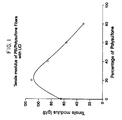
- Fig. 1 shows the variation of the tensile modulus of fibers of the present invention with changing polysulfone percentage.
- Fig. 2 shows that the tenacities of fibers of the invention decrease with increasing polysulfone content.
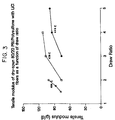
- Fig. 3 shows the effect of draw ratio and temperature on tensile modulus for fibers of the present invention.
- Fig. 4 shows the effect of draw ratio and temperature on tensile strength for fibers of this invention.
- Examples of the more preferred aromatic polybenzimidazoles which may be used in the polymer blends of the present invention include: poly-2,2′-(m-phenylene)-5,5′-bibenzimidazole; poly-2,2′-(pyridylene-3′,5′)-5,5′-bibenzimidazole; poly2,2′-(furylene-2′,5′)-5,5′-bibenzimidazole; poly-2,2′-(naphthalene-1′,6′)-5,5′-bibenzimidazole; poly-2,2′-(biphenylene-4′,4′)-5,5′-bibenzimidazole; poly-2,6′-(m-phenylene)-diimidazobenzene; poly-2,2′-(m-phenylene)-5,5′-di(benzimidazole)ether; poly-2,2′-(m-phenylene)-5,5′-di(benzimidazole)sulfide;
- Aromatic polybenzimidazoles of this type are commercially available from HOESCHST CELANESE Corporation. These polybenzimidazoles are preferred components of the polymer blends because they are relatively more thermally stable and more soluble in N,N-dimethylacetamide than other polybenzimidazoles. This solubility makes them relatively processable.
- the polysulfone used in the invention has the following unit formula: wherein Ar3, Ar4, Ar5 and Ar6 represents divalent aromatic moieties having from 6 to about 18 carbon atoms, or aromatic moieties having the following formula: wherein R2 represents -C(Ch3)2- or SO2-, S, or -O-, or mixtures thereof; R represents a divalent aliphatic moiety containing up to 6 carbon atoms, or mixtures thereof; and a has a value of greater than 0.5 to 1, has a value of 0 or a value less than 0.5, and the sum of a and b is equal to 1.
- the number of sulfone linking groups relative to all others is rarely more than 1 out of 3, and never as much as 1 out of 2.
- the polysulfones from Amoco Corporation (UDEL R , Radel R , e.g., P1700 and P3500), and ICC's Victrex PES R are most preferred. These polysulfones are amorphous polymers. A combination of polysulfones may be blended in the compositions of the invention.
- the polysulfones are soluble in halogenated or polar solvents.
- the UDEL R , Radel R and Victrex PES R polysulfones dissolve readily in methylene chloride, chloroform, N-methylpyrrilidinone, N,N-dimethylformamide and N,N-dimethylacetamide.
- it is necessary to heat concentrated polysulfone ( ⁇ 10%) e.g., at 100°C for 1/2 hour
- N-methylpyrrolidone e.g., at 100°C for 1/2 hour
- novel compositions comprise from about 60 weight percent to about 95 weight percent of a polybenzimidazole and from about 40 weight percent to about 5 weight percent of an aromatic polysulfone.
- the preferred compositions are those which are comprised of about 10 to about 30% polysulfone.
- composition of the present invention is mostly comprised of aromatic polybenzimidazole, it is preferred that the minor amount of polysulfone in the composition be sufficient to make the aromatic polybenzimidazole more tractable and processable and also less susceptible to moisture.
- the composition comprises at least about 10 weight percent of a polysulfone. It is surprising that a minor amount of the polysulfone can ameliorate the weak properties of the polybenzimidazole, i.e., poor thermal plasticity and moisture regain. At the same time the less expensive polysulfone decreases the cost of the composition.
- compositions of the invention may be used as molding compositions.
- These molding compositions may include in the polymer matrix approximately 1 to 40 weight percent, preferably approximately 10 to 30 weight percent, of a solid filler and/or reinforcing agent.
- Representative fibers which may serve as reinforcing media include glass fibers, asbestors, graphitic carbon fibers, amorphous carbon fibers, synthetic polymeric fibers, aluminum fibers, aluminum silic fibers, aluminum oxide fibers, titanium fibers, magnesium fibers, rock woll fibers, steel fibers, etc.
- Representative filler materials include calcium silicate, silica, clays, talc, mica, polytetrafluoroethylene, graphite, alumina trihydrate, sodium aluminum carbonate, barium ferrite, etc.
- the starting polymers for the process of our invenion are dried to a level of 2% or less to minimize problems.
- Drying may be accomplished in any convenient and effective manner, such as by drying the starting polymer overnight in vacuum at elevated temperature, e.g., from about 100°C to about 160°C.
- the aromatic polybenzimidazoles and polysulfones first may be dissolved in a mutual solvent, e.g., N,N-dimethylformamide (DMF), N,N-dimethylacetamide (DMAc), dimethylsulfoxide (DMSO), or N-methylpyrrolidone (NMP) or concentrated H2SO4, so that each polymer is present in the resulting solution in the desired relative proportions, their total concentration being, e.g., from about 1% to about 30% on a weight/volume basis, preferably from about 10 to 30%. It is preferred that the total concentration of the two polymers in the solution be such that the viscosity of the solution is acceptable for subsequent processing.
- the two polymers may be simultaneously dissolved in the solvent, or each polymer may be separately dissolved in separate volumes of solvent and desired portions of the resulting solutions can be mixed together to form a solution of the two polymers.
- the solvent should be evaporated at low relative humidity, e.g., in a dry nitrogen atmosphere, and moderate temperatures, e.g., at about ⁇ 140°C. After a substantial portion of the solvent is removed (e.g., about 85%), the remaining solvent may be removed by washing the film or fibers with hot water. Whether the solution of the composition is cast, extruded or precipitated, moisture should be initially excluded until most of the solvent is removed.
- the composition may be post-treated with heat and/or sulfuric acid to minimize shrinkage and stabilize the film or fiber.
- the composition is post-treated by dipping in 2% sulfuric acid followed by heat-setting at about 350-420°C.
- compositions of this invention have unexpected properties and benefits.
- the compositions are useful under severe environmental conditions.
- the compositions have good thermal resistance, solvent resistance, improved physical properties and good price/performance characteristics.
- aromatic polybenzimidazoles generally have high thermal stability and good solvent resistance, they are expensive polymers with high moisture regain.
- Polysulfones generally have relatively low glass transition temperatures and lack resistance to certain solvents, but they are tractable polymers and are much less expensive than aromatic polybenzimidazoles.
- Fig. 1 shows that the tensile modulus of PBI/PS films exceeds the modulus predicted by the rule of mixtures.
- Fig. 2 shows that the tenacity of several PBI/PS films exceeds the rule of mixtures values.
- Another process for preparing moldable compositions comprises grinding together an aromatic polybenzimidazole and a polysulfone in relative weight proportions to each other of from about 60 to about 95 of the aromatic polybenzimidazole to about 40 to about 5 of the polysulfone until the diameters of the solid particulates reach about 100 ⁇ m or less.
- a solid PBI/PS (70/30) blend may be prepared by mechanically grinding a mixture of PBI and PS polymers.
- a freeze mill device may be used for grinding, and the grinding process continued until the diameters of the solid particulates reach about 37 ⁇ m or less.
- Those fine solid blends have a uniform visual appearance and are compressably moldable (e.g., at ⁇ 5000 psi for 30 minutes at 410°C).
- the molded product has a dark color, is rigid and exhibits good physical integrity.
- a PBI/PS spinning solution may be prepared by using an appropriate solvent.
- Typical solvents include dimethylacetamide, dimethylformamide, dimethylsulfoxide, and concentrated sulfuric acid.
- the polybenzimidazole and polysulfone polymers are each provided in the spinning solution at a concentration of about 20 to 35 percent by weight based upon the weight of the total solution, and preferably in a concentration of 22 to 35 percent by weight based upon the weight of the total solution.
- the spinning solution also contains lithium chloride in a concentration of about 0.1 to 5 percent by weight, preferably in a concentration of about 1 to 4 percent by weight. The lithium chloride serves the function of preventing the polybenzimidazole polymer from pashing out of the solution upon standing for extended periods of time.
- a preferred spinning solution comprises about 22 to 26 percent by weight of the polymers, about 1 to 4 percent lithium chloride, and about 70 to 77 percent by weight dimethylacetamide.
- the spinning solution preferably exhibits a viscosity of about 40 to 4000 poise measured at 30°C, and most preferably a viscosity of about 1200 to 2500 poise measured at 30°C.
- One suitable means for dissolving the polymer in the solvent is by mixing the materials at a temperature above the normal boiling point of the solvent for example, about 25°C to 120°C above such boiling point, and at a pressure of 2 to 15 atmospheres for a period of 1 to 5 hours.
- the resulting solutions then preferably are filtered to remove any undissolved polymer.
- the blend dope is preferably provided at a temperature of approximately 130°C to 150°C at the time of extrusion.
- the solution is extruded through a plurality of extrusion orifices (e.g., anywhere from five or ten to several hundred). These extrusion orifices are generally in the form of a spinneret having 50 or 100 holes.
- the orifices of the present invention have a diameter of approximately 20 to 200 microns, preferably of approximately 30 to 50 microns.
- the spinning solution is placed in a pressure vessel, or bomb, and heated to approximately 120°C. To spin, the solution is fed under about 15 p.s.i. nitrogen pressure to a metering pump driven by a variable speed D.C. motor.
- the pump speed, and hence the solution flow rate, is maintained constant by an electronic controller.
- the solution is passed through a heated candle filter and finally, just before entering the spinneret, through a stainless steel sintered disc filter.
- the face of the spinneret is heated to approximately 130°C to 150°C during extrusion.
- the polymer solution is extruded vertically downward into a gaseous atmosphere by either conventional wet spinning or dry spinning technology.
- a polybenzimidazole dope (25.6% solids in dimethylacetamide) was blended with a polysulfone dope (25.6% solids in dimethylacetamide) prepared with various weight ratios at 80-100°C. The two mixed well, and the resulting dope was clear and transparent at that temperature. After cooling, the dope was stable and quiet clear.
- the 20/80 and 40/60 PBI/PS dopes phase-separated after remaining undistributed for a few days. Separation of a 60/40 PBI/PS sample occured after a few weeks. There was no phase separation for an 80/20 blend, even after a few months. This probably indicates that the PBI is stably miscible with the PS in solution if the PBI content is in the range of from 70 to 100%.
- Dry-spun 80/20 PBI/PS fibers have almost the same tensile modulus as that of 80/20 wet-spun fibers. However, dry-spinning results in a slightly better tensile strength and an elongation at break than the wet-spinning.
- the tensile modulus of high denier 80/20 PBI/PS fibers is almost the same as that of low denier 80/20 PBI/PS fibers, and they both surpass that of PBI.
- IR spectra indicated a shift of the 1244 ether band of 4 cm ⁇ 1 to lower frequency in the PBI/PS blends, which wouild suggest an interaction between the NH and the O.
- Figure 3 shows the effect of draw temperature and draw ratio on the tensile modulus of 80/20 dry-spun fibers
- Figure 4 illustrates the effect of draw temperature and draw ratio on the tensile strength of 80/20 dry-spun fiber.
- the Limiting Oxygen Indices(LOI) of the PBI/PS fibers of Example 2 were compared to those of PBI fibers. As table 4 shows, the LOI's were similar, suggesting that the PBI/PS fibers are as flame retardant as PBI fibers. This test used a non-standard method in which plied yarn lengths were wound with yarn so that the specimen would stand upright in the test apparatus.
- Table 4 also shows the flame shrinkage behavior of these fibers.
- PBI and 80/20 PBI/PS fibers were exposed to steam at 140°C for four hours. As indicated in Table 5, it was surprisingly found that steam treatment had a chemical effect on the PBI/PS fibers. The sulfonated fibers were strengthened by steam treatment, whereas the unsulfonated fibers were weakened under the same conditions.
Landscapes
- Chemical & Material Sciences (AREA)
- Engineering & Computer Science (AREA)
- Chemical Kinetics & Catalysis (AREA)
- Manufacturing & Machinery (AREA)
- Polymers & Plastics (AREA)
- Organic Chemistry (AREA)
- Medicinal Chemistry (AREA)
- Health & Medical Sciences (AREA)
- General Chemical & Material Sciences (AREA)
- Textile Engineering (AREA)
- Materials Engineering (AREA)
- Artificial Filaments (AREA)
- Manufacture Of Macromolecular Shaped Articles (AREA)
- Compositions Of Macromolecular Compounds (AREA)
Applications Claiming Priority (2)
| Application Number | Priority Date | Filing Date | Title |
|---|---|---|---|
| US548041 | 1983-11-02 | ||
| US54804190A | 1990-07-05 | 1990-07-05 |
Publications (1)
| Publication Number | Publication Date |
|---|---|
| EP0465251A1 true EP0465251A1 (de) | 1992-01-08 |
Family
ID=24187163
Family Applications (1)
| Application Number | Title | Priority Date | Filing Date |
|---|---|---|---|
| EP91306082A Withdrawn EP0465251A1 (de) | 1990-07-05 | 1991-07-04 | Zusammensetzungen aus aromatischen Polybenzimidazolen und Polysulfonen und Fasern aus diesen |
Country Status (4)
| Country | Link |
|---|---|
| EP (1) | EP0465251A1 (de) |
| JP (1) | JPH04226566A (de) |
| IE (1) | IE912337A1 (de) |
| PT (1) | PT98242A (de) |
Cited By (3)
| Publication number | Priority date | Publication date | Assignee | Title |
|---|---|---|---|---|
| WO1999004444A1 (en) * | 1997-07-16 | 1999-01-28 | Aventis Research And Technologies Gmbh & Co. Kg | Process for producing fabrics of polybenzimidazole fibers for use in fuel cells |
| WO2013138135A1 (en) * | 2012-03-13 | 2013-09-19 | Sabic Innovative Plastics Ip B.V. | Reinforced thermoplastic articles, compositions for the manufacture of the articles, methods of manufacture, and articles formed therefrom |
| CN116829632A (zh) * | 2021-03-22 | 2023-09-29 | 富士胶片株式会社 | 聚合物膜及层叠体 |
Families Citing this family (3)
| Publication number | Priority date | Publication date | Assignee | Title |
|---|---|---|---|---|
| US20150183993A1 (en) * | 2012-07-12 | 2015-07-02 | Keki Hormusji Gharda | Method for processing a high temperature resistant thermosetting material |
| RU2720683C1 (ru) * | 2015-09-29 | 2020-05-12 | Тейджин Арамид Б.В. | Полиариленовое волокно, характеризующееся улучшенной гидролитической стабильностью |
| JPWO2022202790A1 (de) * | 2021-03-22 | 2022-09-29 |
Citations (3)
| Publication number | Priority date | Publication date | Assignee | Title |
|---|---|---|---|---|
| EP0240302A2 (de) * | 1986-04-01 | 1987-10-07 | Celanese Corporation | Aromatisches Polybenzimidazol und aromatische Polyimid-Zusammensetzung und Verfahren zu deren Herstellung |
| US4810730A (en) * | 1986-03-03 | 1989-03-07 | Hoechst Celanese Corp. | Moldable polybenzimidazole filaments and process for producing molded and foamed products from these filaments |
| EP0333406A1 (de) * | 1988-03-18 | 1989-09-20 | MITSUI TOATSU CHEMICALS, Inc. | Polyimidharz-Zusammensetzung |
-
1991
- 1991-07-04 EP EP91306082A patent/EP0465251A1/de not_active Withdrawn
- 1991-07-04 IE IE233791A patent/IE912337A1/en unknown
- 1991-07-05 PT PT9824291A patent/PT98242A/pt not_active Application Discontinuation
- 1991-07-05 JP JP16597191A patent/JPH04226566A/ja active Pending
Patent Citations (3)
| Publication number | Priority date | Publication date | Assignee | Title |
|---|---|---|---|---|
| US4810730A (en) * | 1986-03-03 | 1989-03-07 | Hoechst Celanese Corp. | Moldable polybenzimidazole filaments and process for producing molded and foamed products from these filaments |
| EP0240302A2 (de) * | 1986-04-01 | 1987-10-07 | Celanese Corporation | Aromatisches Polybenzimidazol und aromatische Polyimid-Zusammensetzung und Verfahren zu deren Herstellung |
| EP0333406A1 (de) * | 1988-03-18 | 1989-09-20 | MITSUI TOATSU CHEMICALS, Inc. | Polyimidharz-Zusammensetzung |
Cited By (5)
| Publication number | Priority date | Publication date | Assignee | Title |
|---|---|---|---|---|
| WO1999004444A1 (en) * | 1997-07-16 | 1999-01-28 | Aventis Research And Technologies Gmbh & Co. Kg | Process for producing fabrics of polybenzimidazole fibers for use in fuel cells |
| US6042968A (en) * | 1997-07-16 | 2000-03-28 | Aventis Research & Technologies Gmbh & Co. Kg | Process for producing polybenzimidazole fabrics for use in fuel |
| WO2013138135A1 (en) * | 2012-03-13 | 2013-09-19 | Sabic Innovative Plastics Ip B.V. | Reinforced thermoplastic articles, compositions for the manufacture of the articles, methods of manufacture, and articles formed therefrom |
| CN116829632A (zh) * | 2021-03-22 | 2023-09-29 | 富士胶片株式会社 | 聚合物膜及层叠体 |
| US12152116B2 (en) | 2021-03-22 | 2024-11-26 | Fujifilm Corporation | Polymer film and laminate |
Also Published As
| Publication number | Publication date |
|---|---|
| JPH04226566A (ja) | 1992-08-17 |
| IE912337A1 (en) | 1992-01-15 |
| PT98242A (pt) | 1992-05-29 |
Similar Documents
| Publication | Publication Date | Title |
|---|---|---|
| Chung | A critical review of polybenzimidazoles: historical development and future R&D | |
| US4606875A (en) | Process for preparing shaped articles of rigid rod heterocyclic liquid crystalline polymers | |
| CN102187023B (zh) | 来自高Tg聚合物的纤维或箔片及其制造方法 | |
| EP0007632B1 (de) | Zusammensetzung auf der Basis aromatischer Polyamide | |
| US5276085A (en) | Aromatic polyamide compositions and fibers | |
| WO1992021711A1 (en) | Amide-imide resin for production of heat-resistant fiber | |
| US4842740A (en) | Membranes prepared from blend of polybenzimidazole with polyarylates | |
| EP0007631B1 (de) | Vollständig aromatische Polyamidzusammensetzung und Fäden oder Fasern daraus | |
| US5250633A (en) | Fibers and fibrets from blends of polybezimidazoles and aromatic polyamides, aromatic polyamide-hydrazides or aromatic polyamides containing heterocyclic linkages | |
| US4640972A (en) | Filament of polyimide from pyromellitic acid dianhydride and 3,4'-oxydianiline | |
| IE912337A1 (en) | Compositions of aromatic polybenzimidazoles and polysulfones¹and fibers therefrom | |
| WO1994011549A1 (en) | Fibers and films of improved flame resistance | |
| US5277981A (en) | Thermo-oxidatively stabilized polybenzimidazole-containing articles | |
| JP3995532B2 (ja) | 緻密なメタ型全芳香族ポリアミド繊維の製造法 | |
| US5208298A (en) | Stable solution of polybenzimidazole and polysulfons blends | |
| KR0127875B1 (ko) | 가수분해 안정성이 향상된 섬유 | |
| US5290884A (en) | Blends of polybenzimidazoles and aromatic polyamides, aromatic polyamide-hydrazides or aromatic polyamides containing heterocyclic linkages | |
| US5458969A (en) | Amide-imide heat-resistant fiber | |
| Chung et al. | Polybenzimidazole and polysulfone blends | |
| JPS62250055A (ja) | 芳香族ポリベンヅイミダゾ−ル及び芳香族ポリイミド組成物及び製法 | |
| US4963628A (en) | Compositions of polybenzimidazoles and polyarylates | |
| KR102181613B1 (ko) | 폴리이미드와 폴리(m-페닐렌이소프탈아미드)를 주성분으로 하는 피브릴화가 용이한 2성분 복합섬유 및 그 제조방법 | |
| EP0091669B1 (de) | Verfahren zur Herstellung von porösen folien- oder faserartigen Strukturen aus aromatischen Polyestern | |
| JP2003342832A (ja) | 熱収縮安定性に優れたメタ型全芳香族ポリアミド繊維の製造法 | |
| US3883467A (en) | Solutions of tetrachlorinated aromatic polyesters in methylene chloride |
Legal Events
| Date | Code | Title | Description |
|---|---|---|---|
| PUAI | Public reference made under article 153(3) epc to a published international application that has entered the european phase |
Free format text: ORIGINAL CODE: 0009012 |
|
| AK | Designated contracting states |
Kind code of ref document: A1 Designated state(s): AT BE CH DE DK ES FR GB GR IT LI LU NL SE |
|
| 17P | Request for examination filed |
Effective date: 19920616 |
|
| 17Q | First examination report despatched |
Effective date: 19940614 |
|
| STAA | Information on the status of an ep patent application or granted ep patent |
Free format text: STATUS: THE APPLICATION IS DEEMED TO BE WITHDRAWN |
|
| 18D | Application deemed to be withdrawn |
Effective date: 19950912 |