EP0466078A2 - Teilnehmeranschlusseinheit mit autonomer Leitungsweglenkung für ein Fernmeldenetz mit intelligenter Struktur - Google Patents
Teilnehmeranschlusseinheit mit autonomer Leitungsweglenkung für ein Fernmeldenetz mit intelligenter Struktur Download PDFInfo
- Publication number
- EP0466078A2 EP0466078A2 EP91111354A EP91111354A EP0466078A2 EP 0466078 A2 EP0466078 A2 EP 0466078A2 EP 91111354 A EP91111354 A EP 91111354A EP 91111354 A EP91111354 A EP 91111354A EP 0466078 A2 EP0466078 A2 EP 0466078A2
- Authority
- EP
- European Patent Office
- Prior art keywords
- signaling
- connection unit
- connection
- center
- network
- Prior art date
- Legal status (The legal status is an assumption and is not a legal conclusion. Google has not performed a legal analysis and makes no representation as to the accuracy of the status listed.)
- Granted
Links
Images



Classifications
-
- H—ELECTRICITY
- H04—ELECTRIC COMMUNICATION TECHNIQUE
- H04Q—SELECTING
- H04Q11/00—Selecting arrangements for multiplex systems
- H04Q11/04—Selecting arrangements for multiplex systems for time-division multiplexing
- H04Q11/0407—Selecting arrangements for multiplex systems for time-division multiplexing using a stored program control
-
- H—ELECTRICITY
- H04—ELECTRIC COMMUNICATION TECHNIQUE
- H04Q—SELECTING
- H04Q3/00—Selecting arrangements
- H04Q3/0016—Arrangements providing connection between exchanges
- H04Q3/0025—Provisions for signalling
-
- H—ELECTRICITY
- H04—ELECTRIC COMMUNICATION TECHNIQUE
- H04W—WIRELESS COMMUNICATION NETWORKS
- H04W76/00—Connection management
- H04W76/20—Manipulation of established connections
-
- H—ELECTRICITY
- H04—ELECTRIC COMMUNICATION TECHNIQUE
- H04W—WIRELESS COMMUNICATION NETWORKS
- H04W88/00—Devices specially adapted for wireless communication networks, e.g. terminals, base stations or access point devices
- H04W88/14—Backbone network devices
-
- H—ELECTRICITY
- H04—ELECTRIC COMMUNICATION TECHNIQUE
- H04W—WIRELESS COMMUNICATION NETWORKS
- H04W92/00—Interfaces specially adapted for wireless communication networks
- H04W92/04—Interfaces between hierarchically different network devices
Definitions
- the invention relates to a subscriber connection unit, with routing autonomy, for a telecommunication network having an intelligent network structure, this network comprising switches and service control points controlling these switches.
- connection units are connected to a switch by telephone channels and by a channel No. 7 carrying the signaling in accordance with protocol No. 7 of the C.C.I.T.T.
- the connection units are located near or at a distance from the home switch.
- connection units do not have autonomy to communicate with other connection units located nearby; nor with local switching centers, closer than the home center.
- the routing of local communications therefore systematically uses transmission resources, between each connection unit and its attachment center, whereas the shortest route would not necessarily pass through the attachment center.
- the architecture of current networks therefore results from a compromise between: an architecture comprising few switches and connection units remote from these switches, which results in a minimum cost for switching and a maximum cost for transmission; and an architecture comprising many switches and connection units close to the switches, which results in a minimum cost for transmission and a maximum cost for switching.
- the object of the invention is to propose a connection unit eliminating this dilemma, that is to say making it possible to reduce the cost of transmission, without increasing the number of switches.
- a subscriber connection unit for a telecommunication network having an intelligent network structure, this network comprising switches controlled by service control points, by means of operations.
- this network comprising switches controlled by service control points, by means of operations.
- predetermined called intelligent network interface and supported by protocols compatible with CCITT protocol No. 7; connected: to a switch known as attachment by telephone links; and to a service control point by a first conventional signaling link No. 7, for managing the access of subscribers to the home center; is characterized in that it is also connected to a service control point by a second signaling link No. 7 supporting the intelligent network interface, to manage by said service control point: connections established by said unit between subscribers connected to the same unit, or connections established towards another unit, or connections established towards the network, without these connections requiring a connection by the home office.
- connection unit must therefore include costly means for generating such tones and messages.
- the subscriber connection unit is also connected, by semi-permanent links, to the home center and / or one or more local centers of the public switched network, on the channels of which it is supplied, from generators provided in these centers, tones and messages to be transmitted to local or remote subscribers, when operation the request.
- said first and second signaling links are not only physically supported by the same signaling channel No. 7, but also employ the same protocol between a single signaling point in the connection unit and a single signaling point in the service control point, an extended protocol to allow remote control of the connection unit and comprising the functionalities of the subscriber access interface to the home office, for example the A interface of the GSM, and at least a subset of those of the smart grid interface or a functional equivalent thereof.
- the means defined above are arranged to allow, by remote control of a first and a second connection unit, by the signaling links connecting them to their home center, the establishment of a transfer connection extending a communication originating from a local center and using a direct communication link between this local center and said first connection unit, to said second connection unit, which depends on the same home center or not, by a direct connection between the two connection units considered, then, later and in the same way, if necessary, to a third connection unit.
- connection units depend on different attachment centers
- the latter are arranged to exchange the information necessary for the remote control of the two connection units concerned, by enriching the signaling protocol circulating on a signaling link which connects them .
- provision will also be made for the return of the communication to the attachment center, by one of the communication links existing between any of the connection units and the attachment center.
- intelligent networks which are described below render a cellular radiotelephony service, but the invention is also applicable to connection units of subscribers of networks rendering other services, if the network includes service control points. , giving it an intelligent network structure by centralizing the data relating to a service as well as the processing logic for this service. Examples: Wireless telephone network, by terminals; Personal communication network; private network (PABX); public telephone or data transmission network.
- PABX private network
- connection units 1, 2, 3 are connected to the inputs-outputs of a connection matrix 22 of the attachment center 7, by speech links 16, conforming to the interface A defined by the Special Mobile group (GSM ).
- the input-outputs of the connection matrix 22 are connected to the public switched network 9, by speech links, 18.
- the connection matrix 22 allows mobile subscribers who are connected to the units 1, 2, 3, to access the cellular radio service, and possibly access other services.
- connection units 1, 2, 3 respectively comprise signaling points (PS) 4, 5, 6, connected to input-outputs of the attachment center 7 by signaling links 17 conforming to the GSM interface A and for managing the access of subscribers connected to units 1, 2, 3, to the home center 7.
- the home center 7 connects the links 17 to a signaling point 13, from the radio service control point, 8, by semi-permanent connections 23.
- the attachment center 7 has a signaling point 11 connected to the public switched network 9 by a link 19 for exchanging conventional signaling messages, associated with the speech links 18. These messages comply with protocol No. 7 of the C.C.I.T.T.
- a signaling point 12 of the attachment center 7 is permanently connected to a signaling point 15 of the radio service control point, 8, by a link 20.
- the radio service control point, 8, has the function of remote control center 7 to provide service. Via the link 20, it dialogues with the attachment center 7 by means of a set of predetermined operations which constitute a so-called intelligent network interface, denoted IN in the figures.
- This set of operations is, for example, that described in the article "Digital Cellular Mobile-Radio System ECR 900, in” European Transactions on Telecommunications and Related Technologies "n ° 1 vol.1, 1990, page 17, figure 5
- This known set of operations is supported by protocols compatible with CCITT protocol # 7
- a signaling point 14 of the control point 8 is connected to an input-output of the attachment center 7 by a signaling link 21.
- the 21-24 link conforms to CCITT protocol No. 7 It carries signaling messages specific to the mobile radio network 10, according to a protocol called Mobile Application Subsystem, and marked MAP, which is compatible with protocol No. 7.
- the mobile radio network 10 notably includes a nominal location recorder, and an authentication center.
- a visitor location recorder is located either in the network 10 or in the control point 8.
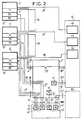
- FIG. 2 represents the block diagram of a cellular radio telephone network comprising: subscriber connection units, 1 ′, 2 ′, 3 ′, according to the invention; a 7 'attachment center; an 8 'radio service control point; a public switched network 9 '; and a 10 'radio network.
- connection units 1 ', 2', 3 ' include signaling points 4', 5 ', 6' similar to the signaling points 4, 5, 6 of the connection units 1, 2, 3 described above.
- the elements of this network which are analogous to those of the network described above and represented in FIG. 1, respectively bear the same numerical references with the prime index, and they play an analogous role. This is particularly the case for signaling points 4 ', 5', 6 'which are used for first 17' signaling links No. 7, to manage access to the network of subscribers connected to units 1 ', 2' , 3 ', at the home center 7'.
- the units 1 ′, 2 ′, 3 ′ furthermore comprise additional signaling points 31, 32, 33 respectively connected to input-outputs of the attachment center 7 ′ by second signaling links 39 # 7, in accordance with the so-called smart grid interface.
- the attachment center 7 ' connects the links 39 to an additional signaling point 43, in the control point 8 ', by semi-permanent links 40.
- the signaling points 31, 32, 33 and the links 39-40 give the units 1', 2 ', 3' the "intelligence" necessary to carry out an autonomous routing of communications of subscribers, that is to say, allows the service control point 8 'to remotely control, in said units, functions of: translation, charging, signaling, and the like, to manage: connections established by said unit between subscribers connected to the same unit, or connections to another connection unit, or connections to the public network 9 ', without these connections requiring a connection by the home center 7'.
- the network is similar to that described above and shown in FIG. 1, except that there are additional telephone links: 34, 35 directly connecting the connection units to each other; and 36, 37, 38 directly connecting said units 2 'to local centers 40, 41, 42, of the public network 9'.
- the connections 34 and 35 allow the connection units to communicate without passing through the attachment center 7 '.
- the links 36, 37, 38 allow the connection units to communicate with the local centers 40, 41, 42 respectively, without passing through the center 7 ′ which is generally more distant from the connection units than the local centers 40 to 42.
- connection units according to the invention therefore provide: a reduction in transmission costs; great organizational flexibility in the network; and better security by allowing local communications even if the speech links 16 ′ to the home center 7 ′ are cut.
- the control point of the connection units is the control point 8 ′ controlling the attachment center 7 ′ of said connection units. It is not necessary to add an additional control point for the connection units. The development of the network can therefore be continued practically at no additional cost to order additional connection units.
- FIG 3 shows an example of such a network. Elements similar to those of the example previously described and shown in Figure 2 have the same reference numerals. There are no additional items.
- the home center 7 ' is deleted.
- the connection units 1 ', 2', 3 ' are connected directly to the public switched network 9' by the telephone links 16 'and 18' which are permanently connected together.
- the signaling links 20 'and 19' are permanently connected together to directly connect the signaling point 15 'of the service control point 8' to the public network 9 '.
- the access point of each unit 1 ', 2', 3 'to the network 9' is then one of the switches of the network 9 ', not shown in the figure.
- the direct connection of the signaling point 15 ′ of the control point 8 ′ to the public switched network 9 ′ can also be applied to the example of network shown in FIG. 2.
- the signaling point 11 ' would be moved from the center 7' to the control point 8 '.
- the signaling point 11 ' would then be connected to the public switched network 9' by semi-permanent links through the home center 7 '.
- the signaling messages intended for the center 7 ' would pass through the signaling points 15' then 12 'to reach the center 7'.
- additional signaling points 31, 32, 33, 43 are added to the conventional signaling points 4 ', 5', 6 ', 13', to route a second signaling link No. 7, supporting the intelligent network interface.
- the signaling points 4 'and 31, as well as their counterparts, would be merged.
- the signaling points n ° 7 allows to transmit several types of signaling n ° 7, by means of different protocols, on the same channel n ° 7.
- the first and second signaling link No. 7, 17 'and 39 can therefore be physically supported by the same signaling channel No. 7, and by the same signaling point.
- connection units 1 ′, 2 ′, 3 ′ with respect to those of FIG. 2, each only have one signaling point PS, 4 ′ / 31, 5 ′ / 32, 6 ′ / 33, grouping the functionality of the two previous respective signaling points.
- These single signaling points are respectively connected by signaling links No. 7 17 '/ 39 to the service control point 8'.
- signaling links 17 '/ 39 Via the semi-permanent connections 23 ', in the home center 7', these signaling links 17 '/ 39 are connected to a single signaling point 13' / 43 in the service control point 8 '.
- the applied protocol, A ′ is extended to allow remote control of the connection unit and includes the functionalities of the subscriber access interface to the home center, for example the GSM interface A, and at least one subset of those of the smart grid interface or a functional equivalent thereof.
- connection unit 1 at least, is connected by a service signal link 52 to the home center 7', in which this service signal link 52 is connected, semi-permanently to a generator. tones and voice messages 54.
- connection unit 1 receives from the home center 7' the tones it needs to respond the needs of the service to be provided to subscribers, in establishing connections and subscribers of the same subscriber connection unit or of neighboring subscriber connection units interconnected by direct communication links such as 34 and 35, or local centers close to the public switched network reached by direct links such as 36, 37 and 38.
- the service signal link in question will include a voice or tone voice channel and will be part of the communication links 16 'connecting the subscriber connection unit 1' to the home office 7 '. It will preferably be duplicated, for security reasons.
- FIG. 4 also represents another solution to the same problem, which can be used, in place of or alongside the previous solution, and according to which a service signal link 51 leads to a generator of tones and voice messages 53 d 'a local center 40 of the public switched network 9'.
- a service signal link 51 leads to a generator of tones and voice messages 53 d 'a local center 40 of the public switched network 9'.
- the duplication of the link is not necessary, in particular if it is supported by the same means as the signaling path between the connection unit and the local exchange.
- the generators 53, 54 can be those normally provided in local centers and the attachment center, which makes the solution presented particularly economical. Similar arrangements can be made between the connection unit 1, considered and each of the local centers to which it is connected, such as 41, 42.
- the means thus described can be easily arranged to allow, by remote control of the connection unit 1 ', for example, by the signaling link 17' / 39, the establishment of a transfer connection extending a communication from the center room 40 and via the communication link 36, to the connection unit 2 ', for example, by the direct link 34, then, later and in the same way, if necessary, to another connection unit, such than 3 'and this, for example, to follow the movement of a mobile subscriber.
- the return of the first connection unit considered, 1 ′ can also be carried out towards another connection unit, not shown in the figure, depending on another attachment center than that of the figure.
- the attachment centers are set up to exchange the information necessary for the remote control of the two connection units concerned (such as 1 '), by enriching the signaling protocol circulating on a signaling link (21 'for example) that connects them.
- the forwarding of the communication to the home center 7 ', by one of the communication links 16', from any of the connection units can also be provided.
- the scope of the invention is not limited to the network examples described above. It can be applied to connection units of other telecommunications networks having an intelligent network structure.
Landscapes
- Engineering & Computer Science (AREA)
- Computer Networks & Wireless Communication (AREA)
- Signal Processing (AREA)
- Mobile Radio Communication Systems (AREA)
- Exchange Systems With Centralized Control (AREA)
- Data Exchanges In Wide-Area Networks (AREA)
- Sub-Exchange Stations And Push- Button Telephones (AREA)
Applications Claiming Priority (4)
| Application Number | Priority Date | Filing Date | Title |
|---|---|---|---|
| FR9008838 | 1990-07-11 | ||
| FR9008838A FR2664780A1 (fr) | 1990-07-11 | 1990-07-11 | Unite de raccordement d'abonnes, a autonomie d'acheminement, pour un reseau de telecommunication ayant une structure de reseau intelligent. |
| FR9012005A FR2667476A2 (fr) | 1990-07-11 | 1990-09-28 | Unite de raccordement d'abonnes, a autonomie d'acheminement, pour un reseau de telecommunication ayant une structure de reseau intelligent. |
| FR9012005 | 1990-09-28 |
Publications (3)
| Publication Number | Publication Date |
|---|---|
| EP0466078A2 true EP0466078A2 (de) | 1992-01-15 |
| EP0466078A3 EP0466078A3 (en) | 1992-03-18 |
| EP0466078B1 EP0466078B1 (de) | 1996-02-14 |
Family
ID=26228141
Family Applications (1)
| Application Number | Title | Priority Date | Filing Date |
|---|---|---|---|
| EP91111354A Expired - Lifetime EP0466078B1 (de) | 1990-07-11 | 1991-07-08 | Teilnehmeranschlusseinheit mit autonomer Leitungsweglenkung für ein Fernmeldenetz mit intelligenter Struktur |
Country Status (9)
| Country | Link |
|---|---|
| US (1) | US5533114A (de) |
| EP (1) | EP0466078B1 (de) |
| JP (1) | JP3258039B2 (de) |
| KR (1) | KR0173794B1 (de) |
| AT (1) | ATE134288T1 (de) |
| CA (1) | CA2046579C (de) |
| DE (1) | DE69117108T2 (de) |
| ES (1) | ES2084064T3 (de) |
| FR (1) | FR2667476A2 (de) |
Cited By (12)
| Publication number | Priority date | Publication date | Assignee | Title |
|---|---|---|---|---|
| EP0462728A3 (en) * | 1990-06-18 | 1992-11-04 | Northern Telecom Limited | Mobile communications |
| EP0549016A1 (de) * | 1991-12-09 | 1993-06-30 | Koninklijke KPN N.V. | Umschaltungsverfahren zwischen Vermittlungsanlagen für mobile Dienste von einer aktiven Verbindung zu einem mobilen Endgerät |
| US5260987A (en) * | 1990-06-18 | 1993-11-09 | Northern Telecom Limited | Mobile communications |
| GB2286094A (en) * | 1994-01-26 | 1995-08-02 | Plessey Telecomm | Call migration in mobile telecommunications |
| WO1995026114A1 (en) * | 1994-03-22 | 1995-09-28 | Telefonaktiebolaget Lm Ericsson | Intelligent mobile telecommunications network arrangement |
| US5504804A (en) * | 1994-01-19 | 1996-04-02 | Telefonaktiebolaget Lm Ericsson | Providing individual subscriber services in a cellular mobile communications network |
| EP0658061A3 (de) * | 1993-12-09 | 1997-01-08 | At & T Corp | Signalisierungssystem für unabhängige Kommunikationsnetzwerke. |
| EP0690640A3 (de) * | 1994-06-30 | 1999-05-19 | AT&T Corp. | Intelligente schnurlose Signalisierungsschicht für Telekommunikationsnetz |
| US6266535B1 (en) | 1993-07-30 | 2001-07-24 | British Telecommunications Public Limited Company | Telecommunication network which transmits the state of an occurrence of a non-call related service request associated with a network termination |
| WO2001056315A1 (en) * | 2000-01-25 | 2001-08-02 | Telefonaktiebolaget Lm Ericsson (Publ) | Method and system for optimal routing of calls in a base station system |
| US6452932B1 (en) | 1994-05-05 | 2002-09-17 | Sprint Communications Company, L.P. | Method, system and apparatus for telecommunications control |
| US6577626B2 (en) | 1994-05-05 | 2003-06-10 | Sprint Communications Company, L.P. | Telecommunications apparatus, system, and method with an enhanced signal transfer point |
Families Citing this family (18)
| Publication number | Priority date | Publication date | Assignee | Title |
|---|---|---|---|---|
| US6430195B1 (en) | 1994-05-05 | 2002-08-06 | Sprint Communications Company L.P. | Broadband telecommunications system interface |
| US6633561B2 (en) | 1994-05-05 | 2003-10-14 | Sprint Communications Company, L.P. | Method, system and apparatus for telecommunications control |
| JPH09214602A (ja) * | 1996-02-02 | 1997-08-15 | Fujitsu Ltd | 加入者系伝送装置における呼制御システム |
| GB2316272B (en) * | 1996-08-09 | 2000-12-27 | Motorola Ltd | Method of local routing and transcoder therefor |
| US5889847A (en) | 1996-09-12 | 1999-03-30 | Alcatel Usa Sourcing, L.P. | Method for signalling connection control part message loop prevention |
| US6301474B1 (en) | 1996-09-27 | 2001-10-09 | Openwave Technologies Inc. | Mobility extended telephone application programming interface and method of use |
| US7359720B2 (en) * | 1996-09-27 | 2008-04-15 | Openwave Systems Inc. | Mobility extended telephone application programming interface and method of use |
| US6181935B1 (en) | 1996-09-27 | 2001-01-30 | Software.Com, Inc. | Mobility extended telephone application programming interface and method of use |
| US5978672A (en) * | 1996-09-27 | 1999-11-02 | Global Mobility Systems, Inc. | Mobility extended telephone application programming interface and method of use |
| FR2760587B1 (fr) * | 1997-03-06 | 1999-04-16 | Alsthom Cge Alcatel | Systeme de communication multireseau pour organisation disposant de terminaux de reseau radio cellulaire numerique |
| US6704327B1 (en) | 1997-05-09 | 2004-03-09 | Sprint Communications Company, L.P. | System and method for connecting a call |
| US5966660A (en) * | 1997-05-28 | 1999-10-12 | Telefonaktiebolaget L/M Ericsson (Publ) | User controlled call setup through manual switchboard |
| US6631140B1 (en) | 1998-01-29 | 2003-10-07 | Telefonaktiebolaget Lm Ericsson (Publ) | Shared communications protocol layer for interfacing between wireless networks |
| GB2334179A (en) * | 1998-02-04 | 1999-08-11 | Motorola Ltd | Local Call Routing in a Mobile communications System |
| GB2334180A (en) * | 1998-02-04 | 1999-08-11 | Motorola Ltd | Local Routing in a Radio Communications System |
| DE10037746B4 (de) * | 2000-08-02 | 2004-09-02 | Siemens Ag | Realisierungskonzept von intelligenten Telekommunikationsnetzen zur Signalisierung von Leistungsmerkmalen im ISDN |
| DE10104543A1 (de) * | 2001-02-01 | 2002-08-29 | Siemens Ag | Verfahren zur Herstellung von Kommunikationsverbindungen in einer Vermittlungsstelle eines Vermittlungssystems |
| FR2913294B1 (fr) * | 2007-03-01 | 2009-04-17 | Alcatel Lucent Sas | Dispositif d'aide au routage transverse de trafics entre sites distants au sein d'un reseau de communication radio |
Family Cites Families (5)
| Publication number | Priority date | Publication date | Assignee | Title |
|---|---|---|---|---|
| US4583218A (en) * | 1983-05-11 | 1986-04-15 | At&T Bell Laboratories | Control communication in a switching system having clustered remote switching modules |
| US4566094A (en) * | 1983-05-11 | 1986-01-21 | At&T Bell Laboratories | Channel selection in a switching system having clustered remote switching modules |
| US4621358A (en) * | 1984-12-10 | 1986-11-04 | Stromberg-Carlson Corporation | Remote switch for telephony switching system |
| DE3609890A1 (de) * | 1986-03-24 | 1987-10-08 | Siemens Ag | Schaltungsanordnung fuer pcm-fernmeldevermittlungsanlagen, insbesondere pcm-fernsprechvermittlungsanlagen mit konzentratoren mit inselamts-notvermittlungsbetrieb |
| US4972465A (en) * | 1989-05-24 | 1990-11-20 | At&T Bell Laboratories | Switching system reliability |
-
1990
- 1990-09-28 FR FR9012005A patent/FR2667476A2/fr active Granted
-
1991
- 1991-07-08 ES ES91111354T patent/ES2084064T3/es not_active Expired - Lifetime
- 1991-07-08 EP EP91111354A patent/EP0466078B1/de not_active Expired - Lifetime
- 1991-07-08 AT AT91111354T patent/ATE134288T1/de not_active IP Right Cessation
- 1991-07-08 DE DE69117108T patent/DE69117108T2/de not_active Expired - Lifetime
- 1991-07-09 CA CA002046579A patent/CA2046579C/fr not_active Expired - Fee Related
- 1991-07-10 JP JP17002491A patent/JP3258039B2/ja not_active Expired - Lifetime
- 1991-07-10 KR KR1019910011673A patent/KR0173794B1/ko not_active Expired - Lifetime
-
1994
- 1994-02-24 US US08/201,094 patent/US5533114A/en not_active Expired - Lifetime
Cited By (15)
| Publication number | Priority date | Publication date | Assignee | Title |
|---|---|---|---|---|
| EP0462728A3 (en) * | 1990-06-18 | 1992-11-04 | Northern Telecom Limited | Mobile communications |
| US5260987A (en) * | 1990-06-18 | 1993-11-09 | Northern Telecom Limited | Mobile communications |
| EP0549016A1 (de) * | 1991-12-09 | 1993-06-30 | Koninklijke KPN N.V. | Umschaltungsverfahren zwischen Vermittlungsanlagen für mobile Dienste von einer aktiven Verbindung zu einem mobilen Endgerät |
| US6266535B1 (en) | 1993-07-30 | 2001-07-24 | British Telecommunications Public Limited Company | Telecommunication network which transmits the state of an occurrence of a non-call related service request associated with a network termination |
| EP0658061A3 (de) * | 1993-12-09 | 1997-01-08 | At & T Corp | Signalisierungssystem für unabhängige Kommunikationsnetzwerke. |
| US5504804A (en) * | 1994-01-19 | 1996-04-02 | Telefonaktiebolaget Lm Ericsson | Providing individual subscriber services in a cellular mobile communications network |
| CN1104178C (zh) * | 1994-01-19 | 2003-03-26 | 艾利森电话股份有限公司 | 在蜂窝移动通信网络中提供用户个人业务 |
| GB2286094B (en) * | 1994-01-26 | 1998-03-25 | Plessey Telecomm | Call migration in mobile communications |
| GB2286094A (en) * | 1994-01-26 | 1995-08-02 | Plessey Telecomm | Call migration in mobile telecommunications |
| WO1995026114A1 (en) * | 1994-03-22 | 1995-09-28 | Telefonaktiebolaget Lm Ericsson | Intelligent mobile telecommunications network arrangement |
| US6452932B1 (en) | 1994-05-05 | 2002-09-17 | Sprint Communications Company, L.P. | Method, system and apparatus for telecommunications control |
| US6577626B2 (en) | 1994-05-05 | 2003-06-10 | Sprint Communications Company, L.P. | Telecommunications apparatus, system, and method with an enhanced signal transfer point |
| EP0690640A3 (de) * | 1994-06-30 | 1999-05-19 | AT&T Corp. | Intelligente schnurlose Signalisierungsschicht für Telekommunikationsnetz |
| WO2001056315A1 (en) * | 2000-01-25 | 2001-08-02 | Telefonaktiebolaget Lm Ericsson (Publ) | Method and system for optimal routing of calls in a base station system |
| US6958983B2 (en) | 2000-01-25 | 2005-10-25 | Telefonaktiebolaget Lm Ericsson (Publ) | Method and system for optimal routing of calls in a base station system |
Also Published As
| Publication number | Publication date |
|---|---|
| KR0173794B1 (ko) | 1999-04-01 |
| JP3258039B2 (ja) | 2002-02-18 |
| CA2046579C (fr) | 2002-04-02 |
| US5533114A (en) | 1996-07-02 |
| ES2084064T3 (es) | 1996-05-01 |
| EP0466078A3 (en) | 1992-03-18 |
| DE69117108T2 (de) | 1996-06-27 |
| FR2667476B2 (de) | 1995-03-31 |
| ATE134288T1 (de) | 1996-02-15 |
| EP0466078B1 (de) | 1996-02-14 |
| DE69117108D1 (de) | 1996-03-28 |
| KR920003796A (ko) | 1992-02-29 |
| JPH04255133A (ja) | 1992-09-10 |
| FR2667476A2 (fr) | 1992-04-03 |
| CA2046579A1 (fr) | 1992-01-12 |
Similar Documents
| Publication | Publication Date | Title |
|---|---|---|
| EP0466078B1 (de) | Teilnehmeranschlusseinheit mit autonomer Leitungsweglenkung für ein Fernmeldenetz mit intelligenter Struktur | |
| EP0461451B1 (de) | Verfahren zur Anrufsvermittlung für einen Teilnehmer eines schnurlosen Telefondienstes | |
| EP0946069B1 (de) | System zum Integrieren von privaten Kommunikationsendgeräten | |
| EP0727129A1 (de) | Digitale funktelefonanlage mit mobilen endgeräten | |
| EP0350402A1 (de) | Personal-Computer, in den ein digitales ISDN-Teilnehmerendgerät integriert ist | |
| EP0291382A1 (de) | Digitales Vermittlungssystem | |
| EP0456547A1 (de) | Verfahren und Einrichtung für telefonische Verbindungen für ein Netzwerk mit selbständigen Stationen | |
| EP0863685A1 (de) | Leitweglenkung in einem internationalen privaten mobilen Funkkommunikationsnetz | |
| CA2089847C (fr) | Systeme de gestion dynamique d'un ensemble d'equipements relies en reseau de telecommunications | |
| EP0133703A2 (de) | Digitale Ortsvermittlungsanlage für Teilnehmeranschlüsse | |
| FR2766317A1 (fr) | Dispositif pour relier un commutateur telephonique a un reseau telephonique fixe via une pluralite de terminaux radiotelephoniques fixes d'un reseau radiotelephonique | |
| EP1349400B1 (de) | Bereitstellung von Diensten entfernten Terminal mit einem entfernten Endgerät | |
| FR2771886A1 (fr) | Systeme de communication sans fil fonctionnant avec la norme dect. | |
| EP0931424A1 (de) | Vorrichtung zur verbindung einer fernsprechvermittlung mit einem festen telefonnetzwerk über ein zellulares netz | |
| FR2664780A1 (fr) | Unite de raccordement d'abonnes, a autonomie d'acheminement, pour un reseau de telecommunication ayant une structure de reseau intelligent. | |
| EP1009178B1 (de) | Verfahren zur Anrufleitweglenkung zu einem mobilen Telefon | |
| EP1250015A1 (de) | Zellulares Telekommunikationssystem mit Übertragung durch Satellit | |
| EP1095485B1 (de) | Mobiles netzwerksystem zum zeitweisen verbinden mit einem festen informationssystem | |
| CA2273422A1 (fr) | Procede pour l'envoi d'un groupe d'informations a un terminal radiotelephonique en communication et terminaux correspondants | |
| FR2797363A1 (fr) | Reseau de telecommunications mobiles avec des controleurs de stations de base chaines | |
| FR2528646A1 (fr) | Dispositif de transmission entre les terminaisons d'un systeme de communication temporel | |
| FR2687519A1 (fr) | Interface pour l'insertion d'equipements relies en reseau de telecommunications, dans un systeme de gestion de tels equipements. | |
| WO2003071776A1 (fr) | Systeme et procede de cooperation d'une plateforme de service telephonique avec une plateforme de service de type internet | |
| EP1003345A1 (de) | Drahtloses Telekommunikationssystem mit erweiterter Mobilität | |
| WO2001045377A2 (fr) | Procede pour la transmission d'nformations a une unite terminale telephonique par une ligne analogique et materiels de telecommunications appliquant ce procede |
Legal Events
| Date | Code | Title | Description |
|---|---|---|---|
| PUAI | Public reference made under article 153(3) epc to a published international application that has entered the european phase |
Free format text: ORIGINAL CODE: 0009012 |
|
| AK | Designated contracting states |
Kind code of ref document: A2 Designated state(s): AT BE CH DE DK ES FR GB IT LI NL SE |
|
| PUAL | Search report despatched |
Free format text: ORIGINAL CODE: 0009013 |
|
| AK | Designated contracting states |
Kind code of ref document: A3 Designated state(s): AT BE CH DE DK ES FR GB IT LI NL SE |
|
| 17P | Request for examination filed |
Effective date: 19920908 |
|
| 17Q | First examination report despatched |
Effective date: 19941024 |
|
| GRAA | (expected) grant |
Free format text: ORIGINAL CODE: 0009210 |
|
| AK | Designated contracting states |
Kind code of ref document: B1 Designated state(s): AT BE CH DE DK ES FR GB IT LI NL SE |
|
| PG25 | Lapsed in a contracting state [announced via postgrant information from national office to epo] |
Ref country code: DK Effective date: 19960214 |
|
| REF | Corresponds to: |
Ref document number: 134288 Country of ref document: AT Date of ref document: 19960215 Kind code of ref document: T |
|
| REF | Corresponds to: |
Ref document number: 69117108 Country of ref document: DE Date of ref document: 19960328 |
|
| REG | Reference to a national code |
Ref country code: CH Ref legal event code: NV Representative=s name: GEC ALSTHOM (SUISSE) S.A. DEPARTEMENT DES BREVETS |
|
| ITF | It: translation for a ep patent filed | ||
| REG | Reference to a national code |
Ref country code: ES Ref legal event code: FG2A Ref document number: 2084064 Country of ref document: ES Kind code of ref document: T3 |
|
| GBT | Gb: translation of ep patent filed (gb section 77(6)(a)/1977) |
Effective date: 19960418 |
|
| PLBE | No opposition filed within time limit |
Free format text: ORIGINAL CODE: 0009261 |
|
| STAA | Information on the status of an ep patent application or granted ep patent |
Free format text: STATUS: NO OPPOSITION FILED WITHIN TIME LIMIT |
|
| 26N | No opposition filed | ||
| REG | Reference to a national code |
Ref country code: GB Ref legal event code: IF02 |
|
| PGFP | Annual fee paid to national office [announced via postgrant information from national office to epo] |
Ref country code: AT Payment date: 20050628 Year of fee payment: 15 |
|
| PGFP | Annual fee paid to national office [announced via postgrant information from national office to epo] |
Ref country code: CH Payment date: 20050714 Year of fee payment: 15 Ref country code: NL Payment date: 20050714 Year of fee payment: 15 Ref country code: SE Payment date: 20050714 Year of fee payment: 15 |
|
| PGFP | Annual fee paid to national office [announced via postgrant information from national office to epo] |
Ref country code: ES Payment date: 20050719 Year of fee payment: 15 |
|
| REG | Reference to a national code |
Ref country code: CH Ref legal event code: NV Representative=s name: CABINET ROLAND NITHARDT CONSEILS EN PROPRIETE INDU Ref country code: CH Ref legal event code: PUE Owner name: ALCATEL Free format text: ALCATEL CIT#12 RUE DE LA BAUME#F-75008 PARIS (FR) -TRANSFER TO- ALCATEL#54, RUE LA BOETIE#75008 PARIS (FR) |
|
| REG | Reference to a national code |
Ref country code: GB Ref legal event code: 732E |
|
| REG | Reference to a national code |
Ref country code: ES Ref legal event code: PC2A |
|
| NLS | Nl: assignments of ep-patents |
Owner name: ALCATEL Effective date: 20051031 |
|
| REG | Reference to a national code |
Ref country code: FR Ref legal event code: TP |
|
| PGFP | Annual fee paid to national office [announced via postgrant information from national office to epo] |
Ref country code: BE Payment date: 20060703 Year of fee payment: 16 |
|
| PG25 | Lapsed in a contracting state [announced via postgrant information from national office to epo] |
Ref country code: AT Free format text: LAPSE BECAUSE OF NON-PAYMENT OF DUE FEES Effective date: 20060708 |
|
| PG25 | Lapsed in a contracting state [announced via postgrant information from national office to epo] |
Ref country code: SE Free format text: LAPSE BECAUSE OF NON-PAYMENT OF DUE FEES Effective date: 20060709 |
|
| PG25 | Lapsed in a contracting state [announced via postgrant information from national office to epo] |
Ref country code: CH Free format text: LAPSE BECAUSE OF NON-PAYMENT OF DUE FEES Effective date: 20060731 Ref country code: LI Free format text: LAPSE BECAUSE OF NON-PAYMENT OF DUE FEES Effective date: 20060731 |
|
| PGFP | Annual fee paid to national office [announced via postgrant information from national office to epo] |
Ref country code: IT Payment date: 20060731 Year of fee payment: 16 |
|
| REG | Reference to a national code |
Ref country code: GB Ref legal event code: 732E |
|
| PG25 | Lapsed in a contracting state [announced via postgrant information from national office to epo] |
Ref country code: NL Free format text: LAPSE BECAUSE OF NON-PAYMENT OF DUE FEES Effective date: 20070201 |
|
| REG | Reference to a national code |
Ref country code: CH Ref legal event code: PL |
|
| EUG | Se: european patent has lapsed | ||
| NLV4 | Nl: lapsed or anulled due to non-payment of the annual fee |
Effective date: 20070201 |
|
| REG | Reference to a national code |
Ref country code: ES Ref legal event code: FD2A Effective date: 20060710 |
|
| BERE | Be: lapsed |
Owner name: *ALCATEL Effective date: 20070731 |
|
| PG25 | Lapsed in a contracting state [announced via postgrant information from national office to epo] |
Ref country code: ES Free format text: LAPSE BECAUSE OF NON-PAYMENT OF DUE FEES Effective date: 20060710 |
|
| PG25 | Lapsed in a contracting state [announced via postgrant information from national office to epo] |
Ref country code: BE Free format text: LAPSE BECAUSE OF NON-PAYMENT OF DUE FEES Effective date: 20070731 |
|
| PG25 | Lapsed in a contracting state [announced via postgrant information from national office to epo] |
Ref country code: IT Free format text: LAPSE BECAUSE OF NON-PAYMENT OF DUE FEES Effective date: 20070708 |
|
| PGFP | Annual fee paid to national office [announced via postgrant information from national office to epo] |
Ref country code: FR Payment date: 20100813 Year of fee payment: 20 Ref country code: DE Payment date: 20100730 Year of fee payment: 20 Ref country code: GB Payment date: 20100616 Year of fee payment: 20 |
|
| REG | Reference to a national code |
Ref country code: DE Ref legal event code: R071 Ref document number: 69117108 Country of ref document: DE |
|
| REG | Reference to a national code |
Ref country code: DE Ref legal event code: R071 Ref document number: 69117108 Country of ref document: DE |
|
| REG | Reference to a national code |
Ref country code: GB Ref legal event code: PE20 Expiry date: 20110707 |
|
| REG | Reference to a national code |
Ref country code: FR Ref legal event code: TP Owner name: NAXOS DATA LLC, US Effective date: 20110927 |
|
| PG25 | Lapsed in a contracting state [announced via postgrant information from national office to epo] |
Ref country code: GB Free format text: LAPSE BECAUSE OF EXPIRATION OF PROTECTION Effective date: 20110707 |
|
| PG25 | Lapsed in a contracting state [announced via postgrant information from national office to epo] |
Ref country code: DE Free format text: LAPSE BECAUSE OF EXPIRATION OF PROTECTION Effective date: 20110709 |