EP0466098A2 - Méthode et appareil pour évaluer l'aptitude d'un objet pour une certaine opération - Google Patents
Méthode et appareil pour évaluer l'aptitude d'un objet pour une certaine opération Download PDFInfo
- Publication number
- EP0466098A2 EP0466098A2 EP91111408A EP91111408A EP0466098A2 EP 0466098 A2 EP0466098 A2 EP 0466098A2 EP 91111408 A EP91111408 A EP 91111408A EP 91111408 A EP91111408 A EP 91111408A EP 0466098 A2 EP0466098 A2 EP 0466098A2
- Authority
- EP
- European Patent Office
- Prior art keywords
- article
- evaluation
- index
- operability
- standard
- Prior art date
- Legal status (The legal status is an assumption and is not a legal conclusion. Google has not performed a legal analysis and makes no representation as to the accuracy of the status listed.)
- Withdrawn
Links
Images





Classifications
-
- G—PHYSICS
- G06—COMPUTING OR CALCULATING; COUNTING
- G06Q—INFORMATION AND COMMUNICATION TECHNOLOGY [ICT] SPECIALLY ADAPTED FOR ADMINISTRATIVE, COMMERCIAL, FINANCIAL, MANAGERIAL OR SUPERVISORY PURPOSES; SYSTEMS OR METHODS SPECIALLY ADAPTED FOR ADMINISTRATIVE, COMMERCIAL, FINANCIAL, MANAGERIAL OR SUPERVISORY PURPOSES, NOT OTHERWISE PROVIDED FOR
- G06Q10/00—Administration; Management
- G06Q10/06—Resources, workflows, human or project management; Enterprise or organisation planning; Enterprise or organisation modelling
-
- G—PHYSICS
- G06—COMPUTING OR CALCULATING; COUNTING
- G06F—ELECTRIC DIGITAL DATA PROCESSING
- G06F17/00—Digital computing or data processing equipment or methods, specially adapted for specific functions
-
- G—PHYSICS
- G05—CONTROLLING; REGULATING
- G05B—CONTROL OR REGULATING SYSTEMS IN GENERAL; FUNCTIONAL ELEMENTS OF SUCH SYSTEMS; MONITORING OR TESTING ARRANGEMENTS FOR SUCH SYSTEMS OR ELEMENTS
- G05B19/00—Program-control systems
- G05B19/02—Program-control systems electric
- G05B19/18—Numerical control [NC], i.e. automatically operating machines, in particular machine tools, e.g. in a manufacturing environment, so as to execute positioning, movement or co-ordinated operations by means of program data in numerical form
- G05B19/4097—Numerical control [NC], i.e. automatically operating machines, in particular machine tools, e.g. in a manufacturing environment, so as to execute positioning, movement or co-ordinated operations by means of program data in numerical form characterised by using design data to control NC machines, e.g. CAD/CAM
-
- G—PHYSICS
- G05—CONTROLLING; REGULATING
- G05B—CONTROL OR REGULATING SYSTEMS IN GENERAL; FUNCTIONAL ELEMENTS OF SUCH SYSTEMS; MONITORING OR TESTING ARRANGEMENTS FOR SUCH SYSTEMS OR ELEMENTS
- G05B19/00—Program-control systems
- G05B19/02—Program-control systems electric
- G05B19/418—Total factory control, i.e. centrally controlling a plurality of machines, e.g. direct or distributed numerical control [DNC], flexible manufacturing systems [FMS], integrated manufacturing systems [IMS] or computer integrated manufacturing [CIM]
- G05B19/41865—Total factory control, i.e. centrally controlling a plurality of machines, e.g. direct or distributed numerical control [DNC], flexible manufacturing systems [FMS], integrated manufacturing systems [IMS] or computer integrated manufacturing [CIM] characterised by job scheduling, process planning, material flow
-
- G—PHYSICS
- G05—CONTROLLING; REGULATING
- G05B—CONTROL OR REGULATING SYSTEMS IN GENERAL; FUNCTIONAL ELEMENTS OF SUCH SYSTEMS; MONITORING OR TESTING ARRANGEMENTS FOR SUCH SYSTEMS OR ELEMENTS
- G05B2219/00—Program-control systems
- G05B2219/30—Nc systems
- G05B2219/31—From computer integrated manufacturing till monitoring
- G05B2219/31065—Disassembly evaluation
-
- G—PHYSICS
- G05—CONTROLLING; REGULATING
- G05B—CONTROL OR REGULATING SYSTEMS IN GENERAL; FUNCTIONAL ELEMENTS OF SUCH SYSTEMS; MONITORING OR TESTING ARRANGEMENTS FOR SUCH SYSTEMS OR ELEMENTS
- G05B2219/00—Program-control systems
- G05B2219/30—Nc systems
- G05B2219/32—Operator till task planning
- G05B2219/32234—Maintenance planning
-
- G—PHYSICS
- G05—CONTROLLING; REGULATING
- G05B—CONTROL OR REGULATING SYSTEMS IN GENERAL; FUNCTIONAL ELEMENTS OF SUCH SYSTEMS; MONITORING OR TESTING ARRANGEMENTS FOR SUCH SYSTEMS OR ELEMENTS
- G05B2219/00—Program-control systems
- G05B2219/30—Nc systems
- G05B2219/35—Nc in input of data, input till input file format
- G05B2219/35028—Adapt design as function of manufacturing merits, features, for manufacturing, DFM
-
- G—PHYSICS
- G05—CONTROLLING; REGULATING
- G05B—CONTROL OR REGULATING SYSTEMS IN GENERAL; FUNCTIONAL ELEMENTS OF SUCH SYSTEMS; MONITORING OR TESTING ARRANGEMENTS FOR SUCH SYSTEMS OR ELEMENTS
- G05B2219/00—Program-control systems
- G05B2219/30—Nc systems
- G05B2219/35—Nc in input of data, input till input file format
- G05B2219/35212—Estimating a cost associated with each operation, amount of time, target cost
-
- Y—GENERAL TAGGING OF NEW TECHNOLOGICAL DEVELOPMENTS; GENERAL TAGGING OF CROSS-SECTIONAL TECHNOLOGIES SPANNING OVER SEVERAL SECTIONS OF THE IPC; TECHNICAL SUBJECTS COVERED BY FORMER USPC CROSS-REFERENCE ART COLLECTIONS [XRACs] AND DIGESTS
- Y02—TECHNOLOGIES OR APPLICATIONS FOR MITIGATION OR ADAPTATION AGAINST CLIMATE CHANGE
- Y02P—CLIMATE CHANGE MITIGATION TECHNOLOGIES IN THE PRODUCTION OR PROCESSING OF GOODS
- Y02P90/00—Enabling technologies with a potential contribution to greenhouse gas [GHG] emissions mitigation
- Y02P90/02—Total factory control, e.g. smart factories, flexible manufacturing systems [FMS] or integrated manufacturing systems [IMS]
Definitions
- the present invention relates generally to a method and an apparatus for evaluating operability such as processability, assemblability or the like of a product, a constituent part or an article in more general sense. More particularly, the invention is concerned with a method of evaluating quantitatively whether an article of concern has a structure which is easy or difficult to process, assemble manufacture, operate, use or handle with a view to improving productivity and reducing manufacturing cost of the article. The invention is also concerned with an apparatus for carrying out the evaluation method in an automated manner.
- the operability of an article is determined by having a corresponding design drawing be reviewed by those skilled in the design, production, inspection and other engineering/technical fields on the basis of their empirical knowledges or experiences, wherein a portion or an area to be improved, if any, are pointed out.
- an engineer familiar with production and manufacturing techniques makes a process planning for an article or product on the basis of a design drawing, whereon estimated operation cost and time consumption expected to be involved in the process operations of the article are arithmetically determined.
- estimated operation cost may be determined in accordance with a work factor (WF) scheme known heretofore (also referred to as method-time measurement or simply as MTM method) and given in terms of a product of the estimated time and the shop rate.
- WF work factor
- significance-dependent item scores are first determined intuitively or empirically by an engineer skilled in the relevant art for the items to be evaluated (e.g. items to be checked such as kinds of process, operation, shape) which are required for evaluating the assemblability (ease of assembling) and, processability or workability (ease of processing or working) of an article to be manufactured, whereon evaluation score or elimination score is determined, for example, from the economical standpoint to serve as a standard or reference element for the evaluation purpose.
- the evaluation score up to, for example, a perfect score of 100 points or corresponding index is presented to the designer and/or a process engineer for allowing him or her to make decision as to the favorableness or satisfactoriness of the structures of the article under evaluation on the basis of the evaluation score thus determined.
- the evaluation methods of this type are also disclosed in, for example, JP-A-61-59900 and JP-A-63-177598.
- the first mentioned prior art evaluation method i.e. design review method
- design review method is of qualitative nature rather than quantitative and is disadvantageous in that not a little difficulty is encountered in expressing objectively and quantitatively to what extent the structure of an article under evaluation is favorable or unfavorable (satisfactory or dissatisfactory) or how effective an improvement attempted will be.
- this method suffers from a problem that it can be carried out only by those having sufficient skillfulness in the design and process engineerings.
- the cost and time consumption can certainly be estimated for a product or article as a whole or for every individual part or for some of parts constituting the article.
- the evaluation requires not a few experiences and knowledges as well as lots of time for the calculations involved therein, which makes the evaluation very expensive.
- evaluation itself is impossible or difficult at the least.
- the third prior art evaluation method mentioned above (which is based on the evaluation score and index) certainly permits a time-sparing evaluation without need for rich experience.
- relation between the evaluation index (such as evaluation score and index) and the cost and time involved in the processing is indefinite and that the result of evaluation is difficult to verify because of lacking of definite and concrete presentation of the standards for determining the relation between the evaluation index and the expenditure (cost and time consumption).
- the standards can be presented only roughly.
- great difficulty will be encountered in making decision on the basis of two or more evaluation indexes such as processability and assemblability evaluation indexes and the like as to whether the design as completed is optimal for the manufacturing of the article or product of concern.
- Another object of the present invention is to provide operability evaluation method and apparatus which are capable of conducting design evaluation without difficulty at an earlier stage in the course of development and designing of an article or an apparatus or equipment.
- an operability evaluating method which comprises steps of: classifying or categorizing states corresponding to kinds of operations to be performed on an article or a part subjected to evaluation into basic elements; defining a predetermined state as a standard element to serve as the standard for the basic elements mentioned above; defining a basic index indicating a degree of difficulty (ease) of operation to be performed for each of the basic elements in accordance with a relation formula or a function which is prepared to compare operation cost and/or time involved in the operation to be performed for of each basic element with those or that for the standard element while taking into account operation conditions (such as the number of the articles, types of operating means, ability of workers, etc.) such that a value resulting from the comparison is scarcely susceptible to change regardless of changes in the operation conditions; and defining an article or a part having a predetermined state to serve as the standard for said article or part under evaluation as an article standard or a part standard;
- the article operability index indicating the operability of the article under evaluation as a whole is arithmetically determined in accordance with a relation formula or a function which is so prepared as to decrease or increase a predetermined value by a value resulting from the comparison mentioned above and to be scarcely susceptible to change regardless of change in the operation conditions.
- factors exerting influence to the cost and time involved in the operation(s) performed on the article or part to be evaluated are extracted as supplementary elements for the states of the article or the part, respectively, in addition to the basic elements mentioned above, whereon a predetermined state serving as the standard for each of the supplementary elements is defined as the supplementary standard.
- a supplementary index indicating a degree of influence exerted to the operability is determined for each of the supplementary states in accordance with a relation formula or function prepared to compare the cost and/or time involved in operation performed for each of the supplementary states with those or that of the supplementary standard under the same operation condition such that a value resulting from the comparison is less susceptible to change regardless of change in the operation conditions.
- the supplementary index can be made use of for correcting the basic index for thereby ensuring a more accurate evaluation.
- the part operability index may be arithmetically determined for each of plural parts constituting an article to be evaluated in respect to the operability thereof, whereon the article operability index may be determined in accordance with a relation formula or a function prepared to determine a mean value of the plurality of the part operability indexes mentioned above. In this case, evaluation can be realized more rapidly and easily.
- the cost and/or time involved in the operation performed on an article or a part to be evaluated is determined on the basis of a real value of the cost and/or time involved in operation actually performed on an existing article or part having similarity to that to be evaluated in accordance with a formula or function prepared to compare the operability index of the article or part under evaluation with that of the existing one having similarity to the former, the practical applicability of the result of the evaluation can further be improved.
- An operability evaluating apparatus for carrying out the evaluation methods described above comprises an input unit, a storage unit, a processing unit and a display unit.
- the input unit serves for the function to input data of the article and/or part to be evaluated.
- the storage unit is adapted to store the data of the basic elements representing the classified states of the article or part to be evaluated, the basic indexes and supplementary indexes thereof and the relation formulae or function programs as well as other data of the article or the part and the results of calculations and evaluation.
- the processing unit serves to arithmetically determine or calculate the operability of an article and/or part under evaluation on the basis of the relevant data read out from the storage unit.
- the display unit serves for displaying a degree of difficulty or ease of the operation (i.e. degree of operability) calculated by the arithmetic unit.
- a function formula is established such that the evaluation score is decreased or increased when the sum of the operation costs and times involved in performing all the kinds of operations to be performed on the article or part subjected to evaluation increases relative to a sum of the operation costs and times involved in all the kinds of operations to be performed on the standard article or part, whereon the evaluation score resulting from the above processing is defined as a synthetic operability evaluation score indicating synthetically the degree of the operabily of the article or part under evaluation for the plurality of operations to be performed thereon.
- a plurality of kinds of operations e.g. processing operation and assembling operation
- may be considered as an operation of conceptually more general kind e.g.
- a synthetic evaluation score indicating synthetically operability of the more general kind of operation i.e. manufacturing operation encompassing both the processing operation and the assembling operation in the case assumed above
- a synthetic evaluation score indicating synthetically operability of the more general kind of operation may be obtained by defining the basic elements, standard element, supplementary element, article standard, part standard and/or the like as in the aforementioned case where the operability evaluation score is determined for each kind of operation to be performed on the article or part under evaluation.
- a synthetic operability evaluating apparatus for carrying out the method described just above may be composed of an input unit, a storage unit, a processing (or arithmetic) unit and a display unit.
- the input unit serves for the function to input data of the article and/or part to be evaluated.
- the storage unit is adapted to store the data of the basic elements representing the classified states of the article or parts to be evaluated, the basic indexes and supplementary indexes thereof and the relation formulae, function programs as well as other data of the article or the part and the results of calculations and evaluation.
- the processing unit serves to arithmetically determine or calculate the operability of an article and/or part under evaluation on the basis of the relevant data read out from the storage unit.
- the display unit serves for displaying degrees of difficulty or ease of the operation calculated by the arithmetic unit.
- operability for one or plural kinds of operations or processes to be performed on an article or a part can be expressed in terms of the operability index derived primarily from the basic indexes in consideration of the cost(s) and/or time(s) involved in performing the operation(s) or process(es).
- the basic elements can easily be extracted or derived from the contents or data written on a design drawing, an article or a part of concern without need for any especial skillfulness, examination or inspection and experience.
- the basic indexes can be summed up or averaged by a simple calculation such as a low-point method of scoring, a high-point method of scoring or the like to thereby determine an index indicating the operability of a part of concern.
- the evaluation method can equally be applied to an article which is an assembly of parts for evaluating the operability of the article as a whole.
- operability for one or plural kinds of operations or processes of an article or a part can be expressed in terms of the individual evaluation scores or a synthetic evaluation score derived primarily from the indexes of the basic elements on the basis of the cost(s) and/or time(s) involved in performing the operations or processes.
- the indexes of the basic elements can be summed up or averaged by a simple calculation (a low-point method of scoring, a high-point method of scoring or the like) to thereby describe or express the operabilities of the individual parts or that of an assembly of the parts in terms of respective evaluation scores or a synthesized evaluation score.
- the evaluation score is decreased or increased in accordance with the pre-established relation or function formula to thereby derive the index indicating synthetically the quality or degree of operabily for the plural kinds of processes to be performed on the article or the part as a whole (this index will be referred to as the synthetic operability evaluation score for plural kinds of operations or simply as the synthetic evaluation score), it is possible to arithmetically determine the synthetic evaluation score simply by correspondingly processing arithmetically the results of evaluations made concerning the operabilities for the plural kinds of operations, respectively, without need for additional definitions of any other elements and standards as well as analyses based thereon.
- Fig. 1 is a schematic block diagram showing generally a hardware structure of a computer system on which a program can run for executing a method of evaluating synthetically processability and assemblability (hereinafter referred to as the processability/assemblability synthetic evaluation method) according to an embodiment of the invention.
- the processability/assemblability synthetic evaluation method a method of evaluating synthetically processability and assemblability (hereinafter referred to as the processability/assemblability synthetic evaluation method) according to an embodiment of the invention.
- the computer system shown therein includes as hardware components a processing unit 1 to serve generally for arithmetic operations or computation processings, a storage unit 2 for storing basic data and information, programs, input data and results of the processings and arithmetic operations, a display unit 3 for displaying input data and the results of the processings and arithmetic operation, a data input unit 4 such as a keyboard, mouse or the like, and a printer 5 for outputting the results of the arithmetic operations (results of evaluations).
- a processing unit 1 to serve generally for arithmetic operations or computation processings
- a storage unit 2 for storing basic data and information, programs, input data and results of the processings and arithmetic operations
- a display unit 3 for displaying input data and the results of the processings and arithmetic operation
- a data input unit 4 such as a keyboard, mouse or the like
- printer 5 for outputting the results of the arithmetic operations (results of evaluations
- the basic data to be stored in the storage unit 2 may include the basic elements used in carrying out the processability evaluation method and the assemblability evaluation method, respectively, basic symbols m X and a X representing the basic elements, respectively, basic elimination scores m ⁇ x and a ⁇ x assigned to the basic elements, respectively, the supplementary elements, symbols m ⁇ and a ⁇ representing the supplementary elements, respectively, and correcting coefficients m ⁇ and a ⁇ provided for the supplementary elements, respectively.
- the programs incorporated as software in the computer system includes evaluation processing programs for the processability evaluation, the assemblability evaluation and the processability/assemblability synthetic evaluation, respectively, and a program for displaying the results of these evaluations on the display unit 3 and for printing out them by the printer 5.
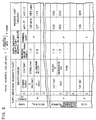
- Fig. 2 is a table diagram for illustrating, by way of example only, classification of a cylindrical part with respect to the basic elements representing the surfaces of the part to be processed or machined, respectively.
- contents of the basic elements m X i.e. surfaces to be processed or machined
- the first basic element 10 represents a planar surface (plane)
- the second basic element 11 is a cylindrical surface (cylinder).
- a third basic element there may be considered a round bore surface (round hole).
- the names of the basic elements m X which may be prepared in multiplicity.
- the accuracy of evaluation is correspondingly improved, although difficulty in handling or processing these basic elements is increased.
- evaluation accuracy is correspondingly degraded, although ease in processing them can be enhanced.
- the number of the basic elements should preferably be selected to be around twenty in the processings such as machining as well as in the assembling even in the case of a product or article of a relatively complicated configuration or structure.
- the basic element representing the planar surface (plane) P which is most easy to machine or process is taken as the standard element m X o , and the basic elimination score m ⁇ x which is assigned to the standard element m X o is set to "0" (zero).
- the elimination scores m ⁇ x to be assigned are increased in dependence on the degrees of difficulty in machining or processing these other basic elements relative to that of the standard element m X o .
- the basic elimination scores m ⁇ x given to the other basic elements m X than the standard element are determined to increase from "0" (zero) as the processing costs m C x of the other basic elements m X increase beyond the processing cost m C xo of the standard element m X o under the same production conditions as that for the standard element m X o .
- m ⁇ x m f1( m C x ) (1)
- the processing time i.e. time required for the processing or machining operation
- m T x in place of the operation or processing cost m C x or indexes m I x ( m C x / m C xo or m T x / m T xo ) derived by dividing the processing cost C x or the processing time m T x by m C xo or m T xo for the standard element m X o , respectively.
- m ⁇ x there may be mentioned those which differ from one another in that m ⁇ x tends to increase or decrease as a function of increase of m C x . They are: Alternatively, in place of the basic elimination score m ⁇ x ' there may be used basic coefficients m ⁇ x ' which assume values greater or smaller than a predetermined value in accordance with the following expressions: where a3 , b2, b3, C1, C2, d1, d2, ⁇ and ⁇ represent constants, respectively. By selecting these constants appropriately, the rate or trend of increase/decrease of the basic index in accompanying the increase in the cost or time for processing the elementary elements can correspondingly be modified or changed.
- the basic elimination score represents a degree of difficulty of operation or processing for a basic element relative to the element standard on the assumption that the basic element is processed in the standard state. Accordingly, when the state of a basic element such as size, processing tolerance etc. changes, it is necessary to change correspondingly the elimination score.
- the rate or proportion of this change can be represented by an element which is referred to as the supplementary element m ⁇ .
- Fig. 3 shows examples of the supplementary elements m ⁇ .
- the supplementary elements there may be mentioned the material m , size l , dimensional tolerance/surface roughness a and other factors which will readily occur to those skilled in the art.
- the state thereof may be classified into one or more sub-states or items, whereon the supplementary standards (m0, l0, a0, 7-8) are defined for the sub-states or items, respectively.
- the supplementary standards m0, l0, a0, 7-8
- Each of these items can be extracted from a product, parts or information described on a design drawing and represents a factor other than the basic element which can affect or influence the ease of processing (i.e. processability).
- the supplementary coefficients m ⁇
- operation costs m C x ⁇ n are displayed for the items (sub-states), respectively, which cost are expected to be involved in the processing performed under the same processing conditions.
- the processing costs m C x ⁇ o for the supplementary standards m o , a o and l o are assumed to be 126 yens which is equal to the process cost m C x of the element standard m X o shown in Fig. 2.
- the value resulted from multiplication of the processing cost for the supplementary standard with the supplementary coefficient represents the processing cost involved in the processing of the supplementary element corresponding to the supplementary standard.
- the suffix "x mean" affixed to the right-hand bracket in the above expression indicates that the supplementary coefficient m ⁇ n indicates a mean value of the values obtained from the calculations for a plurality of the basic element m X.
- the processing cost m C x ⁇ o for the supplementary standard is equal to the processing cost m C x for the basic element
- the processing times m T x ⁇ n and m T x ⁇ o may be employed for evaluation.
- the indexes thereof m I x ⁇ n and m I x ⁇ o or product of the shop allotment rates m A with T x ⁇ n and T x ⁇ o may be employed for evaluation.
- a part i processability evaluation score m E i indicating the processability (ease of processing) of a part can be determined through a procedure which will be described below in detail.
- a processing cost m C bi involved in the processing of the basic element of the part i is determined on the basis of the data shown in Fig. 3.
- m E i 100 ⁇ m g 2 ( m ⁇ nij , m ⁇ xij ).
- the part processability evaluation score m E i can be determined from the basic elimination score m ⁇ xij and the supplementary coefficient m ⁇ nij which correspond to the basic element m X ij and the supplementary element m ⁇ nij , respectively.
- the part processing cost m C i can be determined by placing the value of m E i determined from the expression (14) in the expression (10).
- the part processability evaluation score m E i and the part processing cost m C i can conveniently be arithmetically determined on the basis of the basic elimination score and the supplementary coefficient read out from the table without using the data of m C x , m C x ⁇ n and others shown in Figs. 2 and 3.
- the processing costs m C bi and m C x ⁇ nij mentioned above can be replaced by the processing times m T i and m T x ⁇ nij or the respective indexes m I i and m I x ⁇ nij or alternatively by products m A i ⁇ m T i and m A ij , m T x ⁇ nij of the shop allotment rates m A i and m A ij and the processing time m T i and m T x ⁇ nij at the sequential processing steps j .
- the part coefficient m e i ' g2 ⁇ ( m C i ) increases or decreases its value when the part processing cost m C i increases beyond the part standard processing cost m C bi .
- the part processability evaluation score m E i and the part processing cost m C i are determined for all of the parts, which is then followed by determination of the processing cost m C and the processing evaluation score m E of the product or article on the basis of the values ofthe score m E i and the cost m C i determined for the individual constituent parts, respectively.
- the processing cost of the product standard can be represented by the total sum of the processing costs m C bi for the part standards, i.e. ⁇ m C bi .
- the processing costs m C, m C i , and m C bi can be replaced by the processing times m T, m T i and m T bi or the relevant indexes m I , m I i and m I bi , respectively, or alternatively by the products of the shop rate m A i for the part i and the abovementioned processing times, i.e. ⁇ ( m A i . m T i ), m A i ⁇ m T i , m A i ⁇ m T bi , etc..
- m E i represents the index indicating the degree of ease of processing (i.e. processability) of the part i
- the product processability evaluation score m E represents the index which indicates the degree of ease of processing (processability) of the product as a whole.
- m f4 (E i ) can approximately be given by ( ⁇ m E i )/ m N (deriving method of which is omitted from description), m E may be determined as an approximate value as follows: where m N represents the number of the parts to be processed.
- processing costs m C and m C i of a product and parts of concern as well as the times m T and m T i required for the processings thereof, there may exist such a case in which processing costs m C' and m C i ' as well as processing times m T' and m T i ' of an existing product and parts similar to those of concern are known as real values.
- ⁇ m C m C' m f6 ( m E, m E') (23)
- mf6 is derived on the assumption that formulae of m f3 ⁇ 1 and m f3' ⁇ 1 as well as the constants involved therein are same because of comparison with the similar product.
- the processing times m T, m T i , m T' and m T i ' as well as the relevant indexes m I, m I i , m I' and m I i ' may be employed.
- the products of the production line rates m A i , m A i ' and the processing times m T i , m T i ' for the parts i may be determined for the evaluation.
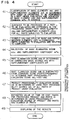
- Fig. 4 is a flow chart for illustrating an evaluation procedure executed by a computer system.
- a plurality of basic elements m X and supplementary elements m ⁇ are classified in advance in accordance with the kinds of operations or processings (machinings) to be performed on partsw subjected to evaluation, whereon the element standard m X o and the supplementary element standard m ⁇ o are defined.
- the part to be evaluated is expressed by symbols of the basic elements and the supplementary elements. Unless the symbols fitting precisely are available, the symbol of the basic element having the best similarity to that of the part of concern is selected.
- the sysmbols representing the basic elements and the supplementary elements are inputted to the computer system on a part-by-part basis by means of the keyboard or the like of the input unit 4.
- the computer determines automatically by computation all or a part of the processability evaluation scores as well as the processing times and the processing costs for the parts as well as the product, whereon the results are displayed on the display screen 3 and outputted, if desired, through the printer 5 (steps 44-49).
- the symbols of the basic elements and the supplementary elements are assigned to individual keys of the keyboard, respectively.
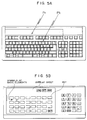
- Figs. 5A and 5B examples of such keyboard are illustrated.
- the keys should preferably be assigned with the symbols such that the characters imprinted thereon can facilitate association with the symbols.
- the symbols of the basic elements for which the alphabetic letters are used as they are may be assigned to the keys of the same alphabetic letters, respectively, as illustrated in Fig. 2, while the basic elements for which other symbols than the alphabetic letters are used may preferably be assigned to the function keys.
- 5A may be assigned to a basic element.
- a sheet known as an overlay sheet may be laid over the keyboard, and relevant symbols may be written on the sheet at locations close to the individual keys, as shown in Fig. 5B, so that the symbol of the basic elements assigned to the keys can immediately be understood.
- a list of the element symbols may be generated on a display screen, wherein the element symbol as desired may be selected by designating with a cursor by means of a pointing device or the like. In this manner, there may occur various methods for inputting the symbols of the basic elements, and any suitable one may be adopted to this end. Parenthetically, the numerical data may be inputted by using the ten-keys.
- the basic element "P" and others represented by alphabetic letters are assigned to the keys belonging to a group Pb, while the other symbols than the alphabetic letters are assigned to the keys belonging to a function key group Fn.
- a list of the element symbols may be generated on a display screen, wherein the element symbol as desired may be selected by designating with a cursor by means of a pointing device or the like. In this manner, there may occur various methods for inputting the symbols of the basic elements, and any suitable one may be adopted to this end. Needless to say, the numerical data may be inputted by using the ten-keys.
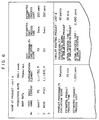
- Fig. 6 illustrates, by way of example, the output display generated as a result of the processing of the input data by the computer system shown in Fig. 4.
- Fig. 7 is a view showing the results of evaluation performed concerning the processability of various parts in accordance with the teachings of the invention incarnated in the illustrated embodiment. It can be seen from this figure that errors or deviations from the real values of processability evaluations of the products are confined to within ⁇ 10 %.
- the processability evaluation scores are determined by adopting a low-point method of scoring (i.e. method of reducing or substracting the score) from the standard score of "100".
- a low-point method of scoring i.e. method of reducing or substracting the score
- various modifications of this method of scoring are conceivable such as those exemplified by a method of determining the processability evaluation score by using the low-point method of scoring from the standard score of "0" (zero), method of determining the processability evaluation score according to a high-point method of scoring from the standard score of "0”, a method of determining the processability evaluation score by the high-point method on the basis of the standard score of "100” and others.
- Fig. 8 shows an example of improvement accomplished by adopting a processability evaluation method according to the invention.
- the invention has been described in conjunction with the method for evaluating processability (ease or difficulty of processing) by taking the machining as the kind or type of operation, the surface to be machined as the state, it should be understood that the invention can equally be applied to evaluation of the assemblability (ease or difficulty of assembling operations) by taking an assembling operation as the type of operation and attachment movement as the state.
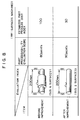
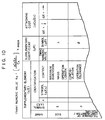
- the basic elements and others used in this assemblability evaluation are shown in Figs. 9 to 13.
- the assemblability evaluation method is discussed by several of the present inventors in Miyakawa et al's article entitled "The Hitachi New Assemblability Evaluation Method (AEM)" contained in Transactions of the North American Manufacturing Research Institute of SME (1990, pp. 352-359) held May 23 to 25, 1990 at Pennsylvania State University, the disclosure of which is hereby incorporated by reference.
- Figs. 9 and 10 show basic elements a X and supplementary element a ⁇ resulting from classification of an assembling or attachment operation involved in assembling or attaching one part to another part in the same formats as those shown in Figs. 2 and 3 for the basic element m X and the supplementary elements m X of the surfaces of the parts to be processed or machined.
- a part assemblability evaluation score a E i a product or article assemblability evaluation score a E and others can be determined through the similar procedures described hereinbefore in conjunction with the part processability evaluation score m E i and the article or product assemblability evaluation score m E.
- the descriptions made concerning the processability evaluation scores by reference to Figs. 2 and 3 may apply to the determination of the assemblability evaluation scores a E i and a E by reading the "surface to be processed or machined” as “attachment movement or operation” while reading “processing or machining” as “assembling or attachment” with the prefix "m” affixed to the symbols being replaced by "a”.
- the processing operation as well as the assembling operation of a product or article and a part can be evaluated for different kinds of operations independently.
- synthetic evaluation for both the processing operation and the assembling operation can not be made simply by adopting straightforwardly the evaluation procedures described in the foregoing.
- the individual operations such as the processing or machining operation and the assembling operation may synthetically be combined to a more general kind of operation such as what may be referred to as the synthetic operation or manufacturing or production operation, whereon synthetic evaluation may be performed by defining basic elements T X, supplementary elements T ⁇ (the prefix "T" is to replace the previously used "m” and "a”) etc. for the combined (or synthetic) operation (e.g.
- a synthetic part evaluation score (e.g. part producibility evaluation score) T E$i can be determined in accordance with the previously mentioned expressions for determining the part processability evaluation score m E i through a modification of replacing the prefix "m" by "T”, as follows:
- the synthetic part evaluation score T E i can be determined on the basis of m X, m ⁇ , a X, a ⁇ which in turn can be arithmetically determined from m ⁇ x , m ⁇ n , a ⁇ x , a ⁇ n or m E i , a E i without resorting to definitions of the basic elements T X and the supplementary elements T ⁇ for the synthetic evaluation.
- T C, T C i , T C', and T C' i there may be derived the total operation time T T, T Ti, T T' and T T' i or indexes therefor such as T I, T I i , T I' and T I i ' or products of the shop allotment rates m A i , m A i ', a A i and a A i ' and m T i , m T i ', a T i and a T i ', i.e. ⁇ ( m A i . m T i + a A i .
- Fig. 14 is a flow chart for illustrating, by way of example, a procedure for performing the processability evaluation, assemblability evaluation and the processing/assemblability synthetic evaluation by using the basic elements and the supplementary elements of constituent parts with the aid of a computer system.
- the part subjected to evaluation is expressed by a combination of symbols representing the basic element and the supplementary element, respectively, of the part. In this case, unless the symbol representing exactly ther basic element is available, that of a basic element bearing the best similarity to the basic element under evaluation is selected.
- a step 2 data of the symbols of the basic elements and the supplementary elements such as m X ij , m ⁇ ij , a X ij , a ⁇ ij as well as the number m i of the parts i used in a product of concern are inputted through the keyboard or the like of the input unit 4.
- the succeeding processings and operations are executed by the computer.
- the data inputted through the keyboard are displayed on a screen of the display unit 3.
- step 4 there are read out from the tables shown in Figs.
- the basic elimination scores m ⁇ xij , a ⁇ xij and supplementary coefficients m ⁇ nij , a ⁇ nij which correspond to the symbols of the basic elements and the supplementary elements used for expressing the surface to be processed and the attachment movement of the part to be evaluated, respectively.
- the part processability evaluation score m E i and the part assemblability evaluation score a E i are arithmetically determined in accordance with the expressions (14) and (26), respectively, on the basis of the basic elimination scores, the supplementary coefficients and other data as read out.
- the part processability evaluation score m E i and the part assemblability evaluation score a E i thus determined are stored in the memory or storage unit.
- the part synthetic evaluation score (part producibility or manufacturability evaluation score) is arithmetically determined on the basis of the part processability evaluation score and the part assemblability evaluation score in accordance with the expression (28), the result of which is stored in the memory.
- the synthetic production evaluation score (producibility evaluation score) T E is determined in accordance with the expressions (28), (29) and (30) mentioned previously in terms of a mean representative numerical value on the basis of the assemblability evaluation scores m E i for all the parts constituting the product or article of concern and the part processability evaluation scores determined for all the parts to be processed or machined.
- the result is displayed on the display unit 3 and at the same time outputted through the printer.
- the computer can be so programmed as to automatically calculate all or a part of the processability evaluation score, the processing time and the processing cost as well as the assemblability evaluation score, the assembling time and the assembling cost on a part-by-part basis or on a product-by-product basis together with the synthetic evaluation score (manufacturability evaluation score), the results of which may of course be displayed on the display unit and/or printed out, as occasion requires.
- Fig. 15 shows examples of the data obtained as the result of processings executed by the computer system concerning the processability evaluation score, estimated processing cost, assemblability evaluation score, estimated assembling cost, producibility (synthetic) evaluation score and the estimated production cost. As will be seen from Fig.
- the part assemblability evaluation scores and the estimated assembling costs for all the parts constituting a product or article of concern the part processability evaluation scores, the estimated processing costs, the part producibility (synthetic) evaluation score and the estimated part production cost together with the product assemblability evaluation score, estimated assembling cost, processability evaluation score, estimated processing cost, producibility evaluation score and the estimated production cost for the product of concern in terms of the sum values or mean representative values of the corresponding evaluation values and the estimated costs of the constituent parts.
- Fig. 16 shows, by way of example, the results of the processability evaluation, assemblability evaluation and the processability/assemblability synthetic evaluation performed by the computer system shown in Fig. 1 for structure models A and B shown in Fig. 17.
- the processability/assemblability evaluation method according to the invention renders it possible to determine at onee that the structure design A is better, as can be seen from Fig. 16.
- the productivity in general is improved with the number of steps involved in the processing or machining and assembling being reduced, while the area to be improved can easily be pointed out, which in turn contributes to promotion of improvement as well as ease of processing and assembling of constituent parts and products or article as a whole.
- the evaluation indexes as obtained can be utilized in common to design engineers, whereby production engineers and management engineers, improvement can be accomplished from numerous and different standpoints with the productivity being enhanced significantly with a considerably reduced number of manufacturing steps.
- factory automation (FA) inclusive of automation of individual manufacturing steps can be implemented easily without requiring lots of time and labor because of simplification of the processing (machining) and assembling owing to the improved producibility.
Landscapes
- Engineering & Computer Science (AREA)
- Physics & Mathematics (AREA)
- General Physics & Mathematics (AREA)
- Business, Economics & Management (AREA)
- Theoretical Computer Science (AREA)
- Economics (AREA)
- Entrepreneurship & Innovation (AREA)
- Quality & Reliability (AREA)
- Strategic Management (AREA)
- Human Resources & Organizations (AREA)
- Manufacturing & Machinery (AREA)
- Automation & Control Theory (AREA)
- General Engineering & Computer Science (AREA)
- Mathematical Physics (AREA)
- Tourism & Hospitality (AREA)
- Educational Administration (AREA)
- Databases & Information Systems (AREA)
- Game Theory and Decision Science (AREA)
- Human Computer Interaction (AREA)
- Data Mining & Analysis (AREA)
- Operations Research (AREA)
- Development Economics (AREA)
- Software Systems (AREA)
- Marketing (AREA)
- General Business, Economics & Management (AREA)
- Management, Administration, Business Operations System, And Electronic Commerce (AREA)
- Automatic Assembly (AREA)
- Control By Computers (AREA)
Applications Claiming Priority (2)
| Application Number | Priority Date | Filing Date | Title |
|---|---|---|---|
| JP181393/90 | 1990-07-11 | ||
| JP18139390A JP3230813B2 (ja) | 1990-07-11 | 1990-07-11 | 物品の複数作業種の作業容易性の総合評価方法およびその装置 |
Publications (2)
| Publication Number | Publication Date |
|---|---|
| EP0466098A2 true EP0466098A2 (fr) | 1992-01-15 |
| EP0466098A3 EP0466098A3 (en) | 1993-09-29 |
Family
ID=16099961
Family Applications (1)
| Application Number | Title | Priority Date | Filing Date |
|---|---|---|---|
| EP19910111408 Withdrawn EP0466098A3 (en) | 1990-07-11 | 1991-07-09 | Method and apparatus for evaluating the suitability of an article for a given operation |
Country Status (3)
| Country | Link |
|---|---|
| EP (1) | EP0466098A3 (fr) |
| JP (1) | JP3230813B2 (fr) |
| KR (1) | KR950007926B1 (fr) |
Cited By (7)
| Publication number | Priority date | Publication date | Assignee | Title |
|---|---|---|---|---|
| DE4396848T1 (de) * | 1992-12-28 | 1995-01-26 | Hitachi Ltd | Verfahren zum Bewerten der Leichtigkeit von Arbeiten und Maßnahmen, die an Artikeln durchgeführt werden, und Bewertungsvorrichtung |
| EP0819996A3 (fr) * | 1991-04-04 | 1998-03-18 | Hitachi, Ltd. | Méthode et système pour évaluer les possibilités de fabrication automatique |
| US5907488A (en) * | 1990-02-14 | 1999-05-25 | Hitachi, Ltd. | Method of evaluating easiness of works and processings performed on articles and evaluation apparatus |
| EP0811941A3 (fr) * | 1996-05-28 | 1999-07-21 | Texas Instruments Incorporated | Prédicteur de capacité |
| US6223092B1 (en) | 1990-02-14 | 2001-04-24 | Hitachi, Ltd. | Automatic manufacturing evaluation method and system |
| DE10110268A1 (de) * | 2001-03-02 | 2002-09-19 | Siemens Ag | Verfahren und Computerprogrammstruktur zur Auswahl des Leiterplattenherstellungsverfahrens mit dem niedigsten Aufwandsgrad |
| DE10156330B4 (de) * | 2001-10-11 | 2008-06-26 | Sew-Eurodrive Gmbh & Co. Kg | Verfahren zur Bestimmung eines Einzelbetriebssicherheitsfaktors für einen Antrieb, Verfahren zur Auswahl von Antrieben für eine Anlage oder Maschine aus einer Baureihe von Antrieben und Datenträger |
Families Citing this family (3)
| Publication number | Priority date | Publication date | Assignee | Title |
|---|---|---|---|---|
| US5586022A (en) * | 1990-02-14 | 1996-12-17 | Hitachi, Ltd. | Method of evaluating easiness of works and processings performed on articles and evaluation apparatus |
| WO1994015308A1 (fr) * | 1991-02-12 | 1994-07-07 | Hitachi, Ltd. | Procede et appareil d'evaluation de la facilite de manipulation et de traitement d'articles |
| JPH11203344A (ja) | 1998-01-20 | 1999-07-30 | Hitachi Ltd | ネットワークを用いた製品の評価システム |
Family Cites Families (2)
| Publication number | Priority date | Publication date | Assignee | Title |
|---|---|---|---|---|
| US4931944A (en) * | 1988-05-27 | 1990-06-05 | General Motors Corporation | Method of optimizing a vehicle assembly line build sequence |
| US5077661A (en) * | 1989-05-03 | 1991-12-31 | Hewlett-Packard Company | Assignment-dependent resource allocation method |
-
1990
- 1990-07-11 JP JP18139390A patent/JP3230813B2/ja not_active Expired - Lifetime
-
1991
- 1991-07-09 EP EP19910111408 patent/EP0466098A3/en not_active Withdrawn
- 1991-07-10 KR KR1019910011667A patent/KR950007926B1/ko not_active Expired - Fee Related
Cited By (8)
| Publication number | Priority date | Publication date | Assignee | Title |
|---|---|---|---|---|
| US5907488A (en) * | 1990-02-14 | 1999-05-25 | Hitachi, Ltd. | Method of evaluating easiness of works and processings performed on articles and evaluation apparatus |
| US6223092B1 (en) | 1990-02-14 | 2001-04-24 | Hitachi, Ltd. | Automatic manufacturing evaluation method and system |
| EP0819996A3 (fr) * | 1991-04-04 | 1998-03-18 | Hitachi, Ltd. | Méthode et système pour évaluer les possibilités de fabrication automatique |
| DE4396848T1 (de) * | 1992-12-28 | 1995-01-26 | Hitachi Ltd | Verfahren zum Bewerten der Leichtigkeit von Arbeiten und Maßnahmen, die an Artikeln durchgeführt werden, und Bewertungsvorrichtung |
| EP0811941A3 (fr) * | 1996-05-28 | 1999-07-21 | Texas Instruments Incorporated | Prédicteur de capacité |
| US7110956B1 (en) | 1996-05-28 | 2006-09-19 | Texas Instruments Incorporated | Capability predictor |
| DE10110268A1 (de) * | 2001-03-02 | 2002-09-19 | Siemens Ag | Verfahren und Computerprogrammstruktur zur Auswahl des Leiterplattenherstellungsverfahrens mit dem niedigsten Aufwandsgrad |
| DE10156330B4 (de) * | 2001-10-11 | 2008-06-26 | Sew-Eurodrive Gmbh & Co. Kg | Verfahren zur Bestimmung eines Einzelbetriebssicherheitsfaktors für einen Antrieb, Verfahren zur Auswahl von Antrieben für eine Anlage oder Maschine aus einer Baureihe von Antrieben und Datenträger |
Also Published As
| Publication number | Publication date |
|---|---|
| JP3230813B2 (ja) | 2001-11-19 |
| EP0466098A3 (en) | 1993-09-29 |
| KR920003197A (ko) | 1992-02-29 |
| JPH0469703A (ja) | 1992-03-04 |
| KR950007926B1 (ko) | 1995-07-21 |
Similar Documents
| Publication | Publication Date | Title |
|---|---|---|
| US5717598A (en) | Automatic manufacturability evaluation method and system | |
| JP7423290B2 (ja) | 機械加工製品をカスタマイズするシステムおよび方法 | |
| US5907488A (en) | Method of evaluating easiness of works and processings performed on articles and evaluation apparatus | |
| US6973358B2 (en) | Defect influence degree evaluation method and design support system | |
| Yu et al. | Computer-aided design for manufacturing process selection | |
| EP0466098A2 (fr) | Méthode et appareil pour évaluer l'aptitude d'un objet pour une certaine opération | |
| EP1683040A2 (fr) | Systemes et procedes destines a la mise en oeuvre de formules | |
| EP0508308B1 (fr) | Méthode et système pour évaluer les possibilités de fabrication automatique | |
| US5586022A (en) | Method of evaluating easiness of works and processings performed on articles and evaluation apparatus | |
| JP3024350B2 (ja) | 製造性自動評価方法およびシステム | |
| Manarvi et al. | Framework of an integrated tolerance synthesis model and using FE simulation as a virtual tool for tolerance allocation in assembly design | |
| Leibl | Cost calculation with a feature-based CAD system using modules for calculation, comparison and forecast | |
| JP7355605B2 (ja) | 設計支援装置、設計支援方法及び設計支援プログラム | |
| Castorani et al. | A CAD-based method for multi-objectives optimization of mechanical products | |
| Tang et al. | Qualitative and quantitative cost analysis for sheet metal stamping | |
| JPH086777A (ja) | 情報制御システムの開発システムおよび開発方法 | |
| JP3799063B2 (ja) | 製品の加工容易性評価装置 | |
| Ishii et al. | HyperQ/Process: An Expert System for Manufactuing Process Selection | |
| JP2001101284A (ja) | 製品製造の見積り方法及びその装置並びに記憶媒体 | |
| Merkel et al. | Determination of cognitive assistance functions for manual assembly systems | |
| JP2702986B2 (ja) | プログラム内データ置換方法 | |
| Bonino et al. | Geometric analysis of product CAD models to support design for assembly | |
| JPH0926998A (ja) | 製造所内の金属帯の品質関連情報の入手方法および装置 | |
| JP7708709B2 (ja) | 商品管理装置、商品管理方法、及び、商品管理プログラム | |
| JP2004178379A (ja) | 工数自動算出システム、工数自動算出方法及びそのプログラム |
Legal Events
| Date | Code | Title | Description |
|---|---|---|---|
| PUAI | Public reference made under article 153(3) epc to a published international application that has entered the european phase |
Free format text: ORIGINAL CODE: 0009012 |
|
| 17P | Request for examination filed |
Effective date: 19910709 |
|
| AK | Designated contracting states |
Kind code of ref document: A2 Designated state(s): DE FR GB NL |
|
| PUAL | Search report despatched |
Free format text: ORIGINAL CODE: 0009013 |
|
| AK | Designated contracting states |
Kind code of ref document: A3 Designated state(s): DE FR GB NL |
|
| 17Q | First examination report despatched |
Effective date: 19960318 |
|
| STAA | Information on the status of an ep patent application or granted ep patent |
Free format text: STATUS: THE APPLICATION HAS BEEN WITHDRAWN |
|
| 18W | Application withdrawn |
Effective date: 20050324 |