EP0466467A2 - Méthode de traitement des demandes d'accès pour le service dans des systèmes de traitement de données, comme des centraux téléphoniques et un système distribué d'application de ladite méthode - Google Patents
Méthode de traitement des demandes d'accès pour le service dans des systèmes de traitement de données, comme des centraux téléphoniques et un système distribué d'application de ladite méthode Download PDFInfo
- Publication number
- EP0466467A2 EP0466467A2 EP91306238A EP91306238A EP0466467A2 EP 0466467 A2 EP0466467 A2 EP 0466467A2 EP 91306238 A EP91306238 A EP 91306238A EP 91306238 A EP91306238 A EP 91306238A EP 0466467 A2 EP0466467 A2 EP 0466467A2
- Authority
- EP
- European Patent Office
- Prior art keywords
- access service
- access
- processing
- service requests
- service request
- Prior art date
- Legal status (The legal status is an assumption and is not a legal conclusion. Google has not performed a legal analysis and makes no representation as to the accuracy of the status listed.)
- Granted
Links
Images

Classifications
-
- H—ELECTRICITY
- H04—ELECTRIC COMMUNICATION TECHNIQUE
- H04Q—SELECTING
- H04Q3/00—Selecting arrangements
- H04Q3/42—Circuit arrangements for indirect selecting controlled by common circuits, e.g. register controller, marker
- H04Q3/54—Circuit arrangements for indirect selecting controlled by common circuits, e.g. register controller, marker in which the logic circuitry controlling the exchange is centralised
- H04Q3/545—Circuit arrangements for indirect selecting controlled by common circuits, e.g. register controller, marker in which the logic circuitry controlling the exchange is centralised using a stored program
- H04Q3/54575—Software application
- H04Q3/54591—Supervision, e.g. fault localisation, traffic measurements, avoiding errors, failure recovery, monitoring, statistical analysis
Definitions
- the invention relates to a method of processing access service requests in data processing systems, such as telephone exchanges, in which method only a limited number of service requests are allowed for access service simultaneously, and the remaining service requests are placed in incoming order into a service request access queue to wait for service.
- the invention relates to the control of overload on processors, programs or other processing units handling service requests, by restricting the number of access service requests coming therein-to.
- the present invention relates particularly to the restriction of call attempts in overload situations at digital telephone exchanges.
- telephone exchanges an attempt is made to maintain as high a throughput as possible at the level of the overall system and small delays in different parts of the system (for instance in the signalling units).
- the maintenance of a high throughput level means that call attempts are lost only if necessary. Long waiting times for the dialling tone are unpleasant to the customer and may result in the customer cancelling the call (on-hook) or taking some other action which leads to failure of later service and thereby to a decreased throughput level and performance.
- the access service requests (call attempts) are placed in a queue of the FIFO (first in-first out) type in incoming order to wait for service.
- the queue When in an overload situation the queue is filled, no further access service requests are taken up in the queue. Since in this method an attempt is made to serve those who have waited the longest time, this results in long waiting times and a long average dialling tone delay in an overload situation. Also, some of the access service requests in the queue are lost, since the subscriber already shuts the line (on-hook) tired of the long wait.
- a queue of the type LIFO last in-first out
- some of the service requests may also have to wait in the queue for a very long time without being rejected or served, and then for instance in the case of a telephone exchange the customer may himself decline the access service request. This also decreases the throughput level of the entire system.
- the object of the present invention is to provide a method and a system wherein as high a through-put level as possible is achieved simultaneously as access response times not exceeding the set requirements are accomplished.
- a processing time is measured for each access service request, said processing time being the time from the transfer of the access service request from the access queue of access service requests for processing in the central processing unit to the completion of the processing of said access service request.
- the average processing time calculated from the processing times is utilized together with the queueing time in the rejection of access service requests. This is effected in such a manner that when a new access service request arrives in the access queue, then those access service requests among the service requests having waited the longest time in the access queue whose combined queueing time and average processing time exceeds a predetermined limit value, such as a maximum allowable response time for the system, are rejected one at a time.
- a predetermined limit value such as a maximum allowable response time for the system
- a time out based rejection rule which is unprejudiced to the access service requests is automatically achieved, and on account of this rejection rule, for instance in telephone exchanges no dialling tone delays for the call attempts that would be longer than allowed by the CCITT (Consultative Committee of International Telephone and Telephone) are created. If the offered traffic (number of call attempts per time unit) exceeds the processing capacity of the telephone exchange, the extra call attempts will be automatically rejected without any significant decrease in the quantity of switched traffic. In other words, the central processing unit can be exploited at 100% capacity even during persistent overload.
- the Invention also relates to a distributed system as claimed in claim 4.
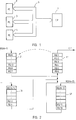
- Figure 1 illustrates in block diagram form a distributed processing system according to the invention
- Figures 2 and 3 show the status of access queues according to the invention as applied in the system of Figure 1 at two successive instants of time.
- the method of the invention can be applied in any connection in which control of the overload in access service request processing is desired.
- the access service requests may be intended for a processor, a program, or other equivalent data or signal processing unit.
- the primary application of the invention is in telephone exchanges, in connection with which the invention will be explained in the following by way of example.
- a digital telephone exchange may be either centralized or hierarchically distributed (decentralized) in its hardware configuration.
- CP central processor
- PC peripheral controller processors
- the units 1, 2, 3 and 4 have typically been realized as different programs in the same computer.
- the signalling units 2, 3 and 4 and the central processing unit 1 communicate with one another via a message bus 5.
- the message bus is sometimes also termed a message switch (MS).
- the invention relates to the controlling of the overload on the central processing unit 1.
- the purpose of the controlling method is to throttle incoming traffic to the central unit 1.
- Characteristic performance parameters of the system are the through-put level of the central unit 1, the average processing time in the central unit 1 and the average response time to a call attempt (for instance dialling tone delay).
- the subscriber lines and the interexchange circuits have been connected to signalling units 2, 3 and 4. If a subscriber line is activated ( off-hook ), the signalling unit to which this line is connected detects the activation, generates a call attempt message, i.e. an access service request, and transmits it via the message bus 5 to the central unit 1, and establishes a state automaton.
- the central unit serves the access service request (for instance enables a DTMF receiver ) and sends an acknowledgement message back to the same signalling unit.
- a state automaton is reserved for each new call attempt in the signalling unit 2, 3, 4, the state of which is updated in the course of the call setup successively from one step to another, depending on the subscriber line or the interexchange circuit or other corresponding signalling means.
- a new call attempt is meant in this connection a signal or signalling message coming in from a subscriber interface or another telephone exchange or some other element of the telephone network to the exchange now discussed.
- each signalling unit 2, 3 and 4 has a respective buffer 21, 31 and 41 representing a queue of access service requests, into which buffer the signalling unit places the identification code of the state automaton as it receives a new call attempt and creates a state automaton corresponding thereto.
- the service access request buffers 21, 31 and 41 are FIFOT (first-in-first out-time out) type buffers wherein the earliest incoming access service request is also first taken out for acceptance or rejection.
- the central unit 1 can simultaneously contain for processing a restricted number of access service requests per each signalling unit.
- This maximum number constitutes a kind of access window to the central unit, which access window can be adjusted if desired by changing said restricted number for instance depending on the load.
- a ticket has been assigned to each access service request being handled in the central unit.
- the tickets however do not correspond to resource units representing the capacity of the central unit.
- Each signalling unit has a predetermined, not necessarily similar or constant, number of tickets at its disposal.
- a new access service request is released from the access service request buffer located in the signalling unit 2, 3 or 4 to the central unit 1 for processing only after the processing of one access service request already being in the central unit has been completed and the ticket corresponding thereto becomes vacant and is returned to the signalling unit it belongs to.
- the return of a ticket may in practice be realized as an acknowledgement signal from the central unit 1 to the respective signalling unit. For this reason, the access service request queues 21, 31 and 41 located in the signalling units are called access queues from now on.
- the main principle of the invention is to keep fresh call attempts waiting in access queues and to assign access tickets to them for access service at the same rate at which tickets are released and returned as a result of the completion of the access services.
- the number of tickets is such that the central unit 1 which is the bottleneck in the system has no idle time in an overload situation and that a larger number of tickets would no longer improve the total throughput level.
- Figure 2 shows codes RQ9-RQN of state automatons corresponding to different service requests in access queues 21, 31 and 41. A new call attempt or access service request RQ(N+2) is entering into the access queue 41.
- the signalling unit 4 creates a new state automaton for this call attempt, and the code RQ(N+2) corresponding thereto is placed into the access queue behind the codes of the previous requests, and simultaneously, on account of the time out of the above-stated time criterion, the code RQ10 at the head of the queue 41 is removed, as is shown in Figure 3.
- the signalling unit 4 rejects the call attempt corresponding to this code.
- the rejection of the call attempt is effected in accordance with the pertinent signalling protocol; for instance to a subscriber's call attempt a busy tone is transmitted upon rejection, and in the case of common channel signalling, a suitable message is transmitted backward to the call attempt arriving on the connecting line, and subscriber release is awaited.
- the calculation of the queueing time for said access service request is initiated for instance by starting a timer or by adding a time stamp to it.
- the recording of time is continued for the entire queueing time.
- An average processing time for the access service requests is then calculated from these measured processing times of the different access service requests, said average processing time being utilized in accordance with the invention in the rejection of call attempts or access service requests in the queue.
- Several access service requests fulfilling the rejection condition may be discarded simultaneously from the access queue, in which case the number of access service requests in the service request queue changes dynamically in dependence on the average processing time. For instance in Figure 2, a new call attempt RQ(N+1) is coming into the access queue 21. In queue 21, there are two service requests RQ7 and RQ8 for which the access response time will become too long, assessed on the basis of the average processing time. For this reason, both access service requests RQ7 and RQ8 are discarded from access queue 21 in accordance with Figure 3.
- the access queue 21 shortens by one place.
- the release rate of tickets from the central unit 1 will slow down when the load on this unit increases. Therefore, changes in the load state caused by other traffic load (for instance disconnection of calls) in the central unit are also reflected in the signalling units 2, 3 and 4 as increase in the waiting times for new call attempts and rejection of overdelayed call attempts.
- a kind of automatic feedback has been achieved.
- the more frequently fresh call attempts arrive the higher the rejection rate is automatically without any need to schedule the rejection procedure.
- the queueing system according to the invention which has been realized in the signalling units does not limit the degree of utilization of the processor of the central unit 1. Thus one does not have to cut back the degree of utilization of the central unit 1, which constitutes the bottleneck unit in the system, below 100% on account of the overload control system.
- the access queues 21, 31 and 41 need not in principle have any maximum length in the invention, yet in practice they have a finite length. If this finite length of the access queue 21, 31 or 41 is reached in an extreme load situation, that is, all queueing seats are in use, the time out criterion of the invention cannot be applied, but when a new access service request arrives the oldest access service request must always be rejected.
- the overload level of the central unit 1 can be monitored in the method of the invention by calculating the relative proportion of rejected access service requests to all access service requests at certain intervals. On the basis of this information, one can transmit for instance to a neighboring telephone exchange a message of a low or high overload of the telephone exchange in question, if necessary.
- the central unit 1 may have a buffer line 11 in accordance with Figures 2 and 3, wherein the service requests still await service.
- the buffer 11 preferably does not utilize any rejection mechanism.
- the service requested by means of a service request may consist of several subservices carried out by different units.
- the first subservice of the access service of a call attempt may take place in the signalling unit, and the subsequent subservices successively in an appropriate manner both in centralized units and in the respective signalling unit.
- service rendered on the outgoing side (B-side) of the telephone exchange seen from the point of view of the call attempt is not included in the access service.
Landscapes
- Engineering & Computer Science (AREA)
- Computer Networks & Wireless Communication (AREA)
- Exchange Systems With Centralized Control (AREA)
- Telephonic Communication Services (AREA)
Applications Claiming Priority (2)
| Application Number | Priority Date | Filing Date | Title |
|---|---|---|---|
| FI903488 | 1990-07-10 | ||
| FI903488A FI903488A7 (fi) | 1990-07-10 | 1990-07-10 | Foerfarande foer behandling av servicebegaeran saerskilt i telefoncentraler och ett foerdelat system som tillaempar foerfarandet. |
Publications (3)
| Publication Number | Publication Date |
|---|---|
| EP0466467A2 true EP0466467A2 (fr) | 1992-01-15 |
| EP0466467A3 EP0466467A3 (en) | 1992-05-13 |
| EP0466467B1 EP0466467B1 (fr) | 1996-11-06 |
Family
ID=8530785
Family Applications (1)
| Application Number | Title | Priority Date | Filing Date |
|---|---|---|---|
| EP91306238A Expired - Lifetime EP0466467B1 (fr) | 1990-07-10 | 1991-07-09 | Méthode de traitement des demandes d'accès pour le service dans des systèmes de traitement de données, comme des centraux téléphoniques et un système distribué d'application de ladite méthode |
Country Status (4)
| Country | Link |
|---|---|
| EP (1) | EP0466467B1 (fr) |
| DE (1) | DE69122995T2 (fr) |
| ES (1) | ES2094202T3 (fr) |
| FI (1) | FI903488A7 (fr) |
Cited By (3)
| Publication number | Priority date | Publication date | Assignee | Title |
|---|---|---|---|---|
| US6772202B2 (en) * | 2001-11-28 | 2004-08-03 | Gamespy Industries, Inc. | Queuing system, method and computer program product for network data transfer |
| US20120254295A1 (en) * | 2011-03-29 | 2012-10-04 | Kddi Corporation | Service request reception control method, apparatus, and system |
| EP2988460A1 (fr) * | 2014-08-20 | 2016-02-24 | Hitachi Ltd. | Système de gestion de trafic et système de réseau sans fil |
Family Cites Families (2)
| Publication number | Priority date | Publication date | Assignee | Title |
|---|---|---|---|---|
| US4682282A (en) * | 1984-10-25 | 1987-07-21 | Unisys Corp. | Minimum latency tie-breaking arbitration logic circuitry |
| NL8602452A (nl) * | 1986-09-29 | 1988-04-18 | Philips Nv | Werkwijze voor het voorkomen van overbelasting van de centrale besturing van een telecommunicatiesysteem en inrichting voor het uitvoeren van de werkwijze. |
-
1990
- 1990-07-10 FI FI903488A patent/FI903488A7/fi not_active Application Discontinuation
-
1991
- 1991-07-09 DE DE69122995T patent/DE69122995T2/de not_active Expired - Lifetime
- 1991-07-09 EP EP91306238A patent/EP0466467B1/fr not_active Expired - Lifetime
- 1991-07-09 ES ES91306238T patent/ES2094202T3/es not_active Expired - Lifetime
Non-Patent Citations (2)
| Title |
|---|
| B.T. DOSHI: "Analysis of Clocked Schedules - High Priority Tasks", AT&T TECHNICAL JOURNAL, no. 2, February 1985 (1985-02-01), pages 622 - 660 |
| IBM TECHNICAL DISCLOSURE BULLETIN, vol. 31, no. 12, May 1989 (1989-05-01), pages 271 - 272 |
Cited By (4)
| Publication number | Priority date | Publication date | Assignee | Title |
|---|---|---|---|---|
| US6772202B2 (en) * | 2001-11-28 | 2004-08-03 | Gamespy Industries, Inc. | Queuing system, method and computer program product for network data transfer |
| US20120254295A1 (en) * | 2011-03-29 | 2012-10-04 | Kddi Corporation | Service request reception control method, apparatus, and system |
| EP2988460A1 (fr) * | 2014-08-20 | 2016-02-24 | Hitachi Ltd. | Système de gestion de trafic et système de réseau sans fil |
| JP2016046575A (ja) * | 2014-08-20 | 2016-04-04 | 株式会社日立製作所 | トラフィック管理装置及び無線ネットワークシステム |
Also Published As
| Publication number | Publication date |
|---|---|
| ES2094202T3 (es) | 1997-01-16 |
| DE69122995T2 (de) | 1997-05-28 |
| EP0466467A3 (en) | 1992-05-13 |
| EP0466467B1 (fr) | 1996-11-06 |
| FI903488A0 (fi) | 1990-07-10 |
| FI903488A7 (fi) | 1992-01-11 |
| DE69122995D1 (de) | 1996-12-12 |
Similar Documents
| Publication | Publication Date | Title |
|---|---|---|
| US5457735A (en) | Method and apparatus for queuing radio telephone service requests | |
| US6049547A (en) | Lookahead interflow of traffic among a plurality of serving sites of one customer | |
| JP3720356B2 (ja) | 電気通信網における過負荷を制御する方法 | |
| US4933935A (en) | Communications systems | |
| EP0587950B1 (fr) | Système de rappel automatique et méthode d'opération | |
| US6493321B1 (en) | Systems and methods for providing communications through an alternate communication network | |
| USRE37073E1 (en) | Automatic call back system and method of operation | |
| JP3042267B2 (ja) | 適応的呼接続規制制御装置及びその方法 | |
| JP2940526B2 (ja) | 移動通信システム | |
| US4821264A (en) | Adaptive concentration communication network ISDN access | |
| EP0256681B1 (fr) | Systèmes de communication | |
| EP0466467B1 (fr) | Méthode de traitement des demandes d'accès pour le service dans des systèmes de traitement de données, comme des centraux téléphoniques et un système distribué d'application de ladite méthode | |
| EP0413490A2 (fr) | Schéma d'allocation de ressources | |
| FI87715B (fi) | Foerfarande foer behandling av servicebegaeran i databehandlingssystem, saosom i telefoncentraler och ett foerdelat system som tillaempar foerfarandet | |
| US6084957A (en) | Method for setting up a telephone connection and an exchange system | |
| JP2534542B2 (ja) | 待合せ着信呼への案内方式 | |
| JP2002300272A (ja) | 輻輳中の着信者番号へ自動的に発信する交換機 | |
| KR100194818B1 (ko) | 비동기 전달모드 교환 시스템에서 트래픽 폭주 제어를 위한 백분율 제어 방법 | |
| JP3283443B2 (ja) | インテリジェントネットワークの網的輻輳制御方法 | |
| JP3725217B2 (ja) | 同報通信における配送制御方法および装置 | |
| KR0175465B1 (ko) | 적응적 호 갭핑을 이용한 트래픽 폭주 제어 방법 | |
| JP3155891B2 (ja) | ファクシミリ蓄積装置 | |
| JPH1013425A (ja) | 帯域可変制御方法 | |
| JPH05153674A (ja) | H1チヤネル接続方法 | |
| JPS5961336A (ja) | 網輻「そう」規制方式 |
Legal Events
| Date | Code | Title | Description |
|---|---|---|---|
| PUAI | Public reference made under article 153(3) epc to a published international application that has entered the european phase |
Free format text: ORIGINAL CODE: 0009012 |
|
| AK | Designated contracting states |
Kind code of ref document: A2 Designated state(s): DE ES FR GB NL SE |
|
| PUAL | Search report despatched |
Free format text: ORIGINAL CODE: 0009013 |
|
| AK | Designated contracting states |
Kind code of ref document: A3 Designated state(s): DE ES FR GB NL SE |
|
| 17P | Request for examination filed |
Effective date: 19920810 |
|
| 17Q | First examination report despatched |
Effective date: 19950215 |
|
| GRAG | Despatch of communication of intention to grant |
Free format text: ORIGINAL CODE: EPIDOS AGRA |
|
| GRAH | Despatch of communication of intention to grant a patent |
Free format text: ORIGINAL CODE: EPIDOS IGRA |
|
| RAP1 | Party data changed (applicant data changed or rights of an application transferred) |
Owner name: NOKIA TELECOMMUNICATIONS OY |
|
| GRAH | Despatch of communication of intention to grant a patent |
Free format text: ORIGINAL CODE: EPIDOS IGRA |
|
| GRAA | (expected) grant |
Free format text: ORIGINAL CODE: 0009210 |
|
| AK | Designated contracting states |
Kind code of ref document: B1 Designated state(s): DE ES FR GB NL SE |
|
| REF | Corresponds to: |
Ref document number: 69122995 Country of ref document: DE Date of ref document: 19961212 |
|
| ET | Fr: translation filed | ||
| REG | Reference to a national code |
Ref country code: ES Ref legal event code: FG2A Ref document number: 2094202 Country of ref document: ES Kind code of ref document: T3 |
|
| PLBE | No opposition filed within time limit |
Free format text: ORIGINAL CODE: 0009261 |
|
| STAA | Information on the status of an ep patent application or granted ep patent |
Free format text: STATUS: NO OPPOSITION FILED WITHIN TIME LIMIT |
|
| 26N | No opposition filed | ||
| REG | Reference to a national code |
Ref country code: GB Ref legal event code: IF02 |
|
| REG | Reference to a national code |
Ref country code: GB Ref legal event code: 732E |
|
| PGFP | Annual fee paid to national office [announced via postgrant information from national office to epo] |
Ref country code: ES Payment date: 20100813 Year of fee payment: 20 Ref country code: NL Payment date: 20100707 Year of fee payment: 20 |
|
| PGFP | Annual fee paid to national office [announced via postgrant information from national office to epo] |
Ref country code: FR Payment date: 20100805 Year of fee payment: 20 Ref country code: DE Payment date: 20100707 Year of fee payment: 20 Ref country code: SE Payment date: 20100708 Year of fee payment: 20 |
|
| PGFP | Annual fee paid to national office [announced via postgrant information from national office to epo] |
Ref country code: GB Payment date: 20100707 Year of fee payment: 20 |
|
| REG | Reference to a national code |
Ref country code: DE Ref legal event code: R071 Ref document number: 69122995 Country of ref document: DE |
|
| REG | Reference to a national code |
Ref country code: DE Ref legal event code: R071 Ref document number: 69122995 Country of ref document: DE |
|
| REG | Reference to a national code |
Ref country code: NL Ref legal event code: V4 Effective date: 20110709 |
|
| REG | Reference to a national code |
Ref country code: GB Ref legal event code: PE20 Expiry date: 20110708 |
|
| REG | Reference to a national code |
Ref country code: SE Ref legal event code: EUG |
|
| PG25 | Lapsed in a contracting state [announced via postgrant information from national office to epo] |
Ref country code: GB Free format text: LAPSE BECAUSE OF EXPIRATION OF PROTECTION Effective date: 20110708 |
|
| PG25 | Lapsed in a contracting state [announced via postgrant information from national office to epo] |
Ref country code: NL Free format text: LAPSE BECAUSE OF EXPIRATION OF PROTECTION Effective date: 20110709 |
|
| PG25 | Lapsed in a contracting state [announced via postgrant information from national office to epo] |
Ref country code: DE Free format text: LAPSE BECAUSE OF EXPIRATION OF PROTECTION Effective date: 20110710 |
|
| REG | Reference to a national code |
Ref country code: ES Ref legal event code: FD2A Effective date: 20130722 |