EP0466639A1 - Schmierstoffzusammensetzung - Google Patents
Schmierstoffzusammensetzung Download PDFInfo
- Publication number
- EP0466639A1 EP0466639A1 EP91810474A EP91810474A EP0466639A1 EP 0466639 A1 EP0466639 A1 EP 0466639A1 EP 91810474 A EP91810474 A EP 91810474A EP 91810474 A EP91810474 A EP 91810474A EP 0466639 A1 EP0466639 A1 EP 0466639A1
- Authority
- EP
- European Patent Office
- Prior art keywords
- alkyl
- atoms
- phenyl
- composition according
- tert
- Prior art date
- Legal status (The legal status is an assumption and is not a legal conclusion. Google has not performed a legal analysis and makes no representation as to the accuracy of the status listed.)
- Granted
Links
Classifications
-
- C—CHEMISTRY; METALLURGY
- C07—ORGANIC CHEMISTRY
- C07C—ACYCLIC OR CARBOCYCLIC COMPOUNDS
- C07C335/00—Thioureas, i.e. compounds containing any of the groups, the nitrogen atoms not being part of nitro or nitroso groups
- C07C335/30—Isothioureas
-
- C—CHEMISTRY; METALLURGY
- C10—PETROLEUM, GAS OR COKE INDUSTRIES; TECHNICAL GASES CONTAINING CARBON MONOXIDE; FUELS; LUBRICANTS; PEAT
- C10M—LUBRICATING COMPOSITIONS; USE OF CHEMICAL SUBSTANCES EITHER ALONE OR AS LUBRICATING INGREDIENTS IN A LUBRICATING COMPOSITION
- C10M133/00—Lubricating compositions characterised by the additive being an organic non-macromolecular compound containing nitrogen
- C10M133/02—Lubricating compositions characterised by the additive being an organic non-macromolecular compound containing nitrogen having a carbon chain of less than 30 atoms
- C10M133/04—Amines, e.g. polyalkylene polyamines; Quaternary amines
- C10M133/12—Amines, e.g. polyalkylene polyamines; Quaternary amines having amino groups bound to a carbon atom of a six-membered aromatic ring
-
- C—CHEMISTRY; METALLURGY
- C10—PETROLEUM, GAS OR COKE INDUSTRIES; TECHNICAL GASES CONTAINING CARBON MONOXIDE; FUELS; LUBRICANTS; PEAT
- C10M—LUBRICATING COMPOSITIONS; USE OF CHEMICAL SUBSTANCES EITHER ALONE OR AS LUBRICATING INGREDIENTS IN A LUBRICATING COMPOSITION
- C10M135/00—Lubricating compositions characterised by the additive being an organic non-macromolecular compound containing sulfur, selenium or tellurium
- C10M135/12—Thio-acids; Thiocyanates; Derivatives thereof
- C10M135/14—Thio-acids; Thiocyanates; Derivatives thereof having a carbon-to-sulfur double bond
- C10M135/16—Thio-acids; Thiocyanates; Derivatives thereof having a carbon-to-sulfur double bond thiourea type, i.e. containing the group
-
- C—CHEMISTRY; METALLURGY
- C10—PETROLEUM, GAS OR COKE INDUSTRIES; TECHNICAL GASES CONTAINING CARBON MONOXIDE; FUELS; LUBRICANTS; PEAT
- C10M—LUBRICATING COMPOSITIONS; USE OF CHEMICAL SUBSTANCES EITHER ALONE OR AS LUBRICATING INGREDIENTS IN A LUBRICATING COMPOSITION
- C10M137/00—Lubricating compositions characterised by the additive being an organic non-macromolecular compound containing phosphorus
- C10M137/02—Lubricating compositions characterised by the additive being an organic non-macromolecular compound containing phosphorus having no phosphorus-to-carbon bond
- C10M137/04—Phosphate esters
- C10M137/10—Thio derivatives
-
- C—CHEMISTRY; METALLURGY
- C10—PETROLEUM, GAS OR COKE INDUSTRIES; TECHNICAL GASES CONTAINING CARBON MONOXIDE; FUELS; LUBRICANTS; PEAT
- C10M—LUBRICATING COMPOSITIONS; USE OF CHEMICAL SUBSTANCES EITHER ALONE OR AS LUBRICATING INGREDIENTS IN A LUBRICATING COMPOSITION
- C10M141/00—Lubricating compositions characterised by the additive being a mixture of two or more compounds covered by more than one of the main groups C10M125/00 - C10M139/00, each of these compounds being essential
- C10M141/10—Lubricating compositions characterised by the additive being a mixture of two or more compounds covered by more than one of the main groups C10M125/00 - C10M139/00, each of these compounds being essential at least one of them being an organic phosphorus-containing compound
-
- C—CHEMISTRY; METALLURGY
- C10—PETROLEUM, GAS OR COKE INDUSTRIES; TECHNICAL GASES CONTAINING CARBON MONOXIDE; FUELS; LUBRICANTS; PEAT
- C10M—LUBRICATING COMPOSITIONS; USE OF CHEMICAL SUBSTANCES EITHER ALONE OR AS LUBRICATING INGREDIENTS IN A LUBRICATING COMPOSITION
- C10M159/00—Lubricating compositions characterised by the additive being of unknown or incompletely defined constitution
- C10M159/12—Reaction products
- C10M159/18—Complexes with metals
-
- C—CHEMISTRY; METALLURGY
- C10—PETROLEUM, GAS OR COKE INDUSTRIES; TECHNICAL GASES CONTAINING CARBON MONOXIDE; FUELS; LUBRICANTS; PEAT
- C10M—LUBRICATING COMPOSITIONS; USE OF CHEMICAL SUBSTANCES EITHER ALONE OR AS LUBRICATING INGREDIENTS IN A LUBRICATING COMPOSITION
- C10M163/00—Lubricating compositions characterised by the additive being a mixture of a compound of unknown or incompletely defined constitution and a non-macromolecular compound, each of these compounds being essential
-
- C—CHEMISTRY; METALLURGY
- C10—PETROLEUM, GAS OR COKE INDUSTRIES; TECHNICAL GASES CONTAINING CARBON MONOXIDE; FUELS; LUBRICANTS; PEAT
- C10M—LUBRICATING COMPOSITIONS; USE OF CHEMICAL SUBSTANCES EITHER ALONE OR AS LUBRICATING INGREDIENTS IN A LUBRICATING COMPOSITION
- C10M2207/00—Organic non-macromolecular hydrocarbon compounds containing hydrogen, carbon and oxygen as ingredients in lubricant compositions
- C10M2207/09—Metal enolates, i.e. keto-enol metal complexes
-
- C—CHEMISTRY; METALLURGY
- C10—PETROLEUM, GAS OR COKE INDUSTRIES; TECHNICAL GASES CONTAINING CARBON MONOXIDE; FUELS; LUBRICANTS; PEAT
- C10M—LUBRICATING COMPOSITIONS; USE OF CHEMICAL SUBSTANCES EITHER ALONE OR AS LUBRICATING INGREDIENTS IN A LUBRICATING COMPOSITION
- C10M2215/00—Organic non-macromolecular compounds containing nitrogen as ingredients in lubricant Compositions
- C10M2215/02—Amines, e.g. polyalkylene polyamines; Quaternary amines
- C10M2215/06—Amines, e.g. polyalkylene polyamines; Quaternary amines having amino groups bound to carbon atoms of six-membered aromatic rings
-
- C—CHEMISTRY; METALLURGY
- C10—PETROLEUM, GAS OR COKE INDUSTRIES; TECHNICAL GASES CONTAINING CARBON MONOXIDE; FUELS; LUBRICANTS; PEAT
- C10M—LUBRICATING COMPOSITIONS; USE OF CHEMICAL SUBSTANCES EITHER ALONE OR AS LUBRICATING INGREDIENTS IN A LUBRICATING COMPOSITION
- C10M2215/00—Organic non-macromolecular compounds containing nitrogen as ingredients in lubricant Compositions
- C10M2215/02—Amines, e.g. polyalkylene polyamines; Quaternary amines
- C10M2215/06—Amines, e.g. polyalkylene polyamines; Quaternary amines having amino groups bound to carbon atoms of six-membered aromatic rings
- C10M2215/064—Di- and triaryl amines
-
- C—CHEMISTRY; METALLURGY
- C10—PETROLEUM, GAS OR COKE INDUSTRIES; TECHNICAL GASES CONTAINING CARBON MONOXIDE; FUELS; LUBRICANTS; PEAT
- C10M—LUBRICATING COMPOSITIONS; USE OF CHEMICAL SUBSTANCES EITHER ALONE OR AS LUBRICATING INGREDIENTS IN A LUBRICATING COMPOSITION
- C10M2215/00—Organic non-macromolecular compounds containing nitrogen as ingredients in lubricant Compositions
- C10M2215/02—Amines, e.g. polyalkylene polyamines; Quaternary amines
- C10M2215/06—Amines, e.g. polyalkylene polyamines; Quaternary amines having amino groups bound to carbon atoms of six-membered aromatic rings
- C10M2215/064—Di- and triaryl amines
- C10M2215/065—Phenyl-Naphthyl amines
-
- C—CHEMISTRY; METALLURGY
- C10—PETROLEUM, GAS OR COKE INDUSTRIES; TECHNICAL GASES CONTAINING CARBON MONOXIDE; FUELS; LUBRICANTS; PEAT
- C10M—LUBRICATING COMPOSITIONS; USE OF CHEMICAL SUBSTANCES EITHER ALONE OR AS LUBRICATING INGREDIENTS IN A LUBRICATING COMPOSITION
- C10M2215/00—Organic non-macromolecular compounds containing nitrogen as ingredients in lubricant Compositions
- C10M2215/02—Amines, e.g. polyalkylene polyamines; Quaternary amines
- C10M2215/06—Amines, e.g. polyalkylene polyamines; Quaternary amines having amino groups bound to carbon atoms of six-membered aromatic rings
- C10M2215/066—Arylene diamines
-
- C—CHEMISTRY; METALLURGY
- C10—PETROLEUM, GAS OR COKE INDUSTRIES; TECHNICAL GASES CONTAINING CARBON MONOXIDE; FUELS; LUBRICANTS; PEAT
- C10M—LUBRICATING COMPOSITIONS; USE OF CHEMICAL SUBSTANCES EITHER ALONE OR AS LUBRICATING INGREDIENTS IN A LUBRICATING COMPOSITION
- C10M2215/00—Organic non-macromolecular compounds containing nitrogen as ingredients in lubricant Compositions
- C10M2215/02—Amines, e.g. polyalkylene polyamines; Quaternary amines
- C10M2215/06—Amines, e.g. polyalkylene polyamines; Quaternary amines having amino groups bound to carbon atoms of six-membered aromatic rings
- C10M2215/067—Polyaryl amine alkanes
-
- C—CHEMISTRY; METALLURGY
- C10—PETROLEUM, GAS OR COKE INDUSTRIES; TECHNICAL GASES CONTAINING CARBON MONOXIDE; FUELS; LUBRICANTS; PEAT
- C10M—LUBRICATING COMPOSITIONS; USE OF CHEMICAL SUBSTANCES EITHER ALONE OR AS LUBRICATING INGREDIENTS IN A LUBRICATING COMPOSITION
- C10M2215/00—Organic non-macromolecular compounds containing nitrogen as ingredients in lubricant Compositions
- C10M2215/02—Amines, e.g. polyalkylene polyamines; Quaternary amines
- C10M2215/06—Amines, e.g. polyalkylene polyamines; Quaternary amines having amino groups bound to carbon atoms of six-membered aromatic rings
- C10M2215/068—Amines, e.g. polyalkylene polyamines; Quaternary amines having amino groups bound to carbon atoms of six-membered aromatic rings having amino groups bound to polycyclic aromatic ring systems, i.e. systems with three or more condensed rings
-
- C—CHEMISTRY; METALLURGY
- C10—PETROLEUM, GAS OR COKE INDUSTRIES; TECHNICAL GASES CONTAINING CARBON MONOXIDE; FUELS; LUBRICANTS; PEAT
- C10M—LUBRICATING COMPOSITIONS; USE OF CHEMICAL SUBSTANCES EITHER ALONE OR AS LUBRICATING INGREDIENTS IN A LUBRICATING COMPOSITION
- C10M2219/00—Organic non-macromolecular compounds containing sulfur, selenium or tellurium as ingredients in lubricant compositions
- C10M2219/06—Thio-acids; Thiocyanates; Derivatives thereof
- C10M2219/062—Thio-acids; Thiocyanates; Derivatives thereof having carbon-to-sulfur double bonds
-
- C—CHEMISTRY; METALLURGY
- C10—PETROLEUM, GAS OR COKE INDUSTRIES; TECHNICAL GASES CONTAINING CARBON MONOXIDE; FUELS; LUBRICANTS; PEAT
- C10M—LUBRICATING COMPOSITIONS; USE OF CHEMICAL SUBSTANCES EITHER ALONE OR AS LUBRICATING INGREDIENTS IN A LUBRICATING COMPOSITION
- C10M2219/00—Organic non-macromolecular compounds containing sulfur, selenium or tellurium as ingredients in lubricant compositions
- C10M2219/06—Thio-acids; Thiocyanates; Derivatives thereof
- C10M2219/062—Thio-acids; Thiocyanates; Derivatives thereof having carbon-to-sulfur double bonds
- C10M2219/064—Thiourea type compounds
-
- C—CHEMISTRY; METALLURGY
- C10—PETROLEUM, GAS OR COKE INDUSTRIES; TECHNICAL GASES CONTAINING CARBON MONOXIDE; FUELS; LUBRICANTS; PEAT
- C10M—LUBRICATING COMPOSITIONS; USE OF CHEMICAL SUBSTANCES EITHER ALONE OR AS LUBRICATING INGREDIENTS IN A LUBRICATING COMPOSITION
- C10M2223/00—Organic non-macromolecular compounds containing phosphorus as ingredients in lubricant compositions
- C10M2223/02—Organic non-macromolecular compounds containing phosphorus as ingredients in lubricant compositions having no phosphorus-to-carbon bonds
- C10M2223/04—Phosphate esters
- C10M2223/045—Metal containing thio derivatives
-
- C—CHEMISTRY; METALLURGY
- C10—PETROLEUM, GAS OR COKE INDUSTRIES; TECHNICAL GASES CONTAINING CARBON MONOXIDE; FUELS; LUBRICANTS; PEAT
- C10M—LUBRICATING COMPOSITIONS; USE OF CHEMICAL SUBSTANCES EITHER ALONE OR AS LUBRICATING INGREDIENTS IN A LUBRICATING COMPOSITION
- C10M2227/00—Organic non-macromolecular compounds containing atoms of elements not provided for in groups C10M2203/00, C10M2207/00, C10M2211/00, C10M2215/00, C10M2219/00 or C10M2223/00 as ingredients in lubricant compositions
- C10M2227/09—Complexes with metals
-
- C—CHEMISTRY; METALLURGY
- C10—PETROLEUM, GAS OR COKE INDUSTRIES; TECHNICAL GASES CONTAINING CARBON MONOXIDE; FUELS; LUBRICANTS; PEAT
- C10N—INDEXING SCHEME ASSOCIATED WITH SUBCLASS C10M RELATING TO LUBRICATING COMPOSITIONS
- C10N2010/00—Metal present as such or in compounds
- C10N2010/02—Groups 1 or 11
-
- C—CHEMISTRY; METALLURGY
- C10—PETROLEUM, GAS OR COKE INDUSTRIES; TECHNICAL GASES CONTAINING CARBON MONOXIDE; FUELS; LUBRICANTS; PEAT
- C10N—INDEXING SCHEME ASSOCIATED WITH SUBCLASS C10M RELATING TO LUBRICATING COMPOSITIONS
- C10N2040/00—Specified use or application for which the lubricating composition is intended
- C10N2040/08—Hydraulic fluids, e.g. brake-fluids
-
- F—MECHANICAL ENGINEERING; LIGHTING; HEATING; WEAPONS; BLASTING
- F02—COMBUSTION ENGINES; HOT-GAS OR COMBUSTION-PRODUCT ENGINE PLANTS
- F02B—INTERNAL-COMBUSTION PISTON ENGINES; COMBUSTION ENGINES IN GENERAL
- F02B1/00—Engines characterised by fuel-air mixture compression
- F02B1/02—Engines characterised by fuel-air mixture compression with positive ignition
- F02B1/04—Engines characterised by fuel-air mixture compression with positive ignition with fuel-air mixture admission into cylinder
Definitions
- the present invention relates to new compositions containing a lubricant or a hydraulic fluid and as an antioxidant at least one copper complex of an N-acylated thiourea, the use of these copper complexes and a method for stabilizing lubricants or hydraulic fluids against oxidative or thermal degradation.
- thermo-oxidative requirement profile of modern engine oils has changed as a result of new engine designs in the field of internal combustion engines with internal or external ignition.
- engines with spark ignition with today's engine design and mode of operation, more and more nitrogen oxides form, which in turn enter the crankcase as blow-by gases.
- the lubricating oil in the upper piston ring and cylinder area takes over the fine sealing to the combustion chamber. This can lead to contamination with high-boiling fuel components. These conditions are exacerbated by the presence of NO x .
- Copper compounds are known as antioxidants in lubricants.
- US Pat. No. 3,351,647 describes phosphorus and nitrogen-containing complexes of metals, among others also copper, with antioxidative activity in lubricants. These complexes show a synergistic effect with phenyl- ⁇ -naphthylamine.
- US-A 3,634,238 a combination of metals or metal carboxylic acid salts, including copper, with aromatic amines with a synergistic, antioxidative effect in organic material, in particular lubricants, is known.
- EP-A 24 146 describes a combination of dispersant, viscosity index improver, zinc dithiophosphate and copper compounds in the ppm range as an antioxidant system in lubricants.
- US-A 4,828,733 describes copper salts of sterically hindered phenolic carboxylic acids as antioxidants in lubricants and mentions a synergistic effect when used with other antioxidants such as e.g. phenolic or aryl amine antioxidants.
- 1,1-Dialkyl-3-benzoylthioureas are described by L. Beyer et al. in Journal for Practical Chemistry, Volume 317, Issue 5, 1975, pp. 829-839, as excellent chelating agents for transition metal ions such as e.g. Cobalt, copper, nickel and palladium are described.
- R 1 represents an alkyl radical with 1 to 25 C atoms
- the alkyl group can be straight-chain or branched and can mean, for example: methyl, ethyl, propyl, isopropyl, n-butyl, isobutyl, t-butyl, pentyl, isopentyl, hexyl, Heptyl, 3-heptyl, octyl, 2-ethylhexyl, nonyl, decyl, undecyl, dodecyl, tridecyl, tetradecyl, pentadecyl, hexadecyl, heptadecyl, octadecyl, eicosyl, henicosyl, docosyl, 2-ethylbutyl, 1-methylpentyl, 1,3- Dimethylbutyl, 1,1,3,3-tetramethylbutyl, 1-methylhexyl,
- Alkyl radicals can be in the form of straight-chain or branched radicals, in particular the branched-chain radicals in the form of mixtures of their isomers.
- R1 can also mean alkenyl having 2 to 18 carbon atoms.
- Examples include vinyl, allyl, 2-methallyl, butenyl, such as e.g. 2-butenyl, hexenyl, e.g. 2-hexenyl, decenyl, undecenyl, e.g. 10-undecenyl, heptadecenyl or oleyl.
- Examples of the above-mentioned unsubstituted or C1-C8-alkyl-substituted cyclo-alkyl groups with 5-12 carbon atoms are cyclopentyl, cyclohexyl, cyclooctyl, cyclododecyl, 2- or 4-methylcyclohexyl, dimethylcyclohexyl, trimethylcyclohexyl, t-butylcyclohexyl, with cyclohexyl being particularly preferred.
- R1, R2 and R3 represent C7-C18-phenylalkyl, for example it is benzyl, 1- or 2-phenylethyl, 3-phenylpropyl, ⁇ , ⁇ -dimethylbenzyl, 2-phenylisopropyl, 2-phenylhexyl or benzhydryl, but preferably around benzyl.
- R1, R2 and R3 as C7-C18 alkylphenyl can contain linear or branched alkyl groups, 1-3, in particular 1 or 2, alkyl groups being present. Examples are tolyl, ethylphenyl, isopropylphenyl, tert-butylphenyl, sec-pentylphenyl, n-hexylphenyl, tert-octylphenyl, iso-nonylphenyl or n-dodecylphenyl.
- R2 and R3 can be the same or different and are preferably the same.
- R5 and R6 are preferably the same.
- R2 and R3 represent an alkyl radical with 1 to 18 carbon atoms, for example methyl, ethyl, n-propyl, i-propyl, n-butyl, i-butyl, n-pentyl, n-hexyl, n-heptyl, N-octyl, 2-ethylhexyl, nonyl, decyl, undecyl, dodecyl, heptadecyl or octadecyl can be mentioned.
- Examples of -NR2R3 or -NR5R6 are the N, N-di-i-butyl, N, N-di-n-hexyl, N, N-di-t-octyl, N, N-di-2 -Ethylhexyl, N, N-didodecyl, N-methyl-N-phenyl or N-dodecyl-N-phenyl radicals.
- R2 and R3 together with the N atom to which they are attached, a 5- to 7-membered heterocyclic ring, which may contain an additional N or O atom, it is preferably saturated rings , especially 6-membered.
- Examples include the piperidine, hexamethyleneimine, piperazine or morpholine ring.
- R4 has the meaning of alkylene with 1 to 12 carbon atoms, including the examples methylene, ethylene, trimethylene, 2,2-dimethyl-1,3-propanediyl, tetramethylene, pentamethylene, hexamethylene, heptamethylene, octamethylene, decamethylene or dodecamethylene . Trimethylene, tetramethylene, hexamethylene and octamethylene prefers.
- R4 as alkylene, which is interrupted by oxygen atoms, preferably 1 or 2 are 3-oxapentane-1,5-diyl; 3,6-dioxaoctane-1,8-diyl; 2-oxapropan-1,3-diyl; 2,7-dioxaoctane-1,8-diyl or 2,6-dioxa-4,4-dimethyl-1,7-heptanediyl.
- R4 represents alkenylene with 2-12 carbon atoms, this can contain one or more, but preferably one, double bonds and be straight-chain or branched.
- alkenyl radicals are: vinylene, alkylene, 2-methalkylene, 2-hexenylene, 2-methyl-3-butenylene, 4-propyl-2-pentenylene, 2-decenylene or dodecenylene.
- R4 represents alkenylene which is interrupted by 1 or 2 oxygen atoms, it is, for example, 3-oxa-5-heptenylene, 2,7-dioxa-4-octenylene, 3,8-dioxa-5-decenylene or 3-oxa -5,8-undecadienylene.
- compositions which contain at least one compound of the formula I in which R1 is alkyl having 1-18 C atoms, an unsubstituted cycloalkyl group having 5-8 C atoms, phenyl, C7-C12-alkylphenyl, -NR5R6 or C7-C12- Phenylalkyl means R2 and R3 or R5 and R6 are identical or different and each represent alkyl with 1-18 C atoms or phenyl, or R2 and R3 or R5 and R6, together with the N atom connecting them, a piperidino - Form, hexamethyleneimino, piperazino or morpholino group, and R4 represents alkylene with 1-12 C atoms or alkenylene with 2-12 C atoms.
- compositions are particularly preferred which contain compounds of the formula I in which R1 represents alkyl having 1-18 C atoms, phenyl, -NR5R6 or benzyl, but in particular alkyl having 6-18 C atoms, -NR5R6 or phenyl, and R2 and R3 or R5 and R6 are the same or different and are alkyl with 1-18 C atoms, but especially alkyl with 1-12 C atoms, and R4 is alkylene with 2-10 C atoms.
- compositions which contain at least one compound of the formula I in which R2 and R3 independently of one another are alkyl having 4-8 C atoms represent and R4 alkylene with 1-10 C atoms or alkenylene with 2- 10 C atoms, but especially alkylene with 3- 8 C atoms.
- compositions which contain at least one compound of the formula I are very particularly preferred, in which R1 is phenyl or -NR5R6 and R2 and R3 or R5 and R6 independently of one another are each alkyl with 1-8 C atoms.
- Represent atoms, or in which, when x 2, R4 is alkylene with 3-8 C atoms, and R2 and R3 each represent alkyl with 3-10 C atoms.
- the ligands in the compounds of the formula I can be prepared according to the following general equations: respectively.
- R1, R2, R3, R4, R5 and R6 have the meanings explained above.
- the starting materials for example an acyl chloride, a thiocyanate and the selected amine, are reacted, for example, in a polar aprotic solvent at temperatures between about 50 ° C. and 70 ° C.
- Suitable acyl chlorides can be derived from the above meanings for R1 and these are, for example, acetyl chloride, butyryl chloride, oleolyl chloride, 3-phenyl-propionyl chloride, benzoyl chloride or for R4 glutaric acid dichloride, adipic acid dichloride, corkic acid dichloride, sebacic acid dichloride, etc.
- thiocyanates which can be mentioned are ammonium thiocyanate, sodium thiocyanate and preferably potassium thiocyanate.
- R2 resp. R3 can be used as amines e.g. N-butylamine, 2-ethyl-hexylamine, dihexylamine, bis (2-ethylhexyl) amine, methylaniline, piperidine, hexamethyleneimine, morpholine, pyrrolidine or piperazine can be mentioned.
- amines e.g. N-butylamine, 2-ethyl-hexylamine, dihexylamine, bis (2-ethylhexyl) amine, methylaniline, piperidine, hexamethyleneimine, morpholine, pyrrolidine or piperazine can be mentioned.
- the compounds of formula I can be easily salted by complexing the sulfur nitrogen ligands with copper (II) salts at elevated temperature, e.g. at 50-60 ° C, in a solvent such as methanol, ethanol, toluene or xylene.
- a solvent such as methanol, ethanol, toluene or xylene.
- compositions according to the invention contain a lubricant or a hydraulic fluid as a further component.
- Products known per se can be used as lubricants.
- the sought-after properties of the compounds according to the invention also have full effect in the hydraulic fluids, even if in this case the absence or lack of ash and phosphorus is not of the importance mentioned above.
- lubricants and hydraulic fluids based on mineral oils, synthetic oils or mixtures of mineral and synthetic oils, or synthetic lubricants or hydraulic fluids, for example those which are carboxylic acid ester derivatives and are used at temperatures of 200 ° C. and higher.
- Examples of synthetic lubricants also include lubricants based on a diester of a dihydric acid with a monohydric alcohol, e.g. Dioctyl sebacate or dinonyl adipate, a triester of trimethylolpropane with a monohydric acid or with a mixture of such acids, e.g. Trimethylolpropane tripelargonate, trimethylolpropane tricaprylate or mixtures thereof, a tetraester of pentaerythritol with a monovalent acid or with a mixture of such acid, e.g.
- Pentaerythritol tetracaprylate or a complex ester of monohydric and dihydric acids with polyhydric alcohols, e.g. a complex ester of trimethylolpropane with caprylic and sebacic acid or a mixture thereof.
- mineral oils e.g. Poly- ⁇ -olefins, ester-based lubricants, phosphates, glycols, polyglycols and polyalkylene glycols, and mixtures thereof with water.
- the compounds of the formula I are readily soluble in lubricants and hydraulic fluids and are therefore particularly suitable as additives to lubricants and hydraulic fluids, and their surprisingly good antioxidant activity should be pointed out.
- the compounds of the formula I can develop their outstanding properties.
- the compounds of the formula I have an antioxidative effect in the lubricating oil, but without adversely affecting a catalytic exhaust gas cleaning system.
- the compounds of the formula I act as additives in lubricants and hydraulic fluids. They are expediently added to the lubricants and hydraulic fluids in an amount of 0.01 to 5% by weight, preferably in an amount of 0.05 to 3% by weight and very particularly preferably in an amount of 0.1 to 2% by weight. -%, in each case based on the lubricant or the hydraulic fluid.
- the compounds of formula I show a very special activity together with aromatic amines and / or alkalidithiophosphates.
- the aromatic amine is expediently a compound of the formulas II, III or a mixture of such compounds, in which R′5 is C1-C18-alkyl, C7-C9-phenylalkyl, C5-C12-cycloalkyl, phenyl, C7-C18-alkylphenyl, C7-C18-alkoxyphenyl or naphthyl, R′6 denotes phenyl, C7-C18-alkylphenyl, C7-C18-alkoxyphenyl or naphthyl, R7 is hydrogen, C1-C12-alkyl, benzyl, ally, methallyl, phenyl or a group -CH2SR8, and R8 is C4-C18-alkyl, -CH2COO (C4-C18-alkyl) or -CH2CH2COO (C4-C18-alkyl), and R9 and R10 are independently hydrogen, C1-C
- Preferred compounds of formula II are those in which R′5 is C1-C4-alkyl, C7-C9-phenylalkyl, cyclohexyl, phenyl, C10-C18-alkylphenyl or naphthyl, R′6 is C10-C18 alkylphenyl or phenyl, R7 is hydrogen, C1-C8-alkyl, benzyl, allyl or a group -CH2SR8, R8 is C8-C18-alkyl or -CH2COO (C8-C18-alkyl), but especially those in which R'5 and R'6 independently of one another are phenyl or C10-C18 alkylphenyl and R7 is hydrogen.
- Preferred compounds of the formula III are those in which R9 and R10 independently of one another are hydrogen or C1-C12-alkyl, and R 10 ′ is hydrogen or together with R10 forms a butadiene diyl radical, and R11 and R12 independently of one another are C1-C12-alkyl are, or R11 and R12 together with the carbon atom to which they are attached form a C5-C7-spiro-cycloalkyl ring, and R13 is hydrogen and R14 is C1-C12-alkyl, or R13 and R14 together with the two carbon atoms they are bonded, form a cyclohexane radical, but especially those in which R9 is hydrogen or C1-C12-alkyl, R10 is hydrogen, methyl or ethyl, R 10 ′ is hydrogen or together with R11 forms a butadiene diyl radical and R11 and R12 Are methyl or ethyl or R12 and R13 together with the carbon atom to which they are attached are
- Preferred alkalidithiophosphates correspond to formula IV, wherein R15 and R16 independently of one another are C1-C24 alkyl or C2-C12 alkyl which is interrupted by -O-, -S- and / or -C (O) O-; phenyl which is unsubstituted or substituted by C1-C12alkyl; C5-C12-cycloalkyl or C5-C12-cycloalkyl which is substituted by C1-C4-alkyl; or C7-C13-phenylalkyl or C7-C13-phenylalkyl which is interrupted in the alkyl radical with -O- or -S-, or R15 and R16 together represent a dimethylene or trimethylene group or a dimethylene or trimethylene group which is represented by C1- C4-alkyl is substituted, and wherein M represents an alkali metal; of particular interest, however, are those in which R15 and R16 independently of one another are C3
- R15 and R16 represent C1-C24-alkyl, it is straight-chain or branched alkyl radicals, such as methyl, ethyl, n-propyl, isopropyl, n-butyl, isobutyl, sec-butyl, tert-butyl, 2nd -Methylpropyl, pentyl, hexyl, heptyl, octyl, 2-ethylhexyl, nonyl, decyl, undecyl, dodecyl, tetradecyl, hexadecyl, heptadecyl, octadecyl or eicosyl. Residues with 3 to 12 carbon atoms are preferred, residues with 3 to 8 carbon atoms are particularly preferred.
- R15 and R16 C2-C12-alkyl which is interrupted by -O-, -S- or -C (O) O-, the hetero atom or the C (O) O group can be in any possible position are located, and the C2-C12-alkyl radical can be interrupted one or more times, the interruption both by the same or different heteroatoms and by C (O) O groups can be done. An interruption is preferred.
- R15 and R16 represent phenyl substituted by C1-C12 alkyl
- the phenyl radical can be substituted one or more times, but preferably one or two times;
- C1-C12-alkyl is, for example, methyl, ethyl, n-propyl, isopropyl, n-butyl, isobutyl, sec-butyl, tert-butyl, straight-chain or branched nonyl or dodecyl.
- Monosubstituted phenyl is preferred, the alkyl radical expediently having 3-12 C atoms and preferably 8-12 C atoms. Nonylphenyl is particularly useful.
- R15 and R16 C5-C12 cycloalkyl it is for example cyclopentyl, cyclohexyl, cycloheptyl, cyclooctyl, cyclononyl, cyclodecyl, cycloundecyl or cyclododecyl, preferably cyclohexyl.
- R15 and R16 represent C5-C12-cycloalkyl substituted by C1-C4-alkyl, it can be single or multiple substituents, but preferably simple substitution; such as methylcyclohexyl, trimethylcyclohexyl, butylcyclohexyl or propylcyclopentyl.
- R15 and R16 represent C7-C13 aralkyl, for example benzyl, 1- or 2-phenylethyl, 3-phenylpropyl, ⁇ , ⁇ -dimethylbenzyl, 2-phenylisopropyl, 2-phenylhexyl, benzhydryl or naphthylmethyl, but preferably around benzyl.
- R15 and R16 C7-C13 aralkyl which is interrupted in the alkyl radical with -O- or -S-, a typical example of this is a phenoxyethyl group.
- R15 and R16 together represent a dimethylene or trimethylene group which is substituted by C1-C4-alkyl
- the dimethylene or trimethylene group expediently carries one, two or three alkyl groups with 1, 2, 3 or 4 carbon atoms and preferably one or two alkyl groups with 1, 2 or 4 carbon atoms.
- M represents an alkali metal, e.g. Li, Na, K or Rb.
- Preferred metals M are Na and K, in particular Na.
- the compounds of the formula IV are particularly preferably O, O-bis-2-methylpropyl sodium dithiophosphate or O, O-bis-2-ethylhexyl sodium dithiophosphate.
- the compounds of the formulas II, III and / or IV are advantageously added to the compositions according to the invention in an amount of 0.01 to 5% by weight, preferably in an amount of 0.05 to 3% by weight and very particularly preferably in one Amount of 0.1 to 2% by weight, based in each case on the lubricant or the hydraulic fluid, with the proviso that the addition of the compounds of the formulas I, II, III and / or IV in total 5% by weight, based on the lubricant or hydraulic fluid.
- the present invention therefore also relates to a method for stabilizing lubricants or hydraulic fluids against oxidative or thermal degradation, characterized in that the lubricant or the hydraulic fluid has at least one compound of the formula I alone or together with at least one aromatic amine and / or at least one alkalidithiophosphate admits.
- the lubricants and hydraulic fluids according to the invention can additionally contain other additives which are added in order to further improve the basic properties of lubricants and hydraulic fluids; these include: other antioxidants, metal passivators, rust inhibitors, viscosity index improvers, pour point depressants, dispersants, detergents, other high-pressure additives and anti-wear additives.
- 2,6-di-tert-butyl-4-methylphenol 2,6-di-tert-butylphenol, 2-tert-butyl-4,6-dimethylphenol, 2,6-di-tert-butyl-4-ethylphenol, 2,6-di-tert-butyl-4-n-butylphenol, 2,6-di-tert-butyl-4-iso-butylphenol, 2,6-di-cyclopentyl-4-methylphenol, 2- ( ⁇ -methylcyclohexyl ) -4,6-dimethylphenol, 2,6-di-octadecyl-4-methylphenol, 2,4,6-tri-cyclohexylphenol, 2,6-di-tert-butyl-4-methoxymethylphenol, o-tert-butylphenol.
- mono- or polyhydric alcohols such as with Methanol, isooctanol, diethylene glycol, octadecanol, triethylene glycol, 1,6-hexanediol, pentaerythritol, neopentyl glycol, tris-hydroxyethyl isocyanurate, thiodiethylene glycol, bis-hydroxyethyl oxalic acid diamide.
- mono- or polyhydric alcohols such as with Methanol, diethylene glycol, octadecanol, triethylene glycol, 1,6-hexanediol, pentaerythritol, neopentyl glycol, tris-hydroxyethyl isocyanurate, thiodiethylene glycol, di-hydroxyethyl oxalic acid diamide.
- metal deactivators e.g. for copper
- metal deactivators e.g. for copper
- Triazoles benzotriazoles and their derivatives, tolutriazoles and their derivatives, 2-mercaptobenzthiazole, 2-mercaptobenztriazole, 2,5-dimercaptobenztriazole, 2,5-dimercaptobenzthiadiazole, 5,5'-methylenebisbenzotriazole, 4,5,6,7-tetrahydrobenztriazole, salicylides -propylenediamine, salicylaminoguanidine and its salts, 1- [N, N-bis (2-ethylhexyl) amino-methyl] -5 (6) -methyl-1H-benzotriazole-1- (1-cyclohexyloxy butyl-5 (6) -methyl-1H-triazole, 1- [N, N-bis (2-ethylhexyl) aminomethyl] -1H-1,2,4-triazole.
- rust inhibitors are:
- viscosity index improvers examples are:
- Polyacrylates polymethacrylates, vinyl pyrrolidone / methacrylate copolymers, polyvinyl pyrrolidones, polybutenes, olefin copolymers, styrene / acrylate copolymers, polyethers.
- pour point demipers are:
- dispersants / surfactants examples are:
- wear protection additives are:
- the present invention therefore also relates to compounds of the formula I in which X 1 and n are 2 and R and R1 -NR5R6, where R5 and R6 and R2 and R3 are as defined above under formula I.
- R2 and R3 on the one hand and R5 and R6 on the other hand are the same. Also useful are those compounds in which -NR2R3 and -N5R6 are the same.
- Example 1 A solution of 9.74 g (0.04 mol) of 1,1-diethyl-3-benzoyl-thiourea in 600 ml of methanol is added to a saturated solution of 4.0 g (0.02 mol ) Copper (II) acetate monohydrate added dropwise in 150 ml of methanol. The dark green-black reaction mixture is stirred for 3 h at 50-60 ° C and concentrated to about 1/3 of its volume. Upon cooling to 4 ° C, shiny olive-black crystals of the formula form Yield 9.5 g (88.8% of theory) with an mp of 102 ° C.
- Examples 2-7 Analogously to the method described in Example 1, the compounds of the formula I shown in Table 1 are prepared.
- Example 8 To a solution of 119 g (0.29 mol) of tetrabutylthiuram disulfide (MERAMID TBTD) in 400 ml of toluene at 40 ° C within 50 min. 18.9 ml (31.5 g, 0.23 mol) of sulfuryl chloride were added dropwise. The suspension is stirred at 60 ° C. for 4 hours, cooled, filtered and evaporated. The heterogeneous crude product is taken up in 400 ml of hexane for purification, filtered and evaporated. 120 g of a light brown oil are obtained, which is distilled at 105-112 ° C. and 0.01 Torr.
- MVAMID TBTD tetrabutylthiuram disulfide
- Examples 10-16 Thermal stabilization of a synthetic oil. The thermal aging of the formulations is performed in a pressure differential calorimeter (P ressure- D ifferential- S canning C alorimetry, PDSC).
- the process works according to the following principle:
- the PDSC cell thermal analysis system 1090 from DuPont
- the PDSC cell consists of a heating block made of silver.
- a constantan plate containing the thermocouples Chromel-Alumel
- Sample pans and reference pans made of aluminum are placed on the slightly elevated thermocouples.
- the interior of the DSC cell is covered with a thin gold film (corrosion protection).
- the reference pan remains empty, three drops of the respective formulation are poured into the sample pan.
- the temperature difference between sample and reference pans is determined under isothermal conditions.
- the enthalpy change dH / dt is given in mW. All measurements are carried out in oxygen.
- the temperature is 180 ° C isothermal.
- the pressure is 10 bar.
- a commercially available mineral oil (Mobil 150 SSU) is used as the base oil. To increase the susceptibility to oxidation of the oil, 40 ppm Fe 3 ⁇ are added to this oil. To test the effectiveness, the oil contains the additives listed in Table 2 in the specified amount.
- the concentration of the added additives decreases continuously.
- the heat tone dH / dt increases.
- the time that passes until this increase occurs is called the induction time (onset). Accordingly, long induction times indicate a high aging stability of the oils.
- Example 17 With the same PDSC method as in Examples 10-16, the induction time is determined for a formulation comprising a combination of the compound according to Example 3 and O, O-bis-2-ethylhexyl sodium dithiophosphate (Na-DTP). The results are shown in Table 3.
- Example 18 The antioxidant effect is determined using a commercial vibratory friction wear device (SRV device) from Optimol GmbH, Kunststoff.
- SRV device commercial vibratory friction wear device
- This device is based on the following principle: A steel ball (100 Cr 6), on which a force F N acts, oscillates on a steel cylinder.
- the ball is fixed in a holder and therefore carries out an oscillating sliding movement.
- the horizontal and vertical force is determined by a piezoelectric force transducer.
- the maximum Hertzian normal stress is 2740 N / mm2
- the maximum shear stress is 850 N / mm2.
- Ball and cylinder are made from the same tool steel.
- a "low reference” oil for diesel engines serves as the base oil
- Example 19 Analogously to Example 18, the formulation from Example 12 is tested in the same base oil.
- the test period until the device is switched off due to overload due to oil thickening is 45 h.
Landscapes
- Chemical & Material Sciences (AREA)
- Organic Chemistry (AREA)
- Chemical Kinetics & Catalysis (AREA)
- General Chemical & Material Sciences (AREA)
- Oil, Petroleum & Natural Gas (AREA)
- Lubricants (AREA)
Abstract
- a) einen Schmierstoff oder eine Hydraulikflüssigkeit und
- b) mindestens eine Verbindung der allgemeinen Formel I

wobei x=1 oder 2 ist und, wenn x=1 ist, n=2 ist und R die Bedeutung von R₁ hat, oder, wenn x=2 ist, n=1 ist und R die Bedeutung von R₄ hat, und R₁ Alkyl mit 1-25 C-Atomen, eine unsubstituierte oder C₁-C₈-alkylsubstituierte Cycloalkylgruppe mit 5-12 C-Atomen, Alkenyl mit 2- 18 C-Atomen, Phenyl, Naphthyl, C₇-C₁₈-Phenylalkyl, C₇-C₁₈-Alkylphenyl oder -NR₅R₆ bedeutet, und R₂ und R₃ gleich oder verschieden sind und Alkyl mit 1-18 C-Atomen, Phenyl, Naphthyl, C₇-C₁₈-Phenylalkyl oder C₇-C₁₈-Alkylphenyl bedeuten, oder R₂ und R₃, zusammen mit dem sie verbindenden N-Atom, einen 5- bis 7-gliedrigen heterozyklischen Ring bilden, der gegebenenfalls zusätzlich ein N- oder O-Atom enthalten kann, R₄ Alkylen mit 1-12 C-Atomen, das gegebenenfalls durch mindestens eine -O-Gruppe unterbrochen ist, darstellt oder Alkenylen mit 2-12 C-Atomen ist, das gegebenenfalls durch mindestens eine -O-Gruppe unterbrochen ist, und R₅ und R₆ die gleichen Bedeutungsmöglichkeiten wie R₂ und R₃ haben.
Description
- Die vorliegende Erfindung betrifft neue Zusammensetzungen, enthaltend einen Schmierstoff oder eine Hydraulikflüssigkeit und als Antioxidans mindestens einen Kupferkomplex eines N-acylierten Thiohamstoffes, die Verwendung dieser Kupferkomplexe sowie ein Verfahren zur Stabilisierung von Schmierstoffen oder Hydraulikflüssigkeiten gegen oxidativen oder thermischen Abbau.
- Es ist bekannt, Schmierstoffen, wie Mineralölen oder synthetischen und halbsynthetischen Oelen, Zusatzstoffe zur Verbesserung der Gebrauchseigenschaften zuzusetzen.
- Von grosser Bedeutung sind Zusatzstoffe, die den oxidativen Abbau der Schmierstoffe unterbinden und eine hohe Lager- und Wirkungsstabilität gewährleisten.
- Insbesondere das thermooxidative Anforderungsprofil modemer Motorenöle hat sich infolge neuer Motorenkonstruktionen im Bereich der Verbrennungskraftmaschinen mit Eigen- oder Fremdzündung geändert. So bilden sich beispielsweise bei Motoren mit Fremdzündung bei der heutigen Motorenauslegung und Betriebsweise vermehrt Stick-oxide, die wiederum als Durchblasgase ("blow-by"-Gase) ins Kurbelgehäuse gelangen.
- Weiters übernimmt das Schmieröl im oberen Kolbenring- und Zylinderbereich die Feinabdichtung zum Verbrennungsraum. Hier kann es zur Kontamination mit hochsiedenden Kraftstoffkomponenten kommen. Diese vorgegebenen Bedingungen werden durch die Anwesenheit von NOx verschärft.
- Die Durchblasgase, die zunehmend höhere NOx-Anteile aufweisen, bewirken nun eine grössere Oxidationsanfälligkeit des Schmieröles und es bilden sich "Schlammkeime", die letztlich zu unerwünschten Schlammablagerungen führen, die als "Schwarzschlamm" bekannt geworden sind.
- Es ist davon auszugehen, dass es sich dabei um eine NOx-initiierte Autooxidation des Schmieröles handelt.
- Es hat nicht an Versuchen gefehlt, Schmieröle durch Zusätze von Antioxidantien zu verbessern.
- Kupferverbindungen als Antioxidantien in Schmierstoffen sind bekannt.
So werden in der US-A 3,351,647 phosphor- und stickstoffhaltige Komplexe von Metallen, neben anderen auch von Kupfer, mit antioxidativer Wirksamkeit in Schmierstoffen beschrieben. Diese Komplexe zeigen einen synergistischen Effekt mit Phenyl-β-naphthylamin. Aus der US-A 3,634,238 ist weiter eine Kombination von Metallen oder Metallcarbonsäuresalzen, u.a. auch von Kupfer, mit aromatischen Aminen mit synergistischer, antioxidativer Wirkung in organischem Material, insbesondere Schmierstoffen, bekannt. - Ferner wird in der EP-A 24 146 eine Kombination von Dispergator, Viskositätsindex-Verbesserer, Zink-dithiophosphat und Kupferverbindungen im ppm-Bereich als antioxidatives System in Schmierstoffen beschrieben.
- Ferner beschreibt die US-A 4,828,733 Kupfersalze von sterisch gehinderten Phenol-carbonsäuren als Antioxidantien in Schmierstoffen und erwähnt einen synergistischen Effekt bei der Verwendung mit anderen Antioxidantien wie z.B. phenolischen oder Aryl-aminantioxidantien.
- Es wurde nun überraschend gefunden, dass sich Kupferkomplexe von 1, 1 -disubstituierten 3-Acylthiohamstoffen ausgezeichnet als Antioxidantien für Schmierstoffe eignen.
- 1,1-Dialkyl-3-benzoylthioharnstoffe werden von L. Beyer et al. in Journal für praktische Chemie, Band 317, Heft 5, 1975, S. 829-839, als ausgezeichnete Chelatbildner für Uebergangsmetallionen wie z.B. Kobalt, Kupfer, Nickel und Palladium beschrieben.
- Weiter sind symmetrische 3,3,3′,3′-Tetraalkyl-1, 1-alkandioylbis(thioharnstoffe) aus K.-H. König et al., Chemische Berichte 120, S. 1251-1253, (1987) als Chelatliganden, die sich zur Abtrennung und extraktiven Anreicherung von Platinmetallen eignen, bekannt.
- Die vorliegende Erfindung betrifft eine Zusammensetzung enthaltend
- a) einen Schmierstoff oder eine Hydraulikflüssigkeit und
- b) mindestens eine Verbindung der allgemeinen Formel I
- In der Struktur der Formel I ist die negative Ladung nicht fixiert. Die Formel beinhaltet somit die verschiedenen möglichen mesomeren Grenzstrukturen, wie sie z.B. durch folgende Formeln dargestellt werden können

- Stellt R₁ einen Alkylrest mit 1 bis 25 C-Atomen dar, so kann die Alkylgruppe geradkettig oder verzweigt sein und kann beispielsweise bedeuten: Methyl, Ethyl, Propyl, Isopropyl, n-Butyl, Isobutyl, t-Butyl, Pentyl, Isopentyl, Hexyl, Heptyl, 3-Heptyl, Octyl, 2-Ethylhexyl, Nonyl, Decyl, Undecyl, Dodecyl, Tridecyl, Tetradecyl, Pentadecyl, Hexadecyl, Heptadecyl, Octadecyl, Eicosyl, Henicosyl, Docosyl, 2-Ethylbutyl, 1-Methylpentyl, 1,3-Di-methylbutyl, 1,1,3,3-Tetramethylbutyl, 1-Methylhexyl, Isoheptyl, 1-Methylheptyl, 1,1,3-Trimethylhexyl, 1,1,3,3-Tetramethylhexyl oder 1-Methylundecyl. Bevorzugt stellt R₁ einen Alkylrest mit 1-18 C-Atomen dar.
- Alkylreste können als geradkettige oder verzweigte Reste vorliegen, wobei insbesondere die verzweigtkettigen Reste als Gemische ihrer Isomeren vorliegen können.
- R₁ kann auch Alkenyl mit 2 bis 18 C-Atomen bedeuten. Beispiele dafür sind Vinyl, Allyl, 2-Methallyl, Butenyl, wie z.B. 2-Butenyl, Hexenyl, wie z.B. 2-Hexenyl, Decenyl, Undecenyl, wie z.B. 10-Undecenyl, Heptadecenyl oder Oleyl.
- Beispiele für die obengenannten unsubstituierten oder C₁-C₈-alkylsubstituierten Cyclo-alkylgruppen mit 5-12 C-Atomen sind Cyclopentyl, Cyclohexyl, Cyclooctyl, Cyclo-dodecyl, 2- oder 4-Methylcyclohexyl, Dimethylcyclohexyl, Trimethylcyclohexyl, t-Butyl-cyclohexyl, wobei Cyclohexyl besonders bevorzugt ist.
- Stellen R₁, R₂ und R₃ C₇-C₁₈-Phenylalkyl dar, so handelt es sich beispielsweise um Benzyl, 1- oder 2-Phenylethyl, 3-Phenylpropyl, α,α-Dimethylbenzyl, 2-Phenylisopropyl, 2-Phenylhexyl oder Benzhydryl, vorzugsweise jedoch um Benzyl.
- R₁, R₂ und R₃ als C₇-C₁₈-Alkylphenyl können lineare oder verzweigte Alkylgruppen enthalten, wobei 1-3, insbesondere 1 oder 2 Alkylgruppen vorhanden sind. Beispiele sind Tolyl, Ethylphenyl, Isopropylphenyl, tert.Butylphenyl, sec.Pentylphenyl, n-Hexylphenyl, tert.Octylphenyl, iso-Nonylphenyl oder n-Dodecylphenyl.
- R₂ und R₃ können gleich oder verschieden sein und sind bevorzugt gleich. Auch R₅ und R₆ sind vorzugsweise gleich. Weiterhin bevorzugt sind Verbindungen der Formel I, worin -NR₂R₃ und -NR₅R₆ gleich sind.
- Stellen R₂ und R₃ einen Alkylrest mit 1 bis 18 C-Atomen dar, so können beispielsweise Methyl, Ethyl, n-Propyl, i-Propyl, n-Butyl, i-Butyl, n-Pentyl, n-Hexyl, n-Heptyl, n-Octyl, 2-Ethylhexyl, Nonyl, Decyl, Undecyl, Dodecyl, Heptadecyl oder Octadecyl genannt werden.
- Beispiele für -NR₂R₃ bzw. -NR₅R₆ sind die N,N-Di-i-Butyl-, N,N-Di-n-Hexyl-, N,N-Di-t-Octyl-, N,N-Di-2-Ethylhexyl-, N,N-Didodecyl-, N-Methyl-N-Phenyl- oder N-Dodecyl-N-Phenylreste.
- Stellen R₂ und R₃, zusammen mit dem N-Atom, an das sie gebunden sind, einen 5- bis 7-gliedrigen heterozyklischen Ring dar, der gegebenenfalls zusätzlich ein weiteres N- oder ein O-Atom enthält, handelt es sich vorzugsweise um gesättigte Ringe, insbesondere um 6-gliedrige. Beispiele dafür sind der Piperidin-, Hexamethylenimin-, Piperazin- oder Morpholinring.
- R₄ hat u.a. die Bedeutung von Alkylen mit 1 bis 12 C-Atomen, wozu die Beispiele Methylen, Ethylen, Trimethylen, 2,2-Dimethyl- 1,3-propandiyl, Tetramethylen, Pentamethylen, Hexamethylen, Heptamethylen, Octamethylen, Decamethylen oder Dodecamethylen gehören. Trimethylen, Tetramethylen, Hexamethylen und Octamethylen werden bevorzugt.
- Beispiele für R₄ als Alkylen, das durch Sauerstoffatome, vorzugsweise 1 oder 2, unterbrochen ist, sind 3-Oxapentan- 1,5-diyl; 3,6-Dioxaoctan- 1,8-diyl; 2-Oxapropan- 1,3-diyl; 2,7-Dioxaoctan- 1,8-diyl oder 2,6-Dioxa-4,4-dimethyl- 1,7-heptandiyl.
- Stellt R₄ Alkenylen mit 2- 12 C-Atomen dar, kann dieses eine oder mehrere, bevorzugt jedoch eine, Doppelbindungen enthalten und geradkettig oder verzweigt sein. Beispiele für solche Alkenylreste sind: Vinylen, Alkylen, 2-Methalkylen, 2-Hexenylen, 2-Methyl-3-butenylen, 4-Propyl-2-pentenylen, 2-Decenylen oder Dodecenylen.
- Stellt R₄ Alkenylen dar, das durch 1 oder 2 Sauerstoffatome unterbrochen ist, handelt es sich beispielsweise um 3-Oxa-5-heptenylen, 2,7-Dioxa-4-octenylen, 3,8-Dioxa-5-decenylen oder 3-Oxa-5,8-undecadienylen.
- Bevorzugt sind Zusammensetzungen, die mindestens eine Verbindung der Formel I enthalten, worin R₁ Alkyl mit 1-18 C-Atomen, eine unsubstituierte Cycloalkylgruppe mit 5-8 C-Atomen, Phenyl, C₇-C₁₂-Alkylphenyl, -NR₅R₆ oder C₇-C₁₂-Phenylalkyl bedeutet, R₂ und R₃ bzw. R₅ und R₆ gleich oder verschieden sind und jeweils Alkyl mit 1-18 C-Atomen oder Phenyl bedeuten, oder R₂ und R₃ bzw. R₅ und R₆, zusammen mit dem sie verbindenden N-Atom, eine Piperidino-, Hexamethylenimino-, Piperazino- oder Morpholino-gruppe bilden, und R₄ Alkylen mit 1-12 C-Atomen oder Alkenylen mit 2-12 C-Atomen darstellt.
- Es ist im Umfange der vorliegenden Erfindung, dass in den Zusammensetzungen auch mehrere Verbindungen der Formel I in beliebigem Gemisch untereinander, angewendet werden können.
- Besonders bevorzugt sind Zusammensetzungen, die Verbindungen der Formel I enthalten, worin R₁ Alkyl mit 1-18 C-Atomen, Phenyl, -NR₅R₆ oder Benzyl, insbesondere jedoch Alkyl mit 6-18 C-Atomen, -NR₅R₆ oder Phenyl, darstellt, und R₂ und R₃ bzw. R₅ und R₆ gleich oder verschieden sind und Alkyl mit 1-18 C-Atomen, insbesondere jedoch Alkyl mit 1-12 C-Atomen, bedeuten und R₄ für Alkylen mit 2-10 C-Atomen steht.
- Weiter sind Zusammensetzungen besonders bevorzugt, die mindestens eine Verbindung der Formel I enthalten, worin R₂ und R₃ unabhängig voneinander Alkyl mit 4-8 C-Atomen darstellen und R₄ Alkylen mit 1-10 C-Atomen oder Alkenylen mit 2- 10 C-Atomen, insbesondere jedoch Alkylen mit 3- 8 C-Atomen, bedeutet.
- Ganz besonders bevorzugt sind Zusammensetzungen, die mindestens eine Verbindung der Formel I enthalten, worin R₁ Phenyl oder -NR₅R₆ darstellt und R₂ und R₃ bzw. R₅ und R₆ unabhängig voneinander jeweils Alkyl mit 1-8 C-Atomen bedeuten.
- Ebenfalls ganz besonders bevorzugt sind Zusammensetzungen, die mindestens eine Verbindung der Formel I enthalten, worin, wenn x = 1 ist, R₁ Phenyl oder -NR₅R₆ bedeutet, und R₂ und R₃ bzw. R₅ und R₆ gleich sind und je Alkyl mit 1-12 C-Atomen darstellen, oder worin, wenn x = 2 ist, R₄ Alkylen mit 3-8 C-Atomen ist, und R₂ und R₃ je Alkyl mit 3-10 C-Atomen bedeuten.
- Weiter ganz speziell bevorzugt sind Zusammensetzungen, die mindestens eine Verbindung der Formel I enthalten, worin, wenn x=1 ist, R₁ Phenyl bedeutet, und R₂ und R₃ gleich sind und je Ethyl, Propyl, n-Butyl, Isobutyl, Hexyl oder 2-Ethylhexyl darstellen, oder worin, wenn x=2 ist, R₄ Tetramethylen ist und R₂ und R₃ je 2-Ethylhexyl bedeuten.
- Die Verbindungen der Formel I sind z.T. aus den nachfolgend zitierten Literaturstellen bekannt oder können beispielsweise nach den an sich bekannten Methoden hergestellt werden.
- Solche Methoden werden in L. Beyer et al., Journal für praktische Chemie, Band 317, Heft 5, 1975, S. 829-939; H. Hartmann et al., Journal für praktische Chemie, Band 315, Heft 1, 1973, S. 144-148, und in K.-H. König et al., Chemische Berichte 120, S. 1251- 1253, (1987) beschrieben.
- In Anlehnung an die an sich bekannten Methoden können die Liganden in den Verbindungen der Formel I (Verbindungen der Formel I ohne Cu) nach folgenden allgemeinen Gleichungen hergestellt werden:


bzw.
- Die Liganden von Verbindungen der Formel I, in denen R₁ -NR₅R₆ bedeutet, können nach folgendem Reaktionsschema hergestellt werden:

- Siehe dazu auch A.N. Pudovik et al., Zh. Obshch. Khim., Band 58, Heft 7, 1988, S. 1489-1493; J.E. Oliver et al., J. Medicinal Chem., Band 15, Heft 3, 1972, S. 315-320.
- Die Bezeichnungen R₁, R₂, R₃, R₄, R₅ und R₆ haben die weiter oben erläuterten Bedeutungen.
- Die Ausgangsstoffe, beispielsweise ein Acylchlorid, ein Thiocyanat und das gewählte Amin werden beispielsweise in einem polaren aprotischen Lösungsmittel bei Temperaturen zwischen etwa 50°C und 70°C zur Umsetzung gebracht.
- Geeignete Acylchloride lassen sich sinngemäss aus den oben genannten Bedeutungen für R₁ ableiten und dies sind beispielsweise Acetylchlorid, Butyrylchlorid, Oleolylchlorid, 3-Phenyl-propionylchlorid, Benzoylchlorid oder für R₄ Glutarsäuredichlorid, Adipinsäuredichlorid, Korksäuredichlorid, Sebacinsäuredichlorid usw.
- Als Thiocyanate lassen sich beispielsweise Ammoniumthiocyanat, Natriumthiocyanat und bevorzugt Kaliumthiocyanat aufzählen.
- Entsprechend den Bedeutungen für R₂ resp. R₃ können als Amine z.B. n-Butylamin, 2-Ethyl-hexylamin, Dihexylamin, Bis(2-Ethylhexyl)amin, Methylanilin, Piperidin, Hexamethylenimin, Morpholin, Pyrrolidin oder Piperazin genannt werden.
- Die Aufzählung von Ausgangsprodukten ist als beispielhaft anzusehen. Die vollständigen Ausgangsprodukte ergeben sich sinngemäss und entsprechend aus allen Substituenten, die für R, R₂ und R₃ in Frage kommen.
- Die Verbindungen der Formel I können leicht über die Komplexierung der SchwefelStickstoffliganden mit Kupfer(II)salzen bei erhöhter Temperatur, wie z.B. bei 50-60°C, in einem Lösungsmittel wie beispielsweise Methanol, Ethanol, Toluol oder Xylol hergestellt werden. Die Umsetzungen sind fast quantitativ, und die Komplexe lassen sich gut durch Kristallisation reinigen.
- Die erfindungsgemässen Zusammensetzungen enthalten als weitere Komponente einen Schmierstoff oder eine Hydraulikflüssigkeit. Als Schmierstoffe können die an sich bekannten Produkte zur Anwendung gelangen.
- Die gesuchten Eigenschaften der erfindungsgemässen Verbindungen kommen auch in den Hydraulikflüssigkeiten voll zum Tragen, wenn auch in diesem Falle der Asche- und Phosphorarmut oder -freiheit nicht die obenerwähnte Bedeutung zukommt.
- Die in Frage kommenden Schmierstoffe und Hydraulikflüssigkeiten sind dem Fachmann geläufig und z.B. in Dieter Klamann "Schmierstoffe und verwandte Produkte", Verlag Chemie, Weinheim, 1982, in Schewe-Kobek, "Das Schmiermittel-Taschenbuch", Dr. Alfred Hüthig-Verlag, Heidelberg, 1974, oder in "Ullmanns Encyclopädie der technischen Chemie", Band 13, Seiten 85-94 (Verlag Chemie, Weinheim, 1977) beschrieben.
- Beispiele hierfür sind Schmierstoffe und Hydraulikflüssigkeiten auf Basis von Mineralölen, synthetischen Oelen oder Mischungen mineralischer und synthetischer Oele, oder synthetischer Schmierstoffe oder Hydraulikflüssigkeiten, beispielsweise solche, die Carbonsäure-Esterderivate darstellen und bei Temperaturen von 200°C und höher verwendet werden.
- Beispiele von synthetischen Schmierstoffen umfassen auch Schmierstoffe auf der Basis eines Diesters einer zweiwertigen Säure mit einem einwertigen Alkohol, wie z.B. Dioctylsebacat oder Dinonyladipat, eines Triesters von Trimethylolpropan mit einer einwertigen Säure oder mit einem Gemisch solcher Säuren, wie z.B. Trimethylolpropantripelargonat, Trimethylolpropan-tricaprylat oder Gemische davon, eines Tetraesters von Pentaerythrit mit einer einwertigen Säure oder mit einem Gemisch solcher Säure, wie z.B. Pentaerythrit-tetracaprylat, oder eines komplexen Esters von einwertigen und zweiwertigen Säuren mit mehrwertigen Alkoholen, wie z.B. ein komplexer Ester von Trimethylolpropan mit Capryl- und Sebacinsäure oder von einem Gemisch davon.
- Besonders geeignet sind neben Mineralölen z.B. Poly-α-Olefine, Schmierstoffe auf Esterbasis, Phosphate, Glykole, Polyglykole und Polyalkylenglykole, sowie deren Mischungen mit Wasser.
- Die Verbindungen der Formel I sind gut in Schmierstoffen und Hydraulikflüssigkeiten löslich und sind deshalb als Zusätze zu Schmierstoffen und Hydraulikflüssigkeiten besonders geeignet, und es ist auf ihre überraschend gute antioxidative Wirkung hinzuweisen.
- Beispielsweise in Schmierstoffen für Verbrennungsmotoren, wie z.B. in Verbrennungsmotoren nach dem Otto-Prinzip, vermögen die Verbindungen der Formel I ihre überragenden Eigenschaften zu entfalten. So wirken die Verbindungen der Formel I im Schmieröl antioxidativ, ohne jedoch nachteilig auf ein katalytisches Abgasreinigungssystem einzuwirken.
- Die Verbindungen der Formel I wirken schon in sehr geringen Mengen als Additive in Schmierstoffen und Hydraulikflüssigkeiten. Sie werden den Schmierstoffen und Hydraulikflüssigkeiten zweckmässig in einer Menge von 0,01 bis 5 Gew.-%, vorzugsweise in einer Menge von 0,05 bis 3 Gew.-% und ganz besonders bevorzugt in einer Menge von 0,1 bis 2 Gew.-%, jeweils bezogen auf den Schmierstoff oder die Hydrauliflüssigkeit, beigemischt.
- Eine ganz spezielle Wirksamkeit zeigen die Verbindungen der Formel I zusammen mit aromatischen Aminen oder/und Alkalidithiophosphaten.
- Daher betrift die vorliegende Erfindung auch eine Zusammensetzung, enthaltend
- a) einen Schmierstoff oder eine Hydraulikflüssigkeit,
- b) mindestens eine Verbindung der Formel I

- c) mindestens ein aromatisches Amin oder/und mindestens ein Alkalidithiophosphat.
- Zweckmässig handelt es sich bei dem aromatischen Amin um eine Verbindung der Formeln II, III oder eine Mischung von solchen Verbindungen,
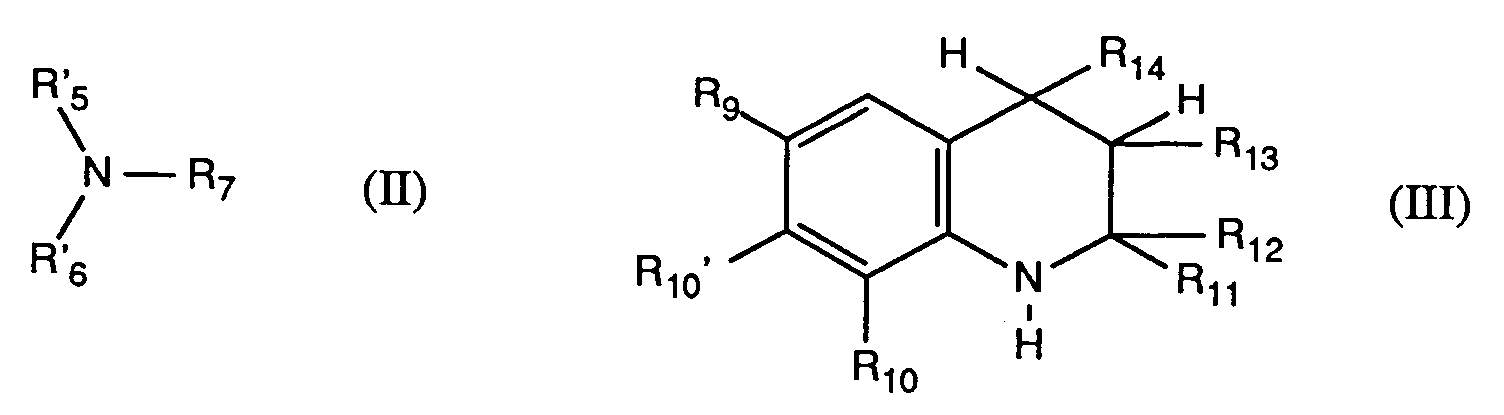
worin R′₅ C₁-C₁₈-Alkyl, C₇-C₉-Phenylalkyl, C₅-C₁₂-Cycloalkyl, Phenyl, C₇-C₁₈-Alkylphenyl, C₇-C₁₈-Alkoxyphenyl oder Naphthyl bedeutet,
R′₆ Phenyl, C₇-C₁₈-Alkylphenyl, C₇-C₁₈-Alkoxyphenyl oder Naphthyl bedeutet,
R₇ Wasserstoff, C₁-C₁₂-Alkyl, Benzyl, Ally, Methallyl, Phenyl oder eine Gruppe -CH₂SR₈ bedeutet, und
R₈ C₄-C₁₈-Alkyl, -CH₂COO(C₄-C₁₈-Alkyl) oder -CH₂CH₂COO(C₄-C₁₈-Alkyl) bedeutet, und
R₉ und R₁₀ unabhängig voneinander Wasserstoff, C₁-C₁₈-Alkyl oder Benzyl bedeuten, und
R10′ Wasserstoff oder C₁-C₁₂-Alkyl bedeutet oder zusammen mit R₁₀ einen Butadiendiyl Rest bildet, und
R₁₁ und R₁₂ unabhängig voneinander C₁-C₁₈-Alkyl, Phenyl oder Benzyl sind oder R₁₁ und
R₁₂ zusammen mit dem Kohlenstoffatom, an welches sie gebunden sind, einen C₅-C₁₂-Spiro-Cycloalkyring bilden, und
R₁₃ Wasserstoff oder C₁-C₁₈-Alkyl und
R₁₄ C₁-C₁₈-Alkyl ist, oder
R₁₃ und R₁₄ zusammen mit den beiden Kohlenstoffatomen, an die sie gebunden sind, einen C₅-C₁₂-cycloaliphatischen Rest bedeuten enthalten sind. - Bevorzugte Verbindungen der Formel II sind die, worin
R′₅ C₁-C₄-Alkyl, C₇-C₉-Phenylalkyl, Cyclohexyl, Phenyl, C₁₀-C₁₈-Alkylphenyl oder Naphthyl bedeutet,
R′₆ C₁₀-C₁₈-Alkylphenyl oder Phenyl bedeutet,
R₇ Wasserstoff, C₁-C₈-Alkyl, Benzyl, Allyl oder eine Gruppe -CH₂SR₈ bedeutet,
R₈ C₈-C₁₈-Alkyl oder -CH₂COO(C₈-C₁₈-Alkyl) bedeutet, insbesondere jedoch die, worin
R′₅ und R′₆ unabhängig voneinander Phenyl oder C₁₀-C₁₈-Alkylphenyl bedeuten und R₇ Wasserstoff ist. - Speziell bevorzugt als Verbindung der Formel II wird ein technisches Gemisch, erhalten durch Reaktion von Diphenylamin mit Diisobutylen, wie z.B. in der US-A 4,824,601 beschrieben, enthaltend

insbesondere ein Gemisch enthaltend - a) 3 % Diphenylamin,
- b) 14 %o 4-tert.Butyl-diphenylamin,
- c) 30 % 4-tert.Octyl-diphenylamin, 4,4′-Di-tert.butyl-diphenylamin und 2,4,4′-Tri-tert.-butyl-diphenylamin,
- d) 29 % 4-tert.Butyl-4′-tert.octyl-diphenylamin, 2,2′- und 3,3′-Di-tert.octyl-diphenylamin und 2,4-Di-tert.butyl-4′-tert.octyl-diphenylamin,
- e) 18 % 4,4′-Di-tert.octyl-diphenylamin,
- f) 6 % 2,4-Di-tert.octyl-4′-tert.butyl-diphenylamin.
- Bevorzugte Verbindungen der Formel III sind die, worin R₉ und R₁₀ unabhängig voneinander Wasserstoff oder C₁-C₁₂-Alkyl bedeutet, und R10′ Wasserstoff ist oder zusammen mit R₁₀ einen Butadiendiyl-Rest bildet, und R₁₁ und R₁₂ unabhängig voneinander C₁-C₁₂-Alkyl sind, oder R₁₁ und R₁₂ zusammen mit dem Kohlenstoffatom, an welches sie gebunden sind, einen C₅-C₇-Spiro-Cycloalkylring bilden, und R₁₃ Wasserstoff und R₁₄ C₁-C₁₂-Alkyl ist, oder R₁₃ und R₁₄ zusammen mit den beiden Kohlenstoffatomen, an die sie gebunden sind, einen Cyclohexanrest bilden, insbesondere jedoch die, worin R₉ Wasserstoff oder C₁-C₁₂-Alkyl ist, R₁₀ Wasserstoff, Methyl oder Ethyl ist, R10′ Wasserstoff ist oder zusammen mit R₁₁ einen Butadiendiyl-Rest bildet und R₁₁ und R₁₂ Methyl oder Ethyl sind oder R₁₂ und R₁₃ zusammen mit dem Kohlenstoffatom, an welches sie gebunden sind, einen Spiro-Cyclohexylring bilden und R₁₃ Wasserstoff und R₁₄ Methyl oder Ethyl ist.
- Ganz speziell bevorzugt als Verbindung der Formel III ist 2,2,4-Trimethyl- 1,2,3,4-tetrahydrochinolin.
- Die Herstellung von Verbindungen der Formel III erfolgt nach an sich bekannten und z.B. in der US-A 4,692,258 beschriebenen Methoden.
- Bevorzugte Alkalidithiophosphate entsprechen der Formel IV,
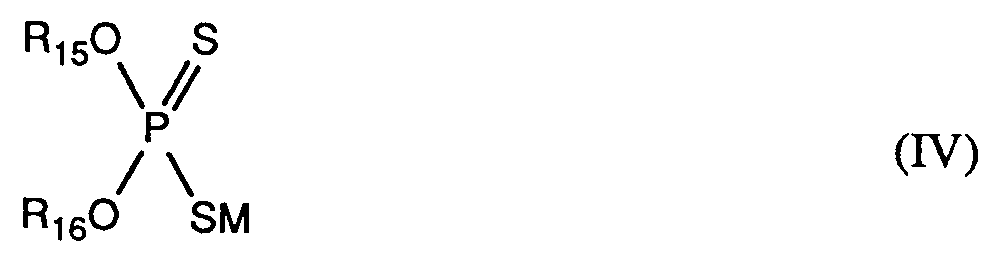
worin R₁₅ und R₁₆ unabhängig voneinander C₁-C₂₄-Alkyl oder C₂-C₁₂-Alkyl, das durch -O-, -S- und/oder -C(O)O- unterbrochen ist; unsubstituiertes oder durch C₁-C₁₂-Alkyl substituiertes Phenyl; C₅-C₁₂-Cycloalkyl oder C₅-C₁₂-Cycloalkyl, das durch C₁-C₄-Alkyl substituiert ist; oder C₇-C₁₃-Phenylalkyl oder C₇-C₁₃-Phenylalkyl, das im Alkylrest mit -O- oder -S- unterbrochen ist, bedeutet, oder R₁₅ und R₁₆ zusammen eine Dimethylen-oder Trimethylengruppe oder eine Dimethylen- oder Trimethylengruppe, die durch C₁-C₄-Alkyl substituiert ist, bedeuten und worin M ein Alkalimetall darstellt; insbesondere von Interesse sind jedoch die, worin R₁₅ und R₁₆ unabhängig voneinander C₃-C₈-Alkyl oder durch C₈-C₁₂-Alkyl substituiertes Phenyl bedeuten und M Na oder K darstellt. - Stellen R₁₅ und R₁₆ C₁-C₂₄-Alkyl dar, so handelt es sich um geradkettige oder verzweigte Alkylreste, wie beispielsweise Methyl, Ethyl, n-Propyl, Isopropyl, n-Butyl, Isobutyl, sec.-Butyl, tert.-Butyl, 2-Methylpropyl, Pentyl, Hexyl, Heptyl, Octyl, 2-Ethylhexyl, Nonyl, Decyl, Undecyl, Dodecyl, Tetradecyl, Hexadecyl, Heptadecyl, Octadecyl oder Eicosyl. Bevorzugt sind Reste mit 3 bis 12 C-Atomen, besonders bevorzugt sind Reste mit 3 bis 8 C-Atomen.
- Stellen R₁₅ und R₁₆ C₂-C₁₂-Alkyl dar, das durch -O-, -S- oder -C(O)O- unterbrochen ist, so kann das Heteroatom bzw. die C(O)O-Gruppe sich in jeder möglichen Position befinden, und der C₂-C₁₂-Alkylrest kann einfach oder mehrfach unterbrochen sein, wobei die Unterbrechung sowohl durch gleiche oder verschiedene Heteroatome als auch durch C(O)O-Gruppen erfolgen kann. Bevorzugt ist eine Unterbrechung.
- Stellen R₁₅ und R₁₆ durch C₁-C₁₂-Alkyl substituiertes Phenyl dar, so kann der Phenylrest ein- oder mehrfach, bevorzugtjedoch ein- oder zweifach substituiert sein; bei C₁-C₁₂-Alkyl handelt es sich beispielsweise um Methyl, Ethyl, n-Propyl, Isopropyl, n-Butyl, Isobutyl, sec.-Butyl, tert.-Butyl, geradkettiges oder verzweigtes Nonyl oder Dodecyl. Bevorzugt ist einfach substituiertes Phenyl, wobei der Alkylrest zweckmässig 3- 12 C-Atome und bevorzugt 8- 12 C-Atome aufweist. Besonders zweckmässig ist Nonylphenyl.
- Stellen R₁₅ und R₁₆ C₅-C₁₂-Cycloalkyl dar, so handelt es sich beispielsweise um Cyclopentyl, Cyclohexyl, Cycloheptyl, Cyclooctyl, Cyclononyl, Cyclodecyl, Cycloundecyl oder Cyclododecyl, vorzugsweise um Cyclohexyl.
- Stellen R₁₅ und R₁₆ durch C₁-C₄-Alkyl substituiertes C₅-C₁₂-Cycloalkyl dar, so kann es sich um einfache oder mehrfache Substituenten, bevorzugt jedoch um einfache Substitution, handeln; wie beispielsweise um Methylcyclohexyl, Trimethylcyclohexyl, Butylcyclohexyl oder Propylcyclopentyl.
- Stellen R₁₅ und R₁₆ C₇-C₁₃-Aralkyl dar, so handelt es sich beispielsweise um Benzyl, 1-oder 2-Phenylethyl, 3-Phenylpropyl, α,α-Dimethylbenzyl, 2-Phenylisopropyl, 2-Phenyl-hexyl, Benzhydryl oder Naphthylmethyl, vorzugsweise jedoch um Benzyl.
- Stellen R₁₅ und R₁₆ C₇-C₁₃-Aralkyl dar, das im Alkylrest mit -O- oder -S- unterbrochen ist, so ist ein typisches Beispiel dafür eine Phenoxyethylgruppe.
- Stellen R₁₅ und R₁₆ zusammen eine Dimethylen- oder Trimethylengruppe dar, die durch C₁-C₄-Alkyl substituiert ist, so trägt die Dimethylen- oder Trimethylengruppe zweckmässig eine, zwei oder drei Alkylgruppen mit 1, 2, 3 oder 4- C-Atomen und bevorzugt eine oder zwei Alkylgruppen mit 1, 2 oder 4 C-Atomen.
- M stellt ein Alkalimetall dar, z.B. Li, Na, K oder Rb. Bevorzugte Metalle M sind Na und K, insbesondere Na.
- Ganz speziell bevorzugt werden Verbindungen der Formel IV, worin R₁₅ und R₁₆ unabhängig voneinander 2-Methylpropyl oder 2-Ethylhexyl bedeuten.
- Insbesondere bevorzugt handelt es sich bei den Verbindungen der Formel IV um O,O-Bis-2-methylpropyl-natriumdithiophosphat oder O,O-Bis-2-ethylhexylnatriumdithiophosphat.
- Die Verbindungen der Formeln II, III und/oder IV werden den erfindungsgemässen Zusammensetzungen zweckmässig in einer Menge von 0,01 bis 5 Gew.-%, vorzugsweise in einer Menge von 0,05 bis 3 Gew.-% und ganz besonders bevorzugt in einer Menge von 0,1 bis 2 Gew.-%, jeweils bezogen auf den Schmierstoff oder die Hydraulikflüssigkeit, beigemischt, mit der Massgabe, dass die Zugabe der Verbindungen der Formeln I, II, III und/oder IV ingesamt 5 Gew.-%, bezogen auf den Schmierstoff oder die Hydraulikflüssigkeit, nicht übersteigt.
- Zweckmässig werden die Verbindungen der Formel I einerseits und die Verbindungen der Formeln II, III und/oder IV andererseits in ungefähr gleichen Gewichtsanteilen zugegeben.
- Daher betrifft die vorliegende Erfindung ebenfalls ein Verfahren zur Stabilisierung von Schmierstoffen oder Hydraulikflüssigkeiten gegen oxidativen oder thermischen Abbau, dadurch gekennzeichnet, dass man dem Schmierstoff oder der Hydraulikflüssigkeit mindestens eine Verbindung der Formel I allein oder zusammen mit mindestens einem aromatischen Amin und/oder mindestens einem Alkalidithiophosphat zugibt.
- Die erfindungsgemässen Schmierstoffe und Hydraulikflüssigkeiten können zusätzlich andere Additive enthalten, die zugegeben werden, um die Grundeigenschaften von Schmierstoffen und Hydraulikflüssigkeiten noch weiter zu verbessern; dazu gehören: weitere Antioxidantien, Metallpassivatoren, Rostinhibitoren, Viskositätsindex-Verbesserer, Stockpunktemiedriger, Dispergiermittel, Detergentien, weitere HochdruckZusätze und Antiverschleiss-Additive.
- Beispielsweise ist eine Reihe solcher Verbindungen der nachfolgenden Auflistung zu entnehmen.
- 1.Alkylierte Monophenole
- 2,6-Di-tert-butyl-4-methylphenol, 2,6-Di-tert-butylphenol, 2-tert-Butyl-4,6-dimethylphenol, 2,6-Di-tert-butyl-4-ethylphenol, 2,6-Di-tert-butyl-4-n-butylphenol, 2,6-Di-tert-butyl-4-iso-butylphenol, 2,6-Di-cyclopentyl-4-methylphenol, 2-(α-Methylcyclohexyl)-4,6-dimethylphenol, 2,6-Di-octadecyl-4-methylphenol, 2,4,6-Tri-cyclohexylphenol, 2,6-Di-tert-butyl-4-methoxymethylphenol, o-tert-Butylphenol.
- 2,6-Di-tert-butyl-4-methoxyphenol, 2,5-Di-tert-butyl-hydrochinon, 2,5-Di-tert-amyl-hydrochinon, 2,6-Diphenyl-4-octadecyloxyphenol.
- 2,2′-Thio-bis-(6-tert-butyl-4-methylphenol), 2,2′-Thio-bis-(4-octylphenol), 4,4′-Thio-bis-(6-tert-butyl-3-methylphenol), 4,4′-Thio-bis-(6-tert-butyl-2-methylphenol).
- 2,2′-Methylen-bis-(6-tert-butyl-4-methylphenol), 2,2′-Methylen-bis-(6-tert-butyl-4-ethylphenol), 2,2′-Methylen-bis-[4-methyl-6-(α-methylcyclohexyl)-phenol], 2,2′-Methylen-bis-(4-methyl-6-cyclohexylphenol), 2,2′-Methylen-bis-(6-nonyl-4-methylphenol), 2,2′-Methylen-bis-(4,6-di-tert-butylphenol), 2,2′-Ethyliden-bis-(4,6-di-tert-butylphenol), 2,2′-Ethyliden-bis-(6-tert-butyl-4- oder -5-iso-butylphenol), 2,2′-Methylen-bis-[6-(αmethylbenzyl)-4-nonylphenol], 2,2′-Methylen-bis-[6-(α,α-dimethylbenzyl)-4-nonylphenol], 4,4′-Methylen-bis-(2,6-di-tert-butylphenol), 4,4′-Methylen-bis-(6-tert-butyl-2-methylphenol), 1,1-Bis-(5-tert-butyl-4-hydroxy-2-methylphenyl)-butan, 2,6-Di-(3-tert-butyl-5-methyl-2-hydroxybenzyl)-4-methylphenol, 1,1,3-Tris-(5-tert-butyl-4-hydroxy-2-methylphenyl)-3-n-dodecylmercaptobutan, Ethylenglycol-bis-[3,3-bis-(3′-tert-butyl-4′-hydroxyphenyl)-butyrat], Bis-(3-tert-butyl-4-hydroxy-5-methylphenyl)-dicyclopentadien, Bis-[2-(3′-tert-butyl-2′-hydroxy-5′-methyl-benzyl)-6-tert-butyl-4-methyl-phenyl]-terephthalat.
- 1,3,5-Tri-(3,5-di-tert-butyl-4-hydroxybenzyl)-2,4,6-trimethylbenzol, Bis-(3,5-di-tert-butyl-4-hydroxybenzyl)-sulfid, 3,5-Di-tert-butyl-4-hydroxybenzyl-mercaptoessigsäure-isotridecylester, 3,5-Di-t ert-butyl-4-hydroxybenzyl-mercaptoessigsäure-iso-octylester, Bis-(4-tert-butyl-3-hydroxy-2,6-dimethylbenzyl)-dithiol-terephthalat, 1,3,5-Tris-(3,5-di-tert-butyl-4-hydroxybenzyl)-isocyanurat, 1,3,5-Tris-(4-tert-butyl-3-hydroxy-2,6-dimethylbenzyl)-isocyanurat, 3,5-Di-tert-butyl-4-hydroxybenzyl-phosphonsäure-di-octadecylester, 3,5-Di-tert-butyl-4-hydroxybenzyl-phosphonsäure-monoethylester, Calcium-salz.
- 4-Hydroxy-laurinsäureanilid, 4-Hydroxy-stearinsäureanilid, 2,4-Bis-octylmercapto-6-(3,5-di-tert-butyl-4-hydroxyanilino)-s-triazin, N-(3,5-di-tert-butyl-4-hydroxyphenyl)-carbaminsäureoctylester.
- mit ein- oder mehrwertigen Alkoholen, wie z.B. mit
Methanol, Isooctanol, Diethylenglycol, Octadecanol, Triethylenglycol, 1,6-Hexandiol, Pentaerythrit, Neopentylglycol, Tris-hydroxyethyl-isocyanurat, Thiodiethylenglycol, Bis-hydroxyethyl-oxalsäurediamid. - mit ein- oder mehrwertigen Alkoholen, wie z.B. mit
Methanol, Diethylenglycol, Octadecanol, Triethylenglycol, 1,6-Hexandiol, Pentaerythrit, Neopentylglycol, Tris-hydroxyethyl-isocyanurat, Thiodiethylenglykol, Di-hydroxyethyl-oxalsäurediamid. - wie z.B. N,N′-Bis-(3,5-di-tert-butyl-4-hydroxyphenylpropionyl)-hexamethylendiamin, N,N′-Bis-(3,5-di-tert-butyl-4-hydroxyphenylpropionyl)-trimethylendiamin, N,N′-Bis-(3,5-di-tert-butyl-4-hydroxyphenylpropionyl)-hydrazin.
- N,N′-Di-isopropyl-p-phenylendiamin, N,N′-Di-sec-butyl-p-phenylendiamin, N,N′-Bis-(1,4-dimethyl-pentyl)-p-phenylendiamin, N,N′-Bis(1-ethyl-3-methyl-pentyl)-p-phenylendiamin, N,N′-Bis (1-methyl-heptyl)-p-phenylendiamin, N,N′-Dicyclohexyl-p-phenylendiamin, N,N′-Diphenyl-p-phenylendiamin, N,N′-Di-(naphthyl-2)-p-phenylendiamin, N-Isopropyl-N′-phenyl-p-phenylendiamin, N-(1,3-Dimethyl-butyl)-N′-phenyl-p-phenylendiamin, N-(1-Methyl-heptyl)-N′-phenyl-p-phenylendiamin, N-Cyclohexyl-N′phenyl-p-phenylendiamin, 4-(p-Toluol-sulfonamido)-diphenylamin, N,N′-Dimethyl-N,N′-di-sec-butyl-p-phenylendiamin, 4-n-Butylaminophenol, 4-Butyrylamino-phenol, 4-Nonanoylamino-phenol, 4-Dodecanoylamino-phenol, 4-Octadecanoylamino-phenol, 2,6-Di-tert-butyl-4-dimethylamino-methyl-phenol, 2,4′-Diamino-diphenylmethan, 4,4′-Diamino-diphenylmethan, N,N,N′,N′-Tetramethyl-4,4′-diamino-diphenylmethan, 1,2-Di-[(2-methyl-phenyl)-amino]-ethan, 1,2-Di-(phenylamino)-propan, (o-Tolyl)-biguanid, Di-[4-(1′,3′-dimethyl-butyl)-phenyl]amin, 2,3-Dihydro-3,3-dimethyl-4H-1,4-benzothiazin, Phenothiazin, N-Allylphenothiazin, N,N-Bis-(2,2,6,6-tetramethylpiperidin-4-yl-hexamethylendiamin, Bis-(2,2,6,6-tetramethylpiperidin-4-yl)-sebacat, 2,2,6,6-Tetramethylpiperidin-4-on, 2,2,6,6-Tetramethylpiperidin-4-ol.
- Aliphatische oder aromatische Phosphite, Ester der Thiodipropionsäure oder der Thiodiessigsäure, oder Salze der Dithiocarbamid- oder Dithiophosphorsäure, 2,2,12,12-Tetramethyl-5,9-dihydroxy-3,7,11-trithiatridecan und 2,2,15,15-Tetramethyl-5,12-dihydroxy-3,7,10,14-tetrathiahexadecan.
- Triazole, Benztriazole und deren Derivate, Tolutriazole und deren Derivate, 2-Mercaptobenzthiazol, 2-Mercaptobenztriazol, 2,5-Dimercaptobenztriazol, 2,5-Dimercaptobenzthiadiazol, 5,5′-Methylenbisbenztriazol, 4,5,6,7-Tetrahydrobenztriazol, Salicyliden-propylendiamin, Salicylaminoguanidin und dessen Salze, 1-[N,N-Bis(2-ethylhexyl)-amino-methyl]-5(6)-methyl-1H-benztriazol-1-(1-Cyclohexyloxy butyl-5(6)-methyl- 1H-triazol, 1-[N,N-Bis(2-ethylhexyl)aminomethyl]-1H-1,2,4-triazol.
-
- a) Organische Säuren, ihre Ester, Metallsalze und Anhydride, z.B.:
N-Oleoyl-sarcosin, Sorbitan-mono-oleat, Blei-naphthenat, Alkenylbemsteinsäure-anhydrid, z.B. Dodecenylbemsteinsäure-anhydrid, Alkenylbemsteinsäure-Teilester und -Teilamide, 4-Nonylphenoxy-essigsäure, 2-(2-Carboxyethyl)-1-dodecyl-3-methylglycerin und dessen Salze, insbesondere Na- und Triethanolaminsalze. - b) Stickstoffhaltige Verbindungen, z.B.:
- I.Primäre, sekundäre oder tertiäre aliphatische oder cycloaliphatische Amine und - Amin-Salze von organischen und anorganischen Säuren, z.B. öllösliche Alkylammoniumcarboxylate, ferner 1[N,N-bis-(2-hydroxyethyl)amino]-3-(4-nonyl-phenoxy)propan-2-ol.
- II. Heterocyclische Verbindungen, z.B.:
Substituierte Imidazoline und Oxazoline.
- c) Phosphorhaltige Verbindungen, z.B.:
Aminsalze von Phosphorsäurepartialestem oder Phosphonsäurepartialestem, Zinkdi-alkyldithiophosphate. - d) Schwefelhaltige Verbindungen, z.B.:
Barium-dinonylnaphthalin-sulfonate, Calciumpetroleum-sulfonate. - Polyacrylate, Polymethacrylate, Vinylpyrrolidon/Methacrylat-Copolymere, Polyvinylpyrrolidone, Polybutene, Olefin-Copolymere, Styrol/Acrylat-Copolymere, Polyether.
- Polymethacrylat, alkylierte Naphthalinderivate.
- Polybutenylbemsteinsäureamide oder -imide, Polybutenylphosphonsäurederivate, basische Magnesium-, Calcium-, und Bariumsulfonate und -phenolate.
- Schwefel und/oder Phosphor und/oder Halogen enthaltende Verbindungen, wie geschwefelte pflanzliche Oele, Zinkdialkyldithiophosphate, Tritolylphosphat, chlorierte Paraffine, Alkyl- und Aryldi- und tri-sulfide, Triphenylphosphorothionate, Diethanol-aminomethyltolyltriazol, Di(2-ethylhexyl)aminomethyltolyltriazol, 3- [(Bis-isopropyl-oxy-phosphinothioyl)thio] -propionsäure-ethylester, Gemische von Alkylphenyl-phosphorothioaten, Triphenylthiophosphat (Triphenylphosphorothioat), Dodecylaminsalz des 3-Hydroxy- 1,3-thiaphosphetan-3-oxids, Trithiophosphorsäure-5,5,5-tris[isooctylacetat (2)], 1-[N,N-Bis(2-ethylhexyl)aminomethyl-2-mercapto-1H-1,3-benzthiazol.
- Die Verbindungen der Formel I sind zum Teil bekannt, wie bereits weiter oben ausgeführt wurde. Neu sind hingegen Verbindungen der Formel I, worin R₁ -NR₅R₆ bedeutet.
- Gegenstand der vorliegenden Erfindung sind daher auch Verbindungen der Formel I, worin X 1, und n 2 und R bzw. R₁ -NR₅R₆ bedeuten, wobei R₅ und R₆ sowie R₂ und R₃ wie oben unter Formel I definiert sind.
- In bevorzugten neuen Verbindungen der Formel I sind R₂ und R₃ einerseits und R₅ und R₆ andererseits gleich. Zweckmässig sind auch solche Verbindungen, in denen -NR₂R₃ und -N₅R₆ gleich sind.
- In zweckmässigen neuen Verbindungen der Formel I bedeuten R₂, R₃, R₅ und R₆, die gleich oder verschieden sein können, C₁-C₁₂-Alkyl.
- Anhand der nachfolgenden Beispiele wird die Erfindung weiter erläutert. Alle Angaben in Prozenten oder Teilen beziehen sich auf das Gewicht, sofern nicht anders angegeben.
- Beispiel 1: Zu einer Lösung von 9,74 g (0,04 Mol) 1,1 -Diethyl-3-benzoyl-thioharnstoff in 600 ml Methanol wird bei 50°C eine gesättigte Lösung von 4,0 g (0,02 Mol) Kupfer(II)-acetat Monohydrat in 150 ml Methanol zugetropft. Das dunkelgrün-schwarze Reaktionsgemisch wird 3 h bei 50-60°C gerührt und auf ca. 1/3 seines Volumens aufkonzentriert. Beim Abkühlen auf 4°C bilden sich glänzende olive-schwarze Kristalle der Formel

Ausbeute 9,5 g (88,8 % d. Th.) mit einem Smp. von 102°C.
- Beispiele 2-7: Analog zu der in Beispiel 1 beschriebenen Methode werden die aus der Tabelle 1 ersichtlichen Verbindungen der Formel I hergestellt.


- Beispiel 8: Zu einer Lösung von 119 g (0,29 Mol) Tetrabutylthiuramdisulfid (MERAMID TBTD) in 400 ml Toluol werden bei 40°C innerhalb 50 min. 18,9 ml (31,5 g, 0,23 Mol) Sulfurylchlorid zugetropft. Die Suspension wird 4 Std. bei 60°C gerührt, abgekühlt, filtriert und eingedampft. Das heterogene Rohprodukt wird zur Reinigung in 400 ml Hexan aufgenommen, filtriert und eingedampft. Man erhält 120 g eines hellbraunen Oels, das bei 105- 112°C und 0,01 Torr destilliert wird. Man erhält 66 g Dibutylthiocarbamylchlorid (55 % d. Th.) als hellbraunes Oel der Formel

Zu einer Lösung von 20,8 g (0,1 Mol) Dibutylthiocarbamylchlorid in 90 ml Aceton werden 9,7 g (0,1 Mol) Kaliumthiocyanant zugegeben. Die Suspension wird 15 min. am Rückfluss gerührt, abgekühlt und filtriert. Zu der filtrierten Lösung werden bei 15-20°C innerhalb 15 min. 17 ml (12,9 g, 0,1 Mol) Dibutylamin zugetropft. Nach 1 Std. Rühren bei Raumtemperatur werden bei 0-5°C innerhalb 15 min. 11,4 ml Bromwasserstoff 48 % (16,9 g, 0,1 Mol) und innerhalb 30 min. 11,3 g Wasserstoffperoxid 30 % (0,1 Mol) zugetropft. Dann wird 1 Std. bei 10- 15°C und 1 Std. bei Raumtemperatur gerührt. Zu der orange trüben Lösung werden schliesslich bei 20-30°C innerhalb 30 min. 50 ml Natronlauge 2N (0,1 Mol) zugetropft. Bei Raumtemperawt wird 1 Std. nachgerührt. Die organische Phase wird abgetrennt, dreimal mit je 100 ml Wasser gewaschen (pH 7), über Natriumsulfat getrocknet, filtriert und eingedampft: 32 g dunkelbraunes Oel. Dieses Rohprodukt wird mit Dichlormethan über 200 g Silicagel chromatographisch gereinigt. Man erhält so 10 g 1,1,5,5-Tetrabutyl-2-thiobiuret als dunkeloranges, mittelviskoses Oel der Formel
Zu einer Lösung von 1,7 g (5 mMol) 1,1,5,5-Tetrabutyl-2-thiobiuret in 20 ml Toluo/Ethanol (1:1) wird bei 50°C innerhalb 10 min. eine Lösung von 0,65 g (2,5 mMol) Kupfer(II)-acetylacetonat in 10 ml Toluo/Ethanol (1:1) zugetropft. Nach 1 Std. bei 50°C wird filtriert und eingedampft. 2,3 g Rohprodukt als hochviskoses, dunkles Oel werden mit Dichlormethan über 16 g Silicagel chromatographisch gereinigt. Man erhält so 1,0 g Kupferkomplex als dunkelgrünes, mittelviskoses Oel (53 % d. Th.) der Formel
- Beispiel 9: Verfährt man wie in Beispiel 8, geht jedoch von Tetra(2-ethylhexyl)thiuramdisulfid aus und verwendet an Stelle von Dibutylamin Di(2-ethylhexyl)amin, so erhält man die Verbindung der Formel


- Beispiele 10-16: Thermische Stabilisierung eines synthetischen Oeles.
Die thermische Alterung der Formulierungen wird in einem Druck-Differenz-Kalorimeter (Pressure-Differential-Scanning Calorimetry, PDSC) durchgeführt. - Das Verfahren arbeitet nach dem folgenden Prinzip: Die PDSC-Zelle (Thermoanalysen-system 1090 von DuPont) besteht aus einem Heizblock aus Silber. In diesen Heizblock ist eine Konstantanplatte eingesetzt, welche die Thermoelemente (Chromel-Alumel) enthält. Auf die etwas erhöht angebrachten Thermoelemente werden Probepfännchen und Referenzpfännchen aus Aluminium gestellt. Der Innenraum der DSC-Zelle ist mit einem dünnen Goldfilm überzogen (Korrosionsschutz). Das Referenzpfännchen bleibt leer, in das Probepfännchen werden drei Tropfen der jeweiligen Formulierung eingefüllt. Bestimmt wird die Temperaturdifferenz zwischen Proben- und Referenzpfännchen unter isothermen Bedingungen. Die Enthalpieänderung dH/dt wird jeweils in mW angegeben. Alle Messungen werden in Sauerstoff durchgeführt. Die Temperatur beträgt 180°C isotherm. Der Druck beträgt 10 bar. Als Basisöl wird jeweils ein kommerziell erhältliches Mineralöl (Mobil 150 SSU) eingesetzt. Um die Oxidationsanfälligkeit des Oeles zu verstärken, werden diesem Oel 40 ppm Fe3⊕ zugefügt. Zur Prüfung der Wirksamkeit enthält das Oel die in Tabelle 2 angeführten Additiven in der angegebenen Menge.
- Während der thermischen Alterung nimmt die Konzentration der zugefügten Additive laufend ab. Bei einer kritischen Additivkonzentration steigt die Wärmetönung dH/dt an. Die Zeit, die verstreicht bis dieser Anstieg erfolgt, wird als Induktionszeit (onset) bezeichnet. Demnach deuten lange Induktionszeiten auf eine hohe Alterungsstabilität der Oele hin.
- Es werden die folgenden aus der Tabelle 2 ersichtlichen Formulierungen hergestellt und gemessen.

- Beispiel 17: Mit der gleichen PDSC-Methode wie in den Beispielen 10- 16 wird für eine Formulierung enthaltend eine Kombination der Verbindung gemäss Beispiel 3 und O,O-Bis-2-ethylhexyl-natriumdithiophosphat (Na-DTP) die Induktionszeit bestimmt. Die Resultate sind in Tabelle 3 wiedergegeben.

- Beispiel 18: Die Antioxidanswirkung wird mit einem kommerziellen Schwing-Reib-Verschleissgerät (SRV-Gerät) der Firma Optimol GmbH, München bestimmt.
- Das Verfahren ist ausführlich beschrieben in R. Schumacher, D. Landolt, H.J. Mathieu und H. Zinke, Surface Reaction of Isogeometrical Phosphorus Compounds, ASLE Transaction, 26 (1982) 94-101.
- Dieses Gerät basiert auf dem folgenden Prinzip: Eine Stahlkugel ( 100 Cr 6), auf die eine Kraft FN wirkt, oszilliert auf einem Stahlzylinder. Die Kugel ist in einer Halterung fixiert und führt demnach eine oszillierende Gleitbewegung aus. Die Horizontal- und Vertikalkraft wird durch einen piezoelektrischen Kraftaufnehmer bestimmt. Unter den vorliegenden Versuchsbedingungen beträgt die maximale Hertz'sche Normalspannung 2740 N/mm², die maximale Schubspannung 850 N/mm². Kugel und Zylinder sind aus demselben Werkzeugstahl hergestellt worden.
- Einige Tropfen Oel, welches das zu untersuchende Gemisch gelöst enthält, werden zwischen Zylinder und Kugel aufgebracht. Die folgenden Testbedingungen werden gewählt:
-
- Last
- 50 N
- Temperatur
- 200°C
- Frequenz
- 50 Hz
- Amplitude
- 1000 µm
- Prüfdauer
- Bis zur Abschaltung des Geräts wegen Ueberbeanspruchung (Oelverdickung wegen oxidativem Abbau). Lange Prüfdauer bedeutet gute Antioxidans-Wirkung. Die Resultate sind in Tabelle 4 zusammengestellt.
- Als Basisöl dient ein "low reference"-Oel für Dieselmotoren

- Beispiel 19: Analog Beispiel 18 wird im gleichen Basisöl die Formulierung aus Beispiel 12 geprüft.
- Die Prüfdauer bis zum Abschalten des Geräts wegen Ueberbelastung infolge Oelverdickung beträgt 45 h.

wobei x=1 oder 2 ist und, wenn x=1 ist, n=2 ist und R die Bedeutung von R₁ hat, oder, wenn x=2 ist, n=1 ist und R die Bedeutung von R₄ hat, und R₁ Alkyl mit 1-25 C-Atomen, eine unsubstituierte oder C₁-C₈-alkylsubstituierte Cycloalkylgruppe mit 5-12 C-Atomen, Alkenyl mit 2-18 C-Atomen, Phenyl, Naphthyl, C₇-C₁₈-Phenylalkyl, C₇-C₁₈-Alkylphenyl oder -NR₅R₆ bedeutet, und R₂ und R₃ gleich oder verschieden sind und Alkyl mit 1-18 C-Atomen, Phenyl, Naphthyl, C₇-C₁₈-Phenylalkyl oder C₇-C₁₈-Alkylphenyl bedeuten, oder R₂ und R₃, zusammen mit dem sie verbindenden N-Atom, einen 5- bis 7-gliedrigen heterozyklischen Ring bilden, der gegebenenfalls zusätzlich ein N- oder O-Atom enthalten kann, R₄ Alkylen mit 1-12 C-Atomen, das gegebenenfalls durch mindestens eine -O-Gruppe unterbrochen ist, darstellt oder Alkenylen mit 2-12 C-Atomen ist, das gegebenenfalls durch mindestens eine -O-Gruppe unterbrochen ist, und R₅ und R₆ die gleichen Bedeutungsmöglichkeiten wie R₂ und R₃ haben.
Claims (15)
- Zusammensetzung enthaltenda) einen Schmierstoff oder eine Hydraulikflüssigkeit undb) mindestens eine Verbindung der allgemeinen Formel I

- Zusammensetzung gemäss Anspruch 1, worin R₁ Alkyl mit 1-18 C-Atomen, eine unsubstituierte Cycloalkylgruppe mit 5-8 C-Atomen, Phenyl, C₇-C₁₂-Alkylphenyl, C₇-C₁₂-Phenylalkyl oder -NR₅R₆ bedeutet, R₂ und R₃ bzw. R₅ und R₆ gleich oder verschieden sind und jeweils Alkyl mit 1-18 C-Atomen oder Phenyl bedeuten, oder R₂ und R₃ bzw. R₅ und R₆ zusammen mit dem sie verbindenden N-Atom eine Piperidino-, Hexamethylenimino-, Piperazino- oder Morpholinogruppe bilden, und R₄ Alkylen mit 1-12 C-Atomen oder Alkenylen mit 2- 12 C-Atomen darstellt.
- Zusammensetzung gemäss Anspruch 1, worin R₁ Alkyl mit 1-18 C-Atomen, Phenyl, -NR₅R₆ oder Benzyl darstellt, und R₂ und R₃ bzw. R₅ und R₆ gleich oder verschieden sind und jeweils Alkyl mit 1-18 C-Atomen bedeuten.
- Zusammensetzung gemäss Anspruch 1, worin R₁ Alkyl mit 6-18 C-Atomen, -NR₅R₆ oder Phenyl darstellt, R₂ und R₃ bzw. R₅ und R₆ unabhängig voneinanderjeweils Alkyl mit 1-12 C-Atomen und R₄ Alkylen mit 2-10 C-Atomen bedeuten.
- Zusammensetzung gemäss Anspruch 1, worin R₁ Phenyl oder -NR₅R₆ darstellt, und R₂ und R₃ bzw. R₅ und R₆ unabhängig voneinanderjeweils Alkyl mit 1-8 C-Atomen bedeuten.
- Zusammensetzung gemäss Anspruch 1, worin R₂ und R₃ unabhängig voneinander Alkyl mit 4-8 C-Atomen darstellen, und R₄ Alkylen mit 1-10 C-Atomen oder Alkenylen mit 2-10 C-Atomen bedeutet.
- Zusammensetzung gemäss Anspruch 1, worin R₂ und R₃ unabhängig voneinander Alkyl mit 4-8 C-Atomen darstellen, und R₄ Alkylen mit 3-8 C-Atomen bedeutet.
- Zusammensetzung gemäss Anspruch 2, worin, wenn x=1 ist, R₁ Phenyl oder -NR₅R₆ bedeutet, und R₂ und R₃ bzw. R₅ und R₆ gleich sind und je Alkyl mit 1-12 C-Atomen darstellen, oder worin, wenn x=2 ist, R₄ Alkylen mit 3-8 C-Atomen ist und R₂ und R₃ je Alkyl mit 3- 10 C-Atomen bedeuten.
- Zusammensetzung gemäss Anspruch 1, die c) zusätzlich mindestens ein aromatisches Amin oder/und mindestens ein Alkalidithiophosphat enthält.
- Zusammensetzung gemäss Anspruch 9, worin das aromatische Amin eine Verbindung der Formeln II oder III oder eine Mischung von solchen Verbindungen ist,

R′₆ Phenyl, C₇-C₁₈-Alkylphenyl, C₇-C₁₈-Alkoxyphenyl oder Naphthyl bedeutet,
R₇ Wasserstoff, C₁-C₁₂-Alkyl, Benzyl, Allyl, Methallyl, Phenyl oder eine Gruppe -CH₂SR₈ bedeutet, und
R₈ C₄-C₁₈-Alkyl, -CH₂COO(C₄-C₁₈-Alkyl) oder -CH₂CH₂COO(C₄-C₁₈-Alkyl) bedeutet, und
R₉ und R₁₀ unabhängig voneinander Wasserstoff, C₁-C₁₈-Alkyl oder Benzyl bedeuten, und
R10′ Wasserstoff oder C₁-C₁₂-Alkyl bedeutet oder zusammen mit R₁₀ einen ButadiendiylRest bildet, und
R₁₁ und R₁₂ unabhängig voneinander C₁-C₁₈-Alkyl, Phenyl oder Benzyl sind oder R₁₁ und R₁₂ zusammen mit dem Kohlenstoffatom, an welches sie gebunden sind, einen C₅-C₁₂-Spiro-Cycloalkylring bilden, und
R₁₃ Wasserstoff oder C₁-C₁₈-Alkyl und
R₁₄ C₁-C₁₈-Alkyl ist, oder
R₁₃ und R₁₄ zusammen mit den beiden Kohlenstoffatomen, an die sie gebunden sind, einen C₅-C₁₂-cycloaliphatischen Rest bedeuten enthalten sind. - Zusammensetzung gemäss Anspruch 10, worin die Verbindung der Formel II ein technisches Gemisch ist, erhalten durch Reaktion von Diphenylamin mit Diisobutylen, enthaltend

- Zusammensetzung gemäss Anspruch 9, worin das Alkalidithiophosphat eine Verbindung der Formel IV ist,

- Verfahren zur Stabilisierung von Schmierstoffen oder Hydraulikflüssigkeiten gegen oxidativen oder/und thermischen Abbau, dadurch gekennzeichnet, dass man dem Schmierstoff oder der Hydraulikflüssigkeit mindestens eine Verbindung der Formel 1 nach Anspruch 1 zugibt.
- Verbindungen der in Anspruch 1 definierten Formel I, worin x 1, n 2 und R bzw. R₁ eine Gruppe -NR₅R₆ bedeuten, wobei R₅ und R₆ wie in Anspruch 1 definiert sind und R₂ und R₃ die in Anspruch 1 angegebene Bedeutung haben.
- Verbindungen nach Anspruch 14, worin R₂ und R₃ sowie R₅ und R₆ jeweils unabhängig voneinander C₁-C₁₂-Alkyl bedeuten.
Applications Claiming Priority (2)
| Application Number | Priority Date | Filing Date | Title |
|---|---|---|---|
| CH2169/90 | 1990-06-28 | ||
| CH216990 | 1990-06-28 |
Publications (2)
| Publication Number | Publication Date |
|---|---|
| EP0466639A1 true EP0466639A1 (de) | 1992-01-15 |
| EP0466639B1 EP0466639B1 (de) | 1994-08-10 |
Family
ID=4227506
Family Applications (1)
| Application Number | Title | Priority Date | Filing Date |
|---|---|---|---|
| EP91810474A Expired - Lifetime EP0466639B1 (de) | 1990-06-28 | 1991-06-19 | Schmierstoffzusammensetzung |
Country Status (5)
| Country | Link |
|---|---|
| US (1) | US5262072A (de) |
| EP (1) | EP0466639B1 (de) |
| JP (1) | JP2958668B2 (de) |
| CA (1) | CA2045717C (de) |
| DE (1) | DE59102477D1 (de) |
Cited By (2)
| Publication number | Priority date | Publication date | Assignee | Title |
|---|---|---|---|---|
| US6545052B2 (en) | 2000-05-10 | 2003-04-08 | Fan Tech, Ltd. | Methods and compositions for inhibiting free radical polymerization in skin and hair |
| US6586628B2 (en) | 2000-05-10 | 2003-07-01 | The United States Of America, As Represented By The Secretary Of Agriculture | 3-Methoxybenzyl thiourea derivatives and improved lipid compositions containing same |
Families Citing this family (3)
| Publication number | Priority date | Publication date | Assignee | Title |
|---|---|---|---|---|
| US8466096B2 (en) * | 2007-04-26 | 2013-06-18 | Afton Chemical Corporation | 1,3,2-dioxaphosphorinane, 2-sulfide derivatives for use as anti-wear additives in lubricant compositions |
| WO2015023559A1 (en) * | 2013-08-12 | 2015-02-19 | Shell Oil Company | Methods for modifying auto-ignition properties of a base oil or lubricant composition |
| CN119242366B (zh) * | 2024-09-27 | 2025-07-11 | 江苏澳润新材料有限公司 | 一种用于润滑油的清净剂及其制备方法 |
Citations (6)
| Publication number | Priority date | Publication date | Assignee | Title |
|---|---|---|---|---|
| EP0024146A1 (de) * | 1979-08-13 | 1981-02-25 | Exxon Research And Engineering Company | Schmiermittelzusammensetzungen |
| EP0072349A2 (de) * | 1981-08-10 | 1983-02-16 | Ciba-Geigy Ag | Tetrahydrochinoline als Antioxidantien für Schmiermittel |
| FR2511699A1 (fr) * | 1981-08-20 | 1983-02-25 | Ciba Geigy Ag | Compositions lubrifiantes renfermant, comme additifs haute pression, des composes organiques chlores |
| WO1986006378A1 (en) * | 1985-04-29 | 1986-11-06 | The Lubrizol Corporation | Metal salts of mixed aromatic/aliphatic phosphorodithioic acids |
| US4824601A (en) * | 1983-12-08 | 1989-04-25 | Ciba-Geigy-Corporation | Liquid antioxidant produced by alkylating diphenylamine with a molar excess of diisobutylene |
| EP0376889A1 (de) * | 1988-12-28 | 1990-07-04 | Ciba-Geigy Ag | Schmierstoffzusammensetzung |
Family Cites Families (6)
| Publication number | Priority date | Publication date | Assignee | Title |
|---|---|---|---|---|
| US3351647A (en) * | 1963-05-14 | 1967-11-07 | Lubrizol Corp | Nitrogen, phosphorus and metal containing composition |
| US3634238A (en) * | 1969-03-12 | 1972-01-11 | Mobil Oil Corp | Organic compositions containing amines and metals or salts thereof |
| US4409114A (en) * | 1982-08-04 | 1983-10-11 | Exxon Research & Engineering Co. | Hydrogen sulfide suppressant additive for functional fluids |
| US4828733A (en) * | 1986-04-18 | 1989-05-09 | Mobil Oil Corporation | Copper salts of hindered phenolic carboxylates and lubricants and fuels containing same |
| JPS63275696A (ja) * | 1987-05-07 | 1988-11-14 | Shin Etsu Chem Co Ltd | シリコ−ングリ−ス組成物 |
| US5055211A (en) * | 1989-09-07 | 1991-10-08 | Exxon Research And Engineering Company | Lubricating oil containing a mixed ligand metal complex and a metal thiophosphate |
-
1991
- 1991-06-19 DE DE59102477T patent/DE59102477D1/de not_active Expired - Fee Related
- 1991-06-19 EP EP91810474A patent/EP0466639B1/de not_active Expired - Lifetime
- 1991-06-24 US US07/719,862 patent/US5262072A/en not_active Expired - Fee Related
- 1991-06-26 CA CA002045717A patent/CA2045717C/en not_active Expired - Fee Related
- 1991-06-28 JP JP3183550A patent/JP2958668B2/ja not_active Expired - Fee Related
Patent Citations (6)
| Publication number | Priority date | Publication date | Assignee | Title |
|---|---|---|---|---|
| EP0024146A1 (de) * | 1979-08-13 | 1981-02-25 | Exxon Research And Engineering Company | Schmiermittelzusammensetzungen |
| EP0072349A2 (de) * | 1981-08-10 | 1983-02-16 | Ciba-Geigy Ag | Tetrahydrochinoline als Antioxidantien für Schmiermittel |
| FR2511699A1 (fr) * | 1981-08-20 | 1983-02-25 | Ciba Geigy Ag | Compositions lubrifiantes renfermant, comme additifs haute pression, des composes organiques chlores |
| US4824601A (en) * | 1983-12-08 | 1989-04-25 | Ciba-Geigy-Corporation | Liquid antioxidant produced by alkylating diphenylamine with a molar excess of diisobutylene |
| WO1986006378A1 (en) * | 1985-04-29 | 1986-11-06 | The Lubrizol Corporation | Metal salts of mixed aromatic/aliphatic phosphorodithioic acids |
| EP0376889A1 (de) * | 1988-12-28 | 1990-07-04 | Ciba-Geigy Ag | Schmierstoffzusammensetzung |
Non-Patent Citations (4)
| Title |
|---|
| CHEMICAL ABSTRACTS, vol. 87, no. 4, 25. Juli 1977, Columbus, Ohio, US; abstract no. 33049X, GEETHARANI ET AL. 'MONOTHIOBIURET COMPLEXES OF SOME BIVALENT METAL CHLORIDES ' Seite 685 ;Spalte 2 ; * |
| CHEMISCHE BERICHTE. Bd. 120, 7. Juli 1987, WEINHEIM DE Seiten 1251 - 1253; KÖNIG ET AL.: 'SYMETRISCHE 3,3,3',3'-TETRAALKYL1,1'-ALKANDIOYLBIS(THIOHARNSTOFFE) ALS NEUE CHELATLIGANDEN ' * |
| JOURNAL FÜR PRAKTISCHE CHEMIE Bd. 317, Nr. 5, 1975, LEIPZIG-BRD Seiten 829 - 839; BEYER ET AL.: 'SYNTHESE UND CHARAKTERISIERUNG NEUARTIGER ÜBERGANGSMETALLCHELATE VON 1,1-DIALKYL-3-BENZOYL-THIOHARNSTOFFEN ' * |
| JOURNAL OF MEDICINAL CHEMISTRY. Bd. 15, Nr. 3, 1972, WASHINGTON US Seiten 315 - 320; OLIVER ET AL.: 'INSECT CHEMOSTERILANTS. 11. SUBSTITUTED 3,5-DIAMINO-1,2,4-DITHIAZOLIUM SALTS AND RELATED COMPOUNDS ' * |
Cited By (3)
| Publication number | Priority date | Publication date | Assignee | Title |
|---|---|---|---|---|
| US6545052B2 (en) | 2000-05-10 | 2003-04-08 | Fan Tech, Ltd. | Methods and compositions for inhibiting free radical polymerization in skin and hair |
| US6586628B2 (en) | 2000-05-10 | 2003-07-01 | The United States Of America, As Represented By The Secretary Of Agriculture | 3-Methoxybenzyl thiourea derivatives and improved lipid compositions containing same |
| US6653505B2 (en) | 2000-05-10 | 2003-11-25 | The United States Of America As Represented By The Secretary Of Agriculture | 3-Methoxybenzyl thiourea derivatives and improved lipid compositions containing same |
Also Published As
| Publication number | Publication date |
|---|---|
| DE59102477D1 (de) | 1994-09-15 |
| JP2958668B2 (ja) | 1999-10-06 |
| CA2045717C (en) | 2001-07-31 |
| CA2045717A1 (en) | 1991-12-29 |
| JPH04226194A (ja) | 1992-08-14 |
| US5262072A (en) | 1993-11-16 |
| EP0466639B1 (de) | 1994-08-10 |
Similar Documents
| Publication | Publication Date | Title |
|---|---|---|
| EP0376889B1 (de) | Schmierstoffzusammensetzung | |
| EP0346283B1 (de) | Schmierölzusammensetzung | |
| DE4317943A1 (de) | Dithiophosphorsäurederivate als Schmiermitteladditive | |
| EP0267875B1 (de) | Hochtemperaturschmiermittel | |
| DE68903468T2 (de) | Schmiermittelzusammensetzungen. | |
| US4104179A (en) | Lubricating and petroleum fuel oil compositions containing azole polysulfide wear inhibitors | |
| EP0432089B1 (de) | Schmierstoffzusammensetzungen | |
| EP0273868B1 (de) | N-substituierte Tetrahydrochinoline als Antioxidantien für Schmiermittel | |
| DE4200192A1 (de) | Schmiermittelzusammensetzungen | |
| DD299655A5 (de) | Schmiermittelzusammensetzungen | |
| DE4317980B4 (de) | Bis-Dithiophosphorsäurederivate als Schmiermitteladditive | |
| EP0466639B1 (de) | Schmierstoffzusammensetzung | |
| EP0480875B1 (de) | Schmierstoffzusammensetzung | |
| EP0317513A2 (de) | Mercaptotriazin-Derivate als Schmiermitteladditive | |
| EP0368803B1 (de) | Schmierstoffzusammensetzungen | |
| EP0307886B1 (de) | Aminomethylderivate von Mono- und Dithiocarbamaten als Schmiermitteladditive | |
| EP0322362B1 (de) | Thiadiazolderivate als Schmierstoffadditive | |
| DE69007214T2 (de) | Butenylaromatische Aminstabilisatoren. | |
| EP0595771B1 (de) | Phosphorfreie Schmiermitteladditive | |
| EP0211806B1 (de) | Additive für Schmiermittelzusammensetzungen | |
| DE4317911A1 (de) | Trisamidodithionodiphosphate | |
| EP0595770B1 (de) | Neue Dithiophosphate als Verschleissschutzadditive | |
| EP0682022B1 (de) | Kondensationsprodukte aus Melamin, (Benzo)triazolen und Aldehyden | |
| EP0323403A2 (de) | Schmierstoffzusammensetzung | |
| EP0398215A1 (de) | Schmierstoffzusammensetzungen |
Legal Events
| Date | Code | Title | Description |
|---|---|---|---|
| PUAI | Public reference made under article 153(3) epc to a published international application that has entered the european phase |
Free format text: ORIGINAL CODE: 0009012 |
|
| 17P | Request for examination filed |
Effective date: 19910621 |
|
| AK | Designated contracting states |
Kind code of ref document: A1 Designated state(s): BE DE FR GB IT |
|
| 17Q | First examination report despatched |
Effective date: 19920904 |
|
| GRAA | (expected) grant |
Free format text: ORIGINAL CODE: 0009210 |
|
| AK | Designated contracting states |
Kind code of ref document: B1 Designated state(s): BE DE FR GB IT |
|
| REF | Corresponds to: |
Ref document number: 59102477 Country of ref document: DE Date of ref document: 19940915 |
|
| ITF | It: translation for a ep patent filed | ||
| GBT | Gb: translation of ep patent filed (gb section 77(6)(a)/1977) |
Effective date: 19941018 |
|
| ET | Fr: translation filed | ||
| PLBE | No opposition filed within time limit |
Free format text: ORIGINAL CODE: 0009261 |
|
| 26N | No opposition filed | ||
| BECN | Be: change of holder's name |
Effective date: 19961129 |
|
| REG | Reference to a national code |
Ref country code: GB Ref legal event code: 732E |
|
| REG | Reference to a national code |
Ref country code: FR Ref legal event code: TP |
|
| REG | Reference to a national code |
Ref country code: GB Ref legal event code: IF02 |
|
| PGFP | Annual fee paid to national office [announced via postgrant information from national office to epo] |
Ref country code: FR Payment date: 20020514 Year of fee payment: 12 |
|
| PGFP | Annual fee paid to national office [announced via postgrant information from national office to epo] |
Ref country code: DE Payment date: 20020527 Year of fee payment: 12 |
|
| PGFP | Annual fee paid to national office [announced via postgrant information from national office to epo] |
Ref country code: GB Payment date: 20020528 Year of fee payment: 12 |
|
| PGFP | Annual fee paid to national office [announced via postgrant information from national office to epo] |
Ref country code: BE Payment date: 20020731 Year of fee payment: 12 |
|
| PG25 | Lapsed in a contracting state [announced via postgrant information from national office to epo] |
Ref country code: GB Free format text: LAPSE BECAUSE OF NON-PAYMENT OF DUE FEES Effective date: 20030619 |
|
| PG25 | Lapsed in a contracting state [announced via postgrant information from national office to epo] |
Ref country code: BE Free format text: LAPSE BECAUSE OF NON-PAYMENT OF DUE FEES Effective date: 20030630 |
|
| BERE | Be: lapsed |
Owner name: *CIBA SPECIALTY CHEMICALS HOLDING INC. Effective date: 20030630 |
|
| PG25 | Lapsed in a contracting state [announced via postgrant information from national office to epo] |
Ref country code: DE Free format text: LAPSE BECAUSE OF NON-PAYMENT OF DUE FEES Effective date: 20040101 |
|
| GBPC | Gb: european patent ceased through non-payment of renewal fee |
Effective date: 20030619 |
|
| PG25 | Lapsed in a contracting state [announced via postgrant information from national office to epo] |
Ref country code: FR Free format text: LAPSE BECAUSE OF NON-PAYMENT OF DUE FEES Effective date: 20040227 |
|
| REG | Reference to a national code |
Ref country code: FR Ref legal event code: ST |
|
| PG25 | Lapsed in a contracting state [announced via postgrant information from national office to epo] |
Ref country code: IT Free format text: LAPSE BECAUSE OF NON-PAYMENT OF DUE FEES;WARNING: LAPSES OF ITALIAN PATENTS WITH EFFECTIVE DATE BEFORE 2007 MAY HAVE OCCURRED AT ANY TIME BEFORE 2007. THE CORRECT EFFECTIVE DATE MAY BE DIFFERENT FROM THE ONE RECORDED. Effective date: 20050619 |