EP0466714B1 - Zeitmessvorrichtung mit geschwindigkeitsanpassung für zeitstandardänderungen - Google Patents
Zeitmessvorrichtung mit geschwindigkeitsanpassung für zeitstandardänderungen Download PDFInfo
- Publication number
- EP0466714B1 EP0466714B1 EP90904549A EP90904549A EP0466714B1 EP 0466714 B1 EP0466714 B1 EP 0466714B1 EP 90904549 A EP90904549 A EP 90904549A EP 90904549 A EP90904549 A EP 90904549A EP 0466714 B1 EP0466714 B1 EP 0466714B1
- Authority
- EP
- European Patent Office
- Prior art keywords
- time
- standard
- timepiece
- rate
- travel
- Prior art date
- Legal status (The legal status is an assumption and is not a legal conclusion. Google has not performed a legal analysis and makes no representation as to the accuracy of the status listed.)
- Expired - Lifetime
Links
- 230000008859 change Effects 0.000 title claims abstract description 18
- 230000006978 adaptation Effects 0.000 title claims 14
- 208000019888 Circadian rhythm sleep disease Diseases 0.000 claims abstract description 6
- 208000001456 Jet Lag Syndrome Diseases 0.000 claims abstract description 6
- 208000033915 jet lag type circadian rhythm sleep disease Diseases 0.000 claims abstract description 6
- 238000004364 calculation method Methods 0.000 claims description 10
- 230000007704 transition Effects 0.000 claims description 9
- 208000024891 symptom Diseases 0.000 claims 1
- 230000006870 function Effects 0.000 abstract description 59
- 239000013078 crystal Substances 0.000 abstract description 3
- 239000010453 quartz Substances 0.000 abstract description 3
- VYPSYNLAJGMNEJ-UHFFFAOYSA-N silicon dioxide Inorganic materials O=[Si]=O VYPSYNLAJGMNEJ-UHFFFAOYSA-N 0.000 abstract description 3
- 230000004800 psychological effect Effects 0.000 abstract description 2
- 230000003213 activating effect Effects 0.000 abstract 1
- 101000767160 Saccharomyces cerevisiae (strain ATCC 204508 / S288c) Intracellular protein transport protein USO1 Proteins 0.000 description 7
- 101100446506 Mus musculus Fgf3 gene Proteins 0.000 description 6
- 230000004044 response Effects 0.000 description 5
- 230000008901 benefit Effects 0.000 description 4
- 238000010586 diagram Methods 0.000 description 3
- 238000010348 incorporation Methods 0.000 description 2
- 239000004973 liquid crystal related substance Substances 0.000 description 2
- 239000004065 semiconductor Substances 0.000 description 2
- 210000000707 wrist Anatomy 0.000 description 2
- 241000238876 Acari Species 0.000 description 1
- 230000027288 circadian rhythm Effects 0.000 description 1
- 210000004247 hand Anatomy 0.000 description 1
- 238000000034 method Methods 0.000 description 1
- 230000003245 working effect Effects 0.000 description 1
Images




Classifications
-
- G—PHYSICS
- G04—HOROLOGY
- G04G—ELECTRONIC TIME-PIECES
- G04G99/00—Subject matter not provided for in other groups of this subclass
-
- G—PHYSICS
- G04—HOROLOGY
- G04G—ELECTRONIC TIME-PIECES
- G04G9/00—Visual time or date indication means
- G04G9/0076—Visual time or date indication means in which the time in another time-zone or in another city can be displayed at will
Definitions
- This invention relates generally to watches, and more particularly to watches especially suited for travelers.
- Present-day personal timepieces such as wrist and pocket watches, employ a quartz crystal to generate a precise timing signal which is stepped down in frequency to produce trains of timing signals to drive the watch display.
- those timing signals drive a step motor which turns the hour and minute hands of the watch.
- the timing signal trains control a circuit which drives a LED or liquid crystal display.
- An electronic watch with an analog display is shown, for example, in patent US-A-4,505,594, to Kawahara et al. (1985), while patent US-A-4,316,272, to Seikosha (1982) illustrates a watch having a digital display.
- a major problem facing people who travel over long distances is adapting to changes in local time caused by their passing through different time zones. This condition is commonly referred to as jet lag.
- Persons traveling a long distance will often set their watches to the local time upon arrival at the destination. While a person arriving in New York from California may know that the local time is 5:00 P.M., Eastern Standard Time, this person is likely to feel that the "real" time is 2:00 P.M., Eastern Standard Time. This is because the person did not experience a progression in time from the place of departure to the destination location. Thus, after having abruptly set the watch three hours ahead of the current local time of the departure location, the traveler must now attempt to believe that this new local time is the "real" time for him or her. For a long voyage, it often takes a traveler a day or even more to acclimate, both physically and psychologically, to the local time at the new location.
- Some present day electronic watches include a function which enables the watch to display local time at various cities in all of the different time zones of the world. Examples of such watches are found in patents US-A-4,072,005 to Teshima et al. (1978); US-A-4,316,272 to Seikosha (1982); and US-A-4,620,797 to Besson and Meister (1986).
- a traveler in Boston embarking on a trip to London at 10:00 A.M. may actuate the world time function switch of such a watch and call up London on the watch which will thereupon display the corresponding local time in London, i.e., 3:00 P.M.
- the traveler becomes aware immediately of the time difference between the two locations.
- a timepiece which changes its time display automatically as it passes from one time zone to the next is described in patent US-A-4,204,398, to Lemelson (1980), and includes a radio receiver which responds to signals generated from a remote transmitter located, for example, in the aircraft in which the user is traveling. As the aircraft passes from one time zone to the next, this timepiece can automatically change its display to show the current time in the new time zone.
- this watch does not permit the user to gradually adapt to the new time zones. The watch is stepped back or forward in abrupt hourly increments. Further, this watch is quite complex and costly. It supposes that transmitters have been placed which have access to the current local time at any point on the earth. This, too, represents a costly and cumbersome requirement. Consequently, its workings are not practical for incorporation into a relatively low cost personal timepiece, such as a wrist or pocket watch.
- Devices which are designed to assist a traveler to adapt physiologically to a new time zone.
- One such device is described in European Patent 0 307126 to Bick and Kinnell.
- This device gives the user a readable display of a procedure to resynchronize his biological clock by controlling exposure of his body to daylight.
- the goal of this invention is to calculate the proper time for the individual to expose himself to daylight (as well as the proper time to avoid exposure to daylight) in order to modify his circadian rhythms in such a way as to reset his biological clock to a desired new time standard.
- the device contains no rate regulation means whatsoever and affords no assistance to a person desiring to adapt psychologically to a new time standard.
- Joschko in German Patent 3 708 578, describes a timepiece which can run at a variable rate in order to eliminate the need to set clocks forward in summer to take advantage of the additional daylight provided by the longer summer days.
- This timepiece is typically set to run at an altered rate between two dates such that the timepiece will run faster for part of a one year period, then slower for the remainder of that one year period in such a way as to cause a particular time of day to be progressively later (when compared to a timepiece running at normal speed), then progressively earlier, until, at the end of the one year period, the indicated time would once again agree with a clock which had been running at a normal rate throughout the year.
- This invention does not address the need for travelers and others to adapt to an existing time standard.
- Marvosh in U.S. Patent 4,763,311, describes a double clock, one face of which runs at a fast or show rate for six months of each year.
- the purpose of this clock is to gradually alter the user's time standard in order to take advantage of all available daylight throughout the year. It too, does not address the need for travelers to adapt to an existing time standard.
- one object and advantage of this invention is to provide a timepiece which can be carried on the person and which reduces the psychological effects of jet lag caused by travel between different time zones.
- Other objects are to provide a watch which will assist the wearer to acclimate to local time changes caused by easterly or westerly travel over relatively great distances between two locations, to provide such a watch which enables a wearer to acclimate to the change in local time over the course of the trip, and to provide a watch of this type which will not cost appreciably more than a conventional electronic watch having a plural function display capability.
- an electronic watch includes a "traveler's time” function which can be activated when a wearer leaves on an east or westbound trip. This function will advance or retard the operation rate of the watch so that after a user-determined trip time has elapsed, the timepiece will display the actual local time at the arrival location, and from that point, will return automatically to its normal operating speed.
- the user enters the time difference at the departure and arrival locations and whether those hours will be gained or lost, i.e., whether one is traveling east or west. This is done by actuating a function which causes a number of hours to be displayed along with a + or-. Following this, the user enters the length of time over which the change to the new time zone is to take place, i.e., the approximate trip time. Then the user presses a function button to activate the traveler's time function. At that moment, the watch will begin to adjust to the arrival location time zone by either running faster or slower than normal. After the preset trip time has elapsed, the watch will display a time which matches the local time in the time zone of the arrival location. At this point, the traveler time function is automatically canceled and the watch resumes operation at its normal rate.
- the time displayed by the watch represents the time the user should consider as "real.” It is advantageous that the user not know or be concerned with the actual local time in either the departure location or the arrival location during this transition period.
- Most airplanes are isolated environments and are, therefore, particularly well suited to providing the user with an opportunity to experience the "traveler's time” displayed by the watch as being “real.”
- the traveler's time is gradually regressing, which leaves the user at Pacific Standard Time, six hours from the moment the function switch on the watch was actuated in Boston, i.e., 11:00 A.M.
- the user programs the watch in the same fashion to gain an additional three hours in the approximately four and a half hours west-to-east trip time.
- the watch now operates faster than normal and thus displays the correct Eastern Standard Time after four and a half hours elapses and the plane is nearing its Boston destination.
- the function can be engaged substantially prior to the commencement of travel and/or be set to terminate after the trip has been completed, so that users crossing time zones extremely rapidly, such as those traveling at very high latitudes or by means of supersonic transport, can provide themselves a sufficient period of time over which to adapt to the new time zone.
- a less expensive version of the watch might operate so as not to permit the user to enter the amount of time allowed for the transition between the different time zones, but would gain or lose time at a constant rate, e.g., one hour every hour. Further, this rate could be provided as a default transition rate even on watches which allowed the user to set the rate. In this way, if the user were willing to accept the default, it would not be necessary to enter the transition period (travel time). Also, the watch can be implemented in conjunction with a conventional date function so that the date will be incremented or decremented if the destination time would cause the date to be other than the one at the departure location.
- the function can as well be incorporated into a conventional electronic watch having a world time display function.
- the user would not have to know the local time difference between the departure and arrival locations of his trip; the watch would display these times, often simultaneously.
- the traveler would then simply enter the expected trip time into the watch, select the destination, and engage the function.
- the watch would thereupon operate at a faster or slower rate to gain or lose the necessary time over the course of the trip such that the watch would display the correct local time at the arrival location upon completion of the entered trip time.
- the traveler's time function can be incorporated into a conventional electronic watch having a multiple time zone display function.
- the user would set the arrival location's time into the second time zone display.
- the traveler would then simply enter the travel time (or accept the default) and engage the function.
- the watch would then automatically determine the difference between the time zones and the likely direction of travel, i.e., east or west. This is the embodiment which will be covered in the detailed explanation which follows.
- the preferred implementation of the travel function includes a microprocessor circuit and associated function switches to receive the input data and make the rate calculations described above to develop the timing signals to drive the watch display at the computed faster or slower rate.
- the electronic circuitry for doing this is well known in the art so that the incorporation of this invention into an otherwise conventional electronic watch should not unduly complicate the watch or materially add to its overall cost.
- FIG. 1 is a block diagram showing the electronic system of a digital watch according to the invention.
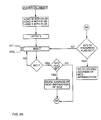
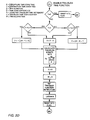
- FIGS. 2A through 2D are flow charts which denote one means by which the traveler's time function can be implemented in the watch of Fig. 1.
- FIGS. 3A through 3F are diagrams illustrating time progression during a typical use of the function.
- FIG. 1 BLOCK DIAGRAM OF WATCH
- FIG. 1 shows one preferred embodiment of the invention.
- Many timepieces manufactured today utilize microprocessors. These typically contain an internal memory, a number of internal registers, counters, latches, decoders, etc.
- One such microprocessor, shown at 10, is the model COP424C, manufactured by National Semiconductor Corporation, 2900 Semiconductor Drive, Santa Clara, CA 95051, U.S.A. The application of these microprocessors to timekeeping is well known to those familiar with both horology and microprocessor technology.
- tick will be used to denote 1/64 second. This is the rate at which the watch will be interrupted and at which the routine for adjusting the time will be executed.
- Microprocessor 10 is supplied with an external quartz crystal 20 to provide a high frequency oscillator circuit.
- Other external components include batteries (not shown) which provide the energy to run the circuitry of the timepiece; a display 30 which, in this embodiment, would preferably be a liquid crystal horological display capable of showing hours, minutes and seconds; and a set of switches 40 through 90. The functions associated with each of switches 40 through 90 will be described in detail below.
- Display 30 is activated by a decoder/driver 100 in microprocessor 10. When the traveler's time function is active, display 30 is programmed to show only hours and minutes, so that the user is not distracted by seconds advancing at an abnormally fast or slow rate.
- Microprocessor 10 additionally contains an oscillator circuit 110, a counter/divider 120, a central processing unit (CPU) 130, a read only memory (ROM) 140, registers W, X, Y, and Z, designated 145, 150, 155, and 156, respectively, registers R, D, S and C, labeled 157, 158, 159, and 160, respectively, and an accumulator and flag registers (not shown).
- the accumulator acts as a temporary storage register in where numbers can be stored in binary form and mathematical operations can be performed on these numbers and from where the results can be directed to other registers.
- a latch 170, a switch decoder 180, and the internal connections are also included as shown in FIG. 1.
- Oscillator 110 provides an output square wave with 50% duty cycle, in well known fashion.
- Divider 120 provides at its output a 64 Hz. square wave, again with a 50% duty cycle, in well known fashion.
- High frequency clocking signal 190 is connected to CPU 130 and decoder/driver 100 to cause them to operate at a high speed.
- CPU 130 must be able to perform operations at a high rate of speed in order to complete numerous tasks each second.
- Decoder/driver 100 must also activate all parts of display 30 in a time short compared with a second. The operation of these two components is well known to those familiar with logic circuits.
- CPU 130 is “interrupt” driven. It is normally waiting for instructions. It can optionally be “powered down” between interrupts to conserve battery energy. Input 200, labeled INT 1'' for "interrupt number 1,” is activated at a rate of 64 Hz. CPU 130 typically recognizes interrupts as positive going, logical transitions between zero volts (logic “0” or “false”) and +1.5 volts (logic "1" or “true”).
- Input 210 is activated whenever one of switches 40 through 90 is closed.
- the inputs to decoder 180 are normally held “low” or at logic “0” by resistors 41 through 91.
- the battery voltage typically 1.5 volts, is momentarily connected to the associated input on decoder 180.
- decoder 180 signals CPU 130 via interrupt line #2 (205) connected to input 210, and provides logical data on multiple lines 220, to input 230 of CPU 130, in well-known fashion.
- CPU 130 can send data to registers W, X, Y, Z, R, D, S, and C, designated 145, 150, 155, 156, 157, 158, 159, and 160, respectively. It can also read the contents of these registers.
- the data in registers W, X, Y, and Z can be stored in latch 170.
- Multiple control lines 240 are used to select among the registers 145, 150, 155, and 156 in well known fashion. Once a register is selected by address lines 240, a momentary pulse is applied to latch 170 via line 300 which connects an output of CPU 130 to the "latch" input of latch 170, and causes the data present at the input of latch 170 to be stored in the latch indefinitely, in well-known fashion.
- register W 145 is used to show the current traveler's time.
- Register X 150 is used to store the "present" time of day, i.e., the departure time zone time.
- Register Y 155 is used to store the current time at the destination.
- Register Z is used to store the transition time, i.e., the duration of the trip.
- Register R (157) is used to store the time zone transition rate which will be calculated by CPU 130 using data from Registers X, Y, Z, and D.
- Register D (158) is used to store the difference between the time at the departure location, and the time at the destination location, as a signed (+ or -) number.
- Register S (159) is a counter which will be incremented once for each successive tick of the timepiece, i.e., once per 1/64 second. This counter is used to increment the time at the departure and destination locations.
- Register C (160) is a counter which will also be incremented once for each tick of the timepiece. This counter is used to increment the traveler's time.
- registers (not shown) capable of storing addresses, statuses, etc. The setting and operation of watches of this type are quite well known. See U.S. patent 4,316,272, to Seikosha (1982), for example.
- CPU 130 is provided with ROM 140 which contains multiple instructions which govern the operation of the timepiece. This concept is also well known to those skilled in the art of microprocessor technology.
- FIGS. 2A through 2D and FIGS. 3A through 3E show the series of instructions which are executed in response to INT 1 at input 200 (FIG 1).
- FIGS. 2C and 2D show the sequence of instructions which are executed in response to INT 2, generated with each closure of a switch 40 through 90.
- the interrupts are prioritized.
- INT 1 has the higher priority and can be activated while INT 2 is in progress.
- INT 2 can never be operational while INT 1 is in progress.
- FIG 2A is a flowchart which illustrates how interrupts are handled.
- the watch loads 1:00 into registers W (145), X (150), and Y (155). Then the time in register X (150 ), i.e., departure time zone time, is displayed. The wait loop is entered.
- the processor will be interrupted (INT 1) each 1/64 second. Control will then be passed to the routine described in FIG. 2B, after the address of the interruption is saved, in the event that an INT 2 operation had been in progress.
- FIG. 2B illustrates the means by which the departure, destination and traveler's current time is incremented, as well as the means by which the traveler's time function is terminated after arrival in the destination time zone.
- Counter S (159) is incremented once per INT 1 interruption of the CPU. When it reaches 64, one second has elapsed and it is time to increment the departure, register X (150), and the destination, register Y (155), time zone time by one second.
- the "timekeeping algorithm” referred to is a routine for incrementing minutes, hours, and dates at the proper time. All electronic timepieces must perform this function and its operation is well known in the art.
- Counter C (160) is also incremented once per INT 1 interruption of the CPU.
- FIG 2C shows the sequence of instructions which are executed in response to INT 2, generated with each closure of one of switches 40 through 90. Operation of the various function switches cause the functions shown to be executed. It should be noted that switch 40 functions as a flip-flop. If the traveler time function is active, operation of this switch resets it, leaving, in this embodiment, the user displaying the departure time zone time. If the traveler time function is not active, operation of switch 40 causes the instructions explained in FIG 2D to be executed. These instructions initialize the traveler time function and commence operation of the adjustment. The user may enter the trip time by operating switch 55 to cause display of the last trip time. Switches 80 and 90 may be operated to adjust this time. Logic to reset the hours after 23 and minutes after 59 is provided but is not shown in view of its conventionality. The user may operate switches 45 through 90 in any order desired.
- Figure 2D shows the sequence of instructions which are executed in response to closure of switch 40 when the traveler time function is not already active.
- the destination time zone time is compared to the departure time zone time. If the destination time zone time is greater than the departure time zone time, the watch determines whether this difference exceeds 12 hours. If so, it is assumed that the destination time zone is actually earlier than (west of) the departure time zone and a negative difference (D) is calculated. If the difference is less than twelve hours, it is assumed that the destination time zone is later than (east of) the departure time zone and a positive difference (D) is calculated. Similar logic is applied to combinations where the destination time zone time is less than the departure time zone time.
- This logic is necessary in a watch without an internal date function, since it must correctly account for a departure time zone time in one day and a destination time zone time in another. For example, a traveler departing San Francisco for Boston at 23:00 would show a destination time zone time of 02:00. The logic shown in FIG 2D would correctly calculate the difference (D) as +3 and not-21. Of course, watches capable of incorporating the date into the difference calculation do not require that this assumption be made.
- Figures 3A through 3E show the time which would appear on an analog embodiment of the watch during a typical operation of the function.
- the user is traveling from Boston to San Francisco, a time difference of -3 hours.
- the user has set the destination time zone time into register Y (155).
- the user has specified a trip time of six hours into register Z (156).
- the function is activated at exactly 8:00 AM EST.
- the traveler's time indicates the same time as the actual time in the departure location. Note that the destination (San Francisco) time is 5:00 AM, three hours earlier.
- FIG 3C another two hours have elapsed and one hour more has elapsed for the traveler's time display, i.e., the traveler's time display is continuing to approach San Francisco time zone time. Boston time is now 12:00 noon, and San Francisco time is 9:00 AM. The traveler's time display indicates 10:00 AM. The traveler continues to consult the watch in a normal fashion, notices the change in time and continues to become psychologically acclimated to the time indicated in the display.
- FIG 3D it can be seen that six hours have elapsed in the departure and destination time zones.
- Boston time is now 2:00 PM, and San Francisco time is 11:00 AM.
- the traveler's time display has increased by one more hour and now indicates 11:00 AM, the exact time in the destination location.
- the watch display now proceeds at a normal rate.
- the traveler has been gradually brought into the destination time zone and will not experience any jolt when the local time is announced to the passengers.
- the traveler is already acclimated to the San Francisco local time.
- FIG 3E one hour has elapsed since arrival at the destination time zone's time.
- Boston time is now 3:00 PM, and San Francisco is 12:00 noon.
- the traveler's display reads 12:00 noon.
- the watch has been running at a normal speed for one hour.
- the traveler is operating on San Francisco time, fully psychologically acclimated to the local time zone. It can be seen that the traveler's watch will continue to indicate destination time zone time until such time as the function is activated again.
- the traveler time function can be incorporated into a standard electronic watch having a date function so that the date will be incremented or decremented if the local time change caused by passage through time zones also results in a date change.
- the traveler's time function can also be incorporated into otherwise conventional digital watches, including those having a world time display, e.g., such as the watch sold under the trademark CASIO DATA BANK by Casio, Inc., Fairfield, New Jersey. This watch displays local time and also the corresponding local times in all of the different time zones of the world.
- a world time display e.g., such as the watch sold under the trademark CASIO DATA BANK by Casio, Inc., Fairfield, New Jersey. This watch displays local time and also the corresponding local times in all of the different time zones of the world.
- my traveler's time function can be incorporated into an analog watch, such as the one described in Patent 4,505,594, to Kawahara et al. (1985). Further, the function can be incorporated into clocks having either an analog or digital display.
- my invention provides a timepiece which can be carried on the person. which reduces jet lag caused by travel between different time zones.
- My timepiece assists the wearer to acclimate to local time changes caused by easterly or westerly travel, by permitting the wearer to acclimate over the course of the trip.
- my timepiece is economical to construct and need not cost appreciably more than a conventional electronic watch having a plural function display capability.
- the invention can be used to adjust a timepiece from different time standards other than time zones, e.g., from standard time to daylight savings time and vice versa within a given time zone.
- the timepiece can contain a function button to activate the loss or gain of one hour over a specified period, e.g., five hours, to give the user time to acclimate to the time change.
- the number of switches can be reduced by assigning several functions to each switch, with the mode of the switches determined by the setting of a mode switch.
- the display can be capable of showing three or more time zones. Audible time indications may be included in the watch, setting means may vary, etc. Therefore, the scope of the invention should be determined by the appended claims and their legal equivalents and not by the examples given.
Landscapes
- Physics & Mathematics (AREA)
- General Physics & Mathematics (AREA)
- Electric Clocks (AREA)
- Electromechanical Clocks (AREA)
Claims (16)
- Zeitmeßvorrichtung mit einer kontinuierlich mit einer Standardrate fortschreitenden Zeitanzeige zur besseren Unterstützung eines Benutzers bei der Anpassung an eine Änderung von einer ursprünglich auf- den Benutzer anzuwendenden Standardzeit zu einer anderen, später auf den Benutzer anzuwendenden verschiedenen Standardzeit während einer gegebenen Anpassungsdauer mit Eingabemitteln (40-90) zur Bedienung der Zeitmeßvorrichtung mit Steuerungsdaten, die mindestens zwei der folgenden Daten darstellen:
die ursprünglich auf den Benutzer anzuwendende Standardzeit (45), die später auf den Benutzer anzuwendende andere Standardzeit (60) und die Anpassungdauer (55);
einem Speicher zur Speicherung von Daten, die mindestens zwei der folgenden Daten darstellen:
die Zeit unter der ursprünglichen Standardzeit (150), die Zeit unter der anderen Standardzeit (155), und die Anpassungsdauer (156);
einem Rechenmittel (130) zu den im Speicher gespeilcherten Daten für die automatische Berechnung und Erzeugung von Ausgabedaten, die den Zeitfortschritt (157) der Zeitmeßvorrichtung mit einer Nicht-Standardrate des Zeitfortschreitens während der Anpassungsdauer auf der Basis von Steuerdaten darstellen, so daß die Nicht-Standardrate des Zeitfortschreitens der Rate entspricht, mit der die Zeit fortschreiten würde, wenn sich die Standardzeit, die der Benutzer erfährt, gleichmäßig über die Anpassungsdauer von der ursprünglichen Standardzeit zur anderen Standardzeit ändern würde;
einer Anzeige für die Ausgabedaten des Rechenmittels, um dem Benutzer die mit der Nicht-Standardrate fortschreitende Zeit während der Anpassungsdauer anzuzeigen,
so daß sich die von der Zeitmeßvorrichtung angezeigte Zeit während der Anpassungsdauer zwischen der Zeit unter der ursprünglichen Standardzeit und der Zeit unter der anderen Standardzeit gleichmäßig ändert und, so daß der Benutzer sich durch Beobachtung der Zeitmeßvorrichtung während der Anpassungsdauer stufenlos psychologisch an die Zeit unter der anderen Standardzeit anpaßt. - Zeitmeßvorrichtung nach Anspruch 1, worin das Rechenmittel automatisch zu einem Fortschreiten der angezeigten Zeit mit einer normalen Rate zurückkehrt, wenn die vorgegebene Anpassungsdauer verstrichen ist.
- Zeitmeßvorrichtung nach Anspruch 1, worin das Speichermittel die Zeit unter der ursprünglichen Standardzeit und der anderen Standardzeit aufnimmt und daraus die gegebene Anpassungszeit auf der Grundlage der Differenz zwischen den Standardzeiten und einer voreingestellten abgeschätzten Anpassungsdauer auswählt.
- Zeitmeßvorrichtung nach Anspruch 1, worin der Speicher die Zeit unter der ursprünglichen Standardzeit, die andere Standardzeit und eine gegebene Anpassungsdauer aufnimmt.
- Zeitmeßvorrichtung nach Anspruch 1, die weiterhin Mittel aufweist, die das Rechenmittel veranlassen, von der Anzeige auch Zeiten unter beiden, der ursprünglichen und der anderen Standardzeit, anzeigen zu lassen.
- Zeitmeßvorrichtung nach Anspruch 1, die weiterhin ein Auswahlmittel zur Darstellung entweder der Zeit unter der ursprünglichen Standardzeit, der Zeit unter der anderen Standardzeit oder der mittels der Nicht-Standardrate bestimmten Zeit auf der Anzeige enthält.
- Zeitmeßvorrichtung nach Anspruch 1, worin der Speicher Eingabedaten aufnimmt, die (1) eine Zeitkorrektur für die Zeitdifferenz zwischen den beiden Standardzeiten, (2) die Richtung der Zeitkorrektur und (3) die gegebene Anpassungsdauer repräsentieren.
- Zeitmeßvorrichtung mit einer kontinuierlich mit einer Standardrate fortschreitenden Zeitanzeige zur besseren Unterstützung eines Reisenden bei der Anpassung an eine Änderung einer anzuwendenden Standardzeit beim Reisen von einer Zeitzone am Startort zu einer davon verschiedenen Zeitzone am Zielort während einer gegebenen Reisedauer mit
Eingabemitteln (40-90) zur Eingabe von Reisedaten, die mindestens zwei der folgenden Daten darstellen: eine Zeitzone des Startorts (45), eine Zeitzone des Zielorts (60) und die Reisedauer (55);
einem Speicher zur Speicherung von Reisedaten, die mindestens zwei der folgenden Daten darstellen:
die Ortszeit der Zeitzone des Abreiseortes (150), die Zeit der Zeitzone des Zielortes (155), und die Reisedauer (156);
einem Rechenmittel (130) zu den im Speicher gespeicherten Reisedaten für die automatische Berechnung und Erzeugung von Ausgabedaten, die den Zeitfortschritt (157) der Zeitmeßvorrichtung mit einer Nicht-Standardrate des Zeitfortschreitens während der Reisedauer auf der Basis von Reisedaten darstellen, so daß die Nicht-Standardrate des Zeitfortschreitens der Rate entspricht, mit der die Zeit fortschreiten würde, wenn sich die Standardzeit, die der Reisende erfährt, gleichmäßig über die Reisedauer von der Standardzeit der Zeitzone des Abreiseortes zur Standardzeit der Zeitzone des Zielortes ändern würde;
einer Anzeige für die Ausgabedaten des Rechenmittels zur Anzeige der mit der Nicht-Standardrate fortschreitenden Zeit während der Reisedauer,
so daß sich die von der Zeitmeßvorrichtung angezeigte Zeit während der Reise zwischen der Ortszeit der Zeitzone des Abreiseortes und der Ortszeit unter der Zeitzone des Zielortes gleichmäßig ändert und, so daß der Reisende durch Beobachtung der Zeitmeßvorrichtung während der Reisedauer weniger psychologische Syptome des "jet lags" erfährt als wenn der Reisende einen abrupten Wechsel der Zeitzonen erführe. - Zeitmeßvorrichtung nach Anspruch 8, worin das Rechenmittel automatisch zum Fortschreiten der angezeigten Zeit mit der normalen Rate zurückkehrt, wenn die gegebene Reisedauer verstrichen ist.
- Zeitmeßvorrichtung nach Anspruch 8, worin das Speichermittel die Standardzeit in den Start- und Zielzeitzonen aufnimmt und daraus automatisch die gegebene Reisedauer aufgrund der Differenz der Standardzeiten und einer voreingestellten abgeschätzten Reisedauer auswählt.
- Zeitmeßvorrichtung nach Anspruch 8, worin das Speichermittel die Standardzeit der Start- und Zielzeitzonen und die gegebene Reisedauer aufnimmt.
- Zeitmeßvorrichtung nach Anspruch 8, worin der Speicher Eingabedaten aufnimmt, die (1) eine Zeitkorrektur für die Zeitdifferenz zwischen den beiden Standardzeiten, (2) die Richtung der Zeitkorrektur und (3) die gegebene Reisedauer darstellen.
- Zeitmeßvorrichtung mit einer kontinuierlich mit einer Standardrate fortschreitenden Zeitanzeige für eine Person, die Änderungen von Standardzeiten erfährt, wobei die aktuelle auf den Benutzer anzuwendende Zeit von einer vorexistierenden Standardzeit zu einer anderen vorexistierenden Standardzeit wechselt, mit:
einer Anzeige (30) zur Anzeige der Zeit durch Darstellung der Anzahl von Zeiteinheiten, die seit einer voreingestellten Startzeit verstrichen sind,
einem Antriebsmittel (130) zum Fortschreiten der Zeitdarstellung mit entweder:(a) einer normalen Rate entsprechend der aktuellen Anzahl von Zeiteinheiten, die von einer vorbestimmten Startzeit an verstreichen würden-, wenn der Benutzer keine Änderung der Standardzeit erführe, oder(b) einer modifizierten Rate (157) entsprechend der Rate, mit der die Zeit gleichmäßig fortschreiten würde, wenn sich die vom Benutzer erfahrene Standardzeit gleichmäßig von einer Standardzeit zu der anderen Standardzeit veränderte,wobei der Benutzer eine gleichmäßige Änderung von einer Standardzeit zu einer anderen Standardzeit erfährt. - Zeitmeßvorrichtung nach Anspruch 13, worin die modifizierte Rate einen linearen Übergang zwischen zwei Zeitzonen repräsentiert.
- Zeitmeßvorrichtung nach Anspruch 13, worin sich die Änderung von Standardzeiten durch die Reise des Benutzers aus einer Zeitzone in eine andere Zeitzone in einem gegebenen Zeitintervall ergibt, so daß das Antriebsmittel das Fortschreiten der Anzeige mit eine: modifizierten Rate veranlaßt, als würde sich die angezeigte Zeit über das Zeitintervall gleichmäßig ändern von der aktuellen Zeit der ersten Zeitzone zu der aktuellen Zeit der zweiten Zeitzone.
- Zeitmeßvorrichtung nach Anspruch 13, worin die Änderung von Standardzeiten durch eine Änderung einer Standardzeit in einer einzigen Zeitzone verursacht ist, so daß das Antriebsmittel das Fortschreiten der Anzeige mit der modifizierten Rate veranlaßt, als würde sich die angezeigte Zeit graduell von der aktuellen Zeit unter einer existierenden Standardzeit zu einer anderen Zeit unter einem verschiedenen existierenden Standard, in dem die angezeigte Zeit unterschiedlich von der gegebenen Zeit ist, verändern.
Priority Applications (1)
| Application Number | Priority Date | Filing Date | Title |
|---|---|---|---|
| AT90904549T ATE93070T1 (de) | 1989-03-17 | 1990-02-28 | Zeitmessvorrichtung mit geschwindigkeitsanpassung fuer zeitstandardaenderungen. |
Applications Claiming Priority (2)
| Application Number | Priority Date | Filing Date | Title |
|---|---|---|---|
| US07/325,293 US4901296A (en) | 1989-03-17 | 1989-03-17 | Watch with speed adjustment during travel for reducing jet lag |
| US325293 | 1989-03-17 |
Publications (2)
| Publication Number | Publication Date |
|---|---|
| EP0466714A1 EP0466714A1 (de) | 1992-01-22 |
| EP0466714B1 true EP0466714B1 (de) | 1993-08-11 |
Family
ID=23267268
Family Applications (1)
| Application Number | Title | Priority Date | Filing Date |
|---|---|---|---|
| EP90904549A Expired - Lifetime EP0466714B1 (de) | 1989-03-17 | 1990-02-28 | Zeitmessvorrichtung mit geschwindigkeitsanpassung für zeitstandardänderungen |
Country Status (8)
| Country | Link |
|---|---|
| US (1) | US4901296A (de) |
| EP (1) | EP0466714B1 (de) |
| JP (1) | JPH04505656A (de) |
| CA (1) | CA2045412C (de) |
| DE (1) | DE69002762T2 (de) |
| ES (1) | ES2044568T3 (de) |
| RU (1) | RU2060529C1 (de) |
| WO (1) | WO1990011554A1 (de) |
Families Citing this family (11)
| Publication number | Priority date | Publication date | Assignee | Title |
|---|---|---|---|---|
| US4995020A (en) * | 1989-03-17 | 1991-02-19 | Mitchell Ross E | Timepiece with speed adjustment for time standard change adaptation |
| US4956829A (en) * | 1989-03-17 | 1990-09-11 | Mitchell Ross E | Timepiece with modified clock rate for faciliting adaptation to new time standard |
| JPH11109477A (ja) * | 1997-10-03 | 1999-04-23 | Minolta Co Ltd | デート表示装置及びこのデート表示装置を備えたカメラ |
| US20030223313A1 (en) * | 2002-05-28 | 2003-12-04 | Su Keng Kuei | Time zone setting device |
| US7351063B2 (en) * | 2002-08-20 | 2008-04-01 | George Peter T | Jet lag forecaster |
| US7806695B1 (en) * | 2002-08-20 | 2010-10-05 | George Peter T | Jet lag forecaster |
| RU2388036C1 (ru) * | 2006-05-29 | 2010-04-27 | Таг Хойер Са | Способ изменения часового пояса и часы для этого |
| US8273380B1 (en) | 2009-05-19 | 2012-09-25 | Jetway Inc. | Fortified beverage for minimizing and/or preventing jet lag |
| US10007236B2 (en) * | 2015-09-02 | 2018-06-26 | Casio Computer Co., Ltd. | Electronic timepiece |
| US9720381B2 (en) * | 2015-09-09 | 2017-08-01 | Paypal, Inc. | Unpredictable time clock |
| CN107194669A (zh) * | 2017-05-26 | 2017-09-22 | 北京小米移动软件有限公司 | 时间调整方法及装置 |
Family Cites Families (10)
| Publication number | Priority date | Publication date | Assignee | Title |
|---|---|---|---|---|
| JPS523469A (en) * | 1975-06-27 | 1977-01-11 | Stanley Electric Co Ltd | Clock apparatus |
| JPS5331170A (en) * | 1976-09-03 | 1978-03-24 | Seiko Epson Corp | Electronic watch |
| US4204398A (en) * | 1977-09-16 | 1980-05-27 | Lemelson Jerome H | Method and means for automatically setting timepieces in a time zone |
| US4445785A (en) * | 1982-07-12 | 1984-05-01 | William C. Crutcher | Electronic time setting for a quartz analog watch |
| JPS6027885A (ja) * | 1983-07-26 | 1985-02-12 | Citizen Watch Co Ltd | 多機能アナログ時計 |
| CH657010GA3 (de) * | 1984-09-06 | 1986-08-15 | ||
| JPS631992A (ja) * | 1986-06-20 | 1988-01-06 | Seiko Instr & Electronics Ltd | 世界時計 |
| DE3708578A1 (de) * | 1987-03-17 | 1987-10-08 | Hubertus Joschko | Uhr zur zeitanzeige in kurzzeiteinheiten wie stunden, minuten oder sekunden |
| GB8720477D0 (en) * | 1987-08-29 | 1987-10-07 | Bick P A | Resynchronisation of body clock |
| US4763311A (en) * | 1987-11-02 | 1988-08-09 | Daniel Marvosh | Double clock for daylight saving |
-
1989
- 1989-03-17 US US07/325,293 patent/US4901296A/en not_active Expired - Fee Related
-
1990
- 1990-02-28 DE DE90904549T patent/DE69002762T2/de not_active Expired - Fee Related
- 1990-02-28 JP JP2504473A patent/JPH04505656A/ja active Pending
- 1990-02-28 WO PCT/US1990/001145 patent/WO1990011554A1/en not_active Ceased
- 1990-02-28 RU SU905001737A patent/RU2060529C1/ru active
- 1990-02-28 EP EP90904549A patent/EP0466714B1/de not_active Expired - Lifetime
- 1990-02-28 CA CA002045412A patent/CA2045412C/en not_active Expired - Fee Related
- 1990-02-28 ES ES90904549T patent/ES2044568T3/es not_active Expired - Lifetime
Also Published As
| Publication number | Publication date |
|---|---|
| JPH04505656A (ja) | 1992-10-01 |
| DE69002762T2 (de) | 1993-11-25 |
| US4901296A (en) | 1990-02-13 |
| CA2045412A1 (en) | 1990-09-18 |
| DE69002762D1 (de) | 1993-09-16 |
| EP0466714A1 (de) | 1992-01-22 |
| WO1990011554A1 (en) | 1990-10-04 |
| CA2045412C (en) | 1995-07-18 |
| ES2044568T3 (es) | 1994-01-01 |
| RU2060529C1 (ru) | 1996-05-20 |
Similar Documents
| Publication | Publication Date | Title |
|---|---|---|
| US4893291A (en) | Devices for aiding resynchronization of body clocks | |
| CA2045412C (en) | Timepiece with speed adjustment for time standard change adaptation | |
| US4995020A (en) | Timepiece with speed adjustment for time standard change adaptation | |
| EP0338535A2 (de) | Elektronisch korrigierte elektronische Uhr | |
| US4956829A (en) | Timepiece with modified clock rate for faciliting adaptation to new time standard | |
| US4926400A (en) | Combined twenty-four (24)/twenty-five (25) hour clock | |
| US5659521A (en) | Electronic watch with multiple function display | |
| US6781922B2 (en) | Electronic timepiece | |
| JPWO1994028469A1 (ja) | 多機能表示電子時計 | |
| US5309413A (en) | Method, integrated circuit, mechanical analog clock movement and completed assembly for a talking analog clock | |
| HK9694A (en) | Timepiece with speed adjustment for time standard change adaptation | |
| US20180046143A1 (en) | Quick multifunctional smart watch for worship timing and orientation and control method | |
| US4370066A (en) | Correction signal input system for electronic timepiece | |
| US4192134A (en) | Electronic timepiece correction device | |
| JPH08211167A (ja) | 時 計 | |
| US4589779A (en) | Multi-alarm timepiece with simplified operating means | |
| HK32093A (en) | Analogous clock with two motors having a perpetual day counter | |
| JPS5979885A (ja) | 電子時計 | |
| JPH0545476A (ja) | 電子時計 | |
| US4280207A (en) | Electronic timepiece and digital display therefor | |
| CN115053187B (zh) | 包括宣礼模拟计数器的计时器 | |
| JP2822452B2 (ja) | 日の出/日の入り時刻表示制御装置 | |
| US4074513A (en) | Electronic display device | |
| JPS6312988A (ja) | スケジユ−ル表示装置 | |
| JP2513600Y2 (ja) | デ―タバンク装置 |
Legal Events
| Date | Code | Title | Description |
|---|---|---|---|
| PUAI | Public reference made under article 153(3) epc to a published international application that has entered the european phase |
Free format text: ORIGINAL CODE: 0009012 |
|
| 17P | Request for examination filed |
Effective date: 19910619 |
|
| AK | Designated contracting states |
Kind code of ref document: A1 Designated state(s): AT BE CH DE DK ES FR GB IT LI LU NL SE |
|
| 17Q | First examination report despatched |
Effective date: 19920819 |
|
| GRAA | (expected) grant |
Free format text: ORIGINAL CODE: 0009210 |
|
| AK | Designated contracting states |
Kind code of ref document: B1 Designated state(s): AT BE CH DE DK ES FR GB IT LI LU NL SE |
|
| PG25 | Lapsed in a contracting state [announced via postgrant information from national office to epo] |
Ref country code: SE Effective date: 19930811 Ref country code: NL Effective date: 19930811 Ref country code: DK Effective date: 19930811 Ref country code: BE Effective date: 19930811 Ref country code: AT Effective date: 19930811 |
|
| REF | Corresponds to: |
Ref document number: 93070 Country of ref document: AT Date of ref document: 19930815 Kind code of ref document: T |
|
| REF | Corresponds to: |
Ref document number: 69002762 Country of ref document: DE Date of ref document: 19930916 |
|
| ITF | It: translation for a ep patent filed | ||
| ET | Fr: translation filed | ||
| REG | Reference to a national code |
Ref country code: ES Ref legal event code: FG2A Ref document number: 2044568 Country of ref document: ES Kind code of ref document: T3 |
|
| NLV1 | Nl: lapsed or annulled due to failure to fulfill the requirements of art. 29p and 29m of the patents act | ||
| PGFP | Annual fee paid to national office [announced via postgrant information from national office to epo] |
Ref country code: ES Payment date: 19940216 Year of fee payment: 5 |
|
| PG25 | Lapsed in a contracting state [announced via postgrant information from national office to epo] |
Ref country code: LU Free format text: LAPSE BECAUSE OF NON-PAYMENT OF DUE FEES Effective date: 19940228 |
|
| PLBE | No opposition filed within time limit |
Free format text: ORIGINAL CODE: 0009261 |
|
| STAA | Information on the status of an ep patent application or granted ep patent |
Free format text: STATUS: NO OPPOSITION FILED WITHIN TIME LIMIT |
|
| 26N | No opposition filed | ||
| PGFP | Annual fee paid to national office [announced via postgrant information from national office to epo] |
Ref country code: FR Payment date: 19950216 Year of fee payment: 6 |
|
| PG25 | Lapsed in a contracting state [announced via postgrant information from national office to epo] |
Ref country code: ES Free format text: LAPSE BECAUSE OF NON-PAYMENT OF DUE FEES Effective date: 19950301 |
|
| PGFP | Annual fee paid to national office [announced via postgrant information from national office to epo] |
Ref country code: CH Payment date: 19950328 Year of fee payment: 6 |
|
| PGFP | Annual fee paid to national office [announced via postgrant information from national office to epo] |
Ref country code: DE Payment date: 19950331 Year of fee payment: 6 |
|
| PG25 | Lapsed in a contracting state [announced via postgrant information from national office to epo] |
Ref country code: LI Free format text: LAPSE BECAUSE OF NON-PAYMENT OF DUE FEES Effective date: 19960228 Ref country code: CH Free format text: LAPSE BECAUSE OF NON-PAYMENT OF DUE FEES Effective date: 19960228 |
|
| REG | Reference to a national code |
Ref country code: CH Ref legal event code: PL |
|
| PG25 | Lapsed in a contracting state [announced via postgrant information from national office to epo] |
Ref country code: FR Effective date: 19961031 |
|
| PG25 | Lapsed in a contracting state [announced via postgrant information from national office to epo] |
Ref country code: DE Effective date: 19961101 |
|
| REG | Reference to a national code |
Ref country code: FR Ref legal event code: ST |
|
| PGFP | Annual fee paid to national office [announced via postgrant information from national office to epo] |
Ref country code: GB Payment date: 19970227 Year of fee payment: 8 |
|
| PG25 | Lapsed in a contracting state [announced via postgrant information from national office to epo] |
Ref country code: GB Free format text: LAPSE BECAUSE OF NON-PAYMENT OF DUE FEES Effective date: 19980228 |
|
| GBPC | Gb: european patent ceased through non-payment of renewal fee |
Effective date: 19980228 |
|
| REG | Reference to a national code |
Ref country code: ES Ref legal event code: FD2A Effective date: 19990301 |
|
| PG25 | Lapsed in a contracting state [announced via postgrant information from national office to epo] |
Ref country code: IT Free format text: LAPSE BECAUSE OF NON-PAYMENT OF DUE FEES;WARNING: LAPSES OF ITALIAN PATENTS WITH EFFECTIVE DATE BEFORE 2007 MAY HAVE OCCURRED AT ANY TIME BEFORE 2007. THE CORRECT EFFECTIVE DATE MAY BE DIFFERENT FROM THE ONE RECORDED. Effective date: 20050228 |