EP0467286A1 - Hochschermodulhonigwabe aus Aramid - Google Patents
Hochschermodulhonigwabe aus Aramid Download PDFInfo
- Publication number
- EP0467286A1 EP0467286A1 EP91111837A EP91111837A EP0467286A1 EP 0467286 A1 EP0467286 A1 EP 0467286A1 EP 91111837 A EP91111837 A EP 91111837A EP 91111837 A EP91111837 A EP 91111837A EP 0467286 A1 EP0467286 A1 EP 0467286A1
- Authority
- EP
- European Patent Office
- Prior art keywords
- core
- honeycomb
- paper
- matrix resin
- percent
- Prior art date
- Legal status (The legal status is an assumption and is not a legal conclusion. Google has not performed a legal analysis and makes no representation as to the accuracy of the status listed.)
- Granted
Links
- 239000004760 aramid Substances 0.000 title claims abstract description 36
- 229920003235 aromatic polyamide Polymers 0.000 title claims description 43
- 239000011162 core material Substances 0.000 claims description 53
- 229920005989 resin Polymers 0.000 claims description 53
- 239000011347 resin Substances 0.000 claims description 53
- 239000011159 matrix material Substances 0.000 claims description 35
- 239000011230 binding agent Substances 0.000 claims description 22
- 239000000835 fiber Substances 0.000 claims description 22
- 239000007787 solid Substances 0.000 claims description 22
- 239000000463 material Substances 0.000 claims description 15
- 239000003822 epoxy resin Substances 0.000 claims description 11
- 229920000647 polyepoxide Polymers 0.000 claims description 11
- 239000000203 mixture Substances 0.000 claims description 9
- 229920001568 phenolic resin Polymers 0.000 claims description 8
- 239000005011 phenolic resin Substances 0.000 claims description 8
- KXGFMDJXCMQABM-UHFFFAOYSA-N 2-methoxy-6-methylphenol Chemical compound [CH]OC1=CC=CC([CH])=C1O KXGFMDJXCMQABM-UHFFFAOYSA-N 0.000 claims description 5
- 230000001747 exhibiting effect Effects 0.000 abstract description 2
- 229920006231 aramid fiber Polymers 0.000 abstract 1
- 241000264877 Hippospongia communis Species 0.000 description 73
- -1 poly(m-phenylene isophthalamide) Polymers 0.000 description 12
- 238000002360 preparation method Methods 0.000 description 7
- 238000004519 manufacturing process Methods 0.000 description 6
- 238000000034 method Methods 0.000 description 6
- 238000012360 testing method Methods 0.000 description 6
- 239000000654 additive Substances 0.000 description 5
- 239000000853 adhesive Substances 0.000 description 5
- 230000001070 adhesive effect Effects 0.000 description 5
- XAGFODPZIPBFFR-UHFFFAOYSA-N aluminium Chemical compound [Al] XAGFODPZIPBFFR-UHFFFAOYSA-N 0.000 description 4
- 229910052782 aluminium Inorganic materials 0.000 description 4
- 239000011152 fibreglass Substances 0.000 description 4
- LNEPOXFFQSENCJ-UHFFFAOYSA-N haloperidol Chemical compound C1CC(O)(C=2C=CC(Cl)=CC=2)CCN1CCCC(=O)C1=CC=C(F)C=C1 LNEPOXFFQSENCJ-UHFFFAOYSA-N 0.000 description 4
- 229920000728 polyester Polymers 0.000 description 4
- XLYOFNOQVPJJNP-UHFFFAOYSA-N water Substances O XLYOFNOQVPJJNP-UHFFFAOYSA-N 0.000 description 4
- 229910000831 Steel Inorganic materials 0.000 description 3
- 239000004744 fabric Substances 0.000 description 3
- 239000003365 glass fiber Substances 0.000 description 3
- 229920003366 poly(p-phenylene terephthalamide) Polymers 0.000 description 3
- 239000000047 product Substances 0.000 description 3
- 239000002002 slurry Substances 0.000 description 3
- 239000010959 steel Substances 0.000 description 3
- VYPSYNLAJGMNEJ-UHFFFAOYSA-N Silicium dioxide Chemical compound O=[Si]=O VYPSYNLAJGMNEJ-UHFFFAOYSA-N 0.000 description 2
- 238000010276 construction Methods 0.000 description 2
- 230000007797 corrosion Effects 0.000 description 2
- 238000005260 corrosion Methods 0.000 description 2
- 238000005520 cutting process Methods 0.000 description 2
- 229920006240 drawn fiber Polymers 0.000 description 2
- 238000002156 mixing Methods 0.000 description 2
- 230000003647 oxidation Effects 0.000 description 2
- 238000007254 oxidation reaction Methods 0.000 description 2
- 229920000889 poly(m-phenylene isophthalamide) Polymers 0.000 description 2
- 239000000126 substance Substances 0.000 description 2
- 229920002994 synthetic fiber Polymers 0.000 description 2
- 239000012209 synthetic fiber Substances 0.000 description 2
- 229920001187 thermosetting polymer Polymers 0.000 description 2
- LHENQXAPVKABON-UHFFFAOYSA-N 1-methoxypropan-1-ol Chemical compound CCC(O)OC LHENQXAPVKABON-UHFFFAOYSA-N 0.000 description 1
- KUBDPQJOLOUJRM-UHFFFAOYSA-N 2-(chloromethyl)oxirane;4-[2-(4-hydroxyphenyl)propan-2-yl]phenol Chemical compound ClCC1CO1.C=1C=C(O)C=CC=1C(C)(C)C1=CC=C(O)C=C1 KUBDPQJOLOUJRM-UHFFFAOYSA-N 0.000 description 1
- LXBGSDVWAMZHDD-UHFFFAOYSA-N 2-methyl-1h-imidazole Chemical compound CC1=NC=CN1 LXBGSDVWAMZHDD-UHFFFAOYSA-N 0.000 description 1
- 239000004641 Diallyl-phthalate Substances 0.000 description 1
- 239000004593 Epoxy Substances 0.000 description 1
- 229920003369 Kevlar® 49 Polymers 0.000 description 1
- 229920000877 Melamine resin Polymers 0.000 description 1
- 239000004697 Polyetherimide Substances 0.000 description 1
- 239000004721 Polyphenylene oxide Substances 0.000 description 1
- 229920002396 Polyurea Polymers 0.000 description 1
- 229920004738 ULTEM® Polymers 0.000 description 1
- 238000010521 absorption reaction Methods 0.000 description 1
- 229920000180 alkyd Polymers 0.000 description 1
- 230000004888 barrier function Effects 0.000 description 1
- QUDWYFHPNIMBFC-UHFFFAOYSA-N bis(prop-2-enyl) benzene-1,2-dicarboxylate Chemical compound C=CCOC(=O)C1=CC=CC=C1C(=O)OCC=C QUDWYFHPNIMBFC-UHFFFAOYSA-N 0.000 description 1
- 238000003490 calendering Methods 0.000 description 1
- 230000015556 catabolic process Effects 0.000 description 1
- 239000003054 catalyst Substances 0.000 description 1
- 239000003795 chemical substances by application Substances 0.000 description 1
- 239000013065 commercial product Substances 0.000 description 1
- 238000007906 compression Methods 0.000 description 1
- 230000006835 compression Effects 0.000 description 1
- 230000001143 conditioned effect Effects 0.000 description 1
- 238000006731 degradation reaction Methods 0.000 description 1
- 238000000280 densification Methods 0.000 description 1
- MTHSVFCYNBDYFN-UHFFFAOYSA-N diethylene glycol Chemical compound OCCOCCO MTHSVFCYNBDYFN-UHFFFAOYSA-N 0.000 description 1
- 238000007598 dipping method Methods 0.000 description 1
- 239000006185 dispersion Substances 0.000 description 1
- 238000001035 drying Methods 0.000 description 1
- 230000000694 effects Effects 0.000 description 1
- 239000003063 flame retardant Substances 0.000 description 1
- UNKQPEQSAGXBEV-UHFFFAOYSA-N formaldehyde;4-[2-(4-hydroxyphenyl)propan-2-yl]phenol Chemical compound O=C.C=1C=C(O)C=CC=1C(C)(C)C1=CC=C(O)C=C1 UNKQPEQSAGXBEV-UHFFFAOYSA-N 0.000 description 1
- 238000009472 formulation Methods 0.000 description 1
- 229910021485 fumed silica Inorganic materials 0.000 description 1
- 239000011521 glass Substances 0.000 description 1
- 230000005484 gravity Effects 0.000 description 1
- 239000003112 inhibitor Substances 0.000 description 1
- 238000010030 laminating Methods 0.000 description 1
- 239000000615 nonconductor Substances 0.000 description 1
- 239000002245 particle Substances 0.000 description 1
- 229920002239 polyacrylonitrile Polymers 0.000 description 1
- 229920000570 polyether Polymers 0.000 description 1
- 229920001601 polyetherimide Polymers 0.000 description 1
- 229920001721 polyimide Polymers 0.000 description 1
- 239000009719 polyimide resin Substances 0.000 description 1
- 239000004814 polyurethane Substances 0.000 description 1
- 229920002635 polyurethane Polymers 0.000 description 1
- 229920002689 polyvinyl acetate Polymers 0.000 description 1
- 230000000717 retained effect Effects 0.000 description 1
- 239000002904 solvent Substances 0.000 description 1
- 238000009987 spinning Methods 0.000 description 1
- 238000010998 test method Methods 0.000 description 1
- 229920001169 thermoplastic Polymers 0.000 description 1
- 239000004416 thermosoftening plastic Substances 0.000 description 1
- 238000005303 weighing Methods 0.000 description 1
- 239000002023 wood Substances 0.000 description 1
- 239000002759 woven fabric Substances 0.000 description 1
Images
Classifications
-
- D—TEXTILES; PAPER
- D21—PAPER-MAKING; PRODUCTION OF CELLULOSE
- D21H—PULP COMPOSITIONS; PREPARATION THEREOF NOT COVERED BY SUBCLASSES D21C OR D21D; IMPREGNATING OR COATING OF PAPER; TREATMENT OF FINISHED PAPER NOT COVERED BY CLASS B31 OR SUBCLASS D21G; PAPER NOT OTHERWISE PROVIDED FOR
- D21H17/00—Non-fibrous material added to the pulp, characterised by its constitution; Paper-impregnating material characterised by its constitution
- D21H17/20—Macromolecular organic compounds
- D21H17/33—Synthetic macromolecular compounds
- D21H17/46—Synthetic macromolecular compounds obtained otherwise than by reactions only involving carbon-to-carbon unsaturated bonds
- D21H17/52—Epoxy resins
-
- D—TEXTILES; PAPER
- D21—PAPER-MAKING; PRODUCTION OF CELLULOSE
- D21H—PULP COMPOSITIONS; PREPARATION THEREOF NOT COVERED BY SUBCLASSES D21C OR D21D; IMPREGNATING OR COATING OF PAPER; TREATMENT OF FINISHED PAPER NOT COVERED BY CLASS B31 OR SUBCLASS D21G; PAPER NOT OTHERWISE PROVIDED FOR
- D21H13/00—Pulp or paper, comprising synthetic cellulose or non-cellulose fibres or web-forming material
- D21H13/10—Organic non-cellulose fibres
- D21H13/20—Organic non-cellulose fibres from macromolecular compounds obtained otherwise than by reactions only involving carbon-to-carbon unsaturated bonds
- D21H13/26—Polyamides; Polyimides
-
- D—TEXTILES; PAPER
- D21—PAPER-MAKING; PRODUCTION OF CELLULOSE
- D21H—PULP COMPOSITIONS; PREPARATION THEREOF NOT COVERED BY SUBCLASSES D21C OR D21D; IMPREGNATING OR COATING OF PAPER; TREATMENT OF FINISHED PAPER NOT COVERED BY CLASS B31 OR SUBCLASS D21G; PAPER NOT OTHERWISE PROVIDED FOR
- D21H17/00—Non-fibrous material added to the pulp, characterised by its constitution; Paper-impregnating material characterised by its constitution
- D21H17/20—Macromolecular organic compounds
- D21H17/33—Synthetic macromolecular compounds
- D21H17/46—Synthetic macromolecular compounds obtained otherwise than by reactions only involving carbon-to-carbon unsaturated bonds
- D21H17/47—Condensation polymers of aldehydes or ketones
- D21H17/48—Condensation polymers of aldehydes or ketones with phenols
-
- Y—GENERAL TAGGING OF NEW TECHNOLOGICAL DEVELOPMENTS; GENERAL TAGGING OF CROSS-SECTIONAL TECHNOLOGIES SPANNING OVER SEVERAL SECTIONS OF THE IPC; TECHNICAL SUBJECTS COVERED BY FORMER USPC CROSS-REFERENCE ART COLLECTIONS [XRACs] AND DIGESTS
- Y10—TECHNICAL SUBJECTS COVERED BY FORMER USPC
- Y10S—TECHNICAL SUBJECTS COVERED BY FORMER USPC CROSS-REFERENCE ART COLLECTIONS [XRACs] AND DIGESTS
- Y10S428/00—Stock material or miscellaneous articles
- Y10S428/902—High modulus filament or fiber
-
- Y—GENERAL TAGGING OF NEW TECHNOLOGICAL DEVELOPMENTS; GENERAL TAGGING OF CROSS-SECTIONAL TECHNOLOGIES SPANNING OVER SEVERAL SECTIONS OF THE IPC; TECHNICAL SUBJECTS COVERED BY FORMER USPC CROSS-REFERENCE ART COLLECTIONS [XRACs] AND DIGESTS
- Y10—TECHNICAL SUBJECTS COVERED BY FORMER USPC
- Y10S—TECHNICAL SUBJECTS COVERED BY FORMER USPC CROSS-REFERENCE ART COLLECTIONS [XRACs] AND DIGESTS
- Y10S493/00—Manufacturing container or tube from paper; or other manufacturing from a sheet or web
- Y10S493/966—Honeycomb structure
-
- Y—GENERAL TAGGING OF NEW TECHNOLOGICAL DEVELOPMENTS; GENERAL TAGGING OF CROSS-SECTIONAL TECHNOLOGIES SPANNING OVER SEVERAL SECTIONS OF THE IPC; TECHNICAL SUBJECTS COVERED BY FORMER USPC CROSS-REFERENCE ART COLLECTIONS [XRACs] AND DIGESTS
- Y10—TECHNICAL SUBJECTS COVERED BY FORMER USPC
- Y10T—TECHNICAL SUBJECTS COVERED BY FORMER US CLASSIFICATION
- Y10T428/00—Stock material or miscellaneous articles
- Y10T428/24—Structurally defined web or sheet [e.g., overall dimension, etc.]
- Y10T428/24149—Honeycomb-like
-
- Y—GENERAL TAGGING OF NEW TECHNOLOGICAL DEVELOPMENTS; GENERAL TAGGING OF CROSS-SECTIONAL TECHNOLOGIES SPANNING OVER SEVERAL SECTIONS OF THE IPC; TECHNICAL SUBJECTS COVERED BY FORMER USPC CROSS-REFERENCE ART COLLECTIONS [XRACs] AND DIGESTS
- Y10—TECHNICAL SUBJECTS COVERED BY FORMER USPC
- Y10T—TECHNICAL SUBJECTS COVERED BY FORMER US CLASSIFICATION
- Y10T428/00—Stock material or miscellaneous articles
- Y10T428/24—Structurally defined web or sheet [e.g., overall dimension, etc.]
- Y10T428/24149—Honeycomb-like
- Y10T428/24165—Hexagonally shaped cavities
Definitions
- This invention relates to a honeycomb structure comprising a paper or structural sheet of aramid materials impregnated by a solid matrix resin wherein the honeycomb exhibits a light weight, a high shear strength/modulus, an excellent stability to moisture and high temperature, and excellent corrosion resistance, toughness, and fatigue performance.
- Japanese Kokai Publication 60-36152 published February 25, 1985 on the application of Yamamoto et al., discloses a two-component, nonwoven, aramid paper for use in the manufacture of honeycomb.
- One of the paper components is a drawn fiber and the other is a non-drawn fiber. There are no binder fibers in the construction.
- Japanese Kokai Publication 62-223398 published October 1, 1987 on the application of Nishimura et al., discloses a two-component, nonwoven, paper wherein one of the components is a strong fiber which can be aramid, and the other component is a polyester fiber of low orientation.
- the paper can be used for honeycomb.
- the present invention provides a honeycomb structure comprising a core impregnated by a solid matrix resin wherein the core comprises a nonwoven paper including a uniform mixture of 0 to 50, weight, percent of a polymeric binder material, 50 to 100, weight, percent para-aramid fibers, and a solid matrix resin uniformly distributed throughout the paper such that the para-aramid fibers represent 20 to 80% of the total volume of the impregnated core material, wherein the core exhibits a density of 0.015 to 0.24 g/cc and a shear modulus of greater than 1000 kg/cm 2 .
- the present invention more particularly provides a honeycomb structure comprising a core impregnated by a solid matrix resin wherein the core comprises a nonwoven paper including a uniform mixture of 0 to 50, weight, percent poly(m-phenylene isophthalamide) (MPD-I) fibrids, 50 to 100, weight, percent poly(p-phenylene terephthalamide) (PPD-T) fibers, and a solid matrix resin uniformly distributed throughout the paper such that the para-aramid fibers represent 20 to 80% of the total volume of the impregnated core material.
- MPD-I percent poly(m-phenylene isophthalamide)
- PPD-T percent poly(p-phenylene terephthalamide)
- the shear modulus of the core of this invention bears the following relationship to the density:
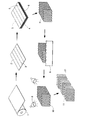
- the Figure is a schematic depiction of a process for manufacturing the honeycomb of this invention.
- High performance honeycomb structures are commonly manufactured from aluminum, fiberglass, or synthetic fibers.
- Aluminum honeycombs exhibit high strength and high shear modulus; but are subject to degradation by corrosion and are electrically conductive. Moreover, aluminum honeycombs exhibit very high coefficients of thermal expansion and are subject to damage during handling.
- Fiberglass honeycombs are, generally, made using woven fabrics of glass fibers and are not available in very low densities due to difficulties in producing fine denier woven glass.
- Honeycomb made from normal woven fiberglass does not exhibit high shear modulus.
- Honeycomb made from bias woven fiberglass exhibits high shear modulus but is difficult to manufacture, has a high coefficient of thermal expansion, and is subject to damage during handling.
- Honeycombs made from woven aramid fabrics are not available in low densities because woven aramid fabrics are not available in low densities.
- Honeycomb made from woven aramid fabrics does not exhibit high shear modulus.
- honeycombs made from synthetic fibers have been honeycombs made from poly(m-phenylene terephthalamide) (MPD-I). Papers made using fibrids and short fibers of MPD-I have been described in U.S. Patent 3,756,908, issued September 4, 1973 on the application of Gross; and have been sold for honeycomb manufacture as lightweight, thermally stable products useful in critical construction such as for vehicular structures in transportation, sporting equipment, and temporary shelters.
- the MPD-I honeycomb exhibits a shear strength and modulus somewhat below honeycombs made from aluminum and bias-woven glass fibers. MPD-I honeycomb shear strength and modulus are comparable with the shear strength and modulus made from normal-woven glass fibers.
- the present invention provides honeycomb which is very light weight, very stable to heat and humidity, has a low moisture absorption, is a good electrical insulator with a low dielectric constant, and which exhibits very high shear modulus. Because the honeycomb of this invention is made using nonwoven paper, the honeycomb can be made at a lower density than when using woven materials.
- the nonwoven paper which is used in the honeycomb of the present invention includes a combination of 0 to 50% binder, preferably MPD-I fibrids, and 50 to 100% para-aramid fibers, preferably PPD-T.
- the use of nonwoven paper in this invention represents, also, an improvement over the use of woven materials because nonwoven structures can be made with controlled uniformity and can more easily be made to include additives.
- Fibrids are nongranular, nonrigid film-like particles and are preferably made from MPD-I. Preparation of fibrids is taught in US 3,756,908 with a general discussion of processes to be found in US 2,999,788. Two of the three fibrid dimensions are on the order of microns and the fibrids should be refined, in accordance with the teachings of U.S. 3,756,908 patent, only to the extent useful to permit permanent densification and saturability of the final sheet.
- Fibrids are used as a binder for the para-aramid fibers; and MPD-I fibrids are preferred because they are made from an aramid material exhibiting properties which are desirable for the product of this invention. Fibrids or a binder resin of other material would be acceptable for this invention provided that it, also, exhibited the properties required for the honeycomb product.
- Other binder materials are in the general form of resins and can be epoxy resins, phenolic resins, polyureas, polyurethanes, melamine formaldehyde resins, polyesters, polyvinyl acetates, polyacrylonitriles, alkyd resins, and the like. Preferred resins are water dispersible and thermosetting. Most preferred are binders consisting of water-dispersible epoxy resins.
- binders such as fibrids or binder resins greatly facilitates the handling of the aramid paper during preparation and when the paper is to be continuously impregnated with resin for the preparation of honeycomb.
- the binder may be omitted at the expense of ease of handling.
- binder at less than 5%, by weight, of total solids provides inadequate effect and at more than 50%, by weight, of total solids is not generally retained by the fibers.
- the sheet may become closed and unsaturable.
- the honeycomb cannot develop improved properties. Likewise, if the binder envelops the fiber and forms a barrier between the impregnating resin and the para-aramid fiber, the honeycomb may be weakened. Saturation of the paper by matrix resin is important.
- Binder materials can be used to prepare the paper and can then be removed by dissolving or burning them away from the para-aramid fibers prior to impregnating the paper to make the honeycomb. In that way, honeycomb of this invention can be made in which the paper is 100% para-aramid fibers.
- Para-aramid fibers are very high in strength and modulus. Examples of para-aramids are set out in U.S. Patent 3,869,429 and in European Patent 330,163. Specific examples of para-aramids are poly(p-phenylene terephthalamide) (PPD-T) and copoly(p-phenylene-3,4'-oxydiphenylene terephthalamide). Fibers of PPD-T are, generally, made by an air gap spinning process such as that described in United States Patent Number 3,767,756; are preferably heat treated as described in United States Patent Number 3,869,430. The fibers used in the honeycomb of this invention are 1 to 25, preferably 2 to 20 mm long and are about 1 to 5 denier. The fibers used in this invention are staple cut from continuous yarn or tow and are combined with the binder to form the paper.
- the paper used in making the honeycomb of this invention must be of high density and must have at least 50%, by weight, para-aramid staple fiber.
- the paper can be made in accordance with usually accepted papermaking practices.
- One preferred papermaking method includes the steps of: (1) preparing a 0.01 to 3 percent, by weight, aqueous slurry of aramid staple fibers; (2) optionally, adding a binder at 5 to 50%, by weight, of the total solids; (3) forming a sheet from the slurry using known papermaking methods; (4) drying the thusly formed sheet; and (5) calendering the sheet in one or more steps between rigid rolls heated at 125 to 400 C at a pressure of about 70 to 3500 kilograms per lineal centimeter.
- the sheets can, also, be densified using platens with equivalent heat and high pressure.
- the density of paper used in this invention equals the density of the para-aramid fibers divided by the weight fraction of the para-aramid fibers in the paper times the volume fraction of fibers in the paper. In order to yield the honeycomb of this invention, it has been determined that the volume fraction of para-aramid fibers in the paper, in the absence of matrix resin, must be from 0.25 to 0.80.
- the density of poly(p-phenylene terephthalamide) fibers is about 1.44 g/cc.
- additives which are normally used with papers of this sort can be used with the paper to be made into the honeycomb of this invention, so long as the additives do not detract significantly from the performance demanded in honeycomb use.
- Oxidation inhibitors, flame retardants, and the like are customarily added to the papers.
- Honeycomb is made using layers of paper having alternate layers affixed in parallel lines staggered from lines in adjacent layers. The layers are generally affixed using a resin adhesive.
- the paper of the honeycomb can be impregnated using a resin characterized as a matrix resin; and matrix resin can be the same resin as is used for a resin adhesive. It is also the case that the same resin which is useful as a binder resin for the paper can be used as matrix resins in manufacture of the honeycomb of this invention.
- Other resins useful as matrix resins are: thermosetting -- phenolic resins, polyimide resins, diallyl phthalate resins, bismaleimide-triazine resins, epoxy resins, and the like.
- Preferred matrix resins are phenolic resins and epoxy resins. As a general rule, any polymeric material is eligible as a matrix resin if it exhibits a tensile modulus of greater than 24,600 kg/cm 2 and has good adhesion to the para-aramid fibers.
- a roll of paper 1 can be used as a source of paper for cutting individual sheets 2 and applying stripes of adhesive 3 before laying the sheets together to form a collapsed structure of sheets expandable to form a honeycomb 4. While still in the unexpanded form, the structure 4 is subjected to curing conditions to cure the adhesive strips 3 and adhere the several layers 2 together. The block 4 is then expanded by pulling edges 5 and 6 apart from each other to yield honeycomb 7.
- Honeycomb 7 is heat set and then dipped in an uncured matrix resin bath 8. The dipped honeycomb with uncured matrix resin is subjected to curing heat 9; and the dipping and curing can be repeated until the desired amount of matrix resin has been accumulated and cured to yield completed honeycomb 10.
- Completed honeycomb 10 is cut or otherwise shaped into individual honeycomb articles 11.
- the honeycomb core of this invention can be made with densities from 0.015 to 0.24 g/cc depending upon the basis weight of the unimpregnated sheet and the amount of matrix resin included in the structure.
- the shear modulus of honeycomb is a direct function of core density and floc content, with higher densities and higher floc contents yielding higher shear moduli.
- the shear modulus (kg/cm 2 ) is greater than 7000 times the core density (g/ CM 3 ) for all cell shapes; and, for hexagonal cell shapes, the shear modulus (kg/cm 2 ) is greater than 14000 times the core density (g/cm 3 ).
- the matrix resin can include additives which are usually present in such materials. Additives can be used to control oxidation, promote flame retardance, color the structure, alter the electromagnetic properties of the material, and the like.
- the density of a honeycomb core is determined by weighing a core of known outside dimensions and calculating the density therefrom.
- Honeycomb core shear moduli and strengths are determined in accordance with United States Military Standard MIL-STD-401 B, 5.1.5.
- Test specimens are 50mm x 12.7mm x 165mm with the longitudinal axis of the cells parallel with the short dimension. Each test is conducted with two specimens and the results are averaged for reporting purposes. Each test specimen is conditioned for 16 hours at 23 C in 50% relative humidity. Steel plates 1.27cm thick are adhered to the open cell ends of the specimens using an epoxy resin. The plates are positioned so that testing forces shall pass as closely as possible through diagonally opposite corners of the specimen.
- Compression is applied to the plates continuously at a rate such that failure will occur in not less than 3 and not more than 6 minutes to the ends of the steel plates through a universal joint so as to distribute the load uniformly across the width of the specimen and along a line extending from diagonally opposite corners of the specimen.
- a stress-strain curve is recorded and shear strength and shear modulus are determined.
- Shear strength is defined as the maximum shear stress developed by the specimen.
- Shear modulus is where W is the slope of the initial linear portion of the load deflection curve and t, a, and b are the thickness, length, and width, respectively, of the specimen.
- the shear modulus identified as "L-shear” is determined.
- the “L-shear” is determined by mounting the honeycombs such that the longitudinal axis of the continuous sheet in the honeycomb is in the same direction as the testing force application as described in MIL-STD-401 B.
- a series of several honeycomb structures was made to demonstrate the improved shear modulus of the honeycomb of the present invention.
- Papers were made using MPD-I fibrids and PPD-T staple in a variety of ratios and a paper was made using 50, weight, percent, each, of MPD-I fibrids and MPD-I staple for a control comparison.
- MPD-I fibrids were made as described in US 3,756,908 (Gross) for preparation of fibrids. Fibrids were partially refined by mixing seven hundred milliliters of a 1.2, weight, percent dispersion of the fibrids with 2100 ml of water in a Waring Blendor jar for 60 seconds.
- PPD-T staple was made by cutting continuous para-aramid yarn into 0.60-0.65 cm pieces.
- the para-aramid yarn was a commercial product having a denier of 1.5 and sold under the trade designation Kevlar 49 by E. I. du Pont de Nemours & Co.
- Handsheets were made as follows: Into 800 ml of water in a Waring Blendor cup were added the staple and the fibrids at weights selected to provide wet-laid sheets of about 54 g/m 2 (1.6 oz/yd 2 ). This mixture was blended 30 to 60 seconds.
- the paper former was an M/K Systems Series 8000 Sheet Former designed to wet-lay 30.5 cm square sheets.
- the slurry in the Waring Blendor was poured into the tank of the paper former which contained 22 liters of water. Mixing in the tank was for about 30 seconds prior to dewatering on the paper former.
- Resultant handsheets were partially dried on a drum dryer at 100°C for about 1 minute and then press-dried using a Noble & Wood Hot Plate Module E9 at 200 C.
- Each sheet was compacted, using a two-roll calender with steel rolls at 159 kg/cm and 325 C, to a specific gravity of about 1.06 g/cc.
- the sheets were dipped in a solution which was 2-5% solids comprising 70 weight parts of an epoxy resin identified as Epon 826 sold by Shell Chemical Co., 30 weight parts of an elastomer-modified epoxy resin identified as Heloxy WC 8006 sold by Wilmington Chemical Corp, Wilmington, DE, USA, 54 weight parts of a bisphenol A - formaldehyde resin curing agent identified as UCAR BRWE 5400 sold by Union Carbide Corp., and 0.6 weight parts of 2-methylimidazole as a curing catalyst, in a glycol ether solvent identified as Dowanol PM sold by The Dow Chemical Company.
- the honeycomb was dipped and cured, repeatedly, in the initially-described epoxy resin solution, but at a solids content of 20%, until a structure having a density of about 0.056 g/cc (3.5 pounds per cubic foot) was obtained.
- the curing was conducted at 140° C for 30 minutes and at 177 C for 40 minutes.
- Honeycombs can, also, be made using a phenolic resin solution as the impregnating material. Such honeycombs will have improved resistance to burning and lower cost.
- An acceptable phenolic resin solution is defined by United States Military Specification MIL-R-9299C.
- the Table provides honeycomb shear properties for the several elements of the Example and the Control Comparison.
- the honeycomb using paper having only 10% MPD-I was made using solid thermoplastic strips of polyetherimide resin identified as Ultem and sold by General Electric Corp. for adhesion at the node lines because of the difficulty in strike-through when printing paper with so little binder.
- the Control Comparison was inadvertently made at a density greater than the density of the examples of the invention.
- the shear modulus of a honeycomb structure is increased by any increase in density. For that reason, the Control Comparison can stand as an acceptable comparison, because, despite the greater density and consequent expectation of greater shear modulus, it exhibits a substantially lower shear modulus than do any of the honeycombs of the invention.
- the honeycomb containing 50, weight, percent or slightly less of para-aramid fiber exhibit acceptably high shear modulus of greater than 1000 kg/cm 2. As the fiber content of the honeycomb falls to values of significantly less than 50, weight, percent fiber, shear modulus falls to less than 1000 kg/cm 2.
Landscapes
- Chemical & Material Sciences (AREA)
- Chemical Kinetics & Catalysis (AREA)
- Laminated Bodies (AREA)
- Artificial Filaments (AREA)
- Paper (AREA)
Applications Claiming Priority (2)
| Application Number | Priority Date | Filing Date | Title |
|---|---|---|---|
| US552553 | 1990-07-16 | ||
| US07/552,553 US5137768A (en) | 1990-07-16 | 1990-07-16 | High shear modulus aramid honeycomb |
Publications (2)
| Publication Number | Publication Date |
|---|---|
| EP0467286A1 true EP0467286A1 (de) | 1992-01-22 |
| EP0467286B1 EP0467286B1 (de) | 1995-04-05 |
Family
ID=24205832
Family Applications (1)
| Application Number | Title | Priority Date | Filing Date |
|---|---|---|---|
| EP91111837A Expired - Lifetime EP0467286B1 (de) | 1990-07-16 | 1991-07-16 | Hochschermodulhonigwabe aus Aramid |
Country Status (5)
| Country | Link |
|---|---|
| US (1) | US5137768A (de) |
| EP (1) | EP0467286B1 (de) |
| JP (1) | JP3518608B2 (de) |
| CA (1) | CA2046947C (de) |
| DE (1) | DE69108623T2 (de) |
Cited By (13)
| Publication number | Priority date | Publication date | Assignee | Title |
|---|---|---|---|---|
| WO1994019181A1 (en) * | 1993-02-22 | 1994-09-01 | E.I. Du Pont De Nemours And Company | Tough layered papers with improved surface adhesion |
| WO1995030044A3 (en) * | 1994-04-28 | 1995-12-21 | Akzo Nobel Nv | Water containing aromatic polyamide pulp and process for producing the same |
| FR2725397A1 (fr) * | 1994-10-11 | 1996-04-12 | Showa Aircraft Ind | Procede de preparation d'une structure alveolaire carbonee a base de fibres impregnees de resine |
| EP0739707A1 (de) * | 1995-04-28 | 1996-10-30 | Showa Aircraft Industry Co., Ltd. | Wabenkernstruktur |
| EP1006237A1 (de) * | 1998-11-18 | 2000-06-07 | Oji Paper Co., Ltd. | Basismaterial zur Herstellung eines Laminates und Verfahren zu dessen Herstellung |
| EP1048446A3 (de) * | 1999-04-27 | 2002-11-27 | Hexcel Corporation | Thermoformbare Wabenstruktur und Taucherharze |
| WO2008076396A3 (en) * | 2006-12-15 | 2009-07-23 | Du Pont | Honeycomb from paper having a high melt point thermoplastic fiber |
| WO2008076404A3 (en) * | 2006-12-15 | 2009-08-20 | Du Pont | Honeycomb from paper having flame retardant thermoplastic binder |
| WO2008076397A3 (en) * | 2006-12-15 | 2009-12-03 | E. I. Du Pont De Nemours And Company | Honeycomb containing poly(paraphenylene terephthalamide) paper with aliphatic polyamide binder and articles made therefrom |
| WO2013126739A1 (en) * | 2012-02-23 | 2013-08-29 | E. I. Du Pont De Nemours And Company | A fiber-resin composite sheet and article comprising the same |
| WO2013154619A1 (en) * | 2012-01-12 | 2013-10-17 | E. I. Du Pont De Nemours And Company | Core structures comprising tannin resin |
| LU92548B1 (de) * | 2014-09-17 | 2016-03-18 | Euro Composites | Wabe, insbesondere verformbare wabe, für leichtbauteile, entsprechendes herstellungsverfahren und sandwichbauteil |
| WO2026008752A1 (en) | 2024-07-05 | 2026-01-08 | Teijin Aramid B.V. | Recycling of aramid honeycombs |
Families Citing this family (34)
| Publication number | Priority date | Publication date | Assignee | Title |
|---|---|---|---|---|
| US5217556A (en) * | 1990-05-31 | 1993-06-08 | Hexcel Corporation | Continuous process for the preparation of unitary thermoplastic honeycomb containing areas with different physical properties |
| US5238725A (en) * | 1990-12-21 | 1993-08-24 | E. I. Du Pont De Nemours And Company | Method for forming a structural panel with decorative facing and product thereof |
| US5618891A (en) * | 1995-03-29 | 1997-04-08 | General Electric Co. | Solventless resin composition having minimal reactivity at room temperature |
| JP3321141B2 (ja) | 2000-04-03 | 2002-09-03 | 昭和飛行機工業株式会社 | アラミドハニカムおよびその製造方法 |
| JP2009521624A (ja) * | 2005-12-21 | 2009-06-04 | イー・アイ・デュポン・ドウ・ヌムール・アンド・カンパニー | Pipd紙およびそれから製造された部品 |
| US7785520B2 (en) * | 2006-12-15 | 2010-08-31 | E.I. Du Pont De Nemours And Company | Processes for making shaped honeycomb and honeycombs made thereby |
| US20080286522A1 (en) * | 2006-12-15 | 2008-11-20 | Subhotosh Khan | Honeycomb having a low coefficient of thermal expansion and articles made from same |
| US7771809B2 (en) * | 2006-12-15 | 2010-08-10 | E. I. Du Pont De Nemours And Company | Shaped honeycomb |
| US7771811B2 (en) * | 2006-12-15 | 2010-08-10 | E.I. Du Pont De Nemours And Company | Honeycomb from controlled porosity paper |
| US20080145602A1 (en) * | 2006-12-15 | 2008-06-19 | Gary Lee Hendren | Processes for making shaped honeycomb and honeycombs made thereby |
| DE102007008424A1 (de) * | 2007-02-21 | 2008-08-28 | Johns Manville Europe Gmbh | Neue Verbundwerkstoffe, Verfahren zu deren Herstellung und deren Verwendung |
| DE102007008423A1 (de) * | 2007-02-21 | 2008-08-28 | Johns Manville Europe Gmbh | Neue Verbundwerkstoffe, Verfahren zu deren Herstellung und deren Verwendung |
| US8114251B2 (en) * | 2007-12-21 | 2012-02-14 | E.I. Du Pont De Nemours And Company | Papers containing fibrids derived from diamino diphenyl sulfone |
| US8118975B2 (en) * | 2007-12-21 | 2012-02-21 | E. I. Du Pont De Nemours And Company | Papers containing fibrids derived from diamino diphenyl sulfone |
| US20090214818A1 (en) * | 2008-02-26 | 2009-08-27 | E. I. Du Pont De Nemours And Company | Core having a high shear strength and articles made from same |
| CN101343845B (zh) * | 2008-07-22 | 2010-09-08 | 成都龙邦新材料有限公司 | 一种芳纶纤维蜂窝芯原纸及其制备方法 |
| US20100048078A1 (en) * | 2008-08-21 | 2010-02-25 | E. I. Du Pont De Nemours And Company | Folded Core Having a High Compression Modulus and Articles Made from the Same |
| US20100047515A1 (en) * | 2008-08-21 | 2010-02-25 | E. I. Du Pont De Nemours And Company | Honeycomb Core Having a High Compression Strength and Articles Made from the Same |
| US20110281080A1 (en) | 2009-11-20 | 2011-11-17 | E. I. Du Pont De Nemours And Company | Folded Core Based on Carbon Fiber Paper and Articles Made from Same |
| ES2523728T3 (es) * | 2010-06-15 | 2014-12-01 | Ahlstrom Corporation | Soporte fibroso apergaminado que contiene fibras sintéticas apergaminables y método para su fabricación |
| JP2014514468A (ja) * | 2011-03-25 | 2014-06-19 | ナノペーパー,エルエルシー | 製紙用揮発性デボンダー製剤 |
| US8926796B2 (en) | 2011-11-09 | 2015-01-06 | Nanopaper, Llc | Bulk and stiffness enhancement in papermaking |
| US20130157001A1 (en) | 2011-12-19 | 2013-06-20 | E I Du Pont De Nemours And Company | Structural core |
| US9434142B2 (en) | 2012-01-26 | 2016-09-06 | E I Du Pont De Nemours And Company | Method of making a sandwich panel |
| US9976258B2 (en) * | 2014-10-03 | 2018-05-22 | E I Du Pont De Nemours And Company | Honeycomb core having a high compression strength |
| WO2017117153A1 (en) * | 2015-12-27 | 2017-07-06 | Massachusetts Institute Of Technology | Design and fabrication of three-dimensional kirigami structures with tunable properties |
| US11292206B2 (en) * | 2019-03-25 | 2022-04-05 | The Boeing Company | Systems and methods for creating a honeycomb core with venting pathways |
| US11292225B2 (en) | 2019-03-25 | 2022-04-05 | The Boeing Company | Systems and methods for creating a honeycomb core with integrated electronic components |
| US11479004B2 (en) * | 2019-03-25 | 2022-10-25 | The Boeing Company | Systems and methods for creating a honeycomb core with venting pathways |
| US10947354B2 (en) | 2019-07-22 | 2021-03-16 | Hexcel Corporation | High temperature composite honeycomb |
| US20250178306A1 (en) | 2022-03-03 | 2025-06-05 | Toray Industries, Inc. | Core material, skin-core structural body, aircraft maneuverable wing, aircraft floor panel, rocket fairing, and rocket interstage portion |
| WO2026006093A1 (en) | 2024-06-24 | 2026-01-02 | Dupont Safety & Construction, Inc. | Papers having high dielectric strength, high average specific modulus, and high density |
| US20260049422A1 (en) | 2024-06-24 | 2026-02-19 | Dupont Safety & Construction, Inc. | Papers Having High Average Specific Modulus and Ultimate Tensile Strength |
| US20260071385A1 (en) | 2024-06-24 | 2026-03-12 | Dupont Safety & Construction, Inc. | Papers Having Low Density and High Average Specific Modulus |
Citations (2)
| Publication number | Priority date | Publication date | Assignee | Title |
|---|---|---|---|---|
| EP0178943A1 (de) * | 1984-10-19 | 1986-04-23 | E.I. Du Pont De Nemours And Company | Para-Aramidpapiere mit hoher Dichte |
| EP0400494A1 (de) * | 1989-05-26 | 1990-12-05 | E.I. Du Pont De Nemours And Company | Feines, harzsättigbares Papier aus aromatischem Polyamid und Verfahren zu seiner Herstellung |
Family Cites Families (9)
| Publication number | Priority date | Publication date | Assignee | Title |
|---|---|---|---|---|
| US3756908A (en) * | 1971-02-26 | 1973-09-04 | Du Pont | Synthetic paper structures of aromatic polyamides |
| US3869430A (en) * | 1971-08-17 | 1975-03-04 | Du Pont | High modulus, high tenacity poly(p-phenylene terephthalamide) fiber |
| US3767756A (en) * | 1972-06-30 | 1973-10-23 | Du Pont | Dry jet wet spinning process |
| US4052523A (en) * | 1976-09-14 | 1977-10-04 | The United States Of America As Represented By The National Aeronautics And Space Administration | Composite sandwich lattice structure |
| US4623951A (en) * | 1982-05-24 | 1986-11-18 | Hughes Aircraft Company | Electrically conductive composite structure |
| JPS6036152A (ja) * | 1983-08-10 | 1985-02-25 | 帝人株式会社 | ハニカムコア |
| JPS6233899A (ja) * | 1985-08-08 | 1987-02-13 | 帝人株式会社 | ハニカムコア用基材およびその製造方法 |
| JPS62223398A (ja) * | 1986-03-18 | 1987-10-01 | 帝人株式会社 | 合成紙 |
| US4836507A (en) * | 1987-08-10 | 1989-06-06 | E. I. Du Pont De Nemours And Company | Aramid staple and pulp prepared by spinning |
-
1990
- 1990-07-16 US US07/552,553 patent/US5137768A/en not_active Expired - Lifetime
-
1991
- 1991-07-12 CA CA002046947A patent/CA2046947C/en not_active Expired - Lifetime
- 1991-07-12 JP JP19739791A patent/JP3518608B2/ja not_active Expired - Lifetime
- 1991-07-16 DE DE69108623T patent/DE69108623T2/de not_active Expired - Lifetime
- 1991-07-16 EP EP91111837A patent/EP0467286B1/de not_active Expired - Lifetime
Patent Citations (2)
| Publication number | Priority date | Publication date | Assignee | Title |
|---|---|---|---|---|
| EP0178943A1 (de) * | 1984-10-19 | 1986-04-23 | E.I. Du Pont De Nemours And Company | Para-Aramidpapiere mit hoher Dichte |
| EP0400494A1 (de) * | 1989-05-26 | 1990-12-05 | E.I. Du Pont De Nemours And Company | Feines, harzsättigbares Papier aus aromatischem Polyamid und Verfahren zu seiner Herstellung |
Non-Patent Citations (2)
| Title |
|---|
| WORLD PATENTS INDEX LATEST Week 8514, Derwent Publications Ltd., London, GB; AN 85-084553 & JP-A-60 036 152 (TEIJIN KK) 25 February 1985 * |
| WORLD PATENTS INDEX LATEST Week 8944, Derwent Publications Ltd., London, GB; AN 89-319825 & JP-A-1 237 130 (TOA NENRYO KOGYO KK) 21 September 1989 * |
Cited By (26)
| Publication number | Priority date | Publication date | Assignee | Title |
|---|---|---|---|---|
| WO1994019181A1 (en) * | 1993-02-22 | 1994-09-01 | E.I. Du Pont De Nemours And Company | Tough layered papers with improved surface adhesion |
| WO1995030044A3 (en) * | 1994-04-28 | 1995-12-21 | Akzo Nobel Nv | Water containing aromatic polyamide pulp and process for producing the same |
| FR2725397A1 (fr) * | 1994-10-11 | 1996-04-12 | Showa Aircraft Ind | Procede de preparation d'une structure alveolaire carbonee a base de fibres impregnees de resine |
| EP0706877A1 (de) * | 1994-10-11 | 1996-04-17 | Showa Aircraft Industry Co., Ltd. | Verfahren zur Herstellung einer kohlenfaserverstärkte Wabenstruktur |
| US5685936A (en) * | 1994-10-11 | 1997-11-11 | Showa Aircraft Industry Co., Ltd. | Method for preparing carbon honeycomb structure |
| EP0739707A1 (de) * | 1995-04-28 | 1996-10-30 | Showa Aircraft Industry Co., Ltd. | Wabenkernstruktur |
| EP1006237A1 (de) * | 1998-11-18 | 2000-06-07 | Oji Paper Co., Ltd. | Basismaterial zur Herstellung eines Laminates und Verfahren zu dessen Herstellung |
| US6558512B2 (en) | 1998-11-18 | 2003-05-06 | Oji Paper Co., Ltd. | Base material for laminate and process for producing the same |
| EP1048446A3 (de) * | 1999-04-27 | 2002-11-27 | Hexcel Corporation | Thermoformbare Wabenstruktur und Taucherharze |
| CN101600572A (zh) * | 2006-12-15 | 2009-12-09 | 纳幕尔杜邦公司 | 由具有阻燃热塑性粘合剂的纸材制成的蜂窝结构 |
| WO2008076397A3 (en) * | 2006-12-15 | 2009-12-03 | E. I. Du Pont De Nemours And Company | Honeycomb containing poly(paraphenylene terephthalamide) paper with aliphatic polyamide binder and articles made therefrom |
| WO2008076396A3 (en) * | 2006-12-15 | 2009-07-23 | Du Pont | Honeycomb from paper having a high melt point thermoplastic fiber |
| US8025949B2 (en) | 2006-12-15 | 2011-09-27 | E.I. Du Pont De Nemours And Company | Honeycomb containing poly(paraphenylene terephthalamide) paper with aliphatic polyamide binder and articles made therefrom |
| EP2433787A1 (de) * | 2006-12-15 | 2012-03-28 | E.I. Dupont De Nemours And Company | Wabe mit Poly(Paraphenylen-Terephthalamid)Papier mit aliphatischem Polyamidbinder und daraus hergestellte Artikel |
| CN101573224B (zh) * | 2006-12-15 | 2012-11-14 | 纳幕尔杜邦公司 | 由具有高熔点热塑性纤维的纸材制成的蜂窝结构 |
| WO2008076404A3 (en) * | 2006-12-15 | 2009-08-20 | Du Pont | Honeycomb from paper having flame retardant thermoplastic binder |
| WO2013154619A1 (en) * | 2012-01-12 | 2013-10-17 | E. I. Du Pont De Nemours And Company | Core structures comprising tannin resin |
| CN104114768A (zh) * | 2012-02-23 | 2014-10-22 | 纳幕尔杜邦公司 | 纤维-树脂复合材料片材及包含其的制品 |
| WO2013126739A1 (en) * | 2012-02-23 | 2013-08-29 | E. I. Du Pont De Nemours And Company | A fiber-resin composite sheet and article comprising the same |
| LU92548B1 (de) * | 2014-09-17 | 2016-03-18 | Euro Composites | Wabe, insbesondere verformbare wabe, für leichtbauteile, entsprechendes herstellungsverfahren und sandwichbauteil |
| WO2016042107A1 (de) * | 2014-09-17 | 2016-03-24 | Euro-Composites S.A. | Wabe, insbesondere verformbare wabe, für leichtbauteile, entsprechendes herstellungsverfahren und sandwichbauteil |
| JP2017529471A (ja) * | 2014-09-17 | 2017-10-05 | ユーロ‐コンポジテス エス.ア. | 軽量構成要素用のハニカム、特に変形可能なハニカム、対応する生産方法、及びサンドイッチ構成要素 |
| RU2684796C2 (ru) * | 2014-09-17 | 2019-04-15 | Евро-Композитс С.А. | Сотовый элемент, в частности деформируемый сотовый элемент, для легких конструктивных элементов, соответствующий способ изготовления и конструктивный элемент типа "сэндвич" |
| US11001029B2 (en) | 2014-09-17 | 2021-05-11 | Euro-Composites S.A. | Honeycomb, in particular deformable honeycomb, for lightweight components, corresponding production method, and sandwich component |
| US12083777B2 (en) | 2014-09-17 | 2024-09-10 | Euro-Composites S.A. | Honeycomb, in particular deformable honeycomb, for lightweight components, corresponding production method, and sandwich component |
| WO2026008752A1 (en) | 2024-07-05 | 2026-01-08 | Teijin Aramid B.V. | Recycling of aramid honeycombs |
Also Published As
| Publication number | Publication date |
|---|---|
| EP0467286B1 (de) | 1995-04-05 |
| DE69108623D1 (de) | 1995-05-11 |
| DE69108623T2 (de) | 1995-10-12 |
| JPH04226745A (ja) | 1992-08-17 |
| CA2046947C (en) | 2001-09-11 |
| CA2046947A1 (en) | 1992-01-17 |
| JP3518608B2 (ja) | 2004-04-12 |
| US5137768A (en) | 1992-08-11 |
Similar Documents
| Publication | Publication Date | Title |
|---|---|---|
| EP0467286B1 (de) | Hochschermodulhonigwabe aus Aramid | |
| US4698267A (en) | High density para-aramid papers | |
| US6042936A (en) | Microsphere containing circuit board paper | |
| US7399379B2 (en) | Process of attaching reinforcing ply to ply containing mica-rich and mica-poor faces | |
| US4729921A (en) | High density para-aramid papers | |
| EP1756360B1 (de) | Aramidfasermischung | |
| US6544622B1 (en) | Aramid honeycombs and a method for producing the same | |
| US5783039A (en) | Wholly aromatic polyamide fiber sheet | |
| EP2315658B1 (de) | Wabenkern mit grosser druckfestigkeit und gegenstand mit diesem wabenkern | |
| US6368698B1 (en) | Base webs for printed circuit board production using the foam process and acrylic fibers | |
| DE69908530T2 (de) | Synthetisches Papier aus vollaromatischen Polyamidfasern | |
| CN101687382A (zh) | 包含具有脂族聚酰胺粘合剂的聚对苯二甲酰对苯二胺纸材的蜂窝结构及由该蜂窝结构制成的制品 | |
| US4992141A (en) | Thin, resin-saturable aromatic polyamide paper and process for making same | |
| US20110244175A1 (en) | Honeycomb Core Having a High Compression Strength and Articles Made from the Same |
Legal Events
| Date | Code | Title | Description |
|---|---|---|---|
| PUAI | Public reference made under article 153(3) epc to a published international application that has entered the european phase |
Free format text: ORIGINAL CODE: 0009012 |
|
| AK | Designated contracting states |
Kind code of ref document: A1 Designated state(s): DE FR GB LU |
|
| 17P | Request for examination filed |
Effective date: 19920721 |
|
| 17Q | First examination report despatched |
Effective date: 19930930 |
|
| GRAA | (expected) grant |
Free format text: ORIGINAL CODE: 0009210 |
|
| AK | Designated contracting states |
Kind code of ref document: B1 Designated state(s): DE FR GB LU |
|
| REF | Corresponds to: |
Ref document number: 69108623 Country of ref document: DE Date of ref document: 19950511 |
|
| ET | Fr: translation filed | ||
| PLBI | Opposition filed |
Free format text: ORIGINAL CODE: 0009260 |
|
| PLBF | Reply of patent proprietor to notice(s) of opposition |
Free format text: ORIGINAL CODE: EPIDOS OBSO |
|
| 26 | Opposition filed |
Opponent name: AKZO NOBEL N.V. Effective date: 19960105 |
|
| PLBF | Reply of patent proprietor to notice(s) of opposition |
Free format text: ORIGINAL CODE: EPIDOS OBSO |
|
| PLAV | Examination of admissibility of opposition |
Free format text: ORIGINAL CODE: EPIDOS OPEX |
|
| PLBO | Opposition rejected |
Free format text: ORIGINAL CODE: EPIDOS REJO |
|
| APAC | Appeal dossier modified |
Free format text: ORIGINAL CODE: EPIDOS NOAPO |
|
| APAE | Appeal reference modified |
Free format text: ORIGINAL CODE: EPIDOS REFNO |
|
| APAC | Appeal dossier modified |
Free format text: ORIGINAL CODE: EPIDOS NOAPO |
|
| APAE | Appeal reference modified |
Free format text: ORIGINAL CODE: EPIDOS REFNO |
|
| APAE | Appeal reference modified |
Free format text: ORIGINAL CODE: EPIDOS REFNO |
|
| REG | Reference to a national code |
Ref country code: GB Ref legal event code: IF02 |
|
| APAC | Appeal dossier modified |
Free format text: ORIGINAL CODE: EPIDOS NOAPO |
|
| PLBN | Opposition rejected |
Free format text: ORIGINAL CODE: 0009273 |
|
| PLBP | Opposition withdrawn |
Free format text: ORIGINAL CODE: 0009264 |
|
| STAA | Information on the status of an ep patent application or granted ep patent |
Free format text: STATUS: OPPOSITION REJECTED |
|
| 27O | Opposition rejected |
Effective date: 20021113 |
|
| APAH | Appeal reference modified |
Free format text: ORIGINAL CODE: EPIDOSCREFNO |
|
| PGFP | Annual fee paid to national office [announced via postgrant information from national office to epo] |
Ref country code: LU Payment date: 20100716 Year of fee payment: 20 Ref country code: DE Payment date: 20100714 Year of fee payment: 20 Ref country code: FR Payment date: 20100805 Year of fee payment: 20 |
|
| PGFP | Annual fee paid to national office [announced via postgrant information from national office to epo] |
Ref country code: GB Payment date: 20100714 Year of fee payment: 20 |
|
| REG | Reference to a national code |
Ref country code: DE Ref legal event code: R071 Ref document number: 69108623 Country of ref document: DE |
|
| REG | Reference to a national code |
Ref country code: DE Ref legal event code: R071 Ref document number: 69108623 Country of ref document: DE |
|
| REG | Reference to a national code |
Ref country code: GB Ref legal event code: PE20 Expiry date: 20110715 |
|
| PG25 | Lapsed in a contracting state [announced via postgrant information from national office to epo] |
Ref country code: GB Free format text: LAPSE BECAUSE OF EXPIRATION OF PROTECTION Effective date: 20110715 |
|
| PG25 | Lapsed in a contracting state [announced via postgrant information from national office to epo] |
Ref country code: DE Free format text: LAPSE BECAUSE OF EXPIRATION OF PROTECTION Effective date: 20110717 |