EP0467320A2 - Procédé de réalisation de revêtements de fils - Google Patents
Procédé de réalisation de revêtements de fils Download PDFInfo
- Publication number
- EP0467320A2 EP0467320A2 EP91111923A EP91111923A EP0467320A2 EP 0467320 A2 EP0467320 A2 EP 0467320A2 EP 91111923 A EP91111923 A EP 91111923A EP 91111923 A EP91111923 A EP 91111923A EP 0467320 A2 EP0467320 A2 EP 0467320A2
- Authority
- EP
- European Patent Office
- Prior art keywords
- wire
- hydroxyl
- wires
- polyisocyanates
- bis
- Prior art date
- Legal status (The legal status is an assumption and is not a legal conclusion. Google has not performed a legal analysis and makes no representation as to the accuracy of the status listed.)
- Granted
Links
Images
Classifications
-
- C—CHEMISTRY; METALLURGY
- C08—ORGANIC MACROMOLECULAR COMPOUNDS; THEIR PREPARATION OR CHEMICAL WORKING-UP; COMPOSITIONS BASED THEREON
- C08G—MACROMOLECULAR COMPOUNDS OBTAINED OTHERWISE THAN BY REACTIONS ONLY INVOLVING UNSATURATED CARBON-TO-CARBON BONDS
- C08G18/00—Polymeric products of isocyanates or isothiocyanates
- C08G18/06—Polymeric products of isocyanates or isothiocyanates with compounds having active hydrogen
- C08G18/08—Processes
- C08G18/0895—Manufacture of polymers by continuous processes
-
- C—CHEMISTRY; METALLURGY
- C03—GLASS; MINERAL OR SLAG WOOL
- C03C—CHEMICAL COMPOSITION OF GLASSES, GLAZES OR VITREOUS ENAMELS; SURFACE TREATMENT OF GLASS; SURFACE TREATMENT OF FIBRES OR FILAMENTS MADE FROM GLASS, MINERALS OR SLAGS; JOINING GLASS TO GLASS OR OTHER MATERIALS
- C03C25/00—Surface treatment of fibres or filaments made from glass, minerals or slags
- C03C25/10—Coating
- C03C25/24—Coatings containing organic materials
- C03C25/26—Macromolecular compounds or prepolymers
- C03C25/32—Macromolecular compounds or prepolymers obtained otherwise than by reactions involving only carbon-to-carbon unsaturated bonds
- C03C25/326—Polyureas; Polyurethanes
-
- H—ELECTRICITY
- H01—ELECTRIC ELEMENTS
- H01B—CABLES; CONDUCTORS; INSULATORS; SELECTION OF MATERIALS FOR THEIR CONDUCTIVE, INSULATING OR DIELECTRIC PROPERTIES
- H01B3/00—Insulators or insulating bodies characterised by the insulating materials; Selection of materials for their insulating or dielectric properties
- H01B3/18—Insulators or insulating bodies characterised by the insulating materials; Selection of materials for their insulating or dielectric properties mainly consisting of organic substances
- H01B3/30—Insulators or insulating bodies characterised by the insulating materials; Selection of materials for their insulating or dielectric properties mainly consisting of organic substances plastics; resins; waxes
- H01B3/302—Polyurethanes or polythiourethanes; Polyurea or polythiourea
Definitions
- the invention relates to the production of coatings on wires or fiber-like materials, such as glass fibers, for example to achieve insulation on electrically conductive wires, in particular to achieve solderable enameled wires or the production of lacquered glass fibers.
- DE-A-728 981 generally discloses the production of polyurethanes from hydroxyl-containing polymers and polyisocyanates.
- DE-A-756 058 describes the production of coatings, including on wires, by passing the wires through a solvent-containing bath of a lacquer based on hydroxyl-containing polymers and polyisocyanates. In practice, the baths and the process proved unsuitable, since only different layer thicknesses of the lacquer coatings could be obtained. For this reason, masked polyisocyanates were developed which should not have this disadvantage (O. Bayer: Recent developments in the diisocyanate polyaddition process / FATIPEC 1957, pp. 14 and 15 and Houben-Weyl, 1962, Vol. 14/2, p 78 and BAYER products for electrical insulation, point 1.1 / 2 to 1.1 / 3, status 1987).
- hydroxyl-containing polymers such as e.g. Polyester resins with phenol-blocked polyisocyanates used in common solution.
- the capping of the polyisocyanate component provides protection against premature gelation of the lacquer and enables these one-component lacquers to be stored adequately.
- a typical example of the phenol-capped polyisocyanates is the addition product of trimethylolpropane, diisocyanatotoluene and phenol (Desmodur AP @), as described in Houben-Weyl, 1962, vol. 14/2, p. 67.
- Typical solvents for these varnishes are technical cresols mixed with aromatic hydrocarbons.
- the varnishes usually have a solids content of about 25 - 35%.
- the enamelled wires are usually produced by multiple, continuous application of the enamel to the metal wire by means of felt or nozzle stripping. After each application, the varnish is cured at temperatures between 300 and 500 ° C.
- the phenolic capping agent splits off during the crosslinking process and escapes from the paint film.
- the temperature and dwell time in the wire enamelling furnace depend on the wire diameter and the constructional conditions of the furnace.
- the high temperature of 300 to 500 ° C required for film formation in the wire enamelling furnace can already lead to pyrolytic degradation reactions during the stoving process with elimination of isocyanates and amines.
- alcoholic blocking agents e.g. are described in DE-A-26 26 175, the uncapping temperature is increased even further and the risk of thermal damage during curing increases.
- DE-A-25 45 912 describes the use of lactam-capped polyisocyanates.
- the caprolactam split off during the baking process condenses in the cooler exhaust air ducts of the wire enamelling furnace and must be removed mechanically from there.
- the achievable painting speeds are reduced compared to the phenol-capped isocyanates.
- DE-A-20 22 802 of the applicant describes a method for producing a plastic sheath for metal wires.
- a film tube made of thermosetting plastic is injected onto a hollow mandrel, the electrical conductor being pulled off at a higher take-off speed.
- all or part of these are prereacted in order to obtain the necessary viscosity on the spray head.
- Crosslinkable plastics of this type include also reaction products from polyisocyanates and hydroxyl polyesters mentioned.
- the high viscosity causes undesirable elongation of the wire up to and including wire cracks, especially in the case of fine wires due to high tensile forces.
- the object of the invention is to provide a method for producing coatings on or for coating wires and fibrous materials, which leads to uniform coating coatings and can be carried out free of the risk of harmful fission product or strong solvent emissions.
- the method is said to lead in particular to solderable insulated conductive wires, such as copper wires. Varnishes for the process and devices suitable therefor are also to be provided.
- the direct consumption results from the speed of travel of the wire or fibrous material and the desired layer thickness of the coating.
- the mixture of reactive components A and B is fed to the wire or fiber-like material to be coated or lacquered in such an amount immediately after mixing that it is used up immediately. It has proven to be particularly favorable and therefore represents a preferred embodiment of the invention when the mixture is supplied to the individual wires or fiber-like materials through capillary tubes.
- wires in particular electrically conductive wires, such as e.g. Copper wires of different cross-sections can be varnished or provided with insulating coatings. Copper wires coated in this way can be soldered, since the coating layer decomposes when the coating wire is immersed in a hot solder bath and the wire can be coated with solder at the same time.
- any fibrous materials such as fibers made of glass, carbon or various plastics, can be coated by the procedure according to the invention.
- the process according to the invention is particularly economical and environmentally friendly compared to the previous one-component process with fully capped polyisocyanates.
- No expensive and environmentally harmful capping agents have to be split off during the baking process.
- Solvents are not required, or only in small proportions, as leveling agents. Phenolic solvents are undesirable for environmental reasons.
- the coating speed can be increased significantly at the same baking temperature compared to the previously known method. This also increases the cost-effectiveness of a wire coating system.
- the enamelled wire or the fiber is also subjected to a lower thermal load, which benefits the quality of the coating and the fiber.
- the mixing ratio can be varied by changing the feed rates of the individual components A and B. This makes it easy to produce enamelled wires and coated fibers with a wide range of properties.
- the hydroxyl-containing component A contains carboxyl groups in addition to the hydroxyl groups. This makes it possible to achieve insulating coatings with improved thermal resistance. The soldering time deteriorates only slightly with a suitable ratio of hydroxyl to carboxyl groups.
- Polyester resins which are prepared by known processes from polyalcohols and polycarboxylic acids are preferred. The production methods of these polyester resins are e.g. in Houben-Weyl, 4th ed., 1963, Vol. 14/2, pp. 1-41. The properties can be varied within wide limits by suitable selection of raw materials.
- the carboxyl groups can be introduced by stopping the esterification reaction with polycarboxylic acids at the desired acid number. Another possibility is the addition of carboxylic anhydride compounds to polyester resins which are largely free of carboxyl groups.
- the acidic half-esters form at reaction temperatures of approx. 50 to 150 ° C.
- Suitable anhydride compounds are e.g. Trimellitic anhydride, phthalic anhydride, maleic anhydride or succinic anhydride.
- polyols examples include ethylene glycol, propanediol- (1,2) and - (1,3), butanediol- (1,4) and - (1,3), pentanediol- (1,5), hexanediol- (1,6 ), Neopentyl glycol, 1,4-bis-hydroxymethyl-cyclohexane, diethylene glycol, triethylene glycol, higher molecular ethers of ethylene glycol or propylene glycol, glycerol, trimethylolethane, trimethylolpropane, tris (hydroxyethyl) isocyanurate.
- polycarboxylic acids are those compounds which are condensed in under the reaction conditions, such as carboxylic acids, e.g. their anhydrides and esters.
- PA phthalic anhydride
- IPS isophthalic acid
- DMT dimethyl terephthalate
- MA succinic acid
- MA maleic anhydride
- MA adipic acid
- sebacic acid sebacic acid
- azelaic acid tetrahydrophthalic anhydride
- THPA tetrahydrophthalic anhydride
- TMS trimellitic acid
- TMA trimellitic anhydride
- TMS trimellitic anhydride
- TMS trimellitic anhydride
- TMS trimellitic anhydride
- TMA butane tetracarboxylic acid or pentanetetracarboxylic acid .
- Dicarboxylic acids and hydroxycarboxylic acids which contain five-membered imide rings are also suitable.
- Such compounds can be prepared by known processes, for example from cyclic carboxylic anhydrides which, in addition to the cyclic anhydride group, also contain at least one further anhydride or carboxyl group, by reaction with aminocarboxylic acids, aliphatic or aromatic diamines or lactams. Examples are:
- the polyester resins may also contain amide groups, e.g. by condensation of diamines, amino alcohols or cyclic amides such as caprolactam.
- amide groups e.g. by condensation of diamines, amino alcohols or cyclic amides such as caprolactam.
- hydroxycarboxylic acids or cyclic lactones can also be used.
- the proportions of the polycarboxylic acids and polyalcohols are chosen such that polyester Resins with average molecular weights of 250 to 1000, acid numbers from 0 to 150 and hydroxyl numbers from 130 to 750 can be obtained. Condensation products with average molecular weights from 300 to 500, acid numbers from 5 to 80 and hydroxyl numbers from 200 to 450 are preferred. Polyester resins with acid numbers from 10 to 30 are particularly preferred.
- Suitable polyether polyols are reaction products of diols and triols with ethylene oxide and propylene oxide, as are e.g. in Houben-Weyl, 4th edition; 1963, vol. 14/2, pp. 436 to 450. Carboxyl groups can be introduced by reaction with anhydride compounds.
- Suitable hydroxy-functional urethanes are reaction products made from polyalcohols and polyisocyanates, such as those e.g. in Houben-Weyl, 4th ed., 1963, Vol. 14/2, pp. 71 to 76.
- the alcohols described for the preparation of the polyester resins are suitable as polyalcohols.
- Ester polyols with at least two hydroxyl groups in the molecule are also suitable.
- carboxyl groups can be introduced by reaction with polycarboxylic anhydride compounds at temperatures of, for example, 20 to 100.degree.
- the polyisocyanates for the production of the urethanes can be selected from the group described under the polyisocyanate component B.
- low-molecular polyisocyanates with molecular weights below 200 are also suitable, such as 2,4- and 2,6-tolylene diisocyanate, 1,3- and 1,4-phenylene diisocyanate and 1,6-hexamethylene diisocyanate.
- Suitable polyisocyanate components of component B with at least two free isocyanate groups are aliphatic, cycloaliphatic, araliphatic, aromatic and heterocyclic polyisocyanates with molecular weights between 200 and 2000, preferably 200 to 900, e.g. 4,4'-diisocyanatodiphenylmethane, 2,4'-diisocyanatodiphenylmethane, 4,4'-diisocyanatodiphenyl ether, 1 - isocyanato-3,3,5-trimethyl-5-isocyanatomethyl-cyclohexane and 2,2,4- and 2, 4,4-trimethylhexamethylene diisocyanate.
- Oligourethanes with two to four free isocyanate groups in the molecule and average molecular weights from 200 to 2000, preferably up to 900, are preferred. Polyisocyanates with molecular weights below 200 can also be used to prepare these oligourethanes. Adducts of aromatic diisocyanates such as 2,4- and 2,6-tolylene diisocyanate are preferred.
- Mixtures of different polyisocyanates can also be used to achieve certain properties.
- component A is selected from the group of compounds with only two functional groups (hydroxyl and / or carboxyl groups), it is advantageous if component B is at least partially tri- or more functional.
- components A and B are both at least partially trifunctional and higher-functional, so that multidimensional networking can take place. It is advantageous if, for example, at least 20 to 30 mol% of the sum of components A and B are trifunctional or higher. In principle, up to 100 mol% can be trifunctional or higher, whereby optimal values can be determined by experiments and can be 50 to 100 mol%.
- the ratio of the sum of hydroxyl and carboxyl groups to isocyanate groups is advantageously in the range from 1: 0.5 to 1: 1.5; i.e. there may be both a deficit and an excess of isocyanate groups. A range from 1: 0.9 to 1: 1.3 is preferred.
- the paint mixture can additionally contain catalysts and / or other customary paint additives, e.g. leveling agents, stabilizers for regulating the gel time and combination resins such as phenolic resins, melamine resins, epoxy resins. Such additives are preferably added to component A.
- leveling agents e.g. leveling agents, stabilizers for regulating the gel time and combination resins such as phenolic resins, melamine resins, epoxy resins.
- additives are preferably added to component A.
- the crosslinking rate can be increased by adding the known catalysts for the polyurethane reaction. This enables a further reduction in the furnace temperature or an increase in the painting speed.
- the known latent catalysts which are only released from certain temperatures and then become effective, are preferred as catalysts.
- the catalysts are usually used in an amount of 0 to 5% by weight, e.g. 0.1 to 5% by weight, preferably 0.3 to 1% by weight, based on the total amount of components A and B used.
- Both components A and B can be in solvent-containing or solvent-free form. If solvents are used, they must not contain any isocyanate-reactive groups.
- the solvents serve primarily to improve the flow and should have boiling points between 100 and 220 ° C., preferably 140 to 200 ° C.
- the concentration is kept as low as possible and can be kept particularly low when processing in the heat at temperatures up to approx. 50 ° C. As a rule, a maximum of 40% by weight, preferably up to 30% by weight and particularly preferably up to 10% by weight, of solvent, based on the total coating composition, is sufficient.
- the coating agents used according to the invention are thus distinguished from the wire enamels used hitherto by a low solvent content.
- paint additives such as defoamers, agents for influencing the surface tension, etc.
- Each of the two components A and B can be stored separately in a closed container.
- the crosslinking reaction begins with an increase in viscosity, which in the case of the coating mixtures according to the invention leads to gelation in about one to several hours. Because of this constant change in viscosity, the conventional wire coating devices which bring the finished coating mixture from a storage container onto the wire via rotating rollers and nozzles or felt wipers are unsuitable for the coating preparations according to the invention.
- the two components are therefore mixed continuously and immediately before being applied to the electrical conductor.
- each wire is fed only the amount of lacquer that is actually used.
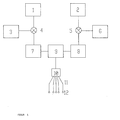
- a suitable application system is e.g. shown in Figure 1.
- 1 means the storage container for component A
- 2 the storage container for component B
- the device which can be used according to the invention essentially consists of three parts, namely the mixing device, a paint distributor and transport lines which lead from the paint distributor to the respective application device.
- the mixing device is indicated by 9, the paint distributor by 10, the transport lines by 11 and the application device by 12.
- components A and B can be continuously mixed in defined proportions immediately before being applied to the wire.
- the paint mixture is supplied separately to each application device and in an amount that corresponds exactly to the consumption.
- the transport route from the mixing device to the application device is kept short.
- the pumps in the example in FIG. 1: numbers 7 and 8) can act continuously (gear pumps) or discontinuously (piston pumps).
- the delivery rate of each pump per unit of time is variably adjustable via engine speed and ratio. This allows the mixing ratio and the amount of paint conveyed to the application device per unit of time to be precisely determined.
- the setting is made in such a way that the delivery rate corresponds to the paint consumption on the application devices.
- the mixing ratio of paint components A and B can be varied and, if necessary, adapted to different requirements. Changing the storage containers of components A or B allows the paint mixture to be quickly changed to a new quality variant.
- the supply of components A and B in front of the pumps can be blocked by means of taps (in the example, Figure 1: Numbers 4 and 5) and switched to the delivery of rinse dilution from the separate containers (in the example: Numbers 3 and 6). This is e.g. required if the painting process is interrupted or ended.
- Inert solvents which are compatible with components A and B are generally used as rinsing diluents, such as those e.g. are described above.
- the components in the mixing device can be mixed mechanically or statically. Have proven successful commercially available static mixing tubes, which bring about perfect homogenization through current division and radial mixing.
- the mixing device is followed by a paint distributor (in the example in FIG. 1: number 10).
- the homogenized paint is divided here for conveying to the individual application devices.
- the path between the mixing device and application device is kept short.
- the paint distributor preferably consists of a short piece of pipe into which flexible capillary pipes, e.g. made of stainless steel.
- flexible capillary pipes e.g. made of stainless steel.
- Tubes or tube-like materials, in particular metal tubes, with an inner diameter of 0.1 to 2.0 mm are referred to here as capillaries, capillary tubes or capillary-like bores.
- the inside diameter is mainly determined by the outflow rate (about 0.2 to 10 ml / min) and the paint viscosity.
- the length of the pipes is determined by the local machine conditions; for example, it is 1-100 cm.
- Devices similar to the capillaries can also be realized with drilled metal or plastic bodies. The effect of such devices is based on the fact that relatively high flow rates (1-100 cm / sec) can be achieved for small amounts of liquid. This ensures that the mixed components do not react in the conveyor system and clogging can be avoided.
- the number of capillaries or holes is determined by the number of wires to be coated (wire runs).
- the length of the capillaries can be varied and adapted to the requirements.
- paint distributors and capillaries e.g. also understood a piece of pipe that is provided with narrow, capillary-like bores and is attached directly above the application device or the application devices.
- Mechanically or electromagnetically adjustable shut-off valves can also be fitted between the paint distributor and application device in order to adapt the paint flow precisely to the consumption of each individual application device. Furthermore, in the case of highly viscous lacquer mixtures, the viscosity can be reduced by means of a heating device for the capillary tubes. The small cable diameter allows good heat transfer.
- the varnish is applied centrally to the wire in a precisely defined amount.
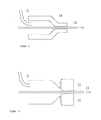
- an application device e.g. the prior art nozzle or felt wipers are used (examples of which are shown in FIGS. 2 and 3.
- FIGS. 2 and 3 show examples of application devices as shown in FIG. 1, for example under number 12 2 and 3, 11 denotes the capillary tube, 13 the wire or the fiber to be coated, 14 a nozzle wiper and 15 a squeeze felt.).
- squeeze felts e.g. number 15 in Figure 3
- a conical funnel which absorbs the amount of paint conveyed, is expediently attached before it is pulled through the felt wiper.
- multiple applicators are used to apply the insulating varnish in multiple Apply layers until the desired increase in paint is achieved.
- Each coat of paint is cured in a drying oven at a temperature of approx. 250 to 500 ° C before the next application.
- the degree of burn-in is regulated by the pull-off speed and the oven temperature.
- the layer thickness is set, for example, by means of nozzle wipers (FIG. 2) or squeeze felt (FIG. 3).
- the paint is preferably transported via capillary tubes directly into a funnel-shaped opening on the application device in an amount which corresponds exactly to the consumption, so that the funnel is always filled but does not overflow.
- the varnish can also be dripped directly onto the wire in front of the application device and is then transported further by this.
- the invention also relates to the device described above. This is not only suitable for carrying out the method according to the invention, but is also suitable for coating wires and fibrous materials or fibers with coating compositions from two-component systems, systems of this type either consisting of individual components which as such, optionally with heating, are liquid are, or by addition of solvent, optionally also with heating, are liquid.
- the method and the device according to the invention make it possible to use wires and fibrous materials such as various fibers, e.g. Glass fibers, carbon fibers, plastic fibers, in a simple manner to be provided with uniform coatings, the elimination of undesired by-products and the emission of solvents being ruled out and at least kept very low.
- electrically conductive wires can be provided with insulating layers without the solderability suffering as a result.
- Other wires or fibers, such as glass fibers can be protected, for example, for protection against mechanical damage, for protection against corrosion or for protection against hydrolysis.
- TI glycerol 306 TI ethylene glycol, 672 TI dimethyl terephthalate and 0.2 TI zinc acetate are heated to 200 ° C under nitrogen; 220 TI of methanol distill off over a column. Then 576 TI isophthalic acid are added at 150 ° C. The temperature is then raised to 210 ° C. in 3 hours and then held until an acid number of 14 is reached. 118 parts of water distill off. The clear resin has a hydroxyl number of 363. The calculated average molecular weight is 513.
- the paint has a viscosity of 115 mPas and a solids content (1 h 180 ° C) of 30.8%.
- the paint is applied by means of nozzles in 8 passes on a copper wire of 0.355 mm diameter and hardened in a vertical oven of 2.4 m length at a circulating air temperature of 450 ° C.
- the lacquering limit is the lacquering speed at which the lacquer no longer adheres to the wire due to insufficient crosslinking in the event of jerky tearing. It is 50 m / min.
- the test values are listed in Table 1.
- 1500 parts of the polyester resin from comparative experiment A are mixed at 100 ° C. with 120 parts of xylene, 185 parts of cyclohexanone and 550 parts of methoxypropyl acetate.
- the solids content (1 h 180 ° C) is 60% and the viscosity is 1720 mPas.
- polyisocyanate component B (Desmodur L 67 @).
- Both components are separately conveyed continuously via electronically controlled precision gear metering pumps to a mixing block with a static mixing tube.
- a coating material with a solids content of 64% by weight is obtained.
- the further transport to the scraper nozzles takes place via 7 capillary tubes, each 40 cm long and 0.05 cm inside diameter.
- the mixing ratio (parts by weight) of component A to component B is 0.92 / 1.
- the conveying speed of the paint mixture is regulated via the pump speed in such a way that no dripping losses occur. Depending on the speed at which the wire is pulled off, it amounts to a total of between 6 and 10 g / min. Wire diameter and furnace setting correspond to comparison test A.
- the processing speed is significantly increased compared to comparative experiment A.
- the test values are listed in Table 1.
- Example 1 Components A and B of Example 1 are mixed as described in Example 1. The mixing ratio of component A to component B is adjusted to 0.74 / 1 (parts by weight). The test values are listed in Table 1.
- Example 1 Components A and B of Example 1 are mixed as described in Example 1. The mixing ratio of component A to component B is adjusted to 0.55 / 1 (parts by weight). The test values are listed in Table 1.
- a mixture of 174 g (1 mol) of tolylene diisocyanate and 168 g (1 mol) of hexamethylene diisocyanate is used as the polyisocyanate component B.
- Both components are mixed as described in Example 1 and applied to the wire.
- the mixing ratio of component A to component B is 1.84 / 1 (parts by weight).
- the painted wire sticks to the deflection wheels of the wire painting furnace and tears. A variation of the painting speed and oven temperature does not improve either.
- Component A corresponds to comparative experiment B.
- polyisocyanate component B the commercially available 67% solution of a reaction product of trimethylolpropane and tolylene diisocyanate is used (Desmodur L 67 @).
- the mixing ratio of component A to component B is 0.48 / 1 (parts by weight).
- trimellitic anhydride After cooling to 90 ° C, 20 g of trimellitic anhydride are added. The temperature is now kept at 90 ° C. for 1 hour. The hydroxyl number is then 314 and the acid number 24, each based on solvent-free resin. The solution has a solids content of 70%.
- polyisocyanate component B (Desmodur L 67 @).
- Example 2 Both components are mixed as described in Example 1 and applied to the wire.
- the mixing ratio of component A to component B is 0.86 / 1 (parts by weight).
- the test results are shown in Table 2.
- Example 2 Components A and B of Example 2 are mixed as described in Example 1. The mixing ratio of component A to component B is adjusted to 0.69 / 1 (parts by weight). The test values are listed in Table 2.
- Example 2 Components A and B of Example 1 are mixed as described in Example 1. The mixing ratio of component A to component B is adjusted to 0.57 / 1 (parts by weight). The test values are listed in Table 2.
Landscapes
- Chemical & Material Sciences (AREA)
- Life Sciences & Earth Sciences (AREA)
- Chemical Kinetics & Catalysis (AREA)
- Engineering & Computer Science (AREA)
- Organic Chemistry (AREA)
- General Chemical & Material Sciences (AREA)
- Materials Engineering (AREA)
- Medicinal Chemistry (AREA)
- Polymers & Plastics (AREA)
- Health & Medical Sciences (AREA)
- Geochemistry & Mineralogy (AREA)
- Manufacturing & Machinery (AREA)
- General Life Sciences & Earth Sciences (AREA)
- Physics & Mathematics (AREA)
- Spectroscopy & Molecular Physics (AREA)
- Application Of Or Painting With Fluid Materials (AREA)
- Paints Or Removers (AREA)
- Organic Insulating Materials (AREA)
- Coating Apparatus (AREA)
- Surface Treatment Of Glass Fibres Or Filaments (AREA)
- Polyurethanes Or Polyureas (AREA)
- Treatments For Attaching Organic Compounds To Fibrous Goods (AREA)
- Wire Bonding (AREA)
Applications Claiming Priority (2)
| Application Number | Priority Date | Filing Date | Title |
|---|---|---|---|
| DE4023061A DE4023061A1 (de) | 1990-07-20 | 1990-07-20 | Verfahren zur herstellung von ueberzuegen auf draehten und faserartigen materialien, sowie hierfuer geeignete vorrichtung |
| DE4023061 | 1990-07-20 |
Publications (3)
| Publication Number | Publication Date |
|---|---|
| EP0467320A2 true EP0467320A2 (fr) | 1992-01-22 |
| EP0467320A3 EP0467320A3 (en) | 1992-09-02 |
| EP0467320B1 EP0467320B1 (fr) | 1996-10-16 |
Family
ID=6410651
Family Applications (1)
| Application Number | Title | Priority Date | Filing Date |
|---|---|---|---|
| EP91111923A Expired - Lifetime EP0467320B1 (fr) | 1990-07-20 | 1991-07-17 | Procédé de réalisation de revêtements de fils |
Country Status (5)
| Country | Link |
|---|---|
| US (1) | US5403615A (fr) |
| EP (1) | EP0467320B1 (fr) |
| JP (1) | JPH04231358A (fr) |
| AT (1) | ATE144347T1 (fr) |
| DE (2) | DE4023061A1 (fr) |
Cited By (1)
| Publication number | Priority date | Publication date | Assignee | Title |
|---|---|---|---|---|
| CN111804504A (zh) * | 2020-05-29 | 2020-10-23 | 中国船舶重工集团公司第七0七研究所 | 一种基于毛细作用的光纤环圈制作用在线施胶装置 |
Families Citing this family (12)
| Publication number | Priority date | Publication date | Assignee | Title |
|---|---|---|---|---|
| DE4201346C2 (de) * | 1992-01-20 | 1994-05-05 | Herberts Gmbh | Verfahren zur Herstellung von isolierenden Überzügen auf elektrischen Leitern und hierfür geeignete Vorrichtung |
| DE4201376C1 (fr) * | 1992-01-20 | 1993-01-28 | Herberts Gmbh, 5600 Wuppertal, De | |
| JP4494829B2 (ja) * | 2004-03-03 | 2010-06-30 | 東レエンジニアリング株式会社 | 塗布液供給装置および塗布液供給方法 |
| EP2193024A4 (fr) | 2007-09-25 | 2013-11-06 | Entrotech Inc | Films de remplacement de peinture, composites de ceux-ci, et procédés associés |
| US10981371B2 (en) | 2008-01-19 | 2021-04-20 | Entrotech, Inc. | Protected graphics and related methods |
| US9790318B2 (en) | 2008-09-26 | 2017-10-17 | entrotech, inc | Methods for polymerizing films in-situ |
| BRPI0923623B1 (pt) * | 2008-12-23 | 2020-03-03 | Basf Se | Elemento compósito, processo para a produção de elementos compósitos, e, componente no acabamento de aeronave, veículos ou de construções |
| DE102009003512A1 (de) * | 2009-02-20 | 2010-09-02 | Elantas Gmbh | Umweltfreundlicher lötbarer Drahtlack |
| EP2767625B1 (fr) * | 2013-02-13 | 2017-01-11 | Maschinenfabrik Rieter Ag | Poste de filage d'un métier à filer |
| US9290863B2 (en) * | 2013-02-13 | 2016-03-22 | Maschinenfabrik Rieter Ag | Spinning unit of an air-jet spinning machine |
| SI3419826T1 (sl) | 2016-09-20 | 2026-01-30 | Ppg Advanced Surface Technologies, Llc | Metoda oblikovanja aplikacij barvne folije, aplikacije barvne folije, izdelki in uporaba |
| CN118403760B (zh) * | 2024-06-25 | 2024-10-15 | 国网湖北省电力有限公司 | 一种电网用紧急防火保护涂层喷涂设备 |
Family Cites Families (12)
| Publication number | Priority date | Publication date | Assignee | Title |
|---|---|---|---|---|
| FR2044202A5 (en) * | 1969-05-12 | 1971-02-19 | Martin Sweets Cy Inc | Coating long tubular objects with a foam - material |
| GB1434926A (en) * | 1972-04-25 | 1976-05-12 | Imp Metal Ind Kynoch Ltd | Impregnating fibre material |
| US3891785A (en) * | 1973-03-20 | 1975-06-24 | Usm Corp | Process for forming a flexible polyurethane coating |
| US4070509A (en) * | 1975-07-28 | 1978-01-24 | Grow Chemical Corporation | High solids urethanes and application thereof |
| US3960530A (en) * | 1975-07-28 | 1976-06-01 | Northern Electric Company Limited | Method of coating a glass fiber filament |
| DE3133571A1 (de) * | 1981-08-25 | 1983-03-10 | Bayer Ag, 5090 Leverkusen | Verfahren zur herstellung von ueberzuegen und die verwendung von n,n',n" -tris-(2-hydroxyethyl)-isocyanurat als zusatzmittel fuer drahtlacke auf polyurethanbasis |
| DE3242089A1 (de) * | 1982-11-13 | 1984-05-17 | Basf Ag | Verfahren zur kontinuierlichen herstellung von halbzeug aus faserverstaerkten, thermoplastischen polyurethanen |
| US4533598A (en) * | 1983-11-18 | 1985-08-06 | Caschem, Inc. | Extended polyurethanes |
| US4518633A (en) * | 1984-04-06 | 1985-05-21 | Northern Telecom Limited | Production of insulated electrical conductors |
| US4542049A (en) * | 1984-08-28 | 1985-09-17 | Ashland Oil, Inc. | Flexibilized polyurethane pipe coating |
| EP0287192A3 (fr) * | 1987-04-16 | 1990-07-18 | Texaco Development Corporation | Méthode pour revêtir un toron |
| US4867775A (en) * | 1988-08-08 | 1989-09-19 | Corning Incorporated | Method and apparatus for coating optical fibers |
-
1990
- 1990-07-20 DE DE4023061A patent/DE4023061A1/de not_active Withdrawn
-
1991
- 1991-07-17 AT AT91111923T patent/ATE144347T1/de not_active IP Right Cessation
- 1991-07-17 EP EP91111923A patent/EP0467320B1/fr not_active Expired - Lifetime
- 1991-07-17 DE DE59108278T patent/DE59108278D1/de not_active Expired - Fee Related
- 1991-07-19 JP JP3179526A patent/JPH04231358A/ja active Pending
-
1993
- 1993-07-13 US US08/091,397 patent/US5403615A/en not_active Expired - Fee Related
Cited By (2)
| Publication number | Priority date | Publication date | Assignee | Title |
|---|---|---|---|---|
| CN111804504A (zh) * | 2020-05-29 | 2020-10-23 | 中国船舶重工集团公司第七0七研究所 | 一种基于毛细作用的光纤环圈制作用在线施胶装置 |
| CN111804504B (zh) * | 2020-05-29 | 2021-12-31 | 中国船舶重工集团公司第七0七研究所 | 一种基于毛细作用的光纤环圈制作用在线施胶装置 |
Also Published As
| Publication number | Publication date |
|---|---|
| US5403615A (en) | 1995-04-04 |
| DE4023061A1 (de) | 1992-04-16 |
| ATE144347T1 (de) | 1996-11-15 |
| EP0467320A3 (en) | 1992-09-02 |
| JPH04231358A (ja) | 1992-08-20 |
| EP0467320B1 (fr) | 1996-10-16 |
| DE59108278D1 (de) | 1996-11-21 |
Similar Documents
| Publication | Publication Date | Title |
|---|---|---|
| EP0467320B1 (fr) | Procédé de réalisation de revêtements de fils | |
| DE3606028C2 (fr) | ||
| DE2404740A1 (de) | Verfahren zur herstellung von filmen und ueberzuegen | |
| DE4201376C1 (fr) | ||
| EP1311588A1 (fr) | Solution de resine de polyamidimide et son utilisation pour la production de vernis pour fils de fer | |
| EP0502858B1 (fr) | Vernis pour fils metalliques et procede pour l'enduction en continu de tels fils | |
| DE2632047C3 (de) | Verwendung von Polyesterurethanlacken | |
| DE19507942A1 (de) | Drahtbeschichtungsmittel sowie Verfahren zu dessen Herstellung | |
| EP0918829A1 (fr) | Email isolant contenant des polyester-imides et/ou des polyamide-imides avec des polyoxyalkylene-diamines comme constituants moleculaires | |
| DE2404739C2 (de) | Verfahren zur Herstellung von Filmen und Überzügen | |
| DE3133571A1 (de) | Verfahren zur herstellung von ueberzuegen und die verwendung von n,n',n" -tris-(2-hydroxyethyl)-isocyanurat als zusatzmittel fuer drahtlacke auf polyurethanbasis | |
| DE2920985A1 (de) | Verfahren zur herstellung eines kationischen elektrotauchlackierungsharzes | |
| EP0941273B1 (fr) | Procede de preparation de polyester-imides contenant des groupes carboxyle et hydroxyle et leur utilisation dans des vernis pour fils de fer | |
| DE1644794A1 (de) | Lackmischung fuer Einbrennlacke | |
| DE3905287A1 (de) | Verfahren zum kontinuierlichen beschichten von draehten sowie die verwendung der so hergestellten draehte | |
| DE2032075C3 (de) | Mehrschichtisolierstoffe | |
| DE4201346C2 (de) | Verfahren zur Herstellung von isolierenden Überzügen auf elektrischen Leitern und hierfür geeignete Vorrichtung | |
| DE1646024A1 (de) | Beschichtungsverfahren | |
| DE2442434A1 (de) | Pulverfoermiges ueberzugsmittel | |
| DE2443576C3 (de) | Verwendung von Imid-Gruppen enthaltenden Polykondensaten zur Lackierung | |
| DE1720694C3 (de) | Verfahren zur Herstellung von Imidgruppen enthaltenden Polyhydantoinen |
Legal Events
| Date | Code | Title | Description |
|---|---|---|---|
| PUAI | Public reference made under article 153(3) epc to a published international application that has entered the european phase |
Free format text: ORIGINAL CODE: 0009012 |
|
| AK | Designated contracting states |
Kind code of ref document: A2 Designated state(s): AT CH DE ES FR GB IT LI NL SE |
|
| PUAL | Search report despatched |
Free format text: ORIGINAL CODE: 0009013 |
|
| AK | Designated contracting states |
Kind code of ref document: A3 Designated state(s): AT CH DE ES FR GB IT LI NL SE |
|
| 17P | Request for examination filed |
Effective date: 19930221 |
|
| 17Q | First examination report despatched |
Effective date: 19950223 |
|
| GRAH | Despatch of communication of intention to grant a patent |
Free format text: ORIGINAL CODE: EPIDOS IGRA |
|
| GRAH | Despatch of communication of intention to grant a patent |
Free format text: ORIGINAL CODE: EPIDOS IGRA |
|
| GRAA | (expected) grant |
Free format text: ORIGINAL CODE: 0009210 |
|
| AK | Designated contracting states |
Kind code of ref document: B1 Designated state(s): AT CH DE FR GB IT LI SE |
|
| REF | Corresponds to: |
Ref document number: 144347 Country of ref document: AT Date of ref document: 19961115 Kind code of ref document: T |
|
| REG | Reference to a national code |
Ref country code: CH Ref legal event code: NV Representative=s name: DIETLIN & CIE S.A. |
|
| ITF | It: translation for a ep patent filed | ||
| GBT | Gb: translation of ep patent filed (gb section 77(6)(a)/1977) |
Effective date: 19961017 |
|
| REF | Corresponds to: |
Ref document number: 59108278 Country of ref document: DE Date of ref document: 19961121 |
|
| ET | Fr: translation filed | ||
| PLBE | No opposition filed within time limit |
Free format text: ORIGINAL CODE: 0009261 |
|
| STAA | Information on the status of an ep patent application or granted ep patent |
Free format text: STATUS: NO OPPOSITION FILED WITHIN TIME LIMIT |
|
| 26N | No opposition filed | ||
| PGFP | Annual fee paid to national office [announced via postgrant information from national office to epo] |
Ref country code: GB Payment date: 19980619 Year of fee payment: 8 |
|
| PGFP | Annual fee paid to national office [announced via postgrant information from national office to epo] |
Ref country code: SE Payment date: 19980720 Year of fee payment: 8 Ref country code: AT Payment date: 19980720 Year of fee payment: 8 |
|
| PGFP | Annual fee paid to national office [announced via postgrant information from national office to epo] |
Ref country code: CH Payment date: 19980722 Year of fee payment: 8 |
|
| PG25 | Lapsed in a contracting state [announced via postgrant information from national office to epo] |
Ref country code: GB Free format text: LAPSE BECAUSE OF NON-PAYMENT OF DUE FEES Effective date: 19990717 Ref country code: AT Free format text: LAPSE BECAUSE OF NON-PAYMENT OF DUE FEES Effective date: 19990717 |
|
| PG25 | Lapsed in a contracting state [announced via postgrant information from national office to epo] |
Ref country code: SE Free format text: THE PATENT HAS BEEN ANNULLED BY A DECISION OF A NATIONAL AUTHORITY Effective date: 19990730 |
|
| PG25 | Lapsed in a contracting state [announced via postgrant information from national office to epo] |
Ref country code: LI Free format text: LAPSE BECAUSE OF NON-PAYMENT OF DUE FEES Effective date: 19990731 Ref country code: CH Free format text: LAPSE BECAUSE OF NON-PAYMENT OF DUE FEES Effective date: 19990731 |
|
| GBPC | Gb: european patent ceased through non-payment of renewal fee |
Effective date: 19990717 |
|
| REG | Reference to a national code |
Ref country code: CH Ref legal event code: PL |
|
| EUG | Se: european patent has lapsed |
Ref document number: 91111923.8 |
|
| PGFP | Annual fee paid to national office [announced via postgrant information from national office to epo] |
Ref country code: FR Payment date: 20000712 Year of fee payment: 10 |
|
| PGFP | Annual fee paid to national office [announced via postgrant information from national office to epo] |
Ref country code: DE Payment date: 20000916 Year of fee payment: 10 |
|
| PG25 | Lapsed in a contracting state [announced via postgrant information from national office to epo] |
Ref country code: FR Free format text: LAPSE BECAUSE OF NON-PAYMENT OF DUE FEES Effective date: 20020329 |
|
| PG25 | Lapsed in a contracting state [announced via postgrant information from national office to epo] |
Ref country code: DE Free format text: LAPSE BECAUSE OF NON-PAYMENT OF DUE FEES Effective date: 20020501 |
|
| REG | Reference to a national code |
Ref country code: FR Ref legal event code: ST |
|
| PG25 | Lapsed in a contracting state [announced via postgrant information from national office to epo] |
Ref country code: IT Free format text: LAPSE BECAUSE OF NON-PAYMENT OF DUE FEES;WARNING: LAPSES OF ITALIAN PATENTS WITH EFFECTIVE DATE BEFORE 2007 MAY HAVE OCCURRED AT ANY TIME BEFORE 2007. THE CORRECT EFFECTIVE DATE MAY BE DIFFERENT FROM THE ONE RECORDED. Effective date: 20050717 |