EP0468317A2 - Procédé de fabrication de matériau magnétique à base du système de substances Sm-Fe-N - Google Patents
Procédé de fabrication de matériau magnétique à base du système de substances Sm-Fe-N Download PDFInfo
- Publication number
- EP0468317A2 EP0468317A2 EP91111665A EP91111665A EP0468317A2 EP 0468317 A2 EP0468317 A2 EP 0468317A2 EP 91111665 A EP91111665 A EP 91111665A EP 91111665 A EP91111665 A EP 91111665A EP 0468317 A2 EP0468317 A2 EP 0468317A2
- Authority
- EP
- European Patent Office
- Prior art keywords
- phase
- hard magnetic
- preliminary product
- nitrogen
- temperature
- Prior art date
- Legal status (The legal status is an assumption and is not a legal conclusion. Google has not performed a legal analysis and makes no representation as to the accuracy of the status listed.)
- Granted
Links
Images


Classifications
-
- H—ELECTRICITY
- H01—ELECTRIC ELEMENTS
- H01F—MAGNETS; INDUCTANCES; TRANSFORMERS; SELECTION OF MATERIALS FOR THEIR MAGNETIC PROPERTIES
- H01F1/00—Magnets or magnetic bodies characterised by the magnetic materials therefor; Selection of materials for their magnetic properties
- H01F1/01—Magnets or magnetic bodies characterised by the magnetic materials therefor; Selection of materials for their magnetic properties of inorganic materials
- H01F1/03—Magnets or magnetic bodies characterised by the magnetic materials therefor; Selection of materials for their magnetic properties of inorganic materials characterised by their coercivity
- H01F1/032—Magnets or magnetic bodies characterised by the magnetic materials therefor; Selection of materials for their magnetic properties of inorganic materials characterised by their coercivity of hard-magnetic materials
- H01F1/04—Magnets or magnetic bodies characterised by the magnetic materials therefor; Selection of materials for their magnetic properties of inorganic materials characterised by their coercivity of hard-magnetic materials metals or alloys
- H01F1/047—Alloys characterised by their composition
- H01F1/053—Alloys characterised by their composition containing rare earth metals
- H01F1/055—Alloys characterised by their composition containing rare earth metals and magnetic transition metals, e.g. SmCo5
- H01F1/059—Alloys characterised by their composition containing rare earth metals and magnetic transition metals, e.g. SmCo5 and Va elements, e.g. Sm2Fe17N2
- H01F1/0593—Alloys characterised by their composition containing rare earth metals and magnetic transition metals, e.g. SmCo5 and Va elements, e.g. Sm2Fe17N2 of tetragonal ThMn12-structure
-
- C—CHEMISTRY; METALLURGY
- C01—INORGANIC CHEMISTRY
- C01B—NON-METALLIC ELEMENTS; COMPOUNDS THEREOF; METALLOIDS OR COMPOUNDS THEREOF NOT COVERED BY SUBCLASS C01C
- C01B21/00—Nitrogen; Compounds thereof
- C01B21/06—Binary compounds of nitrogen with metals, with silicon, or with boron, or with carbon, i.e. nitrides; Compounds of nitrogen with more than one metal, silicon or boron
- C01B21/0602—Binary compounds of nitrogen with metals, with silicon, or with boron, or with carbon, i.e. nitrides; Compounds of nitrogen with more than one metal, silicon or boron with two or more other elements chosen from metals, silicon or boron
-
- C—CHEMISTRY; METALLURGY
- C01—INORGANIC CHEMISTRY
- C01P—INDEXING SCHEME RELATING TO STRUCTURAL AND PHYSICAL ASPECTS OF SOLID INORGANIC COMPOUNDS
- C01P2002/00—Crystal-structural characteristics
- C01P2002/70—Crystal-structural characteristics defined by measured X-ray, neutron or electron diffraction data
- C01P2002/72—Crystal-structural characteristics defined by measured X-ray, neutron or electron diffraction data by d-values or two theta-values, e.g. as X-ray diagram
-
- C—CHEMISTRY; METALLURGY
- C01—INORGANIC CHEMISTRY
- C01P—INDEXING SCHEME RELATING TO STRUCTURAL AND PHYSICAL ASPECTS OF SOLID INORGANIC COMPOUNDS
- C01P2004/00—Particle morphology
- C01P2004/60—Particles characterised by their size
- C01P2004/61—Micrometer sized, i.e. from 1-100 micrometer
-
- C—CHEMISTRY; METALLURGY
- C01—INORGANIC CHEMISTRY
- C01P—INDEXING SCHEME RELATING TO STRUCTURAL AND PHYSICAL ASPECTS OF SOLID INORGANIC COMPOUNDS
- C01P2006/00—Physical properties of inorganic compounds
- C01P2006/42—Magnetic properties
Definitions
- the invention relates to processes for the production of magnetic material based on the material system Sm-Fe-N with a crystalline, hard magnetic phase with a Th 2 Zn 17 crystal structure, in the crystal lattice of which N atoms are incorporated by using a preliminary product of the magnetic material to be produced two-component Sm 2 Fe 17 phase is heated in a nitrogen-containing atmosphere.
- magnetic materials based on material systems have been known that contain a rare earth metal and a transition metal and are characterized by high coercive field strengths H ci and high energy products (W * H) max.
- the main representatives are the binary material system Co-Sm and the ternary material system Nd-Fe-B.
- Their hard magnetic properties are based on intermetallic compounds with a high magnetic anisotropy and a high microstructure in the respective materials.
- These magnetic materials can be produced, for example, by sintering powders of the components of the corresponding material system (see, for example, EP-A-0 134 304).
- it is also possible to manufacture corresponding magnetic materials using a so-called rapid solidification technique see, for example, EP-A-0 284 832).
- the object of the present invention is to design this known method for producing a hard magnetic material based on the material system Sm-Fe-N in such a way that the formation of the desired hard magnetic phase can be ensured in a relatively simple manner and a material with a high coercive force H ci ; of in particular over 5 kA / cm can be obtained.
- This object is achieved according to the invention for a first method with the features mentioned at the outset by first producing a preliminary product with the two-component S M2 Fe 17 phase by mechanical alloying of corresponding starting powders and by heat treatment with a microstructure corresponding to the hard magnetic phase of the magnetic material and that this preliminary product is then converted into the hard magnetic phase of the Sm-Fe-N material system in the nitrogen-containing atmosphere.
- the invention is based on the knowledge that, with the incorporation of N atoms within the known Th 2 Zn 17 crystal structure, a material which has hard magnetic properties can be obtained without changing the lattice type.
- the preliminary product can advantageously already be formed with the microstructure of the end product to be produced. This preliminary product structured in this way can then be nitrided relatively simply and reproducibly at elevated temperature.
- a further process for the production of the magnetic material is characterized in that a preliminary product with the two-component Sm 2 Fe 17 phase by rapid solidification of a melted master alloy of the composition Sm x Fe 100-x with 10 ⁇ x 20 (each in atom%) is included a microstructure corresponding to the hard magnetic phase of the magnetic material is produced and then this preliminary product is converted into the hard magnetic phase of the material system Sm-Fe-N in the nitrogen-containing atmosphere.
- This method also has the advantages mentioned.
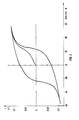
- FIGS. 1 and 2 show X-ray diffractograms or a magnetization curve of a magnetic material obtained via the process of mechanical alloying according to the invention.
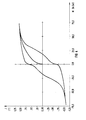
- FIGS. 3 and 4 show X-ray diffraction programs or the hysteresis loop of a magnetic material, for the manufacture of which a rapid solidification technique according to the invention was used.
- a preliminary product with an Sm 2 Fe 17 phase is first produced using a grinding process.
- powders made from or with the components involved are assumed. Either become elementary powders used, or the elements involved can also be present in the form of alloys and / or compounds.
- the powdery starting components with predetermined, generally familiar particle sizes are placed in a suitable grinding device, as is known in principle from mechanical alloying processes (cf., for example, "Metallurgical Transactions", Vol. 5, Aug. 1974, pages 1929 to 1934).
- the quantitative ratio of the individual parts is determined by the predetermined resulting atomic concentration of the preliminary product to be produced.
- Weighing-in (in atomic%) is to be provided, which corresponds to the alloy Sm 12.5 Fe 87.5 .
- the particularly elementary powders of the components involved are then subjected to the grinding process with the aid of hardened steel balls in an Ar-filled steel container, for example.
- the duration t m of the grinding process depends in particular on the grinding parameters. Important parameters are the ball diameter, the number of balls and the materials used for the grinding device.
- the grinding speed and the ratio of the steel balls to the amount of powder are further parameters that determine the necessary grinding time. In general, the grinding time t m is between 1 and 100 hours. A grinding time of two to three days is advantageous. If necessary, the grinding process can also be carried out at elevated temperature.
- the Sm-Fe phase can also be at least partially crystalline.
- the desired Th 2 Z 17 crystal structure with a predetermined grain size that is optimized with regard to the magnetic material to be produced must also be set in this ground material.
- the grain size (size of the crystallites in the grains) should be between 30 nm and 500 nm.
- heat treatment is carried out under a protective gas or vacuum at a temperature between 500 ° C. and 1000 ° C., preferably between 650 ° C. and 800 ° C. The duration of this heat treatment is between 1 minute and 10 hours, preferably between 10 minutes and 1 hour.
- This heat treatment leads on the one hand to the crystallization of the Th 2 Zni 7 phase and on the other hand to the setting of the very fine microstructure, which is essential for magnetic hardening in this material.
- the end of the heat treatment there is a corresponding preliminary product with the soft magnetic Sm 2 Fe 17 phase.
- the powdery precursor obtained in this way is then annealed with the Sm 2 Fe 17 phase in a nitrogen (N 2 ) atmosphere.
- the temperature to be selected for this should be above 300 ° C and below 600 ° C. In general, a total duration of between 1 and 1000 hours, advantageously between 10 and 300 hours, should be provided for this heat treatment.
- nitrogen atoms are incorporated into the crystal lattice. The result is a compound Sm 2 Fe 17 N x. It was found that this compound exists for nitrogen concentrations x for which 0 ⁇ x ⁇ 3.
- the thermal stability of the compound Sm 2 Fe 17 N x decreases significantly as the N content decreases.
- the nitrate ion is too rapid at, for example, 500 ° C.
- the Th 2 Zn 17 phase may decompose.
- Table 1 below shows the clear dependence of the decomposition temperature T d [in C] on the nitrogen concentration x [in atoms per unit cell
- the specified measured values are approximate values above which decomposition occurs (onset values):
- the nitration process of the preliminary product is carried out in two stages with regard to the temperature conditions, the temperature in the first stage being at least 50 ° C. lower than is selected for the second stage.
- An exemplary embodiment of a corresponding two-stage nitration is given below:
- the nitration takes place at a temperature T n1 between 300 ° C and 400 ° C for a duration t n1 between 10 and 1000 hours, the specific time to be selected depends on the grain size of the powder of the preliminary product to be nitrided.
- Corresponding examples are shown in Table 2 below:
- a further loading with nitrogen takes place up to the maximum possible concentration of x 3 3 at a temperature T n2 which is higher than the temperature T n1 of the first nitration stage.
- T n2 which is higher than the temperature T n1 of the first nitration stage.
- a temperature T n2 of 500 ° C. is provided for a duration t n2 of 16 hours.
- the thermal stability of the Sm 2 Fe 17 nitride is advantageously increased in the first nitration step to such an extent that the hard magnetic phase cannot decompose at the higher temperature T n2 required for complete nitration in the second nitration step.
- the nitrate of the preliminary product takes place by expanding the Th 2 Zn 17 crystal structure without changing the lattice type and without changing the microstructure.
- This fact can be seen from the X-ray diffractograms (X-ray diffraction spectra), which are shown in the diagram in FIG.
- the diffraction angle 2 * theta (0 in degrees) is entered on the abscissa, while the associated intensity I (in arbitrary units of the counting rate per second) is plotted in the direction of the ordinate.
- the curve shown in the upper part of the diagram, labeled D1 shows the diffractogram for the regrind with the composition Sm 12.5 Fe 87.5 after mechanical alloying.
- the curve has the typical appearance of an amorphous state and additionally shows two broadened a-Fe reflections.
- the Th 2 Zn 17 crystal structure of the intermediate which occurs after a temperature treatment at 700 C, can be seen from the middle curve labeled D2.
- This diffractogram still contains residues of a-Fe.
- the lower diffractogram designated D3, results for the Th 2 Zn 17 crystal structure expanded with the built-in N atoms at 500 C. From a comparison of the two curves D2 and D3 it can easily be seen that the lattice type in the magnetic material according to the invention remains unchanged compared to the preliminary product.
- the hysteresis curve of the crystalline, hard magnetic end product from the Sm-Fe-N material system is shown in the diagram in FIG. 2 as a curve labeled m.
- the field strength H (in kA / cm) is plotted in the direction of the abscissa and the magnetization J (in T) in the ordinate direction.
- the hysteresis curve m shows a remanence J of about 0.71 T and a coercive field strength H ci ; of about 23.5 kA / cm.
- the table shows the increase in the coercive field strength H ci and the decrease in the remanence J, with an increasing proportion of Sm, while the energy density B * H passes through a maximum.
- the magnetic material according to the invention can also be obtained just as well via a preliminary product which was created using a rapid solidification technique.
- the starting components of the preliminary product must first be melted with sufficient purity in an Ar atmosphere to form a preliminary alloy.
- the proportions of the individual components are chosen so that the master alloy has the composition Sm x Fe 100-x , where x is between 10 and 20 (in each case in atomic%).
- Pyrolytic BN or Al 2 O 3 crucibles can be used for melting. In particular, melting in an arc furnace is also possible.
- the master alloy obtained in this way from the starting components can then be converted into a finely crystalline preliminary product by means of the rapid solidification technique known per se.
- melt spinning can advantageously be provided for this purpose, a process which is generally known for the production of amorphous metal alloys (cf., for example, "Zeitschrift fur Metallischen", volume 69, issue 4, 1978, pages 212 to 220).
- the master alloy is melted under a protective gas such as Ar or under vacuum, for example in a quartz or BN crucible at high frequency at a temperature between 1300 ° C. and 1500 ° C., preferably between 1350 ° C. and 1450 ° C.
- a quartz nozzle with a nozzle diameter of, for example, 0.5 mm and a pressing pressure of, for example, 0.25 bar, are sprayed onto a rotating substrate, for example onto a copper wheel or a copper roller.
- the wheel should rotate at a speed such that a substrate speed v s of between 5 m / s and 60 m / s, preferably between 10 m / s and 25 m / s, results on the wheel circumference.
- This gives short, band-shaped pieces of the preliminary product which are relatively brittle and have Sm 2 Fe 17 with the Th 2 Zn 17 crystal structure as the main phase.
- either a choice of suitable deterrent parameters has to be provided.
- quenching from a hot melt at 1400 ° C. with substrate speeds v s between 15 m / s and 20 m / s is particularly favorable.
- thermal aftertreatment in particular very rapidly quenched strips (with v s > 50 m / s) can be provided at temperatures between 500 ° C. and 1000 ° C., preferably between 650 ° C. and 800 ° C.
- the annealing time is generally between 1 minute and 10 hours, preferably between 10 minutes and 1 hour.
- the soft magnetic SmFe 2 phase of the preliminary product is converted into the magnetically harder SmFe 3 phase of an intermediate product.
- the preliminary or intermediate product to be obtained in this way in process B is advantageously mechanically comminuted, preferably ground as finely as possible, in a nitrogen-containing atmosphere before the final thermal treatment in order to reduce the required nitration times.
- the preliminary or intermediate product can be pulverized or ground to particle sizes below 40 ⁇ m. Then it is subjected to an annealing at temperatures between 300 ° C and 600 ° C to form the desired Sm 2 Fe 17 N x phase in accordance with process A for magnetic hardening.
- FIG. 4 shows a further hysteresis curve which results for a magnetic material with the composition Sm 13 Fe 87 N x .
- This material was produced in accordance with the material which results in curve D6 shown in FIG.
- a representation corresponding to FIG. 2 is selected for FIG.
- a maximum coercive field strength H ci of approximately 17.9 kOe, a remanence J of 0.63 T and an energy density (W * H) max of 44 kJ / m 3 can be read from the curve shown in FIG.
Landscapes
- Chemical & Material Sciences (AREA)
- Inorganic Chemistry (AREA)
- Organic Chemistry (AREA)
- Crystallography & Structural Chemistry (AREA)
- Engineering & Computer Science (AREA)
- Power Engineering (AREA)
- Hard Magnetic Materials (AREA)
- Measuring Magnetic Variables (AREA)
- Audible-Bandwidth Dynamoelectric Transducers Other Than Pickups (AREA)
- Video Image Reproduction Devices For Color Tv Systems (AREA)
- Powder Metallurgy (AREA)
- Manufacturing Of Magnetic Record Carriers (AREA)
Applications Claiming Priority (2)
| Application Number | Priority Date | Filing Date | Title |
|---|---|---|---|
| DE4023575A DE4023575A1 (de) | 1990-07-25 | 1990-07-25 | Verfahren zur herstellung von magnetmaterial auf basis des stromsystems sm-fe-n |
| DE4023575 | 1990-07-25 |
Publications (3)
| Publication Number | Publication Date |
|---|---|
| EP0468317A2 true EP0468317A2 (fr) | 1992-01-29 |
| EP0468317A3 EP0468317A3 (en) | 1992-12-09 |
| EP0468317B1 EP0468317B1 (fr) | 1994-12-07 |
Family
ID=6410960
Family Applications (1)
| Application Number | Title | Priority Date | Filing Date |
|---|---|---|---|
| EP91111665A Expired - Lifetime EP0468317B1 (fr) | 1990-07-25 | 1991-07-12 | Procédé de fabrication de matériau magnétique à base du système de substances Sm-Fe-N |
Country Status (6)
| Country | Link |
|---|---|
| EP (1) | EP0468317B1 (fr) |
| JP (1) | JPH04254304A (fr) |
| AT (1) | ATE115326T1 (fr) |
| DE (2) | DE4023575A1 (fr) |
| FI (1) | FI913551A7 (fr) |
| IE (1) | IE912618A1 (fr) |
Cited By (3)
| Publication number | Priority date | Publication date | Assignee | Title |
|---|---|---|---|---|
| EP0596385A1 (fr) * | 1992-11-05 | 1994-05-11 | Th. Goldschmidt AG | Procédé pour la fabrication d'alliages de terres rares du type RE2Fe17-xTMxNy |
| DE4242839A1 (de) * | 1992-12-17 | 1994-06-23 | Siemens Ag | Verfahren zum Herstellen eines magnetisch anisotropen Pulvers aus einem SE-ÜM-N-Magnetwerkstoff |
| WO1995035176A1 (fr) * | 1994-06-22 | 1995-12-28 | Valtion Teknillinen Tutkimuskeskus | Procede de production d'un materiau magnetostrictif |
Family Cites Families (3)
| Publication number | Priority date | Publication date | Assignee | Title |
|---|---|---|---|---|
| DE3669450D1 (de) * | 1985-08-13 | 1990-04-19 | Siemens Ag | Verfahren zur herstellung eines metallischen koerpers aus einer insbesondere amorphen legierung mit zumindest teilweise magnetischen komponenten. |
| JPH0768612B2 (ja) * | 1987-04-20 | 1995-07-26 | 日立金属株式会社 | 希土類金属―鉄族金属ターゲット用合金粉末、希土類金属―鉄族金属ターゲット、およびそれらの製造方法 |
| ATE136680T1 (de) * | 1990-09-04 | 1996-04-15 | Trinity College Dublin | Seltenerd-basierte magnetische materialien, herstellungsverfahren und anwendung |
-
1990
- 1990-07-25 DE DE4023575A patent/DE4023575A1/de not_active Withdrawn
-
1991
- 1991-07-12 EP EP91111665A patent/EP0468317B1/fr not_active Expired - Lifetime
- 1991-07-12 AT AT91111665T patent/ATE115326T1/de not_active IP Right Cessation
- 1991-07-12 DE DE59103763T patent/DE59103763D1/de not_active Expired - Fee Related
- 1991-07-22 JP JP3206369A patent/JPH04254304A/ja not_active Withdrawn
- 1991-07-24 IE IE261891A patent/IE912618A1/en unknown
- 1991-07-24 FI FI913551A patent/FI913551A7/fi not_active Application Discontinuation
Cited By (3)
| Publication number | Priority date | Publication date | Assignee | Title |
|---|---|---|---|---|
| EP0596385A1 (fr) * | 1992-11-05 | 1994-05-11 | Th. Goldschmidt AG | Procédé pour la fabrication d'alliages de terres rares du type RE2Fe17-xTMxNy |
| DE4242839A1 (de) * | 1992-12-17 | 1994-06-23 | Siemens Ag | Verfahren zum Herstellen eines magnetisch anisotropen Pulvers aus einem SE-ÜM-N-Magnetwerkstoff |
| WO1995035176A1 (fr) * | 1994-06-22 | 1995-12-28 | Valtion Teknillinen Tutkimuskeskus | Procede de production d'un materiau magnetostrictif |
Also Published As
| Publication number | Publication date |
|---|---|
| FI913551A0 (fi) | 1991-07-24 |
| DE59103763D1 (de) | 1995-01-19 |
| IE912618A1 (en) | 1992-01-29 |
| FI913551L (fi) | 1992-01-26 |
| JPH04254304A (ja) | 1992-09-09 |
| EP0468317B1 (fr) | 1994-12-07 |
| ATE115326T1 (de) | 1994-12-15 |
| DE4023575A1 (de) | 1992-01-30 |
| EP0468317A3 (en) | 1992-12-09 |
| FI913551A7 (fi) | 1992-01-26 |
Similar Documents
| Publication | Publication Date | Title |
|---|---|---|
| DE3850001T2 (de) | Magnetisches Seltenerd-Eisen-Bor-Puder und sein Herstellungsverfahren. | |
| DE3875183T2 (de) | Dauermagnete. | |
| DE19626049C2 (de) | Magnetwerkstoff und Verbundmagnet | |
| DE69318998T2 (de) | Legierungsblock für einen Dauermagnet, anisotropes Pulver für einen Dauermagnet, Verfahren zur Herstellung eines solchen und Dauermagneten | |
| DE3779481T2 (de) | Dauermagnet und verfahren zu seiner herstellung. | |
| DE69210017T2 (de) | VERFAHREN ZUR HERSTELLUNG VON WEICHMAGNETISCHEN LEGIERUNGEN AUF Fe-Ni BASIS MIT NANOKRISTALLINER STRUKTUR | |
| DE112013007128B4 (de) | Herstellungsverfahren für ein Seltenerd-Permanentmagnetpulver | |
| DE69819854T2 (de) | Seltenerd-Eisen-Bor-Dauermagnet und Herstellungsverfahren | |
| DE4408114B4 (de) | Magnetisches Material | |
| DE3786426T2 (de) | Dauermagnet und Dauermagnetlegierung. | |
| DE69302329T2 (de) | Feinkörniges anisotropes Pulver aus schmelzgesponnenen Bändern | |
| DE10296960T5 (de) | Seltenerdmetall-Magnet und Verfahren zu seiner Herstellung | |
| DE4430964B4 (de) | Magnetmaterial | |
| EP0470475B1 (fr) | Procédé de fabrication d'un corps à partir d'un matériau magnétique anisotrope à base du système de substances Sm-Fe-N | |
| DE4133214C2 (de) | Aus Eisen-Seltenerdmetall-Legierung bestehendes Dauermagnetmaterial | |
| DE19814441B4 (de) | Permanentmagnet-Material und Verbundmagnet | |
| DE69220876T2 (de) | Magnetisches Material | |
| DE60311960T2 (de) | Verfahren zur herstellung eines seltenerdelement-permanentmagneten auf r-t-b-basis | |
| DE69815479T2 (de) | Seltenerd-Dauermagnetmaterial und Herstellungsverfahren | |
| DE3626406A1 (de) | Verfahren zur herstellung von dauermagneten auf der basis von seltenerdmetallen | |
| EP0502397B1 (fr) | Procédé de fabrication d'un matériau magnétiquement doux à base de fer à haute magnétisation de saturation et à structure de graines ultrafine | |
| EP0468317B1 (fr) | Procédé de fabrication de matériau magnétique à base du système de substances Sm-Fe-N | |
| DE4126893A1 (de) | Magnetmaterial auf basis von sm-fe-n und verfahren zu dessen herstellung | |
| DE69102277T2 (de) | Behandlung von magnetpulvermaterialien und so erhaltene gegenstände. | |
| EP0284832A1 (fr) | Procédé de production d'un matériau magnétique anisotrope à base de Fe, B, et un métal de terre rare |
Legal Events
| Date | Code | Title | Description |
|---|---|---|---|
| PUAI | Public reference made under article 153(3) epc to a published international application that has entered the european phase |
Free format text: ORIGINAL CODE: 0009012 |
|
| AK | Designated contracting states |
Kind code of ref document: A2 Designated state(s): AT DE FR GB IT NL |
|
| PUAL | Search report despatched |
Free format text: ORIGINAL CODE: 0009013 |
|
| AK | Designated contracting states |
Kind code of ref document: A3 Designated state(s): AT DE FR GB IT NL |
|
| 17P | Request for examination filed |
Effective date: 19930604 |
|
| 17Q | First examination report despatched |
Effective date: 19930928 |
|
| GRAA | (expected) grant |
Free format text: ORIGINAL CODE: 0009210 |
|
| AK | Designated contracting states |
Kind code of ref document: B1 Designated state(s): AT DE FR GB IT NL |
|
| PG25 | Lapsed in a contracting state [announced via postgrant information from national office to epo] |
Ref country code: IT Free format text: LAPSE BECAUSE OF FAILURE TO SUBMIT A TRANSLATION OF THE DESCRIPTION OR TO PAY THE FEE WITHIN THE PRE;WARNING: LAPSES OF ITALIAN PATENTS WITH EFFECTIVE DATE BEFORE 2007 MAY HAVE OCCURRED AT ANY TIME BEFORE 2007. THE CORRECT EFFECTIVE DATE MAY BE DIFFERENT FROM THE ONE RECORDED.SCRIBED TIME-LIMIT Effective date: 19941207 |
|
| REF | Corresponds to: |
Ref document number: 115326 Country of ref document: AT Date of ref document: 19941215 Kind code of ref document: T |
|
| REF | Corresponds to: |
Ref document number: 59103763 Country of ref document: DE Date of ref document: 19950119 |
|
| GBT | Gb: translation of ep patent filed (gb section 77(6)(a)/1977) |
Effective date: 19950118 |
|
| ET | Fr: translation filed | ||
| PG25 | Lapsed in a contracting state [announced via postgrant information from national office to epo] |
Ref country code: GB Effective date: 19950712 Ref country code: AT Effective date: 19950712 |
|
| PLBE | No opposition filed within time limit |
Free format text: ORIGINAL CODE: 0009261 |
|
| STAA | Information on the status of an ep patent application or granted ep patent |
Free format text: STATUS: NO OPPOSITION FILED WITHIN TIME LIMIT |
|
| 26N | No opposition filed | ||
| PG25 | Lapsed in a contracting state [announced via postgrant information from national office to epo] |
Ref country code: NL Effective date: 19960201 |
|
| GBPC | Gb: european patent ceased through non-payment of renewal fee |
Effective date: 19950712 |
|
| NLV4 | Nl: lapsed or anulled due to non-payment of the annual fee |
Effective date: 19960201 |
|
| PG25 | Lapsed in a contracting state [announced via postgrant information from national office to epo] |
Ref country code: FR Effective date: 19960430 |
|
| REG | Reference to a national code |
Ref country code: FR Ref legal event code: ST |
|
| REG | Reference to a national code |
Ref country code: FR Ref legal event code: ST |
|
| REG | Reference to a national code |
Ref country code: FR Ref legal event code: ST |
|
| PGFP | Annual fee paid to national office [announced via postgrant information from national office to epo] |
Ref country code: DE Payment date: 19980917 Year of fee payment: 8 |
|
| PG25 | Lapsed in a contracting state [announced via postgrant information from national office to epo] |
Ref country code: DE Free format text: LAPSE BECAUSE OF NON-PAYMENT OF DUE FEES Effective date: 20000503 |