EP0468896A1 - Verfahren zur Ausführung einer nasschemischen Reaktion an einer Reihe von Proben, Vorrichtung zum Durchführen des Verfahrens und ihre Anwendung - Google Patents
Verfahren zur Ausführung einer nasschemischen Reaktion an einer Reihe von Proben, Vorrichtung zum Durchführen des Verfahrens und ihre Anwendung Download PDFInfo
- Publication number
- EP0468896A1 EP0468896A1 EP91420225A EP91420225A EP0468896A1 EP 0468896 A1 EP0468896 A1 EP 0468896A1 EP 91420225 A EP91420225 A EP 91420225A EP 91420225 A EP91420225 A EP 91420225A EP 0468896 A1 EP0468896 A1 EP 0468896A1
- Authority
- EP
- European Patent Office
- Prior art keywords
- circuit
- sample
- conduit
- reaction
- reaction chamber
- Prior art date
- Legal status (The legal status is an assumption and is not a legal conclusion. Google has not performed a legal analysis and makes no representation as to the accuracy of the status listed.)
- Granted
Links
Images


Classifications
-
- G—PHYSICS
- G01—MEASURING; TESTING
- G01N—INVESTIGATING OR ANALYSING MATERIALS BY DETERMINING THEIR CHEMICAL OR PHYSICAL PROPERTIES
- G01N35/00—Automatic analysis not limited to methods or materials provided for in any single one of groups G01N1/00 - G01N33/00; Handling materials therefor
-
- G—PHYSICS
- G01—MEASURING; TESTING
- G01N—INVESTIGATING OR ANALYSING MATERIALS BY DETERMINING THEIR CHEMICAL OR PHYSICAL PROPERTIES
- G01N1/00—Sampling; Preparing specimens for investigation
- G01N1/28—Preparing specimens for investigation including physical details of (bio-)chemical methods covered elsewhere, e.g. G01N33/50, C12Q
-
- B—PERFORMING OPERATIONS; TRANSPORTING
- B01—PHYSICAL OR CHEMICAL PROCESSES OR APPARATUS IN GENERAL
- B01J—CHEMICAL OR PHYSICAL PROCESSES, e.g. CATALYSIS OR COLLOID CHEMISTRY; THEIR RELEVANT APPARATUS
- B01J19/00—Chemical, physical or physico-chemical processes in general; Their relevant apparatus
- B01J19/08—Processes employing the direct application of electric or wave energy, or particle radiation; Apparatus therefor
- B01J19/12—Processes employing the direct application of electric or wave energy, or particle radiation; Apparatus therefor employing electromagnetic waves
- B01J19/122—Incoherent waves
- B01J19/126—Microwaves
-
- Y—GENERAL TAGGING OF NEW TECHNOLOGICAL DEVELOPMENTS; GENERAL TAGGING OF CROSS-SECTIONAL TECHNOLOGIES SPANNING OVER SEVERAL SECTIONS OF THE IPC; TECHNICAL SUBJECTS COVERED BY FORMER USPC CROSS-REFERENCE ART COLLECTIONS [XRACs] AND DIGESTS
- Y10—TECHNICAL SUBJECTS COVERED BY FORMER USPC
- Y10T—TECHNICAL SUBJECTS COVERED BY FORMER US CLASSIFICATION
- Y10T436/00—Chemistry: analytical and immunological testing
- Y10T436/11—Automated chemical analysis
- Y10T436/117497—Automated chemical analysis with a continuously flowing sample or carrier stream
-
- Y—GENERAL TAGGING OF NEW TECHNOLOGICAL DEVELOPMENTS; GENERAL TAGGING OF CROSS-SECTIONAL TECHNOLOGIES SPANNING OVER SEVERAL SECTIONS OF THE IPC; TECHNICAL SUBJECTS COVERED BY FORMER USPC CROSS-REFERENCE ART COLLECTIONS [XRACs] AND DIGESTS
- Y10—TECHNICAL SUBJECTS COVERED BY FORMER USPC
- Y10T—TECHNICAL SUBJECTS COVERED BY FORMER US CLASSIFICATION
- Y10T436/00—Chemistry: analytical and immunological testing
- Y10T436/25—Chemistry: analytical and immunological testing including sample preparation
-
- Y—GENERAL TAGGING OF NEW TECHNOLOGICAL DEVELOPMENTS; GENERAL TAGGING OF CROSS-SECTIONAL TECHNOLOGIES SPANNING OVER SEVERAL SECTIONS OF THE IPC; TECHNICAL SUBJECTS COVERED BY FORMER USPC CROSS-REFERENCE ART COLLECTIONS [XRACs] AND DIGESTS
- Y10—TECHNICAL SUBJECTS COVERED BY FORMER USPC
- Y10T—TECHNICAL SUBJECTS COVERED BY FORMER US CLASSIFICATION
- Y10T436/00—Chemistry: analytical and immunological testing
- Y10T436/25—Chemistry: analytical and immunological testing including sample preparation
- Y10T436/25625—Dilution
-
- Y—GENERAL TAGGING OF NEW TECHNOLOGICAL DEVELOPMENTS; GENERAL TAGGING OF CROSS-SECTIONAL TECHNOLOGIES SPANNING OVER SEVERAL SECTIONS OF THE IPC; TECHNICAL SUBJECTS COVERED BY FORMER USPC CROSS-REFERENCE ART COLLECTIONS [XRACs] AND DIGESTS
- Y10—TECHNICAL SUBJECTS COVERED BY FORMER USPC
- Y10T—TECHNICAL SUBJECTS COVERED BY FORMER US CLASSIFICATION
- Y10T436/00—Chemistry: analytical and immunological testing
- Y10T436/25—Chemistry: analytical and immunological testing including sample preparation
- Y10T436/2575—Volumetric liquid transfer
Definitions
- the present invention relates to a method for carrying out a wet chemical reaction on a succession of samples, the method using microwave heating of the sample into which at least one reagent has been introduced. It also relates to an apparatus for carrying out a wet chemical reaction on a succession of samples which implements the process which is the subject of the invention. Is also part of the invention, the use of the device for example for the mineralization of samples.
- An object of the invention is a method and an apparatus for carrying out a wet chemical reaction which can be placed directly between a sampling line, feeding a succession of samples, and either a collector of the products of the chemical reactions of the various samples, or directly a system for analyzing the various products of chemical reactions.
- the expression "a succession of samples” does not designate a set of individual samples previously prepared before being placed in a situation of undergoing a chemical reaction, but samples taken at regular intervals or not by a sampling line and introduced directly into the apparatus , that is to say without prior preparation apart from the predetermination of the quantity of sample treated, the predetermined quantity of sample is defined either by its volume or by its mass.
- the reaction product after having heated the reaction mixture constituted by the sample and the reagent (s), the reaction product can be cooled.
- reagents are introduced into the looped circuit, these reagents can be introduced all at once.
- the reagents are introduced in several installments, after each introduction of reagent the reaction chamber is heated by microwave for a predetermined time.
- the reagents are introduced individually into the looped circuit, so between operations b) and e) described above, operations c) and d) are repeated for each reagent.
- an apparatus for carrying out a chemical reaction by wet process on a succession of samples characterized in that it comprises a circuit comprising a reaction chamber placed in a microwave application cavity and, with reference to the direction of movement of the sample in the circuit, upstream of the reaction chamber, a conduit d supply of samples, at least one conduit for introducing a reagent, a conduit for supplying rinsing liquid, each conduit being provided with a valve, and, downstream of the reaction chamber, a conduit for exit of the reaction product.
- the microwaves are produced by a microwave generator of any known type with which is associated an application cavity in which the reaction chamber is placed.
- microwave application cavity it is possible to use those of the devices marketed by the company PROLABO under the name of MICRODIGEST 300 and MAXIDIGEST MX 350.
- reaction chamber is not critical, a tubular reaction chamber is particularly suitable.
- conduits each being provided with a valve, can lead individually into the circuit, they can also be in parallel and connected to a common conduit which ensures the connection with the circuit.
- the device can comprise a single conduit for introducing a reagent, it can of course comprise several conduits for introducing several reagents, these conduits can lead individually into the circuit, they can also be in parallel and connected to a common conduit which ensures the connection with the circuit.
- the rinsing liquid can be, for example, the liquid used to carry out the chemical reaction, it can also be water.
- the device which is the subject of the invention may comprise, upstream of the reaction chamber, a supply pipe for a standard, optionally provided with a valve.
- This conduit can join the sample supply conduit downstream from its valve.
- a predetermined quantity of sample is fed into the circuit.
- the sampling line can thus include means for determining a volume or a mass of sample to be treated.
- the apparatus, object of the invention is such that the circuit includes means for adjusting the quantity of sample.
- the means for adjusting the amount of sample are means for adjusting the volume of the sample.
- the means for adjusting the volume of the sample comprise a container associated with the sample supply duct, said container being provided with an overflow outlet carrying a valve.
- the means for adjusting the volume of the sample comprise a graduated container associated with the sample supply conduit, said container being provided with an evacuation conduit carrying a valve.
- different volumes of samples can be fed into the circuit of an apparatus, and the choice and adjustment of the volume of the sample can be easily automated using a level detector associated with the container.
- the reagent (s) can be introduced into the circuit directly in the container, thus the mixture between the reagent (s) and the sample can be assured, the conduit connecting the container to the rest of the circuit being provided with a valve.
- the reagent (s) can also be introduced into the circuit downstream of the container. It is then advantageous for a mixing chamber to be placed, in the circuit, downstream of the last reagent inlet conduit, directly at the inlet of the reaction chamber, the conduit connecting the mixing chamber and the reaction chamber being provided with a valve. Thus, in the mixing chamber, mixing between the reagent (s) and the sample can be ensured.
- the apparatus according to the invention may comprise, at the outlet of the reaction chamber, a zone for cooling the product of the reaction.
- the sample, the reagent (s), the rinsing liquid, the reaction product and possibly the standard can circulate in the circuit under the effect of gravity or even under the effect of the sample pressure, or reagent (s), or rinse aid.
- the device is such that it includes circulation means which can be constituted by a pump of any type usually used.
- a volumetric pump is preferably used which delivers a continuous flow.
- a volumetric pump comprises at least two pistons mounted in opposition displaced by a cam rotating around an axis perpendicular to the axis of displacement of the pistons and return means associated with each piston.
- the wet chemical reaction apparatus which is the subject of the invention is such that the circuit is a looped circuit which comprises an expansion vessel, the outlet pipe for the reaction product being provided with a valve.
- a loop circuit makes it possible to heat the reaction chamber after each introduction of reagent, the expansion vessel allowing the volume of the liquid contained in the circuit to increase, increase due to the introduction of the reactants into the circuit.
- the expansion vessel can be the container for means for adjusting the volume of the sample.
- any product, such as sample, reagent, standard, rinsing liquid, intended, during the implementation of the process, to pass through the reaction chamber is said to be introduced into the looped circuit upstream of the reaction chamber.
- the reaction product leaves the circuit downstream of the reaction chamber because it no longer passes through the reaction chamber.
- the apparatus may include means for monitoring the progress of the reaction.
- the means for monitoring the progress of the reaction can be constituted by a measurement probe placed within the product of the reaction measuring, for example, the conductivity thereof.
- the control means can also proceed by measuring the optical density or by monitoring the coloration of the reaction product, an area of the circuit being made of transparent material.
- the wet chemical reaction apparatus according to the invention can be controlled manually by an operator operating the various valves, the microwave heating and possibly the circulation means and / or the cooling zone according to a predetermined cycle.
- the device comprises control means, such as a microprocessor, which operate, according to a predetermined cycle, the opening and closing of the valves, the starting and stopping of the heating by microwaves and possibly circulation means and / or the cooling zone.
- control means such as a microprocessor, which operate, according to a predetermined cycle, the opening and closing of the valves, the starting and stopping of the heating by microwaves and possibly circulation means and / or the cooling zone.
- the chemical reaction apparatus object of the invention, is advantageously made of materials resistant to corrosion, the reagents used being particularly aggressive and the temperature reached in the reaction chamber being high.
- an apparatus is made of glass and / or polytetrafluoroethylene.
- the chemical reaction apparatus object of the invention, can carry out various wet chemical reactions on a succession of samples. It is particularly intended to be used for chemical reactions of mineralization of a succession of samples.
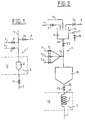
- FIG. 1 diagrammatically represents an embodiment of the apparatus for carrying out a wet chemical reaction on a succession of samples, according to the invention.
- FIG. 2 schematically represents another embodiment of said device.
- FIG. 3 schematically represents an apparatus, object of the invention, comprising a looped circuit.
- FIG. 4 schematically represents another embodiment of the apparatus according to the invention, comprising a looped circuit.
- FIG. 5 shows various methods of mounting the reaction chamber placed in a microwave application cavity.
- Figure 6 is a block diagram of an embodiment of the circulation means.
- the apparatus for carrying out a wet chemical reaction on a succession of samples using microwave heating shown in FIG. 1 comprises a circuit (1) comprising a reaction chamber (2) placed in an application cavity (3) microwave constituted by the terminal segment of a waveguide (13).
- the apparatus comprises, upstream of the reaction chamber (2) a pipe (4) for supplying samples, a pipe (5) d introduction of at least one reagent, and a conduit (6) for supplying flushing liquid. Downstream of the reaction chamber (2) the apparatus has a conduit (7) for output of the reaction product.
- the line (4) for supplying samples, the line (5) for introducing at least one reagent and the line (6) for supplying rinsing liquid are respectively provided with valves (8, 9, 10 ).
- the conduit (5) for introducing at least one reagent can introduce into the circuit (1), a single reagent or successively several reagents or a mixture of at least two reagents, according to the needs of the chemical reaction.
- the conduit (7) for outputting the reaction product is also provided with a valve (11).
- the valve (11) is intended to prevent the flow of the product out of the circuit (1) for the time necessary for the completion of the reaction in the reaction chamber (2).
- the circuit (1) of the device also has a conduit called a vent (12) intended to put the interior space of the circuit (1) into communication with the atmosphere.
- the vent (12) allows, in particular, gases, born of the chemical reaction, to escape outside the circuit (1).
- the sample supply conduit (4) is connected to a source of samples constituted for example by a sampling line coming from an installation.
- the rinsing liquid supply duct (6) is connected to a source of rinsing liquid.
- valves (8, 9, 10, 11) being closed beforehand, the valve (8) of the conduit (4) for supplying samples is opened and a predetermined quantity of sample is fed into the circuit (1) a], upstream of the reaction chamber (2), for example by means of a positive displacement pump. The valve (8) is then closed.
- valve (9) of the pipe (5) for introducing a reagent is opened and the desired amount of reagent is introduced into the circuit (1) [operation b], for example by means of a positive displacement pump, then close the valve (9).
- the sample and the reagent are therefore present in the reaction chamber (2).
- the microwave generator is put into operation for a predetermined time and the reaction chamber (2) placed in the application cavity (3) of the microwaves is thus heated [operation c].
- valve (11) is then opened and the product of the chemical reaction [operation d] is recovered via the outlet pipe (7), this leaving the circuit (1) under the effect of gravity.
- valve (10) of the rinsing liquid supply pipe (6) is opened and rinses the circuit, [operation e], the soiled rinsing liquid leaving the circuit (1) through the conduit (7) being directed to an effluent storage tank.
- valve (10) of the conduit (6) for rinsing liquid supply is closed, then the valve (11) of the outlet conduit (7), the device is ready to receive a new sample supplied by the conduit (4) connected to the sampling line and to carry out a wet chemical reaction on a new sample by repeating the operations a) to e) above.
- the apparatus for carrying out a chemical reaction on a succession of samples also comprises a circuit (1) comprising a reaction chamber (2) placed in an application cavity (3) for micro- waves. It further comprises means (14) for adjusting the quantity of sample and a conduit (15) for supplying a standard.
- the means for adjusting the amount of sample (14) are means for adjusting the volume of the sample. According to the present embodiment, they consist of a container (16) into which the sample supply duct (4) opens, the container (16) being provided with an overflow outlet (17) carrying a valve (18) and a connecting conduit (24) to the rest of the circuit (1), provided with a valve (25).
- the container (16) is opened to allow the escape of gases from the chemical reaction.
- the circuit (1) as shown has three conduits (51, 52, 53) for the introduction of reagents provided respectively with valves (91, 92, 93), these three conduits are mounted in parallel and are connected to a common conduit ( 19) which provides the link with the circuit (1).
- this Downstream of the common conduit (19) for introducing the reactants into the circuit (1), this presents a mixing chamber (20), placed directly at the inlet (21) of the reaction chamber (2).
- the conduit (22) connecting the mixing chamber (20) and the reaction chamber (2) is provided with a valve (23).
- the reaction chamber (2) as shown is tubular and helically wound, its geometrical characteristics have been determined so that the residence time of the sample and the reagents is sufficient in the reaction chamber (2).
- the reaction product flows directly through the outlet pipe (7).
- the conduit (4) for supplying samples and the conduit (6) for supplying rinse aid being connected respectively to a source of samples and to a source of rinse aid, the valves (8, 10, 9, , 92, 93, 18, 23) are closed.
- a predetermined volume of standard is fed into the circuit (1) [operation a], the standard partially fills the mixing chamber (20).
- the necessary quantities of reagents [operation b] are introduced into the circuit (1) and thereby into the mixing chamber (20), then the valves (91, 92, 93). The reagents and the standard mix in the mixing chamber (20).
- the microwave generator is put into operation and the reaction chamber (2) placed in the application cavity (3) of the microwaves is thus heated.
- the valve (23) is opened, the mixture constituted by the standard and the reagents flows from the mixing chamber (20) to the reaction chamber (2).
- the mixture is heated [operation c] for a predetermined time, linked to the geometric characteristics of the reaction chamber (2).
- the chemical reaction takes place, the product of the reaction corresponding to the standard flows through the outlet pipe (7) [operation d].
- valve (10) of the line (6) for supplying rinsing liquid is opened and the circuit (1) is rinsed [operation e].
- the device is then ready to carry out a wet chemical reaction on a succession of samples.
- valves (10, 91, 92, 93, 18, 23, 25) being closed, we open the valve (8) of the sample supply pipe (4) and the container (16) is filled with means for adjusting (14) the volume of the sample to the top of the overflow outlet (17), then the valve (8) is closed.
- the valve (18) is opened and the excess sample flows through the overflow (17), the volume of sample present in the container (16) and which will be supplied in the circuit (1) is therefore perfectly defined.
- the valve (25) is opened and the sample flows into the mixing chamber (20) [operation a].
- the valves are opened (91, 92, 93) and the necessary reagents are introduced into the circuit (1) [operation b] and thereby into the mixing chamber (20).
- the microwave generator is put into operation and the reaction chamber (2) placed in the application cavity (3) of the microwaves is heated.
- the valve (23) is opened, the mixture, consisting of the sample and the reagents, flows from the mixing chamber (20) to the reaction chamber (2), where it is heated for a predetermined time [operation vs].
- the chemical reaction takes place and the reaction product of the sample flows through the outlet pipe (7) [operation d].
- valve (10) of the line (6) for supplying rinsing liquid is opened and the circuit (1) is rinsed [operation e].
- the device is then ready to carry out a wet chemical reaction on another sample, after opening the valve (8) of the pipe (4) for supplying samples.
- the apparatus for carrying out a chemical reaction on a succession of samples comprises a circuit which is a looped circuit (100).
- any product such as sample, standard, reagent, rinsing liquid, intended to pass through the reaction chamber is supplied or introduced upstream thereof by conduits opening into the circuit in upstream of the reaction chamber.
- the reaction product is recovered downstream of the reaction chamber because it no longer passes through it, the outlet pipe for the reaction product is therefore located downstream of the reaction chamber.
- the looped circuit (100) of the chemical reaction apparatus comprises a reaction chamber (2) placed in the application cavity (3) of the microwaves of a waveguide (13), a cooling zone (26) placed at the outlet of the reaction chamber (2), means for adjusting (14) the volume of the sample and circulation means (27).
- the cooling zone (26) can consist of a coil (28) passing through a refrigerant mixture.
- the means for adjusting (14) the volume of the sample are, according to the present embodiment, constituted by a graduated container (29) provided with a discharge conduit (30) carrying a valve (31).
- the means for adjusting the sample volume (14) are of course placed upstream of the reaction chamber (2).
- the connection conduit (33) of the container (29) to the rest of the looped circuit (100) is provided with a valve (34).
- the container (29) is open at its upper part to allow the escape of gases arising from the chemical reaction.
- the container (29) of the means for adjusting (14) the sample volume constitutes the expansion vessel of the looped circuit (100).
- the circulation means (27) can be constituted by a positive displacement pump delivering a continuous flow, an embodiment of such a pump will be described later.
- a compressed gas supply pipe (39), fitted with a valve (42), opens into the looped circuit (100) directly at the inlet of the reaction chamber (2).
- the circuit (100) Downstream of the reaction chamber (2), the circuit (100) comprises an outlet pipe (7) for the reaction product, provided with a valve (11), which is, according to the present embodiment associated with the graduated container (29).
- the line (4) for supplying samples and the line (6) for supplying rinsing liquid being connected respectively to a source of samples and to a source of rinsing liquid and all the valves of the circuit (100) being closed beforehand, the pump (27) is started, the valve (34) and the valve (8) of the sample supply pipe (4) are opened and the graduated container (29) is filled means for adjusting (14) the sample volume.
- the valves (8) and (34) are closed, then the valve (31) of the evacuation duct (30) is opened, when the level of the sample reaches the graduation of the container (29) corresponding to the chosen volume, the valve (31) is closed.
- the volume of sample present in the container and which will be supplied in the circuit (100) is therefore perfectly defined.
- the valve (34) is opened and the predetermined quantity of sample is fed into the looped circuit (100) [operation a], the sample is circulated by means of the pump (27) in the looped circuit (100) [ operation b].
- the mixture formed by the sample and the first reagent is brought back into the container (29), then circulates in the reaction chamber (2) where it is heated [operation d], the microwave generator having been previously put into operation. operation.
- the product of the first reaction of the sample and of the first reagent is then cooled by passing through the coil (28) of the cooling zone (26).
- the product of the first reaction continues to circulate in the circuit (100), we start the pump (32 d'in) for injection of a second reagent brought by the conduit (52) and we open the valve (92), we thus introduces a second reagent into the looped circuit [operation c], then the valve (92) is closed and the pump (322) is stopped.
- the mixture formed by the product of the first reaction and the second reagent is returned to the container (29) then circulates in the reaction chamber (2) where it is heated [operation d], the mixture undergoes the second reaction.
- the product of the second reaction is then cooled by passing it through the coil (28) of the cooling zone (26).
- valve (34) is closed and the pump (27) is stopped, then the valve (42) of the conduit (39) for supplying compressed gas is opened.
- valve (11) of the reaction product outlet conduit (7) we open the valve (11) of the reaction product outlet conduit (7), the gas pushes, in the looped circuit (100), the reaction product which is recovered [operation e].
- valve (42) and the valve (11) of the outlet pipe (7) are closed.
- the valve (11) of the outlet pipe (7) is opened and the soiled rinsing liquid is directed to an effluent storage tank, then the valve (10) of the pipe (6) is closed. flushing liquid supply and the valve (11) of the outlet pipe (7).
- the device is then ready to carry out a wet chemical reaction on another sample.
- the apparatus for carrying out a chemical reaction on a succession of samples according to the embodiment shown in FIG. 4 comprises a circuit which is a looped circuit (100).
- This looped circuit (100) is analogous to the looped circuit according to the embodiment shown in FIG. 3 and only the different constituent elements will be described.
- the means for adjusting (14) the volume of the sample consist of a container (16) provided with an overflow outlet (17) carrying a valve (18).
- the container (16) is not in the open air, it is provided with a tight cover (35), provided with a vent (36) carrying a valve (37).
- a container makes it possible to carry out chemical reactions at atmospheric pressure or under pressure by closing the valve (37).
- the vent (36) can optionally be connected to a vapor condenser or to a recuperator of the gases born from the chemical reaction.
- the looped circuit (100) comprises three conduits (51, 52, 53) for introducing reagents mounted in parallel and connected to a common conduit (38) on which is placed a volumetric pump (32) for injecting the reagents.
- Each conduit (51, 52, 53) carries a valve (91, 92, 93).
- the looped circuit (100) also includes a conduit (15) feeding a standard, carrying a valve (40).
- the apparatus according to the embodiment shown in FIG. 4 further comprises means (41) for monitoring the progress of the reaction, for example by colorimetry.
- the line (4) for supplying samples and the line (6) for supplying rinsing liquid being connected respectively to a source of samples and to a source of rinsing liquid and all the valves of the circuit (100) being closed beforehand, the pump (27) is started, the valve (34) and the valve (40) of the standard supply pipe (15) are opened and the container (16) is filled means for adjusting (14) the sample volume, up to the overflow outlet (17) then the valve (40) is closed.
- the valve (18) is then opened and the excess standard flows through the overflow (17), the volume of standard present in the container (16) and which will be supplied in the looped circuit (100) is therefore perfectly defined.
- the valve (18) is closed.
- the valve (34) is opened and the predetermined quantity of standard is supplied in the looped circuit (100) [operation a], the standard is circulated by means of the pump (27) in the looped circuit (100) [ operation b].
- the reagent injection pump (32) is started and the valve (91) of the conduit (51) for introducing the first reagent is opened, a first reagent is thus introduced into the looped circuit (100) [ operation c], then the valve (91) is closed and the pump (32) is stopped.
- the mixture formed by the standard and the first reagent is brought back into the container (16) then circulates in the reaction chamber (2) where it is heated [operation d], the microwave generator having been put into operation beforehand .
- the product of the first reaction of the standard and of the first reagent is then cooled by passing through the coil (28) of the cooling zone (26).
- the product of the first reaction continues to circulate in the circuit (100), we start the pump (32) for injecting a second reagent supplied by the conduit (52) and we open the valve (92), we thus introduces a second reagent into the looped circuit (100) [operation c], then the valve (92) is closed and the pump (32) is stopped.
- the mixture formed by the product of the first reaction and the second reagent is returned to the container (16) then circulates in the reaction chamber (2) where it is heated [operation d], the mixture undergoes the second reaction.
- the product of the second reaction is then cooled by passing it through the coil (28) of the cooling zone (26).
- valve (34) is closed, the valve (7) of the outlet pipe (11) and the valve (10) of the pipe (6) for rinsing liquid are opened.
- the rinsing liquid under the effect of the pump (27), circulates in the looped circuit (100) and drives out in front of it the product of the reaction which is recovered by the conduit (7) [operation e].
- the soiled rinsing liquid is sent to an effluent storage tank.
- the looped circuit (100) is therefore rinsed [operation f].
- the apparatus is then ready to carry out a wet chemical reaction on samples by repeating the operations a) to f) above on each sample of the succession.
- the duration of heating of the product in the reaction chamber (2) can be increased or decreased by adjusting the flow rate of the pump (27).
- the looped circuit (100) advantageously comprises a bypass (43) which can be isolated by three-way valves (44, 45), which avoids the cooling of the reaction product by passage through the coil (28) of the cooling means (26).
- FIGS 5a, 5b and 5c schematically show the mounting of the reaction chamber (2) placed in an application cavity (3) of microwaves.
- the microwave application cavity (3) is more specifically the microwave application cavity of a MICRODIGEST 300, apparatus marketed by the company PROLABO.
- the application cavity (3) has on its upper wall (69) an opening (71) which makes it possible to place the reaction chamber (2) in the microwave application cavity (3).
- the application cavity (3) has a chimney (70) bordering the opening (71) and rising to a height such that it forms a microwave absorption barrier.
- the microwave application cavity (3) is more specifically the microwave application cavity of a MAXIDIGEST MX 350, device sold by the company PROLABO.
- the waveguide (13) has an opening (72) formed in its upper wall (69). This opening constitutes a coupling window inclined relative to the direction of propagation f of the microwaves in the application cavity (3).
- the coupling window (72) propagates the microwaves inside the chimney (70) which constitutes a secondary application cavity (31) in which the reaction chamber (2) is placed.
- the circulation means are advantageously used in the apparatus for carrying out a chemical reaction by the wet method on a succession of samples, object of the invention.
- These circulation means are formed by a pump (27) connected to two conduits (46, 47) for connecting the pump (27).
- the pump (27) comprises two pistons (48, 49) mounted in opposition, moving in two cylinders (50, 51), they are driven in a reciprocating linear movement by means of a flat cam (52), having an appropriate profile, to which are associated return means constituted by two springs (53, 54).
- the pistons (48, 49) are mounted symmetrically with respect to the axis of rotation (55) of the cam (52).
- Each piston rod (56, 57) (48, 49) is linearly guided and is provided with an anti-rotation device.
- the rods (56, 57) of the pistons (48, 49) are supported on the cam (52) by means of rollers (58, 59). Permanent contact between the rollers (58, 59) and the cam (52) is ensured by the springs (53, 54).
- the drive axis (73) of the cam (52) is rotated, it is perpendicular to the axis of movement of the pistons (48, 49).
- the drive shaft (73) can be driven by means of a motor and a transmission, for example by belt or by pinions.
- the cam (52) is directly mounted on the output shaft of a geared motor at slow, constant speed and known with precision.
- Each cylinder (50, 51) has its output (60, 61) connected to a three-way and two-position solenoid valve (62, 63).
- the outputs (64) and (65) of the solenoid valves (62, 63) are connected to each other and to the conduit (46) for connecting the pump (27), and the outputs (66) and (67) are connected to each other and to the conduit (47) for connecting the pump (27).
- the operation of the solenoid valves (62, 63) is controlled by means of electrical contacts activated at very precise angular positions of the cam (52).
- the movement of the two pistons (48, 49) is determined by the shape of the cam (52).
- the profile of the latter is defined in such a way that the instantaneous sum of the advance speeds of the pistons is constant.
- the apparatus and the method of wet chemical reaction on a succession of samples are intended to carry out very diverse chemical reactions. They are particularly intended for carrying out chemical reactions such as the acid or alkaline treatment by wet methods of samples for the purposes of dissolution, hydrolysis or mineralization.
Landscapes
- Chemical & Material Sciences (AREA)
- Physics & Mathematics (AREA)
- Health & Medical Sciences (AREA)
- General Health & Medical Sciences (AREA)
- Life Sciences & Earth Sciences (AREA)
- Analytical Chemistry (AREA)
- Biochemistry (AREA)
- General Physics & Mathematics (AREA)
- Immunology (AREA)
- Pathology (AREA)
- Electromagnetism (AREA)
- Toxicology (AREA)
- Organic Chemistry (AREA)
- Chemical Kinetics & Catalysis (AREA)
- Physical Or Chemical Processes And Apparatus (AREA)
- Automatic Analysis And Handling Materials Therefor (AREA)
- Sampling And Sample Adjustment (AREA)
- Devices For Use In Laboratory Experiments (AREA)
- Control Of Non-Electrical Variables (AREA)
- Investigating Or Analyzing Non-Biological Materials By The Use Of Chemical Means (AREA)
Applications Claiming Priority (2)
| Application Number | Priority Date | Filing Date | Title |
|---|---|---|---|
| FR9009663 | 1990-07-24 | ||
| FR9009663A FR2665264A1 (fr) | 1990-07-24 | 1990-07-24 | Procede pour realiser une reaction chimique par voie humide sur une succession d'echantillons, appareil pour la mise en óoeuvre du procede et utilisation dudit appareil. |
Publications (2)
| Publication Number | Publication Date |
|---|---|
| EP0468896A1 true EP0468896A1 (de) | 1992-01-29 |
| EP0468896B1 EP0468896B1 (de) | 1996-01-31 |
Family
ID=9399198
Family Applications (1)
| Application Number | Title | Priority Date | Filing Date |
|---|---|---|---|
| EP91420225A Expired - Lifetime EP0468896B1 (de) | 1990-07-24 | 1991-07-04 | Verfahren zur Ausführung einer nasschemischen Reaktion an einer Reihe von Proben, Vorrichtung zum Durchführen des Verfahrens und ihre Anwendung |
Country Status (11)
| Country | Link |
|---|---|
| US (1) | US5393492A (de) |
| EP (1) | EP0468896B1 (de) |
| JP (1) | JPH0712426B2 (de) |
| KR (1) | KR0159780B1 (de) |
| AT (1) | ATE133581T1 (de) |
| AU (1) | AU644456B2 (de) |
| DE (1) | DE69116761T2 (de) |
| DK (1) | DK0468896T3 (de) |
| ES (1) | ES2082954T3 (de) |
| FR (1) | FR2665264A1 (de) |
| GR (1) | GR3019659T3 (de) |
Cited By (5)
| Publication number | Priority date | Publication date | Assignee | Title |
|---|---|---|---|---|
| WO1993003345A1 (en) * | 1991-08-06 | 1993-02-18 | Pompeo Moscetta | Process and apparatus for the determination of analytes in liquid samples |
| FR2717105A1 (fr) * | 1994-03-11 | 1995-09-15 | Knapp Gunter | Réacteur sous pression pouvant être chauffé par micro-ondes. |
| EP0595084B1 (de) * | 1992-10-30 | 1998-02-18 | Moulinex S.A. | Mikrowellenvorrichtung zur Durchführung chemischer Prozesse |
| US5796080A (en) * | 1995-10-03 | 1998-08-18 | Cem Corporation | Microwave apparatus for controlling power levels in individual multiple cells |
| US5840583A (en) * | 1995-10-03 | 1998-11-24 | Cem Corporation | Microwave assisted chemical processes |
Families Citing this family (15)
| Publication number | Priority date | Publication date | Assignee | Title |
|---|---|---|---|---|
| SE508083C2 (sv) * | 1996-12-12 | 1998-08-24 | Patrik Kaellback | Förfarande och utrustning för att bestämma halten av ett löst ämne i en vätska |
| WO2000036880A2 (en) * | 1998-12-17 | 2000-06-22 | Personal Chemistry I Uppsala Ab | Microwave apparatus and methods for performing chemical reactions |
| EE200200495A (et) | 2000-02-25 | 2004-02-16 | Personal Chemistry I Uppsala Ab | Mikrolainekuumutusseade |
| US6630654B2 (en) * | 2001-10-19 | 2003-10-07 | Personal Chemistry I Uppsala Ab | Microwave heating apparatus |
| US6933482B2 (en) * | 2001-10-19 | 2005-08-23 | Personal Chemistry I Uppsala Ab | Microwave heating apparatus |
| US6744024B1 (en) | 2002-06-26 | 2004-06-01 | Cem Corporation | Reaction and temperature control for high power microwave-assisted chemistry techniques |
| EP1596980A1 (de) * | 2002-12-18 | 2005-11-23 | Biotage AB | Verfahren und vorrichtung zur steuerung chemischer reaktionen |
| FR2849343B1 (fr) * | 2002-12-23 | 2009-01-23 | Aldivia | Synthese chimique comportant un traitement thermique par chauffage dielectrique intermittent, combine a un systeme de recirculation |
| CN100352793C (zh) * | 2006-01-20 | 2007-12-05 | 杨鸿生 | 用于以天然气制乙烯的槽波导微波化学反应设备及制备方法 |
| JP2007307440A (ja) * | 2006-05-16 | 2007-11-29 | Hitachi Plant Technologies Ltd | 化学反応装置 |
| DE102007052325A1 (de) * | 2007-03-29 | 2009-05-07 | Erk Eckrohrkessel Gmbh | Verfahren zum gleitenden Temperieren chemischer Substanzen mit definierten Ein- und Ausgangstemperaturen in einem Erhitzer und Einrichtung zur Durchführung des Verfahrens |
| US8052848B2 (en) * | 2007-06-26 | 2011-11-08 | The Penn State Research Foundation | Ultrasonic and microwave methods for enhancing the rate of a chemical reaction and apparatus for such methods |
| JP2010131590A (ja) * | 2008-10-30 | 2010-06-17 | Shinshu Univ | 化学反応装置および攪拌機構 |
| JP2016222746A (ja) * | 2015-05-26 | 2016-12-28 | 佐々木 洋 | バイオディーゼル燃料抽出装置および抽出方法 |
| KR102337125B1 (ko) * | 2021-07-12 | 2021-12-07 | 재단법인 발효미생물산업진흥원 | 류코노스톡 메센테로이데스 srcm209238 균주를 이용한 생리활성이 증진된 쌀 발효액의 제조방법 및 이에 의해 제조된 쌀 요거트 |
Citations (6)
| Publication number | Priority date | Publication date | Assignee | Title |
|---|---|---|---|---|
| US3449082A (en) * | 1965-09-23 | 1969-06-10 | Int Minerals & Chem Corp | Digestion cell and analyzing system containing same |
| FR2281159A1 (fr) * | 1974-08-07 | 1976-03-05 | British Petroleum Co | Application de l'energie des micro-ondes a des reactions chimiques |
| EP0156742A1 (de) * | 1984-03-05 | 1985-10-02 | SOCIETE PROLABO, Société Anonyme | Automatische Zersetzungsvorrichtung zur individuellen Behandlung von Proben in Behältern |
| EP0275826A1 (de) * | 1986-12-16 | 1988-07-27 | Ciba-Geigy Ag | Steuersystem für eine Probenvorbereitungsvorrichtung |
| US4795713A (en) * | 1986-06-06 | 1989-01-03 | The Boeing Company | Auto-digestor |
| WO1990003840A1 (en) * | 1988-10-10 | 1990-04-19 | Commonwealth Scientific And Industrial Research Organisation | Method and apparatus for continuous chemical reactions |
Family Cites Families (12)
| Publication number | Priority date | Publication date | Assignee | Title |
|---|---|---|---|---|
| US828412A (en) * | 1905-03-28 | 1906-08-14 | Gustaf Adolf Larson | Current-motor. |
| US2730952A (en) * | 1953-09-09 | 1956-01-17 | Edwin J Whiffen | Variable capacity pump |
| US3535482A (en) * | 1968-06-26 | 1970-10-20 | Hammtronics Systems Inc | Microwave apparatus for rapid heating of fluids |
| US3700335A (en) * | 1971-01-21 | 1972-10-24 | Eastman Kodak Co | Process and apparatus for sensitometrically testing a liquid,photosensitive emulsion |
| GB1398639A (en) * | 1972-08-05 | 1975-06-25 | Kanebo Ltd | Generation of gaseous formaldehyde from formaldehyde polymer |
| US4013413A (en) * | 1975-07-10 | 1977-03-22 | The United States Of America As Represented By The Secretary Of Agriculture | Apparatus and method for rapid analyses of plurality of samples |
| US4093867A (en) * | 1976-10-27 | 1978-06-06 | General Signal Corporation | Apparatus for automatically calibrating and testing smoke detectors |
| JPS6036957A (ja) * | 1983-08-10 | 1985-02-26 | Mitsubishi Heavy Ind Ltd | スラリ−中のCaCO↓3濃度の測定方法 |
| US4946797A (en) * | 1986-06-13 | 1990-08-07 | Cem Corporation | Microwave-based Kjeldahl method |
| US4794806A (en) * | 1987-02-13 | 1989-01-03 | Nicoli David F | Automatic dilution system |
| US4978506A (en) * | 1988-05-18 | 1990-12-18 | Westinghouse Electric Corp. | Corrosion product monitoring method and system |
| US5066199A (en) * | 1989-10-23 | 1991-11-19 | Nalco Chemical Company | Method for injecting treatment chemicals using a constant flow positive displacement pumping apparatus |
-
1990
- 1990-07-24 FR FR9009663A patent/FR2665264A1/fr active Granted
-
1991
- 1991-07-04 DK DK91420225.4T patent/DK0468896T3/da active
- 1991-07-04 DE DE69116761T patent/DE69116761T2/de not_active Expired - Lifetime
- 1991-07-04 EP EP91420225A patent/EP0468896B1/de not_active Expired - Lifetime
- 1991-07-04 ES ES91420225T patent/ES2082954T3/es not_active Expired - Lifetime
- 1991-07-04 AT AT91420225T patent/ATE133581T1/de not_active IP Right Cessation
- 1991-07-18 AU AU81151/91A patent/AU644456B2/en not_active Ceased
- 1991-07-23 JP JP3182334A patent/JPH0712426B2/ja not_active Expired - Lifetime
- 1991-07-24 KR KR1019910012719A patent/KR0159780B1/ko not_active Expired - Fee Related
-
1993
- 1993-12-20 US US08/169,540 patent/US5393492A/en not_active Expired - Lifetime
-
1996
- 1996-04-16 GR GR960401040T patent/GR3019659T3/el unknown
Patent Citations (6)
| Publication number | Priority date | Publication date | Assignee | Title |
|---|---|---|---|---|
| US3449082A (en) * | 1965-09-23 | 1969-06-10 | Int Minerals & Chem Corp | Digestion cell and analyzing system containing same |
| FR2281159A1 (fr) * | 1974-08-07 | 1976-03-05 | British Petroleum Co | Application de l'energie des micro-ondes a des reactions chimiques |
| EP0156742A1 (de) * | 1984-03-05 | 1985-10-02 | SOCIETE PROLABO, Société Anonyme | Automatische Zersetzungsvorrichtung zur individuellen Behandlung von Proben in Behältern |
| US4795713A (en) * | 1986-06-06 | 1989-01-03 | The Boeing Company | Auto-digestor |
| EP0275826A1 (de) * | 1986-12-16 | 1988-07-27 | Ciba-Geigy Ag | Steuersystem für eine Probenvorbereitungsvorrichtung |
| WO1990003840A1 (en) * | 1988-10-10 | 1990-04-19 | Commonwealth Scientific And Industrial Research Organisation | Method and apparatus for continuous chemical reactions |
Cited By (6)
| Publication number | Priority date | Publication date | Assignee | Title |
|---|---|---|---|---|
| WO1993003345A1 (en) * | 1991-08-06 | 1993-02-18 | Pompeo Moscetta | Process and apparatus for the determination of analytes in liquid samples |
| US5411708A (en) * | 1991-08-06 | 1995-05-02 | Moscetta; Pompeo | Apparatus for the determination of analytes in liquid samples |
| EP0595084B1 (de) * | 1992-10-30 | 1998-02-18 | Moulinex S.A. | Mikrowellenvorrichtung zur Durchführung chemischer Prozesse |
| FR2717105A1 (fr) * | 1994-03-11 | 1995-09-15 | Knapp Gunter | Réacteur sous pression pouvant être chauffé par micro-ondes. |
| US5796080A (en) * | 1995-10-03 | 1998-08-18 | Cem Corporation | Microwave apparatus for controlling power levels in individual multiple cells |
| US5840583A (en) * | 1995-10-03 | 1998-11-24 | Cem Corporation | Microwave assisted chemical processes |
Also Published As
| Publication number | Publication date |
|---|---|
| DK0468896T3 (da) | 1996-04-29 |
| ATE133581T1 (de) | 1996-02-15 |
| JPH0712426B2 (ja) | 1995-02-15 |
| KR0159780B1 (ko) | 1999-03-30 |
| JPH06178931A (ja) | 1994-06-28 |
| GR3019659T3 (en) | 1996-07-31 |
| AU644456B2 (en) | 1993-12-09 |
| KR920003058A (ko) | 1992-02-29 |
| DE69116761D1 (de) | 1996-03-14 |
| ES2082954T3 (es) | 1996-04-01 |
| US5393492A (en) | 1995-02-28 |
| EP0468896B1 (de) | 1996-01-31 |
| FR2665264A1 (fr) | 1992-01-31 |
| FR2665264B1 (de) | 1994-04-22 |
| AU8115191A (en) | 1992-01-30 |
| DE69116761T2 (de) | 1996-08-14 |
Similar Documents
| Publication | Publication Date | Title |
|---|---|---|
| EP0468896B1 (de) | Verfahren zur Ausführung einer nasschemischen Reaktion an einer Reihe von Proben, Vorrichtung zum Durchführen des Verfahrens und ihre Anwendung | |
| EP0496684B1 (de) | Vorrichtung zur gleichzeitigen Nassbehandlung von mehreren Proben und ihre Verwendung | |
| EP0360487B1 (de) | Verfahren und Vorrichtung zur Bestimmung von in einer Flüssigkeitsprobe enthaltenen Teilchen | |
| BE1001048A5 (fr) | Instrument automatise pour analyse d'echantillon de patient. | |
| FR2470385A1 (fr) | Systeme, procede et appareil pour l'analyse automatique d'echantillons de fluide | |
| FR2461250A1 (fr) | Appareil doseur | |
| EP0914753A1 (de) | Vorrichtung zur ausführung einer chemischen reaktion an einer grossen produktmenge,mittels mikrowellen | |
| FR2477132A1 (fr) | Procede et dispositif d'evacuation de tube d'ebauche pour fibre optique | |
| FR2504112A1 (fr) | Dispositifs de denitrification de solution de nitrates de plutonium et d'uranyle pour l'obtention des oxydes correspondants | |
| EP1033173B1 (de) | Zentrifuge mit Kühlung mittels Ranque-Rohr | |
| BE1001518A3 (fr) | Dispositif pour le prelevement d'echantillons de substances radioactives et/ou toxiques de composants de procede. | |
| FR2720972A1 (fr) | Vulcanisation de pneus: apport de calories par l'intérieur. | |
| CA2105470A1 (fr) | Procede et appareil de synthese en phase heterogene de macromolecules telles que des peptides, des polynucleotides ou des oligosaccharides | |
| FR2715228A1 (fr) | Dispositif d'injection automatique de produits solubilisés ou dilués. | |
| CA3078319C (fr) | Dispositif et procede de coloration d'un materiau organique sur une lame | |
| US8173941B2 (en) | Apparatus for microwave-assisted preparation of specimens | |
| US3827304A (en) | Sample handling method | |
| FR2547449A1 (fr) | Procede de decontamination radioactive d'un generateur de vapeur nucleaire, en operant par commande d'ecoulement | |
| FR2789621A1 (fr) | Dispositif melangeur sous vide pour la coulee de materiaux plastiques polymerisables | |
| FR2982510A1 (fr) | Systeme de decontamination de dechets | |
| FR2628533A1 (fr) | Appareil pour l'analyse et la prise d'echantillons sur des effluents liquides issus d'une installation industrielle | |
| FR2485003A1 (fr) | Appareillage automatise utilisable pour la synthese des peptides en phase solide | |
| EP0576762B1 (de) | Gerät zum Abgeben einer definierten Flüssigkeitsmenge | |
| FR2681431A1 (fr) | Appareil pour realiser une reaction chimique par voie humide simultanement sur une pluralite d'echantillons et utilisation dudit appareil. | |
| FR2531538A1 (en) | Method and apparatus for testing liquid samples |
Legal Events
| Date | Code | Title | Description |
|---|---|---|---|
| PUAI | Public reference made under article 153(3) epc to a published international application that has entered the european phase |
Free format text: ORIGINAL CODE: 0009012 |
|
| AK | Designated contracting states |
Kind code of ref document: A1 Designated state(s): AT BE CH DE DK ES FR GB GR IT LI LU NL SE |
|
| 17P | Request for examination filed |
Effective date: 19920217 |
|
| 17Q | First examination report despatched |
Effective date: 19931021 |
|
| RAP1 | Party data changed (applicant data changed or rights of an application transferred) |
Owner name: SOCIETE PROLABO |
|
| GRAA | (expected) grant |
Free format text: ORIGINAL CODE: 0009210 |
|
| AK | Designated contracting states |
Kind code of ref document: B1 Designated state(s): AT BE CH DE DK ES FR GB GR IT LI LU NL SE |
|
| REF | Corresponds to: |
Ref document number: 133581 Country of ref document: AT Date of ref document: 19960215 Kind code of ref document: T |
|
| REF | Corresponds to: |
Ref document number: 69116761 Country of ref document: DE Date of ref document: 19960314 |
|
| GBT | Gb: translation of ep patent filed (gb section 77(6)(a)/1977) |
Effective date: 19960227 |
|
| ITF | It: translation for a ep patent filed | ||
| REG | Reference to a national code |
Ref country code: ES Ref legal event code: FG2A Ref document number: 2082954 Country of ref document: ES Kind code of ref document: T3 |
|
| REG | Reference to a national code |
Ref country code: DK Ref legal event code: T3 |
|
| REG | Reference to a national code |
Ref country code: GR Ref legal event code: FG4A Free format text: 3019659 |
|
| PLBE | No opposition filed within time limit |
Free format text: ORIGINAL CODE: 0009261 |
|
| STAA | Information on the status of an ep patent application or granted ep patent |
Free format text: STATUS: NO OPPOSITION FILED WITHIN TIME LIMIT |
|
| 26N | No opposition filed | ||
| PGFP | Annual fee paid to national office [announced via postgrant information from national office to epo] |
Ref country code: AT Payment date: 19990618 Year of fee payment: 9 |
|
| PGFP | Annual fee paid to national office [announced via postgrant information from national office to epo] |
Ref country code: DK Payment date: 19990621 Year of fee payment: 9 |
|
| PGFP | Annual fee paid to national office [announced via postgrant information from national office to epo] |
Ref country code: NL Payment date: 19990622 Year of fee payment: 9 |
|
| PGFP | Annual fee paid to national office [announced via postgrant information from national office to epo] |
Ref country code: GR Payment date: 19990625 Year of fee payment: 9 |
|
| PGFP | Annual fee paid to national office [announced via postgrant information from national office to epo] |
Ref country code: ES Payment date: 19990701 Year of fee payment: 9 |
|
| PGFP | Annual fee paid to national office [announced via postgrant information from national office to epo] |
Ref country code: LU Payment date: 19990721 Year of fee payment: 9 |
|
| PGFP | Annual fee paid to national office [announced via postgrant information from national office to epo] |
Ref country code: BE Payment date: 19990730 Year of fee payment: 9 |
|
| PG25 | Lapsed in a contracting state [announced via postgrant information from national office to epo] |
Ref country code: LU Free format text: LAPSE BECAUSE OF NON-PAYMENT OF DUE FEES Effective date: 20000704 Ref country code: DK Free format text: LAPSE BECAUSE OF NON-PAYMENT OF DUE FEES Effective date: 20000704 Ref country code: AT Free format text: LAPSE BECAUSE OF NON-PAYMENT OF DUE FEES Effective date: 20000704 |
|
| PG25 | Lapsed in a contracting state [announced via postgrant information from national office to epo] |
Ref country code: ES Free format text: LAPSE BECAUSE OF NON-PAYMENT OF DUE FEES Effective date: 20000705 |
|
| PG25 | Lapsed in a contracting state [announced via postgrant information from national office to epo] |
Ref country code: GR Free format text: LAPSE BECAUSE OF NON-PAYMENT OF DUE FEES Effective date: 20000731 Ref country code: BE Free format text: LAPSE BECAUSE OF NON-PAYMENT OF DUE FEES Effective date: 20000731 |
|
| BERE | Be: lapsed |
Owner name: SOC. PROLABO Effective date: 20000731 |
|
| PG25 | Lapsed in a contracting state [announced via postgrant information from national office to epo] |
Ref country code: NL Free format text: LAPSE BECAUSE OF NON-PAYMENT OF DUE FEES Effective date: 20010201 |
|
| REG | Reference to a national code |
Ref country code: DK Ref legal event code: EBP |
|
| NLV4 | Nl: lapsed or anulled due to non-payment of the annual fee |
Effective date: 20010201 |
|
| PGFP | Annual fee paid to national office [announced via postgrant information from national office to epo] |
Ref country code: CH Payment date: 20010717 Year of fee payment: 11 |
|
| REG | Reference to a national code |
Ref country code: GB Ref legal event code: IF02 |
|
| PG25 | Lapsed in a contracting state [announced via postgrant information from national office to epo] |
Ref country code: CH Free format text: LAPSE BECAUSE OF NON-PAYMENT OF DUE FEES Effective date: 20020731 Ref country code: LI Free format text: LAPSE BECAUSE OF NON-PAYMENT OF DUE FEES Effective date: 20020731 |
|
| REG | Reference to a national code |
Ref country code: ES Ref legal event code: FD2A Effective date: 20010810 |
|
| PG25 | Lapsed in a contracting state [announced via postgrant information from national office to epo] |
Ref country code: IT Free format text: LAPSE BECAUSE OF NON-PAYMENT OF DUE FEES;WARNING: LAPSES OF ITALIAN PATENTS WITH EFFECTIVE DATE BEFORE 2007 MAY HAVE OCCURRED AT ANY TIME BEFORE 2007. THE CORRECT EFFECTIVE DATE MAY BE DIFFERENT FROM THE ONE RECORDED. Effective date: 20050704 |
|
| REG | Reference to a national code |
Ref country code: CH Ref legal event code: PL Ref country code: CH Ref legal event code: EP Ref country code: CH Ref legal event code: NV Representative=s name: SCHAAD, BALASS & PARTNER AG |
|
| PGFP | Annual fee paid to national office [announced via postgrant information from national office to epo] |
Ref country code: FR Payment date: 20100621 Year of fee payment: 20 |
|
| PGFP | Annual fee paid to national office [announced via postgrant information from national office to epo] |
Ref country code: DE Payment date: 20100705 Year of fee payment: 20 Ref country code: GB Payment date: 20100621 Year of fee payment: 20 Ref country code: SE Payment date: 20100618 Year of fee payment: 20 |
|
| REG | Reference to a national code |
Ref country code: DE Ref legal event code: R071 Ref document number: 69116761 Country of ref document: DE |
|
| REG | Reference to a national code |
Ref country code: DE Ref legal event code: R071 Ref document number: 69116761 Country of ref document: DE |
|
| REG | Reference to a national code |
Ref country code: GB Ref legal event code: PE20 Expiry date: 20110703 |
|
| REG | Reference to a national code |
Ref country code: SE Ref legal event code: EUG |
|
| PG25 | Lapsed in a contracting state [announced via postgrant information from national office to epo] |
Ref country code: GB Free format text: LAPSE BECAUSE OF EXPIRATION OF PROTECTION Effective date: 20110703 |
|
| PG25 | Lapsed in a contracting state [announced via postgrant information from national office to epo] |
Ref country code: DE Free format text: LAPSE BECAUSE OF EXPIRATION OF PROTECTION Effective date: 20110705 |