EP0469370A2 - Procédé d'attaque pour obtenir des parois inclinées - Google Patents
Procédé d'attaque pour obtenir des parois inclinées Download PDFInfo
- Publication number
- EP0469370A2 EP0469370A2 EP91111771A EP91111771A EP0469370A2 EP 0469370 A2 EP0469370 A2 EP 0469370A2 EP 91111771 A EP91111771 A EP 91111771A EP 91111771 A EP91111771 A EP 91111771A EP 0469370 A2 EP0469370 A2 EP 0469370A2
- Authority
- EP
- European Patent Office
- Prior art keywords
- etching
- layer
- pattern
- photoresist
- slope
- Prior art date
- Legal status (The legal status is an assumption and is not a legal conclusion. Google has not performed a legal analysis and makes no representation as to the accuracy of the status listed.)
- Ceased
Links
Images




Classifications
-
- H—ELECTRICITY
- H10—SEMICONDUCTOR DEVICES; ELECTRIC SOLID-STATE DEVICES NOT OTHERWISE PROVIDED FOR
- H10P—GENERIC PROCESSES OR APPARATUS FOR THE MANUFACTURE OR TREATMENT OF DEVICES COVERED BY CLASS H10
- H10P50/00—Etching of wafers, substrates or parts of devices
- H10P50/69—Etching of wafers, substrates or parts of devices using masks for semiconductor materials
- H10P50/691—Etching of wafers, substrates or parts of devices using masks for semiconductor materials for Group V materials or Group III-V materials
- H10P50/693—Etching of wafers, substrates or parts of devices using masks for semiconductor materials for Group V materials or Group III-V materials characterised by their size, orientation, disposition, behaviour or shape, in horizontal or vertical plane
- H10P50/695—Etching of wafers, substrates or parts of devices using masks for semiconductor materials for Group V materials or Group III-V materials characterised by their size, orientation, disposition, behaviour or shape, in horizontal or vertical plane characterised by the process involved to create the mask, e.g. lift-off masks or sidewalls or to modify the mask
-
- H—ELECTRICITY
- H10—SEMICONDUCTOR DEVICES; ELECTRIC SOLID-STATE DEVICES NOT OTHERWISE PROVIDED FOR
- H10P—GENERIC PROCESSES OR APPARATUS FOR THE MANUFACTURE OR TREATMENT OF DEVICES COVERED BY CLASS H10
- H10P50/00—Etching of wafers, substrates or parts of devices
- H10P50/71—Etching of wafers, substrates or parts of devices using masks for conductive or resistive materials
-
- H—ELECTRICITY
- H10—SEMICONDUCTOR DEVICES; ELECTRIC SOLID-STATE DEVICES NOT OTHERWISE PROVIDED FOR
- H10P—GENERIC PROCESSES OR APPARATUS FOR THE MANUFACTURE OR TREATMENT OF DEVICES COVERED BY CLASS H10
- H10P50/00—Etching of wafers, substrates or parts of devices
- H10P50/73—Etching of wafers, substrates or parts of devices using masks for insulating materials
-
- H—ELECTRICITY
- H10—SEMICONDUCTOR DEVICES; ELECTRIC SOLID-STATE DEVICES NOT OTHERWISE PROVIDED FOR
- H10P—GENERIC PROCESSES OR APPARATUS FOR THE MANUFACTURE OR TREATMENT OF DEVICES COVERED BY CLASS H10
- H10P76/00—Manufacture or treatment of masks on semiconductor bodies, e.g. by lithography or photolithography
- H10P76/40—Manufacture or treatment of masks on semiconductor bodies, e.g. by lithography or photolithography of masks comprising inorganic materials
Definitions
- the present invention relates to a slope etching process, and particularly to a slope etching process which provides a smooth slope of pattern formed in manufacturing semi-conductor elements, thereby improving the step coverage.
- etching is mainly classified into a dry etching process and a wet etching process, a suitable one of which is used depending on the existing conditions.
- RIE reactive Ion Etching
- the conventional RIE method enables only the anisotropy etching, so that the pattern of etched layer is formed such that its corner angle becomes about 90 ⁇ .
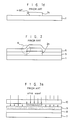
- a layer 2 for forming a predetermined pattern is deposited on a substrate 1, as shown in FIG 1A.
- the layer 2 will be subsequently etched to form a pattern.
- a photoresist 3 is coated and then radiated with ultra violet under the condition that a photomask 4 is aligned on the photoresist 3 to be in contact therewith, in order to form a pattern layer 3a as shown in FIG. 1 B.
- the layer 2 for forming a desired pattern is subjected to an etch utilizing the RIE method which is an anisotropy dry etch method.
- a pattern layer 2a having the corner angle of 90° is formed, as shown in FIG. 1 D.
- the pattern forming utilizing the conventional RIE method has a disadvantage that when a primary upper deposition layer 5 is coated on the pattern layer 2a etched according to the RIE method, the step coverage, that is the coverage of the deposition layer 5 over steps (the "K" portion in FIG. 2) formed at respective corners of about 90° of the pattern layer 2a becomes poor, after the process integration. Consequently, the pattern layer 2a formed by the RIE method and a second upper deposition layer 6 formed on the primary upper deposition layer 5 are subject to a short failure, thereby causing the productivity of semi-conductor elements to be reduced.
- a pattern forming layer 8 to be etched is deposited on a substrate 7, as shown in FIG 3A.
- a photoresist 9 is coated.
- the photoresist 9 is exposed to ultra violet by using a photomask 10 printed with a predetermined pattern, and thereby developed to form a photoresist pattern layer 9a as shown in FIG. 3B.
- the wet etching is carried out as shown in FIG. 3C.
- the pattern forming layer 8 is es- otropically etched.
- the pattern forming utilizing the conventional wet etching process also has a disadvantage that when a primary upper deposition layer 11 is coated on the pattern layer 8a etched according to the RIE method, its step coverage over respective 45° lateral edges of the pattern layer 8a becomes poor. Consequently, the pattern layer 8a and a second upper deposition layer 12 formed on the primary upper deposition layer 11 are subject to a short failure (at the portion "L" in FIG. 4).
- the pattern layer 8a and the second upper deposition layer 12 form metal electrodes and the primary upper deposition layer forms an insulation layer
- the pattern layer 8a and the second upper deposition layer 12 may be subject to a break down at the portion "L", thereby causing the productivity of semi-conductor elements to be reduced.
- an object of the present invention is to overcome the above-mentioned disadvantages encountered in the prior arts and to provide a slope etching process which includes the use of a certain dipping solution added to the conventional wet etching process enabling only the esotropic etch, so that a pattern forming layer obtained in photo processing and etching steps can be etched to have edges of smooth slope angle.
- Another object of the present invention is to provide a slope etching process which includes the addition of a certain gas to the etching gas used in the conventional RIE method, the dry etching method, so that a pattern forming layer obtained in photo processing and etching steps can be etched to have edges of smooth slope angle.
- the present invention provides a slope etching process for wet etching a pattern forming layer to form a desired pattern layer, comprising the steps of: forming said pattern forming layer on a substrate; dipping the pattern forming layer into a dipping solution consisting of an etching solution and a deionized water which are mixed at a predetermined rate so that the pattern forming layer has a porous surface; coating a photoresist and a photomask on the dipped pattern forming layer in order; exposing said photomask to ultra violet and developing said photoresist to form a photoresist pattern layer; and wet etching the pattern forming layer by using the etching solution to obtain the desired pattern layer.
- the present invention also provides a slope etching process for dry etching a pattern forming layer by using a RIE method to form a desired pattern layer, comprising the steps of: forming said pattern forming layer on a substrate; coating a photoresist on said pattern forming layer; disposing a photomask printed with a predetermined pattern at the position upwardly spaced apart from the surface of said photoresist; exposing said photomask to ultra violet and developing the photoresist to form a photoresist pattern layer; and etching the pattern forming layer according to the RIE method and by using a gas mixture consisting of an etching gas and 0 2 gas which are mixed at a predetermined rate.
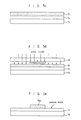
- FIGS. 5A to 5G there is shown an embodiment of the present invention.
- a pattern forming layer 14 is deposited on a substrate 13.
- the pattern forming layer 14 is dipped into a dipping solution which is prepared by mixing an etchant with a deionized water at a certain rate (1:10 to 1:100), so that the surface of pattern forming layer 14 becomes porous, as shown in FIG. 5B.
- a photoresist 15 of a certain thickness is coated as shown in FIG. 5C, on which a photomask 16 printed with a predetermined pattern is coated as shown in FIG. 5D.
- the photomask 16 and the photoresist 15 are exposed to ultra violet so that the photoresist 15 is developed to form a photoresist pattern layer 15a, as shown in FIG.
- the pattern forming layer 14 is wet etched by using the etching solution, so as to form a pattern layer 14a.
- the etching velocity V s in the direction vertical to the surfaces of photoresist 15 and pattern forming layer 14 is rapid, since the surface of pattern forming layer 14 has the porous structure provided by the dipping, so that the formed pattern layer 14a can have a smooth slope at its edges.
- the slope angle is preferably about 15° to about 25 and depends on the concentration of the dipping solution, the dipping time, the used pattern forming layer, the used etching solution and the etching temperature.
- the process according to the present invention enables the forming of the pattern layer having a edge slope of about 15° to about 25°, thereby avoiding a poor step coverage and a short failure due to the breakdown occurring in using a pattern layer which has a edge slope of about 45 according to the conventional wet etching method. Accordingly, the productivity of semi-conductors is improved and the reliability is also improved.
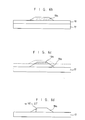
- a pattern forming layer 18 to be etched is deposited on a substrate 17.
- a photoresist 19 is coated.
- a photomask 20 printed with a predetermined pattern is disposed in a proximity alignment manner.
- the photomask 20 and the photoresist 19 are developed by using ultra violet so that the ultra violet is scattered at the corner portions of the printed pattern on the photomask 20, thereby forming a photoresist pattern layer 19a having edges of a smooth slope, as shown in FIG. 6B.
- the RIE method is performed, as shown in FIG. 6C.
- the etching is carried out by using the mixture which contains an etching gas and 0 2 gas mixed with said etching gas at a rate of about 2 to 50 SCCM.
- the using etching gas depends on the kind of pattern forming layer 18 to be etched.
- 0 2 gas functions to etch the photoresist pattern layer 19a, so that the pattern forming layer 18 and the photoresist pattern layer 19a are etched simultaneously.
- the flow rate of 0 2 gas determines the etching velocity of the photoresist pattern layer 18a and thus the slope of edges of the photoresist pattern layer 18a. Therefore, the flow rate of 0 2 gas depends on the kind of pattern forming layer 18 and the kind and the thickness of photoresist 19.
- the pattern forming layer 18 and the photoresist pattern layer 19a are etched simultaneously, as shown in FIG. 6C, thereby producing a pattern layer 17a having the edge slope of about 15° to 20 ⁇ , as shown in FIG. 6D.
- the photomask 20 is disposed at the position which is upwardly spaced apart from the surface of sample coated with the photoresist 19 at a distance of 1 ⁇ m to 50 /1.m. Accordingly, as ultra violet is radiated over the photomask 20, the photoresist pattern layer 19a having inclined edges is formed first. Then, the sample is etched by using the RIE method and the gas mixture which contains the etching gas and 0 2 gas mixed with the etching gas at the rate of 2 to 50 SCCM, thereby causing the pattern layer 18a to have a smooth edge slope.
- the above process enables the slope etching of pattern forming layer using the RIE method, thereby avoiding poor step coverage and short failure which may occur at the corners of pattern layer, after the process integration.
- the productivity of semi-conductors can be improved.
- the RIE method which has been used for anistropy etching can be used for slope etching, thereby enabling the substitution of the wet etching process using chemical solutions by the dry etching process using the RIE method. Accordingly, it is possible to eliminate the complication of manufacturing process, to reduce the manufacturing time and cost and to improve the productivity.
Landscapes
- Drying Of Semiconductors (AREA)
- Internal Circuitry In Semiconductor Integrated Circuit Devices (AREA)
- Weting (AREA)
Applications Claiming Priority (4)
| Application Number | Priority Date | Filing Date | Title |
|---|---|---|---|
| KR1165090 | 1990-07-31 | ||
| KR1164990 | 1990-07-31 | ||
| KR1019900011650A KR950003230B1 (ko) | 1990-07-31 | 1990-07-31 | Rie법을 이용한 경사식각 방법 |
| KR1019900011649A KR930008128B1 (ko) | 1990-07-31 | 1990-07-31 | 습식 식각법을 이용한 경사식각방법 |
Publications (2)
| Publication Number | Publication Date |
|---|---|
| EP0469370A2 true EP0469370A2 (fr) | 1992-02-05 |
| EP0469370A3 EP0469370A3 (en) | 1992-09-09 |
Family
ID=26628311
Family Applications (1)
| Application Number | Title | Priority Date | Filing Date |
|---|---|---|---|
| EP19910111771 Ceased EP0469370A3 (en) | 1990-07-31 | 1991-07-15 | Etching process for sloped side walls |
Country Status (3)
| Country | Link |
|---|---|
| US (1) | US5409566A (fr) |
| EP (1) | EP0469370A3 (fr) |
| JP (1) | JPH04348030A (fr) |
Cited By (2)
| Publication number | Priority date | Publication date | Assignee | Title |
|---|---|---|---|---|
| EP0574911A3 (fr) * | 1992-06-18 | 1994-03-30 | Canon Kk | |
| CN105990472A (zh) * | 2015-02-04 | 2016-10-05 | 深圳市立洋光电子有限公司 | 一种硅衬底led发光芯片的表面处理方法 |
Families Citing this family (5)
| Publication number | Priority date | Publication date | Assignee | Title |
|---|---|---|---|---|
| US6086777A (en) * | 1998-07-02 | 2000-07-11 | Advanced Micro Devices, Inc. | Tantalum barrier metal removal by using CF4 /o2 plasma dry etch |
| JP2002062665A (ja) * | 2000-08-16 | 2002-02-28 | Koninkl Philips Electronics Nv | 金属膜の製造方法、該金属膜を有する薄膜デバイス、及び該薄膜デバイスを備えた液晶表示装置 |
| TWI513993B (zh) | 2013-03-26 | 2015-12-21 | Ind Tech Res Inst | 三軸磁場感測器、製作磁場感測結構的方法與磁場感測電路 |
| JP2016219452A (ja) * | 2015-05-14 | 2016-12-22 | 富士通株式会社 | 多層基板及び多層基板の製造方法 |
| CN106449398A (zh) * | 2016-10-27 | 2017-02-22 | 安徽富芯微电子有限公司 | 减少光刻湿法腐蚀钻蚀的工艺方法 |
Family Cites Families (15)
| Publication number | Priority date | Publication date | Assignee | Title |
|---|---|---|---|---|
| JPS5217995B2 (fr) * | 1972-02-18 | 1977-05-19 | ||
| US3833434A (en) * | 1973-02-20 | 1974-09-03 | Hitachi Ltd | Method of forming multi-layer interconnections |
| US4075367A (en) * | 1976-03-18 | 1978-02-21 | Ncr Corporation | Semiconductor processing of silicon nitride |
| DE3277343D1 (en) * | 1982-06-14 | 1987-10-22 | Ibm Deutschland | Method of adjusting the edge angle in polysilicon |
| JPS5984529A (ja) * | 1982-11-08 | 1984-05-16 | Nippon Denso Co Ltd | パタ−ン形成方法 |
| JPS6016428A (ja) * | 1983-07-08 | 1985-01-28 | Matsushita Electric Ind Co Ltd | 化合物半導体のエツチング方法 |
| US4631248A (en) * | 1985-06-21 | 1986-12-23 | Lsi Logic Corporation | Method for forming an electrical contact in an integrated circuit |
| US4816380A (en) * | 1986-06-27 | 1989-03-28 | Texas Instruments Incorporated | Water soluble contrast enhancement layer method of forming resist image on semiconductor chip |
| US4698132A (en) * | 1986-09-30 | 1987-10-06 | Rca Corporation | Method of forming tapered contact openings |
| DE3686721D1 (de) * | 1986-10-08 | 1992-10-15 | Ibm | Verfahren zur herstellung einer kontaktoeffnung mit gewuenschter schraege in einer zusammengesetzten schicht, die mit photoresist maskiert ist. |
| US4698128A (en) * | 1986-11-17 | 1987-10-06 | Motorola, Inc. | Sloped contact etch process |
| DE3879471T2 (de) * | 1988-04-21 | 1993-09-16 | Ibm | Verfahren zur herstellung eines photoresistmusters und apparat dafuer. |
| US4912022A (en) * | 1988-12-27 | 1990-03-27 | Motorola, Inc. | Method for sloping the profile of an opening in resist |
| US5057186A (en) * | 1989-07-28 | 1991-10-15 | At&T Bell Laboratories | Method of taper-etching with photoresist adhesion layer |
| US4956035A (en) * | 1989-08-01 | 1990-09-11 | Rd Chemical Company | Composition and process for promoting adhesion on metal surfaces |
-
1991
- 1991-07-15 EP EP19910111771 patent/EP0469370A3/en not_active Ceased
- 1991-07-31 JP JP3213170A patent/JPH04348030A/ja active Pending
-
1993
- 1993-09-24 US US08/126,023 patent/US5409566A/en not_active Expired - Lifetime
Cited By (3)
| Publication number | Priority date | Publication date | Assignee | Title |
|---|---|---|---|---|
| EP0574911A3 (fr) * | 1992-06-18 | 1994-03-30 | Canon Kk | |
| US5517224A (en) * | 1992-06-18 | 1996-05-14 | Canon Kabushiki Kaisha | Semiconductor device for driving heat generator |
| CN105990472A (zh) * | 2015-02-04 | 2016-10-05 | 深圳市立洋光电子有限公司 | 一种硅衬底led发光芯片的表面处理方法 |
Also Published As
| Publication number | Publication date |
|---|---|
| US5409566A (en) | 1995-04-25 |
| EP0469370A3 (en) | 1992-09-09 |
| JPH04348030A (ja) | 1992-12-03 |
Similar Documents
| Publication | Publication Date | Title |
|---|---|---|
| US5838055A (en) | Trench sidewall patterned by vapor phase etching | |
| US5876879A (en) | Oxide layer patterned by vapor phase etching | |
| US6074951A (en) | Vapor phase etching of oxide masked by resist or masking material | |
| US4698128A (en) | Sloped contact etch process | |
| EP0076215B1 (fr) | Masque d'ombre pour arrachement | |
| US6579808B2 (en) | Method of fabricating a semiconductor device | |
| EP0369953B1 (fr) | Inclination des parois de trous dans des couches diélectriques pour former des contacts dans des dispositifs intégrés | |
| EP0469370A2 (fr) | Procédé d'attaque pour obtenir des parois inclinées | |
| US4594606A (en) | Semiconductor device having multilayer wiring structure | |
| JPH0637072A (ja) | テーパエッチング方法 | |
| JP3109059B2 (ja) | ドライエッチング方法 | |
| JPS5444474A (en) | Contact forming method of semiconductor device | |
| JP2695919B2 (ja) | 配線パターンの形成方法 | |
| JPH0422021B2 (fr) | ||
| KR950001300B1 (ko) | 반도체장치의 제조방법 | |
| JPS63209128A (ja) | レジストパタ−ン形成方法 | |
| KR950003230B1 (ko) | Rie법을 이용한 경사식각 방법 | |
| KR930008128B1 (ko) | 습식 식각법을 이용한 경사식각방법 | |
| JPS61184828A (ja) | 半導体装置の製造方法 | |
| KR930006133B1 (ko) | 모스소자의 콘택트홀 형성방법 | |
| KR20050002010A (ko) | 반도체 소자의 콘택홀 형성방법 | |
| JPH07135198A (ja) | エッチング方法 | |
| JPS6329933A (ja) | 半導体装置の製造方法 | |
| JPS621230A (ja) | パタ−ン形成方法 | |
| JPS61296722A (ja) | 半導体装置の製造方法 |
Legal Events
| Date | Code | Title | Description |
|---|---|---|---|
| PUAI | Public reference made under article 153(3) epc to a published international application that has entered the european phase |
Free format text: ORIGINAL CODE: 0009012 |
|
| AK | Designated contracting states |
Kind code of ref document: A2 Designated state(s): DE FR NL |
|
| PUAL | Search report despatched |
Free format text: ORIGINAL CODE: 0009013 |
|
| AK | Designated contracting states |
Kind code of ref document: A3 Designated state(s): DE FR NL |
|
| 17P | Request for examination filed |
Effective date: 19921103 |
|
| 17Q | First examination report despatched |
Effective date: 19930831 |
|
| STAA | Information on the status of an ep patent application or granted ep patent |
Free format text: STATUS: THE APPLICATION HAS BEEN REFUSED |
|
| 18R | Application refused |
Effective date: 19960608 |