EP0469580A2 - Dispositif de tête optique - Google Patents
Dispositif de tête optique Download PDFInfo
- Publication number
- EP0469580A2 EP0469580A2 EP91112881A EP91112881A EP0469580A2 EP 0469580 A2 EP0469580 A2 EP 0469580A2 EP 91112881 A EP91112881 A EP 91112881A EP 91112881 A EP91112881 A EP 91112881A EP 0469580 A2 EP0469580 A2 EP 0469580A2
- Authority
- EP
- European Patent Office
- Prior art keywords
- photo
- light
- pickup apparatus
- flux
- receiving areas
- Prior art date
- Legal status (The legal status is an assumption and is not a legal conclusion. Google has not performed a legal analysis and makes no representation as to the accuracy of the status listed.)
- Granted
Links
Images



Classifications
-
- G—PHYSICS
- G11—INFORMATION STORAGE
- G11B—INFORMATION STORAGE BASED ON RELATIVE MOVEMENT BETWEEN RECORD CARRIER AND TRANSDUCER
- G11B7/00—Recording or reproducing by optical means, e.g. recording using a thermal beam of optical radiation by modifying optical properties or the physical structure, reproducing using an optical beam at lower power by sensing optical properties; Record carriers therefor
- G11B7/12—Heads, e.g. forming of the optical beam spot or modulation of the optical beam
- G11B7/135—Means for guiding the beam from the source to the record carrier or from the record carrier to the detector
- G11B7/1381—Non-lens elements for altering the properties of the beam, e.g. knife edges, slits, filters or stops
-
- G—PHYSICS
- G11—INFORMATION STORAGE
- G11B—INFORMATION STORAGE BASED ON RELATIVE MOVEMENT BETWEEN RECORD CARRIER AND TRANSDUCER
- G11B7/00—Recording or reproducing by optical means, e.g. recording using a thermal beam of optical radiation by modifying optical properties or the physical structure, reproducing using an optical beam at lower power by sensing optical properties; Record carriers therefor
- G11B7/12—Heads, e.g. forming of the optical beam spot or modulation of the optical beam
- G11B7/13—Optical detectors therefor
- G11B7/131—Arrangement of detectors in a multiple array
-
- G—PHYSICS
- G11—INFORMATION STORAGE
- G11B—INFORMATION STORAGE BASED ON RELATIVE MOVEMENT BETWEEN RECORD CARRIER AND TRANSDUCER
- G11B7/00—Recording or reproducing by optical means, e.g. recording using a thermal beam of optical radiation by modifying optical properties or the physical structure, reproducing using an optical beam at lower power by sensing optical properties; Record carriers therefor
- G11B7/12—Heads, e.g. forming of the optical beam spot or modulation of the optical beam
- G11B7/135—Means for guiding the beam from the source to the record carrier or from the record carrier to the detector
- G11B7/1356—Double or multiple prisms, i.e. having two or more prisms in cooperation
-
- G—PHYSICS
- G11—INFORMATION STORAGE
- G11B—INFORMATION STORAGE BASED ON RELATIVE MOVEMENT BETWEEN RECORD CARRIER AND TRANSDUCER
- G11B7/00—Recording or reproducing by optical means, e.g. recording using a thermal beam of optical radiation by modifying optical properties or the physical structure, reproducing using an optical beam at lower power by sensing optical properties; Record carriers therefor
- G11B7/12—Heads, e.g. forming of the optical beam spot or modulation of the optical beam
- G11B7/135—Means for guiding the beam from the source to the record carrier or from the record carrier to the detector
- G11B7/1365—Separate or integrated refractive elements, e.g. wave plates
-
- G—PHYSICS
- G11—INFORMATION STORAGE
- G11B—INFORMATION STORAGE BASED ON RELATIVE MOVEMENT BETWEEN RECORD CARRIER AND TRANSDUCER
- G11B7/00—Recording or reproducing by optical means, e.g. recording using a thermal beam of optical radiation by modifying optical properties or the physical structure, reproducing using an optical beam at lower power by sensing optical properties; Record carriers therefor
- G11B7/12—Heads, e.g. forming of the optical beam spot or modulation of the optical beam
- G11B7/135—Means for guiding the beam from the source to the record carrier or from the record carrier to the detector
- G11B7/1372—Lenses
- G11B7/1378—Separate aberration correction lenses; Cylindrical lenses to generate astigmatism; Beam expanders
-
- G—PHYSICS
- G11—INFORMATION STORAGE
- G11B—INFORMATION STORAGE BASED ON RELATIVE MOVEMENT BETWEEN RECORD CARRIER AND TRANSDUCER
- G11B7/00—Recording or reproducing by optical means, e.g. recording using a thermal beam of optical radiation by modifying optical properties or the physical structure, reproducing using an optical beam at lower power by sensing optical properties; Record carriers therefor
- G11B7/08—Disposition or mounting of heads or light sources relatively to record carriers
- G11B7/09—Disposition or mounting of heads or light sources relatively to record carriers with provision for moving the light beam or focus plane for the purpose of maintaining alignment of the light beam relative to the record carrier during transducing operation, e.g. to compensate for surface irregularities of the latter or for track following
- G11B7/0908—Disposition or mounting of heads or light sources relatively to record carriers with provision for moving the light beam or focus plane for the purpose of maintaining alignment of the light beam relative to the record carrier during transducing operation, e.g. to compensate for surface irregularities of the latter or for track following for focusing only
- G11B7/0912—Disposition or mounting of heads or light sources relatively to record carriers with provision for moving the light beam or focus plane for the purpose of maintaining alignment of the light beam relative to the record carrier during transducing operation, e.g. to compensate for surface irregularities of the latter or for track following for focusing only by push-pull method
Definitions
- the present invention relates to an optical pickup apparatus for reading informational signals written on, for example, a magneto-optical disc.
- magneto-optical discs comprising a signal recording layer which is perpendicularly magnetizable so that informational signals can be written in accordance with differences in the direction of magnetization of the signal recording layer have heretofore been proposed as recording media for recording informational thereon.
- a flux of light having a signal polarization direction such as a laser beam is converged and impinged upon the signal recording layer to detect the polarization direction of the reflected light of the flux of light.
- the flux of light changes the polarization direction depending upon the direction of magnetization due to so-called Kerr effect when it is reflected on the signal recording layer. Accordingly, the differences is magnetization direction of the signal recording layer can be detected by detecting the polarization direction of the reflected light of the flux.
- an optical pickup apparatus which is formed so that the signal layer 1 a of the magneto-optical disc 1 is irradiated with the laser beam and the light reflected from the signal recording layer 1 a is detected as shown in Fig. 9.
- the optical pickup apparatus has a light source 102 such as semiconductor laser and is formed so that a flux of light emitted from the light source 102 is converged and is impinged upon the surface of the signal recording layer 1 a via optical devices such as a collimator lens 103, a beam splitter 104 and an objective lens 105.
- a light source 102 such as semiconductor laser
- optical devices such as a collimator lens 103, a beam splitter 104 and an objective lens 105.
- the optical pickup apparatus is also formed so that the reflected light of the flux of light which is incident upon the surface of the signal recording layer 1 a is introduced to a detecting optical system via the objective lens 105 and the reflection surface 104a of the beam splitter 104 to detect the polarization direction of the reflected light.
- the detecting optical system in the optical pickup apparatus may includes a detecting lens 107 for converging the flux of light incident upon the detecting optical system, first and second photo-detecting element 109 and 110, and a prism 108 disposed in an optical path between the detecting lens 107 and each of the photo-detecting elements 109 and 110.
- the prism 108 is formed into a prism having a substantially trapezoidal cross section by bonding a parallelogrammatic prism 108a to a triangular prism 108b each other at a polarization reflection surface 108c.
- the flux of light which has transmitted through the detecting lens 107 is firstly substantially normally incident upon one side of the parallelogrammatic prism 108a constituting an upper bottom portion of the prism 108 and is then incliningly incident upon the polarization reflection surface 108c. A part of the flux of light is reflected by the polarization reflection surface 108c depending upon the polarization direction and the remaining flux will be transmitted through the surface 108c.
- the ratio of the reflected light to the transmitted light changes depending upon the polarization direction of the flux of light.
- the flux of light which has been transmitted through the polarization reflection surface 108c is detected as a first beam spot S 1 by the first photo-detecting element 109 secured to the triangular prism 108b forming a part of the lower bottom portion of the prism 108.
- the flux of light reflected by the polarization reflection surface 108c is reflected by the slanted side of the parallelogrammatic prism 108a forming the slanted side of the prism 108 is detected as a second beam spot S 2 by the second photo-detecting element 110 secured to the parallelogrammatic prism 108a forming the other portion of the lower bottom portion of the prism 108.
- the differential signal between the photo detection signals outputted from the photo-detecting elements 109 and 110 which detect the fluxes of light separated by the polarization reflection surface 108c, that is, the difference between the amounts of light of the beam spots S 1 and S 2 will become a read signal of the informational signal written in the magneto-optical disc 1.
- Each of the photo-detecting elements 109 and 110 comprises three parallel photo-receiving areas as shown in Fig. 10. That is, the first photo-detecting element 109 comprises first to third photo-receiving areas 109a, 109b and 109c.
- the second photo-detecting element 110 comprises fourth to sixth photo-receiving areas 110a, 110b and 110c.
- the convergence condition of the flux of light on the photo-receiving elements 109 and 110 is changed depending upon the focus error of the flux of light focussed on the surface of the signal recording layer 1 a of the magneto-optical disc 1.
- so-called focus error signal representative of the amount of the focus error on the surface of the signal recording layer 1 a of the magnetic-optical disc 1 can be obtained by so-called internal and external differential method in which a signal representative of a difference between the photo detection outputs from the photo-receiving areas 109b and 110b in the central sides of the photo-detecting elements 109 and 110 and the photo detection outputs from the photo-receiving areas 109a, 109c, 110a, 109c on the opposite sides of the photo-detecting elements 109 and 110.
- the focus error signal Fe can be determined by the formula as follows:
- the first and second photo-detecting elements 109 and 110 have boundary lines between photo-receiving areas which are inclined with each other. It is hard to keep the high precision of the securing position of each photo-detecting elements 109 and 110 since the photo-detecting elements 109 and 110 are secured to the prism 108 by means such as bonding.
- the beam spots S 1 and S 2 are formed on the photo-detecting elements 109 and 110, respectively by securing the photo-detecting elements 109 and 110 to the prism 108 so that they are inclined with each other and by adjusting the position of the prism 108.
- a so-called tracking error occurs in which the flux of light incident upon the signal recording layer 1 a is deviated relative to a recording track formed on the signal recording layer 1 a of the magneto-optical disc 1 in the optical pickup apparatus
- a so-called focus offset occurs since the beam spots S 1 and S 2 will be moved in a direction inclined with respect to the boundary lines of the photo-receiving areas constituting each photo-detecting element 109 and 110.
- the condition on which the focus offset occurs is defined as a condition that a focus error signal representing as if a focus error occurred is outputted although the focus error does not actually occur on the surface of the signal recording layer 1 a.
- the photo detecting elements 109 and 110 are mounted by adjusting the position thereof to make parallel the boundary lines between the photo-receiving areas forming the photo-detecting elements 109 and 110.
- the structure of the thus formed optical pickup apparatus becomes more complicated in structure and its assembly and manufacturing becomes more hard.
- the present invention was proposed in view of the above-mentioned circumstances. It is an object of the present invention to provide an optical pickup apparatus in which a focus offset is prevented from occurring and reading of informational signals written on a recording medium can be satisfactorily achieved without complicating the structure.
- the present invention provides an optical pickup apparatus comprising a flat plate like transparent member having one side which is a polarization reflection surface and the other sides which is a total reflection surface, upon which light reflected from a recording medium which is irradiated with a flux of light is inclinatingly incident from the one side thereof; and a photo-detecting element for detecting the flux of light reflected by the one side and the other side of the flat plate transparent member which is irradiated with the flux of light.
- the optical pickup apparatus of the present invention light reflected from a recording medium which is inclinedly incident from one side upon a flat plate like transparent member having the one side which is a polarization reflection surface and the other side which is a total reflection surface is separated at the one side thereof into two fluxes of light depending upon the direction of polarization. Since the flux of light reflected on the one side and the flux of light which has transmitted through the one side and has been reflected on the other side of the transparent member are detected by a photo-detecting elements, the polarization direction of reflected light from the recording medium can be detected by comparing the intensity of these fluxes of light.
- an optical pickup apparatus of the present invention is formed as an optical pickup apparatus for reading informational signals written on an magneto-optical disc which serves as a recording medium.
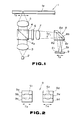
- the optical pickup apparatus is formed as shown in Fig. 1 so that a light flux is converged and impinged upon the surface of a signal recording layer 1 a of a magneto-optical disc 1 and the light reflected on the signal recording layer 1 a is detected by a photo-detecting element 9.
- the optical pickup apparatus has a light source 2 such as semiconductor laser for emitting a flux of light having a single wave length and a single polarization direction.
- the flux of light emitted from the light source 2 is converted into parallel light flux by a collimator lens 3.
- the flux of light transmits through the beam splitter 4 and is incident upon an objective lens 5.
- the objective lens 5 converges the flux of incident light onto the surface of the signal recording layer 1 a of the magneto-optical disc 1.
- the objective lens 5 is supported on an objective lens drive mechanism (not shown) so that it is movable in an direction of an optical axis.
- the objective lens drive mechanism is adapted to move the objective lens 5 in response to a focus error signal representative of the distance between a beam spot formed with the flux of light converged by the objective lens 5 and the surface of the signal recording layer 1a, that is, the amount of focus error.
- the signal recording layer 1 a is formed so that it is perpendicularly magnetized.
- the direction of the magnetization in each small domain is changed in response to the written informational signals.
- the reflected light of the flux of light which has been converged and impinged upon the surface of the signal recording layer 1 a has changed the polarization direction due to so-called Kerr effect depending upon the magnetization direction of the signal recording layer 1 a.
- the flux of light which has been impinged upon the surface of the signal recording layer 1 a is reflected by the surface and is incident upon the objective lens 5 again.
- the flux of light incident upon the objective lens 5 again is converted into parallel rays of light and is returned to the beam splitter 4.
- the flux of light returned to the beam splitter 4 is reflected by the surface 4a of the beam splitter 4 and is incident upon a detecting lens via a half wave-length plate 6 without returning toward the collimator lens 3.
- the half wave-length plate 6 is a so-called rotatory polarizer which rotates the polarization direction of the flux of incident light by 90°.
- the detecting lens 7 converges the flux of incident light.
- the prism 8 comprises a triangular prism 8a and a flat plate like transparent member 8b bonded to the slanted side of the triangular prism 8a.
- the triangular prism 8a and the flat plate like transparent member 8b are formed of the same optical material having the same refraction index.
- One side of the flat plate like transparent member 8b to which the triangular prism 8a is bonded is coated with an dielectric film to provide a polarization reflection surface 8c having a different reflection factor depending on the direction of polarization of the incident flux of light.
- the other side of the flat plate like transparent member 8b which is opposite to the one side is made a so-called total reflection surface 8d so that the flux of light which has transmitted through the polarization reflection surface 8c is reflected thereon.
- a part of the flux of light which is incident on the prism 8 from the triangular prism 8a is reflected on the polarization reflection surface 8c of the flat plate like transparent member 8b and the remaining flux is transmitted through the polarization reflection surface 8c.
- the flux of light reflected on the polarization reflection surface 8c is then transmitted through the triangular prism 8a and is exited from the prism 8.
- the flux of light transmitted through the polarization reflection surface 8c is then reflected on the total reflection surface 8d and is transmitted through the flat plate like transparent member 8b and the triangular prism 8a and exited from the prism 8.
- the flux of light which has been transmitted through the prism 8 in such a manner will travel along separated optical paths depending upon the difference of it's polarization direction.
- the light receiving surface of the photo detecting element 9 has a plurality of light receiving areas each receiving the flux of light, the optical path of which is separated by the prism 8 as shown in Fig. 2.
- the photo detecting element 9 receives each of flux of light at the plurality of light receiving area and is capable of independently outputting photo detection signals each corresponding to the intensity of light at light receiving area through a plurality of leads (not shown).
- a first beam spot S 1 formed of the first flux of light reflected on the polarization reflection surface 8c is formed on first to third photo receiving areas 9a, 9b and 9c.
- a second beam spot S 2 formed by the second flux of light transmitted through the polarization reflection surface 8c is formed on fourth to sixth photo receiving areas 9d, 9e and 9f.
- the first beam spots S 1 is received by each of the photo receiving areas immediately in front of the focal point of the detecting lens 7 while the second beam spot S 2 is received by each of the photo receiving areas immediately in rear of the focal point of the detecting lens 7.
- the first to third photo receiving areas 9a, 9b and 9c are formed into a substantially rectangular shape and are successively arranged in direction of shorter side thereof.
- the fourth to sixth photo receiving areas 9d, 9e and 9f are similarly formed into a substantially rectangular shape and are successively arranged in a direction of shorter side thereof.
- the boundary lines between first, second and third photo receiving areas 9a, 9b and 9c are in parallel with those between the fourth, fifth and sixth photo receiving areas 9d, 9e and 9f.
- a so-called focus error signal representative of the amount of focus error on the signal recording layer 1 a of the magneto-optical disc 1 is represented as Fe
- the focus error signal Fe can be expressed by a formula as follows:
- the focus error signal Fe is fed to a servo circuit for controlling the objective lens drive apparatus.
- the intensity of light of one of the first and second beam spots S 1 and S 2 decreases as the intensity of light of the other spots increases.
- the intensity of light of one of beam spots increases as the intensity of light of the other beam spot decreases. Accordingly, if a read out signal of the information signal written on the magneto-optical disc 1 is represented as Mo, the read out signal can be expressed by the formula as follows:
- the direction of the boundary lines between photo receiving areas of the photo receiving element 9 are arranged in a direction corresponding to the tangential direction of recording tracks formed on the signal recording layer 1 a of the magneto-optical disc 1. Therefore, even if a so-called tracking error in which the flux of light incident upon the surface of the signal recording layer 1 a is deviated in a direction across the recording tracks, represented by an arrow To in Fig. 1 is caused, the focus error signal Fe is prevented from being changed. That is, if the tracking error is caused, the flux of light which is incident upon the prism 8 is deflected in a direction represented by an arrow T 1 in Fig.
- the first and second beam spots S 1 and S 2 are moved in a direction represented by an arrow T 2 in Fig. 1.
- the beam spots S 1 and S 2 are moved in direction represented by arrows T 3 and T 4 in Fig. 2, respectively on the photo receiving areas of the photo detecting element 9.
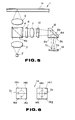
- FIG. 3 there is shown another embodiment of the optical pickup apparatus of the present invention in which optical devices are arranged in a direction along a magneto-optical disc 1 to make the apparatus thinner in a depth direction of the magneto-optical disc 1.
- optical devices are arranged in a direction along a magneto-optical disc 1 to make the apparatus thinner in a depth direction of the magneto-optical disc 1.
- Like reference numerals represent like components.
- a flux of light emitted from light source 2 in a direction along the magneto-optical disc 1 is converted into a flux of parallel light and thereafter it is reflected on the reflection surface 4a of the beam splitter 4 and is then incident upon a reflection mirror 10.
- the reflection mirror 10 is adapted to reflect the flux of the incident light so that the flux of the reflected light is incident upon an objective lens 5 disposed in an opposing manner to the magneto-optical disc 1.
- the objective lens 5 converges the flux of the incident light upon the signal recording layer 1 a of the magneto-optical disc 1.
- the flux of the light reflected by the signal recording layer 1 a is returned to the beam splitter through the objective lens 5 and the reflective mirror 10.
- the flux of the light reflected by the signal recording layer 1 a is transmitted through the reflection surface 4a and is incident upon a detecting lens 7 through a half wave-length plate 6.
- the detecting lens 7 converges the flux of the incident light so that the converged light is incident upon a prism 11.
- the prism 11 comprises a parallelogrammatic prism 11 a and a flat plate like transparent member 11b bonded to the slanted side of the parallelogrammatic prism 11 a.
- the parallelogrammatic prism 11 a and the flat plate like transparent member 11 b are formed of the same optical material having the same refraction index.
- One side of the flat plate like transparent member 11b to which the parallelogrammatic prism 11 a is bonded is coated with an dielectric film to provide a polarization reflection surface 11 having a different reflection factor depending on the direction of polarization of the incident fluxes of light.
- the other side of the flat plate like transparent member 11 which is opposite to the one side is made a so-called total reflection surface 11d so that the flux of light which has transmitted through the polarization reflection surface 11 c is reflected thereon.
- a part of the flux of light which is incident on the prism 11 from the bottom of the parallelogrammatic 11 a is reflected on the polarization reflection surface 11 c of the flat plat like transparent member 11 depending upon the polarization direction and the remaining flux is transmitted through the polarization reflection surface 11c.
- the flux of light reflected on the polarization reflection surface 11 c is then transmitted through the parallelogrammatic prism 11 a and is exited from the prism 11.
- the flux of light transmitted through the polarization reflection surface 11 is then reflected on the total reflection surface 11 and is transmitted through the flat plate like transparent member 11b and the parallelogrammatic prism 11 a and exited from the prism 11
- the flux of light which has been transmitted through the prism 11 in such a manner will travel along separated optical paths depending upon the difference of it's polarization direction.
- the light receiving surface of the photo detecting element 12 which is disposed to detect the flux of light transmitted through the prism 11 has a plurality of light receiving areas each receiving the flux of light, the optical path of which is separated by the prism 8 as shown in Fig. 4.
- the photo detecting element 12 receives each of flux of light at the plurality of light receiving area and is capable of independently outputting photo detection signals each corresponding to the intensity of light at light receiving area through a plurality of leads (not shown).
- a first beam spot S 1 formed of the first flux of light reflected on the polarization reflection surface 11 c is formed on first to third photo receiving areas 12a, 12b and 12c.
- a second beam spot S 2 formed by the second flux of light transmitted through the polarization reflection surface 11 c is formed on fourth to sixth photo receiving areas 12d, 12e and 12f.
- the first to third photo receiving areas 12a, 12b and 12c are formed into a substantially rectangular shape and are successively arranged in direction of shorter side thereof.
- the fourth to sixth photo receiving areas 12d, 12e and 12f are similarly formed into a substantially rectangular shape and are successively arranged in a direction of shorter side thereof.
- the boundary lines between first, second and third photo receiving areas 12a, 12b and 12c are in parallel with those between the fourth, fifth and sixth photo receiving areas 12d, 12e and 12f.
- a so-called focus error signal representative of the amount of focus error on the signal recording layer 1 a of the magneto-optical disc 1 is represented as Fe
- the focus error signal Fe can be expressed as similarly to the above-mentioned optical pickup apparatus by a formula as follows:
- the focus error signal Fe is fed to a servo circuit for controlling the objective lens drive apparatus.
- the intensity of light of one of the first and second beam spots S 1 and S 2 decreases as the intensity of light of the other spots increases.
- the intensity of light of one of beam spots increases as the intensity of light of the other beam spot decreases. Accordingly, if a read out signal of the informational signal written on the magneto-optical disc 1 is represented as Mo, the read out signal can be expressed by the formula as follows:
- the direction of the boundary lines between photo receiving areas of the photo receiving element 12 are arranged in a direction corresponding to the tangential direction of recording tracks. Therefore, even if a so-called tracking error in which the flux of light incident upon the surface of the signal recording layer 1 a is deviated in a direction across the recording tracks, represented by an arrow To in Fig. 3 is caused, the focus error signal Fe is prevented from being changed. That is, if the tracking error is caused, the first and second beam spots S 1 and S 2 are moved in a direction of the boundary lines as represented by an arrows T 5 T 6 in Fig. 4.
- a focus offset due to so-called tracking error can be also prevented from occurring in the optical pickup apparatus in spite of simple structure as mentioned above.
- FIG. 5 there is shown a further embodiment of an optical pick up apparatus of the present invention in which a cylindrical lens 13 is disposed in an optical path along which a flux of light reflected by an magneto-optical disc 1 travels to a photo detecting element to cause an astigmatism in the flux of light and an focus error signal is detected in accordance with the condition of the astigmatism.
- a cylindrical lens 13 is disposed in an optical path along which a flux of light reflected by an magneto-optical disc 1 travels to a photo detecting element to cause an astigmatism in the flux of light and an focus error signal is detected in accordance with the condition of the astigmatism.
- Like numerals represent like components.
- This optical pickup apparatus comprises a light source 2, a collimator lens 3.
- a beam splitter 4 and an objective lens 5, etc. and is formed so that a flux of light is incident upon the surface of a signal recording layer 1 a of the magneto-optical disc 1 as is similar to the above-mentioned optical pickup apparatus.
- the flux of light which was reflected on the surface of the signal recording layer 1 a and reached at the detection lens 7 via the objective lens 5 and the beam splitter 4 transmits through the detection lens 7 and thereafter transmits through the cylindrical lens 13 and is incident upon the prism 8.
- the fluxes of light, the optical path of which is separated depending upon the direction of polarization by the prism 8 are detected by a photo detecting element 14.
- the photo-detecting element 14 has a plurality of photo-receiving areas for receiving the fluxes of light separated by the prism 8 as shown in Fig. 6.
- the photo-detecting element 14 is capable of independently outputting photo detection signals each corresponding to the intensity of light at light receiving area through a plurality of leads (not shown).
- a first beam spot S, formed of the first flux of light reflected on the polarization reflection surface 8c is formed on first to fourth photo receiving areas 14a, 14b, 14c and 14d.
- a second beam spot S 2 formed by the second flux of light transmitted through the polarization reflection surface 8c is formed on fifth to eighth photo receiving area 12e, 12f, 12g and 12h.
- the first to fourth photo-receiving areas 14a, 14b, 14c and 14d are disposed so that they respectively receive the light on the quadrants of the first beam spot S 1 arranged around the center thereof.
- the direction of the lines along which the first to fourth photo-receiving areas 14a, 14b, 14c and 14d are disposed is at 45° relative to the direction of an axis of the cylindrical lens 13.
- the fifth to eighth photo-receiving areas 14e, 14f, 14g and 14h are disposed so that they respectively receive the light on the quadrant of the first beam spots S 2 arranged around the center thereof.
- the direction of the lines along which the fifth to eighth photo-receiving areas 14e, 14f, 14g and 14h are disposed is at 45 relative to the direction of an axis of the cylindrical lens 13.
- the first to fourth photo-receiving areas 14a, 14b, 14c and 14d are disposed so that they are successively adjacent to each other.
- the first and third photo receiving areas 14a and 14c, the second and fourth photo receiving areas 14f and 14d are diagonally disposed on opposite sides of the center of the first beam spot Si.
- the focus error signal Fe can be expressed by a formula as follows:
- the fifth to eighth photo-receiving areas 14e, 14f, 14g and 14h are disposed so that they are successively adjacent to each other.
- the fifth and eighth photo receiving area 14e and 14g, the sixth and eighth photo receiving areas 14f and 14h are diagonally disposed on opposite sides of the center of the first beam spot S 2 .
- the focus error signal is obtained from both of the flux of light reflected by the polarization reflection surface 8c and the flux of light transmitted through the polarization reflection surface 8c, in the optical pickup apparatus, accurate focus error signals can be obtained by canceling fluctuations of both fluxes with each other without being influenced by so-called refringence in a substrate of the magneto-optical disc 1.
- a read signal Mo can be expressed by the formula as follows:
- the focus error signal Fe and the read signal Mo of informational signal written on the magneto-optical disc 1 can be obtained by a simple structure.
- FIG. 7 there is shown a further embodiment of an optical pickup apparatus of the present invention.
- This embodiment is substantially identical with the former embodiment of Fig. 5 except that a flat plate like transparent member 15 is used in lieu of the prisms 8 and 11.
- the optical pickup apparatus comprises a light source 2, a collimator lens 3, a beam splitter 4 and an objective lens 5, etc. as is similarly to the above-mentioned optical pickup apparatus, and is formed so that a flux of light is incident upon the surface of the signal recording layer 1 a of the magneto-optical disc 1.
- the flux of light which was reflected by the surface of the signal recording layer 1 a and reached at a detecting lens 7 via the objective lens 5 and the beam splitter 4 will transmit through the detecting lens 7 and will then transmit through a cylindrical lens 13 and be incliningly incident upon the flat plate like transparent member 15.
- the flat plate like transparent member 15 upon which the flux of light is incident is coated with an dielectric film etc to provide a polarization reflection surface 15a having a reflection factor changing depending upon the polarization direction of the incident flux of light.
- the other side of the flat plate like transparent member 15 which is opposite to the polarization reflection surface 15a of the transparent member 15 is made a so-called total reflection surface 15b so that the flux of light which has transmitted through the polarization reflection surface 15a is reflected thereon.
- a part of the flux of light which is incident on the flat plate like transparent member 15 is reflected on the polarization reflection surface 15a and the remaining flux is transmitted through the polarization reflection surface 15.
- the flux of light reflected on the polarization reflection surface 15a is incident upon the photo-receiving surface of the photo-detecting element 16.
- the flux of light transmitted through the polarization reflection surface 15a is then reflected on the total reflection surface 15b and is transmitted through the flat plate like transparent member 15 and is exited from the member 15 and is then incident upon the photo-receiving areas of the photo-detecting element 16.
- the flux of light which has been the flat plate like transparent member 15 and transmitted therethrough 8 in such a manner is subjected to separation of optical paths depending upon the difference of it's polarization direction.
- the light receiving surface of the photo detecting element 16 has a plurality of light receiving areas each receiving the flux of light, the optical path of which is separated by the flat plate like transparent member 15 as shown in Fig. 8.
- the photo detecting element 16 receives each of flux of light at the plurality of light receiving area and is capable of independently outputting photo detection signals each corresponding to the intensity of light at light receiving area through a plurality of leads (not shown).
- a first beam spot S 1 formed of the first flux of light reflected on the polarization reflection surface 15a is formed on first to fourth photo-receiving areas 16a, 16b, 16c and 16d.
- a second beam spot S 2 formed of the second flux of light which has transmitted through the polarization reflection surface 15a is formed on a fifth photo-receiving area 16e.
- the first to fourth photo-receiving areas 16a, 16b, 16c and 16d are disposed so that they respectively receive the light on the quadrants of the first beam spot S 1 arranged around the center thereof.
- the direction of the lines along which the first so fourth photo-receiving areas 16a, 16b, 16c and 16d are disposed is at 45° relative to the direction of an axis of the cylindrical lens 13.
- the first to fourth photo-receiving areas 16a, 16b, 16c and 16d are disposed so that they are successively adjacent to each other.
- the first and third photo receiving areas 16a and 16c the second and fourth photo receiving areas 16b and 16d are diagonally disposed on opposite sides of the center of the first beam spot S i .
- the read signal Mo can be expressed by a formula as follows:
- light reflected form a recording medium which is inclinedly incident from one side upon of a flat plate like transparent member having the one side which is a polarization reflection surface and the other side which is a total reflection surface is separated at the one side thereof into two fluxes of light depending upon the direction of polarization.
- the flux of light reflected on the one side and the flux of light which has transmitted through the one side and has been reflected on the other side of the transparent member are detected by a photo-detecting elements.
- the polarization direction of reflected light from the recording medium can be detected by comparing the intensity of the flux of light reflected on the one side of the transparent member with that of the flux of light transmitted through the one side based upon photo-detection outputs from the photo-detecting element.
- a focus error signal, etc representative of the amount of the focus error of the flux of light on the recording medium can be detected in a good manner without causing any offset due to so-called tracking deviation and without being influenced by so-called birefringence in the recording medium.
- the present invention provides an optical pickup apparatus in which a focus offset is prevented from occurring and reading of informational signals written on a recording medium can be satisfactorily achieved without complicating the structure.
Landscapes
- Physics & Mathematics (AREA)
- Optics & Photonics (AREA)
- Optical Head (AREA)
- Optical Recording Or Reproduction (AREA)
Applications Claiming Priority (2)
| Application Number | Priority Date | Filing Date | Title |
|---|---|---|---|
| JP203516/90 | 1990-07-31 | ||
| JP2203516A JPH0487042A (ja) | 1990-07-31 | 1990-07-31 | 光学ピックアップ装置 |
Publications (3)
| Publication Number | Publication Date |
|---|---|
| EP0469580A2 true EP0469580A2 (fr) | 1992-02-05 |
| EP0469580A3 EP0469580A3 (en) | 1992-06-10 |
| EP0469580B1 EP0469580B1 (fr) | 1997-12-03 |
Family
ID=16475448
Family Applications (1)
| Application Number | Title | Priority Date | Filing Date |
|---|---|---|---|
| EP91112881A Expired - Lifetime EP0469580B1 (fr) | 1990-07-31 | 1991-07-31 | Dispositif de tête optique |
Country Status (4)
| Country | Link |
|---|---|
| US (1) | US5249167A (fr) |
| EP (1) | EP0469580B1 (fr) |
| JP (1) | JPH0487042A (fr) |
| DE (1) | DE69128312T2 (fr) |
Cited By (8)
| Publication number | Priority date | Publication date | Assignee | Title |
|---|---|---|---|---|
| EP0577369A3 (fr) * | 1992-06-29 | 1994-11-30 | Canon Kk | Tête optique et appareil de lecture d'information optique. |
| NL9402163A (nl) * | 1994-07-30 | 1996-03-01 | Samsung Electronics Co Ltd | Focusseringsfout-detectieinrichting. |
| EP0723263A1 (fr) * | 1995-01-13 | 1996-07-24 | Goldstar Co. Ltd. | Appareil à capteur optique pour un disque magnéto-optique |
| EP0731456A3 (fr) * | 1995-03-04 | 1996-09-25 | Sony Corp | |
| EP0713212A3 (fr) * | 1994-11-17 | 1997-03-05 | Canon Kk | Appareil d'enregistrement et de reproduction optique d'information |
| US5732060A (en) * | 1995-03-04 | 1998-03-24 | Sony Corporation | Optical pickup and optical recording medium reproducing apparatus having a wire grid unit |
| AU690457B2 (en) * | 1996-03-27 | 1998-04-23 | Nippon Steel & Sumitomo Metal Corporation | Low-alloy heat-treated pearlitic steel rails |
| EP0935244A3 (fr) * | 1998-02-04 | 2000-09-20 | Fujitsu Limited | Appareil de détection d'information optique |
Families Citing this family (3)
| Publication number | Priority date | Publication date | Assignee | Title |
|---|---|---|---|---|
| JPH06176426A (ja) * | 1992-12-08 | 1994-06-24 | Sony Corp | 光学ピックアップ装置 |
| US5563870A (en) * | 1995-02-14 | 1996-10-08 | Eastman Kodak Company | Optical write/read head with laser power control |
| JP2002163837A (ja) * | 2000-11-27 | 2002-06-07 | Pioneer Electronic Corp | 光ピックアップ装置及びレーザダイオードチップ |
Family Cites Families (9)
| Publication number | Priority date | Publication date | Assignee | Title |
|---|---|---|---|---|
| US4797868A (en) * | 1985-05-15 | 1989-01-10 | Kabushiki Kaisha Toshiba | Optical system employing a laser beam for focusing, tracking and transferring information signals with respect to a magneto-optical memory |
| JPS6214340A (ja) * | 1985-07-11 | 1987-01-22 | Toshiba Corp | 消去可能な光学ヘツド |
| JPS62266739A (ja) * | 1986-05-14 | 1987-11-19 | Toshiba Corp | 光学ヘツド |
| US4853923A (en) * | 1985-12-12 | 1989-08-01 | Nikon Corporation | Maneto-optical recording apparatus with path length compensated dual photo-electric conversion |
| JPS62200542A (ja) * | 1986-02-26 | 1987-09-04 | Toshiba Corp | 光学ヘツド |
| US4863246A (en) * | 1986-08-14 | 1989-09-05 | Optical Coating Laboratory, Inc. | Optical system and components for optical disk reader |
| JPS6352342A (ja) * | 1986-08-20 | 1988-03-05 | Sony Corp | 光ピツクアツプ |
| EP0339722B1 (fr) * | 1988-04-26 | 1993-10-06 | Koninklijke Philips Electronics N.V. | Dispositif pour explorer un support d'enregistrement magnéto-optique |
| DE69015376T2 (de) * | 1989-01-20 | 1995-05-24 | Matsushita Electric Ind Co Ltd | Optische Kopfanordnung zur Verwendung in einem optischen Scheibensystem. |
-
1990
- 1990-07-31 JP JP2203516A patent/JPH0487042A/ja active Pending
-
1991
- 1991-07-24 US US07/735,381 patent/US5249167A/en not_active Expired - Fee Related
- 1991-07-31 EP EP91112881A patent/EP0469580B1/fr not_active Expired - Lifetime
- 1991-07-31 DE DE69128312T patent/DE69128312T2/de not_active Expired - Fee Related
Cited By (12)
| Publication number | Priority date | Publication date | Assignee | Title |
|---|---|---|---|---|
| EP0577369A3 (fr) * | 1992-06-29 | 1994-11-30 | Canon Kk | Tête optique et appareil de lecture d'information optique. |
| US5490129A (en) * | 1992-06-29 | 1996-02-06 | Canon Kabushiki Kaisha | Optical head and optical information reading apparatus |
| NL9402163A (nl) * | 1994-07-30 | 1996-03-01 | Samsung Electronics Co Ltd | Focusseringsfout-detectieinrichting. |
| EP0713212A3 (fr) * | 1994-11-17 | 1997-03-05 | Canon Kk | Appareil d'enregistrement et de reproduction optique d'information |
| US5657305A (en) * | 1994-11-17 | 1997-08-12 | Canon Kabushiki Kaisha | Optical information recording and reproducing apparatus including a total reflection surface or a light shield plate disposed between a polarized light separating surface and a detection device for light beam compensation |
| EP0723263A1 (fr) * | 1995-01-13 | 1996-07-24 | Goldstar Co. Ltd. | Appareil à capteur optique pour un disque magnéto-optique |
| EP0731456A3 (fr) * | 1995-03-04 | 1996-09-25 | Sony Corp | |
| US5732060A (en) * | 1995-03-04 | 1998-03-24 | Sony Corporation | Optical pickup and optical recording medium reproducing apparatus having a wire grid unit |
| AU690457B2 (en) * | 1996-03-27 | 1998-04-23 | Nippon Steel & Sumitomo Metal Corporation | Low-alloy heat-treated pearlitic steel rails |
| EP0935244A3 (fr) * | 1998-02-04 | 2000-09-20 | Fujitsu Limited | Appareil de détection d'information optique |
| US6212152B1 (en) | 1998-02-04 | 2001-04-03 | Fujitsu Limited | Optical information detection apparatus |
| US6359851B2 (en) | 1998-02-04 | 2002-03-19 | Fujitsu Limited | Optical information detection apparatus |
Also Published As
| Publication number | Publication date |
|---|---|
| JPH0487042A (ja) | 1992-03-19 |
| EP0469580B1 (fr) | 1997-12-03 |
| DE69128312T2 (de) | 1998-03-26 |
| EP0469580A3 (en) | 1992-06-10 |
| US5249167A (en) | 1993-09-28 |
| DE69128312D1 (de) | 1998-01-15 |
Similar Documents
| Publication | Publication Date | Title |
|---|---|---|
| US5712842A (en) | Optical pick-up device | |
| CA2025311C (fr) | Tete optique | |
| EP0745980B1 (fr) | Dispositif de reproduction optique | |
| EP0201917B1 (fr) | Dispositif optique pour mémoire optique | |
| US5416755A (en) | Optical pickup using split beams impinging on different photo-detector areas | |
| US4858218A (en) | Optical recording medium and reproducing apparatus | |
| EP0453576B1 (fr) | Capteur optique et appareil de lecture optique | |
| US5249167A (en) | Optical pickup apparatus which includes a plate-like element for splitting a returning light beam into different light beams having different focussing point | |
| US4977552A (en) | Split type optical pick-up device with a tracking error detector on the moving part | |
| US5615181A (en) | Optical read/write head with low angle beam splitter and coplanar detectors | |
| US5461224A (en) | Optical pick-up device having light splitting means and focus error and tracking error detection | |
| JPH0327978B2 (fr) | ||
| JPH0668540A (ja) | 光学ピックアップ装置 | |
| JPH01307934A (ja) | 光学ヘッド | |
| US5661701A (en) | Optical pickup using split beams impinging on different photodetector areas | |
| US5477521A (en) | Prism for an optical pickup of an optical recording and reproducing device | |
| JPS63288436A (ja) | 光ヘツド | |
| JPH0567345A (ja) | 光基板型光情報記録再生装置 | |
| KR850000421B1 (ko) | 초점 검출방법 | |
| KR100232048B1 (ko) | 박형디스크기재를 가진 광디스크 | |
| JPH0242647A (ja) | 光ピツクアツプ装置 | |
| JPH043572B2 (fr) | ||
| JPH0287333A (ja) | 焦点制御装置 | |
| JPH0487043A (ja) | 光学ピックアップ装置 | |
| EP0577369A2 (fr) | Tête optique et appareil de lecture d'information optique |
Legal Events
| Date | Code | Title | Description |
|---|---|---|---|
| PUAI | Public reference made under article 153(3) epc to a published international application that has entered the european phase |
Free format text: ORIGINAL CODE: 0009012 |
|
| AK | Designated contracting states |
Kind code of ref document: A2 Designated state(s): DE FR GB |
|
| PUAL | Search report despatched |
Free format text: ORIGINAL CODE: 0009013 |
|
| AK | Designated contracting states |
Kind code of ref document: A3 Designated state(s): DE FR GB |
|
| 17P | Request for examination filed |
Effective date: 19921209 |
|
| 17Q | First examination report despatched |
Effective date: 19941020 |
|
| GRAG | Despatch of communication of intention to grant |
Free format text: ORIGINAL CODE: EPIDOS AGRA |
|
| GRAG | Despatch of communication of intention to grant |
Free format text: ORIGINAL CODE: EPIDOS AGRA |
|
| GRAH | Despatch of communication of intention to grant a patent |
Free format text: ORIGINAL CODE: EPIDOS IGRA |
|
| GRAH | Despatch of communication of intention to grant a patent |
Free format text: ORIGINAL CODE: EPIDOS IGRA |
|
| GRAA | (expected) grant |
Free format text: ORIGINAL CODE: 0009210 |
|
| AK | Designated contracting states |
Kind code of ref document: B1 Designated state(s): DE FR GB |
|
| REF | Corresponds to: |
Ref document number: 69128312 Country of ref document: DE Date of ref document: 19980115 |
|
| ET | Fr: translation filed | ||
| PLBE | No opposition filed within time limit |
Free format text: ORIGINAL CODE: 0009261 |
|
| STAA | Information on the status of an ep patent application or granted ep patent |
Free format text: STATUS: NO OPPOSITION FILED WITHIN TIME LIMIT |
|
| 26N | No opposition filed | ||
| PGFP | Annual fee paid to national office [announced via postgrant information from national office to epo] |
Ref country code: FR Payment date: 20010712 Year of fee payment: 11 |
|
| PGFP | Annual fee paid to national office [announced via postgrant information from national office to epo] |
Ref country code: DE Payment date: 20010723 Year of fee payment: 11 |
|
| PGFP | Annual fee paid to national office [announced via postgrant information from national office to epo] |
Ref country code: GB Payment date: 20010725 Year of fee payment: 11 |
|
| REG | Reference to a national code |
Ref country code: GB Ref legal event code: IF02 |
|
| PG25 | Lapsed in a contracting state [announced via postgrant information from national office to epo] |
Ref country code: GB Free format text: LAPSE BECAUSE OF NON-PAYMENT OF DUE FEES Effective date: 20020731 |
|
| PG25 | Lapsed in a contracting state [announced via postgrant information from national office to epo] |
Ref country code: DE Free format text: LAPSE BECAUSE OF NON-PAYMENT OF DUE FEES Effective date: 20030201 |
|
| GBPC | Gb: european patent ceased through non-payment of renewal fee |
Effective date: 20020731 |
|
| PG25 | Lapsed in a contracting state [announced via postgrant information from national office to epo] |
Ref country code: FR Free format text: LAPSE BECAUSE OF NON-PAYMENT OF DUE FEES Effective date: 20030331 |
|
| REG | Reference to a national code |
Ref country code: FR Ref legal event code: ST |