EP0469710B1 - Verfahren zur Herstellung von kornorientierten Elektrostahlblechen mit geringen Eisenverlusten - Google Patents
Verfahren zur Herstellung von kornorientierten Elektrostahlblechen mit geringen Eisenverlusten Download PDFInfo
- Publication number
- EP0469710B1 EP0469710B1 EP91305671A EP91305671A EP0469710B1 EP 0469710 B1 EP0469710 B1 EP 0469710B1 EP 91305671 A EP91305671 A EP 91305671A EP 91305671 A EP91305671 A EP 91305671A EP 0469710 B1 EP0469710 B1 EP 0469710B1
- Authority
- EP
- European Patent Office
- Prior art keywords
- steel sheet
- grooves
- resist
- etching
- printing
- Prior art date
- Legal status (The legal status is an assumption and is not a legal conclusion. Google has not performed a legal analysis and makes no representation as to the accuracy of the status listed.)
- Expired - Lifetime
Links
Images


Classifications
-
- C—CHEMISTRY; METALLURGY
- C21—METALLURGY OF IRON
- C21D—MODIFYING THE PHYSICAL STRUCTURE OF FERROUS METALS; GENERAL DEVICES FOR HEAT TREATMENT OF FERROUS OR NON-FERROUS METALS OR ALLOYS; MAKING METAL MALLEABLE, e.g. BY DECARBURISATION OR TEMPERING
- C21D8/00—Modifying the physical properties of ferrous metals or ferrous alloys by deformation combined with, or followed by, heat treatment
- C21D8/12—Modifying the physical properties of ferrous metals or ferrous alloys by deformation combined with, or followed by, heat treatment during manufacturing of articles with special electromagnetic properties
-
- C—CHEMISTRY; METALLURGY
- C21—METALLURGY OF IRON
- C21D—MODIFYING THE PHYSICAL STRUCTURE OF FERROUS METALS; GENERAL DEVICES FOR HEAT TREATMENT OF FERROUS OR NON-FERROUS METALS OR ALLOYS; MAKING METAL MALLEABLE, e.g. BY DECARBURISATION OR TEMPERING
- C21D8/00—Modifying the physical properties of ferrous metals or ferrous alloys by deformation combined with, or followed by, heat treatment
- C21D8/12—Modifying the physical properties of ferrous metals or ferrous alloys by deformation combined with, or followed by, heat treatment during manufacturing of articles with special electromagnetic properties
- C21D8/1294—Modifying the physical properties of ferrous metals or ferrous alloys by deformation combined with, or followed by, heat treatment during manufacturing of articles with special electromagnetic properties involving a localised treatment
-
- C—CHEMISTRY; METALLURGY
- C23—COATING METALLIC MATERIAL; COATING MATERIAL WITH METALLIC MATERIAL; CHEMICAL SURFACE TREATMENT; DIFFUSION TREATMENT OF METALLIC MATERIAL; COATING BY VACUUM EVAPORATION, BY SPUTTERING, BY ION IMPLANTATION OR BY CHEMICAL VAPOUR DEPOSITION, IN GENERAL; INHIBITING CORROSION OF METALLIC MATERIAL OR INCRUSTATION IN GENERAL
- C23F—NON-MECHANICAL REMOVAL OF METALLIC MATERIAL FROM SURFACE; INHIBITING CORROSION OF METALLIC MATERIAL OR INCRUSTATION IN GENERAL; MULTI-STEP PROCESSES FOR SURFACE TREATMENT OF METALLIC MATERIAL INVOLVING AT LEAST ONE PROCESS PROVIDED FOR IN CLASS C23 AND AT LEAST ONE PROCESS COVERED BY SUBCLASS C21D OR C22F OR CLASS C25
- C23F1/00—Etching metallic material by chemical means
- C23F1/02—Local etching
Definitions
- This invention relates to a method of manufacturing a low-core-loss grain oriented electrical steel sheet suitable for use as a material of cores of electrical apparatus e.g., transformers.
- Grain oriented electrical steel sheets are mainly used as transformer core materials, and it is necessary for such materials to have good magnetic properties. It is particularly important to reduce the energy loss, i.e., core loss of grain oriented electrical steel sheets used as core materials.
- Such conventional methods have enabled manufacture of steel sheets to be improved to some extent, that is, to achieve a core loss W 17/50 of 0.9 W/kg or less (at a magnetic flux density of 1.7T, 50Hz) with respect to sheet thicknesses not greater than 0.23 mm.
- This method can achieve a substantial reduction in core loss and, hence, manufacture of a steel sheet is possible having a thickness of 0.23 mm and a core loss of W 17/50 of 0.85 W/kg or less (at a magnetic flux density of 1.7T, 50Hz).
- Japanese Patent Publication Nos.62-54873 and 62-53579 disclose methods of manufacturing low-core-loss grain oriented electrical steel sheets which can be used for wound core transformers.
- thread-like grooves are locally formed in a final texture annealed steel sheet by locally removing the insulating layer on the steel sheet by laser or by mechanical means and effecting etching by an acid solution on the portions from which the insulating layer has been removed, or by scribing the steel directly and mechanically with a knife or the like, and forming a phosphate tension-applying coating so as to fill the grooves.
- grooves having a depth of 5 ⁇ m or greater are formed in a final texture annealed steel sheet with a load of 90 to 220 kg/mm2, and the steel sheet is thereafter heat-treated at 750°C or higher.
- the coating is damaged by the formation of the grooves to an extent such that it is necessary for the steel sheet to be coated with the insulating material again, resulting in a reduction in space factor and an increase in manufacturing cost.
- Japanese Patents Laid-Open Nos.59-197520 and 63-42332 disclose methods arranged to solve these problems: one in which thread-like grooves are formed in a cold-rolled steel sheet having a final gauge by knife edges, laser or other means, and one which is based on photoetching or electrolytic etching using a stencil.
- Japanese Patent Laid-Open No. 59-197520 is free of any need for re-coating but still entails a need to remove burring formed along the periphery of each groove.
- the thickness of the steel sheet is small, 0.27 mm or less, there are large variations in magnetic properties, and these properties cannot always be stabilised.
- the present invention seeks to provide an improved manufacturing method which makes it possible to manufacture a grain oriented electrical steel sheet having stabilised magnetic properties even if the sheet thickness is small.
- the present invention provides a method of producing a low core loss cold rolled grain oriented electrical steel sheet, which steel sheet has a thickness of 0.27 mm or less, characterised in that the method comprises locally forming grooves in the sheet surface wherein the grooves satisfy the equation log d ⁇ 0.6Ra + 0.4 where d is the groove depth ( ⁇ m) and Ra is the mean surface roughness of the cold-rolled sheet.
- the grooves are discontinuous.
- the grooves are formed in a direction within the range of from 30° to the rolling direction to perpendicular to the rolling direction.
- the method comprises the further steps of a decarburization annealing and final texture annealing.
- the grooves have depths of less than or equal to 100 ⁇ m, have widths in the range of from 5 ⁇ m to 300 ⁇ m and are arranged at intervals of 1 mm or greater in the rolling direction.
- the grooves are formed by locally applying by printing an etching resist to the steel sheet surface, fixing the resist to the steel sheet surface by baking, etching the steel sheet surface and removing the etching resist, whereby only those areas of the steel sheet surface not covered by the etching resist are etched.
- the etching resist is applied by photogravure offset printing, photogravure printing using no offset roll, lithographic offset printing or screen printing.
- the etching process includes electrolytic etching.
- the thickness of the resist after baking is in the range of from 0.5 ⁇ m to 30 ⁇ m.
- the etching resist is removed by use of an alkali or organic solvent.
- grain oriented electrical steel sheets are manufactured by a process described below.
- a slab from which a grain oriented electrical steel sheet is manufactured is hot-rolled, and the hot-rolled sheet is annealed and is cold-rolled one time or two or more times with intermediate process annealing until its thickness is reduced to a final thickness. It then undergoes decarburization annealing and final texture annealing, and is, ordinarily, coated with a top coat, thereby being finished as a product.
- the method of reducing the core loss comprising locally forming grooves in the grain oriented steel sheet was reexamined and we have discovered that, with respect to final sheet thicknesses equal to or less than about 0.27 mm, many steel sheets which are formed under different cold-rolling conditions and in which grooves having the same depth are formed have different core loss improvement characteristics. Even if the desired core loss value is obtained with respect to some steel sheets, the core loss improvement of other steel sheets is limited, and the average core loss value of all steel sheets in the production run may still be unsatisfactory.
- the surface roughness of a steel sheet cold-rolled to final gauge largely varies according to the surface roughness of the roll, the kind and the deterioration of the rolling oil, the rolling speed, the diameter of the roll and other factors.
- the smallest surface roughness is about 0.1 ⁇ m and the largest surface roughness is several microns.
- the mean surface roughnesses of the steel sheets prepared were 0.07, 0.18, 0.35, 0.72 and 0.94 ⁇ m, and thread-like grooves having the depth of about 2 to 40 ⁇ m were locally formed in these steel sheets by printing patterns of an etching resist ink on non-etched portions, etching the steel sheet by electrolytic etching, and thereafter removing the etching resist.
- the width of each thread-like groove was about 150 ⁇ m, the direction in which the grooves extended was perpendicular to the rolling direction and the grooves were arranged at intervals of 4 mm.
- the symbols o indicate cases where the core loss W 17/50 was improved by 0.03 W/kg or more in comparison with the comparative example having no grooves, and symbols ⁇ indicate cases where the improvement in core loss W 17/50 was less than 0.03 W/kg or zero.
- each cold-rolled steel sheet necessarily varies according to the rolling conditions and other factors.
- the groove formation effects can be stabilized and a satisfactory core loss reducing effect can be achieved.
- the thread-like grooves may be formed like dotted lines or curved lines as well as straight lines. It is most advantageous to arrange the thread-like grooves perpendicular to the rolling direction. However, the invention is effective so long as the direction of the grooves is within the range of about 30° from the direction perpendicular to the rolling direction.
- a steel sheet cold-rolled to a final thickness by a method which is known is used.
- Grooves are locally formed in this steel sheet.
- a treatment for changing the surface roughness of the steel sheet may be effected before or after the formation of the grooves.
- the surface of a steel sheet having a large average roughness may be smoothed by polishing or the like or, conversely, the surface of a steel sheet may be roughened by acid cleaning. It is essential to locally form grooves in the steel sheet before decarburization annealing and to provide a relationship between the groove depth and the surface roughness of the steel sheet in accordance with the range of the above equation.
- the groove depth should be about 100 ⁇ m or less or, more preferably, about 5 to 50 ⁇ m.
- each groove is about 5 to 300 ⁇ m and the space between each groove is 1 mm or larger, or more preferably, about 3 to 30 mm. The desired core loss reduction effect cannot be obtained if the width is 1 mm or less.
- an etching resist is applied to a surface of a steel sheet cold-rolled to final gauge by printing so that thread-like non-application regions, continuous or discontinuous, extend in a direction crisscrossing the rolling direction and are not covered with the resist. They are fixed on the surface by baking, the steel sheet is etched to form continuous or discontinuous thread-like grooves in its surface, and the resist is thereafter removed.
- An etching resist having an alkyd resin as a main constituent was applied, by photogravure offset printing, to a surface of a steel sheet cold-rolled to final gauge having a thickness of 0.20 mm with respect to the overall coil length so that thread-like non-application regions were left which had a width of 0.2 mm in a direction perpendicular to the rolling direction and which were arranged at intervals of 4 mm in the rolling direction.
- the resist was fixed by baking at 200°C for 30 seconds. At this time, a roll worked so as to have a recessed cell density of 150 cells/inch and a cell depth of 50 ⁇ m was used as the photogravure plate, and the thickness of the resist after baking was 2 ⁇ m.
- the average surface roughness of this cold-rolled steel sheet was 0.22 ⁇ m.
- the steel sheet to which the etching resist was applied in this manner was etched by electrolytic etching or chemical etching so as to form thread-like grooves having a width of 0.2 mm and a depth of 20 ⁇ m, and was then immersed in an organic solvent to remove the resist.
- the electrolytic etching was effected in an NaCl electrolytic solution at a current density of 0.1 A/cm2 for 20 seconds.
- the chemical etching was effected by immersing the steel sheet in an HNO3 solution for 10 seconds.
- the grooves were sampled at 20 places in the longitudinal direction of the coil and 10 places in the widthwise direction, and the width and the depth of the sampled groove portions were measured with a roughness meter.
- the steel sheet was decarburization-annealed and final texture annealed and was coated with a top coat, thereby obtaining a product sheet.
- Epstein test pieces were cut out from the thus-obtained product sheet at 20 places along the longitudinal direction,subjected to stress relief annealing, and measured with respect to magnetic properties.
- Table 1 shows the results of the measurement of the width and depth of the grooves
- Table 2 shows the results of the measurement of magnetic properties.
- Tables 1 and 2 also show the results of measurement of comparative examples with respect to a case where a cold-rolled sheet was photoetched, a case where a cold-rolled sheet was etched by electrolytic etching using a stencil and a case where no etching was effected.
- the photoetching was effected by a process of applying a synthetic bichromate colloid as a photo resist, irradiating the steel sheet with arc light, and immersing the steel sheet in an HNO3 solution for 10 seconds.
- the resist was removed by immersing the steel sheet in an alkali solution and brushing the surface.
- the grooves formed in the steel sheet processed in accordance with the present invention are improved in uniformity of the width and thickness in comparison with those formed by the conventional methods. Accordingly, the core loss can be determined with stability with respect to the overall coil length.
- the smallest core loss value may be substantially equal to that attained by the present invention, but the mean values of the core loss are greater since the variations of the groove width and depth along the longitudinal direction of the coil are large.
- the space factor of the products obtained in accordance with the present invention is 97.2 %, which is very advantageous and is substantially equal to that of an unprocessed sheet, which is 97.3 %.
- the method of printing the resist in accordance with the present invention is not particularly limited. Photogravure offset printing, photogravure printing using no offset roll,lithographic offset printing, screen printing or the like may be utilized. However, photogravure offset printing is most advantageous because if it can be easily adapted to a process of continuous printing according to the coil, because it enables desired printing faces to be obtained constantly stably while the wear of the roll is limited, and because it enables the resist thickness to be controlled easily.
- the inventors of the present invention formed resist films having different thicknesses and examined the influence of the thickness upon the properties of the product on the assumption that a certain thickness of resist is required when the resist is used as an etching resist.
- the thickness of the resist was changed by variously changing the depth of the recessed mesh cells of a photogravure roll plate cylinder for photogravure offset printing and the pressing depth of a rubber transfer roll,and by utilizing screen printing.
- the test pieces were cold-rolled sheets having a final thickness of 0.20 mm on which thread-like grooves were formed by electrolytic etching after the application of the resist.
- the conditions of processing of patterns at the time of printing and electrolytic etching were the same as in the experiment described above.
- Fig. 2 of the drawings shows the relationship between the core loss W 17/50 and the thickness of the resist after final annealing.
- the core loss is remarkably reduced in comparison with an unprocessed sheet.
- the resist thickness is smaller than 0.5 ⁇ m or larger than 30 ⁇ m, the reduction in the core loss is limited.
- a thickness of the resist within the range of about 0.5 to 30 ⁇ m in order to realize a sufficient reduction in core loss.
- a photogravure roll whose depth of mesh cells is 10 ⁇ m or more.
- the ink used as the etching resist is, preferably, an ink containing an alkyd resin, an epoxy resin or a polyethylene resin as a main component. It is necessary to effect baking to set the resin after the application of the resist ink. For this baking, however, it is sufficient to heat the resin at a temperature such that the solvent and water contained in the ink are evaporated, e.g., 100°C or higher.
- This etching may be electrolytic etching or chemical etching.
- electrolytic etching it is preferable to etch the steel sheet in an electrolytic bath of an NaCl water solution or a KCl water solution using a current density range of 0.01 to 1 A/cm2. This is because if the current density is excessively low, the desired etching effect cannot be obtained or, if the current density is excessively high, there is a risk of the resist being damaged during etching.
- electrolytic etching is more suitable than chemical etching which tends to damage the resist.
- the method of removing the resist after etching is not particularly limited.
- An alkali or organic solvent or the like is suitable for removing the resist.
- composition of the material processed to form a grain oriented steel sheet in accordance with the present invention is not specifically limited, and any of well known compositions can be selected.
- a typical one of the compositions suitable for the present invention includes 0.01 to 0.08 % C, 2.0 to 4.0 % Si, and at least one or two of MnSe, MnS, AlN, BN provided as an inhibitor.
- Materials containing some of other inhibitor components such as Sb, Sn, Cu, and Bi may also be used in accordance with the present invention.
- a slab the composition of which is adjusted to the above suitable composition is hot-rolled, and the hot-rolled sheet is annealed, is cold-rolled one time or two or more times with intermediate process annealing until its thickness is reduced to a final thickness, and thereafter undergoes decarburization annealing.
- the cold-rolled sheet is etched by the above-described method.
- the steel sheet After being etched, the steel sheet is decarburization-annealed, is coated with an annealing separator and is finishing-annealed. After this final annealing, the annealing separator is removed and the steel sheet is covered with a top coat if necessary, thereby obtaining a product.
- the effects of the present invention can be exhibited irrespective of whether or not the sheet is top-coated.
- the steel sheet manufactured in this manner has a stable, very small core loss value which can be maintained even after stress relieving annealing.
- the steel sheet can therefore be used even as a coil core material with stability. Needless to say, it may be used as the material of a laminated core which ordinarily require no stress relieving annealing.
- a silicon steel slab containing 0.07 % C, 3.25 % Si, 0.07 % Mn, 0.02 % Se, 0.025 % Al, 0.008 % N and the balance substantially consisting of a composition of Fe was hot-rolled and annealed and was then cold-rolled to obtain cold-rolled sheets having final thicknesses of 0.20 and 0.23 mm.
- Thread-like grooves having a width of 150 ⁇ m were formed by electrolytic etching in these cold-rolled sheets so as to be arranged at intervals of 4.5 mm in the rolling direction and to extend in a direction perpendicular to the rolling direction.
- the etching was effected by printing a resist ink on non-etched portions.
- the average surface roughness of these cold-rolled sheets was 0.25 ⁇ m and the grooves had depths of 3 and 20 ⁇ m.
- the steel sheets were decarburization-annealed in a humid hydrogen atmosphere and were final texture annealed at 1200°C.
- Epstein test pieces were cut out from the product sheets thus obtained and were annealed at 800°C for 3 hours for stress relieving, and the core loss of each of these test pieces was measured.
- Table 3 shows the results of this measurement in comparison with other steel sheets having no grooves. Those formed in accordance with the present invention were remarkably improved in core loss properties with respect to both the two sheet thicknesses.
- a silicon steel slab containing 0.04 % C, 3.35 % Si, 0.07 % Mn, 0.02 % Se, 0.026 % Sb, and the balance substantially consisting of a composition of Fe was hot-rolled, was cold-rolled two times with intermediate process annealing at 975°C for 2 minutes, and was cold-rolled to obtain sheets having a final thickness of 0.18 mm.
- the sheets thereby obtained were polished so that the average roughness thereof was 0.08 ⁇ m, and were chemically etched with HNO3. Except for these, the process was the same as Example 1. However, the grooves had depth of 2, 5 and 15 ⁇ m.
- the sheets obtained by the present invention were remarkably improved in core loss.
- a silicon steel slab containing 0.062 % C, 3.3 % Si, 0.076 % Mn, 0.024 % Se, 0.025 % Al, 0.008 % N and the balance substantially consisting of a composition of Fe was hot-rolled, annealed at 1050°C for 2 minutes, and cold-rolled to obtain a sheet having a final thickness of 0.20 mm.
- Electrolytic etching was effected in a KCl electrolytic solution at a current density of 0.08A/cm2 for 30 seconds. Chemical etching was performed by immersion in an FeCl3, solution for 20 seconds. Photoetching was performed by using a synthetic bichromate colloid as a photo resist and by spraying an FeCl3 solution for 20 seconds.
- a polyurethane stencil was placed on the steel sheet, a roller type cartridge containing an NaCl electrolytic solution and a cathode was rotated on the stencil to process the steel sheet at a current density of 0.08A/cm2 for 30 seconds.
- Thread-like regions etched by these processes had a width of about 0.2 mm in a direction perpendicular to the rolling direction and were arranged at intervals of 3.5 mm.
- the depths of grooves formed by etching were within the range of 20 ⁇ 2 ⁇ m with respect to the overall coil length.
- the groove depth was dispersed from 0 to 35 ⁇ m although the processing conditions were the same as the processes (1) and (2).
- the coils processed as described above were decarburization annealed and final texture annealed together with the coil unprocessed (5).
- the magnetic properties of the product coils were measured by sampling in 20 places along the longitudinal direction.
- Table 5 shows the mean values and dispersions measured.
- a silicon steel slab containing 0.045 % C, 3.2 % Si, 0.070 % Mn, 0.020 % Se, 0.025 % Sb, and the balance substantially consisting of a composition of Fe was hot-rolled, was cold-rolled two times with intermediate process annealing at 1000°C for 1 minute, and was cold-rolled to obtain a sheet having a final thickness of 0.20 mm.
- the treatments (6) and (7) were the same as the treatments (1) and (2), and the treatments (8) and (9) were performed to form grooves having a width of 0.2 mm and a depth of 20 ⁇ m.
- the present invention achieved a remarkable improvement in core loss without reducing the space factor.
- grain oriented electrical steel sheets having a small thickness of 0.27 mm or less can be manufactured at a reduced cost while ensuring suitable magnetic properties. Moreover, the properties of the grain oriented electrical steel sheets thus-obtained can be maintained during high-temperature processing such as stress relief annealing. Accordingly, the sheets can be used efficiently while effectively limiting the core loss, when applied to either stacked or wound type cores of transformers.
Landscapes
- Chemical & Material Sciences (AREA)
- Engineering & Computer Science (AREA)
- Physics & Mathematics (AREA)
- Metallurgy (AREA)
- Materials Engineering (AREA)
- Mechanical Engineering (AREA)
- Organic Chemistry (AREA)
- Electromagnetism (AREA)
- Manufacturing & Machinery (AREA)
- Thermal Sciences (AREA)
- Crystallography & Structural Chemistry (AREA)
- General Chemical & Material Sciences (AREA)
- Chemical Kinetics & Catalysis (AREA)
- Manufacturing Of Steel Electrode Plates (AREA)
- Soft Magnetic Materials (AREA)
Claims (11)
- Verfahren zur Herstellung eines kaltgewalzten, kornorientierten Elektrostahlblechs mit geringem Kernverlust, wobei das Stahlblech 0,27 mm oder weniger dick ist, dadurch gekennzeichnet, daß das Verfahren das stellenweise Herstellen von Vertiefungen in der Oberfläche des Blechs umfaßt, wobei die Vertiefungen die Gleichung erfüllen:
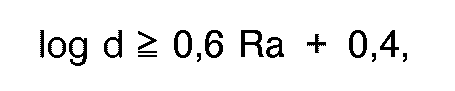
worin d die Tiefe (µm) der Vertiefungen und Ra der Mittenrauhwert des kaltgewalzten Stahlblechs sind. - Verfahren nach Anspruch 1, wobei die Vertiefungen diskontinuierlich sind.
- Verfahren nach Anspruch 1 oder 2, wobei die Vertiefungen in einer Richtung hergestellt werden, die im Bereich von 30° bis senkrecht zur Walzrichtung liegt.
- Verfahren nach Anspruch 1, 2 oder 3, das weiterhin den Schritt eines Entkohlungstemperns und den Schritt eines abschließenden Texturtemperns umfaßt.
- Verfahren nach einem der vorstehenden Ansprüche, wobei die Vertiefungen weniger oder gleich 100 µm tief sind.
- Verfahren nach einem der vorstehenden Ansprüche, wobei die Vertiefungen Breiten im Bereich von 5 bis 300 µm haben und in Walzrichtung in Abständen von 1 mm oder mehr angeordnet sind.
- Verfahren nach einem der vorstehenden Ansprüche, wobei die Vertiefungen hergestellt werden durch stellenweises Aufbringen, Aufdrucken eines Ätzresists auf die Stahlblechoberfläche; durch Fixieren des Ätzresists an der Stahlblechoberfläche durch Backen; durch Ätzen der Stahlblechoberfläche und durch Entfernen des Ätzresists, so daß nur die Bereiche der Stahlblechoberfläche geätzt werden, die nicht vom Ätzresist bedeckt waren.
- Verfahren nach Anspruch 7, wobei der Ätzresist durch Heliographie-Offsetdruck, Heliographiedruck ohne Offsetwalze, Lithographie-Offsetdruck oder Siebdruck aufgebracht wird.
- Verfahren nach Anspruch 7 oder 8, wobei das Ätzverfahren ein elektrolytisches Ätzen umfaßt.
- Verfahren nach Anspruch 7, 8 oder 9, wobei die Dicke des Resists nach dem Backen im Bereich von 0,5 bis 30 µm liegt.
- Verfahren nach einem der Ansprüche 7 bis 10, wobei der Ätzresist durch ein alkalisches oder organisches Lösungsmittel entfernt wird.
Applications Claiming Priority (4)
| Application Number | Priority Date | Filing Date | Title |
|---|---|---|---|
| JP202366/90 | 1990-08-01 | ||
| JP2202366A JPH086140B2 (ja) | 1990-08-01 | 1990-08-01 | 低鉄損方向性電磁鋼板の製造方法 |
| JP2204003A JPH0499130A (ja) | 1990-08-02 | 1990-08-02 | 低鉄損方向性電磁鋼板の製造方法 |
| JP204003/90 | 1990-08-02 |
Publications (2)
| Publication Number | Publication Date |
|---|---|
| EP0469710A1 EP0469710A1 (de) | 1992-02-05 |
| EP0469710B1 true EP0469710B1 (de) | 1994-11-23 |
Family
ID=26513329
Family Applications (1)
| Application Number | Title | Priority Date | Filing Date |
|---|---|---|---|
| EP91305671A Expired - Lifetime EP0469710B1 (de) | 1990-08-01 | 1991-06-24 | Verfahren zur Herstellung von kornorientierten Elektrostahlblechen mit geringen Eisenverlusten |
Country Status (5)
| Country | Link |
|---|---|
| US (1) | US5413639A (de) |
| EP (1) | EP0469710B1 (de) |
| KR (1) | KR930007313B1 (de) |
| CA (1) | CA2045701C (de) |
| DE (1) | DE69105247T2 (de) |
Families Citing this family (9)
| Publication number | Priority date | Publication date | Assignee | Title |
|---|---|---|---|---|
| US5618591A (en) * | 1995-05-15 | 1997-04-08 | Fuse Co. | Method of coating an inside of a pipe or tube |
| US5798001A (en) * | 1995-12-28 | 1998-08-25 | Ltv Steel Company, Inc. | Electrical steel with improved magnetic properties in the rolling direction |
| US6231685B1 (en) | 1995-12-28 | 2001-05-15 | Ltv Steel Company, Inc. | Electrical steel with improved magnetic properties in the rolling direction |
| US6605294B2 (en) * | 1998-08-14 | 2003-08-12 | Incept Llc | Methods of using in situ hydration of hydrogel articles for sealing or augmentation of tissue or vessels |
| US20090088723A1 (en) * | 2007-09-28 | 2009-04-02 | Accessclosure, Inc. | Apparatus and methods for treating pseudoaneurysms |
| RU2503729C1 (ru) * | 2010-06-25 | 2014-01-10 | Ниппон Стил Энд Сумитомо Метал Корпорейшн | Способ изготовления листа из электротехнической стали с ориентированной зеренной структурой |
| US10131018B2 (en) | 2012-04-27 | 2018-11-20 | Nippon Steel & Sumitomo Metal Corporation | Grain-oriented magnetic steel sheet and method of producing the same |
| WO2016129235A1 (ja) * | 2015-02-10 | 2016-08-18 | Jfeスチール株式会社 | 方向性電磁鋼板の製造方法 |
| CN107849631B (zh) * | 2015-07-28 | 2021-12-28 | 杰富意钢铁株式会社 | 线状槽形成方法及线状槽形成装置 |
Family Cites Families (3)
| Publication number | Priority date | Publication date | Assignee | Title |
|---|---|---|---|---|
| SE465129B (sv) * | 1984-11-10 | 1991-07-29 | Nippon Steel Corp | Kornorienterad staaltunnplaat foer elektriska aendamaal med laag wattfoerlust efter avspaenningsgloedgning samt foerfarande foer framstaellning av plaaten |
| JPS61117218A (ja) * | 1984-11-10 | 1986-06-04 | Nippon Steel Corp | 低鉄損一方向性電磁鋼板の製造方法 |
| US4728083A (en) * | 1985-12-16 | 1988-03-01 | Allegheny Ludlum Corporation | Method and apparatus for scribing grain-oriented silicon steel strip |
-
1991
- 1991-04-30 KR KR1019910006986A patent/KR930007313B1/ko not_active Expired - Lifetime
- 1991-06-24 EP EP91305671A patent/EP0469710B1/de not_active Expired - Lifetime
- 1991-06-24 DE DE69105247T patent/DE69105247T2/de not_active Expired - Lifetime
- 1991-06-26 CA CA002045701A patent/CA2045701C/en not_active Expired - Lifetime
-
1993
- 1993-01-19 US US08/006,143 patent/US5413639A/en not_active Expired - Lifetime
Also Published As
| Publication number | Publication date |
|---|---|
| DE69105247T2 (de) | 1995-04-06 |
| US5413639A (en) | 1995-05-09 |
| KR930007313B1 (ko) | 1993-08-05 |
| KR920004584A (ko) | 1992-03-27 |
| DE69105247D1 (de) | 1995-01-05 |
| EP0469710A1 (de) | 1992-02-05 |
| CA2045701C (en) | 1997-05-13 |
| CA2045701A1 (en) | 1992-02-02 |
Similar Documents
| Publication | Publication Date | Title |
|---|---|---|
| US5718775A (en) | Grain-oriented electrical steel sheet and method of manufacturing the same | |
| KR900008852B1 (ko) | 저철손 방향성 전자강판 및 그것의 제조방법 | |
| KR900007448B1 (ko) | 저철손 일방향성 전자강판의 제조방법 | |
| EP0539236B1 (de) | Kornorientiertes elektromagnetisches Stahlblech mit niedrigen Wattverlusten und Verfahren zur Herstellung desselben | |
| EP0469710A1 (de) | Verfahren zur Herstellung von kornorientierten Elektrostahlblechen mit geringen Eisenverlusten | |
| JP3726289B2 (ja) | 鉄損の低い方向性電磁鋼板 | |
| EP3950971B1 (de) | Orientiertes elektrostahlblech sowie verfahren zur herstellung davon | |
| EP4219776B1 (de) | Verfahren zur formung von rillen auf einer metallbandoberfläche und verfahren zur herstellung eines kern-orientierten elektromagnetischen stahlblechs | |
| WO2011162086A1 (ja) | 一方向性電磁鋼板の製造方法 | |
| JPS6342332A (ja) | 低鉄損方向性電磁鋼板の製造方法 | |
| JPH086140B2 (ja) | 低鉄損方向性電磁鋼板の製造方法 | |
| US4846939A (en) | Method for producing a grain-oriented electrical steel sheet having an ultra low watt loss | |
| EP4219775B1 (de) | Verfahren zur formung einer rille auf einer metallbandoberfläche und verfahren zur herstellung eines kornorientierten elektrischen stahlblechs | |
| EP0584610A1 (de) | Kornorientiertes elektromagnetisches Stahl mit geringen Eisenverlusten und Verfahren zur deren Herstellung | |
| JPS6376819A (ja) | 低鉄損方向性電磁鋼板およびその製造方法 | |
| JP2942074B2 (ja) | 低鉄損方向性電磁鋼板の製造方法 | |
| JP3369724B2 (ja) | 鉄損の低い方向性電磁鋼板 | |
| JP2583357B2 (ja) | 低鉄損一方向性珪素鋼板の製造方法 | |
| JP3663784B2 (ja) | 低鉄損方向性電磁鋼板の製造方法 | |
| JPH07331332A (ja) | 低鉄損方向性電磁鋼板の製造方法 | |
| KR20250090318A (ko) | 방향성 전자 강판 | |
| JPH06100939A (ja) | 低鉄損方向性電磁鋼板の製造方法 | |
| JPS6319573B2 (de) | ||
| JPH0499130A (ja) | 低鉄損方向性電磁鋼板の製造方法 | |
| KR20210110364A (ko) | 방향성 전자 강판의 제조 방법 |
Legal Events
| Date | Code | Title | Description |
|---|---|---|---|
| PUAI | Public reference made under article 153(3) epc to a published international application that has entered the european phase |
Free format text: ORIGINAL CODE: 0009012 |
|
| AK | Designated contracting states |
Kind code of ref document: A1 Designated state(s): BE DE FR GB IT SE |
|
| 17P | Request for examination filed |
Effective date: 19920211 |
|
| 17Q | First examination report despatched |
Effective date: 19940315 |
|
| GRAA | (expected) grant |
Free format text: ORIGINAL CODE: 0009210 |
|
| AK | Designated contracting states |
Kind code of ref document: B1 Designated state(s): BE DE FR GB IT SE |
|
| PG25 | Lapsed in a contracting state [announced via postgrant information from national office to epo] |
Ref country code: BE Effective date: 19941123 |
|
| ITF | It: translation for a ep patent filed | ||
| REF | Corresponds to: |
Ref document number: 69105247 Country of ref document: DE Date of ref document: 19950105 |
|
| PG25 | Lapsed in a contracting state [announced via postgrant information from national office to epo] |
Ref country code: SE Effective date: 19950223 |
|
| ET | Fr: translation filed | ||
| PLBE | No opposition filed within time limit |
Free format text: ORIGINAL CODE: 0009261 |
|
| STAA | Information on the status of an ep patent application or granted ep patent |
Free format text: STATUS: NO OPPOSITION FILED WITHIN TIME LIMIT |
|
| 26N | No opposition filed | ||
| REG | Reference to a national code |
Ref country code: GB Ref legal event code: IF02 |
|
| PGFP | Annual fee paid to national office [announced via postgrant information from national office to epo] |
Ref country code: FR Payment date: 20100709 Year of fee payment: 20 |
|
| PGFP | Annual fee paid to national office [announced via postgrant information from national office to epo] |
Ref country code: IT Payment date: 20100617 Year of fee payment: 20 |
|
| PGFP | Annual fee paid to national office [announced via postgrant information from national office to epo] |
Ref country code: GB Payment date: 20100623 Year of fee payment: 20 Ref country code: DE Payment date: 20100616 Year of fee payment: 20 |
|
| REG | Reference to a national code |
Ref country code: DE Ref legal event code: R071 Ref document number: 69105247 Country of ref document: DE |
|
| REG | Reference to a national code |
Ref country code: DE Ref legal event code: R071 Ref document number: 69105247 Country of ref document: DE |
|
| REG | Reference to a national code |
Ref country code: GB Ref legal event code: PE20 Expiry date: 20110623 |
|
| PG25 | Lapsed in a contracting state [announced via postgrant information from national office to epo] |
Ref country code: GB Free format text: LAPSE BECAUSE OF EXPIRATION OF PROTECTION Effective date: 20110623 |
|
| PG25 | Lapsed in a contracting state [announced via postgrant information from national office to epo] |
Ref country code: DE Free format text: LAPSE BECAUSE OF EXPIRATION OF PROTECTION Effective date: 20110625 |