EP0469773A2 - Überwachung des Eisen(II)gehalts zur Korrosionsbestimmung in Kesseleinrichtungen - Google Patents
Überwachung des Eisen(II)gehalts zur Korrosionsbestimmung in Kesseleinrichtungen Download PDFInfo
- Publication number
- EP0469773A2 EP0469773A2 EP91306684A EP91306684A EP0469773A2 EP 0469773 A2 EP0469773 A2 EP 0469773A2 EP 91306684 A EP91306684 A EP 91306684A EP 91306684 A EP91306684 A EP 91306684A EP 0469773 A2 EP0469773 A2 EP 0469773A2
- Authority
- EP
- European Patent Office
- Prior art keywords
- boiler
- ferrous ion
- reagent
- complex
- corrosion
- Prior art date
- Legal status (The legal status is an assumption and is not a legal conclusion. Google has not performed a legal analysis and makes no representation as to the accuracy of the status listed.)
- Granted
Links
- CWYNVVGOOAEACU-UHFFFAOYSA-N Fe2+ Chemical compound [Fe+2] CWYNVVGOOAEACU-UHFFFAOYSA-N 0.000 title claims abstract description 98
- 238000005260 corrosion Methods 0.000 title claims abstract description 72
- 230000007797 corrosion Effects 0.000 title claims abstract description 72
- 238000012544 monitoring process Methods 0.000 title description 11
- 229910001448 ferrous ion Inorganic materials 0.000 claims abstract description 90
- XLYOFNOQVPJJNP-UHFFFAOYSA-N water Substances O XLYOFNOQVPJJNP-UHFFFAOYSA-N 0.000 claims abstract description 69
- 239000000126 substance Substances 0.000 claims abstract description 60
- 239000003153 chemical reaction reagent Substances 0.000 claims abstract description 54
- 238000011282 treatment Methods 0.000 claims abstract description 42
- 239000003643 water by type Substances 0.000 claims abstract description 37
- 238000000034 method Methods 0.000 claims abstract description 36
- 239000002253 acid Substances 0.000 claims abstract description 6
- 150000004682 monohydrates Chemical class 0.000 claims abstract description 4
- XEEYBQQBJWHFJM-UHFFFAOYSA-N iron Substances [Fe] XEEYBQQBJWHFJM-UHFFFAOYSA-N 0.000 claims description 62
- 229910052742 iron Inorganic materials 0.000 claims description 30
- 238000002835 absorbance Methods 0.000 claims description 25
- QVGXLLKOCUKJST-UHFFFAOYSA-N atomic oxygen Chemical compound [O] QVGXLLKOCUKJST-UHFFFAOYSA-N 0.000 claims description 23
- 229910052760 oxygen Inorganic materials 0.000 claims description 23
- 239000001301 oxygen Substances 0.000 claims description 23
- 238000005259 measurement Methods 0.000 claims description 13
- VTLYFUHAOXGGBS-UHFFFAOYSA-N Fe3+ Chemical compound [Fe+3] VTLYFUHAOXGGBS-UHFFFAOYSA-N 0.000 claims description 12
- 229910001447 ferric ion Inorganic materials 0.000 claims description 12
- 150000003839 salts Chemical class 0.000 claims description 10
- 239000000203 mixture Substances 0.000 claims description 9
- WTDHULULXKLSOZ-UHFFFAOYSA-N Hydroxylamine hydrochloride Chemical compound Cl.ON WTDHULULXKLSOZ-UHFFFAOYSA-N 0.000 claims description 5
- CIWBSHSKHKDKBQ-JLAZNSOCSA-N Ascorbic acid Chemical compound OC[C@H](O)[C@H]1OC(=O)C(O)=C1O CIWBSHSKHKDKBQ-JLAZNSOCSA-N 0.000 claims description 4
- OAKJQQAXSVQMHS-UHFFFAOYSA-N Hydrazine Chemical compound NN OAKJQQAXSVQMHS-UHFFFAOYSA-N 0.000 claims description 4
- KEAYESYHFKHZAL-UHFFFAOYSA-N Sodium Chemical class [Na] KEAYESYHFKHZAL-UHFFFAOYSA-N 0.000 claims description 4
- XEVRDFDBXJMZFG-UHFFFAOYSA-N carbonyl dihydrazine Chemical compound NNC(=O)NN XEVRDFDBXJMZFG-UHFFFAOYSA-N 0.000 claims description 4
- 239000003638 chemical reducing agent Substances 0.000 claims description 4
- QTBSBXVTEAMEQO-UHFFFAOYSA-M Acetate Chemical compound CC([O-])=O QTBSBXVTEAMEQO-UHFFFAOYSA-M 0.000 claims description 3
- 238000002156 mixing Methods 0.000 claims description 3
- 235000010350 erythorbic acid Nutrition 0.000 claims description 2
- 238000003860 storage Methods 0.000 claims description 2
- CWERGRDVMFNCDR-UHFFFAOYSA-N thioglycolic acid Chemical compound OC(=O)CS CWERGRDVMFNCDR-UHFFFAOYSA-N 0.000 claims 4
- CIWBSHSKHKDKBQ-DUZGATOHSA-N D-araboascorbic acid Natural products OC[C@@H](O)[C@H]1OC(=O)C(O)=C1O CIWBSHSKHKDKBQ-DUZGATOHSA-N 0.000 claims 1
- DWAQJAXMDSEUJJ-UHFFFAOYSA-M Sodium bisulfite Chemical compound [Na+].OS([O-])=O DWAQJAXMDSEUJJ-UHFFFAOYSA-M 0.000 claims 1
- 239000012445 acidic reagent Substances 0.000 claims 1
- 239000004318 erythorbic acid Substances 0.000 claims 1
- 229940026239 isoascorbic acid Drugs 0.000 claims 1
- 235000010267 sodium hydrogen sulphite Nutrition 0.000 claims 1
- 239000000243 solution Substances 0.000 description 41
- KCXVZYZYPLLWCC-UHFFFAOYSA-N EDTA Chemical compound OC(=O)CN(CC(O)=O)CCN(CC(O)=O)CC(O)=O KCXVZYZYPLLWCC-UHFFFAOYSA-N 0.000 description 29
- 229910052739 hydrogen Inorganic materials 0.000 description 27
- 239000001257 hydrogen Substances 0.000 description 27
- UFHFLCQGNIYNRP-UHFFFAOYSA-N Hydrogen Chemical compound [H][H] UFHFLCQGNIYNRP-UHFFFAOYSA-N 0.000 description 26
- 238000012360 testing method Methods 0.000 description 18
- 238000006243 chemical reaction Methods 0.000 description 17
- 239000008139 complexing agent Substances 0.000 description 14
- MGFYIUFZLHCRTH-UHFFFAOYSA-N nitrilotriacetic acid Chemical group OC(=O)CN(CC(O)=O)CC(O)=O MGFYIUFZLHCRTH-UHFFFAOYSA-N 0.000 description 14
- 230000015572 biosynthetic process Effects 0.000 description 12
- 238000004458 analytical method Methods 0.000 description 11
- UQSXHKLRYXJYBZ-UHFFFAOYSA-N iron oxide Inorganic materials [Fe]=O UQSXHKLRYXJYBZ-UHFFFAOYSA-N 0.000 description 9
- 230000001590 oxidative effect Effects 0.000 description 9
- 229920000642 polymer Polymers 0.000 description 9
- 238000009472 formulation Methods 0.000 description 8
- 229960001484 edetic acid Drugs 0.000 description 7
- 238000001514 detection method Methods 0.000 description 6
- 235000013980 iron oxide Nutrition 0.000 description 6
- 239000012153 distilled water Substances 0.000 description 5
- SZVJSHCCFOBDDC-UHFFFAOYSA-N iron(II,III) oxide Inorganic materials O=[Fe]O[Fe]O[Fe]=O SZVJSHCCFOBDDC-UHFFFAOYSA-N 0.000 description 5
- VTYYLEPIZMXCLO-UHFFFAOYSA-L Calcium carbonate Chemical compound [Ca+2].[O-]C([O-])=O VTYYLEPIZMXCLO-UHFFFAOYSA-L 0.000 description 4
- 239000008351 acetate buffer Substances 0.000 description 4
- 238000011161 development Methods 0.000 description 4
- 230000006870 function Effects 0.000 description 4
- 229910052751 metal Inorganic materials 0.000 description 4
- 239000002184 metal Substances 0.000 description 4
- 239000000047 product Substances 0.000 description 4
- 238000005070 sampling Methods 0.000 description 4
- 239000012086 standard solution Substances 0.000 description 4
- 229940123973 Oxygen scavenger Drugs 0.000 description 3
- 229910000831 Steel Inorganic materials 0.000 description 3
- 239000007853 buffer solution Substances 0.000 description 3
- 230000003139 buffering effect Effects 0.000 description 3
- 239000013522 chelant Substances 0.000 description 3
- 238000010668 complexation reaction Methods 0.000 description 3
- 150000001875 compounds Chemical class 0.000 description 3
- 150000002431 hydrogen Chemical class 0.000 description 3
- 238000005342 ion exchange Methods 0.000 description 3
- VBMVTYDPPZVILR-UHFFFAOYSA-N iron(2+);oxygen(2-) Chemical class [O-2].[Fe+2] VBMVTYDPPZVILR-UHFFFAOYSA-N 0.000 description 3
- 230000007246 mechanism Effects 0.000 description 3
- 238000002798 spectrophotometry method Methods 0.000 description 3
- 239000010959 steel Substances 0.000 description 3
- QTBSBXVTEAMEQO-UHFFFAOYSA-N Acetic acid Chemical compound CC(O)=O QTBSBXVTEAMEQO-UHFFFAOYSA-N 0.000 description 2
- OYPRJOBELJOOCE-UHFFFAOYSA-N Calcium Chemical compound [Ca] OYPRJOBELJOOCE-UHFFFAOYSA-N 0.000 description 2
- 229910000640 Fe alloy Inorganic materials 0.000 description 2
- VEXZGXHMUGYJMC-UHFFFAOYSA-N Hydrochloric acid Chemical compound Cl VEXZGXHMUGYJMC-UHFFFAOYSA-N 0.000 description 2
- FYYHWMGAXLPEAU-UHFFFAOYSA-N Magnesium Chemical compound [Mg] FYYHWMGAXLPEAU-UHFFFAOYSA-N 0.000 description 2
- GRYLNZFGIOXLOG-UHFFFAOYSA-N Nitric acid Chemical compound O[N+]([O-])=O GRYLNZFGIOXLOG-UHFFFAOYSA-N 0.000 description 2
- RAHZWNYVWXNFOC-UHFFFAOYSA-N Sulphur dioxide Chemical compound O=S=O RAHZWNYVWXNFOC-UHFFFAOYSA-N 0.000 description 2
- 238000010521 absorption reaction Methods 0.000 description 2
- 230000005540 biological transmission Effects 0.000 description 2
- 239000011575 calcium Substances 0.000 description 2
- 229910052791 calcium Inorganic materials 0.000 description 2
- 229910000019 calcium carbonate Inorganic materials 0.000 description 2
- 230000015556 catabolic process Effects 0.000 description 2
- 238000010349 cathodic reaction Methods 0.000 description 2
- 239000002738 chelating agent Substances 0.000 description 2
- 239000003795 chemical substances by application Substances 0.000 description 2
- 230000000536 complexating effect Effects 0.000 description 2
- 238000009833 condensation Methods 0.000 description 2
- 230000005494 condensation Effects 0.000 description 2
- 239000000356 contaminant Substances 0.000 description 2
- 238000009792 diffusion process Methods 0.000 description 2
- 239000003651 drinking water Substances 0.000 description 2
- 230000000694 effects Effects 0.000 description 2
- 150000004677 hydrates Chemical class 0.000 description 2
- 125000004435 hydrogen atom Chemical group [H]* 0.000 description 2
- 239000007788 liquid Substances 0.000 description 2
- 239000011777 magnesium Substances 0.000 description 2
- 229910052749 magnesium Inorganic materials 0.000 description 2
- 238000004519 manufacturing process Methods 0.000 description 2
- 239000000463 material Substances 0.000 description 2
- 229910017604 nitric acid Inorganic materials 0.000 description 2
- 230000003647 oxidation Effects 0.000 description 2
- 238000007254 oxidation reaction Methods 0.000 description 2
- 150000005041 phenanthrolines Chemical class 0.000 description 2
- 239000002244 precipitate Substances 0.000 description 2
- 238000012545 processing Methods 0.000 description 2
- 210000002966 serum Anatomy 0.000 description 2
- 150000004760 silicates Chemical class 0.000 description 2
- 159000000000 sodium salts Chemical class 0.000 description 2
- URDCARMUOSMFFI-UHFFFAOYSA-N 2-[2-[bis(carboxymethyl)amino]ethyl-(2-hydroxyethyl)amino]acetic acid Chemical compound OCCN(CC(O)=O)CCN(CC(O)=O)CC(O)=O URDCARMUOSMFFI-UHFFFAOYSA-N 0.000 description 1
- FPFSGDXIBUDDKZ-UHFFFAOYSA-N 3-decyl-2-hydroxycyclopent-2-en-1-one Chemical compound CCCCCCCCCCC1=C(O)C(=O)CC1 FPFSGDXIBUDDKZ-UHFFFAOYSA-N 0.000 description 1
- DHDHJYNTEFLIHY-UHFFFAOYSA-N 4,7-diphenyl-1,10-phenanthroline Chemical compound C1=CC=CC=C1C1=CC=NC2=C1C=CC1=C(C=3C=CC=CC=3)C=CN=C21 DHDHJYNTEFLIHY-UHFFFAOYSA-N 0.000 description 1
- LSNNMFCWUKXFEE-UHFFFAOYSA-M Bisulfite Chemical compound OS([O-])=O LSNNMFCWUKXFEE-UHFFFAOYSA-M 0.000 description 1
- 229910000975 Carbon steel Inorganic materials 0.000 description 1
- AVXURJPOCDRRFD-UHFFFAOYSA-N Hydroxylamine Chemical compound ON AVXURJPOCDRRFD-UHFFFAOYSA-N 0.000 description 1
- 229910019142 PO4 Inorganic materials 0.000 description 1
- ABLZXFCXXLZCGV-UHFFFAOYSA-N Phosphorous acid Chemical class OP(O)=O ABLZXFCXXLZCGV-UHFFFAOYSA-N 0.000 description 1
- KJTLSVCANCCWHF-UHFFFAOYSA-N Ruthenium Chemical compound [Ru] KJTLSVCANCCWHF-UHFFFAOYSA-N 0.000 description 1
- VMHLLURERBWHNL-UHFFFAOYSA-M Sodium acetate Chemical compound [Na+].CC([O-])=O VMHLLURERBWHNL-UHFFFAOYSA-M 0.000 description 1
- DGEZNRSVGBDHLK-UHFFFAOYSA-N [1,10]phenanthroline Chemical compound C1=CN=C2C3=NC=CC=C3C=CC2=C1 DGEZNRSVGBDHLK-UHFFFAOYSA-N 0.000 description 1
- 238000000862 absorption spectrum Methods 0.000 description 1
- 229960000583 acetic acid Drugs 0.000 description 1
- 239000000654 additive Substances 0.000 description 1
- -1 and the like Chemical compound 0.000 description 1
- 239000012736 aqueous medium Substances 0.000 description 1
- 235000010323 ascorbic acid Nutrition 0.000 description 1
- 229960005070 ascorbic acid Drugs 0.000 description 1
- 239000011668 ascorbic acid Substances 0.000 description 1
- FBKZHCDISZZXDK-UHFFFAOYSA-N bathocuproine disulfonic acid Chemical compound C=12C=CC3=C(C=4C=CC(=CC=4)S(O)(=O)=O)C=C(C)N=C3C2=NC(C)=CC=1C1=CC=C(S(O)(=O)=O)C=C1 FBKZHCDISZZXDK-UHFFFAOYSA-N 0.000 description 1
- 239000012490 blank solution Substances 0.000 description 1
- 235000012206 bottled water Nutrition 0.000 description 1
- 239000000872 buffer Substances 0.000 description 1
- 239000008366 buffered solution Substances 0.000 description 1
- 239000006227 byproduct Substances 0.000 description 1
- 238000012512 characterization method Methods 0.000 description 1
- 238000002144 chemical decomposition reaction Methods 0.000 description 1
- 150000001868 cobalt Chemical class 0.000 description 1
- 229910017052 cobalt Inorganic materials 0.000 description 1
- 239000010941 cobalt Substances 0.000 description 1
- GUTLYIVDDKVIGB-UHFFFAOYSA-N cobalt atom Chemical compound [Co] GUTLYIVDDKVIGB-UHFFFAOYSA-N 0.000 description 1
- 238000004737 colorimetric analysis Methods 0.000 description 1
- 238000002485 combustion reaction Methods 0.000 description 1
- 238000011109 contamination Methods 0.000 description 1
- 238000007796 conventional method Methods 0.000 description 1
- 150000001879 copper Chemical class 0.000 description 1
- 230000029087 digestion Effects 0.000 description 1
- 238000007865 diluting Methods 0.000 description 1
- 239000002270 dispersing agent Substances 0.000 description 1
- 238000006073 displacement reaction Methods 0.000 description 1
- 238000004090 dissolution Methods 0.000 description 1
- 235000020188 drinking water Nutrition 0.000 description 1
- 230000002255 enzymatic effect Effects 0.000 description 1
- 229940026231 erythorbate Drugs 0.000 description 1
- CFUNAYGQFFNNSD-UHFFFAOYSA-L ferrous ammonium sulfate heptahydrate Chemical compound [NH4+].[NH4+].O.O.O.O.O.O.O.[Fe+2].[O-]S([O-])(=O)=O.[O-]S([O-])(=O)=O CFUNAYGQFFNNSD-UHFFFAOYSA-L 0.000 description 1
- ZGVNYCXXBQPDPQ-UHFFFAOYSA-M ferrozine monosodium salt Chemical compound [H+].[Na+].C1=CC(S(=O)(=O)[O-])=CC=C1C1=NN=C(C=2N=CC=CC=2)N=C1C1=CC=C(S([O-])(=O)=O)C=C1 ZGVNYCXXBQPDPQ-UHFFFAOYSA-M 0.000 description 1
- 235000015203 fruit juice Nutrition 0.000 description 1
- 239000007789 gas Substances 0.000 description 1
- 230000007274 generation of a signal involved in cell-cell signaling Effects 0.000 description 1
- 239000012362 glacial acetic acid Substances 0.000 description 1
- 239000012456 homogeneous solution Substances 0.000 description 1
- 230000036571 hydration Effects 0.000 description 1
- 238000006703 hydration reaction Methods 0.000 description 1
- WCYJQVALWQMJGE-UHFFFAOYSA-M hydroxylammonium chloride Chemical compound [Cl-].O[NH3+] WCYJQVALWQMJGE-UHFFFAOYSA-M 0.000 description 1
- 239000004615 ingredient Substances 0.000 description 1
- 238000011835 investigation Methods 0.000 description 1
- 150000002506 iron compounds Chemical class 0.000 description 1
- 159000000014 iron salts Chemical class 0.000 description 1
- 230000007774 longterm Effects 0.000 description 1
- 238000000691 measurement method Methods 0.000 description 1
- 229910044991 metal oxide Inorganic materials 0.000 description 1
- 150000004706 metal oxides Chemical class 0.000 description 1
- 150000002739 metals Chemical class 0.000 description 1
- BOPGDPNILDQYTO-NNYOXOHSSA-N nicotinamide-adenine dinucleotide Chemical compound C1=CCC(C(=O)N)=CN1[C@H]1[C@H](O)[C@H](O)[C@@H](COP(O)(=O)OP(O)(=O)OC[C@@H]2[C@H]([C@@H](O)[C@@H](O2)N2C3=NC=NC(N)=C3N=C2)O)O1 BOPGDPNILDQYTO-NNYOXOHSSA-N 0.000 description 1
- 229930027945 nicotinamide-adenine dinucleotide Natural products 0.000 description 1
- 235000015097 nutrients Nutrition 0.000 description 1
- 230000003287 optical effect Effects 0.000 description 1
- 229910052762 osmium Inorganic materials 0.000 description 1
- SYQBFIAQOQZEGI-UHFFFAOYSA-N osmium atom Chemical compound [Os] SYQBFIAQOQZEGI-UHFFFAOYSA-N 0.000 description 1
- 238000006213 oxygenation reaction Methods 0.000 description 1
- 235000021317 phosphate Nutrition 0.000 description 1
- 150000003013 phosphoric acid derivatives Chemical group 0.000 description 1
- 230000001376 precipitating effect Effects 0.000 description 1
- 238000002360 preparation method Methods 0.000 description 1
- 230000001681 protective effect Effects 0.000 description 1
- 230000035484 reaction time Effects 0.000 description 1
- 229910052707 ruthenium Inorganic materials 0.000 description 1
- 239000013535 sea water Substances 0.000 description 1
- 239000001632 sodium acetate Substances 0.000 description 1
- 235000017281 sodium acetate Nutrition 0.000 description 1
- 239000007787 solid Substances 0.000 description 1
- 230000003381 solubilizing effect Effects 0.000 description 1
- 229910001220 stainless steel Inorganic materials 0.000 description 1
- 238000010561 standard procedure Methods 0.000 description 1
- 239000000758 substrate Substances 0.000 description 1
- 238000003786 synthesis reaction Methods 0.000 description 1
- UEUXEKPTXMALOB-UHFFFAOYSA-J tetrasodium;2-[2-[bis(carboxylatomethyl)amino]ethyl-(carboxylatomethyl)amino]acetate Chemical compound [Na+].[Na+].[Na+].[Na+].[O-]C(=O)CN(CC([O-])=O)CCN(CC([O-])=O)CC([O-])=O UEUXEKPTXMALOB-UHFFFAOYSA-J 0.000 description 1
- 150000004684 trihydrates Chemical class 0.000 description 1
- 210000002700 urine Anatomy 0.000 description 1
- 239000002349 well water Substances 0.000 description 1
- 235000020681 well water Nutrition 0.000 description 1
Images


Classifications
-
- G—PHYSICS
- G01—MEASURING; TESTING
- G01N—INVESTIGATING OR ANALYSING MATERIALS BY DETERMINING THEIR CHEMICAL OR PHYSICAL PROPERTIES
- G01N17/00—Investigating resistance of materials to the weather, to corrosion, or to light
-
- G—PHYSICS
- G01—MEASURING; TESTING
- G01N—INVESTIGATING OR ANALYSING MATERIALS BY DETERMINING THEIR CHEMICAL OR PHYSICAL PROPERTIES
- G01N21/00—Investigating or analysing materials by the use of optical means, i.e. using sub-millimetre waves, infrared, visible or ultraviolet light
- G01N21/75—Systems in which material is subjected to a chemical reaction, the progress or the result of the reaction being investigated
- G01N21/77—Systems in which material is subjected to a chemical reaction, the progress or the result of the reaction being investigated by observing the effect on a chemical indicator
- G01N21/78—Systems in which material is subjected to a chemical reaction, the progress or the result of the reaction being investigated by observing the effect on a chemical indicator producing a change of colour
-
- G—PHYSICS
- G01—MEASURING; TESTING
- G01N—INVESTIGATING OR ANALYSING MATERIALS BY DETERMINING THEIR CHEMICAL OR PHYSICAL PROPERTIES
- G01N33/00—Investigating or analysing materials by specific methods not covered by groups G01N1/00 - G01N31/00
- G01N33/18—Water
- G01N33/1813—Specific cations in water, e.g. heavy metals
Definitions
- Boiler systems that are operating at extremely high pressures and temperatures particularly require pretreatment of waters being used to feed the boilers to eliminate such contaminants as calcium and magnesium hardness, other inorganic salts such as ferrous and ferric salts, silicates, and the like.
- our invention is related to the detection and determination of corrosion and of corrosion rates of boiler system ferrometals in contact with boiler waters, particularly those boiler waters containing boiler treatment chemicals purposely added to boiler waters, and boiler feed waters.
- Bornak also talks generally In terms of the difficulties encountered by the production of hydrogen which is a byproduct of corrosion and which has been traditionally used to measure corrosion rates occurring in a operating boiler. According to Bornak, hydrogen atoms produced through corrosion or through some other side mechanism, can diffuse into the metal and be lost either by direct diffusion or by reactions with various forms of metal oxides encountered by the hydrogen Hydrogen lost in any of these ways is therefore not available for measurement and the detection based on hydrogen of actual corrosion in an operating boiler is therefore limited.
- boiler system ferrometals e.g. carbon steels, stainless steels, iron, or other iron alloys
- boiler water treatment chemicals such chemicals including, but not necessarily limited to, oxygen scavengers such as bisulfite, hydrazine, carbohydrazide, erythorbic salts, and the like; and such other chemical treatments such as hardness transporting chemicals including EDTA, HEDTA, NTA, and certain polymeric complexes, as well as other boiler water treatment chemicals such as the precipitating treatments for hardness, that is phosphates, phosphonates, and the like.
- oxygen scavengers such as bisulfite, hydrazine, carbohydrazide, erythorbic salts, and the like
- hardness transporting chemicals including EDTA, HEDTA, NTA, and certain polymeric complexes
- other boiler water treatment chemicals such as the precipitating treatments for hardness, that is phosphates, phosphonates, and the like.
- this complex After formation of the ferrous ion/FZ complex, this complex is relatively stable to oxidation, however, the presence of the complex should he measured spectrophotometrically by measuring, within a reasonable time period of from about 1 minute to about 48 hours, the absorbance of a known standard containing this complex and comparing that with a concentration of an unknown sample having known aliquot relationships at a wave length of about 560 ⁇ 30 nanometers.
- This complexing reagent is primarily used as the monosodium salt but may also be made up in other salt forms.
- the complex is primarily present as a monosodium salt having one water of hydration related thereto and can be commercially purchased from the Hach Company.
- the complexing agent should be used at a known pH of from about 2 to about 6, preferably from between about 3 and about 5 and most preferably at a pH of approximately 3.6 ⁇ 0.2.
- the standardized solution of the FZ reagent primarily is a solution of this above FZ complexing agent that preferably contains an acetate buffer such that the pH ranges between 3.6 ⁇ 0.2, although other buffering systems besides the acetate buffering system may be used
- the known volume, or aliquot, sample is immediately added to a known volume of the FZ reagent solution, buffered as above.
- a known volume of the FZ reagent solution buffered as above.
- an acetate buffer solution as described above is used.
- an acetate buffer is used primarily in our technique, any other buffer in the range between about 2.0 and 6.0 would be sufficient. Buffering ingredients which might form precipitates with boiler chemicals or contaminants should be avoided.
- the complex solutions formed be protected from oxygen, although these complexes are considerably more stable against oxygenation than are the original ferrous containing solutions. It is advisable to maintain some protection against exposure to air or oxygen during the entire process of our invention
- the spectrophotometric measurement is fairly straightforward and can use any equipment available which has the capability of presenting a light source having a wave length of about 560 ⁇ 30 nanometers through a controlled length cell path into which the ferrous ion/FZ complex solution has been added, and which equipment includes means for measuring light absorbance, light transmission and the like, of this wave length, through the spectrophotometric cell containing the ferrous ion/FZ complex solution
- the reagent containing the FZ complexing agents should provide for essentially quantitative formation of ferrous ion FZ complexes in the presence of concentrations of the FZ complexing agent ranging from approximately 0.005 to about 0.20 molar concentration of FZ complexing agent in the acetate buffer solution.
- concentrations of the FZ complexing agent ranging from approximately 0.005 to about 0.20 molar concentration of FZ complexing agent in the acetate buffer solution.
- a preferred concentration of the FZ complexing agent in this buffered solution, in the absence of EDTA/NTA, or like chemical complexing agents, is at about 0.025 molar, although higher concentrations are permitted. Higher concentrations of FZ reagent is needed in the presence of EDTA, for example, see Table II.
- the acid buffer should control the pH in a range from between about 2 to about 6, preferably from between about 3 to about 5, and most preferably at a pH of between about 3.6 ⁇ 0.2.
- the boiler system can contain a number of different boiler system units, each unit subject to corrosion according to the reactions cited in the references incorporated herein by reference and presented above.
- the primary reaction for corrosion is the reaction of iron metal with water to form ferrous ion, and a similar reaction of the protons in water to form hydrogen gas, the reactions occurring at the anodic and/or cathodic sites respectively. If samples are taken of the boiler waters immediately within the boiler water system being monitored, and the samples are protected from oxygen or oxidizing species, and the samples are added immediately to the FZ reagent solutions as described above, the complex formed is sufficiently stable to permit its spectrophotometric measurement. Therefore the direct measurement of instantaneous corrosion occurring with the boiler system or the boiler system unit being monitored is now available, with no drawbacks as in hydrogen measurement.
- These boiler system units can include but are not necessarily limited to the inlet and/or outlet of an economizer, the inlet and/or outlet of the pre-heaters, the inlet and/or outlet of each steam condensers, the actual feed water to the boiler, the actual blow down from the boiler, the inlet and/or outlet samples obtained from any storage vessel or any holding tank or any aqueous condensate receiver, any steam receiver which is undergoing condensation to provide a liquid sample therein, any heat exchanger, any working unit being driven by the steam generation such as a turbine, a piston and the like.
- samples from the water wall header and outlet of the deaerator, inlet and outlet of the water treatment system providing for low hardness water, such treatment facilities including ion exchange and the like may be monitored for corrosion.
- water samples in any line, any pump, any vessel, and the like, which devices are contained in a boiler system may be so monitored.
- FerroZine@ is a registered trademark of Hach Chemical Company.
- Samples of boiler waters were obtained from various operating boiler system units by taking the water sample in a manner that guaranteed the sample was protected from exposure to oxygen or oxidizing systems. Samples were taken in such a manner so as to provide a known volume of the boiler water samples and the sample was added immediately to the standard solution of FZ reagent as prepared above. This was also done in a manner to protect both the FZ solution and the boiler samples from exposure to air, any oxygen sources, or any oxidizing chemicals.
- the color development is completed within one minute, or earlier, at temperatures ranging from about 60 to about 80 F.
- the complex is stable to air oxidation for at least 48 hours.
- all measurements and sampling be made in an oxygen protected or free environment. It is important that the sample to be analysed from the boiler system unit be collected in a testing apparatus such that the sample is mixed with a solution of the FZ reagent, both sample, and preferably the reagent also, being protected from oxygen exposure, air exposure and the like.
- This interference can be eliminated by increasing the concentration of the FZ reagent as is shown in Table II, so that when the concentration of the FZ reagent is high enough compensation for the interference cause by the ethylenediaminetetraacetic acid chelant is achieved.
- a key to monitoring for the presence of corrosion products, as measured by the presence of ferrous ion in boiler waters, particularly when those boiler waters are treated with certain boiler water treatment chemicals, is to have sufficient and effective concentrations of the FZ reagent present to overwhelm and compensate for any interferences caused by the boiler chemical treatment chemicals.
- boiler feed water ferrous ion pick up studies were made across various boiler system units operating in a steel manufacturing plant. Samples across an economizer operating within this boiler were analyzed using the proprietary ferrous iron FZ sampling and analysis procedures above. Chemical treatment programs containing ethylenediaminetetraacetic acid as well as chemical treatment programs containing nitrilotriacetic acid and another chemical treatment program containing an all polymer transport treatment chemical were evaluated
- Tests confirmed that corrosion across the economizer boiler unit was a direct function of the dosage of strong chelant chemical treating agents.
- Ferrous ion levels were detected (with treatment at a 0.1 ppm EDTA residual dosage) at concentrations ranging from 78-85 parts per billion with or without the presence of the above mentioned oxygen scavengers.
- the formulations containing nitrilotriacetic acid were not nearly as aggressive in terms of creating corrosion of iron across this economizer as were the formulations containing ethylenediaminetetracedic acid.
- Table III presents the results obtained when this operating economizer was monitored using the techniques of this invention for iron pickup.
- Table IV presents the data obtained when this boiler system was operated with the listed percentages of recommended dosages for various formulations which contained, as the primary hardness treatment reagents, EDTA, NTA, or all-polymer treatment formulations.
- the data for EDTA, #1 was obtained from a treatment program suggested by one water treatment chemical company, EDTA #2, was from a treatment program suggested by that same company but having a slightly different formulation, EDTA, #3 was obtained from a second water treatment chemical company and the NTA and all polymer programs were also commercially available products.
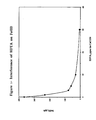
- Figure 5 presents the iron pickup, as measured by ferrous ion/FZ complexation, when an EDTA based treatment program is compared to an all polymer treatment program for scale control.
- the recommended dosages for hardness control using EDTA are averages of treatment systems recommended by two separate boiler treatment chemical companies.
- An automatic system has been constructed that provides samples from any sampling point within a boiler operating unit or within any boiler system operating unit.
- boiler operating units can include those listed previously, including the boiler itself, the down comer tubes, the overhead condensation system, or any condenser therein, the economizers, the pre-heaters, the ion exchange water preparation units or any line, water or steam vessels, tanks, pumps, or the like.
- This automatic monitoring system includes mechanical and electronic devices which will allow the operation, automatically under the control of a microprocessor, of all functions required to perform our tests.
- the functions provided by this device and controlled by this device include sample manipulation, such manipulation including the taking and transporting of samples in an oxygen free environment to a reaction chamber where the samples are reacted with the FZ reagent, appropriate time permitted for formation of the ferrous ion/FZ complex, then transport of this solution containing that ferrous ion/FZ complex into a photometric cell.
- the automatic device also provides for the generation of a light source wavelength of approximately 560 nanometers, the measurement of absorption of this light when passed through the optical cell containing the ferrous ion/FZ complex, the automated reading of this absorbance signal, and the data processing necessary to provide for read outs which are measurable and proportional to the concentration of ferrous ion in the sample taken
- This microprocessor also would control signal generation, data processing, and would control component failure detection.
- This system is capable of being programmed, calibrated, and data acquisition can be implemented easily using this system both in the laboratory and in field installed devices. Data generated can be down loaded onto any computer having appropriate interface with the microprocessor, which is part of the analyzer.
- This analyzer is subject to another patent application which is copending with this application entitled "On-Line Analyzer for Ferrous Ion" by Banks, et al, which application is incorporated herein by reference.
- This proposed analyzer provides for controlled volume samples being withdrawn from the sample source line without air contact, transport of samples into the instrument manifold via a miniature positive displacement pump. (However, any means of transporting a boiler water sample without air contact into an instrument manifold may be used).
- a sample blank reading is taken and buffered FZ reagent is injected at a volume ratio of from about 100:1 to about 1:100, depending on concentrations of FZ reagent and iron, preferably from 50:1 to about 1:50, into the sample stream and allowed to react.
- Another reading of the photometric transmission and/or absorbance of the reacted sample is taken and, in combination with the blank value, is converted into parts per billion ferrous ion via software calculations based on standardized absorbance concentration determination made earlier, then displayed either on a terminal or stored in memory for later downloading. Calibration of the instrument can be done manually at any time by employing known ferrous ion standards and programming proper factors.
- the proposed analyzer is designed to determine the concentration of ferrous ion in boiler water samples obtained from any boiler water unit or boiler system unit within the range of 0.4 to 1000 parts per billion ferrous ion in the boiler water sample.
Landscapes
- Life Sciences & Earth Sciences (AREA)
- Chemical & Material Sciences (AREA)
- Physics & Mathematics (AREA)
- Health & Medical Sciences (AREA)
- Immunology (AREA)
- Pathology (AREA)
- General Physics & Mathematics (AREA)
- General Health & Medical Sciences (AREA)
- Analytical Chemistry (AREA)
- Biochemistry (AREA)
- Engineering & Computer Science (AREA)
- Plasma & Fusion (AREA)
- Biodiversity & Conservation Biology (AREA)
- Environmental Sciences (AREA)
- Environmental & Geological Engineering (AREA)
- Chemical Kinetics & Catalysis (AREA)
- Ecology (AREA)
- Food Science & Technology (AREA)
- Medicinal Chemistry (AREA)
- Preventing Corrosion Or Incrustation Of Metals (AREA)
- Investigating Or Analyzing Non-Biological Materials By The Use Of Chemical Means (AREA)
- Investigating And Analyzing Materials By Characteristic Methods (AREA)
- Investigating Or Analyzing Materials By The Use Of Electric Means (AREA)
- Testing Resistance To Weather, Investigating Materials By Mechanical Methods (AREA)
Applications Claiming Priority (2)
| Application Number | Priority Date | Filing Date | Title |
|---|---|---|---|
| US56068790A | 1990-07-31 | 1990-07-31 | |
| US560687 | 1990-07-31 |
Publications (3)
| Publication Number | Publication Date |
|---|---|
| EP0469773A2 true EP0469773A2 (de) | 1992-02-05 |
| EP0469773A3 EP0469773A3 (en) | 1992-10-28 |
| EP0469773B1 EP0469773B1 (de) | 1996-09-25 |
Family
ID=24238899
Family Applications (1)
| Application Number | Title | Priority Date | Filing Date |
|---|---|---|---|
| EP91306684A Expired - Lifetime EP0469773B1 (de) | 1990-07-31 | 1991-07-23 | Überwachung des Eisen(II)gehalts zur Korrosionsbestimmung in Kesseleinrichtungen |
Country Status (6)
| Country | Link |
|---|---|
| EP (1) | EP0469773B1 (de) |
| AT (1) | ATE143496T1 (de) |
| AU (1) | AU635144B2 (de) |
| CA (1) | CA2041800C (de) |
| DE (1) | DE69122329T2 (de) |
| ES (1) | ES2094794T3 (de) |
Cited By (11)
| Publication number | Priority date | Publication date | Assignee | Title |
|---|---|---|---|---|
| EP0614085A1 (de) * | 1993-03-03 | 1994-09-07 | W.R. Grace & Co.-Conn. | Verfahren zum direkten Nachweis der Inhalte an Wasserbehandlungsstoffen bei dampferzeugenden Einrichtungen |
| EP0902232A1 (de) * | 1997-04-28 | 1999-03-17 | Siemens Aktiengesellschaft | Verfahren zum Betreiben eines von einem Medium durchströmten Bauteils und Aufbereitungssystem für ein Medium |
| WO2007103694A3 (en) * | 2006-03-01 | 2007-11-01 | Bristol Myers Squibb Co | Triazine 11-beta hydroxysteroid dehydrogenase type i inhibitors |
| DE102008041507A1 (de) * | 2008-08-25 | 2010-03-04 | Robert Bosch Gmbh | Verfahren zur quantitativen Bewertung von Korrosion an einem Bauteil |
| RU2416791C1 (ru) * | 2010-03-09 | 2011-04-20 | Государственное образовательное учреждение высшего профессионального образования "Мордовский государственный университет им. Н.П. Огарева" | Способ фотометрического определения железа (ii) в растворах чистых солей и искусственных смесей |
| EP2743674A1 (de) * | 2012-12-17 | 2014-06-18 | Industrial Technology Research Institute | Verfahren zur Diagnose der Korrosion eines unterirdischen Lagerbehälterssystems |
| RU2594659C2 (ru) * | 2011-04-27 | 2016-08-20 | Налко Компани | Способ и устройство для определения параметров системы в целях уменьшения коррозии в установке первичной обработки нефти |
| RU2600510C2 (ru) * | 2010-12-01 | 2016-10-20 | Налко Компани | Способ и устройство для определения параметров системы в целях уменьшения коррозии в установке первичной обработки нефти |
| US9488633B2 (en) | 2013-12-05 | 2016-11-08 | Kittiwake Developments Ltd. | Method for determining the concentration of iron ions in hydrocarbon compositions |
| WO2018130476A1 (en) * | 2017-01-11 | 2018-07-19 | Akzo Nobel Chemicals International B.V. | Method for determining iron |
| CN110146432A (zh) * | 2019-05-28 | 2019-08-20 | 深圳市水务工程检测有限公司 | 一种饮用水管材的测试方法 |
Families Citing this family (5)
| Publication number | Priority date | Publication date | Assignee | Title |
|---|---|---|---|---|
| AU651603B2 (en) * | 1990-07-31 | 1994-07-28 | Nalco Chemical Company | On-line analyzer for ferrous ion |
| US5898002A (en) * | 1997-08-22 | 1999-04-27 | Betzdearborn Inc. | Method for removing ferric-ferrous oxides from a liquid |
| RU2312338C1 (ru) * | 2006-10-05 | 2007-12-10 | Государственное образовательное учреждение высшего профессионального образования "Мордовский государственный университет им. Н.П. Огарева" | Способ фотометрического определения железа (ii) в растворах чистых солей и искусственных смесей |
| RU2349914C1 (ru) * | 2008-02-19 | 2009-03-20 | Государственное образовательное учреждение высшего профессионального образования "Мордовский государственный университет им. Н.П. Огарева" | Способ фотометрического определения железа (ii) в растворах чистых солей и искусственных смесей |
| DE102015212461A1 (de) * | 2015-07-02 | 2017-01-05 | Gasunie Deutschland Gmbh & Co. Kg | Verfahren zum Aufspüren von Korrosion an erdverlegten Stahlleitungen |
Family Cites Families (3)
| Publication number | Priority date | Publication date | Assignee | Title |
|---|---|---|---|---|
| US3770735A (en) * | 1970-06-24 | 1973-11-06 | Hach Chemical Co | Ferroin reagent and method of making same |
| US3709662A (en) * | 1970-07-20 | 1973-01-09 | Hach Chemical Co | Iron analysis reagent formulation |
| AU651603B2 (en) * | 1990-07-31 | 1994-07-28 | Nalco Chemical Company | On-line analyzer for ferrous ion |
-
1991
- 1991-05-03 CA CA002041800A patent/CA2041800C/en not_active Expired - Fee Related
- 1991-07-22 AU AU81219/91A patent/AU635144B2/en not_active Ceased
- 1991-07-23 DE DE69122329T patent/DE69122329T2/de not_active Expired - Fee Related
- 1991-07-23 EP EP91306684A patent/EP0469773B1/de not_active Expired - Lifetime
- 1991-07-23 AT AT91306684T patent/ATE143496T1/de not_active IP Right Cessation
- 1991-07-23 ES ES91306684T patent/ES2094794T3/es not_active Expired - Lifetime
Cited By (15)
| Publication number | Priority date | Publication date | Assignee | Title |
|---|---|---|---|---|
| EP0614085A1 (de) * | 1993-03-03 | 1994-09-07 | W.R. Grace & Co.-Conn. | Verfahren zum direkten Nachweis der Inhalte an Wasserbehandlungsstoffen bei dampferzeugenden Einrichtungen |
| TR28427A (tr) * | 1993-03-03 | 1996-06-13 | Grace W R & Co | Buhar üretme sistemlerindeki su islah bilesimlerinin derisimlerini dogrudan izlemek icin bir yöntem. |
| EP0902232A1 (de) * | 1997-04-28 | 1999-03-17 | Siemens Aktiengesellschaft | Verfahren zum Betreiben eines von einem Medium durchströmten Bauteils und Aufbereitungssystem für ein Medium |
| US7834178B2 (en) | 2006-03-01 | 2010-11-16 | Bristol-Myers Squibb Company | Triazine 11-beta hydroxysteroid dehydrogenase type 1 inhibitors |
| WO2007103694A3 (en) * | 2006-03-01 | 2007-11-01 | Bristol Myers Squibb Co | Triazine 11-beta hydroxysteroid dehydrogenase type i inhibitors |
| DE102008041507A1 (de) * | 2008-08-25 | 2010-03-04 | Robert Bosch Gmbh | Verfahren zur quantitativen Bewertung von Korrosion an einem Bauteil |
| DE102008041507B4 (de) * | 2008-08-25 | 2010-08-19 | Robert Bosch Gmbh | Prüfvorrichtung zur quantitativen Bewertung von Korrosion an einem Bauteil |
| RU2416791C1 (ru) * | 2010-03-09 | 2011-04-20 | Государственное образовательное учреждение высшего профессионального образования "Мордовский государственный университет им. Н.П. Огарева" | Способ фотометрического определения железа (ii) в растворах чистых солей и искусственных смесей |
| RU2600510C2 (ru) * | 2010-12-01 | 2016-10-20 | Налко Компани | Способ и устройство для определения параметров системы в целях уменьшения коррозии в установке первичной обработки нефти |
| RU2594659C2 (ru) * | 2011-04-27 | 2016-08-20 | Налко Компани | Способ и устройство для определения параметров системы в целях уменьшения коррозии в установке первичной обработки нефти |
| EP2743674A1 (de) * | 2012-12-17 | 2014-06-18 | Industrial Technology Research Institute | Verfahren zur Diagnose der Korrosion eines unterirdischen Lagerbehälterssystems |
| US9194856B2 (en) | 2012-12-17 | 2015-11-24 | Industrial Technology Research Institute | Method for diagnosing corrosion of underground storage tank system |
| US9488633B2 (en) | 2013-12-05 | 2016-11-08 | Kittiwake Developments Ltd. | Method for determining the concentration of iron ions in hydrocarbon compositions |
| WO2018130476A1 (en) * | 2017-01-11 | 2018-07-19 | Akzo Nobel Chemicals International B.V. | Method for determining iron |
| CN110146432A (zh) * | 2019-05-28 | 2019-08-20 | 深圳市水务工程检测有限公司 | 一种饮用水管材的测试方法 |
Also Published As
| Publication number | Publication date |
|---|---|
| EP0469773A3 (en) | 1992-10-28 |
| ATE143496T1 (de) | 1996-10-15 |
| ES2094794T3 (es) | 1997-02-01 |
| EP0469773B1 (de) | 1996-09-25 |
| DE69122329T2 (de) | 1997-03-06 |
| DE69122329D1 (de) | 1996-10-31 |
| AU8121991A (en) | 1992-02-06 |
| AU635144B2 (en) | 1993-03-11 |
| CA2041800A1 (en) | 1992-02-01 |
| CA2041800C (en) | 2003-04-29 |
Similar Documents
| Publication | Publication Date | Title |
|---|---|---|
| US5236845A (en) | On-line iron (II) concentration monitoring to continuously determine corrosion in boiler systems | |
| EP0469773B1 (de) | Überwachung des Eisen(II)gehalts zur Korrosionsbestimmung in Kesseleinrichtungen | |
| JP2954964B2 (ja) | 処理薬品トレーサーとしての遷移金属 | |
| Nydahl | On the peroxodisulphate oxidation of total nitrogen in waters to nitrate | |
| Mulvaney | Nitrogen—inorganic forms | |
| EP0447721B1 (de) | Überwachung der Funktion eines zu einer Wassermenge zugesetzten Behandlungsmittels und Analysiervorrichtung dafür | |
| Harp | Modifications to the azomethine-H method for determining boron in water | |
| Crosby | Determination of ammonia by the Nessler method in waters containing hydrazine | |
| Musagala et al. | A spectrophotometric method for quantification of sulphite ions in environmental samples | |
| CA2354015C (en) | Rapid colorimetric method for measuring polymers in aqueous systems | |
| Spencer et al. | Azomethine H colorimetric method for determining dissolved boron in water | |
| Rho et al. | A novel approach to measure carbonate alkalinity in aqueous solutions using a total organic carbon analyzer | |
| CN114544531B (zh) | 一种海洋沉积物中有机碳含量的测定方法 | |
| Belkin et al. | Effect of inorganic constituents on chemical oxygen demand—I. Bromides are unneutralizable by mercuric sulfate complexation | |
| US5898002A (en) | Method for removing ferric-ferrous oxides from a liquid | |
| Rahim et al. | Absorptiometric determination of trace amounts of sulphide ion in water | |
| US3706532A (en) | Method for determining zinc concentration in aqueous mediums | |
| Godfrey et al. | On-Line Corrosion Monitoring in Boiler Systems | |
| US3479152A (en) | Chelometric zinc titration | |
| Holm et al. | Characterizing the lead-complexing properties of polyphosphate water treatment products by competing-ligand spectrophotometry using 4-(2-pyridylazo) resorcinol | |
| Godfrey et al. | Monitoring corrosion in boiler systems with colorimetric tests for ferrous and total iron | |
| Bjorklund et al. | Determination of Free Residual Chlorine in Water by Para‐Aminodiethlaniline | |
| US20250283802A1 (en) | Systems, kits, and methods for determining corrosion tendencies of an aqueous sample on metal alloys exposed thereto | |
| Doyle et al. | Analysis of Kjeldahl digests by the salicylate method: Optimizing pH and buffering improves both sensitivity and precision | |
| Clarke | Discussion:“Hydrazine as an Oxygen Scavenger—A Progress Report on Tests at Springdale Station”(Baker, MD, and Marcy, VM, 1956, Trans. ASME, 78, pp. 299–303) |
Legal Events
| Date | Code | Title | Description |
|---|---|---|---|
| PUAI | Public reference made under article 153(3) epc to a published international application that has entered the european phase |
Free format text: ORIGINAL CODE: 0009012 |
|
| AK | Designated contracting states |
Kind code of ref document: A2 Designated state(s): AT DE ES FR GB IT NL |
|
| PUAL | Search report despatched |
Free format text: ORIGINAL CODE: 0009013 |
|
| AK | Designated contracting states |
Kind code of ref document: A3 Designated state(s): AT DE ES FR GB IT NL |
|
| 17P | Request for examination filed |
Effective date: 19930127 |
|
| GRAG | Despatch of communication of intention to grant |
Free format text: ORIGINAL CODE: EPIDOS AGRA |
|
| 17Q | First examination report despatched |
Effective date: 19960205 |
|
| GRAH | Despatch of communication of intention to grant a patent |
Free format text: ORIGINAL CODE: EPIDOS IGRA |
|
| GRAH | Despatch of communication of intention to grant a patent |
Free format text: ORIGINAL CODE: EPIDOS IGRA |
|
| GRAA | (expected) grant |
Free format text: ORIGINAL CODE: 0009210 |
|
| AK | Designated contracting states |
Kind code of ref document: B1 Designated state(s): AT DE ES FR GB IT NL |
|
| REF | Corresponds to: |
Ref document number: 143496 Country of ref document: AT Date of ref document: 19961015 Kind code of ref document: T |
|
| REF | Corresponds to: |
Ref document number: 69122329 Country of ref document: DE Date of ref document: 19961031 |
|
| ET | Fr: translation filed | ||
| ITF | It: translation for a ep patent filed | ||
| REG | Reference to a national code |
Ref country code: ES Ref legal event code: FG2A Ref document number: 2094794 Country of ref document: ES Kind code of ref document: T3 |
|
| PLBE | No opposition filed within time limit |
Free format text: ORIGINAL CODE: 0009261 |
|
| STAA | Information on the status of an ep patent application or granted ep patent |
Free format text: STATUS: NO OPPOSITION FILED WITHIN TIME LIMIT |
|
| 26N | No opposition filed | ||
| GBPC | Gb: european patent ceased through non-payment of renewal fee |
Effective date: 19980723 |
|
| GBPC | Gb: european patent ceased through non-payment of renewal fee |
Free format text: ERRATUM: "PATENT NUMBERS EP0469772, EP0469773 AND EP0469776 PREVIOUSLY ANNOUNCED AS CEASED IN THE PATENTS DESIGNS JOURNAL NO 5732 ON 17 MARCH 1999, PAGE 1158. CONSIDERATION IS BEING GIVEN TO REINSTATEMENT UNDER THE PROVISIONS OF RULE 100". |
|
| GBPC | Gb: european patent ceased through non-payment of renewal fee |
Free format text: "PATENT NUMBERS EP(UK)00469772 AND EP(UK)00469773 PREVIOUSLY ANNOUNCED AS CEASED IN THE PATENTS AND DESIGNS JOURNAL NUMBER 5723 ON 17 MARCH 1999 HAVE BEEN REINSTATED FOLLOWING THE EXERCISE OF DISCRETION BY THE COMPTROLLER UNDER RULE 100 AND SUBJECT TO THE ATTACHMENT OF TERMS TO PROTECT THIRD PARTIES." |
|
| PGFP | Annual fee paid to national office [announced via postgrant information from national office to epo] |
Ref country code: GB Payment date: 20000703 Year of fee payment: 10 |
|
| PGFP | Annual fee paid to national office [announced via postgrant information from national office to epo] |
Ref country code: AT Payment date: 20000704 Year of fee payment: 10 |
|
| PGFP | Annual fee paid to national office [announced via postgrant information from national office to epo] |
Ref country code: FR Payment date: 20000706 Year of fee payment: 10 |
|
| PGFP | Annual fee paid to national office [announced via postgrant information from national office to epo] |
Ref country code: ES Payment date: 20000808 Year of fee payment: 10 |
|
| GBPC | Gb: european patent ceased through non-payment of renewal fee |
Free format text: ERRATUM: THE NOTICE IN THE PDJ OF 17 MARCH 1999 (NO. 5732) ANNOUNCING THAT EUROPEAN PATENTS (UK) 0469772 AND 0469773 HAD CEASED WAS AN ERROR AND IS CANCELLED. SUBSEQUENT NOTICES CONCERNING THE EXERCISE OF DISCRETION UNDER RULE 100 TO REINSTATE THE PATENTS ARE ALSO WITHDRAWN. |
|
| PGFP | Annual fee paid to national office [announced via postgrant information from national office to epo] |
Ref country code: DE Payment date: 20010703 Year of fee payment: 11 |
|
| PGFP | Annual fee paid to national office [announced via postgrant information from national office to epo] |
Ref country code: NL Payment date: 20010717 Year of fee payment: 11 |
|
| PG25 | Lapsed in a contracting state [announced via postgrant information from national office to epo] |
Ref country code: GB Free format text: LAPSE BECAUSE OF NON-PAYMENT OF DUE FEES Effective date: 20010723 Ref country code: AT Free format text: LAPSE BECAUSE OF NON-PAYMENT OF DUE FEES Effective date: 20010723 |
|
| PG25 | Lapsed in a contracting state [announced via postgrant information from national office to epo] |
Ref country code: ES Free format text: LAPSE BECAUSE OF NON-PAYMENT OF DUE FEES Effective date: 20010724 |
|
| GBPC | Gb: european patent ceased through non-payment of renewal fee |
Effective date: 20010723 |
|
| PG25 | Lapsed in a contracting state [announced via postgrant information from national office to epo] |
Ref country code: FR Free format text: LAPSE BECAUSE OF NON-PAYMENT OF DUE FEES Effective date: 20020329 |
|
| REG | Reference to a national code |
Ref country code: FR Ref legal event code: ST |
|
| PG25 | Lapsed in a contracting state [announced via postgrant information from national office to epo] |
Ref country code: NL Free format text: LAPSE BECAUSE OF NON-PAYMENT OF DUE FEES Effective date: 20030201 Ref country code: DE Free format text: LAPSE BECAUSE OF NON-PAYMENT OF DUE FEES Effective date: 20030201 |
|
| NLV4 | Nl: lapsed or anulled due to non-payment of the annual fee |
Effective date: 20030201 |
|
| REG | Reference to a national code |
Ref country code: ES Ref legal event code: FD2A Effective date: 20020810 |
|
| PG25 | Lapsed in a contracting state [announced via postgrant information from national office to epo] |
Ref country code: IT Free format text: LAPSE BECAUSE OF NON-PAYMENT OF DUE FEES Effective date: 20050723 |