EP0470685A1 - Moteur à réluctance - Google Patents
Moteur à réluctance Download PDFInfo
- Publication number
- EP0470685A1 EP0470685A1 EP91301975A EP91301975A EP0470685A1 EP 0470685 A1 EP0470685 A1 EP 0470685A1 EP 91301975 A EP91301975 A EP 91301975A EP 91301975 A EP91301975 A EP 91301975A EP 0470685 A1 EP0470685 A1 EP 0470685A1
- Authority
- EP
- European Patent Office
- Prior art keywords
- coils
- motor control
- control circuit
- current
- signal
- Prior art date
- Legal status (The legal status is an assumption and is not a legal conclusion. Google has not performed a legal analysis and makes no representation as to the accuracy of the status listed.)
- Ceased
Links
- 230000008859 change Effects 0.000 claims abstract description 6
- 238000001514 detection method Methods 0.000 claims description 11
- 230000007704 transition Effects 0.000 claims description 4
- 230000000873 masking effect Effects 0.000 claims description 2
- 238000010586 diagram Methods 0.000 description 9
- XEEYBQQBJWHFJM-UHFFFAOYSA-N Iron Chemical group [Fe] XEEYBQQBJWHFJM-UHFFFAOYSA-N 0.000 description 3
- 238000000034 method Methods 0.000 description 3
- 230000003247 decreasing effect Effects 0.000 description 2
- 230000014509 gene expression Effects 0.000 description 2
- 238000005070 sampling Methods 0.000 description 2
- 238000004804 winding Methods 0.000 description 2
- 230000005355 Hall effect Effects 0.000 description 1
- 239000003990 capacitor Substances 0.000 description 1
- 238000006243 chemical reaction Methods 0.000 description 1
- 230000001419 dependent effect Effects 0.000 description 1
- 230000000694 effects Effects 0.000 description 1
- 230000006698 induction Effects 0.000 description 1
- 229910052742 iron Inorganic materials 0.000 description 1
- 239000000463 material Substances 0.000 description 1
- 230000008569 process Effects 0.000 description 1
- 238000009987 spinning Methods 0.000 description 1
Images



Classifications
-
- H—ELECTRICITY
- H02—GENERATION; CONVERSION OR DISTRIBUTION OF ELECTRIC POWER
- H02P—CONTROL OR REGULATION OF ELECTRIC MOTORS, ELECTRIC GENERATORS OR DYNAMO-ELECTRIC CONVERTERS; CONTROLLING TRANSFORMERS, REACTORS OR CHOKE COILS
- H02P25/00—Arrangements or methods for the control of AC motors characterised by the kind of AC motor or by structural details
- H02P25/02—Arrangements or methods for the control of AC motors characterised by the kind of AC motor or by structural details characterised by the kind of motor
- H02P25/08—Reluctance motors
Definitions
- the following invention relates to a sensorless control circuit for use with a switched reluctance electric motor.
- Switched reluctance stepping motors employ an iron core rotor having a plurality of poles and pairs of stator coils aligned on opposite sides of the rotor so as to create a magnetic circuit when the poles of the rotor are aligned with the oppositely placed coils.
- the reluctance of the magnetic circuit is lowest when a pole pair is aligned directly between a pair of opposed coils.
- Control circuits for such motors typically include an external sensor which is connected to the rotor to sense rotor position. This signal is used to maintain alignment between the coil switching sequence and the rotor position. Hall effect sensors have long been employed for this purpose.
- a mechanical sensor is shown in the U.S. patent to Abraham, et al. No. 3,601,678. In the Abraham patent, a mechanical emitter coupled to the shaft of the rotor provides position information for a reader head which in turn generates a feedback signal to a control loop which controls motor speed. Sensors, however, take up space, are costly, and typically cannot withstand the harsh environments for which switched reluctance motors are rated.
- This signal represents a phase error when compared with an optimum value and drives a voltage controlled oscillator which in turn generates timing signals for an inverter.
- switched reluctance motors do not employ permanent magnets, there is no back EMF induced in an unenergized coil as a direct result of rotor rotation.
- the inductance in the coils does vary as a function of rotor position. When a pair of rotor poles become aligned with a pair of stator coils, the inductance reaches a maximum. In the past, motor designers have attempted to build control loops utilizing some value of sensed inductance. However, this requires complex bridge circuitry which tends to have a high level of noise associated with it. Saturation and hysterysis effects also compromise inductance sensing techniques.
- the present invention solves the aforementioned problems in a switched reluctance stepping motor by providing a current sensing circuit to detect a signal proportional to current in the energizing coils of the motor.
- a slope detector determines the rate of change of the signal proportional to current over a set of discrete time intervals. The time intervals are provided by a window generator which masks the slope detector during periods when the current signal is rapidly fluctuating so that sampling takes place only when the current signal is either slowly increasing with time, slowly decreasing with time or constant.
- a variable oscillator is responsive to an integrated output of the slope detector and generates timing pulses for a driver circuit which is coupled to the energizing coils.
- This circuit operates on the theory that back EMF is generated by the driving current and rotor rotation.
- a switched reluctance motor does not generate back EMF in the sense that a DC motor does; that is, externally spinning the rotor of an unenergized switched reluctance motor does not produce a voltage on the windings as is seen in a DC permanent magnet motor.
- a switched reluctance motor does, however, convert electrical power into mechanical power. Therefore, some generated voltage must exist to oppose the current and force the supply to provide power at least equal to the mechanical output power.
- the induction component in the voltage equation is written with both the inductance and current inside the derivative because both components vary in time.
- the term (dL/do *i )* f 2 is a term which represents back EMF. This is the voltage generated by the energy conversion process.
- the term inside the parentheses also appears in the torque equation but is multiplied by one-half. Thus, only half of the energy converted due to the change of inductance with position is converted as mechanical work. The other half is stored in internal magnetic fields.
- the current pulse should be aligned with the peak of the back EMF term. This occurs when dL/de is at a maximum.
- the voltage-current relationship is dominated by the di/dt * L term.
- the current will soon level off and, because di/dt is nearly zero, the voltage-current relationship is dominated by the back EMF term. If the current pulse and back EMF is aligned, the slope of the current will be zero. If the current pulse is leading the back EMF then the dL/de term will be increasing toward its maximum. The current will decrease during this period in order to keep the product dL/d0 * I constant.
- the circuit of the invention senses the current in the coils and detects the slope of the current pulse with respect to time during the time intervals that the back EMF dominates the voltage-current relationship. The resulting signal is proportional to the phase error between the rotor position and drive waveforms.
- a differentiator is used as a slope detector. Since only the peak portions of each phase are dominated by the back EMF term, the invention utilizes a window generator to mask the slope detector during transitional periods where one coil is turned off and the next coil is turned on. This is to isolate the slope detector during times when the current changes rapidly due to switching transitions from one coil to the next.
- the slope detector includes a switched inverting amplifier that divides the current peak into two equal portions, inverts one portion and compares the relative amplitudes of each.
- the comparator output should be zero when the motor is in phase but produces a net positive or negative error signal when out of phase.
- the slope detector, window generator, proportional integral controller (PI controller), VCO, and sequencer may be implemented in a digital processor.
- the current is digitally sampled at the beginning of the window and again at the end.
- the phase error signal is generated as the arithmetic difference between these two values.
- a principal object of this invention is to provide a sensorless control circuit for a switched reluctance motor.
- such control circuit may enable an essentially noise immune control loop for the switched reluctance motor to be provided using a minimum number of components, this control loop being arranged to sense the slope of the currents in the motor coils at a time when back EMF is at a maximum to generate a phase error signal indicating whether the motor rotation is in phase with, leading or lagging the driving current pulses.
- a switched reluctance motor 10 includes a rotor 12 constructed of magnetically permeable material such as iron.
- the rotor 12 is surrounded by a plurality of stator poles 14 wrapped with wire coils 16.
- the coils 16 of the pole pairs 14A, 14B and 14C are energized by a driver circuit 18 (refer to FIG. 2).
- the driver 18 is controlled by a sequencer 20 which is in turn driven by a voltage controlled oscillator 22.
- a counter 24 coupled to the sequencer 20 provides an output indicative of rotor position.
- the sequencer 20 provides timing pulses for the driver 18 which in turn drives the motor 10 with a three phase driving voltage.
- a feedback line 26 connects the output of the voltage controlled oscillator (VCO) 22 with a window generator 28.
- the purpose of the window generator 28 is to mask certain portions of the output (or the input) of a slope detector 30 which senses the slope of signals proportional to current which are sensed through a current sensing resistor 32.
- the current signal from resistor 32 forms an input to the slope detector 30, and the slope detector output forms a first input to an AND gate 34.
- the other input to the gate 34 is the output of the window generator 28.
- the output of the gate 34 is coupled to inverting amplifier 36 which is in turn connected to a PI controller 38.
- the output of the PI controller 38 forms the input to the VCO 22.
- the coils 16 for stator poles A, B and C are connected to a common node 40 to which current sensing resistor 32 is also connected.
- the current signal at node 40 is thus the sum of the currents flowing in the coils 16 at any point in time.
- the output of the PI controller 38 will adjust the phase of the VCO 22 until the phase error signal is zero. This occurs when the rotor rotation and the driver 18 are in phase. In certain applications it is desirable to control the driver 18 to lead the motor 10 at high speeds. This allows the current to rise to a higher level before the back EMF dominates the voltage-current relationship. This produces greater output torque and power at the cost of a small decrease in efficiency.
- This feature can be implemented by adding velocity feed forward.
- the input to the VCO 22 is indicative of motor velocity. It can be fed forward through a gain element K ⁇ and subtracted from the phase error signal.
- the gain element could be a simple resistor. At low speeds, this term is negligible and the driver will be in phase with the rotor rotation. At high speeds, the velocity feed forward becomes significant and the PI controller 38 will adjust the phase of the VCO 22 until the difference between the phase error and the velocity feed forward term is zero. Thus, the driver will lead the motor which produces the required negative phase error signal.
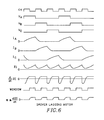
- Waveform diagrams shown in FIGS. 5, 6 and 7 illustrate the operation of the invention, for the cases phase alignment, phase lag and phase lead respectively.
- a clock pulse train generated by the sequencer 20 causes the driver 18 to produce driving voltages V a , V b and V e . These voltage pulses are impressed upon the coils sequentially to form current pulses l ao , l bO , and l ea where a, b and c stand for the three motor coil pairs.
- the next waveform represents the sum of the current pulses at node 40. It is this signal which is sensed by the current sensing resistor 32 and provided as an input to the slope detector 30.
- the window generator 28 generates pulses which mask the derivative signal during times when it is rapidly fluctuating due to transitions from one coil to the next by the driver 18.
- the window generator signal is low the output of AND gate 34 is blocked. The result is shown in the bottommost line of FIG. 5 where the output is essentially zero because the driving voltage and the back EMF are in phase. It should be recalled that the signal generated by back EMF is dependent upon rotor position.
- the output of gate 34 is of the form shown in the bottommost waveform of FIG. 6 or FIG. 7.
- the positive or negative pulses representing either the lagging or leading of the rotor position with respect to the driver pulses are inverted in amplifier 36 and integrated by PI controller 38. The result is an analog voltage that controls the frequency of the VCO 22.
- the preferred form of the slope detector is shown in FIG. 3.
- the current sum signal from resistor 32 is applied to a differentiator circuit 30 comprising resistor R1 connected in series with capacitor C1 which is in turn connected in series with amplifier U8A.
- the output of amplifier U8A is coupled through resistor R13 to gate circuit 34 comprising buffer amplifier U9A and switch 52.
- the switch S2 is connected in parallel with the positive input to amplifier U9A. This input is grounded whenever switch S2 is closed. Switch S2 is closed when the window signal provided by window generator 28 is low. This periodically masks the output of the slope detector 30 and the portions of its output that are passed to the PI controller 38 are those where the slope is determined by the back EMF. Nonlinearities in the slope signal which occur around transitions in the driving signal from one coil to the next are eliminated.
- FIG. 4 A second form of the slope detector is shown in FIG. 4.
- the detection of the slope of the current sum signal takes place after masking by the window generator.
- the connections between gate 34 and slope detector 30 would be reversed.
- the current sum signal is applied through a resistor R27 to an amplifier U11A which functions as a buffer. This signal is grounded by switch SW1 which is driven by a signal from the window generator.
- the pulsed output of the buffer amplifier U11A is applied to an inverting amplifier U11 B.
- the positive input to amplifier U11 B is connected through a switch SW2 to ground.
- the switch SW2 is controlled by a gate U5C which includes a clock input which operates at the frequency of the VCO and a signal derived from the window generator circuit which operates at twice the frequency of the VCO. This causes switch SW2 to effectively divide each pulse from the output of amplifier U11A into inverted and noninverted portions. When the rotor position and the motor driver are in phase alignment the positive and negative portions of each detected slope pulse are the same but when the signal either leads or lags the rotor position the portions become unequal, thus generating a phase error signal which is integrated to become an analog control voltage for the VCO.
Landscapes
- Engineering & Computer Science (AREA)
- Power Engineering (AREA)
- Control Of Stepping Motors (AREA)
- Control Of Motors That Do Not Use Commutators (AREA)
- Control Of Electric Motors In General (AREA)
Applications Claiming Priority (2)
| Application Number | Priority Date | Filing Date | Title |
|---|---|---|---|
| US07/565,943 US5015939A (en) | 1990-08-10 | 1990-08-10 | Control circuit for switched reluctance motor |
| US565943 | 1995-12-01 |
Publications (1)
| Publication Number | Publication Date |
|---|---|
| EP0470685A1 true EP0470685A1 (fr) | 1992-02-12 |
Family
ID=24260751
Family Applications (1)
| Application Number | Title | Priority Date | Filing Date |
|---|---|---|---|
| EP91301975A Ceased EP0470685A1 (fr) | 1990-08-10 | 1991-03-11 | Moteur à réluctance |
Country Status (3)
| Country | Link |
|---|---|
| US (1) | US5015939A (fr) |
| EP (1) | EP0470685A1 (fr) |
| JP (1) | JPH04229093A (fr) |
Cited By (4)
| Publication number | Priority date | Publication date | Assignee | Title |
|---|---|---|---|---|
| EP1109309A3 (fr) * | 1999-12-15 | 2003-04-02 | Switched Reluctance Drives Limited | Surveillance de la position du rotor d'un entraínement à réluctance |
| WO2004025822A1 (fr) * | 2002-09-12 | 2004-03-25 | Black & Decker Inc. | Commande d'une machine electrique a reluctance |
| US6979974B2 (en) | 2003-04-24 | 2005-12-27 | Switched Reluctance Drives Limited | Rotor position determination in a switched reluctance machine |
| DE102008016814A1 (de) | 2008-04-01 | 2009-10-08 | Panasonic Electronic Devices Europe Gmbh | Steuerung einer geschalteten Reluktanz-Maschine mit einer Vorrichtung zur Bereitstellung von Signalen der Rotorposition |
Families Citing this family (38)
| Publication number | Priority date | Publication date | Assignee | Title |
|---|---|---|---|---|
| US5196775A (en) * | 1991-02-20 | 1993-03-23 | Honeywell Inc. | Switched reluctance motor position by resonant signal injection |
| GB2258765B (en) * | 1991-06-27 | 1996-01-10 | Dana Corp | Variable reluctance motor having foil wire wound coils |
| US5469033A (en) * | 1994-05-20 | 1995-11-21 | Sl Montevideo Technology, Inc. | Virtual hall-effect signal generating for a brushless sensorless electrical rotary machine |
| US5448149A (en) * | 1994-06-20 | 1995-09-05 | Texas A&M University | Indirect rotor position sensor for a sinusoidal synchronous reluctance machine |
| US5426354A (en) * | 1994-11-15 | 1995-06-20 | Synektron Corporation | Vector control for brushless DC motor |
| US5497064A (en) * | 1995-03-14 | 1996-03-05 | A. O. Smith Corporation | Apparatus for starting a switched reluctance motor |
| US5525887A (en) * | 1995-03-14 | 1996-06-11 | A. O. Smith Corporation | Switched reluctance motor providing rotor position detection at low speeds without a separate rotor shaft position sensor |
| US5537019A (en) * | 1995-03-14 | 1996-07-16 | A. O. Smith Corporation | Switched reluctance motor providing rotor position detection at high speeds without a separate rotor shaft position sensor |
| DE69621736T2 (de) * | 1995-03-30 | 2003-03-06 | Akira Chiba | Geschaltete reluktions-rotationsmaschine |
| GB9506975D0 (en) * | 1995-04-04 | 1995-05-24 | Switched Reluctance Drives Ltd | Controller for a switched reluctance machine |
| US5825145A (en) * | 1995-12-18 | 1998-10-20 | Siliconix Incorporated | Quiet commutation circuit for an electric motor |
| GB9525952D0 (en) * | 1995-12-19 | 1996-02-21 | Switched Reluctance Drives Ltd | Sensorless rotor position monitoring in reluctance machines |
| US5736879A (en) * | 1996-02-02 | 1998-04-07 | Siliconix Incorporated | Closed-loop frequency-to-current converter with integrable capacitances |
| US5767643A (en) * | 1996-02-02 | 1998-06-16 | Siliconix Incorporated | Commutation delay generator for a multiphase brushless DC motor |
| RU2212755C2 (ru) * | 2001-05-15 | 2003-09-20 | ООО Научно-производственное предприятие "ЭМЕТРОН" | Способ регулирования момента индукторной электрической машины |
| RU2225067C1 (ru) * | 2002-06-21 | 2004-02-27 | Государственное образовательное учреждение высшего профессионального образования Московский энергетический институт (технический университет) | Вентильно-индукторный электропривод |
| RU2229194C2 (ru) * | 2002-07-01 | 2004-05-20 | Открытое акционерное общество "Всероссийский научно-исследовательский и проектно-конструкторский институт электровозостроения" | Способ управления индукторным двигателем |
| US20040089190A1 (en) * | 2002-11-08 | 2004-05-13 | Krishnan Ramu | Transportation system with linear switched reluctance actuator for propulsion and levitation |
| RU2234793C1 (ru) * | 2002-11-25 | 2004-08-20 | Демьяненко Александр Васильевич | Способ получения вращающего момента для бесконтактных индукторных вентильных двигателей |
| RU2265950C2 (ru) * | 2003-06-03 | 2005-12-10 | Государственное образовательное учреждение высшего профессионального образования Московский энергетический институт (технический университет) (ГОУВПО "МЭИ (ТУ") | Вентильно-индукторный электропривод |
| RU2282300C2 (ru) * | 2004-09-20 | 2006-08-20 | Открытое акционерное общество "Всероссийский научно-исследовательский и проектно-конструкторский институт электровозостроения" (ОАО "ВЭлНИИ") | Способ управления индукторным двигателем (варианты) |
| RU2277291C1 (ru) * | 2004-11-29 | 2006-05-27 | Александр Васильевич Демьяненко | Устройство питания обмотки возбуждения в бесконтактных вентильных двигателях с электромагнитным возбуждением |
| RU2284628C2 (ru) * | 2004-12-20 | 2006-09-27 | Открытое акционерное общество "Всероссийский научно-исследовательский и проектно-конструкторский институт электровозостроения" (ОАО "ВЭлНИИ") | Схема питания фазной обмотки реактивного индукторного двигателя |
| RU2297091C2 (ru) * | 2005-05-11 | 2007-04-10 | Открытое акционерное общество "Всероссийский научно-исследовательский и проектно-конструкторский институт электровозостроения" (ОАО "ВЭлНИИ") | Способ управления индукторным двигателем |
| RU2284643C1 (ru) * | 2005-05-11 | 2006-09-27 | Открытое акционерное общество "Всероссийский научно-исследовательский и проектно-конструкторский институт электровозостроения" (ОАО "ВЭлНИИ") | Способ стабилизации частоты вращения индукторного двигателя |
| RU2294049C1 (ru) * | 2005-07-25 | 2007-02-20 | Открытое акционерное общество "Всероссийский научно-исследовательский и проектно-конструкторский институт электровозостроения" (ОАО "ВЭлНИИ") | Способ управления индукторным двигателем |
| DE602005021794D1 (de) * | 2005-11-03 | 2010-07-22 | Black & Decker Inc | Steuerung geschalteter Reluktanzmaschinen |
| EP1959428A4 (fr) * | 2005-12-09 | 2011-08-31 | Sony Corp | Dispositif et procede d'edition musicale |
| CN100384080C (zh) * | 2006-01-06 | 2008-04-23 | 上海微电子装备有限公司 | 用于光刻机的数字可调双环电机控制器及其数字调节方法 |
| RU2315419C2 (ru) * | 2006-01-31 | 2008-01-20 | Открытое акционерное общество "Всероссийский научно-исследовательский и проектно-конструкторский институт электровозостроения" (ОАО "ВЭлНИИ") | Способ регулирования момента тягового индукторного электропривода |
| GB0709200D0 (en) * | 2007-05-12 | 2007-06-20 | Trw Ltd | Current measuring apparatus for use with electric motors |
| US8451634B2 (en) * | 2008-12-22 | 2013-05-28 | Texas Instruments Incorporated | Circuit and method of output power detection for a converter circuit |
| RU2430462C1 (ru) * | 2009-12-28 | 2011-09-27 | Государственное образовательное учреждение высшего профессионального образования "Югорский государственный университет" | Способ импульсного регулирования электродвигателей постоянного и переменного тока |
| JP5116785B2 (ja) * | 2010-02-25 | 2013-01-09 | 株式会社日立製作所 | 交流電動機の駆動装置及び電動機車両 |
| US10333443B2 (en) * | 2016-12-06 | 2019-06-25 | Dialog Semiconductor (Uk) Limited | Apparatus and method for controlling a device |
| US10888069B2 (en) | 2017-11-07 | 2021-01-12 | Towerstar Pets, Llc | Pet toy including apertures for receiving treats |
| USD843680S1 (en) | 2018-02-21 | 2019-03-26 | Towerstar Pets, Llc | Pet chew toy |
| EP3665770B1 (fr) | 2018-03-31 | 2025-03-19 | Turntide Technologies Inc. | Procédé et système de commande d'une machine à réluctance commutée |
Citations (1)
| Publication number | Priority date | Publication date | Assignee | Title |
|---|---|---|---|---|
| EP0305876A2 (fr) * | 1987-08-31 | 1989-03-08 | AlliedSignal Inc. | Capteur de position d'axe de moteur pas à pas |
Family Cites Families (4)
| Publication number | Priority date | Publication date | Assignee | Title |
|---|---|---|---|---|
| NL137155C (fr) * | 1964-05-01 | |||
| GB8307047D0 (en) * | 1983-03-15 | 1983-04-20 | Hill R J | Stepping motors and drive circuits |
| US4595865A (en) * | 1985-10-31 | 1986-06-17 | General Electric Company | Current-sensing scheme for switched reluctance motor drives |
| US4933620A (en) * | 1989-05-09 | 1990-06-12 | General Electric Company | Control system for low speed switched reluctance motor |
-
1990
- 1990-08-10 US US07/565,943 patent/US5015939A/en not_active Expired - Lifetime
-
1991
- 1991-03-11 EP EP91301975A patent/EP0470685A1/fr not_active Ceased
- 1991-07-25 JP JP3207300A patent/JPH04229093A/ja active Pending
Patent Citations (1)
| Publication number | Priority date | Publication date | Assignee | Title |
|---|---|---|---|---|
| EP0305876A2 (fr) * | 1987-08-31 | 1989-03-08 | AlliedSignal Inc. | Capteur de position d'axe de moteur pas à pas |
Non-Patent Citations (1)
| Title |
|---|
| IEEE TRANSACTIONS ON INDUSTRIAL ELECTRONICS, vol. IE-33, no. 3, August 1986, pages 212-216, New York, US; J.T. BASS et al.: "Robust torque control of switched-reluctance motors without a shaft-position sensor" * |
Cited By (5)
| Publication number | Priority date | Publication date | Assignee | Title |
|---|---|---|---|---|
| EP1109309A3 (fr) * | 1999-12-15 | 2003-04-02 | Switched Reluctance Drives Limited | Surveillance de la position du rotor d'un entraínement à réluctance |
| US6586903B2 (en) | 1999-12-15 | 2003-07-01 | Switched Reluctance Drives Ltd. | Rotor position monitoring of a reluctance drive |
| WO2004025822A1 (fr) * | 2002-09-12 | 2004-03-25 | Black & Decker Inc. | Commande d'une machine electrique a reluctance |
| US6979974B2 (en) | 2003-04-24 | 2005-12-27 | Switched Reluctance Drives Limited | Rotor position determination in a switched reluctance machine |
| DE102008016814A1 (de) | 2008-04-01 | 2009-10-08 | Panasonic Electronic Devices Europe Gmbh | Steuerung einer geschalteten Reluktanz-Maschine mit einer Vorrichtung zur Bereitstellung von Signalen der Rotorposition |
Also Published As
| Publication number | Publication date |
|---|---|
| US5015939A (en) | 1991-05-14 |
| JPH04229093A (ja) | 1992-08-18 |
Similar Documents
| Publication | Publication Date | Title |
|---|---|---|
| US5015939A (en) | Control circuit for switched reluctance motor | |
| US4611157A (en) | Switched reluctance motor drive operating without a shaft position sensor | |
| EP0276625B1 (fr) | Appareil de commande et méthode pour commander un moteur à reluctance variable | |
| Gallegos-Lopez et al. | A new sensorless method for switched reluctance motor drives | |
| JP3432226B2 (ja) | パルス幅変調モータ制御装置 | |
| US5036264A (en) | Brushless motor with no rotor-position sensor | |
| EP0822649B1 (fr) | Reconstruction des signals FCEM pour la synchronisation de commande des moteurs sans capteur et sans balai par reconstruire des signals de commande | |
| US6011368A (en) | Sensorless detection of a locked rotor in a switched reluctance motor | |
| EP0119097B2 (fr) | Moteurs pas à pas et circuits d'entraînement | |
| US4631459A (en) | Brushless DC motor | |
| KR100218547B1 (ko) | 회전자 위치센서없이 다중위상 무브러쉬 전동기 제어방법 및 그 장치 | |
| CN100486100C (zh) | 用于驱动无刷直流电机的方法和电路 | |
| US4988939A (en) | Electric motor with variable commutation delay | |
| US5079494A (en) | Fast response motor current regulator | |
| US5006774A (en) | Torque angle control system for controlling the torque angle of a permanent magnet synchronous motor | |
| US4510429A (en) | Stepper motor damping circuit and a method therefor | |
| US4717864A (en) | Speed control method and apparatus for electronically commutated motors | |
| US4065708A (en) | Method and apparatus for determining stepping motor parameters from induced voltages | |
| JPH0363318B2 (fr) | ||
| KR100745007B1 (ko) | 브러시리스 머신 제어 장치, 시스템 및 방법 | |
| US6242874B1 (en) | Phase commutation of a switched reluctance motor by single phase sensing of inductance | |
| Lee et al. | Rotor position detection techniques for brushless permanent-magnet and reluctance motor drives | |
| Panda et al. | Comparison of two techniques for closed-loop drive of VR step motors without direct rotor position sensing | |
| Ehsani et al. | Rotor position sensing in switched reluctance motor drives by measuring mutually induced voltages | |
| US6107764A (en) | Drive control for a switched reluctance motor |
Legal Events
| Date | Code | Title | Description |
|---|---|---|---|
| PUAI | Public reference made under article 153(3) epc to a published international application that has entered the european phase |
Free format text: ORIGINAL CODE: 0009012 |
|
| AK | Designated contracting states |
Kind code of ref document: A1 Designated state(s): AT BE CH DE DK ES FR GB GR IT LI LU NL SE |
|
| 17P | Request for examination filed |
Effective date: 19920806 |
|
| 17Q | First examination report despatched |
Effective date: 19940620 |
|
| STAA | Information on the status of an ep patent application or granted ep patent |
Free format text: STATUS: THE APPLICATION HAS BEEN REFUSED |
|
| 18R | Application refused |
Effective date: 19950910 |