EP0470831A2 - Zuordnungsverfahren von Fernsprechkanälen in einem zellularen Telefonsystem - Google Patents
Zuordnungsverfahren von Fernsprechkanälen in einem zellularen Telefonsystem Download PDFInfo
- Publication number
- EP0470831A2 EP0470831A2 EP91307264A EP91307264A EP0470831A2 EP 0470831 A2 EP0470831 A2 EP 0470831A2 EP 91307264 A EP91307264 A EP 91307264A EP 91307264 A EP91307264 A EP 91307264A EP 0470831 A2 EP0470831 A2 EP 0470831A2
- Authority
- EP
- European Patent Office
- Prior art keywords
- cell
- frequencies
- cells
- adjacent
- group
- Prior art date
- Legal status (The legal status is an assumption and is not a legal conclusion. Google has not performed a legal analysis and makes no representation as to the accuracy of the status listed.)
- Withdrawn
Links
- 238000000034 method Methods 0.000 title claims abstract description 36
- 230000001413 cellular effect Effects 0.000 title claims abstract description 30
- 230000006872 improvement Effects 0.000 claims description 5
- 230000005855 radiation Effects 0.000 abstract description 8
- 210000004027 cell Anatomy 0.000 description 332
- 230000032823 cell division Effects 0.000 description 10
- 238000010586 diagram Methods 0.000 description 7
- 230000008859 change Effects 0.000 description 6
- 230000008901 benefit Effects 0.000 description 4
- 230000003247 decreasing effect Effects 0.000 description 3
- 230000008569 process Effects 0.000 description 3
- 230000009467 reduction Effects 0.000 description 3
- 238000000926 separation method Methods 0.000 description 3
- 230000012447 hatching Effects 0.000 description 2
- 230000011664 signaling Effects 0.000 description 2
- 238000012876 topography Methods 0.000 description 2
- IRLPACMLTUPBCL-KQYNXXCUSA-N 5'-adenylyl sulfate Chemical compound C1=NC=2C(N)=NC=NC=2N1[C@@H]1O[C@H](COP(O)(=O)OS(O)(=O)=O)[C@@H](O)[C@H]1O IRLPACMLTUPBCL-KQYNXXCUSA-N 0.000 description 1
- 241000854350 Enicospilus group Species 0.000 description 1
- 210000004460 N cell Anatomy 0.000 description 1
- 230000009286 beneficial effect Effects 0.000 description 1
- 230000005540 biological transmission Effects 0.000 description 1
- 230000023715 cellular developmental process Effects 0.000 description 1
- 238000006243 chemical reaction Methods 0.000 description 1
- 238000004891 communication Methods 0.000 description 1
- 230000018109 developmental process Effects 0.000 description 1
- 239000000835 fiber Substances 0.000 description 1
- 230000007704 transition Effects 0.000 description 1
Images




Classifications
-
- H—ELECTRICITY
- H04—ELECTRIC COMMUNICATION TECHNIQUE
- H04W—WIRELESS COMMUNICATION NETWORKS
- H04W16/00—Network planning, e.g. coverage or traffic planning tools; Network deployment, e.g. resource partitioning or cells structures
- H04W16/02—Resource partitioning among network components, e.g. reuse partitioning
- H04W16/12—Fixed resource partitioning
-
- H—ELECTRICITY
- H04—ELECTRIC COMMUNICATION TECHNIQUE
- H04B—TRANSMISSION
- H04B7/00—Radio transmission systems, i.e. using radiation field
- H04B7/24—Radio transmission systems, i.e. using radiation field for communication between two or more posts
- H04B7/26—Radio transmission systems, i.e. using radiation field for communication between two or more posts at least one of which is mobile
- H04B7/2621—Radio transmission systems, i.e. using radiation field for communication between two or more posts at least one of which is mobile using frequency division multiple access [FDMA]
-
- H—ELECTRICITY
- H04—ELECTRIC COMMUNICATION TECHNIQUE
- H04W—WIRELESS COMMUNICATION NETWORKS
- H04W16/00—Network planning, e.g. coverage or traffic planning tools; Network deployment, e.g. resource partitioning or cells structures
- H04W16/02—Resource partitioning among network components, e.g. reuse partitioning
-
- H—ELECTRICITY
- H04—ELECTRIC COMMUNICATION TECHNIQUE
- H04W—WIRELESS COMMUNICATION NETWORKS
- H04W16/00—Network planning, e.g. coverage or traffic planning tools; Network deployment, e.g. resource partitioning or cells structures
- H04W16/24—Cell structures
-
- H—ELECTRICITY
- H04—ELECTRIC COMMUNICATION TECHNIQUE
- H04W—WIRELESS COMMUNICATION NETWORKS
- H04W28/00—Network traffic management; Network resource management
- H04W28/16—Central resource management; Negotiation of resources or communication parameters, e.g. negotiating bandwidth or QoS [Quality of Service]
-
- H—ELECTRICITY
- H04—ELECTRIC COMMUNICATION TECHNIQUE
- H04W—WIRELESS COMMUNICATION NETWORKS
- H04W36/00—Hand-off or reselection arrangements
- H04W36/08—Reselecting an access point
Definitions
- This invention relates to a method for cell splitting and frequency assignment in a cellular telephone system, and to a distribution of frequency assignments in a cellular telecommunications system.
- Mobile telephone systems use a separate frequency channel for each call from a mobile customer.
- the use of the same channel by another nearby customer may lead to interference on the channel and a reduction in service quality. This interference is known as co-channel interference.
- each service area is known as a cell, from which the term "cellular system" is derived. Cells having the same group of frequencies are separated as much as possible to reduce co-channel interference.
- Each cell is served by a cell site, at which the transmission and control equipment is located. Calls are routed to and from the cell site to a mobile telecommunications switching office and from there to the telephone network.
- the equipment at each cell site includes an antenna, which may be either directional or omnidirectional.
- An omni-directional antenna will typically be located at the center of a cell and radiate the entire cell.
- a directional antenna will typically be located at the corner of a cell and radiate the entire cell, known as end radiating the cell.
- Cell shapes are determined by the radiation patterns of the antenna and the local conditions at the cell site. However, they may be idealized for analysis as a hexagonal pattern, since such a pattern closely approximates the ideal distribution of cell sites.
- Each cell typically includes an omni-directional antenna radiating all of the cell from the mid-point of the cell.
- the cells are sectorized or partitioned with sectors A, B and C. Each sector will now have up to 14 channels (Normally the 15th voice channel is dropped to accommodate the control and locate channels). Sectorization is accomplished by using directional antennas at about the mid-point of each cell and separate control channels per sector. Radiation patterns from the antennas would be as close as possible to provide end radiation of each sector.
- Decreased trunking efficiency refers to the statistical improvement of decreased blockage to phone calls as the number of channels are increased).
- the telephone traffic tables (see appendix 1.1 in Mobile Cellular Telecommunications Systems cited above) indicate approximately a 30% reduction per channel of traffic handling capability when the trunk group is changed from 44 to 14 channels. (Normally only 14 voice, control and locate channels are used per sector).
- K 4, 7, 9 or 12, see Figure 2.3 of Mobile Cellular Telecommunications Systems cited above.
- the 666 frequencies of the primary frequency allocations have been allocated equally to the A & B bands. Normally the B Band has been assigned by the communication commission to the wireline companies and the A Band has been assigned to the Non-wireline companies.
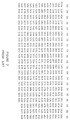
- the formula cited above gives the standard frequency layout (a chart is given at page 246 of Mobile Cellular Telecommunications Systems cited above).
- the first 21 channels are used for control channels and the remaining channels are used for voice channels.
- This allocation provides for 15 voice channels (the last 3 groups have only 14 voice channels) in each sub-group or 45 channels in the larger group (i.e. Group 1 consists of 15 voice channels in each sub-group 1A, 1B and 1C).
- all of the frequencies assigned to the sectors or parts of the cell were originally in the cell, and have simply been divided between the sectors or the cell.
- most of the cells have been shown with sectors A, B and C, to which are assigned the frequency subgroups as shown in Figure 2.
- This distribution greater trunking efficiency is obtained, which results in a net re-use of frequency, and thus a greater degree of protection against co-channel interference may be obtained, than without sectoring.
- This method of cell splitting requires that a directional antenna be used for each sector at each cell site. Normally the sectors have the same orientation, i.e. 1A is oriented in the same direction as 2A, 3A, 4A, etc.
- a second stage of cell division is also shown in Figure 1C in which the same frequency distribution is re-used on a smaller scale.
- the invention described in this patent disclosure has been created by a new frequency allocation and by end radiating 3 cells from one cell site.
- the co-channel interference is further minimized with the use of highly directional antennas and high gain antennas. Other methods that are known in the art may also be used.
- the adjacent channel interference from co-located cells is prevented by avoiding adjacent channels at a site.
- a method of available frequencies to a plurality of cells in a cellular telecommunications system comprising:
- the method includes r e - assigning the first group of frequencies to a first part of the first cell;
- a cell is an area on the surface of the earth that is served by a given antenna.
- Each cell will be assigned a group of distinct frequencies, and thus the antenna (whether omni-directional or directional) will have its associated filters tuned to those frequencies.
- Distinct frequencies means frequencies that do not interfere with each other at an unacceptable level, which in the case of frequencies assigned to a specific cell means at least that the frequencies are separated by at least one channel and preferably more, and in the case of frequencies assigned to adjacent cells means the frequencies are at least not the same.
- the signalling channels are numbered 334 to 354 inclusive.
- the base transmit frequency is (870 + n x 0.030)MHz
- the mobile transmit frequency is (825 + n x 0.030)MHz, where n is the channel number, for an allocation of 20MHz per system.
- the remaining frequencies are wildcard frequencies that can be used where required, such as in inner city areas with dense mobile telephone traffic.
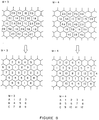
- the wildcard groups are groups 19, 20 and 21 of Figure 6.
- the channel assignment pattern allows for 30 voice channels per cell.
- the wildcard groups can be used to increase this number up to 44 channels in selected cells.
- the control channels are compatible and the frequencies are the same in the sub-groups for both systems (that is, where 15 or fewer channels are used).
- This seeming inefficient use of frequencies results in benefits during cell splitting.
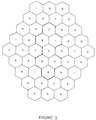
- frequencies of the 1st group are assigned to the cell labelled 1, and then one of the adjacent surrounding cells is assigned frequencies from another group (cell 2). This process continues for each surrounding cell, but leaving out the frequencies that are to be used later for cell splitting, which are preferably those that minimize co-channel interference.
- groups 4 and 7 are not assigned to cells adjacent cell 1
- groups 5 and 8 are not assigned to cells adjacent cell 2
- groups 6 and 9 are not assigned to cells adjacent cell 3.
- the cells surrounding the first cell may be assigned frequency groups 2, 3, 4, 6, 7 and 8, leaving out groups 5 and 9 for later re-use.
- the frequencies assigned to each of these groups is made on the same principles as used to establish the frequency groups shown in Figure 6.
- the frequencies are distributed such that any group of cells kA, kB and kC forms an equilateral triangle, with a cell having a distinct group of frequencies between any pair of cells kA and kB, kB and kC, and kA and kC.
- the complete cell distribution is thus formed by leaving out the re-use frequencies (for cell kA these are kB and kC) in the cells adjacent kA, and then assigning the re-use frequencies to non-adjacent cells.
- the equilateral distribution of the cells with re-use frequencies permits the antennas in cells with the same frequencies to be separated by the maximum uniform distance. This may be seen in Figures 3, 4 and 8.
- the orientation of the directional antennas in the smaller cells results in there being 7 hexagonal cell radii between co-channel cells in the direction of orientation of the antenna. That is, a random pattern may result in greater distance between some co-channel cells, but others will be closer together.
- the cells adjacent to any particular cell are assigned frequencies that are separated from the frequencies assigned to that particular cell by at least one channel.
- At least two of the cells that are separated by one cell from any particular cell are assigned frequencies that differ from the frequencies assigned to the particular cell by at least three channels.
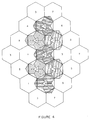
- the first stage of cell splitting using an embodiment of the method of the present invention is shown in Figure 4, where the same cell group as outlined in Figure 3 is shown in heavy outline.
- FIG 4 the cells without hatching, identified by the numerals in circles, are the larger (omni-directional) cells before splitting, while the smaller cells with hatching are the cells after splitting.
- Each of the smaller cells is preferably end radiated using a set of three co-located directional antennas.
- the direction of the maximum radiation from the antenna (referred to as the orientation of the antenna) is indicated for each antenna by the apex of the triangle.
- Each larger cell is split by assigning to a part of it frequencies of a non-adjacent cell, so that after the split some of the cell is assigned the original group of frequencies and at least one part of the cell is assigned frequencies from a non-adjacent cell to form a new cell, while maintaining coverage of the cell from the same, or essentially the same cell site.
- cell 2 is divided into parts or cells having assigned to them frequencies from the 2, 5 and 8 cells. These cells (5 and 8) are the only two cells that are non-adjacent the 2 cell before splitting, hence providing for a minimum cell separation of two intervening cells of the size of cell after cell splitting.
- the groups of cells 1, 4 and 7 and 2, 5 and 8 are the first and second sets of three co-located end radiated cells, each radiated by directional antennas at first and second cell sites respectively.
- the cell splitting method is then to locate a third cell site at about the mid-way point between the first and second cell sites; and to radiate at least a third cell from the third cell site.
- the first and second sets of cells are assigned distinct groups of frequencies (1, 4, 7, 2, 5 and 8) and in the method of cell division frequencies are assigned to the third cell that are distinct from the frequencies assigned to the first and second sets of cells (3, 6 and 9).
- directional antennas are used at the third cell site to end radiate a third set of three co-located cells.
- the assigning of frequencies is done by assigning to each of the cells in the third set of cells frequencies that are distinct from the frequencies assigned to the first and second sets of cells.
- each cell if the cell is sub-divided into m different parts then each cell must be surrounded by no more than K - m cells. This yields at least m - 1 non-adjacent cells from which frequency subsets can be taken for cell splitting.
- the smaller cell extends the boundaries of the old omni-directional cell.
- This extension of the cell or equivalently, extension of the footprint of the directional antenna, requires the directional antenna to have a narrower footprint than the directional antennas used in the conventional cell distribution illustrated in Figure 1.
- a narrower footprint may be obtained by increasing the horizontal directivity of the antenna.
- the edge of a footprint is normally defined in relation to adjacent cells since the footprint of an antenna is the area where the signal of that antenna is the predominant signal. Because handoff algorithms assign a mobile customer the dominant frequency receivable by that customer, the footprint of an antenna is defined as the area where that antenna will be the one used by a mobile customer. Otherwise, the edge of the footprint may be defined in terms of the signal level, for example, where the signal level coverage is at the 39 dB microvolt contour.
- the extension of the footprints formed by adjacent first and second antennas at a first cell site results in a gap, and the extension of the footprint of an antenna of an adjacent cell site into the gap results in the interleaving of the footprints.
- the footprint of the smaller 2 cell in the center of Figure 4 extends between and interleaves with the footprints of the small adjacent 4 and 7 cells. With a 60 degree antenna that is 10 dB down at the side of the footprint, this provides for a more distinct handoff than is available from the sectorization system shown in Figure 1.
- handoff (which requires extensive control equipment, all readily commercially available) may be controlled by the mobile telecommunications switching office rather than, as commonly used, the cell site.
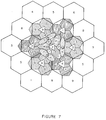
- interleaving is made more apparent by the replacement of the idealized hexagonal cells by approximations of the actual footprints.
- interleaving of cells may also be introduced before the second stage of cell splitting where appropriate as a method of filling in frequency assignments.
- the interleaved cells are the densely hatched cells surrounding the 2 cell site with the three end radiated 2, 5 and 8 cells. This assignment is facilitated by making available frequencies to be assigned to the new interleaved cells.
- a KATHREIN antenna model no. A 633061 with a vertical beamwidth of 19 degrees may be used, or a DECIBEL DB 874 antenna with vertical beamwidth of 14 degrees. These antennas are readily commercially available with various horizontal beamwidths, and mechanical tilting is available on the Decibel products.
- 3 cells are end radiated from one cell site.
- k 2, 5 and 8.
- These cells would be served with directional antennas oriented at 30 degrees, 150 degrees and 270 degrees.
- the gain of the antenna should be high (i.e. +16 dB at 0 degrees, + 13 dB at plus and minus 30 degrees, and + 6 dB at plus and minus 60 degrees).
- the base station antennas and power should be selected to provide the required decrease in signal level in areas where interference could be expected. Greater uniformity of signal strength within a cell may be obtained with antennas at high heights as the point of reflection from the ground (or other obstacles) increases directly with antenna height.
- an omni-directional antenna is located at a cell site on one side of a hill and it is desired to replace it with a set of three co-located directional antennas, then two of the directional antennas may be located at the cell site, and a third located nearer the top of the hill, using the back lobe of the antenna radiation pattern to fill in the intervening area.
- the wildcard groups are distributed over cells 2, 5 and 9.
- the wildcard groups are sub-groups 19, 20 and 21 from Figure 6, indicated in the figure by the notation WC.
- Handoff occurs when a mobile traverses from 1 cell to another, or from 1 cell sector to another.
- the 60 degree antenna will provide additional co-channel interference protection. Both systems require careful selection of sites and the use of antenna tilt to ensure maximum co-channel interference protection. Co-channel interference is expected to be similar between the two systems.
- the present invention allows for more flexibility as each cell can stand alone. This would allow all three co-located cells to be separated when necessary.
- the transition from omni-directional large cells to small directional cells can evolve smoothly as there is not the jump down in trunking efficiency when directional cells are introduced.
- each directional cell covers 3 times the area of a 7 x 3 sector and thus less than one third of the handoffs would be expected on the present invention.
- Co-located cells as handoff is significantly less with the present approach, the need for intersite handoff (from control at site) is unnecessary. Without this handoff limitation the 3 co-located cells could be separated. This type of separation would occur when the topography prevents serving three areas from one site.
Landscapes
- Engineering & Computer Science (AREA)
- Computer Networks & Wireless Communication (AREA)
- Signal Processing (AREA)
- Mobile Radio Communication Systems (AREA)
Applications Claiming Priority (2)
| Application Number | Priority Date | Filing Date | Title |
|---|---|---|---|
| CA2023053 | 1990-08-10 | ||
| CA002023053A CA2023053C (en) | 1990-08-10 | 1990-08-10 | Method for assigning telecommunications channels in a cellular telephone system |
Publications (2)
| Publication Number | Publication Date |
|---|---|
| EP0470831A2 true EP0470831A2 (de) | 1992-02-12 |
| EP0470831A3 EP0470831A3 (en) | 1992-12-16 |
Family
ID=4145704
Family Applications (1)
| Application Number | Title | Priority Date | Filing Date |
|---|---|---|---|
| EP19910307264 Withdrawn EP0470831A3 (en) | 1990-08-10 | 1991-08-07 | Method for assigning telecommunications channels in a cellular telephone system |
Country Status (5)
| Country | Link |
|---|---|
| US (1) | US5111534A (de) |
| EP (1) | EP0470831A3 (de) |
| JP (1) | JPH0537449A (de) |
| AU (1) | AU8173191A (de) |
| CA (1) | CA2023053C (de) |
Cited By (16)
| Publication number | Priority date | Publication date | Assignee | Title |
|---|---|---|---|---|
| WO1993021699A1 (en) * | 1992-04-13 | 1993-10-28 | Telefonaktiebolaget Lm Ericsson | Cdma frequency allocation |
| EP0569693A1 (de) * | 1992-05-11 | 1993-11-18 | Motorola, Inc. | Gerät und Verfahren zur Spektrumwiedergewinnung |
| EP0578075A3 (en) * | 1992-07-06 | 1994-05-11 | Motorola Inc | Communication system employing spectrum reuse on a spherical surface |
| EP0629097A2 (de) * | 1993-06-10 | 1994-12-14 | Matsushita Electric Industrial Co., Ltd. | Mobil Kommunikationsgerät |
| WO1996017485A3 (en) * | 1994-11-28 | 1996-08-29 | Nokia Telecommunications Oy | Method of allocating frequency bands to different cells, and tdma cellular radio system |
| WO1997017771A1 (en) * | 1995-11-10 | 1997-05-15 | Ionica International Limited | Frequency assignment in a cellular telecommunications network |
| WO1997027715A1 (en) * | 1996-01-23 | 1997-07-31 | Comviq Gsm Ab | A method for densifying a transmitter and receiver network for mobile telephony |
| WO1998011748A3 (en) * | 1996-09-13 | 1998-08-27 | Airnet Communications Corp | Frequency plan that accommodates demand growth |
| WO1998030054A3 (en) * | 1996-12-31 | 1998-11-19 | Ericsson Ge Mobile Inc | Frequency assigning method in a seven cell frequency plan for a cellular communications system without adjacent frequencies |
| WO1999004589A1 (en) * | 1997-07-17 | 1999-01-28 | Northern Telecom Limited | Method and system for solving cellular communications frequency planning problem |
| EP0818090A4 (de) * | 1996-01-30 | 1999-06-30 | Motorola Inc | Verfahren und vorrichtung zum behaupten der anrufqualität in einem kommunikationssystem |
| US6178328B1 (en) | 1998-06-11 | 2001-01-23 | Nortel Networks Corporation | Method and system for solving cellular communications frequency planning problem |
| SG79929A1 (en) * | 1995-12-29 | 2001-04-17 | At & T Corp | System and method for management of neighbor-channel interference with cellular reuse partitioning |
| US7110759B2 (en) | 2001-02-28 | 2006-09-19 | Inventel Systems | Local radio communication system |
| EP1739999A1 (de) * | 1995-12-29 | 2007-01-03 | AT&T Corporation | Verfahren und Vorrichtung zur Verwaltung von Nachbarkanalinterferenz in zellularen Systemen |
| CN101442752B (zh) * | 2007-11-21 | 2010-11-03 | 上海贝尔阿尔卡特股份有限公司 | 基站与用户终端中用于控制相邻小区间干扰的方法及装置 |
Families Citing this family (59)
| Publication number | Priority date | Publication date | Assignee | Title |
|---|---|---|---|---|
| DE69111629T2 (de) * | 1990-02-08 | 1996-02-29 | Nippon Electric Co | Verfahren zur optimalen Kanalzuteilung in einem Funksystem mit mehreren Stationen. |
| JP2573738B2 (ja) * | 1990-10-04 | 1997-01-22 | 株式会社小電力高速通信研究所 | 無線通信システムにおける仮アドレス方式 |
| JP2777861B2 (ja) * | 1992-12-10 | 1998-07-23 | 国際電信電話株式会社 | 移動通信方式 |
| DE4302228C2 (de) * | 1993-01-27 | 1999-09-30 | Deutsche Telekom Mobil | Verfahren zur Zuweisung von Frequenzen zu Basisstationen eines Mobilfunknetzes |
| US5437054A (en) * | 1993-02-05 | 1995-07-25 | The Research Foundation Of State University Of New York | Method and apparatus of assigning and sharing channels in a cellular communication system |
| US5722043A (en) * | 1993-02-05 | 1998-02-24 | The Research Foundation Of State University Of New York | Method and apparatus of assigning and sharing channels in a cellular communication system |
| JPH0744725B2 (ja) * | 1993-03-17 | 1995-05-15 | 日本電気株式会社 | 無線通信システムのチャネル割当方式 |
| CA2113750C (en) * | 1993-04-30 | 1999-08-24 | Hamid Ahmadi | A multiaccess scheme for mobile integrated local area networks |
| US5483667A (en) * | 1993-07-08 | 1996-01-09 | Northern Telecom Limited | Frequency plan for a cellular network |
| US5499386A (en) * | 1993-07-09 | 1996-03-12 | Telefonaktiebolaget L M Ericsson | Best server selection in layered cellular radio system |
| US5448621A (en) * | 1993-08-02 | 1995-09-05 | Motorola, Inc. | Dynamic reallocation of spectral capacity in cellular communication systems |
| US5410538A (en) * | 1993-11-09 | 1995-04-25 | At&T Corp. | Method and apparatus for transmitting signals in a multi-tone code division multiple access communication system |
| AU686698B2 (en) * | 1993-12-07 | 1998-02-12 | British Telecommunications Public Limited Company | Channel sharing in a mixed macro/micro cellular system |
| US6157811A (en) * | 1994-01-11 | 2000-12-05 | Ericsson Inc. | Cellular/satellite communications system with improved frequency re-use |
| US5619503A (en) * | 1994-01-11 | 1997-04-08 | Ericsson Inc. | Cellular/satellite communications system with improved frequency re-use |
| US5708971A (en) * | 1994-01-11 | 1998-01-13 | Ericsson Inc. | Two-way paging system and apparatus |
| US5790606A (en) * | 1994-01-11 | 1998-08-04 | Ericsson Inc. | Joint demodulation using spatial maximum likelihood |
| US5907809A (en) * | 1994-01-11 | 1999-05-25 | Ericsson Inc. | Position determination using multiple base station signals |
| AUPM448194A0 (en) * | 1994-03-15 | 1994-04-14 | Telstra Corporation Limited | A method and apparatus for frequency allocation in a cellular telecommunications network |
| US5542115A (en) * | 1994-06-24 | 1996-07-30 | Pioneer Tech Development Limited | Paging method and apparatus |
| US5490137A (en) * | 1994-08-03 | 1996-02-06 | Motorola, Inc. | Method of allocating a new frequency plan in a communication system |
| GB2292865B (en) * | 1994-08-04 | 1998-05-27 | Northern Telecom Ltd | Cellular communications system |
| IL111722A (en) * | 1994-11-21 | 2000-12-06 | Eci Telecom Ltd | Cellular network |
| US6151491A (en) * | 1995-01-12 | 2000-11-21 | Bell Atlantic Network Services, Inc. | Mobile voice message/electronic mail system |
| US6167253A (en) * | 1995-01-12 | 2000-12-26 | Bell Atlantic Network Services, Inc. | Mobile data/message/electronic mail download system utilizing network-centric protocol such as Java |
| US6473623B1 (en) | 1996-04-18 | 2002-10-29 | At&T Wireless Services, Inc. | Method for self-calibration of a wireless communication system |
| US5734983A (en) * | 1996-06-20 | 1998-03-31 | Northern Telecom Limited | Frequency assignment in a cellular radio system |
| US6415162B1 (en) * | 1996-10-11 | 2002-07-02 | Ericsson Inc. | Interstitial sector system |
| US6496543B1 (en) * | 1996-10-29 | 2002-12-17 | Qualcomm Incorporated | Method and apparatus for providing high speed data communications in a cellular environment |
| DE19648543A1 (de) * | 1996-11-25 | 1998-05-28 | Alsthom Cge Alcatel | Testsender, Verfahren und Rechner zum Testen eines zellularen Mobilfunknetzes |
| US6023459A (en) * | 1996-12-04 | 2000-02-08 | Northern Telecom Limited | Frequency assignment in wireless networks |
| US6097708A (en) * | 1996-12-31 | 2000-08-01 | Ericsson Inc. | Frequency assigning method for an eight cell frequency re-use plan providing cellular communications system without adjacent frequency channels |
| US6052593A (en) * | 1997-05-08 | 2000-04-18 | Telefonaktiebolaget L M Ericsson | Method for frequency mode validation for, frequency assignment for, and evaluating the network effect of a frequency plan revision within a dual mode cellular telephone system |
| US6865170B1 (en) * | 1997-06-19 | 2005-03-08 | Idt Corporation | Metropolitan wide area network |
| US5970411A (en) * | 1997-08-08 | 1999-10-19 | Nortel Networks Corporation | N=4 directional frequency assignment in a cellular radio system |
| US5970412A (en) * | 1997-12-02 | 1999-10-19 | Maxemchuk; Nicholas Frank | Overload control in a packet-switching cellular environment |
| US6614773B1 (en) * | 1997-12-02 | 2003-09-02 | At&T Corp. | Packet transmissions over cellular radio |
| US6128497A (en) * | 1997-12-03 | 2000-10-03 | Nortel Networks Limited | High capacity cell planning based on fractional frequency reuse |
| US6246380B1 (en) * | 1998-08-25 | 2001-06-12 | Tempress Network Systems, Inc. | System and method for establishing a point to point radio system |
| US6311068B1 (en) | 1998-10-19 | 2001-10-30 | At&T Corp. | Method and apparatus for a high-capacity cellular network by improved sectorization and interleaved channel assignment |
| US6393302B1 (en) * | 1999-03-05 | 2002-05-21 | Verizon Laboratories Inc. | System and method for increasing capacity of a cellular network by cell site reconfiguration |
| US6438115B1 (en) * | 1999-03-08 | 2002-08-20 | Telefonaktiebolaget L M Ericsson (Publ) | High speed data communication system and method |
| US6898431B1 (en) * | 1999-05-24 | 2005-05-24 | Ericsson Inc. | Dynamic channel allocation in a sectored cell of a cellular communication system |
| US6553234B1 (en) | 2000-05-01 | 2003-04-22 | Alcatel Canada, Inc. | Method of frequency reuse in a fixed access wireless network |
| US6577869B1 (en) * | 2000-06-29 | 2003-06-10 | Harris Broadband Wireless Access, Inc. | Frequency re-use for TDD applications |
| US6859652B2 (en) * | 2000-08-02 | 2005-02-22 | Mobile Satellite Ventures, Lp | Integrated or autonomous system and method of satellite-terrestrial frequency reuse using signal attenuation and/or blockage, dynamic assignment of frequencies and/or hysteresis |
| WO2002011302A2 (en) * | 2000-08-02 | 2002-02-07 | Mobiles Satellite Ventures Lp | Coordinated satellite-terrestrial frequency reuse |
| EP1204283A1 (de) * | 2000-11-06 | 2002-05-08 | Telefonaktiebolaget L M Ericsson (Publ) | Zellulares Funknetz mit Wiedergebrauch von Frequenzen |
| US7792488B2 (en) | 2000-12-04 | 2010-09-07 | Atc Technologies, Llc | Systems and methods for transmitting electromagnetic energy over a wireless channel having sufficiently weak measured signal strength |
| US20020077152A1 (en) * | 2000-12-15 | 2002-06-20 | Johnson Thomas J. | Wireless communication methods and systems using multiple overlapping sectored cells |
| US8195172B2 (en) * | 2002-04-03 | 2012-06-05 | Illinois Institute Of Technology | Process to allocate channels in a sectorized and tiered cellular network |
| US8165591B2 (en) * | 2002-04-03 | 2012-04-24 | Illinois Institute Of Technology | Process to allocate channels in a sectorized cellular network |
| KR100663557B1 (ko) * | 2004-11-08 | 2007-01-02 | 삼성전자주식회사 | 분산 무선 통신 시스템에서의 셀간 간섭 제거 방법 |
| JP2007166411A (ja) * | 2005-12-15 | 2007-06-28 | Mitsubishi Electric Corp | サービスエリア構築方法及び無線通信システム |
| WO2008137994A1 (en) | 2007-05-08 | 2008-11-13 | Interdigital Technology Corporation | Method and apparatus for reducing interference in space frequency block coding communication |
| WO2010044487A1 (ja) * | 2008-10-16 | 2010-04-22 | 日本電気株式会社 | 予約型スケジューリングにおけるリソース割り当て方法及びリソース割り当てシステム |
| GB201021988D0 (en) * | 2010-12-24 | 2011-02-02 | Hexcel Designs Ltd | Geometrical shape apparatus |
| US9276685B2 (en) * | 2011-10-14 | 2016-03-01 | Qualcomm Incorporated | Distributed antenna systems and methods of wireless communications for facilitating simulcasting and de-simulcasting of downlink transmissions |
| JP6210174B2 (ja) * | 2015-06-24 | 2017-10-11 | コニカミノルタ株式会社 | 被監視者監視システムに用いるセンサの周波数割当方法及び被監視者監視システム |
Family Cites Families (15)
| Publication number | Priority date | Publication date | Assignee | Title |
|---|---|---|---|---|
| US4144496A (en) * | 1976-03-17 | 1979-03-13 | Harris Corporation | Mobile communication system and method employing frequency reuse within a geographical service area |
| US4144411A (en) * | 1976-09-22 | 1979-03-13 | Bell Telephone Laboratories, Incorporated | Cellular radiotelephone system structured for flexible use of different cell sizes |
| US4128740A (en) * | 1977-02-14 | 1978-12-05 | Motorola, Inc. | Antenna array for a cellular RF communications system |
| FR2438389A1 (fr) * | 1978-10-05 | 1980-04-30 | Cit Alcatel | Systeme de couverture radio-electrique |
| US4249181A (en) * | 1979-03-08 | 1981-02-03 | Bell Telephone Laboratories, Incorporated | Cellular mobile radiotelephone system using tilted antenna radiation patterns |
| US4355411A (en) * | 1980-03-24 | 1982-10-19 | Bell Telephone Laboratories, Incorporated | Technique for efficient spectrum utilization in mobile radio systems using space diversity |
| JPS6154725A (ja) * | 1984-08-27 | 1986-03-19 | Nippon Telegr & Teleph Corp <Ntt> | 移動通信チヤネル配置方式 |
| US4730187A (en) * | 1986-02-18 | 1988-03-08 | Motorola, Inc. | Interface method and apparatus for a cellular system site controller |
| US4726050A (en) * | 1986-02-18 | 1988-02-16 | Motorola, Inc. | Scanning receiver allocation method and apparatus for cellular radiotelephone systems |
| US4797947A (en) * | 1987-05-01 | 1989-01-10 | Motorola, Inc. | Microcellular communications system using macrodiversity |
| SE457763B (sv) * | 1987-05-27 | 1989-01-23 | Ericsson Telefon Ab L M | Foerfarande att utjaemna spaerrsannolikheten i ett cellindelat mobilradiosystem |
| US4775998A (en) * | 1987-07-20 | 1988-10-04 | Motorola, Inc. | Cellular radiotelephone system having colocated base sites |
| GB8814176D0 (en) * | 1988-06-15 | 1988-07-20 | Marconi Gec Ltd | Communication systems |
| US4914651A (en) * | 1988-09-20 | 1990-04-03 | Cellular Data, Inc. | Cellular data system |
| US4932049A (en) * | 1989-02-06 | 1990-06-05 | Pactel Corporation | Cellular telephone system |
-
1990
- 1990-08-10 CA CA002023053A patent/CA2023053C/en not_active Expired - Fee Related
- 1990-09-04 US US07/576,744 patent/US5111534A/en not_active Expired - Fee Related
-
1991
- 1991-08-07 EP EP19910307264 patent/EP0470831A3/en not_active Withdrawn
- 1991-08-08 AU AU81731/91A patent/AU8173191A/en not_active Abandoned
- 1991-08-09 JP JP3200217A patent/JPH0537449A/ja active Pending
Cited By (30)
| Publication number | Priority date | Publication date | Assignee | Title |
|---|---|---|---|---|
| WO1993021699A1 (en) * | 1992-04-13 | 1993-10-28 | Telefonaktiebolaget Lm Ericsson | Cdma frequency allocation |
| US5341397A (en) * | 1992-04-13 | 1994-08-23 | Telefonaktiebolaget L M Ericsson | CDMA frequency allocation |
| AU668391B2 (en) * | 1992-04-13 | 1996-05-02 | Telefonaktiebolaget Lm Ericsson (Publ) | CDMA frequency allocation |
| SG87772A1 (en) * | 1992-04-13 | 2002-04-16 | Ericsson Telefon Ab L M | Dma frequency allocation |
| EP0569693A1 (de) * | 1992-05-11 | 1993-11-18 | Motorola, Inc. | Gerät und Verfahren zur Spektrumwiedergewinnung |
| US5423084A (en) * | 1992-05-11 | 1995-06-06 | Motorola, Inc. | Spectrum recovery apparatus and method therefor |
| EP0578075A3 (en) * | 1992-07-06 | 1994-05-11 | Motorola Inc | Communication system employing spectrum reuse on a spherical surface |
| EP0629097A2 (de) * | 1993-06-10 | 1994-12-14 | Matsushita Electric Industrial Co., Ltd. | Mobil Kommunikationsgerät |
| US6233229B1 (en) | 1994-11-28 | 2001-05-15 | Nokia Telecommunications Oy | Method of allocating frequency bands to different cells, and TDMA cellular radio system |
| WO1996017485A3 (en) * | 1994-11-28 | 1996-08-29 | Nokia Telecommunications Oy | Method of allocating frequency bands to different cells, and tdma cellular radio system |
| CN1076572C (zh) * | 1994-11-28 | 2001-12-19 | 诺基亚电信公司 | 各小区频段分配的方法及时分多址蜂窝无线电话系统 |
| AU700187B2 (en) * | 1994-11-28 | 1998-12-24 | Nokia Telecommunications Oy | Method of allocating frequency bands to different cells, and TDMA cellular radio system |
| WO1997017771A1 (en) * | 1995-11-10 | 1997-05-15 | Ionica International Limited | Frequency assignment in a cellular telecommunications network |
| EP1753257A1 (de) * | 1995-12-29 | 2007-02-14 | AT&T Corporation | System und Verfahren zur Verwaltung von Nachbarkanalinterferenz in zellularen Systemen |
| EP1742499A1 (de) * | 1995-12-29 | 2007-01-10 | AT&T Corporation | System und Verfahren zur Verwaltung von Nachbarkanalinterferenz in zellularen Systemen |
| SG79929A1 (en) * | 1995-12-29 | 2001-04-17 | At & T Corp | System and method for management of neighbor-channel interference with cellular reuse partitioning |
| EP1739999A1 (de) * | 1995-12-29 | 2007-01-03 | AT&T Corporation | Verfahren und Vorrichtung zur Verwaltung von Nachbarkanalinterferenz in zellularen Systemen |
| AU710200B2 (en) * | 1996-01-23 | 1999-09-16 | Comviq Gsm Ab | A method for densifying a transmitter and receiver network for mobile telephony |
| US6038454A (en) * | 1996-01-23 | 2000-03-14 | Comviq Gsm Ab | Method for densifying a transmitter and receiver network for mobile telephony |
| RU2160976C2 (ru) * | 1996-01-23 | 2000-12-20 | Комвик ГСМ АБ | Способ уплотнения сети передатчиков и приемников для мобильной телефонии |
| WO1997027715A1 (en) * | 1996-01-23 | 1997-07-31 | Comviq Gsm Ab | A method for densifying a transmitter and receiver network for mobile telephony |
| EP0818090A4 (de) * | 1996-01-30 | 1999-06-30 | Motorola Inc | Verfahren und vorrichtung zum behaupten der anrufqualität in einem kommunikationssystem |
| AU718988B2 (en) * | 1996-09-13 | 2000-05-04 | Airnet Communications Corporation | Frequency plan that accommodates demand growth |
| WO1998011748A3 (en) * | 1996-09-13 | 1998-08-27 | Airnet Communications Corp | Frequency plan that accommodates demand growth |
| WO1998030054A3 (en) * | 1996-12-31 | 1998-11-19 | Ericsson Ge Mobile Inc | Frequency assigning method in a seven cell frequency plan for a cellular communications system without adjacent frequencies |
| US6522885B1 (en) | 1997-07-17 | 2003-02-18 | Nortel Networks Limited | Method and system for solving cellular communications frequency planning problem |
| WO1999004589A1 (en) * | 1997-07-17 | 1999-01-28 | Northern Telecom Limited | Method and system for solving cellular communications frequency planning problem |
| US6178328B1 (en) | 1998-06-11 | 2001-01-23 | Nortel Networks Corporation | Method and system for solving cellular communications frequency planning problem |
| US7110759B2 (en) | 2001-02-28 | 2006-09-19 | Inventel Systems | Local radio communication system |
| CN101442752B (zh) * | 2007-11-21 | 2010-11-03 | 上海贝尔阿尔卡特股份有限公司 | 基站与用户终端中用于控制相邻小区间干扰的方法及装置 |
Also Published As
| Publication number | Publication date |
|---|---|
| US5111534A (en) | 1992-05-05 |
| CA2023053A1 (en) | 1992-02-11 |
| CA2023053C (en) | 1994-06-28 |
| JPH0537449A (ja) | 1993-02-12 |
| AU8173191A (en) | 1992-02-13 |
| EP0470831A3 (en) | 1992-12-16 |
Similar Documents
| Publication | Publication Date | Title |
|---|---|---|
| US5111534A (en) | Method for assigning telecommunications channels in a cellular telephone system | |
| US5734983A (en) | Frequency assignment in a cellular radio system | |
| US5649292A (en) | Obtaining improved frequency reuse in wireless communication systems | |
| US5247699A (en) | Cellular frequency reuse cell plan | |
| US6002935A (en) | Wireless communications cellular architecture for improving communications resource allocation | |
| AU750721B2 (en) | Adaptive frequency reuse plan | |
| US5850608A (en) | Directional frequency assignment in a cellular radio system | |
| US6205337B1 (en) | Use of sectorized polarization diversity as a means of increasing capacity in cellular wireless systems | |
| US6405044B1 (en) | Cellular communications system | |
| WO1992022148A1 (en) | Radio frequency communications system | |
| GB2320618A (en) | Base station antenna arrangement with narrow overlapping beams | |
| CA2265726A1 (en) | Frequency plan that accommodates demand growth | |
| JP2878456B2 (ja) | セルラ無線システム | |
| EP0855126A1 (de) | Verfahren zur frequenzverteilung und -zuordnung in drahtlosen kommunikationssystemen | |
| JP2001507892A (ja) | セルラー通信システム用の7セル周波数プランにおける隣接周波数を伴わない周波数割り当て方法 | |
| US6128497A (en) | High capacity cell planning based on fractional frequency reuse | |
| JP3948630B2 (ja) | 8セル用周波数再利用計画に対する周波数割り当て方法 | |
| US5802474A (en) | Directional frequency allocation in an N=6 cellular radio system | |
| US5603083A (en) | Microcell base station antenna pattern for dense urban areas | |
| US20010012780A1 (en) | Cellular communications frequency plan system | |
| US5970411A (en) | N=4 directional frequency assignment in a cellular radio system | |
| JP2917906B2 (ja) | 移動無線通信システム | |
| RU2172072C2 (ru) | Система базовых приемопередающих станций с разбиением на многочисленные секторы | |
| Faruque | Science, engineering and art of cellular network deployment | |
| EP1267585A2 (de) | Mittelpooling |
Legal Events
| Date | Code | Title | Description |
|---|---|---|---|
| PUAI | Public reference made under article 153(3) epc to a published international application that has entered the european phase |
Free format text: ORIGINAL CODE: 0009012 |
|
| AK | Designated contracting states |
Kind code of ref document: A2 Designated state(s): AT BE CH DE DK ES FR GB GR IT LI LU NL SE |
|
| RAP1 | Party data changed (applicant data changed or rights of an application transferred) |
Owner name: TELUS CORPORATION |
|
| PUAL | Search report despatched |
Free format text: ORIGINAL CODE: 0009013 |
|
| AK | Designated contracting states |
Kind code of ref document: A3 Designated state(s): AT BE CH DE DK ES FR GB GR IT LI LU NL SE |
|
| STAA | Information on the status of an ep patent application or granted ep patent |
Free format text: STATUS: THE APPLICATION IS DEEMED TO BE WITHDRAWN |
|
| 18D | Application deemed to be withdrawn |
Effective date: 19930617 |