EP0472313A2 - Gerät und Verfahren zur Bildverarbeitung - Google Patents
Gerät und Verfahren zur Bildverarbeitung Download PDFInfo
- Publication number
- EP0472313A2 EP0472313A2 EP91307105A EP91307105A EP0472313A2 EP 0472313 A2 EP0472313 A2 EP 0472313A2 EP 91307105 A EP91307105 A EP 91307105A EP 91307105 A EP91307105 A EP 91307105A EP 0472313 A2 EP0472313 A2 EP 0472313A2
- Authority
- EP
- European Patent Office
- Prior art keywords
- horizontal
- counting
- image information
- characters
- vertical
- Prior art date
- Legal status (The legal status is an assumption and is not a legal conclusion. Google has not performed a legal analysis and makes no representation as to the accuracy of the status listed.)
- Granted
Links
Images







Classifications
-
- G—PHYSICS
- G06—COMPUTING OR CALCULATING; COUNTING
- G06V—IMAGE OR VIDEO RECOGNITION OR UNDERSTANDING
- G06V30/00—Character recognition; Recognising digital ink; Document-oriented image-based pattern recognition
- G06V30/10—Character recognition
- G06V30/14—Image acquisition
- G06V30/146—Aligning or centring of the image pick-up or image-field
- G06V30/1463—Orientation detection or correction, e.g. rotation of multiples of 90 degrees
-
- G—PHYSICS
- G06—COMPUTING OR CALCULATING; COUNTING
- G06V—IMAGE OR VIDEO RECOGNITION OR UNDERSTANDING
- G06V30/00—Character recognition; Recognising digital ink; Document-oriented image-based pattern recognition
- G06V30/10—Character recognition
Definitions
- the present invention relates to an image processing method for receiving text image information in which horizontal or vertical writing is not identified, and recognizing characters etc. in said text image information, and an apparatus therefor.
- Conventional character recognition apparatus is composed of an input unit for reading a text image, a pre-treatment unit for extracting a character from the input image and applying various normalizations to the extracted image, and a recognition unit for extracting geometrical features from the normalized pattern and comparing said features with standard patterns stored in advance in a dictionary, thereby recognizing the character portion of said text image.
- the pre-treatment unit for extracting the character pattern in the character recognition apparatus for Japanese characters has been designed, for a horizontally written text image, to extract a row of characters by taking a horizontal image projection, and to extract a character by taking a vertical image projection of thus extracted row or rows.
- a row of characters is extracted by taking a vertical image projection, and a character is extracted by taking a horizontal image projection on thus extracted row or rows.
- the character recognition apparatus for Japanese characters employs different process for the horizontal writing and for the vertical writing. It has therefore been necessary to prepare a character recognition apparatus exclusive for horizontal or vertical writing, or to designate the horizontal or vertical writing by the user prior to the character recognition.
- the object of the present invention is to provide a character recognition apparatus capable of character recognition, by detecting whether the text image is vertically or horizontally written, based on said text image.
- the object of the present invention is to resolve the drawbacks in the above-explained prior technology, and to discriminate whether the text of input image information is vertically or horizontally written, by taking histograms in the vertical and horizontal directions on the entered text image information, and comparing thus prepared histograms with suitable reference values or investigating the relationships of said histograms in the vertical and horizontal directions.
- the detection of areas and of mode of writing in each area can be achieved without the toil of operator, by partially analyzing the histograms in each of horizontal and vertical directions.
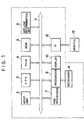
- Fig. 1 is a schematic block diagram of a character recognition apparatus embodying the present invention, common to all the embodiments.
- Fig. 1 there are shown the entire character recognition apparatus 1 of the present embodiment; an input unit 2, composed for example of a scanner, for reading a text image and generating digital original image data; a central processing unit (CPU) 3 for controlling the entire apparatus; a ROM 4 storing a control program for the CPU 3 corresponding to flow charts to be explained later and other various data; and a memory (RAM) 5 used as a work area of the CPU 3 and also having an area for storing the text image data entered from the input unit 2.
- CPU central processing unit
- ROM 4 storing a control program for the CPU 3 corresponding to flow charts to be explained later and other various data
- RAM memory
- a character row determination unit 6 for determining the direction of row of characters in the text image stored in the memory 5, namely whether said text is vertically or horizontally written, and extracting respective areas if vertical and horizontal writings are mixedly present as shown in Fig. 18; a pre-processing unit 7 for extracting the pattern of a character from the text image stored in the memory 5 and effecting variousnormalizations; a recognition unit 8 for extracting geometrical features from the pattern pre-processed by the pre-processing unit 7 and comparing said features with standard patterns stored in advance in a dictionary 9 for recognition; a display unit 10 for displaying, for example, the result of recognition on the input text image; a system bus 11 including a data bus, an address bus, a control signal bus etc. from the CPU 3; and an interface unit 12 for interface control with an external output unit such as a printer 13.
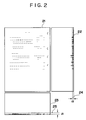
- Fig. 2 shows an example of text image entered into the character recognition apparatus of the present embodiment.
- Fig. 2 there are shown a text image 21 read by the input unit 2; a projection 22 of the text image 21 (count of black pixels) when it is scanned in the horizontal direction; a similar projection 23 of said text image 21 obtained by vertical scanning; and lines 24, 25 indicating a reference value ⁇ .
- the entered text image 21 is horizontally written, and it will be understood that the number of lines in which the count of black pixels exceeds the reference value ⁇ is larger in the horizontal direction than in the vertical direction.
- Fig. 3 is a flow chart of the control sequence of the CPU 3 in the present embodiment, and a corresponding control program is stored in the ROM 4.
- a step S0 reads a text image, set by the operator, by the input unit 2 (scanner), and stores it in the memory 5.
- the character line determination unit 6 discriminates whether the text image stored in the memory 5 is horizontally or vertically written, by calculating the projections (counts of black pixels) of said text image in the horizontal and vertical directions, then determining the ratio of number of lines in which said pixel count exceeds the reference value ⁇ to the total number of lines, and comparing said ratio for the horizontal direction with that for the vertical direction.
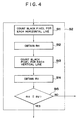
- Fig. 4 shows the details of said step S2 executed by the determination unit 6.
- a step S11 counts the number of black pixels for each horizontal line, and a step S12 determines the number of lines in which the obtained count is equal to or larger than the reference value ⁇ .
- This operation is conducted for all the horizontal lines (number TH) of the text image, and the number UH of lines in which the count is equal to or larger than the reference value a is determined.
- a step S13 counts the number of black pixels in each vertical line, and a step S14 discriminates whether the count is at least equal to the reference value ⁇ .
- This operation is conducted for all the vertical lines (numbber TV), and the number UV of lines in which the count is equal to or larger than the reference value ⁇ is determined.
- a step S15 compares the obtained ratio RH for the horizontal direction with that RV for the vertical direction. If a condition RH ⁇ RV is satisfied, the text image is identified as horizontally written.
- Said preprocessing for horizontal writing consists of character extraction by extracting a row of characters by taking a projection in the horizontal direction and extracting a character by taking a projection in the vertical direction on the extracted row(s) of characters, normalization of position, inclination, line width and density of the character, and noise elimination.
- a step S4 executes pre-processing for vertical writing in the pre-processing unit 7.
- Said pre-processing consists of character extraction by extracting a row of characters by taking a projection in the vertical direction and extracting a character by taking a projection in the horizontal direction on the extracted row(s) of characters, normalization of position, inclination, line width and density of the character, and noise elimination.
- step S5 the recognition unit 8 effects extraction of features such as contour line on each unknown character pattern pre-processed in the pre-processing unit 7.
- the dictionary 9 stores the features of standard patterns of all the characters to be identified. The feature of the unknown character pattern is matched with all the features of the standard patterns stored in the dictionary 9, and a character pattern of the highest probability is stored as the result of recognition in the memory 5. All the characters of the input text image are similarly recognized and stored in the memory 5.
- a next step S6 displays the results of recognition, stored in the memory 5, on the display unit 10. An output process of characters by the printer 13 is omitted for the purpose of simplicity.
- this embodiment provides a character recognition apparatus which can adapt texts of horizontal and vertical writings and is therefore easily usable for the users.
- Fig. 5 shows the details of the step S2, in Fig. 3, for discriminating whether the text image is horizontally or vertically written.
- the order of sequence of the steps S11, S12 and the steps S13, S14 is inverted in comparison with the foregoing embodiment 1.1. More specifically, the embodiment 1.1 counts the black pixels at first in the horizontal direction and then in the vertical direction, whereas the present embodiment effects said counting at first in the vertical direction and then in the horizontal direction.
- the structure of the apparatus in the present embodiment is same as shown in Fig. 1.
- the present embodiment can provide same effects and advantages as in the foregoing embodiment 1.1.
- Fig. 6 is a flow chart of the present embodiment in which the counting of black pixels in the step S2 in the embodiment 1.1 is replaced by counting of white pixels.
- the structure of the character recognition apparatus and the control sequence other than said step S2 are identical to those of the embodiment 1.1, shown in Figs. 1 and 3.
- a step S31 counts the white pixels in each horizontal line, and a step S32 discriminates whether the obtained count is at least equal to the reference value ⁇ , then determines the number of lines in which the obtained count is at least equal to the reference value ⁇ over the entire input image, and calculates the ratio RH of the number of such lines to the entire number of lines.
- a step S33 counts the white pixels in each vertical line, and a step S34 discriminates whether the obtained count is at least equal to the reference value ⁇ , then determines the number of lines in which the obtained count is at least equal to the reference value ⁇ over the entire input image, and calculates the ratio RV of the number of such lines to the entire number of lines.
- a next step S35 compares RH and RV, and the text image is identified as horizontally written or vertically written, respectively if a condition RH ⁇ RV is satisfied or not.
- Fig. 7 is a flow chart of the present embodiment, in which the counting of black pixels in the step 2 of the embodiment 1.1 is replaced by counting of black pixels in plural lines. Also in this embodiment, the structure of the character recognition apparatus and the control sequence except for said step S2 are identical to those of the embodiment 1.1, shown in Figs. 1 and 3.
- a step S41 counts the black pixels in every plural lines, and a step S42 discriminates whether the obtained count is at least equal to a reference value ⁇ , then determines, in the entire input image, the number of lines in which the obtained count is at least equal to said reference value ⁇ , and calculates the ratio RH of the number of such line to the entire number of lines.
- a step S43 similarly effects counting of black pixels in the vertical direction and a step S44 determines the ratio RV of the number of lines in which the count is at least equal to the reference value ⁇ to the entire number of lines.
- a next step S45 compares thus determined RH and RV, and the text image is identified as horizontally written or vertically written, respectively if a condition RH ⁇ RV is satisfied or not.
- the above-explained embodiment 1.3 can provide similar effects and advantages as those in the embodiment 1.1 even when the sequence of horizontal counting and vertical counting is interchanged as in the embodiment 1.2.
- the configuration of the character recognition apparatus and the control sequence remain same as those of the embodiment 1.1, shown in Figs. 1 and 3, and the only difference lies in the step S2 shown in Fig. 6, in which the steps are executed in the order of S33, S34, S31 and S32.
- the above-explained embodiment 1.3 can provide similar effects and advantages as those in the embodiment 1.1, even when the counting for each line is replaced by counting of plural lines as the foregoing embodiment 1.4.
- the configuration of the character recognition apparatus and the control sequence remain same as those of the embodiment 1.1 shown in Figs. 1 and 3, and the only difference lies in the step S2 in Fig. 6, in which the steps S31 and S33 execute counting on plural lines at a time instead of a line.
- the above-explained embodiment 1.4 can also provide similar effects and advantages to those of the embodiment 1.1, even when the sequence of horizontal counting and vertical counting is interchanged as in the embodiment 1.2.
- the configuration of the character recognition apparatus and the control sequence remain same as those of the embodiment 1.1 shown in Figs. 1 and 3, and the only difference lies in the step S2 shown in Fig. 7, in which the steps are executed in the order of S43, S44, S41 and S42.
- the condition "the count of black pixels equal to or larger than the reference value ⁇ " may be replaced by "the count of black pixels equal to or less than the reference value ⁇ ".
- the configuration of the character recognition apparatus and the control sequence except for the step S2 are same as those of the embodiment 1.1 shown in Figs. 1 and 3.
- Fig. 8 shows the details of the step S2 of the control sequence in the present embodiment.
- a step S51 counts the black pixeLs in each horizontal line, and discriminates whether the obtained count is not in excess of a reference value ⁇ . Then a step S52 counts, in the entire input image, the number of lines in which the count is not in excess of the reference value ⁇ , and calculates the ratio RH of the number of such lines to the entire number of horizontal lines.
- step S53 counts the black pixels in each vertical lines
- step S54 discriminates whether the obtained count is not in excess of the reference value ⁇ , counts the number of lines in which the count is not in excess of the reference value ⁇ , and calculates the ratio RV of such lines.
- step S55 compares RH with RV, and identifies the text image as horizontally or vertically written, respectively if a condition RH ⁇ RV is satisfied or not.
- these embodiments are capable of automatically identifying the direction of row of characters in a text, thereby determining whether the text image is written horizontally or vertically. Consequently, in the character recognition by reading a text image, the operator is no longer required to enter whether the text is horizontally or vertically written, and the operation of character recognition is therefore improved.
- reference values ⁇ , ⁇ are employed respectively in the horizontal and vertical directions as shown in Fig. 9, instead of the single reference value a in the embodiment 1.1 shown in Fig. 2.
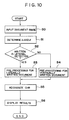
- the reference values ⁇ , ⁇ are determined in the step S1 in the following manner.
- the use of the height and width of the designated area of the text image enables exact identification of vertical or horizontal wiring, without being influenced by the vertical-to-horizontal ratio of the designated area.
- Fig. 9 shows an example of identifying the horizontal or vertical writing in the entire area of the text image.
- the reference values ⁇ , ⁇ determined in said step S1 may be employed similarly in the embodiments 1.1 to 1.8 shown in Figs. 4 to 8.
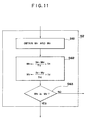
- Fig. 11 shows the details of the step S2 shown in Fig. 3, for identifying whether the text image is horizontally or vertically written.
- a step S61 determines the maximum values M H , M V of black pixels respectively in the horizontal and vertical directions, and corrects said maximum values with the horizontal line number TH, vertical line number VH and correction coefficients as indicated in Fig. 11.
- a next step S63 compares thus corrected maximum values of the black pixels in the horizontal and vertical directions, and the text image is identified as horizontally or vertically written respectively if the maximum value in the horizontal direction is larger or smaller than that in the vertical direction.
- the configuration of the image processing, apparatus in the present embodiment is same as that shown in Fig. 1.
- Fig. 12 shows the details of the step S2, shown in Fig. 3, for discriminating whether the text image is horizontally or vertically written.
- a step S71 extracts a rectangular area according to a histogram in the horizontal direction (Fig. 13), then prepares a histogram in the vertical direction in said extracted area, and extracts one or plural rectangular areas (Fig. 14).
- Fig. 14 shows only the rectangular areas extracted from the first row.
- a step S72 extracts a rectangular area according to a histogram in the vertical direction (Fig. 15), prepares a histogram in the horizontal direction in said extracted area, and extracts one or plural rectangular areas (Fig. 16).
- a next step S73 recognizes the rectangles extracted in the steps S71, S72, and a step S74 determines whether the text image is horizontally or vertically written, according to the level or similarity of said extracted rectangles.
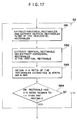
- Fig. 17 shows the details of the step S2, shown in Fig. 3, for determining whether the text image is horizontally or vertically written.
- a step S81 extracts a rectangle according to the histogram in the horizontal direction (Fig. 13), then prepares a histogram in the vertical direction, in said rectangle, and extracts one or plural rectangles (Fig. 14).
- Fig. 14 only shows the rectangles extracted from the first row.
- a step S82 extracts a rectangle according to the histogram in the vertical direction (Fig. 15), then prepares a histogram in the horizontal direction, and extracts one or plural rectangles (Fig. 16).
- a next step S83 calculates the vertical-to-horizontal (V-H) ratio of the rectangles extracted in the steps S81 and S82.
- the V-H ratio is apparently closer to 1:1 in the rectangle extracted in the step S81.
- a next step S84 identifies the text image as horizontally or vertically written respectively if the V-H ratio closer to 1:1 is obtained in the step S81 or not.
- Fig. 18 shows an example of the input text image, to the character recognition apparatus, including vertically and horizontally written areas in mixed manner.
- Fig. 18 there are shown a text image 31 read by the input unit 2; a projection 32 of said text image (counts of black pixels) obtained by scanning said text image in the horizontal direction; a projection 33 of said text image obtained by scanning in the vertical direction; lines 34, 35 respectively corresponding to reference values ⁇ , ⁇ ; horizontally written areas 36, 42 identified by the character row/area determination unit; a vertically written area 37; characters 38 - 40 in said areas; and an area 41 identified as free of characters.
- the input text image 31 contains both the horizontally and vertically written texts.
- Fig. 19 is a flow chart of the control sequence executed by the CPU 3 in the present embodiment, and a corresponding control program is stored in the ROM 4.
- a step S100 enters a text image, set by the operator, through the input unit (scanner) 2 and stores said image in the memory 5.
- the character determination unit 6 extracts horizontally written areas and vertically written areas from the text image stored in the memory 5, by determining projections (counts of black pixels) in the horizontal and vertical directions on the text image stored in the memory 5 and comparing the numbers of lines in which said count is at least equal to the reference value ⁇ or ⁇ .
- Fig. 20 shows the details of said step S101 executed by the character row determination unit 6.
- a step S111 counts the black pixels in each line, and determines an area or areas in which the obtained count is at least equal to the reference value ⁇ . In the example shown in Fig. 18, such an area is indicated by 36.
- a next step S112 similarly determines an area or areas in the vertical direction. In Fig. 18, such areas are indicated by 36, 37.
- a step S113 determines the horizontally written areas and vertically written areas in the text image.
- the steps S111 and S112 classify the text image into areas of following four categories shown in Fig. 21:
- Area A where the count is at least equal to the reference value both in the horizontal and vertical directions;
- histograms are prepared again in said area, and the area is identified as horizontally or vertically written respectively if the maximum value of the histogram minus the reference value is larger in the horizontal direction or in the vertical direction.
- Area B where the count is at least equal to the reference value only in the horizontal direction;
- Such area is identified as horizontally written.
- the area 36 in Fig. 18 is identified as horizontally written. Since the areas 36 and 42 are mutually adjacent and have the same writing direction, the two areas are combined as an area.
- Area D where the count is less than the reference value both in the horizontal and vertical directions;
- Histograms are again prepared in such area in the horizontal and vertical directions, and the area is identified as horizontally or vertically written respectively if the maximum value of the histogram minus the reference value is larger in the horizontal or vertical direction.
- a zero histogram indicates absence of characters in the area, as in case of the area 41 in Fig. 18.
- the above-mentioned reference value are corrected by the width and height of the text image.
- a step S114 determines the order of sequence of recognition of such areas, for example from above to bottom according to the magnitude of coordinate value.
- the sequence proceeds to a step S103 in which the pre-processing unit 7 effects pre-processing for horizontal writing, including character extraction by taking horizontal projection to extract a character row and then taking vertical projection on the extracted row or rows; normalizations on the position, inclination and density of character; and noise elimination.
- step S104 the pre-processing unit 7 executes pre-processing for vertical writing, including character extraction by taking vertical projection to extract a character row and then taking horizontal projection on thus extracted row or rows; normalizations on the position, inclination and density of character; and noise elimination.
- the recognition unit 8 extracts features, such as contours, from the unknown character pattern pre-processed in the pre-processing unit 7.
- the dictionary 9 store features of the standard patterns of all the characters to be recognized. The feature of said unknown character pattern is matched with the features of the standard patterns stored in the dictionary 9, and the most probable character is stored as the result of recognition in the memory 5, and all the characters in the input text image are similarly recognized and stored in the memory 5.
- step S106 the sequence proceeds to a step S106, and returns to the step S102 if any unrecognized area still exists, or proceeds to a step S107 if all the areas have been recognized.
- step S107 displays the results of recognition, stored in the memory 5, on the display unit 10. The process of output of characters by the printer 13 will be omitted from the description.
- the present embodiment provides a character recognition apparatus adaptable to any text that is horizontally or vertically written or contains both writings.
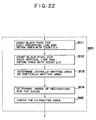
- Fig. 22 shows the details of the step S101 in the present embodiment.
- Steps S111 ⁇ S114 determine the horizontally and vertically written areas in the same manner as in the embodiment 4.1. Then a step S115 determines the property (vertical or horizontal writing) of the extracted areas and the order of recognition thereof, through request to and confirmation by the operator.
Landscapes
- Engineering & Computer Science (AREA)
- Computer Vision & Pattern Recognition (AREA)
- Physics & Mathematics (AREA)
- General Physics & Mathematics (AREA)
- Multimedia (AREA)
- Theoretical Computer Science (AREA)
- Character Input (AREA)
Applications Claiming Priority (4)
| Application Number | Priority Date | Filing Date | Title |
|---|---|---|---|
| JP205229/90 | 1990-08-03 | ||
| JP2205229A JPH0490083A (ja) | 1990-08-03 | 1990-08-03 | 文字認識装置 |
| JP03190238A JP3135290B2 (ja) | 1991-07-30 | 1991-07-30 | 画像処理方法及び装置 |
| JP190238/91 | 1991-07-30 |
Publications (3)
| Publication Number | Publication Date |
|---|---|
| EP0472313A2 true EP0472313A2 (de) | 1992-02-26 |
| EP0472313A3 EP0472313A3 (en) | 1993-08-11 |
| EP0472313B1 EP0472313B1 (de) | 1998-11-11 |
Family
ID=26505955
Family Applications (1)
| Application Number | Title | Priority Date | Filing Date |
|---|---|---|---|
| EP91307105A Expired - Lifetime EP0472313B1 (de) | 1990-08-03 | 1991-08-02 | Gerät und Verfahren zur Bildverarbeitung |
Country Status (3)
| Country | Link |
|---|---|
| US (1) | US5696841A (de) |
| EP (1) | EP0472313B1 (de) |
| DE (1) | DE69130469T2 (de) |
Cited By (5)
| Publication number | Priority date | Publication date | Assignee | Title |
|---|---|---|---|---|
| US5588072A (en) * | 1993-12-22 | 1996-12-24 | Canon Kabushiki Kaisha | Method and apparatus for selecting blocks of image data from image data having both horizontally- and vertically-oriented blocks |
| EP0843275A3 (de) * | 1996-11-13 | 1999-08-11 | Nec Corporation | Gerät und Verfahren zum Extrahieren von Mustern |
| EP1439486A1 (de) * | 2002-11-22 | 2004-07-21 | Océ-Technologies B.V. | Segmentierung eines Bildes mittels eines Graphen |
| EP1439484A1 (de) * | 2002-11-22 | 2004-07-21 | Océ-Technologies B.V. | Segmentierung eines Bildes mittels kürzester Zyklen |
| US7529407B2 (en) | 2002-11-22 | 2009-05-05 | Oce-Technologies B.V. | Segmenting an image via shortest cycles |
Families Citing this family (24)
| Publication number | Priority date | Publication date | Assignee | Title |
|---|---|---|---|---|
| JPH0951422A (ja) * | 1995-08-09 | 1997-02-18 | Minolta Co Ltd | 画像編集装置 |
| JP3720502B2 (ja) * | 1996-12-26 | 2005-11-30 | キヤノン株式会社 | 画像処理装置及び該装置における画像処理方法、並びにコンピュータ読み取り可能な記憶媒体 |
| US6023534A (en) * | 1997-08-04 | 2000-02-08 | Xerox Corporation | Method of extracting image data from an area generated with a halftone pattern |
| JP3472094B2 (ja) * | 1997-08-21 | 2003-12-02 | シャープ株式会社 | 領域判定装置 |
| JP4170441B2 (ja) * | 1997-11-28 | 2008-10-22 | 富士通株式会社 | 文書画像傾き検出装置および文書画像傾き検出プログラムの記憶媒体 |
| US6151423A (en) * | 1998-03-04 | 2000-11-21 | Canon Kabushiki Kaisha | Character recognition with document orientation determination |
| JP3795238B2 (ja) * | 1998-10-01 | 2006-07-12 | シャープ株式会社 | 文書画像処理装置及び文書画像処理方法 |
| US6970894B2 (en) * | 1998-12-30 | 2005-11-29 | Intel Corporation | Method for extracting information from a file using a printer driver |
| JP4323606B2 (ja) * | 1999-03-01 | 2009-09-02 | 理想科学工業株式会社 | 文書画像傾き検出装置 |
| US8311946B1 (en) | 1999-10-15 | 2012-11-13 | Ebrary | Method and apparatus for improved information transactions |
| US20040148274A1 (en) * | 1999-10-15 | 2004-07-29 | Warnock Christopher M. | Method and apparatus for improved information transactions |
| US7536561B2 (en) * | 1999-10-15 | 2009-05-19 | Ebrary, Inc. | Method and apparatus for improved information transactions |
| KR100315428B1 (ko) * | 1999-12-24 | 2001-11-26 | 오길록 | 다국어 인쇄체 문서인식을 위한 문자 특징 추출 장치 및그 방법 |
| US7034849B1 (en) * | 2001-12-31 | 2006-04-25 | Apple Computer, Inc. | Method and apparatus for image blending |
| US7840564B2 (en) | 2005-02-16 | 2010-11-23 | Ebrary | System and method for automatic anthology creation using document aspects |
| US20060239555A1 (en) * | 2005-04-25 | 2006-10-26 | Destiny Technology Corporation | System and method for differentiating pictures and texts |
| US7433869B2 (en) * | 2005-07-01 | 2008-10-07 | Ebrary, Inc. | Method and apparatus for document clustering and document sketching |
| US9002096B2 (en) * | 2009-01-06 | 2015-04-07 | Siemens Healthcare Diagnostics Inc. | Method and apparatus for determining a liquid level in a container using imaging |
| KR101035739B1 (ko) * | 2009-02-13 | 2011-05-20 | 전남대학교산학협력단 | 문자 인식의 왜곡을 보정하는 방법 |
| US9569679B1 (en) * | 2012-12-04 | 2017-02-14 | A9.Com, Inc. | Adaptive image sampling for text detection |
| US10607381B2 (en) | 2014-07-07 | 2020-03-31 | Canon Kabushiki Kaisha | Information processing apparatus |
| JP6938318B2 (ja) | 2017-10-03 | 2021-09-22 | キヤノン株式会社 | 情報処理装置、情報処理方法及びプログラム |
| US11042735B2 (en) * | 2018-09-25 | 2021-06-22 | Drägerwerk AG & Co. KGaA | System and method for verifying whether text will be properly rendered in a target area of a user interface and/or a graphics file |
| CN113505745B (zh) * | 2021-07-27 | 2024-04-05 | 京东科技控股股份有限公司 | 一种文字识别方法、装置、电子设备及存储介质 |
Family Cites Families (8)
| Publication number | Priority date | Publication date | Assignee | Title |
|---|---|---|---|---|
| EP0020897B1 (de) * | 1979-06-26 | 1983-11-16 | International Business Machines Corporation | Vorrichtung zur Bestimmung des optimalen Abtastwinkels von Druckschriften |
| JPS62200486A (ja) * | 1986-02-28 | 1987-09-04 | Toshiba Corp | 文字読取装置 |
| US4827529A (en) * | 1987-04-14 | 1989-05-02 | Nippon Sheet Glass Co., Ltd. | Lines and characters separation apparatus |
| US4817169A (en) * | 1987-04-14 | 1989-03-28 | Nippon Sheet Glass Co., Ltd. | Page segmentor |
| US5001766A (en) * | 1988-05-16 | 1991-03-19 | At&T Bell Laboratories | Apparatus and method for skew control of document images |
| US5073949A (en) * | 1989-03-16 | 1991-12-17 | Kabushiki Kaisha Toshiba | Personal verification apparatus |
| US5191438A (en) * | 1989-12-12 | 1993-03-02 | Sharp Kabushiki Kaisha | Facsimile device with skew correction and text line direction detection |
| JPH03290774A (ja) * | 1990-04-06 | 1991-12-20 | Fuji Facom Corp | 文書画像の文章領域抽出装置 |
-
1991
- 1991-08-02 EP EP91307105A patent/EP0472313B1/de not_active Expired - Lifetime
- 1991-08-02 DE DE69130469T patent/DE69130469T2/de not_active Expired - Lifetime
-
1993
- 1993-10-12 US US08/135,129 patent/US5696841A/en not_active Expired - Lifetime
Cited By (8)
| Publication number | Priority date | Publication date | Assignee | Title |
|---|---|---|---|---|
| US5588072A (en) * | 1993-12-22 | 1996-12-24 | Canon Kabushiki Kaisha | Method and apparatus for selecting blocks of image data from image data having both horizontally- and vertically-oriented blocks |
| US5854853A (en) * | 1993-12-22 | 1998-12-29 | Canon Kabushika Kaisha | Method and apparatus for selecting blocks of image data from image data having both horizontally- and vertically-oriented blocks |
| EP0843275A3 (de) * | 1996-11-13 | 1999-08-11 | Nec Corporation | Gerät und Verfahren zum Extrahieren von Mustern |
| US6327384B1 (en) | 1996-11-13 | 2001-12-04 | Nec Corporation | Character recognition apparatus and method for recognizing characters |
| EP1439486A1 (de) * | 2002-11-22 | 2004-07-21 | Océ-Technologies B.V. | Segmentierung eines Bildes mittels eines Graphen |
| EP1439484A1 (de) * | 2002-11-22 | 2004-07-21 | Océ-Technologies B.V. | Segmentierung eines Bildes mittels kürzester Zyklen |
| US7529407B2 (en) | 2002-11-22 | 2009-05-05 | Oce-Technologies B.V. | Segmenting an image via shortest cycles |
| US7570811B2 (en) | 2002-11-22 | 2009-08-04 | Oce Technologies B.V. | Segmenting an image via a graph |
Also Published As
| Publication number | Publication date |
|---|---|
| DE69130469D1 (de) | 1998-12-17 |
| US5696841A (en) | 1997-12-09 |
| DE69130469T2 (de) | 1999-05-06 |
| EP0472313B1 (de) | 1998-11-11 |
| EP0472313A3 (en) | 1993-08-11 |
Similar Documents
| Publication | Publication Date | Title |
|---|---|---|
| EP0472313A2 (de) | Gerät und Verfahren zur Bildverarbeitung | |
| US5764799A (en) | OCR method and apparatus using image equivalents | |
| US6151423A (en) | Character recognition with document orientation determination | |
| US5889897A (en) | Methodology for OCR error checking through text image regeneration | |
| US5761344A (en) | Image pre-processor for character recognition system | |
| EP0677817B1 (de) | System zur Seitensegmentierung und Zeichenerkennung | |
| KR100247970B1 (ko) | 문서 영상의 방향 교정방법 | |
| EP0660256A2 (de) | Verfahren und Gerät zur Auswahl von Text und/oder Non-Text-Blöcken in einem gespeicherten Dokument | |
| US5650799A (en) | Programmable function keys for a networked imaging computer system | |
| EP0266140A2 (de) | Optische Buchstabenerkennung durch Bilden und Auswerten von Matrizen geographischer Merkmale | |
| GB2301470A (en) | Hand-written character recognition in facsimile apparatus | |
| EP0482187A1 (de) | Zeilenweise segmentierung und schwellenwertbestimmung für optische zeichenerkennung (system und verfahren) | |
| US7149352B2 (en) | Image processing device, program product and system | |
| EP0809205A2 (de) | Gerät und Verfahren zur Ermitlung der Zeichenlinie mittels vereinfachter Projektionsinformation; Zeichenerkennungsgerät und Verfahren | |
| US20010043742A1 (en) | Communication document detector | |
| JP2644041B2 (ja) | 文字認識装置 | |
| JP3086653B2 (ja) | 文字認識方法及び文字認識装置 | |
| JP3135290B2 (ja) | 画像処理方法及び装置 | |
| JPH0490083A (ja) | 文字認識装置 | |
| JP3090928B2 (ja) | 文字認識装置 | |
| JP3384634B2 (ja) | 文字種識別方法 | |
| JP3276554B2 (ja) | フォーマット認識装置及び文字読取り装置 | |
| JP3606218B2 (ja) | 文書分類装置、文字読み取り装置及び真贋判定装置、並びにこれらの方法 | |
| JP2616995B2 (ja) | 文字認識装置 | |
| JPH0259502B2 (de) |
Legal Events
| Date | Code | Title | Description |
|---|---|---|---|
| PUAI | Public reference made under article 153(3) epc to a published international application that has entered the european phase |
Free format text: ORIGINAL CODE: 0009012 |
|
| AK | Designated contracting states |
Kind code of ref document: A2 Designated state(s): DE FR GB |
|
| PUAL | Search report despatched |
Free format text: ORIGINAL CODE: 0009013 |
|
| AK | Designated contracting states |
Kind code of ref document: A3 Designated state(s): DE FR GB |
|
| 17P | Request for examination filed |
Effective date: 19931223 |
|
| 17Q | First examination report despatched |
Effective date: 19950404 |
|
| GRAG | Despatch of communication of intention to grant |
Free format text: ORIGINAL CODE: EPIDOS AGRA |
|
| GRAG | Despatch of communication of intention to grant |
Free format text: ORIGINAL CODE: EPIDOS AGRA |
|
| GRAH | Despatch of communication of intention to grant a patent |
Free format text: ORIGINAL CODE: EPIDOS IGRA |
|
| GRAH | Despatch of communication of intention to grant a patent |
Free format text: ORIGINAL CODE: EPIDOS IGRA |
|
| GRAA | (expected) grant |
Free format text: ORIGINAL CODE: 0009210 |
|
| AK | Designated contracting states |
Kind code of ref document: B1 Designated state(s): DE FR GB |
|
| REF | Corresponds to: |
Ref document number: 69130469 Country of ref document: DE Date of ref document: 19981217 |
|
| ET | Fr: translation filed | ||
| PLBE | No opposition filed within time limit |
Free format text: ORIGINAL CODE: 0009261 |
|
| STAA | Information on the status of an ep patent application or granted ep patent |
Free format text: STATUS: NO OPPOSITION FILED WITHIN TIME LIMIT |
|
| 26N | No opposition filed | ||
| REG | Reference to a national code |
Ref country code: GB Ref legal event code: IF02 |
|
| PGFP | Annual fee paid to national office [announced via postgrant information from national office to epo] |
Ref country code: FR Payment date: 20090821 Year of fee payment: 19 |
|
| PGFP | Annual fee paid to national office [announced via postgrant information from national office to epo] |
Ref country code: DE Payment date: 20090831 Year of fee payment: 19 Ref country code: GB Payment date: 20090827 Year of fee payment: 19 |
|
| GBPC | Gb: european patent ceased through non-payment of renewal fee |
Effective date: 20100802 |
|
| REG | Reference to a national code |
Ref country code: FR Ref legal event code: ST Effective date: 20110502 |
|
| REG | Reference to a national code |
Ref country code: DE Ref legal event code: R119 Ref document number: 69130469 Country of ref document: DE Effective date: 20110301 |
|
| PG25 | Lapsed in a contracting state [announced via postgrant information from national office to epo] |
Ref country code: FR Free format text: LAPSE BECAUSE OF NON-PAYMENT OF DUE FEES Effective date: 20100831 Ref country code: DE Free format text: LAPSE BECAUSE OF NON-PAYMENT OF DUE FEES Effective date: 20110301 |
|
| PG25 | Lapsed in a contracting state [announced via postgrant information from national office to epo] |
Ref country code: GB Free format text: LAPSE BECAUSE OF NON-PAYMENT OF DUE FEES Effective date: 20100802 |